

Optimize Your Job Search

Specific actions you should be taking
              to get hired
Hiring process
Then                      Now
• Print and mail          • Online/email
• ‘Gut feel’              • ATS
                          • Phone interview
                          • In Person interview
                          • Assessment Centers
                          • Psychological tests
                            (aptitude)
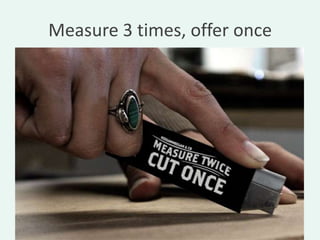
Measure 3 times, offer once
Measurement Before the Posting
• Job Analysis

• Competency model

• Job Description
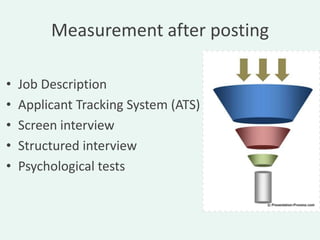
Measurement after posting

•   Job Description
•   Applicant Tracking System (ATS)
•   Screen interview
•   Structured interview
•   Psychological tests
Applicant Tracking Systems (ATS)
Handle job applications and to manage resume
 data

• Work like search engines
• Keywords affect resume ranking
• Value of character
  – PivotTable, pivot-table, pivot table
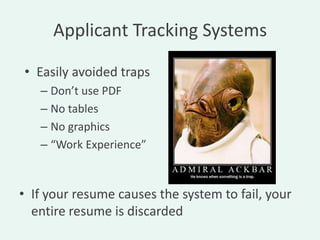
Applicant Tracking Systems

• Easily avoided traps
   – Don’t use PDF
   – No tables
   – No graphics
   – “Work Experience”


• If your resume causes the system to fail, your
  entire resume is discarded
Resumes (& cover letters)
Resume Strategy
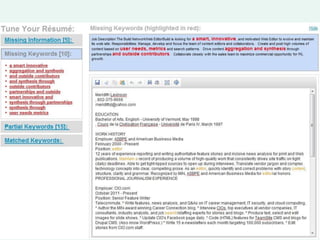
1. Identify keywords
2. Create overstuffed resume.
3. Save it as your base
4. Eliminate/Converge bullets to fit job
   description
5. Tailor specifics from job description
6. Formatting
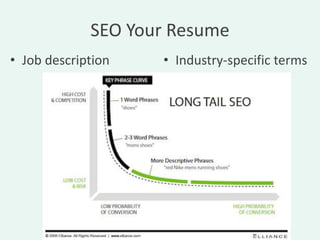
SEO Your Resume
• Job description   • Industry-specific terms
Bullets
Verb | Obj Modifier | Object |Statement Mod

Active verbs
Modifiers help add context
6 seconds
• Time required for recruiters to determine fit/no fit
• Recruiters will look at :
  – Your name
  – Current title and company
  – Current position start and end dates
  – Previous title and company
  – Previous position start and end dates
  – Education
Heat map
Resume Red Flags

• Changing jobs too often
• Lack of bullet points/too many
  paragraphs
• Lack of numbers
• Lack of specificity
• Not addressing resume flags in
  cover letter
Cover letters
•   Rarely read
•   Closing
•   Direct AND personality
•   Proofread, Proofread, and proofread
•   Email: Don’t attach CL. Email IS the CL
•   Encourage the reader to look at resume
Linkedin

Online networking
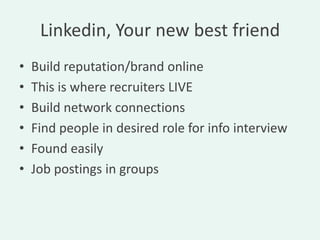
Linkedin, Your new best friend
•   Build reputation/brand online
•   This is where recruiters LIVE
•   Build network connections
•   Find people in desired role for info interview
•   Found easily
•   Job postings in groups
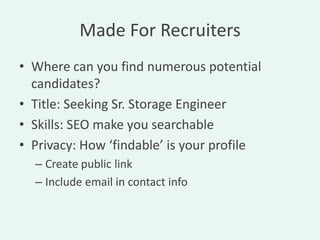
Made For Recruiters
• Where can you find numerous potential
  candidates?
• Title: Seeking Sr. Storage Engineer
• Skills: SEO make you searchable
• Privacy: How ‘findable’ is your profile
  – Create public link
  – Include email in contact info
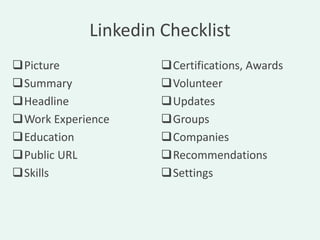
Linkedin Checklist
Picture             Certifications, Awards
Summary             Volunteer
Headline            Updates
Work Experience     Groups
Education           Companies
Public URL          Recommendations
Skills              Settings
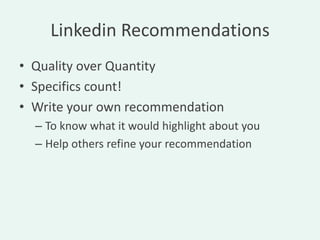
Linkedin Recommendations
• Quality over Quantity
• Specifics count!
• Write your own recommendation
  – To know what it would highlight about you
  – Help others refine your recommendation
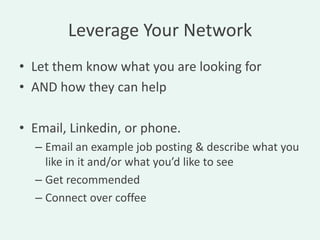
Leverage Your Network
• Let them know what you are looking for
• AND how they can help

• Email, Linkedin, or phone.
  – Email an example job posting & describe what you
    like in it and/or what you’d like to see
  – Get recommended
  – Connect over coffee
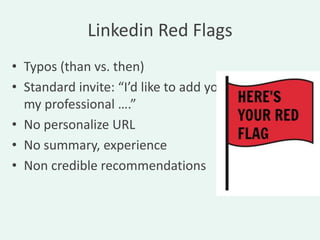
Linkedin Red Flags
• Typos (than vs. then)
• Standard invite: “I’d like to add you to
  my professional ….”
• No personalize URL
• No summary, experience
• Non credible recommendations
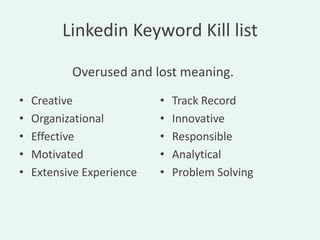
Linkedin Keyword Kill list

           Overused and lost meaning.
•   Creative               •   Track Record
•   Organizational         •   Innovative
•   Effective              •   Responsible
•   Motivated              •   Analytical
•   Extensive Experience   •   Problem Solving
The Final Hurdle!

           Interviewing
       Informational Interviews
            Phone interviews
Behaviorally-based structured interviews
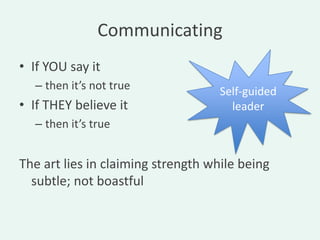
Communicating
• If YOU say it
  – then it’s not true              Self-guided
• If THEY believe it                  leader
  – then it’s true


The art lies in claiming strength while being
  subtle; not boastful
Primary Objective
• Intentionally talking about yourself
  – Demonstrating skill, problem solving
  – Without bragging, sounding arrogant
  – Assertive, but not overbearing
  – Relaxed but focused
Message map
• Create: twitter friendly headline
  – Overarching message.
• 3 supporting points:
  – Additional points under supporting points:
    examples, data, statistics
• Useful for creating elevator pitch
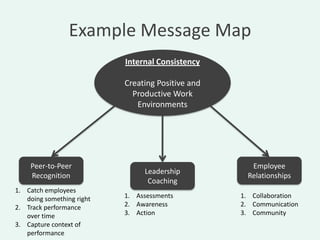
Example Message Map
                           Internal Consistency

                           Creating Positive and
                             Productive Work
                              Environments


    Peer-to-Peer                                      Employee
                                Leadership
    Recognition                                      Relationships
                                 Coaching
1. Catch employees
   doing something right   1. Assessments          1. Collaboration
2. Track performance       2. Awareness            2. Communication
   over time               3. Action               3. Community
3. Capture context of
   performance
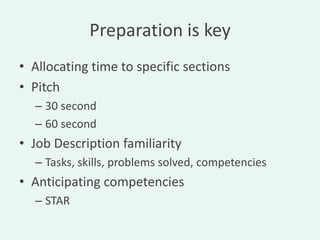
Preparation is key
• Allocating time to specific sections
• Pitch
  – 30 second
  – 60 second
• Job Description familiarity
  – Tasks, skills, problems solved, competencies
• Anticipating competencies
  – STAR
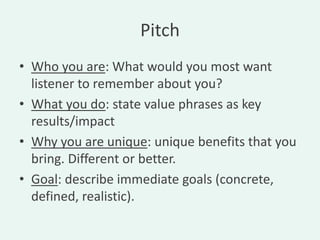
Pitch
• Who you are: What would you most want
  listener to remember about you?
• What you do: state value phrases as key
  results/impact
• Why you are unique: unique benefits that you
  bring. Different or better.
• Goal: describe immediate goals (concrete,
  defined, realistic).
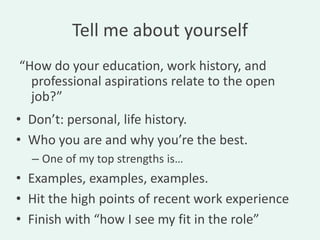
Tell me about yourself
“How do your education, work history, and
  professional aspirations relate to the open
  job?”
• Don’t: personal, life history.
• Who you are and why you’re the best.
  – One of my top strengths is…
• Examples, examples, examples.
• Hit the high points of recent work experience
• Finish with “how I see my fit in the role”
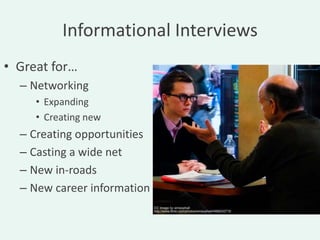
Informational Interviews
• Great for…
  – Networking
     • Expanding
     • Creating new
  – Creating opportunities
  – Casting a wide net
  – New in-roads
  – New career information
Informational Interviews
1. Other person is doing you a favor; follow
   their lead
2. Not about job leads; about learning
   something
3. Think as a way to build relationship, not leads
4. Be incredibly prepared with questions
5. Be the one to end it, not them. Do not
   overstay, bookend the follow-up.
Informational Interview Questions
1. Can you tell me how you got to this position?
2. What do you like most about what you do, and what would you change if you
   could?
3. What’s a typical day like for you?
4. What are some current projects or initiatives you are working on?
5. Where would you suggest a person investigate if the person were particularly skilled
   at _________?
6. What are some of the biggest challenges facing your company and/or your industry
   today?
7. Are there any groups, professional, or trade associations I should connect with?
8. What do you read — in print and online — to keep up with developments in your
   field?
9. If you were just getting involved now, where would you put yourself?
10.What can I do for you? How can I help you?
Phone Interview
1. Clarify details: Time zone, etc.
2. Copy: Resume, job description, paper to take
   notes
3. Dress the part: mental tactic
4. Environment: charged phone, water, ear buds,
   etc.
5. End game: Characteristics you want to
   portray.
6. Speak slowly & smile into the phone
Phone Interview Goal
• Build a relationship & rapport with
  interviewer.
  – Get to the face-to-face interview step
• Demonstrate capability of doing job.
• Demonstrate interest by asking about org &
  role.
• Minimum standards met and preferred skills
  as an offering
Next Hurdle
Behavior-based Interview
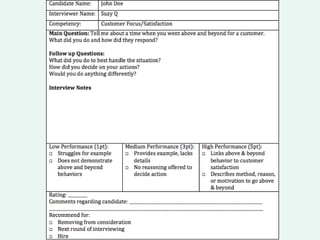
• Tell me about a time…
• Measuring a competency
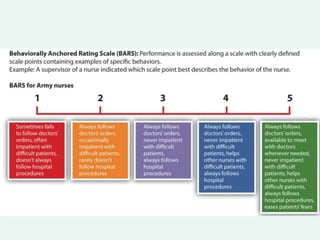
• BARS
  – Behaviorally
  – Anchored
  – Rating
  – Scale
Anticipate Questions
• Use the job description to anticipate questions
  or competencies
• What is essential?
• What will separate good from great?
• Examples, examples, examples
Interview Questions
• Describe a time when
   – Your work was criticized and how you handled it
   – Your workload was heavy and how you handled it
   – Had multiple deadlines and couldn’t finish them all
   – You had to conform to a policy which you did not
     agree
   – You went above and beyond the call of duty
• How have you handled a time when someone
  was not pulling their own weight
• How can you apply your specific skills to help the
  org
• Describe your workstyle
Interview Questions
• Tell me about…
  – A time when you disagreed with your boss about
    a way something should be done.
  – A time when you faced a difficult situation with a
    coworker
  – A time when you failed
  – A time when you had to give difficult feedback
  – A time you went against corporate directives
  – Your greatest success
Interview follow up
• Follow up thank you
  – Interviewer, receptionist/office manager
  – Remind them why you bring value
• 3 paragraph rule
  – Thank and iterate interest
  – Strengths and benefits of hiring you
  – Clarifications on questions. Keep it brief
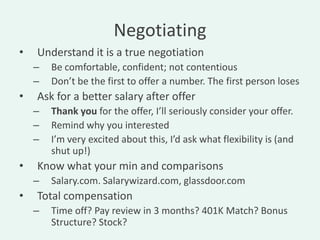
Negotiating
•   Understand it is a true negotiation
    –   Be comfortable, confident; not contentious
    –   Don’t be the first to offer a number. The first person loses
•   Ask for a better salary after offer
    –   Thank you for the offer, I’ll seriously consider your offer.
    –   Remind why you interested
    –   I’m very excited about this, I’d ask what flexibility is (and
        shut up!)
•   Know what your min and comparisons
    –   Salary.com. Salarywizard.com, glassdoor.com
•   Total compensation
    –   Time off? Pay review in 3 months? 401K Match? Bonus
        Structure? Stock?
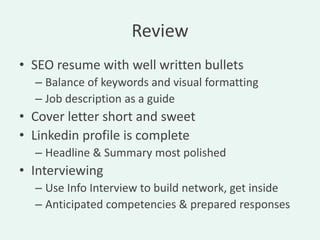
Review
• SEO resume with well written bullets
  – Balance of keywords and visual formatting
  – Job description as a guide
• Cover letter short and sweet
• Linkedin profile is complete
  – Headline & Summary most polished
• Interviewing
  – Use Info Interview to build network, get inside
  – Anticipated competencies & prepared responses
Contact:

        Josh Kuehler
Josh@internalconsistency.com
       888-481-4741

Optimize Your Job Search Workshop

  • 1.
    Optimize Your JobSearch Specific actions you should be taking to get hired
  • 2.
    Hiring process Then Now • Print and mail • Online/email • ‘Gut feel’ • ATS • Phone interview • In Person interview • Assessment Centers • Psychological tests (aptitude)
  • 3.
    Measure 3 times,offer once
  • 4.
    Measurement Before thePosting • Job Analysis • Competency model • Job Description
  • 5.
    Measurement after posting • Job Description • Applicant Tracking System (ATS) • Screen interview • Structured interview • Psychological tests
  • 6.
    Applicant Tracking Systems(ATS) Handle job applications and to manage resume data • Work like search engines • Keywords affect resume ranking • Value of character – PivotTable, pivot-table, pivot table
  • 7.
    Applicant Tracking Systems •Easily avoided traps – Don’t use PDF – No tables – No graphics – “Work Experience” • If your resume causes the system to fail, your entire resume is discarded
  • 8.
  • 9.
    Resume Strategy 1. Identifykeywords 2. Create overstuffed resume. 3. Save it as your base 4. Eliminate/Converge bullets to fit job description 5. Tailor specifics from job description 6. Formatting
  • 11.
    SEO Your Resume •Job description • Industry-specific terms
  • 12.
    Bullets Verb | ObjModifier | Object |Statement Mod Active verbs Modifiers help add context
  • 13.
    6 seconds • Timerequired for recruiters to determine fit/no fit • Recruiters will look at : – Your name – Current title and company – Current position start and end dates – Previous title and company – Previous position start and end dates – Education
  • 14.
  • 15.
    Resume Red Flags •Changing jobs too often • Lack of bullet points/too many paragraphs • Lack of numbers • Lack of specificity • Not addressing resume flags in cover letter
  • 16.
    Cover letters • Rarely read • Closing • Direct AND personality • Proofread, Proofread, and proofread • Email: Don’t attach CL. Email IS the CL • Encourage the reader to look at resume
  • 17.
  • 18.
    Linkedin, Your newbest friend • Build reputation/brand online • This is where recruiters LIVE • Build network connections • Find people in desired role for info interview • Found easily • Job postings in groups
  • 19.
    Made For Recruiters •Where can you find numerous potential candidates? • Title: Seeking Sr. Storage Engineer • Skills: SEO make you searchable • Privacy: How ‘findable’ is your profile – Create public link – Include email in contact info
  • 20.
    Linkedin Checklist Picture Certifications, Awards Summary Volunteer Headline Updates Work Experience Groups Education Companies Public URL Recommendations Skills Settings
  • 21.
    Linkedin Recommendations • Qualityover Quantity • Specifics count! • Write your own recommendation – To know what it would highlight about you – Help others refine your recommendation
  • 22.
    Leverage Your Network •Let them know what you are looking for • AND how they can help • Email, Linkedin, or phone. – Email an example job posting & describe what you like in it and/or what you’d like to see – Get recommended – Connect over coffee
  • 23.
    Linkedin Red Flags •Typos (than vs. then) • Standard invite: “I’d like to add you to my professional ….” • No personalize URL • No summary, experience • Non credible recommendations
  • 24.
    Linkedin Keyword Killlist Overused and lost meaning. • Creative • Track Record • Organizational • Innovative • Effective • Responsible • Motivated • Analytical • Extensive Experience • Problem Solving
  • 25.
    The Final Hurdle! Interviewing Informational Interviews Phone interviews Behaviorally-based structured interviews
  • 26.
    Communicating • If YOUsay it – then it’s not true Self-guided • If THEY believe it leader – then it’s true The art lies in claiming strength while being subtle; not boastful
  • 27.
    Primary Objective • Intentionallytalking about yourself – Demonstrating skill, problem solving – Without bragging, sounding arrogant – Assertive, but not overbearing – Relaxed but focused
  • 28.
    Message map • Create:twitter friendly headline – Overarching message. • 3 supporting points: – Additional points under supporting points: examples, data, statistics • Useful for creating elevator pitch
  • 29.
    Example Message Map Internal Consistency Creating Positive and Productive Work Environments Peer-to-Peer Employee Leadership Recognition Relationships Coaching 1. Catch employees doing something right 1. Assessments 1. Collaboration 2. Track performance 2. Awareness 2. Communication over time 3. Action 3. Community 3. Capture context of performance
  • 30.
    Preparation is key •Allocating time to specific sections • Pitch – 30 second – 60 second • Job Description familiarity – Tasks, skills, problems solved, competencies • Anticipating competencies – STAR
  • 31.
    Pitch • Who youare: What would you most want listener to remember about you? • What you do: state value phrases as key results/impact • Why you are unique: unique benefits that you bring. Different or better. • Goal: describe immediate goals (concrete, defined, realistic).
  • 32.
    Tell me aboutyourself “How do your education, work history, and professional aspirations relate to the open job?” • Don’t: personal, life history. • Who you are and why you’re the best. – One of my top strengths is… • Examples, examples, examples. • Hit the high points of recent work experience • Finish with “how I see my fit in the role”
  • 33.
    Informational Interviews • Greatfor… – Networking • Expanding • Creating new – Creating opportunities – Casting a wide net – New in-roads – New career information
  • 34.
    Informational Interviews 1. Otherperson is doing you a favor; follow their lead 2. Not about job leads; about learning something 3. Think as a way to build relationship, not leads 4. Be incredibly prepared with questions 5. Be the one to end it, not them. Do not overstay, bookend the follow-up.
  • 35.
    Informational Interview Questions 1.Can you tell me how you got to this position? 2. What do you like most about what you do, and what would you change if you could? 3. What’s a typical day like for you? 4. What are some current projects or initiatives you are working on? 5. Where would you suggest a person investigate if the person were particularly skilled at _________? 6. What are some of the biggest challenges facing your company and/or your industry today? 7. Are there any groups, professional, or trade associations I should connect with? 8. What do you read — in print and online — to keep up with developments in your field? 9. If you were just getting involved now, where would you put yourself? 10.What can I do for you? How can I help you?
  • 36.
    Phone Interview 1. Clarifydetails: Time zone, etc. 2. Copy: Resume, job description, paper to take notes 3. Dress the part: mental tactic 4. Environment: charged phone, water, ear buds, etc. 5. End game: Characteristics you want to portray. 6. Speak slowly & smile into the phone
  • 37.
    Phone Interview Goal •Build a relationship & rapport with interviewer. – Get to the face-to-face interview step • Demonstrate capability of doing job. • Demonstrate interest by asking about org & role. • Minimum standards met and preferred skills as an offering
  • 38.
  • 39.
    Behavior-based Interview • Tellme about a time… • Measuring a competency • BARS – Behaviorally – Anchored – Rating – Scale
  • 42.
    Anticipate Questions • Usethe job description to anticipate questions or competencies • What is essential? • What will separate good from great? • Examples, examples, examples
  • 43.
    Interview Questions • Describea time when – Your work was criticized and how you handled it – Your workload was heavy and how you handled it – Had multiple deadlines and couldn’t finish them all – You had to conform to a policy which you did not agree – You went above and beyond the call of duty • How have you handled a time when someone was not pulling their own weight • How can you apply your specific skills to help the org • Describe your workstyle
  • 44.
    Interview Questions • Tellme about… – A time when you disagreed with your boss about a way something should be done. – A time when you faced a difficult situation with a coworker – A time when you failed – A time when you had to give difficult feedback – A time you went against corporate directives – Your greatest success
  • 45.
    Interview follow up •Follow up thank you – Interviewer, receptionist/office manager – Remind them why you bring value • 3 paragraph rule – Thank and iterate interest – Strengths and benefits of hiring you – Clarifications on questions. Keep it brief
  • 46.
    Negotiating • Understand it is a true negotiation – Be comfortable, confident; not contentious – Don’t be the first to offer a number. The first person loses • Ask for a better salary after offer – Thank you for the offer, I’ll seriously consider your offer. – Remind why you interested – I’m very excited about this, I’d ask what flexibility is (and shut up!) • Know what your min and comparisons – Salary.com. Salarywizard.com, glassdoor.com • Total compensation – Time off? Pay review in 3 months? 401K Match? Bonus Structure? Stock?
  • 47.
    Review • SEO resumewith well written bullets – Balance of keywords and visual formatting – Job description as a guide • Cover letter short and sweet • Linkedin profile is complete – Headline & Summary most polished • Interviewing – Use Info Interview to build network, get inside – Anticipated competencies & prepared responses
  • 48.
    Contact: Josh Kuehler Josh@internalconsistency.com 888-481-4741

Editor's Notes

  • #2 It’s less and less about your skill or ability to DO THE ACTUAL JOB. Getting a job is a skill in itself. I’ve done a bunch of research directly related to this and indirectly by running a website. Today we are not fixing a resume or polishing a linkedin profile. We are learning a job search skill.
  • #3 Many differences between the processes. One similarity, a direct reference candidate will have the inside track. It isn’t a guarantee, but it is a great advantage.
  • #4 Measurement is everywhere – involved in every step.
  • #7 handle job applications and to manage resume dataSimplifies a recruiter’s jobAlgorithms give resumes a ranking.
  • #9 Error-prone applicant tracking systems kill 75 percent of job seekers' chances of landing an interview as soon as they submit their resumes, despite how qualified they may be. Job seekers' only hope for rising through these systems is to understand exactly how these systems work and how best to optimize their resumes for them.- CIO
  • #14 http://www.businessinsider.com/how-to-write-the-perfect-resume-2012-11#use-the-right-keywords-7http://articles.businessinsider.com/2012-04-09/news/31311078_1_recruiters-study-decision#ixzz2F1oeo6LYRead more: Tailor resume to reflect what employer is looking for
  • #15 Design focusedMatch recruiters’ mental modelSupport their scanning of:TitlesCompany namesEducationQuick bursts of infoLeft Align bold headingsTo stand out, conform on formatting
  • #16 Changing jobs too oftenTenure of 2 or less is eyebrow raisingLack of bullet points/too many paragraphsLack of numbersDollars, # of peopleLack of specificityAchievements, duties, etc lack credibilityNot addressing resume flags in cover letterShow avoidance of red flags vs embracing
  • #17 First & quick introductionEasy to skim yet get factsDear FnameContext: the particular jobYou want/I have (job requirementscapabilities)Objective measurement of achievement.Use of numbers and bullet points.“Why should I talk to you about this job?”
  • #19 This is where recruiters LIVEMonster, Careerbuilder are nice, but here is where the people looking for people areJob postings in groupsFind people in desired role for Info InterviewBuild reputation/brand online Google search & Linkedin searchVisibility: want candidate seekers to easily find you
  • #20  (if recruiters want to connect, they’ll be prompted for email)
  • #21  The Headline The headline is a bite-sized explanation of what you do and what your value is. Note that your headline shows up ALL OVER LinkedIn, especially in lists. Your headline very often accompanies your name. Make sure your headline is at least clear and concise. If you are building "brand you" consider making it more engaging. You could spend countless hours tweaking and refining this single 120 character field. Just try not to.Your SummaryUse this area in a similar way to a cover letter. Explain in (relatively) normal-speak what makes you unique or different, why someone might want to connect with you, and possibly few details about your products or services. Note that you cannot create clickable links in this area.30-90 minutes
  • #25 http://www.businessinsider.com/please-stop-using-these-15-words-in-your-linkedin-profile-immediately-2012-12
  • #32 http://www.alumni.hbs.edu/careers/pitch/Know who’s catching: Who’s the audience?What do they need to hearStay away from stock phrases: “customer focused”Preparation is key to confidence: What are the FAQ’s? Have answersSolve a problemPassion
  • #33 Answer the question, “Can we see this person in this job?”
  • #35 Different from job interviews in that:Informational interviews are generally easier to get.With an informational interview, you ask the questions and are in control.An informational interview is typically more relaxed for both parties.Informational interviewees may become part of your network, and may provide referrals.Informational interviewees may be less guarded in sharing information.
  • #37 End game: 3 characteristics you want to portray. Write it on the top of your notesClarify Details (ex. Time zone, caller, etc.)Have resume, job description, talking points, questions for interviewerLead with the body Prepare the environment (water, phone signal)Speak slow and clear (they are taking notes!)Use your hands to make it conversational
  • #44 How do you…Deal with difficult customersDeal with stressful situationsEvaluate successHandle stress and pressureRate yourself as a professionalEstablish credibility with the teamWhat motivates youWhat makes you uniqueWhat type of work environment do you preferWhat would your friends tell me about youWhat area do you need the most development Why do you believe you are the best fitWhat are your workplace valuesWhat did you like/dislike about previous jobsWhat do people most criticize about youWhat do you expect from a supervisorWhat do you wish you’d done betterWhat excites you about this positionWhat have you been doing since you got laid off/let goWhat is your least favorite managerial task
  • #47 http://www.youtube.com/watch?v=XY5SeCl_8NE