King saud university
          College of nursing


Types of Health Care
   Organizations
Prepared by: Dr. Fatmah Baddar
Outlines
 Introduction
 Classification of health care agencies:
   1- classification by length of stay
   2- classification by type of services
   3- classification by type of ownership
 Summary
 Hospital
  - Definition
  - Functions of the hospital
Types of Health Care Organizations
• An understanding of the various health care agencies
  and their services could help the nurse manager to
  perform and assume his/her role effectively.

• Health care agency is considered as a setting for
  providing health care services (e.g. curative,
  preventive, and/or educational) to the society

•    Whether in clinics; homes; ambulatory care settings;
    and hospitals.
Types of Health Care Organizations

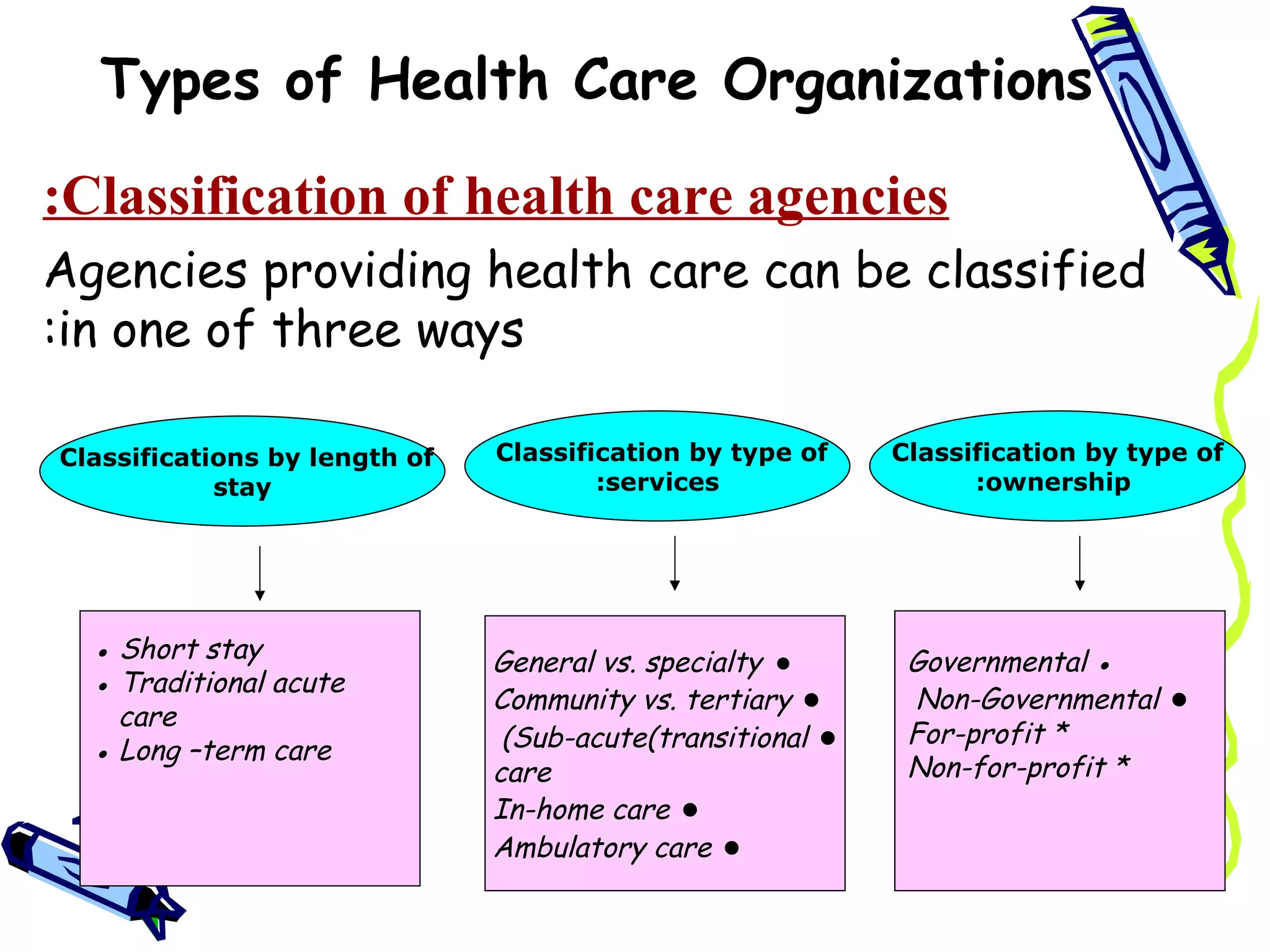
:Classification of health care agencies
Agencies providing health care can be classified
:in one of three ways

Classifications by length of   Classification by type of    Classification by type of
            stay                       :services                  :ownership


  ● Short stay                 General vs. specialty ●       Governmental ●
  ● Traditional acute
                               Community vs. tertiary ●      Non-Governmental ●
    care
                                (Sub-acute(transitional ●    For-profit *
  ● Long –term care
                               care                          Non-for-profit *
                               In-home care ●
                               Ambulatory care ●
Types of Health Care Organizations

  Classification according to length of
                         stay:
1) Sort-stay facilities:
● Which provide services to patients/clients
                            who are suffering
 from acute conditions that require less than 24
 hrs of care.

● Short stay may take place in separate units in a
  hospital, or in short –stay centers.
Types of Health Care Organizations

:Traditional acute care (2
.It takes place in the hospital ●
It includes patients staying more than 24 hrs but fewer ●
.than 30 days

: Long term care (3
        Which include those agencies that offering ●
services to patients with major rehabilitation  needs,
.chronic diseases, functional losses, or   mental illness
             The average length of stay extends from ●
  .several months to years
Types of Health Care Organizations


     Classification by type of service:

:General hospital (1
 Which offers medical, surgical. Obstetric, ●
        emergency, and diagnostic as well as
 . laboratory services
Types of Health Care Organizations

:Specialty hospital (2
   Which offers only a particular type of care. ●
:   such as
psychiatric hospitals -
women's hospitals -
  children's hospitals -

  Specialty hospitals tend to be less common ●
 than general hospitals
Types of Health Care Organizations


  :Community hospital (3
  Which provides those services ●
  provided in the general hospital but
  .for specific community
Types of Health Care Organizations
:Tertiary hospital (4
  Which are serving asreferral        centers for●
.    clients with complex or unusual problems
They have the facilities for specialized types of●
          care such as burn centers, bone marrow
      transplant centers, as well as resources for
.   general care
They serve a wide geographic area in addition to●
. their own community
   Usually associated with a university or●
        .     are a part of a large medical center
Types of Health Care Organizations

:(Sub-acute care (transitional care (5
    It is a growing type of services that may be ●
     offered in a special unit of a hospital or may
. be provided in long –term care setting

  The unit )medical services +discharge rapid(Hospitals
   The unit ) rehabilitative services (Long-term facilities
Types of Health Care Organizations
:In-home services (6
   Which are provided in the community health●
       care agencies, by health care professional
   includingnurses     , physical therapists, social
.workers, and home health care aid
:this care may be ●
 (1Short–term:          teaching and monitoring
        after hospitalization
 (2Intermediate-term:                to assist an
        individual until self-care is possible
 (3Long-term:        for those with ongoing
         health problems
Types of Health Care Organizations

:Ambulatory care (7
   Which refers to care services provided to ●
   persons who are not hospitalized
:The ambulatory settings include ●

            The outpatient surgery centers
            Minor emergency clinics
            Outpatient dialysis units
            Outpatient birthing centers
Types of Health Care Organizations


        Classification by ownership

 3) Governmental Organizations:
     • Owned, administered, and controlled by
       government
     • Provide free care for patients
     • May offer private accommodation for
       free-paying patient
Types of Health Care Organizations


The governmental hospital are owned by:
     a-   The Ministry of Health
     b-   The University
     c-   Military personnel
     d-   Health insurance organization
     e-   Health care organization
Types of Health Care Organizations


2) Non-Governmental Organizations:

  For-profit agencies (PRIVATE):
  owned, operated, and controlled by
  individuals, groups, or private organizations.
Types of Health Care Organizations

Non-for-profit agencies (Voluntary
 health agencies):

● Owned and operated by non-profit groups or

           organizations (e.g. religious bodies
  & community boards)

● The original capital costs are obtained in a
  variety of ways (e.g. through donation)
Hospital
     In the past, the hospital has been a
place for care of the sick. Today the
hospital has become a center of technical
services for the sick and well, in patients as
well-as out-patients

With greater emphasis on achieving the
highest standard of patient care and
      community health.
Hospital

Definition:
      A hospital is a health care institution
 with an organized medical and professional
 staff, and with permanent facilities that
 include in-patient beds. Provide medical,
 nursing and other health related services
 to patients.
Hospital

Functions of the hospital:
2)   Preventive function
3)   Curative function
4)   Training function
5)   Research function
Hospital
1) Preventive function:

    o it is an emerging secondary function for
      the hospital and concerned with health
      promotion
    o It is geared toward providing the
      preventive services through a community
      health center
    o It takes an active role to improve the
      health of the population
Hospital
2) Curative function:

  o it is the primary function of the hospital
    and concerned with providing patient care
  o It refers to any type of care given to the
    patients by the health team members e.g.
    physicians, nurses, dietitians……
  o Also includes health education to patients
Hospital
3) Training function:

  o It is a secondary function and concerned
    with providing training and educational
    courses for the professional and technical
    personnel who provides health services
    (e.g. physicians, nurses, dentists,
    therapist………
Hospital
4) Research function:

  o It is a secondary function and concerned
   with conducting the health related
   researches that focus on the improvement of
   the health and/or prevention of diseases.
THANK YOU

Classification of health care organizations

  • 1.
    King saud university College of nursing Types of Health Care Organizations Prepared by: Dr. Fatmah Baddar
  • 2.
    Outlines  Introduction  Classificationof health care agencies: 1- classification by length of stay 2- classification by type of services 3- classification by type of ownership  Summary  Hospital - Definition - Functions of the hospital
  • 3.
    Types of HealthCare Organizations • An understanding of the various health care agencies and their services could help the nurse manager to perform and assume his/her role effectively. • Health care agency is considered as a setting for providing health care services (e.g. curative, preventive, and/or educational) to the society • Whether in clinics; homes; ambulatory care settings; and hospitals.
  • 4.
    Types of HealthCare Organizations :Classification of health care agencies Agencies providing health care can be classified :in one of three ways Classifications by length of Classification by type of Classification by type of stay :services :ownership ● Short stay General vs. specialty ● Governmental ● ● Traditional acute Community vs. tertiary ● Non-Governmental ● care (Sub-acute(transitional ● For-profit * ● Long –term care care Non-for-profit * In-home care ● Ambulatory care ●
  • 5.
    Types of HealthCare Organizations Classification according to length of stay: 1) Sort-stay facilities: ● Which provide services to patients/clients who are suffering from acute conditions that require less than 24 hrs of care. ● Short stay may take place in separate units in a hospital, or in short –stay centers.
  • 6.
    Types of HealthCare Organizations :Traditional acute care (2 .It takes place in the hospital ● It includes patients staying more than 24 hrs but fewer ● .than 30 days : Long term care (3 Which include those agencies that offering ● services to patients with major rehabilitation needs, .chronic diseases, functional losses, or mental illness The average length of stay extends from ● .several months to years
  • 7.
    Types of HealthCare Organizations Classification by type of service: :General hospital (1 Which offers medical, surgical. Obstetric, ● emergency, and diagnostic as well as . laboratory services
  • 8.
    Types of HealthCare Organizations :Specialty hospital (2 Which offers only a particular type of care. ● : such as psychiatric hospitals - women's hospitals - children's hospitals - Specialty hospitals tend to be less common ● than general hospitals
  • 9.
    Types of HealthCare Organizations :Community hospital (3 Which provides those services ● provided in the general hospital but .for specific community
  • 10.
    Types of HealthCare Organizations :Tertiary hospital (4 Which are serving asreferral centers for● . clients with complex or unusual problems They have the facilities for specialized types of● care such as burn centers, bone marrow transplant centers, as well as resources for . general care They serve a wide geographic area in addition to● . their own community Usually associated with a university or● . are a part of a large medical center
  • 11.
    Types of HealthCare Organizations :(Sub-acute care (transitional care (5 It is a growing type of services that may be ● offered in a special unit of a hospital or may . be provided in long –term care setting The unit )medical services +discharge rapid(Hospitals The unit ) rehabilitative services (Long-term facilities
  • 12.
    Types of HealthCare Organizations :In-home services (6 Which are provided in the community health● care agencies, by health care professional includingnurses , physical therapists, social .workers, and home health care aid :this care may be ● (1Short–term: teaching and monitoring after hospitalization (2Intermediate-term: to assist an individual until self-care is possible (3Long-term: for those with ongoing health problems
  • 13.
    Types of HealthCare Organizations :Ambulatory care (7 Which refers to care services provided to ● persons who are not hospitalized :The ambulatory settings include ● The outpatient surgery centers Minor emergency clinics Outpatient dialysis units Outpatient birthing centers
  • 14.
    Types of HealthCare Organizations Classification by ownership 3) Governmental Organizations: • Owned, administered, and controlled by government • Provide free care for patients • May offer private accommodation for free-paying patient
  • 15.
    Types of HealthCare Organizations The governmental hospital are owned by: a- The Ministry of Health b- The University c- Military personnel d- Health insurance organization e- Health care organization
  • 16.
    Types of HealthCare Organizations 2) Non-Governmental Organizations: For-profit agencies (PRIVATE): owned, operated, and controlled by individuals, groups, or private organizations.
  • 17.
    Types of HealthCare Organizations Non-for-profit agencies (Voluntary health agencies): ● Owned and operated by non-profit groups or organizations (e.g. religious bodies & community boards) ● The original capital costs are obtained in a variety of ways (e.g. through donation)
  • 18.
    Hospital In the past, the hospital has been a place for care of the sick. Today the hospital has become a center of technical services for the sick and well, in patients as well-as out-patients With greater emphasis on achieving the highest standard of patient care and community health.
  • 19.
    Hospital Definition: A hospital is a health care institution with an organized medical and professional staff, and with permanent facilities that include in-patient beds. Provide medical, nursing and other health related services to patients.
  • 20.
    Hospital Functions of thehospital: 2) Preventive function 3) Curative function 4) Training function 5) Research function
  • 21.
    Hospital 1) Preventive function: o it is an emerging secondary function for the hospital and concerned with health promotion o It is geared toward providing the preventive services through a community health center o It takes an active role to improve the health of the population
  • 22.
    Hospital 2) Curative function: o it is the primary function of the hospital and concerned with providing patient care o It refers to any type of care given to the patients by the health team members e.g. physicians, nurses, dietitians…… o Also includes health education to patients
  • 23.
    Hospital 3) Training function: o It is a secondary function and concerned with providing training and educational courses for the professional and technical personnel who provides health services (e.g. physicians, nurses, dentists, therapist………
  • 24.
    Hospital 4) Research function: o It is a secondary function and concerned with conducting the health related researches that focus on the improvement of the health and/or prevention of diseases.
  • 26.