White Label ATM
(Source:http://mrunal.org/2014/01/banking-white-label-atm-meaning-features-
advantages-limitations-financial-inclusion-nested-design-contagion-risk.html
Accessedon31st August,2015)
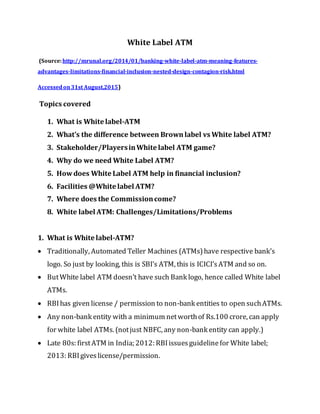
Topics covered
1. What is White label-ATM
2. What’s the difference between Brown label vs White label ATM?
3. Stakeholder/PlayersinWhite label ATM game?
4. Why do we need White Label ATM?
5. Howdoes White Label ATM help in financial inclusion?
6. Facilities @White label ATM?
7. Where does the Commissioncome?
8. White label ATM: Challenges/Limitations/Problems
1. What is White label-ATM?
 Traditionally, Automated Teller Machines (ATMs)have respective bank’s
logo. So just by looking, this is SBI’s ATM, this is ICICI’sATM and so on.
 ButWhite label ATM doesn’t have such Bank logo, hence called White label
ATMs.
 RBIhas given license / permission to non-bank entities to open suchATMs.
 Any non-bank entity with a minimum networthof Rs.100 crore, can apply
for white label ATMs. (notjust NBFC, any non-bank entity can apply.)
 Late 80s: firstATM in India; 2012: RBIissuesguidelinefor White label;
2013: RBIgiveslicense/permission.
 Tata CommunicationsPaymentSolutionsLimited =the first company to get
RBI’spermission to open White label ATMs.
 They started their chain under brand name“Indicash”.
 Other White label= MuthootFinance, Srei Infra., Vakrangee Software, Prizm
Payments, AGS. Morethan 15 companiesare given such permission.
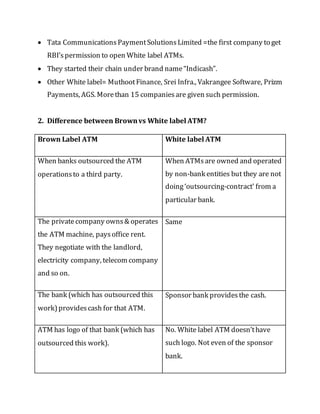
2. Difference between Brownvs White label ATM?
Brown Label ATM White label ATM
When banks outsourced the ATM
operationsto a third party.
When ATMsare owned and operated
by non-bank entities but they are not
doing‘outsourcing-contract’ from a
particular bank.
The privatecompany owns& operates
the ATM machine, paysoffice rent.
They negotiate with the landlord,
electricity company, telecom company
and so on.
Same
The bank (which has outsourced this
work)providescash for that ATM.
Sponsor bank providesthe cash.
ATM has logo of that bank (which has
outsourced this work).
No. White label ATM doesn’thave
such logo. Not even of the sponsor
bank.
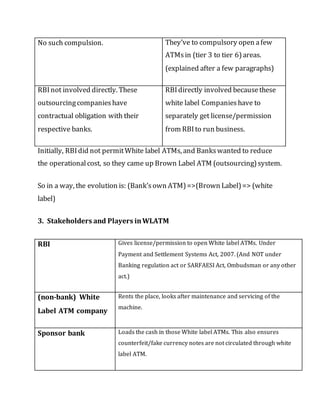
No such compulsion. They’ve to compulsory open afew
ATMsin (tier 3 to tier 6)areas.
(explained after a few paragraphs)
RBInot involved directly. These
outsourcingcompanieshave
contractual obligation with their
respective banks.
RBIdirectly involved becausethese
white label Companieshave to
separately get license/permission
from RBIto run business.
Initially, RBIdid not permitWhite label ATMs, and Bankswanted to reduce
the operationalcost, so they came up Brown Label ATM (outsourcing)system.
So in a way, the evolution is: (Bank’sown ATM)=>(Brown Label)=> (white
label)
3. Stakeholders and Players inWLATM
RBI Gives license/permission to open White label ATMs. Under
Payment and Settlement Systems Act, 2007. (And NOT under
Banking regulation act or SARFAESI Act, Ombudsman or any other
act.)
(non-bank) White
Label ATM company
Rents the place, looks after maintenance and servicing of the
machine.
Sponsor bank Loads the cash in those White label ATMs. This also ensures
counterfeit/fake currency notes are not circulated through white
label ATM.
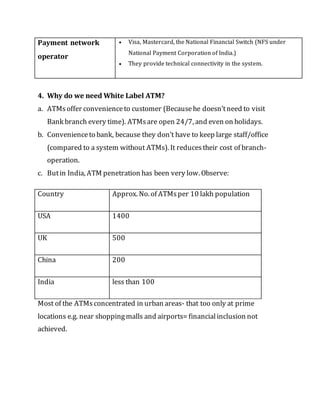
Payment network
operator
 Visa, Mastercard, the National Financial Switch (NFS under
National Payment Corporation of India.)
 They provide technical connectivity in the system.
4. Why do we need White Label ATM?
a. ATMsoffer convenienceto customer (Becausehe doesn’tneed to visit
Bank branch every time). ATMsare open 24/7, and even on holidays.
b. Convenienceto bank, because they don’t have to keep large staff/office
(compared to a system without ATMs). It reducestheir cost of branch-
operation.
c. Butin India, ATM penetration has been very low. Observe:
Country Approx. No. of ATMsper 10 lakh population
USA 1400
UK 500
China 200
India less than 100
Most of the ATMs concentrated in urban areas- that too only at prime
locations e.g. near shoppingmalls and airports= financialinclusion not
achieved.
5. Howdoes White Label ATM help in financial inclusion?
 RBIrequires White label-ATM companiesto install machines in the ratio of
Two ATMsin (tier 3 to 6 place) : One ATM in (tier 1-2 place).
Center city census
definition:population is
White Label ATM
Metropolitan Tier 1 10 lakh and above if company wantsto Setup
ONE ATM here,
Urban 1 lakh and above
Semi-Urban Tier 2 50,000 to 99,999
Tier 3 20,000 to 49,999 Then, company mustinstall
TWO ATMshere.
Tier 4 10,000 to 19,999
Rural Tier 5 5,000 to 9,999
Tier 6 Less than 5,000.
For example, RBIhas permitted Tata to deploy 15000Whitelabel ATMs.
Meaning[2/(2+1)] x15000 = 10,000 ATMswillbesetup in the ruraland
semi-urban areas. = more access to ATM= financialinclusion
6. Facilities at white label ATM
1. Any customer from belonging to any bank, can useit.
2. Every month, Five transactions are free.
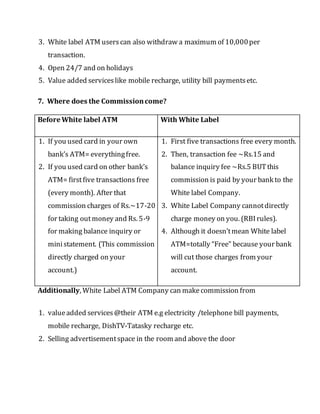
3. White label ATM userscan also withdraw a maximum of 10,000per
transaction.
4. Open 24/7 and on holidays
5. Value added serviceslike mobile recharge, utility bill paymentsetc.
7. Where does the Commissioncome?
Before White label ATM With White Label
1. If you used card in your own
bank’s ATM= everythingfree.
2. If you used card on other bank’s
ATM= firstfive transactions free
(every month). After that
commission charges of Rs.~17-20
for taking outmoney and Rs. 5-9
for making balance inquiry or
ministatement. (This commission
directly charged on your
account.)
1. First five transactions free every month.
2. Then, transaction fee ~Rs.15 and
balance inquiry fee ~Rs.5 BUTthis
commission is paid by your bank to the
White label Company.
3. White Label Company cannotdirectly
charge money on you. (RBIrules).
4. Although it doesn’tmean White label
ATM=totally “Free” because your bank
will cut those charges from your
account.
Additionally, White Label ATM Company can makecommission from
1. valueadded services@their ATM e.g electricity /telephone bill payments,
mobile recharge, DishTV-Tatasky recharge etc.
2. Selling advertisementspace in the room and above the door
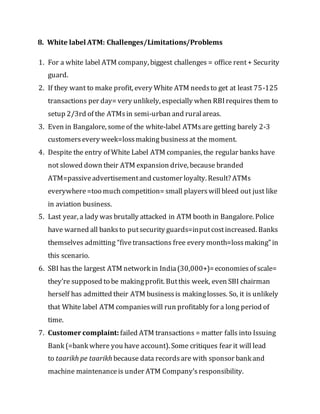
8. White label ATM: Challenges/Limitations/Problems
1. For a white label ATM company, biggest challenges = office rent+ Security
guard.
2. If they want to make profit, every White ATM needsto get at least 75-125
transactions per day= very unlikely, especially when RBIrequires them to
setup 2/3rd of the ATMsin semi-urban and ruralareas.
3. Even in Bangalore, some of the white-label ATMsare getting barely 2-3
customersevery week=lossmaking businessat the moment.
4. Despite the entry of White Label ATM companies, the regular banks have
not slowed down their ATM expansion drive, because branded
ATM=passiveadvertisementand customer loyalty. Result? ATMs
everywhere=too much competition= small playerswillbleed out just like
in aviation business.
5. Last year, a lady was brutally attacked in ATM booth in Bangalore. Police
have warned all banksto putsecurity guards=inputcostincreased. Banks
themselves admitting “fivetransactions free every month=lossmaking” in
this scenario.
6. SBI has the largest ATM network in India(30,000+)=economiesof scale=
they’re supposed to be makingprofit. Butthis week, even SBI chairman
herself has admitted their ATM businessis makinglosses. So, it is unlikely
that White label ATM companieswill run profitably for a long period of
time.
7. Customer complaint: failed ATM transactions = matter falls into Issuing
Bank (=bank where you have account). Some critiques fear it will lead
to taarikh pe taarikh because data recordsare with sponsor bank and
machine maintenanceis under ATM Company’s responsibility.

Whitelabel atm

  • 1.
    White Label ATM (Source:http://mrunal.org/2014/01/banking-white-label-atm-meaning-features- advantages-limitations-financial-inclusion-nested-design-contagion-risk.html Accessedon31stAugust,2015) Topics covered 1. What is White label-ATM 2. What’s the difference between Brown label vs White label ATM? 3. Stakeholder/PlayersinWhite label ATM game? 4. Why do we need White Label ATM? 5. Howdoes White Label ATM help in financial inclusion? 6. Facilities @White label ATM? 7. Where does the Commissioncome? 8. White label ATM: Challenges/Limitations/Problems 1. What is White label-ATM?  Traditionally, Automated Teller Machines (ATMs)have respective bank’s logo. So just by looking, this is SBI’s ATM, this is ICICI’sATM and so on.  ButWhite label ATM doesn’t have such Bank logo, hence called White label ATMs.  RBIhas given license / permission to non-bank entities to open suchATMs.  Any non-bank entity with a minimum networthof Rs.100 crore, can apply for white label ATMs. (notjust NBFC, any non-bank entity can apply.)  Late 80s: firstATM in India; 2012: RBIissuesguidelinefor White label; 2013: RBIgiveslicense/permission.
  • 2.
     Tata CommunicationsPaymentSolutionsLimited=the first company to get RBI’spermission to open White label ATMs.  They started their chain under brand name“Indicash”.  Other White label= MuthootFinance, Srei Infra., Vakrangee Software, Prizm Payments, AGS. Morethan 15 companiesare given such permission. 2. Difference between Brownvs White label ATM? Brown Label ATM White label ATM When banks outsourced the ATM operationsto a third party. When ATMsare owned and operated by non-bank entities but they are not doing‘outsourcing-contract’ from a particular bank. The privatecompany owns& operates the ATM machine, paysoffice rent. They negotiate with the landlord, electricity company, telecom company and so on. Same The bank (which has outsourced this work)providescash for that ATM. Sponsor bank providesthe cash. ATM has logo of that bank (which has outsourced this work). No. White label ATM doesn’thave such logo. Not even of the sponsor bank.
  • 3.
    No such compulsion.They’ve to compulsory open afew ATMsin (tier 3 to tier 6)areas. (explained after a few paragraphs) RBInot involved directly. These outsourcingcompanieshave contractual obligation with their respective banks. RBIdirectly involved becausethese white label Companieshave to separately get license/permission from RBIto run business. Initially, RBIdid not permitWhite label ATMs, and Bankswanted to reduce the operationalcost, so they came up Brown Label ATM (outsourcing)system. So in a way, the evolution is: (Bank’sown ATM)=>(Brown Label)=> (white label) 3. Stakeholders and Players inWLATM RBI Gives license/permission to open White label ATMs. Under Payment and Settlement Systems Act, 2007. (And NOT under Banking regulation act or SARFAESI Act, Ombudsman or any other act.) (non-bank) White Label ATM company Rents the place, looks after maintenance and servicing of the machine. Sponsor bank Loads the cash in those White label ATMs. This also ensures counterfeit/fake currency notes are not circulated through white label ATM.
  • 4.
    Payment network operator  Visa,Mastercard, the National Financial Switch (NFS under National Payment Corporation of India.)  They provide technical connectivity in the system. 4. Why do we need White Label ATM? a. ATMsoffer convenienceto customer (Becausehe doesn’tneed to visit Bank branch every time). ATMsare open 24/7, and even on holidays. b. Convenienceto bank, because they don’t have to keep large staff/office (compared to a system without ATMs). It reducestheir cost of branch- operation. c. Butin India, ATM penetration has been very low. Observe: Country Approx. No. of ATMsper 10 lakh population USA 1400 UK 500 China 200 India less than 100 Most of the ATMs concentrated in urban areas- that too only at prime locations e.g. near shoppingmalls and airports= financialinclusion not achieved.
  • 5.
    5. Howdoes WhiteLabel ATM help in financial inclusion?  RBIrequires White label-ATM companiesto install machines in the ratio of Two ATMsin (tier 3 to 6 place) : One ATM in (tier 1-2 place). Center city census definition:population is White Label ATM Metropolitan Tier 1 10 lakh and above if company wantsto Setup ONE ATM here, Urban 1 lakh and above Semi-Urban Tier 2 50,000 to 99,999 Tier 3 20,000 to 49,999 Then, company mustinstall TWO ATMshere. Tier 4 10,000 to 19,999 Rural Tier 5 5,000 to 9,999 Tier 6 Less than 5,000. For example, RBIhas permitted Tata to deploy 15000Whitelabel ATMs. Meaning[2/(2+1)] x15000 = 10,000 ATMswillbesetup in the ruraland semi-urban areas. = more access to ATM= financialinclusion 6. Facilities at white label ATM 1. Any customer from belonging to any bank, can useit. 2. Every month, Five transactions are free.
  • 6.
    3. White labelATM userscan also withdraw a maximum of 10,000per transaction. 4. Open 24/7 and on holidays 5. Value added serviceslike mobile recharge, utility bill paymentsetc. 7. Where does the Commissioncome? Before White label ATM With White Label 1. If you used card in your own bank’s ATM= everythingfree. 2. If you used card on other bank’s ATM= firstfive transactions free (every month). After that commission charges of Rs.~17-20 for taking outmoney and Rs. 5-9 for making balance inquiry or ministatement. (This commission directly charged on your account.) 1. First five transactions free every month. 2. Then, transaction fee ~Rs.15 and balance inquiry fee ~Rs.5 BUTthis commission is paid by your bank to the White label Company. 3. White Label Company cannotdirectly charge money on you. (RBIrules). 4. Although it doesn’tmean White label ATM=totally “Free” because your bank will cut those charges from your account. Additionally, White Label ATM Company can makecommission from 1. valueadded services@their ATM e.g electricity /telephone bill payments, mobile recharge, DishTV-Tatasky recharge etc. 2. Selling advertisementspace in the room and above the door
  • 7.
    8. White labelATM: Challenges/Limitations/Problems 1. For a white label ATM company, biggest challenges = office rent+ Security guard. 2. If they want to make profit, every White ATM needsto get at least 75-125 transactions per day= very unlikely, especially when RBIrequires them to setup 2/3rd of the ATMsin semi-urban and ruralareas. 3. Even in Bangalore, some of the white-label ATMsare getting barely 2-3 customersevery week=lossmaking businessat the moment. 4. Despite the entry of White Label ATM companies, the regular banks have not slowed down their ATM expansion drive, because branded ATM=passiveadvertisementand customer loyalty. Result? ATMs everywhere=too much competition= small playerswillbleed out just like in aviation business. 5. Last year, a lady was brutally attacked in ATM booth in Bangalore. Police have warned all banksto putsecurity guards=inputcostincreased. Banks themselves admitting “fivetransactions free every month=lossmaking” in this scenario. 6. SBI has the largest ATM network in India(30,000+)=economiesof scale= they’re supposed to be makingprofit. Butthis week, even SBI chairman herself has admitted their ATM businessis makinglosses. So, it is unlikely that White label ATM companieswill run profitably for a long period of time. 7. Customer complaint: failed ATM transactions = matter falls into Issuing Bank (=bank where you have account). Some critiques fear it will lead to taarikh pe taarikh because data recordsare with sponsor bank and machine maintenanceis under ATM Company’s responsibility.