Banking
Atul Abhiman Agalawe
(M. Com, B. Ed, D. B. M)
• The history of banking begins with the first prototype banks of merchants
of the ancient world, which made grain loans to farmers and traders who
carried goods between cities. This began around 2000 BC in Assyria and
Babylonia. Later, in ancient Greece and during the Roman Empire, lenders
based in temples made loans and added two important innovations: they
accepted deposits and changed money. Archaeology from this period in
ancient China and India also shows evidence of money lending activity.
• The origins of modern banking can be traced to medieval and early
Renaissance Italy, to the rich cities in the north like Florence, Lucca, Siena,
Venice and Genoa. The Bardi and Peruzzi families dominated banking in
14th century Florence, establishing branches in many other parts of
Europe. One of the most famous Italian banks was the Medici Bank, set up
by Giovanni di Bicci de' Medici in 1397. The earliest known state deposit
bank, Banco di San Giorgio (Bank of St. George), was founded in 1407 at
Genoa, Italy.
• The word bank was borrowed in Middle English from Middle French
banque, from Old Italian banca, from Old High German banc, bank "bench,
counter". Benches were used as desks or exchange counters during the
Renaissance by Florentine bankers, who used to make their transactions
atop desks covered by green tablecloths.
• According to Walter Leaf “A bank is a person or corporation
which holds itself out to receive from the public, deposits
payable on demand by cheque.”
• Horace White has defined a bank, “as a manufacture of credit
and a machine for facilitating exchange.”
• According to Prof. Kinley, “A bank is an establishment which
makes to individuals such advances of money as may be
required and safely made, and to which individuals entrust
money when not required by them for use.”
• Oxford Dictionary: Bank is an establishment for custody of
money, which it pays out on customer order.
• Indian Banking Companies Regulation Act, 1949: Banking
company is one which transacts the business of banking which
means the accepting for the purpose of lending or investment of
deposits of money from the public, repayable on demand or
otherwise and withdrawable by cheque, draft, order or
otherwise.
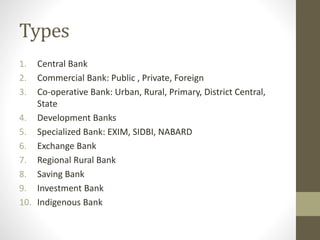
Types
1. Central Bank
2. Commercial Bank: Public , Private, Foreign
3. Co-operative Bank: Urban, Rural, Primary, District Central,
State
4. Development Banks
5. Specialized Bank: EXIM, SIDBI, NABARD
6. Exchange Bank
7. Regional Rural Bank
8. Saving Bank
9. Investment Bank
10. Indigenous Bank
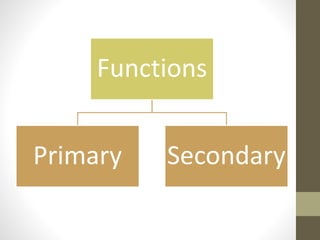
Functions
Primary Secondary
Primary Functions
Accepting
Deposits
• Fixed Deposits
• Recurring Deposits
• Saving Account
• Current Account
• Multiple Option
Deposit/Flexi
Granting loans
and Advances
• Money at call
• Overdraft
• Cash Credit
• Discounting of bills
• Loans
Secondary Functions
Agency Functions
• Collection of Cheques, Dividend
and Interests
• Payment of Rent, Insurance
Premiums, etc.
• Dealing in foreign Exchange
• Purchase and Sales of Securities
• Acts as a Trustee, Executor of will,
Attorney, etc.
• Act as a Correspondent
• Preparation of Income Tax Return
• Bank Drafts
• Underwriting of Shares
• De-mat Account
Utility Functions
• Safe Deposit Vault/Locker
• Traveller’s Cheques
• Letter of Credit
• Provide Trade Information
• Gift Cheques
E-Banking
• ATM
• Credit Card
• Debit Card
• Electronic Fund Transfer
• Core Banking
• Internet Banking
• Phone Banking
• NEFT
• RTGS

Banking

  • 1.
  • 3.
    • The historyof banking begins with the first prototype banks of merchants of the ancient world, which made grain loans to farmers and traders who carried goods between cities. This began around 2000 BC in Assyria and Babylonia. Later, in ancient Greece and during the Roman Empire, lenders based in temples made loans and added two important innovations: they accepted deposits and changed money. Archaeology from this period in ancient China and India also shows evidence of money lending activity. • The origins of modern banking can be traced to medieval and early Renaissance Italy, to the rich cities in the north like Florence, Lucca, Siena, Venice and Genoa. The Bardi and Peruzzi families dominated banking in 14th century Florence, establishing branches in many other parts of Europe. One of the most famous Italian banks was the Medici Bank, set up by Giovanni di Bicci de' Medici in 1397. The earliest known state deposit bank, Banco di San Giorgio (Bank of St. George), was founded in 1407 at Genoa, Italy. • The word bank was borrowed in Middle English from Middle French banque, from Old Italian banca, from Old High German banc, bank "bench, counter". Benches were used as desks or exchange counters during the Renaissance by Florentine bankers, who used to make their transactions atop desks covered by green tablecloths.
  • 4.
    • According toWalter Leaf “A bank is a person or corporation which holds itself out to receive from the public, deposits payable on demand by cheque.” • Horace White has defined a bank, “as a manufacture of credit and a machine for facilitating exchange.” • According to Prof. Kinley, “A bank is an establishment which makes to individuals such advances of money as may be required and safely made, and to which individuals entrust money when not required by them for use.” • Oxford Dictionary: Bank is an establishment for custody of money, which it pays out on customer order. • Indian Banking Companies Regulation Act, 1949: Banking company is one which transacts the business of banking which means the accepting for the purpose of lending or investment of deposits of money from the public, repayable on demand or otherwise and withdrawable by cheque, draft, order or otherwise.
  • 5.
    Types 1. Central Bank 2.Commercial Bank: Public , Private, Foreign 3. Co-operative Bank: Urban, Rural, Primary, District Central, State 4. Development Banks 5. Specialized Bank: EXIM, SIDBI, NABARD 6. Exchange Bank 7. Regional Rural Bank 8. Saving Bank 9. Investment Bank 10. Indigenous Bank
  • 6.
  • 7.
    Primary Functions Accepting Deposits • FixedDeposits • Recurring Deposits • Saving Account • Current Account • Multiple Option Deposit/Flexi Granting loans and Advances • Money at call • Overdraft • Cash Credit • Discounting of bills • Loans
  • 8.
    Secondary Functions Agency Functions •Collection of Cheques, Dividend and Interests • Payment of Rent, Insurance Premiums, etc. • Dealing in foreign Exchange • Purchase and Sales of Securities • Acts as a Trustee, Executor of will, Attorney, etc. • Act as a Correspondent • Preparation of Income Tax Return • Bank Drafts • Underwriting of Shares • De-mat Account Utility Functions • Safe Deposit Vault/Locker • Traveller’s Cheques • Letter of Credit • Provide Trade Information • Gift Cheques
  • 9.
    E-Banking • ATM • CreditCard • Debit Card • Electronic Fund Transfer • Core Banking • Internet Banking • Phone Banking • NEFT • RTGS