


BASIC FINANCIAL STATEMENTS Chapter 2
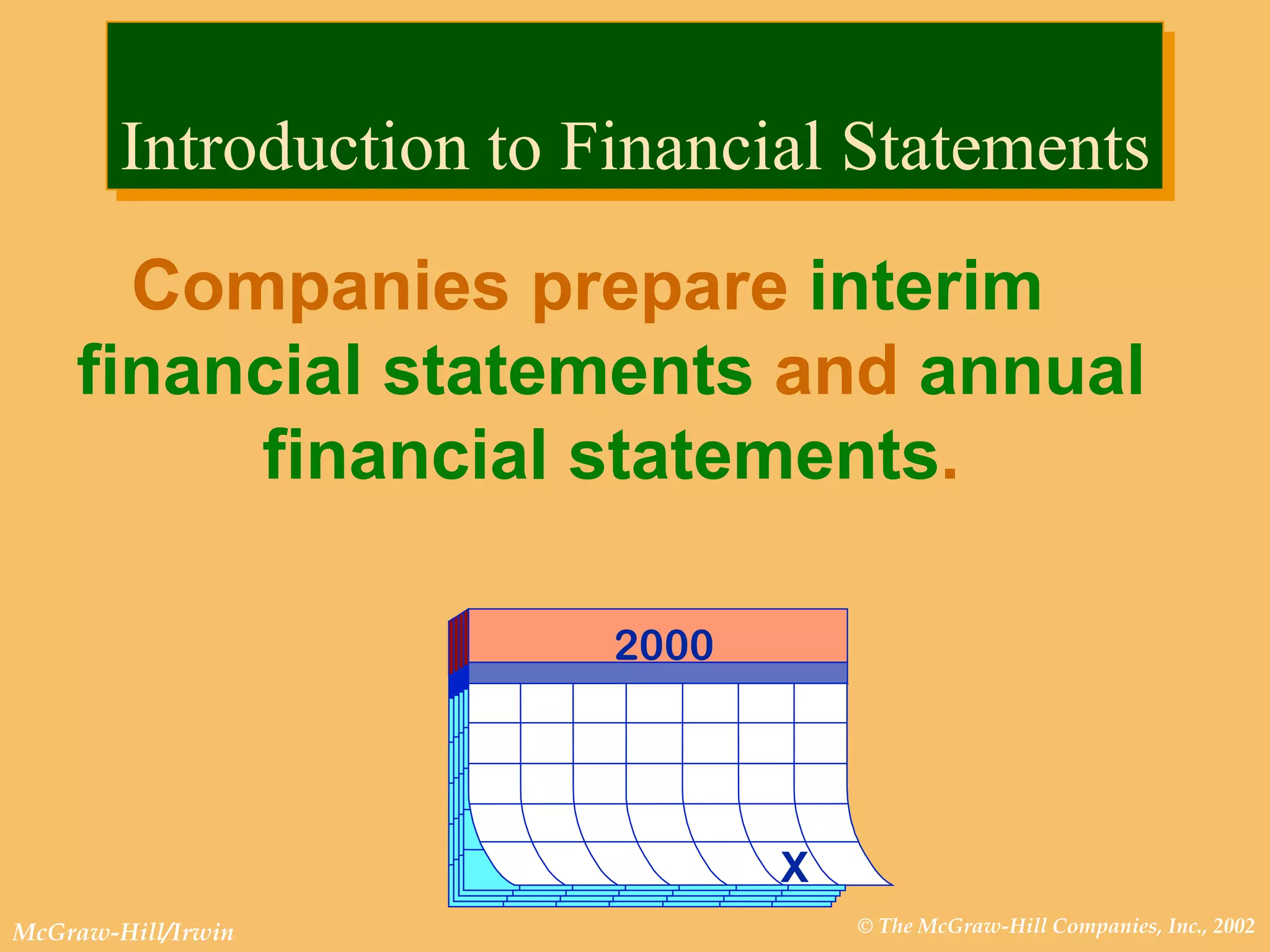
Introduction to Financial Statements Companies prepare  interim financial statements  and  annual financial statements . 2000 X
Introduction to Financial Statements Three primary financial statements. Income Statement Balance Sheet Statement of Cash Flows We will use a  corporation  to describe these statements.
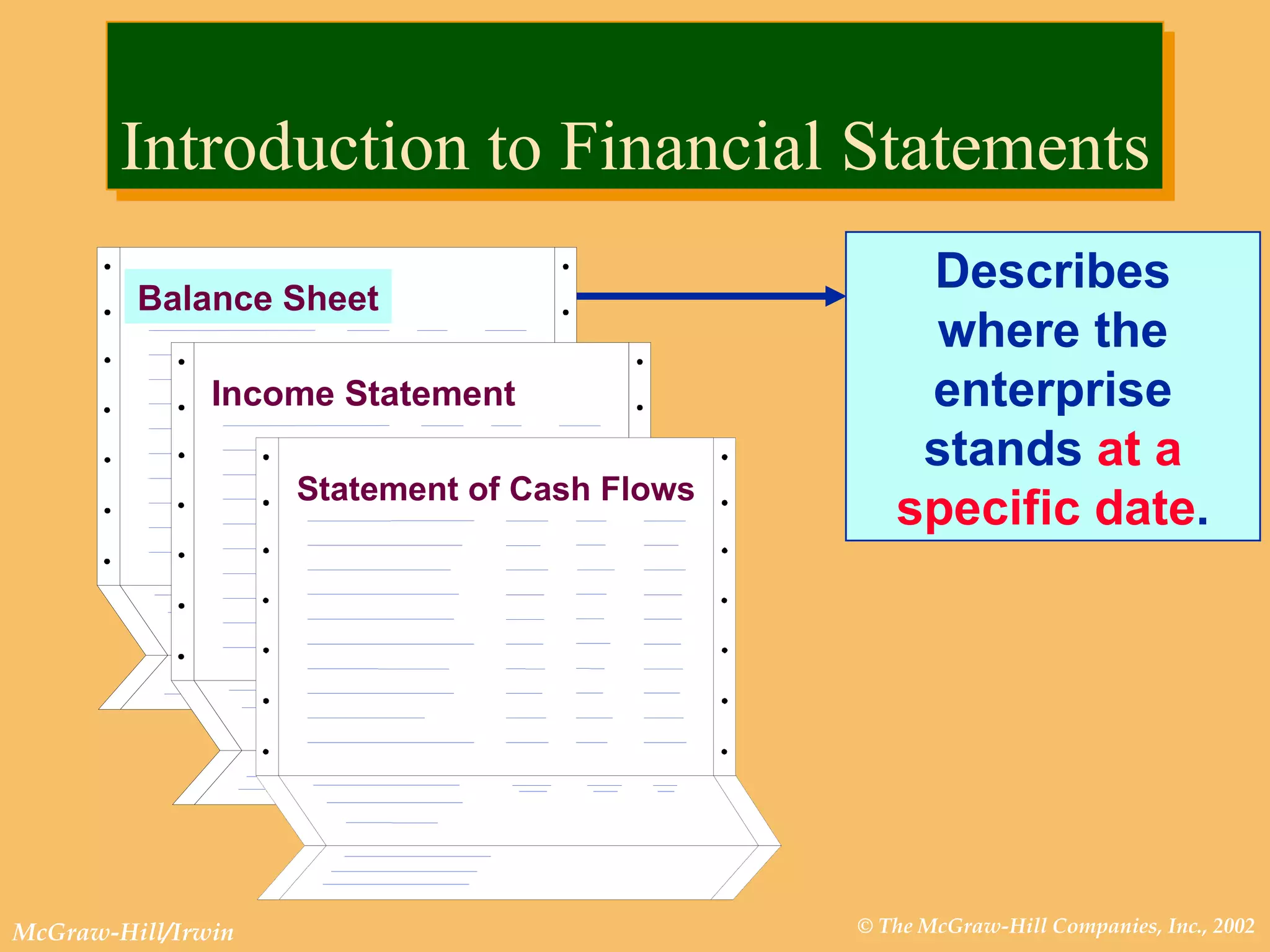
Introduction to Financial Statements Describes where the enterprise stands  at a specific date . Income Statement Balance Sheet Statement of Cash Flows
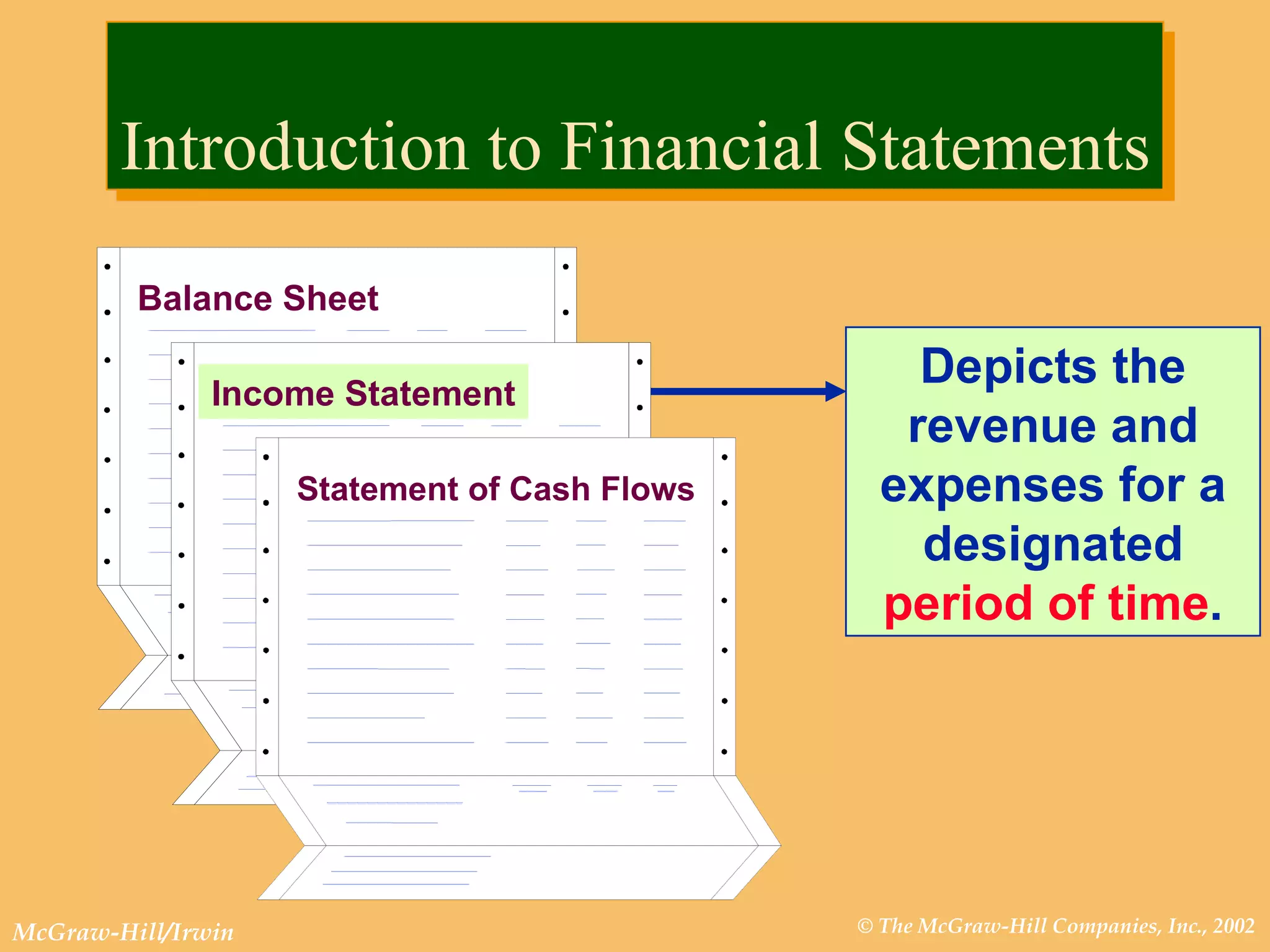
Introduction to Financial Statements Depicts the revenue and expenses for a designated  period of time . Income Statement Balance Sheet Statement of Cash Flows
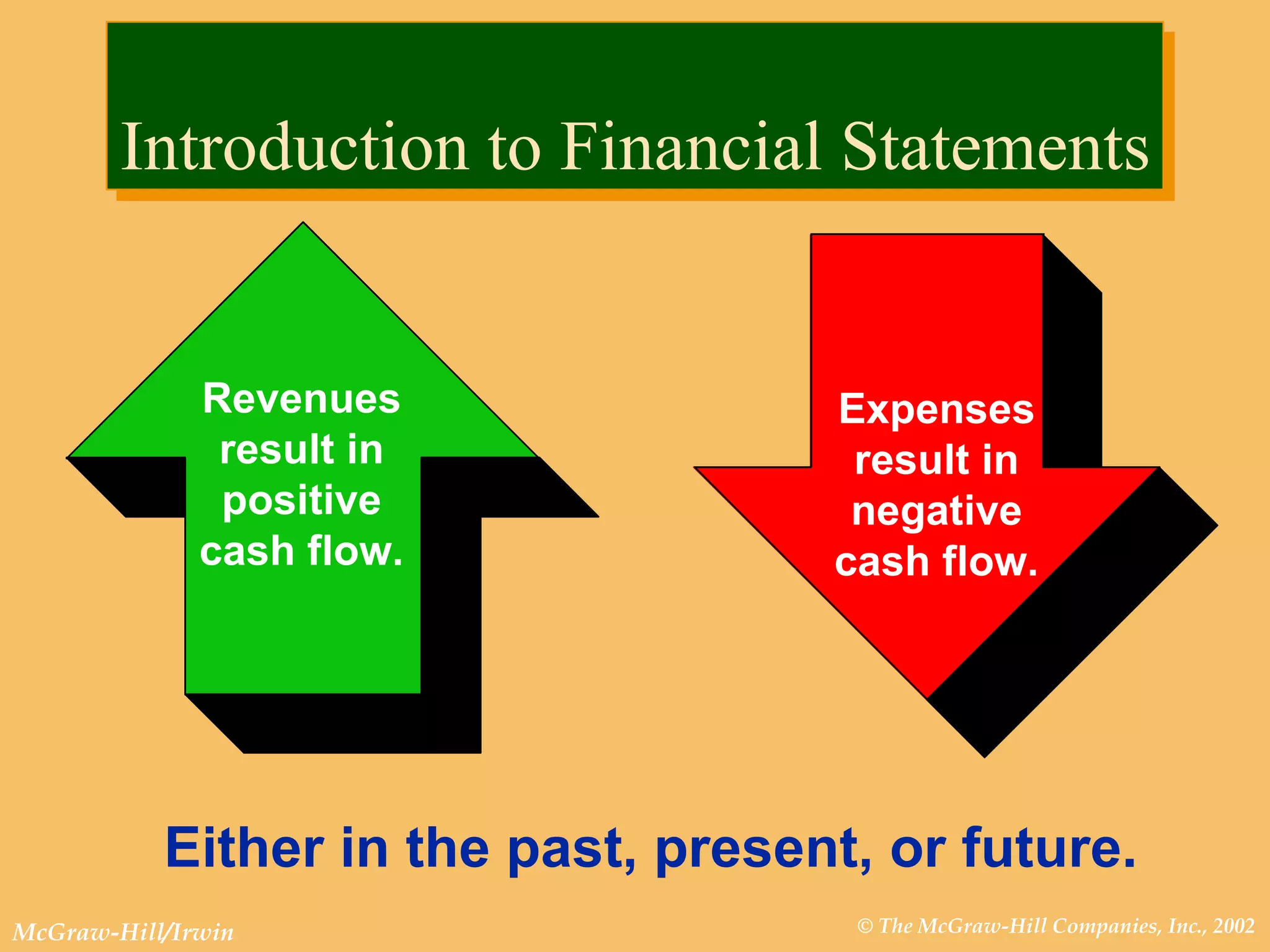
Introduction to Financial Statements Revenues result in positive cash flow. Expenses result in negative cash flow. Either in the past, present, or future.
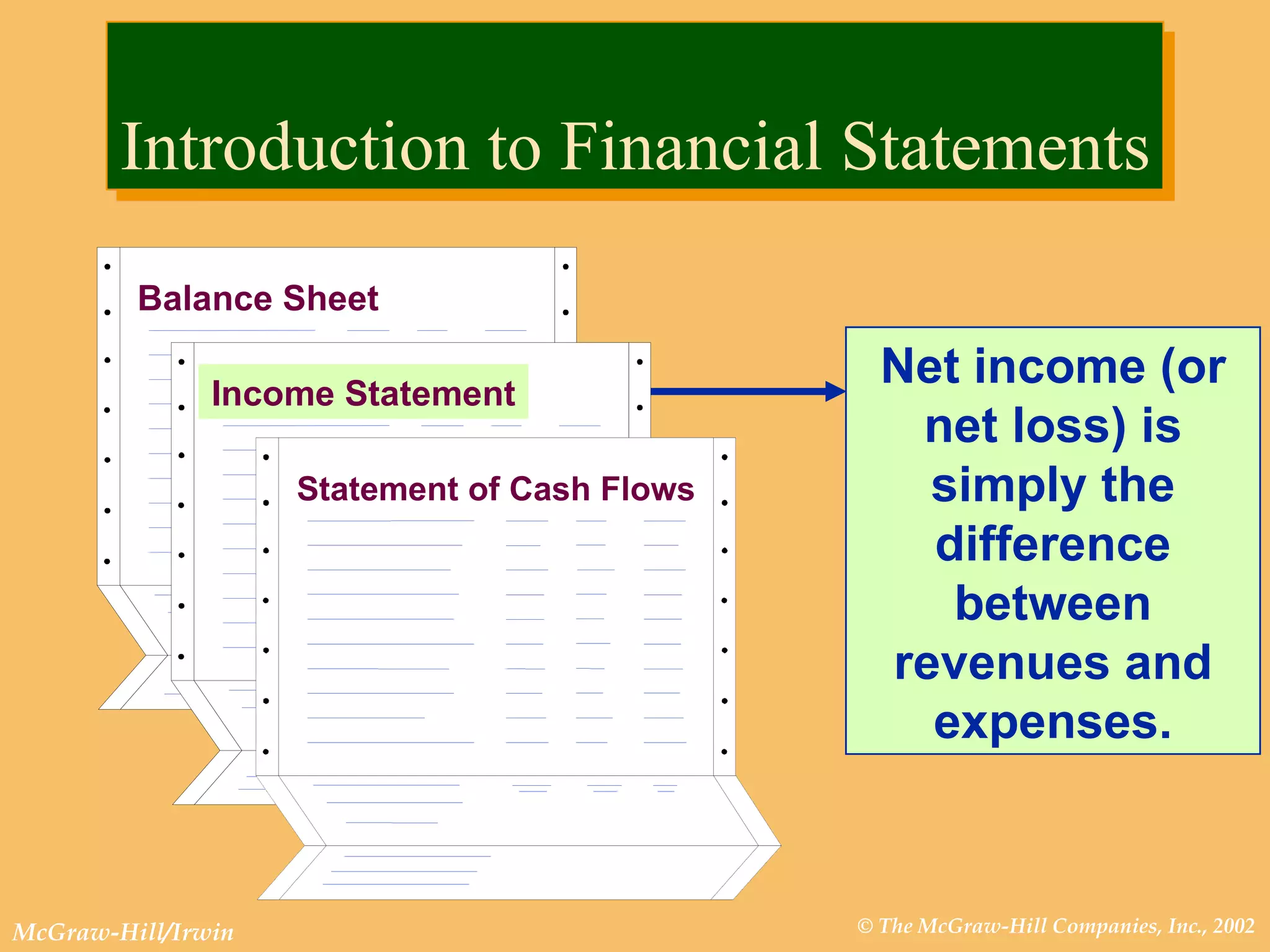
Introduction to Financial Statements Net income (or net loss) is simply the difference between revenues and expenses. Income Statement Balance Sheet Statement of Cash Flows
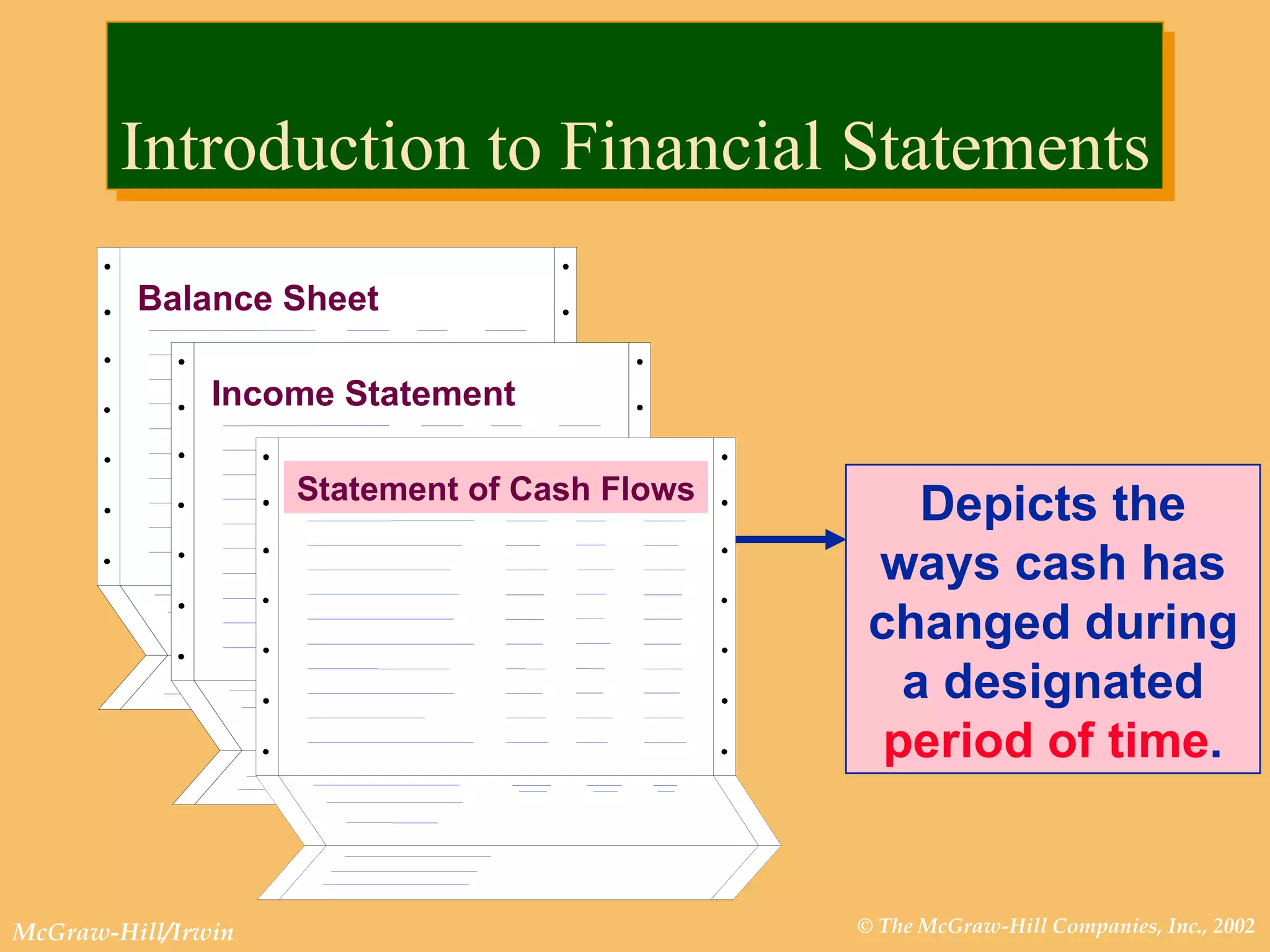
Introduction to Financial Statements Depicts the ways cash has changed during a designated  period of time . Income Statement Balance Sheet Statement of Cash Flows
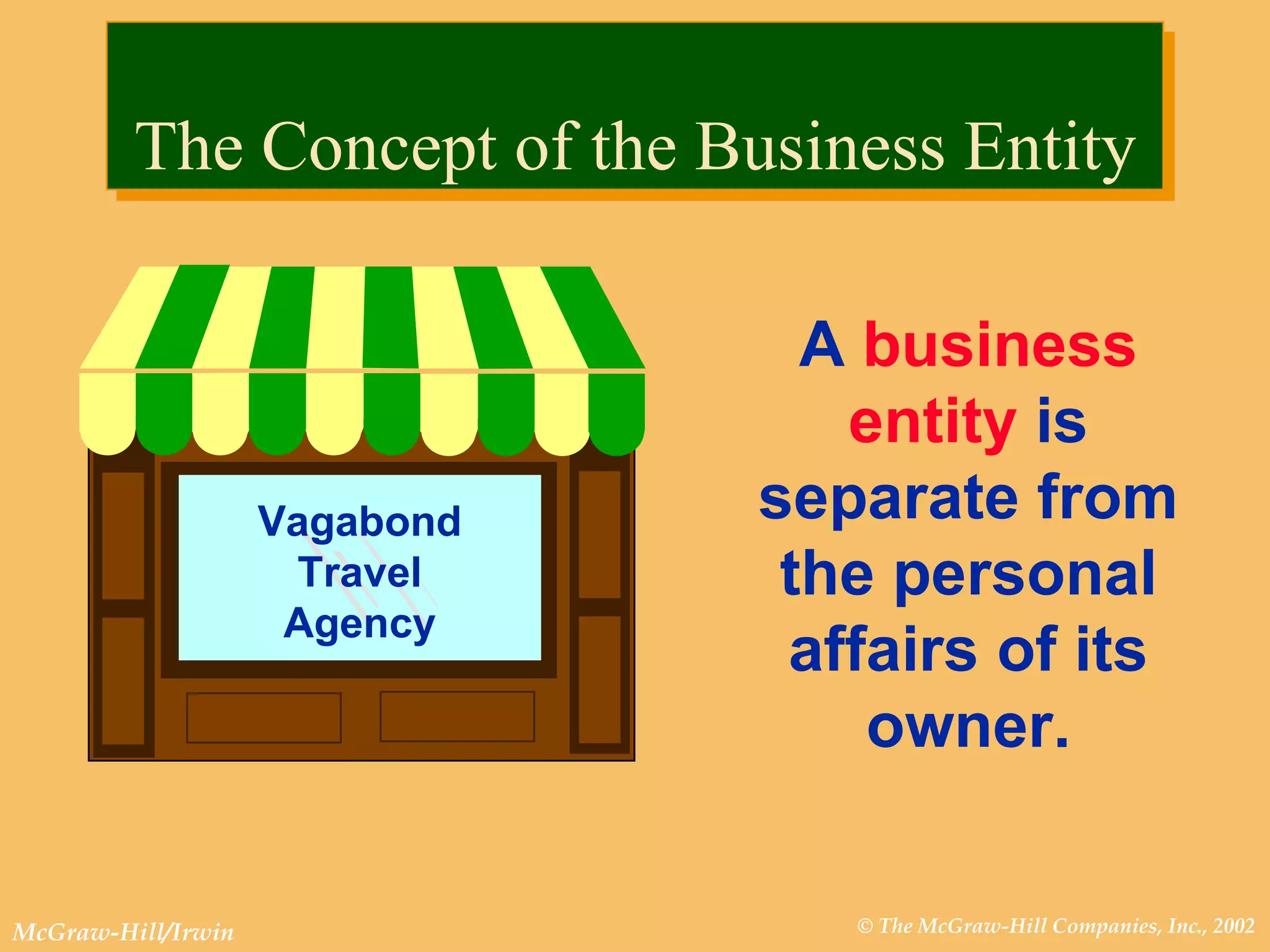
The Concept of the Business Entity Vagabond Travel Agency A  business entity  is separate from the personal affairs of its owner.
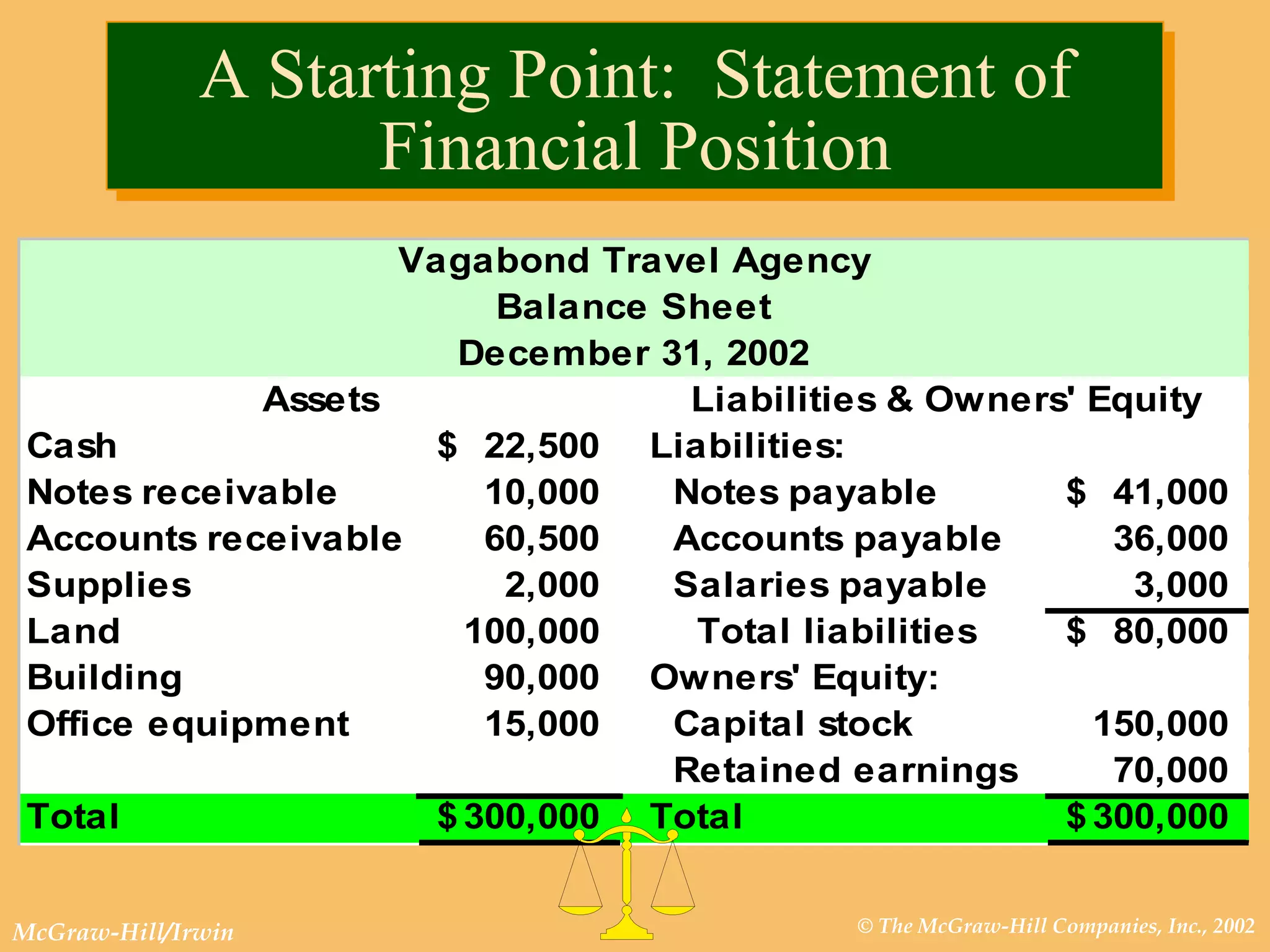
A Starting Point:  Statement of Financial Position
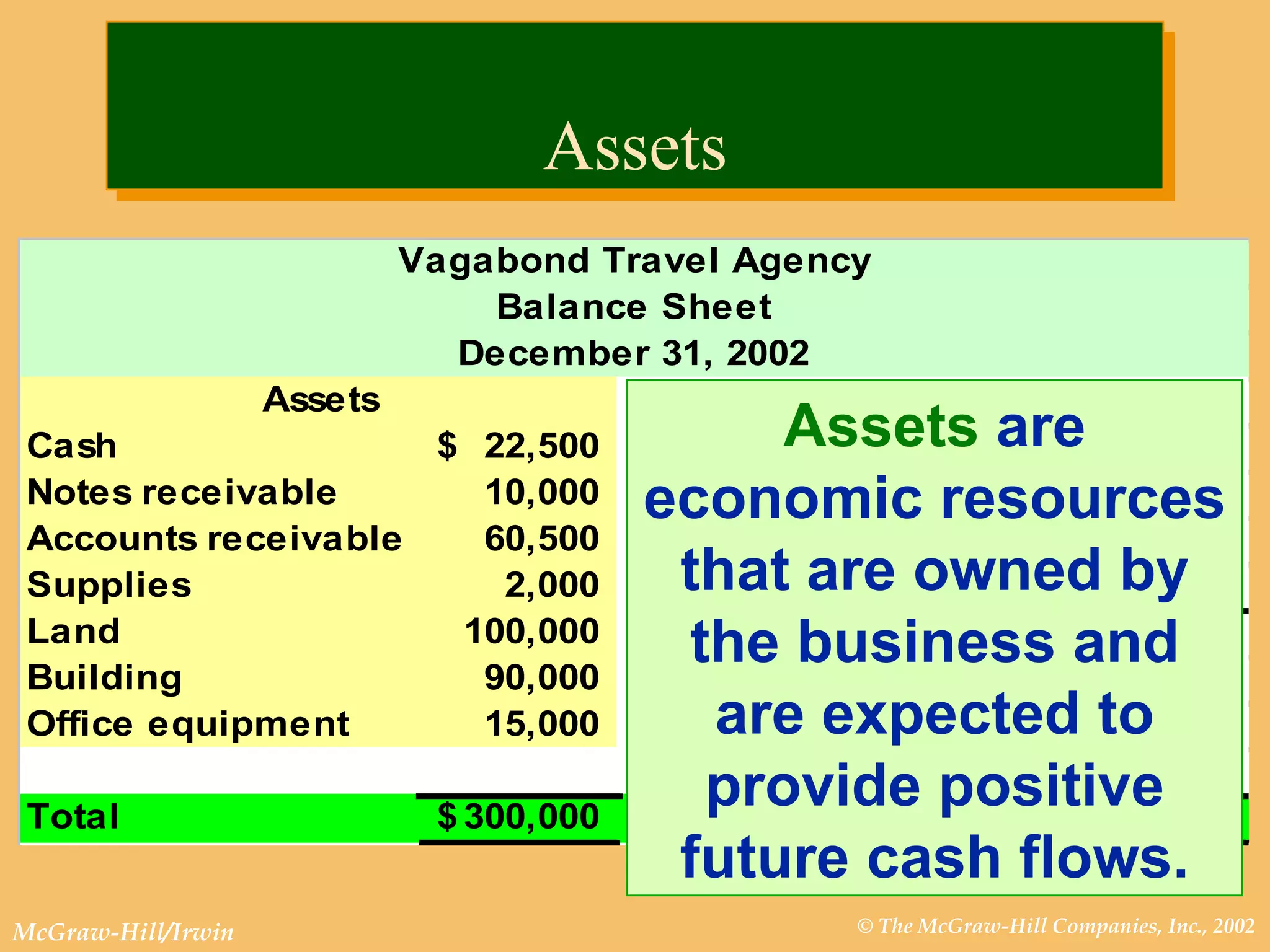
Assets Assets  are economic resources that are owned by the business and are expected to provide positive future cash flows.
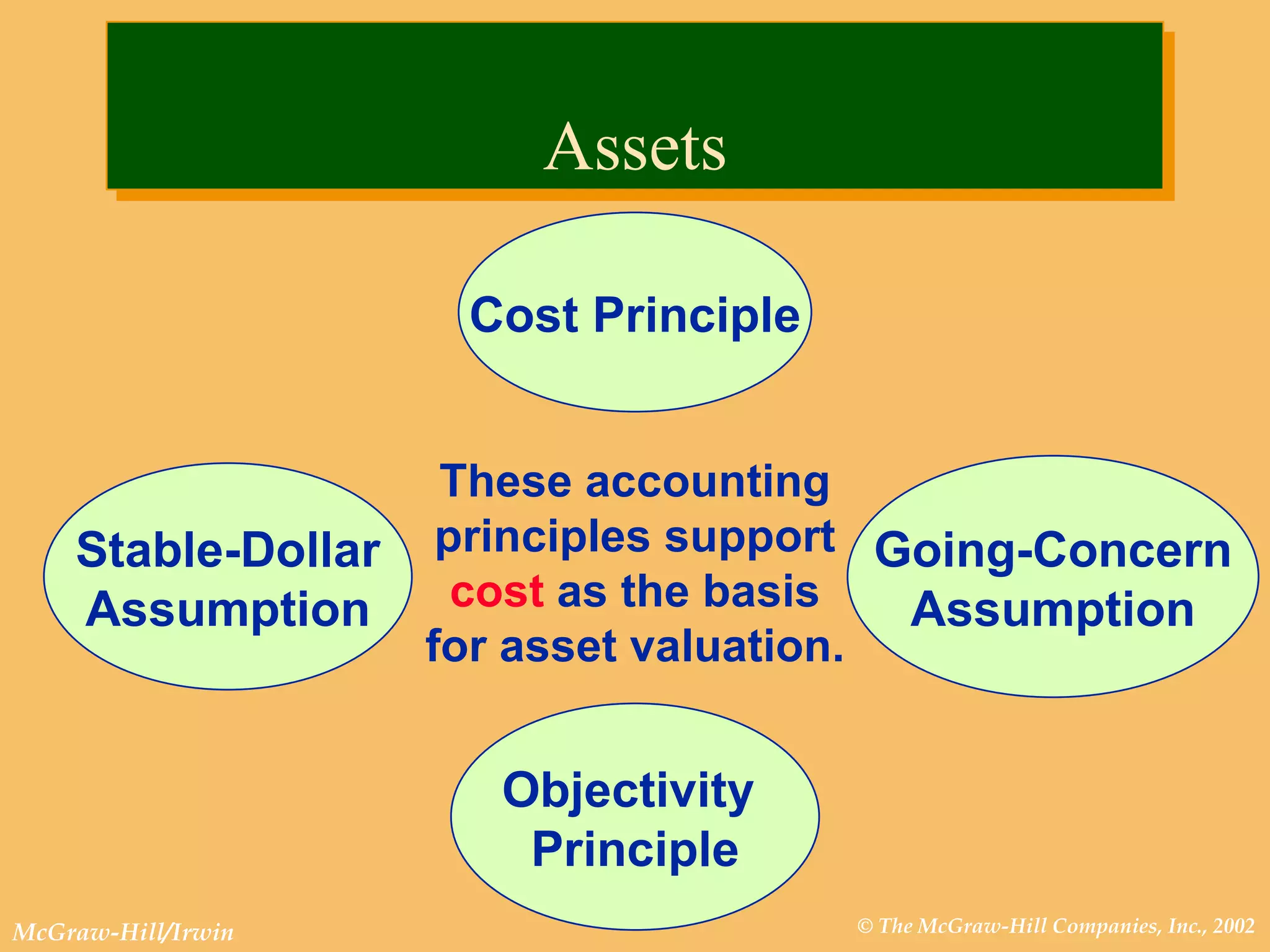
Assets Cost Principle Going-Concern Assumption Objectivity  Principle Stable-Dollar Assumption These accounting principles support  cost  as the basis for asset valuation.
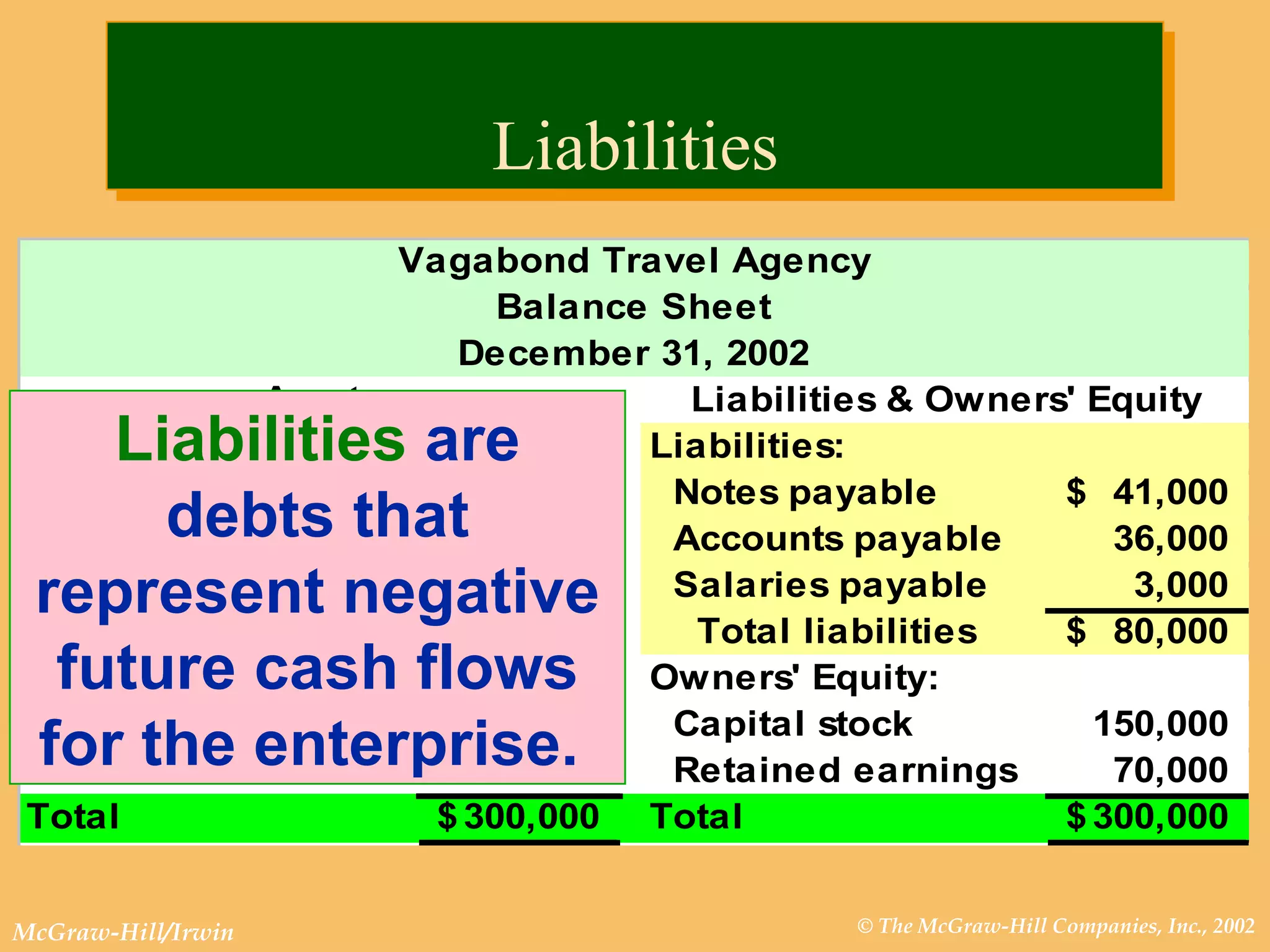
Liabilities Liabilities  are debts that represent negative future cash flows for the enterprise.
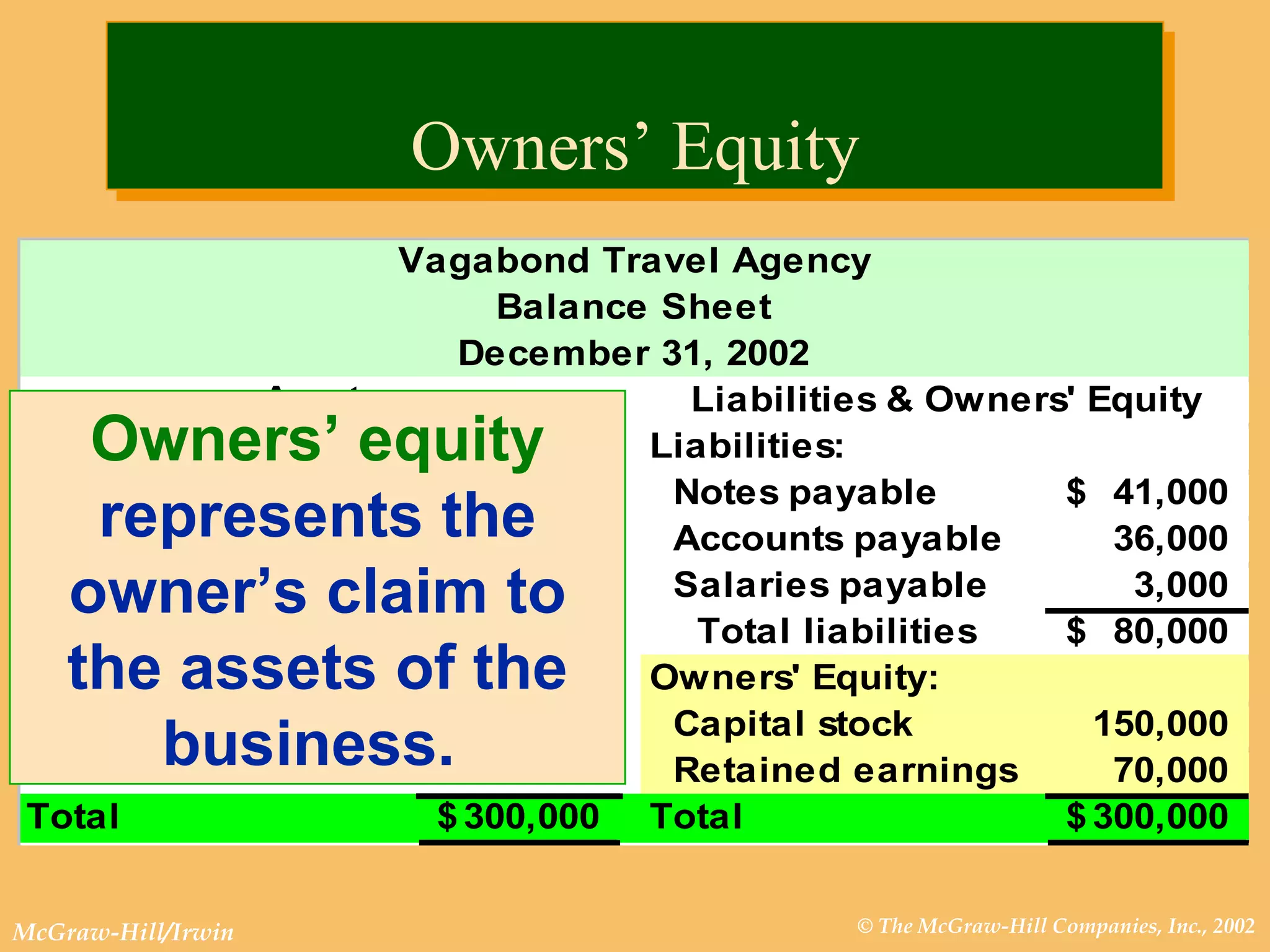
Owners’ Equity Owners’ equity  represents the owner’s claim to the assets of the business.
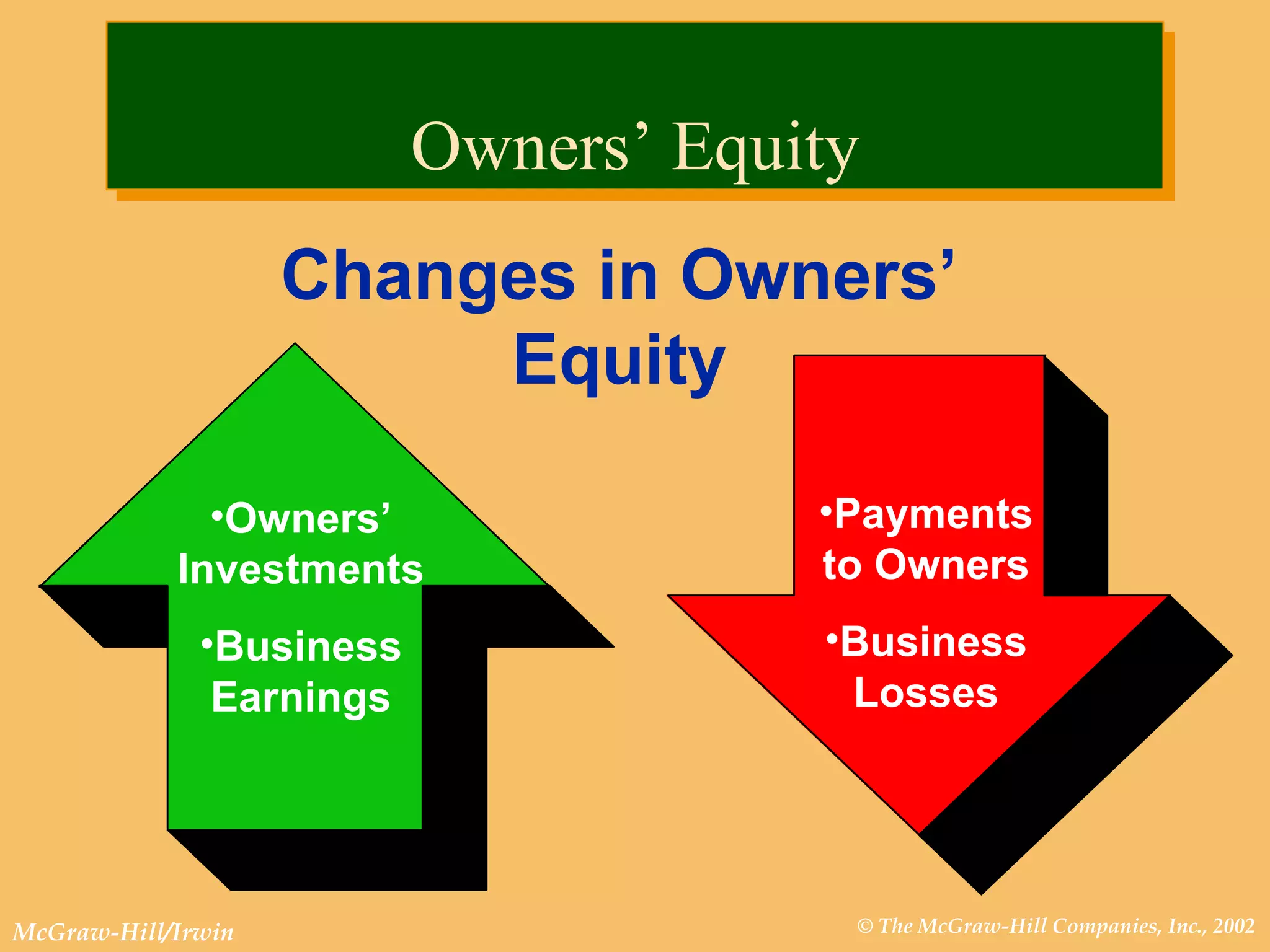
Owners’ Equity Changes in Owners’ Equity Owners’ Investments Business Earnings Payments to Owners Business Losses
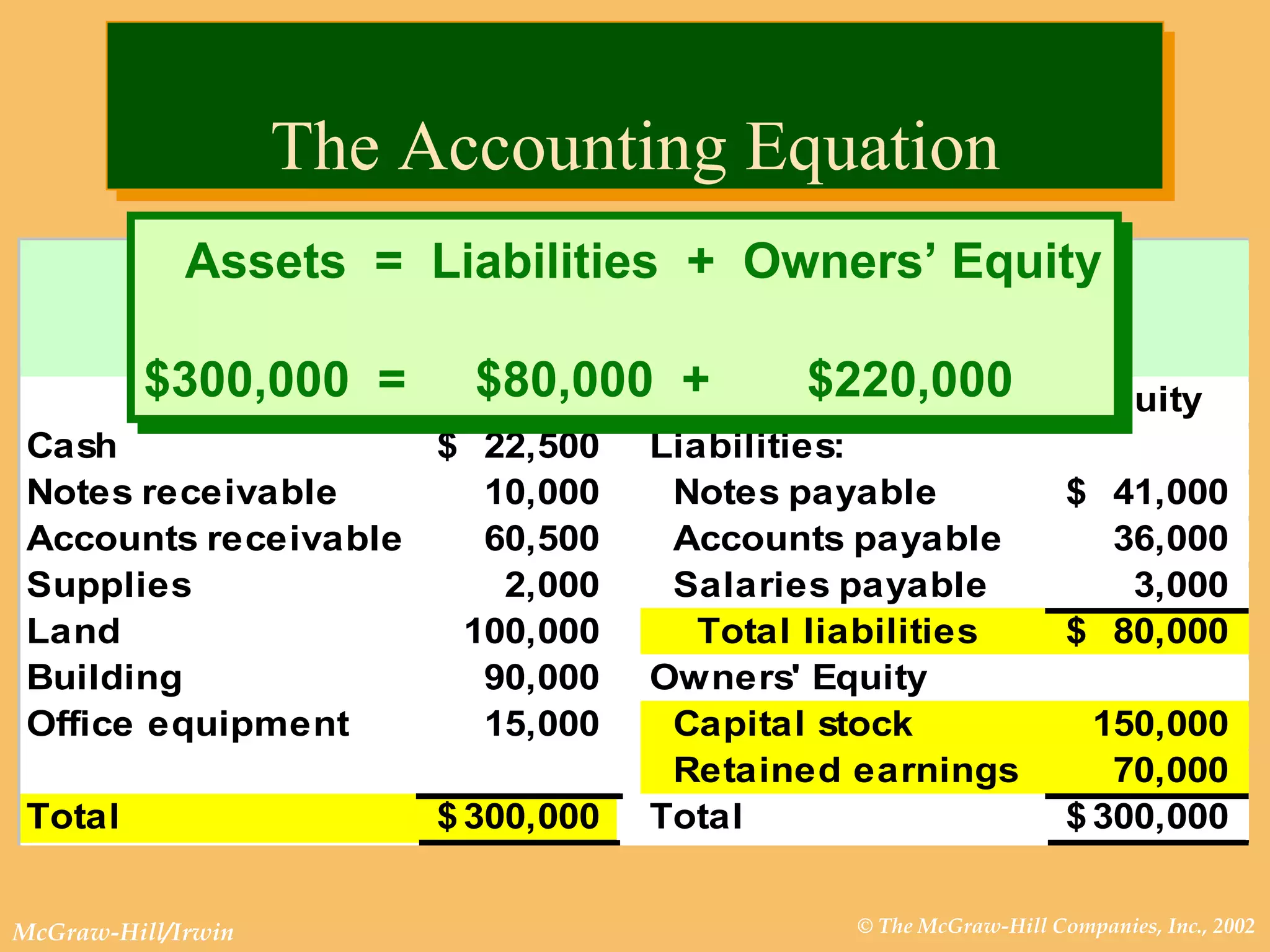
The Accounting Equation Assets  =  Liabilities  +  Owners’ Equity $300,000  =  $80,000  +  $220,000
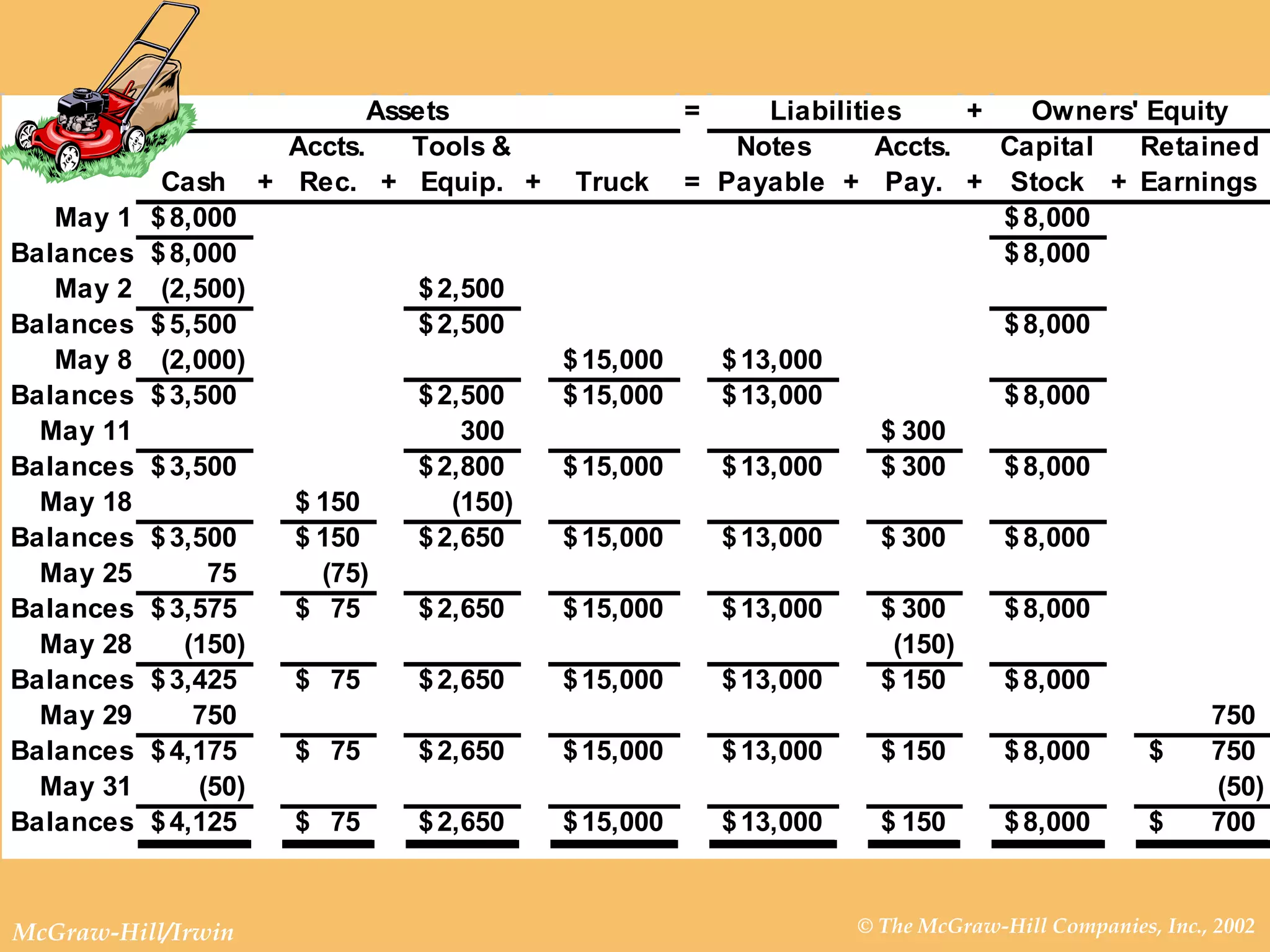
Let’s analyze some transactions for JJ’s Lawn Care Service.
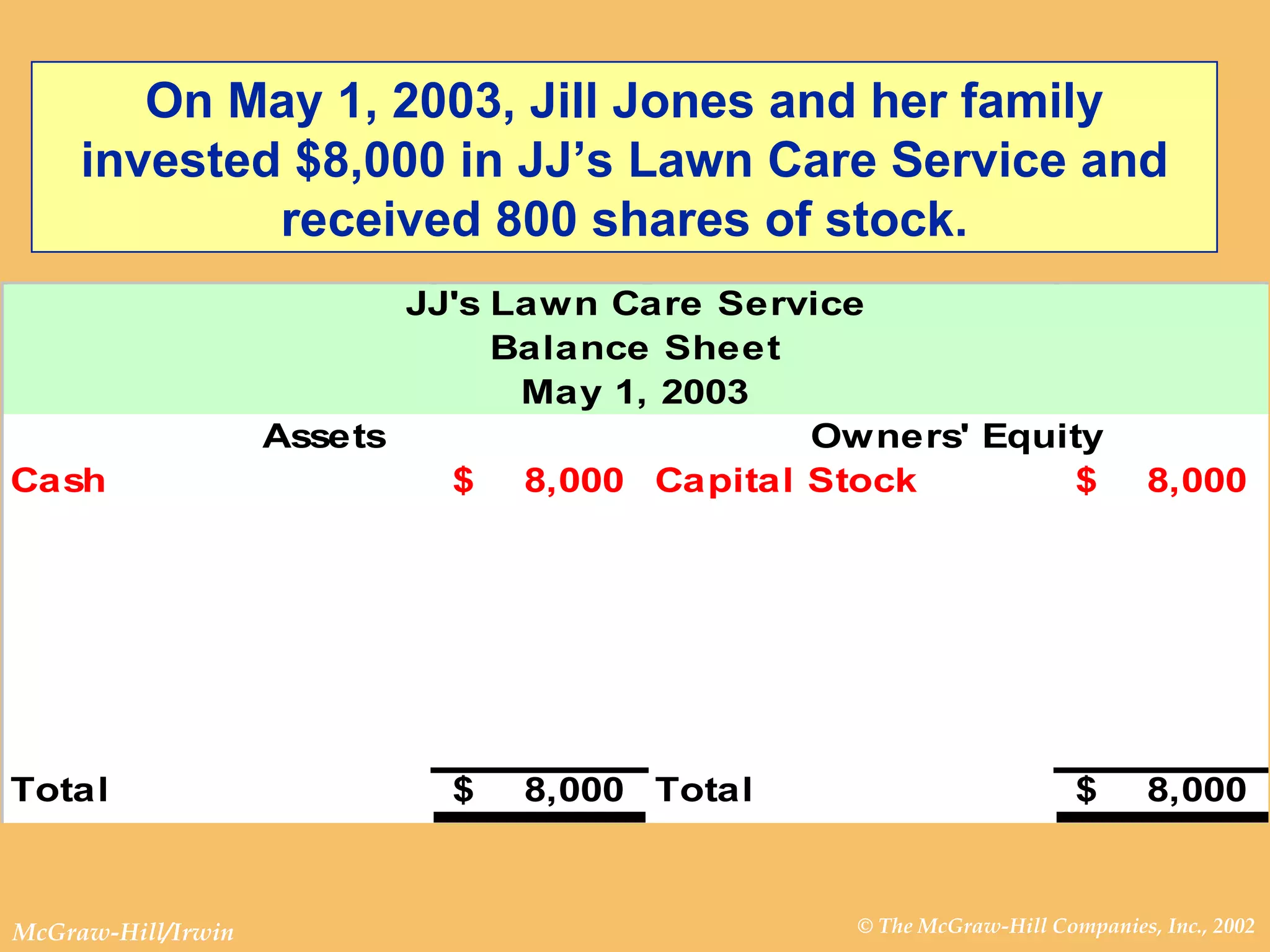
On May 1, 2003, Jill Jones and her family invested $8,000 in JJ’s Lawn Care Service and received 800 shares of stock.
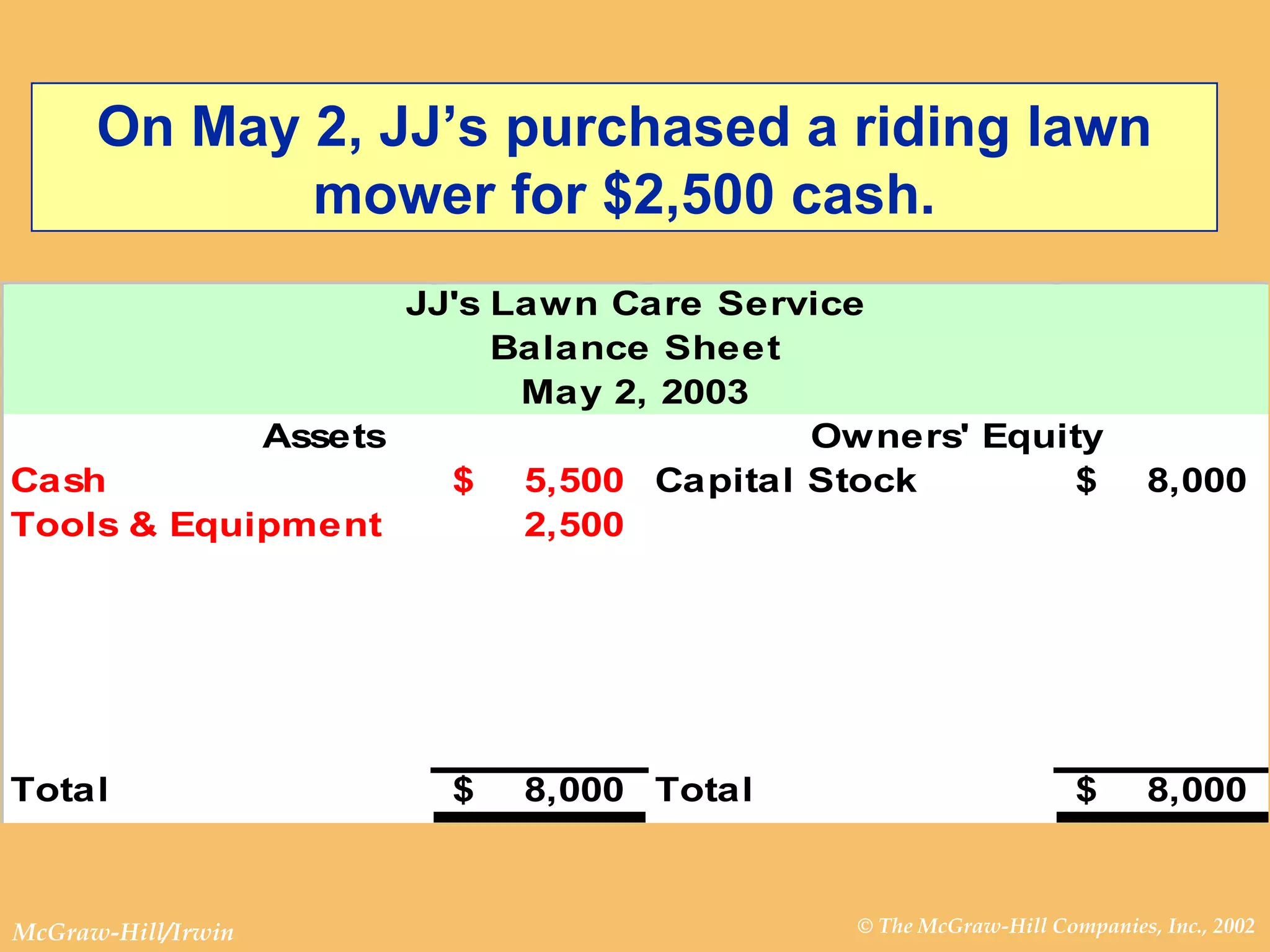
On May 2, JJ’s purchased a riding lawn mower for $2,500 cash.
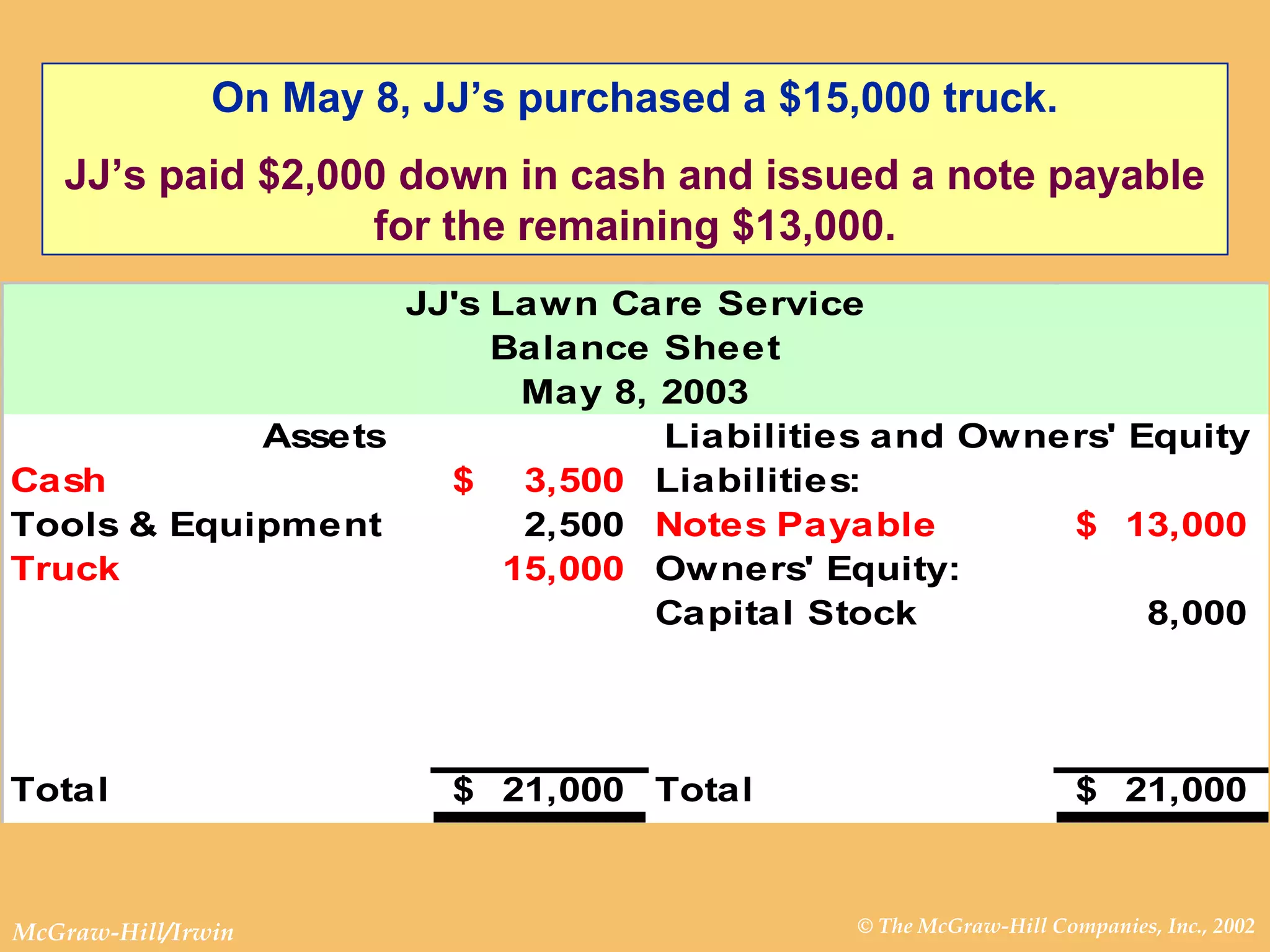
On May 8, JJ’s purchased a $15,000 truck. JJ’s paid $2,000 down in cash and issued a note payable for the remaining $13,000.
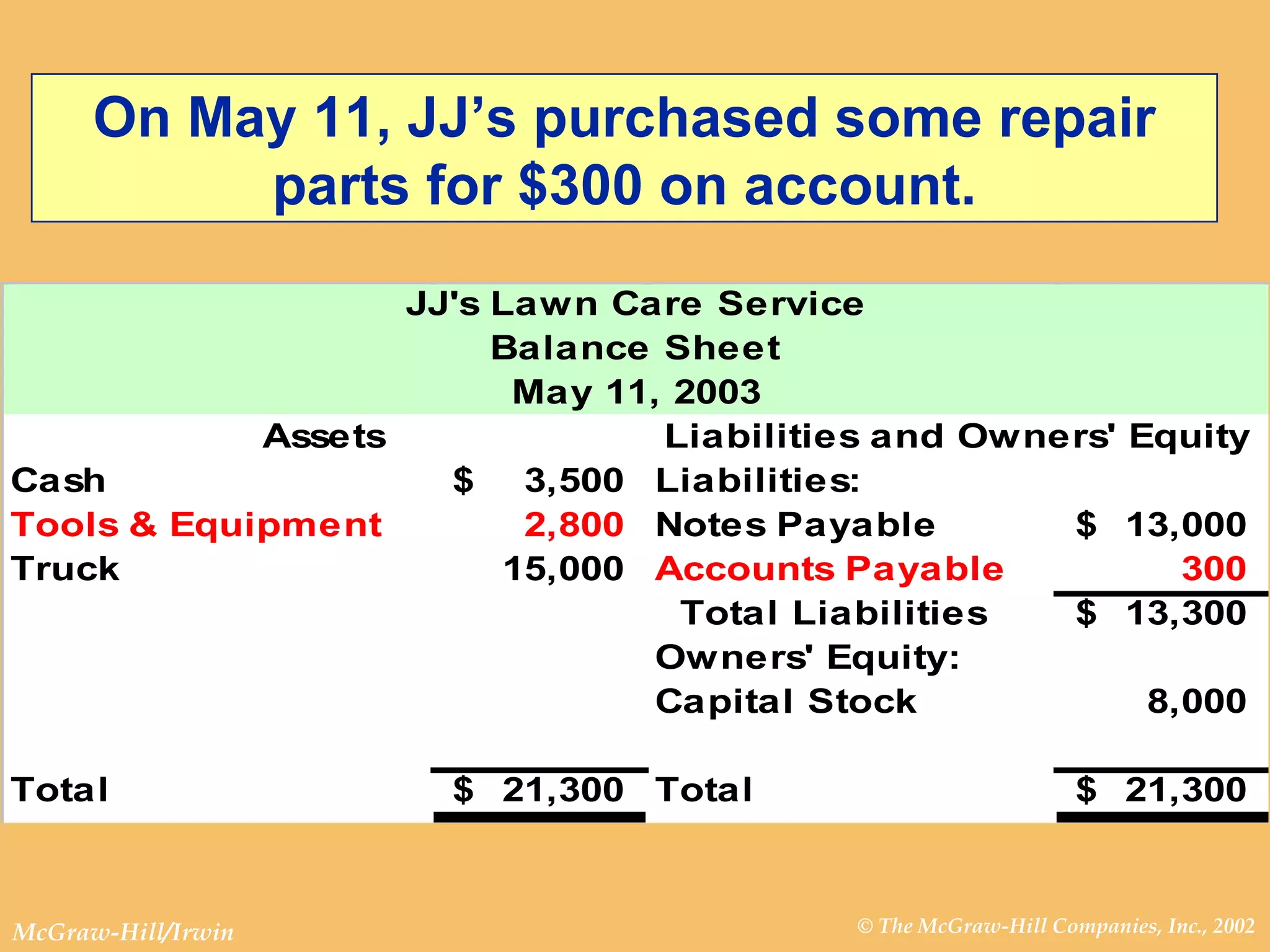
On May 11, JJ’s purchased some repair parts for $300 on account.
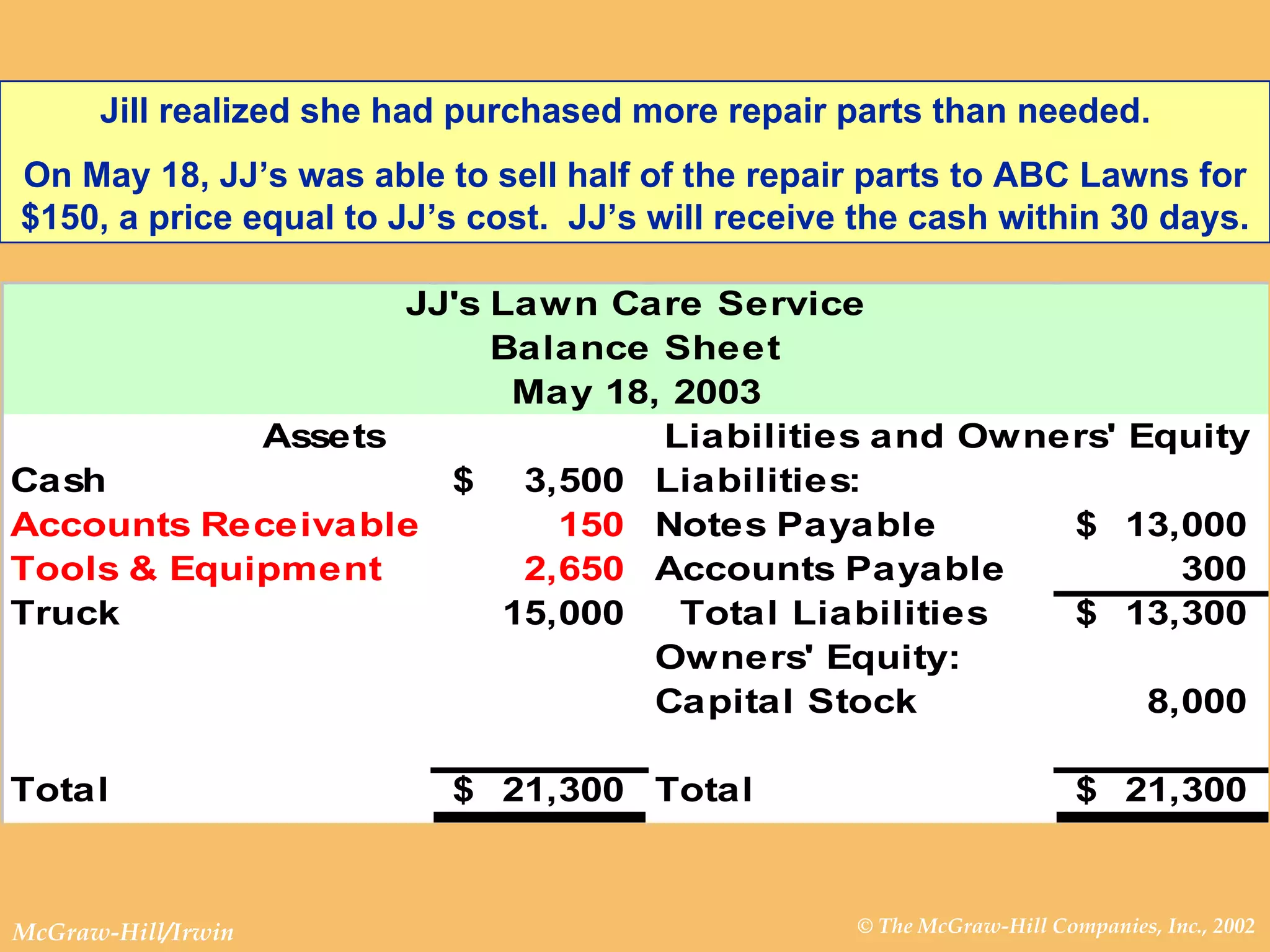
Jill realized she had purchased more repair parts than needed.  On May 18, JJ’s was able to sell half of the repair parts to ABC Lawns for $150, a price equal to JJ’s cost.  JJ’s will receive the cash within 30 days.
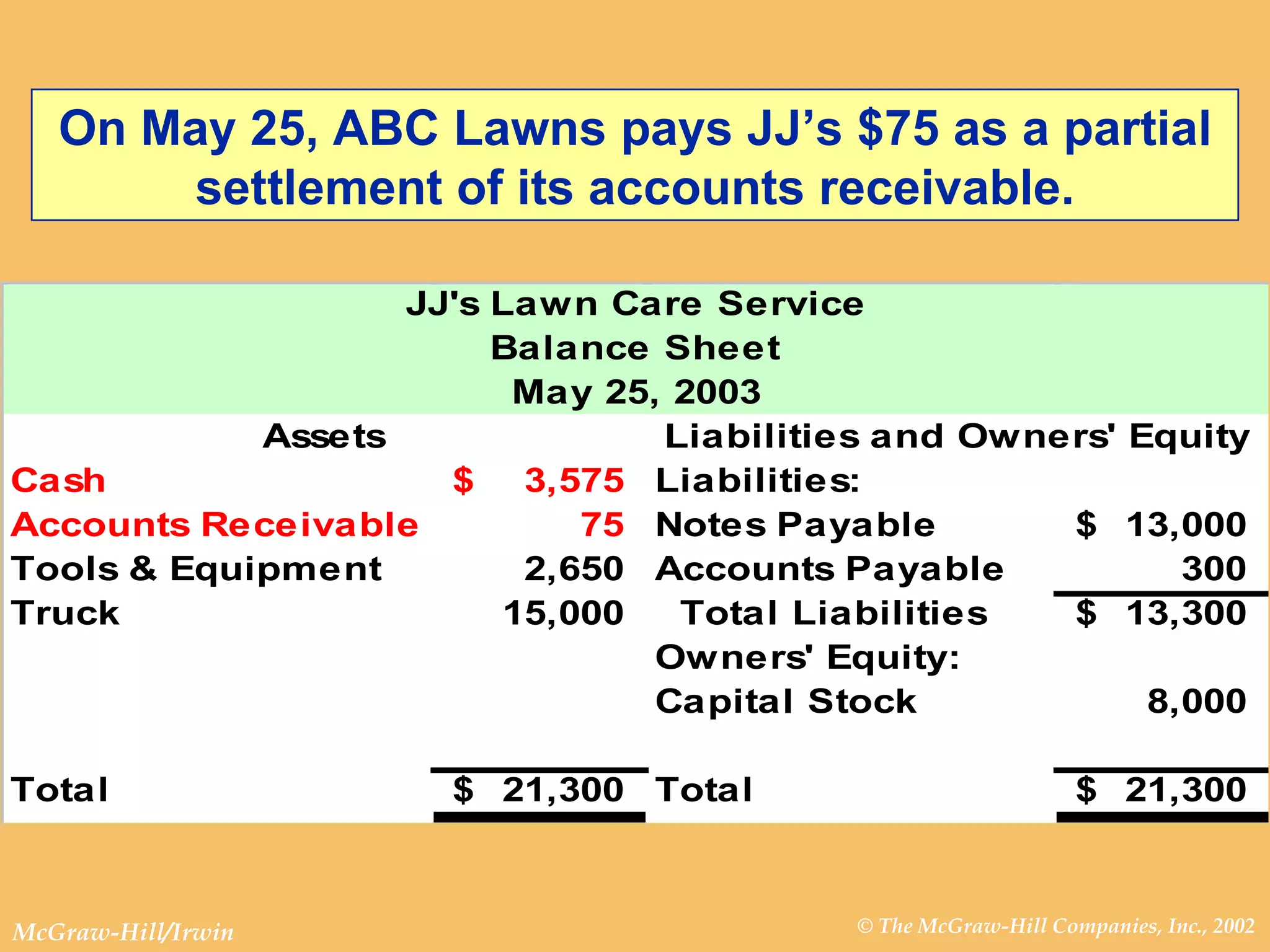
On May 25, ABC Lawns pays JJ’s $75 as a partial settlement of its accounts receivable.
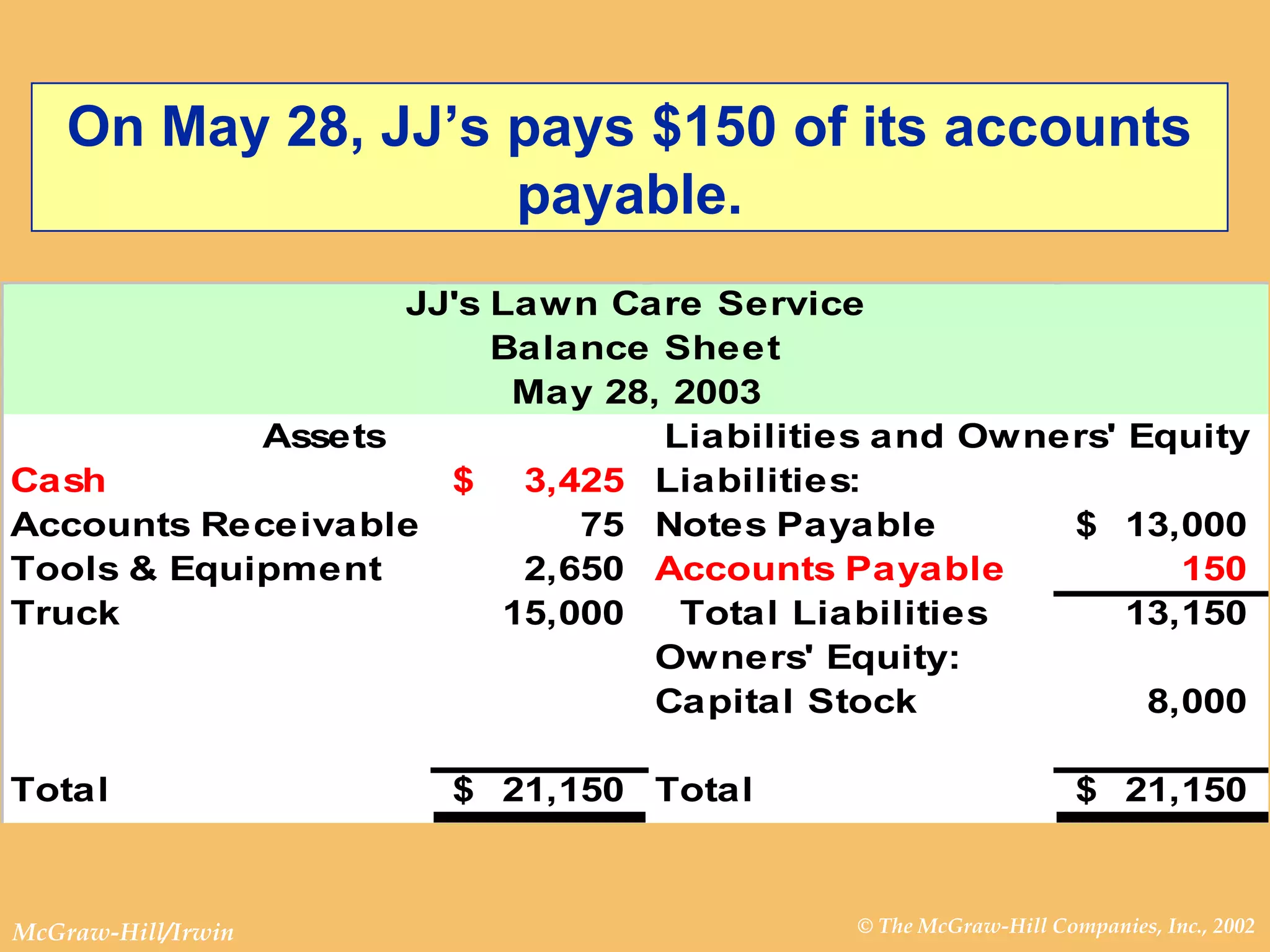
On May 28, JJ’s pays $150 of its accounts payable.
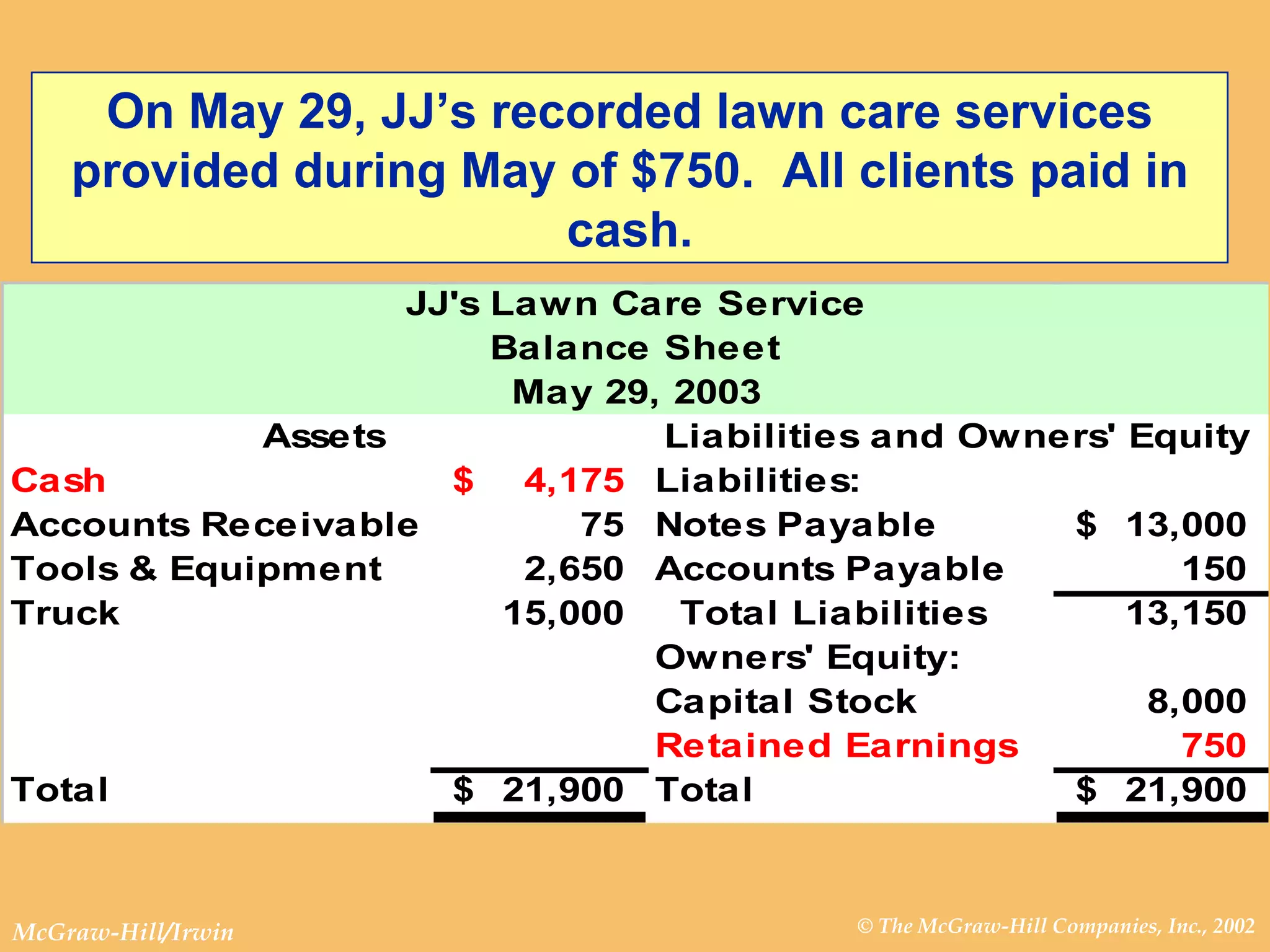
On May 29, JJ’s recorded lawn care services provided during May of $750.  All clients paid in cash.
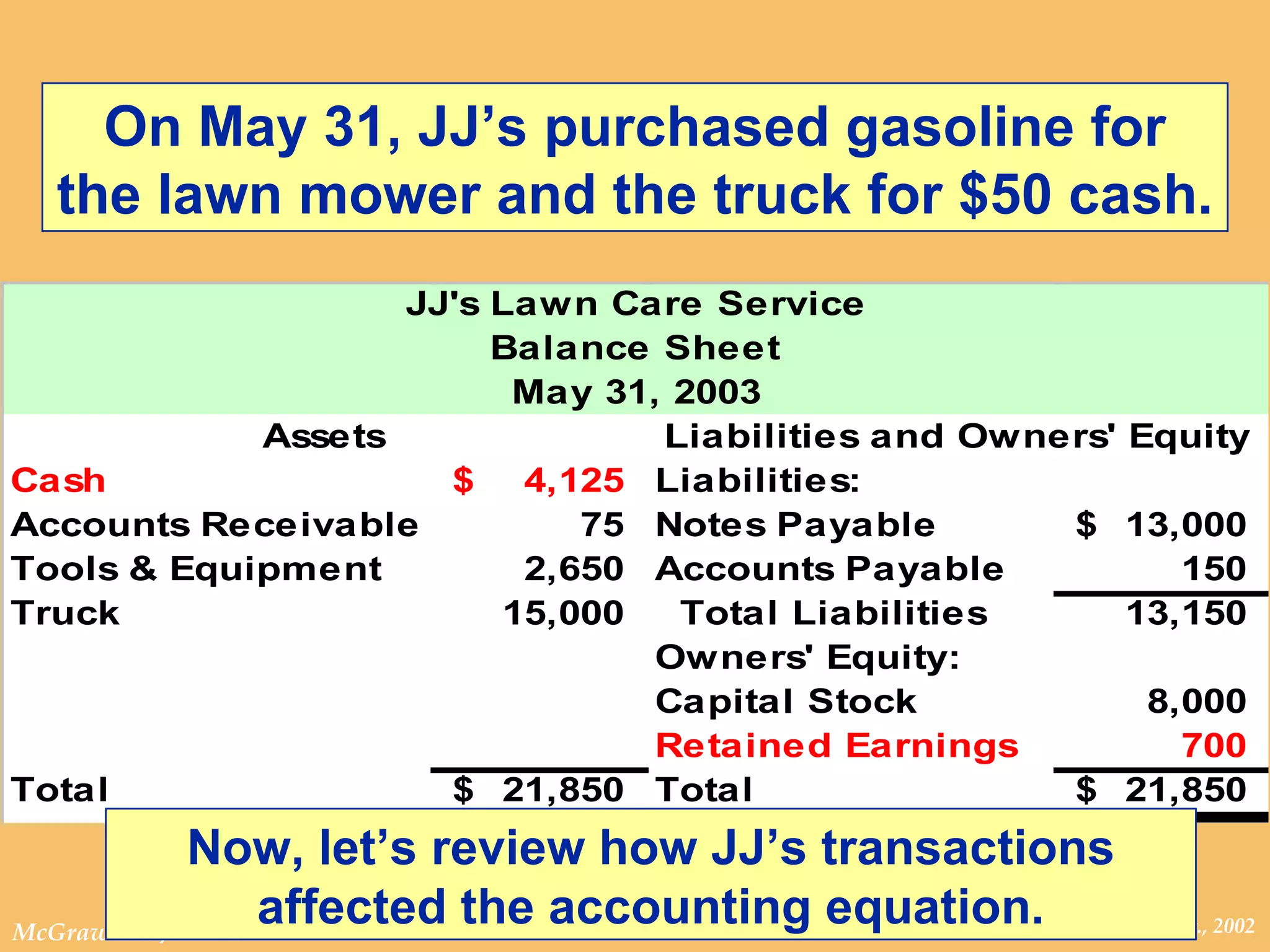
Now, let’s review how JJ’s transactions affected the accounting equation. On May 31, JJ’s purchased gasoline for the lawn mower and the truck for $50 cash.
 
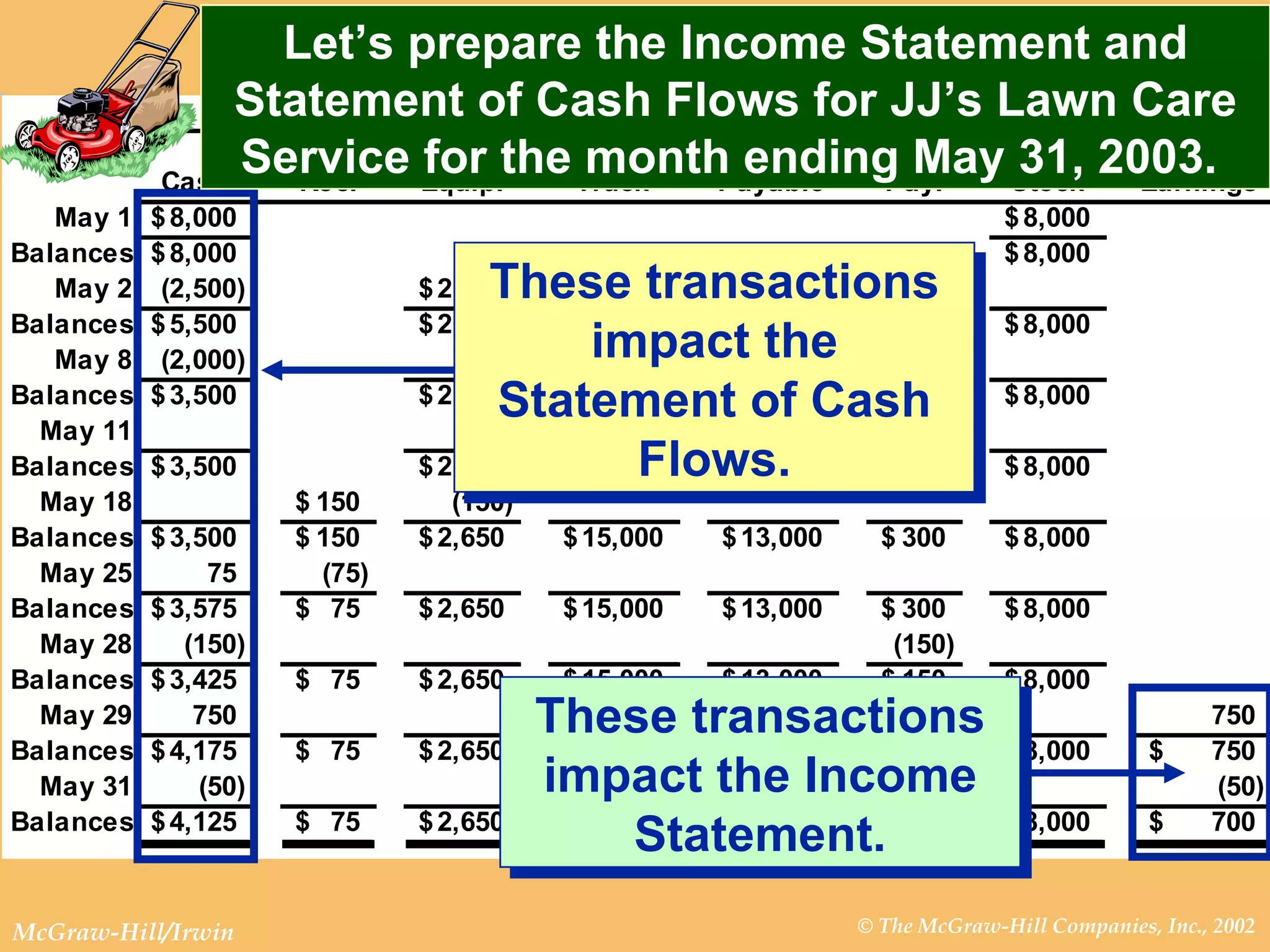
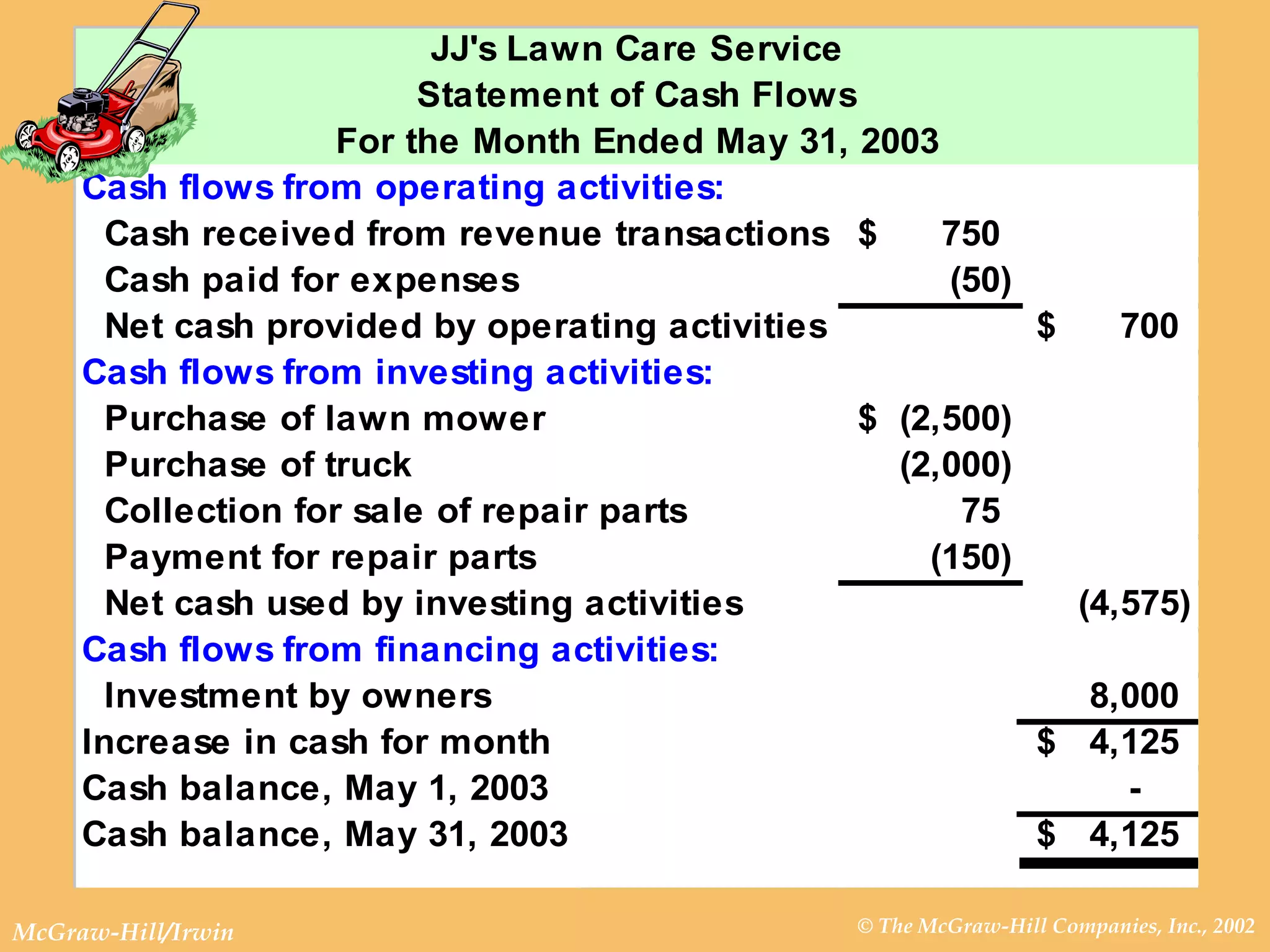
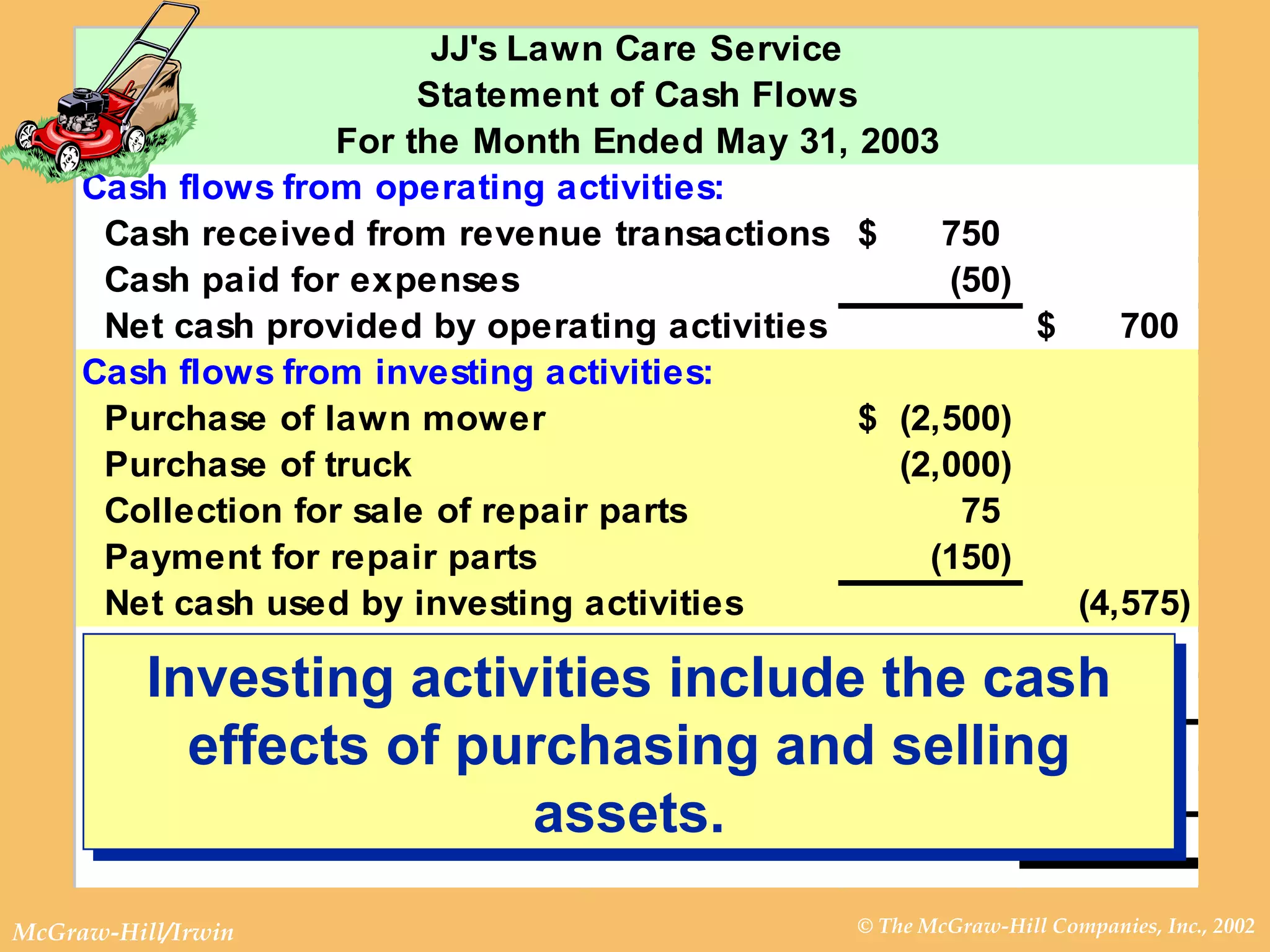
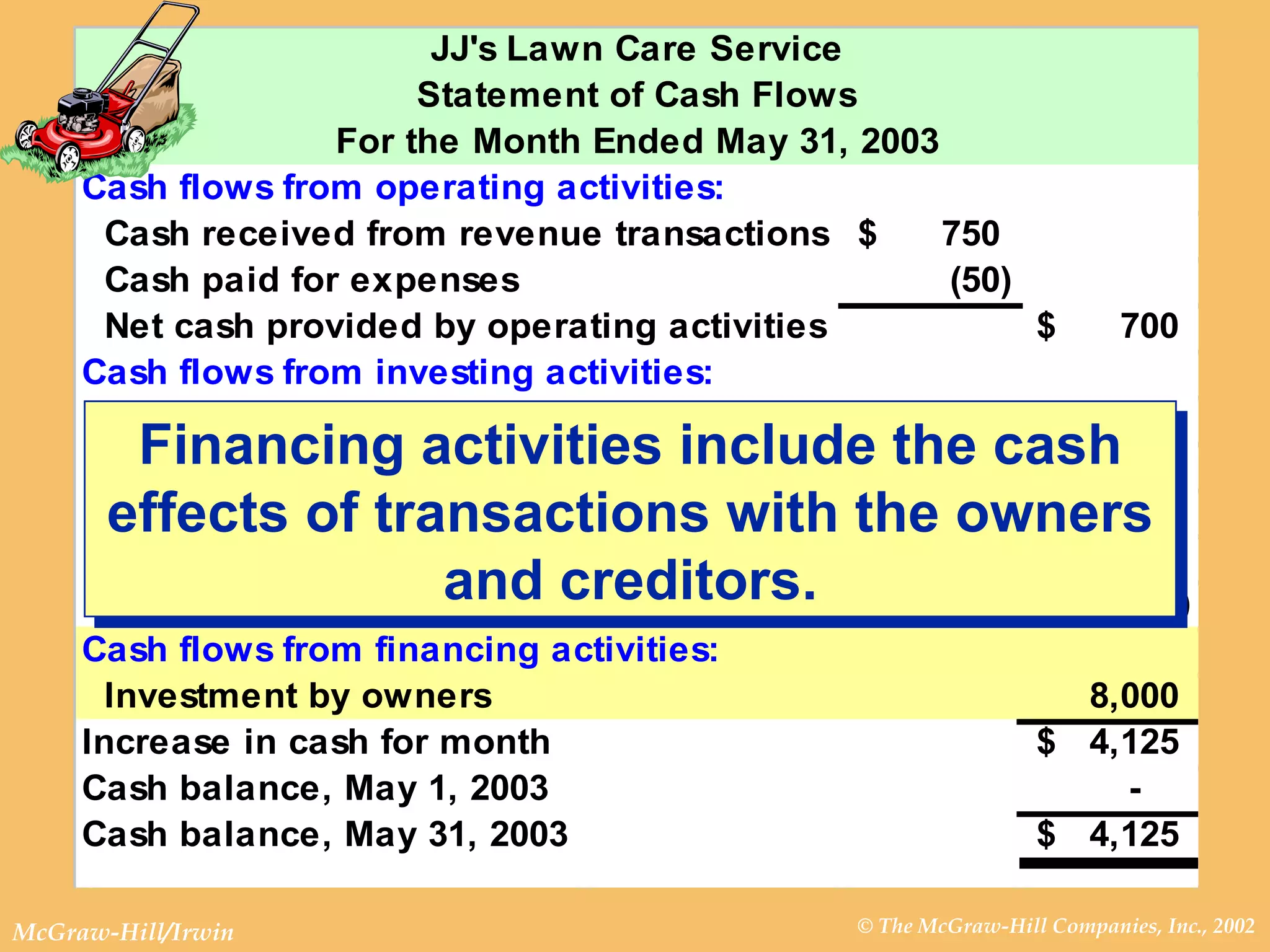
Let’s prepare the Income Statement and Statement of Cash Flows for JJ’s Lawn Care Service for the month ending May 31, 2003.  These transactions impact the Statement of Cash Flows. These transactions impact the Income Statement.
Investments by and payments to the owners are  not  included on the Income Statement.
 
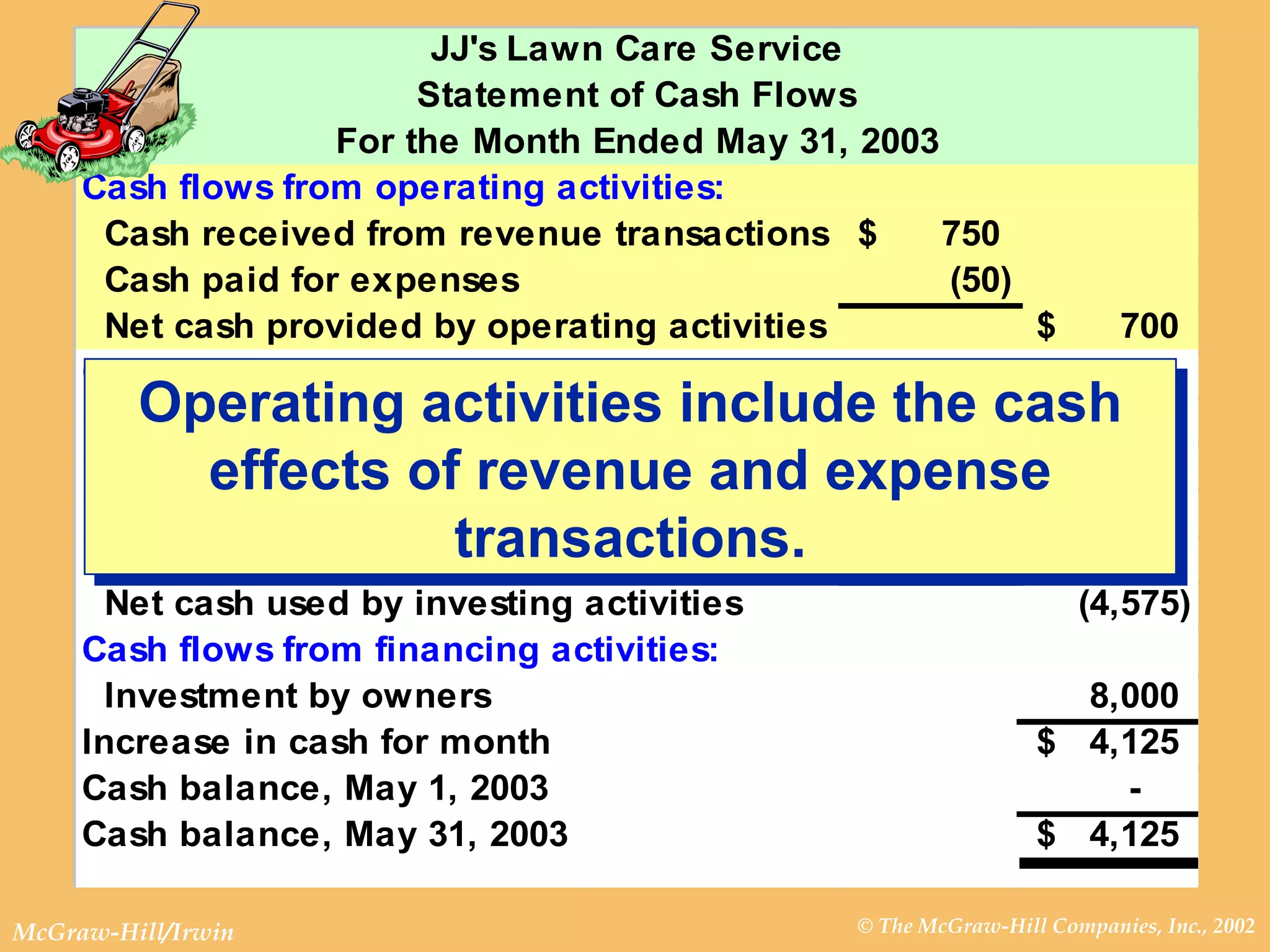
Operating activities include the cash effects of revenue and expense transactions.
Investing activities include the cash effects of purchasing and selling assets.
Financing activities include the cash effects of transactions with the owners and creditors.
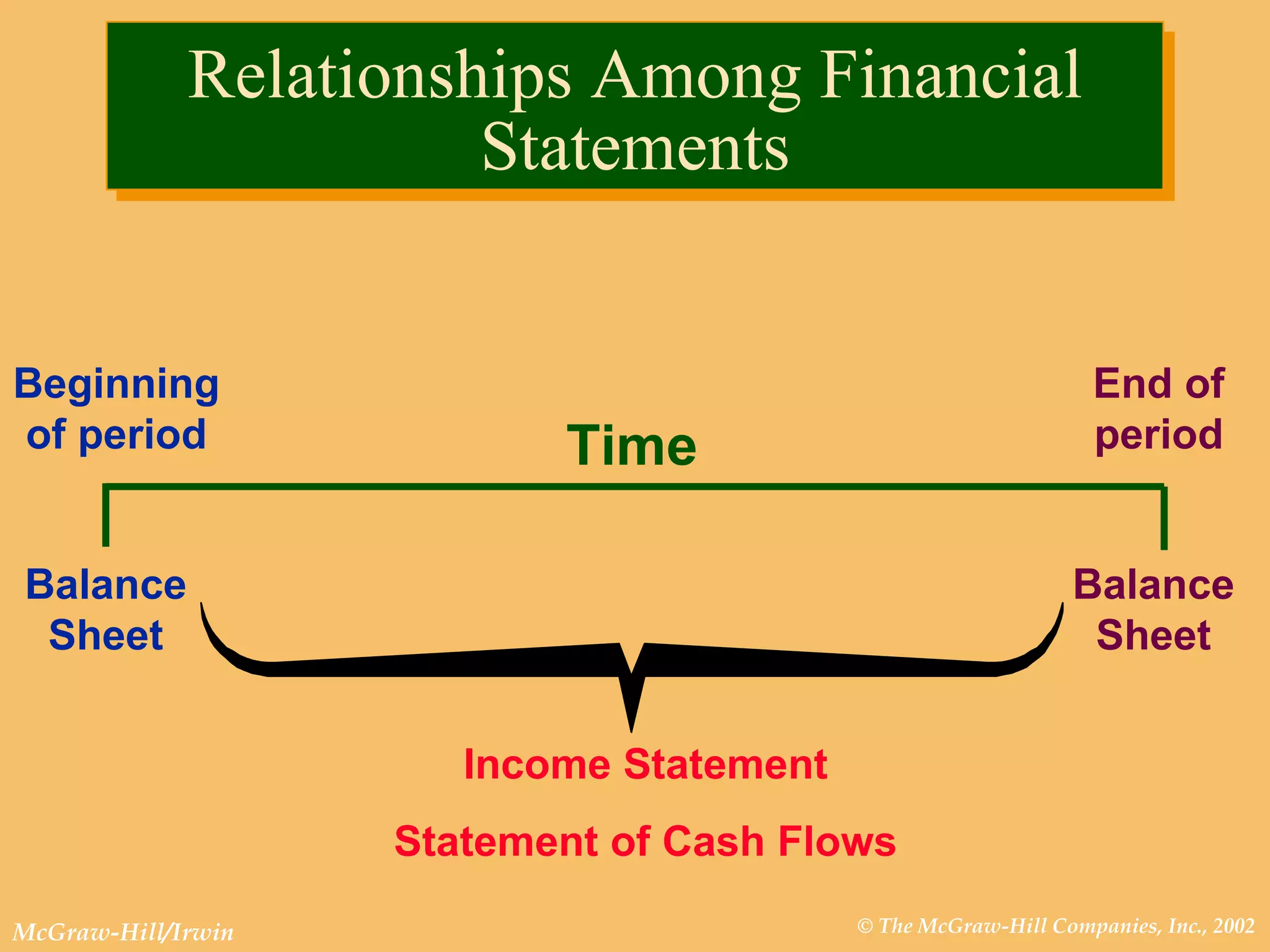
Relationships Among Financial Statements Beginning of period End of period Balance Sheet Balance Sheet Time Income Statement Statement of Cash Flows
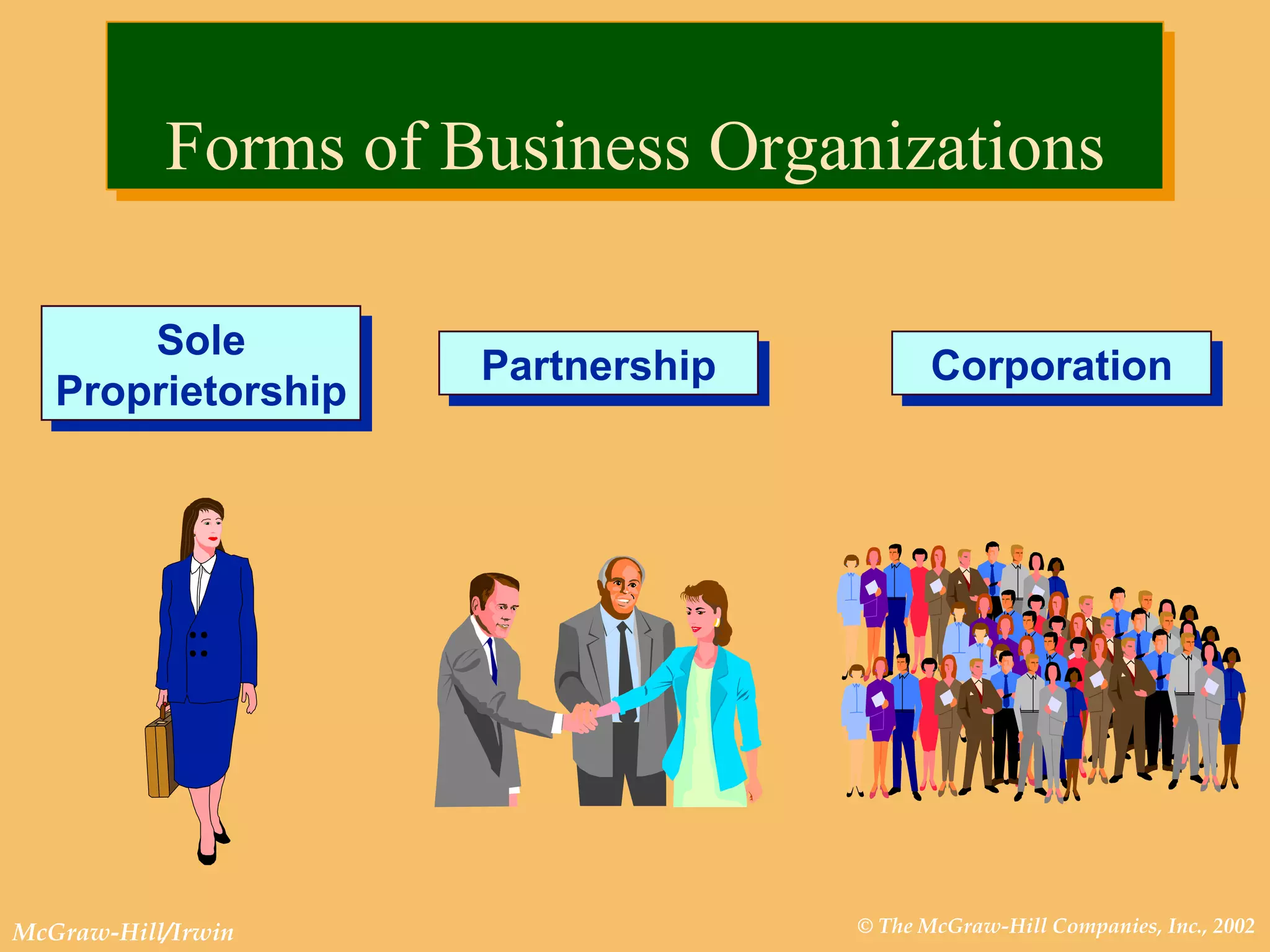
Forms of Business Organizations Sole Proprietorship Partnership Corporation
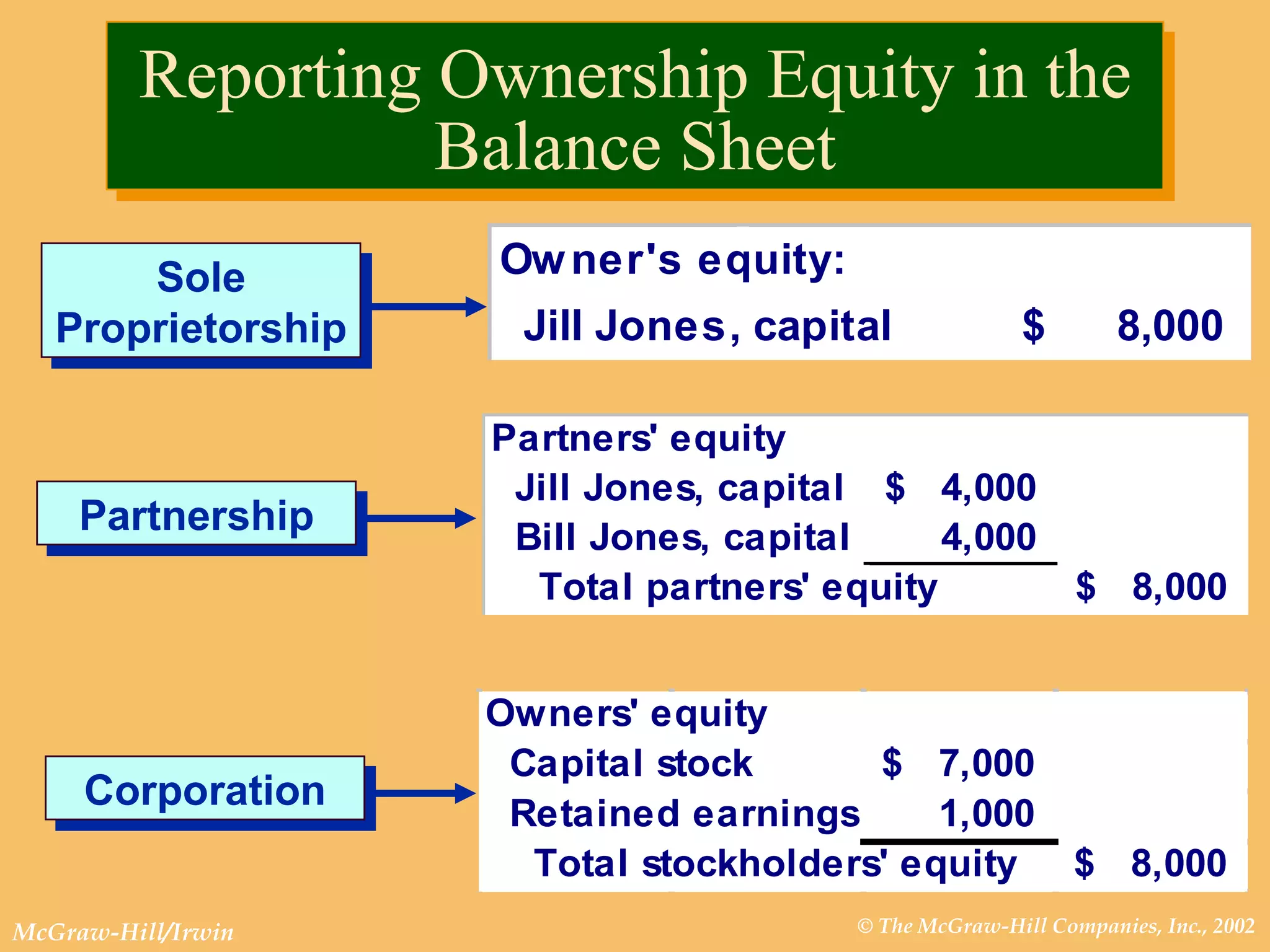
Reporting Ownership Equity in the Balance Sheet Sole Proprietorship Partnership Corporation
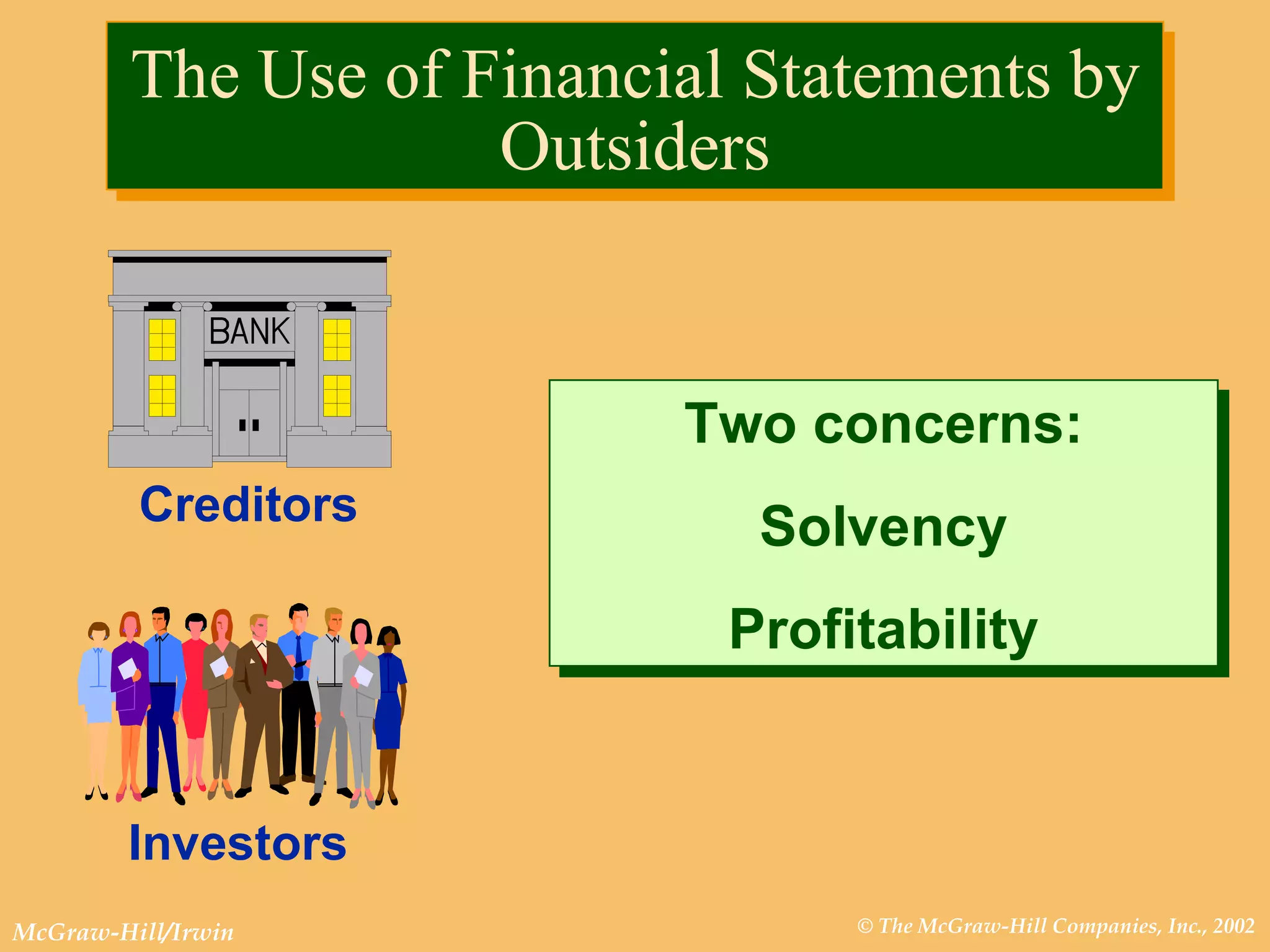
The Use of Financial Statements by Outsiders Creditors Investors Two concerns: Solvency Profitability
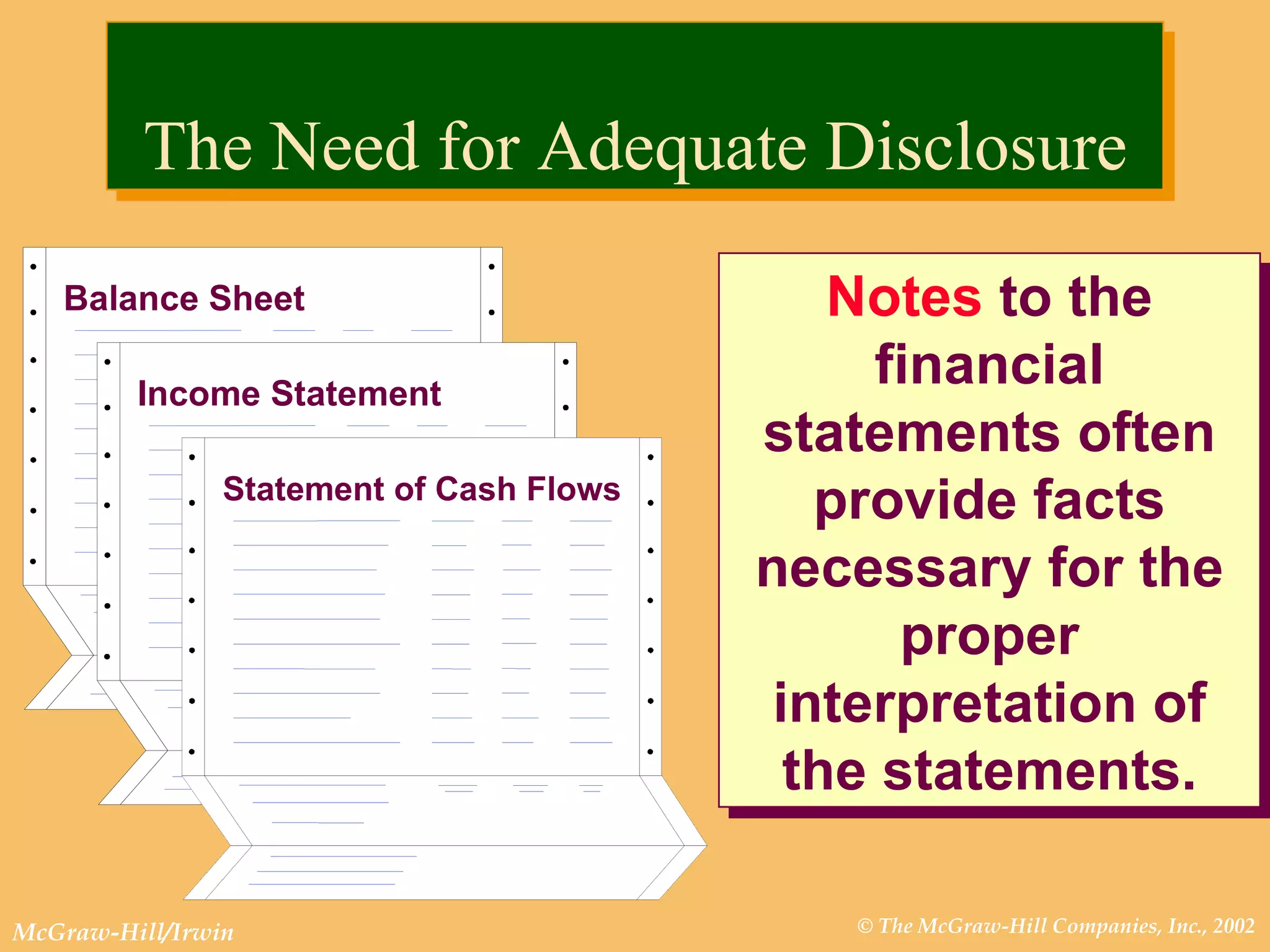
The Need for Adequate Disclosure Notes  to the financial statements often provide facts necessary for the proper interpretation of the statements. Income Statement Balance Sheet Statement of Cash Flows
End of Chapter 2

Whbm02

  • 1.
  • 2.
    Introduction to FinancialStatements Companies prepare interim financial statements and annual financial statements . 2000 X
  • 3.
    Introduction to FinancialStatements Three primary financial statements. Income Statement Balance Sheet Statement of Cash Flows We will use a corporation to describe these statements.
  • 4.
    Introduction to FinancialStatements Describes where the enterprise stands at a specific date . Income Statement Balance Sheet Statement of Cash Flows
  • 5.
    Introduction to FinancialStatements Depicts the revenue and expenses for a designated period of time . Income Statement Balance Sheet Statement of Cash Flows
  • 6.
    Introduction to FinancialStatements Revenues result in positive cash flow. Expenses result in negative cash flow. Either in the past, present, or future.
  • 7.
    Introduction to FinancialStatements Net income (or net loss) is simply the difference between revenues and expenses. Income Statement Balance Sheet Statement of Cash Flows
  • 8.
    Introduction to FinancialStatements Depicts the ways cash has changed during a designated period of time . Income Statement Balance Sheet Statement of Cash Flows
  • 9.
    The Concept ofthe Business Entity Vagabond Travel Agency A business entity is separate from the personal affairs of its owner.
  • 10.
    A Starting Point: Statement of Financial Position
  • 11.
    Assets Assets are economic resources that are owned by the business and are expected to provide positive future cash flows.
  • 12.
    Assets Cost PrincipleGoing-Concern Assumption Objectivity Principle Stable-Dollar Assumption These accounting principles support cost as the basis for asset valuation.
  • 13.
    Liabilities Liabilities are debts that represent negative future cash flows for the enterprise.
  • 14.
    Owners’ Equity Owners’equity represents the owner’s claim to the assets of the business.
  • 15.
    Owners’ Equity Changesin Owners’ Equity Owners’ Investments Business Earnings Payments to Owners Business Losses
  • 16.
    The Accounting EquationAssets = Liabilities + Owners’ Equity $300,000 = $80,000 + $220,000
  • 17.
    Let’s analyze sometransactions for JJ’s Lawn Care Service.
  • 18.
    On May 1,2003, Jill Jones and her family invested $8,000 in JJ’s Lawn Care Service and received 800 shares of stock.
  • 19.
    On May 2,JJ’s purchased a riding lawn mower for $2,500 cash.
  • 20.
    On May 8,JJ’s purchased a $15,000 truck. JJ’s paid $2,000 down in cash and issued a note payable for the remaining $13,000.
  • 21.
    On May 11,JJ’s purchased some repair parts for $300 on account.
  • 22.
    Jill realized shehad purchased more repair parts than needed. On May 18, JJ’s was able to sell half of the repair parts to ABC Lawns for $150, a price equal to JJ’s cost. JJ’s will receive the cash within 30 days.
  • 23.
    On May 25,ABC Lawns pays JJ’s $75 as a partial settlement of its accounts receivable.
  • 24.
    On May 28,JJ’s pays $150 of its accounts payable.
  • 25.
    On May 29,JJ’s recorded lawn care services provided during May of $750. All clients paid in cash.
  • 26.
    Now, let’s reviewhow JJ’s transactions affected the accounting equation. On May 31, JJ’s purchased gasoline for the lawn mower and the truck for $50 cash.
  • 27.
  • 28.
    Let’s prepare theIncome Statement and Statement of Cash Flows for JJ’s Lawn Care Service for the month ending May 31, 2003. These transactions impact the Statement of Cash Flows. These transactions impact the Income Statement.
  • 29.
    Investments by andpayments to the owners are not included on the Income Statement.
  • 30.
  • 31.
    Operating activities includethe cash effects of revenue and expense transactions.
  • 32.
    Investing activities includethe cash effects of purchasing and selling assets.
  • 33.
    Financing activities includethe cash effects of transactions with the owners and creditors.
  • 34.
    Relationships Among FinancialStatements Beginning of period End of period Balance Sheet Balance Sheet Time Income Statement Statement of Cash Flows
  • 35.
    Forms of BusinessOrganizations Sole Proprietorship Partnership Corporation
  • 36.
    Reporting Ownership Equityin the Balance Sheet Sole Proprietorship Partnership Corporation
  • 37.
    The Use ofFinancial Statements by Outsiders Creditors Investors Two concerns: Solvency Profitability
  • 38.
    The Need forAdequate Disclosure Notes to the financial statements often provide facts necessary for the proper interpretation of the statements. Income Statement Balance Sheet Statement of Cash Flows
  • 39.