2
Colophon
This is an integrated thesis combining english and Communication
English Supervisor: Anne Fabricius
Communication Supervisor: Mira Skadegaard Thorsen
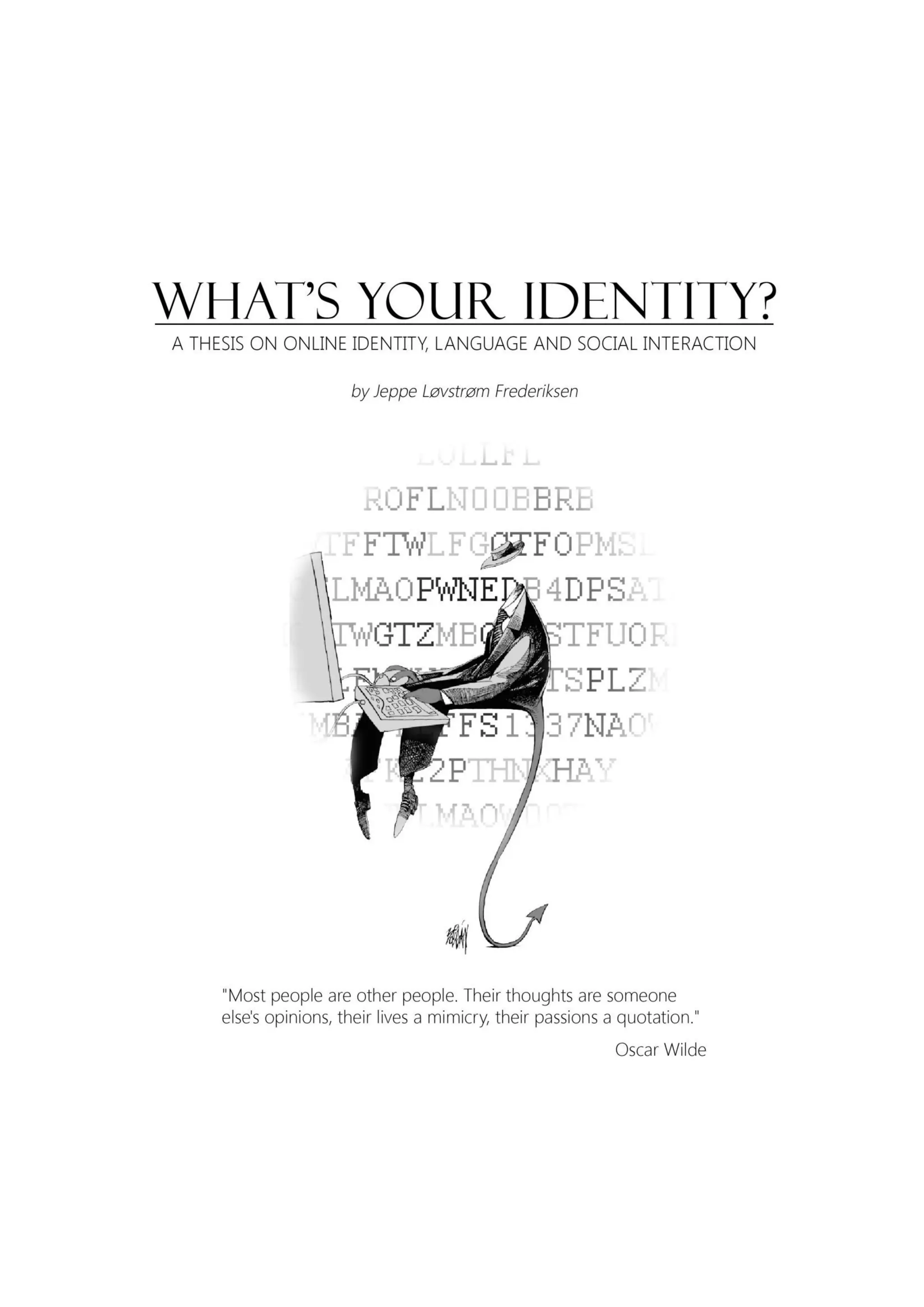
Frontpage picture: Internet and Identity, Angel Boligan, El Universal, Mexico City
For educational purposes only, no copyright infringement intended
A special thank you to the guilds ‘the exiled’ and Third Day
3
Table of contents
Preface .................................................................................................................................................5
1. Introduction..................................................................................................................................6
1.1 Composition ........................................................................................................................14
2. Problem Field..............................................................................................................................15
2.1 Problem definition...............................................................................................................17
3. Theory.........................................................................................................................................18
3.1 Defining key terms ..............................................................................................................18
3.2 Jan Blommaert.....................................................................................................................22
3.3 Norman Fairclough..............................................................................................................25
3.4 Erving Goffman....................................................................................................................26
3.5 Michel Maffesoli..................................................................................................................28
3.6 Celia Pearce.........................................................................................................................30
4. Method .......................................................................................................................................34
4.1 Gathering empirical data.....................................................................................................36
4.2 Ethnographic fieldwork.......................................................................................................40
4.3 Case study – What is World of Warcraft?...........................................................................44
5. Analysis .......................................................................................................................................46
5.1 Language and culture in a virtual world..............................................................................46
5.2 English and leet speek as global languages.........................................................................53
5.3 Avatars – shaping your online identity................................................................................55
5.4 Guilds – a social marker ......................................................................................................58
4
5.5 Dissolving the social filter....................................................................................................63
5.6 A look at gamer culture.......................................................................................................66
6. Discussion ...................................................................................................................................71
7. Conclusion...................................................................................................................................74
8. Perspective .................................................................................................................................75
Bibliography .......................................................................................................................................78
Books..............................................................................................................................................78
Articles............................................................................................................................................79
Appendix ............................................................................................................................................80
1. Screenshots.............................................................................................................................81
2. Forum thread ..........................................................................................................................83
3. Interviews................................................................................................................................93
4. Article....................................................................................................................................108
5
Preface
On November 23, 2004 the online gaming experience changed forever. It was the launch date of
the highly anticipated game World of Warcraft. Destined to become a worldwide phenomenon it
quickly gained fame and reputation amongst gamers. I was one of them. It was clear to me then
that this game had a durability and progression rate rarely seen in games of that time. Ever since
the launch, the franchise has grown rapidly, but has now stagnated to roughly 12 million
subscribers worldwide. This is more than twice the population of Denmark.
Being a gamer is just a hobby to me, but there are people who see it as a way of life, as a culture a
place of belonging. My motivation for doing a thesis on an emerging subculture was clear. I
wanted to investigate new territory and approach it through social sciences dealing with culture
and language. I wanted to combine the use of English language and theories on communication in
a postmodern world.
I am fully aware that my conclusion only represents a fragment of plausible conclusions to the very
problem, and that the conclusion reflects the context in which it is conceived and written.
However I do hope that you will enjoy reading my thesis as much as I have enjoyed working with
the topic at hand.
Regards, Jeppe Løvstrøm Frederiksen
6
1. Introduction
This chapter is a short introduction to what the thesis will focus on, and also why I find the topic of
internet subcultures and their use of language and social interaction interesting. It will provide a
look at the growing use of the internet and one of the many sub-cultures it has spawned.
This is an integrated thesis between the departments of English and Communication and will
combine theories derived from both subjects. The focus of the thesis is social interaction and
language. These are approached particularly using Communication theory and communicative
tools. On the other hand, the primary research object is written English in an online context. The
sociolinguistic approaches used throughout the thesis deal primarily with English as a lingua
franca1
, as a world language. The way I see it, the connection between English and Communication
is obvious in this case. The use of English as means of communication is vital to global
understanding on the internet. In my opinion they complement each other in this case, as English
is the language used within the case studied.
The thesis deals with the internet as a communication platform, but also how this new way of
communication can offer alternative ways of communicating. It will try to examine the positive as
well as the negative effects of a medium as uncontrolled as the internet when it is used by people
to communicate. This might seem overly ambitious, but what I want to look into is simply the use
and abuse that goes along with the freedom of speech online. The internet culture has emerged
very rapidly and some claim it has changed the way we think and act. An example of how the
internet has changed the way we think is the term to “google”. Instead of going to the library and
search for answers in a book, it has become easier to just “google” for knowledge. Unfortunately,
this could lead to a lack of critical approach to knowledge gained. The phrase “if it’s on the
internet, it must be true” is a joke on its own. Sociolinguist David Crystal argues in his book
Language and the Internet that:
The Internet is one of the most remarkable things human beings have ever made. In terms
of its impact on society, it ranks with print, the railways, the telegraph, the automobile,
electric power and television. Some would equate it with print and television, two earlier
1
A shared language of communication used between people whose main languages are different. (Wehmeier,
2005:896)
7
technologies which most transformed the communications environment in which people
live. Yet it is potentially more powerful than both because it harnesses the intellectual
leverage which print gave to mankind without being hobbled by the one-to-many nature
of broadcast television. (Crystal, 2006:ix)
As Crystal suggests, the power of the internet lies within the interactivity and possibility for
everyone with access to take part in the phenomenon (Crystal, 2006:5). And as such the internet
allows for infinite ways of expressing yourself. The internet culture is an emergent culture as
Game Designer Celia Pearce states:
The Internet is just such an accelerating technology, and emergent social processes that
might take years to play out in real life, such as the example of intergame immigration
chronicled in this book, can happen in a matter of months, weeks or even days. The speed
of communication enabled by the Internet allows for a kind of snowball effect in terms of
feedback dynamics. People tend to follow trends among their peers, not, as some might
cynically suppose, because people behave like sheep, but because as Schelling’s model
suggests, they wish to maintain a connection to a community. Thus, as with his
segregation example, we find numerous instances of humans gathering, moving, and
assembling based on a desire to join or to remain proximal to a community with which
they identify. (Pearce, 2009:39)
Pearce’s quote delivers a glimpse into how online communities work. These communities are fast,
mobile and emergent in behavior. The internet allows for individuals to fit into sub-cultures and
create identities they cannot have in the real world. I will define the real world as what goes on at
a physical level in everyday life e.g. conversations between persons face-to-face, and the virtual
world is defined as communication through avatars or other means of identity – altering
alternatives online e.g. Facebook profiles, YouTube comments.
The overall aim of the thesis is an analysis of social interaction on the internet. Another aim of the
thesis is to look at how language use and identity comes into play when the user is hiding behind a
screen. Something happens with the way we communicate when we do not have the face-to-face
contact. We adapt to the new media of the internet and this calls for new ways of communicating
(Crystal, 2006:257).
8
The internet is still a quite new phenomenon and as such the impact is uncertain, but when it
comes to language David Crystal argues that:
The Internet has not yet had a major impact on English vocabulary and use. Perhaps this is
not surprising, given that is has been in existence only for a generation – an eyeblink, in
terms of language chronology. But when words do begin to come into general use, what
the Internet does is spread the words around the globe faster than has ever been possible
before. (Crystal, 2004: viii)
Social interaction is a combination of speech and gestures and within this combination we also
find language and identity. I see language and identity as abstract concepts that define and create
each other. According to Omoniyi, language defines and constitutes identity and culture and the
way people perceive us, and also how we perceive people. As the introduction from The
Sociolinguistics of Identity says:
*…+ The sociolinguistics of identity focuses on the ways in which people position or
construct themselves and are positioned or constructed by other in socio-cultural
situations through the instrumentality of language and with reference to all of those
variables that are identity markers for each society in the speech of its members.
(Omoniyi, 2006:1)
If we analyze the statement above, we can argue that we are all social constructs. The relation
between the different factors of language, identity and social interaction all come into play in the
science of social constructivism. Social constructivism deals with the relation between how
knowledge is created and perceived, and also how linguistic and conceptual categories are
observed, described and understood.
This definition of social constructivism is translated from the reference book Klassisk og Moderne
Samfundsteori2
In a social constructivist perspective knowledge is a social activity in line with other social
activities, in which linguistic and conceptual categories are developed, these are then used
again to describe and understand what we observe. Knowledge is thus produced and not
2
The definition has been translated from Danish. This can result in minor changes in meaning.
9
determined in advance waiting to be discovered, and this ought and should be the study
subject of how this knowledge emerges. (Andersen, 2005:617)
Language is constructed through use, but through the use, it is also re-constructed. As an overall
frame for looking at internet-based language and culture, I will use social constructivism as a
meta-frame because even on the internet we are constructing social behavior through the use of
language and other means of expression. It is also worth noticing that internet usage in general is
a social construct, because if no one used it, it would lose its importance, probably cease to exist.
It would still be there regardless of how many users it had, but the idea of it as a shared free
media would collapse if people stopped using it and its possibilities. The internet is a social media
which provides new ways for sharing knowledge and opinions. Furthermore social constructivism
deals with culture and shared meanings.
Basically it is an advanced form of ‘learning by doing’, as we keep repeating habits and alter them
to fit new encounters every day. It is through social interaction we construct our identities, and
also here we perceive the identities of others.
As my primary goal is to analyze the language and social interaction of World of Warcraft, which is
an MMORPG (Massive Multi-player Online Role Playing Game) that is currently inhabited by 12
million active players3
, and its gamers, social constructivism is a suitable theoretical approach to
apply as an over-all view on the thesis. I use the word inhabit as some people spend a large
amount of their time in these virtual worlds.
As such it is a dialectic relation between the use and perception of language that enables us to
understand and decode social actions. We need specific contexts to perceive and thus make
meaning of communication through language use. This is known as pragmatics4
. There are several
different approaches to analyzing and decoding language in order for us to make meaning of
sentences or text5
:
3
Numbers taken from game developer blizzard at http://eu.blizzard.com/en-
gb/company/press/pressreleases.html?101007 13/10 - 2010
4
http://en.wikipedia.org/wiki/Pragmatics 1/11 - 2010
5
Text here referred to as an abstract concept
10
I shall use the term text in a very broad sense. Written and printed texts such as shopping
lists and newspaper articles are ´texts´, but so also are transcripts of (spoken)
conversations and interviews, as well as television programmes and webpages. We might
say that any actual instance of language in use is a ´text´. (Fairclough, 2003:3)
Fairclough’s definition of “text” as an abstract subject fits perfectly with the way I wish to analyze
the empirical data, which contains chatlogs, forum comments, ethnographic fieldwork, and
interviews to get a clearer picture of the gamer culture as a whole. Common for all of the data is
that it revolves around language and social interaction. The gaming society has a codified language
referred to as leet speek6
which exists in many different forms online with small variations
differing from game to game.
The main focus of this thesis is written language, and mainly the written language used online by
internet users. However the number of people using the internet exceeds my means of data
collecting and analyzing, and as such I have chosen to focus on a small group of people who
actively use the internet and who are part of an active, global culture. The particular target
audience is that of WoW gamers.
Games in all shapes and sizes have been around since humanity inhabited the earth. As a social
tool, but since the coming of computers and gaming consoles (e.g. Nintendo Wii, Xbox and
PlayStation) it has turned into an industry with a fan base dedicated to the culture. I have chosen
not look at board games, sports, leisure activities, but only on social online activities that revolves
around gamer culture. This is primarily because the interest lies within the social interaction and
not the emergence of gaming itself.
Another focus will be on gamers who play online games and use avatars to communicate with one
another. My case study is World of Warcraft (WoW). The players are spread globally across
continents and countries including America, Asia, Russia, and Europe, and the language used by a
majority of players is English, which serves as a lingua franca, a common ground for
understanding.
6
Leet, also known as eleet or leetspeak, is an alternative alphabet for the English language that is used primarily on
the Internet. It uses various combinations of ASCII characters to replace Latinate letters. For example, leet spellings of
the word leet include 1337 and l33t; eleet may be spelled 31337 or 3l33t. (http://en.wikipedia.org/wiki/Leet) 3/9 –
2010
11
I am myself an active player of WoW, and that is what got me interested in how the English
language is used and developed through use in an online culture. I am aware that my own interest
in the topic can seem problematic, but the knowledge gained from being part of the gaming
discourse gives more advantages than disadvantages. The biggest obstacle for me will be to try
and keep the thesis open to all kinds of readers.
As a student of English and Communication I find the development of those two particular
sciences very interesting in relation to the evolution of language we see on the internet. This is a
sort of situated language practice that develops among the participants of the game at hand and
in doing so changes constantly. It is not the entire language that changes, but minor changes in
suffixes or prefixes, adding or changing meaning of words; going from “newbie” to “nab” is an
example of two words with a shared meaning.
In short, gamers have taken the English language and made small alterations to it, so that it fits
well within the gamer discourse. As such language becomes a constitutional part of a certain
culture. However, the language use in WoW reflects not only the virtual world of WoW, but the
internet culture as a whole – a culture where language use is very intertextual and some acronyms
are used widely across platforms such as YouTube, Facebook and various games. David Crystal,
states that the internet and its impact on language can be seen as a new possibility to spread
language faster than ever before.
The language on the internet used by gamers is often a kind of slang, which help the users
recognize one another. ’The chief use of slang’, it has often been said, ‘is to show that you’re one
of the gang.’ This still obtains, but today the Internet lets us be members of a global gang. (Crystal,
2004:viii) The use of ‘gang’ deals with the social context of any given culture that is derived
through the use of language. Individuals strive to be with other people with shared interests or
rituals. This is seen in cultures, sub-cultures, and tribalism.
French sociologist Michel Maffesoli defines what he calls neo-tribes in the post-modern society.
Neo-tribes are communities that revolve around people with shared interests, but who are also
emotionally engaged in the community at hand. Maffesoli differs between subcultures and neo-
tribes, however, I will however not as I see them as separate entities as they both deal with
12
identities in social context. The difference according to Maffesoli is that subcultures deal with
fixed identities, and neo-tribalism allows for the individual to change identity. As we shall see
later, this use of a fixed identity does not work well with my definition of identity.
Another important term for a group of individuals sharing knowledge or values is communities of
practice, a concept coined by Educational Theorist Etienne Wenger: Communities of practice are
groups of people who share a concern or a passion for something they do and learn how to do it
better as they interact regularly.7
I see communities of practice as a way of understanding what
drives these subcultures into progression. As practice in this form deals primarily with learning I
wish to use it as a term for social learning within the cultures I wish to study. In order to become
one of the gang, one of the primary things the player has to learn as a “noob”, “newb” or
“newbie”8
to gaming is their language and rituals. However, in accordance with the topic at hand I
have chosen to use Celia Pearce’s rendition and alteration of the term communities of practice.
She develops a term called communities of play (See chapter 3.6).
Acronyms such as LOL (laughing out loud), ROFL (rolling on the floor laughing), ROFLMAO (rolling
on the floor laughing my ass off), and other acronyms often used online have already entered
spoken language to a certain degree. So the unanswered and open question remains whether or
not this trend will continue, and what the effects will be. The use of English as a global language
used for communication is problematic, but also very useful. There are arguments for and against.
One the one hand some argue that the widespread use of English will result in a new form of
linguistic imperialism. Sociolinguist Robert Phillipson offers this definition:
A working definition of English linguistic imperialism is that the dominance of English is
asserted and maintained by the establishment and continuous reconstitution of structural
and cultural inequalities between English and other languages. (Phillipson, 2000:47)
On the other hand, we have the people who treat worldwide English as a lingua franca, and who
claim it helps bridge gaps and improve worldwide communication. David Crystal writes:
7
(http://www.ewenger.com/theory) 31/8 – 2010
8
Newbie: A newcomer to a chatgroup or virtual-world environment, especially one who has not yet learned the way
to behave when participating in the dialogue. >> chatgroup; netiquette; virtual world (Crystal, 2004:79)
13
I believe in the fundamental value of a common language, as an amazing world resource
which presents us with unprecedented possibilities for mutual understanding, and thus
enables us to find fresh opportunities for international cooperation. (Crystal, 2003:xiii)
No matter how you look at it, English has become the lingua franca of the internet and people
from around the world use it to utter their opinions on every matter imaginable. The abuse in the
ways people use language online is known as “flaming”9
or trolling10
and is very different to
language normally used in face to face communication. For some reason, writing from behind a
screen, not being concerned about the recipient can result in a disregard of the social filter. I refer
to the social filter as common courtesy, as rituals and practices we have been brought up with
such as greeting people and being polite. From what I have learned from simply reading comments
on YouTube or comment sections in newspapers it becomes very clear that people do not consider
it rude or impolite to abuse others through written communication online. This is what I
understand as the social filter; a social mechanism that usually kicks in during face-to-face
communication when the conversation is turning into an argument or worse.
David Crystal compares the social impact of the internet with that of the telegraph and the
television. They also changed the way which humanity communicated and society as a whole. The
telegraph made it possible to communicate across large distances and television changes to how
entertainment and news have been presented to people (Crystal, 2006:2). As mentioned earlier he
further argues that the possibility to take part in the evolution of the internet will see an even
greater social impact than the telegraph and the television combined. This however remains to be
seen. An impact that cannot be measured directly but only pondered upon.
The thesis is split into different chapters all related to the topic at hand.
9
An aggressive, inflammatory, or hostile electronic message sent in an email or to a chatroom (also called flaming);
also, the act of sending such a message. Flaming is always aggressive, related to specific topic, and directed at an
individual recipient (and therefore contrasts with spamming, which is often ludic or emotionally neutral, unspecific in
content and aimed at numbers of people). (Crystal, 2004:44)
10
In Internet situations, a message specifically intended to cause irritation to other members of the group; the
practice is called trolling. Trolls are usually innocent-sounding questions or statements, delivered deadpan, and
usually containing false information; the originator then sits back and waits to see the explosive reactions of the
group. (Crystal, 2004:106)
14
1.1 Composition
The first chapter is the introduction.
The second chapter is the problem field which will revolve around some of the problems I wish to
address during the thesis, but will also have the function of delimitation, focusing on some
interesting aspects I did not include in the thesis, but that have somehow inspired my research.
The problem field ends with a problem definition.
The third chapter is the theory chapter where I will present the relevant parts of the theories and
also a brief introduction to the theorists. The theory chapter opens with a short introduction
defining some of the key terms used throughout the thesis. Each chapter on the theorists begins
with a small quote that relates to the theory in one way or another.
The fourth chapter is the methodology chapter. This chapter deals with my theory of science and
how I wish to conduct my research. It includes a short chapter on my interview methods.
Furthermore it deals with my ethnographic approach where I will be elaborating on theories
described in the theory chapter. When I have explained my methodology, it is time to put it to
work, and I will do so in the analysis.
The fifth chapter is the analysis. The analysis will try to answer a few of the different aspects of the
same genre – online social behavior. The analysis will also deal with the research questions
presented in the problem definition. The analysis will look upon gamer culture, language use,
intertextuality with popular culture, online identity etc.
The sixth chapter is the discussion chapter, and the main purpose of it, is to provide and elaborate
on some of the things not dealt with in the analysis. The discussion chapter will only deal with
questions relevant to the topic at hand.
Chapter seven is the conclusion which will answer the problem definition.
Chapter eight presents the wider perspectives of this general topic, where I will examine some of
the broader effects of the present widespread use and abuse of the internet.
15
2. Problem Field
This chapter will look at some of the problems I wish to investigate, and also some I will not
investigate, but that may have some substance matter that can help shine a light on the problem
field.
A wide variety of problems arise when dealing with language and culture, but in my thesis I will
focus on the relation between language and identity. I am not referring to the psychological
definition of identity, but on the identity created by our language use and our social actions. A
more precise definition of the way I will use the term identity will be presented in the theory
chapter. I am aware that there are many different views on what post-modernity is and should be,
and probably even as many arguing that there is no such thing as post-modernity. I have chosen
the definition beneath. Post-modernity offers the individual a greater range of choices and
possibilities than ever before. This excerpt from Sociologi – en grundbog til et fag11
explains in
short what post-modernity is.
Concerning the changes in value, the fundamental idea is that the individual is liberated
from the traditional ties in the form of earlier existing forms of communities. A
fragmentation and an individualization of the values are happening. This results in major
differences between the individuals and their set of values. These values change according
to the situation. The individual can change values as one changes clothes. Furthermore,
these values are not stabile throughout life. The postmodern individual is in constant
pursuit of experiences and achieving own needs. Where work used to be a central
category for the individual in the modern society, consumption, and consumption-based
lifestyles are now central to the postmodern human. Communities are tied to personal
reference and taste. (Andersen, 2004:374)
I understand post-modernity as a view on how we live life in the 21st
century: we are constantly
faced with new choices and the consequences of our choices no matter where we are in society.
The options for education, careers, and jobs have increased. New technology enables us to be in
11
The definition has been translated from Danish. This can result in minor changes in meaning.
16
contact with people globally, the “time and space” rules of communication have changed the way
we interact with the world around us.
However, the increasing numbers of choices have left the individual not as grounded as earlier.
The individual is in focus rather than the group. A thought is that the internet allows the
individuals to express themselves to the world without a filter. Furthermore, the internet allows
anonymous expressions on several forums and homepages. One of the crucial aspects that is
missing in most online communication is face-to-face contact, and as such the social recognition of
another person. This lack of direct contact can lead to written abuse, also known as flaming, or
other forms of ridicule. The absence of consequences is a main reason for the lying and abusive
behavior seen online sometimes: The fact that it is so easy to lie and get away with it – as long as
we can live with our own deceptions and the harm the may cause others – is a significant feature
of the Internet (Crystal, 2006:55)
In order to focus and work with just a single fragment of the interactive activity on the internet, I
have chosen to look at a specific case that involves written communication online and in which
people use or abuse the language when constructing their online identity. My focus will be the
online game World of Warcraft and primarily on the dialectic relation between gamer culture and
their written online discourse and their use of intertextuality12
, which is grounded in popular
culture on a large scale ranging from literature to films and other computer games. An evident
problem is the use of avatars in online communication, whether in games, forums, blogs, or
commentary sections. The use of avatars, digital online representations that people use on the
internet, has created a new platform for people to express themselves. Avatars are an extension
of yourself needed to communicate in virtual worlds. Avatars are also used on forums when
people need an alias to communicate. Clearly people, different as we are, will deal with this free
form of communication differently, but often I have noticed that people, when using avatars,
seem to break through social boundaries and write things they would not have said face-to-face.
In other words, the language used online could have serious social consequences if used in real
life. So it is my assumption that this, the online social interaction, as a worst-case scenario, could
change social behavior in real life over time given that people take their actions with them.
12
“How texts draw upon, incorporate, recontextualize and dialogue with other texts.” (Fairclough,2003:17)
17
2.1 Problem definition
In order to come up with a precise and focused question to conclude on, I need a few research
questions that will need answering during the analysis’ various chapters.
 How does intertextuality come into play in the World of Warcraft universe?
 How is the social world of gaming defined?
 Is it social, competitive, playful?
 What is the role of the avatar?
 What is the purpose of an extension of your personality in a virtual environment?
 How does the use/abuse of avatars affect real life?
 What happens to English when it is altered to fit a new medium? Does it evolve or
degenerate into a “lesser” English?
The research questions are made to help me focus on topics within the gaming discourse. The
discourse is construed by gaming rituals, speech, and habits. They all represent fragments that will
help me understand what gaming culture is about. In order to get a broader perspective and
knowledge on the different aspects I will use a hermeneutical circle. Doing it like that, I can focus
on both the entirety and the smaller parts. All of the research questions above will help me
answer the problem definition below. These research questions, along with empirical data I have
collected will help me gain an improved understanding of the people playing WoW and how they
look at themselves as being part of a sub-culture.
How does the language and social interaction used by World of Warcraft-players define their
online identity?
18
3. Theory
3.1 Defining key terms
On the topic of internet behavior and language use, I have chosen a wide range of theories in
order to create an eclectic approach to my analysis. As a meta-frame I will use social
constructivism as this theory deals with the construction of shared knowledge and meanings in
groups. Social constructivism is not the only theoretical approach to deal with these concepts, but
I found it be the most useful for my purpose.
Furthermore, since I am working with culture as something which is created through social
interaction and is in constant change, social constructivism can be of use when analyzing some of
the knowledge and shared meanings within these groups. It focuses on the individual and its
abilities to fit into groups through learning and participating. It is by socializing with others that we
learn to be social, and where we construct our social identity:
Goffman’s (1959) notion of the ‘presentation of self’ implies the possibility of several
presentations in the course of an interaction. These presentations are all acts of identity.
The situating of identity within social action reaffirms the significance of the relational
factor. This breaking up of identity into contexts, acts and moments facilitates the
conceptualization and articulation of multiple roles and identities that may not have equal
salience. This approach defines the frame for studies that consider identity as fluid and
that the individual is able to move in and out of identity categories by varying their acts in
response to demands and needs within particular moments of identification. (Omoniyi,
2006:18)
To help clarify the topic of language use and online behavior, I have chosen four major topics for
the eclectic theory to revolve around – culture, identity, language, and social interaction. All of
these topics fit into the social constructivist approach that I wish to use.
Furthermore, they form a dialectic relation with one another, culture constructs language and vice
versa, identity is constructed through social interaction, and the interaction constructs identities.
19
As such we create and alter identities constantly, but the changes are often too small to notice
unless we change context and go from one identity to another.
The idea of the identity as a social construct is further clarified by Omoniyi:
They conceptualize identities as ‘social, discursive, and narrative options offered by a
particular society in a specific time and place to which individuals and groups appeal in an
attempt to self-name, to self-characterize, and to claim social spaces and social
prerogatives’. (Omoniyi, 2006:19)
The definition of identity I am using throughout the thesis is taken from Tope Omoniyi’s collection
of articles called The Sociolinguistics of Identity and identity, is seen as a hierarchy of identities
which are defined as:
1. That identity is not fixed;
2. that identity is constructed within established contexts and may vary from on context to
another;
3. that these contexts are moderated and defined by intervening social variables and
expressed through language(s);
4. that identity is a salient factor in every communicative context whether given prominence
or not;
5. that identity informs social relationships and therefore also informs the communicative
exchanges that characterize them;
6. that more than one identity may be articulated in a given context in which case there will a
dynamic of identities management.
(Omoniyi, 2006:2)
I understand identity as something that is in constant change, and that identity can change
according to the situations we find ourselves in. I am aware that this view can cause problems
when taken to extremes. We have a “core” that helps define who we are, but I also see this core
as a flexible unit which can change over time. This relates to the first two definitions, that identity
is not fixed and that identity is constructed within established contexts and can vary from one
context to another. As such we have opinions, clothing style, interests, sexuality etc. that are
20
questioned or considered daily according to our surroundings. For instance, I have my gamer-
identity and I have my boyfriend-identity, they are both very similar and contain almost identical
traits, but there are small differences when I identify myself with either of them. It all depends on
the context I am in.
In order to elaborate and clarify I will also define the concept of culture I will be using throughout
the thesis. The following is taken and translated from Iben Jensen’s Grundbog i kulturforståelse.
I will use a complex understanding of culture, which can be divided in to several parts:
1. Culture is not something you have, it is something you do – culture is created among
people.
2. Culture is in constant change.
3. Culture is not a single entity, but rather several communities shared by some, but not by all.
4. The significance of culture can never be predicted. One must always examine in what ways
culture plays a part in a situation.
(Jensen, 2005:22)
My perspective on culture is that it is defined by its creators, and is in constant change. As with
identity it changes constantly and is negotiated all the time. It is by reinforcing culture and rituals
that we can perceive culture as we do something that we do rather than something we have. I am
born and raised Christian; however there is nothing stopping me from changing religion or
becoming an atheist if my world views changes or I am drawn to another culture. I could choose
not to celebrate Christmas, but that would not mean the end of Christmas, only that I am no
longer part of that culture.
21
My perspective on language is taken from Oxford Advanced Learner’s Dictionary which
categorizes language(s) as:
 Of a country: The system of communication in speech and writing that is used by people of
a particular country or area.
 Communication: The use by humans of a system of sounds and words to communicate.
 Style of speaking/writing: A particular style of speaking or writing.
(Wehmeier, 2005:862)
The view of language as a system is useful as it makes it easier to look for changes in language.
Language is also seen as both written and spoken adding to the complexity and the importance of
a language system. When researching a particular system, for instance gamers’ use of English the
style of speech and writing is relevant.
Social interaction also needs clarification and a definition. However, there are various views on
what it is. I create my definition of social interaction loosely on Max Weber’s theory of social
actions. I see social interaction as:
 A relation between two or more individuals (or agents).
 Actions carried out by individuals (or agents) will create meaning and purpose in social
settings.
 The behavior of individuals (or agents) and the cause and effect of this behavior.
Social interaction is very complex, but in order for it to function as an analytical tool it needs to be
defined for this purpose. The people playing WoW will influence each other, and their actions will
create meanings in the social contexts within the game.
Having provided a short introduction to the theorists by defining the four primary concepts
culture, identity, language, and social interaction, I will now present each theorist and the key
points of their theories which are relevant to my thesis.
22
3.2 Jan Blommaert
English is a funny language; that explains why we park our car on the driveway and drive
our car on the parkway. – Author Unknown
Sociolinguist Jan Blommaert argues that in order to work with sociolinguistics in a globalized world
we need to look at it in a new way. He proposes a sociolinguistics of mobility rather than a
sociolinguistics of distribution. The major difference between his views on sociolinguistics,
contrary to others, is the focus on language-in-motion contrary to language-in-place. Language-in-
motion deals with communication not bound by time and space, meaning that you can
communicate around the world with people regardless of your own time and space situation. This
also means that we need to categorize the language patterns as scales which are defined as
different vertical layers.
These scales deal with resources of power and inequality within language. Furthermore,
Blommaert’s theory deals with language as resources deployed in real sociocultural, historical and
political contexts (Blommaert, 2010:5), which means that we change our language according to
the situation. Depending on the context you will switch between the scales in order to
accommodate what you think the recipient wants. Blommaert understands scales as levels or
dimensions at which particular forms of normativity, patterns of language use and expectations
thereof are organized. (Blommaert, 2010:36) These scales can be divided into lower and higher
scales with values of their own.
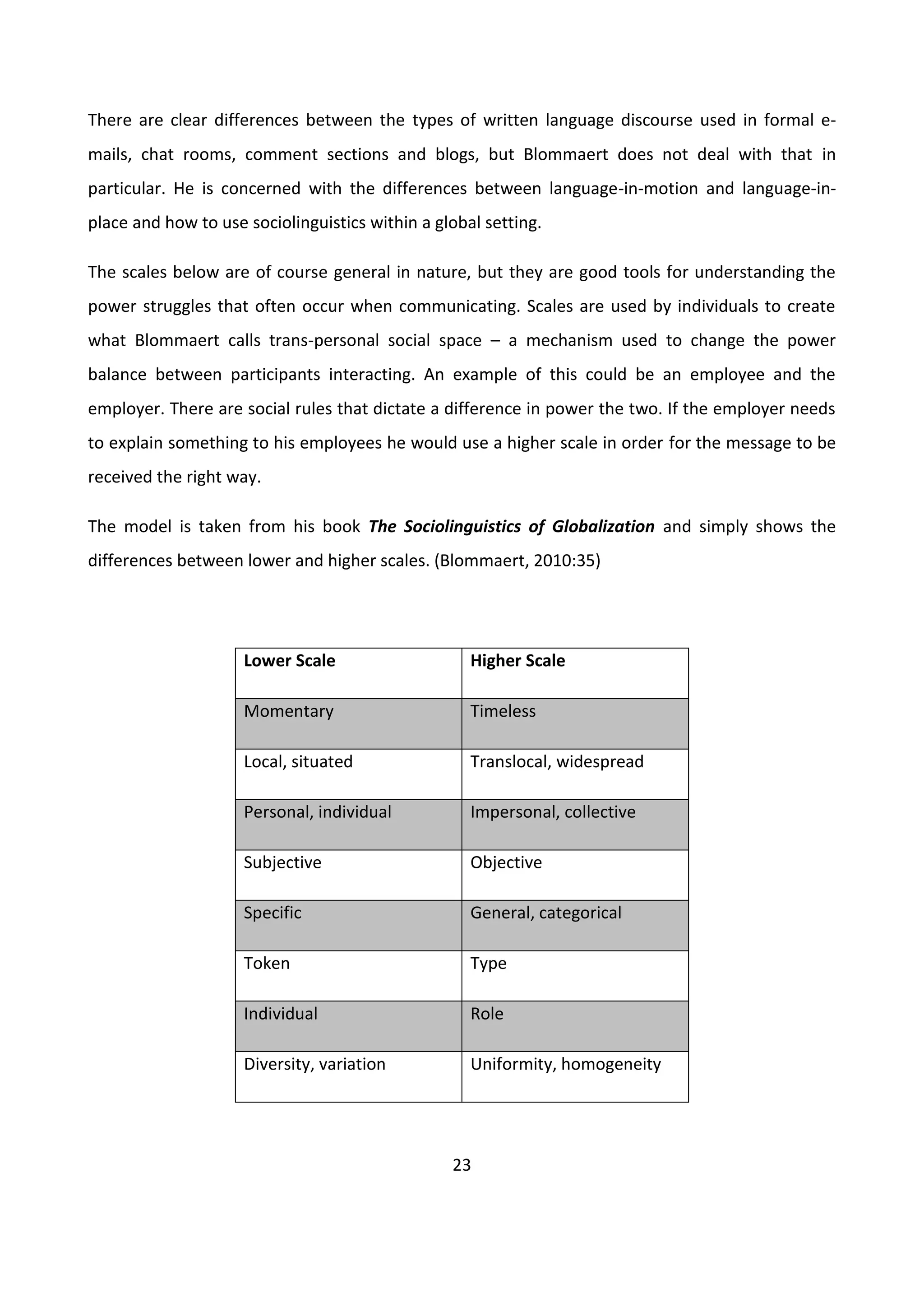
The model below shows the differences between the two scales and what happens when moving
from one scale to another. The model is very general, but as an indicator of the differences in
language that happen when the power struggle in communication becomes imminent it works
well.
Within linguistics and in particular within phonetics we have a set of varieties known as prestige
accents. These are the varieties used to measure language from. This is done in order to track
regional changes. In British English it is known as RP (Received Pronunciation) and in American
English it is called GA (General American). However, when dealing with written online English the
difference between varieties are yet to be distinguished into categories.
23
There are clear differences between the types of written language discourse used in formal e-
mails, chat rooms, comment sections and blogs, but Blommaert does not deal with that in
particular. He is concerned with the differences between language-in-motion and language-in-
place and how to use sociolinguistics within a global setting.
The scales below are of course general in nature, but they are good tools for understanding the
power struggles that often occur when communicating. Scales are used by individuals to create
what Blommaert calls trans-personal social space – a mechanism used to change the power
balance between participants interacting. An example of this could be an employee and the
employer. There are social rules that dictate a difference in power the two. If the employer needs
to explain something to his employees he would use a higher scale in order for the message to be
received the right way.
The model is taken from his book The Sociolinguistics of Globalization and simply shows the
differences between lower and higher scales. (Blommaert, 2010:35)
Lower Scale Higher Scale
Momentary Timeless
Local, situated Translocal, widespread
Personal, individual Impersonal, collective
Subjective Objective
Specific General, categorical
Token Type
Individual Role
Diversity, variation Uniformity, homogeneity
24
Blommaert argues that most people use these scales while communicating, either knowingly to
gain advantage: or unknowingly because of a certain context.
The advantage in this case is the power struggle which exists in all forms of communication at a
conscious or subconscious level. The connection of these scales are indexical and it is this
connection that enables us to make meaning of momentary instances of interaction to the level of
common meanings, and the two directions of indexicality (presupposing – the retrieval of available
meanings – and entailing – the production of new meanings *…+ are at the heart of such processes.
(Blommaert, 2010:33) The process he is referring to is the process of making sense of language in
any given situation. We need to put language in contexts, through common meanings, which are
again retrieved or produced in new contexts.
Another important aspect of this theory deals with what Blommaert calls order of indexicality
which in short refers to authority, access, and power (Blommaert, 2010:28). The order of
indexicality is a way to understand and analyze social and cultural value in different cultures and
contexts. He also talks about polycentricity – a concept that deals with the notion that we as
individuals extract meaning from several sources all the time.
These sources have authority on different levels. Some act as ideologies, others as cultural and
they help behave accordingly when in different situations. We change our performance according
to the surroundings. This change can be through language, behavior or other codes of conduct.
And we draw upon this knowledge from several centers. One speaks differently and as a different
person about cars or music than about the economy or about sex. (Blommaert, 2010:39)
Blommaert argues that communication becomes less predictable when they are taken out of their
own environment, and that is one of the things I wish to examine. Basically, this means that when
communication takes place on more than one level, for instance across time and space online,
they can change more rapidly and out of their original context they can become unclear.
25
3.3 Norman Fairclough
Language is power, life and the instrument of culture, the instrument of domination and
liberation – Angela Carter
Sociolinguist Norman Fairclough is included mainly because of his term intertextuality, which I see
as an integral part of online gaming and subcultures. The use of intertextuality is evident
everywhere in the virtual universe of WoW, and the game as such can be treated as “text” using
the concept of intertextuality. Hence, I will not go into specific details about his theoretical
approach or major branches of his theory. I will however dwell on his definition of discourse and
hegemony, which will prove useful to me in the analysis. Besides his theory on intertextuality,
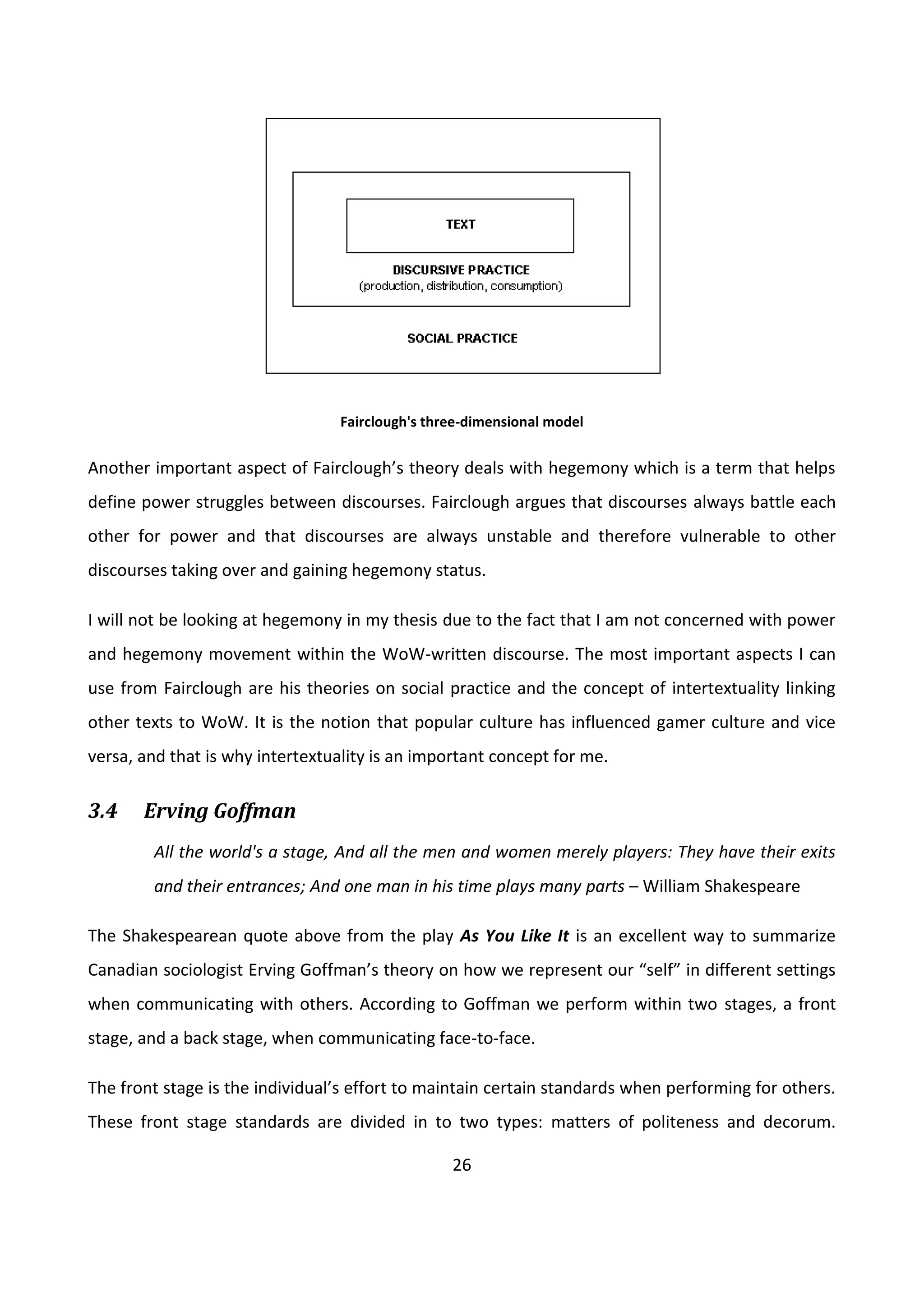
Fairclough presents a three-dimensional model of how a text is produced, distributed, and
consumed.
This model is taken from Fairclough’s earlier work, but presents a good frame for analyzing the
various layers of discourse on different levels. The model is a way to see how discourses work
within a social practice. Furthermore, the model is divided into text, discursive practice, and social
practice. These three components of the model are connected by mutual use. When a text enters
the discursive practice it is produced, distributed, and consumed by the people involved. After
consuming the text, and dealing with it through discursive practice it enters social practice.
As mentioned in the introduction, Fairclough operates with an abstract definition of the concept
of text, which basically means that any form of language use is considered a text. In relation to this
thesis, the text would be any language use related to WoW.
The discursive practice is any production, distribution, and/or consumption of the text. In the
thesis’ case of WoW this would be in-game chat, forum threads, or other WoW related
homepages.
The social practice is anything revolving around the WoW discourse, for instance Blizzcon, which is
an annual event hosting 27.000 attendees in 201013
, but also smaller events that occur within the
guilds. Guilds are online player driven communities within WoW.
13
http://en.wikipedia.org/wiki/BlizzCon 9/11 - 2010
26
Fairclough's three-dimensional model
Another important aspect of Fairclough’s theory deals with hegemony which is a term that helps
define power struggles between discourses. Fairclough argues that discourses always battle each
other for power and that discourses are always unstable and therefore vulnerable to other
discourses taking over and gaining hegemony status.
I will not be looking at hegemony in my thesis due to the fact that I am not concerned with power
and hegemony movement within the WoW-written discourse. The most important aspects I can
use from Fairclough are his theories on social practice and the concept of intertextuality linking
other texts to WoW. It is the notion that popular culture has influenced gamer culture and vice
versa, and that is why intertextuality is an important concept for me.
3.4 Erving Goffman
All the world's a stage, And all the men and women merely players: They have their exits
and their entrances; And one man in his time plays many parts – William Shakespeare
The Shakespearean quote above from the play As You Like It is an excellent way to summarize
Canadian sociologist Erving Goffman’s theory on how we represent our “self” in different settings
when communicating with others. According to Goffman we perform within two stages, a front
stage, and a back stage, when communicating face-to-face.
The front stage is the individual’s effort to maintain certain standards when performing for others.
These front stage standards are divided in to two types: matters of politeness and decorum.
27
Matters of politeness have to do with the performer’s treatment of the audience, either while
talking or by gestural interchanges substituting talk. Decorum deals with the way the performer
comports himself in range of the audience, but not necessarily engaged in conversation with
them. Decorum standards can be further divided into to two: moral and instrumental
requirements. Moral requirements deal with rules regarding non-interference and non molestation
of others, [...], sexual propriety, rules regarding respect of sacred places, etc. (Goffman, 1990:110)
Instrumental requirements however [...] refer to duties such as an employer might demand of his
employees – care of property, maintenance of work levels, etc. (Goffman, 1990:110) Another
aspect of his theory is the back stage, and he describes back stage as [...] a place, relative to a
given performance, where the impression fostered by the performance is knowingly contradicted
as a matter of course. (Goffman, 1990:114)
However, Goffman’s theory on the presentation of self never accounted for the possibilities of
communication that the internet offers today. This means that I will have to re-invent or alter his
theory to fit my thesis. This is simply due to the fact that the internet was not a reality when his
theory was written. The thesis deals with online social behavior without face-to-face contact. The
lack of face-to-face contact leads to what I call “dissolving the social filter” which is basically a
merging of front and backstage which then again leads to a blurring of social behavior. With no
clear distinction between the two, people behave differently as opposed to face-to-face
communication. The possibility offered by the internet to communicate through avatars or
anonymously adds a whole way of communicating with others.
Goffman’s theory deals with a concept called social information. Social information, which I will
use quite differently than Goffman, refers to the symbols or signs that provide others with an
image of our social identity. In Goffman’s terms this can be jewelry, but also physical features.
These symbols have an either negative or positive effect on our social identity. In my thesis I will
apply the term social information to the players gear and armor, because this along with what
guild you are a part of is indeed a social marker within the game.
Goffman operates with 3 kinds of identity within the individual; social, personal and i-identity. The
individual identity is constructed by unique personal traits, for instance social security number,
name, and image. The personal identity is what makes us able to tell individuals from one another.
28
The i-identity deals with the individual’s feelings about themselves and the world that surrounds
them. It is in other words, the individual’s way of making sense of the world through reflecting
upon it by mirroring it in the individual’s own experiences. However, the only relevant identity
from his theory, to me, is the social identity, as it is impossible for me to gather the relevant
information to say anything about the other two. And the social identity I have in mind is only the
one I can derive from the individuals’ behavior online. Goffman’s theory on social identity is a
theory which states that the identity given to an individual by others is different from his own
constructed identity.
The social identity is constructed by the expectations we have when meeting another individual.
The individual can then fit or alter the identity constructed by us. If the expectations we have for
the individual and its social identity are not met it could result in a social stigma, which is the result
of the stereotypical image we have constructed and the expectations we have of the individual.
Goffman’s theory and his notions on social interaction are sometimes a bit vague as his examples
can be too general. The use of common sense when wanting to prove things can be good, but it
can also result in lack of diversity which will lead to rushed conclusions. His ideas about social
interaction and how to observe them have proven very useful. As such a clear cut apparatus of
definitions and terms is lacking with Goffman. As such, his biggest force also becomes a target of
criticism. He has also been criticized for being cynical in his rendering of the dramaturgical
approach to everyday life and his opinion on how individuals’ social interaction is determined by
manipulation and hidden agendas in order to maintain a public façade.
3.5 Michel Maffesoli
The individual has always had to struggle to keep from being overwhelmed by the tribe. If
you try it, you will be lonely often, and sometimes frightened. But no price is too high to
pay for the privilege of owning yourself. – Friedrich Nietzsche
French sociologist Michel Maffesoli and his theory on post-modern relations include his theory on
neo-tribalism in post-modern society. His theory is inspired by hermeneutics, and according to
him, the researcher needs to identify with the subject at hand. As opposed to other theories on
post-modernity, which focus on the individual, he focuses on the group and the factors that make
up groups in different settings. He refers to an energy and vital force within people that he calls
29
puissance14
. Puissance is hard to describe, but I understand puissance as the ‘glue’ that keeps
people together socially, and the bond that ensures constant change within society. [...], the
above-mentioned puissance, which is both cause and effect of the societal symbolism, can be
termed a sort of underground centrality which we find constantly in individual histories and
communal life. (Maffesoli, 1996:58) Maffesoli is referring to the masses as an organic structure
and the puissance as the will to live – as an ever-flowing source of energy within people.
Maffesoli uses religion as a base for neo-tribalism and shared rituals. However, I do not consider
gamers to be religious people, in the sense that they treat gaming as a religion, and their rituals
are not religious in nature. Neo-tribalism as such deals with the collectiveness of people, a being-
togetherness that evolves from an unknown need, but which feeds off the puissance. The
following quote taken from Maffesoli’s The Time of the Tribes refers to the notion of people trying
to make sense of things that are hard to identify, and Maffesoli argues that neo-tribalism is one of
the things that are hard to categorize as it: refuses to identify with any political project
whatsoever, to subscribe to any sort of finality and whose sole raison d’être is a preoccupation with
the collective present. (Maffesoli, 1996:75)
Another important aspect of Maffesoli’s theory is his view on post-modern society. He argues that
in a post-modern society, the individual can easily fit into more than one social setting, and not
necessarily a setting defined by its function. Another aspect of his theory is his model of the
transition between “social” and “sociality”.
These two concepts possess small differences and none of them are absolute, as they have a
dialectic relation and share certain things. The most important distinction between the two is the
shifting focus on the shift from rational to emotional structures. He differs between “person” and
“individual”. The major difference is again the focus on emotional rather than rational choices.
14
“The term ’puissance’ in French conveys the idea of the inherent energy and vital force of the people, as opposed to
the institutions of ‘power’.” (Maffesoli, 1996:1)
30
I disagree with some of the points in Maffesoli’s theory. So this is both a critique, but also a
clarification of where I disagree with him. Maffesoli’s theory is written in an essayistic form, and
thus his theory is open to interpretation. This will result in a more open discussion when using his
theory for analysis. Maffesoli makes a distinction between subcultures and neo-tribes, I do not. He
argues that neo-tribalism allows for people to switch more easily between groups, but with a sub-
culture one is more locked in a role of belonging somewhere. I see no difference here – I see sub-
cultures and neo-tribes as one and the same, they are both groups of people with shared
interests. This shared interest does not stop them from entering other groups as well. I do not
share his view on the difference between “persons” and “individuals” as well, as I would argue
that we are as guided as ever by rational choices concerning our careers, education, family life etc.
3.6 Celia Pearce
Weakness of attitude becomes weakness of character – Albert Einstein
Pearce brings a non-linguistic approach to the field of theory as she deals with communities of
play and the study of avatars. She also deals with rituals in online communities. Her theories can
provide elaboration to my own knowledge of online gaming and provide an academic optic on
ludic behavior and emergent cultures such as the cultures WoW-gamers.
Pearce argues that the formations of virtual communities are as real as any that form in proximal
space (Pearce, 2009:17). Pearce further argues that this has to do with what she calls active
creation of belief which revolves around virtual worlds as social constructs. According to Pearce, a
virtual world must have these principles:
 Spatial – the virtual worlds must have a spatial graphic representation.
 Contiguous – the virtual world must be geographically mapped to some extent.
 Explorable – the virtual world must be free to roam. Some obstacles might come in the way
of exploring such as higher level creatures or geographic obstacles such as mountains or
oceans.
 Persistent – the virtual world must be active and ongoing, thus allowing for avatar
development through each visit.
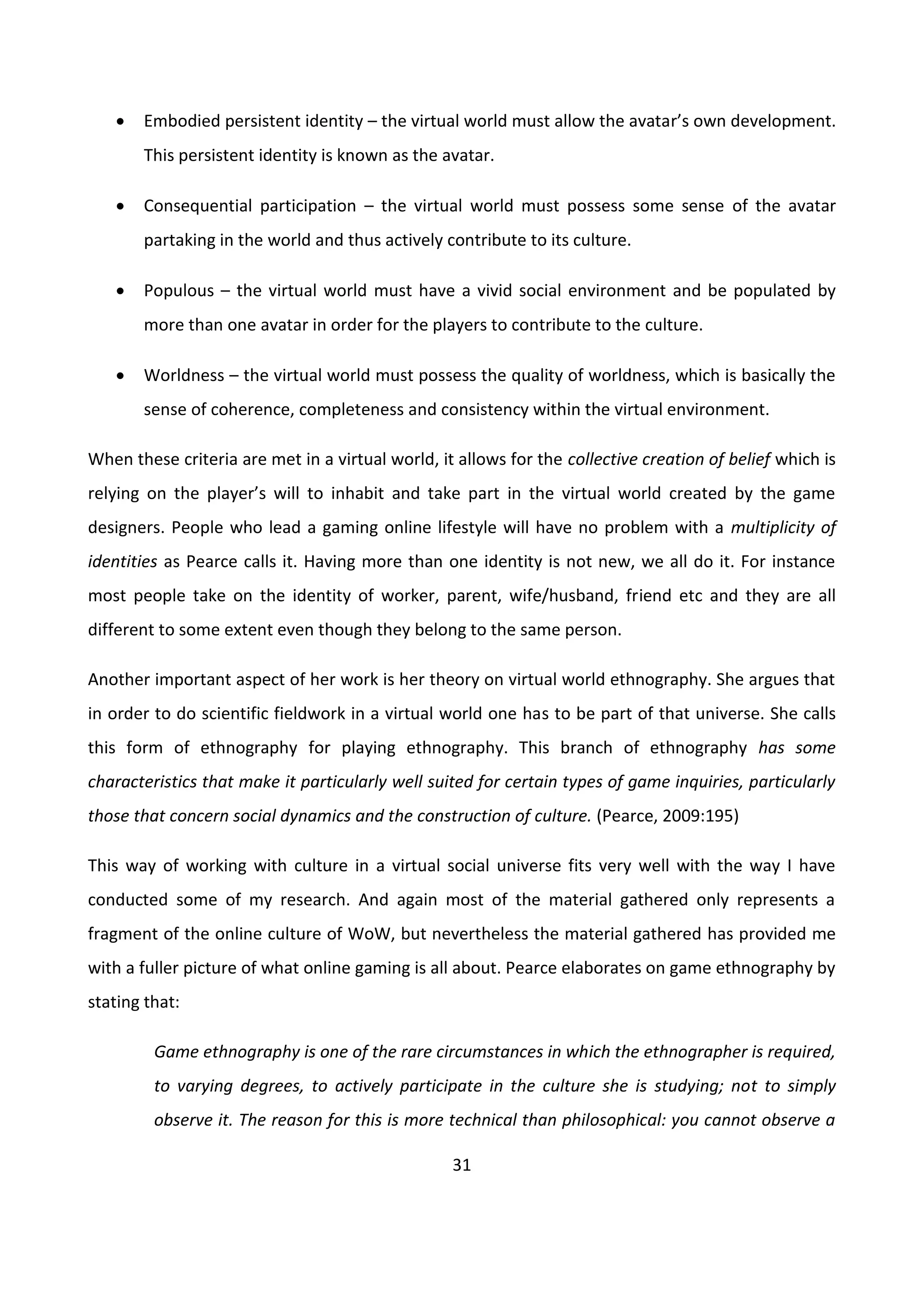
31
 Embodied persistent identity – the virtual world must allow the avatar’s own development.
This persistent identity is known as the avatar.
 Consequential participation – the virtual world must possess some sense of the avatar
partaking in the world and thus actively contribute to its culture.
 Populous – the virtual world must have a vivid social environment and be populated by
more than one avatar in order for the players to contribute to the culture.
 Worldness – the virtual world must possess the quality of worldness, which is basically the
sense of coherence, completeness and consistency within the virtual environment.
When these criteria are met in a virtual world, it allows for the collective creation of belief which is
relying on the player’s will to inhabit and take part in the virtual world created by the game
designers. People who lead a gaming online lifestyle will have no problem with a multiplicity of
identities as Pearce calls it. Having more than one identity is not new, we all do it. For instance
most people take on the identity of worker, parent, wife/husband, friend etc and they are all
different to some extent even though they belong to the same person.
Another important aspect of her work is her theory on virtual world ethnography. She argues that
in order to do scientific fieldwork in a virtual world one has to be part of that universe. She calls
this form of ethnography for playing ethnography. This branch of ethnography has some
characteristics that make it particularly well suited for certain types of game inquiries, particularly
those that concern social dynamics and the construction of culture. (Pearce, 2009:195)
This way of working with culture in a virtual social universe fits very well with the way I have
conducted some of my research. And again most of the material gathered only represents a
fragment of the online culture of WoW, but nevertheless the material gathered has provided me
with a fuller picture of what online gaming is all about. Pearce elaborates on game ethnography by
stating that:
Game ethnography is one of the rare circumstances in which the ethnographer is required,
to varying degrees, to actively participate in the culture she is studying; not to simply
observe it. The reason for this is more technical than philosophical: you cannot observe a
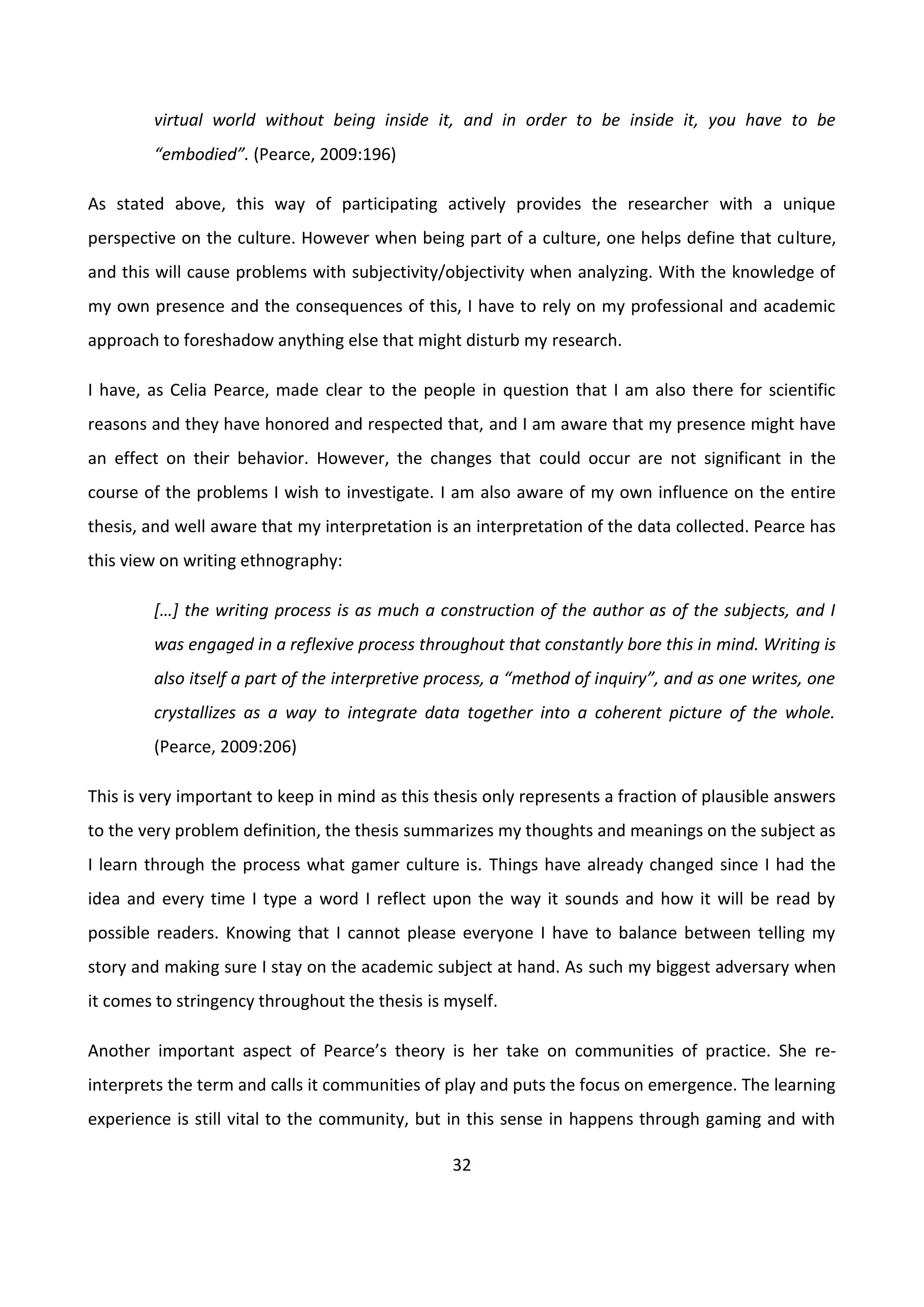
32
virtual world without being inside it, and in order to be inside it, you have to be
“embodied”. (Pearce, 2009:196)
As stated above, this way of participating actively provides the researcher with a unique
perspective on the culture. However when being part of a culture, one helps define that culture,
and this will cause problems with subjectivity/objectivity when analyzing. With the knowledge of
my own presence and the consequences of this, I have to rely on my professional and academic
approach to foreshadow anything else that might disturb my research.
I have, as Celia Pearce, made clear to the people in question that I am also there for scientific
reasons and they have honored and respected that, and I am aware that my presence might have
an effect on their behavior. However, the changes that could occur are not significant in the
course of the problems I wish to investigate. I am also aware of my own influence on the entire
thesis, and well aware that my interpretation is an interpretation of the data collected. Pearce has
this view on writing ethnography:
*…+ the writing process is as much a construction of the author as of the subjects, and I
was engaged in a reflexive process throughout that constantly bore this in mind. Writing is
also itself a part of the interpretive process, a “method of inquiry”, and as one writes, one
crystallizes as a way to integrate data together into a coherent picture of the whole.
(Pearce, 2009:206)
This is very important to keep in mind as this thesis only represents a fraction of plausible answers
to the very problem definition, the thesis summarizes my thoughts and meanings on the subject as
I learn through the process what gamer culture is. Things have already changed since I had the
idea and every time I type a word I reflect upon the way it sounds and how it will be read by
possible readers. Knowing that I cannot please everyone I have to balance between telling my
story and making sure I stay on the academic subject at hand. As such my biggest adversary when
it comes to stringency throughout the thesis is myself.
Another important aspect of Pearce’s theory is her take on communities of practice. She re-
interprets the term and calls it communities of play and puts the focus on emergence. The learning
experience is still vital to the community, but in this sense in happens through gaming and with
33
the purpose of having fun reaching your goals. Pearce states that one could argue that playing is a
form of practice, but she sees the difference in how the community is formed and maintained.
(Pearce, 2009:5) Also, the technology of the internet allows for people around the globe to
interact and take part in the community regardless of time and space.
34
4. Method
This chapter will deal with the theoretical approaches I will be taking when I analyze and produce
my empirical data. I will attempt to provide a meta-theoretical framework I can work within, in
order to narrow my focus on a single case.
The analysis will revolve around various topics all related to social interaction online and with
relation to the various research questions from the problem definition. The analysis itself will
represent broad as well as more specific views on gamer culture. The analysis will deal with the
specific sub-culture of WoW gamers. Specifically, the thesis will revolve around the use of
language and social interaction that takes place within this virtual world. The analysis will also deal
with the problems of “flaming” and “trolling” on a general level. The creators of WoW have
written a code of conduct15
which state that:
When engaging in Chat, you may not:
Transmit or post any content or language which, in the sole and absolute discretion of
Blizzard, is deemed to be offensive, including without limitation content or language that
is unlawful, harmful, threatening, abusive, harassing, defamatory, vulgar, obscene,
hateful, sexually explicit, or racially, ethnically or otherwise objectionable, nor may you
use a misspelling or an alternative spelling to circumvent the content and language
restrictions listed above.
Another topic is the topic of English as a global language and how it affects the use or abuse of
what is considered a prestige English. In other words, is the use of leet speek good or bad for
English a lingua franca?
The analysis is divided into various chapters all related to the topic of the thesis. The first chapter,
5.1 Language and culture in a virtual world, deals with the English use of gamers that constructs
parts of their culture. The second chapter, 5.2 English and leet speek as global languages presents
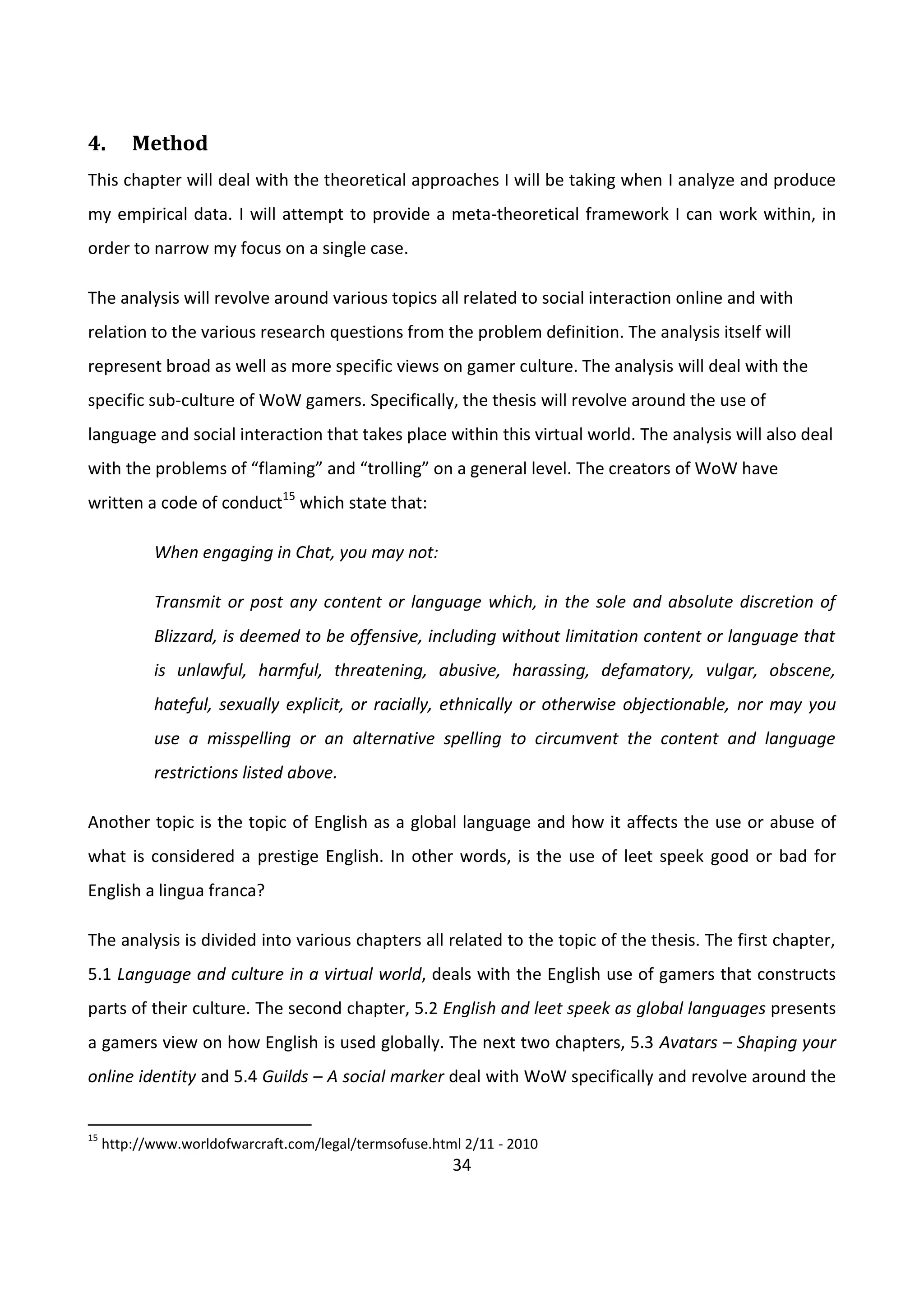
a gamers view on how English is used globally. The next two chapters, 5.3 Avatars – Shaping your
online identity and 5.4 Guilds – A social marker deal with WoW specifically and revolve around the
15
http://www.worldofwarcraft.com/legal/termsofuse.html 2/11 - 2010
35
avatars and the guilds. The third and last part of the analysis is a more general view of online
tendencies. Chapter, 5.5 Dissolving the social filter, is a look at Goffman’s stages in an online
perspective and what happens when face-to-face contact is gone. The last chapter of the analysis,
5.6 A look at gamer culture, is a summary of gamer culture.
The analysis will take on different approaches that all have to do with language, culture, and
online behavior. My focus will be more practical than theoretical. This especially apply to Erving
Goffman and Michel Maffesoli whose theories I have found very inspiring, but in order to use
them I have had to adapt some of their concepts in order to fit in with the online discourse of
communication, which is different and not originally a part of their theories. This is mainly due to
the reason that my community is not together in a physical shared space, but on-line in a virtual
world. This means that face-to-face contact is not there so a clear distinction between front stage
and backstage behavior is non-existent. The only time I was faced with face-to-face contact and a
shift in front and backstage behavior was during the interviews.
Michel Maffesoli has provided me with the term puissance which will be relevant when looking at
the culture of gamers. I have left out his term neo-tribalism, and will instead use sub-culture when
appropriate as I see no difference between the two. As I stated in the chapter on Maffesoli he
differs between sub-cultures and neo-tribes and argues that neo-tribes are bound together by
emotional rather than rational choices. I disagree with his notion of neo-tribes versus sub-cultures
as I see sub-cultures as easily bound together by emotion as they are by reason.
Furthermore, the analysis will be dealt with by using intertextuality as coined by Norman
Fairclough, game ethnography and communities of play as determined by Celia Pearce and as such
the analysis will be an eclectic analysis drawing upon analytical tools from different approaches.
However, I see no problem in combining these theories as the combination of a sociolinguist
approach and sociological science are both concerned with language and the behavior associated
with language in social interaction. I will also use the work of sociolinguist David Crystal who deals
with the impact of language on the internet and vice versa. Another important sociolinguist is Jan
Blommaert who deals with sociolinguistics in a globalized world.
36
To elaborate on this, my methodological approach will be eclectic to a certain extent as I wish to
uncover both linguistic and cultural behavior and features of online discourse. I will look at
theories provided by Jan Blommaert to investigate the dialectic relation between language and
social behavior. In order to strengthen the analysis I will draw upon the work by David Crystal on
the impact of the internet on language.
In order to focus the optic of the analysis on gamer culture I will use the theory of Celia Pearce,
who deals with gamer communities, which she refers to as communities of play, and the use of
avatars. When dealing with the way people present themselves online I have chosen to look at
Erving Goffman’s theory on social behavior and his use of the terms backstage and front stage
activity in order to decode social online behavior when people act through the use of avatars. I see
gamer-culture as a sub-culture – one of many sub-cultures on the internet, a recent one too.
4.1 Gathering empirical data
My main source of empirical data will be screenshots, which is basically instant pictures taken
from the in-game screen, in the actual game WoW. Furthermore I have chosen a few topics from
the WoW forums, known as threads. The WoW community forums are divided into several topics
ranging from class-specific threads to server-specific ones. The combination of in-game and forum
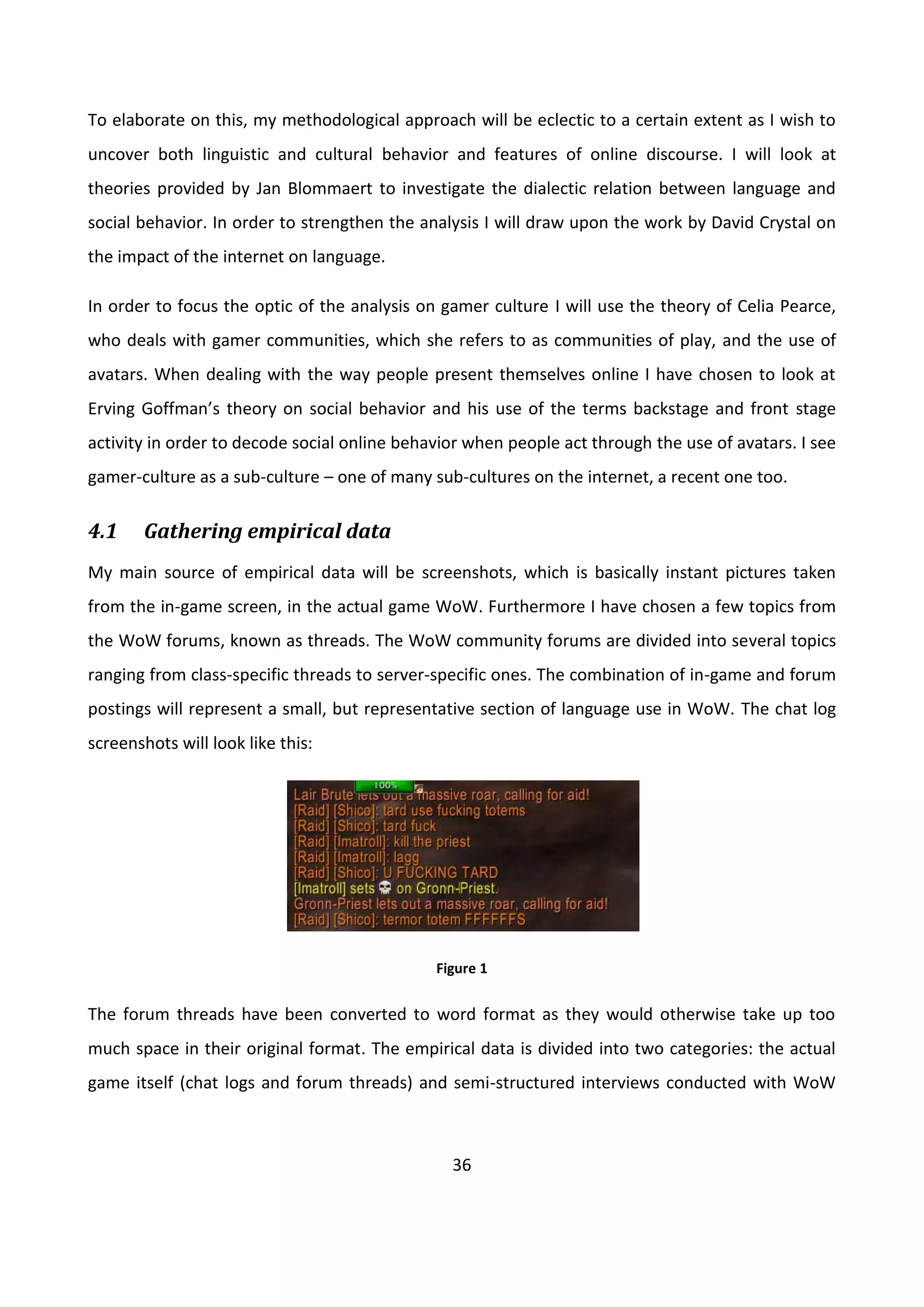
postings will represent a small, but representative section of language use in WoW. The chat log
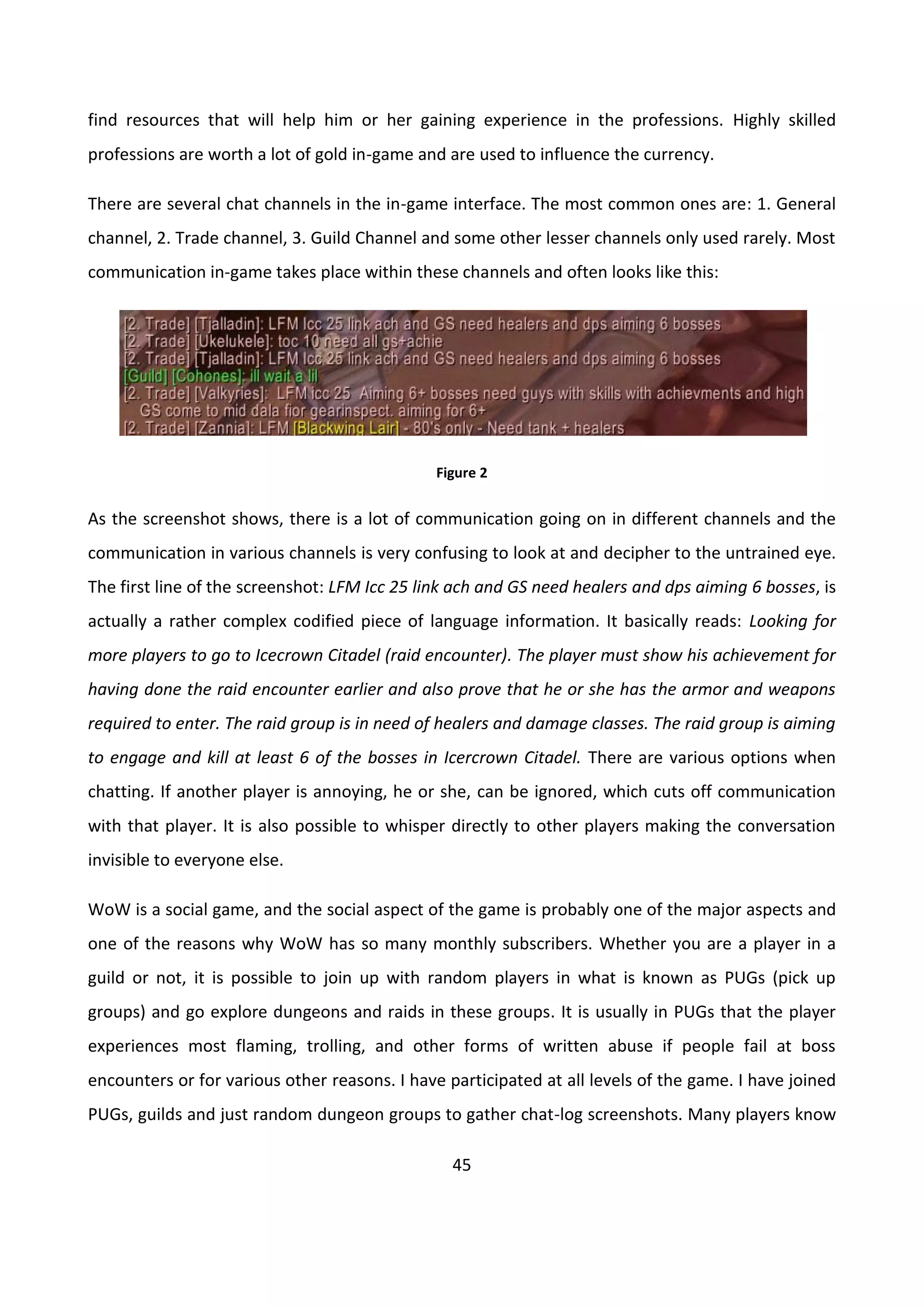
screenshots will look like this:
Figure 1
The forum threads have been converted to word format as they would otherwise take up too
much space in their original format. The empirical data is divided into two categories: the actual
game itself (chat logs and forum threads) and semi-structured interviews conducted with WoW
37
gamers face-to-face. To achieve a more cultural approach that deals with more than just written
language discourse I wanted to conduct interviews with the target audience.
In order to elaborate on the written discourse used online and the people playing, I went to a large
gamers convention in Sweden called DreamHack16
where I conducted seven semi-structured
interviews with people from ‘the exiled’ guild in order to obtain a better understanding of the
people playing WoW and how they look at them self as gamers and being part of a culture. I made
arrangements with ‘the exiled’ guild master, Valik, in WoW, and we agreed that I should come visit
them privately in Sweden and then attend DreamHack with them in order to conduct the
interviews.
The interview method I have conducted is called semi-structured interview and the main purpose
of this method is obtaining descriptions of the life world of the interviewee in order to interpret the
meaning of the described phenomena. (Kvale, 2009:3) My reasons for using this interview
technique is to uncover what the interviewees view on the topic is. I have the intention or wish to
find out whether or not they hesitate on certain questions or if they are hiding agendas when they
answer my questions. The analysis of semi-structured interviews can be done in many ways.
I simply want to know their opinion about being a gamer, and whether or not they change the way
they behave online. Furthermore, the interview allows for me and the interviewee to produce
knowledge while talking. The knowledge created is thus contextual, linguistic, narrative and
pragmatic (Kvale, 2009:18). The interview process is hermeneutical in nature as I want to validate
and understand the text or the conversation as a whole I need to understand all the smaller parts
too. As the body of interviews and the answers become more stringent the validity of them grows.
In order to analyze the interview material as fragments I need to understand the entire process.
This relates to the entire process from the first question to the analysis of the interviews. This is
known as the hermeneutic circle.
The interviewees have all conceded in me using their gamer tags (in-game name) for references in
the thesis. Furthermore, I have chosen to interview the persons using the online names and not
16
DreamHack is a LAN party, a local area network gathering with demo competitions, gaming competitions and more.
At DreamHack Winter 2007 a new world record was set. The record is now 10,554 computers and 11,060 attendees.
(http://en.wikipedia.org/wiki/DreamHack) 26/8 – 2010
38
their real names in order for them to maintain a form of anonymity in the process. They have all
given consent to partake in the thesis material as the results of my research is in their interest.
I had prepared a short interview guide with following questions:
 How old are you?
 Are you male or female?
 What is your current occupation?
 When playing, do you have a nickname or gamer tag that you use?
 Are you associated with a guild? Which one?
 What do you associate with being a gamer?
 Do you act differently online as opposed to in real life?
 Do you consider gaming as being part of a culture?
 In what way do you use language to create an online identity?
 Do you use gaming for social reasons? How?
As for the reliability, I have been the only one transcribing the interviews in order to ensure a
reliable and stringent transcript. As for the validity of the transcription I stick to Kvale’s definition
there is no true, objective transformation from the oral to the written mode. (Kvale, 2009:186) He
argues that the transcription should fit the purpose. Once transcribed, the interviews need to be
analyzed. In my case I will condense the meaning from the combined interviews and in doing so
draw out the important and relevant information.
Basically this means that the interviews primary function is to back up arguments within the
analysis. If the interviews can either strengthen or weaken statements, they will be used. All in all I
wish to interpret the meaning of the interviews hermeneutically which implies a possibility of a
continuously deepened understanding of meaning. (Kvale, 2009:210) This means that my
understanding of gamers will improve while doing the interviews, while transcribing the interviews
and while analyzing the interviews.
In order to understand what was said in one interview, I might have to look for answers in another
interview and cross-reference. Each interview presents a fragment of all the interviews conducted,
and the interviews together represent the fragments. This is again the hermeneutical circle. I also
39
find the amount of interviews sufficient for my analysis as I only need them to elaborate on my
own hypothesis about gamers and whether or not this hypothesis is true. The interviews and the
answers within them are coherent and they mostly agree on the topics involved and as such they
are consistent. As I intend to use these interviews not as primary empirical data, but only to
strengthen the data collected from within the game or on the forums I have found this to be
sufficient.
In order to elaborate during the analysis I have included some articles on internet behavior in
general in the bibliography which deal with trolling and the consequences of language abuse
online, because sometimes the online trolling is taken from the internet and into the real life with
horrific results and personal traumas as a result. An example if this is the story about the “an
hero” meme Mitchell Henderson whose family was terrorized following the suicide of their son
(Schwartz:1).
WoW only represents a fragment of online opportunities that trolls take advantage of when they
want to engage in the act of trolling. WoW-trolling in this context is gentle compared to other
more vicious forums out there17
. Another aspect of the internet behavior is the way it is changing
English. Numerous new acronyms are being used daily on the internet and create trends which
spread virally. An example of this is ‘rickrolling’ which is a meme or internet kind of trend that
started on 4chan where users - it's basically a bait and switch. Users link you to a video of Rick
Astley performing Never Gonna Give You Up,"
(Kleinmann)
Also the rise of ‘cult dialects’ such as ‘LOLcat’ - a
phonetic and deliberately grammatically incorrect
caption that accompanies a picture of a cat (Kleinmann)
has seen an increase in fame on the internet. An
example of this is the homepage
icanhascheezburger.com which is famous for its LOLcats.
17
Measured in terms of depravity, insularity and traffic-driven turnover, the culture of /b/ has little precedent.
(Schwartz:1) /b is the anonymous forum of the 4 chan image board.
LOLcat
40
Another aspect of trolling and flaming as internet “sports” is the concept of “lulz” which is a
deviation from the acronym “lol”, but lulz are also a virtually made up currency which in its
strictest sense means laughs, jest, cheap amusement, but in a broader sense encompasses both the
furious creativity that generates /b/'s vast repertoire of memes and the rollicking subcultural
intensity they inspire (Dibbell). The reasons for looking at these trends online and including them
in the thesis, is the fact that they not only deal with user generated content, but also how they
treat language as a way of communicating, not bound by rules of grammar and punctuation. They
follow rules though, but those are rules that differ slightly from those of Standard English. The use
of leet speek and LOLcat dialects are evident on the internet and it is also used in WoW from time
to time.
4.2 Ethnographic fieldwork
Gaining knowledge through observation was not my intention when I went to Sweden to conduct
interviews, but I quickly realized that being part of something as big as DreamHack provided me
with a marvelous opportunity to gather information through experience and observation.
Furthermore, applying an ethnographic perspective on the trip could open my eyes to the
seemingly invisible puissance which exists among the participants.
The ethnographic fieldwork will only serve as an elaborate product from my field trip to
DreamHack, and in doing so strengthen arguments about this group of people as a subculture with
shared rituals and language. Having only realized after the trip that the impressions received could
serve as data, I did not prepare any ethnographic material before going. So what remains are my
recollections of the event and impressions I received.
This means that my account on the DreamHack event is to be considered as background reading to
add a reflexive view on my journey to Sweden. The analysis and processing of the data will
therefore be sporadic and will only be used if thought useful. Jan Blommaert argues that
ethnographic fieldwork is aimed at finding out things that are often not seen as important but
belong to the implicit structures of people’s life. (Blommaert & Jie, 2010:3) Furthermore,
ethnography deals with contexts of social actions such as speech, interaction, gestures etc.
41
After my trip to DreamHack I was asked to write an article for a course on Communication. The
article, (see Appendix 4. Article) is inspired by ‘new journalism’ and has some of my own personal
experiences and an introduction to the world of gamers outside the computers they inhabit in
their spare time. I will now proceed with what I feel I have learned from my trip, which is not
concerned with language. It became clear to me upon arrival in Sweden that the gamers are
indeed people like any others, but to people not familiar with their culture, they are being
“stigmatized” by popular culture.
Goffman also works with stigmatization of people. The stigma can be caused by physical
appearance or by the prejudice people have. I too have my own prejudices about gamers and
some were confirmed, others not. Prejudices and generalizations can be both problematic and
helpful. Problematic because prejudices and generalizations render our world into segments and
we tend to have already made up our mind about certain people. On the other hand, prejudices
and generalizations can help to organize and in most cases prove our prejudices wrong. I too have
prejudices about gamers and a generalized view on their behavior. However the ability to
generalize is a good tool as we are often surprised to learn new things when proven wrong.
The first couple of days were spent with family and friends of the gamers. The people I met from
‘the exiled’ were very hospitable and they were all fine with me visiting them. Their non-gaming
friends and siblings seemed to have no problems with the gamers spending a great amount of
time in a virtual universe with others. The very first evening we had a BBQ and unless you knew
this for a fact, you would not have guessed that the majority of people attending the BBQ were
engaged in MMORPG’s. Occasionally the talk would revolve around WoW, but mostly it was just
friendly banter. Even though their native tongue was Swedish, they would converse in English out
of respect for those who came from the Netherlands. The next two days went with sightseeing
around the local area.
Then we finally went to DreamHack and I was amazed with the effort put into making people feel
good and having a good time. The event is a no drugs, no alcohol event. The event was however
not free from junk-food and non-healthy food, as every desk had a case of either energy drinks or
sodas nearby and bags of snacks scattered around. This was not a health convention. Roughly
12.000 people participated in the event and they had been split up into three major groups in
42
different halls. Each hall had been neatly arranged with lines of desks and chairs for each
individual to sit. Imagine 12.000 people sitting at their own personal computer, but participating
as a whole in this event. This very idea of being alone together struck me as curious, but even
though they communicate and act through their computers, the puissance was always present.
The event is more than just playing computer with friends. DreamHack is a festival – an enormous
digital festival with a focus on gaming. There were game developers, pro-gamers, stalls, clothing
and much more, even live performances on stage. The audience of DreamHack is very hard to
please and I heard more than one band being booh’ed off the stage during their performance.
Mostly the extremely loud music would be played by a resident DJ who specializes in gamer music.
In the stall area there were shootouts between pro-gamers and their fans. The different
companies had models walking around doing PR, handing out flyers and lollipops while wearing
skimpy clothes. There was also a store selling the newest computer equipment to enhance the
gaming experience. The majority of people attending DreamHack were boys aged 13-17 with
fashionable hairstyles and expensive clothes. Apparently, looks are important while gaming at that
age. Or maybe the dress-up was due to the other segment of people, the equally aged girls in
fashionable who were also there.
The atmosphere was both hectic and peaceful at the same time. There were a lot of things
happening simultaneously, but at a slow pace which allowed for people to know one another and
enjoy the event. It seemed as if, no matter what your identity was in real life, here the individual is
part of something bigger, a secluded society in which all people were accepted regardless. There
was no obvious bullying with the exception of the pro-gamers yawning while killing their
opponents in the virtual worlds and the crowd applauding when the underdog succeeded in killing
the pro-gamer. Pro-gamers are people who make a living playing computer games. They often
sponsored by computer related companies.
It became obvious to me that besides sharing an interest online, they shared a common view of
life whilst on the event. Everyone was accepted and no one questioned what you did in your real
life, because somehow real life was not as important as whom you were as a gamer. One of the
things that do matter when discussing WoW is whether you play Horde or Alliance; the faction you
choose is part of your gamer identity. There is an innocent hatred amongst the players that to
43
some extent is taken out in real life. Let us call this behavior WoW-hooliganism, a friendly banter
when flaming the opposite faction. This behavior occurs within same-faction players as well as
when people flame each other’s guilds and avatars. This behavior was not evident at DreamHack,
but is very much alive online.
Another important aspect of ethnography tied to this thesis is game ethnography as coined by
Celia Pearce and this form of ethnography deals with how information is gathered in a virtual
environment. In order to do this, the researcher has to become part of the virtual environment by
embodying an avatar for the purpose. Once you are a part of the virtual environment there are
several ways of gathering information on in-game behavior. I have chosen to look at in-game chat,
out-of-game forums related to WoW, and the interviews conducted while at DreamHack.
Furthermore, my own knowledge from being part of the very culture I wish to investigate offers
me an advantage when trying to decipher some of the codified language used when
communicating. When in-game I am there as my avatar, Bruco, who is a Tauren shaman18
.
The pictures above are of Bruco and me. As Bruco is an extension of me within the virtual world of
WoW, he exhibits the traits I want him to. In addition to that he does elemental damage and has
the ability to heal friendly players.
My own participation also allows for what Celia Pearce calls game ethnography and which I have
been using when playing the game and taking screenshots from the game. I have found situations I
found typical for the game at large and I will use them throughout my analysis to elaborate on
18
Taurens are a race of Minotaur looking creatures. Shamans are practitioners of the elemental powers.
Bruco - Me
44
certain claims. I claim that being part of the environment you are analyzing is again a
hermeneutical approach as I need to understand the smaller details of the game in order to
provide a full analysis. I can elaborate on things that an outsider would have no idea about. On the
other hand, an outsider to the world of gamers might see problems and discourses that I am blind
to.
4.3 Case study – What is World of Warcraft?
World of Warcraft is an MMORPG, a multi-player virtual universe online game that currently has
12 million subscribers worldwide. World of Warcraft has been around since 2004 and has seen
two expansion added to the original game so far with a third one to be launched December 7th
2010. The game itself takes place on various virtual continents and is loosely based on the fantasy
genre inspired by authors like H.P. Lovecraft and J.R.R. Tolkien just to name a few. Much of the
WoW lore is based on mythology and the eternal struggle between good and evil.
Before entering WoW, the player chooses a faction, either becoming an Alliance or a Horde avatar.
You then choose a race, and the choices here are many depending on faction. The first obstacle of
the game is to level up the avatar from level 1 all the way to level 80 in the current state of the
game (from December 7th
, another 5 levels will be added). The avatar starts in a low level area
with only a few mobs19
of an equal level. The avatar then progresses and engages in doing quests
for experience points that will allow the avatar to gain reputation and levels. During the process of
leveling, the player will come across many other players, some friendly, some hostile.
If the player is lucky or know people in advance they might get accepted to join one of the many
guilds on the various servers. Guilds are player-controlled groups that socialize and engage in
doing quests, raids, and explore dungeons together in order to obtain better gear and level up
skills and professions (often associated with trade in-game). Raids are player-based encounters
composed of either 10 or 25 players in a group. The task is then, through teamwork and the right
setup of different classes, to encounter and defeat bosses in order to progress deeper into the
dungeons. The trade professions are associated with handicrafts such as leather-working, tailoring,
blacksmithing, engineering, and jewel-crafting etc. When leveling up in the game, the player will
19
Mobs is an acronym for mobiles, which are non-playable characters for instance creeps, beasts, monsters etc.
45
find resources that will help him or her gaining experience in the professions. Highly skilled
professions are worth a lot of gold in-game and are used to influence the currency.
There are several chat channels in the in-game interface. The most common ones are: 1. General
channel, 2. Trade channel, 3. Guild Channel and some other lesser channels only used rarely. Most
communication in-game takes place within these channels and often looks like this:
Figure 2
As the screenshot shows, there is a lot of communication going on in different channels and the
communication in various channels is very confusing to look at and decipher to the untrained eye.
The first line of the screenshot: LFM Icc 25 link ach and GS need healers and dps aiming 6 bosses, is
actually a rather complex codified piece of language information. It basically reads: Looking for
more players to go to Icecrown Citadel (raid encounter). The player must show his achievement for
having done the raid encounter earlier and also prove that he or she has the armor and weapons
required to enter. The raid group is in need of healers and damage classes. The raid group is aiming
to engage and kill at least 6 of the bosses in Icercrown Citadel. There are various options when
chatting. If another player is annoying, he or she, can be ignored, which cuts off communication
with that player. It is also possible to whisper directly to other players making the conversation
invisible to everyone else.
WoW is a social game, and the social aspect of the game is probably one of the major aspects and
one of the reasons why WoW has so many monthly subscribers. Whether you are a player in a
guild or not, it is possible to join up with random players in what is known as PUGs (pick up
groups) and go explore dungeons and raids in these groups. It is usually in PUGs that the player
experiences most flaming, trolling, and other forms of written abuse if people fail at boss
encounters or for various other reasons. I have participated at all levels of the game. I have joined
PUGs, guilds and just random dungeon groups to gather chat-log screenshots. Many players know
46
each other from other games, so they migrate to WoW in order to still play together. I also think
that the players coming from other games are one of the things which adds to the rapid and
continuous change of language and social behavior as they bring their habits into the WoW-
community and vice versa. The same language and behavior is used in games like Counter Strike,
Heroes of Newerth, and Stacraft II, just to name a few, only with minor word changes that fit the
types of game they are used within20
.
5. Analysis
5.1 Language and culture in a virtual world
This chapter deals with some of the common phrases and acronyms used in WoW, but which are
also present in other online games too. This part of the analysis also focuses on what happens with
English when it is used in a new medium such as an MMORPG. I will also look at how players adapt
to the language use, and/or if that language changes their behavior online.
The examples given will also reflect other games as the intertextuality and use of the same
acronyms is present everywhere. David Crystal argues that language use reflects the context,
which means that when you communicate in a virtual world in fantasy-based setting, the language
will reflect that. The players adopt personae which fit into this world. (Crystal, 2006:179) This
notion is similar to that of Celia Pearce who argues that your actions are transferred to some
degree to your avatar and vice versa. I will argue that the same goes for your language use, which
will change according to your avatar.
A few acronyms that people will come across on a regular basis when playing games online are:
noob (newb, n00b, nab), imba, stfu, gtfo, lfg, wipe it, ninja, rofl, roflmao, pmsl, lol, wtf. These
acronyms are all used in WoW and represent a selection of acronyms that all have a descriptive
function in-game.
20
These days l33t speak is very well known to the hardcore Internet community (especially gamers).
http://www.bbc.co.uk/dna/h2g2/A787917 2/11 - 2010
47
 A noob is a beginner to the game, or someone with very poor skills. Also used to flame
players who fail on dungeon runs and raids.
Figure 3
 Imba means imbalanced and refers to the fact that some classes have powers that
outweigh the powers of other classes in some contexts. Often used to refer to certain
items in-game as well e.g. “OMG dude that axe is effing imba”
 Stfu is an acronym simply meaning shut the fuck up and is often used to end arguments in
raids, when people start to argue about the armor and weapons dropped by the bosses
after the kills. The phrase is also used in feuds between players when discussing topics in
the trade channel.
Figure 4
48
 Gtfo is also an acronym meaning get the fuck out and is often used when in situations of
doubt. It is also used as a question such as really?, but also as a statement regarding a
claim that is not true e.g. Player 1 “I just solo’ed Blood Council.” Player 2 “gtfo”
Figure 5
 Lfg is a term used when looking for group in chat and is used when looking for more
players to assemble PUG groups for raids or dungeons. Another term very closely
associated with lfg is lfm which simply means looking for more and is used when the player
needs more persons for a group already in progress.
Figure 6
 Wipe it is a term used when the raid group has failed on a boss encounter and the only way
out is to die. This can lead to people leaving groups due to repeated wiping and failing.
Figure 7
49
 Ninja or ninja’ing is a term used about players who take loot for themselves in a very
selfish manner. Some players are known to be notorious ninjas and some people refuse to
raid with people who are known to ninja. Players who have been part of a ninja group
often use the trade channel to get rid of their anger. They do this by flaming the ninja and
his guild.
 Rofl, roflmao, pmsl and lol are all acronyms for laughing in one way or another. Two of
them are quite lavatory meaning rolling on (the) floor laughing my ass off and pissing my
(self) laughing and both of them have the effect of an onomatopoeia, a type of word that
resembles a sound or an action. People who type this will not throw themselves to the
floor and laugh and they will not piss themselves laughing either, but the acronym creates
a picture of what the player wants to do.
Figure 8
 Wtf refers to the wonderment when something surprising happens or something that is
deemed as unfair by the player. It simply means what the fuck.
Figure 9
These acronyms and many others represent some of the communication going on in the chat of
WoW, and it is evident that not all people are friendly and mature when it comes to mutual
respect and understanding. Of course there are people who treat each other with respect and
communicate normally, but usually when doing random PUGs and raids the player will experience
the occasional flamer or troll. Maybe they are not even aware of their language use is offensive
because so many players are doing it. The players that I interviewed also mentioned that their
50
attitude and language could change when online. Klia of ‘the exiled’ guild when asked, Do you act
differently online as opposed to in real life? answers:
Yeah, definitely. In real life I am a bit soft and a bit shy, uhm, but when I’m online in
say World of Warcraft I can be a lot more harsh, yell at people which I probably
wouldn’t be doing in real life, because I guess it’s due to the phenomenon called the
epenis, and you can just say whatever you want basically and just do what you want
and I feel that it is a good thing, especially in World of Warcraft you have to be very
strict if people fuck up on certain fights and if they can’t be arsed to do things
correctly, you have to be strict and tell them what to do, and tell them to shut the
fuck up, and it’s actually affected my real life behavior in the way that I am actually
able to be more strict and more aggressive in real life, is that good? (Appendix, 3.
interviews, Klia)
And other people from ‘the exiled’ guild seem to share this view on online personality changes.
Koldar of ‘the exiled’ says: I try not to, but sometimes being anonymous does make you play a little
bit cocky so, at least makes me a little bit cocky. (Appendix, 3. interviews, Koldar) On the other
hand we also have some players who claim not to change behavior when playing. Malexia of ‘the
exiled’ when asked the same question simply states: No (Appendix, 3. interviews, Malexia) and
Infernoj of ‘the exiled’ says: No, but from what I am seeing, some people do, but this is pretty much
me (Appendix, 3. interviews, Infernoj). One the players, Valik, compare his attitude online with his
job in real life:
I wouldn’t say so, but maybe sometimes, I don’t know, uhm no not really, like I have
my job where I am supposed to have this tough exterior and I have it both in-game
sometimes when it’s needed for like raid leading and I have it at work as well so I
don’t think so but I don’t know maybe. Depends on how people like, what’s it called,
what’s it called, how people see me or how they like, what do you say, how they feel
me yeah or something (Interviewer: perceive?), perceive yeah exactly. (Appendix, 3.
interviews, Valik)
As the different answers imply, behavior online is connected closely with the player’s play style
and how they wish other players perceive them, but they seem to agree that the direct and
51
sometimes abusive discourse is part of the gaming culture. All of the interviewees agree that they
consider being a gamer as being part of a culture. The player Malexia answers when asked about
gaming culture: Uhm, how do you mean by culture? But yeah I see it as a, yeah, you could say it’s
like a community, like it brings lots of different people together, like just look around, there is
people of different ages and different countries and they are all here to do the same thing.
(Appendix, 3. interviews, Malexia) and the player, Koldar, elaborates by saying:
Erh, yeah I do actually, with at least a generation that are growing up being raised with
video games, those are, I can’t say for like 70 years old that those should play video games
in order to fit in to the social life now, that erh, my English fail, but for like kids like me and
the generation over, yeah. (Appendix, 3. interviews, Koldar)
They also agree that gaming culture is a social phenomenon. Some of the interviewees even claim,
that the common use of English can help improve language skills and not only promote poor
language and behavior. Valik of ‘the exiled’ says: And I mean, it strengthens the English like, the
kids that are talking in English on mumble today or in-game, they are good at it, so they learn a lot
as well from hearing other people talk about it. Talking English. (Appendix, 3. interviews, Valik)
Language and culture seem closely connected, but as in real life there are exceptions to the rules.
When looking at leet speek in a WoW-context using Blommaert’s theory, language use within
WoW is clearly language-in-motion rather than language-in-place: even though the virtual world
of WoW could be considered a place, the players themselves are situated in many various
locations around the world. Within WoW there are guidelines, the code of conduct, that dictate
the language use when in-game; however there is so much going on that the administrators are
having a hard time making sure it is being followed.
One of the things that tie WoW together with popular culture is the use of virtual easter eggs21
in
the game. There are references to countless figures, fictional or real, even Paris Hilton has an
anagrammed sister in-game called Haris Pilton who sells bags. Also He-man and Super Mario are
referenced, just to name a few. Even Ernest Hemmingway made an appearance in the game world
with his computer animated counterpart Hemet Nesingwary who is a big game hunter in-game
21
A virtual Easter egg is an intentional hidden message, in-joke or feature in an object such as a movie, book, CD, DVD,
computer program, web page or video game. (http://en.wikipedia.org/wiki/Easter_egg_(media)) 18/10 - 2010
52
that offers quests with clear references to his real life works, for instance Hills like White Elekk, The
Snows of Northrend and The Old Gnome and the Sea just to name a few. The entire game is filled
with small hidden references and some people consider it a challenge figuring them out and some
of the references are even made in honor of some players22
within the universe who made a huge
impact on the culture in one way or the other.
Other than these references, the community is very vivid and the competitions between the
players sometimes evolve into so-called flame wars on the forums. These are threads in which a
player states something that will make another player look bad. Sometimes it is aimed at an entire
guild and everyone is entitled to their own opinion with the risk of being the next target. This
means that when people flame or troll, they are not safe; they are at level with everyone else.
There are no safe zones when engaging in internet banter.
One of the things that create a culture is rituals, and WoW and its players are no exception when it
comes to rituals. WoW has developed an in-game calendar and they often celebrate real life
holidays in-game. They have Halloween, Oktoberfest, Valentine’s Day, Christmas, and New Year’s
Eve just to name the most spectacular ones. During these in-game festivities people do holiday
related quests and obtain gear or in-game pets related to the events. During Valentine’s Day, the
player can get a small flying Cupid to travel around with them and during Oktoberfest the player
can receive a small pink elephant for their interest in the festivities. Another random non-decided
ritual is the usual for or against when new content is added. This happens when the game is
updated and the game play mechanics are changed. These changes will either leave your beloved
avatar with improved or reduced skills. Skills are characteristics that only apply to the particular
type of avatar the player controls.
Some of the higher level players also take their vengeance on lower level avatars if they are killed
by equals, a ritual act known as ganking – a WoW gamer’s revenge taken out on a player of the
opposite faction. Some players just do it because they find it funny. These are all rituals that are
part of the WoW community and more are added. Some guilds have their own rituals and require
players of a certain kind in order to join their ranks.
22
http://en.wikipedia.org/wiki/Leeroy_Jenkins 5/11 - 2010
53
When adding Pearce’s collective creation of belief and Maffesoli’s puissance it makes sense that
the virtual world is indeed constructed through the players’ use of the world designed by the
developers. Once the avatars have inhabited the virtual world, the construction of cultures will
emerge if the will of the players is present. Maffesoli’s puissance is useful when trying to
understand why people spend time in virtual worlds. They have an urge to see change, which is
easy in WoW as you level up and progress with your avatar. You gain new spells, new armor, and
new weapons. After a while you get new means of transportation. The vital passion and drive is
what makes a game like WoW challenging and creative. WoW is not a game you can complete as
such. There are several different achievements to get, and once you have done all that is worth
while doing in the virtual world, the developers presents an expansion pack with new and
different challenges to battle against.
The manners of expression in WoW go beyond just written chat text. When in-game it is possible
for the avatar to communicate via emoticons, which are basically textually representations of a
physical action. The use of emoticons is also a favored gesture between factions if the players get
annoyed with one another. The avatars can simulate flirting, whistling, slapping, spitting and many
other gestures. The avatar also possesses more physical gestures such as dancing, flexing muscles,
and telling jokes. All this is to create the illusion that the avatar has a bit of personality aside from
what you as a player bring to the avatar. Some guilds and players use voice communication
devices and programs to talk to each other while doing raids or dungeons.
5.2 English and leet speek as global languages
This chapter will deal with some of the more general issues concerning English as a lingua franca.
English is a global language and is used worldwide. What exactly does it mean and what will the
consequences be on a larger scale? Will the widespread use of English erode the language from
within, making it a lingua franca and no longer a native language only? Will the widespread use of
English result in a narrowing of the English language or will it encourage people to learn even
more?
It is already a fact that English is used all around the world to communicate. However, it is the
evolution and change of the language which is interesting to look at in this context. As mentioned
in the previous chapter the internet has already created a few dialects of its own; LOLcat, leet
54
speek and probably a lot more. What they share is their use of English as a core language. Both
LOLcat and leet speek are very hard to categorize in terms of grammar as there are still no official
recognition of them as dialects. To most people they are probably still unknown or the knowledge
about them is minimal. Some players will eventually have to learn and use English in order to
benefit mostly from an MMORPG like WoW because most of the language used is English and
creates a common ground of understanding.
The future of English as a global language is uncertain. The more people sharing a language the
more it will evolve and change. Language is a democratic institution and David Crystal states:
Language is an immensely democratising institution. To have learned a language is
immediately to have rights in it, you may add to it, modify it, play with it, create in it,
ignore bits of it, as you will. And it is just as likely that the course of the English language is
going to be influenced by those who speak it as a second or foreign language as by those
who speak it as a mother tongue. (Crystal, 2003:172)
What Crystal is saying is that English as global language will keep evolving and take on new forms,
either radical or small, it will see changes and with the internet that change can occur faster than
ever before. On another note on changes in English on the international scene Crystal argues that:
*…+ there is no getting away from the fact that, these days, regional national varieties of English
are increasingly being used with prestige on the international scene. (Crystal, 2003:174) When
taken into consideration it is easy to see why internet dialects such as LOLcat and leet speek have
seen such widespread fame on the internet. They are both dialects of English that have been
altered to fit a new medium – a medium where freedom of speech is usually present and the
results of language use or abuse are swiftly accepted or condemned by others. The idea that only
a standard variety of English is any good is no longer viable according to David Crystal who argues
that language has more functions than that of speech and writing – it establishes cultures, and
even bridges between existing cultures globally for instance hip hop, sports and many others.
Leet speek is not only a WoW dialect, but is used in various other games and on the internet in
general. The historicity and origin of LOLcat and leet speek dialects are very hard to trace, and the
only sources are internet sources, which are only as reliable as the people posting on them. On
another note – language use is tied to identity, so the use of leet speek or LOLcat is primarily to
55
promote a sense of online identity associated with gaming. Leet speek and LOLcat are not what is
considered local dialects as they are globally used, but they have the same effect – they promote a
“local” feeling, a feeling of belonging somewhere in the middle of nowhere. In order to clarify
people who use these dialects do so in order to be identified as belonging to a certain internet
culture.
All cultures have rituals and languages that are exclusive only to them. The same is the case with
gamer culture, and as such also their language or lingo. Gamer lingo has derived from the jargon
files, first used by programmers pre-popular internet usage, but has seen a revision as the use of
abbreviations and numerical in sentences have become the standard by many gamers online.
A Standard English will always be needed in order to teach a proper use of English, but
condemning of dialects is not a way to ensure a global language. Crystal talks about bidialectal
policy which allows for dialects while aiming for a Standard variety of English.
5.3 Avatars – shaping your online identity
This chapter will deal with what happens when people use avatars or other means of online
profiles in order to communicate. Do these constitute major changes, or simply a minor change in
behavior? The use of avatars as means of expression is problematic when dealing with the
concepts of front and backstage behavior.
The avatar is the essential unit within the network of the play community, and is the means
whereby the individual player interacts with both other players and the ecosystem of the play
environment. (Pearce, 2009:111) As Pearce points out, the avatar is an extended performance
medium of the player. In order to partake in a virtual world one needs an avatar to do so, and in
WoW the first choice is between the opposing factions of Alliance and Horde. After choosing the
faction, the player chooses a race and a class, for instance an orc warrior or a dwarf hunter. The
choices are limited, yet adequate enough to implement personal play style and preference to the
avatar. Most players have more than one avatar in WoW, but they are divided in to mains and alts.
A main is the avatar played the most by the player, alts are alternatives to the player’s main, and
often avatars played less, but played in order to widen the player’s repertoire of play-styles.
Classes can be roughly divided in to three different play-styles:
56
DPS (damage per second): DPS is the measured damage done by the player each second and it is a
way to calculate the damage output. The higher the DPS, the more damage output done and the
more viable the player is in a raid or a group. DPS classes are Hunter, Death Knight, Rogue,
Warlock, Mage, Shaman, Paladin, Druid, Warrior, and Priest.
Healing: Healing classes are used to treat the players who take damage during fights. It is very
hard, close to impossible, to have a group without a healer or a tank. Healing classes are Priest,
Druid, Paladin, and Shaman.
Tanking: Tanking classes are the ones who take the punishment and the beating in raids and
dungeons. The usually have more health and are better at avoiding hits and spells. Tanking classes
are Warrior, Druid, Paladin, and Death Knight.
Some classes possess more than one play style and are usually known as hybrids.
In WoW, the avatars available are not very versatile or customizable compared to other avatar
driven online universes, however the classes offer for very different play styles. As guilds require a
rather versatile group of people, some players have more than one avatar they use for different
roles online, ranging from tanking, dps’ing or healing.
One of the things I find fascinating is the use of avatars as an extension of yourself online. Pearce
argues that avatars are a necessity in order to take part in an online world. Having an avatar – that
is, a representation of yourself – is a prerequisite to being in a multiplayer world. (Pearce,
2009:115). It is like wearing a mask that reveals only some of the person behind it. An avatar is an
online mask. According to Goffman we have two stages we act within in social interaction with
other people. However, when dealing with online behavior, this set of principles and stages
change. Online social communication lacks the face-to-face communication and presents us with a
new challenge of how to communicate and by which rules. If there are no consequences
connected directly with us, but only with our avatars, the risk of being excluded from a virtual
world are not deemed as serious as an exclusion from the real world due to a disobeying the rules
of social law and order.
One of the things that tie the avatar to the player is their use of the virtual world and its spatiality.
This means that in order for both player and avatar to achieve the best feeling of the virtual world,
57
they must play with and in the space offered to them by the game designers. This will ensure
emergent behavior as the player will be able to construct and partake in the culture of the virtual
world. The avatars are created by the game designers and then adopted by the players. Just as in
real life people use social contexts to create their identity – virtual worlds are no different.
Dealing with multiple identities in various settings can seem confusing, but to gamers it is
considered natural. Pearce calls this use of various identities a multiplicity of identities. Goffman
shares this notion of people acting differently in different settings. His theory on front stage and
backstage behavior fits well with everyday situations. However, when put into a virtual discourse
with virtual identities it becomes another matter.
When dealing with avatars in post-modern society, the lines between the front and back stage
become somewhat blurry and the performance of avatars online can be seen as a mix of the
stages as people are not held responsible for their avatar’s performance. At worst you can be
banned from a forum or have your avatar frozen for a period of time if the code of conduct
associated with the game is broken. As such the back stage behavior might serve as front stage
behavior with no consequence. Goffman mentions Western society as a fine example of the mix of
front and back stages.
Throughout Western society there tends to be on informal or backstage language of
behaviour, and another language of behaviour for occasions when a performance is being
presented. The backstage language consists of reciprocal first-naming, cooperative
decision-making, profanity, open sexual remarks, elaborate griping, smoking, rough
informal dress, ‘sloppy’ sitting and standing posture, use of dialect or sub-standard
speech, mumbling and shouting, playful aggressivity and ‘kidding’ , inconsiderateness for
the other in minor but potentially symbolic acts, minor physical acts, minor physical self-
involvements such as humming, whistling, chewing, nibbling, belching and flatulence.
(Goffman, 1990:129)
I fully concur with the statement above, and especially when dealing with online behavior the mix
of front and back stages become clear, or vanish all together and form what I will propose calling
“dissolving the social filter” as the use of avatars or other forms of aliases online blur out the
distinction between the two stages. Concepts like trolling and flaming are clear indicators that
58
people online behave differently when communicating. Furthermore, the need for fast replies
when communicating online has shortened the written replies which can result in a more direct
way of communicating. Goffman never accounted for the uses of stage behavior online, so
“dissolving the social filter” is my concept derived from his theory on social interaction. He
elaborates by stating the following:
The frontstage behaviour language can be taken as the absence (and in some sense the
opposite) of this. In general, then, backstage conduct is one which allows minor acts which
might easily be taken as symbolic of intimacy and disrespect for others present and for the
region, while front region conduct is one which disallows such potentially offensive
behaviour. (Goffman, 1990:129)
The phenomenon that the statement above refers to, as I read and interpret it, is non-existent
online. Of course there are courtesy and official ways of communicating online via work related
mails, or when communicating with family. But when dealing with online gaming and other social
phenomena online, the language changes and so does the social interaction.
If people do not feel like it is them, but their avatars, communicating, they are free to do things
they normally would not. An entirely different aspect is that of age, but I do not think it is due to
immaturity alone. I have more than once encountered older people with a bad temper online. Also
the idea of it being an internet “sport” and an art is worth considering, but is it really a sport if the
only one you are challenging is yourself and your ability to cause irritation with other people? I beg
to differ.
5.4 Guilds – a social marker
This chapter elaborates on the social aspect of massive multi-player online games such as WoW.
Identity can be collective as well as individual, and the guild the player is in is often an extension of
the players’ online identity.
In most cases, the collective feeling of “we” is present in guilds, and most people choose guilds on
the premise of their play style and/or reputation on the server; usually the guild fits the player’s
style of performing and acting. The guilds of my analysis, Third Day and ‘the exiled’ are two very
59
different guilds regarding play style, ambition, social tone, and members. However, common for
both of them is a feeling of pride when belonging to either of them and for different reasons.
In interviews, players would often speak in collective we, identifying qualities and values
of the group. The majority of these group indicators were couched in terms of play styles;
for example, “We are explorers; we are puzzle solvers; we do not like violence,” suggesting
that a large factor in group identity had to do with their signature play style and values.
Other qualities were tied to social interaction styles. “We are tolerant and respectful of
others; we do not join factions; we avoid drama.” (Pearce, 2009:121)
I was lucky enough to gain access to two guilds and their forums. They each have very different
approaches to how they want their guilds to be run and they also have very different views on
how to achieve it. The Swedish run guild, ‘the exiled’, has this teaser tagline on their front page23
:
And the other guild, the English run Third Day has this on their forum24
:
The layout and style of writing are clearly the work of two very different approaches on how to
run a guild. Some people join guilds and stay there for long periods of time, while others browse
around to see which guilds fit their mentality and play style. It is often friends who get people
invited to the guilds or start up their own guild and then invite people. Some of the very hardcore
raiding guilds achieve worldwide fame and their players are sponsored to actually play WoW
fulltime in order to stay on top of their game. The guilds I have been a member of are not
23
http://www.hide-out.se/punbb/upload/userlist.php (21/10 - 2010)
24
http://third-day.guildlaunch.com/index.php?gid=86558 (21/10 – 2010)
60
hardcore raiding guilds, but do regular raiding and end-game content, which is considered to be
the thing to do once the avatars, have reached maximum level.
However, some of the really dedicated guilds and players have in-game feuds and sometimes take
these feuds to the forums where they flame one another and the achievements they have earned
during their time on the servers. This is a copied thread from the official forums25
. I have edited
them so they will not take up all the space of these pages. The following is an argument about
which guild was the original Darksun (name of a guild on the Bloodfeather server):
Trollo, Darkscum, Bloodfeather:
Hi Internet,
I wonder why Dàrksun call themself as Darksun when they are clearly not Darksun.
False advertising. Please stop.
I don't want anything to do with your filthy guild.
Thanks.
/Trollo, Offcier of Darksun (Yeah, the real one)
Ahhaveabeam, Talnivar:
Failtroll fails..
Draug, Dàrksun, Bloodfeather:
I wasnt in the vanilla darksun, however I joined when natryl recreated it in tbc, your choice if that makes me "true" DS
or not.
However, what happened with the original line up is, all of you quit or left the guild, If that is indeed what your
thinking the mentality of DS being about quiters and leavers then I guess im not a true DS member.
Either get back and put an effort to reforge DS into what you believe it should be or GTFO, you left us remember?
Edit: surely you must know why natryl remade it under the name Dàrksun or I wouldnt call you "true" DS.
Ciq, Aspire, Bloodfeather:
Hai Trollo!
25
http://forums.wow-europe.com/thread.html?topicId=14574458602&sid=1 26/10 – 2010
61
Trollo, Darkscum, Bloodfeather:
Q u o t e:
I wasnt in the vanilla darksun [...] if that makes me "true" DS or not.
Not.
You clearly don't even know why Darksun decided to disband.
We did that because us leaders didn't want to play anymore (for awhile at least) and thought it's better to disband the
guild in the glory days than a half-assed guild ruin the name.
Q u o t e:
Either get back and put an effort to reforge DS into what you believe it should be or GTFO, you left us remember?
I don't even know who you are, so I've never left you.
Yes, old DS is reforged under the guild "Darkscum". And all the old ones know the funneh in that name.
Q u o t e:
Edit: surely you must know why natryl remade it under the name Dàrksun or I wouldnt call you "true" DS.
Yeah, Natryl always makes mistakes. Nothing new there!
You can never be a "true" DS if you weren't in Darksun (read: not Dàrksun)
Edit: Hai Argos.
This is just a small piece of the entire thread which basically revolves around the original Darksun
and the new Dàrksun who have taken the name in vain. This is an example of players taking their
role as guild members seriously and often go to verbal extremes in order to defend the guild’s
honor. At some point the identity changes from individual to group identity. Instead of flaming an
individual player for their lack of skill people aim at the entire guild.
The guild Third Day, that I am a member of, has seen their share of flaming for not achieving
enough in other player’s eyes. Third Day is one of the oldest guilds on the Bloodfeather server and
is considered a social guild by its members and not a raiding guild. For some reason people still
find it funny that the guild still exists in its present form. In my opinion this has to do with what
people expect from the game, but also the average age of the players within the guild. Third Day is
run by heart and by family values, and as such it becomes more than just a gaming community in
the sense that they are not only doing it to play the game, but to meet other people with the same
62
interest as their own. The guild hosts annual barbecues on different locations around Europe. And
the members visit each other when time and economy allows for it. The social interaction is taken
out of its virtual world. For people not familiar with WoW, the real life gatherings might come off
as weird due to the gaming discourse which is still a part of the group.
As part of my ethnographic field trip to Sweden I also had time to spend with the Swedish run
guild, ‘the exiled’. They are a casual raiding guild with a lot of achievements to show for it. They
also have a lot of non-game related social interaction between the guild members, and they also
host annual parties for the members to take part in.
I cannot generalize my observations based on two guilds, but I would like to think that most guilds
with a core of players have social gatherings that strengthen the online community, and to my
knowledge this adds an extra dimension to the game. The fact that you can actually put a face to
the avatar in-game is at the same time de-mystifying, but also familiarizing.
Group identity is an important aspect of WoW and especially when dealing with guilds. Most
guilds have inner turmoil and to some extent power struggles as political parties or workplaces in
real life. When you are in a guild in WoW you take on part of a group identity. Most guilds on the
different servers have a reputation of some kind, and when you join the ranks of a guild you are
considered part of that identity. There are very distinct differences between the ways in which
Third Day and ‘the exiled’ conduct their group identity, they are as guilds very different, but they
both belong to the Horde faction and that is a common trait for them, their sense of pride.
One of the striking features of any online game is that no matter who the player is in real life, it is
the player’s skills and actions online that count. This is one of the major forces offered by avatar
driven gaming – the individual can be someone else or they can stay exactly the same. The status
the player has in real life, has little or no effect on the status of the player in real life. The factors
that may seem to have a social impact on real life as for instance race, economy, career, and
sexual orientation are obsolete in WoW. In WoW, the players share an interest for the game, and
that is what is important. On the other hand, gamers seem to be faster to pass judgment on other
players’ skills or lack thereof than people in real life. For instance, calling someone a “noob” is
common in gaming, but telling off a new employee at workplace would most likely be done with
more courtesy than that.
63
5.5 Dissolving the social filter
This chapter deals with the change in social behavior that is recognized on the internet. It is as if
the rules of social engagement are changed radically and do not apply as in real life. Flaming,
trolling and other forms of written abuse has become an everyday phenomenon online. This is
where I want to discuss the meltdown of front stage and backstage behavior online, as I see signs
which indicate that a division of the stages is non-existent online. Acting with little or no
consequences destroys the need to keep up an appearance, mostly visible in general chat or in
PUGs.
I see the aggressive use of profanity in online communication as clear sign of the possibilities
people have for uttering opinions anonymously or when communicating through an avatar. The
tendency is occurring not only in WoW and other games, but also in social media such as
Facebook, YouTube and other forums with the possibility to comment on thing. Some of the
individuals online seem to thrive on other people’s misery. They even take pride in being online
“tough guys”, who apparently do not care about others. It is easy to be a “tough guy” when not
having to face consequences. On a more serious note, some of these cases of trolling and flaming
have transcended the internet and entered the real world with results not achievable otherwise. A
recent case of the power of the trolls
of the internet occurred during a vote
for the new face of a Norwegian soap
brand called Lano26
. The users of
4chan forum got hold of the pictures
of a misshaped boy and rigged the
votes by urging the users to vote for
the kid as his face would then appear
on the soap bottles sometime during
2011.
This act is both cruel and offensive in my opinion, but on the other hand, the mother who sent in
the picture, won 30.000 Norwegian kroner to brighten up his and her life. So by pulling an online
26
http://www.lano.no/ (21/10 – 2010)
Lano Kid
64
prank the community of 4chan managed to do good by aiming for doing bad. This kind of result
would have never occurred if people had to register votes manually and not anonymously. This
provides a look at the distinction between the internet’s ability to stay anonymous and a non-
anonymous environment where such a thing would have had consequences.
It is also a clear sign to me that Goffman’s stage behavior is non-existent in an anonymously
controlled virtual world. The trolls do not care about their statements as they can post
anonymously and not face consequences of their actions. I am aware that not all people in the
world share my idea of morality and ethics, so this might seem perfectly normal to some people.
However, it is my belief that people act differently in an anonymous online setting as opposed to
how they would in real life.
The example with the Lano kid is just one of many cases where trolling has been carried into a real
life setting with horrible effects. It seems that humanity rears its ugly head when the
consequences are at a minimum. Estimations say that 4chan draws more than 200 million page
views27
each month from all over the world. 200 million views and the people viewing can
accomplish a lot if they put their mind to it. Luckily most of what goes on in there is people flaming
each other and giving each other names.
David Crystal mentions netiquette as a way of behaving online, but also states that it is close to
impossible to accomplish. The ideal guide to Netspeak would be one grounded in systematic
empirical observation, providing a representative corpus of material which would reflect the
frequency with which Internet situations use and vary particular structures. But it takes a long time
to carry out such descriptive linguistic surveys. (Crystal, 2006:78) The internet changes discourse at
a very fast pace and the possibility of creating endless forums, meeting places, videos etc. just
adds to the constant change of internet culture. As such the internet becomes a double edged
sword of opportunity and abuse. To quote a famous comic book super hero, Spiderman: With
great power comes great responsibility. It is the same with the internet, with the power it holds,
comes great responsibility. However that power is easily corrupted by the millions of users
browsing it each day whether killing time on Facebook or watching videos on YouTube.
27
4chan.org, a group of message boards that draws more than 200 million page views a month. (Schwartz:1)
65
It is possible that some people, who are not content with how things are going in real life, take out
their revenge on people virtually. An article from NY Times states:
Today the Internet is much more than esoteric discussion forums. It is a mass medium for
defining who we are to ourselves and to others. Teenagers groom their MySpace profiles
as intensely as their hair; escapists clock 50-hour weeks in virtual worlds, accumulating
gold for their online avatars. Anyone seeking work or love can expect to be Googled. As
our emotional investment in the Internet has grown, the stakes for trolling — for
provoking strangers online — have risen. Trolling has evolved from ironic solo skit to
vicious group hunt. (Schwartz:1)
Schwartz mentions the emotional investment in our time spent online, and it fits well with
Maffesoli’s notion of puissance as a vital force that drives us forwards in search of change. I see
trolls online as a sub-culture of the internet culture as a whole. The identity created online could
reflect the person you are in real life to some extent. When I asked whether or not the gamers
changed personality online, one of the interviewees, Koldar, stated that:
I try not to, but sometimes being anonymous does make you play a little bit cocky so, at
least makes me a little bit cocky. (Appendix, 3. interviews, Koldar)
Pearce shares the notion that the avatar and the role you have online affects your real life person
to some extent and vice versa. She claims that you have to identify yourself with your avatar in
order to inhabit the virtual world. In a rather peculiar way she thinks about the relationship
between her and her avatar Artemesia:
When I log off these worlds – when I untransform, or retransform, from Artemesia to Celia
– Artemesia pops off the screen. The screen image of the various ”mes” dissolves like a
bubble, but Artemesia still exists inside Celia: she is still part of the complex of mes that is
both Celia and Artemesia. Each of the “shes” is a ghost that haunts the rest of the complex
me, and each haunts the others’ domains. (Pearce, 2009:216)
It is my belief that some people invest a lot of themselves into creating online identities, some to
the extent where the online existence take over the role of the real life existence, spending more
time online than in real life. This is of course exaggerated, but I do imagine some people with
66
social handicaps to find friends or likeminded individuals online. I do not see this as a bad thing, on
the contrary. However, most people will find a balance between their online existence and their
real life.
Pearce writes about the dialectic relation between the avatars and herself, they complete each
other so to speak or compliment. One reflects the other. And it can be even more dangerous if you
take your online identity with you into the real world, granted that your online identity is a troll or
flamer, or simply a social deviate of the internet. On my own account I have found it weird to be
called by my avatar name when I have been among guild members from either Third Day or ‘the
exiled’, hearing them call me Bruco and not Jeppe triggers something inside me – a doubt of some
sort. Do they see me as the public person or as the real life representation of the guy who controls
the avatar? Lately I have seen an increase in people using real life names when referring to each
other, however I will not discuss this as I have only seen this practice among a few of the guild
members.
Also when communicating online, the use of physical gestures are replaced by emoticons or
smileys to represent a feeling or state of mind. This means that online communication becomes
very straightforward and is probably the reason why some forms of online communication can
seem harsh. Short and direct sentences or even single acronyms are used to express what would
require a more subtle approach in real life. But it goes both ways, for both communicator and
receivers as they will have to adopt in order to understand and decode what is being
communicated.
5.6 A look at gamer culture
This chapter will be an elaboration on the earlier chapter, and will help define and clarify what I
see as gamer culture.
The DreamHack event in Sweden is a sign of a vivid culture indeed. The people participating share
rituals, games, fashion (to some extent), and the consumption of energy drinks and fast food. By
participating in an event like DreamHack they reconstruct their culture. Gamer culture is only one
of their many cultures. Some of these people may play football or join the boyscouts too, but this
event is where they meet up with likeminded people with a shared interest. To people with no
67
knowledge or interest in gaming it can seem odd to gather 12.000 people in a huge building only
to have them sit individually by their computers gaming constantly on sugar rush and fast food. To
put things into perspective there was another event in the very same building, which was a dog
show. This represents another culture all together, but they have must have their rituals too such
as grooming the dogs, feeding them special foods etc. To an outsider like me, it seems like a weird
thing to do, and I am guessing people with no knowledge of gamer culture would fell the same
about gamers.
One of the most significant features of games is their focus on competition. This competition can
be analyzed on different levels. I will look at some of the competition that goes on outside the
game, but still within the WoW-sphere. I have chosen to look at few logs taken from the forums
where guilds have arguments about who is the better guild also in these threads are personal
opinions on the other players lack of skills.
Most of the people playing WoW also play other games, some of which offers no possibility of
configuring their own identity to the same degree as WoW, but they still see themselves as
gamers, so it is not only tied to the avatar, but also your real life. The avatar in WoW is only an
extension of the player’s skills and maybe vanity too.
One of the distinct features of gamer culture is the reason as to why they do it. When I was at
DreamHack I asked the interviewees what they associated with being a gamer and the answers
were quite similar.
Aleih of ‘the exiled answered:
Aleih: Uhm, yeah, for me, I just play games, I enjoy playing games and it’s basically my
whole life revolve around games.
Interviewer: Why do you think that is, is it for social reasons, like a hobby or a competitive
level?
Aleih: For me it’s a mix of everything basically, I am a competitive gamer, I don’t play on
competitive level but I’d like to be one, uhm, yeah, I like to socialize and I have more online
68
friends than in real life and, yeah, so it’s a mix of everything basically. (Appendix, 3.
interviews, Aleih)
Aleih plays for various reasons, but as we can gather from his statement, gaming is a very big part
of his life. And he favors both the competitive and the social aspect it has to offer.
Infernoj of ‘the exiled’ answered:
Infernoj: What do you mean? Emphasize on it, what do you mean by associate?
Interviewer: Is it the social aspect, the competitive, having fun, stuff like that.
Infernoj: Hmm, all right, yeah, it’s uh, well yeah, the social aspect of the game is a big part
of it, uh, the fun of raiding and playing a game it’s uh, it’s part of it as well, and then you
have, erh, if you’re like me then it’s part of your attitude, it’s kind of an attitude, being a
professional gamer or hardcore gamer. (Appendix, 3. interviews, Infernoj)
Infernoj is more of a social gamer, but states that to him, gaming is a part of his attitude. He also
favors the importance of having fun while playing.
Klia of ‘the exiled’ answered:
Erhm, I feel that a gamer is a person that has, uhm, a passion to play a game, either solo
or multiplayer, and they spend, they make room in their normal day just to play and do
something that they like and preferably with other people and, uhm, they just love to play.
(Appendix, 3. interviews, Klia)
Klia mentions passion, which to me translates to the puissance bond of emotion that Maffesoli
refers to when talking about the ties that tie communities together.
Malexia of ‘the exiled’ answered: Uhm, like social, being part of a community, at least for World of
Warcraft and those kind of games. Like the social experience. And also like gaming as something
you do to have fun and stuff like that. (Appendix, 3. interviews, Malexia)
Malexia mentions three important things which have all been mentioned earlier; being social,
have fun, and being part of a community.
69
Koldar of ‘the exiled’ answered:
Uhm, that you don’t seek erh, how do you call that, erh, entertainment outside of your, I
don’t really know how to say that, (Interviewer: like an area of interest or), like you can
get your entertainment real easily, just like at your home you can just log in and you just
play your shit whatever you want and you can just quit it. (Interviewer: as in easy
accessible or?). Yes, instead of going out, which I do, but not a lot. (Appendix, 3.
interviews, Koldar)
Koldar refers to the accessibility of internet gaming as easy. He likes the fact that you can simply
log on and then play.
Valik of the ‘the exiled’ answered:
Oh, uhm, that’s, socialize that’s a hard one, uhm, but it’s something social, all my friends
do it and I meet new people and it’s fun to play with other people that are friends so you
can, so I mean you can meet people from around the world and you can like meet up with
and have fun. It’s fun to play a game where everyone is like friends but they’re not really
friends because they haven’t met each other before. That’s what I socialize, how do you
say that like? (Interviewer: It is associate). All right yeah. What else? Associate, uhm, uhm,
fun basically, fun yeah, yeah fun, uhm. (Appendix, 3. interviews, Valik)
Valik is no different as he also focuses on the aspects of fun, socializing, and playing with friends.
Dalair of ‘the exiled’ answered:
Dalair: Associate? Hmm, what do you mean sort of, I don’t know really.
Interviewer: Is it, are you playing because of social or competitive reasons?
Dalair: I think it’s mostly because it’s fun and then I feel it entertaining and also you can
meet different people, you can play like MMO-games or, we are international. (Appendix,
3. interviews, Dalair)
Dalair ends the arguments by mentioning entertainment and meeting different people, which I
interpret as fun and socializing. As the different quotes show they have various reasons for
70
playing, but they all seem to agree that it is for entertainment and social reasons. The content of
gaming is easily accessible and puts you in direct contact with a variety of different people who
share a passion for gaming and having fun doing it. Some of the interviewees compared gaming to
sports and put emphasis on the competitive aspect of gaming when asked about gaming as a
culture.
Klia of ‘the exiled’ said:
Yeah, definitely, it’s like being part of a football phenomenon or any other sport, erh, I’d
like to classify it as some kind of sport, erh, but it definitely has its own culture, especially
among young people there’ll be Internet talk and the, her, msn speak or whatever it’s
called, erhm, and it’s starting to become a big lifestyle. (Appendix, 3. interviews, Klia)
The interviews are only representing the opinions of a few gamers, but a game like WoW hosting
roughly 12 million monthly subscribers speak its own clear language – people enjoy this
phenomenon and they see it as a culture. The WoW community and the abilities for
communicating with one another offers unique ways of sharing ideas on how to play the game, on
how to improve your skills in-game and the tactics used for the boss encounters in raid dungeons.
Clearly WoW is not the only game representing gamer culture, far from it. WoW is very popular
among gamers, but there are people who are not too pleased with it for various reasons. They
either prefer other games or platforms to indulge in their own cultures.
The view on culture as something you do instead of something you have fits very well with the
emergent behavior of gaming, and especially if you include the social aspect of gaming as well. By
playing games you re-create and re-construct gamer culture. Through either rituals or by using the
language associated with being a gamer. Another important aspect of the view on culture is that it
is not a single entity, but rather several communities shared by some, but not by all (Chapter 3.1),
which again fits very well with gamer participating in more than one game, but sharing culture
across communities thus affecting gamer culture as a whole. T
his effect results in gamer culture as an entity in constant change, which is also an aspect of the
view I presented of culture. The last aspect of how culture is defined says: The significance of
culture can never be predicted. One must always examine in what ways culture plays a part in a
71
situation. (Chapter 3.1) As such, the gamer culture cannot be predicted and it must be examined in
the context in which it occurs. I have chosen to look at gamer culture using WoW as a case. WoW
only represents a fragment of a larger culture, but it presents a significant idea on how a culture
works in terms of social interaction, language use and the creation of online identities.
6. Discussion
This chapter aims at discussing various topics from the analysis, but also work around some of the
research questions from the problem field. The discussion also tries to deal with some of the
themes not discussed in the analysis.
Intertextuality is a recurrent theme throughout the thesis, and will also be discussed here. As
mentioned earlier intertextuality plays a big part in the virtual world of WoW with references to
popular culture as well as mythology. This homage and use of intertextuality provides the game
with an extra dimension for those interested in exploring more than just the game in its original
form. The use of texts in various games is also one of things that help create a gamer culture which
exists across platforms and reflects one another. Language has a big influence on the
intertextuality in games and the use of gamers’ language can be seen in WoW as well. As such it
becomes a dialectic relation between the game designers and the players who help one another
construct the culture in the future.
Another aspect of gamer culture is how it is defined. Is it social, competitive or simply
entertainment? It is a mixture of these definitions as it has various facets and it is possible to take
part in the culture on several levels. In that way it can be associated with a sport. As people who
compete on different levels of professionalism. Some do it for fun, some do it for social reasons,
and some do it for fame and fortune. Comparing gaming with sports is not utopia. The DreamHack
event had several competitions with gamers competing in their favorite games for big prizes.
Some of the professional gamers spend several hours a day training their keyboard and mouse
skills. The bigger teams are often sponsored and in South Korea, the StarCraft game franchise is
considered a national sport28
. The social aspect cannot be denied, as gamer culture is a very
28
http://www.gamejudgment.com/a-build-up-to-koreas-national-sport 18/11 - 2010
72
emergent culture in nature. It is a culture where people with a shared interest interact and
socialize and thus help re-construct the very culture they are a part of.
When taking part in gaming culture and especially in MMORPG’s you handle yourself by the
actions of your avatar. Celia Pearce claims that when engaging in avatar driven gameplay you
invest some of yourself while doing so. You become the avatar and the avatar becomes you. This
might seem a bit steep, but there is no doubt that when playing with avatars, the player will affect
the avatar and vice versa. If the players cannot play as themselves, they can at least achieve
something quite similar.
Maybe it is to play someone else that drives people to take on the role of the avatar. Acting as
someone else with powers inaccessible to humans makes it obvious why people would engage in
playing in virtual worlds. The ability to fly, cast spells, wielding armor and weapons may seem silly,
but to underestimate the power of imagination and wanting to do these things is equally silly.
There is a reason why 12 million people play WoW and one of the reasons are that it is fantasy
based and that people can play out roles not accessible to them in real life. It is a form of escapism
that allows for interaction and development.
The more I think about it, the more I am puzzled by the creation of the virtual me and what it does
to people. I know from myself that I too can change behavior and type words that I would never
utter in front of a real person, but I tell myself that it is just a part of how communication goes on
online. I am aware that it is me typing, but seeing it on screen uttered by my avatar somehow
alienates it and I can ignore the impact of such harsh wording by the fact that it was not me, but
my avatar. I think this is the best example of “dissolving the social filter” and Goffman’s
dramaturgical theories. The lines between what is considered front and backstage behavior are
changed radically when communicating through an avatar.
With so many people engaging in a culture, it is a necessity with common grounds of
communication and in the case of my thesis I have chosen English as it is a globally spoken
language. Furthermore, the leet speek phenomenon, which can be considered a variety of English,
is used by non-native speakers as well.
73
One of the trends that are occurring on the internet is the harshness of the written language.
Trolling and flaming have become everyday situations and people share opinions at a very fast
pace not always considering the impact that words can actually have.
Some words are used out of context and change meaning when put into new contexts. For
instance the word gay has seen a lot of changes, from meaning joyful and happy to applying to a
sexual orientation. It is now used casually about things or persons that are considered cool.
Another word that is used in a very different context in online gaming is rape, which very different
from the word associated with sexual abuse. In gaming it is used when one player kills another
player in battle. The impact of such words are still strong, but they change meaning completely
when put into new contexts.
This change of meaning in words has always happened. Culture is in constant change and so is
language. These two are connected. Language and identity are also connected, which means that
when people use a different language online their online identity will be different from the one
they use in other situations. This observation goes well with Goffman’s theory on social
interaction, and it is almost certain that people will behave more friendly when engaging in face-
to-face contact rather than communicating via a computer. The internet allows and makes it
possible to say things and share opinions people would not share anywhere else.
74
7. Conclusion
This chapter will answer the problem definition.
How does the language and social interaction used by World of Warcraft-players define their
online identity?
Language alone is not the only factor when dealing with identity of WoW-players, but it is an
essential part. Leet speek has been used before WoW was launched in 2004, but many of the
people who play WoW have been playing games for years and have picked up the language
elsewhere and the people new to WoW quickly learn the language and discourse used in gaming.
They become part of the culture and they re-construct it by taking part in it. A part of that culture
is also social interaction, which I have learned is a very important aspect of WoW. The guilds I have
become acquainted with are leading a very social life outside the game with people from the guild
and often travel between countries to visit each other.
Clearly language and social interaction defines how we are perceived and also how we wish to be
perceived, so in that sense they are indicators of the online identity of WoW-players. Looking at
identity among WoW-players it is evident that the choice of guild reflects your identity as a player.
You are not only in a guild you are part of constructing that guild’s identity. On another note there
is a big difference between the language use within guilds and the language used outside the guild
discourse, especially when meeting strangers in PUG groups the tone of language can be quite
harsh. Mostly the use of harsh language revolves around players’ lack of skill and their gear so it
rarely becomes personal. However, if you consider the avatar an extension of the player, it does
become personal if it is true what Pearce says about avatars: We create our avatars, and our
avatars create us. (Pearce, 2009:215)
75
8. Perspective
This chapter will try to propose different approaches and answers to some of the questions
presented in the thesis. This could be a greater look at social effects due to the use of internet
usage. Also I wish to look at how I could have done things differently in order to achieve other
results.
A few years back World of Warcraft was the hot topic on the internet, and not for obvious
reasons, but because some people got addicted to the game. In other words they became
WoWaholics. This addiction became so bad that families were destroyed29
, babies were
abandoned30
, friendships ended in conflict and even death31
. The time spent in the virtual world
sometimes exceeded the time spent in the real world. Some people must have liked their avatar
life online better than their real life. World of Warcraft offers a place for people to hang out, be
someone else, fight monsters, achieve cool armor and make gold. If people fail in real life, they can
always succeed in WoW. That is a stigmatization and a false prejudice.
The people I have met during my time of playing WoW and working on my thesis have all been
normal people with work, education, in relationships etc. They do however have one thing in
common; they like gaming and the like the social aspect of it. So why is it, that WoW is still a place
of trolling, flaming, and scamming? The theory proposed here is that it happens because it is a
product of the internet culture as whole it has the tools provided for the very behavior this thesis
is all about. Creating an identity with simple means and making it your own somehow.
World of Warcraft only represents a small fragment of what goes on with gaming online, but
nevertheless it represents a trend too. This trend deals with the way people behave when
interacting socially.
The focus of the interview guide could have been more dedicated to the aspect of identity in order
to gain further knowledge about gamers and their own thoughts on creating online identities. The
29
A couple divorces after the husband’s addiction to WoW http://www.gamegrep.com/news/7464-
warning_world_of_warcraft_may_cause_divorce/ 2/11 – 2010
30
Korean couple’s infant die due to their obsession with WoW
http://www.gamespot.com/news/2005/06/20/news_6127866.html 2/11 – 2010
31
Chinese man kills his friend over the sale of an online artifact (not WoW)
http://news.bbc.co.uk/2/hi/technology/4072704.stm 2/11 – 2010
76
interview guide could have focused more on their choice of class and why they have chosen the
name of the avatar that they have. Focus groups instead of individual interviews could have
probably helped me get a better understanding of group dynamics and group identity. The idea
with the interviews from the start was to simply elaborate and strengthen my own assumptions
on the target audience. Looking back on the process, a more focused approach on the interviews
and the people involved could have proven more useful for my research.
Also, instead of focusing my attention on only one server, I could have looked various servers and
compared results. However, the time needed to do so, would have meant less time for theory and
looking at social interaction within the environment I already knew. On this note, I could have
looked at other games too, in order to cross reference language use more thoroughly and possibly
get interviews with other types of players to look at similarities and differences.
Trolling and flaming has become an internet “sport” to some groups of people and most of them
take pride in provoking or pushing the moral boundaries of what normal people would consider
morally or ethically right. As mentioned earlier 4chan is a forum originally intended for sharing
picture files related to Japanese anime, but it has developed into a hive for the morally challenged
people, who use/abuse the possibility of posting anonymously by posting obscene pictures of child
pornography or gore pictures of dead people. Hopefully this is only a small part of the users and
an interest spawned by boredom rather than real fascination.
But when do internet hoaxes and pranks become dangerous? They do so the very moment an
internet action becomes real in terms of crossing the line from digital to physical form. It is
frightening to imagine that things in a virtual universe can have an effect on the real world. Either
by internet bullying leading to suicide, or trolls harassing families of deceased people via personal
data leaked online. These occasions are rare and will hardy effect anyone by accident, but they are
still a sign of a current trend that is alarming.
The internet has become a place where people with all kinds of opinions, whether you agree with
them or not, can be argued for and against. As such the internet has become a very important part
of the post-modern way of dealing with real life. We can blog about things that irritates us, we can
post pictures of the family’s new dog or car, or we can chat with friends from all over the world.
The possibilities for sharing information with the world have become almost unimaginable. Some
77
countries have laws on how to use the internet and even more countries are considering filtering
and monitoring internet traffic. In doing so, the intended use for the internet, which is, a place for
people to share knowledge and culture, in different sized groups and determined by interest, will
cease to exist in the form it has today. The idea of sanctuary as a place to share meanings
regardless of how offensive they are is a double edged sword, but I am not sure that passing laws
against it will solve anything.
There is a clear a tendency of real life society is catching up with the internet. One of these is the
rise of a virtual black market for avatars, weapons and other layer related articles on e-bay.
Another huge industry is what is mocked as Chinese gold farming, but is a real phenomenon
nonetheless. It is basically modern sweatshops with Chinese people making virtual gold and selling
it for real life currency via homepages and or e-bay.
78
Bibliography
Books
Andersen, Heine og Kaspersen, Lars Bo, Klassisk og moderne samfundsteori, Hans Reitzels Forlag,
3. reviderede udgave, 2005
Andersen, Heine, sociologi – en grundbog til et fag, Hans Reitzels Forlag, 3. reviderede udgave,
2004
Blommaert, Jan, The Sociolinguistics of Globalization, Cambridge University Press, 2010
Blommaert & Jie, Jan & Dong, Ethnographic Fieldwork: A Beginner’s Guide, Short Run Press Ltd,
2010
Crystal, David, A Glossary of Netspeak and Textspeak, Edinburgh University Press Ltd, 2004
Crystal, David, English as a Global Language, Cambridge University Press, second edition, 2003
Crystal, David, Language and the Internet, Cambridge University Press, second edition, 2006
Fairclough, Norman, Analysing Discourse – Textual analysis for social research, Routledge, 2003
Goffman, Erving, The Presentation of Self in Everyday Life, Penguin Books, 1990 (first published by
Anchor Books 1959)
Jensen, Iben, Grundbog i kulturforståelse, Roskilde Universitetsforlag, 2005
Kvale, Steinar, Interviews, SAGE publications, 2009
Maffesoli, Michel, The Time of the Tribes The Decline of Individuality in Mass Society, SAGE
Publications, 1996
Omoniyi, Tope, White. Goodith, The Sociolinguistics of Identity, Continuum International
Publishing Group, 2006
Pearce, Celia, Communities of Play, Massachusetts Institute of Technology, 2009
Phillpson, Robert, Linguistic Imperialism, Oxford University Press, 2000 (First published in 1992)
79
Wehmeier, Sally, Oxford Advanced Learner’s Dictionary, Oxford University Press, 2005, 7th
edition
Articles
Dibbell, Julian, Radical Opacity, http://www.technologyreview.com/web/25997/page3/ 10/9 –
2010
Kleiman, Zoe, How the internet is changing language, http://www.bbc.co.uk/news/technology-
10971949 10/9 – 2010
Schwartz, Mattathias, The Trolls Among Us,
http://www.nytimes.com/2008/08/03/magazine/03trolls-t.html 10/9 – 2010
80
Appendix
81
1. Screenshots
Figure 10
Figure 11
Figure 12
Figure 13
82
Figure 14
Figure 15
Figure 16
Figure 17
Figure 18
83
2. Forum thread
Trollo, Darkscum, Bloodfeather:
Hi Internet,
I wonder why Dàrksun call themself as Darksun when they are clearly not Darksun.
False advertising. Please stop.
I don't want anything to do with your filthy guild.
Thanks.
/Trollo, Offcier of Darksun (Yeah, the real one)
Ahhaveabeam, Talnivar:
Failtroll fails..
Draug, Dàrksun, Bloodfeather:
I wasnt in the vanilla darksun, however I joined when natryl recreated it in tbc, your choice if that makes me "true" DS
or not.
However, what happened with the original line up is, all of you quit or left the guild, If that is indeed what your
thinking the mentality of DS being about quiters and leavers then I guess im not a true DS member.
Either get back and put an effort to reforge DS into what you believe it should be or GTFO, you left us remember?
Edit: surely you must know why natryl remade it under the name Dàrksun or I wouldnt call you "true" DS.
Ciq, Aspire, Bloodfeather:
Hai Trollo!
Trollo, Darkscum, Bloodfeather:
Q u o t e:
I wasnt in the vanilla darksun [...] if that makes me "true" DS or not.
Not.
You clearly don't even know why Darksun decided to disband.
84
We did that because us leaders didn't want to play anymore (for awhile at least) and thought it's better to disband the
guild in the glory days than a half-assed guild ruin the name.
Q u o t e:
Either get back and put an effort to reforge DS into what you believe it should be or GTFO, you left us remember?
I don't even know who you are, so I've never left you.
Yes, old DS is reforged under the guild "Darkscum". And all the old ones know the funneh in that name.
Q u o t e:
Edit: surely you must know why natryl remade it under the name Dàrksun or I wouldnt call you "true" DS.
Yeah, Natryl always makes mistakes. Nothing new there!
You can never be a "true" DS if you weren't in Darksun (read: not Dàrksun)
Edit: Hai Argos.
Magicstick, Bloodfeather:
Well if its Dàrksun or Darksun they still remain 1 of the top guilds on the server so maybe just be happy that they
maintained a good standard of progress!
Draug has been there main tank for many moons now! and i never recall him even missing a raid!
does it really matter ?
If you left the game then you hand over any rights you had to the guild and its name :(
Not trolling just my 5 cents worth
But itd nice to see an old face return!
Draug, Dàrksun, Bloodfeather:
Well you said it yourself, if your true DS you sit down , QQ and then quit as soon something doesnt go your
way, I value myself higher than that.
And btw it wasnt nat alone who remade Dàrksun and imo the only mistake he did was to leave the real
guildname up for grabs (you know to whom).
85
edit: checking old screenies from tbc theres about 20 ppl who im sure was in the original DS, as I remember
we also had awesome progression then, sadly everyone slowly left or quit.
Arnow, Bloodfeather:
We're no strangers to love, you know the rules and so do I
A full commitments what I'm thinking of
You wouldn't get this from any other guy.
I just wanna tell you how I'm feeling, gotta make you understand.
Never gonna give you up, never gonna let you down
Never gonna run around and desert you
Never gonna make you cry, never gonna say goodbye
Never gonna tell a lie and hurt you.
We've known each other for so long
Your heart's been aching, but you're too shy to say it
Inside we both know what's been going on
We know the game and we're gonna play it.
And if you ask me how I'm feeling, don't tell me you're too blind to see.
Never gonna give you up, never gonna let you down
Never gonna run around and desert you
Never gonna make you cry, never gonna say goodbye
Never gonna tell a lie and hurt you.
Never gonna give you up, never gonna let you down
Never gonna run around and desert you
Never gonna make you cry, never gonna say goodbye
Never gonna tell a lie and hurt you.
(Ooh, give you up, ooh, give you up)
Never gonna give, never gonna give (Give you up)
We've known each other for so long
Your heart's been aching, but you're too shy to say it
Inside we both know what's been going on
We know the game and we're gonna play it.
I just wanna tell you how I'm feeling, gotta make you understand.
Never gonna give you up, never gonna let you down
Never gonna run around and desert you
Never gonna make you cry, never gonna say goodbye
Never gonna tell a lie and hurt you.
Never gonna give you up, never gonna let you down
Never gonna run around and desert you
Never gonna make you cry, never gonna say goodbye
Never gonna tell a lie and hurt you.
Never gonna give you up, never gonna let you down
Never gonna run around and desert you
Never gonna make you cry, never gonna say goodbye
Never gonna tell a lie and hurt you.
Trollo, Darkscum, Bloodfeather:
86
Q u o t e:
Well you said it yourself, if your true DS you sit down , QQ and then quit as soon something doesnt go your way, I value myself higher
than that.
I didnt write anything like that, you just twist my words, I think somone got hurt latley.
At least we agree that Dàrksun is not Darksun.
Q u o t e:
And btw it wasnt nat alone who remade Dàrksun and imo the only mistake he did was to leave the real guildname up for grabs (you
know to whom).
Sarcasm detector needs to be tuned.
Q u o t e:
edit: checking old screenies from tbc theres about 20 ppl who im sure was in the original DS, as I remember we also had awesome
progression then, sadly everyone slowly left or quit.
Still not real Darksun.
Draug, Dàrksun, Bloodfeather:
Its not real becouse its an à or that you missed 2 expansions with us? =P
You cant deny that the Tbc version of DS wasnt true, if you would been there you would have enjoyed the
highlights and the birth of the tony era (im sure you remember from our old forum tho).
Although I didnt play in DS in vanilla but in tbc I hung out wih the majority of the original DS members and im
sure some of them can recall who I am and I miss them like hell tbh, wotlk isnt the same without them.
Trollo, Darkscum, Bloodfeather:
Q u o t e:
Its not real becouse its an à or that you missed 2 expansions with us? =P
I've not missed 2 expansions with Darksun, because Dàrksun is not Darksun. Simple!
Just an imposter living on the Darksuns name 'n fame for last 2 expansions.
Edit: That Dàrksun Tony "era" was just silly. And It got started by ppl that wasn't in Darksun.
Draug, Dàrksun, Bloodfeather:
87
Q u o t e:
I've not missed 2 expansions with Darksun, beacuse Dàrksun is not Darksun. Simple!
Just an imposter living on the Darksuns name 'n fame for last 2 expansions.
Edit: That Dàrksun Tony "era" was just silly. And It got started by ppl that wasn't in Darksun.
The non DS ppl who remember our feats from vanilla can be counted on a hand.......sadly.
Draug, Dàrksun, Bloodfeather:
Its true I can never compare old DS with the "new" however while looking through the old forum with a
feeling of emptiness from all the awesome ppl who isnt here anylonger I came across this post from one of
the servers legendary persons, master of everything written.
Q u o t e:
It's always sad when a guild loses its figurehead, especially one as charismatic and influential as you. Others can tell how you picked up
a group of stragglers from the post apocalyptic scenario of TBC without a Darksun and reunited them into a mirror image of the original
thing - no, into THE original thing. I've only ever raided so much with both incarnations of DS, so while others learned to distinguish te
guild by high dps meters, Scatman after boss kills, angry priests shouting on Vent or overall miscellaneous ownage in all fields of
experience, I learned to tell DS from other guilds by the amazing, embracing atmosphere that it covers playing WoW in, so much that I
quickly realized that spirit was the only thing that kept me playing. That spirit is alive today because of you, Cloudnine, for your inspiring
leadership over good and bad, your unrelenting dedication to the success of this extraordinary group of individuals. You lived up to the
name of Darksun and its leaders before you (well, except Anymfah, but that's a good thing) and there can be no greater praise than that.
I cannot tell how well you lead raids or how brilliantly you managed the many complex facets of guild management, but I do thank you
for allowing me to be a part of the guild - never having been kicked, even when I went AFK for more than one month without warning or
apparent cause. And nothing lifted my spirits more than logging in and seeing, still, the tag above my character's head that affirmed my
belonging in DS. For unsurpassed perseverance in the line of duty and personally, for letting me belong, thank you, and good luck.
Know that success is a measure of a man's worth and luck, and given what was seen here, it shall accompany you for as long as you
keep as dedicated and stalwart as you have so far.
Its from when C9 quit the first time.
Only one guys impression tho but what an awesome mage he was.
3min2win
Trollo, Darkscum, Bloodfeather:
Lol, even stole our theme song, sad. And Cloudnine is a shaman. Nothing else! A random post like that
dosen't mean anything, sorry.
I can continue like this, nothing will change, it's not real Darksun.
I find it funny that people think and say that they are Darksun and really stick to it. You will never be what
Darksun was. Lightmoon more like it! Bunch of wannabes. Should rename yourself to Ràbidus or why not
The Rènegades.
Erix, Dàrksun, Bloodfeather:
88
LOOOOOOOOOOOL THE ALLIANCE LOVERS!
Arnow, Bloodfeather:
We're no strangers to love, you know the rules and so do I
A full commitments what I'm thinking of
You wouldn't get this from any other guy.
I just wanna tell you how I'm feeling, gotta make you understand.
Draug, Dàrksun, Bloodfeather:
Q u o t e:
Lol, even stole our theme song, sad. And Cloudnine is a shaman. Nothing else! A random post like that dosen't mean anything, sorry.
I can continue like this, nothing will change, it's not real Darksun.
I find it funny that people think and say that they are Darksun and really stick to it. You will never be what Darksun was. Lightmoon more
like it! Bunch of wannabes. Should rename yourself to Ràbidus or why not The Rènegades.
You seem so angry you kinda missed the point what was said in the above quote, but anywas, hope it sorts
itself for you irl.
If aoe wouldnt been banned with the old guildtag we would have had that too, Dàrksun or Darksun, its the
same.
edit: btw, if anything the new DS is far more true since we actually cleared TBC pve content with its current
lineup on that time, more than you can say about the vanilla DS. (no offence to the old school DS ofc, you
know I love you).
Ahhaveabeam, Talnivarr:
Q u o t e:
We're no strangers to love, you know the rules and so do I
A full commitments what I'm thinking of
You wouldn't get this from any other guy.
I just wanna tell you how I'm feeling, gotta make you understand.
To make this perfectly clear Arnow.
You are a joke to Bloodfeather.. HELL the world that is, im sure you're parents are proud of they're failed
student son who's getting fatter and fatter and really have no explanation..
Seriously stop posting here, no one cares about you or any of you're chars.
Draug, Dàrksun, Bloodfeather:
Pacific wasnt nearly as good as Band of brothers, that made me ENRAAAAAAAAAAGEEEE!!!!
(also I missed couple episodes)
=P
89
Trollo, Darkscum, Bloodfeather:
Q u o t e:
You seem so angry you kinda missed the point what was said in the above quote, but anywas, hope it sorts itself for you irl.
Im not angry, not at all. Just speaking the truth.
Q u o t e:
If aoe wouldnt been banned with the old guildtag we would have had that too, Dàrksun or Darksun, its the same.
Once again, you keep telling yourself that you're the vanilla Darksun (but then again the quote under here
that you're better than Darksun?). You even said you wasn't in Darksun back then.
Q u o t e:
edit: btw, if anything the new DS is far more true since we actually cleared TBC pve content with its current lineup on that time, more
than you can say about the vanilla DS. (no offence to the old school DS ofc, you know I love you).
Heh, this speaks by itself. No need to make a comment on this.
Once again. Dàrksun is not Darksun. I don't understand why you (and others?) keep thinking that you're
Darksun. But when I look at your posts now, you more and more say that you're not Darksun. Maybe soon
enough you'll agree with me that you're not Darksun
Draug, Dàrksun, Bloodfeather:
I’m Darksun.
Trollo, Darkscum, Bloodfeather:
Q u o t e:
I`m Darksun.
Dàrksun - Fixed it.
90
Arnow, Bloodfeather:
Q u o t e:
To make this perfectly clear Arnow.
You are a joke to Bloodfeather.. HELL the world that is, im sure you're parents are proud of they're failed student son who's getting fatter
and fatter and really have no explanation..
Seriously stop posting here, no one cares about you or any of you're chars.
oke mate
no need to be mad
lemme sing a song for you.
We're no strangers to love, you know the rules and so do I
A full commitments what I'm thinking of
You wouldn't get this from any other guy.
I just wanna tell you how I'm feeling, gotta make you understand.
Draug, Dàrksun, Bloodfeather:
Number of guilds named Darksun- 45
Number of ppl not bothering using ` while typing - millions
Someone @**!%ing about a `- priceless
Draug, Dàrksun, Bloodfeather:
Q u o t e:
Once again. Dàrksun is not Darksun. I don't understand why you (and others?) keep thinking that you're Darksun. But when I look at
your posts now, you more and more say that you're not Darksun. Maybe soon enough you'll agree with me that you're not Darksun
Ok on a more serious note, I joined natryl and ALOT of ex vanilla darksun members when Nat remade the
guild in tbc, I dont realy care about the guild name just that it was so many pro ppl to play with and with the
progress we had in tbc (taking our very late start into account) it was fun to put darksun back on the map
again together with ppl you know from vanilla.
Majority of the old members realy enjoyd to see Darksun back and rolling again.
Ive played enough with DS members to know what its all about, if you was there you would have known =P
Times change man, times change. Just like you are running out of seals to club and oil to pump.
91
Trollo, Darkscum, Bloodfeather:
Q u o t e:
Ive played enough with DS members to know what its all about, if you was there you would have known =P
I think (heck, I can even say know) every Darksun member can say it could never be as good as it was. You
wouldn't know, beacuse you weren't there. Because you weren't in Darksun, you were/are in Dàrksun.
Edit: And we achieved something amazing, when ppl really want to say that they are/were Darksun, when
they clearly was not. Even after many years they still want to be in Darksun. Great success.
This will be the last post by me in this thread. Guess I'll end it with; the ppl that matters know who Darksun
was and who are the imposters.
I'll be back in a few years again.
Draug, Dàrksun, Bloodfeather:
Q u o t e:
I think (heck, I can even say know) every Darksun member can say it could never be as good as it was. You wouldn't know, beacuse
you weren't there. Because you weren't in Darksun, you were/are in Dàrksun.
Edit: And we achieved something amazing, when ppl really want to say that they are/were Darksun, when they clearly was not. Even
after many years they still want to be in Darksun. Great success.
This will be the last post by me in this thread. Guess I'll end it with; the ppl that matters know who Darksun was and who are the
imposters.
I'll be back in a few years again.
I`m just gonna say the same thing about when Natryl remade Darksun, we achieved amazing stuff which you
ppl who quit in vanilla never will know anything about, annoying as it might be to you, you missed out on
some seriously awesome times.
There is only one true Darksun and its live and kicking on bloodfeather, all the rest are imposters. =P
GL with the sealclubbing btw.
92
Gnomefood, Mental, Bloodfeather:
Q u o t e:
oke mate
no need to be mad
lemme sing a song for you.
We're no strangers to love, you know the rules and so do I
A full commitments what I'm thinking of
You wouldn't get this from any other guy.
I just wanna tell you how I'm feeling, gotta make you understand.
Comments from such a pro cheese fingerd warlock!
maybe when you stop doing your star wars dance in your room, You WILL wash ur hands you durty boy!
but still cheese boy go wash the crumbs from chest hair!
but 1 question i would like to find out how on earth do you play with cheese stained fingers? does your
keyboard not get all messsssssy?
Now go make a thread of your own to sing and dance!
/shoo!
93
3. Interviews
Aleih
Interviewer: How old are you?
Aleih: I am 18
Interviewer: Are you male or female?
Aleih: I am male
Interviewer: What’s your current occupation?
Aleih: I am in high school
Interviewer: When playing do you have like a nickname or a gamertag that you use?
Aleih: Well most people call me either Aleih or Eddie
Interviewer: Ok, and concerning World of Warcraft, are you associated with a guild? Which one?
Aleih: Erh, the exiled
Interviewer: that was the basic questions, uhm, so here comes all the I-have-to-think kindda
questions. What do you associate with being a gamer?
Aleih: Uhm, yeah, for me, I just play games, I enjoy playing games and it’s basically my whole life
revolve around games.
Interviewer: Why do you think that is, is it for social reasons, like a hobby or a competitive level?
Aleih: For me it’s a mix of everything basically, I am a competitive gamer, I don’t play on
competitive level but I’d like to be one, uhm, yeah, I like to socialize and I have more online friends
than in real life and, yeah, so it’s a mix of everything basically.
Interviewer: Do you act differently when you’re online as opposed to in real life?
94
Aleih: Kindda, I mean if it’s among friends I basically act the same, but yeah I mean against my
parents and shit it’s just I talk normally I behave and act mature, but yeah that’s not what I act like
online.
Interviewer: Do you consider gaming as being part of a culture? If yes, how?
Aleih: Uhm, yeah I mean in wasn’t it Korea it’s a national sport so, Starcraft is, so I mean, yeah it’s
big and it’s just growing and yeah. So many people game, so yeah I think it is a culture.
Interviewer: Erhm, in what way do you use language, uhm this might be a little tricky, and if you
need I’ll elaborate on the question, in what way do you use language to create an online identity?
Aleih: Uhm, please do elaborate
Interviewer: Uhm, in your everyday life you use Dutch as your native language, but when you’re
online the common ground for understanding and communication is usually in English in our WoW
setting. So how do you use English in order to communicate, is there a certain code of conduct
when playing WoW?
Aleih: Well I just try to act as mature as I can, I mean obviously not around my guildmembers and
stuff like that, I just blur out stuff, but when like I’m around random people I just try to behave and
help them if needed. So I mean if it’s around people I know I act the same as I would in, erh, real
life and stuff like that. But yeah. I don’t really do anything special with my language and stuff like
that.
Interviewer: OK, just a final question. Do you use gaming for social reasons? And if yes, how?
Aleih: Hmm I would say so, yeah, I mean I still play World of Warcraft, the main reason I still play it
is because of the social aspect, erh I used to play a lot of world of Warcraft, which is erh like 8
hours a day maybe, and now I just raid so that’s like 3 or 4 hours a day and I just enjoy talking to
people online and just right now at DreamHack it’s just fun meeting other people from other
countries.
95
Dalair
Interviewer: First off, how old are you?
Dalair: I am 17
Interviewer: Are you male or female?
Dalair: I’m male
Interviewer: What’s your current occupation? Student, working?
Dalair: I am still a student
Interviewer: when you’re playing do you have like nickname or a gamertag that you use?
Dalair: It’s quite different sometimes, usually I use like a madhunter or…
Interviewer: What is your main name?
Dalair: Uhm, it’s Dalair
Interviewer: And are you in a guild?
Dalair: Yeah, the exiled
Interviewer: Ok, that’s the basic questions, so here comes the other ones. What do you associate
with being a gamer?
Dalair: Associate? Hmm, what do you mean sort of, I don’t know really.
Interviewer: Is it, are you playing because of social or competitive reasons?
Dalair: I think it’s mostly because it’s fun and then I feel it entertaining and also you can meet
different people, you can play like MMO-games or, we are international.
Interviewer: So a social aspect? Do you act differently when you’re online as opposed to real life?
Dalair: Yeah, I think I do that a little different.
Interviewer: Can you tell me how?
96
Interviewer: I don’t know who people are, I don’t see how they look.
Interviewer: So there is no face-to-face connection?
Dalair: No, you just write
Interviewer: Ok, do you consider gaming as being part of a culture?
Dalair: I think it’s starting to be, because it is quite big now, because more and more use
computers and it comes more games and I think it will be a culture soon.
Interviewer: This is a little tricky if you want me to elaborate I will, your native tongue is Swedish,
but when you’re online you speak English, so in what way do you use language, in this case
English, to create your online identity? Let’s say Dalair, is he communicating in a certain way?
Dalair: I don’t think so really, I think it’s probably the same.
Interviewer: The same?
Dalair: Yeah
Interviewer: So this is the very last question, you have talked a little about it, do you use gaming
for social reasons?
Dalair: Not priori, I don’t prioritize for social reasons if gaming, but in second place I think it’s for
social reasons, it’s fun to talk to people at the same time because sometimes it’s really boring if
you just sit there alone. It makes it fun if you have friends playing, or other stuff like talking to
people on skype or mumble.
Infernoj
Interviewer: How old are you?
Infernoj: erh, I am 31 this year
Interviewer: And are you male or female?
Infernoj: Erh, male, I would like to think so
97
Interviewer: What’s your current occupation?
Infernoj: Uhm, I run a family business, import/export basically
Interviewer: Do you have like a gamertag or an in-game nickname that you use when you play?
Infernoj: Infernoj, yeah
Interviewer: Are you part of a guild, and in case you are, what guild are you associated with?
Infernoj: Uhm, I am part of the exiled, it’s a raiding guild
Interviewer: Ok, that was the basic questions, so here comes the ones that you need to think
about. What do you associate with being a gamer?
Infernoj: What do you mean? Emphasize on it, what do you mean by associate?
Interviewer: Is it the social aspect, the competitive, having fun, stuff like that.
Infernoj: Hmm, all right, yeah, it’s uh, well yeah, the social aspect of the game is a big part of it, uh,
the fun of raiding and playing a game it’s uh, it’s part of it as well, and then you have, erh, if you’re
like me then it’s part of your attitude, it’s kind of an attitude, being a professional gamer or
hardcore gamer.
Interviewer: Ok, do you act differently online as opposed to in real life?
Infernoj: No, but from what I am seeing, some people do, but this is pretty much me.
Interviewer: Okidoke, do you consider gaming as being part of a culture? Let’s say like hiphop or
something.
Infernoj: Well yeah, I mean it’s, it’s something that has evolved from nothing into something, I
mean just World of Warcraft has 14 million people online, and I’d say that is quite an
achievement, so yeah, it is
Interviewer: In what way, this a bit tricky, let me know if you need me to elaborate, your native
language that is Sri Lankan yeah, (Infernoj: Sinhalese), ok, and you use English as your
98
communicative means on the Internet so in what way do you use language to create your online
identity?
Infernoj: What do you mean? What way?
Interviewer: When you type things, when you say things, people get a picture of who you are,
normally when you speak to people you have like a face-to-face recognition, but when we are
talking about games online, you only associate with the pixels and the things you see on the
screen, so in order for people to perceive you, they must do it through language
Infernoj: Well it’s like this, uhm, in real life I associate my friends and associate my colleagues,
business partners, I obviously don’t talk with my business partners they way I speak with my
friends, that’s kind of a given. I am assuming everyone’s like that. So I would like to think that I
speak online, or chat online, through mumble and stuff like that, the way I would speak with my
real life friends, and communicate like the way I would sort matters or whatever the way I would
in real life
Interviewer: Ok, thank you, and this is the last question. Do you use gaming for social reasons?
Infernoj: Uhm, well yes, and no, I mean yes I do get a social, uhm, how do you say it, well it’s a bit
of culture and shit like that, I don’t know if I can say shit like that, but yeah you can edit that part
out, uhm, yeah, so yeah I use it as a social aspect, as meeting like a, meeting people from different
cultures, different countries, it’s kindda nice, on the other hand I kinnda use it to spend some time
you know, when I am bored, when I am not going out, when I am not busy, uhm that is what I am
doing, when I am not busy obviously
Klia
Interviewer: First off, how old are you?
Klia: I am 22 years old.
Interviewer: And are you male or female?
Klia: I am a male.
99
Interviewer: What’s your current occupation?
Klia: Uhm, I am working as an installer on a nuclear plant.
Interviewer: And do you have like a nickname or a gamertag when you play?
Klia: Yeah, since I play World of Warcraft, erhm I have an in-game nick called Klia.
Interviewer: Ok, and do you associate it with a guild, I mean do you play in a guild?
Klia: Yeah, I play in a guild in World of Warcraft called the exiled.
Interviewer: That was the basic questions, and now I am gonna go on to the more lets-think-
about-things-kindda questions.
Klia: Sexual preferences?
Interviewer: No... What do you associate with being a gamer?
Klia: Erhm, I feel that a gamer is a person that has, uhm, a passion to play a game, either solo or
multiplayer, and they spend, they make room in their normal day just to play and do something
that they like and preferably with other people and, uhm, they just love to play.
Interviewer: Yup, uhm, do you act differently when you’re online compared to real life?
Klia: Yeah, definitely. In real life I am a bit soft and a bit shy, uhm, but when I’m online in say
World of Warcraft I can be a lot more harsh, yell at people which I probably wouldn’t be doing in
real life, because I guess it’s due to the phenomenon called the epenis, and you can just say
whatever you want basically and just do what you want and I feel that it is a good thing, especially
in world of Warcraft you have to be very strict if people fuck up on certain fights and if they can’t
be arsed to do things correctly, you have to be strict and tell them what to do, and tell them to
shut the fuck up, and it’s actually affected my real life behavior in the way that I am actually able
to be more strict and more aggressive in real life, is that good?
Interviewer: Thank you. Do you consider gaming as being part of a culture?
Klia: Yeah, definitely, it’s like being part of a football phenomenon or any other sport, erh, I’d like
to classify it as some kind of sport, erh, but it definitely has its own culture, especially among
100
young people there’ll be Internet talk and the, her, msn speak or whatever it’s called, erhm, and
it’s starting to become a big lifestyle.
Interviewer: Yup, erhm, you just mentioned msn chatspeak, so this is regarding language. In what
way are you using language to create an online identity?
Klia: How do you mean?
Interviewer: Erhm, you touched briefly on it, erhm, yelling at people, do you use more harsh
language when you’re online than in normal life (Klia: Yeah). So in order to create an online
identity you need to use your language so that people can perceive you and create an image of
Klia online. So in what way do you use language?
Klia: Uhm, uhm, basically I just use the normal leetspeak or whatever it’s called, msn speak, just
use a lot of abbreviations I think it’s called. You say the words, erh, out loud but when you type it,
it’s like WTF instead of what the fuck, but sometimes you say what you, erhm, you use the
abbreviations instead of whole real word like LOL and ROFL and stuff like that. So yeah.
Interviewer: So just a final question, do you use gaming for social reasons?
Klia: Yeah, definitely. It’s the eh, it’s the biggest part, since I play WoW and I play it a lot, several
times a week for several hours. If it did not have a social component, I would not be playing it. I do
love the lore and the story and everything in-game, that’s mechanically erh, (Interviewer:
Engineered?), yeah engineered, but if I couldn’t have the social part as in making new friends from
across the whole world and just making new friends in Europe and the home area as well and
meet people that wouldn’t have met otherwise. If that part hadn’t been in World of Warcraft
lifestyle I wouldn’t be playing. It’s a big part.
Koldar
Interviewer: So, how old are you?
Koldar: I am 17 years old
Interviewer: And are you male or female?
101
Koldar: Male
Interviewer: What is your current occupation? What do you do?
Koldar: As in school? (Interviewer: school is an occupation). Ok like that, I go to college.
Interviewer: erhm, do you have a nick or a gamertag that you use while playing?
Koldar: Erh, usually Neodog
Interviewer: Neodog? (Koldar: yeah) And when playing WoW are you associated with a guild?
Koldar: Yes, (Interviewer: which?), the exiled
Interviewer: Uhm, that’s actually the basic questions so here a little non... well here are the other
questions. What do you associate with being a gamer?
Koldar: Uhm, that you don’t seek erh, how do you call that, erh, entertainment outside of your, I
don’t really know how to say that, (Interviewer: like an area of interest or), like you can get your
entertainment real easily, just like at your home you can just log in and you just play your shit
whatever you want and you can just quit it. (Interviewer: as in easy accessible or?). Yes, instead of
going out, which I do, but not a lot.
Interviewer: Do you act differently when online? As opposed to real life.
Koldar: I try not to, but sometimes being anonymous does make you play a little bit cocky so, at
least makes me a little bit cocky.
Interviewer: Cool. Uhm, do you consider gaming as being part of a culture?
Koldar: Erh, yeah I do actually, with at least a generation that are growing up being raised with
video games, those are, I can’t say for like 70 years old that those should play video games in order
to fit in to the social life now, that erh, my English fail, but for like kids like me and the generation
over, yeah.
Interviewer: So they have something in common? Like they can relate to one another and share
interest, language and such?
102
Koldar: Ok. Age difference isn’t really that much of a problem anymore.
Interviewer: Ok, this is a little tricky so if you need me to elaborate I will. In what way do you use
language to create your online identity? You have your native tongue which I know is Dutch, but
when you are online you use English as the preferred language, in what way do you use that in
order to create an identity? Do you use in order to fit in with a sort of persona you are trying to
create when you’re gaming?
Koldar: Erhm, erh, this is a hard one. Erh, I just, no, I don’t.
Interviewer: Let’s say you have Milan as a real life person and Koldar, Irothe being the person you
play online, how are they different when they communicate as opposed to how you communicate
in real life?
Koldar: I guess it’s my English is more thought of, as opposed to Dutch, as Dutch just comes out
and there’s less time to think about what you’re actually gonna say and English is more, I have to
think about that a lot more, so, and even without being online I can think a lot more about what I
am going to say so. I don’t know if that’s a proper answer.
Interviewer: As I said there a no wrong or right answers. So this is the final question. Do you use
gaming for social reason?
Koldar: Erhm, I think I do, but otherwise I do go out and see friends in real life, but as since now I
am playing World of Warcraft online I have been going to Sweden and meet lots of people I met
online so yeah. I guess.
Interviewer: Well, thank you, that was all the answers I needed so take care.
Malexia
Interviewer: How old are you?
Malexia: I am 26, because I haven’t had my birthday yet.
Interviewer: Male or female?
Malexia: Female
103
Interviewer: What’s your current occupation?
Malexia: Uhm, I dunno what the word is in English, I work in an office.
Interviewer: Like a receptionist?
Malexia: No, uhm, marknadassistent (Swedish), marketing.
Interviewer: Do you have a nickname or a gamername that you use?
Malexia: Not really the same name no
Interviewer: Ok, but since this is regarding World of Warcraft, what is your name there?
Malexia: Malexia or Conspicuous
Interviewer: And are you part of a guild?
Malexia: Yes, the exiled
Interviewer: That was the basic questions, so here are the other ones. What do you associate with
being a gamer?
Malexia: Uhm, like social, being part of a community, at least for World of Warcraft and those kind
of games. Like the social experience. And also like gaming as something you do to have fun and
stuff like that.
Interviewer: So like a hobby? That bring people together
Malexia: Yeah exactly
Interviewer: Do you act differently when you’re online as opposed to in real life?
Malexia: No.
Interviewer: No?
Malexia: No
104
Interviewer: Do you consider gaming as being part of a culture? A question that elaborates on the
other one, do you see it as a culture and how?
Malexia: Uhm, how do you mean by culture? But yeah I see it as a, yeah, you could say it’s like a
community, like it brings lots of different people together, like just look around, there is people of
different ages and different countries and they are all here to do the same thing.
Interviewer: Yeah, normally you would define culture as sharing rituals and that could be gaming
or sharing a language.
Malexia: Yeah
Interviewer: Uhm, this is a bit tricky, but your native tongue is Swedish, but when you’re online
you use English as a common ground for communication, so in what way do you use language to
create your online identity? Let’s say Malexia, is she speaking in a certain way when online?
Malexia: Uhm, no, I guess she speaks like, yeah I guess there is a bit more like in World of Warcraft
you all the little corky like hi and, like certain words that everyone knows, like in real life, if you are
not a gamer, you will have a hard time getting, getting the fun part, you get what I am saying?
Interviewer: So they have something in common, a certain code of conduct? Or certain words they
use again and again?
Malexia: Yeah, but I don’t change my language that much, but I use certain words that I wouldn’t
use in real life. Like when I am at work or with people not gaming.
Interviewer: This is the final question, do you use gaming for social reasons? And if yes, how?
Malexia: Hmm, sometimes, I mean there is different kinds of gaming, you have like, erhm,
Rockband and Singstar and those kind of games, they are like perfect for social occasions, also
World of Warcraft is also about the social part, I mean if World of Warcraft didn’t have the social
part that is has, it wouldn’t be as fun, because you meet a lot of people.
105
Valik
Interviewer: ok so here we go, I am gonna press the button right here and then I am gonna ask you
a few basic questions.
Valik: All right
Interviewer: How old are you?
Valik: 25
Interviewer: And you are female or male?
Valik: Male
Interviewer: What’s your current occupation?
Valik: Security guard
Interviewer: And do you have a nick or a gamertag?
Valik: Tag?
Interviewer: Gamername
Valik: Ah ok, Valik, yeah Valik
Interviewer: And you are part of a guild?
Valik: The Exiled
Interviewer: What kind of games do you play?
Valik: Besides that? Besides World of Warcraft I play Battlefield 2 – Bad company
Interviewer: Ok, so now I am going to ask you, that was the basic questions, just to get good feel
about who you are (Valik: yup!), and now I am gonna ask you a few questions about being a
gamer. What do you associate with being a gamer?
106
Valik: oh, uhm, that’s, socialize that’s a hard one, uhm, but it’s something social, all my friends do
it and I meet new people and it’s fun to play with other people that are friends so you can, so I
mean you can meet people from around the world and you can like meet up with and have fun.
It’s fun to play a game where everyone is like friends but they’re not really friends because they
haven’t met each other before. That’s what I socialize, how do you say that like? (Interviewer: It is
associate). All right yeah. What else? Associate, uhm, uhm, fun basically, fun yeah, yeah fun, uhm.
Interviewer: Do you act differently when you’re online?
Valik: I wouldn’t say so, but maybe sometimes, I don’t know, uhm no not really, like I have my job
where I am supposed to have this tough exterior and I have it both in-game sometimes when it’s
needed for like raid leading and I have it at work as well so I don’t think so but I don’t know
maybe. Depends on how people like, what’s it called, what’s it called, how people see me or how
they like, what do you say, how they feel me yeah or something (Interviewer: perceive?), perceive
yeah exactly.
Interviewer: Would you consider being a gamer as being part of a culture?
Valik: Yeah it is a culture, yeah I would say so.
Interviewer: Uhm, how would you define the culture?
Valik: Well going to a lot of festivals like this, or like playing like, it’s like there’s no fighting and
shit, like everyone, even though they’re like hardasses, like behave, try to be like really tough guys,
they’re not, it’s just everyone just gets along, well some people change their attitude while in-
game and are really different when you meet them in real life. But, uhm, how do you say it? No,
yeah, maybe like that yeah.
Interviewer: Would you say that gaming revolves around a common interest as you said before
it’s a social thing?
Valik: Yes, it’s a social thing.
Interviewer: This may sound a little strange, but how do you use language to create your online
identity?
107
Valik: Language? Hmm let’s see, could you define that?
Interviewer: Yeah, your native tongue would be Swedish, but when you’re online typing or on your
ventrilo/mumble you usually speak English, so that would be the preferred language to set the
agenda of your online identity. So in what way do you use it?
Valik: Yeah, uhm, shout at people, give them commands to tell them what to do to, make sure that
everything happens like it’s supposed to happen. Make sure that nobody fails along the line and
that nobody messes up. And I mean, it strengthens the English like, the kids that are talking in
English on mumble today or in-game, they are good at it, so they learn a lot as well from hearing
other people talk about it. Talking English.
Interviewer: You kindda already answered this one, but do you use gaming for social reasons?
Valik: Yup, we do, we meet twice a year most of us, and a lot of them that play in the guild are real
life friends of ours so everyone just meet up now and then and we go to this big LAN- festival
where we are now, called DreamHack twice a year just to play, meet friends and shit.
Interviewer: So besides being online you have like, what’s it called, real life events going on?
Valik: Real life barbecues and smaller ones like just a few us like five people just sitting, hanging
out, playing WoW and drinking coke and just getting fat, stuff like that basically.
Interviewer: Ok, that will be all I need to know, so thank you for your time.
108
4. Article
By: Jeppe Frederiksen
DreamHack is the world’s largest digital festival and it houses more than 12.000 gamers and
volunteers. The huge event takes place in Jönköping, Sweden. The festival holds the record for
biggest LAN-party in the world. I went there to see what the life of a gamer is all about.
One of the most popular games of all time, World of Warcraft, has caught my attention and I want
to know more about the core players of this game, so I contacted a guild whose majority of players
are Swedish so that I could join them at DreamHack for a talk about gaming as a culture. Prior to
going to DreamHack I spent a few days with some of the players. This is what anyone researching
a tribe, or in my case a World of Warcraft guild, would do in order to uncover their rituals,
language and rites of passage. So before even going to DreamHack I decided to visit them in their
natural habitat, Tjörn.
Hanging out with ‘the exiled’
The sun is high in the sky, it is Wednesday, and I am
on my way to Sweden. I am behind the wheel,
Creedence Clearwater is on the stereo and a pack of
Red Bulls is by my side, and a 6-hour drive to the
exotic island of Tjörn, is all that is between me and a
meeting with the people from the guild I have chosen
for my interviews. They call themselves ‘the exiled’.
Their guild master Valík invited me over to hang out
109
with them for a few days prior to the DreamHack event, so that I could get a feeling of what
gamers do when they are not playing. First off, Tjörn is an awesome and very beautiful island with
granite rocks and surrounded by clear water on all sides.
I spent a few hours just driving around the island to soak up some nature and good vibes before
meeting with ‘the exiled’. The first thing they did was throw a BBQ, as a celebration of the distant
guild members coming to visit them, in this case guildies all the way from the Netherlands. It was
clearly held for a social purpose to welcome the travelers. The beers are on the table, sausages
and meat on the grill, potato salad in bowls all ready for our enjoyment. The weather is nice, a
slow breeze is coming from the salty seas, and people are happy.
It struck me as curious that the guild, despite not having shared more than raid encounters,
laughs, defeats and victories online had so much in common. I am certain that the reason is to be
found in the social aspect of gamer culture. The next couple of days I hung out with friends and
family of the guild hoping that, at some point the true “nerdyness” would break through and
confirm all my prejudices. However it never happened while on Tjörn, to my astonishment and big
surprise, they were pretty much just normal
people, doing normal stuff like working, and
hanging out with friends. At one point I was
even invited to join the family in their evening
dinner. So it is safe to say that they are very
hospitable, and despite the fact they had never
met me in real life the accepted me with open
arms, and offered me a place to sleep.
Life on Tjörn is good and I have had my share of Swedish exotic tribal life and I am now ready to
face the huge event that is DreamHack and enter the realm of the gamers. In order for you,
beloved readers, to get an idea of the event that is DreamHack, I have tried to capture the
sensations and feelings I had during the event.
110
OMFG! DreamHack
It’s hot as hell outside, the sun is beaming from a clear blue sky, and I have no idea what awaits
me inside the huge complex. All I can see is hordes of young people carrying loads of computer
gear and sleeping bags with them in a seemingly endless line. This event is what they have been
waiting for the last six months. It is a way for them to meet their online friends in real life and
exchange war stories of how they “pwn noobs” and “faceroll” bosses in various online games.
My own expectations and prejudices are all confirmed, counting both the positive and the
negative ones. However, I am surprised by how organized and commercial things are, but also
amazed by how connected by a common culture the visitors are - it’s clear that they share more
than the interest for games - this is a way of life.
The Elmia building is divided into several large halls that all contain rows and rows of tables with
chairs and small reserved seatings. I find my table seat and I am still amazed at the magnitude of
this event. No wonder that the city of Jönköping granted the event an honorary diploma for their
efforts in putting up this event.
As I walk amongst the seemingly endless rows of
people and their computers, a funny thought
occurs to me – 12.000 people gathered for this
event and they interact and socialize, but mainly
through their computers. The social aspect of
gaming has long been something I have discarded
as gamers as being loners with no real friends.
Nothing could be further from the truth. Gamers
share more than just language and gamer discourse
- they share a culture. DreamHack
111
What’s your identity?
As with many other cultures, you have to be part
of it to fully appreciate and understand it, so I
went to Elmia to talk to a few gamers about their
view on what being a gamer is really all about.
Armed with a recorder and a few basic questions I
set out to uncover the truth about gamers and
their online identities. I had a blast doing the
interviews and I will not bore you with all the details so I have summed up the answers in tight
little bundle of joy. In short gamers play for social and competitive reasons.
I also asked them a few questions about their online behavior to uncover the truth about
“flamewars” and trolling and the majority agreed that minor changes occur in language and
behavior when gaming, but they also agreed it was part of the lingo and part of the gamer culture.
Gaming has gone from being a sub-culture be becoming one of the fastest growing mainstream
cultures in the world, and to some it has become a profession.
Gaming goes pro, WTF?
As with many hobbies, it takes up a lot of your time. Gaming has long been a sort of taboo and
associated with obese pale children in fear of sunlight and exercise, but that has changed, and
gaming has become a sport. It is no longer only considered an amateur sport; the best of the
gamers can make a very good living through sponsorship and tournaments. This DreamHack will
host the Swedish Street Fighter VI Turbo Championship with a 50.000 SEK prize purse, but also
many smaller tournaments with gear as prizes.
It is safe to say that gamer culture and gaming as a phenomenon has become a well established
and worldwide industry. The movie industry has made films based on videogames and vice versa,
and some of the biggest game developers have their own conventions for fans and the media is
lining up to cover these large events. Gamer culture is here to stay.

Whats_your_identity

  • 2.
    2 Colophon This is anintegrated thesis combining english and Communication English Supervisor: Anne Fabricius Communication Supervisor: Mira Skadegaard Thorsen Frontpage picture: Internet and Identity, Angel Boligan, El Universal, Mexico City For educational purposes only, no copyright infringement intended A special thank you to the guilds ‘the exiled’ and Third Day
  • 3.
    3 Table of contents Preface.................................................................................................................................................5 1. Introduction..................................................................................................................................6 1.1 Composition ........................................................................................................................14 2. Problem Field..............................................................................................................................15 2.1 Problem definition...............................................................................................................17 3. Theory.........................................................................................................................................18 3.1 Defining key terms ..............................................................................................................18 3.2 Jan Blommaert.....................................................................................................................22 3.3 Norman Fairclough..............................................................................................................25 3.4 Erving Goffman....................................................................................................................26 3.5 Michel Maffesoli..................................................................................................................28 3.6 Celia Pearce.........................................................................................................................30 4. Method .......................................................................................................................................34 4.1 Gathering empirical data.....................................................................................................36 4.2 Ethnographic fieldwork.......................................................................................................40 4.3 Case study – What is World of Warcraft?...........................................................................44 5. Analysis .......................................................................................................................................46 5.1 Language and culture in a virtual world..............................................................................46 5.2 English and leet speek as global languages.........................................................................53 5.3 Avatars – shaping your online identity................................................................................55 5.4 Guilds – a social marker ......................................................................................................58
  • 4.
    4 5.5 Dissolving thesocial filter....................................................................................................63 5.6 A look at gamer culture.......................................................................................................66 6. Discussion ...................................................................................................................................71 7. Conclusion...................................................................................................................................74 8. Perspective .................................................................................................................................75 Bibliography .......................................................................................................................................78 Books..............................................................................................................................................78 Articles............................................................................................................................................79 Appendix ............................................................................................................................................80 1. Screenshots.............................................................................................................................81 2. Forum thread ..........................................................................................................................83 3. Interviews................................................................................................................................93 4. Article....................................................................................................................................108
  • 5.
    5 Preface On November 23,2004 the online gaming experience changed forever. It was the launch date of the highly anticipated game World of Warcraft. Destined to become a worldwide phenomenon it quickly gained fame and reputation amongst gamers. I was one of them. It was clear to me then that this game had a durability and progression rate rarely seen in games of that time. Ever since the launch, the franchise has grown rapidly, but has now stagnated to roughly 12 million subscribers worldwide. This is more than twice the population of Denmark. Being a gamer is just a hobby to me, but there are people who see it as a way of life, as a culture a place of belonging. My motivation for doing a thesis on an emerging subculture was clear. I wanted to investigate new territory and approach it through social sciences dealing with culture and language. I wanted to combine the use of English language and theories on communication in a postmodern world. I am fully aware that my conclusion only represents a fragment of plausible conclusions to the very problem, and that the conclusion reflects the context in which it is conceived and written. However I do hope that you will enjoy reading my thesis as much as I have enjoyed working with the topic at hand. Regards, Jeppe Løvstrøm Frederiksen
  • 6.
    6 1. Introduction This chapteris a short introduction to what the thesis will focus on, and also why I find the topic of internet subcultures and their use of language and social interaction interesting. It will provide a look at the growing use of the internet and one of the many sub-cultures it has spawned. This is an integrated thesis between the departments of English and Communication and will combine theories derived from both subjects. The focus of the thesis is social interaction and language. These are approached particularly using Communication theory and communicative tools. On the other hand, the primary research object is written English in an online context. The sociolinguistic approaches used throughout the thesis deal primarily with English as a lingua franca1 , as a world language. The way I see it, the connection between English and Communication is obvious in this case. The use of English as means of communication is vital to global understanding on the internet. In my opinion they complement each other in this case, as English is the language used within the case studied. The thesis deals with the internet as a communication platform, but also how this new way of communication can offer alternative ways of communicating. It will try to examine the positive as well as the negative effects of a medium as uncontrolled as the internet when it is used by people to communicate. This might seem overly ambitious, but what I want to look into is simply the use and abuse that goes along with the freedom of speech online. The internet culture has emerged very rapidly and some claim it has changed the way we think and act. An example of how the internet has changed the way we think is the term to “google”. Instead of going to the library and search for answers in a book, it has become easier to just “google” for knowledge. Unfortunately, this could lead to a lack of critical approach to knowledge gained. The phrase “if it’s on the internet, it must be true” is a joke on its own. Sociolinguist David Crystal argues in his book Language and the Internet that: The Internet is one of the most remarkable things human beings have ever made. In terms of its impact on society, it ranks with print, the railways, the telegraph, the automobile, electric power and television. Some would equate it with print and television, two earlier 1 A shared language of communication used between people whose main languages are different. (Wehmeier, 2005:896)
  • 7.
    7 technologies which mosttransformed the communications environment in which people live. Yet it is potentially more powerful than both because it harnesses the intellectual leverage which print gave to mankind without being hobbled by the one-to-many nature of broadcast television. (Crystal, 2006:ix) As Crystal suggests, the power of the internet lies within the interactivity and possibility for everyone with access to take part in the phenomenon (Crystal, 2006:5). And as such the internet allows for infinite ways of expressing yourself. The internet culture is an emergent culture as Game Designer Celia Pearce states: The Internet is just such an accelerating technology, and emergent social processes that might take years to play out in real life, such as the example of intergame immigration chronicled in this book, can happen in a matter of months, weeks or even days. The speed of communication enabled by the Internet allows for a kind of snowball effect in terms of feedback dynamics. People tend to follow trends among their peers, not, as some might cynically suppose, because people behave like sheep, but because as Schelling’s model suggests, they wish to maintain a connection to a community. Thus, as with his segregation example, we find numerous instances of humans gathering, moving, and assembling based on a desire to join or to remain proximal to a community with which they identify. (Pearce, 2009:39) Pearce’s quote delivers a glimpse into how online communities work. These communities are fast, mobile and emergent in behavior. The internet allows for individuals to fit into sub-cultures and create identities they cannot have in the real world. I will define the real world as what goes on at a physical level in everyday life e.g. conversations between persons face-to-face, and the virtual world is defined as communication through avatars or other means of identity – altering alternatives online e.g. Facebook profiles, YouTube comments. The overall aim of the thesis is an analysis of social interaction on the internet. Another aim of the thesis is to look at how language use and identity comes into play when the user is hiding behind a screen. Something happens with the way we communicate when we do not have the face-to-face contact. We adapt to the new media of the internet and this calls for new ways of communicating (Crystal, 2006:257).
  • 8.
    8 The internet isstill a quite new phenomenon and as such the impact is uncertain, but when it comes to language David Crystal argues that: The Internet has not yet had a major impact on English vocabulary and use. Perhaps this is not surprising, given that is has been in existence only for a generation – an eyeblink, in terms of language chronology. But when words do begin to come into general use, what the Internet does is spread the words around the globe faster than has ever been possible before. (Crystal, 2004: viii) Social interaction is a combination of speech and gestures and within this combination we also find language and identity. I see language and identity as abstract concepts that define and create each other. According to Omoniyi, language defines and constitutes identity and culture and the way people perceive us, and also how we perceive people. As the introduction from The Sociolinguistics of Identity says: *…+ The sociolinguistics of identity focuses on the ways in which people position or construct themselves and are positioned or constructed by other in socio-cultural situations through the instrumentality of language and with reference to all of those variables that are identity markers for each society in the speech of its members. (Omoniyi, 2006:1) If we analyze the statement above, we can argue that we are all social constructs. The relation between the different factors of language, identity and social interaction all come into play in the science of social constructivism. Social constructivism deals with the relation between how knowledge is created and perceived, and also how linguistic and conceptual categories are observed, described and understood. This definition of social constructivism is translated from the reference book Klassisk og Moderne Samfundsteori2 In a social constructivist perspective knowledge is a social activity in line with other social activities, in which linguistic and conceptual categories are developed, these are then used again to describe and understand what we observe. Knowledge is thus produced and not 2 The definition has been translated from Danish. This can result in minor changes in meaning.
  • 9.
    9 determined in advancewaiting to be discovered, and this ought and should be the study subject of how this knowledge emerges. (Andersen, 2005:617) Language is constructed through use, but through the use, it is also re-constructed. As an overall frame for looking at internet-based language and culture, I will use social constructivism as a meta-frame because even on the internet we are constructing social behavior through the use of language and other means of expression. It is also worth noticing that internet usage in general is a social construct, because if no one used it, it would lose its importance, probably cease to exist. It would still be there regardless of how many users it had, but the idea of it as a shared free media would collapse if people stopped using it and its possibilities. The internet is a social media which provides new ways for sharing knowledge and opinions. Furthermore social constructivism deals with culture and shared meanings. Basically it is an advanced form of ‘learning by doing’, as we keep repeating habits and alter them to fit new encounters every day. It is through social interaction we construct our identities, and also here we perceive the identities of others. As my primary goal is to analyze the language and social interaction of World of Warcraft, which is an MMORPG (Massive Multi-player Online Role Playing Game) that is currently inhabited by 12 million active players3 , and its gamers, social constructivism is a suitable theoretical approach to apply as an over-all view on the thesis. I use the word inhabit as some people spend a large amount of their time in these virtual worlds. As such it is a dialectic relation between the use and perception of language that enables us to understand and decode social actions. We need specific contexts to perceive and thus make meaning of communication through language use. This is known as pragmatics4 . There are several different approaches to analyzing and decoding language in order for us to make meaning of sentences or text5 : 3 Numbers taken from game developer blizzard at http://eu.blizzard.com/en- gb/company/press/pressreleases.html?101007 13/10 - 2010 4 http://en.wikipedia.org/wiki/Pragmatics 1/11 - 2010 5 Text here referred to as an abstract concept
  • 10.
    10 I shall usethe term text in a very broad sense. Written and printed texts such as shopping lists and newspaper articles are ´texts´, but so also are transcripts of (spoken) conversations and interviews, as well as television programmes and webpages. We might say that any actual instance of language in use is a ´text´. (Fairclough, 2003:3) Fairclough’s definition of “text” as an abstract subject fits perfectly with the way I wish to analyze the empirical data, which contains chatlogs, forum comments, ethnographic fieldwork, and interviews to get a clearer picture of the gamer culture as a whole. Common for all of the data is that it revolves around language and social interaction. The gaming society has a codified language referred to as leet speek6 which exists in many different forms online with small variations differing from game to game. The main focus of this thesis is written language, and mainly the written language used online by internet users. However the number of people using the internet exceeds my means of data collecting and analyzing, and as such I have chosen to focus on a small group of people who actively use the internet and who are part of an active, global culture. The particular target audience is that of WoW gamers. Games in all shapes and sizes have been around since humanity inhabited the earth. As a social tool, but since the coming of computers and gaming consoles (e.g. Nintendo Wii, Xbox and PlayStation) it has turned into an industry with a fan base dedicated to the culture. I have chosen not look at board games, sports, leisure activities, but only on social online activities that revolves around gamer culture. This is primarily because the interest lies within the social interaction and not the emergence of gaming itself. Another focus will be on gamers who play online games and use avatars to communicate with one another. My case study is World of Warcraft (WoW). The players are spread globally across continents and countries including America, Asia, Russia, and Europe, and the language used by a majority of players is English, which serves as a lingua franca, a common ground for understanding. 6 Leet, also known as eleet or leetspeak, is an alternative alphabet for the English language that is used primarily on the Internet. It uses various combinations of ASCII characters to replace Latinate letters. For example, leet spellings of the word leet include 1337 and l33t; eleet may be spelled 31337 or 3l33t. (http://en.wikipedia.org/wiki/Leet) 3/9 – 2010
  • 11.
    11 I am myselfan active player of WoW, and that is what got me interested in how the English language is used and developed through use in an online culture. I am aware that my own interest in the topic can seem problematic, but the knowledge gained from being part of the gaming discourse gives more advantages than disadvantages. The biggest obstacle for me will be to try and keep the thesis open to all kinds of readers. As a student of English and Communication I find the development of those two particular sciences very interesting in relation to the evolution of language we see on the internet. This is a sort of situated language practice that develops among the participants of the game at hand and in doing so changes constantly. It is not the entire language that changes, but minor changes in suffixes or prefixes, adding or changing meaning of words; going from “newbie” to “nab” is an example of two words with a shared meaning. In short, gamers have taken the English language and made small alterations to it, so that it fits well within the gamer discourse. As such language becomes a constitutional part of a certain culture. However, the language use in WoW reflects not only the virtual world of WoW, but the internet culture as a whole – a culture where language use is very intertextual and some acronyms are used widely across platforms such as YouTube, Facebook and various games. David Crystal, states that the internet and its impact on language can be seen as a new possibility to spread language faster than ever before. The language on the internet used by gamers is often a kind of slang, which help the users recognize one another. ’The chief use of slang’, it has often been said, ‘is to show that you’re one of the gang.’ This still obtains, but today the Internet lets us be members of a global gang. (Crystal, 2004:viii) The use of ‘gang’ deals with the social context of any given culture that is derived through the use of language. Individuals strive to be with other people with shared interests or rituals. This is seen in cultures, sub-cultures, and tribalism. French sociologist Michel Maffesoli defines what he calls neo-tribes in the post-modern society. Neo-tribes are communities that revolve around people with shared interests, but who are also emotionally engaged in the community at hand. Maffesoli differs between subcultures and neo- tribes, however, I will however not as I see them as separate entities as they both deal with
  • 12.
    12 identities in socialcontext. The difference according to Maffesoli is that subcultures deal with fixed identities, and neo-tribalism allows for the individual to change identity. As we shall see later, this use of a fixed identity does not work well with my definition of identity. Another important term for a group of individuals sharing knowledge or values is communities of practice, a concept coined by Educational Theorist Etienne Wenger: Communities of practice are groups of people who share a concern or a passion for something they do and learn how to do it better as they interact regularly.7 I see communities of practice as a way of understanding what drives these subcultures into progression. As practice in this form deals primarily with learning I wish to use it as a term for social learning within the cultures I wish to study. In order to become one of the gang, one of the primary things the player has to learn as a “noob”, “newb” or “newbie”8 to gaming is their language and rituals. However, in accordance with the topic at hand I have chosen to use Celia Pearce’s rendition and alteration of the term communities of practice. She develops a term called communities of play (See chapter 3.6). Acronyms such as LOL (laughing out loud), ROFL (rolling on the floor laughing), ROFLMAO (rolling on the floor laughing my ass off), and other acronyms often used online have already entered spoken language to a certain degree. So the unanswered and open question remains whether or not this trend will continue, and what the effects will be. The use of English as a global language used for communication is problematic, but also very useful. There are arguments for and against. One the one hand some argue that the widespread use of English will result in a new form of linguistic imperialism. Sociolinguist Robert Phillipson offers this definition: A working definition of English linguistic imperialism is that the dominance of English is asserted and maintained by the establishment and continuous reconstitution of structural and cultural inequalities between English and other languages. (Phillipson, 2000:47) On the other hand, we have the people who treat worldwide English as a lingua franca, and who claim it helps bridge gaps and improve worldwide communication. David Crystal writes: 7 (http://www.ewenger.com/theory) 31/8 – 2010 8 Newbie: A newcomer to a chatgroup or virtual-world environment, especially one who has not yet learned the way to behave when participating in the dialogue. >> chatgroup; netiquette; virtual world (Crystal, 2004:79)
  • 13.
    13 I believe inthe fundamental value of a common language, as an amazing world resource which presents us with unprecedented possibilities for mutual understanding, and thus enables us to find fresh opportunities for international cooperation. (Crystal, 2003:xiii) No matter how you look at it, English has become the lingua franca of the internet and people from around the world use it to utter their opinions on every matter imaginable. The abuse in the ways people use language online is known as “flaming”9 or trolling10 and is very different to language normally used in face to face communication. For some reason, writing from behind a screen, not being concerned about the recipient can result in a disregard of the social filter. I refer to the social filter as common courtesy, as rituals and practices we have been brought up with such as greeting people and being polite. From what I have learned from simply reading comments on YouTube or comment sections in newspapers it becomes very clear that people do not consider it rude or impolite to abuse others through written communication online. This is what I understand as the social filter; a social mechanism that usually kicks in during face-to-face communication when the conversation is turning into an argument or worse. David Crystal compares the social impact of the internet with that of the telegraph and the television. They also changed the way which humanity communicated and society as a whole. The telegraph made it possible to communicate across large distances and television changes to how entertainment and news have been presented to people (Crystal, 2006:2). As mentioned earlier he further argues that the possibility to take part in the evolution of the internet will see an even greater social impact than the telegraph and the television combined. This however remains to be seen. An impact that cannot be measured directly but only pondered upon. The thesis is split into different chapters all related to the topic at hand. 9 An aggressive, inflammatory, or hostile electronic message sent in an email or to a chatroom (also called flaming); also, the act of sending such a message. Flaming is always aggressive, related to specific topic, and directed at an individual recipient (and therefore contrasts with spamming, which is often ludic or emotionally neutral, unspecific in content and aimed at numbers of people). (Crystal, 2004:44) 10 In Internet situations, a message specifically intended to cause irritation to other members of the group; the practice is called trolling. Trolls are usually innocent-sounding questions or statements, delivered deadpan, and usually containing false information; the originator then sits back and waits to see the explosive reactions of the group. (Crystal, 2004:106)
  • 14.
    14 1.1 Composition The firstchapter is the introduction. The second chapter is the problem field which will revolve around some of the problems I wish to address during the thesis, but will also have the function of delimitation, focusing on some interesting aspects I did not include in the thesis, but that have somehow inspired my research. The problem field ends with a problem definition. The third chapter is the theory chapter where I will present the relevant parts of the theories and also a brief introduction to the theorists. The theory chapter opens with a short introduction defining some of the key terms used throughout the thesis. Each chapter on the theorists begins with a small quote that relates to the theory in one way or another. The fourth chapter is the methodology chapter. This chapter deals with my theory of science and how I wish to conduct my research. It includes a short chapter on my interview methods. Furthermore it deals with my ethnographic approach where I will be elaborating on theories described in the theory chapter. When I have explained my methodology, it is time to put it to work, and I will do so in the analysis. The fifth chapter is the analysis. The analysis will try to answer a few of the different aspects of the same genre – online social behavior. The analysis will also deal with the research questions presented in the problem definition. The analysis will look upon gamer culture, language use, intertextuality with popular culture, online identity etc. The sixth chapter is the discussion chapter, and the main purpose of it, is to provide and elaborate on some of the things not dealt with in the analysis. The discussion chapter will only deal with questions relevant to the topic at hand. Chapter seven is the conclusion which will answer the problem definition. Chapter eight presents the wider perspectives of this general topic, where I will examine some of the broader effects of the present widespread use and abuse of the internet.
  • 15.
    15 2. Problem Field Thischapter will look at some of the problems I wish to investigate, and also some I will not investigate, but that may have some substance matter that can help shine a light on the problem field. A wide variety of problems arise when dealing with language and culture, but in my thesis I will focus on the relation between language and identity. I am not referring to the psychological definition of identity, but on the identity created by our language use and our social actions. A more precise definition of the way I will use the term identity will be presented in the theory chapter. I am aware that there are many different views on what post-modernity is and should be, and probably even as many arguing that there is no such thing as post-modernity. I have chosen the definition beneath. Post-modernity offers the individual a greater range of choices and possibilities than ever before. This excerpt from Sociologi – en grundbog til et fag11 explains in short what post-modernity is. Concerning the changes in value, the fundamental idea is that the individual is liberated from the traditional ties in the form of earlier existing forms of communities. A fragmentation and an individualization of the values are happening. This results in major differences between the individuals and their set of values. These values change according to the situation. The individual can change values as one changes clothes. Furthermore, these values are not stabile throughout life. The postmodern individual is in constant pursuit of experiences and achieving own needs. Where work used to be a central category for the individual in the modern society, consumption, and consumption-based lifestyles are now central to the postmodern human. Communities are tied to personal reference and taste. (Andersen, 2004:374) I understand post-modernity as a view on how we live life in the 21st century: we are constantly faced with new choices and the consequences of our choices no matter where we are in society. The options for education, careers, and jobs have increased. New technology enables us to be in 11 The definition has been translated from Danish. This can result in minor changes in meaning.
  • 16.
    16 contact with peopleglobally, the “time and space” rules of communication have changed the way we interact with the world around us. However, the increasing numbers of choices have left the individual not as grounded as earlier. The individual is in focus rather than the group. A thought is that the internet allows the individuals to express themselves to the world without a filter. Furthermore, the internet allows anonymous expressions on several forums and homepages. One of the crucial aspects that is missing in most online communication is face-to-face contact, and as such the social recognition of another person. This lack of direct contact can lead to written abuse, also known as flaming, or other forms of ridicule. The absence of consequences is a main reason for the lying and abusive behavior seen online sometimes: The fact that it is so easy to lie and get away with it – as long as we can live with our own deceptions and the harm the may cause others – is a significant feature of the Internet (Crystal, 2006:55) In order to focus and work with just a single fragment of the interactive activity on the internet, I have chosen to look at a specific case that involves written communication online and in which people use or abuse the language when constructing their online identity. My focus will be the online game World of Warcraft and primarily on the dialectic relation between gamer culture and their written online discourse and their use of intertextuality12 , which is grounded in popular culture on a large scale ranging from literature to films and other computer games. An evident problem is the use of avatars in online communication, whether in games, forums, blogs, or commentary sections. The use of avatars, digital online representations that people use on the internet, has created a new platform for people to express themselves. Avatars are an extension of yourself needed to communicate in virtual worlds. Avatars are also used on forums when people need an alias to communicate. Clearly people, different as we are, will deal with this free form of communication differently, but often I have noticed that people, when using avatars, seem to break through social boundaries and write things they would not have said face-to-face. In other words, the language used online could have serious social consequences if used in real life. So it is my assumption that this, the online social interaction, as a worst-case scenario, could change social behavior in real life over time given that people take their actions with them. 12 “How texts draw upon, incorporate, recontextualize and dialogue with other texts.” (Fairclough,2003:17)
  • 17.
    17 2.1 Problem definition Inorder to come up with a precise and focused question to conclude on, I need a few research questions that will need answering during the analysis’ various chapters.  How does intertextuality come into play in the World of Warcraft universe?  How is the social world of gaming defined?  Is it social, competitive, playful?  What is the role of the avatar?  What is the purpose of an extension of your personality in a virtual environment?  How does the use/abuse of avatars affect real life?  What happens to English when it is altered to fit a new medium? Does it evolve or degenerate into a “lesser” English? The research questions are made to help me focus on topics within the gaming discourse. The discourse is construed by gaming rituals, speech, and habits. They all represent fragments that will help me understand what gaming culture is about. In order to get a broader perspective and knowledge on the different aspects I will use a hermeneutical circle. Doing it like that, I can focus on both the entirety and the smaller parts. All of the research questions above will help me answer the problem definition below. These research questions, along with empirical data I have collected will help me gain an improved understanding of the people playing WoW and how they look at themselves as being part of a sub-culture. How does the language and social interaction used by World of Warcraft-players define their online identity?
  • 18.
    18 3. Theory 3.1 Definingkey terms On the topic of internet behavior and language use, I have chosen a wide range of theories in order to create an eclectic approach to my analysis. As a meta-frame I will use social constructivism as this theory deals with the construction of shared knowledge and meanings in groups. Social constructivism is not the only theoretical approach to deal with these concepts, but I found it be the most useful for my purpose. Furthermore, since I am working with culture as something which is created through social interaction and is in constant change, social constructivism can be of use when analyzing some of the knowledge and shared meanings within these groups. It focuses on the individual and its abilities to fit into groups through learning and participating. It is by socializing with others that we learn to be social, and where we construct our social identity: Goffman’s (1959) notion of the ‘presentation of self’ implies the possibility of several presentations in the course of an interaction. These presentations are all acts of identity. The situating of identity within social action reaffirms the significance of the relational factor. This breaking up of identity into contexts, acts and moments facilitates the conceptualization and articulation of multiple roles and identities that may not have equal salience. This approach defines the frame for studies that consider identity as fluid and that the individual is able to move in and out of identity categories by varying their acts in response to demands and needs within particular moments of identification. (Omoniyi, 2006:18) To help clarify the topic of language use and online behavior, I have chosen four major topics for the eclectic theory to revolve around – culture, identity, language, and social interaction. All of these topics fit into the social constructivist approach that I wish to use. Furthermore, they form a dialectic relation with one another, culture constructs language and vice versa, identity is constructed through social interaction, and the interaction constructs identities.
  • 19.
    19 As such wecreate and alter identities constantly, but the changes are often too small to notice unless we change context and go from one identity to another. The idea of the identity as a social construct is further clarified by Omoniyi: They conceptualize identities as ‘social, discursive, and narrative options offered by a particular society in a specific time and place to which individuals and groups appeal in an attempt to self-name, to self-characterize, and to claim social spaces and social prerogatives’. (Omoniyi, 2006:19) The definition of identity I am using throughout the thesis is taken from Tope Omoniyi’s collection of articles called The Sociolinguistics of Identity and identity, is seen as a hierarchy of identities which are defined as: 1. That identity is not fixed; 2. that identity is constructed within established contexts and may vary from on context to another; 3. that these contexts are moderated and defined by intervening social variables and expressed through language(s); 4. that identity is a salient factor in every communicative context whether given prominence or not; 5. that identity informs social relationships and therefore also informs the communicative exchanges that characterize them; 6. that more than one identity may be articulated in a given context in which case there will a dynamic of identities management. (Omoniyi, 2006:2) I understand identity as something that is in constant change, and that identity can change according to the situations we find ourselves in. I am aware that this view can cause problems when taken to extremes. We have a “core” that helps define who we are, but I also see this core as a flexible unit which can change over time. This relates to the first two definitions, that identity is not fixed and that identity is constructed within established contexts and can vary from one context to another. As such we have opinions, clothing style, interests, sexuality etc. that are
  • 20.
    20 questioned or considereddaily according to our surroundings. For instance, I have my gamer- identity and I have my boyfriend-identity, they are both very similar and contain almost identical traits, but there are small differences when I identify myself with either of them. It all depends on the context I am in. In order to elaborate and clarify I will also define the concept of culture I will be using throughout the thesis. The following is taken and translated from Iben Jensen’s Grundbog i kulturforståelse. I will use a complex understanding of culture, which can be divided in to several parts: 1. Culture is not something you have, it is something you do – culture is created among people. 2. Culture is in constant change. 3. Culture is not a single entity, but rather several communities shared by some, but not by all. 4. The significance of culture can never be predicted. One must always examine in what ways culture plays a part in a situation. (Jensen, 2005:22) My perspective on culture is that it is defined by its creators, and is in constant change. As with identity it changes constantly and is negotiated all the time. It is by reinforcing culture and rituals that we can perceive culture as we do something that we do rather than something we have. I am born and raised Christian; however there is nothing stopping me from changing religion or becoming an atheist if my world views changes or I am drawn to another culture. I could choose not to celebrate Christmas, but that would not mean the end of Christmas, only that I am no longer part of that culture.
  • 21.
    21 My perspective onlanguage is taken from Oxford Advanced Learner’s Dictionary which categorizes language(s) as:  Of a country: The system of communication in speech and writing that is used by people of a particular country or area.  Communication: The use by humans of a system of sounds and words to communicate.  Style of speaking/writing: A particular style of speaking or writing. (Wehmeier, 2005:862) The view of language as a system is useful as it makes it easier to look for changes in language. Language is also seen as both written and spoken adding to the complexity and the importance of a language system. When researching a particular system, for instance gamers’ use of English the style of speech and writing is relevant. Social interaction also needs clarification and a definition. However, there are various views on what it is. I create my definition of social interaction loosely on Max Weber’s theory of social actions. I see social interaction as:  A relation between two or more individuals (or agents).  Actions carried out by individuals (or agents) will create meaning and purpose in social settings.  The behavior of individuals (or agents) and the cause and effect of this behavior. Social interaction is very complex, but in order for it to function as an analytical tool it needs to be defined for this purpose. The people playing WoW will influence each other, and their actions will create meanings in the social contexts within the game. Having provided a short introduction to the theorists by defining the four primary concepts culture, identity, language, and social interaction, I will now present each theorist and the key points of their theories which are relevant to my thesis.
  • 22.
    22 3.2 Jan Blommaert Englishis a funny language; that explains why we park our car on the driveway and drive our car on the parkway. – Author Unknown Sociolinguist Jan Blommaert argues that in order to work with sociolinguistics in a globalized world we need to look at it in a new way. He proposes a sociolinguistics of mobility rather than a sociolinguistics of distribution. The major difference between his views on sociolinguistics, contrary to others, is the focus on language-in-motion contrary to language-in-place. Language-in- motion deals with communication not bound by time and space, meaning that you can communicate around the world with people regardless of your own time and space situation. This also means that we need to categorize the language patterns as scales which are defined as different vertical layers. These scales deal with resources of power and inequality within language. Furthermore, Blommaert’s theory deals with language as resources deployed in real sociocultural, historical and political contexts (Blommaert, 2010:5), which means that we change our language according to the situation. Depending on the context you will switch between the scales in order to accommodate what you think the recipient wants. Blommaert understands scales as levels or dimensions at which particular forms of normativity, patterns of language use and expectations thereof are organized. (Blommaert, 2010:36) These scales can be divided into lower and higher scales with values of their own. The model below shows the differences between the two scales and what happens when moving from one scale to another. The model is very general, but as an indicator of the differences in language that happen when the power struggle in communication becomes imminent it works well. Within linguistics and in particular within phonetics we have a set of varieties known as prestige accents. These are the varieties used to measure language from. This is done in order to track regional changes. In British English it is known as RP (Received Pronunciation) and in American English it is called GA (General American). However, when dealing with written online English the difference between varieties are yet to be distinguished into categories.
  • 23.
    23 There are cleardifferences between the types of written language discourse used in formal e- mails, chat rooms, comment sections and blogs, but Blommaert does not deal with that in particular. He is concerned with the differences between language-in-motion and language-in- place and how to use sociolinguistics within a global setting. The scales below are of course general in nature, but they are good tools for understanding the power struggles that often occur when communicating. Scales are used by individuals to create what Blommaert calls trans-personal social space – a mechanism used to change the power balance between participants interacting. An example of this could be an employee and the employer. There are social rules that dictate a difference in power the two. If the employer needs to explain something to his employees he would use a higher scale in order for the message to be received the right way. The model is taken from his book The Sociolinguistics of Globalization and simply shows the differences between lower and higher scales. (Blommaert, 2010:35) Lower Scale Higher Scale Momentary Timeless Local, situated Translocal, widespread Personal, individual Impersonal, collective Subjective Objective Specific General, categorical Token Type Individual Role Diversity, variation Uniformity, homogeneity
  • 24.
    24 Blommaert argues thatmost people use these scales while communicating, either knowingly to gain advantage: or unknowingly because of a certain context. The advantage in this case is the power struggle which exists in all forms of communication at a conscious or subconscious level. The connection of these scales are indexical and it is this connection that enables us to make meaning of momentary instances of interaction to the level of common meanings, and the two directions of indexicality (presupposing – the retrieval of available meanings – and entailing – the production of new meanings *…+ are at the heart of such processes. (Blommaert, 2010:33) The process he is referring to is the process of making sense of language in any given situation. We need to put language in contexts, through common meanings, which are again retrieved or produced in new contexts. Another important aspect of this theory deals with what Blommaert calls order of indexicality which in short refers to authority, access, and power (Blommaert, 2010:28). The order of indexicality is a way to understand and analyze social and cultural value in different cultures and contexts. He also talks about polycentricity – a concept that deals with the notion that we as individuals extract meaning from several sources all the time. These sources have authority on different levels. Some act as ideologies, others as cultural and they help behave accordingly when in different situations. We change our performance according to the surroundings. This change can be through language, behavior or other codes of conduct. And we draw upon this knowledge from several centers. One speaks differently and as a different person about cars or music than about the economy or about sex. (Blommaert, 2010:39) Blommaert argues that communication becomes less predictable when they are taken out of their own environment, and that is one of the things I wish to examine. Basically, this means that when communication takes place on more than one level, for instance across time and space online, they can change more rapidly and out of their original context they can become unclear.
  • 25.
    25 3.3 Norman Fairclough Languageis power, life and the instrument of culture, the instrument of domination and liberation – Angela Carter Sociolinguist Norman Fairclough is included mainly because of his term intertextuality, which I see as an integral part of online gaming and subcultures. The use of intertextuality is evident everywhere in the virtual universe of WoW, and the game as such can be treated as “text” using the concept of intertextuality. Hence, I will not go into specific details about his theoretical approach or major branches of his theory. I will however dwell on his definition of discourse and hegemony, which will prove useful to me in the analysis. Besides his theory on intertextuality, Fairclough presents a three-dimensional model of how a text is produced, distributed, and consumed. This model is taken from Fairclough’s earlier work, but presents a good frame for analyzing the various layers of discourse on different levels. The model is a way to see how discourses work within a social practice. Furthermore, the model is divided into text, discursive practice, and social practice. These three components of the model are connected by mutual use. When a text enters the discursive practice it is produced, distributed, and consumed by the people involved. After consuming the text, and dealing with it through discursive practice it enters social practice. As mentioned in the introduction, Fairclough operates with an abstract definition of the concept of text, which basically means that any form of language use is considered a text. In relation to this thesis, the text would be any language use related to WoW. The discursive practice is any production, distribution, and/or consumption of the text. In the thesis’ case of WoW this would be in-game chat, forum threads, or other WoW related homepages. The social practice is anything revolving around the WoW discourse, for instance Blizzcon, which is an annual event hosting 27.000 attendees in 201013 , but also smaller events that occur within the guilds. Guilds are online player driven communities within WoW. 13 http://en.wikipedia.org/wiki/BlizzCon 9/11 - 2010
  • 26.
    26 Fairclough's three-dimensional model Anotherimportant aspect of Fairclough’s theory deals with hegemony which is a term that helps define power struggles between discourses. Fairclough argues that discourses always battle each other for power and that discourses are always unstable and therefore vulnerable to other discourses taking over and gaining hegemony status. I will not be looking at hegemony in my thesis due to the fact that I am not concerned with power and hegemony movement within the WoW-written discourse. The most important aspects I can use from Fairclough are his theories on social practice and the concept of intertextuality linking other texts to WoW. It is the notion that popular culture has influenced gamer culture and vice versa, and that is why intertextuality is an important concept for me. 3.4 Erving Goffman All the world's a stage, And all the men and women merely players: They have their exits and their entrances; And one man in his time plays many parts – William Shakespeare The Shakespearean quote above from the play As You Like It is an excellent way to summarize Canadian sociologist Erving Goffman’s theory on how we represent our “self” in different settings when communicating with others. According to Goffman we perform within two stages, a front stage, and a back stage, when communicating face-to-face. The front stage is the individual’s effort to maintain certain standards when performing for others. These front stage standards are divided in to two types: matters of politeness and decorum.
  • 27.
    27 Matters of politenesshave to do with the performer’s treatment of the audience, either while talking or by gestural interchanges substituting talk. Decorum deals with the way the performer comports himself in range of the audience, but not necessarily engaged in conversation with them. Decorum standards can be further divided into to two: moral and instrumental requirements. Moral requirements deal with rules regarding non-interference and non molestation of others, [...], sexual propriety, rules regarding respect of sacred places, etc. (Goffman, 1990:110) Instrumental requirements however [...] refer to duties such as an employer might demand of his employees – care of property, maintenance of work levels, etc. (Goffman, 1990:110) Another aspect of his theory is the back stage, and he describes back stage as [...] a place, relative to a given performance, where the impression fostered by the performance is knowingly contradicted as a matter of course. (Goffman, 1990:114) However, Goffman’s theory on the presentation of self never accounted for the possibilities of communication that the internet offers today. This means that I will have to re-invent or alter his theory to fit my thesis. This is simply due to the fact that the internet was not a reality when his theory was written. The thesis deals with online social behavior without face-to-face contact. The lack of face-to-face contact leads to what I call “dissolving the social filter” which is basically a merging of front and backstage which then again leads to a blurring of social behavior. With no clear distinction between the two, people behave differently as opposed to face-to-face communication. The possibility offered by the internet to communicate through avatars or anonymously adds a whole way of communicating with others. Goffman’s theory deals with a concept called social information. Social information, which I will use quite differently than Goffman, refers to the symbols or signs that provide others with an image of our social identity. In Goffman’s terms this can be jewelry, but also physical features. These symbols have an either negative or positive effect on our social identity. In my thesis I will apply the term social information to the players gear and armor, because this along with what guild you are a part of is indeed a social marker within the game. Goffman operates with 3 kinds of identity within the individual; social, personal and i-identity. The individual identity is constructed by unique personal traits, for instance social security number, name, and image. The personal identity is what makes us able to tell individuals from one another.
  • 28.
    28 The i-identity dealswith the individual’s feelings about themselves and the world that surrounds them. It is in other words, the individual’s way of making sense of the world through reflecting upon it by mirroring it in the individual’s own experiences. However, the only relevant identity from his theory, to me, is the social identity, as it is impossible for me to gather the relevant information to say anything about the other two. And the social identity I have in mind is only the one I can derive from the individuals’ behavior online. Goffman’s theory on social identity is a theory which states that the identity given to an individual by others is different from his own constructed identity. The social identity is constructed by the expectations we have when meeting another individual. The individual can then fit or alter the identity constructed by us. If the expectations we have for the individual and its social identity are not met it could result in a social stigma, which is the result of the stereotypical image we have constructed and the expectations we have of the individual. Goffman’s theory and his notions on social interaction are sometimes a bit vague as his examples can be too general. The use of common sense when wanting to prove things can be good, but it can also result in lack of diversity which will lead to rushed conclusions. His ideas about social interaction and how to observe them have proven very useful. As such a clear cut apparatus of definitions and terms is lacking with Goffman. As such, his biggest force also becomes a target of criticism. He has also been criticized for being cynical in his rendering of the dramaturgical approach to everyday life and his opinion on how individuals’ social interaction is determined by manipulation and hidden agendas in order to maintain a public façade. 3.5 Michel Maffesoli The individual has always had to struggle to keep from being overwhelmed by the tribe. If you try it, you will be lonely often, and sometimes frightened. But no price is too high to pay for the privilege of owning yourself. – Friedrich Nietzsche French sociologist Michel Maffesoli and his theory on post-modern relations include his theory on neo-tribalism in post-modern society. His theory is inspired by hermeneutics, and according to him, the researcher needs to identify with the subject at hand. As opposed to other theories on post-modernity, which focus on the individual, he focuses on the group and the factors that make up groups in different settings. He refers to an energy and vital force within people that he calls
  • 29.
    29 puissance14 . Puissance ishard to describe, but I understand puissance as the ‘glue’ that keeps people together socially, and the bond that ensures constant change within society. [...], the above-mentioned puissance, which is both cause and effect of the societal symbolism, can be termed a sort of underground centrality which we find constantly in individual histories and communal life. (Maffesoli, 1996:58) Maffesoli is referring to the masses as an organic structure and the puissance as the will to live – as an ever-flowing source of energy within people. Maffesoli uses religion as a base for neo-tribalism and shared rituals. However, I do not consider gamers to be religious people, in the sense that they treat gaming as a religion, and their rituals are not religious in nature. Neo-tribalism as such deals with the collectiveness of people, a being- togetherness that evolves from an unknown need, but which feeds off the puissance. The following quote taken from Maffesoli’s The Time of the Tribes refers to the notion of people trying to make sense of things that are hard to identify, and Maffesoli argues that neo-tribalism is one of the things that are hard to categorize as it: refuses to identify with any political project whatsoever, to subscribe to any sort of finality and whose sole raison d’être is a preoccupation with the collective present. (Maffesoli, 1996:75) Another important aspect of Maffesoli’s theory is his view on post-modern society. He argues that in a post-modern society, the individual can easily fit into more than one social setting, and not necessarily a setting defined by its function. Another aspect of his theory is his model of the transition between “social” and “sociality”. These two concepts possess small differences and none of them are absolute, as they have a dialectic relation and share certain things. The most important distinction between the two is the shifting focus on the shift from rational to emotional structures. He differs between “person” and “individual”. The major difference is again the focus on emotional rather than rational choices. 14 “The term ’puissance’ in French conveys the idea of the inherent energy and vital force of the people, as opposed to the institutions of ‘power’.” (Maffesoli, 1996:1)
  • 30.
    30 I disagree withsome of the points in Maffesoli’s theory. So this is both a critique, but also a clarification of where I disagree with him. Maffesoli’s theory is written in an essayistic form, and thus his theory is open to interpretation. This will result in a more open discussion when using his theory for analysis. Maffesoli makes a distinction between subcultures and neo-tribes, I do not. He argues that neo-tribalism allows for people to switch more easily between groups, but with a sub- culture one is more locked in a role of belonging somewhere. I see no difference here – I see sub- cultures and neo-tribes as one and the same, they are both groups of people with shared interests. This shared interest does not stop them from entering other groups as well. I do not share his view on the difference between “persons” and “individuals” as well, as I would argue that we are as guided as ever by rational choices concerning our careers, education, family life etc. 3.6 Celia Pearce Weakness of attitude becomes weakness of character – Albert Einstein Pearce brings a non-linguistic approach to the field of theory as she deals with communities of play and the study of avatars. She also deals with rituals in online communities. Her theories can provide elaboration to my own knowledge of online gaming and provide an academic optic on ludic behavior and emergent cultures such as the cultures WoW-gamers. Pearce argues that the formations of virtual communities are as real as any that form in proximal space (Pearce, 2009:17). Pearce further argues that this has to do with what she calls active creation of belief which revolves around virtual worlds as social constructs. According to Pearce, a virtual world must have these principles:  Spatial – the virtual worlds must have a spatial graphic representation.  Contiguous – the virtual world must be geographically mapped to some extent.  Explorable – the virtual world must be free to roam. Some obstacles might come in the way of exploring such as higher level creatures or geographic obstacles such as mountains or oceans.  Persistent – the virtual world must be active and ongoing, thus allowing for avatar development through each visit.
  • 31.
    31  Embodied persistentidentity – the virtual world must allow the avatar’s own development. This persistent identity is known as the avatar.  Consequential participation – the virtual world must possess some sense of the avatar partaking in the world and thus actively contribute to its culture.  Populous – the virtual world must have a vivid social environment and be populated by more than one avatar in order for the players to contribute to the culture.  Worldness – the virtual world must possess the quality of worldness, which is basically the sense of coherence, completeness and consistency within the virtual environment. When these criteria are met in a virtual world, it allows for the collective creation of belief which is relying on the player’s will to inhabit and take part in the virtual world created by the game designers. People who lead a gaming online lifestyle will have no problem with a multiplicity of identities as Pearce calls it. Having more than one identity is not new, we all do it. For instance most people take on the identity of worker, parent, wife/husband, friend etc and they are all different to some extent even though they belong to the same person. Another important aspect of her work is her theory on virtual world ethnography. She argues that in order to do scientific fieldwork in a virtual world one has to be part of that universe. She calls this form of ethnography for playing ethnography. This branch of ethnography has some characteristics that make it particularly well suited for certain types of game inquiries, particularly those that concern social dynamics and the construction of culture. (Pearce, 2009:195) This way of working with culture in a virtual social universe fits very well with the way I have conducted some of my research. And again most of the material gathered only represents a fragment of the online culture of WoW, but nevertheless the material gathered has provided me with a fuller picture of what online gaming is all about. Pearce elaborates on game ethnography by stating that: Game ethnography is one of the rare circumstances in which the ethnographer is required, to varying degrees, to actively participate in the culture she is studying; not to simply observe it. The reason for this is more technical than philosophical: you cannot observe a
  • 32.
    32 virtual world withoutbeing inside it, and in order to be inside it, you have to be “embodied”. (Pearce, 2009:196) As stated above, this way of participating actively provides the researcher with a unique perspective on the culture. However when being part of a culture, one helps define that culture, and this will cause problems with subjectivity/objectivity when analyzing. With the knowledge of my own presence and the consequences of this, I have to rely on my professional and academic approach to foreshadow anything else that might disturb my research. I have, as Celia Pearce, made clear to the people in question that I am also there for scientific reasons and they have honored and respected that, and I am aware that my presence might have an effect on their behavior. However, the changes that could occur are not significant in the course of the problems I wish to investigate. I am also aware of my own influence on the entire thesis, and well aware that my interpretation is an interpretation of the data collected. Pearce has this view on writing ethnography: *…+ the writing process is as much a construction of the author as of the subjects, and I was engaged in a reflexive process throughout that constantly bore this in mind. Writing is also itself a part of the interpretive process, a “method of inquiry”, and as one writes, one crystallizes as a way to integrate data together into a coherent picture of the whole. (Pearce, 2009:206) This is very important to keep in mind as this thesis only represents a fraction of plausible answers to the very problem definition, the thesis summarizes my thoughts and meanings on the subject as I learn through the process what gamer culture is. Things have already changed since I had the idea and every time I type a word I reflect upon the way it sounds and how it will be read by possible readers. Knowing that I cannot please everyone I have to balance between telling my story and making sure I stay on the academic subject at hand. As such my biggest adversary when it comes to stringency throughout the thesis is myself. Another important aspect of Pearce’s theory is her take on communities of practice. She re- interprets the term and calls it communities of play and puts the focus on emergence. The learning experience is still vital to the community, but in this sense in happens through gaming and with
  • 33.
    33 the purpose ofhaving fun reaching your goals. Pearce states that one could argue that playing is a form of practice, but she sees the difference in how the community is formed and maintained. (Pearce, 2009:5) Also, the technology of the internet allows for people around the globe to interact and take part in the community regardless of time and space.
  • 34.
    34 4. Method This chapterwill deal with the theoretical approaches I will be taking when I analyze and produce my empirical data. I will attempt to provide a meta-theoretical framework I can work within, in order to narrow my focus on a single case. The analysis will revolve around various topics all related to social interaction online and with relation to the various research questions from the problem definition. The analysis itself will represent broad as well as more specific views on gamer culture. The analysis will deal with the specific sub-culture of WoW gamers. Specifically, the thesis will revolve around the use of language and social interaction that takes place within this virtual world. The analysis will also deal with the problems of “flaming” and “trolling” on a general level. The creators of WoW have written a code of conduct15 which state that: When engaging in Chat, you may not: Transmit or post any content or language which, in the sole and absolute discretion of Blizzard, is deemed to be offensive, including without limitation content or language that is unlawful, harmful, threatening, abusive, harassing, defamatory, vulgar, obscene, hateful, sexually explicit, or racially, ethnically or otherwise objectionable, nor may you use a misspelling or an alternative spelling to circumvent the content and language restrictions listed above. Another topic is the topic of English as a global language and how it affects the use or abuse of what is considered a prestige English. In other words, is the use of leet speek good or bad for English a lingua franca? The analysis is divided into various chapters all related to the topic of the thesis. The first chapter, 5.1 Language and culture in a virtual world, deals with the English use of gamers that constructs parts of their culture. The second chapter, 5.2 English and leet speek as global languages presents a gamers view on how English is used globally. The next two chapters, 5.3 Avatars – Shaping your online identity and 5.4 Guilds – A social marker deal with WoW specifically and revolve around the 15 http://www.worldofwarcraft.com/legal/termsofuse.html 2/11 - 2010
  • 35.
    35 avatars and theguilds. The third and last part of the analysis is a more general view of online tendencies. Chapter, 5.5 Dissolving the social filter, is a look at Goffman’s stages in an online perspective and what happens when face-to-face contact is gone. The last chapter of the analysis, 5.6 A look at gamer culture, is a summary of gamer culture. The analysis will take on different approaches that all have to do with language, culture, and online behavior. My focus will be more practical than theoretical. This especially apply to Erving Goffman and Michel Maffesoli whose theories I have found very inspiring, but in order to use them I have had to adapt some of their concepts in order to fit in with the online discourse of communication, which is different and not originally a part of their theories. This is mainly due to the reason that my community is not together in a physical shared space, but on-line in a virtual world. This means that face-to-face contact is not there so a clear distinction between front stage and backstage behavior is non-existent. The only time I was faced with face-to-face contact and a shift in front and backstage behavior was during the interviews. Michel Maffesoli has provided me with the term puissance which will be relevant when looking at the culture of gamers. I have left out his term neo-tribalism, and will instead use sub-culture when appropriate as I see no difference between the two. As I stated in the chapter on Maffesoli he differs between sub-cultures and neo-tribes and argues that neo-tribes are bound together by emotional rather than rational choices. I disagree with his notion of neo-tribes versus sub-cultures as I see sub-cultures as easily bound together by emotion as they are by reason. Furthermore, the analysis will be dealt with by using intertextuality as coined by Norman Fairclough, game ethnography and communities of play as determined by Celia Pearce and as such the analysis will be an eclectic analysis drawing upon analytical tools from different approaches. However, I see no problem in combining these theories as the combination of a sociolinguist approach and sociological science are both concerned with language and the behavior associated with language in social interaction. I will also use the work of sociolinguist David Crystal who deals with the impact of language on the internet and vice versa. Another important sociolinguist is Jan Blommaert who deals with sociolinguistics in a globalized world.
  • 36.
    36 To elaborate onthis, my methodological approach will be eclectic to a certain extent as I wish to uncover both linguistic and cultural behavior and features of online discourse. I will look at theories provided by Jan Blommaert to investigate the dialectic relation between language and social behavior. In order to strengthen the analysis I will draw upon the work by David Crystal on the impact of the internet on language. In order to focus the optic of the analysis on gamer culture I will use the theory of Celia Pearce, who deals with gamer communities, which she refers to as communities of play, and the use of avatars. When dealing with the way people present themselves online I have chosen to look at Erving Goffman’s theory on social behavior and his use of the terms backstage and front stage activity in order to decode social online behavior when people act through the use of avatars. I see gamer-culture as a sub-culture – one of many sub-cultures on the internet, a recent one too. 4.1 Gathering empirical data My main source of empirical data will be screenshots, which is basically instant pictures taken from the in-game screen, in the actual game WoW. Furthermore I have chosen a few topics from the WoW forums, known as threads. The WoW community forums are divided into several topics ranging from class-specific threads to server-specific ones. The combination of in-game and forum postings will represent a small, but representative section of language use in WoW. The chat log screenshots will look like this: Figure 1 The forum threads have been converted to word format as they would otherwise take up too much space in their original format. The empirical data is divided into two categories: the actual game itself (chat logs and forum threads) and semi-structured interviews conducted with WoW
  • 37.
    37 gamers face-to-face. Toachieve a more cultural approach that deals with more than just written language discourse I wanted to conduct interviews with the target audience. In order to elaborate on the written discourse used online and the people playing, I went to a large gamers convention in Sweden called DreamHack16 where I conducted seven semi-structured interviews with people from ‘the exiled’ guild in order to obtain a better understanding of the people playing WoW and how they look at them self as gamers and being part of a culture. I made arrangements with ‘the exiled’ guild master, Valik, in WoW, and we agreed that I should come visit them privately in Sweden and then attend DreamHack with them in order to conduct the interviews. The interview method I have conducted is called semi-structured interview and the main purpose of this method is obtaining descriptions of the life world of the interviewee in order to interpret the meaning of the described phenomena. (Kvale, 2009:3) My reasons for using this interview technique is to uncover what the interviewees view on the topic is. I have the intention or wish to find out whether or not they hesitate on certain questions or if they are hiding agendas when they answer my questions. The analysis of semi-structured interviews can be done in many ways. I simply want to know their opinion about being a gamer, and whether or not they change the way they behave online. Furthermore, the interview allows for me and the interviewee to produce knowledge while talking. The knowledge created is thus contextual, linguistic, narrative and pragmatic (Kvale, 2009:18). The interview process is hermeneutical in nature as I want to validate and understand the text or the conversation as a whole I need to understand all the smaller parts too. As the body of interviews and the answers become more stringent the validity of them grows. In order to analyze the interview material as fragments I need to understand the entire process. This relates to the entire process from the first question to the analysis of the interviews. This is known as the hermeneutic circle. The interviewees have all conceded in me using their gamer tags (in-game name) for references in the thesis. Furthermore, I have chosen to interview the persons using the online names and not 16 DreamHack is a LAN party, a local area network gathering with demo competitions, gaming competitions and more. At DreamHack Winter 2007 a new world record was set. The record is now 10,554 computers and 11,060 attendees. (http://en.wikipedia.org/wiki/DreamHack) 26/8 – 2010
  • 38.
    38 their real namesin order for them to maintain a form of anonymity in the process. They have all given consent to partake in the thesis material as the results of my research is in their interest. I had prepared a short interview guide with following questions:  How old are you?  Are you male or female?  What is your current occupation?  When playing, do you have a nickname or gamer tag that you use?  Are you associated with a guild? Which one?  What do you associate with being a gamer?  Do you act differently online as opposed to in real life?  Do you consider gaming as being part of a culture?  In what way do you use language to create an online identity?  Do you use gaming for social reasons? How? As for the reliability, I have been the only one transcribing the interviews in order to ensure a reliable and stringent transcript. As for the validity of the transcription I stick to Kvale’s definition there is no true, objective transformation from the oral to the written mode. (Kvale, 2009:186) He argues that the transcription should fit the purpose. Once transcribed, the interviews need to be analyzed. In my case I will condense the meaning from the combined interviews and in doing so draw out the important and relevant information. Basically this means that the interviews primary function is to back up arguments within the analysis. If the interviews can either strengthen or weaken statements, they will be used. All in all I wish to interpret the meaning of the interviews hermeneutically which implies a possibility of a continuously deepened understanding of meaning. (Kvale, 2009:210) This means that my understanding of gamers will improve while doing the interviews, while transcribing the interviews and while analyzing the interviews. In order to understand what was said in one interview, I might have to look for answers in another interview and cross-reference. Each interview presents a fragment of all the interviews conducted, and the interviews together represent the fragments. This is again the hermeneutical circle. I also
  • 39.
    39 find the amountof interviews sufficient for my analysis as I only need them to elaborate on my own hypothesis about gamers and whether or not this hypothesis is true. The interviews and the answers within them are coherent and they mostly agree on the topics involved and as such they are consistent. As I intend to use these interviews not as primary empirical data, but only to strengthen the data collected from within the game or on the forums I have found this to be sufficient. In order to elaborate during the analysis I have included some articles on internet behavior in general in the bibliography which deal with trolling and the consequences of language abuse online, because sometimes the online trolling is taken from the internet and into the real life with horrific results and personal traumas as a result. An example if this is the story about the “an hero” meme Mitchell Henderson whose family was terrorized following the suicide of their son (Schwartz:1). WoW only represents a fragment of online opportunities that trolls take advantage of when they want to engage in the act of trolling. WoW-trolling in this context is gentle compared to other more vicious forums out there17 . Another aspect of the internet behavior is the way it is changing English. Numerous new acronyms are being used daily on the internet and create trends which spread virally. An example of this is ‘rickrolling’ which is a meme or internet kind of trend that started on 4chan where users - it's basically a bait and switch. Users link you to a video of Rick Astley performing Never Gonna Give You Up," (Kleinmann) Also the rise of ‘cult dialects’ such as ‘LOLcat’ - a phonetic and deliberately grammatically incorrect caption that accompanies a picture of a cat (Kleinmann) has seen an increase in fame on the internet. An example of this is the homepage icanhascheezburger.com which is famous for its LOLcats. 17 Measured in terms of depravity, insularity and traffic-driven turnover, the culture of /b/ has little precedent. (Schwartz:1) /b is the anonymous forum of the 4 chan image board. LOLcat
  • 40.
    40 Another aspect oftrolling and flaming as internet “sports” is the concept of “lulz” which is a deviation from the acronym “lol”, but lulz are also a virtually made up currency which in its strictest sense means laughs, jest, cheap amusement, but in a broader sense encompasses both the furious creativity that generates /b/'s vast repertoire of memes and the rollicking subcultural intensity they inspire (Dibbell). The reasons for looking at these trends online and including them in the thesis, is the fact that they not only deal with user generated content, but also how they treat language as a way of communicating, not bound by rules of grammar and punctuation. They follow rules though, but those are rules that differ slightly from those of Standard English. The use of leet speek and LOLcat dialects are evident on the internet and it is also used in WoW from time to time. 4.2 Ethnographic fieldwork Gaining knowledge through observation was not my intention when I went to Sweden to conduct interviews, but I quickly realized that being part of something as big as DreamHack provided me with a marvelous opportunity to gather information through experience and observation. Furthermore, applying an ethnographic perspective on the trip could open my eyes to the seemingly invisible puissance which exists among the participants. The ethnographic fieldwork will only serve as an elaborate product from my field trip to DreamHack, and in doing so strengthen arguments about this group of people as a subculture with shared rituals and language. Having only realized after the trip that the impressions received could serve as data, I did not prepare any ethnographic material before going. So what remains are my recollections of the event and impressions I received. This means that my account on the DreamHack event is to be considered as background reading to add a reflexive view on my journey to Sweden. The analysis and processing of the data will therefore be sporadic and will only be used if thought useful. Jan Blommaert argues that ethnographic fieldwork is aimed at finding out things that are often not seen as important but belong to the implicit structures of people’s life. (Blommaert & Jie, 2010:3) Furthermore, ethnography deals with contexts of social actions such as speech, interaction, gestures etc.
  • 41.
    41 After my tripto DreamHack I was asked to write an article for a course on Communication. The article, (see Appendix 4. Article) is inspired by ‘new journalism’ and has some of my own personal experiences and an introduction to the world of gamers outside the computers they inhabit in their spare time. I will now proceed with what I feel I have learned from my trip, which is not concerned with language. It became clear to me upon arrival in Sweden that the gamers are indeed people like any others, but to people not familiar with their culture, they are being “stigmatized” by popular culture. Goffman also works with stigmatization of people. The stigma can be caused by physical appearance or by the prejudice people have. I too have my own prejudices about gamers and some were confirmed, others not. Prejudices and generalizations can be both problematic and helpful. Problematic because prejudices and generalizations render our world into segments and we tend to have already made up our mind about certain people. On the other hand, prejudices and generalizations can help to organize and in most cases prove our prejudices wrong. I too have prejudices about gamers and a generalized view on their behavior. However the ability to generalize is a good tool as we are often surprised to learn new things when proven wrong. The first couple of days were spent with family and friends of the gamers. The people I met from ‘the exiled’ were very hospitable and they were all fine with me visiting them. Their non-gaming friends and siblings seemed to have no problems with the gamers spending a great amount of time in a virtual universe with others. The very first evening we had a BBQ and unless you knew this for a fact, you would not have guessed that the majority of people attending the BBQ were engaged in MMORPG’s. Occasionally the talk would revolve around WoW, but mostly it was just friendly banter. Even though their native tongue was Swedish, they would converse in English out of respect for those who came from the Netherlands. The next two days went with sightseeing around the local area. Then we finally went to DreamHack and I was amazed with the effort put into making people feel good and having a good time. The event is a no drugs, no alcohol event. The event was however not free from junk-food and non-healthy food, as every desk had a case of either energy drinks or sodas nearby and bags of snacks scattered around. This was not a health convention. Roughly 12.000 people participated in the event and they had been split up into three major groups in
  • 42.
    42 different halls. Eachhall had been neatly arranged with lines of desks and chairs for each individual to sit. Imagine 12.000 people sitting at their own personal computer, but participating as a whole in this event. This very idea of being alone together struck me as curious, but even though they communicate and act through their computers, the puissance was always present. The event is more than just playing computer with friends. DreamHack is a festival – an enormous digital festival with a focus on gaming. There were game developers, pro-gamers, stalls, clothing and much more, even live performances on stage. The audience of DreamHack is very hard to please and I heard more than one band being booh’ed off the stage during their performance. Mostly the extremely loud music would be played by a resident DJ who specializes in gamer music. In the stall area there were shootouts between pro-gamers and their fans. The different companies had models walking around doing PR, handing out flyers and lollipops while wearing skimpy clothes. There was also a store selling the newest computer equipment to enhance the gaming experience. The majority of people attending DreamHack were boys aged 13-17 with fashionable hairstyles and expensive clothes. Apparently, looks are important while gaming at that age. Or maybe the dress-up was due to the other segment of people, the equally aged girls in fashionable who were also there. The atmosphere was both hectic and peaceful at the same time. There were a lot of things happening simultaneously, but at a slow pace which allowed for people to know one another and enjoy the event. It seemed as if, no matter what your identity was in real life, here the individual is part of something bigger, a secluded society in which all people were accepted regardless. There was no obvious bullying with the exception of the pro-gamers yawning while killing their opponents in the virtual worlds and the crowd applauding when the underdog succeeded in killing the pro-gamer. Pro-gamers are people who make a living playing computer games. They often sponsored by computer related companies. It became obvious to me that besides sharing an interest online, they shared a common view of life whilst on the event. Everyone was accepted and no one questioned what you did in your real life, because somehow real life was not as important as whom you were as a gamer. One of the things that do matter when discussing WoW is whether you play Horde or Alliance; the faction you choose is part of your gamer identity. There is an innocent hatred amongst the players that to
  • 43.
    43 some extent istaken out in real life. Let us call this behavior WoW-hooliganism, a friendly banter when flaming the opposite faction. This behavior occurs within same-faction players as well as when people flame each other’s guilds and avatars. This behavior was not evident at DreamHack, but is very much alive online. Another important aspect of ethnography tied to this thesis is game ethnography as coined by Celia Pearce and this form of ethnography deals with how information is gathered in a virtual environment. In order to do this, the researcher has to become part of the virtual environment by embodying an avatar for the purpose. Once you are a part of the virtual environment there are several ways of gathering information on in-game behavior. I have chosen to look at in-game chat, out-of-game forums related to WoW, and the interviews conducted while at DreamHack. Furthermore, my own knowledge from being part of the very culture I wish to investigate offers me an advantage when trying to decipher some of the codified language used when communicating. When in-game I am there as my avatar, Bruco, who is a Tauren shaman18 . The pictures above are of Bruco and me. As Bruco is an extension of me within the virtual world of WoW, he exhibits the traits I want him to. In addition to that he does elemental damage and has the ability to heal friendly players. My own participation also allows for what Celia Pearce calls game ethnography and which I have been using when playing the game and taking screenshots from the game. I have found situations I found typical for the game at large and I will use them throughout my analysis to elaborate on 18 Taurens are a race of Minotaur looking creatures. Shamans are practitioners of the elemental powers. Bruco - Me
  • 44.
    44 certain claims. Iclaim that being part of the environment you are analyzing is again a hermeneutical approach as I need to understand the smaller details of the game in order to provide a full analysis. I can elaborate on things that an outsider would have no idea about. On the other hand, an outsider to the world of gamers might see problems and discourses that I am blind to. 4.3 Case study – What is World of Warcraft? World of Warcraft is an MMORPG, a multi-player virtual universe online game that currently has 12 million subscribers worldwide. World of Warcraft has been around since 2004 and has seen two expansion added to the original game so far with a third one to be launched December 7th 2010. The game itself takes place on various virtual continents and is loosely based on the fantasy genre inspired by authors like H.P. Lovecraft and J.R.R. Tolkien just to name a few. Much of the WoW lore is based on mythology and the eternal struggle between good and evil. Before entering WoW, the player chooses a faction, either becoming an Alliance or a Horde avatar. You then choose a race, and the choices here are many depending on faction. The first obstacle of the game is to level up the avatar from level 1 all the way to level 80 in the current state of the game (from December 7th , another 5 levels will be added). The avatar starts in a low level area with only a few mobs19 of an equal level. The avatar then progresses and engages in doing quests for experience points that will allow the avatar to gain reputation and levels. During the process of leveling, the player will come across many other players, some friendly, some hostile. If the player is lucky or know people in advance they might get accepted to join one of the many guilds on the various servers. Guilds are player-controlled groups that socialize and engage in doing quests, raids, and explore dungeons together in order to obtain better gear and level up skills and professions (often associated with trade in-game). Raids are player-based encounters composed of either 10 or 25 players in a group. The task is then, through teamwork and the right setup of different classes, to encounter and defeat bosses in order to progress deeper into the dungeons. The trade professions are associated with handicrafts such as leather-working, tailoring, blacksmithing, engineering, and jewel-crafting etc. When leveling up in the game, the player will 19 Mobs is an acronym for mobiles, which are non-playable characters for instance creeps, beasts, monsters etc.
  • 45.
    45 find resources thatwill help him or her gaining experience in the professions. Highly skilled professions are worth a lot of gold in-game and are used to influence the currency. There are several chat channels in the in-game interface. The most common ones are: 1. General channel, 2. Trade channel, 3. Guild Channel and some other lesser channels only used rarely. Most communication in-game takes place within these channels and often looks like this: Figure 2 As the screenshot shows, there is a lot of communication going on in different channels and the communication in various channels is very confusing to look at and decipher to the untrained eye. The first line of the screenshot: LFM Icc 25 link ach and GS need healers and dps aiming 6 bosses, is actually a rather complex codified piece of language information. It basically reads: Looking for more players to go to Icecrown Citadel (raid encounter). The player must show his achievement for having done the raid encounter earlier and also prove that he or she has the armor and weapons required to enter. The raid group is in need of healers and damage classes. The raid group is aiming to engage and kill at least 6 of the bosses in Icercrown Citadel. There are various options when chatting. If another player is annoying, he or she, can be ignored, which cuts off communication with that player. It is also possible to whisper directly to other players making the conversation invisible to everyone else. WoW is a social game, and the social aspect of the game is probably one of the major aspects and one of the reasons why WoW has so many monthly subscribers. Whether you are a player in a guild or not, it is possible to join up with random players in what is known as PUGs (pick up groups) and go explore dungeons and raids in these groups. It is usually in PUGs that the player experiences most flaming, trolling, and other forms of written abuse if people fail at boss encounters or for various other reasons. I have participated at all levels of the game. I have joined PUGs, guilds and just random dungeon groups to gather chat-log screenshots. Many players know
  • 46.
    46 each other fromother games, so they migrate to WoW in order to still play together. I also think that the players coming from other games are one of the things which adds to the rapid and continuous change of language and social behavior as they bring their habits into the WoW- community and vice versa. The same language and behavior is used in games like Counter Strike, Heroes of Newerth, and Stacraft II, just to name a few, only with minor word changes that fit the types of game they are used within20 . 5. Analysis 5.1 Language and culture in a virtual world This chapter deals with some of the common phrases and acronyms used in WoW, but which are also present in other online games too. This part of the analysis also focuses on what happens with English when it is used in a new medium such as an MMORPG. I will also look at how players adapt to the language use, and/or if that language changes their behavior online. The examples given will also reflect other games as the intertextuality and use of the same acronyms is present everywhere. David Crystal argues that language use reflects the context, which means that when you communicate in a virtual world in fantasy-based setting, the language will reflect that. The players adopt personae which fit into this world. (Crystal, 2006:179) This notion is similar to that of Celia Pearce who argues that your actions are transferred to some degree to your avatar and vice versa. I will argue that the same goes for your language use, which will change according to your avatar. A few acronyms that people will come across on a regular basis when playing games online are: noob (newb, n00b, nab), imba, stfu, gtfo, lfg, wipe it, ninja, rofl, roflmao, pmsl, lol, wtf. These acronyms are all used in WoW and represent a selection of acronyms that all have a descriptive function in-game. 20 These days l33t speak is very well known to the hardcore Internet community (especially gamers). http://www.bbc.co.uk/dna/h2g2/A787917 2/11 - 2010
  • 47.
    47  A noobis a beginner to the game, or someone with very poor skills. Also used to flame players who fail on dungeon runs and raids. Figure 3  Imba means imbalanced and refers to the fact that some classes have powers that outweigh the powers of other classes in some contexts. Often used to refer to certain items in-game as well e.g. “OMG dude that axe is effing imba”  Stfu is an acronym simply meaning shut the fuck up and is often used to end arguments in raids, when people start to argue about the armor and weapons dropped by the bosses after the kills. The phrase is also used in feuds between players when discussing topics in the trade channel. Figure 4
  • 48.
    48  Gtfo isalso an acronym meaning get the fuck out and is often used when in situations of doubt. It is also used as a question such as really?, but also as a statement regarding a claim that is not true e.g. Player 1 “I just solo’ed Blood Council.” Player 2 “gtfo” Figure 5  Lfg is a term used when looking for group in chat and is used when looking for more players to assemble PUG groups for raids or dungeons. Another term very closely associated with lfg is lfm which simply means looking for more and is used when the player needs more persons for a group already in progress. Figure 6  Wipe it is a term used when the raid group has failed on a boss encounter and the only way out is to die. This can lead to people leaving groups due to repeated wiping and failing. Figure 7
  • 49.
    49  Ninja orninja’ing is a term used about players who take loot for themselves in a very selfish manner. Some players are known to be notorious ninjas and some people refuse to raid with people who are known to ninja. Players who have been part of a ninja group often use the trade channel to get rid of their anger. They do this by flaming the ninja and his guild.  Rofl, roflmao, pmsl and lol are all acronyms for laughing in one way or another. Two of them are quite lavatory meaning rolling on (the) floor laughing my ass off and pissing my (self) laughing and both of them have the effect of an onomatopoeia, a type of word that resembles a sound or an action. People who type this will not throw themselves to the floor and laugh and they will not piss themselves laughing either, but the acronym creates a picture of what the player wants to do. Figure 8  Wtf refers to the wonderment when something surprising happens or something that is deemed as unfair by the player. It simply means what the fuck. Figure 9 These acronyms and many others represent some of the communication going on in the chat of WoW, and it is evident that not all people are friendly and mature when it comes to mutual respect and understanding. Of course there are people who treat each other with respect and communicate normally, but usually when doing random PUGs and raids the player will experience the occasional flamer or troll. Maybe they are not even aware of their language use is offensive because so many players are doing it. The players that I interviewed also mentioned that their
  • 50.
    50 attitude and languagecould change when online. Klia of ‘the exiled’ guild when asked, Do you act differently online as opposed to in real life? answers: Yeah, definitely. In real life I am a bit soft and a bit shy, uhm, but when I’m online in say World of Warcraft I can be a lot more harsh, yell at people which I probably wouldn’t be doing in real life, because I guess it’s due to the phenomenon called the epenis, and you can just say whatever you want basically and just do what you want and I feel that it is a good thing, especially in World of Warcraft you have to be very strict if people fuck up on certain fights and if they can’t be arsed to do things correctly, you have to be strict and tell them what to do, and tell them to shut the fuck up, and it’s actually affected my real life behavior in the way that I am actually able to be more strict and more aggressive in real life, is that good? (Appendix, 3. interviews, Klia) And other people from ‘the exiled’ guild seem to share this view on online personality changes. Koldar of ‘the exiled’ says: I try not to, but sometimes being anonymous does make you play a little bit cocky so, at least makes me a little bit cocky. (Appendix, 3. interviews, Koldar) On the other hand we also have some players who claim not to change behavior when playing. Malexia of ‘the exiled’ when asked the same question simply states: No (Appendix, 3. interviews, Malexia) and Infernoj of ‘the exiled’ says: No, but from what I am seeing, some people do, but this is pretty much me (Appendix, 3. interviews, Infernoj). One the players, Valik, compare his attitude online with his job in real life: I wouldn’t say so, but maybe sometimes, I don’t know, uhm no not really, like I have my job where I am supposed to have this tough exterior and I have it both in-game sometimes when it’s needed for like raid leading and I have it at work as well so I don’t think so but I don’t know maybe. Depends on how people like, what’s it called, what’s it called, how people see me or how they like, what do you say, how they feel me yeah or something (Interviewer: perceive?), perceive yeah exactly. (Appendix, 3. interviews, Valik) As the different answers imply, behavior online is connected closely with the player’s play style and how they wish other players perceive them, but they seem to agree that the direct and
  • 51.
    51 sometimes abusive discourseis part of the gaming culture. All of the interviewees agree that they consider being a gamer as being part of a culture. The player Malexia answers when asked about gaming culture: Uhm, how do you mean by culture? But yeah I see it as a, yeah, you could say it’s like a community, like it brings lots of different people together, like just look around, there is people of different ages and different countries and they are all here to do the same thing. (Appendix, 3. interviews, Malexia) and the player, Koldar, elaborates by saying: Erh, yeah I do actually, with at least a generation that are growing up being raised with video games, those are, I can’t say for like 70 years old that those should play video games in order to fit in to the social life now, that erh, my English fail, but for like kids like me and the generation over, yeah. (Appendix, 3. interviews, Koldar) They also agree that gaming culture is a social phenomenon. Some of the interviewees even claim, that the common use of English can help improve language skills and not only promote poor language and behavior. Valik of ‘the exiled’ says: And I mean, it strengthens the English like, the kids that are talking in English on mumble today or in-game, they are good at it, so they learn a lot as well from hearing other people talk about it. Talking English. (Appendix, 3. interviews, Valik) Language and culture seem closely connected, but as in real life there are exceptions to the rules. When looking at leet speek in a WoW-context using Blommaert’s theory, language use within WoW is clearly language-in-motion rather than language-in-place: even though the virtual world of WoW could be considered a place, the players themselves are situated in many various locations around the world. Within WoW there are guidelines, the code of conduct, that dictate the language use when in-game; however there is so much going on that the administrators are having a hard time making sure it is being followed. One of the things that tie WoW together with popular culture is the use of virtual easter eggs21 in the game. There are references to countless figures, fictional or real, even Paris Hilton has an anagrammed sister in-game called Haris Pilton who sells bags. Also He-man and Super Mario are referenced, just to name a few. Even Ernest Hemmingway made an appearance in the game world with his computer animated counterpart Hemet Nesingwary who is a big game hunter in-game 21 A virtual Easter egg is an intentional hidden message, in-joke or feature in an object such as a movie, book, CD, DVD, computer program, web page or video game. (http://en.wikipedia.org/wiki/Easter_egg_(media)) 18/10 - 2010
  • 52.
    52 that offers questswith clear references to his real life works, for instance Hills like White Elekk, The Snows of Northrend and The Old Gnome and the Sea just to name a few. The entire game is filled with small hidden references and some people consider it a challenge figuring them out and some of the references are even made in honor of some players22 within the universe who made a huge impact on the culture in one way or the other. Other than these references, the community is very vivid and the competitions between the players sometimes evolve into so-called flame wars on the forums. These are threads in which a player states something that will make another player look bad. Sometimes it is aimed at an entire guild and everyone is entitled to their own opinion with the risk of being the next target. This means that when people flame or troll, they are not safe; they are at level with everyone else. There are no safe zones when engaging in internet banter. One of the things that create a culture is rituals, and WoW and its players are no exception when it comes to rituals. WoW has developed an in-game calendar and they often celebrate real life holidays in-game. They have Halloween, Oktoberfest, Valentine’s Day, Christmas, and New Year’s Eve just to name the most spectacular ones. During these in-game festivities people do holiday related quests and obtain gear or in-game pets related to the events. During Valentine’s Day, the player can get a small flying Cupid to travel around with them and during Oktoberfest the player can receive a small pink elephant for their interest in the festivities. Another random non-decided ritual is the usual for or against when new content is added. This happens when the game is updated and the game play mechanics are changed. These changes will either leave your beloved avatar with improved or reduced skills. Skills are characteristics that only apply to the particular type of avatar the player controls. Some of the higher level players also take their vengeance on lower level avatars if they are killed by equals, a ritual act known as ganking – a WoW gamer’s revenge taken out on a player of the opposite faction. Some players just do it because they find it funny. These are all rituals that are part of the WoW community and more are added. Some guilds have their own rituals and require players of a certain kind in order to join their ranks. 22 http://en.wikipedia.org/wiki/Leeroy_Jenkins 5/11 - 2010
  • 53.
    53 When adding Pearce’scollective creation of belief and Maffesoli’s puissance it makes sense that the virtual world is indeed constructed through the players’ use of the world designed by the developers. Once the avatars have inhabited the virtual world, the construction of cultures will emerge if the will of the players is present. Maffesoli’s puissance is useful when trying to understand why people spend time in virtual worlds. They have an urge to see change, which is easy in WoW as you level up and progress with your avatar. You gain new spells, new armor, and new weapons. After a while you get new means of transportation. The vital passion and drive is what makes a game like WoW challenging and creative. WoW is not a game you can complete as such. There are several different achievements to get, and once you have done all that is worth while doing in the virtual world, the developers presents an expansion pack with new and different challenges to battle against. The manners of expression in WoW go beyond just written chat text. When in-game it is possible for the avatar to communicate via emoticons, which are basically textually representations of a physical action. The use of emoticons is also a favored gesture between factions if the players get annoyed with one another. The avatars can simulate flirting, whistling, slapping, spitting and many other gestures. The avatar also possesses more physical gestures such as dancing, flexing muscles, and telling jokes. All this is to create the illusion that the avatar has a bit of personality aside from what you as a player bring to the avatar. Some guilds and players use voice communication devices and programs to talk to each other while doing raids or dungeons. 5.2 English and leet speek as global languages This chapter will deal with some of the more general issues concerning English as a lingua franca. English is a global language and is used worldwide. What exactly does it mean and what will the consequences be on a larger scale? Will the widespread use of English erode the language from within, making it a lingua franca and no longer a native language only? Will the widespread use of English result in a narrowing of the English language or will it encourage people to learn even more? It is already a fact that English is used all around the world to communicate. However, it is the evolution and change of the language which is interesting to look at in this context. As mentioned in the previous chapter the internet has already created a few dialects of its own; LOLcat, leet
  • 54.
    54 speek and probablya lot more. What they share is their use of English as a core language. Both LOLcat and leet speek are very hard to categorize in terms of grammar as there are still no official recognition of them as dialects. To most people they are probably still unknown or the knowledge about them is minimal. Some players will eventually have to learn and use English in order to benefit mostly from an MMORPG like WoW because most of the language used is English and creates a common ground of understanding. The future of English as a global language is uncertain. The more people sharing a language the more it will evolve and change. Language is a democratic institution and David Crystal states: Language is an immensely democratising institution. To have learned a language is immediately to have rights in it, you may add to it, modify it, play with it, create in it, ignore bits of it, as you will. And it is just as likely that the course of the English language is going to be influenced by those who speak it as a second or foreign language as by those who speak it as a mother tongue. (Crystal, 2003:172) What Crystal is saying is that English as global language will keep evolving and take on new forms, either radical or small, it will see changes and with the internet that change can occur faster than ever before. On another note on changes in English on the international scene Crystal argues that: *…+ there is no getting away from the fact that, these days, regional national varieties of English are increasingly being used with prestige on the international scene. (Crystal, 2003:174) When taken into consideration it is easy to see why internet dialects such as LOLcat and leet speek have seen such widespread fame on the internet. They are both dialects of English that have been altered to fit a new medium – a medium where freedom of speech is usually present and the results of language use or abuse are swiftly accepted or condemned by others. The idea that only a standard variety of English is any good is no longer viable according to David Crystal who argues that language has more functions than that of speech and writing – it establishes cultures, and even bridges between existing cultures globally for instance hip hop, sports and many others. Leet speek is not only a WoW dialect, but is used in various other games and on the internet in general. The historicity and origin of LOLcat and leet speek dialects are very hard to trace, and the only sources are internet sources, which are only as reliable as the people posting on them. On another note – language use is tied to identity, so the use of leet speek or LOLcat is primarily to
  • 55.
    55 promote a senseof online identity associated with gaming. Leet speek and LOLcat are not what is considered local dialects as they are globally used, but they have the same effect – they promote a “local” feeling, a feeling of belonging somewhere in the middle of nowhere. In order to clarify people who use these dialects do so in order to be identified as belonging to a certain internet culture. All cultures have rituals and languages that are exclusive only to them. The same is the case with gamer culture, and as such also their language or lingo. Gamer lingo has derived from the jargon files, first used by programmers pre-popular internet usage, but has seen a revision as the use of abbreviations and numerical in sentences have become the standard by many gamers online. A Standard English will always be needed in order to teach a proper use of English, but condemning of dialects is not a way to ensure a global language. Crystal talks about bidialectal policy which allows for dialects while aiming for a Standard variety of English. 5.3 Avatars – shaping your online identity This chapter will deal with what happens when people use avatars or other means of online profiles in order to communicate. Do these constitute major changes, or simply a minor change in behavior? The use of avatars as means of expression is problematic when dealing with the concepts of front and backstage behavior. The avatar is the essential unit within the network of the play community, and is the means whereby the individual player interacts with both other players and the ecosystem of the play environment. (Pearce, 2009:111) As Pearce points out, the avatar is an extended performance medium of the player. In order to partake in a virtual world one needs an avatar to do so, and in WoW the first choice is between the opposing factions of Alliance and Horde. After choosing the faction, the player chooses a race and a class, for instance an orc warrior or a dwarf hunter. The choices are limited, yet adequate enough to implement personal play style and preference to the avatar. Most players have more than one avatar in WoW, but they are divided in to mains and alts. A main is the avatar played the most by the player, alts are alternatives to the player’s main, and often avatars played less, but played in order to widen the player’s repertoire of play-styles. Classes can be roughly divided in to three different play-styles:
  • 56.
    56 DPS (damage persecond): DPS is the measured damage done by the player each second and it is a way to calculate the damage output. The higher the DPS, the more damage output done and the more viable the player is in a raid or a group. DPS classes are Hunter, Death Knight, Rogue, Warlock, Mage, Shaman, Paladin, Druid, Warrior, and Priest. Healing: Healing classes are used to treat the players who take damage during fights. It is very hard, close to impossible, to have a group without a healer or a tank. Healing classes are Priest, Druid, Paladin, and Shaman. Tanking: Tanking classes are the ones who take the punishment and the beating in raids and dungeons. The usually have more health and are better at avoiding hits and spells. Tanking classes are Warrior, Druid, Paladin, and Death Knight. Some classes possess more than one play style and are usually known as hybrids. In WoW, the avatars available are not very versatile or customizable compared to other avatar driven online universes, however the classes offer for very different play styles. As guilds require a rather versatile group of people, some players have more than one avatar they use for different roles online, ranging from tanking, dps’ing or healing. One of the things I find fascinating is the use of avatars as an extension of yourself online. Pearce argues that avatars are a necessity in order to take part in an online world. Having an avatar – that is, a representation of yourself – is a prerequisite to being in a multiplayer world. (Pearce, 2009:115). It is like wearing a mask that reveals only some of the person behind it. An avatar is an online mask. According to Goffman we have two stages we act within in social interaction with other people. However, when dealing with online behavior, this set of principles and stages change. Online social communication lacks the face-to-face communication and presents us with a new challenge of how to communicate and by which rules. If there are no consequences connected directly with us, but only with our avatars, the risk of being excluded from a virtual world are not deemed as serious as an exclusion from the real world due to a disobeying the rules of social law and order. One of the things that tie the avatar to the player is their use of the virtual world and its spatiality. This means that in order for both player and avatar to achieve the best feeling of the virtual world,
  • 57.
    57 they must playwith and in the space offered to them by the game designers. This will ensure emergent behavior as the player will be able to construct and partake in the culture of the virtual world. The avatars are created by the game designers and then adopted by the players. Just as in real life people use social contexts to create their identity – virtual worlds are no different. Dealing with multiple identities in various settings can seem confusing, but to gamers it is considered natural. Pearce calls this use of various identities a multiplicity of identities. Goffman shares this notion of people acting differently in different settings. His theory on front stage and backstage behavior fits well with everyday situations. However, when put into a virtual discourse with virtual identities it becomes another matter. When dealing with avatars in post-modern society, the lines between the front and back stage become somewhat blurry and the performance of avatars online can be seen as a mix of the stages as people are not held responsible for their avatar’s performance. At worst you can be banned from a forum or have your avatar frozen for a period of time if the code of conduct associated with the game is broken. As such the back stage behavior might serve as front stage behavior with no consequence. Goffman mentions Western society as a fine example of the mix of front and back stages. Throughout Western society there tends to be on informal or backstage language of behaviour, and another language of behaviour for occasions when a performance is being presented. The backstage language consists of reciprocal first-naming, cooperative decision-making, profanity, open sexual remarks, elaborate griping, smoking, rough informal dress, ‘sloppy’ sitting and standing posture, use of dialect or sub-standard speech, mumbling and shouting, playful aggressivity and ‘kidding’ , inconsiderateness for the other in minor but potentially symbolic acts, minor physical acts, minor physical self- involvements such as humming, whistling, chewing, nibbling, belching and flatulence. (Goffman, 1990:129) I fully concur with the statement above, and especially when dealing with online behavior the mix of front and back stages become clear, or vanish all together and form what I will propose calling “dissolving the social filter” as the use of avatars or other forms of aliases online blur out the distinction between the two stages. Concepts like trolling and flaming are clear indicators that
  • 58.
    58 people online behavedifferently when communicating. Furthermore, the need for fast replies when communicating online has shortened the written replies which can result in a more direct way of communicating. Goffman never accounted for the uses of stage behavior online, so “dissolving the social filter” is my concept derived from his theory on social interaction. He elaborates by stating the following: The frontstage behaviour language can be taken as the absence (and in some sense the opposite) of this. In general, then, backstage conduct is one which allows minor acts which might easily be taken as symbolic of intimacy and disrespect for others present and for the region, while front region conduct is one which disallows such potentially offensive behaviour. (Goffman, 1990:129) The phenomenon that the statement above refers to, as I read and interpret it, is non-existent online. Of course there are courtesy and official ways of communicating online via work related mails, or when communicating with family. But when dealing with online gaming and other social phenomena online, the language changes and so does the social interaction. If people do not feel like it is them, but their avatars, communicating, they are free to do things they normally would not. An entirely different aspect is that of age, but I do not think it is due to immaturity alone. I have more than once encountered older people with a bad temper online. Also the idea of it being an internet “sport” and an art is worth considering, but is it really a sport if the only one you are challenging is yourself and your ability to cause irritation with other people? I beg to differ. 5.4 Guilds – a social marker This chapter elaborates on the social aspect of massive multi-player online games such as WoW. Identity can be collective as well as individual, and the guild the player is in is often an extension of the players’ online identity. In most cases, the collective feeling of “we” is present in guilds, and most people choose guilds on the premise of their play style and/or reputation on the server; usually the guild fits the player’s style of performing and acting. The guilds of my analysis, Third Day and ‘the exiled’ are two very
  • 59.
    59 different guilds regardingplay style, ambition, social tone, and members. However, common for both of them is a feeling of pride when belonging to either of them and for different reasons. In interviews, players would often speak in collective we, identifying qualities and values of the group. The majority of these group indicators were couched in terms of play styles; for example, “We are explorers; we are puzzle solvers; we do not like violence,” suggesting that a large factor in group identity had to do with their signature play style and values. Other qualities were tied to social interaction styles. “We are tolerant and respectful of others; we do not join factions; we avoid drama.” (Pearce, 2009:121) I was lucky enough to gain access to two guilds and their forums. They each have very different approaches to how they want their guilds to be run and they also have very different views on how to achieve it. The Swedish run guild, ‘the exiled’, has this teaser tagline on their front page23 : And the other guild, the English run Third Day has this on their forum24 : The layout and style of writing are clearly the work of two very different approaches on how to run a guild. Some people join guilds and stay there for long periods of time, while others browse around to see which guilds fit their mentality and play style. It is often friends who get people invited to the guilds or start up their own guild and then invite people. Some of the very hardcore raiding guilds achieve worldwide fame and their players are sponsored to actually play WoW fulltime in order to stay on top of their game. The guilds I have been a member of are not 23 http://www.hide-out.se/punbb/upload/userlist.php (21/10 - 2010) 24 http://third-day.guildlaunch.com/index.php?gid=86558 (21/10 – 2010)
  • 60.
    60 hardcore raiding guilds,but do regular raiding and end-game content, which is considered to be the thing to do once the avatars, have reached maximum level. However, some of the really dedicated guilds and players have in-game feuds and sometimes take these feuds to the forums where they flame one another and the achievements they have earned during their time on the servers. This is a copied thread from the official forums25 . I have edited them so they will not take up all the space of these pages. The following is an argument about which guild was the original Darksun (name of a guild on the Bloodfeather server): Trollo, Darkscum, Bloodfeather: Hi Internet, I wonder why Dàrksun call themself as Darksun when they are clearly not Darksun. False advertising. Please stop. I don't want anything to do with your filthy guild. Thanks. /Trollo, Offcier of Darksun (Yeah, the real one) Ahhaveabeam, Talnivar: Failtroll fails.. Draug, Dàrksun, Bloodfeather: I wasnt in the vanilla darksun, however I joined when natryl recreated it in tbc, your choice if that makes me "true" DS or not. However, what happened with the original line up is, all of you quit or left the guild, If that is indeed what your thinking the mentality of DS being about quiters and leavers then I guess im not a true DS member. Either get back and put an effort to reforge DS into what you believe it should be or GTFO, you left us remember? Edit: surely you must know why natryl remade it under the name Dàrksun or I wouldnt call you "true" DS. Ciq, Aspire, Bloodfeather: Hai Trollo! 25 http://forums.wow-europe.com/thread.html?topicId=14574458602&sid=1 26/10 – 2010
  • 61.
    61 Trollo, Darkscum, Bloodfeather: Qu o t e: I wasnt in the vanilla darksun [...] if that makes me "true" DS or not. Not. You clearly don't even know why Darksun decided to disband. We did that because us leaders didn't want to play anymore (for awhile at least) and thought it's better to disband the guild in the glory days than a half-assed guild ruin the name. Q u o t e: Either get back and put an effort to reforge DS into what you believe it should be or GTFO, you left us remember? I don't even know who you are, so I've never left you. Yes, old DS is reforged under the guild "Darkscum". And all the old ones know the funneh in that name. Q u o t e: Edit: surely you must know why natryl remade it under the name Dàrksun or I wouldnt call you "true" DS. Yeah, Natryl always makes mistakes. Nothing new there! You can never be a "true" DS if you weren't in Darksun (read: not Dàrksun) Edit: Hai Argos. This is just a small piece of the entire thread which basically revolves around the original Darksun and the new Dàrksun who have taken the name in vain. This is an example of players taking their role as guild members seriously and often go to verbal extremes in order to defend the guild’s honor. At some point the identity changes from individual to group identity. Instead of flaming an individual player for their lack of skill people aim at the entire guild. The guild Third Day, that I am a member of, has seen their share of flaming for not achieving enough in other player’s eyes. Third Day is one of the oldest guilds on the Bloodfeather server and is considered a social guild by its members and not a raiding guild. For some reason people still find it funny that the guild still exists in its present form. In my opinion this has to do with what people expect from the game, but also the average age of the players within the guild. Third Day is run by heart and by family values, and as such it becomes more than just a gaming community in the sense that they are not only doing it to play the game, but to meet other people with the same
  • 62.
    62 interest as theirown. The guild hosts annual barbecues on different locations around Europe. And the members visit each other when time and economy allows for it. The social interaction is taken out of its virtual world. For people not familiar with WoW, the real life gatherings might come off as weird due to the gaming discourse which is still a part of the group. As part of my ethnographic field trip to Sweden I also had time to spend with the Swedish run guild, ‘the exiled’. They are a casual raiding guild with a lot of achievements to show for it. They also have a lot of non-game related social interaction between the guild members, and they also host annual parties for the members to take part in. I cannot generalize my observations based on two guilds, but I would like to think that most guilds with a core of players have social gatherings that strengthen the online community, and to my knowledge this adds an extra dimension to the game. The fact that you can actually put a face to the avatar in-game is at the same time de-mystifying, but also familiarizing. Group identity is an important aspect of WoW and especially when dealing with guilds. Most guilds have inner turmoil and to some extent power struggles as political parties or workplaces in real life. When you are in a guild in WoW you take on part of a group identity. Most guilds on the different servers have a reputation of some kind, and when you join the ranks of a guild you are considered part of that identity. There are very distinct differences between the ways in which Third Day and ‘the exiled’ conduct their group identity, they are as guilds very different, but they both belong to the Horde faction and that is a common trait for them, their sense of pride. One of the striking features of any online game is that no matter who the player is in real life, it is the player’s skills and actions online that count. This is one of the major forces offered by avatar driven gaming – the individual can be someone else or they can stay exactly the same. The status the player has in real life, has little or no effect on the status of the player in real life. The factors that may seem to have a social impact on real life as for instance race, economy, career, and sexual orientation are obsolete in WoW. In WoW, the players share an interest for the game, and that is what is important. On the other hand, gamers seem to be faster to pass judgment on other players’ skills or lack thereof than people in real life. For instance, calling someone a “noob” is common in gaming, but telling off a new employee at workplace would most likely be done with more courtesy than that.
  • 63.
    63 5.5 Dissolving thesocial filter This chapter deals with the change in social behavior that is recognized on the internet. It is as if the rules of social engagement are changed radically and do not apply as in real life. Flaming, trolling and other forms of written abuse has become an everyday phenomenon online. This is where I want to discuss the meltdown of front stage and backstage behavior online, as I see signs which indicate that a division of the stages is non-existent online. Acting with little or no consequences destroys the need to keep up an appearance, mostly visible in general chat or in PUGs. I see the aggressive use of profanity in online communication as clear sign of the possibilities people have for uttering opinions anonymously or when communicating through an avatar. The tendency is occurring not only in WoW and other games, but also in social media such as Facebook, YouTube and other forums with the possibility to comment on thing. Some of the individuals online seem to thrive on other people’s misery. They even take pride in being online “tough guys”, who apparently do not care about others. It is easy to be a “tough guy” when not having to face consequences. On a more serious note, some of these cases of trolling and flaming have transcended the internet and entered the real world with results not achievable otherwise. A recent case of the power of the trolls of the internet occurred during a vote for the new face of a Norwegian soap brand called Lano26 . The users of 4chan forum got hold of the pictures of a misshaped boy and rigged the votes by urging the users to vote for the kid as his face would then appear on the soap bottles sometime during 2011. This act is both cruel and offensive in my opinion, but on the other hand, the mother who sent in the picture, won 30.000 Norwegian kroner to brighten up his and her life. So by pulling an online 26 http://www.lano.no/ (21/10 – 2010) Lano Kid
  • 64.
    64 prank the communityof 4chan managed to do good by aiming for doing bad. This kind of result would have never occurred if people had to register votes manually and not anonymously. This provides a look at the distinction between the internet’s ability to stay anonymous and a non- anonymous environment where such a thing would have had consequences. It is also a clear sign to me that Goffman’s stage behavior is non-existent in an anonymously controlled virtual world. The trolls do not care about their statements as they can post anonymously and not face consequences of their actions. I am aware that not all people in the world share my idea of morality and ethics, so this might seem perfectly normal to some people. However, it is my belief that people act differently in an anonymous online setting as opposed to how they would in real life. The example with the Lano kid is just one of many cases where trolling has been carried into a real life setting with horrible effects. It seems that humanity rears its ugly head when the consequences are at a minimum. Estimations say that 4chan draws more than 200 million page views27 each month from all over the world. 200 million views and the people viewing can accomplish a lot if they put their mind to it. Luckily most of what goes on in there is people flaming each other and giving each other names. David Crystal mentions netiquette as a way of behaving online, but also states that it is close to impossible to accomplish. The ideal guide to Netspeak would be one grounded in systematic empirical observation, providing a representative corpus of material which would reflect the frequency with which Internet situations use and vary particular structures. But it takes a long time to carry out such descriptive linguistic surveys. (Crystal, 2006:78) The internet changes discourse at a very fast pace and the possibility of creating endless forums, meeting places, videos etc. just adds to the constant change of internet culture. As such the internet becomes a double edged sword of opportunity and abuse. To quote a famous comic book super hero, Spiderman: With great power comes great responsibility. It is the same with the internet, with the power it holds, comes great responsibility. However that power is easily corrupted by the millions of users browsing it each day whether killing time on Facebook or watching videos on YouTube. 27 4chan.org, a group of message boards that draws more than 200 million page views a month. (Schwartz:1)
  • 65.
    65 It is possiblethat some people, who are not content with how things are going in real life, take out their revenge on people virtually. An article from NY Times states: Today the Internet is much more than esoteric discussion forums. It is a mass medium for defining who we are to ourselves and to others. Teenagers groom their MySpace profiles as intensely as their hair; escapists clock 50-hour weeks in virtual worlds, accumulating gold for their online avatars. Anyone seeking work or love can expect to be Googled. As our emotional investment in the Internet has grown, the stakes for trolling — for provoking strangers online — have risen. Trolling has evolved from ironic solo skit to vicious group hunt. (Schwartz:1) Schwartz mentions the emotional investment in our time spent online, and it fits well with Maffesoli’s notion of puissance as a vital force that drives us forwards in search of change. I see trolls online as a sub-culture of the internet culture as a whole. The identity created online could reflect the person you are in real life to some extent. When I asked whether or not the gamers changed personality online, one of the interviewees, Koldar, stated that: I try not to, but sometimes being anonymous does make you play a little bit cocky so, at least makes me a little bit cocky. (Appendix, 3. interviews, Koldar) Pearce shares the notion that the avatar and the role you have online affects your real life person to some extent and vice versa. She claims that you have to identify yourself with your avatar in order to inhabit the virtual world. In a rather peculiar way she thinks about the relationship between her and her avatar Artemesia: When I log off these worlds – when I untransform, or retransform, from Artemesia to Celia – Artemesia pops off the screen. The screen image of the various ”mes” dissolves like a bubble, but Artemesia still exists inside Celia: she is still part of the complex of mes that is both Celia and Artemesia. Each of the “shes” is a ghost that haunts the rest of the complex me, and each haunts the others’ domains. (Pearce, 2009:216) It is my belief that some people invest a lot of themselves into creating online identities, some to the extent where the online existence take over the role of the real life existence, spending more time online than in real life. This is of course exaggerated, but I do imagine some people with
  • 66.
    66 social handicaps tofind friends or likeminded individuals online. I do not see this as a bad thing, on the contrary. However, most people will find a balance between their online existence and their real life. Pearce writes about the dialectic relation between the avatars and herself, they complete each other so to speak or compliment. One reflects the other. And it can be even more dangerous if you take your online identity with you into the real world, granted that your online identity is a troll or flamer, or simply a social deviate of the internet. On my own account I have found it weird to be called by my avatar name when I have been among guild members from either Third Day or ‘the exiled’, hearing them call me Bruco and not Jeppe triggers something inside me – a doubt of some sort. Do they see me as the public person or as the real life representation of the guy who controls the avatar? Lately I have seen an increase in people using real life names when referring to each other, however I will not discuss this as I have only seen this practice among a few of the guild members. Also when communicating online, the use of physical gestures are replaced by emoticons or smileys to represent a feeling or state of mind. This means that online communication becomes very straightforward and is probably the reason why some forms of online communication can seem harsh. Short and direct sentences or even single acronyms are used to express what would require a more subtle approach in real life. But it goes both ways, for both communicator and receivers as they will have to adopt in order to understand and decode what is being communicated. 5.6 A look at gamer culture This chapter will be an elaboration on the earlier chapter, and will help define and clarify what I see as gamer culture. The DreamHack event in Sweden is a sign of a vivid culture indeed. The people participating share rituals, games, fashion (to some extent), and the consumption of energy drinks and fast food. By participating in an event like DreamHack they reconstruct their culture. Gamer culture is only one of their many cultures. Some of these people may play football or join the boyscouts too, but this event is where they meet up with likeminded people with a shared interest. To people with no
  • 67.
    67 knowledge or interestin gaming it can seem odd to gather 12.000 people in a huge building only to have them sit individually by their computers gaming constantly on sugar rush and fast food. To put things into perspective there was another event in the very same building, which was a dog show. This represents another culture all together, but they have must have their rituals too such as grooming the dogs, feeding them special foods etc. To an outsider like me, it seems like a weird thing to do, and I am guessing people with no knowledge of gamer culture would fell the same about gamers. One of the most significant features of games is their focus on competition. This competition can be analyzed on different levels. I will look at some of the competition that goes on outside the game, but still within the WoW-sphere. I have chosen to look at few logs taken from the forums where guilds have arguments about who is the better guild also in these threads are personal opinions on the other players lack of skills. Most of the people playing WoW also play other games, some of which offers no possibility of configuring their own identity to the same degree as WoW, but they still see themselves as gamers, so it is not only tied to the avatar, but also your real life. The avatar in WoW is only an extension of the player’s skills and maybe vanity too. One of the distinct features of gamer culture is the reason as to why they do it. When I was at DreamHack I asked the interviewees what they associated with being a gamer and the answers were quite similar. Aleih of ‘the exiled answered: Aleih: Uhm, yeah, for me, I just play games, I enjoy playing games and it’s basically my whole life revolve around games. Interviewer: Why do you think that is, is it for social reasons, like a hobby or a competitive level? Aleih: For me it’s a mix of everything basically, I am a competitive gamer, I don’t play on competitive level but I’d like to be one, uhm, yeah, I like to socialize and I have more online
  • 68.
    68 friends than inreal life and, yeah, so it’s a mix of everything basically. (Appendix, 3. interviews, Aleih) Aleih plays for various reasons, but as we can gather from his statement, gaming is a very big part of his life. And he favors both the competitive and the social aspect it has to offer. Infernoj of ‘the exiled’ answered: Infernoj: What do you mean? Emphasize on it, what do you mean by associate? Interviewer: Is it the social aspect, the competitive, having fun, stuff like that. Infernoj: Hmm, all right, yeah, it’s uh, well yeah, the social aspect of the game is a big part of it, uh, the fun of raiding and playing a game it’s uh, it’s part of it as well, and then you have, erh, if you’re like me then it’s part of your attitude, it’s kind of an attitude, being a professional gamer or hardcore gamer. (Appendix, 3. interviews, Infernoj) Infernoj is more of a social gamer, but states that to him, gaming is a part of his attitude. He also favors the importance of having fun while playing. Klia of ‘the exiled’ answered: Erhm, I feel that a gamer is a person that has, uhm, a passion to play a game, either solo or multiplayer, and they spend, they make room in their normal day just to play and do something that they like and preferably with other people and, uhm, they just love to play. (Appendix, 3. interviews, Klia) Klia mentions passion, which to me translates to the puissance bond of emotion that Maffesoli refers to when talking about the ties that tie communities together. Malexia of ‘the exiled’ answered: Uhm, like social, being part of a community, at least for World of Warcraft and those kind of games. Like the social experience. And also like gaming as something you do to have fun and stuff like that. (Appendix, 3. interviews, Malexia) Malexia mentions three important things which have all been mentioned earlier; being social, have fun, and being part of a community.
  • 69.
    69 Koldar of ‘theexiled’ answered: Uhm, that you don’t seek erh, how do you call that, erh, entertainment outside of your, I don’t really know how to say that, (Interviewer: like an area of interest or), like you can get your entertainment real easily, just like at your home you can just log in and you just play your shit whatever you want and you can just quit it. (Interviewer: as in easy accessible or?). Yes, instead of going out, which I do, but not a lot. (Appendix, 3. interviews, Koldar) Koldar refers to the accessibility of internet gaming as easy. He likes the fact that you can simply log on and then play. Valik of the ‘the exiled’ answered: Oh, uhm, that’s, socialize that’s a hard one, uhm, but it’s something social, all my friends do it and I meet new people and it’s fun to play with other people that are friends so you can, so I mean you can meet people from around the world and you can like meet up with and have fun. It’s fun to play a game where everyone is like friends but they’re not really friends because they haven’t met each other before. That’s what I socialize, how do you say that like? (Interviewer: It is associate). All right yeah. What else? Associate, uhm, uhm, fun basically, fun yeah, yeah fun, uhm. (Appendix, 3. interviews, Valik) Valik is no different as he also focuses on the aspects of fun, socializing, and playing with friends. Dalair of ‘the exiled’ answered: Dalair: Associate? Hmm, what do you mean sort of, I don’t know really. Interviewer: Is it, are you playing because of social or competitive reasons? Dalair: I think it’s mostly because it’s fun and then I feel it entertaining and also you can meet different people, you can play like MMO-games or, we are international. (Appendix, 3. interviews, Dalair) Dalair ends the arguments by mentioning entertainment and meeting different people, which I interpret as fun and socializing. As the different quotes show they have various reasons for
  • 70.
    70 playing, but theyall seem to agree that it is for entertainment and social reasons. The content of gaming is easily accessible and puts you in direct contact with a variety of different people who share a passion for gaming and having fun doing it. Some of the interviewees compared gaming to sports and put emphasis on the competitive aspect of gaming when asked about gaming as a culture. Klia of ‘the exiled’ said: Yeah, definitely, it’s like being part of a football phenomenon or any other sport, erh, I’d like to classify it as some kind of sport, erh, but it definitely has its own culture, especially among young people there’ll be Internet talk and the, her, msn speak or whatever it’s called, erhm, and it’s starting to become a big lifestyle. (Appendix, 3. interviews, Klia) The interviews are only representing the opinions of a few gamers, but a game like WoW hosting roughly 12 million monthly subscribers speak its own clear language – people enjoy this phenomenon and they see it as a culture. The WoW community and the abilities for communicating with one another offers unique ways of sharing ideas on how to play the game, on how to improve your skills in-game and the tactics used for the boss encounters in raid dungeons. Clearly WoW is not the only game representing gamer culture, far from it. WoW is very popular among gamers, but there are people who are not too pleased with it for various reasons. They either prefer other games or platforms to indulge in their own cultures. The view on culture as something you do instead of something you have fits very well with the emergent behavior of gaming, and especially if you include the social aspect of gaming as well. By playing games you re-create and re-construct gamer culture. Through either rituals or by using the language associated with being a gamer. Another important aspect of the view on culture is that it is not a single entity, but rather several communities shared by some, but not by all (Chapter 3.1), which again fits very well with gamer participating in more than one game, but sharing culture across communities thus affecting gamer culture as a whole. T his effect results in gamer culture as an entity in constant change, which is also an aspect of the view I presented of culture. The last aspect of how culture is defined says: The significance of culture can never be predicted. One must always examine in what ways culture plays a part in a
  • 71.
    71 situation. (Chapter 3.1)As such, the gamer culture cannot be predicted and it must be examined in the context in which it occurs. I have chosen to look at gamer culture using WoW as a case. WoW only represents a fragment of a larger culture, but it presents a significant idea on how a culture works in terms of social interaction, language use and the creation of online identities. 6. Discussion This chapter aims at discussing various topics from the analysis, but also work around some of the research questions from the problem field. The discussion also tries to deal with some of the themes not discussed in the analysis. Intertextuality is a recurrent theme throughout the thesis, and will also be discussed here. As mentioned earlier intertextuality plays a big part in the virtual world of WoW with references to popular culture as well as mythology. This homage and use of intertextuality provides the game with an extra dimension for those interested in exploring more than just the game in its original form. The use of texts in various games is also one of things that help create a gamer culture which exists across platforms and reflects one another. Language has a big influence on the intertextuality in games and the use of gamers’ language can be seen in WoW as well. As such it becomes a dialectic relation between the game designers and the players who help one another construct the culture in the future. Another aspect of gamer culture is how it is defined. Is it social, competitive or simply entertainment? It is a mixture of these definitions as it has various facets and it is possible to take part in the culture on several levels. In that way it can be associated with a sport. As people who compete on different levels of professionalism. Some do it for fun, some do it for social reasons, and some do it for fame and fortune. Comparing gaming with sports is not utopia. The DreamHack event had several competitions with gamers competing in their favorite games for big prizes. Some of the professional gamers spend several hours a day training their keyboard and mouse skills. The bigger teams are often sponsored and in South Korea, the StarCraft game franchise is considered a national sport28 . The social aspect cannot be denied, as gamer culture is a very 28 http://www.gamejudgment.com/a-build-up-to-koreas-national-sport 18/11 - 2010
  • 72.
    72 emergent culture innature. It is a culture where people with a shared interest interact and socialize and thus help re-construct the very culture they are a part of. When taking part in gaming culture and especially in MMORPG’s you handle yourself by the actions of your avatar. Celia Pearce claims that when engaging in avatar driven gameplay you invest some of yourself while doing so. You become the avatar and the avatar becomes you. This might seem a bit steep, but there is no doubt that when playing with avatars, the player will affect the avatar and vice versa. If the players cannot play as themselves, they can at least achieve something quite similar. Maybe it is to play someone else that drives people to take on the role of the avatar. Acting as someone else with powers inaccessible to humans makes it obvious why people would engage in playing in virtual worlds. The ability to fly, cast spells, wielding armor and weapons may seem silly, but to underestimate the power of imagination and wanting to do these things is equally silly. There is a reason why 12 million people play WoW and one of the reasons are that it is fantasy based and that people can play out roles not accessible to them in real life. It is a form of escapism that allows for interaction and development. The more I think about it, the more I am puzzled by the creation of the virtual me and what it does to people. I know from myself that I too can change behavior and type words that I would never utter in front of a real person, but I tell myself that it is just a part of how communication goes on online. I am aware that it is me typing, but seeing it on screen uttered by my avatar somehow alienates it and I can ignore the impact of such harsh wording by the fact that it was not me, but my avatar. I think this is the best example of “dissolving the social filter” and Goffman’s dramaturgical theories. The lines between what is considered front and backstage behavior are changed radically when communicating through an avatar. With so many people engaging in a culture, it is a necessity with common grounds of communication and in the case of my thesis I have chosen English as it is a globally spoken language. Furthermore, the leet speek phenomenon, which can be considered a variety of English, is used by non-native speakers as well.
  • 73.
    73 One of thetrends that are occurring on the internet is the harshness of the written language. Trolling and flaming have become everyday situations and people share opinions at a very fast pace not always considering the impact that words can actually have. Some words are used out of context and change meaning when put into new contexts. For instance the word gay has seen a lot of changes, from meaning joyful and happy to applying to a sexual orientation. It is now used casually about things or persons that are considered cool. Another word that is used in a very different context in online gaming is rape, which very different from the word associated with sexual abuse. In gaming it is used when one player kills another player in battle. The impact of such words are still strong, but they change meaning completely when put into new contexts. This change of meaning in words has always happened. Culture is in constant change and so is language. These two are connected. Language and identity are also connected, which means that when people use a different language online their online identity will be different from the one they use in other situations. This observation goes well with Goffman’s theory on social interaction, and it is almost certain that people will behave more friendly when engaging in face- to-face contact rather than communicating via a computer. The internet allows and makes it possible to say things and share opinions people would not share anywhere else.
  • 74.
    74 7. Conclusion This chapterwill answer the problem definition. How does the language and social interaction used by World of Warcraft-players define their online identity? Language alone is not the only factor when dealing with identity of WoW-players, but it is an essential part. Leet speek has been used before WoW was launched in 2004, but many of the people who play WoW have been playing games for years and have picked up the language elsewhere and the people new to WoW quickly learn the language and discourse used in gaming. They become part of the culture and they re-construct it by taking part in it. A part of that culture is also social interaction, which I have learned is a very important aspect of WoW. The guilds I have become acquainted with are leading a very social life outside the game with people from the guild and often travel between countries to visit each other. Clearly language and social interaction defines how we are perceived and also how we wish to be perceived, so in that sense they are indicators of the online identity of WoW-players. Looking at identity among WoW-players it is evident that the choice of guild reflects your identity as a player. You are not only in a guild you are part of constructing that guild’s identity. On another note there is a big difference between the language use within guilds and the language used outside the guild discourse, especially when meeting strangers in PUG groups the tone of language can be quite harsh. Mostly the use of harsh language revolves around players’ lack of skill and their gear so it rarely becomes personal. However, if you consider the avatar an extension of the player, it does become personal if it is true what Pearce says about avatars: We create our avatars, and our avatars create us. (Pearce, 2009:215)
  • 75.
    75 8. Perspective This chapterwill try to propose different approaches and answers to some of the questions presented in the thesis. This could be a greater look at social effects due to the use of internet usage. Also I wish to look at how I could have done things differently in order to achieve other results. A few years back World of Warcraft was the hot topic on the internet, and not for obvious reasons, but because some people got addicted to the game. In other words they became WoWaholics. This addiction became so bad that families were destroyed29 , babies were abandoned30 , friendships ended in conflict and even death31 . The time spent in the virtual world sometimes exceeded the time spent in the real world. Some people must have liked their avatar life online better than their real life. World of Warcraft offers a place for people to hang out, be someone else, fight monsters, achieve cool armor and make gold. If people fail in real life, they can always succeed in WoW. That is a stigmatization and a false prejudice. The people I have met during my time of playing WoW and working on my thesis have all been normal people with work, education, in relationships etc. They do however have one thing in common; they like gaming and the like the social aspect of it. So why is it, that WoW is still a place of trolling, flaming, and scamming? The theory proposed here is that it happens because it is a product of the internet culture as whole it has the tools provided for the very behavior this thesis is all about. Creating an identity with simple means and making it your own somehow. World of Warcraft only represents a small fragment of what goes on with gaming online, but nevertheless it represents a trend too. This trend deals with the way people behave when interacting socially. The focus of the interview guide could have been more dedicated to the aspect of identity in order to gain further knowledge about gamers and their own thoughts on creating online identities. The 29 A couple divorces after the husband’s addiction to WoW http://www.gamegrep.com/news/7464- warning_world_of_warcraft_may_cause_divorce/ 2/11 – 2010 30 Korean couple’s infant die due to their obsession with WoW http://www.gamespot.com/news/2005/06/20/news_6127866.html 2/11 – 2010 31 Chinese man kills his friend over the sale of an online artifact (not WoW) http://news.bbc.co.uk/2/hi/technology/4072704.stm 2/11 – 2010
  • 76.
    76 interview guide couldhave focused more on their choice of class and why they have chosen the name of the avatar that they have. Focus groups instead of individual interviews could have probably helped me get a better understanding of group dynamics and group identity. The idea with the interviews from the start was to simply elaborate and strengthen my own assumptions on the target audience. Looking back on the process, a more focused approach on the interviews and the people involved could have proven more useful for my research. Also, instead of focusing my attention on only one server, I could have looked various servers and compared results. However, the time needed to do so, would have meant less time for theory and looking at social interaction within the environment I already knew. On this note, I could have looked at other games too, in order to cross reference language use more thoroughly and possibly get interviews with other types of players to look at similarities and differences. Trolling and flaming has become an internet “sport” to some groups of people and most of them take pride in provoking or pushing the moral boundaries of what normal people would consider morally or ethically right. As mentioned earlier 4chan is a forum originally intended for sharing picture files related to Japanese anime, but it has developed into a hive for the morally challenged people, who use/abuse the possibility of posting anonymously by posting obscene pictures of child pornography or gore pictures of dead people. Hopefully this is only a small part of the users and an interest spawned by boredom rather than real fascination. But when do internet hoaxes and pranks become dangerous? They do so the very moment an internet action becomes real in terms of crossing the line from digital to physical form. It is frightening to imagine that things in a virtual universe can have an effect on the real world. Either by internet bullying leading to suicide, or trolls harassing families of deceased people via personal data leaked online. These occasions are rare and will hardy effect anyone by accident, but they are still a sign of a current trend that is alarming. The internet has become a place where people with all kinds of opinions, whether you agree with them or not, can be argued for and against. As such the internet has become a very important part of the post-modern way of dealing with real life. We can blog about things that irritates us, we can post pictures of the family’s new dog or car, or we can chat with friends from all over the world. The possibilities for sharing information with the world have become almost unimaginable. Some
  • 77.
    77 countries have lawson how to use the internet and even more countries are considering filtering and monitoring internet traffic. In doing so, the intended use for the internet, which is, a place for people to share knowledge and culture, in different sized groups and determined by interest, will cease to exist in the form it has today. The idea of sanctuary as a place to share meanings regardless of how offensive they are is a double edged sword, but I am not sure that passing laws against it will solve anything. There is a clear a tendency of real life society is catching up with the internet. One of these is the rise of a virtual black market for avatars, weapons and other layer related articles on e-bay. Another huge industry is what is mocked as Chinese gold farming, but is a real phenomenon nonetheless. It is basically modern sweatshops with Chinese people making virtual gold and selling it for real life currency via homepages and or e-bay.
  • 78.
    78 Bibliography Books Andersen, Heine ogKaspersen, Lars Bo, Klassisk og moderne samfundsteori, Hans Reitzels Forlag, 3. reviderede udgave, 2005 Andersen, Heine, sociologi – en grundbog til et fag, Hans Reitzels Forlag, 3. reviderede udgave, 2004 Blommaert, Jan, The Sociolinguistics of Globalization, Cambridge University Press, 2010 Blommaert & Jie, Jan & Dong, Ethnographic Fieldwork: A Beginner’s Guide, Short Run Press Ltd, 2010 Crystal, David, A Glossary of Netspeak and Textspeak, Edinburgh University Press Ltd, 2004 Crystal, David, English as a Global Language, Cambridge University Press, second edition, 2003 Crystal, David, Language and the Internet, Cambridge University Press, second edition, 2006 Fairclough, Norman, Analysing Discourse – Textual analysis for social research, Routledge, 2003 Goffman, Erving, The Presentation of Self in Everyday Life, Penguin Books, 1990 (first published by Anchor Books 1959) Jensen, Iben, Grundbog i kulturforståelse, Roskilde Universitetsforlag, 2005 Kvale, Steinar, Interviews, SAGE publications, 2009 Maffesoli, Michel, The Time of the Tribes The Decline of Individuality in Mass Society, SAGE Publications, 1996 Omoniyi, Tope, White. Goodith, The Sociolinguistics of Identity, Continuum International Publishing Group, 2006 Pearce, Celia, Communities of Play, Massachusetts Institute of Technology, 2009 Phillpson, Robert, Linguistic Imperialism, Oxford University Press, 2000 (First published in 1992)
  • 79.
    79 Wehmeier, Sally, OxfordAdvanced Learner’s Dictionary, Oxford University Press, 2005, 7th edition Articles Dibbell, Julian, Radical Opacity, http://www.technologyreview.com/web/25997/page3/ 10/9 – 2010 Kleiman, Zoe, How the internet is changing language, http://www.bbc.co.uk/news/technology- 10971949 10/9 – 2010 Schwartz, Mattathias, The Trolls Among Us, http://www.nytimes.com/2008/08/03/magazine/03trolls-t.html 10/9 – 2010
  • 80.
  • 81.
    81 1. Screenshots Figure 10 Figure11 Figure 12 Figure 13
  • 82.
    82 Figure 14 Figure 15 Figure16 Figure 17 Figure 18
  • 83.
    83 2. Forum thread Trollo,Darkscum, Bloodfeather: Hi Internet, I wonder why Dàrksun call themself as Darksun when they are clearly not Darksun. False advertising. Please stop. I don't want anything to do with your filthy guild. Thanks. /Trollo, Offcier of Darksun (Yeah, the real one) Ahhaveabeam, Talnivar: Failtroll fails.. Draug, Dàrksun, Bloodfeather: I wasnt in the vanilla darksun, however I joined when natryl recreated it in tbc, your choice if that makes me "true" DS or not. However, what happened with the original line up is, all of you quit or left the guild, If that is indeed what your thinking the mentality of DS being about quiters and leavers then I guess im not a true DS member. Either get back and put an effort to reforge DS into what you believe it should be or GTFO, you left us remember? Edit: surely you must know why natryl remade it under the name Dàrksun or I wouldnt call you "true" DS. Ciq, Aspire, Bloodfeather: Hai Trollo! Trollo, Darkscum, Bloodfeather: Q u o t e: I wasnt in the vanilla darksun [...] if that makes me "true" DS or not. Not. You clearly don't even know why Darksun decided to disband.
  • 84.
    84 We did thatbecause us leaders didn't want to play anymore (for awhile at least) and thought it's better to disband the guild in the glory days than a half-assed guild ruin the name. Q u o t e: Either get back and put an effort to reforge DS into what you believe it should be or GTFO, you left us remember? I don't even know who you are, so I've never left you. Yes, old DS is reforged under the guild "Darkscum". And all the old ones know the funneh in that name. Q u o t e: Edit: surely you must know why natryl remade it under the name Dàrksun or I wouldnt call you "true" DS. Yeah, Natryl always makes mistakes. Nothing new there! You can never be a "true" DS if you weren't in Darksun (read: not Dàrksun) Edit: Hai Argos. Magicstick, Bloodfeather: Well if its Dàrksun or Darksun they still remain 1 of the top guilds on the server so maybe just be happy that they maintained a good standard of progress! Draug has been there main tank for many moons now! and i never recall him even missing a raid! does it really matter ? If you left the game then you hand over any rights you had to the guild and its name :( Not trolling just my 5 cents worth But itd nice to see an old face return! Draug, Dàrksun, Bloodfeather: Well you said it yourself, if your true DS you sit down , QQ and then quit as soon something doesnt go your way, I value myself higher than that. And btw it wasnt nat alone who remade Dàrksun and imo the only mistake he did was to leave the real guildname up for grabs (you know to whom).
  • 85.
    85 edit: checking oldscreenies from tbc theres about 20 ppl who im sure was in the original DS, as I remember we also had awesome progression then, sadly everyone slowly left or quit. Arnow, Bloodfeather: We're no strangers to love, you know the rules and so do I A full commitments what I'm thinking of You wouldn't get this from any other guy. I just wanna tell you how I'm feeling, gotta make you understand. Never gonna give you up, never gonna let you down Never gonna run around and desert you Never gonna make you cry, never gonna say goodbye Never gonna tell a lie and hurt you. We've known each other for so long Your heart's been aching, but you're too shy to say it Inside we both know what's been going on We know the game and we're gonna play it. And if you ask me how I'm feeling, don't tell me you're too blind to see. Never gonna give you up, never gonna let you down Never gonna run around and desert you Never gonna make you cry, never gonna say goodbye Never gonna tell a lie and hurt you. Never gonna give you up, never gonna let you down Never gonna run around and desert you Never gonna make you cry, never gonna say goodbye Never gonna tell a lie and hurt you. (Ooh, give you up, ooh, give you up) Never gonna give, never gonna give (Give you up) Never gonna give, never gonna give (Give you up) We've known each other for so long Your heart's been aching, but you're too shy to say it Inside we both know what's been going on We know the game and we're gonna play it. I just wanna tell you how I'm feeling, gotta make you understand. Never gonna give you up, never gonna let you down Never gonna run around and desert you Never gonna make you cry, never gonna say goodbye Never gonna tell a lie and hurt you. Never gonna give you up, never gonna let you down Never gonna run around and desert you Never gonna make you cry, never gonna say goodbye Never gonna tell a lie and hurt you. Never gonna give you up, never gonna let you down Never gonna run around and desert you Never gonna make you cry, never gonna say goodbye Never gonna tell a lie and hurt you. Trollo, Darkscum, Bloodfeather:
  • 86.
    86 Q u ot e: Well you said it yourself, if your true DS you sit down , QQ and then quit as soon something doesnt go your way, I value myself higher than that. I didnt write anything like that, you just twist my words, I think somone got hurt latley. At least we agree that Dàrksun is not Darksun. Q u o t e: And btw it wasnt nat alone who remade Dàrksun and imo the only mistake he did was to leave the real guildname up for grabs (you know to whom). Sarcasm detector needs to be tuned. Q u o t e: edit: checking old screenies from tbc theres about 20 ppl who im sure was in the original DS, as I remember we also had awesome progression then, sadly everyone slowly left or quit. Still not real Darksun. Draug, Dàrksun, Bloodfeather: Its not real becouse its an à or that you missed 2 expansions with us? =P You cant deny that the Tbc version of DS wasnt true, if you would been there you would have enjoyed the highlights and the birth of the tony era (im sure you remember from our old forum tho). Although I didnt play in DS in vanilla but in tbc I hung out wih the majority of the original DS members and im sure some of them can recall who I am and I miss them like hell tbh, wotlk isnt the same without them. Trollo, Darkscum, Bloodfeather: Q u o t e: Its not real becouse its an à or that you missed 2 expansions with us? =P I've not missed 2 expansions with Darksun, because Dàrksun is not Darksun. Simple! Just an imposter living on the Darksuns name 'n fame for last 2 expansions. Edit: That Dàrksun Tony "era" was just silly. And It got started by ppl that wasn't in Darksun. Draug, Dàrksun, Bloodfeather:
  • 87.
    87 Q u ot e: I've not missed 2 expansions with Darksun, beacuse Dàrksun is not Darksun. Simple! Just an imposter living on the Darksuns name 'n fame for last 2 expansions. Edit: That Dàrksun Tony "era" was just silly. And It got started by ppl that wasn't in Darksun. The non DS ppl who remember our feats from vanilla can be counted on a hand.......sadly. Draug, Dàrksun, Bloodfeather: Its true I can never compare old DS with the "new" however while looking through the old forum with a feeling of emptiness from all the awesome ppl who isnt here anylonger I came across this post from one of the servers legendary persons, master of everything written. Q u o t e: It's always sad when a guild loses its figurehead, especially one as charismatic and influential as you. Others can tell how you picked up a group of stragglers from the post apocalyptic scenario of TBC without a Darksun and reunited them into a mirror image of the original thing - no, into THE original thing. I've only ever raided so much with both incarnations of DS, so while others learned to distinguish te guild by high dps meters, Scatman after boss kills, angry priests shouting on Vent or overall miscellaneous ownage in all fields of experience, I learned to tell DS from other guilds by the amazing, embracing atmosphere that it covers playing WoW in, so much that I quickly realized that spirit was the only thing that kept me playing. That spirit is alive today because of you, Cloudnine, for your inspiring leadership over good and bad, your unrelenting dedication to the success of this extraordinary group of individuals. You lived up to the name of Darksun and its leaders before you (well, except Anymfah, but that's a good thing) and there can be no greater praise than that. I cannot tell how well you lead raids or how brilliantly you managed the many complex facets of guild management, but I do thank you for allowing me to be a part of the guild - never having been kicked, even when I went AFK for more than one month without warning or apparent cause. And nothing lifted my spirits more than logging in and seeing, still, the tag above my character's head that affirmed my belonging in DS. For unsurpassed perseverance in the line of duty and personally, for letting me belong, thank you, and good luck. Know that success is a measure of a man's worth and luck, and given what was seen here, it shall accompany you for as long as you keep as dedicated and stalwart as you have so far. Its from when C9 quit the first time. Only one guys impression tho but what an awesome mage he was. 3min2win Trollo, Darkscum, Bloodfeather: Lol, even stole our theme song, sad. And Cloudnine is a shaman. Nothing else! A random post like that dosen't mean anything, sorry. I can continue like this, nothing will change, it's not real Darksun. I find it funny that people think and say that they are Darksun and really stick to it. You will never be what Darksun was. Lightmoon more like it! Bunch of wannabes. Should rename yourself to Ràbidus or why not The Rènegades. Erix, Dàrksun, Bloodfeather:
  • 88.
    88 LOOOOOOOOOOOL THE ALLIANCELOVERS! Arnow, Bloodfeather: We're no strangers to love, you know the rules and so do I A full commitments what I'm thinking of You wouldn't get this from any other guy. I just wanna tell you how I'm feeling, gotta make you understand. Draug, Dàrksun, Bloodfeather: Q u o t e: Lol, even stole our theme song, sad. And Cloudnine is a shaman. Nothing else! A random post like that dosen't mean anything, sorry. I can continue like this, nothing will change, it's not real Darksun. I find it funny that people think and say that they are Darksun and really stick to it. You will never be what Darksun was. Lightmoon more like it! Bunch of wannabes. Should rename yourself to Ràbidus or why not The Rènegades. You seem so angry you kinda missed the point what was said in the above quote, but anywas, hope it sorts itself for you irl. If aoe wouldnt been banned with the old guildtag we would have had that too, Dàrksun or Darksun, its the same. edit: btw, if anything the new DS is far more true since we actually cleared TBC pve content with its current lineup on that time, more than you can say about the vanilla DS. (no offence to the old school DS ofc, you know I love you). Ahhaveabeam, Talnivarr: Q u o t e: We're no strangers to love, you know the rules and so do I A full commitments what I'm thinking of You wouldn't get this from any other guy. I just wanna tell you how I'm feeling, gotta make you understand. To make this perfectly clear Arnow. You are a joke to Bloodfeather.. HELL the world that is, im sure you're parents are proud of they're failed student son who's getting fatter and fatter and really have no explanation.. Seriously stop posting here, no one cares about you or any of you're chars. Draug, Dàrksun, Bloodfeather: Pacific wasnt nearly as good as Band of brothers, that made me ENRAAAAAAAAAAGEEEE!!!! (also I missed couple episodes) =P
  • 89.
    89 Trollo, Darkscum, Bloodfeather: Qu o t e: You seem so angry you kinda missed the point what was said in the above quote, but anywas, hope it sorts itself for you irl. Im not angry, not at all. Just speaking the truth. Q u o t e: If aoe wouldnt been banned with the old guildtag we would have had that too, Dàrksun or Darksun, its the same. Once again, you keep telling yourself that you're the vanilla Darksun (but then again the quote under here that you're better than Darksun?). You even said you wasn't in Darksun back then. Q u o t e: edit: btw, if anything the new DS is far more true since we actually cleared TBC pve content with its current lineup on that time, more than you can say about the vanilla DS. (no offence to the old school DS ofc, you know I love you). Heh, this speaks by itself. No need to make a comment on this. Once again. Dàrksun is not Darksun. I don't understand why you (and others?) keep thinking that you're Darksun. But when I look at your posts now, you more and more say that you're not Darksun. Maybe soon enough you'll agree with me that you're not Darksun Draug, Dàrksun, Bloodfeather: I’m Darksun. Trollo, Darkscum, Bloodfeather: Q u o t e: I`m Darksun. Dàrksun - Fixed it.
  • 90.
    90 Arnow, Bloodfeather: Q uo t e: To make this perfectly clear Arnow. You are a joke to Bloodfeather.. HELL the world that is, im sure you're parents are proud of they're failed student son who's getting fatter and fatter and really have no explanation.. Seriously stop posting here, no one cares about you or any of you're chars. oke mate no need to be mad lemme sing a song for you. We're no strangers to love, you know the rules and so do I A full commitments what I'm thinking of You wouldn't get this from any other guy. I just wanna tell you how I'm feeling, gotta make you understand. Draug, Dàrksun, Bloodfeather: Number of guilds named Darksun- 45 Number of ppl not bothering using ` while typing - millions Someone @**!%ing about a `- priceless Draug, Dàrksun, Bloodfeather: Q u o t e: Once again. Dàrksun is not Darksun. I don't understand why you (and others?) keep thinking that you're Darksun. But when I look at your posts now, you more and more say that you're not Darksun. Maybe soon enough you'll agree with me that you're not Darksun Ok on a more serious note, I joined natryl and ALOT of ex vanilla darksun members when Nat remade the guild in tbc, I dont realy care about the guild name just that it was so many pro ppl to play with and with the progress we had in tbc (taking our very late start into account) it was fun to put darksun back on the map again together with ppl you know from vanilla. Majority of the old members realy enjoyd to see Darksun back and rolling again. Ive played enough with DS members to know what its all about, if you was there you would have known =P Times change man, times change. Just like you are running out of seals to club and oil to pump.
  • 91.
    91 Trollo, Darkscum, Bloodfeather: Qu o t e: Ive played enough with DS members to know what its all about, if you was there you would have known =P I think (heck, I can even say know) every Darksun member can say it could never be as good as it was. You wouldn't know, beacuse you weren't there. Because you weren't in Darksun, you were/are in Dàrksun. Edit: And we achieved something amazing, when ppl really want to say that they are/were Darksun, when they clearly was not. Even after many years they still want to be in Darksun. Great success. This will be the last post by me in this thread. Guess I'll end it with; the ppl that matters know who Darksun was and who are the imposters. I'll be back in a few years again. Draug, Dàrksun, Bloodfeather: Q u o t e: I think (heck, I can even say know) every Darksun member can say it could never be as good as it was. You wouldn't know, beacuse you weren't there. Because you weren't in Darksun, you were/are in Dàrksun. Edit: And we achieved something amazing, when ppl really want to say that they are/were Darksun, when they clearly was not. Even after many years they still want to be in Darksun. Great success. This will be the last post by me in this thread. Guess I'll end it with; the ppl that matters know who Darksun was and who are the imposters. I'll be back in a few years again. I`m just gonna say the same thing about when Natryl remade Darksun, we achieved amazing stuff which you ppl who quit in vanilla never will know anything about, annoying as it might be to you, you missed out on some seriously awesome times. There is only one true Darksun and its live and kicking on bloodfeather, all the rest are imposters. =P GL with the sealclubbing btw.
  • 92.
    92 Gnomefood, Mental, Bloodfeather: Qu o t e: oke mate no need to be mad lemme sing a song for you. We're no strangers to love, you know the rules and so do I A full commitments what I'm thinking of You wouldn't get this from any other guy. I just wanna tell you how I'm feeling, gotta make you understand. Comments from such a pro cheese fingerd warlock! maybe when you stop doing your star wars dance in your room, You WILL wash ur hands you durty boy! but still cheese boy go wash the crumbs from chest hair! but 1 question i would like to find out how on earth do you play with cheese stained fingers? does your keyboard not get all messsssssy? Now go make a thread of your own to sing and dance! /shoo!
  • 93.
    93 3. Interviews Aleih Interviewer: Howold are you? Aleih: I am 18 Interviewer: Are you male or female? Aleih: I am male Interviewer: What’s your current occupation? Aleih: I am in high school Interviewer: When playing do you have like a nickname or a gamertag that you use? Aleih: Well most people call me either Aleih or Eddie Interviewer: Ok, and concerning World of Warcraft, are you associated with a guild? Which one? Aleih: Erh, the exiled Interviewer: that was the basic questions, uhm, so here comes all the I-have-to-think kindda questions. What do you associate with being a gamer? Aleih: Uhm, yeah, for me, I just play games, I enjoy playing games and it’s basically my whole life revolve around games. Interviewer: Why do you think that is, is it for social reasons, like a hobby or a competitive level? Aleih: For me it’s a mix of everything basically, I am a competitive gamer, I don’t play on competitive level but I’d like to be one, uhm, yeah, I like to socialize and I have more online friends than in real life and, yeah, so it’s a mix of everything basically. Interviewer: Do you act differently when you’re online as opposed to in real life?
  • 94.
    94 Aleih: Kindda, Imean if it’s among friends I basically act the same, but yeah I mean against my parents and shit it’s just I talk normally I behave and act mature, but yeah that’s not what I act like online. Interviewer: Do you consider gaming as being part of a culture? If yes, how? Aleih: Uhm, yeah I mean in wasn’t it Korea it’s a national sport so, Starcraft is, so I mean, yeah it’s big and it’s just growing and yeah. So many people game, so yeah I think it is a culture. Interviewer: Erhm, in what way do you use language, uhm this might be a little tricky, and if you need I’ll elaborate on the question, in what way do you use language to create an online identity? Aleih: Uhm, please do elaborate Interviewer: Uhm, in your everyday life you use Dutch as your native language, but when you’re online the common ground for understanding and communication is usually in English in our WoW setting. So how do you use English in order to communicate, is there a certain code of conduct when playing WoW? Aleih: Well I just try to act as mature as I can, I mean obviously not around my guildmembers and stuff like that, I just blur out stuff, but when like I’m around random people I just try to behave and help them if needed. So I mean if it’s around people I know I act the same as I would in, erh, real life and stuff like that. But yeah. I don’t really do anything special with my language and stuff like that. Interviewer: OK, just a final question. Do you use gaming for social reasons? And if yes, how? Aleih: Hmm I would say so, yeah, I mean I still play World of Warcraft, the main reason I still play it is because of the social aspect, erh I used to play a lot of world of Warcraft, which is erh like 8 hours a day maybe, and now I just raid so that’s like 3 or 4 hours a day and I just enjoy talking to people online and just right now at DreamHack it’s just fun meeting other people from other countries.
  • 95.
    95 Dalair Interviewer: First off,how old are you? Dalair: I am 17 Interviewer: Are you male or female? Dalair: I’m male Interviewer: What’s your current occupation? Student, working? Dalair: I am still a student Interviewer: when you’re playing do you have like nickname or a gamertag that you use? Dalair: It’s quite different sometimes, usually I use like a madhunter or… Interviewer: What is your main name? Dalair: Uhm, it’s Dalair Interviewer: And are you in a guild? Dalair: Yeah, the exiled Interviewer: Ok, that’s the basic questions, so here comes the other ones. What do you associate with being a gamer? Dalair: Associate? Hmm, what do you mean sort of, I don’t know really. Interviewer: Is it, are you playing because of social or competitive reasons? Dalair: I think it’s mostly because it’s fun and then I feel it entertaining and also you can meet different people, you can play like MMO-games or, we are international. Interviewer: So a social aspect? Do you act differently when you’re online as opposed to real life? Dalair: Yeah, I think I do that a little different. Interviewer: Can you tell me how?
  • 96.
    96 Interviewer: I don’tknow who people are, I don’t see how they look. Interviewer: So there is no face-to-face connection? Dalair: No, you just write Interviewer: Ok, do you consider gaming as being part of a culture? Dalair: I think it’s starting to be, because it is quite big now, because more and more use computers and it comes more games and I think it will be a culture soon. Interviewer: This is a little tricky if you want me to elaborate I will, your native tongue is Swedish, but when you’re online you speak English, so in what way do you use language, in this case English, to create your online identity? Let’s say Dalair, is he communicating in a certain way? Dalair: I don’t think so really, I think it’s probably the same. Interviewer: The same? Dalair: Yeah Interviewer: So this is the very last question, you have talked a little about it, do you use gaming for social reasons? Dalair: Not priori, I don’t prioritize for social reasons if gaming, but in second place I think it’s for social reasons, it’s fun to talk to people at the same time because sometimes it’s really boring if you just sit there alone. It makes it fun if you have friends playing, or other stuff like talking to people on skype or mumble. Infernoj Interviewer: How old are you? Infernoj: erh, I am 31 this year Interviewer: And are you male or female? Infernoj: Erh, male, I would like to think so
  • 97.
    97 Interviewer: What’s yourcurrent occupation? Infernoj: Uhm, I run a family business, import/export basically Interviewer: Do you have like a gamertag or an in-game nickname that you use when you play? Infernoj: Infernoj, yeah Interviewer: Are you part of a guild, and in case you are, what guild are you associated with? Infernoj: Uhm, I am part of the exiled, it’s a raiding guild Interviewer: Ok, that was the basic questions, so here comes the ones that you need to think about. What do you associate with being a gamer? Infernoj: What do you mean? Emphasize on it, what do you mean by associate? Interviewer: Is it the social aspect, the competitive, having fun, stuff like that. Infernoj: Hmm, all right, yeah, it’s uh, well yeah, the social aspect of the game is a big part of it, uh, the fun of raiding and playing a game it’s uh, it’s part of it as well, and then you have, erh, if you’re like me then it’s part of your attitude, it’s kind of an attitude, being a professional gamer or hardcore gamer. Interviewer: Ok, do you act differently online as opposed to in real life? Infernoj: No, but from what I am seeing, some people do, but this is pretty much me. Interviewer: Okidoke, do you consider gaming as being part of a culture? Let’s say like hiphop or something. Infernoj: Well yeah, I mean it’s, it’s something that has evolved from nothing into something, I mean just World of Warcraft has 14 million people online, and I’d say that is quite an achievement, so yeah, it is Interviewer: In what way, this a bit tricky, let me know if you need me to elaborate, your native language that is Sri Lankan yeah, (Infernoj: Sinhalese), ok, and you use English as your
  • 98.
    98 communicative means onthe Internet so in what way do you use language to create your online identity? Infernoj: What do you mean? What way? Interviewer: When you type things, when you say things, people get a picture of who you are, normally when you speak to people you have like a face-to-face recognition, but when we are talking about games online, you only associate with the pixels and the things you see on the screen, so in order for people to perceive you, they must do it through language Infernoj: Well it’s like this, uhm, in real life I associate my friends and associate my colleagues, business partners, I obviously don’t talk with my business partners they way I speak with my friends, that’s kind of a given. I am assuming everyone’s like that. So I would like to think that I speak online, or chat online, through mumble and stuff like that, the way I would speak with my real life friends, and communicate like the way I would sort matters or whatever the way I would in real life Interviewer: Ok, thank you, and this is the last question. Do you use gaming for social reasons? Infernoj: Uhm, well yes, and no, I mean yes I do get a social, uhm, how do you say it, well it’s a bit of culture and shit like that, I don’t know if I can say shit like that, but yeah you can edit that part out, uhm, yeah, so yeah I use it as a social aspect, as meeting like a, meeting people from different cultures, different countries, it’s kindda nice, on the other hand I kinnda use it to spend some time you know, when I am bored, when I am not going out, when I am not busy, uhm that is what I am doing, when I am not busy obviously Klia Interviewer: First off, how old are you? Klia: I am 22 years old. Interviewer: And are you male or female? Klia: I am a male.
  • 99.
    99 Interviewer: What’s yourcurrent occupation? Klia: Uhm, I am working as an installer on a nuclear plant. Interviewer: And do you have like a nickname or a gamertag when you play? Klia: Yeah, since I play World of Warcraft, erhm I have an in-game nick called Klia. Interviewer: Ok, and do you associate it with a guild, I mean do you play in a guild? Klia: Yeah, I play in a guild in World of Warcraft called the exiled. Interviewer: That was the basic questions, and now I am gonna go on to the more lets-think- about-things-kindda questions. Klia: Sexual preferences? Interviewer: No... What do you associate with being a gamer? Klia: Erhm, I feel that a gamer is a person that has, uhm, a passion to play a game, either solo or multiplayer, and they spend, they make room in their normal day just to play and do something that they like and preferably with other people and, uhm, they just love to play. Interviewer: Yup, uhm, do you act differently when you’re online compared to real life? Klia: Yeah, definitely. In real life I am a bit soft and a bit shy, uhm, but when I’m online in say World of Warcraft I can be a lot more harsh, yell at people which I probably wouldn’t be doing in real life, because I guess it’s due to the phenomenon called the epenis, and you can just say whatever you want basically and just do what you want and I feel that it is a good thing, especially in world of Warcraft you have to be very strict if people fuck up on certain fights and if they can’t be arsed to do things correctly, you have to be strict and tell them what to do, and tell them to shut the fuck up, and it’s actually affected my real life behavior in the way that I am actually able to be more strict and more aggressive in real life, is that good? Interviewer: Thank you. Do you consider gaming as being part of a culture? Klia: Yeah, definitely, it’s like being part of a football phenomenon or any other sport, erh, I’d like to classify it as some kind of sport, erh, but it definitely has its own culture, especially among
  • 100.
    100 young people there’llbe Internet talk and the, her, msn speak or whatever it’s called, erhm, and it’s starting to become a big lifestyle. Interviewer: Yup, erhm, you just mentioned msn chatspeak, so this is regarding language. In what way are you using language to create an online identity? Klia: How do you mean? Interviewer: Erhm, you touched briefly on it, erhm, yelling at people, do you use more harsh language when you’re online than in normal life (Klia: Yeah). So in order to create an online identity you need to use your language so that people can perceive you and create an image of Klia online. So in what way do you use language? Klia: Uhm, uhm, basically I just use the normal leetspeak or whatever it’s called, msn speak, just use a lot of abbreviations I think it’s called. You say the words, erh, out loud but when you type it, it’s like WTF instead of what the fuck, but sometimes you say what you, erhm, you use the abbreviations instead of whole real word like LOL and ROFL and stuff like that. So yeah. Interviewer: So just a final question, do you use gaming for social reasons? Klia: Yeah, definitely. It’s the eh, it’s the biggest part, since I play WoW and I play it a lot, several times a week for several hours. If it did not have a social component, I would not be playing it. I do love the lore and the story and everything in-game, that’s mechanically erh, (Interviewer: Engineered?), yeah engineered, but if I couldn’t have the social part as in making new friends from across the whole world and just making new friends in Europe and the home area as well and meet people that wouldn’t have met otherwise. If that part hadn’t been in World of Warcraft lifestyle I wouldn’t be playing. It’s a big part. Koldar Interviewer: So, how old are you? Koldar: I am 17 years old Interviewer: And are you male or female?
  • 101.
    101 Koldar: Male Interviewer: Whatis your current occupation? What do you do? Koldar: As in school? (Interviewer: school is an occupation). Ok like that, I go to college. Interviewer: erhm, do you have a nick or a gamertag that you use while playing? Koldar: Erh, usually Neodog Interviewer: Neodog? (Koldar: yeah) And when playing WoW are you associated with a guild? Koldar: Yes, (Interviewer: which?), the exiled Interviewer: Uhm, that’s actually the basic questions so here a little non... well here are the other questions. What do you associate with being a gamer? Koldar: Uhm, that you don’t seek erh, how do you call that, erh, entertainment outside of your, I don’t really know how to say that, (Interviewer: like an area of interest or), like you can get your entertainment real easily, just like at your home you can just log in and you just play your shit whatever you want and you can just quit it. (Interviewer: as in easy accessible or?). Yes, instead of going out, which I do, but not a lot. Interviewer: Do you act differently when online? As opposed to real life. Koldar: I try not to, but sometimes being anonymous does make you play a little bit cocky so, at least makes me a little bit cocky. Interviewer: Cool. Uhm, do you consider gaming as being part of a culture? Koldar: Erh, yeah I do actually, with at least a generation that are growing up being raised with video games, those are, I can’t say for like 70 years old that those should play video games in order to fit in to the social life now, that erh, my English fail, but for like kids like me and the generation over, yeah. Interviewer: So they have something in common? Like they can relate to one another and share interest, language and such?
  • 102.
    102 Koldar: Ok. Agedifference isn’t really that much of a problem anymore. Interviewer: Ok, this is a little tricky so if you need me to elaborate I will. In what way do you use language to create your online identity? You have your native tongue which I know is Dutch, but when you are online you use English as the preferred language, in what way do you use that in order to create an identity? Do you use in order to fit in with a sort of persona you are trying to create when you’re gaming? Koldar: Erhm, erh, this is a hard one. Erh, I just, no, I don’t. Interviewer: Let’s say you have Milan as a real life person and Koldar, Irothe being the person you play online, how are they different when they communicate as opposed to how you communicate in real life? Koldar: I guess it’s my English is more thought of, as opposed to Dutch, as Dutch just comes out and there’s less time to think about what you’re actually gonna say and English is more, I have to think about that a lot more, so, and even without being online I can think a lot more about what I am going to say so. I don’t know if that’s a proper answer. Interviewer: As I said there a no wrong or right answers. So this is the final question. Do you use gaming for social reason? Koldar: Erhm, I think I do, but otherwise I do go out and see friends in real life, but as since now I am playing World of Warcraft online I have been going to Sweden and meet lots of people I met online so yeah. I guess. Interviewer: Well, thank you, that was all the answers I needed so take care. Malexia Interviewer: How old are you? Malexia: I am 26, because I haven’t had my birthday yet. Interviewer: Male or female? Malexia: Female
  • 103.
    103 Interviewer: What’s yourcurrent occupation? Malexia: Uhm, I dunno what the word is in English, I work in an office. Interviewer: Like a receptionist? Malexia: No, uhm, marknadassistent (Swedish), marketing. Interviewer: Do you have a nickname or a gamername that you use? Malexia: Not really the same name no Interviewer: Ok, but since this is regarding World of Warcraft, what is your name there? Malexia: Malexia or Conspicuous Interviewer: And are you part of a guild? Malexia: Yes, the exiled Interviewer: That was the basic questions, so here are the other ones. What do you associate with being a gamer? Malexia: Uhm, like social, being part of a community, at least for World of Warcraft and those kind of games. Like the social experience. And also like gaming as something you do to have fun and stuff like that. Interviewer: So like a hobby? That bring people together Malexia: Yeah exactly Interviewer: Do you act differently when you’re online as opposed to in real life? Malexia: No. Interviewer: No? Malexia: No
  • 104.
    104 Interviewer: Do youconsider gaming as being part of a culture? A question that elaborates on the other one, do you see it as a culture and how? Malexia: Uhm, how do you mean by culture? But yeah I see it as a, yeah, you could say it’s like a community, like it brings lots of different people together, like just look around, there is people of different ages and different countries and they are all here to do the same thing. Interviewer: Yeah, normally you would define culture as sharing rituals and that could be gaming or sharing a language. Malexia: Yeah Interviewer: Uhm, this is a bit tricky, but your native tongue is Swedish, but when you’re online you use English as a common ground for communication, so in what way do you use language to create your online identity? Let’s say Malexia, is she speaking in a certain way when online? Malexia: Uhm, no, I guess she speaks like, yeah I guess there is a bit more like in World of Warcraft you all the little corky like hi and, like certain words that everyone knows, like in real life, if you are not a gamer, you will have a hard time getting, getting the fun part, you get what I am saying? Interviewer: So they have something in common, a certain code of conduct? Or certain words they use again and again? Malexia: Yeah, but I don’t change my language that much, but I use certain words that I wouldn’t use in real life. Like when I am at work or with people not gaming. Interviewer: This is the final question, do you use gaming for social reasons? And if yes, how? Malexia: Hmm, sometimes, I mean there is different kinds of gaming, you have like, erhm, Rockband and Singstar and those kind of games, they are like perfect for social occasions, also World of Warcraft is also about the social part, I mean if World of Warcraft didn’t have the social part that is has, it wouldn’t be as fun, because you meet a lot of people.
  • 105.
    105 Valik Interviewer: ok sohere we go, I am gonna press the button right here and then I am gonna ask you a few basic questions. Valik: All right Interviewer: How old are you? Valik: 25 Interviewer: And you are female or male? Valik: Male Interviewer: What’s your current occupation? Valik: Security guard Interviewer: And do you have a nick or a gamertag? Valik: Tag? Interviewer: Gamername Valik: Ah ok, Valik, yeah Valik Interviewer: And you are part of a guild? Valik: The Exiled Interviewer: What kind of games do you play? Valik: Besides that? Besides World of Warcraft I play Battlefield 2 – Bad company Interviewer: Ok, so now I am going to ask you, that was the basic questions, just to get good feel about who you are (Valik: yup!), and now I am gonna ask you a few questions about being a gamer. What do you associate with being a gamer?
  • 106.
    106 Valik: oh, uhm,that’s, socialize that’s a hard one, uhm, but it’s something social, all my friends do it and I meet new people and it’s fun to play with other people that are friends so you can, so I mean you can meet people from around the world and you can like meet up with and have fun. It’s fun to play a game where everyone is like friends but they’re not really friends because they haven’t met each other before. That’s what I socialize, how do you say that like? (Interviewer: It is associate). All right yeah. What else? Associate, uhm, uhm, fun basically, fun yeah, yeah fun, uhm. Interviewer: Do you act differently when you’re online? Valik: I wouldn’t say so, but maybe sometimes, I don’t know, uhm no not really, like I have my job where I am supposed to have this tough exterior and I have it both in-game sometimes when it’s needed for like raid leading and I have it at work as well so I don’t think so but I don’t know maybe. Depends on how people like, what’s it called, what’s it called, how people see me or how they like, what do you say, how they feel me yeah or something (Interviewer: perceive?), perceive yeah exactly. Interviewer: Would you consider being a gamer as being part of a culture? Valik: Yeah it is a culture, yeah I would say so. Interviewer: Uhm, how would you define the culture? Valik: Well going to a lot of festivals like this, or like playing like, it’s like there’s no fighting and shit, like everyone, even though they’re like hardasses, like behave, try to be like really tough guys, they’re not, it’s just everyone just gets along, well some people change their attitude while in- game and are really different when you meet them in real life. But, uhm, how do you say it? No, yeah, maybe like that yeah. Interviewer: Would you say that gaming revolves around a common interest as you said before it’s a social thing? Valik: Yes, it’s a social thing. Interviewer: This may sound a little strange, but how do you use language to create your online identity?
  • 107.
    107 Valik: Language? Hmmlet’s see, could you define that? Interviewer: Yeah, your native tongue would be Swedish, but when you’re online typing or on your ventrilo/mumble you usually speak English, so that would be the preferred language to set the agenda of your online identity. So in what way do you use it? Valik: Yeah, uhm, shout at people, give them commands to tell them what to do to, make sure that everything happens like it’s supposed to happen. Make sure that nobody fails along the line and that nobody messes up. And I mean, it strengthens the English like, the kids that are talking in English on mumble today or in-game, they are good at it, so they learn a lot as well from hearing other people talk about it. Talking English. Interviewer: You kindda already answered this one, but do you use gaming for social reasons? Valik: Yup, we do, we meet twice a year most of us, and a lot of them that play in the guild are real life friends of ours so everyone just meet up now and then and we go to this big LAN- festival where we are now, called DreamHack twice a year just to play, meet friends and shit. Interviewer: So besides being online you have like, what’s it called, real life events going on? Valik: Real life barbecues and smaller ones like just a few us like five people just sitting, hanging out, playing WoW and drinking coke and just getting fat, stuff like that basically. Interviewer: Ok, that will be all I need to know, so thank you for your time.
  • 108.
    108 4. Article By: JeppeFrederiksen DreamHack is the world’s largest digital festival and it houses more than 12.000 gamers and volunteers. The huge event takes place in Jönköping, Sweden. The festival holds the record for biggest LAN-party in the world. I went there to see what the life of a gamer is all about. One of the most popular games of all time, World of Warcraft, has caught my attention and I want to know more about the core players of this game, so I contacted a guild whose majority of players are Swedish so that I could join them at DreamHack for a talk about gaming as a culture. Prior to going to DreamHack I spent a few days with some of the players. This is what anyone researching a tribe, or in my case a World of Warcraft guild, would do in order to uncover their rituals, language and rites of passage. So before even going to DreamHack I decided to visit them in their natural habitat, Tjörn. Hanging out with ‘the exiled’ The sun is high in the sky, it is Wednesday, and I am on my way to Sweden. I am behind the wheel, Creedence Clearwater is on the stereo and a pack of Red Bulls is by my side, and a 6-hour drive to the exotic island of Tjörn, is all that is between me and a meeting with the people from the guild I have chosen for my interviews. They call themselves ‘the exiled’. Their guild master Valík invited me over to hang out
  • 109.
    109 with them fora few days prior to the DreamHack event, so that I could get a feeling of what gamers do when they are not playing. First off, Tjörn is an awesome and very beautiful island with granite rocks and surrounded by clear water on all sides. I spent a few hours just driving around the island to soak up some nature and good vibes before meeting with ‘the exiled’. The first thing they did was throw a BBQ, as a celebration of the distant guild members coming to visit them, in this case guildies all the way from the Netherlands. It was clearly held for a social purpose to welcome the travelers. The beers are on the table, sausages and meat on the grill, potato salad in bowls all ready for our enjoyment. The weather is nice, a slow breeze is coming from the salty seas, and people are happy. It struck me as curious that the guild, despite not having shared more than raid encounters, laughs, defeats and victories online had so much in common. I am certain that the reason is to be found in the social aspect of gamer culture. The next couple of days I hung out with friends and family of the guild hoping that, at some point the true “nerdyness” would break through and confirm all my prejudices. However it never happened while on Tjörn, to my astonishment and big surprise, they were pretty much just normal people, doing normal stuff like working, and hanging out with friends. At one point I was even invited to join the family in their evening dinner. So it is safe to say that they are very hospitable, and despite the fact they had never met me in real life the accepted me with open arms, and offered me a place to sleep. Life on Tjörn is good and I have had my share of Swedish exotic tribal life and I am now ready to face the huge event that is DreamHack and enter the realm of the gamers. In order for you, beloved readers, to get an idea of the event that is DreamHack, I have tried to capture the sensations and feelings I had during the event.
  • 110.
    110 OMFG! DreamHack It’s hotas hell outside, the sun is beaming from a clear blue sky, and I have no idea what awaits me inside the huge complex. All I can see is hordes of young people carrying loads of computer gear and sleeping bags with them in a seemingly endless line. This event is what they have been waiting for the last six months. It is a way for them to meet their online friends in real life and exchange war stories of how they “pwn noobs” and “faceroll” bosses in various online games. My own expectations and prejudices are all confirmed, counting both the positive and the negative ones. However, I am surprised by how organized and commercial things are, but also amazed by how connected by a common culture the visitors are - it’s clear that they share more than the interest for games - this is a way of life. The Elmia building is divided into several large halls that all contain rows and rows of tables with chairs and small reserved seatings. I find my table seat and I am still amazed at the magnitude of this event. No wonder that the city of Jönköping granted the event an honorary diploma for their efforts in putting up this event. As I walk amongst the seemingly endless rows of people and their computers, a funny thought occurs to me – 12.000 people gathered for this event and they interact and socialize, but mainly through their computers. The social aspect of gaming has long been something I have discarded as gamers as being loners with no real friends. Nothing could be further from the truth. Gamers share more than just language and gamer discourse - they share a culture. DreamHack
  • 111.
    111 What’s your identity? Aswith many other cultures, you have to be part of it to fully appreciate and understand it, so I went to Elmia to talk to a few gamers about their view on what being a gamer is really all about. Armed with a recorder and a few basic questions I set out to uncover the truth about gamers and their online identities. I had a blast doing the interviews and I will not bore you with all the details so I have summed up the answers in tight little bundle of joy. In short gamers play for social and competitive reasons. I also asked them a few questions about their online behavior to uncover the truth about “flamewars” and trolling and the majority agreed that minor changes occur in language and behavior when gaming, but they also agreed it was part of the lingo and part of the gamer culture. Gaming has gone from being a sub-culture be becoming one of the fastest growing mainstream cultures in the world, and to some it has become a profession. Gaming goes pro, WTF? As with many hobbies, it takes up a lot of your time. Gaming has long been a sort of taboo and associated with obese pale children in fear of sunlight and exercise, but that has changed, and gaming has become a sport. It is no longer only considered an amateur sport; the best of the gamers can make a very good living through sponsorship and tournaments. This DreamHack will host the Swedish Street Fighter VI Turbo Championship with a 50.000 SEK prize purse, but also many smaller tournaments with gear as prizes. It is safe to say that gamer culture and gaming as a phenomenon has become a well established and worldwide industry. The movie industry has made films based on videogames and vice versa, and some of the biggest game developers have their own conventions for fans and the media is lining up to cover these large events. Gamer culture is here to stay.