What the Geeks Know:
Hypertext and the Problem of Literacy

                       Jianwei Zhang
Stuart Moulthrop

•  an innovator of electronic literature
   and hypertext fiction, both as a
   theoretician and as a writer.
•  a Professor of Information Arts and
   Technologies at the University of
   Baltimore.
•  a founding board member of the
   Electronic Literature Organization in
   1999.
Hypertext

–  Hypertext is text, displayed on a
   computer, with references (hyperlinks)
   to other text that the reader can
   immediately access, usually by a mouse
   click or keypress sequence.
–  The most extensive example of
   hypertext today is the World Wide
   Web.
   (http://en.wikipedia.org/wiki/
   Hypertext)
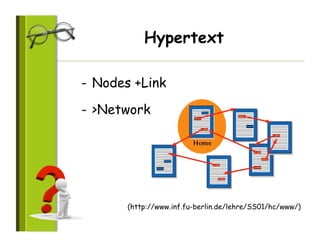
Hypertext

-  Nodes +Link

-  >Network


       (http://www.inf.fu-berlin.de/lehre/SS01/hc/www/)
Normal Text vs. Hypertext


(http://www.cs.sfu.ca/CC/365/mark/material/notes/Chap1/Chap1.html)
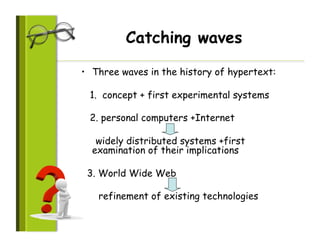
Catching waves

•  Three waves in the history of hypertext:

 1. concept + first experimental systems

 2. personal computers +Internet

   widely distributed systems +first
  examination of their implications

 3. World Wide Web

   refinement of existing technologies
Catching waves

•  Hypertext as reality, not
   novelty (3rd wave)
  –  archive:“ a communication
     environment in which virtually all
     texts are exposed to automated
     search, retrieval and hypertext
     reference” (Dalgaard 2001)
  –  archive refers to any application
     of hypertext
Catching waves

–  Earlier accounts of hypertext:
   “remediation” (Dalgaard 2001)
–  since the difference between
   hypertext and print culture
   there is the need to re-examine
   earlier positions
–  the ‘archive’ and digital media in
   general have yet to establish
   legitimacy
Misreading Reading

–  The World Wide Web expands all
   over the world and we live with
   hypertext in our everyday life
–  According to an American (NEA)
   report called “Reading at Risk”:
   reading of leisure literature is on
   decline
  in another half century nobody will
   pay for fiction and poetry, except
   textbooks
Misreading Reading

–  This report confines reading solely on
   printed books
–  reading in context of the electronic
   archive, like Weblogs, Wikis or even
   Audiobooks are not incorporated at all
   in this study
–  Electronic media is only seen as a threat
   to conventional print publishing
–  demonstrates the ignorance towards
   digital technologies, as well as the
   problem to see the electronic archive as
   a possibility for literacy to evolve
   continuously
What the Geeks Know

–  encounters between old and new
   media are inherently adversarial
   and never assured of balanced
   resolution

innovation in communication seems
  to be problematic
What the Geeks Know

–  Epistemology (theory of knowledge) of
   electronic text vs conventional writing
–  According to Miles “hypertext” belongs
   not to an economy of scarcity but to a
   mode of excess”.
–  The archive doesn’t know sufficiency,
   only surfeit.
–  > With uncountable documents instantly
   available, there is an overload of
   information on the world wide web
–  > attention must be elective
Literacy in Babylon

–  Moulthrop brings up the
   connection to Borges and his story
   “The Lottery in Babylon”,
   published in 1941.
–  a fictional society in ancient
   Babylon which reorganizes its
   epistemology around a municipal
   numbers game
–  perhaps God does not play at dice
   with the universe, perhaps God is
   the dice.
Literacy in Babylon

–  Moulthrop argues that literacy can no
   longer be ceded to print culture alone
–  a new definition of literacy founded on
   pathwork in the hypertextual archive
–  to take up the challenge of reinventing
   literacy for a world increasingly
   afflicted by ignorance
–  he concedes that such a change in
   agenda will not automatically fix the
   widespread misunderstanding of media
–  but he is confident that those ideas will
   tend to exceed initial expectations
•  What is the new literacy we
   need in digital context?
•  http://www.youtube.com/watch?
   v=_XqRR5WJ85k
Reference

•    http://iat.ubalt.edu/moulthrop/
•    http://en.wikipedia.org/wiki/Hypertext
•    http://www.inf.fuberlin.de/lehre/SS01/hc/www/
•    http://www.cs.sfu.ca/CC/365/mark/material/
     notes/Chap1/Chap1.html
•  Nielsen,J., (1995).Multimedia and Hypertext: The
     Internet and Beyond.
Thank you

What the geeks know

  • 1.
    What the GeeksKnow: Hypertext and the Problem of Literacy Jianwei Zhang
  • 2.
    Stuart Moulthrop •  aninnovator of electronic literature and hypertext fiction, both as a theoretician and as a writer. •  a Professor of Information Arts and Technologies at the University of Baltimore. •  a founding board member of the Electronic Literature Organization in 1999.
  • 3.
    Hypertext –  Hypertext istext, displayed on a computer, with references (hyperlinks) to other text that the reader can immediately access, usually by a mouse click or keypress sequence. –  The most extensive example of hypertext today is the World Wide Web. (http://en.wikipedia.org/wiki/ Hypertext)
  • 4.
    Hypertext -  Nodes +Link - >Network (http://www.inf.fu-berlin.de/lehre/SS01/hc/www/)
  • 5.
    Normal Text vs.Hypertext (http://www.cs.sfu.ca/CC/365/mark/material/notes/Chap1/Chap1.html)
  • 6.
    Catching waves •  Threewaves in the history of hypertext: 1. concept + first experimental systems 2. personal computers +Internet widely distributed systems +first examination of their implications 3. World Wide Web refinement of existing technologies
  • 7.
    Catching waves •  Hypertextas reality, not novelty (3rd wave) –  archive:“ a communication environment in which virtually all texts are exposed to automated search, retrieval and hypertext reference” (Dalgaard 2001) –  archive refers to any application of hypertext
  • 8.
    Catching waves –  Earlieraccounts of hypertext: “remediation” (Dalgaard 2001) –  since the difference between hypertext and print culture there is the need to re-examine earlier positions –  the ‘archive’ and digital media in general have yet to establish legitimacy
  • 9.
    Misreading Reading –  TheWorld Wide Web expands all over the world and we live with hypertext in our everyday life –  According to an American (NEA) report called “Reading at Risk”: reading of leisure literature is on decline in another half century nobody will pay for fiction and poetry, except textbooks
  • 10.
    Misreading Reading –  Thisreport confines reading solely on printed books –  reading in context of the electronic archive, like Weblogs, Wikis or even Audiobooks are not incorporated at all in this study –  Electronic media is only seen as a threat to conventional print publishing –  demonstrates the ignorance towards digital technologies, as well as the problem to see the electronic archive as a possibility for literacy to evolve continuously
  • 11.
    What the GeeksKnow –  encounters between old and new media are inherently adversarial and never assured of balanced resolution innovation in communication seems to be problematic
  • 12.
    What the GeeksKnow –  Epistemology (theory of knowledge) of electronic text vs conventional writing –  According to Miles “hypertext” belongs not to an economy of scarcity but to a mode of excess”. –  The archive doesn’t know sufficiency, only surfeit. –  > With uncountable documents instantly available, there is an overload of information on the world wide web –  > attention must be elective
  • 13.
    Literacy in Babylon – Moulthrop brings up the connection to Borges and his story “The Lottery in Babylon”, published in 1941. –  a fictional society in ancient Babylon which reorganizes its epistemology around a municipal numbers game –  perhaps God does not play at dice with the universe, perhaps God is the dice.
  • 14.
    Literacy in Babylon – Moulthrop argues that literacy can no longer be ceded to print culture alone –  a new definition of literacy founded on pathwork in the hypertextual archive –  to take up the challenge of reinventing literacy for a world increasingly afflicted by ignorance –  he concedes that such a change in agenda will not automatically fix the widespread misunderstanding of media –  but he is confident that those ideas will tend to exceed initial expectations
  • 15.
    •  What isthe new literacy we need in digital context? •  http://www.youtube.com/watch? v=_XqRR5WJ85k
  • 16.
    Reference •  http://iat.ubalt.edu/moulthrop/ •  http://en.wikipedia.org/wiki/Hypertext •  http://www.inf.fuberlin.de/lehre/SS01/hc/www/ •  http://www.cs.sfu.ca/CC/365/mark/material/ notes/Chap1/Chap1.html •  Nielsen,J., (1995).Multimedia and Hypertext: The Internet and Beyond.
  • 17.