EVOLVING CHANGES IN
ENGLISH LITERARY
STUDIES
Dr. Felix Moses
CHANGE
• “Change is not merely necessary to life - it is
life.” - Alvin Toffler
• Ubiquitous
• –ING: A continuous process
• Different attitudes to change [techno-phobic
or techno-addict]
• Inevitable [‘time and tide wait for no man’]
THEMATIC STATEMENTS
• “This is an amazing time to be teaching. We are at a juncture
between centuries-old traditions and fresh untouched territory. At
once our classrooms are both relics of antiquated traditions and
symbols of the future of a global society.”
Michelle Pacansky-Brock [2013]
• “The field of literary studies is being reshaped in the digital age.”
Kenneth M. Price and Ray Siemens [2013]
• “Social Media sites and services are incredibly popular among
college students.”
Reynol Junco [2014]
LITERARY STUDIES
OLDER: TEXT BASED
• The syllabus is merely a list of different literary texts to be
taught by different professors.
• Fragmentary
• The literary text is always the primary focus.
• The professor teaches/explains the ‘meaning’ of the text.
• The student is assessed whether he has understood the
‘meaning’ of the text.
• Both the professor and the student are not motivated
enough because the objectives have not been specified
clearly.
OLD: COURSE BASED
• Individual courses offered by individual
professors
• The courses are thematically organized
• The objectives of each course are specified
clearly
• The literary text is taught as a means to realize
course objectives
• Both the professor and the student are
empowered: the professor has the freedom to
frame his course and the student has the freedom
to choose his course of study.
• Choice Based Credit System - Globalization
DRAWBACKS
• The lecture method predominates in both text and course
based teaching
• Passive learning – monotony and boredom
• Disconnect between the classroom and the real world
outside.
• The final assessment is no real indication of the students’
abilities or achievements.
THE REMEDY: BLENDED
LEARNING
http://www.nccsa.org/
THE HYBRID/POROUS/FLIPPED
CLASSROOM
To take advantage of both face to face and online teaching. It is a mix of academic
instruction with practical professional experience beyond the traditional classroom.
Learners can both access data and communicate with other learners at little or no effort
or cost being freed from the immediate environment of the classroom.
ONLINE EDUCATION
MOOC A massive open online course (MOOC) is a model for delivering
learning content online to any person who wants to take a course, with no
limit on attendance: “Untethered Learning”
[a] https://www.khanacademy.org/ “For free. For everyone. Forever.”
[b] World Impact of MIT OpenCourseWare.
MIT OpenCourseWare is being successfully used for a wide range of
purposes. “Globally, Indians form the second-largest pool of students
attending MOOC classes.” Forbes India 6.5.15
TECHNOLOGY IN THE
CLASSROOM: WHY?
• Indian Express 10.02.2016 and 29.02.16
• Reflection of the real world outside
• Convenience
• Speed of delivery and feedback
• Boosts student motivation
• Diverse and richer learning styles – audio books
• Collaborative and cooperative learning
• The global reach
• employment
BUT:
• Simple addition of technology into a class is
not blended learning
• Classroom activities must be linked to the
world outside
• Students must be transformed into content
creators by sharing and collaborating with
others
• Students transformed into active learners
WHY DIGITAL ENGLISH
LITERARY STUDIES?
• Instant access to humongous general and
scholarly collections of virtual libraries like
Project Gutenberg and Google’s Library Project.
• Instant access to multiple texts or different
editions of the same text
• Instant access to rare literary texts/multimedia
collections/manuscripts
• New and state-of-the-art forms of textual
scholarship and enquiry
• State of the art and innovative employment
opportunities in English Literary Studies
WHAT – CONTENT
• “Digital literary studies is multifaceted in its
techniques, assumptions and cross disciplinary
connections.” Kenneth M. Price and Ray Siemens
[2013]
https://dlsanthology.commons.mla.org/introduction/
THE CANON
• Choice of texts for the syllabus by upsetting the
standard notions of the canon. Alastair Fowler’s three
types of Canon [1982]
• http://www.unife.it/
ELECTRONIC AND/OR DIGITAL
LITERATURE:
• “The Age of Print is passing” Katherine Hayles [2012]
“All the world’s a screen”: http://alltheworldsascreen.tumblr.com/
We have to prepare our “screenagers” to thrive in a screen based world.
• Audio and video books and vlooks: an electronic book which consists of both video and
text.
• Eg: “The Dionaea House” 2004-06 by Eric Heisserer. It is told in different formats over the
internet: emails and blogs. http://www.dionaea-house.com/
• Apps: “Pry” by Samantha Gorman and Danny Cannizzaro is an App novella that re-imagines
the form of the eBook. It is exclusive to devices like iPads and iPhones and it requires a
touchscreen iPad app-novella. “In Pry, text, interaction and cinema combine to reimagine how
we can touch, open, close and pry into a text, moving seamlessly among words and images to
explore the layers of a character’s consciousness.” http://prynovella.com/
• “Electric Literature” is an independent publisher founded by Andy Hunter and Scott
Lindenbaum in 2009 as a quarterly journal which deals with books, literature, writing, fiction,
and using technology and digital innovation to keep literature a vital part of popular culture
and amplify storytelling. They simultaneously distribute their product via e-book, Kindle,
iPhone, audiobooks, and other platforms. The print version of the journal is produced via
print on demand. . http://electricliterature.com/
• SOCIAL MEDIA FICTION
. “Texts that appear in social networks don’t stem from literature, but are the result of
the act of communication.” Eugenia Kuznetsova [2014]
• Twitter: Hint Fiction, Micro Fiction, Flash Fiction, Nano Fiction and
Twiction: “Black Box” by Jennifer Egan an original work of fiction first published
online in the New Yorker 2012 http://www.newyorker.com/magazine/2012
• http://www.confettifall.com/twiction-history.html
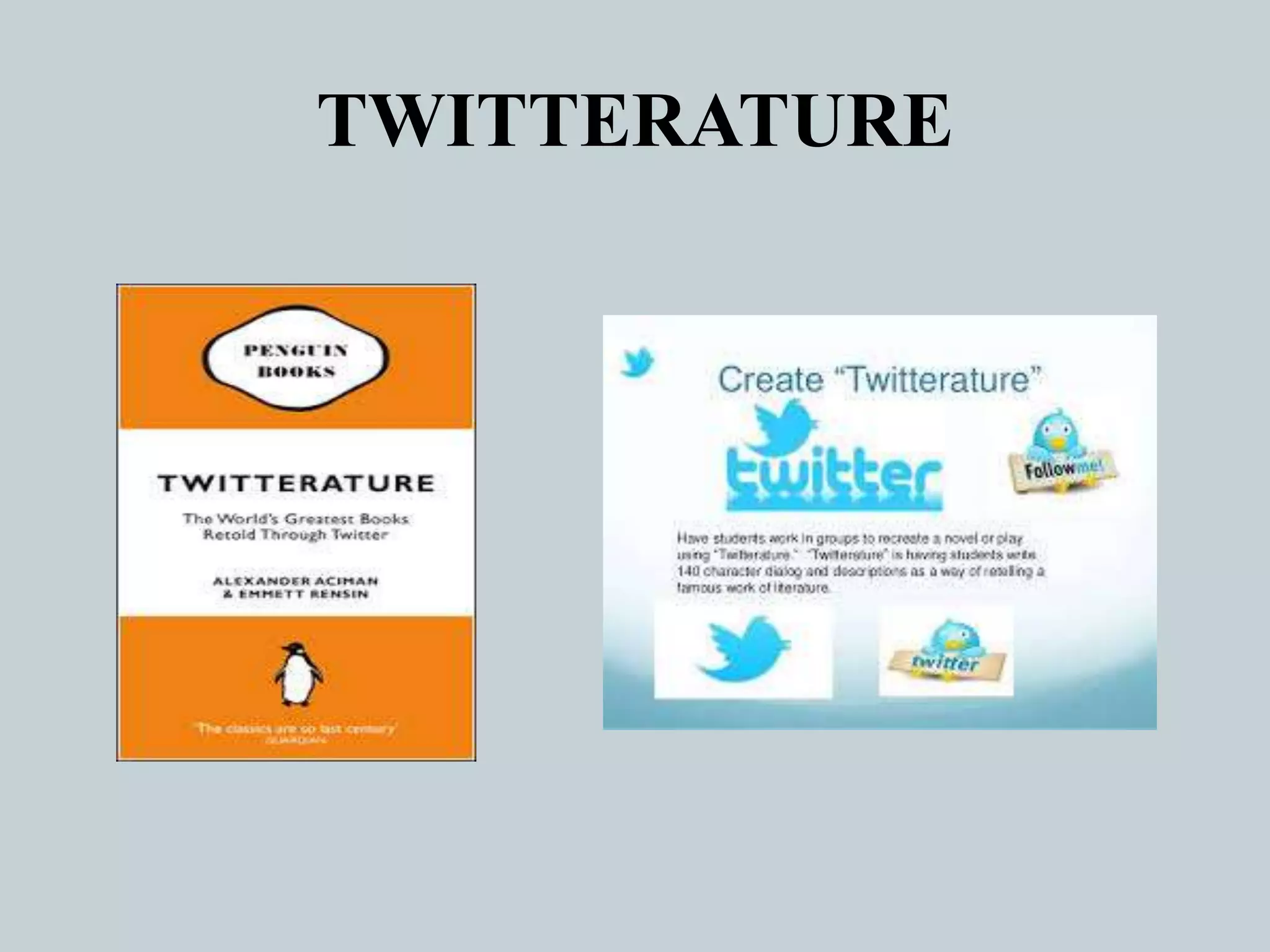
Twitterature: The World’s Greatest Books Retold Through Twitter by Alexander
Aciman and Emmett Rensin [2009]
https://www.penguin.co.uk/books/177715/twitterature/
TWITTERATURE
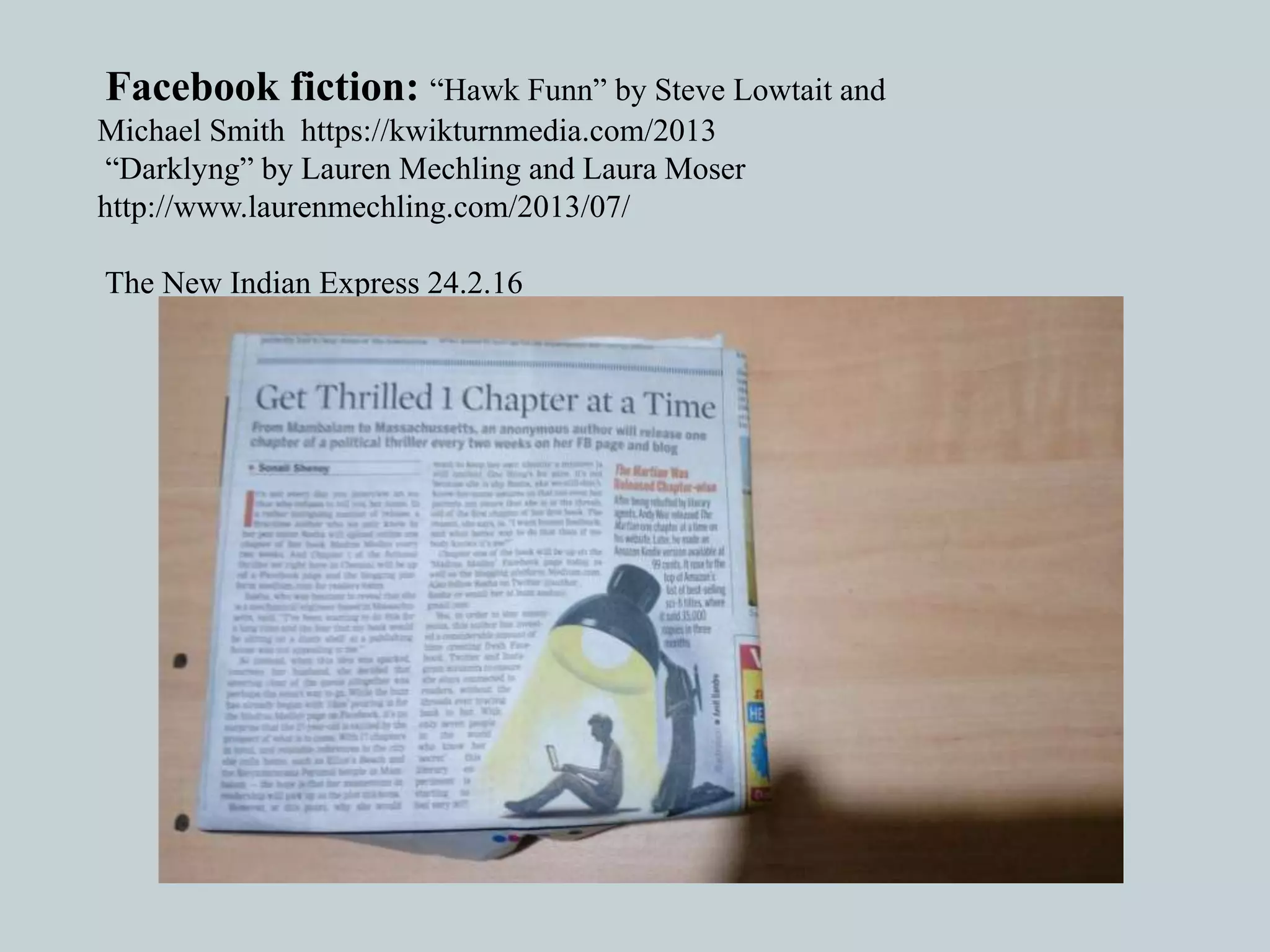
Facebook fiction: “Hawk Funn” by Steve Lowtait and
Michael Smith https://kwikturnmedia.com/2013
“Darklyng” by Lauren Mechling and Laura Moser
http://www.laurenmechling.com/2013/07/
The New Indian Express 24.2.16
Instagram fiction : “Hey Harry Hey Matilda” by the photographer Rachel Hulin [2015]
http://www.rachelhulin.com/ and http://carolinecalloway.com/
• Snapchat fiction: In October 2013, Snapchat introduced the "My Story" feature, which allows users to
compile snaps [photos and videos] into chronological storylines, accessible to all of their friends, or to the
public. Stories are viewed in chronological order, and each segment is accessible for 24 hours. An "Official
stories" designation was added in November 2015 to denote the public stories of notable figures and
celebrities, similarly to Twitter's "Verified account" program. https://www.snapchat.com/
• Fiction Apps: Prerna Gupta from California has developed an app, called Hooked, as "books for the
Snapchat generation." Each book will be roughly 1,000 words and is designed to be read in about five
minutes. The stories will be told entirely through dialogue and read like texts. Gupta envisions the app as
being like "Twitter for fiction," http://prernagupta.com/
• Video Games fiction: “Façade a one act interactive drama” by Michael Mateas, and Andrew Stern
http://www.interactivestory.net/
• Literary blog:
• “Four and Twenty Black Birds” by Cherie Priest [2005] won the Lulu Blooker Prize, a literary award for
"blooks" (books based on blogs).
• http://www.cheriepriest.com/
• Fake Blogs [Flogs]: The 100% Unofficial Blog of the Indian PM at: http://desiprimeminister.com/
• Fan fiction: (also abbreviated to fan fic, fanfic, or fic) is fiction about characters or settings from an
original work of fiction, created by fans of that work rather than by its creator. Eg. Seth Grahame-Smith,
“Pride and Prejudice and Zombies.” https://www.fanfiction.net/
• “We are living in a time of immense creativity with new opportunities for creators appearing nearly
every day.” Bryan Alexander [2011]
THE LANGUAGE OF DIGITAL LITERATURE
textspeak and netspeak
Digital fluency: It was once trendy to try to speak like people wrote, and now it’s the other way around. For the first time in
history, we can write quickly enough to capture qualities of spoken language in our writing, and teens are skillfully doing just that.
Jane Solomon [2013] http://blog.dictionary.com/shortening-english/
Features : Jannis Androutsopoulos [2011]
(a) It is vernacular, in the sense of non-institutional writing that is located beyond education or professional control;
(b) It is interpersonal and relationship-focused rather than subject-oriented;
(c) It is unplanned and spontaneous; and
(d) It is dialogical and interaction oriented, carrying expectations of continuous exchange.
(e) Acronyms, keyboard symbols, abbreviations and emoticons: Lol, @, xlnt
Textspeak: From the guardian dated 12.6.2015 “YOLO Juliet. srsly Hamlet. Macbeth #killingit. Shakespeare goes textspeak”
http://www.amazon.com/YOLO-Juliet-OMG-Shakespeare-William/dp/0553535390
Imagine: What if those star-crossed lovers Romeo and Juliet had smartphones? A classic is reborn in this fun and funny adaptation
of one of Shakespeare’s most famous plays!
David Crystal [2001] “I see the arrival of Netspeak as similarly enriching the range of communicative options available to us. And
the Internet is going to record this linguistic diversity more fully and accurately than was ever possible before. What is truly
remarkable is that so many people have learned so quickly to adapt their language to meet the demands of the new situations, and
to exploit the potential of the new medium so creatively to form new areas of expression.”
Crystal, David (2001). Language and the Internet. Cambridge: Cambridge University Press.
Crystal, David (2004). A Glossary of Netspeak and Textspeak. Edinburgh: Edinburgh UniversityPress
TEXTSPEAK
HOW – METHODOLGY AND
DELIVERY DEVICES
• Small portable computing devices: laptops, net
books, tablets, iPads, iPods and smartphones.
• E readers
• advantages: portability, capacity, download free books
http://www.planetebook.com/, underline, highlight,
save and export.
• Kindle readers, “Amazon Launch Kindle Unlimited in
India with Local Partners In News Blog by Edward
Nawotka September 3, 2015
• Interactive whiteboards and even PDAs
ADVANTAGES
• Flexible and convenient - allows the student to access information anywhere, anytime.
• Portable - students can use the devices in any classroom as well as outside of the classroom.
• Community - allows students to connect with each other and can reinforce integration of different
curriculum.
• Communication - students, teachers and parents are able to connect instantaneously.
• Support - handheld devices can enable and support those students who have learning difficulties.
• Features - applications such as GPS
• Taking photographs of homework, solutions, examples, or evidence
• Using photo and music editing applications for multimedia assignments https://animoto.com/
• Accessing the Internet for research/information
• Using application software for language translations
• Access digital classroom assignments and audio-recorded lectures
• Collaborate with other students using cloud computing (Dropbox, Google's GoogleDocs, Microsoft's
OneDrive)
WEB 2.0
• World Wide Web sites that emphasize user-generated content, usability, and interoperability : share, collaborate,
create and participate.
• "The Web has the potential to radically change what we assume about teaching and learning, and it presents us with
important questions to ponder: What needs to change about our curriculum when our students have the ability to reach
audiences far beyond our classroom walls?" Will Richardson [2010]
• Blogs: Allows an individual to make regular postings, like a diary
• Wikis: An open collective publication to which anyone can contribute
• .Social networking: a social utility that enables one to be connected with friends and others who share similar interests.
Pages on literature in general and authors in particular.
• “Teaching and learning is and will become much more social.”
• Facebook Guide for Educators: http://www.ednfoundation.org/wp-content/uploads/Facebookguideforeducators.pdf [2013]
• http://edtechpicks.org/2014/06/twitter/ [2014]
• Audio and video sharing websites: YouTube, podcasts www.stitcher.com
• Voice threads: http://voicethread.com/ “VoiceThread is an excellent online tool that promotes meaningful conversation
through the use of visual prompts such as video clips, images, graphs, and more.” Bill Ferriter
• Synchronous communication tools: like Skype which allows real time audio and visual communication.
• Snapchat: https://www.snapchat.com/
• 3-D Virtual worlds: like secondlife.com, real time semi-random communication with virtual sites and people.
• Visual Dictionary: http://www.visuwords.com/
• Multiplayer games: enables players to compete or collaborate with one another usually in real time
http://www.nobelprize.org/nobel_prizes/literature/laureates/2015/
• Audio and Video stories: http://www.openculture.com/freeaudiobooks
• Free podcasts: http://learn.org/articles/20_Free_Literary_Podcasts_Worth_Listening_To.html
• Mashups: a ‘mash’ of some or all of the above. The term mash-up refers to a new breed of Web-based applications
created by hackers and programmers (typically on a volunteer basis) to mix at least two different services from disparate, and
even competing, Web sites. Eg: Wikilog or bliki
INDIVIDUAL LEARNER’S
RECORD
• E portfolios: In general, an E Portfolio is a purposeful collection of information and
digital artifacts [inputted text, electronic files, images, multimedia, blog entries, and
hyperlinks] that demonstrates development or evidences learning outcomes, skills or
competencies. Helen C. Barrett [2009]
http://electronicportfolios.org/balance/Balancing.jpg
• Uses of E Portfolio: http://www.bu.edu/eportfolio/using/ [Boston University]
• E Portfolios can provide a means for assessment based on evidence of an
individual’s growth over time and effort- not a list of test scores.
• Evaluating the learner’s work using a variety of artifacts – graphics, pictures,
multimedia, stories, journals, or projects – provides a view into the individual’s
mind and capabilities as well as the teaching and learning environment
• The collection of work provides a powerful and comprehensive digital resumé of
the multiple intelligences of an individual, as a linguist, an artist, a scientist, a
mathematician, an athlete, a reflective learner, a self learner, or a cooperative
learner.
• A longitudinal view of a learner’s work paints a picture of growth, progress, and
continuity over time that the learner can collect, select, and reflect upon to present a
profile of accomplishment based on evidence
E-PORTFOLIO INTERFACE
INSTITUTIONAL
Learning Management System: https://moodle.org/ , http://itslearning.eu/
A Learning Management System (LMS) is software that automates the different aspects of training such as tracking
courses in a catalog, registering users, recording data, displaying students’ or participants’ progress toward certification,
and providing reports to managers. These systems also serve as a platform to deliver e-Learning to people.
CLOUD BASED LEARNING
Mobile cloud learning takes place through web based apps and has the following characteristics:
• .Storage and sharing: Learning outcomes and resources can be stored in the “Cloud,” which
provides almost unlimited store and computation capacities. Documents can be commonly
edited and shared in the “Cloud,” such as services provided by GoogleDocs, Live Skydrive,
and Office Live.
• .Universal accessibility: Learners can study as long as they have access to the network.
Mobile cloud learning also makes a low-cost access terminal possible, because software,
applications, and data are all operated in the cloud servers. This improved accessibility can
greatly benefit developing regions.
• .Collaborative interactions: Learners can cooperate anywhere in the “Cloud.” From social
learning perspectives, they can collaboratively build common knowledge through frequent
and convenient interactions.
• .Learner centered: Mobile cloud learning is heavily people-oriented, which meets the
individual needs of learners. Learners in the “Cloud” select suitable resources and can track
their learning progress and outcomes.
• Given the above characteristics, mobile cloud learning is mostly utilized to enable
communication between educators and students, manage the teaching and learning processes,
and add knowledge to interested and willing users, utilized among learners, and so on.
Indian Express 20.02.16
MERITS AND DEMERITS OF CLOUD
BASED M-LEARNING
. Devices used are lightweight and cheaper than PCs and laptops
. Readily available a/synchronous learning experience
. M-Learning provides financial savings because we don’t have to provide
physical space for all students.
. Individualized, situated, collaborative, and informal learning without being
limited to classroom contexts
----
. Size of screen
. Connectivity and battery charge
. Limited memory
. Difficult to keep track of students’ progress.
CONCLUSION
• “Technology will never replace great teachers BUT technology in the hands of a great teacher can be
transformational. The process of learning is more important than the product” George Couros [2016] .
• “Effective technology integration is achieved when the use of the technology is routine and transparent and
when technology supports curricular goals.”
• Edutopia [2008] http://www.edutopia.org/
Evolving changes in english literary studies

Evolving changes in english literary studies

  • 1.
    EVOLVING CHANGES IN ENGLISHLITERARY STUDIES Dr. Felix Moses
  • 2.
    CHANGE • “Change isnot merely necessary to life - it is life.” - Alvin Toffler • Ubiquitous • –ING: A continuous process • Different attitudes to change [techno-phobic or techno-addict] • Inevitable [‘time and tide wait for no man’]
  • 3.
    THEMATIC STATEMENTS • “Thisis an amazing time to be teaching. We are at a juncture between centuries-old traditions and fresh untouched territory. At once our classrooms are both relics of antiquated traditions and symbols of the future of a global society.” Michelle Pacansky-Brock [2013] • “The field of literary studies is being reshaped in the digital age.” Kenneth M. Price and Ray Siemens [2013] • “Social Media sites and services are incredibly popular among college students.” Reynol Junco [2014]
  • 4.
    LITERARY STUDIES OLDER: TEXTBASED • The syllabus is merely a list of different literary texts to be taught by different professors. • Fragmentary • The literary text is always the primary focus. • The professor teaches/explains the ‘meaning’ of the text. • The student is assessed whether he has understood the ‘meaning’ of the text. • Both the professor and the student are not motivated enough because the objectives have not been specified clearly.
  • 5.
    OLD: COURSE BASED •Individual courses offered by individual professors • The courses are thematically organized • The objectives of each course are specified clearly • The literary text is taught as a means to realize course objectives • Both the professor and the student are empowered: the professor has the freedom to frame his course and the student has the freedom to choose his course of study. • Choice Based Credit System - Globalization
  • 6.
    DRAWBACKS • The lecturemethod predominates in both text and course based teaching • Passive learning – monotony and boredom • Disconnect between the classroom and the real world outside. • The final assessment is no real indication of the students’ abilities or achievements.
  • 7.
  • 8.
    THE HYBRID/POROUS/FLIPPED CLASSROOM To takeadvantage of both face to face and online teaching. It is a mix of academic instruction with practical professional experience beyond the traditional classroom. Learners can both access data and communicate with other learners at little or no effort or cost being freed from the immediate environment of the classroom.
  • 9.
    ONLINE EDUCATION MOOC Amassive open online course (MOOC) is a model for delivering learning content online to any person who wants to take a course, with no limit on attendance: “Untethered Learning” [a] https://www.khanacademy.org/ “For free. For everyone. Forever.” [b] World Impact of MIT OpenCourseWare. MIT OpenCourseWare is being successfully used for a wide range of purposes. “Globally, Indians form the second-largest pool of students attending MOOC classes.” Forbes India 6.5.15
  • 10.
    TECHNOLOGY IN THE CLASSROOM:WHY? • Indian Express 10.02.2016 and 29.02.16 • Reflection of the real world outside • Convenience • Speed of delivery and feedback • Boosts student motivation • Diverse and richer learning styles – audio books • Collaborative and cooperative learning • The global reach • employment
  • 11.
    BUT: • Simple additionof technology into a class is not blended learning • Classroom activities must be linked to the world outside • Students must be transformed into content creators by sharing and collaborating with others • Students transformed into active learners
  • 12.
    WHY DIGITAL ENGLISH LITERARYSTUDIES? • Instant access to humongous general and scholarly collections of virtual libraries like Project Gutenberg and Google’s Library Project. • Instant access to multiple texts or different editions of the same text • Instant access to rare literary texts/multimedia collections/manuscripts • New and state-of-the-art forms of textual scholarship and enquiry • State of the art and innovative employment opportunities in English Literary Studies
  • 13.
    WHAT – CONTENT •“Digital literary studies is multifaceted in its techniques, assumptions and cross disciplinary connections.” Kenneth M. Price and Ray Siemens [2013] https://dlsanthology.commons.mla.org/introduction/ THE CANON • Choice of texts for the syllabus by upsetting the standard notions of the canon. Alastair Fowler’s three types of Canon [1982] • http://www.unife.it/
  • 14.
    ELECTRONIC AND/OR DIGITAL LITERATURE: •“The Age of Print is passing” Katherine Hayles [2012] “All the world’s a screen”: http://alltheworldsascreen.tumblr.com/ We have to prepare our “screenagers” to thrive in a screen based world. • Audio and video books and vlooks: an electronic book which consists of both video and text. • Eg: “The Dionaea House” 2004-06 by Eric Heisserer. It is told in different formats over the internet: emails and blogs. http://www.dionaea-house.com/ • Apps: “Pry” by Samantha Gorman and Danny Cannizzaro is an App novella that re-imagines the form of the eBook. It is exclusive to devices like iPads and iPhones and it requires a touchscreen iPad app-novella. “In Pry, text, interaction and cinema combine to reimagine how we can touch, open, close and pry into a text, moving seamlessly among words and images to explore the layers of a character’s consciousness.” http://prynovella.com/ • “Electric Literature” is an independent publisher founded by Andy Hunter and Scott Lindenbaum in 2009 as a quarterly journal which deals with books, literature, writing, fiction, and using technology and digital innovation to keep literature a vital part of popular culture and amplify storytelling. They simultaneously distribute their product via e-book, Kindle, iPhone, audiobooks, and other platforms. The print version of the journal is produced via print on demand. . http://electricliterature.com/
  • 15.
    • SOCIAL MEDIAFICTION . “Texts that appear in social networks don’t stem from literature, but are the result of the act of communication.” Eugenia Kuznetsova [2014] • Twitter: Hint Fiction, Micro Fiction, Flash Fiction, Nano Fiction and Twiction: “Black Box” by Jennifer Egan an original work of fiction first published online in the New Yorker 2012 http://www.newyorker.com/magazine/2012 • http://www.confettifall.com/twiction-history.html Twitterature: The World’s Greatest Books Retold Through Twitter by Alexander Aciman and Emmett Rensin [2009] https://www.penguin.co.uk/books/177715/twitterature/
  • 16.
  • 17.
    Facebook fiction: “HawkFunn” by Steve Lowtait and Michael Smith https://kwikturnmedia.com/2013 “Darklyng” by Lauren Mechling and Laura Moser http://www.laurenmechling.com/2013/07/ The New Indian Express 24.2.16
  • 18.
    Instagram fiction :“Hey Harry Hey Matilda” by the photographer Rachel Hulin [2015] http://www.rachelhulin.com/ and http://carolinecalloway.com/ • Snapchat fiction: In October 2013, Snapchat introduced the "My Story" feature, which allows users to compile snaps [photos and videos] into chronological storylines, accessible to all of their friends, or to the public. Stories are viewed in chronological order, and each segment is accessible for 24 hours. An "Official stories" designation was added in November 2015 to denote the public stories of notable figures and celebrities, similarly to Twitter's "Verified account" program. https://www.snapchat.com/ • Fiction Apps: Prerna Gupta from California has developed an app, called Hooked, as "books for the Snapchat generation." Each book will be roughly 1,000 words and is designed to be read in about five minutes. The stories will be told entirely through dialogue and read like texts. Gupta envisions the app as being like "Twitter for fiction," http://prernagupta.com/ • Video Games fiction: “Façade a one act interactive drama” by Michael Mateas, and Andrew Stern http://www.interactivestory.net/ • Literary blog: • “Four and Twenty Black Birds” by Cherie Priest [2005] won the Lulu Blooker Prize, a literary award for "blooks" (books based on blogs). • http://www.cheriepriest.com/ • Fake Blogs [Flogs]: The 100% Unofficial Blog of the Indian PM at: http://desiprimeminister.com/ • Fan fiction: (also abbreviated to fan fic, fanfic, or fic) is fiction about characters or settings from an original work of fiction, created by fans of that work rather than by its creator. Eg. Seth Grahame-Smith, “Pride and Prejudice and Zombies.” https://www.fanfiction.net/ • “We are living in a time of immense creativity with new opportunities for creators appearing nearly every day.” Bryan Alexander [2011]
  • 19.
    THE LANGUAGE OFDIGITAL LITERATURE textspeak and netspeak Digital fluency: It was once trendy to try to speak like people wrote, and now it’s the other way around. For the first time in history, we can write quickly enough to capture qualities of spoken language in our writing, and teens are skillfully doing just that. Jane Solomon [2013] http://blog.dictionary.com/shortening-english/ Features : Jannis Androutsopoulos [2011] (a) It is vernacular, in the sense of non-institutional writing that is located beyond education or professional control; (b) It is interpersonal and relationship-focused rather than subject-oriented; (c) It is unplanned and spontaneous; and (d) It is dialogical and interaction oriented, carrying expectations of continuous exchange. (e) Acronyms, keyboard symbols, abbreviations and emoticons: Lol, @, xlnt Textspeak: From the guardian dated 12.6.2015 “YOLO Juliet. srsly Hamlet. Macbeth #killingit. Shakespeare goes textspeak” http://www.amazon.com/YOLO-Juliet-OMG-Shakespeare-William/dp/0553535390 Imagine: What if those star-crossed lovers Romeo and Juliet had smartphones? A classic is reborn in this fun and funny adaptation of one of Shakespeare’s most famous plays! David Crystal [2001] “I see the arrival of Netspeak as similarly enriching the range of communicative options available to us. And the Internet is going to record this linguistic diversity more fully and accurately than was ever possible before. What is truly remarkable is that so many people have learned so quickly to adapt their language to meet the demands of the new situations, and to exploit the potential of the new medium so creatively to form new areas of expression.” Crystal, David (2001). Language and the Internet. Cambridge: Cambridge University Press. Crystal, David (2004). A Glossary of Netspeak and Textspeak. Edinburgh: Edinburgh UniversityPress
  • 20.
  • 21.
    HOW – METHODOLGYAND DELIVERY DEVICES • Small portable computing devices: laptops, net books, tablets, iPads, iPods and smartphones. • E readers • advantages: portability, capacity, download free books http://www.planetebook.com/, underline, highlight, save and export. • Kindle readers, “Amazon Launch Kindle Unlimited in India with Local Partners In News Blog by Edward Nawotka September 3, 2015 • Interactive whiteboards and even PDAs
  • 22.
    ADVANTAGES • Flexible andconvenient - allows the student to access information anywhere, anytime. • Portable - students can use the devices in any classroom as well as outside of the classroom. • Community - allows students to connect with each other and can reinforce integration of different curriculum. • Communication - students, teachers and parents are able to connect instantaneously. • Support - handheld devices can enable and support those students who have learning difficulties. • Features - applications such as GPS • Taking photographs of homework, solutions, examples, or evidence • Using photo and music editing applications for multimedia assignments https://animoto.com/ • Accessing the Internet for research/information • Using application software for language translations • Access digital classroom assignments and audio-recorded lectures • Collaborate with other students using cloud computing (Dropbox, Google's GoogleDocs, Microsoft's OneDrive)
  • 23.
    WEB 2.0 • WorldWide Web sites that emphasize user-generated content, usability, and interoperability : share, collaborate, create and participate. • "The Web has the potential to radically change what we assume about teaching and learning, and it presents us with important questions to ponder: What needs to change about our curriculum when our students have the ability to reach audiences far beyond our classroom walls?" Will Richardson [2010] • Blogs: Allows an individual to make regular postings, like a diary • Wikis: An open collective publication to which anyone can contribute • .Social networking: a social utility that enables one to be connected with friends and others who share similar interests. Pages on literature in general and authors in particular. • “Teaching and learning is and will become much more social.” • Facebook Guide for Educators: http://www.ednfoundation.org/wp-content/uploads/Facebookguideforeducators.pdf [2013] • http://edtechpicks.org/2014/06/twitter/ [2014] • Audio and video sharing websites: YouTube, podcasts www.stitcher.com • Voice threads: http://voicethread.com/ “VoiceThread is an excellent online tool that promotes meaningful conversation through the use of visual prompts such as video clips, images, graphs, and more.” Bill Ferriter • Synchronous communication tools: like Skype which allows real time audio and visual communication. • Snapchat: https://www.snapchat.com/ • 3-D Virtual worlds: like secondlife.com, real time semi-random communication with virtual sites and people. • Visual Dictionary: http://www.visuwords.com/ • Multiplayer games: enables players to compete or collaborate with one another usually in real time http://www.nobelprize.org/nobel_prizes/literature/laureates/2015/ • Audio and Video stories: http://www.openculture.com/freeaudiobooks • Free podcasts: http://learn.org/articles/20_Free_Literary_Podcasts_Worth_Listening_To.html • Mashups: a ‘mash’ of some or all of the above. The term mash-up refers to a new breed of Web-based applications created by hackers and programmers (typically on a volunteer basis) to mix at least two different services from disparate, and even competing, Web sites. Eg: Wikilog or bliki
  • 24.
    INDIVIDUAL LEARNER’S RECORD • Eportfolios: In general, an E Portfolio is a purposeful collection of information and digital artifacts [inputted text, electronic files, images, multimedia, blog entries, and hyperlinks] that demonstrates development or evidences learning outcomes, skills or competencies. Helen C. Barrett [2009] http://electronicportfolios.org/balance/Balancing.jpg • Uses of E Portfolio: http://www.bu.edu/eportfolio/using/ [Boston University] • E Portfolios can provide a means for assessment based on evidence of an individual’s growth over time and effort- not a list of test scores. • Evaluating the learner’s work using a variety of artifacts – graphics, pictures, multimedia, stories, journals, or projects – provides a view into the individual’s mind and capabilities as well as the teaching and learning environment • The collection of work provides a powerful and comprehensive digital resumé of the multiple intelligences of an individual, as a linguist, an artist, a scientist, a mathematician, an athlete, a reflective learner, a self learner, or a cooperative learner. • A longitudinal view of a learner’s work paints a picture of growth, progress, and continuity over time that the learner can collect, select, and reflect upon to present a profile of accomplishment based on evidence
  • 25.
  • 26.
    INSTITUTIONAL Learning Management System:https://moodle.org/ , http://itslearning.eu/ A Learning Management System (LMS) is software that automates the different aspects of training such as tracking courses in a catalog, registering users, recording data, displaying students’ or participants’ progress toward certification, and providing reports to managers. These systems also serve as a platform to deliver e-Learning to people.
  • 27.
    CLOUD BASED LEARNING Mobilecloud learning takes place through web based apps and has the following characteristics: • .Storage and sharing: Learning outcomes and resources can be stored in the “Cloud,” which provides almost unlimited store and computation capacities. Documents can be commonly edited and shared in the “Cloud,” such as services provided by GoogleDocs, Live Skydrive, and Office Live. • .Universal accessibility: Learners can study as long as they have access to the network. Mobile cloud learning also makes a low-cost access terminal possible, because software, applications, and data are all operated in the cloud servers. This improved accessibility can greatly benefit developing regions. • .Collaborative interactions: Learners can cooperate anywhere in the “Cloud.” From social learning perspectives, they can collaboratively build common knowledge through frequent and convenient interactions. • .Learner centered: Mobile cloud learning is heavily people-oriented, which meets the individual needs of learners. Learners in the “Cloud” select suitable resources and can track their learning progress and outcomes. • Given the above characteristics, mobile cloud learning is mostly utilized to enable communication between educators and students, manage the teaching and learning processes, and add knowledge to interested and willing users, utilized among learners, and so on.
  • 28.
  • 30.
    MERITS AND DEMERITSOF CLOUD BASED M-LEARNING . Devices used are lightweight and cheaper than PCs and laptops . Readily available a/synchronous learning experience . M-Learning provides financial savings because we don’t have to provide physical space for all students. . Individualized, situated, collaborative, and informal learning without being limited to classroom contexts ---- . Size of screen . Connectivity and battery charge . Limited memory . Difficult to keep track of students’ progress.
  • 31.
    CONCLUSION • “Technology willnever replace great teachers BUT technology in the hands of a great teacher can be transformational. The process of learning is more important than the product” George Couros [2016] . • “Effective technology integration is achieved when the use of the technology is routine and transparent and when technology supports curricular goals.” • Edutopia [2008] http://www.edutopia.org/

Editor's Notes

  • #8 http://www.nccsa.org/