1
Scaling to Millions of
Simultaneous Connections
Rick Reed
WhatsApp
Erlang Factory SF
March 30, 2012
2
About ...
Joined WhatsApp in 2011
New to Erlang
Background in performance of C-based
systems on FreeBSD and Linux
Prior work at Yahoo!, SGI
3
Overview
The “good problem to have”
Performance Goals
Tools and Techniques
Results
General Findings
Specific Scalability Fixes
4
The Problem
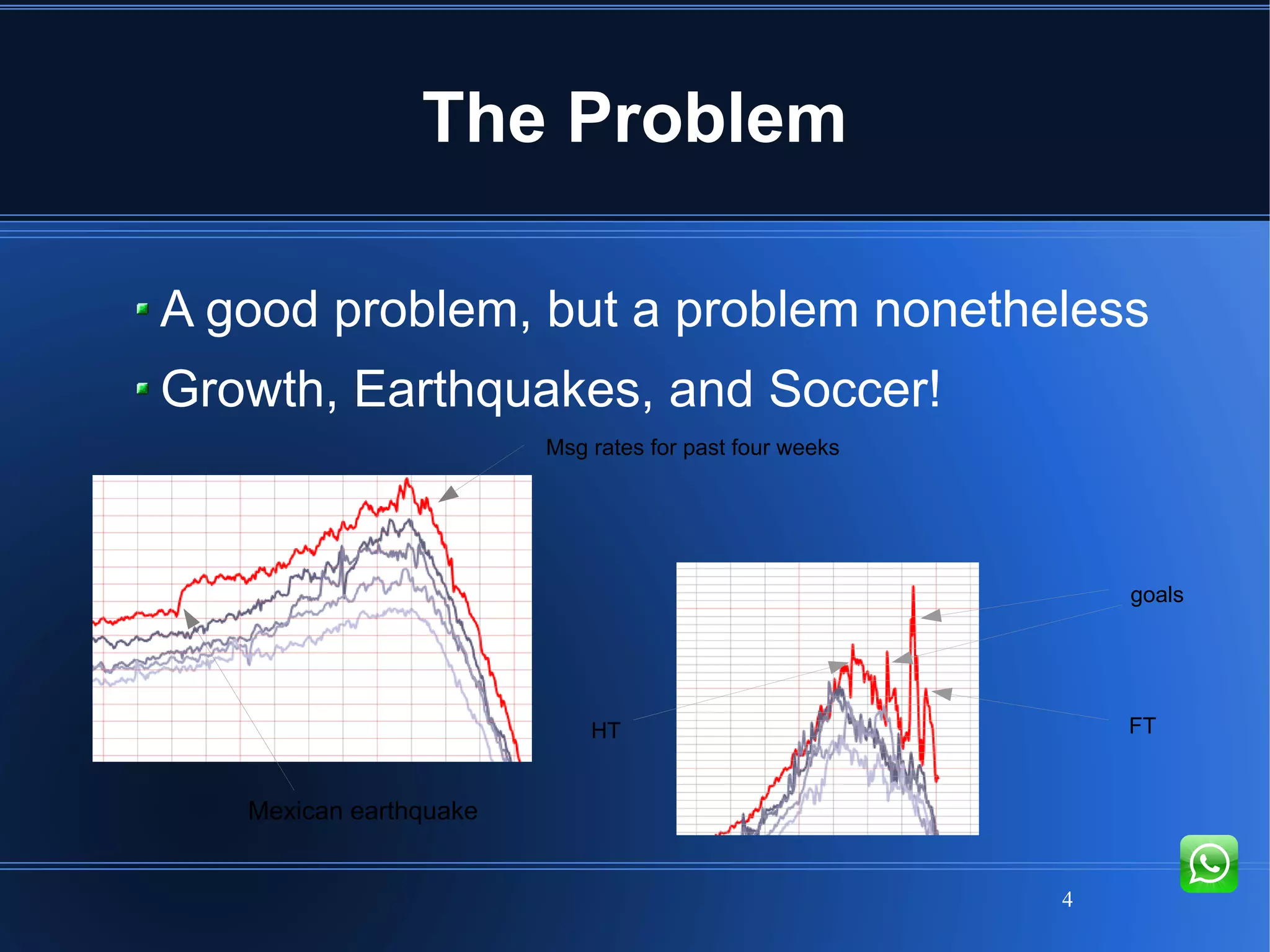
A good problem, but a problem nonetheless
Growth, Earthquakes, and Soccer!
Msg rates for past four weeks
Mexican earthquake
goals
HT FT
5
The Problem
Initial server loading: ~200k connections
Discouraging prognosis for growth
Cluster brittle in the face of failures/overloads
6
Performance Goals
1 Million connections per server … !
Resilience against disruptions under load
Software failures
Hardware failures (servers, network gear)
World events (sports, earthquakes, etc.)
7
Performance Goals
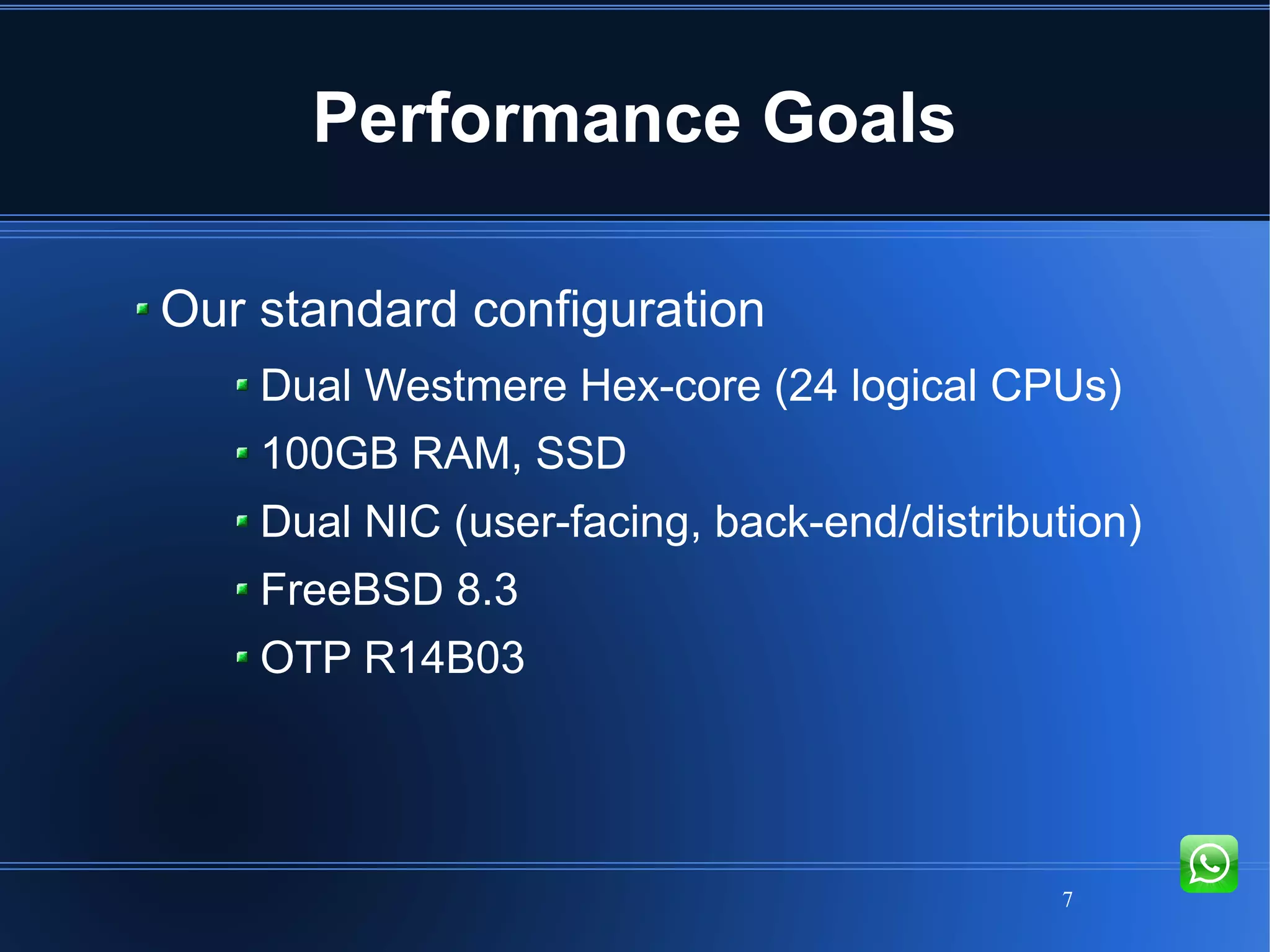
Our standard configuration
Dual Westmere Hex-core (24 logical CPUs)
100GB RAM, SSD
Dual NIC (user-facing, back-end/distribution)
FreeBSD 8.3
OTP R14B03
8
Tools and Techniques
System activity monitoring (wsar)
OS-level
BEAM
9
Tools and Techniques
Processor hardware perf counters (pmcstat)
dtrace, kernel lock-counting, gprof
10
Tools and Techniques
fprof (w/ and w/o cpu_timestamp)
BEAM lock-counting (invaluable!!!)
11
Tools and Techniques
Synthetic workload
Good for subsystems with simple interfaces
Limited value for user-facing systems
12
Tools and Techniques
Tee'd workload
Where side-effects can be contained
Extremely useful for tuning
13
Tools and Techniques
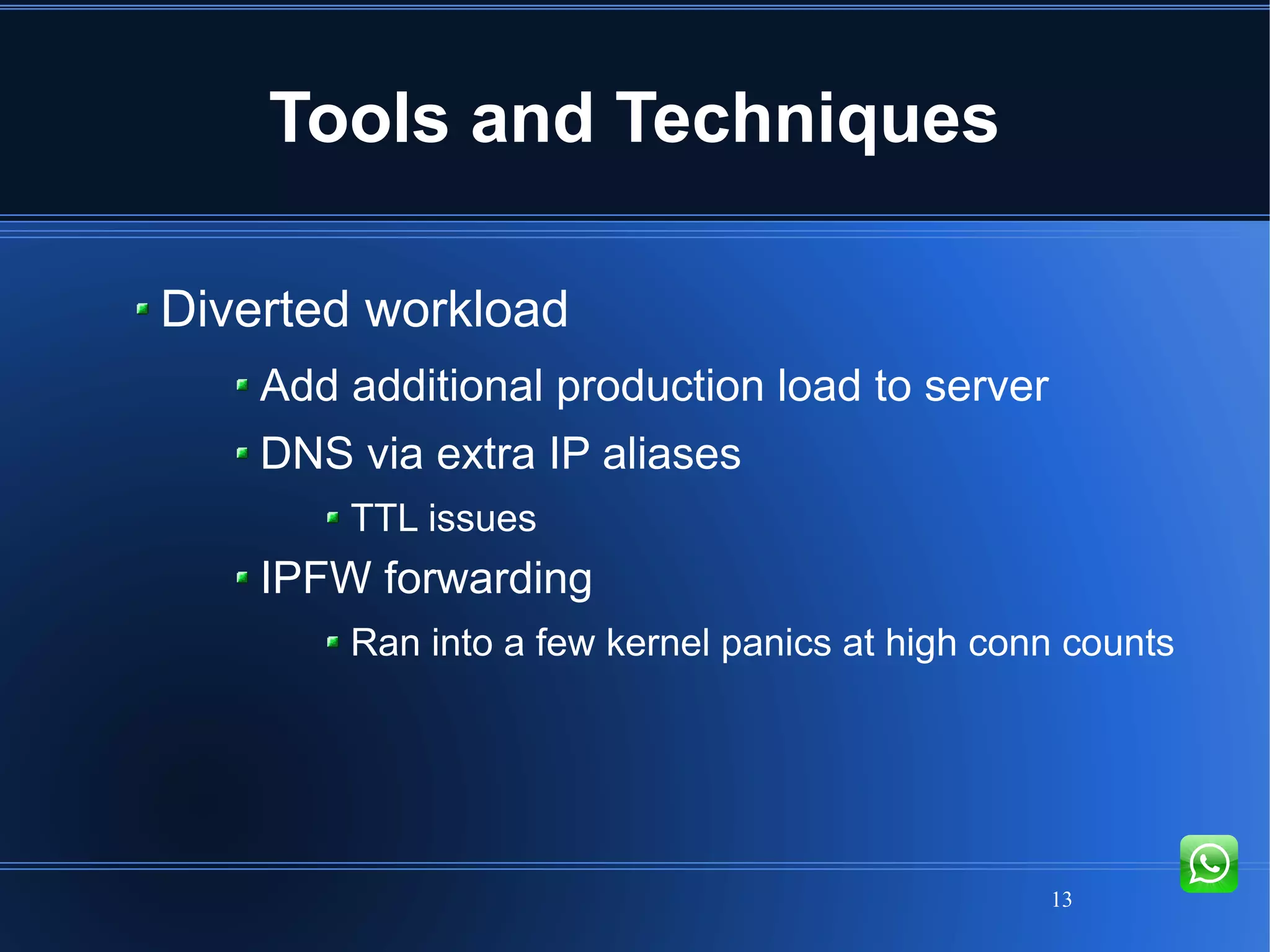
Diverted workload
Add additional production load to server
DNS via extra IP aliases
TTL issues
IPFW forwarding
Ran into a few kernel panics at high conn counts
14
Results
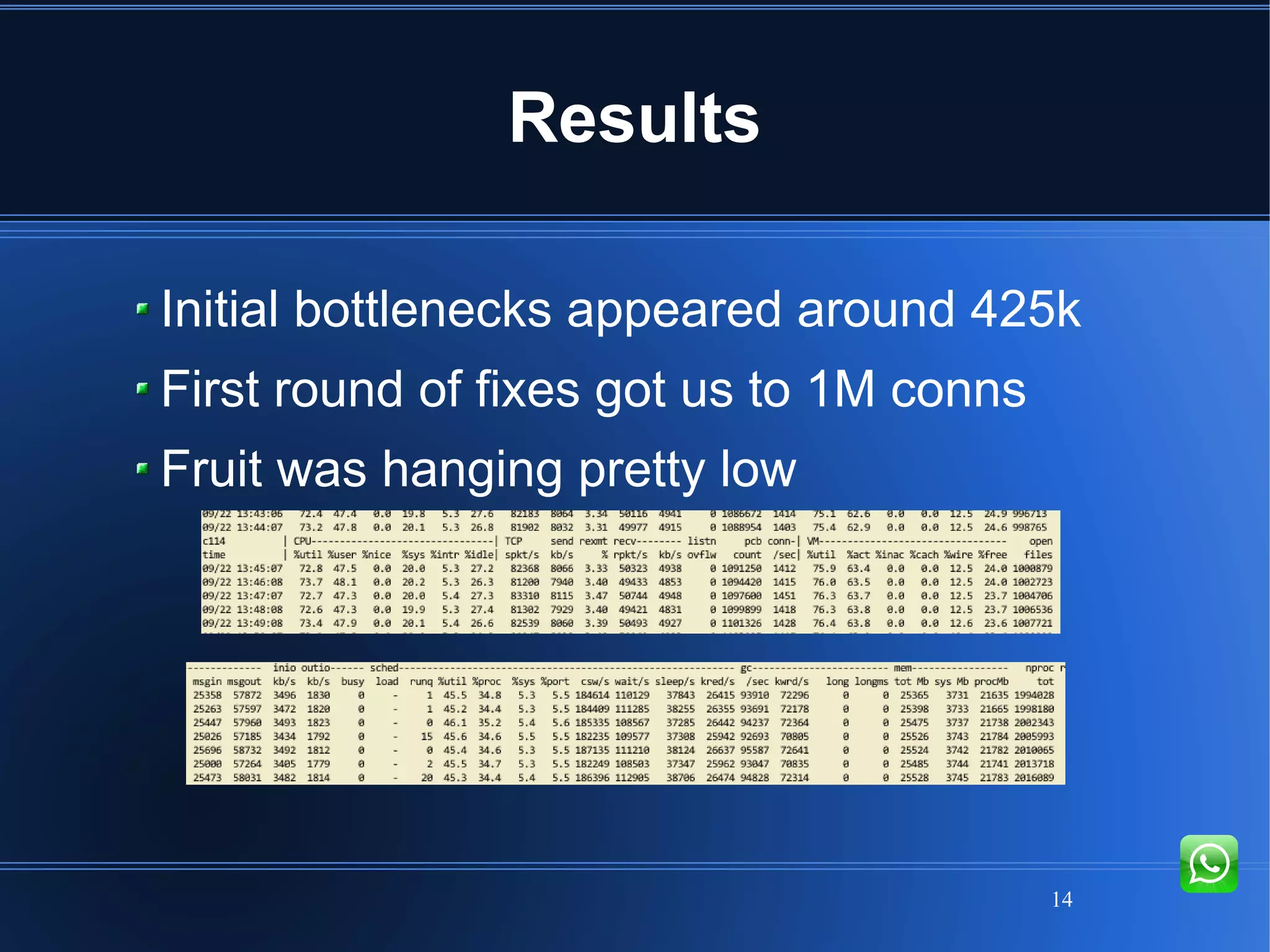
Initial bottlenecks appeared around 425k
First round of fixes got us to 1M conns
Fruit was hanging pretty low
15
Results
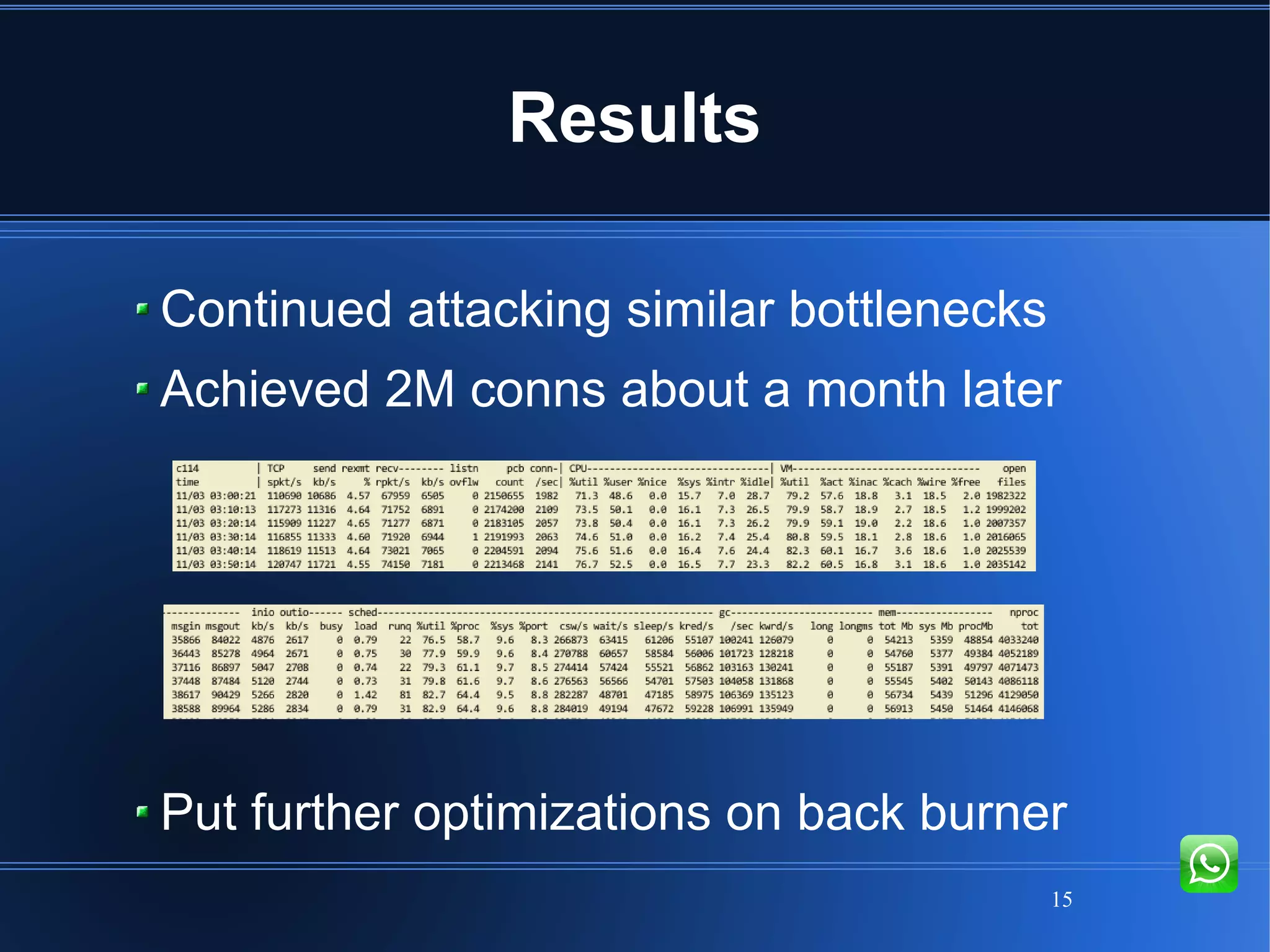
Continued attacking similar bottlenecks
Achieved 2M conns about a month later
Put further optimizations on back burner
16
Results
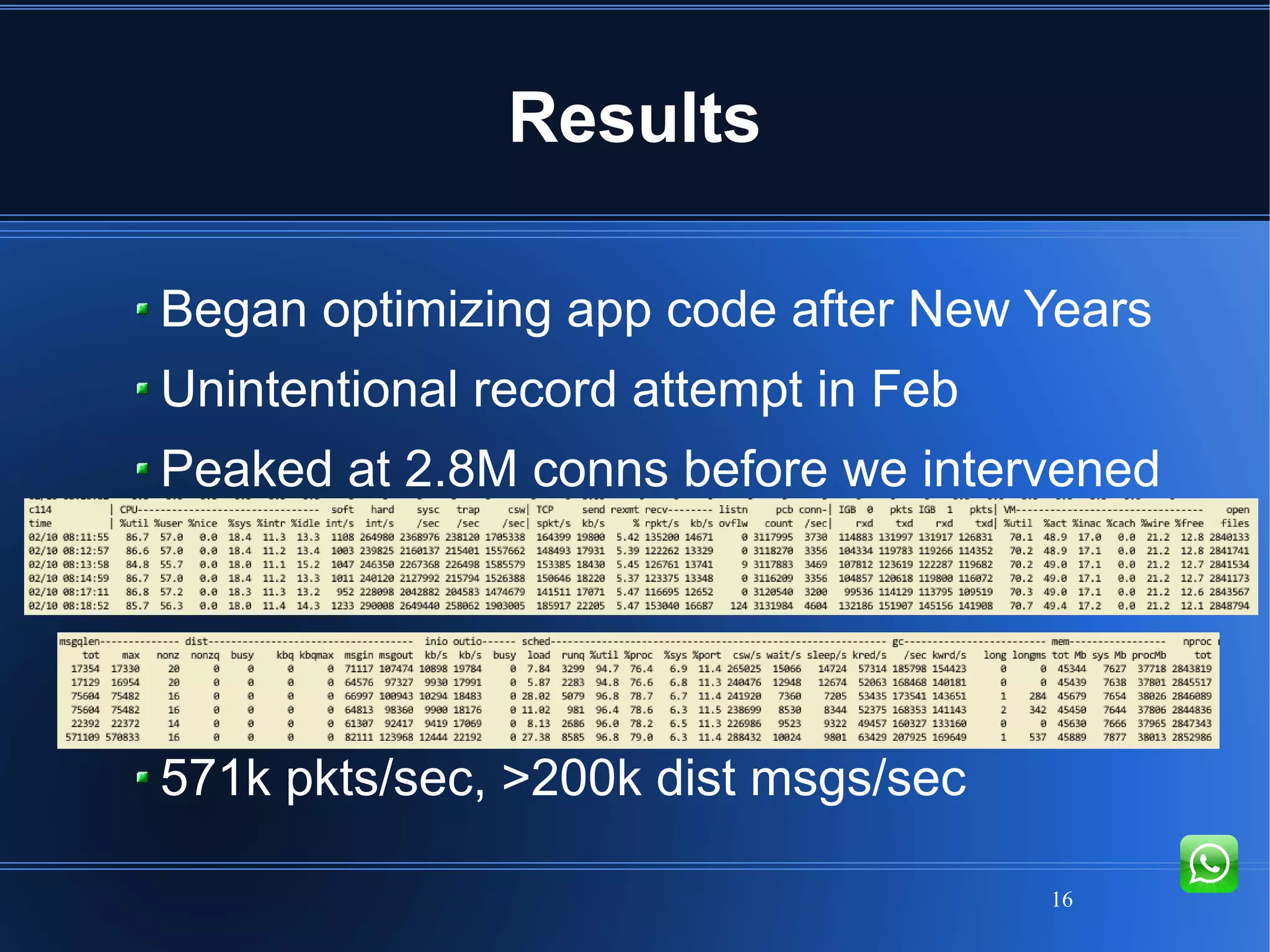
Began optimizing app code after New Years
Unintentional record attempt in Feb
Peaked at 2.8M conns before we intervened
571k pkts/sec, >200k dist msgs/sec
17
Results
Still trying to obtain elusive 3M conns
St. Patrick's Day wasn't as lucky as hoped
18
General Findings
Erlang has awesome SMP scalability
>85% cpu utilization across 24 logical cpus
FreeBSD shines as well
19
General Findings
CPU% vs. # Conns
20
General Findings
Contention, contention, contention
From 200k to 2M were all contention fixes
Some issues are internal to BEAM
Some addressable with app changes
Most required BEAM patches
Some required app changes
Especially: partitioning workload correctly
Some common Erlang idioms come at a price
21
Specific Scalability Fixes
FreeBSD
Backported TSC-based kernel timecounter
gettimeofday(2) calls much less expensive
Backported igb network driver
Had issues with MSI-X queue stalls
sysctl tuning
Obvious limits (e.g., kern.ipc.maxsockets)
net.inet.tcp.tcphashsize=524288
22
Specific Scalability Fixes
BEAM metrics
Scheduler (%util, csw, waits, sleeps, …)
statistics(message_queues)
Msgs queued, #non-empty queues, longest queue
process_info(message_queue_stats)
Enq/deq/send count & rates (1s, 10s, 100s)
statistics(message_counts)
Aggregation of message_queue_stats
Enable fprof cpu_timestamp for FreeBSD
23
Specific Scalability Fixes
BEAM metrics (cont.)
Make lock-counting work for larger async
thread counts (e.g., +A 1024)
Add suspend, location, and port_locks options
to erts_debug:lock_counters
Enable/disable process/port lock counting at
runtime
Fix missing accounting for outbound dist bytes
24
Specific Scalability Fixes
BEAM tuning
+swt low
Avoid scheduler perma-sleep
+Mummc/mmmbc/mmsbc 99999
Prefer mseg over malloc
+Mut 24
Want allocator instance per scheduler
25
Specific Scalability Fixes
BEAM tuning
+Mulmbcs 32767 +Mumbcgs 1
+Musmbcs 2047
Want large 2M-aligned mseg allocations to
maximize superpage promotions
Run with real-time scheduling priority
+ssct 1 (via patch; scheduler spin count)
26
Specific Scalability Fixes
BEAM contention
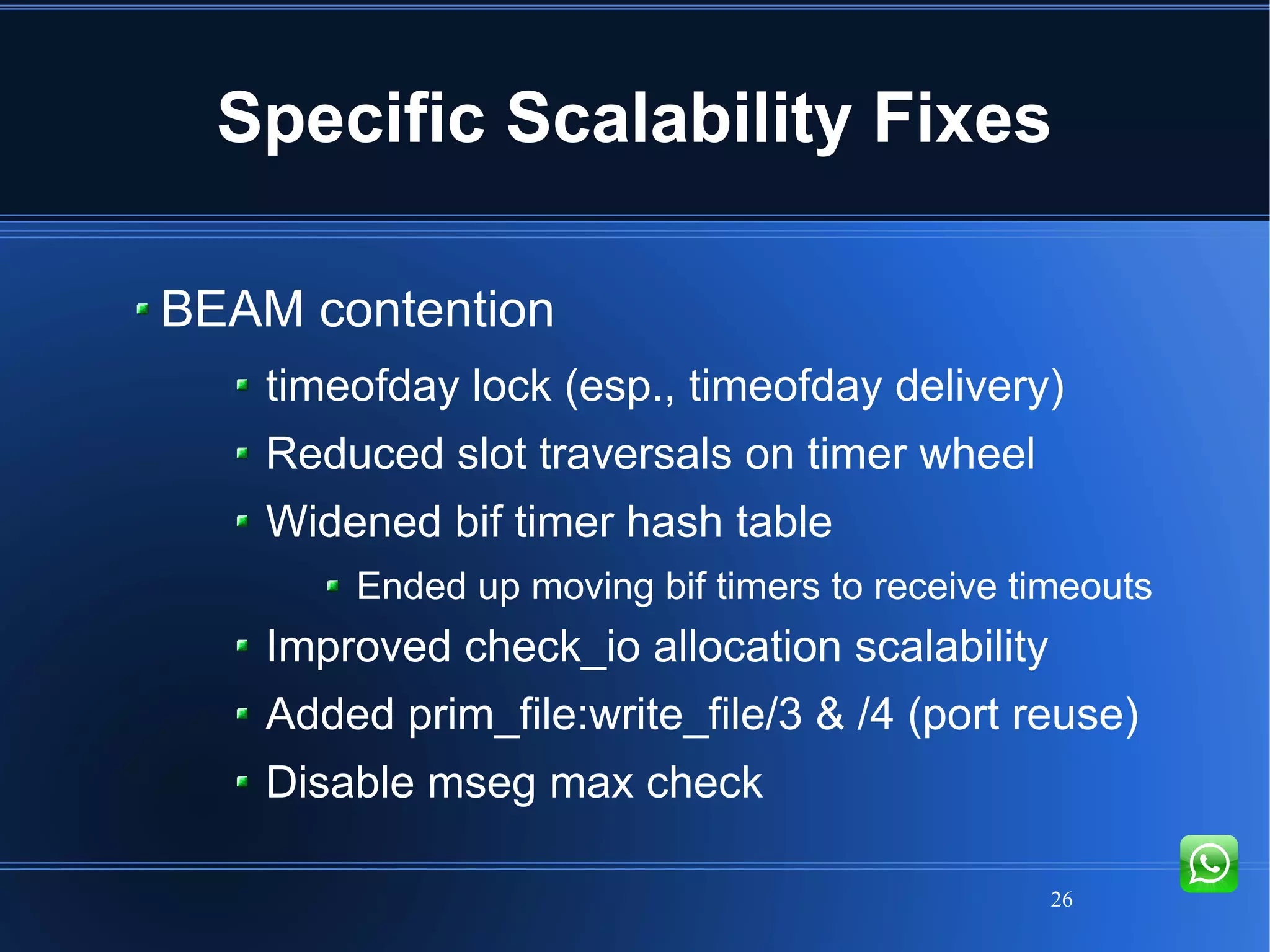
timeofday lock (esp., timeofday delivery)
Reduced slot traversals on timer wheel
Widened bif timer hash table
Ended up moving bif timers to receive timeouts
Improved check_io allocation scalability
Added prim_file:write_file/3 & /4 (port reuse)
Disable mseg max check
27
Specific Scalability Fixes
BEAM contention (cont.)
Reduce setopts calls in prim_inet:accept
and in inet:tcp_controlling_process
28
Specific Scalability Fixes
OTP throughput
Add gc throttling when message queue is long
Increase default dist receive buffer from 4k to
256k (and make configurable)
Patch mnesia_tm to dispatch async_dirty txns
to separate per-table procs for concurrency
Add pg2 denormalized group member lists to
improve lookup throughput
Increase max configurable mseg cache size
29
Specific Scalability Fixes
Erlang usage
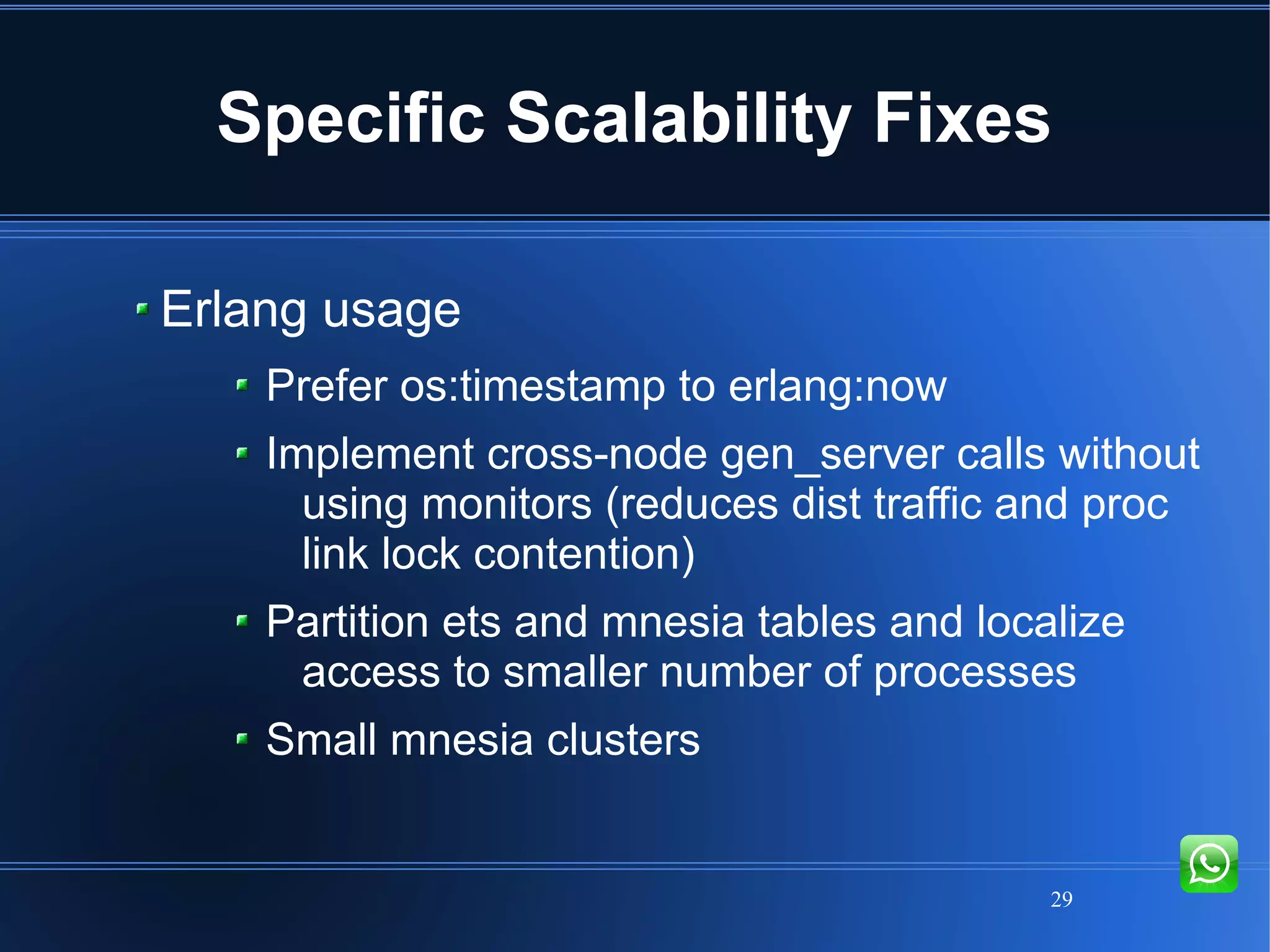
Prefer os:timestamp to erlang:now
Implement cross-node gen_server calls without
using monitors (reduces dist traffic and proc
link lock contention)
Partition ets and mnesia tables and localize
access to smaller number of processes
Small mnesia clusters
30
Specific Scalability Fixes
Operability fixes
Added [prepend] option to erlang:send
Added process_flag(flush_message_queue)
31
Questions? Comments?
rr@whatsapp.com

Whatsapp's Architecture

  • 1.
    1 Scaling to Millionsof Simultaneous Connections Rick Reed WhatsApp Erlang Factory SF March 30, 2012
  • 2.
    2 About ... Joined WhatsAppin 2011 New to Erlang Background in performance of C-based systems on FreeBSD and Linux Prior work at Yahoo!, SGI
  • 3.
    3 Overview The “good problemto have” Performance Goals Tools and Techniques Results General Findings Specific Scalability Fixes
  • 4.
    4 The Problem A goodproblem, but a problem nonetheless Growth, Earthquakes, and Soccer! Msg rates for past four weeks Mexican earthquake goals HT FT
  • 5.
    5 The Problem Initial serverloading: ~200k connections Discouraging prognosis for growth Cluster brittle in the face of failures/overloads
  • 6.
    6 Performance Goals 1 Millionconnections per server … ! Resilience against disruptions under load Software failures Hardware failures (servers, network gear) World events (sports, earthquakes, etc.)
  • 7.
    7 Performance Goals Our standardconfiguration Dual Westmere Hex-core (24 logical CPUs) 100GB RAM, SSD Dual NIC (user-facing, back-end/distribution) FreeBSD 8.3 OTP R14B03
  • 8.
    8 Tools and Techniques Systemactivity monitoring (wsar) OS-level BEAM
  • 9.
    9 Tools and Techniques Processorhardware perf counters (pmcstat) dtrace, kernel lock-counting, gprof
  • 10.
    10 Tools and Techniques fprof(w/ and w/o cpu_timestamp) BEAM lock-counting (invaluable!!!)
  • 11.
    11 Tools and Techniques Syntheticworkload Good for subsystems with simple interfaces Limited value for user-facing systems
  • 12.
    12 Tools and Techniques Tee'dworkload Where side-effects can be contained Extremely useful for tuning
  • 13.
    13 Tools and Techniques Divertedworkload Add additional production load to server DNS via extra IP aliases TTL issues IPFW forwarding Ran into a few kernel panics at high conn counts
  • 14.
    14 Results Initial bottlenecks appearedaround 425k First round of fixes got us to 1M conns Fruit was hanging pretty low
  • 15.
    15 Results Continued attacking similarbottlenecks Achieved 2M conns about a month later Put further optimizations on back burner
  • 16.
    16 Results Began optimizing appcode after New Years Unintentional record attempt in Feb Peaked at 2.8M conns before we intervened 571k pkts/sec, >200k dist msgs/sec
  • 17.
    17 Results Still trying toobtain elusive 3M conns St. Patrick's Day wasn't as lucky as hoped
  • 18.
    18 General Findings Erlang hasawesome SMP scalability >85% cpu utilization across 24 logical cpus FreeBSD shines as well
  • 19.
  • 20.
    20 General Findings Contention, contention,contention From 200k to 2M were all contention fixes Some issues are internal to BEAM Some addressable with app changes Most required BEAM patches Some required app changes Especially: partitioning workload correctly Some common Erlang idioms come at a price
  • 21.
    21 Specific Scalability Fixes FreeBSD BackportedTSC-based kernel timecounter gettimeofday(2) calls much less expensive Backported igb network driver Had issues with MSI-X queue stalls sysctl tuning Obvious limits (e.g., kern.ipc.maxsockets) net.inet.tcp.tcphashsize=524288
  • 22.
    22 Specific Scalability Fixes BEAMmetrics Scheduler (%util, csw, waits, sleeps, …) statistics(message_queues) Msgs queued, #non-empty queues, longest queue process_info(message_queue_stats) Enq/deq/send count & rates (1s, 10s, 100s) statistics(message_counts) Aggregation of message_queue_stats Enable fprof cpu_timestamp for FreeBSD
  • 23.
    23 Specific Scalability Fixes BEAMmetrics (cont.) Make lock-counting work for larger async thread counts (e.g., +A 1024) Add suspend, location, and port_locks options to erts_debug:lock_counters Enable/disable process/port lock counting at runtime Fix missing accounting for outbound dist bytes
  • 24.
    24 Specific Scalability Fixes BEAMtuning +swt low Avoid scheduler perma-sleep +Mummc/mmmbc/mmsbc 99999 Prefer mseg over malloc +Mut 24 Want allocator instance per scheduler
  • 25.
    25 Specific Scalability Fixes BEAMtuning +Mulmbcs 32767 +Mumbcgs 1 +Musmbcs 2047 Want large 2M-aligned mseg allocations to maximize superpage promotions Run with real-time scheduling priority +ssct 1 (via patch; scheduler spin count)
  • 26.
    26 Specific Scalability Fixes BEAMcontention timeofday lock (esp., timeofday delivery) Reduced slot traversals on timer wheel Widened bif timer hash table Ended up moving bif timers to receive timeouts Improved check_io allocation scalability Added prim_file:write_file/3 & /4 (port reuse) Disable mseg max check
  • 27.
    27 Specific Scalability Fixes BEAMcontention (cont.) Reduce setopts calls in prim_inet:accept and in inet:tcp_controlling_process
  • 28.
    28 Specific Scalability Fixes OTPthroughput Add gc throttling when message queue is long Increase default dist receive buffer from 4k to 256k (and make configurable) Patch mnesia_tm to dispatch async_dirty txns to separate per-table procs for concurrency Add pg2 denormalized group member lists to improve lookup throughput Increase max configurable mseg cache size
  • 29.
    29 Specific Scalability Fixes Erlangusage Prefer os:timestamp to erlang:now Implement cross-node gen_server calls without using monitors (reduces dist traffic and proc link lock contention) Partition ets and mnesia tables and localize access to smaller number of processes Small mnesia clusters
  • 30.
    30 Specific Scalability Fixes Operabilityfixes Added [prepend] option to erlang:send Added process_flag(flush_message_queue)
  • 31.