What?
Why?
How?
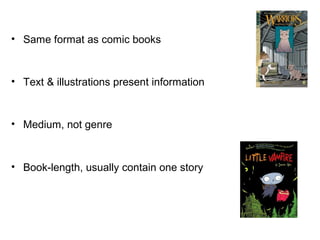
• Same format as comic books
• Text & illustrations present information
• Medium, not genre
• Book-length, usually contain one story
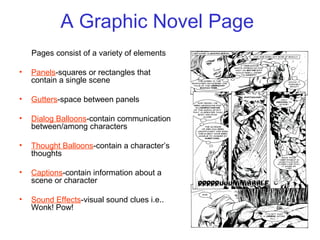
A Graphic Novel Page
Pages consist of a variety of elements
• Panels-squares or rectangles that
contain a single scene
• Gutters-space between panels
• Dialog Balloons-contain communication
between/among characters
• Thought Balloons-contain a character’s
thoughts
• Captions-contain information about a
scene or character
• Sound Effects-visual sound clues i.e..
Wonk! Pow!
How to
Read a
Graphic
Novel Page
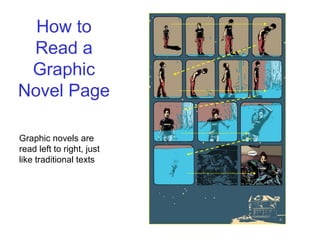
Graphic novels are
read left to right, just
like traditional texts
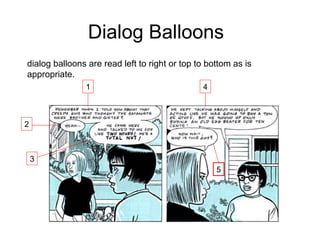
Dialog Balloons
dialog balloons are read left to right or top to bottom as is
appropriate.
1
2
3
5
4
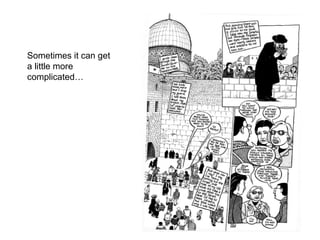
Sometimes it can get
a little more
complicated…
1
3
2
4
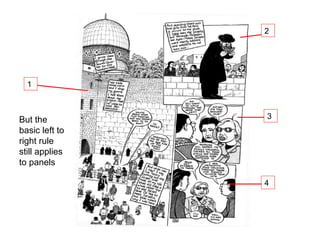
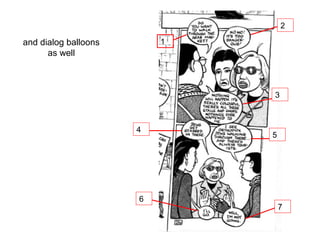
But the
basic left to
right rule
still applies
to panels
and dialog balloons
as well
1
2
3
4
5
6
7
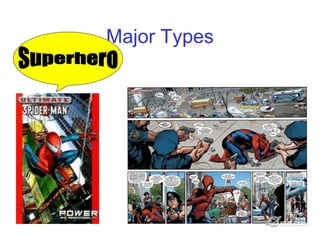
Major Types
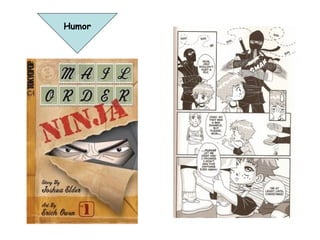
Humor
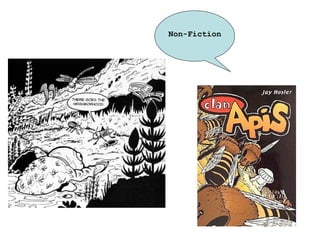
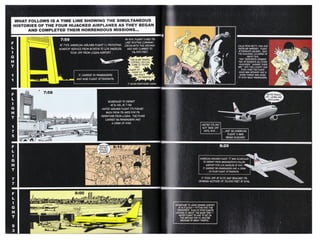
Non-Fiction
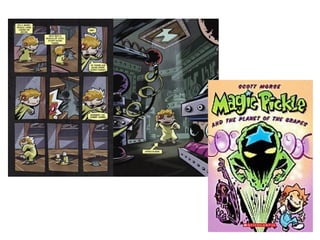
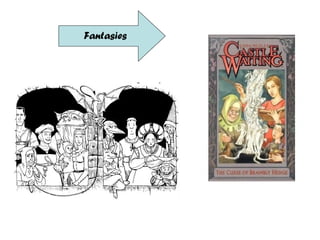
Fantasies
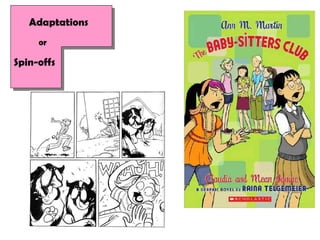
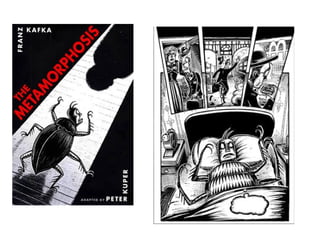
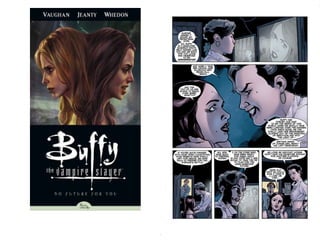
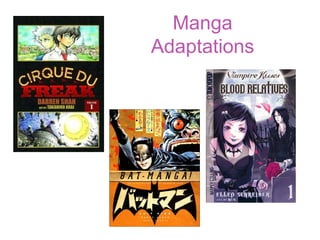
Adaptations
Spin-offs
or
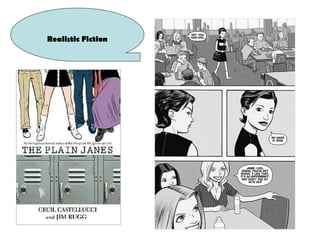
Realistic Fiction
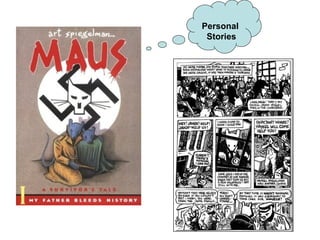
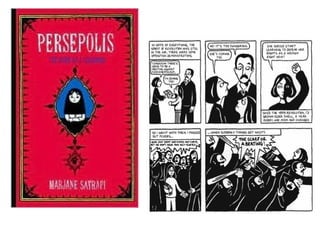
Personal
Stories
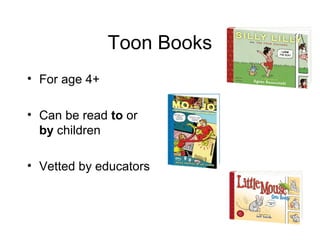
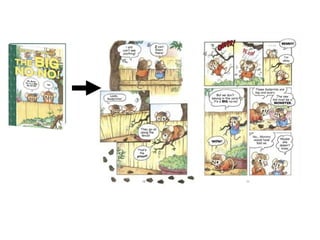
Toon Books
• For age 4+
• Can be read to or
by children
• Vetted by educators
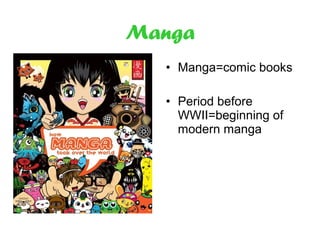
• Manga=comic books
• Period before
WWII=beginning of
modern manga
Manga
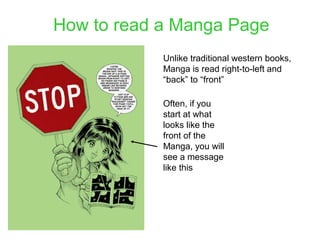
How to read a Manga Page
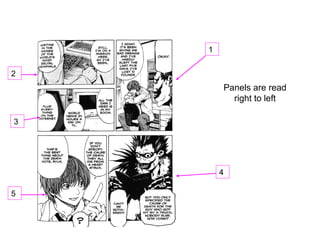
Unlike traditional western books,
Manga is read right-to-left and
“back” to “front”
Often, if you
start at what
looks like the
front of the
Manga, you will
see a message
like this
Panels are read
right to left
1
2
3
4
5
13
4
2
8
5
6
7
10
9
11
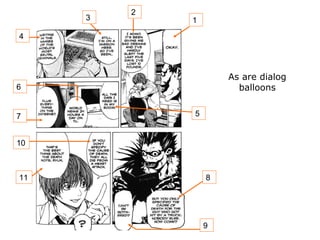
As are dialog
balloons
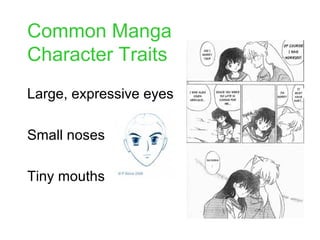
Common Manga
Character Traits
Large, expressive eyes
Small noses
Tiny mouths
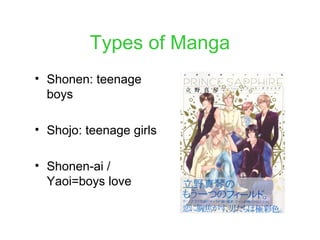
Types of Manga
• Shonen: teenage
boys
• Shojo: teenage girls
• Shonen-ai /
Yaoi=boys love
Manga
Adaptations
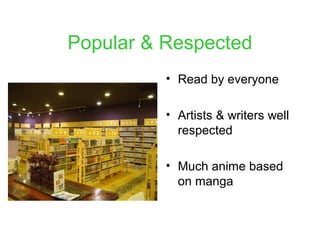
Popular & Respected
• Read by everyone
• Artists & writers well
respected
• Much anime based
on manga
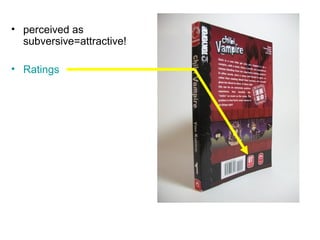
• perceived as
subversive=attractive!
• Ratings
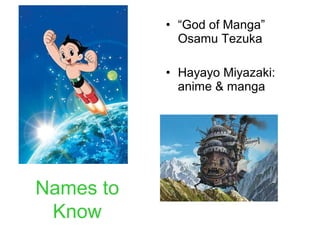
• “God of Manga”
Osamu Tezuka
• Hayayo Miyazaki:
anime & manga
Names to
Know
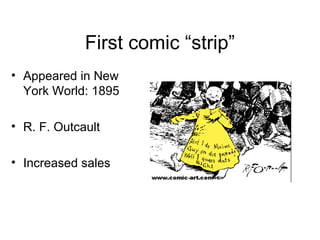
First comic “strip”
• Appeared in New
York World: 1895
• R. F. Outcault
• Increased sales
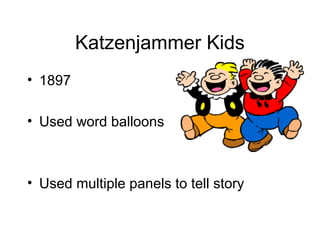
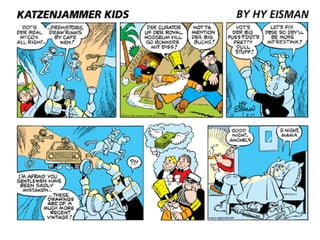
Katzenjammer Kids
• 1897
• Used word balloons
• Used multiple panels to tell story
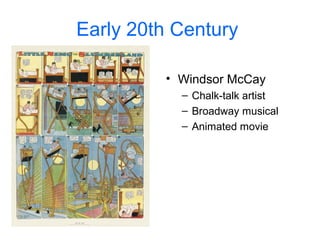
Early 20th Century
• Windsor McCay
– Chalk-talk artist
– Broadway musical
– Animated movie
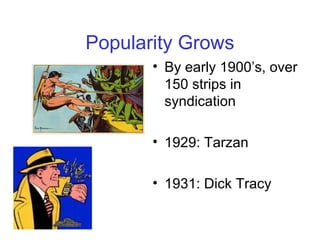
Popularity Grows
• By early 1900’s, over
150 strips in
syndication
• 1929: Tarzan
• 1931: Dick Tracy
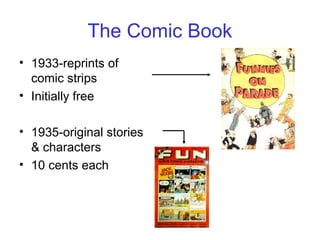
The Comic Book
• 1933-reprints of
comic strips
• Initially free
• 1935-original stories
& characters
• 10 cents each
Popular comics
• Superman
– First superhero
– On newsstands: 1938
• Characters spun-off into radio & movies
• Superheroes big during World War II
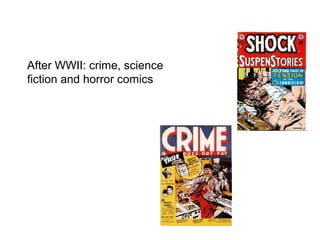
After WWII: crime, science
fiction and horror comics
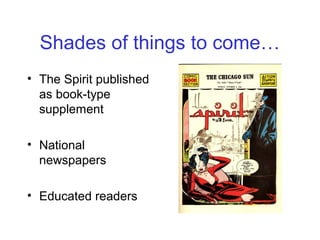
Shades of things to come…
• The Spirit published
as book-type
supplement
• National
newspapers
• Educated readers
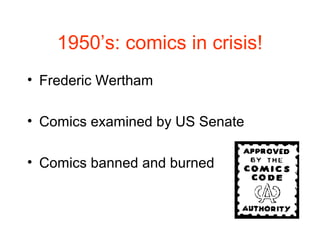
1950’s: comics in crisis!
• Frederic Wertham
• Comics examined by US Senate
• Comics banned and burned
A New Beginning
• Late 1950’s: Justice League of America born
• 1961: Fantastic Four, Incredible Hulk, &
Spiderman
• 1960’s: Self-published underground comics
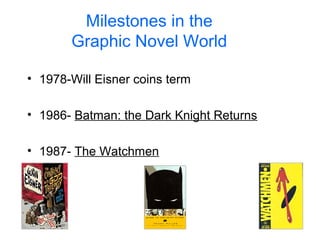
• 1978-Will Eisner coins term
• 1986- Batman: the Dark Knight Returns
• 1987- The Watchmen
Milestones in the
Graphic Novel World
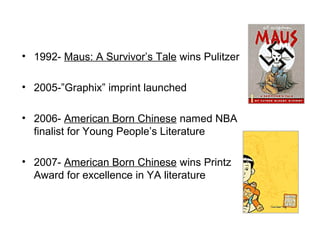
• 1992- Maus: A Survivor’s Tale wins Pulitzer
• 2005-”Graphix” imprint launched
• 2006- American Born Chinese named NBA
finalist for Young People’s Literature
• 2007- American Born Chinese wins Printz
Award for excellence in YA literature
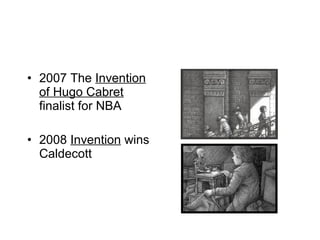
• 2007 The Invention
of Hugo Cabret
finalist for NBA
• 2008 Invention wins
Caldecott
• 2007-YALSA creates new annual booklist: “Great
Graphic Novels for Teens”
• 2009-NYT Graphic Books Bestseller List
• 2009- David Small’s Stitches NBA finalist
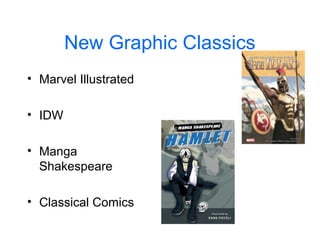
New Graphic Classics
• Marvel Illustrated
• IDW
• Manga
Shakespeare
• Classical Comics
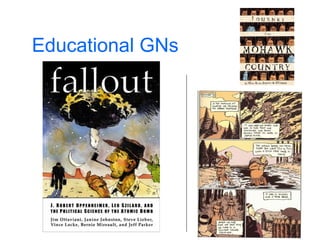
Educational GNs
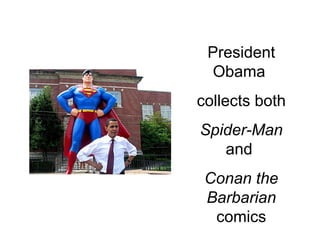
President
Obama
collects both
Spider-Man
and
Conan the
Barbarian
comics
Why Graphic Novels &
Manga?
• 6.3 million secondary school students reading below
grade level.
• Average American age 15-24 spends only 7 minutes of
daily leisure time reading.
• >57%of high schoolers devote 3 or more hours of an
average school day to electronic viewing.
• Students with access to variety of reading
materials=higher average reading scores.
• Present complex material in readable text
• Serve as a bridge to more difficult reading
• Challenge readers of more traditional literature
• Embrace nature of multimedia world
• Fulfill NCTE’s “21st
Century literacies” (multiple streams,
simultaneous information)
Graphic Novels & Manga:
• Public Library
• Local comic stores
• Book stores
Checking Out Graphic
Novels & Manga
Purchasing
• Many traditional library suppliers offer
graphic novel titles.
• Local comic stores
• Book stores
Collection Development
Policies
• Clear (enough) definition
• Selection criteria
• Maintenance
• Challenges
Classification & Shelving
• Within general collection
• Format specific (PS, NC or 741.5)
• Graphic Novel designation
• DNC
Learning more about Graphic
Novels & Manga!
School Library Journal
Library Journal
Diamond Comics Bookshelf
Cooperative Children’s Book Center
Reviews & More
• Get Graphic!
• Graphic Novel Resources: SUNY at Buffalo
• First Second Books
• Public Square Books

What? Why? How? Graphic Novels

Editor's Notes

  • #13 Jay Hosler: PhD in Biology (teaches at Juniata College in Huntington, PA)
  • #17 Also: Give it Up! And other short stories by Kafka, The Jungle, Spy vs. Spy
  • #23 First comics created to be read by emerging readers Created by “veteran children’s book authors, renowned cartoonists, & new talent”
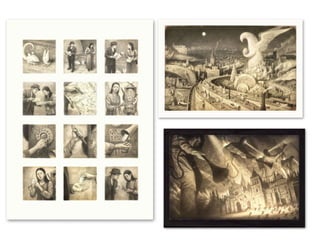
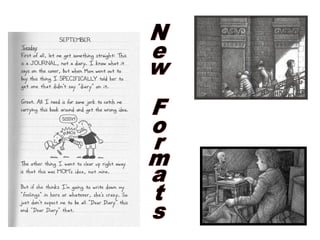
  • #25 Brian Selznick blends text and visual (text-less) narrative to produce more than an illustrated novel. Jeff Kinney Diary of a Wimpy Kid also uses pictures (with word balloons) to advance the story.
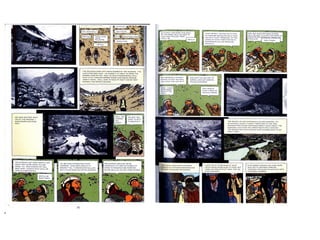
  • #26 From The Photographer: into war-torn Afghanistan with Doctors Without Borders by Emmanuel Guibert published by First Second
  • #27 Manga is the Japanese word for comics-literally translated it means “whimsical pictures” Mid 1990s=came to US
  • #28 Tokyopop: JAPANESE traslations are right-to-left KOREAN translations are left-to-right
  • #31 Osamu Tezuka began large eye trend (1960s), influenced by Disney & Betty Boop cartoons YOUTHFUL FEATURES=more attractive character Also lots of eminata
  • #32 These denote the demographic group at whom the manga is marketed and usually indicates what kind of story it will be. Shonen: more sports, contests, fighting Shjo: more relationships, character development Shonen-ai=FEMALE ORIENTED homoerotic/homoromantic male relationships USUALLY CREATED BY FEMALE AUTHORS
  • #34 Both children & adults reach high level of manga literacy in Japan “Manga helps to release tension from the controlled work/school environment“ and helps teach people about the BELIEFS, VALUES AND PRACTICES of the culture
  • #35 Read “backwards” / cultural cues=subversive! Viz BIG TITLES Tokyopop BIG TITLES
  • #36 Tezuka: Ambassador Atom=Mighty Atom=Astro Boy, Astro Boy=mark of rise of manga of contemporary Japan also: Adolf, Buddha Hiyayo Miyazaki=Spirited Away (first anime to win Academy Award), Howl’s Moving Castle, Princess Mononoke, Nausicaa of the Valley of the Wind
  • #37 NYWorld=Pulitzer Outcault also created BUSTER BROWN
  • #39 The Katzenjammers combined internal dialogue and panelized continuity, and designed and solidified the form of the modern visual narrative strip.
  • #40 Ran 1905-1911 in NY Herlad + 1911-1914 in Hearst’s Journal American paper
  • #41 over 150 strips in syndication *(this doesn’t include the ones running only in local papers) Dick Tracy’s villains were direct predecessors of super villains.
  • #43 Superman teenagers: Jerry Siegel & Joe Shuster (Title: Superman of Metropolis)-Jewish teens influenced by superhero figures of Jewish folklore? Comic book sales soared during WWII. *SUPERHEROES had young male sidekicks so that they would be seen as FATHER FIGURES by boys who had fathers off fighting the war.*
  • #44 Recent DEATH OF CAPTAIN AMERICA and new REBIRTH OF CAPTAIN AMERICA
  • #45 Began as supplement in 1940 Also: CLASSICS ILLUSTRATED educational gns w/support material included
  • #46 investigation into Juvenile Delinquency
  • #47 SATURATION of market w/Superhero comics to the detriment of all other types.
  • #48 Watchmen (Allen Moore / DC comics)=one of 1st superhero GNs to present itself as serious literature Only GN to: Win Hugo Award Appear on Time Magazine’s “100 Best English Language Novels 1923-Present (2005)”
  • #49 Graphix=BONE (originally self-published in black and white, Scholastic began publishing color version in 2004)
  • #50 Brian Selznick blends text and visual (text-less) narrative to produce more than an illustrated novel. Jeff Kinney Diary of a Wimpy Kid also uses pictures (with word balloons) to advance the story.
  • #52 Marvel Illustrated DOWNLOADABLE teacher guides IDW=Idea and Design Works Classical Comics=UK publisher
  • #53 Ottaviani: Masters in NUCLEAR ENGINEERING Fallout: science & politics of first nuclear bomb Mohwawk: written from primary source document.
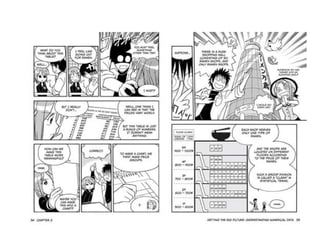
  • #54 Manga Guide to Statistics
  • #55 And there has already been Spiderman storylines with Obama as a character
  • #56 About 93 percent of U.S. teens use the Internet and 97 percent play video or computer gaming systems, according to the Pew Internet & American Life Project.
  • #57 Help ESL students Help students learning non-English language Help stuents learn about different cultures
  • #61 741.5 Cartoons, caricatures, comics, graphic novels,
fotonovelas PS=American Literature PL=Manga (Asian Literature) NC=Drawing, Design
  • #62 LJ=youth & ADULT gn reviews
  • #63 First Second: *Show trailer for LOST COLONY