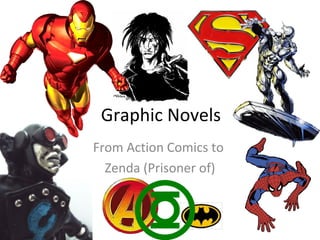
Graphic Novels
From Action Comics to
Zenda (Prisoner of)
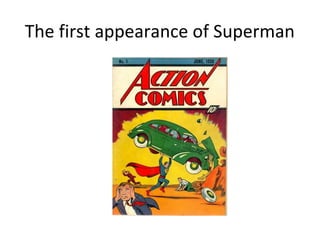
The first appearance of Superman
What are Comics?
• “The printed arrangement of art and balloons
in sequence, particularly in comic books."
Will Eisner

• “Juxtaposed pictorial and other images in
deliberate sequence, intended to convey
information and/or to produce an aesthetic
response in the viewer."
Scott Mcloud
What are Graphic Novels?
• No strict definition, although the term is often used to
allow people who would not admit to reading comics to
actually read comics.
• A narrative work in which the story is conveyed to the
reader using the comics form. The term is employed in a
broad manner, encompassing non-fiction works and
thematically linked short stories as well as fictional stories
across a number of genres.
• Albums?
A general term for collections of European comics e.g.
Asterix, Tintin and Blueberry.
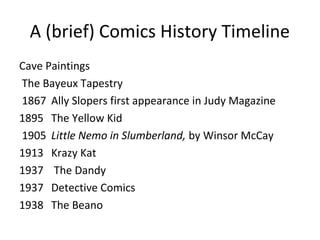
A (brief) Comics History Timeline
Cave Paintings
The Bayeux Tapestry
1867 Ally Slopers first appearance in Judy Magazine
1895 The Yellow Kid
1905 Little Nemo in Slumberland, by Winsor McCay
1913 Krazy Kat
1937 The Dandy
1937 Detective Comics
1938 The Beano
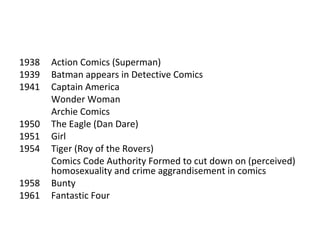
1938
1939
1941
1950
1951
1954
1958
1961

Action Comics (Superman)
Batman appears in Detective Comics
Captain America
Wonder Woman
Archie Comics
The Eagle (Dan Dare)
Girl
Tiger (Roy of the Rovers)
Comics Code Authority Formed to cut down on (perceived)
homosexuality and crime aggrandisement in comics
Bunty
Fantastic Four
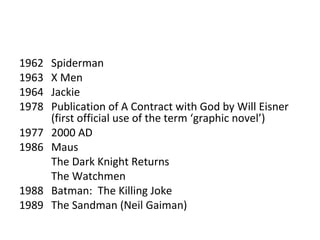
1962
1963
1964
1978
1977
1986
1988
1989

Spiderman
X Men
Jackie
Publication of A Contract with God by Will Eisner
(first official use of the term ‘graphic novel’)
2000 AD
Maus
The Dark Knight Returns
The Watchmen
Batman: The Killing Joke
The Sandman (Neil Gaiman)
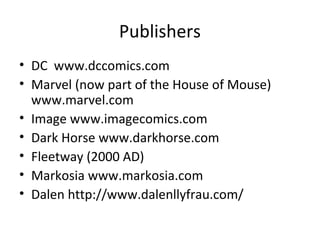
Publishers
• DC www.dccomics.com
• Marvel (now part of the House of Mouse)
www.marvel.com
• Image www.imagecomics.com
• Dark Horse www.darkhorse.com
• Fleetway (2000 AD)
• Markosia www.markosia.com
• Dalen http://www.dalenllyfrau.com/
Why have Graphic Novels?
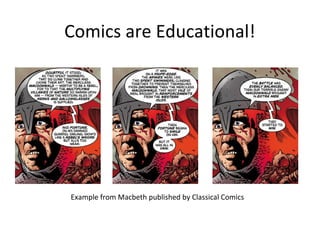
Comics are Educational!

Example from Macbeth published by Classical Comics
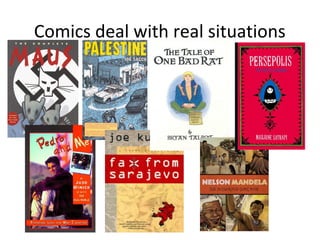
Comics deal with real situations
Comics get people reading
• At the end of the day that is what counts.
Comics encourage people who wouldn’t
normally read, to pick up a book.
• Therefore, stocking a selection of Graphic
Novels adds greatly to the number of people
taking out library materials. In fact, Graphic
Novels have some of the highest issues in
many collections.
How to use Graphic Novels
• Start a GN reading group.
• Introduce reluctant readers to the Classics
(Classical Comics, Classics Illustrated & Self
Made Hero Press).
• Attract more young readers to your library –
get them to suggest stock items.
Graphic Novels that you MUST read!
• Batman: the Dark Knight Returns
the Killing Joke
• Watchmen
• The Sandman
• Bone
• The League of Extraordinary Gentlemen
• Understanding Comics
Writers that will be read
•
•
•
•
•
•
•

Alan Moore
Neil Gaiman
Warren Ellis
Garth Ennis
Jason Aaron
Grant Morrison
Brian K. Vaughan
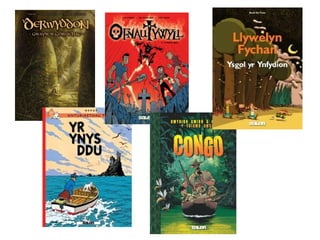
Dalen
Dalen primarily publishes Welsh adaptations of works previously developed
and published in other languages. In particular, they specialise in
adaptations of comic strips and graphic novels.
•

Every good cartoon strip needs three equal constituents:

a good story
good writing
good illustration
All of Dalen’s books exceed these benchmarks in an attractive reading
medium for pupils whose first language is Welsh, who are learning Welsh
as a second language, for students of modern languages, as well as
students of art and design.
http://www.dalenllyfrau.com/
Starting & Displaying a Collection
• If in doubt seek advice from local professionals
(dealers, readers or publishers)
• Be aware of age appropriate materials
• Start with superheroes & mainstream titles
before looking at esoteric titles
• Display face on if possible
• Shelve related titles together
• Keep adult & teen collections separate from
children’s collections
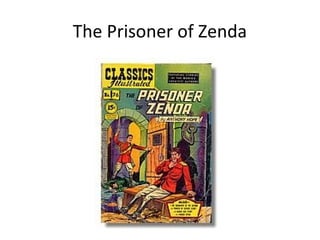
The Prisoner of Zenda

Graphic Novels: from Action Comics to Zenda (Prisoner of)

  • 1.
    Graphic Novels From ActionComics to Zenda (Prisoner of)
  • 2.
  • 3.
    What are Comics? •“The printed arrangement of art and balloons in sequence, particularly in comic books." Will Eisner • “Juxtaposed pictorial and other images in deliberate sequence, intended to convey information and/or to produce an aesthetic response in the viewer." Scott Mcloud
  • 4.
    What are GraphicNovels? • No strict definition, although the term is often used to allow people who would not admit to reading comics to actually read comics. • A narrative work in which the story is conveyed to the reader using the comics form. The term is employed in a broad manner, encompassing non-fiction works and thematically linked short stories as well as fictional stories across a number of genres. • Albums? A general term for collections of European comics e.g. Asterix, Tintin and Blueberry.
  • 5.
    A (brief) ComicsHistory Timeline Cave Paintings The Bayeux Tapestry 1867 Ally Slopers first appearance in Judy Magazine 1895 The Yellow Kid 1905 Little Nemo in Slumberland, by Winsor McCay 1913 Krazy Kat 1937 The Dandy 1937 Detective Comics 1938 The Beano
  • 6.
    1938 1939 1941 1950 1951 1954 1958 1961 Action Comics (Superman) Batmanappears in Detective Comics Captain America Wonder Woman Archie Comics The Eagle (Dan Dare) Girl Tiger (Roy of the Rovers) Comics Code Authority Formed to cut down on (perceived) homosexuality and crime aggrandisement in comics Bunty Fantastic Four
  • 7.
    1962 1963 1964 1978 1977 1986 1988 1989 Spiderman X Men Jackie Publication ofA Contract with God by Will Eisner (first official use of the term ‘graphic novel’) 2000 AD Maus The Dark Knight Returns The Watchmen Batman: The Killing Joke The Sandman (Neil Gaiman)
  • 8.
    Publishers • DC www.dccomics.com •Marvel (now part of the House of Mouse) www.marvel.com • Image www.imagecomics.com • Dark Horse www.darkhorse.com • Fleetway (2000 AD) • Markosia www.markosia.com • Dalen http://www.dalenllyfrau.com/
  • 9.
  • 10.
    Comics are Educational! Examplefrom Macbeth published by Classical Comics
  • 11.
    Comics deal withreal situations
  • 12.
    Comics get peoplereading • At the end of the day that is what counts. Comics encourage people who wouldn’t normally read, to pick up a book. • Therefore, stocking a selection of Graphic Novels adds greatly to the number of people taking out library materials. In fact, Graphic Novels have some of the highest issues in many collections.
  • 13.
    How to useGraphic Novels • Start a GN reading group. • Introduce reluctant readers to the Classics (Classical Comics, Classics Illustrated & Self Made Hero Press). • Attract more young readers to your library – get them to suggest stock items.
  • 14.
    Graphic Novels thatyou MUST read! • Batman: the Dark Knight Returns the Killing Joke • Watchmen • The Sandman • Bone • The League of Extraordinary Gentlemen • Understanding Comics
  • 15.
    Writers that willbe read • • • • • • • Alan Moore Neil Gaiman Warren Ellis Garth Ennis Jason Aaron Grant Morrison Brian K. Vaughan
  • 16.
    Dalen Dalen primarily publishesWelsh adaptations of works previously developed and published in other languages. In particular, they specialise in adaptations of comic strips and graphic novels. • Every good cartoon strip needs three equal constituents: a good story good writing good illustration All of Dalen’s books exceed these benchmarks in an attractive reading medium for pupils whose first language is Welsh, who are learning Welsh as a second language, for students of modern languages, as well as students of art and design. http://www.dalenllyfrau.com/
  • 18.
    Starting & Displayinga Collection • If in doubt seek advice from local professionals (dealers, readers or publishers) • Be aware of age appropriate materials • Start with superheroes & mainstream titles before looking at esoteric titles • Display face on if possible • Shelve related titles together • Keep adult & teen collections separate from children’s collections
  • 19.