Vanessa Irvin Morris Assistant Professor The iSchool at Drexel University Philadelphia, PA, USA [email_address]
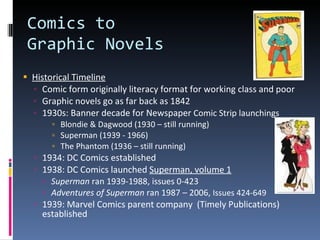
Comics to Graphic Novels Historical Timeline Comic form originally literacy format for working class and poor Graphic novels go as far back as 1842 1930s: Banner decade for Newspaper  Comic Strip launchings Blondie & Dagwood (1930 – still running) Superman (1939 - 1966) The Phantom (1936 – still running) 1934: DC Comics established 1938: DC Comics launched  Superman, volume 1 Superman  ran 1939-1988, issues 0-423 Adventures of Superman  ran 1987 – 2006,  Issues 424-649 1939: Marvel Comics parent company  (Timely Publications) established
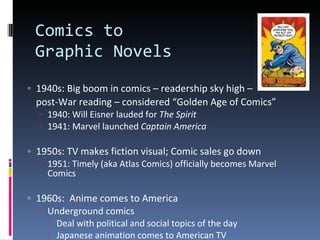
Comics to  Graphic Novels 1940s: Big boom in comics – readership sky high –  post-War reading – considered “Golden Age of Comics” 1940: Will Eisner lauded for  The Spirit 1941: Marvel launched  Captain America 1950s: TV makes fiction visual; Comic sales go down 1951: Timely (aka Atlas Comics) officially becomes Marvel Comics 1960s:  Anime comes to America Underground comics  Deal with political and social topics of the day Japanese animation comes to American TV
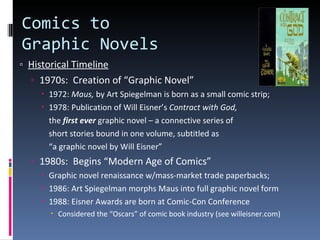
Comics to  Graphic Novels Historical Timeline 1970s:  Creation of “Graphic Novel” 1972:  Maus,  by Art Spiegelman is born as a small comic strip;  1978: Publication of Will Eisner’s  Contract with God,  the  first ever  graphic novel – a connective series of short stories bound in one volume, subtitled as  “ a graphic novel by Will Eisner” 1980s:  Begins “Modern Age of Comics” Graphic novel renaissance w/mass-market trade paperbacks; 1986: Art Spiegelman morphs Maus into full graphic novel form 1988: Eisner Awards are born at Comic-Con Conference Considered the “Oscars” of comic book industry (see willeisner.com)
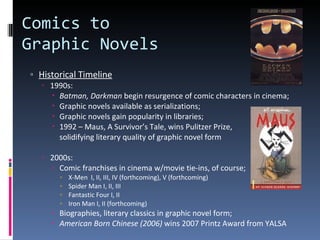
Comics to Graphic Novels Historical Timeline 1990s:  Batman, Darkman  begin resurgence of comic characters in cinema; Graphic novels available as serializations; Graphic novels gain popularity in libraries; 1992 – Maus, A Survivor’s Tale, wins Pulitzer Prize, solidifying literary quality of graphic novel form  2000s:  Comic franchises in cinema w/movie tie-ins, of course; X-Men  I, II, III, IV (forthcoming), V (forthcoming) Spider Man I, II, III Fantastic Four I, II Iron Man I, II (forthcoming) Biographies, literary classics in graphic novel form; American Born Chinese (2006)  wins 2007 Printz Award from YALSA
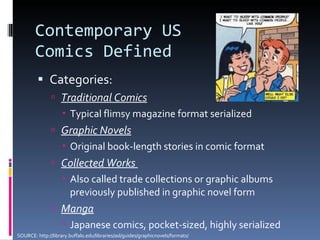
Contemporary US Comics Defined Categories:  Traditional Comics Typical flimsy magazine format serialized Graphic Novels   Original book-length stories in comic format Collected Works   Also called trade collections or graphic albums previously published in graphic novel form Manga Japanese comics, pocket-sized, highly serialized SOURCE: http://library.buffalo.edu/libraries/asl/guides/graphicnovels/formats/
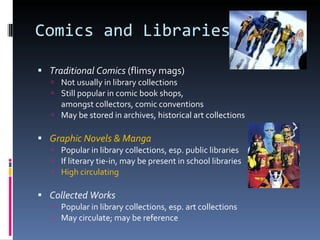
Comics and Libraries Traditional Comics  (flimsy mags) Not usually in library collections Still popular in comic book shops,  amongst collectors, comic conventions May be stored in archives, historical art collections Graphic Novels & Manga Popular in library collections, esp. public libraries If literary tie-in, may be present in school libraries High circulating Collected Works Popular in library collections, esp. art collections May circulate; may be reference
Comics & Censorship May have challenges to: Language Graphic depictions of violence Possible sexist representations Possible objectionable themes Horror/Supernatural Science Fiction Crime Contemporary Issues (Middle East themes, war, etc.) Collection development policy should cover intellectual freedom ALA Code of Ethics counsels against self-censorship Always use sanctioned resources for selection SOURCE:  http://library.buffalo.edu/libraries/asl/guides/graphicnovels/dev/censorship.php
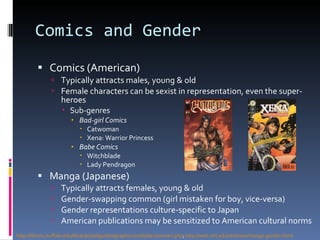
Comics and Gender Comics (American) Typically attracts males, young & old Female characters can be sexist in representation, even the super-heroes Sub-genres Bad-girl Comics   Catwoman Xena: Warrior Princess Babe Comics Witchblade Lady Pendragon Manga (Japanese) Typically attracts females, young & old Gender-swapping common (girl mistaken for boy, vice-versa) Gender representations culture-specific to Japan American publications may be sensitized to American cultural norms http://library.buffalo.edu/libraries/asl/guides/graphicnovels/dev/women.php ;  http://web.mit.edu/rei/www/manga-gender.html
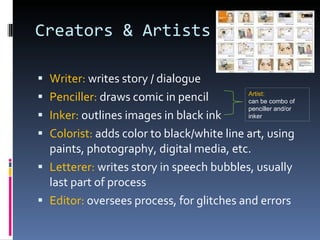
Creators & Artists Writer:  writes story / dialogue Penciller:  draws comic in pencil Inker:  outlines images in black ink Colorist:  adds color to black/white line art, using paints, photography, digital media, etc. Letterer:  writes story in speech bubbles, usually last part of process Editor:  oversees process, for glitches and errors Artist:  can be combo of penciller and/or inker
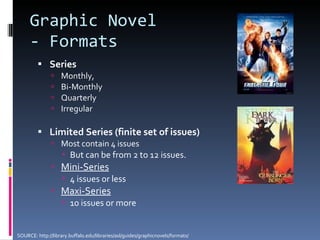
Graphic Novel  - Formats Series   Monthly, Bi-Monthly Quarterly Irregular Limited Series (finite set of issues) Most contain 4 issues  But can be from 2 to 12 issues.  Mini-Series 4 issues or less  Maxi-Series 10 issues or more SOURCE: http://library.buffalo.edu/libraries/asl/guides/graphicnovels/formats/
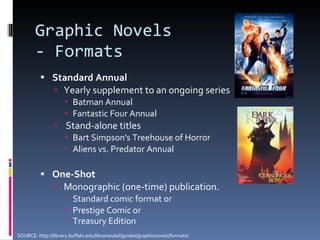
Graphic Novels  - Formats Standard Annual Yearly supplement to an ongoing series  Batman Annual  Fantastic Four Annual  Stand-alone titles Bart Simpson's Treehouse of Horror  Aliens vs. Predator Annual One-Shot Monographic (one-time) publication.  Standard comic format or Prestige Comic or  Treasury Edition SOURCE: http://library.buffalo.edu/libraries/asl/guides/graphicnovels/formats/
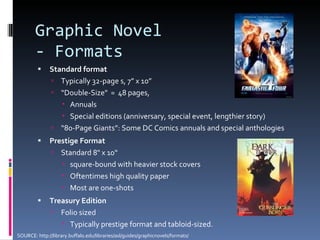
Graphic Novel  - Formats Standard format  Typically 32-page s, 7” x 10” “ Double-Size"  =  48 pages, Annuals Special editions (anniversary, special event, lengthier story) “ 80-Page Giants”: Some DC Comics annuals and special anthologies Prestige Format   Standard 8" x 10“ square-bound with heavier stock covers Oftentimes high quality paper Most are one-shots Treasury Edition Folio sized Typically prestige format and tabloid-sized. SOURCE: http://library.buffalo.edu/libraries/asl/guides/graphicnovels/formats/
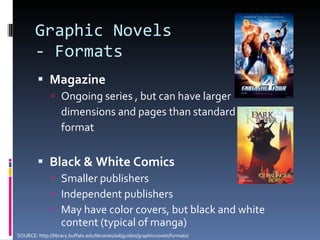
Graphic Novels - Formats Magazine Ongoing series , but can have larger  dimensions and pages than standard  format Black & White Comics Smaller publishers Independent publishers May have color covers, but black and white content (typical of manga) SOURCE: http://library.buffalo.edu/libraries/asl/guides/graphicnovels/formats/
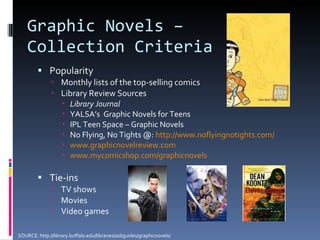
Graphic Novels –  Collection Criteria Popularity Monthly lists of the top-selling comics  Library Review Sources Library Journal  YALSA’s  Graphic Novels for Teens IPL Teen Space – Graphic Novels No Flying, No Tights @:  http://www.noflyingnotights.com/ www.graphicnovelreview.com www.mycomicshop.com/graphicnovels Tie-ins TV shows Movies Video games SOURCE: http://library.buffalo.edu/libraries/asl/guides/graphicnovels/
Graphic Novels –  Collection Criteria Age level Target audience Tweeners Teens Young Adults Adults General suitability Not too mature Not too immature Writing quality - Originality important Plot & Character Development  Dialogue Pacing
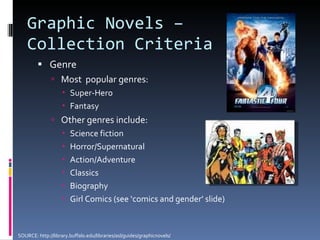
Graphic Novels –  Collection Criteria Genre Most  popular genres: Super-Hero Fantasy Other genres include: Science fiction Horror/Supernatural Action/Adventure Classics Biography Girl Comics (see ‘comics and gender’ slide) SOURCE: http://library.buffalo.edu/libraries/asl/guides/graphicnovels/
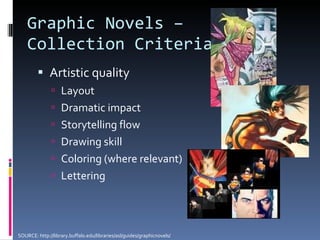
Graphic Novels –  Collection Criteria Artistic quality Layout Dramatic impact Storytelling flow Drawing skill Coloring (where relevant) Lettering SOURCE: http://library.buffalo.edu/libraries/asl/guides/graphicnovels/
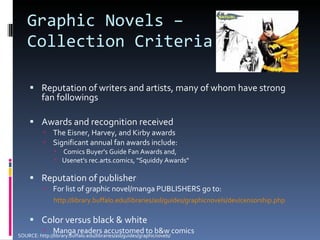
Graphic Novels –  Collection Criteria Reputation of writers and artists, many of whom have strong fan followings Awards and recognition received The Eisner, Harvey, and Kirby awards  Significant annual fan awards include: Comics Buyer's Guide Fan Awards and, Usenet’s rec.arts.comics, "Squiddy Awards" Reputation of publisher For list of graphic novel/manga PUBLISHERS go to:   http://library.buffalo.edu/libraries/asl/guides/graphicnovels/dev/censorship.php Color versus black & white Manga readers accustomed to b&w comics SOURCE: http://library.buffalo.edu/libraries/asl/guides/graphicnovels/
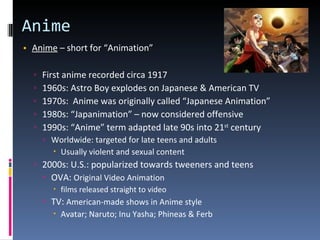
Anime Anime  – short for “Animation”  First anime recorded circa 1917 1960s: Astro Boy explodes on Japanese & American TV 1970s:  Anime was originally called “Japanese Animation” 1980s: “Japanimation” – now considered offensive 1990s: “Anime” term adapted late 90s into 21 st  century Worldwide: targeted for late teens and adults Usually violent and sexual content 2000s: U.S.: popularized towards tweeners and teens OVA:  Original Video Animation  films released straight to video TV:  American-made shows in Anime style Avatar; Naruto; Inu Yasha; Phineas & Ferb
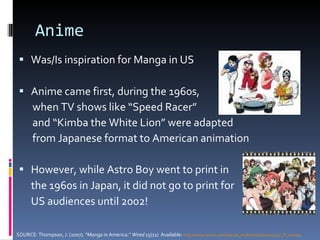
Anime Was/Is inspiration for Manga in US Anime came first, during the 1960s, when TV shows like “Speed Racer”  and “Kimba the White Lion” were adapted from Japanese format to American animation However, while Astro Boy went to print in  the 1960s in Japan, it did not go to print for  US audiences until 2002! SOURCE: Thompson, J. (2007). “Manga in America.”  Wired  15(11)  Available:  http://www.wired.com/special_multimedia/2007/1511_ff_manga
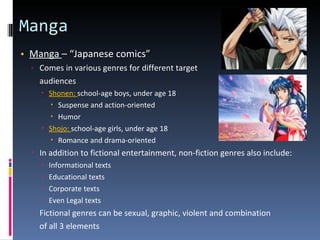
Manga Manga  – “Japanese comics” Comes in various genres for different target  audiences Shonen:  school-age boys, under age 18 Suspense and action-oriented Humor Shojo:  school-age girls, under age 18 Romance and drama-oriented In addition to fictional entertainment, non-fiction genres also include: Informational texts Educational texts Corporate texts Even Legal texts Fictional genres can be sexual, graphic, violent and combination  of all 3 elements
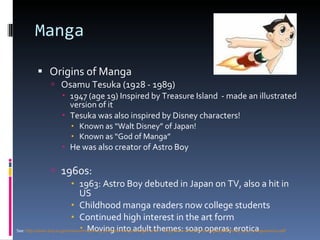
Manga Origins of Manga Osamu Tesuka (1928 - 1989) 1947 (age 19) Inspired by Treasure Island  - made an illustrated version of it Tesuka was also inspired by Disney characters!  Known as “Walt Disney” of Japan! Known as “God of Manga” He was also creator of Astro Boy 1960s:  1963: Astro Boy debuted in Japan on TV, also a hit in US Childhood manga readers now college students Continued high interest in the art form Moving into adult themes: soap operas; erotica See:  http://www.dnp.co.jp/museum/nmp/nmp_i/articles/manga/manga2.html;   http://www.wired.com/images/pdf/Wired_1511_mangaamerica.pdf
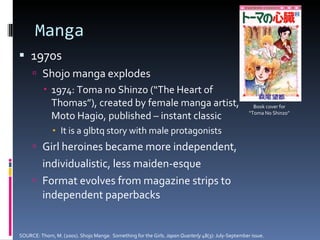
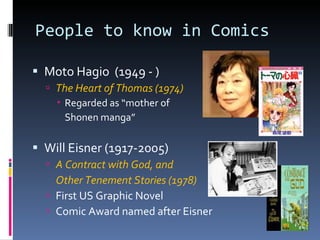
Manga 1970s Shojo manga explodes  1974: Toma no Shinzo (“The Heart of Thomas”), created by female manga artist, Moto Hagio, published – instant classic It is a glbtq story with male protagonists Girl heroines became more independent,  individualistic, less maiden-esque Format evolves from magazine strips to independent paperbacks SOURCE: Thorn, M. (2001). Shojo Manga:  Something for the Girls.  Japan Quarterly  48(3): July-September issue. Book cover for “ Toma No Shinzo”
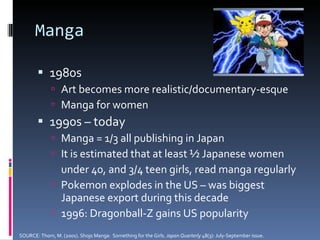
Manga 1980s Art becomes more realistic/documentary-esque Manga for women 1990s – today Manga = 1/3 all publishing in Japan It is estimated that at least ½ Japanese women under 40, and 3/4 teen girls, read manga regularly Pokemon explodes in the US – was biggest Japanese export during this decade 1996: Dragonball-Z gains US popularity SOURCE: Thorn, M. (2001). Shojo Manga:  Something for the Girls.  Japan Quarterly  48(3): July-September issue.
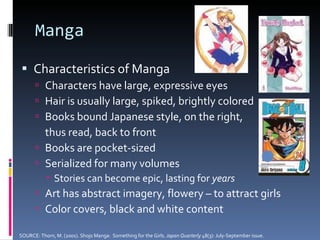
Manga Characteristics of Manga Characters have large, expressive eyes Hair is usually large, spiked, brightly colored Books bound Japanese style, on the right,  thus read, back to front Books are pocket-sized Serialized for many volumes Stories can become epic, lasting for  years Art has abstract imagery, flowery – to attract girls Color covers, black and white content SOURCE: Thorn, M. (2001). Shojo Manga:  Something for the Girls.  Japan Quarterly  48(3): July-September issue.
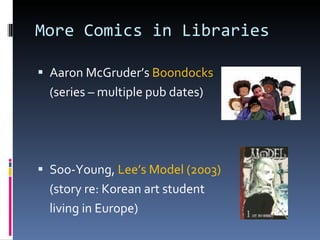
More Comics in Libraries Aaron McGruder’s  Boondocks (series – multiple pub dates) Soo-Young,  Lee’s Model (2003) (story re: Korean art student living in Europe)
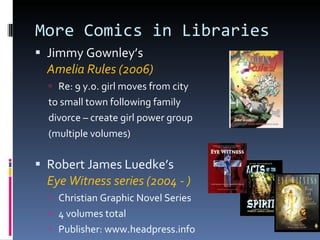
More Comics in Libraries Jimmy Gownley’s  Amelia Rules (2006) Re: 9 y.o. girl moves from city to small town following family  divorce – create girl power group (multiple volumes) Robert James Luedke’s  Eye Witness series (2004 - ) Christian Graphic Novel Series 4 volumes total Publisher: www.headpress.info
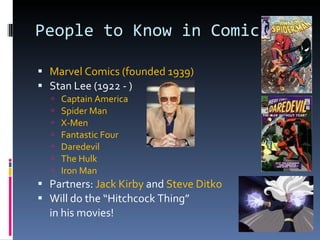
People to Know in Comics Marvel Comics (founded 1939) Stan Lee (1922 - )  Captain America Spider Man X-Men Fantastic Four Daredevil The Hulk Iron Man Partners:  Jack Kirby  and  Steve Ditko Will do the “Hitchcock Thing”  in his movies!
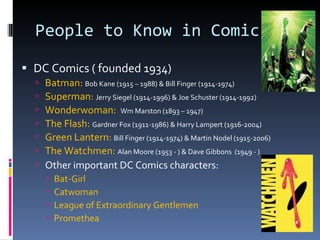
People to Know in Comics DC Comics ( founded 1934) Batman:  Bob Kane (1915 – 1988) & Bill Finger (1914-1974) Superman:  Jerry Siegel (1914-1996) & Joe Schuster (1914-1992) Wonderwoman:  Wm Marston (1893 – 1947) The Flash:  Gardner Fox (1911-1986) & Harry Lampert (1916-2004) Green Lantern:  Bill Finger (1914-1974) & Martin Nodel (1915-2006) The Watchmen:  Alan Moore (1953 - ) & Dave Gibbons  (1949 - ) Other important DC Comics characters: Bat-Girl Catwoman League of Extraordinary Gentlemen Promethea
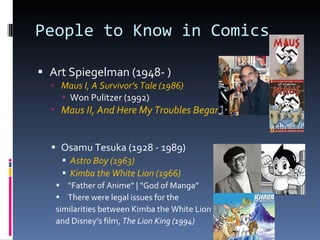
People to Know in Comics Art Spiegelman (1948- )  Maus I, A Survivor’s Tale (1986) Won Pulitzer (1992) Maus II, And Here My Troubles Began (1991) Osamu Tesuka (1928 - 1989) Astro Boy (1963) Kimba the White Lion (1966) “ Father of Anime” | “God of Manga” There were legal issues for the  similarities between Kimba the White Lion and Disney’s film,  The Lion King (1994)
People to know in Comics Moto Hagio  (1949 - ) The Heart of Thomas (1974) Regarded as “mother of Shonen manga” Will Eisner (1917-2005) A Contract with God, and  Other Tenement Stories (1978) First US Graphic Novel Comic Award named after Eisner
Librarian Considerations  4 Graphic Novels/Anime/Manga Collect for children, teens, and adults  for a wide-range collection Anime:   Subtitled & Re-Dubbed may have varying titles Manga:   Purchase series as a whole b/c serializations usually one story Label clearly so patrons know sequence Graphic Novels:   Purchase literary titles for reluctant readers Classics Biographies Source: http://www.koyagi.com/Libguide.html#anchor118912
References Graphic Novels Resources for Librarians http://library.buffalo.edu/libraries/asl/guides/graphicnovels/ Shotaro Inshinomori Website (Excellent Manga Timeline) @:  http://en.ishimoripro.com/prof/index.html Booklist: Reference on the Web, Graphic Novels http://www.booklistonline.com/default.aspx?page=show_product&pid=1538194 A History of Manga:  http://www.dnp.co.jp/museum/nmp/nmp_i/articles/manga/manga1.html Gender and Gender Relations in Manga and Anime. (2000). Available:  http://web.mit.edu/rei/www/manga-gender.html
References Thorn, M. (2001). Shojo Manga: Something for the Girls.  Available:  http://www.matt-thorn.com/shoujo_manga/japan_quarterly/index.php Thompson, J. (2007). How Manga Conquered the US, A graphic guide to Japan’s coolest export.  Available:  http://www.wired.com/special_multimedia/2007/1511_ff_manga The Unofficial Guide to the DC Universe.  Available:  http://www.dcuguide.com/

Graphic Novels: An Introduction

  • 1.
    Vanessa Irvin MorrisAssistant Professor The iSchool at Drexel University Philadelphia, PA, USA [email_address]
  • 2.
    Comics to GraphicNovels Historical Timeline Comic form originally literacy format for working class and poor Graphic novels go as far back as 1842 1930s: Banner decade for Newspaper Comic Strip launchings Blondie & Dagwood (1930 – still running) Superman (1939 - 1966) The Phantom (1936 – still running) 1934: DC Comics established 1938: DC Comics launched Superman, volume 1 Superman ran 1939-1988, issues 0-423 Adventures of Superman ran 1987 – 2006, Issues 424-649 1939: Marvel Comics parent company (Timely Publications) established
  • 3.
    Comics to Graphic Novels 1940s: Big boom in comics – readership sky high – post-War reading – considered “Golden Age of Comics” 1940: Will Eisner lauded for The Spirit 1941: Marvel launched Captain America 1950s: TV makes fiction visual; Comic sales go down 1951: Timely (aka Atlas Comics) officially becomes Marvel Comics 1960s: Anime comes to America Underground comics Deal with political and social topics of the day Japanese animation comes to American TV
  • 4.
    Comics to Graphic Novels Historical Timeline 1970s: Creation of “Graphic Novel” 1972: Maus, by Art Spiegelman is born as a small comic strip; 1978: Publication of Will Eisner’s Contract with God, the first ever graphic novel – a connective series of short stories bound in one volume, subtitled as “ a graphic novel by Will Eisner” 1980s: Begins “Modern Age of Comics” Graphic novel renaissance w/mass-market trade paperbacks; 1986: Art Spiegelman morphs Maus into full graphic novel form 1988: Eisner Awards are born at Comic-Con Conference Considered the “Oscars” of comic book industry (see willeisner.com)
  • 5.
    Comics to GraphicNovels Historical Timeline 1990s: Batman, Darkman begin resurgence of comic characters in cinema; Graphic novels available as serializations; Graphic novels gain popularity in libraries; 1992 – Maus, A Survivor’s Tale, wins Pulitzer Prize, solidifying literary quality of graphic novel form 2000s: Comic franchises in cinema w/movie tie-ins, of course; X-Men I, II, III, IV (forthcoming), V (forthcoming) Spider Man I, II, III Fantastic Four I, II Iron Man I, II (forthcoming) Biographies, literary classics in graphic novel form; American Born Chinese (2006) wins 2007 Printz Award from YALSA
  • 6.
    Contemporary US ComicsDefined Categories: Traditional Comics Typical flimsy magazine format serialized Graphic Novels Original book-length stories in comic format Collected Works Also called trade collections or graphic albums previously published in graphic novel form Manga Japanese comics, pocket-sized, highly serialized SOURCE: http://library.buffalo.edu/libraries/asl/guides/graphicnovels/formats/
  • 7.
    Comics and LibrariesTraditional Comics (flimsy mags) Not usually in library collections Still popular in comic book shops, amongst collectors, comic conventions May be stored in archives, historical art collections Graphic Novels & Manga Popular in library collections, esp. public libraries If literary tie-in, may be present in school libraries High circulating Collected Works Popular in library collections, esp. art collections May circulate; may be reference
  • 8.
    Comics & CensorshipMay have challenges to: Language Graphic depictions of violence Possible sexist representations Possible objectionable themes Horror/Supernatural Science Fiction Crime Contemporary Issues (Middle East themes, war, etc.) Collection development policy should cover intellectual freedom ALA Code of Ethics counsels against self-censorship Always use sanctioned resources for selection SOURCE: http://library.buffalo.edu/libraries/asl/guides/graphicnovels/dev/censorship.php
  • 9.
    Comics and GenderComics (American) Typically attracts males, young & old Female characters can be sexist in representation, even the super-heroes Sub-genres Bad-girl Comics Catwoman Xena: Warrior Princess Babe Comics Witchblade Lady Pendragon Manga (Japanese) Typically attracts females, young & old Gender-swapping common (girl mistaken for boy, vice-versa) Gender representations culture-specific to Japan American publications may be sensitized to American cultural norms http://library.buffalo.edu/libraries/asl/guides/graphicnovels/dev/women.php ; http://web.mit.edu/rei/www/manga-gender.html
  • 10.
    Creators & ArtistsWriter: writes story / dialogue Penciller: draws comic in pencil Inker: outlines images in black ink Colorist: adds color to black/white line art, using paints, photography, digital media, etc. Letterer: writes story in speech bubbles, usually last part of process Editor: oversees process, for glitches and errors Artist: can be combo of penciller and/or inker
  • 11.
    Graphic Novel - Formats Series Monthly, Bi-Monthly Quarterly Irregular Limited Series (finite set of issues) Most contain 4 issues But can be from 2 to 12 issues. Mini-Series 4 issues or less Maxi-Series 10 issues or more SOURCE: http://library.buffalo.edu/libraries/asl/guides/graphicnovels/formats/
  • 12.
    Graphic Novels - Formats Standard Annual Yearly supplement to an ongoing series Batman Annual Fantastic Four Annual Stand-alone titles Bart Simpson's Treehouse of Horror Aliens vs. Predator Annual One-Shot Monographic (one-time) publication. Standard comic format or Prestige Comic or Treasury Edition SOURCE: http://library.buffalo.edu/libraries/asl/guides/graphicnovels/formats/
  • 13.
    Graphic Novel - Formats Standard format Typically 32-page s, 7” x 10” “ Double-Size" = 48 pages, Annuals Special editions (anniversary, special event, lengthier story) “ 80-Page Giants”: Some DC Comics annuals and special anthologies Prestige Format Standard 8" x 10“ square-bound with heavier stock covers Oftentimes high quality paper Most are one-shots Treasury Edition Folio sized Typically prestige format and tabloid-sized. SOURCE: http://library.buffalo.edu/libraries/asl/guides/graphicnovels/formats/
  • 14.
    Graphic Novels -Formats Magazine Ongoing series , but can have larger dimensions and pages than standard format Black & White Comics Smaller publishers Independent publishers May have color covers, but black and white content (typical of manga) SOURCE: http://library.buffalo.edu/libraries/asl/guides/graphicnovels/formats/
  • 15.
    Graphic Novels – Collection Criteria Popularity Monthly lists of the top-selling comics Library Review Sources Library Journal YALSA’s Graphic Novels for Teens IPL Teen Space – Graphic Novels No Flying, No Tights @: http://www.noflyingnotights.com/ www.graphicnovelreview.com www.mycomicshop.com/graphicnovels Tie-ins TV shows Movies Video games SOURCE: http://library.buffalo.edu/libraries/asl/guides/graphicnovels/
  • 16.
    Graphic Novels – Collection Criteria Age level Target audience Tweeners Teens Young Adults Adults General suitability Not too mature Not too immature Writing quality - Originality important Plot & Character Development Dialogue Pacing
  • 17.
    Graphic Novels – Collection Criteria Genre Most popular genres: Super-Hero Fantasy Other genres include: Science fiction Horror/Supernatural Action/Adventure Classics Biography Girl Comics (see ‘comics and gender’ slide) SOURCE: http://library.buffalo.edu/libraries/asl/guides/graphicnovels/
  • 18.
    Graphic Novels – Collection Criteria Artistic quality Layout Dramatic impact Storytelling flow Drawing skill Coloring (where relevant) Lettering SOURCE: http://library.buffalo.edu/libraries/asl/guides/graphicnovels/
  • 19.
    Graphic Novels – Collection Criteria Reputation of writers and artists, many of whom have strong fan followings Awards and recognition received The Eisner, Harvey, and Kirby awards Significant annual fan awards include: Comics Buyer's Guide Fan Awards and, Usenet’s rec.arts.comics, "Squiddy Awards" Reputation of publisher For list of graphic novel/manga PUBLISHERS go to: http://library.buffalo.edu/libraries/asl/guides/graphicnovels/dev/censorship.php Color versus black & white Manga readers accustomed to b&w comics SOURCE: http://library.buffalo.edu/libraries/asl/guides/graphicnovels/
  • 20.
    Anime Anime – short for “Animation” First anime recorded circa 1917 1960s: Astro Boy explodes on Japanese & American TV 1970s: Anime was originally called “Japanese Animation” 1980s: “Japanimation” – now considered offensive 1990s: “Anime” term adapted late 90s into 21 st century Worldwide: targeted for late teens and adults Usually violent and sexual content 2000s: U.S.: popularized towards tweeners and teens OVA: Original Video Animation films released straight to video TV: American-made shows in Anime style Avatar; Naruto; Inu Yasha; Phineas & Ferb
  • 21.
    Anime Was/Is inspirationfor Manga in US Anime came first, during the 1960s, when TV shows like “Speed Racer” and “Kimba the White Lion” were adapted from Japanese format to American animation However, while Astro Boy went to print in the 1960s in Japan, it did not go to print for US audiences until 2002! SOURCE: Thompson, J. (2007). “Manga in America.” Wired 15(11) Available: http://www.wired.com/special_multimedia/2007/1511_ff_manga
  • 22.
    Manga Manga – “Japanese comics” Comes in various genres for different target audiences Shonen: school-age boys, under age 18 Suspense and action-oriented Humor Shojo: school-age girls, under age 18 Romance and drama-oriented In addition to fictional entertainment, non-fiction genres also include: Informational texts Educational texts Corporate texts Even Legal texts Fictional genres can be sexual, graphic, violent and combination of all 3 elements
  • 23.
    Manga Origins ofManga Osamu Tesuka (1928 - 1989) 1947 (age 19) Inspired by Treasure Island - made an illustrated version of it Tesuka was also inspired by Disney characters! Known as “Walt Disney” of Japan! Known as “God of Manga” He was also creator of Astro Boy 1960s: 1963: Astro Boy debuted in Japan on TV, also a hit in US Childhood manga readers now college students Continued high interest in the art form Moving into adult themes: soap operas; erotica See: http://www.dnp.co.jp/museum/nmp/nmp_i/articles/manga/manga2.html; http://www.wired.com/images/pdf/Wired_1511_mangaamerica.pdf
  • 24.
    Manga 1970s Shojomanga explodes 1974: Toma no Shinzo (“The Heart of Thomas”), created by female manga artist, Moto Hagio, published – instant classic It is a glbtq story with male protagonists Girl heroines became more independent, individualistic, less maiden-esque Format evolves from magazine strips to independent paperbacks SOURCE: Thorn, M. (2001). Shojo Manga: Something for the Girls. Japan Quarterly 48(3): July-September issue. Book cover for “ Toma No Shinzo”
  • 25.
    Manga 1980s Artbecomes more realistic/documentary-esque Manga for women 1990s – today Manga = 1/3 all publishing in Japan It is estimated that at least ½ Japanese women under 40, and 3/4 teen girls, read manga regularly Pokemon explodes in the US – was biggest Japanese export during this decade 1996: Dragonball-Z gains US popularity SOURCE: Thorn, M. (2001). Shojo Manga: Something for the Girls. Japan Quarterly 48(3): July-September issue.
  • 26.
    Manga Characteristics ofManga Characters have large, expressive eyes Hair is usually large, spiked, brightly colored Books bound Japanese style, on the right, thus read, back to front Books are pocket-sized Serialized for many volumes Stories can become epic, lasting for years Art has abstract imagery, flowery – to attract girls Color covers, black and white content SOURCE: Thorn, M. (2001). Shojo Manga: Something for the Girls. Japan Quarterly 48(3): July-September issue.
  • 27.
    More Comics inLibraries Aaron McGruder’s Boondocks (series – multiple pub dates) Soo-Young, Lee’s Model (2003) (story re: Korean art student living in Europe)
  • 28.
    More Comics inLibraries Jimmy Gownley’s Amelia Rules (2006) Re: 9 y.o. girl moves from city to small town following family divorce – create girl power group (multiple volumes) Robert James Luedke’s Eye Witness series (2004 - ) Christian Graphic Novel Series 4 volumes total Publisher: www.headpress.info
  • 29.
    People to Knowin Comics Marvel Comics (founded 1939) Stan Lee (1922 - ) Captain America Spider Man X-Men Fantastic Four Daredevil The Hulk Iron Man Partners: Jack Kirby and Steve Ditko Will do the “Hitchcock Thing” in his movies!
  • 30.
    People to Knowin Comics DC Comics ( founded 1934) Batman: Bob Kane (1915 – 1988) & Bill Finger (1914-1974) Superman: Jerry Siegel (1914-1996) & Joe Schuster (1914-1992) Wonderwoman: Wm Marston (1893 – 1947) The Flash: Gardner Fox (1911-1986) & Harry Lampert (1916-2004) Green Lantern: Bill Finger (1914-1974) & Martin Nodel (1915-2006) The Watchmen: Alan Moore (1953 - ) & Dave Gibbons (1949 - ) Other important DC Comics characters: Bat-Girl Catwoman League of Extraordinary Gentlemen Promethea
  • 31.
    People to Knowin Comics Art Spiegelman (1948- ) Maus I, A Survivor’s Tale (1986) Won Pulitzer (1992) Maus II, And Here My Troubles Began (1991) Osamu Tesuka (1928 - 1989) Astro Boy (1963) Kimba the White Lion (1966) “ Father of Anime” | “God of Manga” There were legal issues for the similarities between Kimba the White Lion and Disney’s film, The Lion King (1994)
  • 32.
    People to knowin Comics Moto Hagio (1949 - ) The Heart of Thomas (1974) Regarded as “mother of Shonen manga” Will Eisner (1917-2005) A Contract with God, and Other Tenement Stories (1978) First US Graphic Novel Comic Award named after Eisner
  • 33.
    Librarian Considerations 4 Graphic Novels/Anime/Manga Collect for children, teens, and adults for a wide-range collection Anime: Subtitled & Re-Dubbed may have varying titles Manga: Purchase series as a whole b/c serializations usually one story Label clearly so patrons know sequence Graphic Novels: Purchase literary titles for reluctant readers Classics Biographies Source: http://www.koyagi.com/Libguide.html#anchor118912
  • 34.
    References Graphic NovelsResources for Librarians http://library.buffalo.edu/libraries/asl/guides/graphicnovels/ Shotaro Inshinomori Website (Excellent Manga Timeline) @: http://en.ishimoripro.com/prof/index.html Booklist: Reference on the Web, Graphic Novels http://www.booklistonline.com/default.aspx?page=show_product&pid=1538194 A History of Manga: http://www.dnp.co.jp/museum/nmp/nmp_i/articles/manga/manga1.html Gender and Gender Relations in Manga and Anime. (2000). Available: http://web.mit.edu/rei/www/manga-gender.html
  • 35.
    References Thorn, M.(2001). Shojo Manga: Something for the Girls. Available: http://www.matt-thorn.com/shoujo_manga/japan_quarterly/index.php Thompson, J. (2007). How Manga Conquered the US, A graphic guide to Japan’s coolest export. Available: http://www.wired.com/special_multimedia/2007/1511_ff_manga The Unofficial Guide to the DC Universe. Available: http://www.dcuguide.com/