SMART CIVIL SERVANTS
IMPROVE PUBLIC SERVICES
Dr. Zsuzsanna Lonti, OECD, Public Governance Directorate
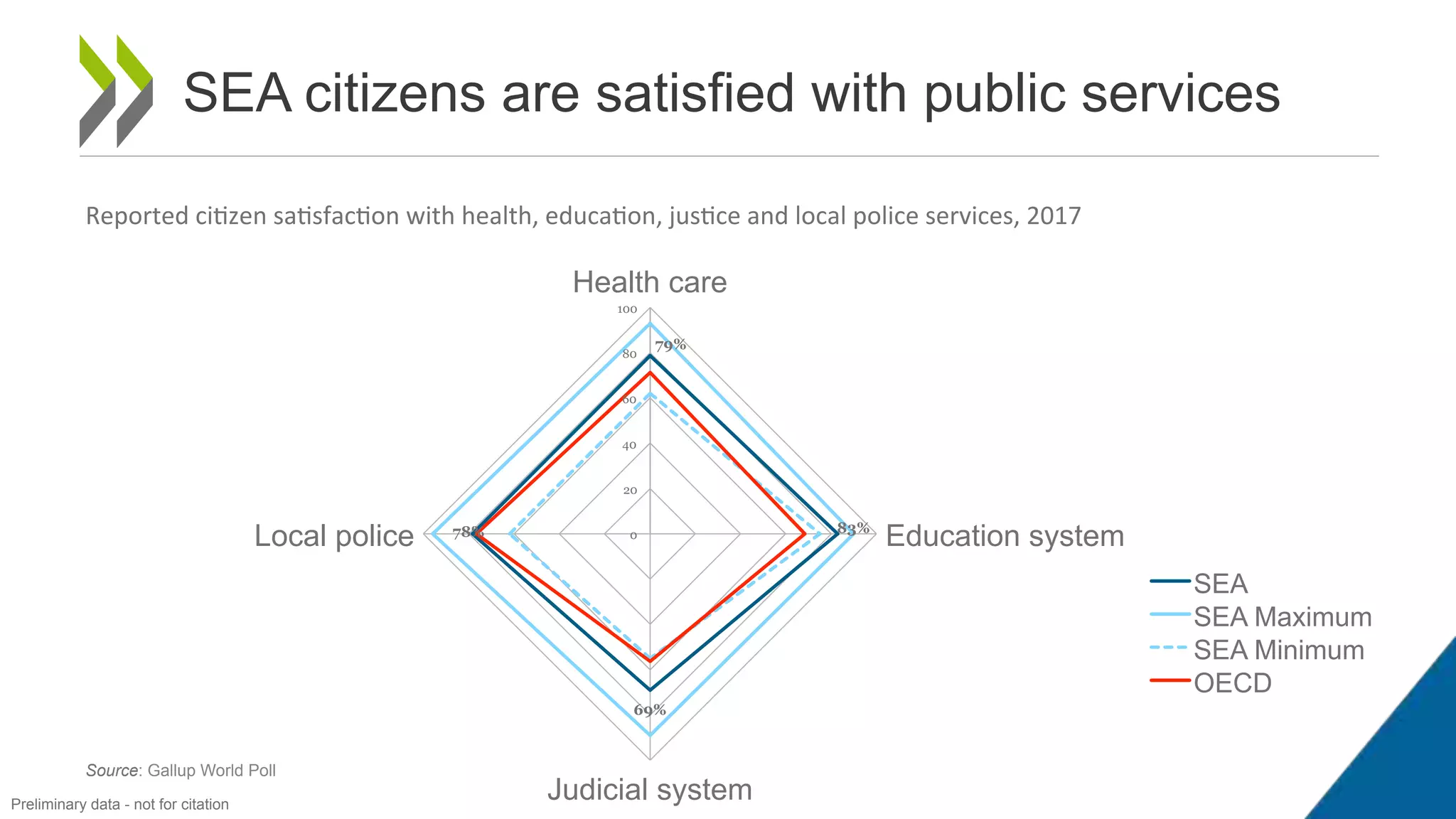
SEA citizens are satisfied with public services
79%
83%
69%
78% 0
20
40
60
80
100
Health care
Education system
Judicial system
Local police
SEA
SEA Maximum
SEA Minimum
OECD
Reported(ci+zen(sa+sfac+on(with(health,(educa+on,(jus+ce(and(local(police(services,(2017((
Source: Gallup World Poll
Preliminary data - not for citation
…changing the skills needed in the civil service.
What is needed are
civil servants with
skills to address
increasingly complex
problems in
increasingly
pluralistic societies
using new tools
available to
governments.
System-wide
capacity
Organisational
Capabilities
Individual Skills
Building civil servants’ capabilities
Policy Development
Working with
Citizens
Commissioning and
Contracting
Managing through
Networks
Professional
basic building blocks of civil service professions
e.g. economists, lawyers, statisticians, political scientists, policy experts, and
communications specialists.
Strategic
skills that enable professionals to create impact and improve public value for their
citizens and clients
e.g. future-oriented and evidence-based problem solving; risk management, foresight
and resilience
Innovation
skills to redesign the tools of governance
to develop novel solutions to persistent and emergent policy challenges
Professional, strategic and innovative
Six core skills areas for public sector innovation
6
Iteration
Data literacy
User centred
Curiosity
Storytelling
Insurgency
! Rapid and incremental development
! Developing and refining prototypes
! Experimentation and testing
! Basing decisions on data and evidence
! Building systems that collect the right data
! Communicating data effectively
! Identifying new ideas, ways of working
! Adapting approaches used elsewhere
! Reframing problems and perspectives
! Using narratives to explain 'the journey'
! Including 'user stories' to outline benefits
! Progressing the story as situations change
! Challenging the usual way of doing things
! Working with unusual/ different partners
! Building alliances for change
! Policies and services solve user needs
! Considering users at every stage
! Users that say: "I would do that again"
Citizen engagement and
service delivery
Professional
Expertise
Public relations, communications,
marketing, consultation, facilitation,
service delivery, conflict resolution,
community development, outreach etc.
Strategic
Orientation
Using engagement skills to achieve specific
outcomes, for example, better targeted
interventions, or nudging.
Innovation
Capabilities
Co-creation, social media, crowdsourcing,
challenge prizes, ethnography, opinion
research, user data analytics, etc.
Building a highly-skilled civil service…
8
1. Determine
• What are the needed skill sets and where are the gaps? How can they
be identified?
2. Attract and Select
• How can the right people with sought-after skill sets be attracted to jobs in
the public sector?
3. Develop and nurture
• How can public organisations create a culture of learning for a dynamic and fast-
changing world?
4. Use
• What kind of organisation and leadership to motivate employees and
provide opportunities to put skills to use?
Performance assessments can encourage
more citizen-centric behaviour
Extent(to(which(performance(assessments(are(used(in(central(government,(2018(
Sources: For SEA countries, OECD (2018) Strategic Human Resources Management Survey. For OECD countries, OECD (2016) Strategic Human Resources
Management Survey.
Preliminary data - not for citation
Performance-related pay is a common monetary
incentive to promote desired behaviours
Extent(to(which(performanceArelated(pay(is(used(in(central(government,(2018(
Sources: For SEA countries, OECD (2018) Strategic Human Resources Management Survey. For OECD countries, OECD (2016) Strategic Human Resources
Management Survey.
Preliminary data - not for citation
0.0
0.1
0.2
0.3
0.4
0.5
0.6
0.7
0.8
0.9
1.0
SGP THA PHL BRN MYS VNM IDN LAO KHM KOR AUS JPN
SEA OECDHigh use
Low use
Data on the workforce is the basis for HR
planning
Collec+on(and(availability(of(administra+ve(human(resources((HR)(data(in(central(government,(2018(
Sources: For SEA countries, OECD (2018) Strategic Human Resources Management Survey. For OECD countries, OECD (2016) Strategic Human Resources
Management Survey.
Preliminary data - not for citation
0.0
0.1
0.2
0.3
0.4
0.5
0.6
0.7
0.8
0.9
1.0
MYS LAO BRN IDN PHL SGP KHM THA VNM KOR AUS NZL JPN
SEA OECDHigh level
Low level
•  Covers all 10 ASEAN countries + 4 OECD countries close to region
•  Possibility to compare these countries to each other, to the SEA and
OECD average
•  Content:
–  Public finances
–  Public employment
–  SHRM
–  Budget practices and procedures
–  Digital government
–  Open government/data
–  Serving Citizens
Upcoming SEA Government at a Glance

SMART Civil Servants Improve Public Services

  • 1.
    SMART CIVIL SERVANTS IMPROVEPUBLIC SERVICES Dr. Zsuzsanna Lonti, OECD, Public Governance Directorate
  • 2.
    SEA citizens aresatisfied with public services 79% 83% 69% 78% 0 20 40 60 80 100 Health care Education system Judicial system Local police SEA SEA Maximum SEA Minimum OECD Reported(ci+zen(sa+sfac+on(with(health,(educa+on,(jus+ce(and(local(police(services,(2017(( Source: Gallup World Poll Preliminary data - not for citation
  • 3.
    …changing the skillsneeded in the civil service. What is needed are civil servants with skills to address increasingly complex problems in increasingly pluralistic societies using new tools available to governments. System-wide capacity Organisational Capabilities Individual Skills
  • 4.
  • 5.
    Policy Development Working with Citizens Commissioningand Contracting Managing through Networks Professional basic building blocks of civil service professions e.g. economists, lawyers, statisticians, political scientists, policy experts, and communications specialists. Strategic skills that enable professionals to create impact and improve public value for their citizens and clients e.g. future-oriented and evidence-based problem solving; risk management, foresight and resilience Innovation skills to redesign the tools of governance to develop novel solutions to persistent and emergent policy challenges Professional, strategic and innovative
  • 6.
    Six core skillsareas for public sector innovation 6 Iteration Data literacy User centred Curiosity Storytelling Insurgency ! Rapid and incremental development ! Developing and refining prototypes ! Experimentation and testing ! Basing decisions on data and evidence ! Building systems that collect the right data ! Communicating data effectively ! Identifying new ideas, ways of working ! Adapting approaches used elsewhere ! Reframing problems and perspectives ! Using narratives to explain 'the journey' ! Including 'user stories' to outline benefits ! Progressing the story as situations change ! Challenging the usual way of doing things ! Working with unusual/ different partners ! Building alliances for change ! Policies and services solve user needs ! Considering users at every stage ! Users that say: "I would do that again"
  • 7.
    Citizen engagement and servicedelivery Professional Expertise Public relations, communications, marketing, consultation, facilitation, service delivery, conflict resolution, community development, outreach etc. Strategic Orientation Using engagement skills to achieve specific outcomes, for example, better targeted interventions, or nudging. Innovation Capabilities Co-creation, social media, crowdsourcing, challenge prizes, ethnography, opinion research, user data analytics, etc.
  • 8.
    Building a highly-skilledcivil service… 8 1. Determine • What are the needed skill sets and where are the gaps? How can they be identified? 2. Attract and Select • How can the right people with sought-after skill sets be attracted to jobs in the public sector? 3. Develop and nurture • How can public organisations create a culture of learning for a dynamic and fast- changing world? 4. Use • What kind of organisation and leadership to motivate employees and provide opportunities to put skills to use?
  • 9.
    Performance assessments canencourage more citizen-centric behaviour Extent(to(which(performance(assessments(are(used(in(central(government,(2018( Sources: For SEA countries, OECD (2018) Strategic Human Resources Management Survey. For OECD countries, OECD (2016) Strategic Human Resources Management Survey. Preliminary data - not for citation
  • 10.
    Performance-related pay isa common monetary incentive to promote desired behaviours Extent(to(which(performanceArelated(pay(is(used(in(central(government,(2018( Sources: For SEA countries, OECD (2018) Strategic Human Resources Management Survey. For OECD countries, OECD (2016) Strategic Human Resources Management Survey. Preliminary data - not for citation 0.0 0.1 0.2 0.3 0.4 0.5 0.6 0.7 0.8 0.9 1.0 SGP THA PHL BRN MYS VNM IDN LAO KHM KOR AUS JPN SEA OECDHigh use Low use
  • 11.
    Data on theworkforce is the basis for HR planning Collec+on(and(availability(of(administra+ve(human(resources((HR)(data(in(central(government,(2018( Sources: For SEA countries, OECD (2018) Strategic Human Resources Management Survey. For OECD countries, OECD (2016) Strategic Human Resources Management Survey. Preliminary data - not for citation 0.0 0.1 0.2 0.3 0.4 0.5 0.6 0.7 0.8 0.9 1.0 MYS LAO BRN IDN PHL SGP KHM THA VNM KOR AUS NZL JPN SEA OECDHigh level Low level
  • 12.
    •  Covers all10 ASEAN countries + 4 OECD countries close to region •  Possibility to compare these countries to each other, to the SEA and OECD average •  Content: –  Public finances –  Public employment –  SHRM –  Budget practices and procedures –  Digital government –  Open government/data –  Serving Citizens Upcoming SEA Government at a Glance