Download to read offline
![IEEE TRANSACTIONS ON SYSTEMS, MAN, AND CYBERNETICS—PART A: SYSTEMS AND HUMANS, VOL. 30, NO. 4, JULY 2000 421
What Makes Consumers Buy from Internet? A
Longitudinal Study of Online Shopping
Moez Limayem, Mohamed Khalifa, and Anissa Frini
Abstract—The objective of this study is to investigate the fac-tors
affecting online shopping. A model explaining the impact of
different factors on online shopping intentions and behavior is de-veloped
based on the Theory of Planned Behavior. The model is
then tested empirically in a longitudinal study with two surveys.
Data collected from 705 consumers indicate that subjective norms,
attitude, and beliefs concerning the consequences of online shop-ping
have significant effects on consumers’ intentions to buy on-line.
Behavioral control and intentions significantly influenced on-line
shopping behavior. The results also provide strong support for
the positive effects of personal innovativeness on attitude and in-tentions
to shop online. The implications of the findings for theory
and practice are discussed.
Index Terms—e-commerce, online shopping, TPB.
I. INTRODUCTION
THE use of the Internet as a shopping and purchasing
medium has seen unprecedented growth. Most experts
expect the global electronic market to dramatically impact
commerce in the twenty first century. Jaffray [1] estimates the
total volume of cybersales to reach $201 billion in 2001 and
Forrester Research [2] predicts electronic commerce activities
to reach $327 billion in 2002 worldwide. Activmedia [3]
forecasts Web revenues to amount to $1.2 trillion in 2002.
In addition to this tremendous growth, the characteristics of
the global electronic market constitute a unique opportunity
for companies to more efficiently reach existing and potential
customers by replacing traditional retail stores with Web-based
businesses. Many physical obstacles hinder companies in their
efforts to reach global markets. Therefore, the World Wide
Web (WWW) enables businesses to explore new markets
that otherwise cannot be reached. Consequently, Electronic
Commerce (EC) has emerged as the most important way of
doing business for years to come. This term was first used by
Kalakota and Whinston [4]. They state that EC has two distinct
forms: Business-to-business and business-to consumer. Much
of the growth in revenues from transactions over the Internet
has been achieved from business-to-business exchanges leading
to the accumulation of an impressive body of knowledge and
expertise in the area of business-to-business EC [5], [6].
Unfortunately, this is not the case for business-to-consumer
EC. With the exception of software, hardware, travel services,
and few other niche areas, shopping on the Internet is far from
Manuscript received November 10, 1999; revised April 3, 2000. This paper
was recommended by Associate Editor C. Hsu.
M. Limayem and M. Khalifa are with the Information Systems Department,
City University of Hong Kong, Kowloon, Hong Kong.
A. Frini is with the Laval University, Quebec City, P.Q., Canada.
Publisher Item Identifier S 1083-4427(00)05143-2.
universal even among people who spend long hours online
[7], [8]. A recent survey reported by Krochmal [9], found that
only 18% of U.S. households have made a purchase online.
Moreover, many companies already practicing EC are having
a difficult time generating satisfactory profits. For example,
many e-companies such as Amazon.com have successfully
attracted much attention but have not been able to convert their
competitive advantage into tangible profit [10].
Selling in cyberspace is very different from selling in phys-ical
markets, and it requires a critical understanding of consumer
behavior and how new technologies challenge the traditional as-sumptions
underlying conventional theories and models. Butler
and Peppard [11], for example, explain the failure of IBM’s
sponsored Web shopping malls by the naive comprehension of
the true nature of consumer behavior on the net. A critical un-derstanding
of this behavior in cyberspace, as in the physical
world, cannot be achieved without a good appreciation of the
factors affecting the purchase decision. If cybermarketers know
how consumers make these decisions, they can adjust their mar-keting
strategies to fit this new way of selling in order to convert
their potential customers to real ones and retain them. Similarly,
Web site designers, who are faced with the difficult question of
how to design pages to make them not only popular but also
effective in increasing sales, can benefit from such an under-standing.
This research has two primary objectives. The first objective
is to use current behavioral theories in the elaboration of a model
that can identify key factors influencing purchasing on the web.
Such a model should also explain the relationship between indi-viduals’
intentions to buy from the web and the actual behavior
of purchasing online. The second objective is to conduct a lon-gitudinal
study to empirically test the validity of the proposed
model. This study therefore enhances our understanding of con-sumer
behavior on the Web and leads to valuable implications
to marketers and managers on how to develop effective strate-gies
to win the battles of cyber competition. The findings of this
study should also help Web designers in their difficult task of
designing sites that must compete with millions of other sites
on the Web.
This paper is presented as follows. Section II reviews the
current literature on consumer behavior on the web. Section
III presents the theoretical foundations of our research model.
Section IV outlines the research methodology and describes the
data analysis. Section V presents the results, while Section VI
discusses these results and their implications for researchers and
practitioners. Finally, Section VII concludes this paper by de-scribing
the limitations of the current study and by providing
several suggestions for future research in this area.
1083–4427/00$10.00 © 2000 IEEE](https://image.slidesharecdn.com/khalifa2000-whatmakesconsumersbuyfrominternet-140918053633-phpapp02/85/What-makes-consumers-buy-from-internet-1-320.jpg)
![IEEE TRANSACTIONS ON SYSTEMS, MAN, AND CYBERNETICS—PART A: SYSTEMS AND HUMANS, VOL. 30, NO. 4, JULY 2000 421
What Makes Consumers Buy from Internet? A
Longitudinal Study of Online Shopping
Moez Limayem, Mohamed Khalifa, and Anissa Frini
Abstract—The objective of this study is to investigate the fac-tors
affecting online shopping. A model explaining the impact of
different factors on online shopping intentions and behavior is de-veloped
based on the Theory of Planned Behavior. The model is
then tested empirically in a longitudinal study with two surveys.
Data collected from 705 consumers indicate that subjective norms,
attitude, and beliefs concerning the consequences of online shop-ping
have significant effects on consumers’ intentions to buy on-line.
Behavioral control and intentions significantly influenced on-line
shopping behavior. The results also provide strong support for
the positive effects of personal innovativeness on attitude and in-tentions
to shop online. The implications of the findings for theory
and practice are discussed.
Index Terms—e-commerce, online shopping, TPB.
I. INTRODUCTION
THE use of the Internet as a shopping and purchasing
medium has seen unprecedented growth. Most experts
expect the global electronic market to dramatically impact
commerce in the twenty first century. Jaffray [1] estimates the
total volume of cybersales to reach $201 billion in 2001 and
Forrester Research [2] predicts electronic commerce activities
to reach $327 billion in 2002 worldwide. Activmedia [3]
forecasts Web revenues to amount to $1.2 trillion in 2002.
In addition to this tremendous growth, the characteristics of
the global electronic market constitute a unique opportunity
for companies to more efficiently reach existing and potential
customers by replacing traditional retail stores with Web-based
businesses. Many physical obstacles hinder companies in their
efforts to reach global markets. Therefore, the World Wide
Web (WWW) enables businesses to explore new markets
that otherwise cannot be reached. Consequently, Electronic
Commerce (EC) has emerged as the most important way of
doing business for years to come. This term was first used by
Kalakota and Whinston [4]. They state that EC has two distinct
forms: Business-to-business and business-to consumer. Much
of the growth in revenues from transactions over the Internet
has been achieved from business-to-business exchanges leading
to the accumulation of an impressive body of knowledge and
expertise in the area of business-to-business EC [5], [6].
Unfortunately, this is not the case for business-to-consumer
EC. With the exception of software, hardware, travel services,
and few other niche areas, shopping on the Internet is far from
Manuscript received November 10, 1999; revised April 3, 2000. This paper
was recommended by Associate Editor C. Hsu.
M. Limayem and M. Khalifa are with the Information Systems Department,
City University of Hong Kong, Kowloon, Hong Kong.
A. Frini is with the Laval University, Quebec City, P.Q., Canada.
Publisher Item Identifier S 1083-4427(00)05143-2.
universal even among people who spend long hours online
[7], [8]. A recent survey reported by Krochmal [9], found that
only 18% of U.S. households have made a purchase online.
Moreover, many companies already practicing EC are having
a difficult time generating satisfactory profits. For example,
many e-companies such as Amazon.com have successfully
attracted much attention but have not been able to convert their
competitive advantage into tangible profit [10].
Selling in cyberspace is very different from selling in phys-ical
markets, and it requires a critical understanding of consumer
behavior and how new technologies challenge the traditional as-sumptions
underlying conventional theories and models. Butler
and Peppard [11], for example, explain the failure of IBM’s
sponsored Web shopping malls by the naive comprehension of
the true nature of consumer behavior on the net. A critical un-derstanding
of this behavior in cyberspace, as in the physical
world, cannot be achieved without a good appreciation of the
factors affecting the purchase decision. If cybermarketers know
how consumers make these decisions, they can adjust their mar-keting
strategies to fit this new way of selling in order to convert
their potential customers to real ones and retain them. Similarly,
Web site designers, who are faced with the difficult question of
how to design pages to make them not only popular but also
effective in increasing sales, can benefit from such an under-standing.
This research has two primary objectives. The first objective
is to use current behavioral theories in the elaboration of a model
that can identify key factors influencing purchasing on the web.
Such a model should also explain the relationship between indi-viduals’
intentions to buy from the web and the actual behavior
of purchasing online. The second objective is to conduct a lon-gitudinal
study to empirically test the validity of the proposed
model. This study therefore enhances our understanding of con-sumer
behavior on the Web and leads to valuable implications
to marketers and managers on how to develop effective strate-gies
to win the battles of cyber competition. The findings of this
study should also help Web designers in their difficult task of
designing sites that must compete with millions of other sites
on the Web.
This paper is presented as follows. Section II reviews the
current literature on consumer behavior on the web. Section
III presents the theoretical foundations of our research model.
Section IV outlines the research methodology and describes the
data analysis. Section V presents the results, while Section VI
discusses these results and their implications for researchers and
practitioners. Finally, Section VII concludes this paper by de-scribing
the limitations of the current study and by providing
several suggestions for future research in this area.
1083–4427/00$10.00 © 2000 IEEE](https://image.slidesharecdn.com/khalifa2000-whatmakesconsumersbuyfrominternet-140918053633-phpapp02/75/What-makes-consumers-buy-from-internet-1-2048.jpg)
![422 IEEE TRANSACTIONS ON SYSTEMS, MAN, AND CYBERNETICS—PART A: SYSTEMS AND HUMANS, VOL. 30, NO. 4, JULY 2000
II. LITERATURE REVIEW
Several researchers have tried during the last few years to
investigate consumers’ perceptions of the obstacles hindering
the development of online shopping. Jarvenpaa and Todd [12]
surveyed consumer reactions to Web-based stores using a
sample of 220 shoppers. They found, for example, that 31% of
respondents were disappointed with product variety and 80%
had at least one negative comment about customer service on
the Web. Spiller and Lohse [13] reported the results of a survey
investigating 35 attributes of 137 Internet retail stores to provide
a classification of the strategies used in Web-based marketing.
Most of their results confirmed the findings of Jarvenpaa and
Todd [14] in their survey of consumer reactions to electronic
shopping on the WWW. Rhee and Riggins [15] explored the
relationship between Internet users’ experience with online
shopping and their perceptions of how wellWeb-based vendors
support three types of consumer activities: pre-purchase inter-actions,
purchase consummation, and post-purchase activities.
They found that consumers with online purchasing experience
believe that Web-based businesses support all these three
activities. However, users who only seek information about
products and services do not regard Web-based business as
supporting their informational needs.
Several recent studies have explored the predictors of online
buying. Liang and Huang [16] for example found that online
shopping adoption depends on the type of the product, the per-ceived
risk, and the consumer’s experience. Similarly, [17] ar-gued
that the two most important obstacles to online shopping
are the lack of security as well as network reliability. This con-clusion
was confirmed by [18], who found that consumers hesi-tate
to use their credit number for online shopping because they
are afraid that the number will be stolen. Another survey con-ducted
by Forrester also found that many consumers consider
that lack of security is one of the main factors inhibiting them
from engaging in online purchasing [19].
Web page design characteristics were also found to affect
consumers’ decisions to buy online. Ho andWu [20] found that
homepage presentation is a major antecedent of customer satis-faction.
Other antecedents were logical support, technological
characteristics (i.e. hardware and software), information char-acteristics,
and product characteristics. Dholakia and Rego [21]
investigated the factors that make commercial Web pages pop-ular.
They found that a high daily hit-rate is strongly influenced
by the number of updates made to theWeb site in the preceding
three-month period. The number of links to otherWeb sites was
also found to attract visitors’ traffic. Lohse and Spiller [22] used
a regression model to predict store traffic and sales revenues as
a function of interface design features and store navigation fea-tures.
The findings indicated that including additional products
in the store and adding a FAQ section attract more traffic. Pro-viding
a feedback section for the customers lead to lower traffic
but resulted in higher sales. Finally, they found that improved
product lists significantly affected sales.
Lohse et al. [23] conducted a survey to determine the pre-dictors
of online buying. They found that the typical consumer
leads a wired lifestyle and is time starved. Therefore, they rec-ommended
making Web sites more convenient to buy standard
or repeat purchase items by providing customized information
to make quick purchase decisions. The authors also stressed
the need for an easy checkout process. Gehrke and Turban
[24] presented the results of a literature survey indicating that
the main categories for successful Website design are: page
loading speed, business content, navigation efficiency, security,
and marketing/customer focus. Finally, Raman and Leckenby
[25] investigated the factors affecting the duration of visits to
Web sites. They found that, when subjects attached utilitarian
value to Web ads, they tended to spend more time at the Web
site. Also, Web interaction (the degree to which consumers like
and enjoy their Web browsing experience) negatively affected
the duration of visit. They explained this rather unexpected
result by the fact that individuals, who use the Web very often,
are likely to develop efficient navigation patterns and effective
search strategies than those who do not use theWeb extensively.
Therefore, experienced users who enjoy the Web and use it
frequently are more likely to spend shorter time in Web sites.
Several conclusions can be drawn from this review of the em-pirical
studies on online consumer behavior. First, this important
area of research is still in its infancy as most of these studies
were conducted in 1998 and 1999. As a result, the literature
is rather fragmented and we still lack a good understanding of
the factors affecting consumers’ decision to buy from the Web.
Butler and Peppard [26] eloquently express the need for such
understanding:
“Whether in the cyber-world or the physical world,
the heart of marketing management is understanding
consumers and their behavior patterns.” (p. 608)
This lack of understanding caused a wide confusion regarding
what is really happening, how much potential there is, and what
companies should be doing to take advantage of online shop-ping.
As a result, commerce on the Net has turned out to be
baffling, even to experienced managers and marketers [27].
Second, most of the empirical studies in this area, if not all
of them, are cross-sectional. Therefore, they do not capture the
essence of the dynamic online shopping phenomenon. The re-peated
surveys conducted by Georgia Institute of Technology’s
Graphics, Visualization, and Usability Center attest to the
changing nature of WWW shopping over time [28]. Moreover,
many researchers emphasize the need for longitudinal studies
to better understand online shopping (e.g., [29], [30])
Finally, existing studies ignored several other important fac-tors
that can affect consumers’ decisions to purchase from the
Web. For example, the role of consumers’ innovativeness has
not been investigated despite its importance. Personal innova-tiveness
was found to transform consumer actions from static,
routinized purchasing to dynamic and continually changing be-havior
[31]. Hirschman [32] confirmed the importance of this
concept by stating that:
“Few concepts in the behavioral sciences have as much
immediate relevance to consumer behavior as innovative-ness.
The propensities of consumers to adopt novel prod-ucts,
whether they are ideas, goods, or services, can play
an important role of theories of brand loyalty, decision
making, preference, and communication.”(p. 283)](https://image.slidesharecdn.com/khalifa2000-whatmakesconsumersbuyfrominternet-140918053633-phpapp02/85/What-makes-consumers-buy-from-internet-2-320.jpg)
![LIMAYEM et al.: WHAT MAKES CONSUMERS BUY FROM INTERNET? A LONGITUDINAL STUDY OF ONLINE SHOPPING 423
This study attempts to remedy to the three deficiencies de-tected
in the literature review. It enhances our understanding of
the factors affecting online shopping by using a more compre-hensive
behavioral model and taking into consideration the im-portant
concept of personal innovativeness. Moreover, by con-ducting
a longitudinal study, we explore the link between inten-tions
and the actual behavior of online shopping.
III. RESEARCH MODEL
Shopping on the Internet is a voluntary individual behavior
that can be explained by behavioral theories such as the theory
of reasoned action (TRA) proposed by Fishbein and Ajzen [33],
the theory of planned behavior (TPB) proposed by Ajzen [34]
or Triandis’ [35] model. The TRA argues that behavior is pre-ceded
by intentions and that intentions are determined by the
individual’s attitude toward the behavior and the individual’s
subjective norms (i.e., social influence). The TPB extends the
TRA to account for conditions where individuals do not have
complete control over their behavior. It argues that perceived be-havioral
control (the individual’s perception of his/her ability to
perform the behavior) influences both intentions and behavior.
Triandis’ model is similar to the TPB in modeling intentions and
facilitating conditions as direct antecedents of behavior. In ad-dition,
Triandis’ model posits that behavior is also affected by
habits and arousal. It contains aspects that are directly related
to an individual (genetic factors, personality, habits, attitudes,
behavioral intentions, and behavior) and others that are related
to an individual’s environment (culture, social situation, social
norms, facilitating conditions, etc.). Although Triandis’ model
is more comprehensive than the TPB, several of its constructs
are difficult to operationalize.
We chose to base our research model (depicted in Fig. 1) on
the TPB not only because the TPB’s constructs are easier to op-erationalize,
but also because this theory has received substan-tial
empirical support in information systems and other domains
as well (e.g., [36]–[39].). We also augment the TPB with two
new constructs: personal innovativeness and perceived conse-quences.
Hence, our research model includes all the hypothe-sized
links of the TPB as well as the new links that we would
like to explore in this research. The new links represents the ef-fects
of personal innovativeness and perceived consequences.
Since the TPB model is well established, we will focus our dis-cussion
on the new links.
Rogers and Shoemaker [41] and Rogers [42] conceptualize
the “personal innovativeness” construct as the degree and speed
of adoption of innovation by an individual. This construct has
been of particular interest in innovation diffusion research in
general [43], [44] and the domain of marketing in particular
[45]–[47]. It has recently been applied to the domain of infor-mation
technology (i.e., [48]). Personal innovativeness is a per-sonality
trait that is possessed by all individuals to a greater
or lesser degree [49], as “some people characteristically adapt
while others characteristically innovate” [50, p. 624]. Shopping
on the Internet is an innovative behavior that is more likely to
be adopted by innovators than noninnovators. It is thus impor-tant
to include this construct in order to account for individual
differences. Its inclusion has important implications for both
Fig. 1. Theoretical model.
theory and practice. From a theoretical perspective, the inclu-sion
of personal innovativeness furthers our understanding of
the role of personality traits in innovation adoption [51]. From
the perspective of practice, the identification of individuals who
are more likely to adopt online shopping can be very valuable
for marketing purposes, e.g., market segmentation and targeted
marketing.
We hypothesize that personal innovativeness has both direct
and indirect effects, mediated by attitude, on intentions of inno-vation
adoption. The indirect effect implies that innovative indi-viduals
are more likely to be favorable toward online shopping,
which in turn affects positively their intentions to shop on the
Internet. Petrof [52] specifically emphasizes the important role
of personality traits in consumers’ attitude formation. Personal
innovativeness, being a personality characteristic [53], should
hence facilitate the formation of a favorable attitude toward an
innovative behavior such as online shopping. Further support
for this relationship comes from Feaster [54] who considers in-novativeness
to be a positive attitude toward change and from
Roehrich [55] who considers it as an important attitudinal di-mension.
The direct link between innovativeness and intentions,
on the other hand, is meant to capture possible effects that are
not completely mediated by attitude.
The other new links that we added to the TPB are the
ones representing the potential effects of “perceived conse-quences.”
This construct is borrowed from Triandis’ [56]
model. According to Triandis, each act or behavior is perceived
as having a potential outcome that can be either positive or
negative. An individual’s choice of behavior is based on the
probability that an action will provoke a specific consequence.
We decided to include this construct because we are interested
in identifying the specific consequences of online shopping
that drive individuals to perform this behavior. The TRA and
the TPB claim that beliefs such as perceived consequences are
completely mediated by attitude. For this reason, Taylor and
Todd [57] modeled a similar construct, perceived usefulness, as
an antecedent of attitude. Traindis, on the other hand, modeled
perceived consequences as a direct antecedent of intentions.We
believe that perceived consequences have both direct and indi-rect
effects on intentions, the indirect effects being mediated
by attitude. An innovative individual may be favorable toward](https://image.slidesharecdn.com/khalifa2000-whatmakesconsumersbuyfrominternet-140918053633-phpapp02/85/What-makes-consumers-buy-from-internet-3-320.jpg)
![424 IEEE TRANSACTIONS ON SYSTEMS, MAN, AND CYBERNETICS—PART A: SYSTEMS AND HUMANS, VOL. 30, NO. 4, JULY 2000
TABLE I
SUMMARY OF THE HYPHTHESES
online shopping, but will not adopt it if he/she perceives some
important negative consequences. This view is consistent with
the technology acceptance model [58], which posits perceived
usefulness as an antecedent to both attitude and intentions.
Table I summarizes all the hypotheses investigated in this study.
IV. METHODOLOGY
The research methodology consisted of three stages:
1) belief elicitation,
2) survey of intentions and beliefs, and
3) survey of behavior (online shopping).
The purpose of the first stage is to elicit beliefs regarding the
consequences of online shopping, subjective norms (social fac-tors)
influencing such behavior as well as behavioral control
(i.e., self-efficacy and facilitating conditions). The elicited be-liefs
were used to develop the measurement models of these
constructs.Asurvey instrumentwas then constructed, pre-tested
and validated in a longitudinal study consisting of stages 2 and
3. The first survey was aimed at testing the links explaining in-tention,
while the second one focused on the links explaining be-havior
and was administered three months after the first survey.
We assumed that three months would be sufficient for individ-uals
to act on their intentions, as several statistics show that most
online shoppers buy at least once each month. The findings of
the tenth survey conducted by the Graphics, Visualization and
Usability (GVU) Center at Georgia Tech on October 1998, for
example, showed that the frequency of purchasing online varies
from less than once each month to several times each week [59].
The same survey found that 85.7% of the respondents searched
the Web with the intention to buy at least once each month.
1) Belief Elicitation: The belief elicitation was done
through a questionnaire and focus groups involving a total of
177 consumers chosen randomly from the targeted population.
Such a procedure guarantees a more salient and relevant set
specific to the population being studied. The subjects were
asked to perform three tasks:
1) to specify possible consequences, both positive and neg-ative,
of online shopping;
2) to enumerate conditions that would facilitate the act of
online shopping; and
3) to identify the social factors that would influence such a
behavior (subjective norms).
The purpose of the belief elicitation was to complete a list
of formative items measuring the “perceived consequences,”
“behavioral control,” and “subjective norms” constructs that
were initially compiled from the literature. Chin and Gopal
[60] urged researchers to consider whether the items form
the “emergent” first-order factor or constitute reflective,
congeneric indicators tapping into a “latent” first-order factor.
Although, we could have used reflective items validated in
previous studies, we opted for formative measures in order
to gain a better understanding of the specific consequences,
social factors and facilitating conditions that affect intentions
and subsequently online shopping. The resulting items are
described in Appendix A.
Survey 1: The first survey was aimed at measuring inten-tions
of online shopping, attitudes, personal innovativeness,
perceived consequences, subjective norms, and behavioral
control. 6110 consumers were chosen randomly from four
Internet-Based directories and solicited to participate in this
study. Table II presents a list of these directories. We did not
use the postal service as the means of distribution, instead
we relied on an Internet-based survey administration system.
This method consisted of e-mailing the potential participants a
message introducing the survey and directing them to a private
WWW address containing the survey. Once the person has
completed the questionnaire, the responses were automatically
sent to a database. Pitkow and Recker [61] present all the
advantage of this surveying method.
The respondents were told that they would be asked to answer
a second questionnaire in three months time and that in order to
match the first questionnaire with the second one they had to
specify the last five digits of their phone number. This method
allowed us to keep the survey anonymous while being able to](https://image.slidesharecdn.com/khalifa2000-whatmakesconsumersbuyfrominternet-140918053633-phpapp02/85/What-makes-consumers-buy-from-internet-4-320.jpg)
![LIMAYEM et al.: WHAT MAKES CONSUMERS BUY FROM INTERNET? A LONGITUDINAL STUDY OF ONLINE SHOPPING 425
TABLE II
INTERNET DIRECTORIES USED IN THIS STUDY
match the answers of the same individual. A total of 1410 an-swered
the first survey.
Survey 2: An e-mail message was sent to all the 6110
consumers originally selected to participate in this study,
urging those who responded to the first questionnaire to answer
the second one. This second questionnaire included only one
question intended to measure the level of online shopping done
by the respondents since answering the first questionnaire.
Only 705 of those who responded in the first round returned
the second questionnaire (as indicated by the last four digits
of their phone numbers). Table III describes the demographic
profile of the respondents.
A. Measures
To insure measurement reliability while operationalizing our
research constructs, we tried to choose those items that had been
validated in previous research. This was possible for all reflec-tive
items. Specifically, the instrument developed and validated
by Hurt et al. [62] was used to measure personal innovativeness.
Attitudes, Intentions and actual behavior were assessed using
measures adapted from previous TPB studies (e.g., [63]–[67]).
Subjective norms, perceived consequences and behavioral con-trol
were measured with formative items resulting from the be-lief
elicitation and complemented by our review of the relevant
literature.
According to Ajzen [68] the construct of perceived behavioral
control reflects beliefs regarding the availability of resources
and opportunities for performing the behavior as well as the
existence of internal/external factors that may impede the be-havior.
Hence, we agree with Taylor and Todd’s [69] decom-position
of perceived behavioral control into “facilitating con-ditions”
[70] and the internal notion of individual “self-effi-cacy”
[71]. Self-efficacy was assessed with one formative mea-sure
evaluating the ability of an individual to navigate on the
Web. Facilitating conditions were measured with five other for-mative
measures. As explained earlier, the usage of formative
items was intentional, as it allowed us to identify the specific be-havioral
control factors, perceived consequences, and subjective
norms factors that drove intentions and the act of online shop-ping.
All items, both reflective and formative, and their mea-surement
scales are in Appendix A.
TABLE III
DEMOGRAPHICS
B. Data Analysis
The analysis of the data was done in a holistic manner using
partial least squares (PLS). The PLS procedure [72] has been
gaining interest and use among researchers in recent years be-cause
of its ability to model latent constructs under conditions
of nonnormality and small to medium sample sizes [73]–[75]. It
allows the researchers to both specify the relationships among
the conceptual factors of interest and the measures underlying
each construct. The result of such a procedure is a simultaneous
analysis of 1) how well the measures relate to each construct
and 2) whether the hypothesized relationships at the theoretical
level are empirically confirmed. This ability to include multiple
measures for each construct also provides more accurate esti-mates
of the paths among constructs which is typically biased
downward by measurement error when using techniques such as
multiple regression. Furthermore, due to the formative nature of
some of the measures used (discussed below) and nonnormality
of the data, LISREL analysis was not appropriate [76]. Thus,
PLS-Graph version 2.91.02 [77] was used to perform the anal-ysis.
Tests of significance for all paths were conducted using the
bootstrap resampling procedure [78]. For reflective measures,
all items are viewed as parallel measures capturing the same
construct of interests. Thus, the standard approach for evalu-ation,
where all path loadings from construct to measures are
expected to be strong (i.e., 0.70 or higher), is used. In the case
of formative measures, all item measures can be independent of
one another since they are viewed as items that create the “emer-gent
factor.” Thus, high loadings are not necessarily true and
reliability assessments such as Cronbach’s alpha are not appli-cable.
Under this situation, Chin [79] suggests that the weights
of each item be used to assess how much it contributes to the
overall factor. For the reflective measures, rather than using](https://image.slidesharecdn.com/khalifa2000-whatmakesconsumersbuyfrominternet-140918053633-phpapp02/85/What-makes-consumers-buy-from-internet-5-320.jpg)
![426 IEEE TRANSACTIONS ON SYSTEMS, MAN, AND CYBERNETICS—PART A: SYSTEMS AND HUMANS, VOL. 30, NO. 4, JULY 2000
Fig. 2. Results.
Cronbach’s alpha, which represents a lower bound estimate of
internal consistency due to its assumption of equal weightings
of items, a better estimate can be gained using the composite
reliability formula [80].
V. RESULTS
Fig. 2 provides the results of testing the structural links of
the proposed research model using PLS analysis. The estimated
path effects (standardized) are given along with the associated
t-value. All path coefficients are significant at the 99% signif-icance
level providing strong support for all the hypothesized
relationships. These results represent yet another confirmation
of the appropriateness of the TPB for explaining voluntary in-dividual
behavior in general and a strong indication of its appli-cability
to online shopping in particular. The results also pro-vide
strong support for the new links added to the TPB rep-resenting
the effects of personal innovativeness and perceived
consequences.
The effects of the two antecedents of online shopping (i.e.,
intentions and behavioral control) accounted for over 36% of the
variance in this variable. Behavioral control and intentions had
equally important effects, with similar path coefficients (0.35
for both). This represents an indication of the importance of self-efficacy
and facilitating conditions in encouraging individuals to
act on their intention to shop on the Internet.
The effects of the five antecedents of intentions (i.e., per-ceived
consequences, attitude, personal innovativeness, subjec-tive
norms and behavioral control) accounted for over 53% of
the variance in this variable. This is an indication of the good
explanatory power of the model for intentions. Attitude had the
strongest effect with a path coefficient of 0.35 emphasizing the
important role of an individual’s attitude in driving his/her in-tentions
toward online shopping.
The significance of the effects of innovativeness and per-ceived
consequences indicates the importance of these two
constructs in shaping attitude and intentions. Perceived conse-quences
had a strong effect on attitude with a path coefficient
of 0.62 and relatively weaker (though significant) effect on
intentions with a path coefficient of 0.22. Personal innovative-ness
had equally important effects on attitude and intentions
with similar path coefficients (0.143 for the link with intentions
and 0.145 for the link with attitude). These results indicate that
an important part of the effects of both personal innovativeness
and perceived consequences is mediated by attitude. In fact,
over 46% of the variance in attitude is explained by personal
innovativeness and perceived consequences.
Table IV provides information concerning the weights and
loadings of the measures to their respective constructs. As dis-cussed
earlier, weights should be interpreted for formative mea-sure
while loadings for reflective. For all constructs with mul-tiple
reflective measures, all items have reasonably high load-ings
(i.e., above 0.70) with the majority above 0.80 therefore
demonstrating convergent validity. Furthermore, all reflective
measures were found to be significant .
In the case of formative measures, all items for behavioral
control, two out of three items for subjective norms (social in-fluence)
and five out of seven items for perceived consequences
were found to contribute significantly to the formation of their
respective construct.
For subjective norms, while media and family influences
were significant, friends’ influence did not make a difference.
The influence of the media had a considerable weight of 0.67
as compared to only 0.35 for family influence. For perceived
consequences, the items that did not make a difference in-cluded:
risk of privacy violation and improved convenience of
shopping. All other items, i.e., cheaper prices, risk of security
breach, comparative shopping, better customer service and
saving time were significant with cheaper prices and risk of
security breach having the most important weights (0.59 and
0.52, respectively). For behavioral control, al items, i.e.,
ability to navigate the Internet, site accessibility, web page
loading speed, navigation efficiency, product description, and
transaction efficiency were significant with site accessibility
and transaction efficiency having the most important weights
(0.51 and 0.47, respectively).
VI. DISCUSSION
The purpose of this study was to use and refine TPB in order
to investigate factors that motivate online shopping. The find-ings
present a strong support to the existing theoretical links
of TPB as well as to the ones that were newly hypothesized in
this study. Specifically, we found that intentions and behavioral
control equally influence online shopping behavior. Therefore,
we caution researchers not to stop their investigation at inten-tion,
assuming that behavior will automatically follow. We be-lieve
that significant theoretical and practical contributions can
be made by investigating the antecedents of behavior. Similarly,
assuming that intentions alone lead to behavior could be mis-leading.
Our study shows that behavioral control (e.g., self-effi-cacy
and facilitating conditions) is as important as intentions in
influencing online shopping behavior.
The results show also that attitude toward online shopping
had the strongest effect on the intentions to shop online. There-fore,
it becomes essential to examine the factors affecting atti-tude
formation. This study sheds some light on the antecedents
of attitude toward online shopping. Precisely, the results indicate](https://image.slidesharecdn.com/khalifa2000-whatmakesconsumersbuyfrominternet-140918053633-phpapp02/85/What-makes-consumers-buy-from-internet-6-320.jpg)
![LIMAYEM et al.: WHAT MAKES CONSUMERS BUY FROM INTERNET? A LONGITUDINAL STUDY OF ONLINE SHOPPING 427
TABLE IV
CONSTRUCT WEIGHTS AND LOADINGS
that perceived consequences and personal innovativeness ex-plain
as much as 46% of the variance in attitudes toward online
shopping. It was found that personal innovativeness has both
direct and indirect effects, mediated by attitude, on intentions
of online shopping. Therefore, innovative consumers are more
likely to be favorable toward online shopping. These consumers
represent a key market segment that many marketers should
identify and profile for several reasons. First, sales to early on-line
buyers constitute a positive cash flowfor the company eager
to quickly recover the expenses of selling online. Early adopters
may be also heavy users in many product fields [81]. Second,
successful sales to innovators could result in online market lead-ership
and may even raise barriers to entry making it harder
for other competitors to enter the same cyber market. Third,
the innovative online buyers can provide useful feedback to
the company about the whole online purchasing experience,
highlighting deficiencies or suggesting improvements. Finally,
the online innovative buyers can help promote the Web site to
other Internet users. It is becoming common to see many online
buyers linking their favorite cyber stores to their personal Web
pages.
Similar to personal innovativeness, perceived consequences
were found to significantly affect attitude and intentions to shop
online. As indicated by the weight of its formative measure
(see Table IV), paying cheaper prices appears to be the most
important perceived consequence of online shopping. There-fore,
companies should convert the savings in the operational
costs resulting from electronic commerce to the consumers.
They should also offer discounts, coupons, and other incentives
[82]. Moreover, results show that security breaches continue
to constitute an important negative perceived consequence of
online shopping, confirming findings in earlier studies such
as Gehrke and Turban [83] and Ho and Wu [83]. Even though
Internet security is now more a psychological than a financial
or a technological problem [85], nervous online shoppers must
be reassured that the transactions are protected [86]. Web
designers and marketers should implement security measures
such as encyptions, Secure Sockets Layer (SSL), and secure
payment systems. They should also publicize to potential online
shoppers their own security policies. For instance, adding the
statement “Secure Server” can increase customers’ confidence
[87].
The results also indicated that the “possibility of saving time”
was also an important perceived consequence of online shop-ping.
Bellman et al.(Forthcoming) found that the amount of dis-cretionary
time available to shoppers is an important predictor
of online buying. If the checkout process, for example, is more
complicated than necessary, customers might get frustrated and
the sales can be easily lost [88]. Thus, web designers should
make it easy and quick for online shoppers to review and empty
all or part of the content of the shopping cart. The use of con-sistent
menus to allow online customers to review and change
the content of the shopping cart from all the pages of the site is
highly recommended [89].
Improved customer service was also found to be a significant
perceived consequence of online shopping. Customer service](https://image.slidesharecdn.com/khalifa2000-whatmakesconsumersbuyfrominternet-140918053633-phpapp02/85/What-makes-consumers-buy-from-internet-7-320.jpg)
![428 IEEE TRANSACTIONS ON SYSTEMS, MAN, AND CYBERNETICS—PART A: SYSTEMS AND HUMANS, VOL. 30, NO. 4, JULY 2000
and support should cover pre-purchase interactions, purchase,
and post-purchase activities. Rhee and Riggins [90] found
that consumers with online purchasing experiences believe
that web-based businesses support all these three phases.
However, users who only seek information about products
and services do not regard web-based business as supporting
their informational needs. Jarvenpaa and Todd [91] found that
80% had at least one negative comment about online customer
services. Offering guarantees and warranties is an effective
way of improving online shopping customer service and makes
commercial web pages popular [92]. Lohsee and Spiller [93]
found that adding a frequently asked questions (FAQ) section
about the company and its products was associated with more
cyberstore traffic and higher sales.
Finally, the last perceived consequence that was found to be
significant in this study is “comparative shopping.” This is con-sistent
with Rowley’s [94] argument that most customers ex-pect
to be able to compare available products and their prices
from a variety of different online stores. Therefore, web de-signers
should allowonline shoppers to easily select attributes to
compare between the company’s products and other competing
brands. Dholakia and Rego [95] argue that showing the specific
advantages of the company’s product is an important indication
of the quality of the information content of commercial web
pages.
The link between behavioral control and online shopping be-havior
was significant. Self-efficacy, as assessed by a formative
measure indicating the ability to navigate on the web, was sig-nificant.
This result was expected since online shopping is only
possible for consumers who are able to use the web. Several
facilitating conditions were also significant. First, site accessi-bility
turned out to be the most important factor facilitating on-line
shopping. As shown in Table IV, this formative measure had
the highest weight compared to all other facilitating conditions.
This result is consistent with the findings of Lohse and Spiller
[96] indicating that promotion of web sites generated traffic and
sales. They also found that a higher number of “store entrances”
lead to an increase of the number of web site visitors and pro-duced
higher sales. Moreover, Dholakia and Rego [97] found
that the number of links to a commercial home page from other
web sites resulted in a significant increase of its daily hit-rate.
Marketers can promote their business web sites by including
their links in other cybermalls, by negotiating reciprocal links
with other commercial web sites, and by submitting the web
site addresses to important search engines.
The second facilitating condition that was significant is a rea-sonable
web site loading speed. This results confirmed the find-ings
of the multiple surveys conducted by the Graphics, Visu-alization
and Usability (GVU) Center at Georgia Tech which
have consistently shown that slow loading speed is one of the
major complaints of web shoppers [98]. Gehrke and Turban
[99] urge web designers to keep site loading speed to a min-imum
by keeping graphics simple and meaningful, limiting the
use of unnecessary animation and multimedia plug-in require-ments,
using thumbnails, providing a “text-only” option, contin-uously
monitoring the server and the Internet routes, and finally
allowing text to load first followed by graphics.
The third significant facilitating condition was “good product
description.” Lohse and Spiller [100] found that improved
product lists had an important impact on sales. They recom-mend
including product pictures to supplement these lists. Ho
and Wu [101] also found that valuable and accurate product
descriptions lead to higher online customers’ satisfaction.
In short, getting the right product information motivates the
consumer to act. Providing and managing such information
with clear and concise text coupled with appropriate pictures is
essential and constitutes the primary role of the web designers
and the marketers.
The fourth formative measure that was a significant facili-tating
condition was “transaction efficiency.” This result is con-sistent
with the finding of Ho and Wu [102] indicating that the
quality of the logical support during online transactions leads to
higher customer satisfaction. In addition to the fast retrieval of
information and the ease of the payment discussed earlier, web
designers and marketers should not forget the delivery compo-nent
of the transactions. Prompt delivery of the merchandise is
also very important to online customers’ perceptions [103].
The final facilitating condition that was found to be signif-icant
was the navigation efficiency. Many authors emphasize
the importance of this factor. Lohse and Spiller [104], for
example, urged web designers to carefully think of their online
store layout in order to facilitate navigation. They found that
product list navigation alone explained as much as 61% of
sales and 7% of the traffic. They illustrate the importance of
efficient navigation by citing several comments from frustrated
consumers such as “this is not for computer illiterate people”
and “I had places I wanted to go but couldn’t understand how.”
Hyperlinks facilitate the access to relevant information and
help users drill down to more details if needed. These links
should be well labeled, consistent, and accurate (not broken).
A commercial site with many underlying links should provide
a map site and an effective search engine in the site itself [105].
The final result that is worth discussing is the significant link
between subjective norms and intentions to shop online. Kraut
et al. [106] also found that individuals use the Internet more
if they have a more socially supportive environment, including
friends and relatives who are also Internet users. What is new
in this study is that, in addition to the importance of the family
influence, the media turned out to be a significant social factor
influencing intentions to shop online. Therefore, online busi-nesses
should promote their sites on the radio and TV, as well
as in newspapers and trade journals.
VII. CONCLUSION
The purpose of this study was to investigate the factors af-fecting
online shopping intentions and behavior. The overall re-sults
indicate that the Theory of Planned Behavior provides a
good understanding of these factors. Coupling belief elicitation
with prior research allowed us to obtain a salient set of forma-tive
measures that resulted in interesting practical implications
for web designers and marketers about the critical drivers of be-havioral
control, subjective norms, and perceived consequences
of online shopping. The results also show strong support for the
importance of considering the personal innovativeness construct
in the online shopping context. The use of a longitudinal ap-proach
toward data acquisition provided a stronger causal un-derstanding
of the factors affecting online shopping intentions](https://image.slidesharecdn.com/khalifa2000-whatmakesconsumersbuyfrominternet-140918053633-phpapp02/85/What-makes-consumers-buy-from-internet-8-320.jpg)
![430 IEEE TRANSACTIONS ON SYSTEMS, MAN, AND CYBERNETICS—PART A: SYSTEMS AND HUMANS, VOL. 30, NO. 4, JULY 2000
• The Web sites of the Internet stores where I usually shop
(or will shop) are (will be) easy to navigate.
• Transaction processing in Internet stores where I usually
shop (or will shop) are (will be) efficient, e.g., fast retrieval
of information and payment processing and delivery.
6) Personal Innovativeness: This scale was adapted from
the instrument developed and validated by Hurt et al. 1977). A
Likert-type scale with five levels (1 Strongly disagree to 5
Strongly agree) was used to measure four reflective items.
For each of the following, please answer by an X in the box
that best represents your level of agreement or disagreement.
Innovativeness 1. I am generally cautious about accepting
new ideas.
Innovativeness 2. I find it stimulating to be original in my
thinking and behavior.
Innovativeness 3. I am challenged by ambiguities and un-solved
problems.
Innovativeness 4. I must see other people using innovations
before I will consider them.
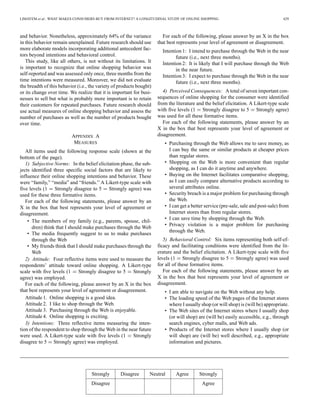
7) Online shopping behavior: This construct was measured
by a single item representing the number of purchases that the
respondents did through the Web since the first survey.
REFERENCES
[1] P. Jaffray, U.S. Bancorp" Electronic Commerce Investor, 18/03/99.
[2] Forrester Research, Forrester Research, 25/04/99.
[3] Activmedia, ActivMedia Research—Syndicated and Custom Studies of
Internet Commerce and Online Activity, 15/08/99.
[4] R. Kalakota and A. B. Whinston, Frontiers of Electronic Com-merce.
Reading, MA: Addison-Wesley, 1996.
[5] P. Butler and J. Peppard, “Consumer purchasing on the internet: Pro-cesses
and prospects,” Eur. Manage. J., vol. 16, no. 5, pp. 600–610, Oct.
1998.
[6] G. Yan and J. C. Paradi, “Success criteria for financial institutions in
electronic commerce,” in Proc. 32nd Hawaii Int. Conf. System Sciences,
1999.
[7] S. Bellman, G. L. Lohse, and E. J. Johnson, “Predictors of online buying:
Findings from the Wharton virtual test market,” Commun. ACM, to be
published.
[8] P. Butler and J. Peppard, “Consumer purchasing on the internet: Pro-cesses
and prospects,” Eur. Manage. J., vol. 16, no. 5, pp. 600–610, Oct.
1998.
[9] M. Krochmal, “People aren’t Cybershopping till they drop yet,” in
Planet IT E-Business TechCenter, 1999.
[10] G. Yan and J. C. Paradi, “Success criteria for financial institutions in
electronic commerce,” in Proc. 32nd Hawaii Int. Conf. System Sciences,
1999.
[11] P. Butler and J. Peppard, “Consumer purchasing on the internet: Pro-cesses
and prospects,” Eur. Manage. J., vol. 16, no. 5, pp. 600–610, Oct.
1998.
[12] S. L. Jarvenpaa and P. A. Todd, “Consumer reactions to electronic shop-ping
on the world wide web,” Int. J. Electron. Commerce, vol. 1, no. 2,
pp. 59–88, 1997.
[13] P. Spiller and G. L. Lohse, “A classification of internet retail stores,” Int.
J. Electron. Commerce, vol. 2, no. 2, pp. 29–56, 1998.
[14] S. L. Jarvenpaa and P. A. Todd, “Consumer reactions to electronic shop-ping
on the world wide web,” Int. J. Electron. Commerce, vol. 1, no. 2,
pp. 59–88, 1997.
[15] S. Rhee and F. Riggins, “Internet user’s perception of world wide web
vendors and their support of consumer mercantile activities,” in Center
for Electronic Commerce at the DuPree College of Management at
Georgia Tech, 1999.
[16] T. P. Liang and J. S. Huang, “An empirical study on consumer accep-tance
of products in electronic markets: A transaction cost model,” De-cision
Support Systems, vol. 24, no. 1, pp. 29–43, Nov. 1998.
[17] S. Salkin, Fear of buying, in Logistics Management and Distribution
Report, Radnor, vol. 8, no. 5, pp. 101–104, May 1999.
[18] C. Cockburn and T.Wilson, Business Use of the World Wide Web, U.K.:
Dept. Information Studies, Univ. of Sheffield, Oct. 4 1999.
[19] Forrester Research, Forrester Research, 25/04/99.
[20] C. F. Ho and W. H. Wu, “Antecedents of customer satisfaction on the
internet: An empirical study of online shopping,” in Proc. 32nd Hawaii
Int. Conf. System Sciences, 1999.
[21] U. M. Dholakia and L. L. Rego, “What makes commercial web pages
popular{?} An empirical investigation of web page effectiveness,” Eur.
J. Marketing, vol. 32, no. 7/8, pp. 724–736, 1998.
[22] G. Lohse and P. Spiller, “Quantifying the effect of user interface design
features on Cyberstore traffic and sales,” in CHI’98 Conf. Proc.. Los
Alamitos, CA, 1998b.
[23] G. Lohse, S. Bellman, and E. J. Johnson, Consumer Buying Behavior on
the Internet: Findings from Panel Data, 1999.
[24] D. Gehrke and E. Turban, “Determinants of successful website design:
Relative importance and recommendations for effectiveness,” in Proc.
32nd Hawaii Int. Conf. System Sciences, 1999.
[25] N.V. Raman and J. D. Leckenby, “Factors affecting consumers’ ‘Webad’
visits,” Eur. J. Marketing, vol. 32, no. 7/8, pp. 737–748, 1998.
[26] P. Butler and J. Peppard, “Consumer purchasing on the internet: Pro-cesses
and prospects,” Eur. Manage. J. , vol. 16, no. 5, pp. 600–610,
Oct. 1998.
[27] A. Aldridge, K. Forcht, and J. Pierson, “Get linked or get lost: Marketing
strategy for the internet,” Internet Research, vol. 7, no. 3, pp. 161–169,
1997.
[28] J. E. Pitkow and C. M. Kehoe, “Emerging trends in the WWW user
population,” Commun. ACM, vol. 30, no. 6, pp. 106–108, June 1996.
[29] P. Butler and J. Peppard, “Consumer purchasing on the internet: Pro-cesses
and prospects,” Eur. Manage. J., vol. 16, no. 5, pp. 600–610, Oct.
1998.
[30] N.V. Raman and J. D. Leckenby, “Factors affecting consumers’ ‘Webad’
visits,” Eur. J. Marketing, vol. 32, no. 7/8, pp. 737–748, 1998.
[31] L. Carlson and S. L. Grossbart, “Toward a better understanding of in-herent
innovativeness,” in AMA Educators Conf. Proc., 1984, pp. 88–91.
[32] E. C. Hirschman, “Innovativeness, novelty seeking, and consumer cre-ativity,”
J. Consumer Research, vol. 7, no. 3, pp. 283–295, 1980.
[33] M. Fishbein and I. Ajzen, Belief, Attitude, Intention and Behavior: An
Introduction to Theory and Research. Reading, MA: Addison-Wesley,
1975.
[34] I. Ajzen, The theory of planned behavior: Some unresolved issues, in
Organizational Behavior and Human Decision Processes, vol. 50, pp.
179–211, 1991.
[35] C. H. Triandis, “Values, attitudes and interpersonal behavior,” in
Nebraska Symposium on Motivation, 1979: Beliefs, Attitudes and
Values. Lincoln, NE: Univ. Nebraska Press, 1980, pp. 159–295.
[36] D. Parker, A. S. R. Manstead, S. G. Stradling, J. T. Reason, and J. S.
Baxter, “Intention to commit driving violations: An application of the
theory of planned behavior,” J. Appl. Psych., vol. 77, no. 1, pp. 94–101,
Feb. 1992.
[37] J. R. East, “Investment decisions and the theory of planning behavior,”
J. Econ. Psych., vol. 14, pp. 337–375, 1993.
[38] D. M. Randall, “Why students take elective business ethics courses: Ap-plying
the theory of planned behavior,” J. Bus. Ethics, pp. 369–378, May
1994.
[39] A. S. R. Manstead and D. Parker, “Evaluating and extending the theory
of planned behavior,” in Eur. Review of Social Psychology, W. Storere
and M. Hewstone, Eds., 1995, vol. 6, pp. 69–96.
[40] S. Taylor and P. A. Todd, “Understanding information technology usage:
A test of competing models,” Inf. Syst. Res., vol. 6, no. 2, pp. 144–176,
1995.
[41] E. M. Rogers and F. F. Shoemaker, Communication of Innova-tions.
New York: The Free Press, 1971.
[42] E. M. Rogers, Diffusion of Innovations, 4th ed. New York: The Free
Press, Macmillan Publishing Co., 1995.
[43] , Diffusion of Innovations, 3rd ed. New York: The Free Press,
Macmillan Publishing Co., 1983.
[44] E. M. Rogers, Diffusion of Innovations, 4th ed. New York: The Free
Press, Macmillan Publishing Co., 1995.
[45] F. D. Midgley and G. R. Dowling, “Innovativeness: The concept end its
measurement,” J. Consumer Research, vol. 4, no. 4, p. 229, Mar. 1978.
[46] L. R. Flynn and R. E. Goldsmith, A validation of the Goldsmith and
Hofacker innovativeness scale, in Educational and Psychological Mea-surement,
vol. 53, pp. 1105–1116, 1993.
[47] G. Roehrich, Innovativité hédoniste et sociale: Proposition d’une áchelle
de mesure, in Recherche et Applications en Marketing, vol. 4, no. 2, pp.
19–42, 1994.](https://image.slidesharecdn.com/khalifa2000-whatmakesconsumersbuyfrominternet-140918053633-phpapp02/85/What-makes-consumers-buy-from-internet-10-320.jpg)
![LIMAYEM et al.: WHAT MAKES CONSUMERS BUY FROM INTERNET? A LONGITUDINAL STUDY OF ONLINE SHOPPING 431
[48] R. Agrawal and J. Prasad, “A conceptual and operational definition of
personal innovativeness in the domain of information technology,” Inf.
Syst. Res., vol. 9, no. 2, pp. 204–215, June 1998.
[49] F. D. Midgley and G. R. Dowling, “Innovativeness: The concept end its
measurement,” J. Consumer Research, vol. 4, no. 4, p. 229, Mar. 1978.
[50] M. Kirton, “Adaptors and innovators: A description and measure,” J.
Appl. Psych., vol. 61, no. 5, pp. 622–629, 1976.
[51] R. Agarwal and J. Prasad, “A conceptual and operational definition of
personal innovativeness in the domain of information technology,” Inf.
Syst. Res., vol. 9, no. 2, pp. 204–215, June 1998.
[52] J. Rowley, “Retailing and shopping on the internet,” Internet Research:
Electronic Networking Applications and Policy, vol. 6, no. 1, pp. 81–91,
1996.
[53] H. T. Hurt, K. Joseph, and C. D. Cook, “Scale for the measurement of
innovativeness,” Human Communication Research, vol. 4, pp. 58–65,
Fall 1977.
[54] J. R. East, “Investment decisions and the theory of planning behavior,”
J. Econ. Psych., vol. 14, pp. 337–375, 1993.
[55] G. Roehrich, “Innovativité hédoniste et sociale: Proposition d’une
échelle de mesure,” Recherche et Applications en Marketing, vol. 4,
no. 2, pp. 19–42, 1994.
[56] C. H. Triandis, “Values, attitudes and interpersonal behavior,” in
Nebraska Symposium on Motivation, 1979: Beliefs, Attitudes and
Values. Lincoln, NE: Univ. Nebraska Press, 1980, pp. 159–295.
[57] S. Taylor and P. A. Todd, “Understanding information technology usage:
A test of competing models,” Inf. Syst. Res., vol. 6, no. 2, pp. 144–176,
1995.
[58] F. D. Davis, R. Bagozzi, and P. R. Warshaw, “User acceptance of com-puter
technology,” Manage. Sci. , vol. 35, no. 8, pp. 982–1003, Aug.
1989.
[59] GVU, “Frequency of searching with intent to buy, 4/11/1999,” .
[60] W. W. Chin and A. Gopal, Adoption intention in GSS: Importance of
beliefs, in Data Base Advance, vol. 26, no. 2 & 3, pp. 42–64, 1995.
[61] J. E. Pitkow and M. M. Recker, “Using the web as a survey tool: Results
from the second WWW user survey,” J. Comput. Networks ISDN Syst.,
vol. 27, no. 6, 1995.
[62] H. T. Hurt, K. Joseph, and C. D. Cook, “Scale for the measurement of
innovativeness,” Human Commun. Res., vol. 4, pp. 58–65, Fall 1977.
[63] D. Parker, A. S. R. Manstead, S. G. Stradling, J. T. Reason, and J. S.
Baxter, “Intention to commit driving violations: An application of the
theory of planned behavior,” J. Appl. Psych., vol. 77, no. 1, pp. 94–101,
Feb. 1992.
[64] J. R. East, “Investment decisions and the theory of planning behavior,”
J. Econ. Psych., vol. 14, pp. 337–375, 1993.
[65] D. M. Randall, “Why students take elective business ethics courses: Ap-plying
the theory of planned behavior,” J. Bus. Ethics, pp. 369–378, May
1994.
[66] A. S. R. Manstead and D. Parker, “Evaluating and extending the theory
of planned behavior,” in Eur. Review Social Psychology,W. Storere and
M. Hewstone, Eds., 1995, vol. 6, pp. 69–96.
[67] S. Taylor and P. A. Todd, “Understanding information technology usage:
A test of competing models,” Inf. Syst. Res., vol. 6, no. 2, pp. 144–176,
1995.
[68] I. Ajzen, “The theory of planned behavior: Some unresolved issues,”
Org. Beh. Human Dec. Processes, vol. 50, pp. 179–211, 1991.
[69] S. Taylor and P. A. Todd, “Understanding information technology usage:
A test of competing models,” Inf. Syst. Res., vol. 6, no. 2, pp. 144–176,
1995.
[70] C. H. Triandis, “Values, attitudes and interpersonal behavior,” in
Nebraska Symposium on Motivation, 1979: Beliefs, Attitudes and
Values. Lincoln, NE: Univ. Nebraska Press, 1980, pp. 159–295.
[71] A. Bandura, “Self-efficacy: Toward a unifying theory of behavioral
change,” Psycol. Rev., vol. 84, no. 2, pp. 191–215, 1977.
[72] H. Wold, “Introduction to the second generation of multivariate anal-ysis,”
in Theoretical Empiricism, H. Wold, Ed. New York: Paragon,
1989, pp. vii–xl.
[73] W. W. Chin, The partial least squares approach for structural equation
modeling, , Lawrence Erlbaum Assoc., pp. 295–336, 1998.
[74] D. R. Compeau and C. A. Higgins, “Application of social cognitive
theory to training for computer skills,” Inf. Syst. Res., vol. 6, no. 2, pp.
118–143, 1995.
[75] W. W. Chin and A. Gopal, “Adoption intention in GSS: Importance of
beliefs,” Data Base Advance, vol. 26, no. 2 & 3, pp. 42–64, 1995.
[76] , “Adoption intention in GSS: Importance of beliefs,” Data Base
Advance, vol. 26, no. 2 & 3, pp. 42–64, 1995.
[77] W. W. Chin, PLS-Graph Manual, 1994.
[78] W. Cotterman and J. Senn, Challenges and Strategies for Research in
Information Systems Development. New York: Wiley Series in Infor-mation
Systems, 1992.
[79] W. W. Chin, The partial least squares approach for structural equation
modeling, , Lawrence Erlbaum Assoc., pp. 295–336, 1998.
[80] , The partial least squares approach for structural equation mod-eling,
, Lawrence Erlbaum Assoc., pp. 295–336, 1998.
[81] R. Goldsmith and L. R. Flynn, “Identifying innovators in consumer
product markets,” Eur. J. Marketing, vol. 26, no. 12, pp. 42–55, 1992.
[82] D. Gehrke and E. Turban, “Determinants of successful website design:
Relative importance and recommendations for effectiveness,” in Proc.
32nd Hawaii Int. Conf. System Sciences, 1999.
[83] , “Determinants of successful website design: Relative importance
and recommendations for effectiveness,” in Proc. 32nd Hawaii Int. Conf.
System Sciences, 1999.
[84] C. F. Ho and W. H. Wu, “Antecedents of customer satisfaction on the
internet: An empirical study of online shopping,” in Proc. 32nd Hawaii
Int. Conf. System Sciences, 1999.
[85] T. E. Weber, “ATT will insure its card customers on its web service,”
Wall Str. J., p. 6B, Feb. 7 1996.
[86] A. Aldridge, K. Forcht, and J. Pierson, “Get linked or get lost: Marketing
strategy for the internet,” Internet Research, vol. 7, no. 3, pp. 161–169,
1997.
[87] D. Gehrke and E. Turban, “Determinants of successful website design:
Relative importance and recommendations for effectiveness,” in Proc.
32nd Hawaii Int. Conf. System Sciences, 1999.
[88] G. L. Lohse and P. Spiller, “Electronic shopping: How do customer in-terfaces
produce sales on the internet{?},” Commun. ACM, vol. 41, no.
7, pp. 81–87, 1998a.
[89] P. Spiller and G. L. Lohse, “A classification of internet retail stores,” Int.
J. Electron. Commerce, vol. 2, no. 2, pp. 29–56, 1998.
[90] S. Rhee and F. Riggins, “Internet user’s perception of world wide web
vendors and their support of consumer mercantile activities,” in Center
for Electronic Commerce at the DuPree College of Management at
Georgia Tech, 1999.
[91] S. L. Jarvenpaa and P. A. Todd, “Consumer reactions to electronic shop-ping
on the world wide web,” Int. J. Electron. Commerce, vol. 1, no. 2,
pp. 59–88, 1997.
[92] U. M. Dholakia and L. L. Rego, “What makes commercial web pages
popular{?} An empirical investigation of web page effectiveness,” Eur.
J. Marketing, vol. 32, no. 7/8, pp. 724–736, 1998.
[93] G. Lohse and P. Spiller, “Quantifying the effect of user interface design
features on cyberstore traffic and sales,” in CHI’98 Conf. Proc.. Los
Alamitos, CA, 1988b.
[94] J. Rowley, Retailing and shopping on the internet, in Internet Research:
Electronic Networking Applications and Policy, vol. 6, no. 1, pp. 81–91,
1996.
[95] U. M. Dholakia and L. L. Rego, “What makes commercial web pages
popular? An empirical investigation of web page effectiveness,” Eur. J.
Marketing, vol. 32, no. 7/8, pp. 724–736, 1998.
[96] G. Lohse and P. Spiller, “Quantifying the effect of user interface design
features on cyberstore traffic and sales,” in CHI’98 Conf. Proc.. Los
Alamitos, CA, 1988b.
[97] U. M. Dholakia and L. L. Rego, “What makes commercial web pages
popular? An empirical investigation of web page effectiveness,” Eur. J.
Marketing, vol. 32, no. 7/8, pp. 724–736, 1998.
[98] GVU, “Frequency of searching with intent to buy, 4/11/1999,” .
[99] D. Gehrke and E. Turban, “Determinants of successful website design:
Relative importance and recommendations for effectiveness,” in Proc.
32nd Hawaii Int. Conf. System Sciences, 1999.
[100] G. Lohse and P. Spiller, “Quantifying the effect of user interface design
features on cyberstore traffic and sales,” in CHI’98 Conf. Proc.. Los
Alamitos, CA, 1998b.
[101] C. F. Ho and W. H. Wu, “Antecedents of customer satisfaction on the
internet: An empirical study of online shopping,” in Proc. 32nd Hawaii
Int. Conf. System Sciences, 1999.
[102] , “Antecedents of customer satisfaction on the internet: An empir-ical
study of online shopping,” in Proc. 32nd Hawaii Int. Conf. System
Sciences, 1999.
[103] P. Butler and J. Peppard, “Consumer purchasing on the internet: Pro-cesses
and prospects,” Eur. Manage. J., vol. 16, no. 5, pp. 600–610, Oct.
1998.
[104] G. L. Lohse and P. Spiller, “Electronic shopping: How do customer in-terfaces
produce sales on the internet{?},” Commun. ACM, vol. 41, no.
7, pp. 81–87, 1998a.](https://image.slidesharecdn.com/khalifa2000-whatmakesconsumersbuyfrominternet-140918053633-phpapp02/85/What-makes-consumers-buy-from-internet-11-320.jpg)
![432 IEEE TRANSACTIONS ON SYSTEMS, MAN, AND CYBERNETICS—PART A: SYSTEMS AND HUMANS, VOL. 30, NO. 4, JULY 2000
[105] D. Gehrke and E. Turban, “Determinants of successful website design:
Relative importance and recommendations for effectiveness,” in Proc.
32nd Hawaii Int. Conf. System Sciences, 1999.
[106] R. Kraut, W. Scherlis, T. Mukhopadhyay, J. Manning, and S. Kiesler,
“The home net field trial of residential internet services,” Commun.
ACM, vol. 39, no. 12, pp. 55–63, Dec. 1996.
Moez Limayem received the MBA and Ph.D.de-grees
in MIS from the University of Minnesota,
Minneapolis.
He is currently an Associate Professor in the
Information Systems Department, City Univerity
of Hong Kong. Until 1999, he was the chair of
the Management Information Systems Department
at Laval University, Quebec City, P.Q., Canada.
His current research interests include electronic
commerce, IT adoption, and groupware. He has had
several articles published or accepted for publication
in journals such as Management Science, Information Systems Research,
Accounting, Management, and Information Technologies, Group Decision and
Negotiation, and Small Group Research. He has been invited to present his
research in many countries in North America, Europe, Africa, Asia, and in the
Middle East.
Prof. Limayem recently received the 3M Award of the Best Teacher in
Canada.
Mohamed Khalifa received the M.A. degree in de-cision
sciences and the Ph.D. degree in information
systems from the Wharton Business School of the
University of Pennsylvania, Philadelphia.
His work experience includes four years as a busi-ness
analyst and over ten years as an academic in
the United States, Canada, China, and Hong Kong.
At present, he is Associate Professor at the Informa-tion
Systems Department of City University of Hong
Kong. His research interests include innovation adop-tion,
electronic commerce and IT-enabled innovative
learning. He has published books and articles in journals such as Communica-tions
of the ACM, Decision Support Systems, Data Base, and Information and
Management.
Anissa Frini received the MBA degree in MIS from Laval University, Quebec
City, P.Q., Canada, where she is currently a Doctoral Student. Her current re-search
interests deal with understanding online consumer behavior.](https://image.slidesharecdn.com/khalifa2000-whatmakesconsumersbuyfrominternet-140918053633-phpapp02/85/What-makes-consumers-buy-from-internet-12-320.jpg)

This document summarizes a research study that investigated factors affecting online shopping behavior. The study: 1) Developed a model based on the Theory of Planned Behavior to identify key factors influencing online shopping intentions and behavior, such as subjective norms, attitude, perceived behavioral control, and intentions. 2) Augmented the model with two additional constructs: personal innovativeness and perceived consequences of online shopping. 3) Empirically tested the model in a longitudinal study with two surveys to better understand how factors predict actual online purchasing over time.


