Power  disruptions  can cost hundreds of thousands - or even millions of dollars in lost production, clean-up and start-up costs.  Few industrial or commercial operations are immune to the costs of power problems, making devices that correct for or eliminate these problems an economic imperative.
Any occurrence, manifested in voltage, current, or frequency deviations which results in failure or misoperation of customer end-use equipment
The integration of electronic equipment into everyday life has raised the bar substantially!
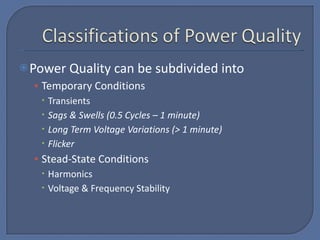
Power Quality can be subdivided into Temporary Conditions Transients Sags & Swells (0.5 Cycles – 1 minute) Long Term Voltage Variations (> 1 minute) Flicker Stead-State Conditions Harmonics Voltage & Frequency Stability
 
Causes of: Grid Switching (Utility) Load Switching (In-Plant) * Lightning Transformer Inrush *  Load switching accounts for 85% of all transients
Solutions for: Inductors “ Smart” Switching techniques (zero crossing) Transient Voltage Surge Suppression
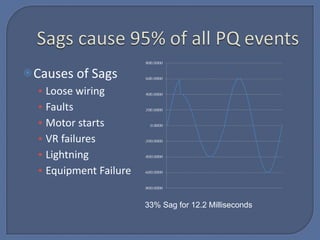
Causes of Sags Loose wiring Faults Motor starts VR failures Lightning Equipment Failure 33% Sag for 12.2 Milliseconds
Service Entrance Gear Utility Source A B C fault
Causes of Swells: Faulty equipment (i.e. regulators & load-tap changers) Capacitors 67% Swell for 26.1 Milliseconds
Causes of: Storms Ice Animals Failed equipment
Power Reliability is a statistical measure of the number, frequency and duration of power disruptions Sags, Swells and even Momentary events are not factored into Reliability calculations Most Utilities maintain an acceptable level Reliability as required by their local utility board
Source:  EPRI, An Assessment of Distribution System Power Quality, Vol. 2: Statistical Summary Report. Palo Alto, CA. EPRI TR-106294-V2 (May 1996)
 
Device % Nominal Voltage Ride-Through Time Contactors 43-49% 2 cycles Relays 78% < 1 cycle DC Power Supplies 70%  9.2 cycles PLC’s 47% 37 cycles Regulating Ballasts 65% Varies ASD’s 70% 2 cycles
Defining your level of sensitivity Outage (5 minutes+) Momentary (2 seconds to 5 minutes) “ Blips” (< 2 seconds) Picking the correct solution Includes an evaluation of cost, space, personnel, safety, etc
Berkeley Lab Study Estimates  $80 Billion Annual Cost  of Power Interruptions (February 2, 2005) $57 billion (73 percent) is from Commercial Sector and $20 billion (25 percent) in the Industrial Sector Momentary interruptions were responsible for two-thirds of the cost, at $52 billion “ This finding underscores that fact that, for many commercial and industrial customers, it is the length of the ‘down-time’ resulting from a loss of power that determines the cost of interruption, not necessarily the length of interruption itself,”  Source: Understanding the Cost of Power Interruptions to U.S. Electricity Consumers
Local protection (sags and outages) Sectionalize (outages)  Install arresters (transient protection) Expedite protection equipment (sags) Regular maintenance (outages) Backup generation or 2 nd  Utility source (outages)
Device Possible Solution Result Contactors & Relays Hold-in Circuit Improved performance up to 75% Sags PLC’s PQ Resistant Programming Improved performance up to protection limits ASD Local Ride-Thru Device Improved performance up to 60 % Sags UPS Local Ride-Thru Device Full sag protection
One PD for each XFMR One PD for 3 XFRM’s A B C fault
“ Facilities housing electronic load equipment of any type should have  service entrances  equipped with effective lightning protection in the form of  Category “C”  surge protective devices, as specified in IEEE Std C62.41.1&.2-2002” In addition, “It is recommended that additional surge protective devices of  Category “B” or Category “A”,  as specified in IEEE Std C62.41.1&.2-2002 be applied to  downstream electrical switchboards and panel boards , and panel boards on the secondary of separately derived systems.”
Want the device closest to the fault to operate as quickly as possible Want to avoid miss-coordination Fuses will operate in ½ cycle vs. 3-5 cycles for breakers A B C fault
Critical Load Utility Input Output Input Bypass PES Isolation transformer Up to (4) power modules System control AC caps Battery Battery charger AC inverter
Voltage Sag red = supply voltage;   blue = load voltage
Critical load Output Input Bypass Main container Isolation transformer Up to (8) power modules Battery New or existing back-up generator system Utility input AC gen Diesel, Natural Gas or Turbine Engine Diesel engine Power- Electronic Switch Battery charger AC inverter System control AC caps Transfer switch
 

What is Power Quality?

  • 1.
  • 2.
    Power disruptions can cost hundreds of thousands - or even millions of dollars in lost production, clean-up and start-up costs. Few industrial or commercial operations are immune to the costs of power problems, making devices that correct for or eliminate these problems an economic imperative.
  • 3.
    Any occurrence, manifestedin voltage, current, or frequency deviations which results in failure or misoperation of customer end-use equipment
  • 4.
    The integration ofelectronic equipment into everyday life has raised the bar substantially!
  • 5.
    Power Quality canbe subdivided into Temporary Conditions Transients Sags & Swells (0.5 Cycles – 1 minute) Long Term Voltage Variations (> 1 minute) Flicker Stead-State Conditions Harmonics Voltage & Frequency Stability
  • 6.
  • 7.
    Causes of: GridSwitching (Utility) Load Switching (In-Plant) * Lightning Transformer Inrush * Load switching accounts for 85% of all transients
  • 8.
    Solutions for: Inductors“ Smart” Switching techniques (zero crossing) Transient Voltage Surge Suppression
  • 9.
    Causes of SagsLoose wiring Faults Motor starts VR failures Lightning Equipment Failure 33% Sag for 12.2 Milliseconds
  • 10.
    Service Entrance GearUtility Source A B C fault
  • 11.
    Causes of Swells:Faulty equipment (i.e. regulators & load-tap changers) Capacitors 67% Swell for 26.1 Milliseconds
  • 12.
    Causes of: StormsIce Animals Failed equipment
  • 13.
    Power Reliability isa statistical measure of the number, frequency and duration of power disruptions Sags, Swells and even Momentary events are not factored into Reliability calculations Most Utilities maintain an acceptable level Reliability as required by their local utility board
  • 14.
    Source: EPRI,An Assessment of Distribution System Power Quality, Vol. 2: Statistical Summary Report. Palo Alto, CA. EPRI TR-106294-V2 (May 1996)
  • 15.
  • 16.
    Device % NominalVoltage Ride-Through Time Contactors 43-49% 2 cycles Relays 78% < 1 cycle DC Power Supplies 70% 9.2 cycles PLC’s 47% 37 cycles Regulating Ballasts 65% Varies ASD’s 70% 2 cycles
  • 17.
    Defining your levelof sensitivity Outage (5 minutes+) Momentary (2 seconds to 5 minutes) “ Blips” (< 2 seconds) Picking the correct solution Includes an evaluation of cost, space, personnel, safety, etc
  • 18.
    Berkeley Lab StudyEstimates $80 Billion Annual Cost of Power Interruptions (February 2, 2005) $57 billion (73 percent) is from Commercial Sector and $20 billion (25 percent) in the Industrial Sector Momentary interruptions were responsible for two-thirds of the cost, at $52 billion “ This finding underscores that fact that, for many commercial and industrial customers, it is the length of the ‘down-time’ resulting from a loss of power that determines the cost of interruption, not necessarily the length of interruption itself,” Source: Understanding the Cost of Power Interruptions to U.S. Electricity Consumers
  • 19.
    Local protection (sagsand outages) Sectionalize (outages) Install arresters (transient protection) Expedite protection equipment (sags) Regular maintenance (outages) Backup generation or 2 nd Utility source (outages)
  • 20.
    Device Possible SolutionResult Contactors & Relays Hold-in Circuit Improved performance up to 75% Sags PLC’s PQ Resistant Programming Improved performance up to protection limits ASD Local Ride-Thru Device Improved performance up to 60 % Sags UPS Local Ride-Thru Device Full sag protection
  • 21.
    One PD foreach XFMR One PD for 3 XFRM’s A B C fault
  • 22.
    “ Facilities housingelectronic load equipment of any type should have service entrances equipped with effective lightning protection in the form of Category “C” surge protective devices, as specified in IEEE Std C62.41.1&.2-2002” In addition, “It is recommended that additional surge protective devices of Category “B” or Category “A”, as specified in IEEE Std C62.41.1&.2-2002 be applied to downstream electrical switchboards and panel boards , and panel boards on the secondary of separately derived systems.”
  • 23.
    Want the deviceclosest to the fault to operate as quickly as possible Want to avoid miss-coordination Fuses will operate in ½ cycle vs. 3-5 cycles for breakers A B C fault
  • 24.
    Critical Load UtilityInput Output Input Bypass PES Isolation transformer Up to (4) power modules System control AC caps Battery Battery charger AC inverter
  • 25.
    Voltage Sag red= supply voltage; blue = load voltage
  • 26.
    Critical load OutputInput Bypass Main container Isolation transformer Up to (8) power modules Battery New or existing back-up generator system Utility input AC gen Diesel, Natural Gas or Turbine Engine Diesel engine Power- Electronic Switch Battery charger AC inverter System control AC caps Transfer switch
  • 27.

Editor's Notes

  • #15 The average power quality in the U.S. was documented in a two-year (1995-1996) study by the Electric Power Research Institute (EPRI). This histogram shows the statistical average performance a user can expect. It shows the average monthly number of events, in terms of voltage sags and outages. As you can see, most sites can expect at least one disruption of some type every few months. The solutions that we will discuss can protect critical loads from all the events noted.
  • #22 Metal-enclosed switchgear allows protection of each individual circuit instead of group protection.
  • #24 Metal-enclosed switchgear allows protection of each individual circuit instead of group protection.
  • #25 These small units come in four sizes as shown on the previous slide. This shows the single-line diagram for a 1250 kVA system at 480 volts. In this example, the PES and circuit breakers are rated at 1,600 amps.
  • #26 This graph shows an actual 25% sag in utility voltage being corrected by the PureWave UPS.
  • #27 The system can be combined with a new or existing generator to make a “seamless” power system. When combined with a backup generator, the PureWave UPS will ride-through sags and very short outages ( up to 2 seconds) without sending a signal to start the generator. Once the outage exceeds 2 seconds, the start command is sent to the generator, the generator reaches rated speed in about 6-10 seconds, and the transfer switch “transfers” to the generator position. The PureWave “sync” to the generator and ramps the critical load over to the generator in a “soft load” method. A typical diesel generator can accept load at about one megawatt every 3 seconds. Therefore, total transfer of a two megawatt system load from outage to running on a generator takes about 15 seconds .
  • #28 Switchgear Options by S&amp;C Electric Company 05/10/11 Presented to Tri-City Electric on February 17, 2005