What  Is New In Danny Ravid SQL & BI Practice Leader ,Glasshouse Ltd.
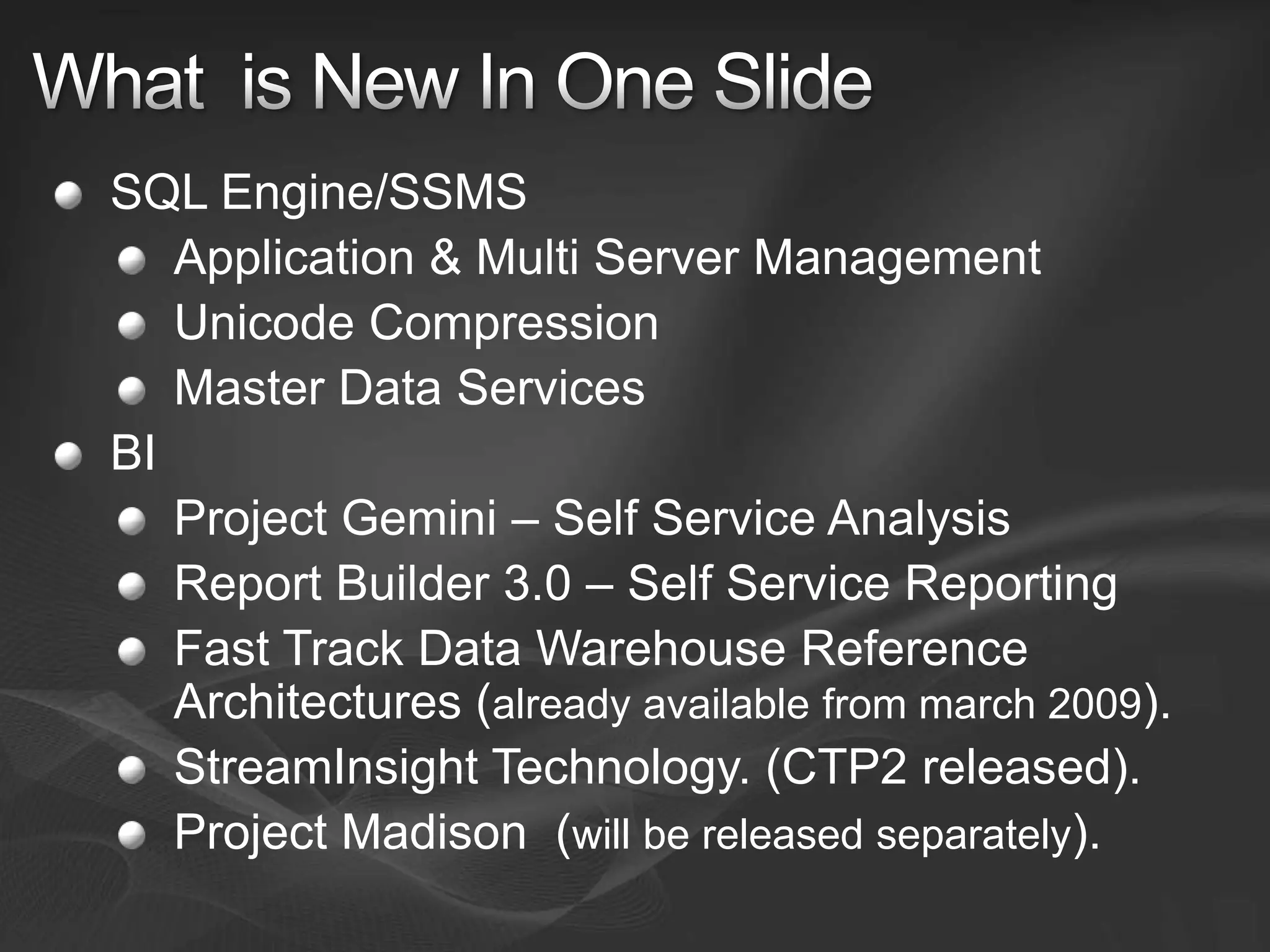
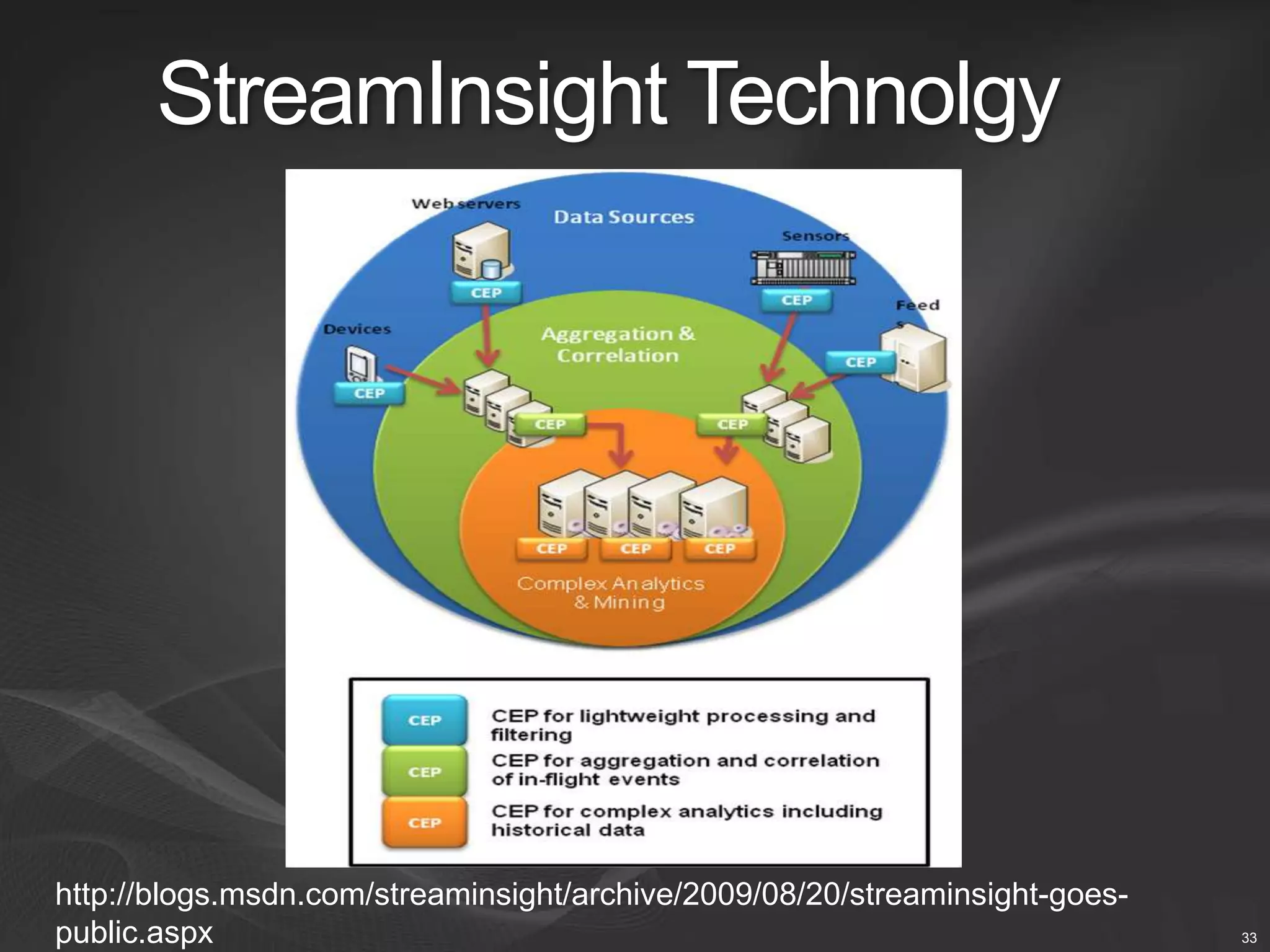
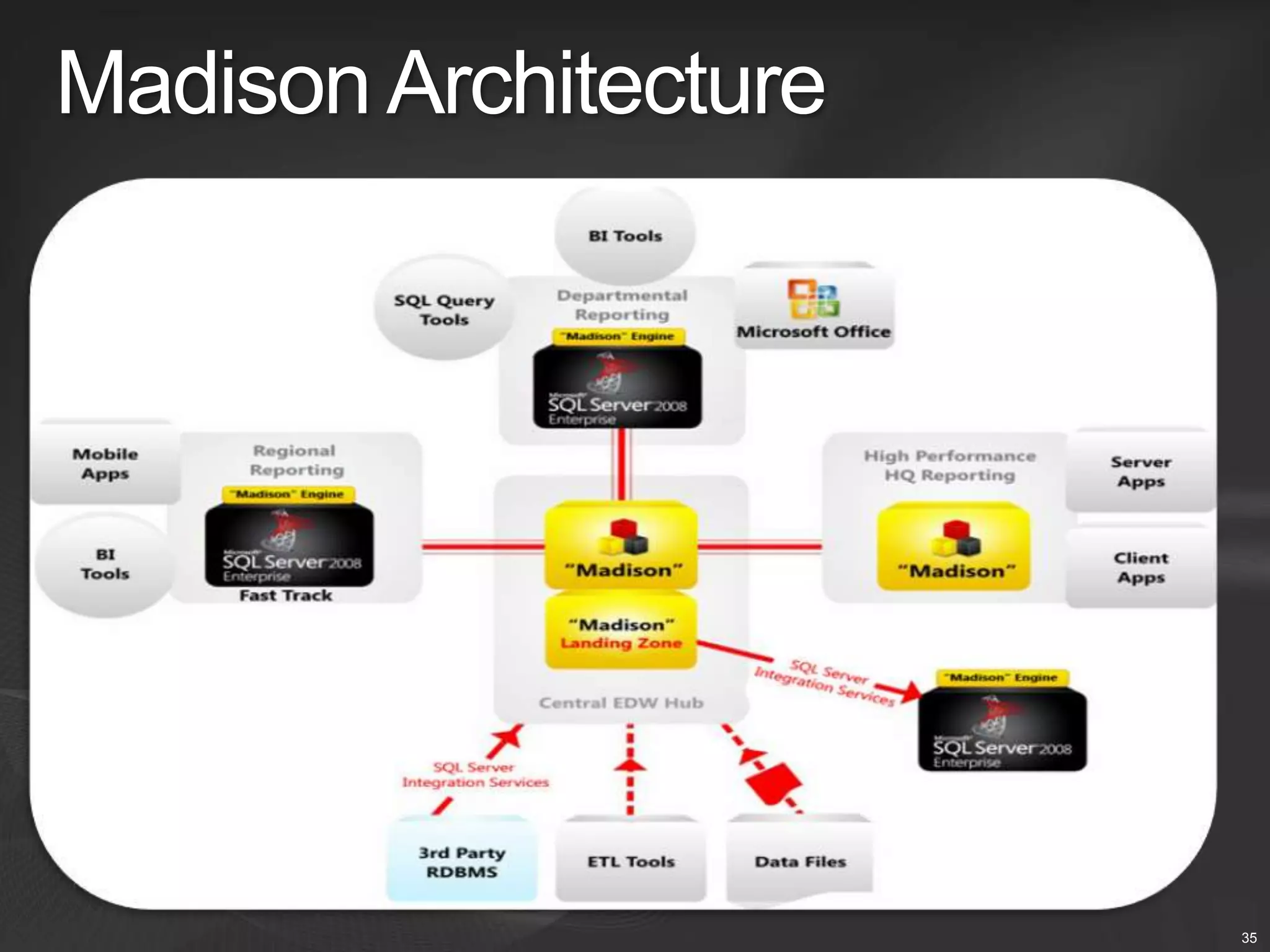
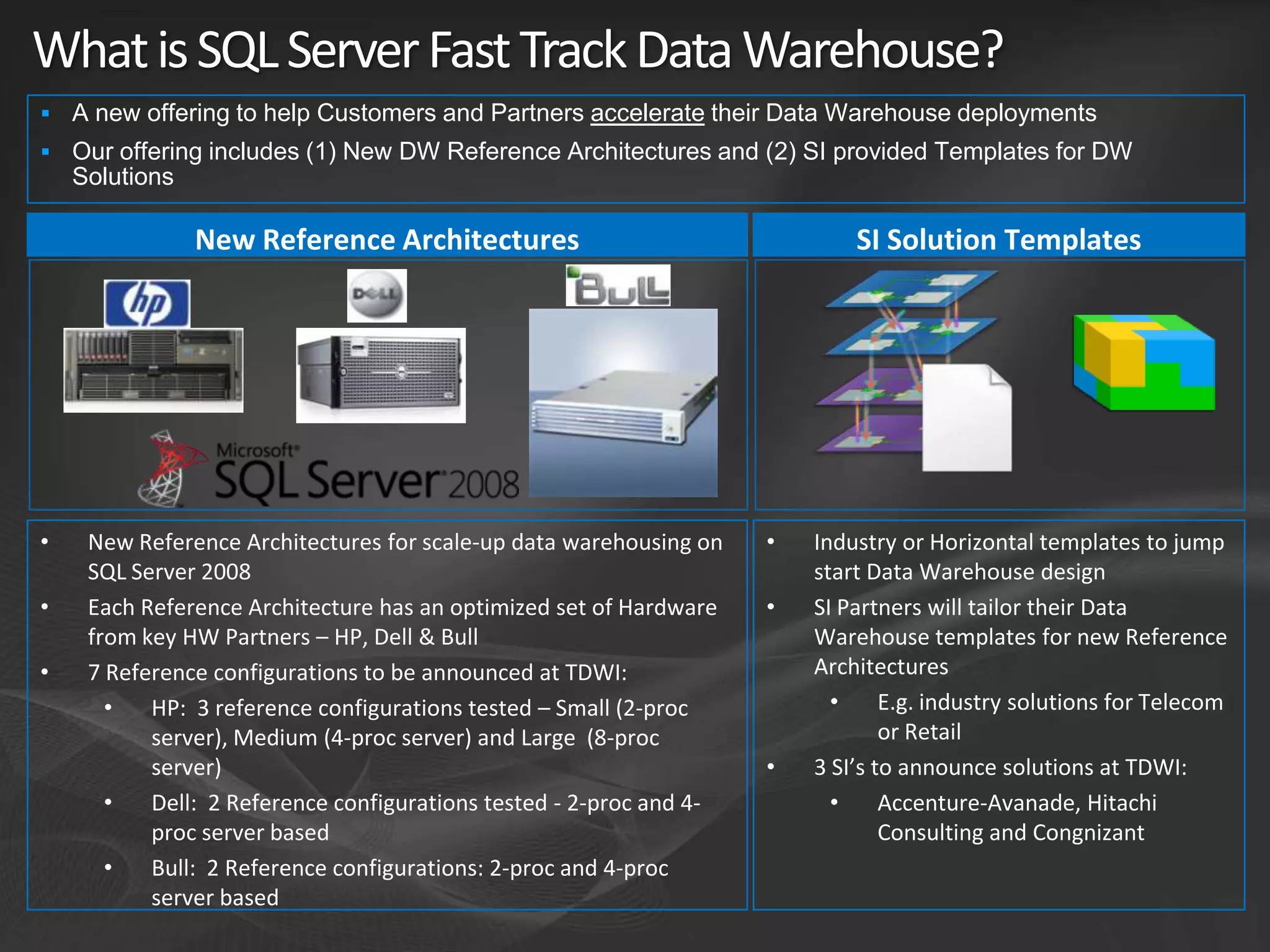
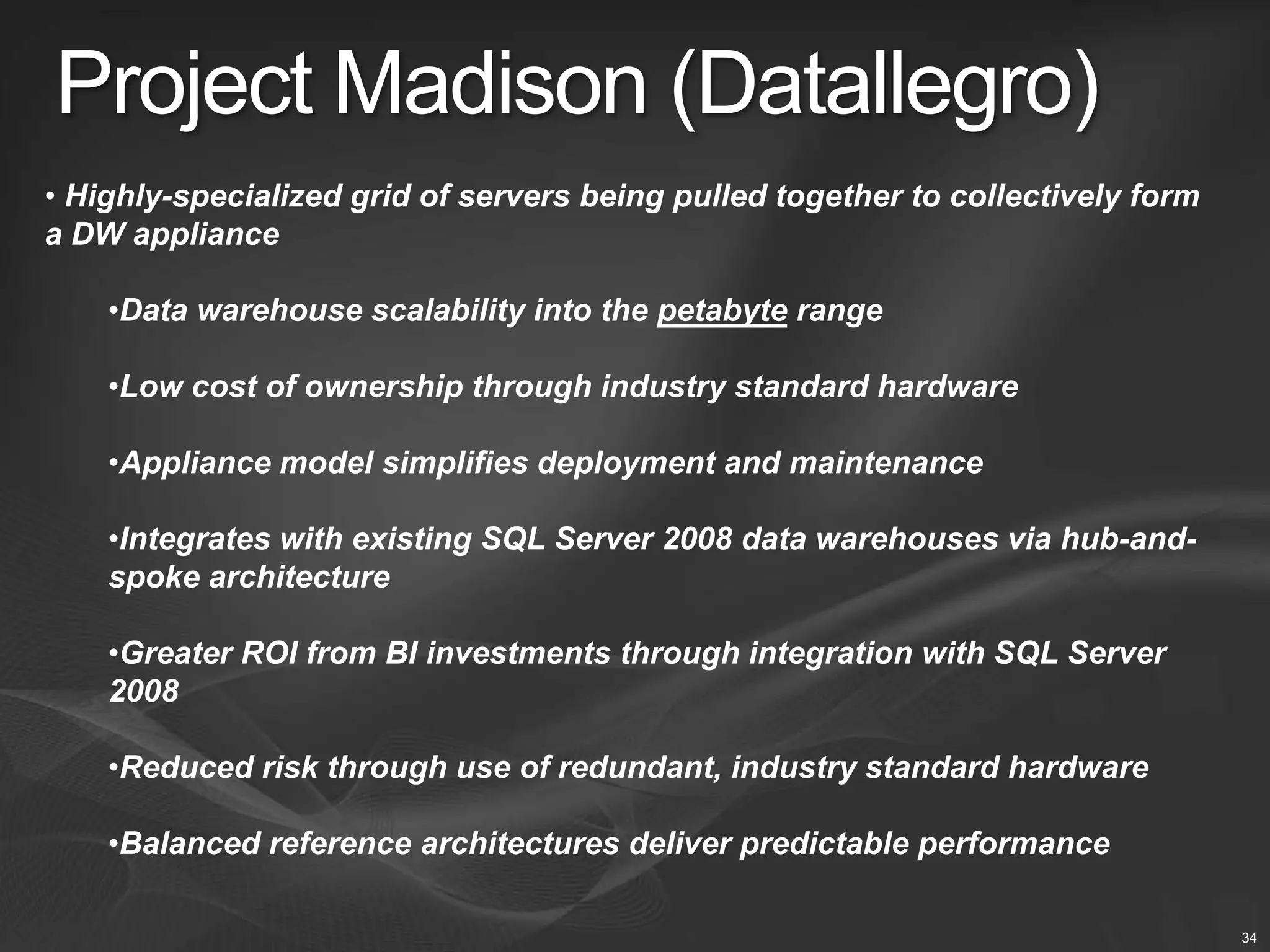
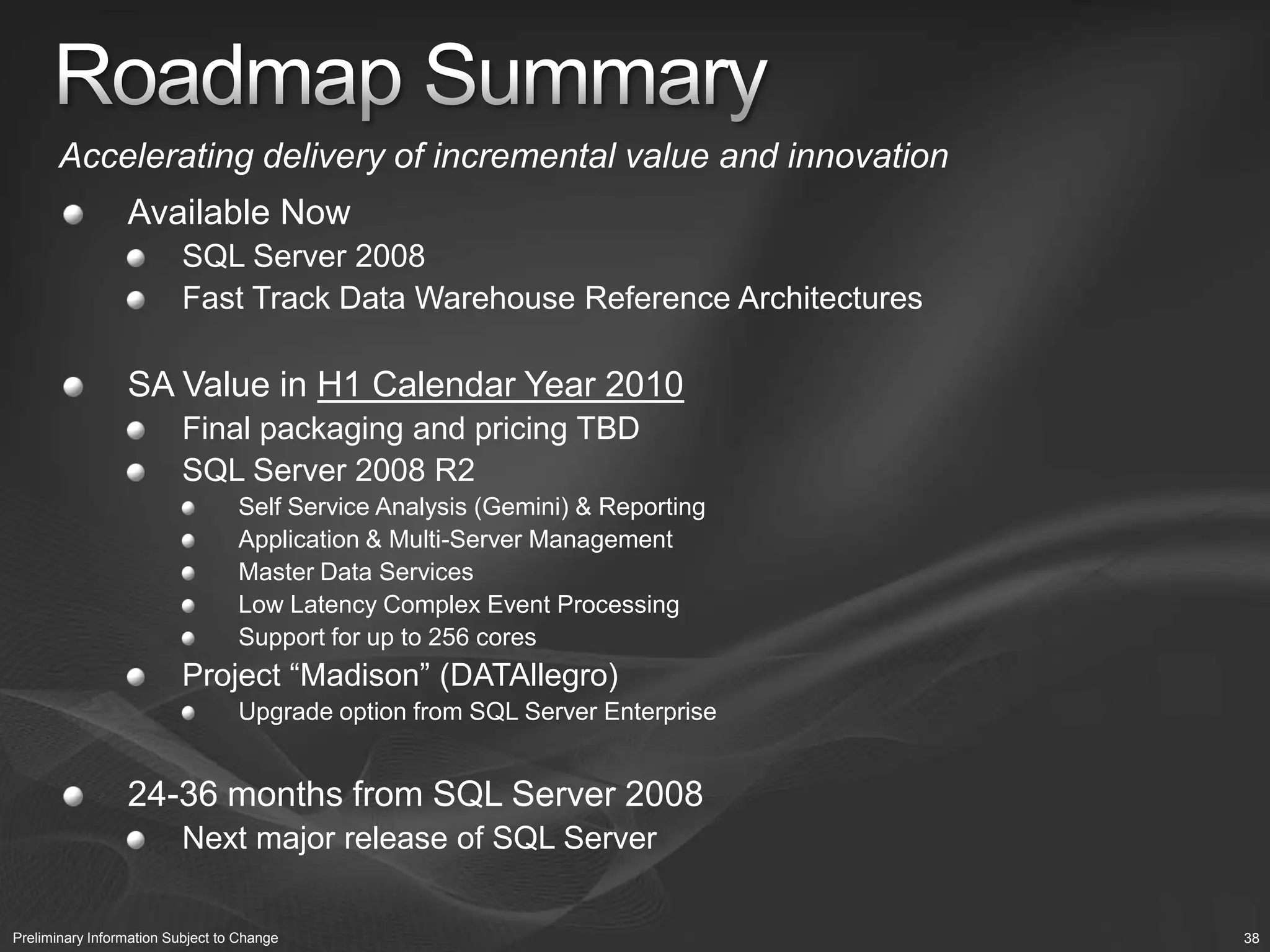
What  is New In One Slide SQL Engine/SSMS Application & Multi Server Management Unicode Compression Master Data ServicesBI Project Gemini – Self Service AnalysisReport Builder 3.0 – Self Service ReportingFast Track Data Warehouse Reference Architectures (already available from march 2009).StreamInsight Technology. (CTP2 released).Project Madison  (will be released separately).
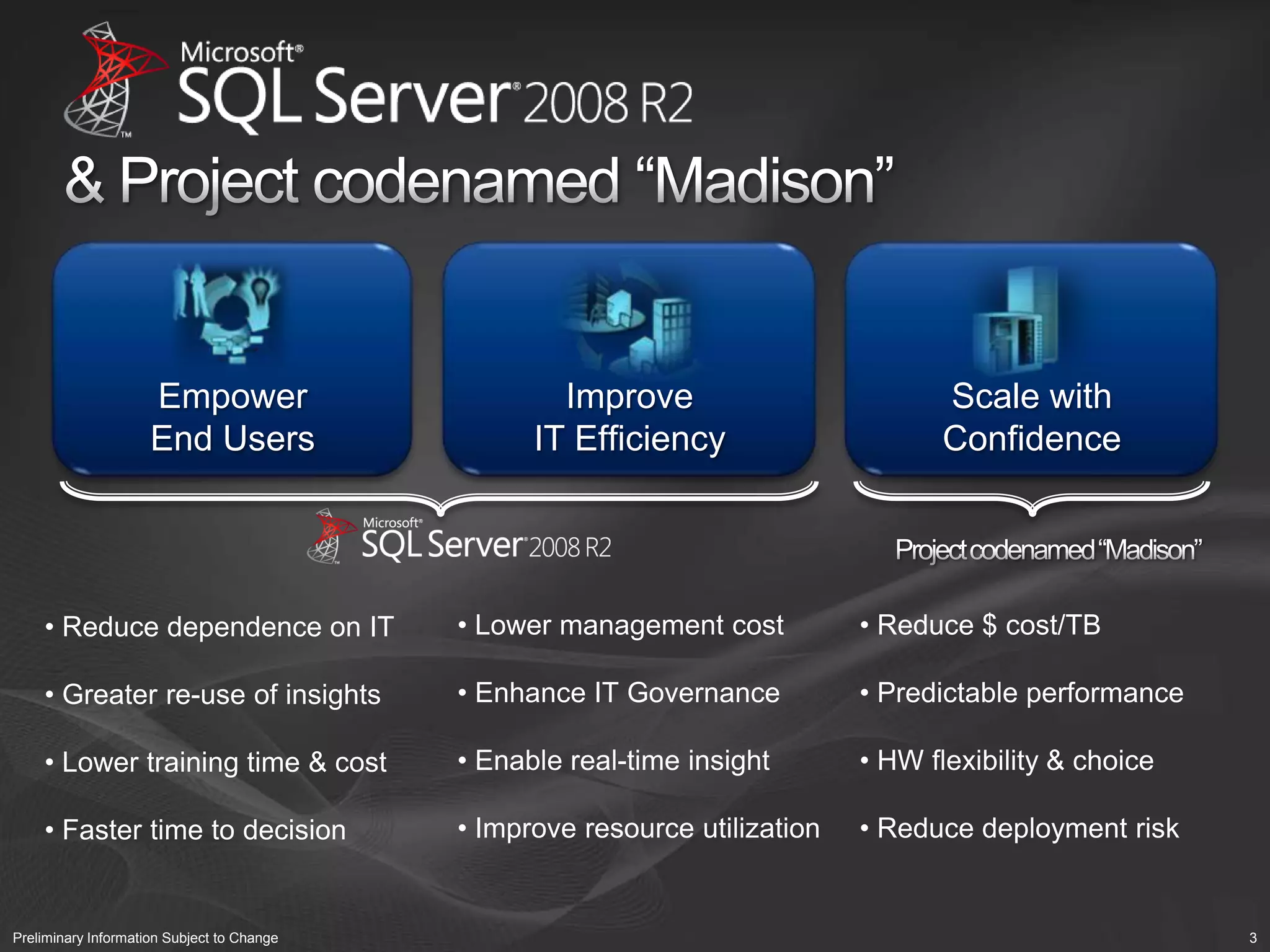
& Project codenamed “Madison”Scale with ConfidenceEmpower End UsersImprove IT EfficiencyProject codenamed “Madison” Lower management cost
 Enhance IT Governance
 Enable real-time insight
 Improve resource utilization
 Reduce $ cost/TB
 Predictable performance
 HW flexibility & choice
 Reduce deployment risk
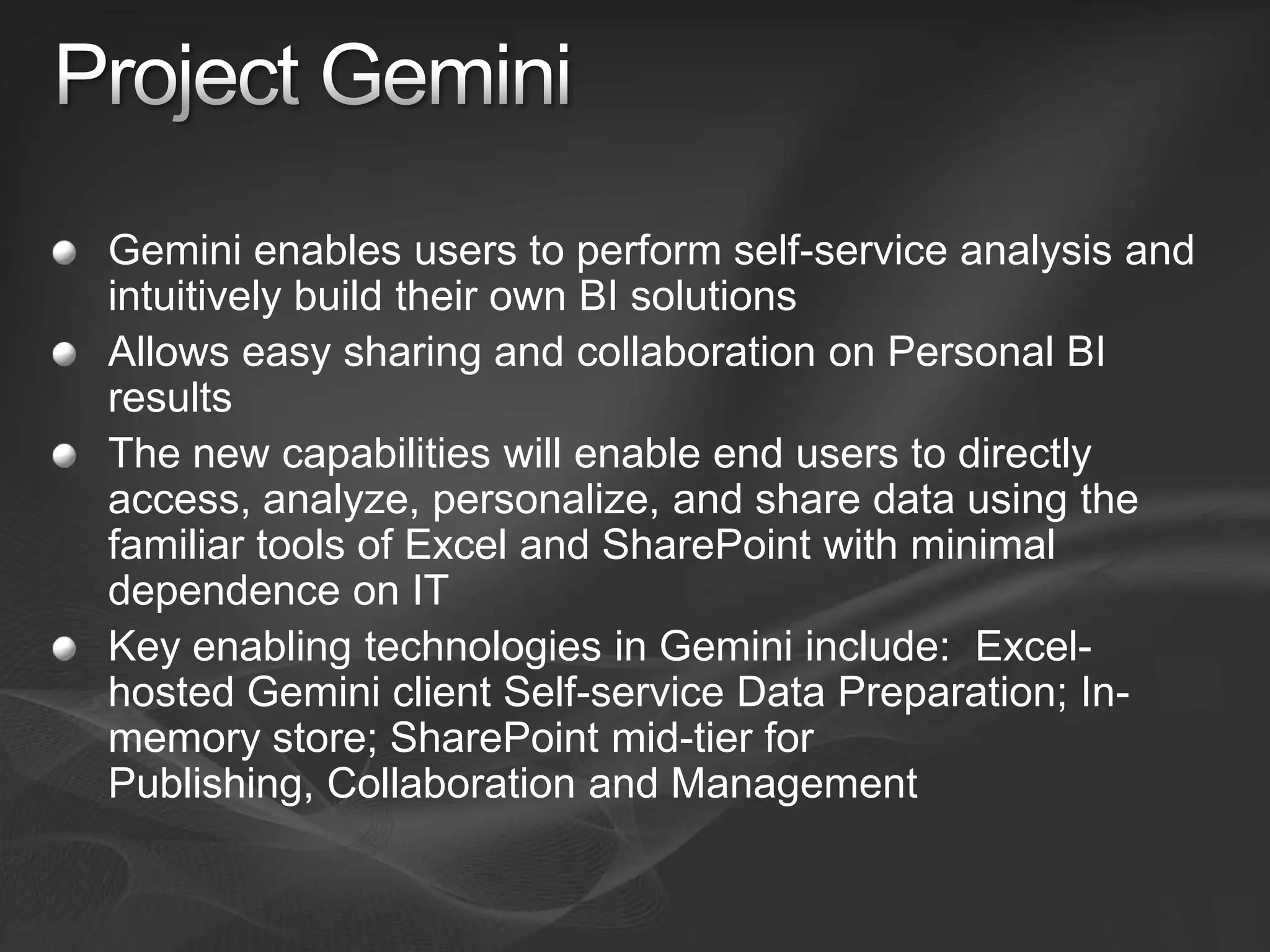
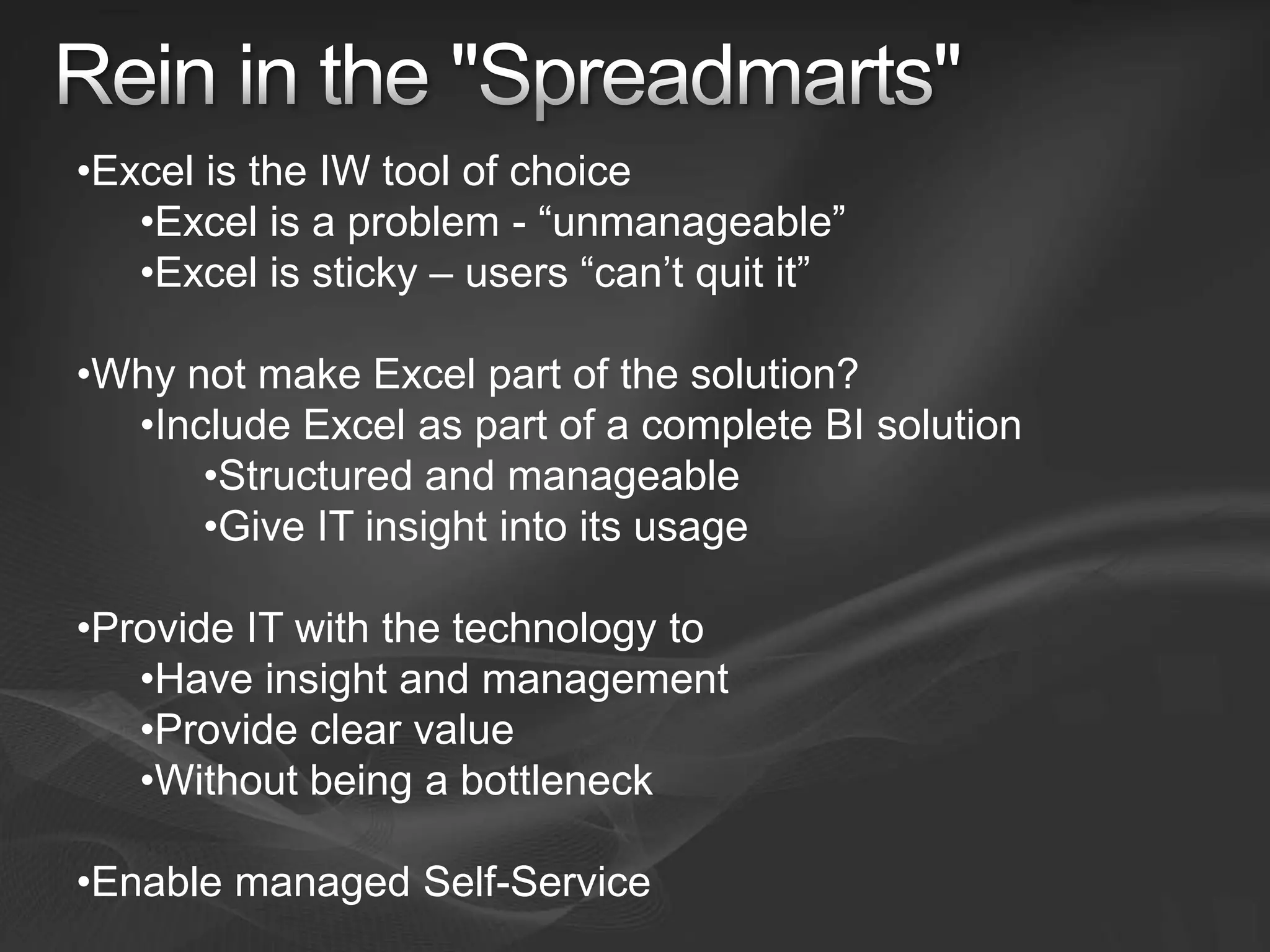
 Reduce dependence on IT
 Greater re-use of insights
 Lower training time & cost
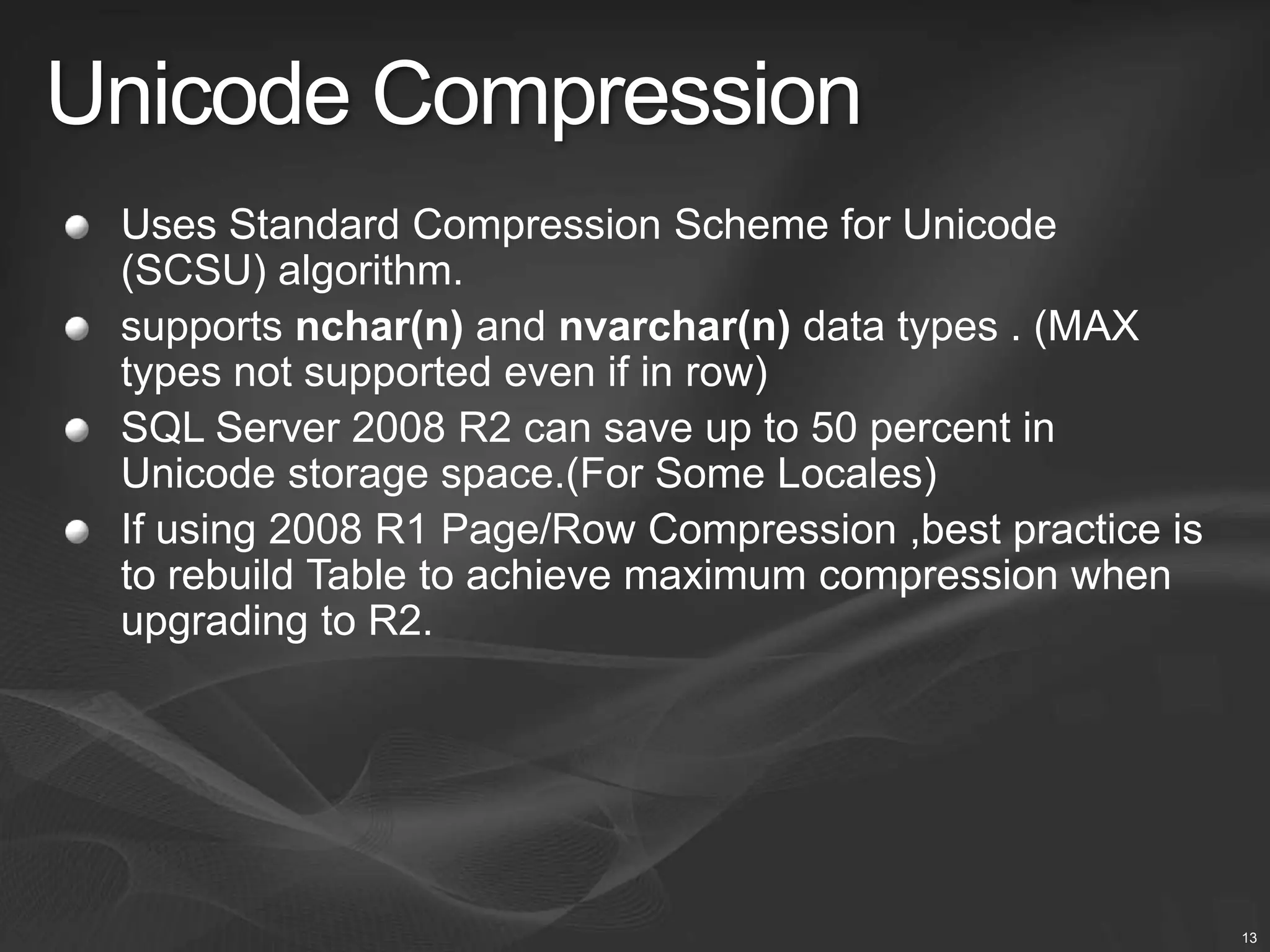
 Faster time to decisionPreliminary Information Subject to Change3
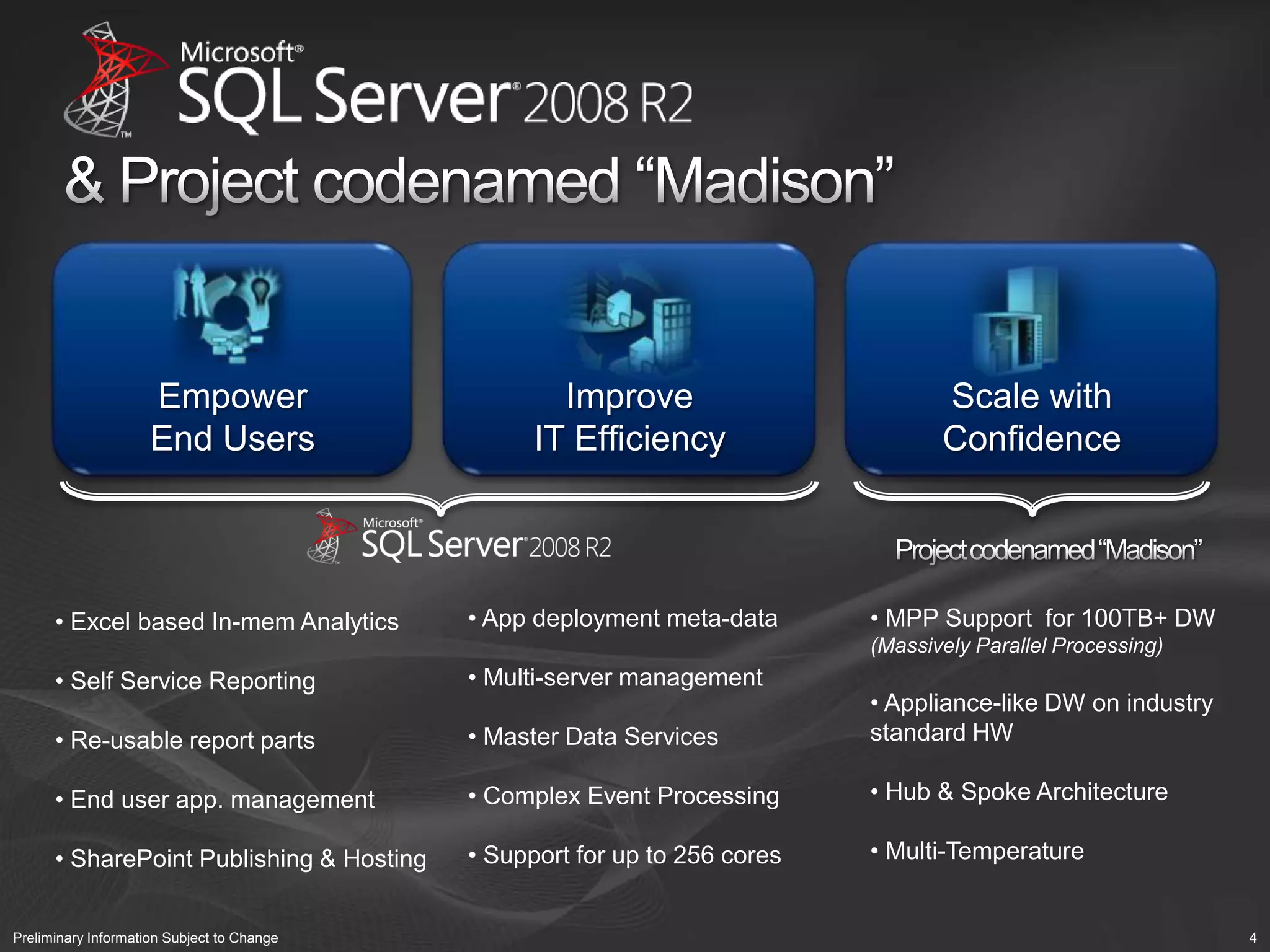
& Project codenamed “Madison”Scale with ConfidenceEmpower End UsersImprove IT EfficiencyProject codenamed “Madison” App deployment meta-data
 Multi-server management
 Master Data Services
 Complex Event Processing
 Support for up to 256 cores
 MPP Support  for 100TB+ DW(Massively Parallel Processing)
 Appliance-like DW on industry standard HW
 Hub & Spoke Architecture
 Multi-Temperature
 Excel based In-mem Analytics
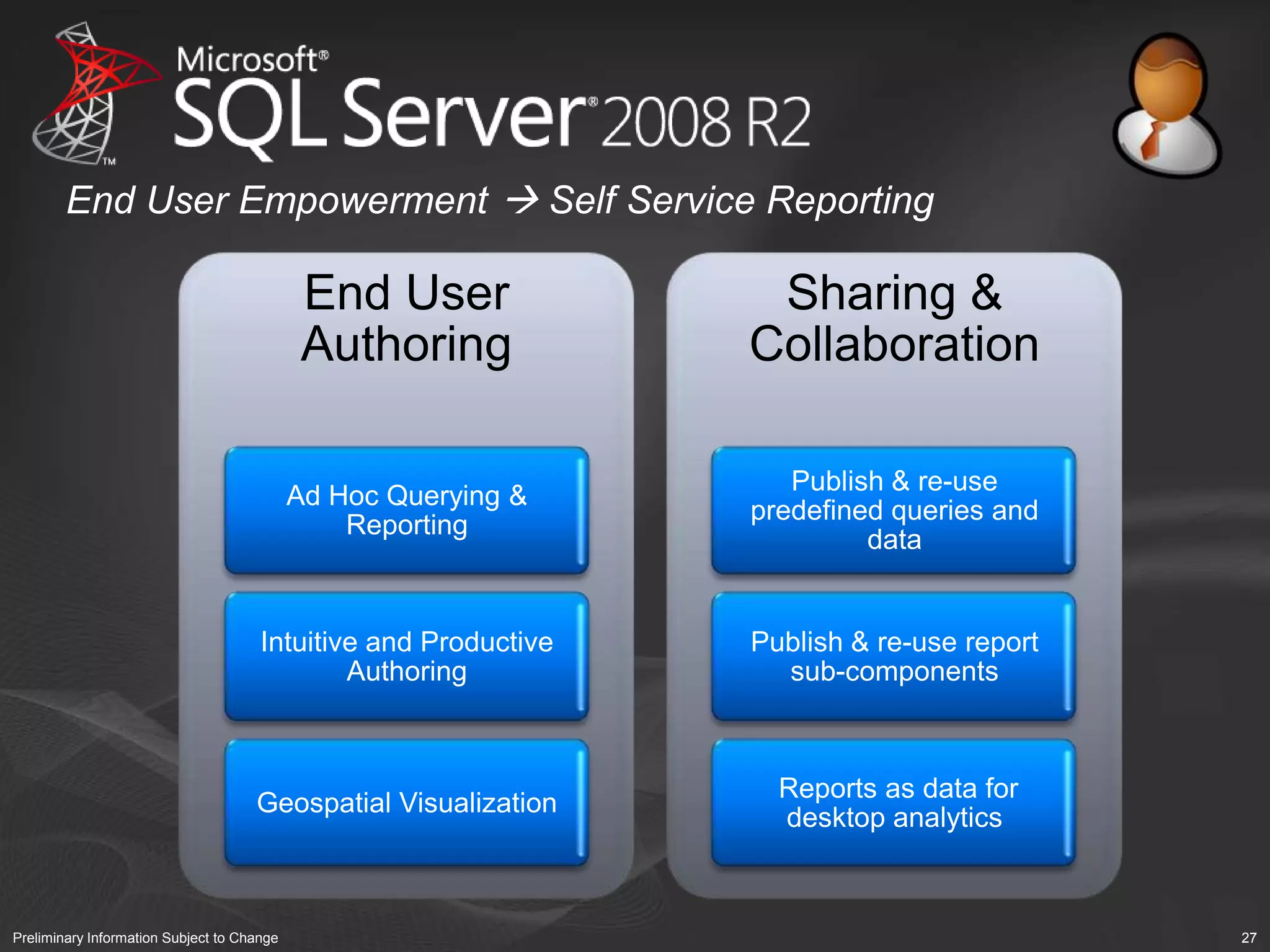
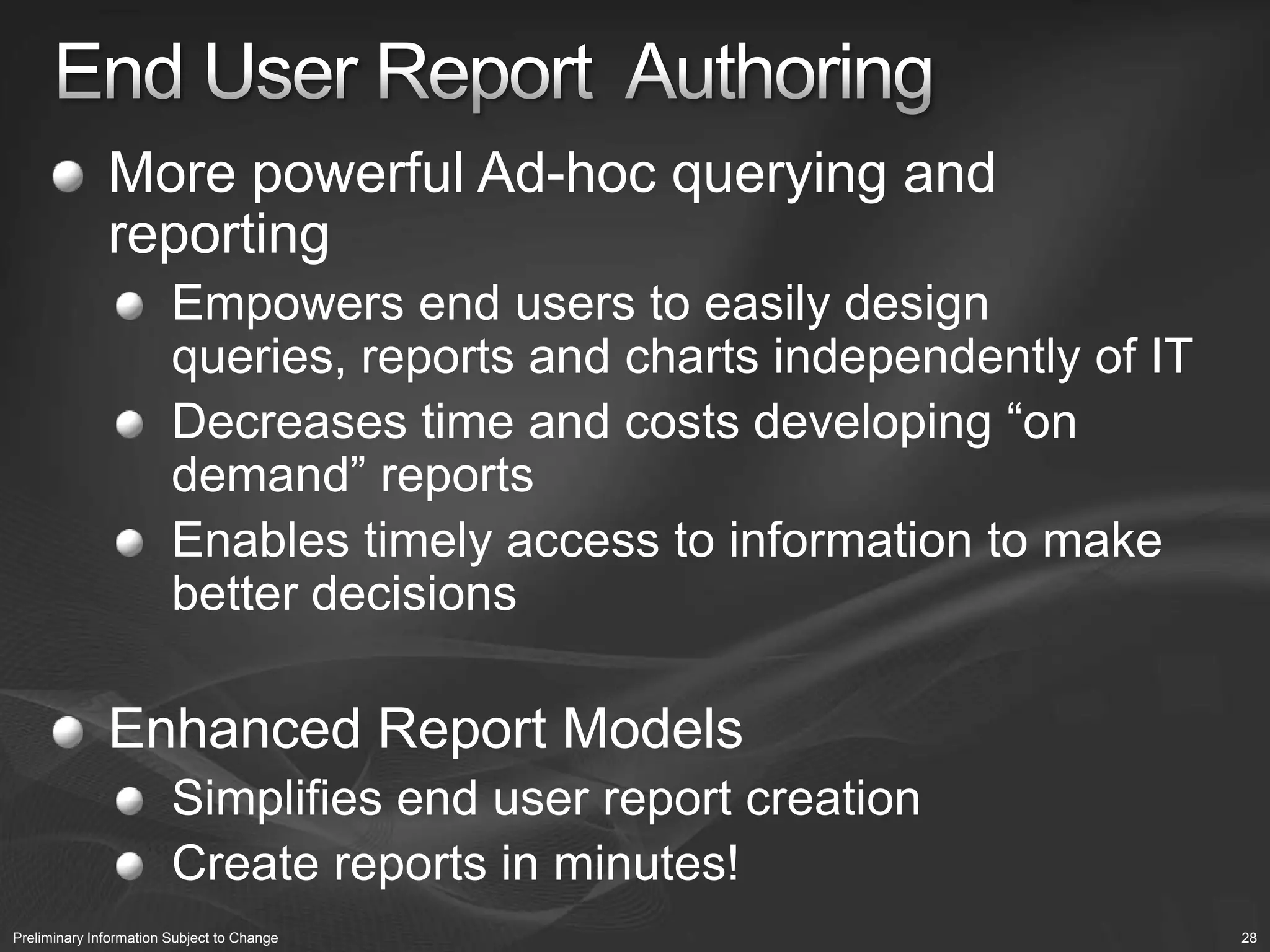
 Self Service Reporting
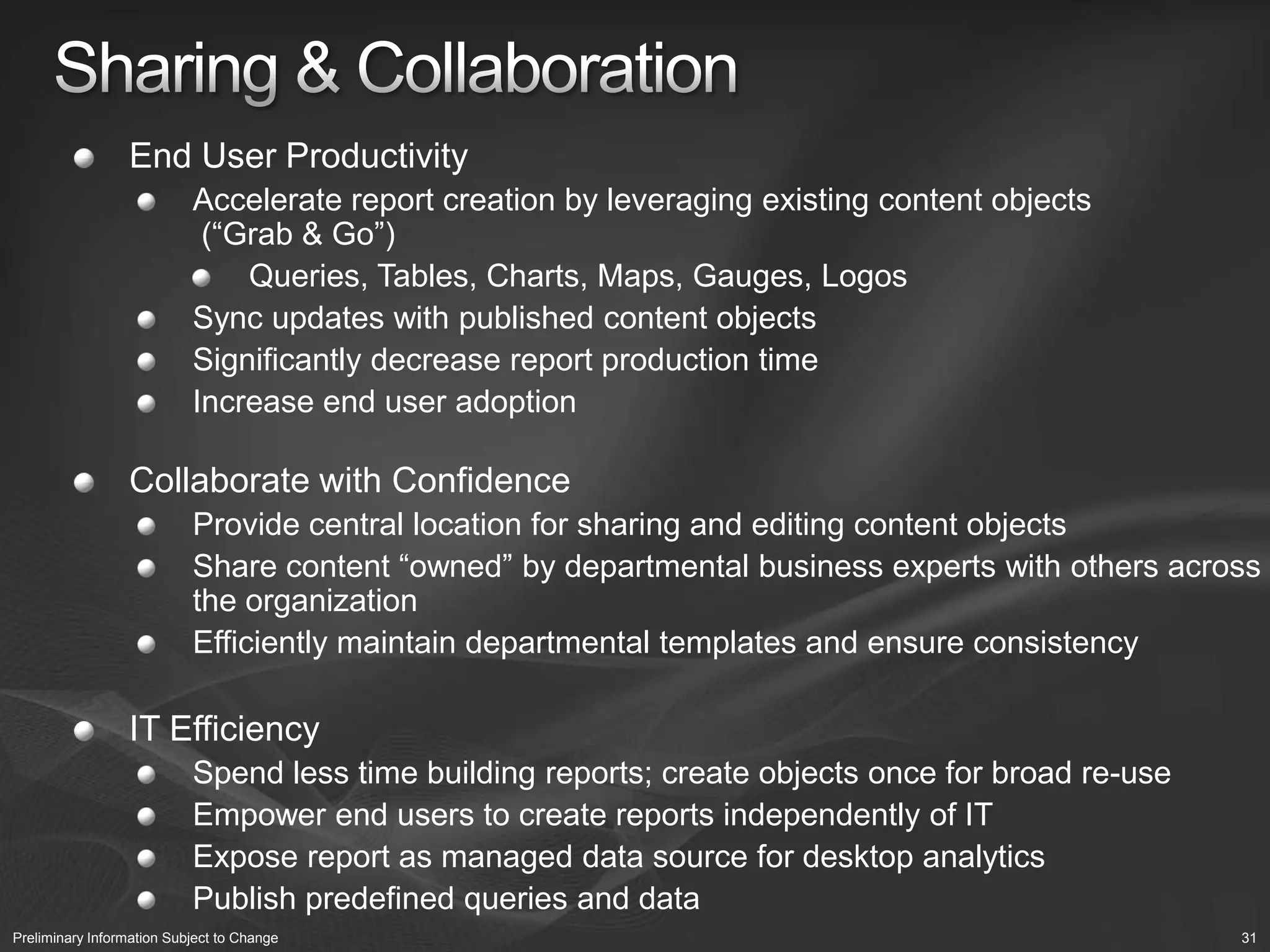
 Re-usable report parts
 End user app. management
 SharePoint Publishing & HostingPreliminary Information Subject to Change4
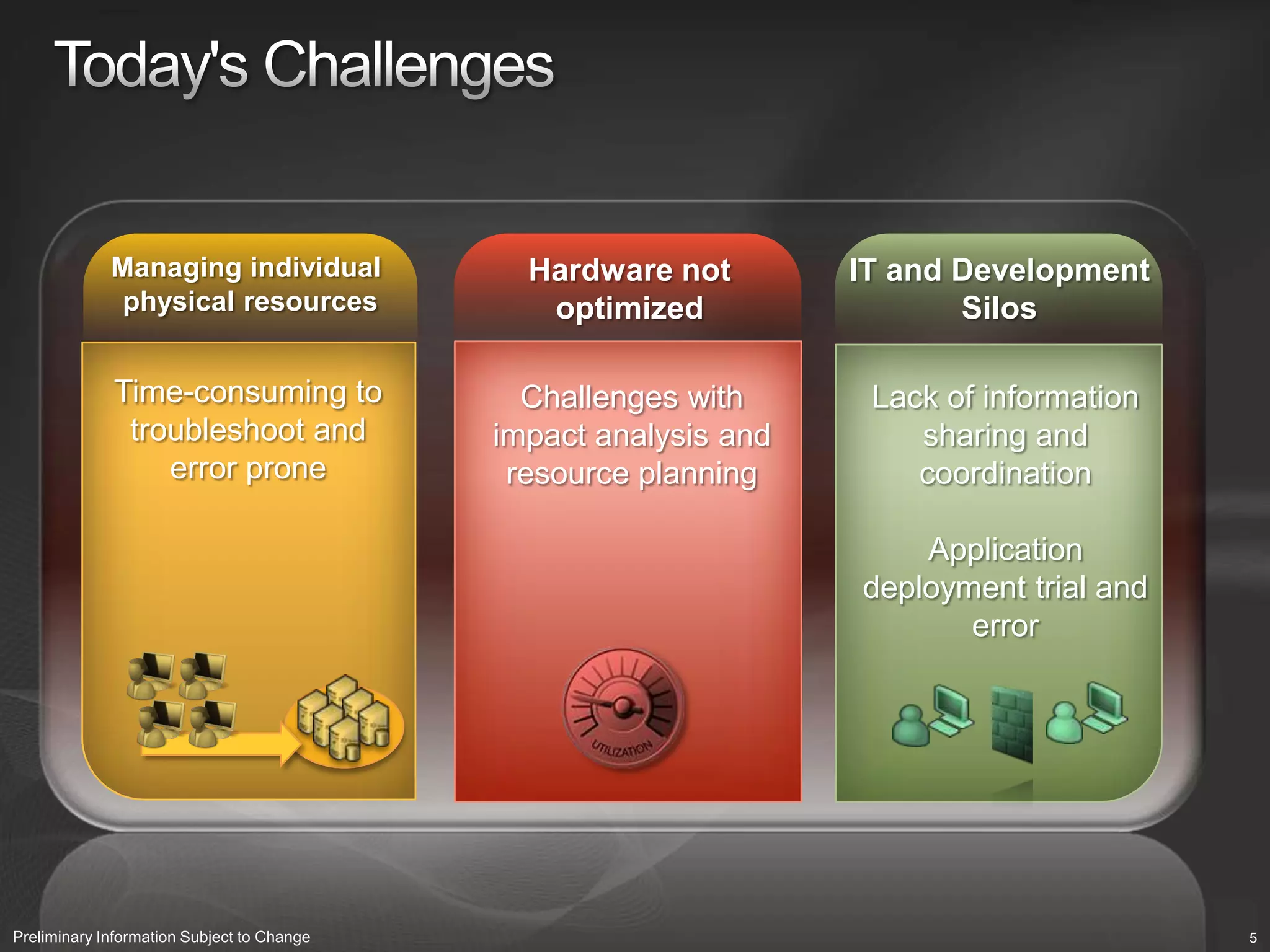
Today's ChallengesManaging individual physical resourcesIT and Development SilosHardware not optimizedTime-consuming to troubleshoot and error proneLack of information sharing and coordination Application deployment trial and errorChallenges with impact analysis and resource planning5Preliminary Information Subject to Change
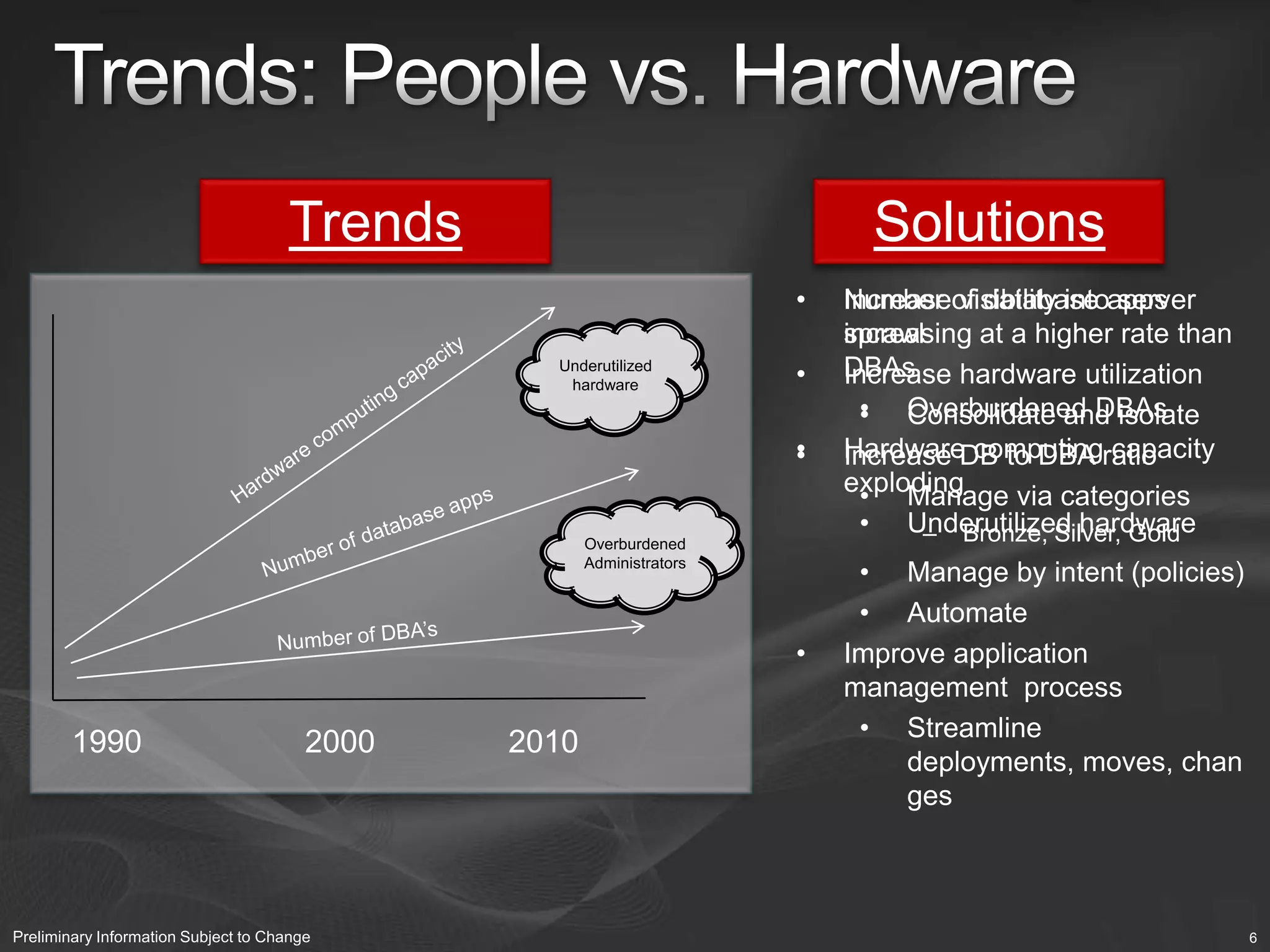
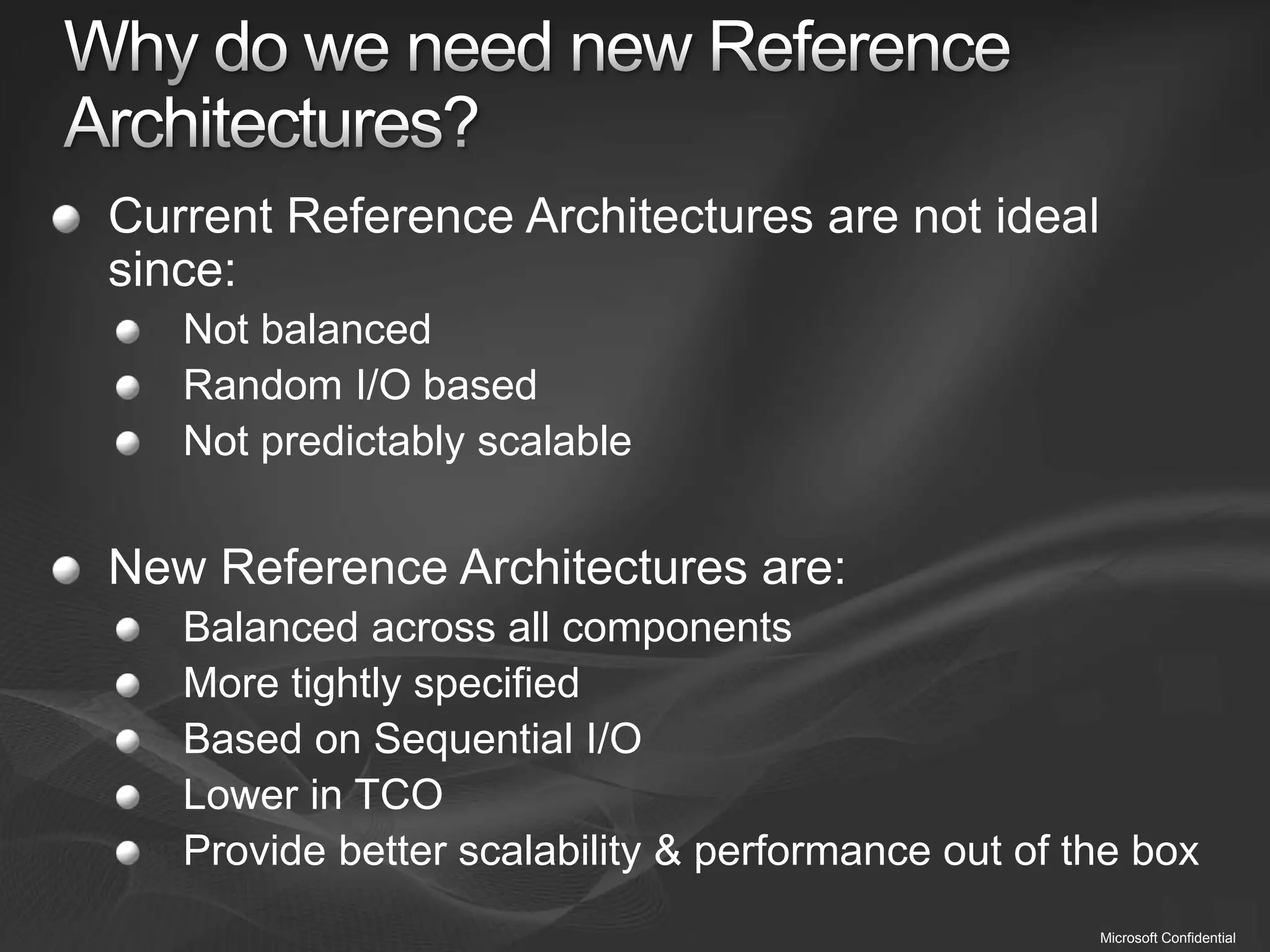
Trends: People vs. HardwareTrendsSolutionsIncrease visibility into server sprawl
Increase hardware utilization
Consolidate and isolate
Increase DB to DBA ratio
Manage via categories
Bronze, Silver, Gold
Manage by intent (policies)
Automate
Improve application management  process
Streamline deployments, moves, changes

What Is New In 2008 R2 Public

Editor's Notes

  • #6 When we think about the key challenges we are addressing with Application and Multi-Server Management, we see the following challenges on the rise:Managing individual physical resourcesWhat this means is: DBAs are currently managing disparate physical resources versus managing by application or the logical layer. When DBAs receive a call that something is wrong with say the finance app, in most cases, they need to reference multiple spreadsheets and run several scripts to determine which applications live on which instances so they can start to put the puzzle together and determine where the issues might lie.The net result: When issues do arise, the lack of centralized tools and the focus on physical assets makes troubleshooting extremely time-consuming.One of the most important challenges we’re addressing is, Hardware is not being optimizedToday, within SQL Server, there is no single unit of management that DBAs can use to better understand the utilization of instances or the elements in the data-tier of an application. Instead, customers need to pay for third-party tools or not gain insights.Therefore, DBAs and their teams are finding it difficult to gain insight into their resources and proactivelymanage resource utilization. This affects their ability to optimize hardware and predict which servers might be running with 90% capacity and which applications might be running hot and take action before there’s an issue. And lastly, With regards to IT and Development SilosWe hear when we talk to customers that in many cases these silos exist across the organization. In some cases, these employees don’t know even each other. Developers are building their data-tier apps in a silo and handing over multiple scripts to DBAs for them to decipher requirements and deploy the application to instances. The net result, developer intentions could be lost in translation and this results in a lot of application deployment trial and error for the DBAs.
  • #7 Furthermore, industry trends are contributing to these growing challenges.<click 1x for animation>First, the number of database applications are increasing at a faster rate than DBA resources. <click 1x for animation> Meanwhile, hardware computing capacities are exploding, leaving a large majority of servers tremendously under-utilized.<Click 1x for animation>We believe solving the problems resulting from these trends are toIncrease visibility into server sprawlIncrease hardware utilization through consolidationIncrease the database to DBA ratioWe’ll accomplish this through managing applications via categoriesSome companies categorize their applications by Bronze, Silver, Gold or Tier 3, Tier 2, Tier 1…Tier 1 being Line of Business applicationsWe’ll also help remove procedural management by turning the tables and proactively manage by intent or by policyThrough this we’ll achieve increased automationAnd lastly, we want to improve the application management processTo help streamline deployments, moves, changes over time
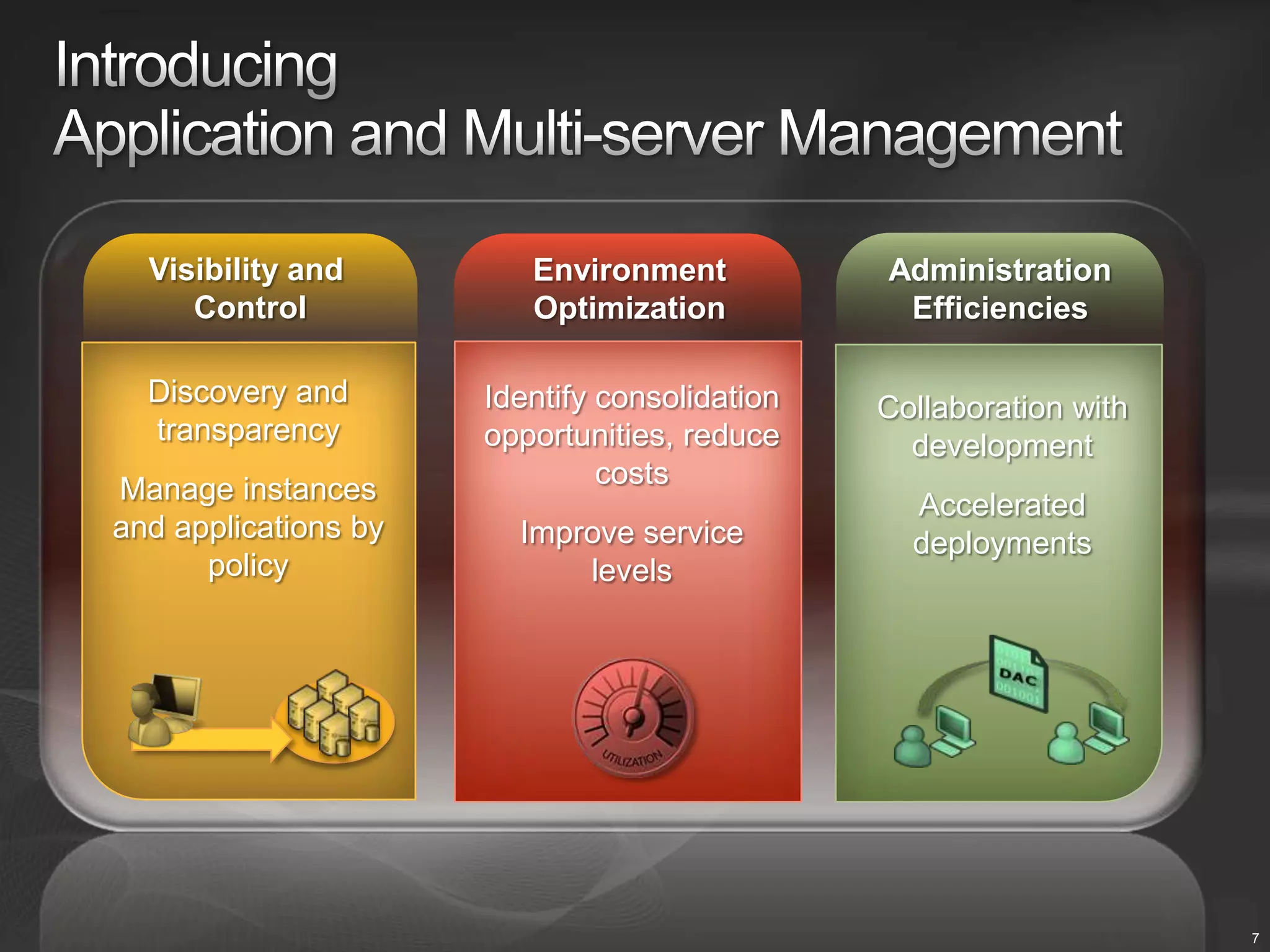
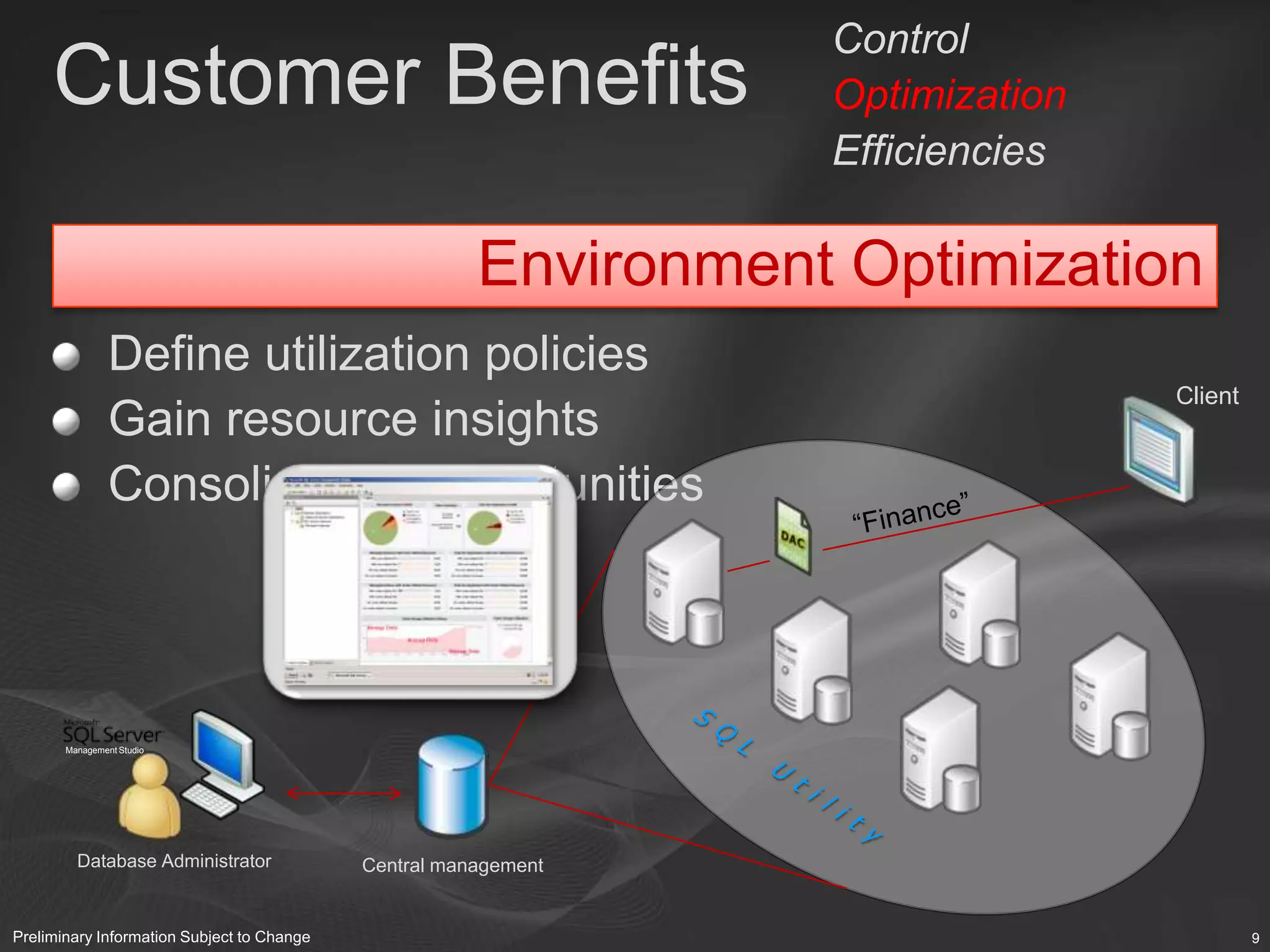
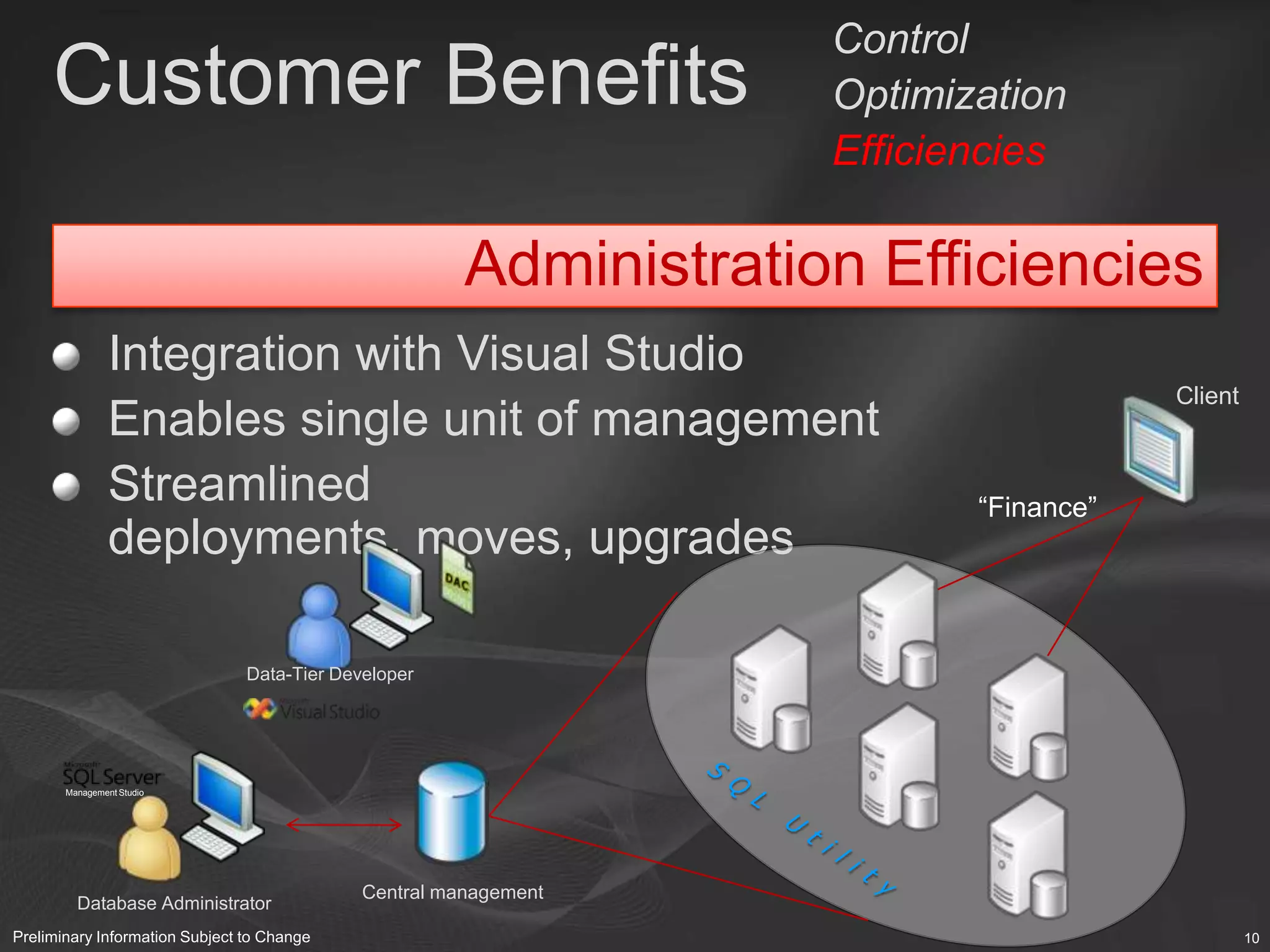
  • #8 So let’s look at how we’re tackling these challenges. With Microsoft’sinvestments in Application and Multi-Server Management, DBA teams will gain more visibility and controlover their databaseenvironment: Through extensions of SQL Server Management Studio (SSMS), DBAs will quicklydiscover instances across their environment and enroll targets into central management where built-in policies track utilization thresholds. These capabilities will help DBAs more efficiently optimize their server environment. A new central management point delivers insights into utilization to help showcase consolidation opportunities. What’s more, this utilization data will provide the necessary insights to help manage more proactively, ultimately improving service levels.Furthermore, integration with Visual Studio will help streamline administration efficienciesand enable a single unit of management that packagesdatabase schema with developer intent. This raises the level of abstraction and improves collaboration across development and IT and results in accelerated deployments.Now let’s take a closer look at each of these promises and concepts in more detail…
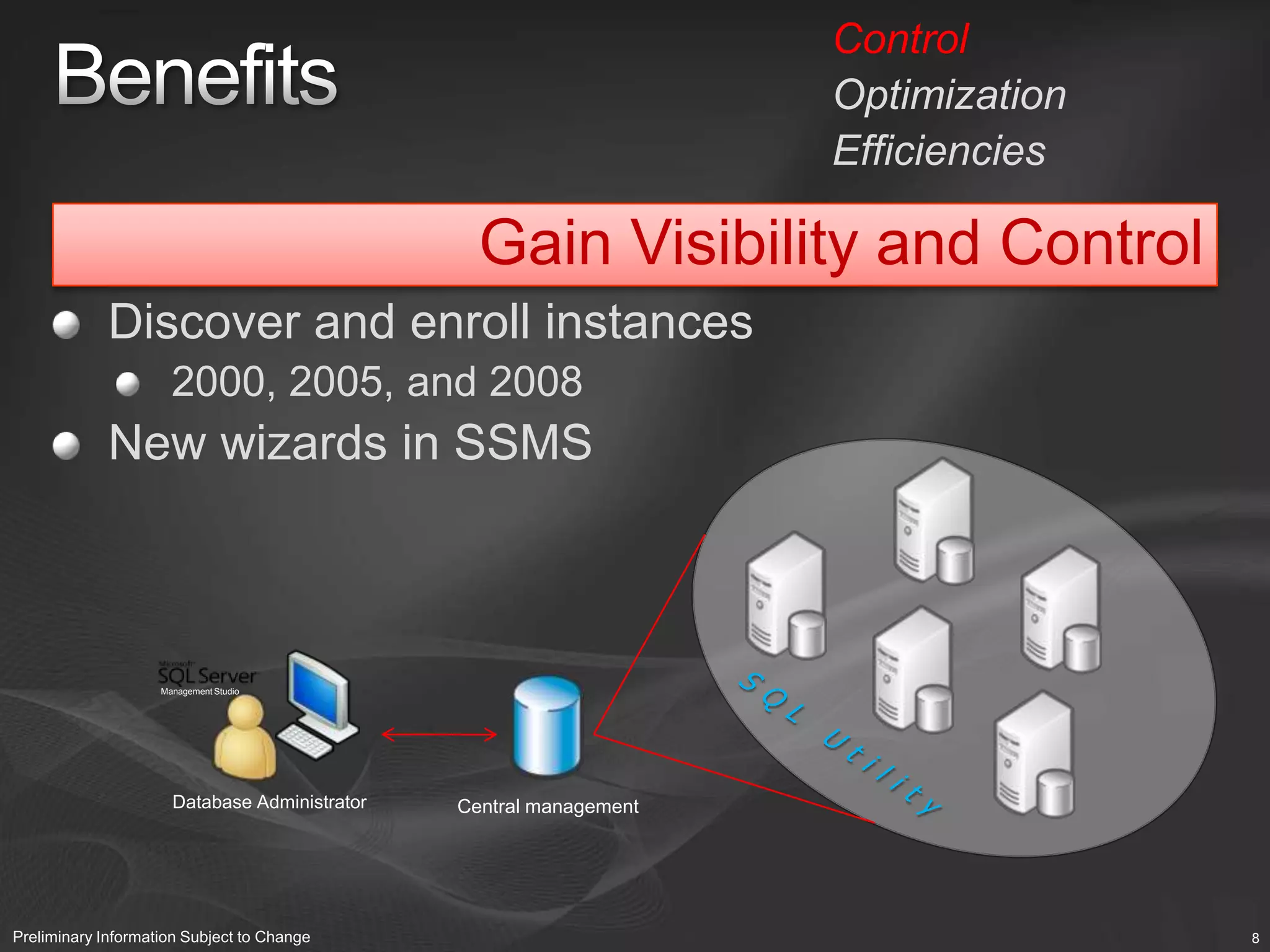
  • #9 As I mentioned before, DBA teams will gain more visibility and control over their environment through new extensions in SQL Server Management Studio.DBAs will be able to quickly and easily discoverSQL Server 2000, 2005 and 2008 instances through a new central management point, offering a central inventory of their SQL Server environment.New wizards will allow DBAs to quickly enroll them into centralized multi-server management, and within about 15 minutes have insights into databaseutilization.
  • #10 Once instances are enrolled, DBAs can set policies to define desired utilization thresholds across target servers or applications within a new central management point.DBAs can set capacity policies around the health of their applications and instances. This will tell the utility to reason over utilization data and indicate health status through dashboard viewpoints.<Click 1x to animate>Dashboard viewpoints will provide real-time insight into application and hardware utilization and policy violation to help identify consolidation opportunities, maximize investments and ultimately maintain healthy systems.
  • #11 <Click 1x for animation>Integration with Visual Studio offers a new database project type that packages database schema with application requirements while built-in developmenttools will help improve overall data-tier application quality. Policy-Based Management is extended through these new capabilities in Visual Studio allowing developers to define deployment requirements or intent within their database projects—for example, the application requires spatial data support and at least 20 gigs of free space to allow for growth. This integration enables a single unit of management for DBAs to deploy database applicationsto available servers that meet deployment criteria. This helps significantlystreamline deployments, moves and changes by reducing the amount of trial and error associated with typical database application deployments.<Click 3 times for animation>And here’swhere the incremental value lay for Application and Multi-Server Management, in the future, with the single unit of management in place and client machines pointing to these units instead of physical assets, moves and upgrades will be significantly streamlined. From the central management point, DBAs can simply identify the application that needs to move, locate another instance that meets the deployment requirements, and move it. The client machines simply follow the application unit to the new instance removing the manual need to redefine those connections.

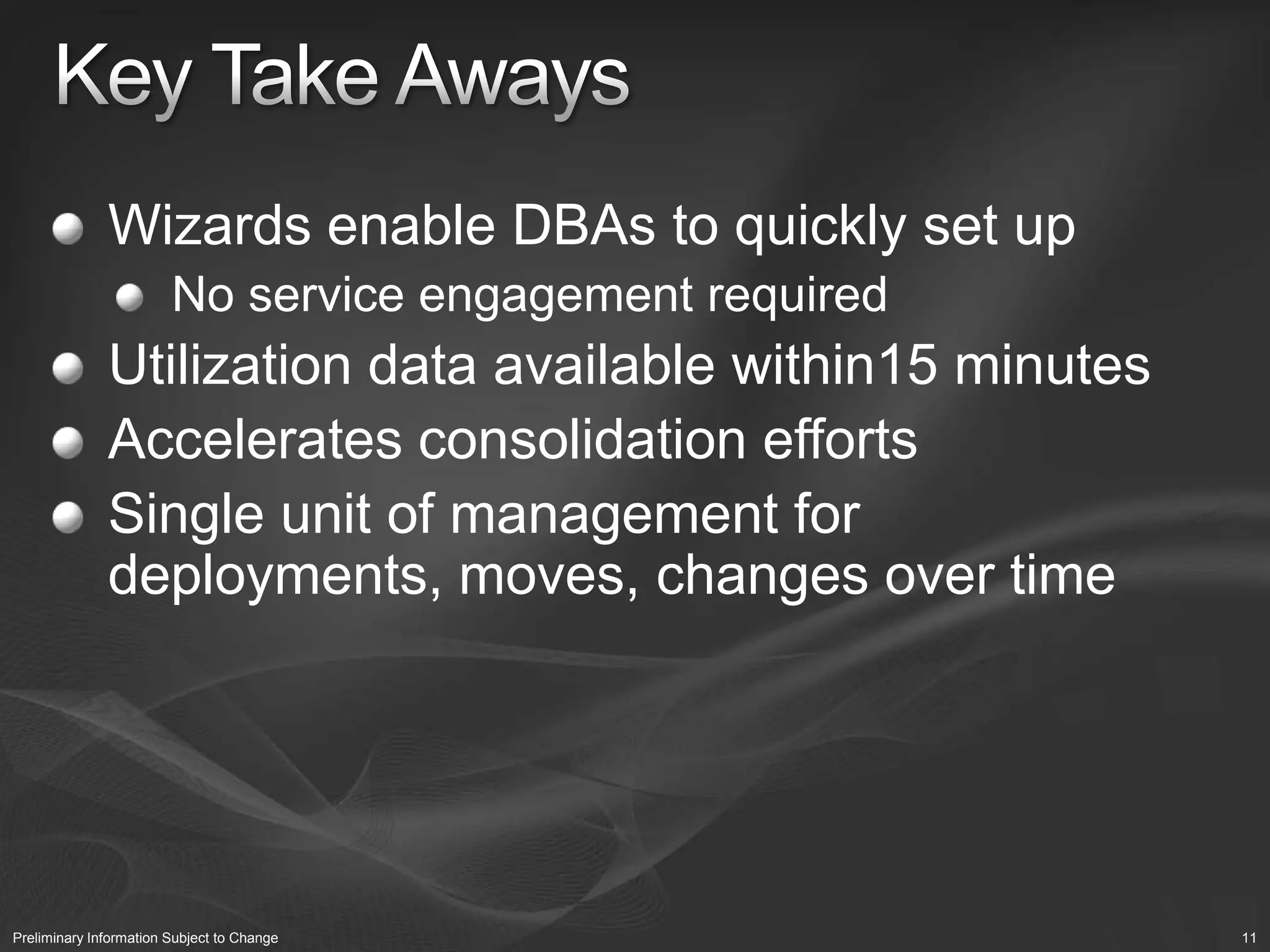
  • #12 We just learned a lot of new concepts, so before we dive into a quick demo of the capabilities, I want to drive home some key points that I believe are of most value to you (to customers).New wizards in SQL Server Management Studio walk DBAs through enrolling applications and instances into central management – this can literally take minutes and doesn’t require third party service engagements.Once servers and applications are enrolled, utilization data is set to update every 15 minutes. This means DBAs can almost immediately gain insight into utilization data and begin working on consolidation plans.Introducing a single unit of management removes the laborious task of manually locating and identifying disparate pieces of the data-tier application, in the future, DBAs will identify an application candidate to move, the system will reason over the utility for available instances that meet the criteria, and voila a move is quickly made.