Focus group interview
Nagraj G D
BAPUJI B SCHOOLS
What is focus group interview ?
It is an interview conducted by a trained moderator in a non
structured and natural manner with a small group of respondents.
What is the purpose of this interview?
To gain insights by listening to a group of people from the
appropriate target market talk about issues of interest to the
researcher.
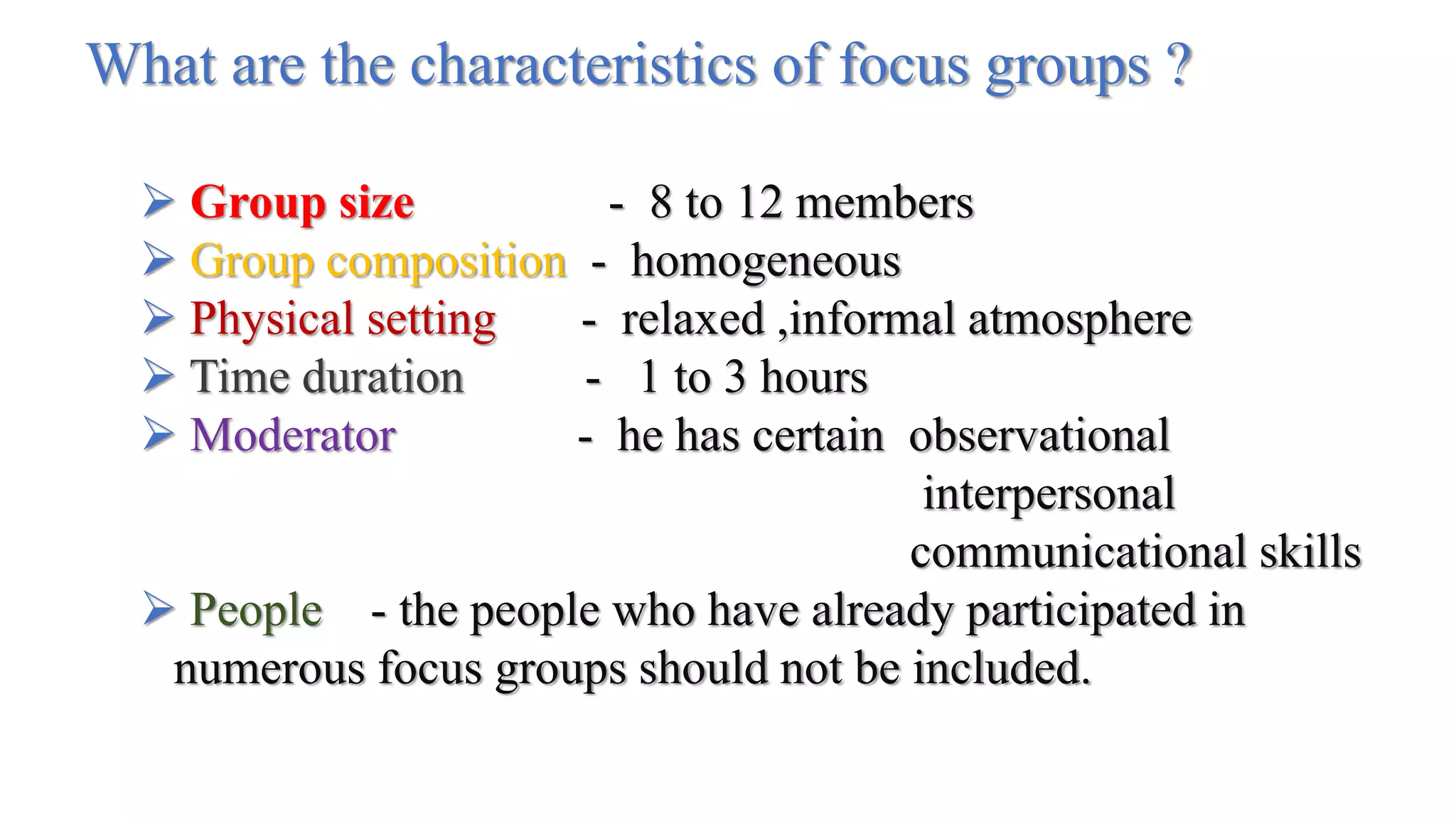
What are the characteristics of focus groups ?
 Group size - 8 to 12 members
 Group composition - homogeneous
 Physical setting - relaxed ,informal atmosphere
 Time duration - 1 to 3 hours
 Moderator - he has certain observational
interpersonal
communicational skills
 People - the people who have already participated in
numerous focus groups should not be included.
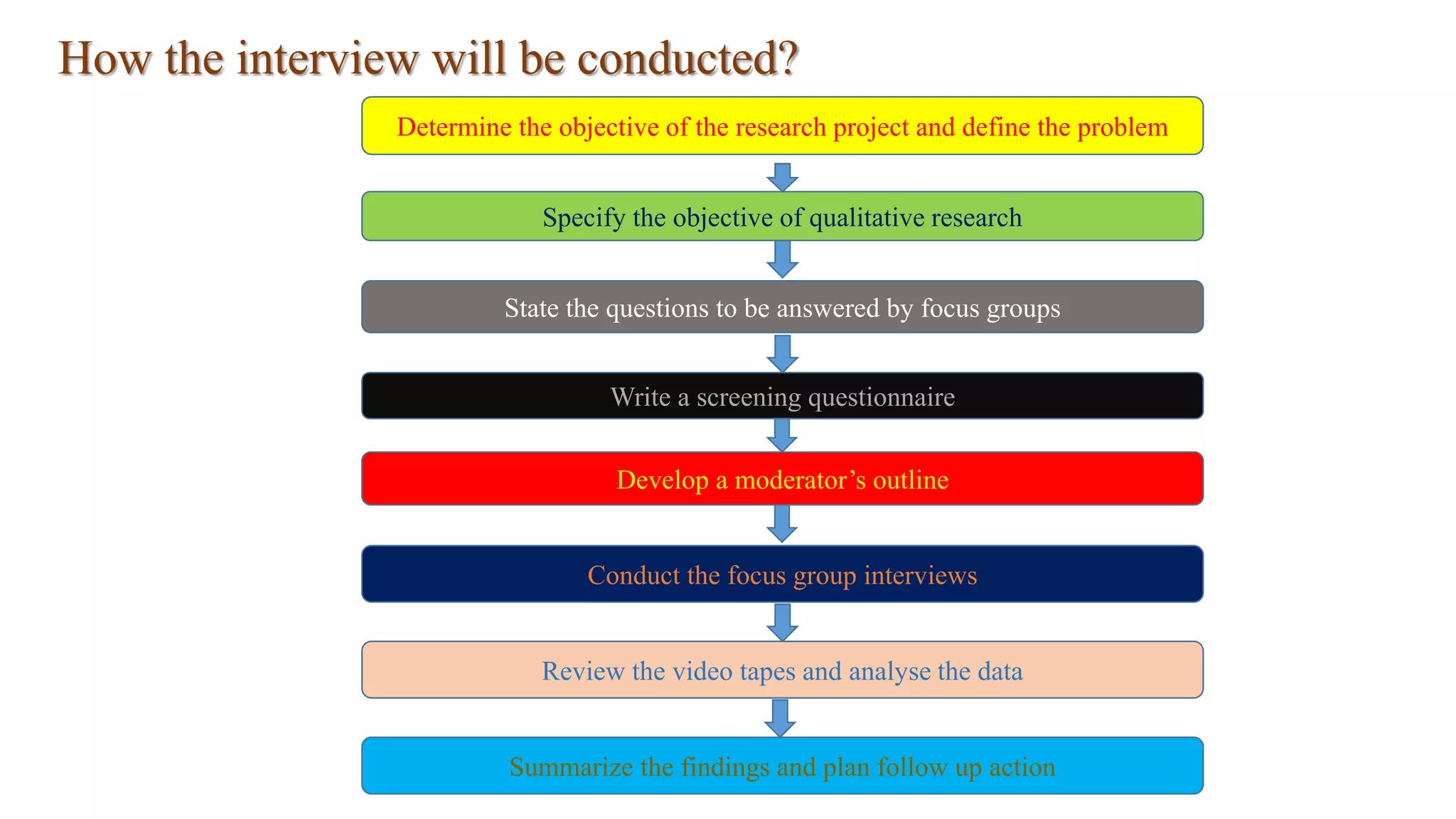
How the interview will be conducted?
Determine the objective of the research project and define the problem
Specify the objective of qualitative research
State the questions to be answered by focus groups
Write a screening questionnaire
Develop a moderator’s outline
Conduct the focus group interviews
Review the video tapes and analyse the data
Summarize the findings and plan follow up action
What are the Applications of focus group interview?
 Understanding the consumers perception , preferences and
behaviour concerning product category
 Obtaining impressions of new product concepts
 Generating new ideas about older products
 Developing creative concepts and copy material for
advertisements
 Securing price impressions
 Obtaining preliminary consumer reaction to specific marketing
programs
Advantages :
 They can save time and money compared to individual interviews
 They can provide a broader range of information
 They offer the opportunity to seek clarification
 They are used to obtain personal and group feelings, perceptions and
opinions.
Disadvantages :
 There can be disagreements and irrelevant discussion which distract
from the main focus
 They can be hard to control and manage
 They can be difficult to encourage a range of people to participate
 They can to tricky to analyse
CONCLUSION:
“ It is an effective method for the upcoming products which are
new to the market. And we can use this method in various other
fields like improving the students learning habits ,improving skills
of employees in the work environment etc.”
Reference : marketing research by Naresh K Malhotra

focus group interview

  • 1.
    Focus group interview NagrajG D BAPUJI B SCHOOLS
  • 2.
    What is focusgroup interview ? It is an interview conducted by a trained moderator in a non structured and natural manner with a small group of respondents. What is the purpose of this interview? To gain insights by listening to a group of people from the appropriate target market talk about issues of interest to the researcher.
  • 3.
    What are thecharacteristics of focus groups ?  Group size - 8 to 12 members  Group composition - homogeneous  Physical setting - relaxed ,informal atmosphere  Time duration - 1 to 3 hours  Moderator - he has certain observational interpersonal communicational skills  People - the people who have already participated in numerous focus groups should not be included.
  • 4.
    How the interviewwill be conducted? Determine the objective of the research project and define the problem Specify the objective of qualitative research State the questions to be answered by focus groups Write a screening questionnaire Develop a moderator’s outline Conduct the focus group interviews Review the video tapes and analyse the data Summarize the findings and plan follow up action
  • 5.
    What are theApplications of focus group interview?  Understanding the consumers perception , preferences and behaviour concerning product category  Obtaining impressions of new product concepts  Generating new ideas about older products  Developing creative concepts and copy material for advertisements  Securing price impressions  Obtaining preliminary consumer reaction to specific marketing programs
  • 6.
    Advantages :  Theycan save time and money compared to individual interviews  They can provide a broader range of information  They offer the opportunity to seek clarification  They are used to obtain personal and group feelings, perceptions and opinions. Disadvantages :  There can be disagreements and irrelevant discussion which distract from the main focus  They can be hard to control and manage  They can be difficult to encourage a range of people to participate  They can to tricky to analyse
  • 7.
    CONCLUSION: “ It isan effective method for the upcoming products which are new to the market. And we can use this method in various other fields like improving the students learning habits ,improving skills of employees in the work environment etc.” Reference : marketing research by Naresh K Malhotra