PRESENTED BY DHIRAJ
KAUSHIK
Goods and Services Tax is an Indirect Tax
which has replaced many Indirect Taxes in
India.
Goods and Services Act was passed in the
Parliament on 29th March 2017.
Act came into effect on 1st July 2017.
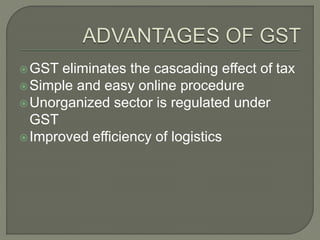
GST eliminates the cascading effect of tax
Simple and easy online procedure
Unorganized sector is regulated under
GST
Improved efficiency of logistics
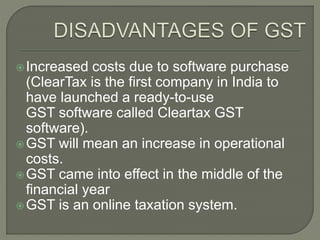
Increased costs due to software purchase
(ClearTax is the first company in India to
have launched a ready-to-use
GST software called Cleartax GST
software).
GST will mean an increase in operational
costs.
GST came into effect in the middle of the
financial year
GST is an online taxation system.
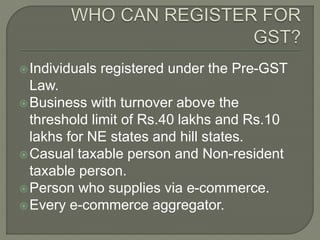
Individuals registered under the Pre-GST
Law.
Business with turnover above the
threshold limit of Rs.40 lakhs and Rs.10
lakhs for NE states and hill states.
Casual taxable person and Non-resident
taxable person.
Person who supplies via e-commerce.
Every e-commerce aggregator.
PAN of the Applicant.
Aadhaar card.
Proof of business registration or
incorporation certificate
Identity and address proof of promoters/
director with photographs.
Address proof of the place of business.
Bank Account statement.
Digital signature.
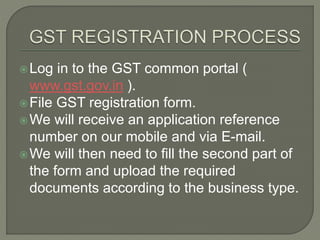
Log in to the GST common portal (
www.gst.gov.in ).
File GST registration form.
We will receive an application reference
number on our mobile and via E-mail.
We will then need to fill the second part of
the form and upload the required
documents according to the business type.
Finally a certificate of registration is issued
to us by the department.
The office may also reject our application if
there any errors. We will be informed in
Form GST REG -05 regarding the same
An offender not paying tax or making short
payments (genuine errors) has to pay a
penalty of 10% of the tax amount due
subject to a minimum of Rs.10000.
The penalty will at 100% of the tax amount
due when the offender has deliberately
evaded paying taxes.
THANK YOU

What is gst

  • 1.
  • 2.
    Goods and ServicesTax is an Indirect Tax which has replaced many Indirect Taxes in India. Goods and Services Act was passed in the Parliament on 29th March 2017. Act came into effect on 1st July 2017.
  • 4.
    GST eliminates thecascading effect of tax Simple and easy online procedure Unorganized sector is regulated under GST Improved efficiency of logistics
  • 5.
    Increased costs dueto software purchase (ClearTax is the first company in India to have launched a ready-to-use GST software called Cleartax GST software). GST will mean an increase in operational costs. GST came into effect in the middle of the financial year GST is an online taxation system.
  • 7.
    Individuals registered underthe Pre-GST Law. Business with turnover above the threshold limit of Rs.40 lakhs and Rs.10 lakhs for NE states and hill states. Casual taxable person and Non-resident taxable person. Person who supplies via e-commerce. Every e-commerce aggregator.
  • 8.
    PAN of theApplicant. Aadhaar card. Proof of business registration or incorporation certificate Identity and address proof of promoters/ director with photographs. Address proof of the place of business.
  • 9.
  • 10.
    Log in tothe GST common portal ( www.gst.gov.in ). File GST registration form. We will receive an application reference number on our mobile and via E-mail. We will then need to fill the second part of the form and upload the required documents according to the business type.
  • 11.
    Finally a certificateof registration is issued to us by the department. The office may also reject our application if there any errors. We will be informed in Form GST REG -05 regarding the same
  • 12.
    An offender notpaying tax or making short payments (genuine errors) has to pay a penalty of 10% of the tax amount due subject to a minimum of Rs.10000. The penalty will at 100% of the tax amount due when the offender has deliberately evaded paying taxes.
  • 15.