The eMarket Services
project


                       1
What is e-business?


E-business is a general term that means that the
business is done by communication from one
computer to another, and usually through the
internet.


E-business definition:
A collaborative business and trade development
process conducted electronically within a company
and between business partners.

It refers to any kind of information exchange, service
and transactions, undertaken through ICT-enabled
networks.


                                                         2
Why use e-business?


Electronic business (e-business) is increasing

and can be an interesting alternative or supplement
to "normal" business that is done with direct contact
between the buyer and seller


– especially for companies that export and therefore
do business over a long distance.


                                                        3
A B2B Electronic marketplace


  Business to Business (B2B) or Business to
  Government (B2G)

  Open to several buyers and sellers

  Does not itself sell or buy goods or services

  Must have at least one trading function


                                                  4
Purchasing processes


Companies use a more complex buying process than
consumers


E-marketplaces support the purchasing process used
by companies


                                                     5
Why use
e-marketplaces?


                  6
Results from using e-marketplaces for
international business


 A study conducted by eMarket Services among
 SME’s that use e-marketplaces to do international
 business shows that:

 Only 5% use e-marketplaces for international
 business

 However among those that DO:

 64% shows increased international sales

 74% see increased economic results

 86% want to continue using e-marketplaces for
 international sales

                              Source: eMarket Services (http://tinyurl.com/yg7cv7s )


                                                                             7
Fi
                                                                  rs
                                                                    t
                                                                        m
                                                                         ov
                                                                           er
                                                                              ad
                                                                                  va

                                                                                                    0%
                                                                                                   10%
                                                                                                   20%
                                                                                                   30%
                                                                                                   40%
                                                                                                   50%
                                                                                                   60%
                                                                                                   70%
                                                                                                   80%
                                                                                                   90%


                                                                                       nt
                                                                                          ag
                                                                                             e
                                                                              M
                                                                                 or
                                                                                    e
                                                                                        sa
                                                                         Be                le
                                                               N             tt
                                                                 ew            er


    Source: case studies interview - eMarketServices
                                                                      tr            pr
                                                                        ad              ic
                                                              In           in             es
                                                                te            g
                                                                   rn            pa
                                                                      al              rt
                                                                         im             ne
                                                                             pr             rs
                                                       Im                       ov
                                                         pr                          em
                                                           ov          C                  en
                                                             e           os
                                                                            te               ts
                                                                cu
                                                                   st           ffi
                                                                      om            ci
                                                                                      en
                                                                          er              cy
                                                             Sp               re
                                                                 ee              la
                                                                    d               tio
                                                                       up                ns
                                                                           tr               hi
                                                                              an               p
                                                                                  sa
                                                                                     ct
                                                                                         io
                                                                                           ns
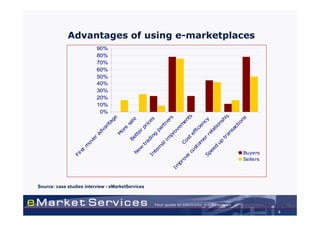
                                                                                                         Advantages of using e-marketplaces


                                                            Sellers
                                                            Buyers


8
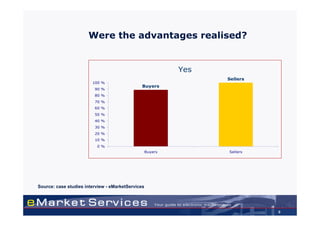
Were the advantages realised?


                                                            Yes
                                                                  Sellers
                        100 %
                                               Buyers
                         90 %
                         80 %
                         70 %
                         60 %
                         50 %
                         40 %
                         30 %
                         20 %
                         10 %
                          0%
                                                   Buyers         Sellers


Source: case studies interview - eMarketServices


                                                                            9
What are
e-marketplaces?


                  10
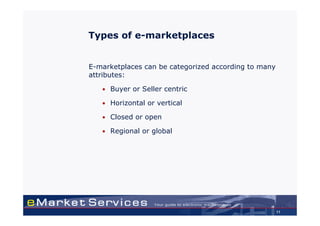
Types of e-marketplaces


E-marketplaces can be categorized according to many
attributes:

   • Buyer or Seller centric

   • Horizontal or vertical

   • Closed or open

   • Regional or global


                                                      11
Buyer-centric


On a buyer-centric e-Marketplace, the e-
Marketplace implements software that supports the
procurement process.


The catalogue contains information from a set of
suppliers and aggregates these into a single internal
catalogue that makes it easier to find and compare
the products offered.


                                                        12
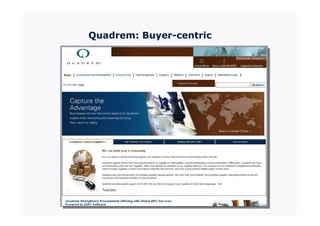
Quadrem: Buyer-centric
Advantages of buyer-centric

Tight control over the procurement software, catalogue
data and processes

Highly customised solution to meet the buying
organisation's needs

Procurement solutions can be fully integrated into the
buying organisation's financial management system to
automate the procurement process


                                                     14
Advantages of buyer-centric

For buyer:
   •   Offer the most procurement functionality

   •   Lead to fast and easy product search and selection.

   •   Access to multiple suppliers' offerings

   •   Can usually do price comparisons.


For suppliers
   •   The costs of participating in these systems are
       generally low

   •   There are no transaction fees

   •   Require little investment to participate.


                                                             15
Disadvantages of buyer-centric


A closed purchasing environment, allowing suppliers to trade
only with the central buying organisation.
Higher system maintenance costs for the buyer, but
generally catalogue maintenance (updating items, prices
and availability) can be done by sellers, with the updated
data provided to the buyer.
Issues can arise as to the currency of data, stock availability
etc, when suppliers do not have direct control over items
listed in the buyer's catalogue.
High up-front investment for the buying organisation.
Suppliers wishing to move to on-line trading may need to
accommodate a number of different systems used by their
customers, increasing costs and complicating content
management.


                                                                  16
Seller-centric e-marketplaces


On the seller-centric e-Marketplace, the suppliers
present themselves and their product catalogue.


The buyers browse the catalogues, make requests
and place orders.


                                                     17
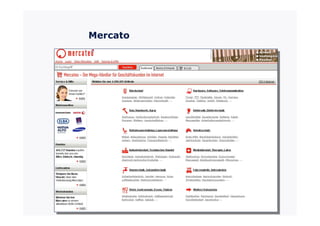
Mercato
Advantages of seller-centric


For buyers

    •   Low investment cost

    •   Some sites are aggregated into virtual e-malls to
        reduce the need to search many different sites


For suppliers

    •   Optimal in terms of control, cost, maintenance and
        functionality, but their customers need to know
        where to find them so their use may be limited.


                                                             19
Disadvantages of seller-centric


Suppliers' sites provide only limited support for the buyer's
purchasing process, typically only the ability to browse
catalogues and place orders.
Buyers lose control over catalogue data.
Support for pre-arranged contracts may be limited.
Buyers must access each supplying organisation's system
individually, and only one supplier's catalogue can be
accessed at a time.
Buyers must learn to use multiple supplier systems and
manage multiple access right details (e.g. user-name and
password).
Buyers must know where to find the site.
Integration into financial management systems at the
buyer's end may be very difficult.


                                                                20
Vertical e-Marketplaces


A Vertical e-Marketplace addresses the needs of a
particular industry, such as the chemical industry.

It links buyers and their suppliers and often have
other industry related services, such as industry news
and newsletters, information about commodity pricing
and may even host industry specific events.


                                                         21
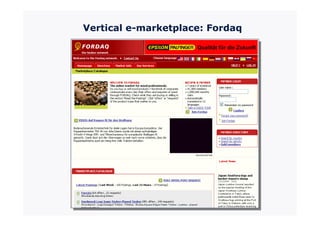
Vertical e-marketplace: Fordaq
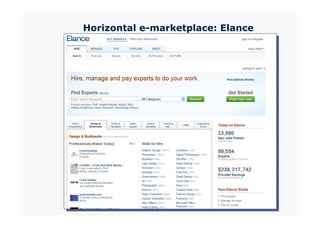
Horizontal e-Marketplaces


The Horizontal e-Marketplaces covers a wide range of
industries, and are mostly trading MRO (Material, Repair and
Operations) products, as opposed to strategic products that
are used in the production.
A horizontal e-Marketplace will focus on a set of trading
functions (such as catalogues or auctions) or the needs or
companies in a particular region and attempt to offer the
best function or the most complete coverage of that regions
needs.


                                                               23
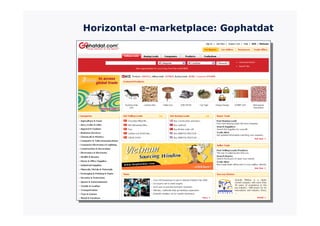
Horizontal e-marketplace: Gophatdat
Horizontal e-marketplace: Elance
Closed and open e-Marketplaces


Some e-Marketplaces are closed and require an
invitation to join.

Usually this invitation is given by the buyer and
extended to its suppliers.


                                                    26
Regional and global e-Marketplaces


Many products cannot easily be sold to any region.
Many public procurement sites have a regional focus
Some e-Marketplaces also have a focus on a small
region to help develop the suppliers and producers of
that region.
Regional e-marketplaces are only available in the
language of the region


                                                        27
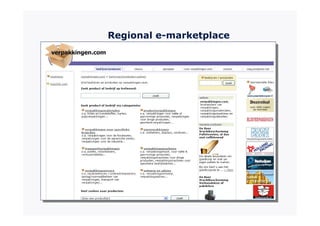
Regional e-marketplace
Trading functions


In order to promote business, the e-Marketplace needs to
have at least one Trading Function:

    •   Online directories

    •   Catalogue

    •   Classified ads

    •   Online order

    •   Request for Quotation/Proposal/Bid (RFQ, RFP, RFB)

    •   Auctions

    •   Reverse auctions

    •   System integration


                                                             29
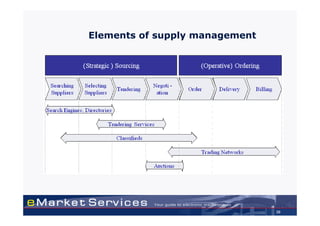
Elements of supply management


                                30
Online directories


Online directories are databases of companies.

Buyers can find new suppliers and suppliers can get
leads.

Buyers can search by products or services, by region
or by company.


                                                       31
Catalogue


A catalogue is list of products and services offered by
the sellers.

Some catalogues list product information on a general
level, others are very detailed.


                                                          32
Classified ads


Classified ads display offers of specific products for
sale or wanted by a buyer.

The ads are sorted by the type of product, brand or
company.


                                                         33
Online order


"Online order" is when an order can be placed online
for the articles listed for sale in a catalogue or
classified ad.

Orders to various sellers can in this way be placed
directly on an e-Marketplace.


                                                       34
Request for Quotation/Proposal/Bid (RFQ,
RFP, RFB)


"Requests for Quotation/Proposal or Bid" are usually
an on-line form where the seller or buyer sends a
request to sell or buy a product.

The RFQ/RFP/RFB function can be used to request a
price or proposal on a product

The request is typically sent to the trading partners
by email to be answered.


                                                        35
Auctions


In an auction, a specific product or a specific quantity
of products is being placed for sale.

The auction starts and ends at a pre-set time. Buyers
can then submit bids during that period of time.


                                                           36
Reverse auctions


"Reverse auctions" are also called sourcing auctions
or buyers' auctions, help buyers to find the cheapest
supplier for a contract.

Within the auction the potential suppliers submit
offers, lowering the selling price for each submitted
bid.


                                                        37
What is
eMarket Services?


                    38
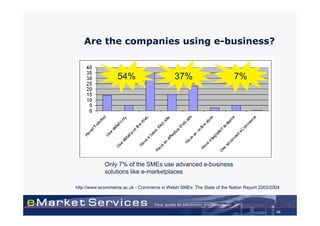
Are the companies using e-business?


                   54%                       37%                        7%


             Only 7% of the SMEs use advanced e-business
             solutions like e-marketplaces

http://www.ecommerce.ac.uk - Commerce in Welsh SMEs: The State of the Nation Report 2003/2004


                                                                                           39
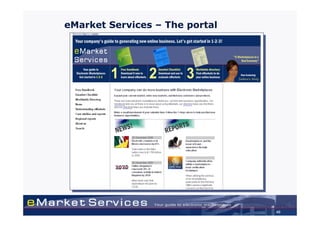
eMarket Services – The portal


                                40
eMarket Services


eMarket Services is funded and operated by the trade
promotion organisations of Canada, Norway, Spain
and Mexico.

The eMarket Services is a non profit project and
serves to help our companies to expand their
business.

Our mission is to make it easier for companies to use
e-marketplaces to find new customers and suppliers
for their international business.


                                                        41
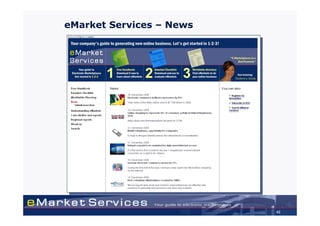
eMarket Services – News


                          42
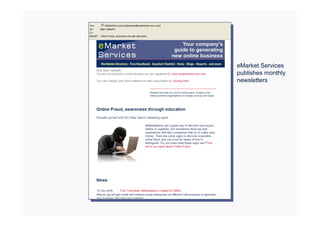
eMarket Services
publishes monthly
newsletters
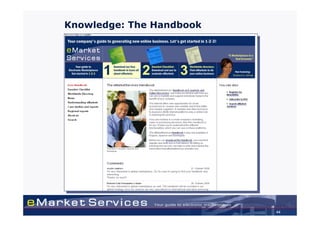
Knowledge: The Handbook


                          44
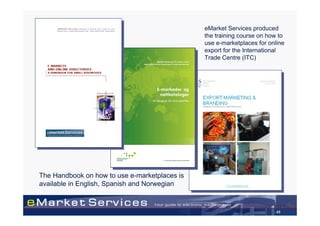
eMarket Services produced
                                               the training course on how to
                                               use e-marketplaces for online
                                               export for the International
                                               Trade Centre (ITC)


The Handbook on how to use e-marketplaces is
available in English, Spanish and Norwegian


                                                                         45
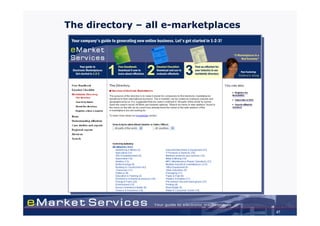
46
The directory – all e-marketplaces


                                     47
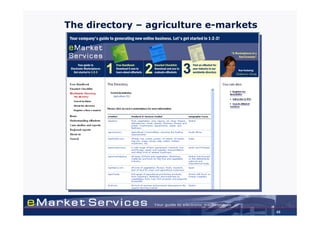
The directory – agriculture e-markets


                                        48
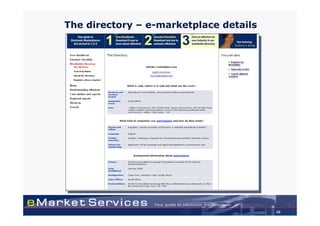
The directory – e-marketplace details


                                        49
For more information


Please visit: www.eMarketServices.com


                                        50

What is e market services 2010

  • 1.
  • 2.
    What is e-business? E-businessis a general term that means that the business is done by communication from one computer to another, and usually through the internet. E-business definition: A collaborative business and trade development process conducted electronically within a company and between business partners. It refers to any kind of information exchange, service and transactions, undertaken through ICT-enabled networks. 2
  • 3.
    Why use e-business? Electronicbusiness (e-business) is increasing and can be an interesting alternative or supplement to "normal" business that is done with direct contact between the buyer and seller – especially for companies that export and therefore do business over a long distance. 3
  • 4.
    A B2B Electronicmarketplace Business to Business (B2B) or Business to Government (B2G) Open to several buyers and sellers Does not itself sell or buy goods or services Must have at least one trading function 4
  • 5.
    Purchasing processes Companies usea more complex buying process than consumers E-marketplaces support the purchasing process used by companies 5
  • 6.
  • 7.
    Results from usinge-marketplaces for international business A study conducted by eMarket Services among SME’s that use e-marketplaces to do international business shows that: Only 5% use e-marketplaces for international business However among those that DO: 64% shows increased international sales 74% see increased economic results 86% want to continue using e-marketplaces for international sales Source: eMarket Services (http://tinyurl.com/yg7cv7s ) 7
  • 8.
    Fi rs t m ov er ad va 0% 10% 20% 30% 40% 50% 60% 70% 80% 90% nt ag e M or e sa Be le N tt ew er Source: case studies interview - eMarketServices tr pr ad ic In in es te g rn pa al rt im ne pr rs Im ov pr em ov C en e os te ts cu st ffi om ci en er cy Sp re ee la d tio up ns tr hi an p sa ct io ns Advantages of using e-marketplaces Sellers Buyers 8
  • 9.
    Were the advantagesrealised? Yes Sellers 100 % Buyers 90 % 80 % 70 % 60 % 50 % 40 % 30 % 20 % 10 % 0% Buyers Sellers Source: case studies interview - eMarketServices 9
  • 10.
  • 11.
    Types of e-marketplaces E-marketplacescan be categorized according to many attributes: • Buyer or Seller centric • Horizontal or vertical • Closed or open • Regional or global 11
  • 12.
    Buyer-centric On a buyer-centrice-Marketplace, the e- Marketplace implements software that supports the procurement process. The catalogue contains information from a set of suppliers and aggregates these into a single internal catalogue that makes it easier to find and compare the products offered. 12
  • 13.
  • 14.
    Advantages of buyer-centric Tightcontrol over the procurement software, catalogue data and processes Highly customised solution to meet the buying organisation's needs Procurement solutions can be fully integrated into the buying organisation's financial management system to automate the procurement process 14
  • 15.
    Advantages of buyer-centric Forbuyer: • Offer the most procurement functionality • Lead to fast and easy product search and selection. • Access to multiple suppliers' offerings • Can usually do price comparisons. For suppliers • The costs of participating in these systems are generally low • There are no transaction fees • Require little investment to participate. 15
  • 16.
    Disadvantages of buyer-centric Aclosed purchasing environment, allowing suppliers to trade only with the central buying organisation. Higher system maintenance costs for the buyer, but generally catalogue maintenance (updating items, prices and availability) can be done by sellers, with the updated data provided to the buyer. Issues can arise as to the currency of data, stock availability etc, when suppliers do not have direct control over items listed in the buyer's catalogue. High up-front investment for the buying organisation. Suppliers wishing to move to on-line trading may need to accommodate a number of different systems used by their customers, increasing costs and complicating content management. 16
  • 17.
    Seller-centric e-marketplaces On theseller-centric e-Marketplace, the suppliers present themselves and their product catalogue. The buyers browse the catalogues, make requests and place orders. 17
  • 18.
  • 19.
    Advantages of seller-centric Forbuyers • Low investment cost • Some sites are aggregated into virtual e-malls to reduce the need to search many different sites For suppliers • Optimal in terms of control, cost, maintenance and functionality, but their customers need to know where to find them so their use may be limited. 19
  • 20.
    Disadvantages of seller-centric Suppliers'sites provide only limited support for the buyer's purchasing process, typically only the ability to browse catalogues and place orders. Buyers lose control over catalogue data. Support for pre-arranged contracts may be limited. Buyers must access each supplying organisation's system individually, and only one supplier's catalogue can be accessed at a time. Buyers must learn to use multiple supplier systems and manage multiple access right details (e.g. user-name and password). Buyers must know where to find the site. Integration into financial management systems at the buyer's end may be very difficult. 20
  • 21.
    Vertical e-Marketplaces A Verticale-Marketplace addresses the needs of a particular industry, such as the chemical industry. It links buyers and their suppliers and often have other industry related services, such as industry news and newsletters, information about commodity pricing and may even host industry specific events. 21
  • 22.
  • 23.
    Horizontal e-Marketplaces The Horizontale-Marketplaces covers a wide range of industries, and are mostly trading MRO (Material, Repair and Operations) products, as opposed to strategic products that are used in the production. A horizontal e-Marketplace will focus on a set of trading functions (such as catalogues or auctions) or the needs or companies in a particular region and attempt to offer the best function or the most complete coverage of that regions needs. 23
  • 24.
  • 25.
  • 26.
    Closed and opene-Marketplaces Some e-Marketplaces are closed and require an invitation to join. Usually this invitation is given by the buyer and extended to its suppliers. 26
  • 27.
    Regional and globale-Marketplaces Many products cannot easily be sold to any region. Many public procurement sites have a regional focus Some e-Marketplaces also have a focus on a small region to help develop the suppliers and producers of that region. Regional e-marketplaces are only available in the language of the region 27
  • 28.
  • 29.
    Trading functions In orderto promote business, the e-Marketplace needs to have at least one Trading Function: • Online directories • Catalogue • Classified ads • Online order • Request for Quotation/Proposal/Bid (RFQ, RFP, RFB) • Auctions • Reverse auctions • System integration 29
  • 30.
    Elements of supplymanagement 30
  • 31.
    Online directories Online directoriesare databases of companies. Buyers can find new suppliers and suppliers can get leads. Buyers can search by products or services, by region or by company. 31
  • 32.
    Catalogue A catalogue islist of products and services offered by the sellers. Some catalogues list product information on a general level, others are very detailed. 32
  • 33.
    Classified ads Classified adsdisplay offers of specific products for sale or wanted by a buyer. The ads are sorted by the type of product, brand or company. 33
  • 34.
    Online order "Online order"is when an order can be placed online for the articles listed for sale in a catalogue or classified ad. Orders to various sellers can in this way be placed directly on an e-Marketplace. 34
  • 35.
    Request for Quotation/Proposal/Bid(RFQ, RFP, RFB) "Requests for Quotation/Proposal or Bid" are usually an on-line form where the seller or buyer sends a request to sell or buy a product. The RFQ/RFP/RFB function can be used to request a price or proposal on a product The request is typically sent to the trading partners by email to be answered. 35
  • 36.
    Auctions In an auction,a specific product or a specific quantity of products is being placed for sale. The auction starts and ends at a pre-set time. Buyers can then submit bids during that period of time. 36
  • 37.
    Reverse auctions "Reverse auctions"are also called sourcing auctions or buyers' auctions, help buyers to find the cheapest supplier for a contract. Within the auction the potential suppliers submit offers, lowering the selling price for each submitted bid. 37
  • 38.
  • 39.
    Are the companiesusing e-business? 54% 37% 7% Only 7% of the SMEs use advanced e-business solutions like e-marketplaces http://www.ecommerce.ac.uk - Commerce in Welsh SMEs: The State of the Nation Report 2003/2004 39
  • 40.
    eMarket Services –The portal 40
  • 41.
    eMarket Services eMarket Servicesis funded and operated by the trade promotion organisations of Canada, Norway, Spain and Mexico. The eMarket Services is a non profit project and serves to help our companies to expand their business. Our mission is to make it easier for companies to use e-marketplaces to find new customers and suppliers for their international business. 41
  • 42.
  • 43.
  • 44.
  • 45.
    eMarket Services produced the training course on how to use e-marketplaces for online export for the International Trade Centre (ITC) The Handbook on how to use e-marketplaces is available in English, Spanish and Norwegian 45
  • 46.
  • 47.
    The directory –all e-marketplaces 47
  • 48.
    The directory –agriculture e-markets 48
  • 49.
    The directory –e-marketplace details 49
  • 50.
    For more information Pleasevisit: www.eMarketServices.com 50