What is Diffusion?
  The information and context behind our link
from diffusion to electric cars. This presentation
   shows how we have come to explore how
      electric cars have diffused, by firstly
  understanding more about diffusion and the
   role it plays in society in the 21st century.
What is Diffusion?

1)What do we associate with
          Diffusion?
2) Diffusion as a “Universal”
          definition
 3)Diffusion and Innovation
4)21st Century Diffusion and
         Innovation
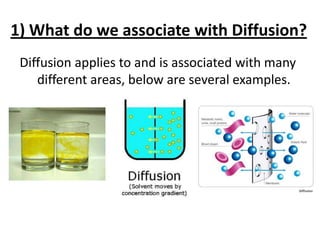
1) What do we associate with Diffusion?
 Diffusion applies to and is associated with many
    different areas, below are several examples.
2) Diffusion as a “Universal” definition
   Even though diffusion is a term widely used and associated with many different areas,
it holds the same deep rooted meaning throughout many different contexts. For example,
    Brown (1981 p.1) says whilst talking about innovation diffusion that diffusion is “the
   process by which change occurs, that is, by which innovations spread from one locale
                               or one social group to another.”

            Mehrer (2007 p.1) describes diffusion (in a scientific sense) by saying,
                            “If a droplet of ink is placed without
      stirring at the bottom of a bottle filled with water, the colour will slowly spread
  through the bottle. At first, it will be concentrated near the bottom. After a few days,
   it will penetrate upwards a few centimetres. After several days , the solution will be
                                  coloured homogeneously.”

 Both of these definitions, although used to describe diffusion in different settings and
  within different contexts have the same basis, which is the dispersal of something more
                                          widely.
          Brown, L. A. (1981) Innovation Diffusion: A New Perspective, London, Menthuen & Co, Ltd

        Mehrer, H. (2007) Diffusion in Solids: Fundamentals, Methods, Materials, Diffusion, Controlled
      Processes – Springer Series in Solid State Science 155, New York, Springer-Verlag Berlin Heidelberg
3) Diffusion and Innovation


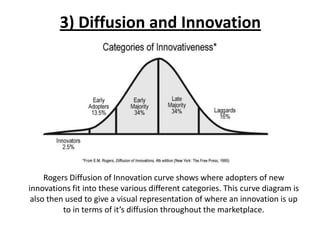
     Rogers Diffusion of Innovation curve shows where adopters of new
innovations fit into these various different categories. This curve diagram is
 also then used to give a visual representation of where an innovation is up
          to in terms of it’s diffusion throughout the marketplace.
3) Diffusion and Innovation
                          (continued)
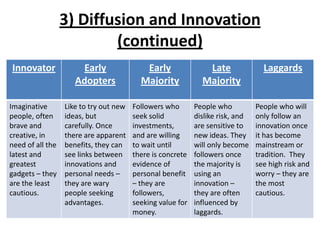
Innovator              Early               Early               Late               Laggards
                     Adopters             Majority            Majority

Imaginative       Like to try out new   Followers who       People who          People who will
people, often     ideas, but            seek solid          dislike risk, and   only follow an
brave and         carefully. Once       investments,        are sensitive to    innovation once
creative, in      there are apparent    and are willing     new ideas. They     it has become
need of all the   benefits, they can    to wait until       will only become    mainstream or
latest and        see links between     there is concrete   followers once      tradition. They
greatest          innovations and       evidence of         the majority is     see high risk and
gadgets – they    personal needs –      personal benefit    using an            worry – they are
are the least     they are wary         – they are          innovation –        the most
cautious.         people seeking        followers,          they are often      cautious.
                  advantages.           seeking value for   influenced by
                                        money.              laggards.
4) 21st Century Diffusion
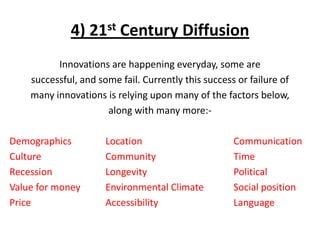
          Innovations are happening everyday, some are
    successful, and some fail. Currently this success or failure of
    many innovations is relying upon many of the factors below,
                      along with many more:-

Demographics          Location                       Communication
Culture               Community                      Time
Recession             Longevity                      Political
Value for money       Environmental Climate          Social position
Price                 Accessibility                  Language

What is diffusion?

  • 1.
    What is Diffusion? The information and context behind our link from diffusion to electric cars. This presentation shows how we have come to explore how electric cars have diffused, by firstly understanding more about diffusion and the role it plays in society in the 21st century.
  • 2.
    What is Diffusion? 1)Whatdo we associate with Diffusion? 2) Diffusion as a “Universal” definition 3)Diffusion and Innovation 4)21st Century Diffusion and Innovation
  • 3.
    1) What dowe associate with Diffusion? Diffusion applies to and is associated with many different areas, below are several examples.
  • 4.
    2) Diffusion asa “Universal” definition Even though diffusion is a term widely used and associated with many different areas, it holds the same deep rooted meaning throughout many different contexts. For example, Brown (1981 p.1) says whilst talking about innovation diffusion that diffusion is “the process by which change occurs, that is, by which innovations spread from one locale or one social group to another.” Mehrer (2007 p.1) describes diffusion (in a scientific sense) by saying, “If a droplet of ink is placed without stirring at the bottom of a bottle filled with water, the colour will slowly spread through the bottle. At first, it will be concentrated near the bottom. After a few days, it will penetrate upwards a few centimetres. After several days , the solution will be coloured homogeneously.” Both of these definitions, although used to describe diffusion in different settings and within different contexts have the same basis, which is the dispersal of something more widely. Brown, L. A. (1981) Innovation Diffusion: A New Perspective, London, Menthuen & Co, Ltd Mehrer, H. (2007) Diffusion in Solids: Fundamentals, Methods, Materials, Diffusion, Controlled Processes – Springer Series in Solid State Science 155, New York, Springer-Verlag Berlin Heidelberg
  • 5.
    3) Diffusion andInnovation Rogers Diffusion of Innovation curve shows where adopters of new innovations fit into these various different categories. This curve diagram is also then used to give a visual representation of where an innovation is up to in terms of it’s diffusion throughout the marketplace.
  • 6.
    3) Diffusion andInnovation (continued) Innovator Early Early Late Laggards Adopters Majority Majority Imaginative Like to try out new Followers who People who People who will people, often ideas, but seek solid dislike risk, and only follow an brave and carefully. Once investments, are sensitive to innovation once creative, in there are apparent and are willing new ideas. They it has become need of all the benefits, they can to wait until will only become mainstream or latest and see links between there is concrete followers once tradition. They greatest innovations and evidence of the majority is see high risk and gadgets – they personal needs – personal benefit using an worry – they are are the least they are wary – they are innovation – the most cautious. people seeking followers, they are often cautious. advantages. seeking value for influenced by money. laggards.
  • 7.
    4) 21st CenturyDiffusion Innovations are happening everyday, some are successful, and some fail. Currently this success or failure of many innovations is relying upon many of the factors below, along with many more:- Demographics Location Communication Culture Community Time Recession Longevity Political Value for money Environmental Climate Social position Price Accessibility Language