Audience
Starter Activity
Who is the target audience for your music
video? (how would you classify them?)
Brainstorm on A3 Paper
 Gender
 Age range
 Ethnicity
 UK Tribes Category
 Social Economic Class
How did you try to
appeal to your target
audience in your
video?
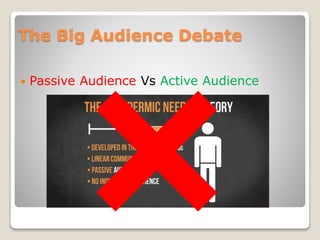
The Big Audience Debate
 Passive Audience Vs Active Audience
Active Audience Theories
 Theories that support the idea of
audiences being active.
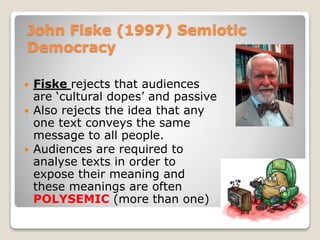
John Fiske (1997) Semiotic
Democracy
 Fiske rejects that audiences
are ‘cultural dopes’ and passive
 Also rejects the idea that any
one text conveys the same
message to all people.
 Audiences are required to
analyse texts in order to
expose their meaning and
these meanings are often
POLYSEMIC (more than one)
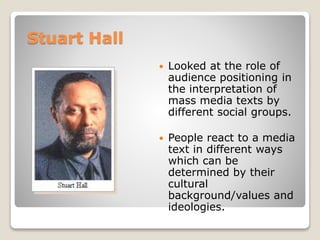
Stuart Hall
 Looked at the role of
audience positioning in
the interpretation of
mass media texts by
different social groups.
 People react to a media
text in different ways
which can be
determined by their
cultural
background/values and
ideologies.
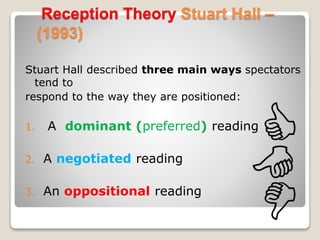
Reception Theory Stuart Hall –
(1993)
Stuart Hall described three main ways spectators
tend to
respond to the way they are positioned:
1. A dominant (preferred) reading
2. A negotiated reading
3. An oppositional reading
Encoding and Decoding
 Dominant Reading: audience fully accepts the
preferred reading so that the code seems
natural. The preferred reading is often one that
reinforces dominant ideologies.
 Negotiated Reading: audience largely believes
the code and broadly accepts the preferred
reading, but sometimes modifies it in a way
which reflects their own position, experience, and
interests.
 Oppositional Reading: audiences’ social
position places them in oppositional relation to
the dominant code. They reject the reading.
Uses and Gratification Theory -
Denis McQuail (2000)
 The basic theme is the idea that people
use the media to get specific gratifications
 People are not helpless victims of the
powerful media, but use media to fulfil
their various needs
Denis Mcquail (2000)
 Escapism
 Social Interaction
 Identification
 Inform and Educate
 Entertainment
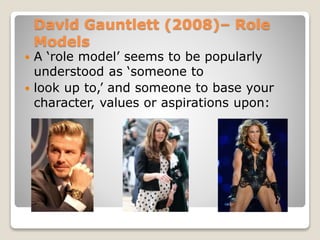
David Gauntlett (2008)– Role
Models
 A ‘role model’ seems to be popularly
understood as ‘someone to
 look up to,’ and someone to base your
character, values or aspirations upon:
Six Types of Role Models
 The ‘straightforward success’ role model
 The ‘triumph over difficult circumstances’
role model
 The ‘challenging stereotypes’ role model
 The ‘wholesome’ role model
 The ‘outsider’ role model
 The family role model:
Apply theories of Audience to ONE
of your media productions
1. Who was your target audience?
2. What was the dominant (preferred
reading)? How did you position your
audience to get the dominant reading? (did
you promote any dominant ideologies?)
3. How might people from other groups view
your representations?
4. What uses and gratifications might the
audience get from your video?
5. How did you construct your artists as role
models and how should the audience
respond to them?
Key Terms
 Dominant Ideology
 Passive Audience
 Active Audience
 Dominant Reading/Negotiated
Reading/Oppositional Reading
 Role Models
 Polysemic (more than one meaning)
 Target audience
Refer to at least two theorists…
 Stuart Hall: Reception theory
 John Fiske: Semiotic Subversion
 Blumler & Katz:Uses & Gratifications
model
 David Gauntlett: Role Models

Audience new

  • 1.
  • 2.
    Starter Activity Who isthe target audience for your music video? (how would you classify them?) Brainstorm on A3 Paper  Gender  Age range  Ethnicity  UK Tribes Category  Social Economic Class How did you try to appeal to your target audience in your video?
  • 3.
    The Big AudienceDebate  Passive Audience Vs Active Audience
  • 4.
    Active Audience Theories Theories that support the idea of audiences being active.
  • 5.
    John Fiske (1997)Semiotic Democracy  Fiske rejects that audiences are ‘cultural dopes’ and passive  Also rejects the idea that any one text conveys the same message to all people.  Audiences are required to analyse texts in order to expose their meaning and these meanings are often POLYSEMIC (more than one)
  • 6.
    Stuart Hall  Lookedat the role of audience positioning in the interpretation of mass media texts by different social groups.  People react to a media text in different ways which can be determined by their cultural background/values and ideologies.
  • 7.
    Reception Theory StuartHall – (1993) Stuart Hall described three main ways spectators tend to respond to the way they are positioned: 1. A dominant (preferred) reading 2. A negotiated reading 3. An oppositional reading
  • 8.
    Encoding and Decoding Dominant Reading: audience fully accepts the preferred reading so that the code seems natural. The preferred reading is often one that reinforces dominant ideologies.  Negotiated Reading: audience largely believes the code and broadly accepts the preferred reading, but sometimes modifies it in a way which reflects their own position, experience, and interests.  Oppositional Reading: audiences’ social position places them in oppositional relation to the dominant code. They reject the reading.
  • 9.
    Uses and GratificationTheory - Denis McQuail (2000)  The basic theme is the idea that people use the media to get specific gratifications  People are not helpless victims of the powerful media, but use media to fulfil their various needs
  • 10.
    Denis Mcquail (2000) Escapism  Social Interaction  Identification  Inform and Educate  Entertainment
  • 11.
    David Gauntlett (2008)–Role Models  A ‘role model’ seems to be popularly understood as ‘someone to  look up to,’ and someone to base your character, values or aspirations upon:
  • 12.
    Six Types ofRole Models  The ‘straightforward success’ role model  The ‘triumph over difficult circumstances’ role model  The ‘challenging stereotypes’ role model  The ‘wholesome’ role model  The ‘outsider’ role model  The family role model:
  • 13.
    Apply theories ofAudience to ONE of your media productions 1. Who was your target audience? 2. What was the dominant (preferred reading)? How did you position your audience to get the dominant reading? (did you promote any dominant ideologies?) 3. How might people from other groups view your representations? 4. What uses and gratifications might the audience get from your video? 5. How did you construct your artists as role models and how should the audience respond to them?
  • 14.
    Key Terms  DominantIdeology  Passive Audience  Active Audience  Dominant Reading/Negotiated Reading/Oppositional Reading  Role Models  Polysemic (more than one meaning)  Target audience
  • 15.
    Refer to atleast two theorists…  Stuart Hall: Reception theory  John Fiske: Semiotic Subversion  Blumler & Katz:Uses & Gratifications model  David Gauntlett: Role Models

Editor's Notes

  • #9 Media messages are always open and polysemic (having multiple meanings) and are interpreted according the context and culture of receivers Firstly, communicators choose to encode messages. Media messages are given a preferred reading, or what might now be called spin. Secondly, receivers (decoders) are not obliged to accept messages as sent but can and do resist ideological influence by applying negotatiated or oppositional readings, according to their own experience and outlook focus on how various types of audience members make sense of the specific forms of content. Hall was concerned with media power, including how it propagates particular social values to create dominant ideologies i.e. framing public debate about certain issues The mass media create and define issues of public concern and interest through audience positioning Polysemy – is the capacity for a text to have multiple meanings. argued that most texts can be read in several ways but there is generally a preferred or dominant reading that the producers of a message intend when they create a message, as a critical theorist, Hall assumed that most popular media content will have a preferred reading that reinforces the status quo (or dominant ideology)