DEVELOPMENT
ECONOMICS
DEVELOPMENT
 DIFFERENT PEOPLE, DIFFERENT GOALS
 Landless rural labourers - More days of work and better
wages, education, no discrimination….
 Prosperous farmers from Punjab - high family income,
higher support prices, hardworking and cheap labourers;
they should be able to settle their children abroad….
 Farmers who depend only on rain for growing crops –
sufficient rain, fertilizers, subsidy from government, good
prices….
DEVELOPMENT
 A rural woman from a land owning family – Freedom,
education, marry to a wealthy family …..
 Urban unemployed youth – Employment, better income,
high standard of living – house, car, stylish dress….
 A boy from a rich urban family – travelling abroad, site
seeing, spending money with friends…..
 A girl from a rich urban family – freedom as her brothers,
study abroad…
 An adivasi from Narmada valley – Food, shelter, clean water,
medical facilities….
DEVELOPMENT - GOALS
 Different persons can have different developmental
goals.
 What may be development for one may not be
development for the other. It may even be destructive
for the other.
DEVELOPMENT - GOALS
 A girl expects as much freedom and opportunity as her
brother, and that he also shares in the household work.
Her brother may not like this.
 To get more electricity, industrialists may want more
dams. But this may submerge the land and disrupt the
lives of people who are displaced – such as tribals.
They might resent this and may prefer small check
dams or tanks to irrigate their land.
INCOME AND OTHER GOALS
 People want more income, regular work, better wages, and decent
price for their crops….
 People also seek things like equal treatment, freedom, security,
and respect of others. They resent discrimination.
 Material things that one can buy with money, but the quality of our
life depends on non-material things – friendship
 Job in a far off place - apart from income, such as facilities for
your family, working atmosphere, or opportunity to learn.
 Less pay but may offer regular employment that enhances your
sense of security
MIX GOALS
 High pay but no job security and also leave no time for
your family.
 If women are engaged in paid work, their dignity in the
household and society increases.
 if there is respect for women there would be more
sharing of housework and a greater acceptance of
women working outside.
 A safe and secure environment may allow more women
to take up a variety of jobs or run a business.
NATIONAL DEVELOPMENT
 Different persons could have different as well as
conflicting notions of a country’s development.
 Can all the ideas be considered equally important?
 Or, if there are conflicts how does one decide?
 whether there is a better way of doing things.
 Would the idea benefit a large number of people or only
a small group?
HOW TO COMPARE?
 Some countries are called developed and others underdeveloped.
 When we compare different things, they could have similarities as
well as differences.
 Students - differ in their height, health, talents and interests.
 We use different criterion to choose a sports team, a debate team,
a music team or a team to organise a picnic.
 All-round progress - one or more important characteristics.
Comparing Countries
 For comparing countries, their income is considered to be
one of the most important attributes.
 This is based on the understanding that more income
means more of all things that human beings need.
 Total income - the income of all the residents of the
country.
 Total income is not such an useful measure - Since,
countries have different populations, comparing total
income will not tell us what an average person is likely to
earn.
Comparing Countries
 Average income which is the total income of the country
divided by its total population.
 The average income is also called per capita income.
 In World Development Reports, brought out by the World
Bank, this criterion is used in classifying countries.
 Countries with per capita income of US$ 12,056 per annum
and above in 2017, are called rich countries and those with
per capita income of US$ 955 or less are called low-income
countries.
Comparing Countries
 India comes in the category of low middle income
countries because its per capita income in 2017 was
just US$ 1820 per annum.
 Pg No. 9
INCOME AND OTHER CRITERIA
 Pg No. 10
 Haryana will be considered the most developed and
Bihar the least developed state of the three.
 Infant Mortality Rate (IMR)
 Literacy Rate
 Net Attendance Ratio
PUBLIC FACILITIES
 Haryana has more income than the average person in Kerala but
lags behind in some crucial areas.
 Money in your pocket cannot buy all the goods and services that
you may need to live well
 Money cannot buy you a pollution-free environment or ensure that
you get unadulterated medicines, unless you can afford to shift to
a community that already has all these things.
 Money may also not be able to protect you from infectious
diseases, unless the whole of your community takes preventive
steps.
PUBLIC FACILITIES
 The best and the cheapest way, is to provide these goods and
services collectively.
 cheaper to have collective security for the whole locality than for
each house to have its own security man.
 What if no one, other than you, in your village or locality is
interested in studying?
 Even now, in many areas, children, particularly girls, are not able
to go to high school because the government/society has not
provided adequate facilities.
PUBLIC FACILITIES
 Kerala has a low Infant Mortality Rate because it has adequate
provision of basic health and educational facilities.
 Similarly, in some states, the Public Distribution System (PDS)
functions well.
 Health and nutritional status of people of such states is certainly
likely to be better.
Body Mass Index (BMI)
 Weight in Kilograms
 Height in Meters
 Divide the weight in kg by the square of the height
HUMAN DEVELOPMENT REPORT
 Income is an important indicator for development
 Other criterion- Health and education indicators
 Human Development Report published by UNDP
compares countries based on the educational levels of
the people, their health status and per capita income.
 UNDP- The United Nations Development Programme
INDIA AND ITS NEIGHBOURS
 Gross National Income (GNI) Per capita
 Life Expectancy at birth
 Mean years of schooling of people aged 25 and above
 HDI Rank in the world
 Sri Lanka is much ahead of India (76 and 130)
SUSTAINABILITY OF DEVELOPMENT
 Groundwater in India
 About 300 districts have reported a water level decline of over 4
metres during the past 20 years.
 In another 25 years, 60 per cent of the country would be doing the
same if the present way of using this resource continues.
 Agriculturally prosperous regions of Punjab and Western U.P., hard
rock plateau areas of central and south India, some coastal areas
and the rapidly growing urban settlements.
SUSTAINABILITY OF DEVELOPMENT
 Groundwater is an example of renewable resources.
 If we use more than what is being replenished by rain
then we would be overusing this resource.
 Non renewable resources: We have a fixed stock on earth
which cannot be replenished.
 We do discover new resources that we did not know of
earlier. New sources in this way add to the stock
Exhaustion of Natural Resources
Region/Country Reserves (2017)
(Thousand Million
Barrels)
Number of Years
Reserves will Last
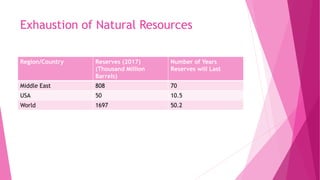
Middle East 808 70
USA 50 10.5
World 1697 50.2
Exhaustion of Natural Resources
 The reserves would last only 50 years more.
 Countries like India depend on importing oil from
abroad because they do not have enough stocks of their
own.
 There are countries like USA which have low reserves
and hence want to secure oil through military or
economic power.
SUSTAINABILITY OF DEVELOPMENT
 Consequences of environmental degradation do not respect
national or state boundaries; this issue is no longer region or nation
specific.
 Sustainability of development is comparatively a new area of
knowledge in which scientists, economists, philosophers and other
social scientists are working together.
 The question of development or progress is perennial.
 At all times as a member of society and as individuals we need to
ask where we want to go, what we wish to become and what our
goals are.

Development

  • 1.
  • 2.
    DEVELOPMENT  DIFFERENT PEOPLE,DIFFERENT GOALS  Landless rural labourers - More days of work and better wages, education, no discrimination….  Prosperous farmers from Punjab - high family income, higher support prices, hardworking and cheap labourers; they should be able to settle their children abroad….  Farmers who depend only on rain for growing crops – sufficient rain, fertilizers, subsidy from government, good prices….
  • 3.
    DEVELOPMENT  A ruralwoman from a land owning family – Freedom, education, marry to a wealthy family …..  Urban unemployed youth – Employment, better income, high standard of living – house, car, stylish dress….  A boy from a rich urban family – travelling abroad, site seeing, spending money with friends…..  A girl from a rich urban family – freedom as her brothers, study abroad…  An adivasi from Narmada valley – Food, shelter, clean water, medical facilities….
  • 4.
    DEVELOPMENT - GOALS Different persons can have different developmental goals.  What may be development for one may not be development for the other. It may even be destructive for the other.
  • 5.
    DEVELOPMENT - GOALS A girl expects as much freedom and opportunity as her brother, and that he also shares in the household work. Her brother may not like this.  To get more electricity, industrialists may want more dams. But this may submerge the land and disrupt the lives of people who are displaced – such as tribals. They might resent this and may prefer small check dams or tanks to irrigate their land.
  • 6.
    INCOME AND OTHERGOALS  People want more income, regular work, better wages, and decent price for their crops….  People also seek things like equal treatment, freedom, security, and respect of others. They resent discrimination.  Material things that one can buy with money, but the quality of our life depends on non-material things – friendship  Job in a far off place - apart from income, such as facilities for your family, working atmosphere, or opportunity to learn.  Less pay but may offer regular employment that enhances your sense of security
  • 7.
    MIX GOALS  Highpay but no job security and also leave no time for your family.  If women are engaged in paid work, their dignity in the household and society increases.  if there is respect for women there would be more sharing of housework and a greater acceptance of women working outside.  A safe and secure environment may allow more women to take up a variety of jobs or run a business.
  • 8.
    NATIONAL DEVELOPMENT  Differentpersons could have different as well as conflicting notions of a country’s development.  Can all the ideas be considered equally important?  Or, if there are conflicts how does one decide?  whether there is a better way of doing things.  Would the idea benefit a large number of people or only a small group?
  • 9.
    HOW TO COMPARE? Some countries are called developed and others underdeveloped.  When we compare different things, they could have similarities as well as differences.  Students - differ in their height, health, talents and interests.  We use different criterion to choose a sports team, a debate team, a music team or a team to organise a picnic.  All-round progress - one or more important characteristics.
  • 10.
    Comparing Countries  Forcomparing countries, their income is considered to be one of the most important attributes.  This is based on the understanding that more income means more of all things that human beings need.  Total income - the income of all the residents of the country.  Total income is not such an useful measure - Since, countries have different populations, comparing total income will not tell us what an average person is likely to earn.
  • 11.
    Comparing Countries  Averageincome which is the total income of the country divided by its total population.  The average income is also called per capita income.  In World Development Reports, brought out by the World Bank, this criterion is used in classifying countries.  Countries with per capita income of US$ 12,056 per annum and above in 2017, are called rich countries and those with per capita income of US$ 955 or less are called low-income countries.
  • 12.
    Comparing Countries  Indiacomes in the category of low middle income countries because its per capita income in 2017 was just US$ 1820 per annum.  Pg No. 9
  • 13.
    INCOME AND OTHERCRITERIA  Pg No. 10  Haryana will be considered the most developed and Bihar the least developed state of the three.  Infant Mortality Rate (IMR)  Literacy Rate  Net Attendance Ratio
  • 14.
    PUBLIC FACILITIES  Haryanahas more income than the average person in Kerala but lags behind in some crucial areas.  Money in your pocket cannot buy all the goods and services that you may need to live well  Money cannot buy you a pollution-free environment or ensure that you get unadulterated medicines, unless you can afford to shift to a community that already has all these things.  Money may also not be able to protect you from infectious diseases, unless the whole of your community takes preventive steps.
  • 15.
    PUBLIC FACILITIES  Thebest and the cheapest way, is to provide these goods and services collectively.  cheaper to have collective security for the whole locality than for each house to have its own security man.  What if no one, other than you, in your village or locality is interested in studying?  Even now, in many areas, children, particularly girls, are not able to go to high school because the government/society has not provided adequate facilities.
  • 16.
    PUBLIC FACILITIES  Keralahas a low Infant Mortality Rate because it has adequate provision of basic health and educational facilities.  Similarly, in some states, the Public Distribution System (PDS) functions well.  Health and nutritional status of people of such states is certainly likely to be better.
  • 17.
    Body Mass Index(BMI)  Weight in Kilograms  Height in Meters  Divide the weight in kg by the square of the height
  • 18.
    HUMAN DEVELOPMENT REPORT Income is an important indicator for development  Other criterion- Health and education indicators  Human Development Report published by UNDP compares countries based on the educational levels of the people, their health status and per capita income.  UNDP- The United Nations Development Programme
  • 19.
    INDIA AND ITSNEIGHBOURS  Gross National Income (GNI) Per capita  Life Expectancy at birth  Mean years of schooling of people aged 25 and above  HDI Rank in the world  Sri Lanka is much ahead of India (76 and 130)
  • 20.
    SUSTAINABILITY OF DEVELOPMENT Groundwater in India  About 300 districts have reported a water level decline of over 4 metres during the past 20 years.  In another 25 years, 60 per cent of the country would be doing the same if the present way of using this resource continues.  Agriculturally prosperous regions of Punjab and Western U.P., hard rock plateau areas of central and south India, some coastal areas and the rapidly growing urban settlements.
  • 21.
    SUSTAINABILITY OF DEVELOPMENT Groundwater is an example of renewable resources.  If we use more than what is being replenished by rain then we would be overusing this resource.  Non renewable resources: We have a fixed stock on earth which cannot be replenished.  We do discover new resources that we did not know of earlier. New sources in this way add to the stock
  • 22.
    Exhaustion of NaturalResources Region/Country Reserves (2017) (Thousand Million Barrels) Number of Years Reserves will Last Middle East 808 70 USA 50 10.5 World 1697 50.2
  • 23.
    Exhaustion of NaturalResources  The reserves would last only 50 years more.  Countries like India depend on importing oil from abroad because they do not have enough stocks of their own.  There are countries like USA which have low reserves and hence want to secure oil through military or economic power.
  • 24.
    SUSTAINABILITY OF DEVELOPMENT Consequences of environmental degradation do not respect national or state boundaries; this issue is no longer region or nation specific.  Sustainability of development is comparatively a new area of knowledge in which scientists, economists, philosophers and other social scientists are working together.  The question of development or progress is perennial.  At all times as a member of society and as individuals we need to ask where we want to go, what we wish to become and what our goals are.