Prepared by
Prashant Aghara
Dharam Rughani
Culture & Its Learnings
Contents
Definition
Theoretical model of Culture
Invisible Hand of Culture
Elements of culture
Levels
How culture satisfies needs?
Culture is learned
Culture is Dynamic
What is Culture?
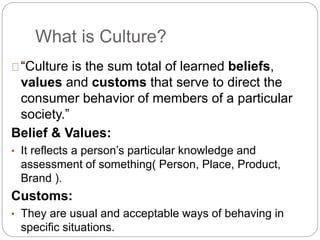
“Culture is the sum total of learned beliefs,
values and customs that serve to direct the
consumer behavior of members of a particular
society.”
Belief & Values:
• It reflects a person’s particular knowledge and
assessment of something( Person, Place, Product,
Brand ).
Customs:
• They are usual and acceptable ways of behaving in
specific situations.
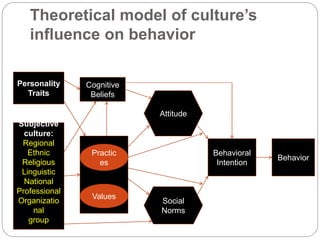
Theoretical model of culture’s
influence on behavior
Subjective
culture:
Regional
Ethnic
Religious
Linguistic
National
Professional
Organizatio
nal
group
Personality
Traits
Practic
es
Values
Cognitive
Beliefs
Attitude
Social
Norms
Behavioral
Intention
Behavior
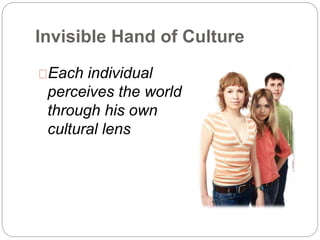
Invisible Hand of Culture
Each individual
perceives the world
through his own
cultural lens
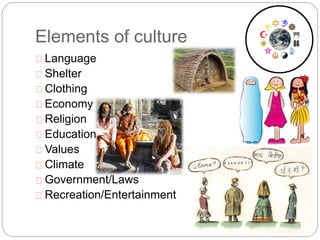
Elements of culture
Language
Shelter
Clothing
Economy
Religion
Education
Values
Climate
Government/Laws
Recreation/Entertainment
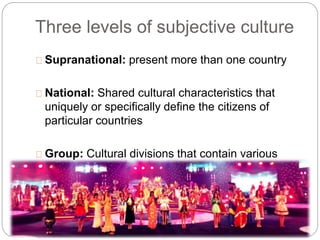
Three levels of subjective culture
Supranational: present more than one country
National: Shared cultural characteristics that
uniquely or specifically define the citizens of
particular countries
Group: Cultural divisions that contain various
collections of individual (e.g. families, work
groups, friendships)
Culture satisfies needs
Food and Clothing
Needs vs. Luxury
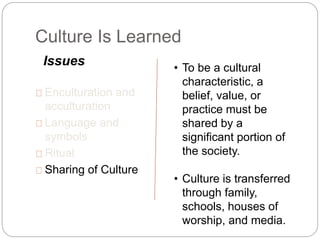
Culture Is Learned
Enculturation and
acculturation
Language and
symbols
Ritual
Sharing of culture
Issues
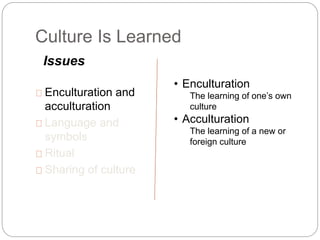
• Enculturation
The learning of one’s own
culture
• Acculturation
The learning of a new or
foreign culture
Culture Is Learned
Enculturation and
acculturation
Language and
symbols
Ritual
Sharing of culture
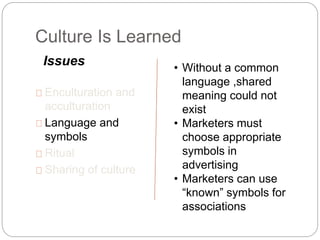
Issues • Without a common
language ,shared
meaning could not
exist
• Marketers must
choose appropriate
symbols in
advertising
• Marketers can use
“known” symbols for
associations
Culture Is Learned
Enculturation and
acculturation
Language and
symbols
Ritual
Sharing of culture
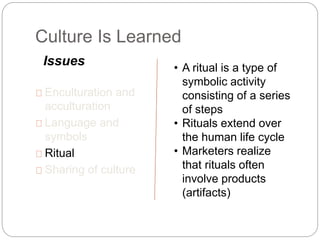
Issues • A ritual is a type of
symbolic activity
consisting of a series
of steps
• Rituals extend over
the human life cycle
• Marketers realize
that rituals often
involve products
(artifacts)
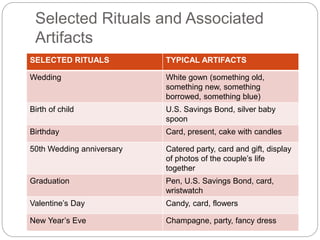
Selected Rituals and Associated
Artifacts
SELECTED RITUALS TYPICAL ARTIFACTS
Wedding White gown (something old,
something new, something
borrowed, something blue)
Birth of child U.S. Savings Bond, silver baby
spoon
Birthday Card, present, cake with candles
50th Wedding anniversary Catered party, card and gift, display
of photos of the couple’s life
together
Graduation Pen, U.S. Savings Bond, card,
wristwatch
Valentine’s Day Candy, card, flowers
New Year’s Eve Champagne, party, fancy dress
Culture Is Learned
Enculturation and
acculturation
Language and
symbols
Ritual
Sharing of Culture
Issues • To be a cultural
characteristic, a
belief, value, or
practice must be
shared by a
significant portion of
the society.
• Culture is transferred
through family,
schools, houses of
worship, and media.
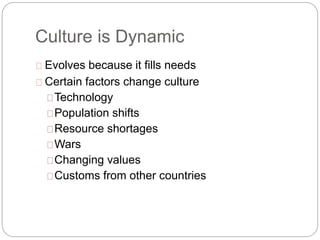
Culture is Dynamic
Evolves because it fills needs
Certain factors change culture
Technology
Population shifts
Resource shortages
Wars
Changing values
Customs from other countries
THANK YOU….!!

Culture & its learnings

  • 1.
    Prepared by Prashant Aghara DharamRughani Culture & Its Learnings
  • 2.
    Contents Definition Theoretical model ofCulture Invisible Hand of Culture Elements of culture Levels How culture satisfies needs? Culture is learned Culture is Dynamic
  • 3.
    What is Culture? “Cultureis the sum total of learned beliefs, values and customs that serve to direct the consumer behavior of members of a particular society.” Belief & Values: • It reflects a person’s particular knowledge and assessment of something( Person, Place, Product, Brand ). Customs: • They are usual and acceptable ways of behaving in specific situations.
  • 4.
    Theoretical model ofculture’s influence on behavior Subjective culture: Regional Ethnic Religious Linguistic National Professional Organizatio nal group Personality Traits Practic es Values Cognitive Beliefs Attitude Social Norms Behavioral Intention Behavior
  • 5.
    Invisible Hand ofCulture Each individual perceives the world through his own cultural lens
  • 6.
  • 7.
    Three levels ofsubjective culture Supranational: present more than one country National: Shared cultural characteristics that uniquely or specifically define the citizens of particular countries Group: Cultural divisions that contain various collections of individual (e.g. families, work groups, friendships)
  • 8.
    Culture satisfies needs Foodand Clothing Needs vs. Luxury
  • 9.
    Culture Is Learned Enculturationand acculturation Language and symbols Ritual Sharing of culture Issues • Enculturation The learning of one’s own culture • Acculturation The learning of a new or foreign culture
  • 10.
    Culture Is Learned Enculturationand acculturation Language and symbols Ritual Sharing of culture Issues • Without a common language ,shared meaning could not exist • Marketers must choose appropriate symbols in advertising • Marketers can use “known” symbols for associations
  • 11.
    Culture Is Learned Enculturationand acculturation Language and symbols Ritual Sharing of culture Issues • A ritual is a type of symbolic activity consisting of a series of steps • Rituals extend over the human life cycle • Marketers realize that rituals often involve products (artifacts)
  • 12.
    Selected Rituals andAssociated Artifacts SELECTED RITUALS TYPICAL ARTIFACTS Wedding White gown (something old, something new, something borrowed, something blue) Birth of child U.S. Savings Bond, silver baby spoon Birthday Card, present, cake with candles 50th Wedding anniversary Catered party, card and gift, display of photos of the couple’s life together Graduation Pen, U.S. Savings Bond, card, wristwatch Valentine’s Day Candy, card, flowers New Year’s Eve Champagne, party, fancy dress
  • 13.
    Culture Is Learned Enculturationand acculturation Language and symbols Ritual Sharing of Culture Issues • To be a cultural characteristic, a belief, value, or practice must be shared by a significant portion of the society. • Culture is transferred through family, schools, houses of worship, and media.
  • 14.
    Culture is Dynamic Evolvesbecause it fills needs Certain factors change culture Technology Population shifts Resource shortages Wars Changing values Customs from other countries
  • 15.

Editor's Notes

  • #4 To understand culture, just think of the difference between two societies. How do they think, believe, and act differently? Even though many believe culture is becoming less distinct from country to country, I am sure you can identify differences in values and behaviors.
  • #5 This theoretical model of culture’s influence on behavior gives us a sense of how culture combines with personality traits to build our beliefs and values. This forms our attitudes, which combine with social norms to determine how we intend to behave, and consequently do behave, in given situations.
  • #6 We often don’t think about the influence that culture has on behavior. Sometimes things just seem like the “right thing to do.” The statement in this slide helps sum up culture as a lens with which people see the world.
  • #9 What kinds of needs does culture help satisfy? It helps us decide where to eat, when to eat, and what to eat. It helps us know which products we simply must have, like a cell phone, and what products are a luxury, like a private plane.
  • #10 We learn about our own culture from the time we are small children. Through both informal and formal learning, we learn how to behave and the difference between right and wrong. The learning of our own culture usually happens slowly over time. Quite often, when someone moves, they must learn a new culture. This process of acculturation can be very difficult and will differ based on age, interest in the culture, and desire to become part of the new society. This web link gives you information on doing business in Japan and some cultural issues, including etiquette and manners.
  • #11 There is a strong symbolic nature to human language. We use symbols to communicate with each other and marketers will use symbols to communicate to their customers.
  • #12 You can probably think of many rituals in which you have been involved – birthday parties, weddings, graduations, or religious rites of passage. Many of these rituals involved artifacts, objects that are important to the day. Some rituals might even be informal, like poker night. Are there certain artifacts that students absolutely must have? Food, perhaps, music or objects.
  • #14 A culture can not just exist within one person. There must be a large group which is involved, a significant portion of society. We will discuss subcultures in the next chapter, which are smaller subcultural groups that exist within larger cultures.
  • #15 It is important for marketers to realize that culture is changing. The products that fulfill needs, what is cool and in style, are constantly changing. Large cultural shifts may occur due to events that affect society. Certain cultures would like to change. For example, this is a link to changing the drinking culture at colleges.