HUMOV1003 Community
and Bush Environments
Seminar six
Large human movements spring from
individual human initiatives. If you feel that
you cannot have much of an effect, the next
person may also become discouraged and a
great opportunity will have been lost.
On the other hand, each of us can inspire
others simply by working to develop our own
altruistic motivation
His Holiness the Dalai Lama
“
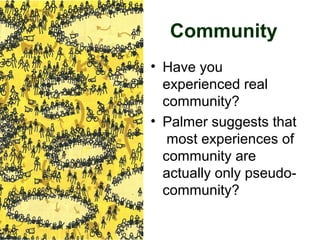
Community
• Have you
experienced real
community?
• Palmer suggests that
most experiences of
community are
actually only pseudo-
community?
Parker Palmer on real C.
The concept of community has been distorted -
most references to community are more
realistically - Pseudocommunity – where people
hate conflicts
Parker Palmer on real C.
By contrast real community is only reached
through hard work … at a great cost.
Parker Palmer on real C.
To be connected – you have to look at your heart –
otherwise you will not be able to respond to
criticism – you will always be defending. The heart
needs to be a place of peace. (need to know what
you believe and be OK with that - worldviews?)
Parker Palmer on real C.
Real community involves: taking social risks, being
vulnerable, being able to forgive, soft
individualism, working from a position of
weakness, taking responsibility for our own
actions.
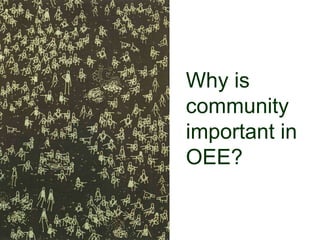
Why is
community
important in
OEE?
Is community that important?
Rousseau (1991) - we all experience an
ontological loneliness
This brings discomfort, loneliness, anguish.
Our distinctively human way of overcoming
solitude is to “enter into unity with, share the
existence of, other beings through knowing
and loving them” (p35)
Is community that important?
What are the consequences of non-
community?
The “true” meaning of community(according to Peck 1990)
Concept of community is used far too loosely
Community is like a gem - multi-faceted,
inherently mysterious, miraculous,
unfathomable
1. Inclusivity
• Most groups are exclusive cliques that
work hard to keep people out.
• It is much easier to exclude rather than
include.
• Communities seek to be inclusive
• Inclusivity extends the groups
2. Commitment
• Must be a willingness to co-exist - and
make it work
• Requires an appreciation of differences.
3. Consensus
• Community avoids the use of voting to
resolve differences - as in a democracy
• Consensus values individual difference -
which is not congruent with “majority
rules”.
• Consensus is when all agree that they
have come to the best decision for the
group at that time, given all the
circumstances.
4. Realism
• Diversity and difference are more likely to
produce realistic solutions to problems
• The multiple points of view and freedom of
expression usually gives a better
understanding of the situation
• Humility is a key ingredient because you
begin to appreciate other people’s gifts and
recognise your own limitations
5. Contemplation
• Community is self examining, self-critical,
self aware
• Contemplation is the key to insight
• You don’t reach community and sit back
and relax
6. A safe place
• Acceptance and freedom to be yourself is
a critical part of community
• Community is healing - even though that is
not the focus of community - more a by
product
7. Fight gracefully
• there are no sides, factions - cliques have
been dropped
• Community is a place where conflict can
be resolved without bloodshed
• Conflict resolution is a product more than a
pre-requisite to community
8. A group of leaders
• Total decentralisation of authority
• Not leaderless - leader-full
• Flow of leadership
Community concepts
Community is essentially about being a part of a group
where:
People can be themselves without fear of being judged or
condemned by others
People are committed to work together and although conflicts
occur they are resolved without big dramas.
Forgiveness runs freely.
People’s strengths are respected and utilised for the good of
the group. People’s weaknesses are shared, understood, and
accepted.
You feel safe to try (and possibly fail) new things.
People are welcome to participate in the group - it is not just a
little club for people who feel the same way.
Community in OE
• How realistic is it to expect us to
experience/promote community in our OE
program?
• What are the constraints to establishing
true community - what makes it hard for
OE?
• Should community even be something that
we strive for in OE programs?

What is community?

  • 1.
    HUMOV1003 Community and BushEnvironments Seminar six
  • 2.
    Large human movementsspring from individual human initiatives. If you feel that you cannot have much of an effect, the next person may also become discouraged and a great opportunity will have been lost. On the other hand, each of us can inspire others simply by working to develop our own altruistic motivation His Holiness the Dalai Lama “
  • 3.
    Community • Have you experiencedreal community? • Palmer suggests that most experiences of community are actually only pseudo- community?
  • 4.
    Parker Palmer onreal C. The concept of community has been distorted - most references to community are more realistically - Pseudocommunity – where people hate conflicts
  • 5.
    Parker Palmer onreal C. By contrast real community is only reached through hard work … at a great cost.
  • 6.
    Parker Palmer onreal C. To be connected – you have to look at your heart – otherwise you will not be able to respond to criticism – you will always be defending. The heart needs to be a place of peace. (need to know what you believe and be OK with that - worldviews?)
  • 7.
    Parker Palmer onreal C. Real community involves: taking social risks, being vulnerable, being able to forgive, soft individualism, working from a position of weakness, taking responsibility for our own actions.
  • 8.
  • 9.
    Is community thatimportant? Rousseau (1991) - we all experience an ontological loneliness This brings discomfort, loneliness, anguish. Our distinctively human way of overcoming solitude is to “enter into unity with, share the existence of, other beings through knowing and loving them” (p35)
  • 10.
    Is community thatimportant? What are the consequences of non- community?
  • 11.
    The “true” meaningof community(according to Peck 1990) Concept of community is used far too loosely Community is like a gem - multi-faceted, inherently mysterious, miraculous, unfathomable
  • 12.
    1. Inclusivity • Mostgroups are exclusive cliques that work hard to keep people out. • It is much easier to exclude rather than include. • Communities seek to be inclusive • Inclusivity extends the groups
  • 13.
    2. Commitment • Mustbe a willingness to co-exist - and make it work • Requires an appreciation of differences.
  • 14.
    3. Consensus • Communityavoids the use of voting to resolve differences - as in a democracy • Consensus values individual difference - which is not congruent with “majority rules”. • Consensus is when all agree that they have come to the best decision for the group at that time, given all the circumstances.
  • 15.
    4. Realism • Diversityand difference are more likely to produce realistic solutions to problems • The multiple points of view and freedom of expression usually gives a better understanding of the situation • Humility is a key ingredient because you begin to appreciate other people’s gifts and recognise your own limitations
  • 16.
    5. Contemplation • Communityis self examining, self-critical, self aware • Contemplation is the key to insight • You don’t reach community and sit back and relax
  • 17.
    6. A safeplace • Acceptance and freedom to be yourself is a critical part of community • Community is healing - even though that is not the focus of community - more a by product
  • 18.
    7. Fight gracefully •there are no sides, factions - cliques have been dropped • Community is a place where conflict can be resolved without bloodshed • Conflict resolution is a product more than a pre-requisite to community
  • 19.
    8. A groupof leaders • Total decentralisation of authority • Not leaderless - leader-full • Flow of leadership
  • 20.
    Community concepts Community isessentially about being a part of a group where: People can be themselves without fear of being judged or condemned by others People are committed to work together and although conflicts occur they are resolved without big dramas. Forgiveness runs freely. People’s strengths are respected and utilised for the good of the group. People’s weaknesses are shared, understood, and accepted. You feel safe to try (and possibly fail) new things. People are welcome to participate in the group - it is not just a little club for people who feel the same way.
  • 21.
    Community in OE •How realistic is it to expect us to experience/promote community in our OE program? • What are the constraints to establishing true community - what makes it hard for OE? • Should community even be something that we strive for in OE programs?

Editor's Notes

  • #4 <?xml version="1.0" encoding="ISO-8859-1" ?> <poll url="http://www.polleverywhere.com/free_text_polls/D7HnpzYap7Hc9XE"> <!-- This snippet was inserted via the PollEv Presenter app --> <!-- The presence of this snippet is used to indicate that a poll will be shown during the slideshow --> <!-- TIP: You can draw a solid, filled rectangle on your slide and the PollEv Presenter will automatically display your poll in that area. --> <!-- The PollEv Presenter app must also be running and logged in for this to work. --> <!-- To remove this, simply delete it from the notes yourself or use the PollEv Presenter to remove it for you. --> <title>What is one would you would use to describe community?</title> </poll>
  • #5 Discuss in pairs when you have experienced real community – sporting club, family, school, friendship group?
  • #11 Just like your comments on the solo experience?
  • #23 What is the value of community in OE? Let’s revisit the why question – Why is community important in OEE? In small groups, discuss the first two questions. What are your responses?