Navigation Review
  How much do you remember?
Grid References
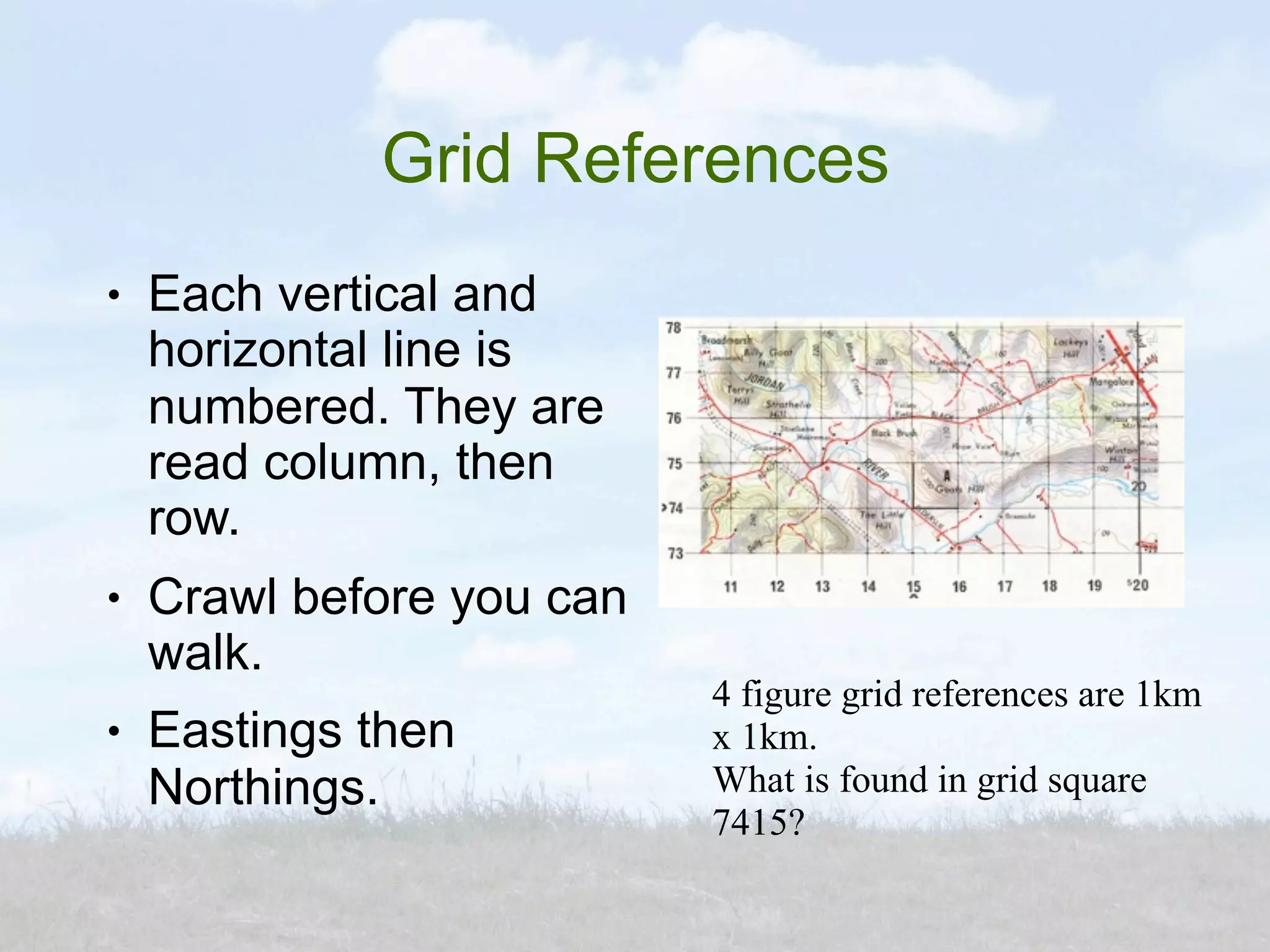
●   Each vertical and
    horizontal line is
    numbered. They are
    read column, then
    row.
●   Crawl before you can
    walk.
                           4 figure grid references are 1km
●   Eastings then          x 1km.
    Northings.             What is found in grid square
                           7415?
Grid References
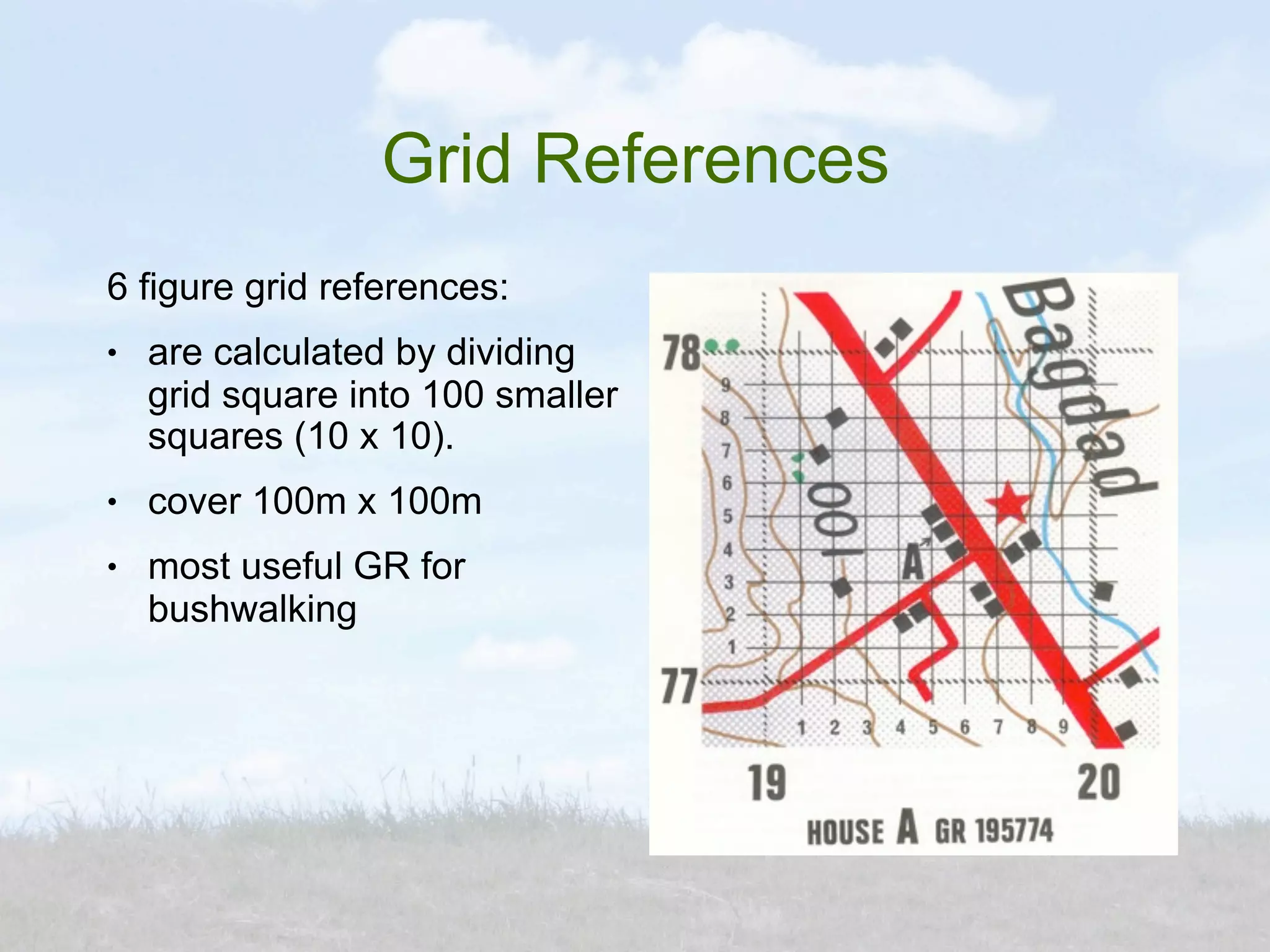
6 figure grid references:
●   are calculated by dividing
    grid square into 100 smaller
    squares (10 x 10).
●   cover 100m x 100m
●   most useful GR for
    bushwalking
North
True, magnetic, Grid
●   True North - the direction of the North Pole
    (where longitude meet)
●   Magnetic North - direction compass points to
    when free from interference
●   Grid North - used to orientate each Grid Zone
    (result of representing a round object on a flat
    surface)
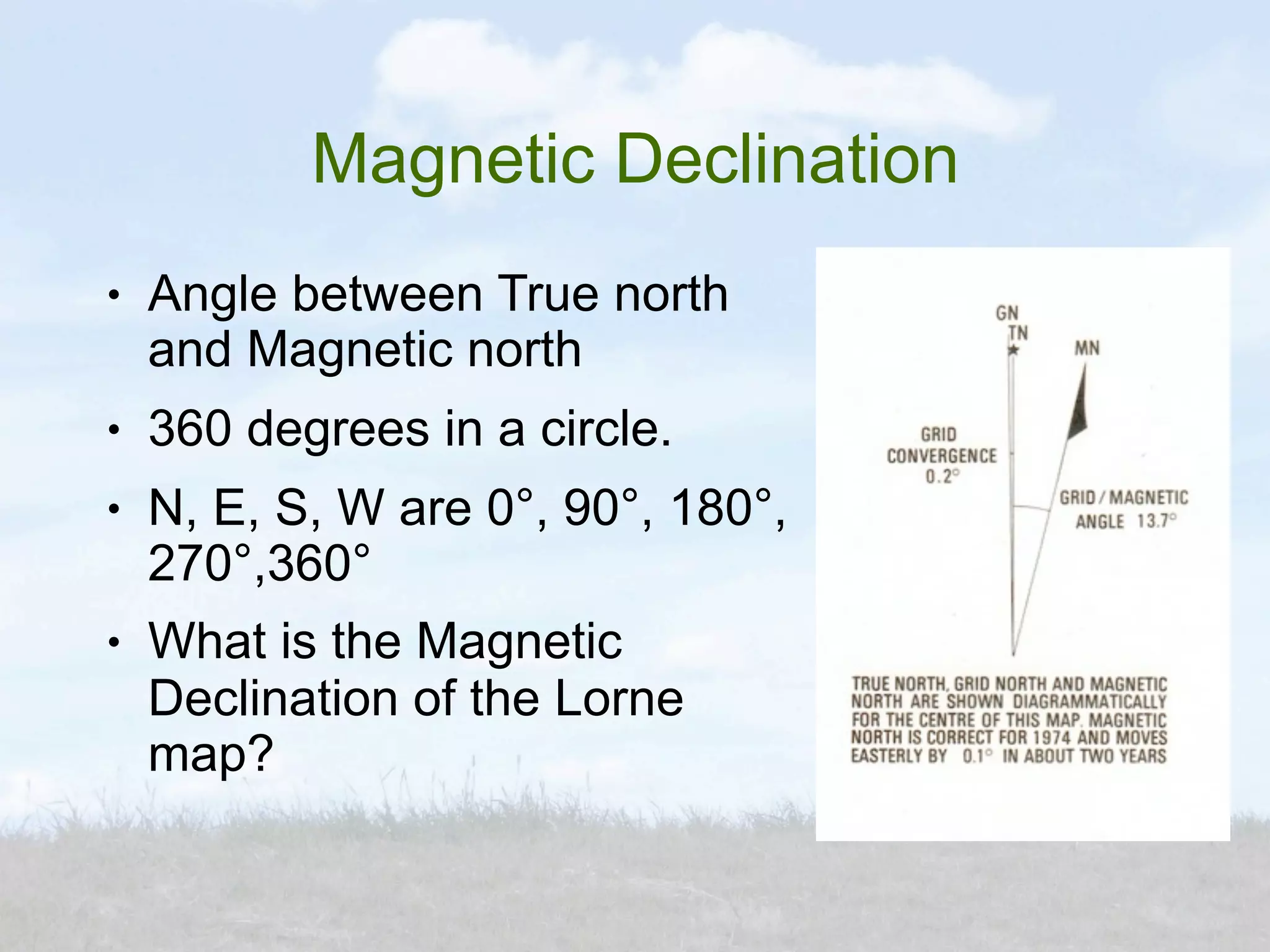
Magnetic Declination
●   Angle between True north
    and Magnetic north
●   360 degrees in a circle.
●   N, E, S, W are 0°, 90°, 180°,
    270°,360°
●   What is the Magnetic
    Declination of the Lorne
    map?
Scale Bar
●   Maps are scaled down versions of the land. The
    scale bar tells us the ratio of map coverage to
    ground coverage.
●   On a 1:50,000, 1km = 2 cm of map, or 1cm of map
    = 500 metres.
●   Grid Interval
●   Contour Interval
●   Australian Map Grid Zone
●   What is the scale of the Lorne map?
Orienting a map using land features
Observations
●   Shape of the land - don’t be too quick to make
    the map fit.
●   Gradient - how steep is the slope?
●   Aspect - what direction does the slope face?
●   Distance travelled - how far have you come, how
    far do you have to go?
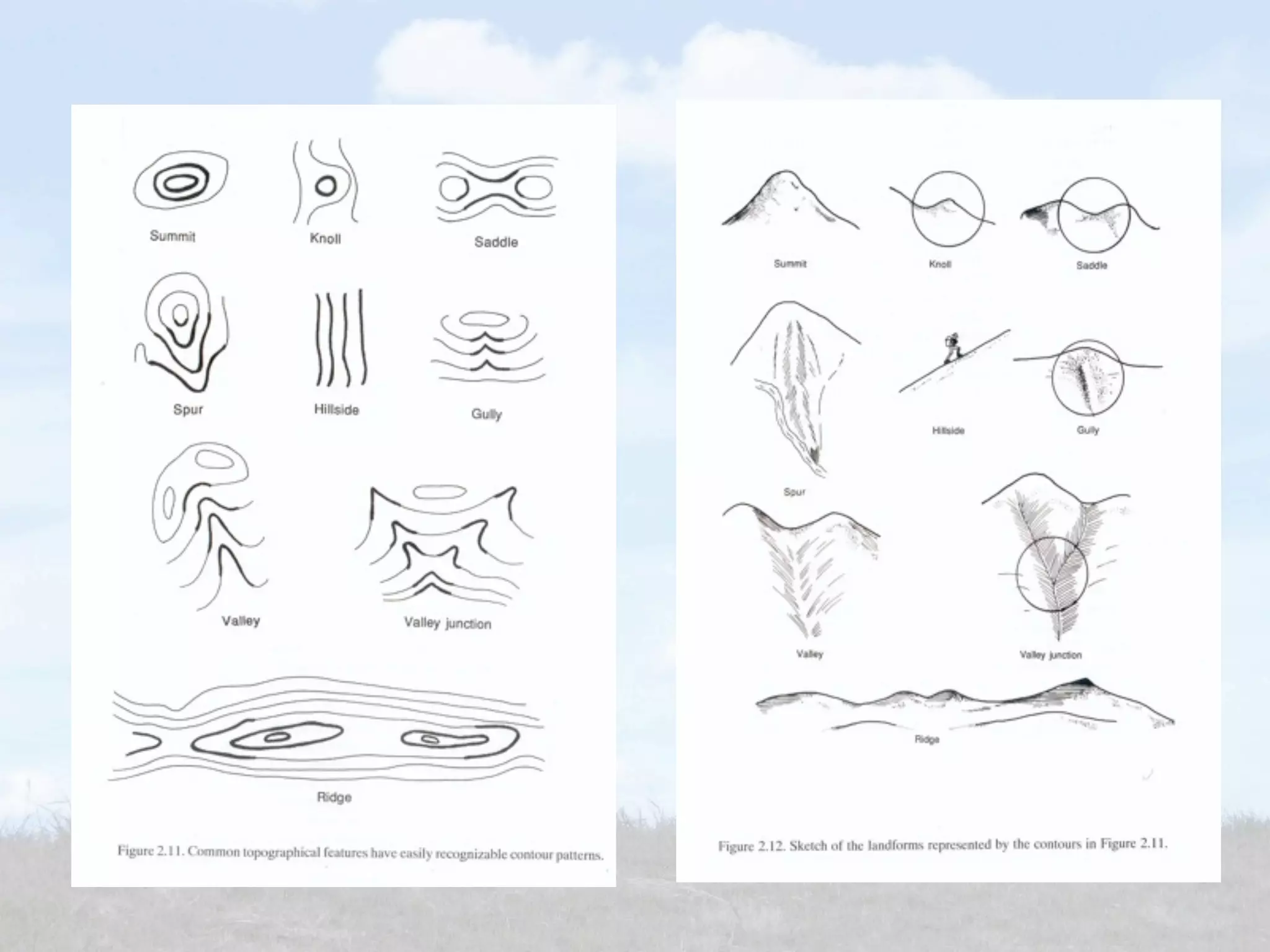
●   Gullies, knolls, saddles
Orienting a map using land features
●   Other information helpful in confirming position -
    huts, tracks, ruins, old mines - do not jump to
    conclusion too quickly as human made objects
    are not always marked accurately.
●   Vegetation coverage
●   Shadow - related to direction finding using the
    sun
●   Time of year, plants flowering, temperature in
    gullies in/out of sun, winter/summer.
Before you start, ask yourself...
●   Position - Where am I?
●   Direction - What direction do I need to go?
●   Distance - How far do I need to go?
●   Time - How long will it take?
●   Strategies - What strategies will I use?
●   Arrive - How will I know when I get there?
●   Overshoot - How will I know if I have gone too far?
●   PDDTSAO (Please Don’t Die Today Stressing About
    Orienteering).
Strategies

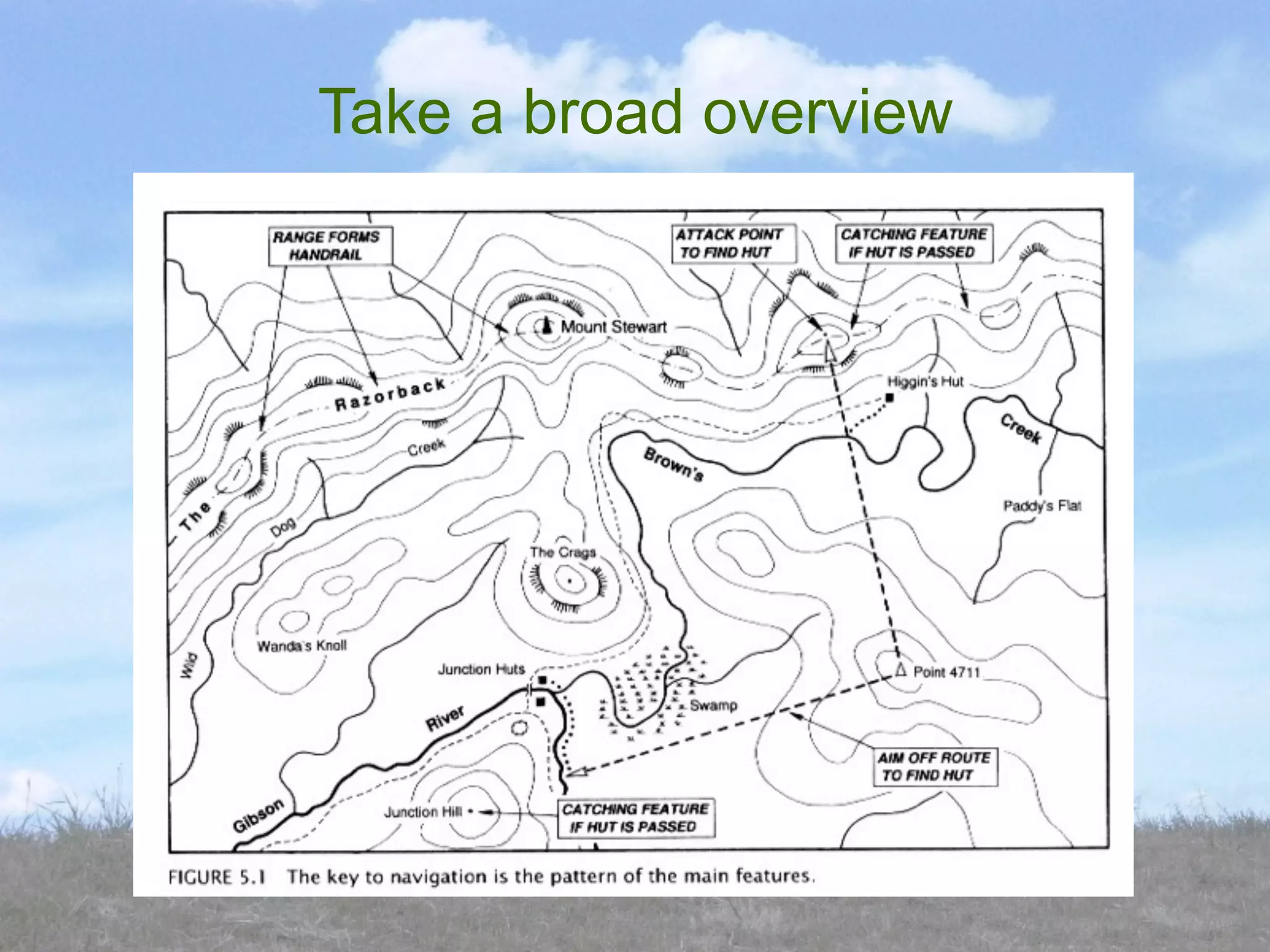
● Aiming off.
● Catching features.

● Handrails.


● Attack points.

● Thumbing the map.
Aiming Off
●   Deliberately aiming to one side of your
    destination in order to know which way to turn
    when reaching the creek/track
●   Used when travelling to a linear feature.
Handrails
●    Features that help you to follow roughly the
     direction of travel that you need to take.
    Examples of handrails -
     – waterways.
     – fences, tracks, power lines.
     – cliff edge, ridge.
     – vegetation boundaries
Catching Features
●   A prominent feature beyond your destination that
    signals to you that you have missed your
    destination.
●   Oops, it is back there!!
Attack Points
●   A point close to your destination which is easier
    to locate than your destination.
For example -
    – Knoll, saddle, cliff
    – Dam, paddock
    – Vegetation boundaries
Thumbing the map

●   Thumbing the map helps you to stay focussed
    on your position when in difficult terrain.
Map and Compass
    Orientating your map.
●    Place compass on map. Both must be flat!!
●    Align grid lines up on map with grid lines of the
     reference arrow within the capsule of the
     compass.
●    Turn (rotate) the map until the magnetic needle
     is inside the reference arrow (Red in the Shed).
●    When this has been completed, your map is
     orientated north.
Bearings
    Back Bearings and triangulations.
●    A back bearing is from a known point back to you (ie
     180°).
●    Triangulations - the method used to fix your location
     using 3 known points. And using 3 back bearings.
Route Planning
●   More than just plotting the shortest route from A
    to B
●   Ensures trip meets expectations of the group
●   Provides appropriate challenge
●   Allows opportunity for enjoyment
Route Planning
There are many factors involved in planning for a
bushwalk:
–   Time of year, weather, water etc.
–   Maps - availability/accuracy
–   Location of campsites, escape routes, rivers
–   Capabilities of the group
What do I need to know?
●   Is the route likely to be affected by weather?
    –   River crossings, treeless plains etc.
●   Is the altitude gained or lost within the
    capabilities of the group?
●   Obstacles to slow the group
●   Type of terrain
●   Vegetation – how dense?
●   What is the environmental impact of the group?
What do I need to know?
●   Is the route safe?
    –   Mineshafts, snow drifts, fire
●   Required equipment
●   Water availability
    –   How much needs to be carried?
●   Are the campsites at appropriate spots?
●   Is there enough time without rushing?
Making it easier to plan
●   Easier to go up a spur and down a gully
●   Vegetation is often less dense on top of spurs
    and ridges
●   North facing slopes are drier, less scrubby
●   South facing slopes are wetter, scrubbier
●   Granite country, gullies are easier, spurs have
    boulders
●   Big climbs should be at the start of trip or day
Measuring distance on a map

●   String – compass strap
●   Edge of paper
●   Blade of grass
How long 'til we get there?
●   Many variables are involved in predicting walk
    times
●   Naismith's rule works well in Australia
●   For an average walker with a medium pack,
    allow one hour for:
    –   Every 4km of easy going
    –   Every 3km of easy scrambling
    –   Every 1.5km of very rough country/thick bush
How long 'til we get there?
●   Then add:
    –   One hour for every 500m of up
    –   One hour for every 1000m of down
●   Remember:
●   This rule is for an 'average' group.
    –   For fit and experienced walkers, reduce by a third
    –   For larger less experienced walkers, this rule may be
        optimistic
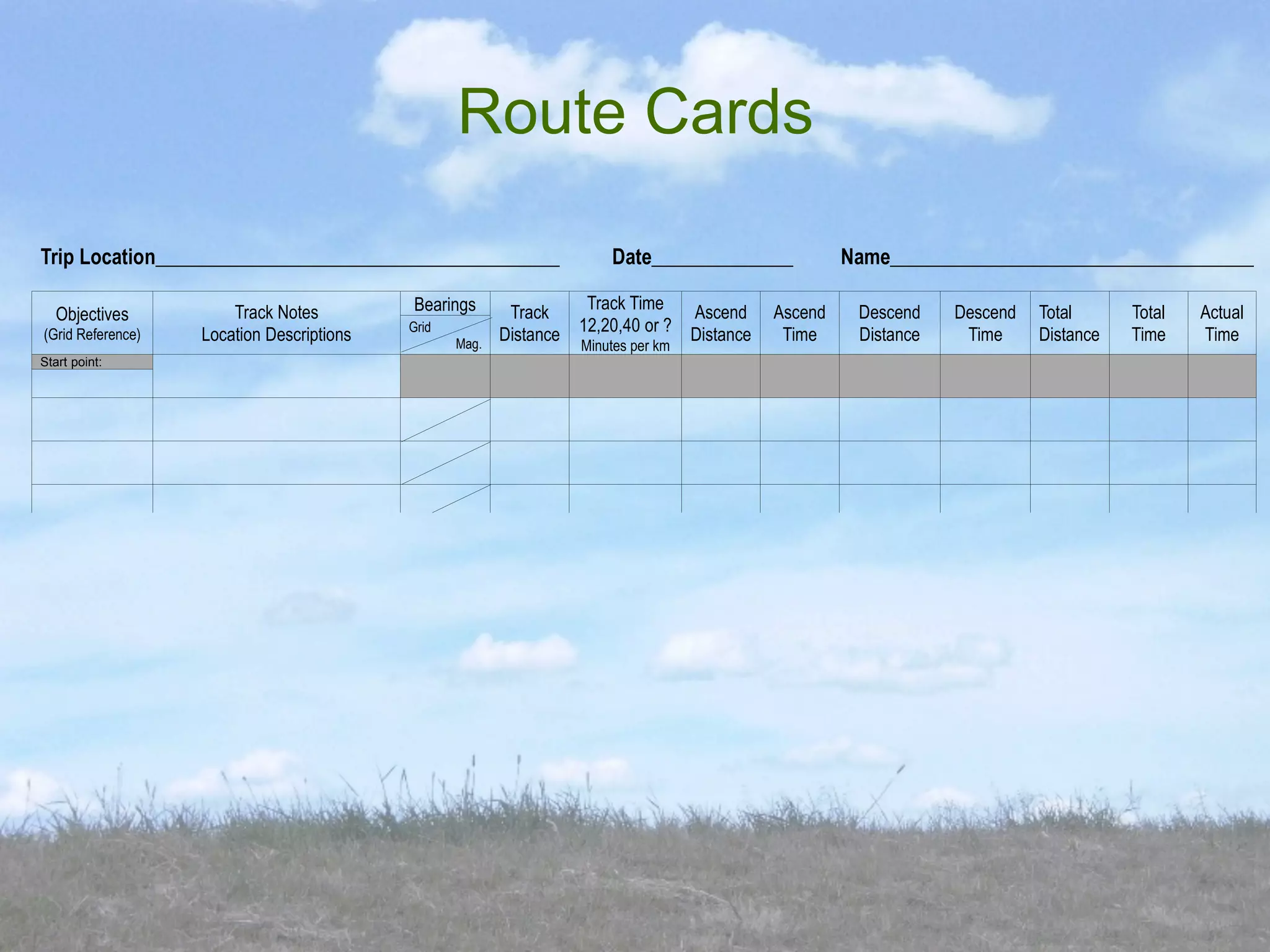
Route Cards
●   A simple method of recording the information
    gained about the stages of a trip
●   Break the trip into easy achievable goals
●   If you have prepared a route card well, you will
    feel like you have already walked the route
    before.
Route Cards
●   Break the trip into short easy stages.
●   Avoid change of navigated route within a stage
●   Include:
    –   Distance
    –   Estimate of time required
    –   Ascent and descent information
Take a broad overview
Route Cards
                                                      Certificate IV in Outdoor Recreation

Trip Location________________________________________                   Date______________            Name____________________________________

                       Track Notes         Bearings       Track      Track Time   Ascend     Ascend    Descend    Descend   Total      Total   Actual
  Objectives
(Grid Reference)   Location Descriptions   Grid
                                                         Distance   12,20,40 or ? Distance    Time     Distance    Time     Distance   Time    Time
                                                  Mag.              Minutes per km
Start point:
How to create a route card
●   For more info, check out pp 16 in Bushwalking
    and Ski Touring Leadership (2000).

Expo navigation revision

  • 1.
    Navigation Review How much do you remember?
  • 2.
    Grid References ● Each vertical and horizontal line is numbered. They are read column, then row. ● Crawl before you can walk. 4 figure grid references are 1km ● Eastings then x 1km. Northings. What is found in grid square 7415?
  • 3.
    Grid References 6 figuregrid references: ● are calculated by dividing grid square into 100 smaller squares (10 x 10). ● cover 100m x 100m ● most useful GR for bushwalking
  • 4.
    North True, magnetic, Grid ● True North - the direction of the North Pole (where longitude meet) ● Magnetic North - direction compass points to when free from interference ● Grid North - used to orientate each Grid Zone (result of representing a round object on a flat surface)
  • 5.
    Magnetic Declination ● Angle between True north and Magnetic north ● 360 degrees in a circle. ● N, E, S, W are 0°, 90°, 180°, 270°,360° ● What is the Magnetic Declination of the Lorne map?
  • 6.
    Scale Bar ● Maps are scaled down versions of the land. The scale bar tells us the ratio of map coverage to ground coverage. ● On a 1:50,000, 1km = 2 cm of map, or 1cm of map = 500 metres. ● Grid Interval ● Contour Interval ● Australian Map Grid Zone ● What is the scale of the Lorne map?
  • 8.
    Orienting a mapusing land features Observations ● Shape of the land - don’t be too quick to make the map fit. ● Gradient - how steep is the slope? ● Aspect - what direction does the slope face? ● Distance travelled - how far have you come, how far do you have to go? ● Gullies, knolls, saddles
  • 9.
    Orienting a mapusing land features ● Other information helpful in confirming position - huts, tracks, ruins, old mines - do not jump to conclusion too quickly as human made objects are not always marked accurately. ● Vegetation coverage ● Shadow - related to direction finding using the sun ● Time of year, plants flowering, temperature in gullies in/out of sun, winter/summer.
  • 10.
    Before you start,ask yourself... ● Position - Where am I? ● Direction - What direction do I need to go? ● Distance - How far do I need to go? ● Time - How long will it take? ● Strategies - What strategies will I use? ● Arrive - How will I know when I get there? ● Overshoot - How will I know if I have gone too far? ● PDDTSAO (Please Don’t Die Today Stressing About Orienteering).
  • 11.
    Strategies ● Aiming off. ●Catching features. ● Handrails. ● Attack points. ● Thumbing the map.
  • 12.
    Aiming Off ● Deliberately aiming to one side of your destination in order to know which way to turn when reaching the creek/track ● Used when travelling to a linear feature.
  • 13.
    Handrails ● Features that help you to follow roughly the direction of travel that you need to take. Examples of handrails - – waterways. – fences, tracks, power lines. – cliff edge, ridge. – vegetation boundaries
  • 14.
    Catching Features ● A prominent feature beyond your destination that signals to you that you have missed your destination. ● Oops, it is back there!!
  • 15.
    Attack Points ● A point close to your destination which is easier to locate than your destination. For example - – Knoll, saddle, cliff – Dam, paddock – Vegetation boundaries
  • 16.
    Thumbing the map ● Thumbing the map helps you to stay focussed on your position when in difficult terrain.
  • 17.
    Map and Compass Orientating your map. ● Place compass on map. Both must be flat!! ● Align grid lines up on map with grid lines of the reference arrow within the capsule of the compass. ● Turn (rotate) the map until the magnetic needle is inside the reference arrow (Red in the Shed). ● When this has been completed, your map is orientated north.
  • 18.
    Bearings Back Bearings and triangulations. ● A back bearing is from a known point back to you (ie 180°). ● Triangulations - the method used to fix your location using 3 known points. And using 3 back bearings.
  • 19.
    Route Planning ● More than just plotting the shortest route from A to B ● Ensures trip meets expectations of the group ● Provides appropriate challenge ● Allows opportunity for enjoyment
  • 20.
    Route Planning There aremany factors involved in planning for a bushwalk: – Time of year, weather, water etc. – Maps - availability/accuracy – Location of campsites, escape routes, rivers – Capabilities of the group
  • 21.
    What do Ineed to know? ● Is the route likely to be affected by weather? – River crossings, treeless plains etc. ● Is the altitude gained or lost within the capabilities of the group? ● Obstacles to slow the group ● Type of terrain ● Vegetation – how dense? ● What is the environmental impact of the group?
  • 22.
    What do Ineed to know? ● Is the route safe? – Mineshafts, snow drifts, fire ● Required equipment ● Water availability – How much needs to be carried? ● Are the campsites at appropriate spots? ● Is there enough time without rushing?
  • 23.
    Making it easierto plan ● Easier to go up a spur and down a gully ● Vegetation is often less dense on top of spurs and ridges ● North facing slopes are drier, less scrubby ● South facing slopes are wetter, scrubbier ● Granite country, gullies are easier, spurs have boulders ● Big climbs should be at the start of trip or day
  • 24.
    Measuring distance ona map ● String – compass strap ● Edge of paper ● Blade of grass
  • 25.
    How long 'tilwe get there? ● Many variables are involved in predicting walk times ● Naismith's rule works well in Australia ● For an average walker with a medium pack, allow one hour for: – Every 4km of easy going – Every 3km of easy scrambling – Every 1.5km of very rough country/thick bush
  • 26.
    How long 'tilwe get there? ● Then add: – One hour for every 500m of up – One hour for every 1000m of down ● Remember: ● This rule is for an 'average' group. – For fit and experienced walkers, reduce by a third – For larger less experienced walkers, this rule may be optimistic
  • 27.
    Route Cards ● A simple method of recording the information gained about the stages of a trip ● Break the trip into easy achievable goals ● If you have prepared a route card well, you will feel like you have already walked the route before.
  • 28.
    Route Cards ● Break the trip into short easy stages. ● Avoid change of navigated route within a stage ● Include: – Distance – Estimate of time required – Ascent and descent information
  • 29.
    Take a broadoverview
  • 30.
    Route Cards Certificate IV in Outdoor Recreation Trip Location________________________________________ Date______________ Name____________________________________ Track Notes Bearings Track Track Time Ascend Ascend Descend Descend Total Total Actual Objectives (Grid Reference) Location Descriptions Grid Distance 12,20,40 or ? Distance Time Distance Time Distance Time Time Mag. Minutes per km Start point:
  • 31.
    How to createa route card ● For more info, check out pp 16 in Bushwalking and Ski Touring Leadership (2000).