OEEDU5003 Connecting
with Nature
Week two
What is nature, valuing nature.
• Art Gallery visit next
week. We leave during
class. Who is on the
bus?
• Collaborative learning
reflections, today –
TK, Dave, Hendo
• PDFs on Moodle
• Add paper title on
PDF.
Last week…
Framing behaviours through
language and metaphor
Nature as Friend
• Implies:
– A relationship with a subjective other
(emotional)
– Based on lived personal experiences with
other.
– Closeness but separate (a relationship with)
– Co-operative and caring outcomes sought
– Developmental – grows or diminishes
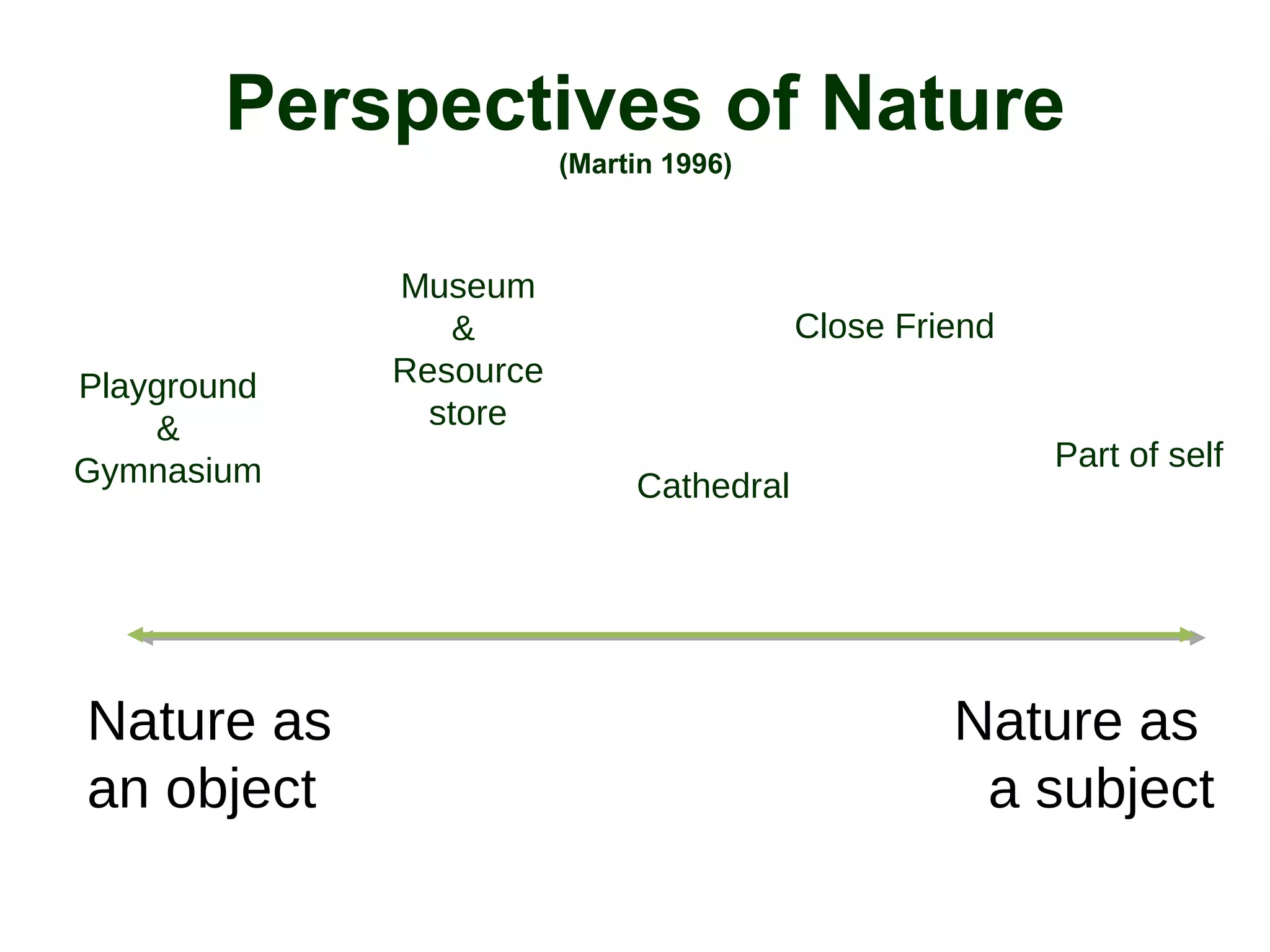
Museum
&
Resource
store
Cathedral
Close Friend
Part of self
Nature as
an object
Nature as
a subject
Playground
&
Gymnasium
Perspectives of Nature
(Martin 1996)
Implications?
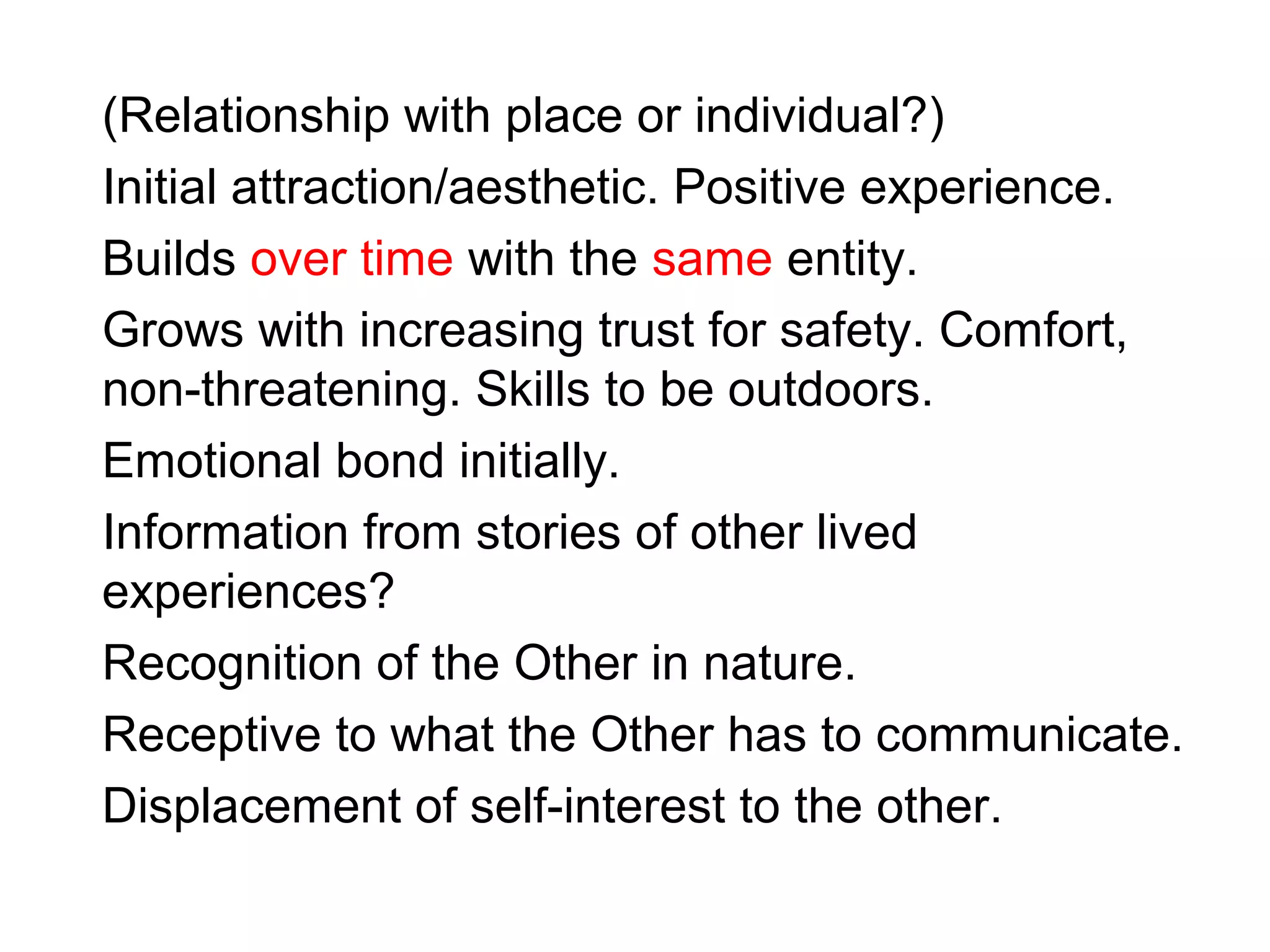
(Relationship with place or individual?)
Initial attraction/aesthetic. Positive experience.
Builds over time with the same entity.
Grows with increasing trust for safety. Comfort,
non-threatening. Skills to be outdoors.
Emotional bond initially.
Information from stories of other lived
experiences?
Recognition of the Other in nature.
Receptive to what the Other has to communicate.
Displacement of self-interest to the other.
Today:
Meanings of nature
Environmental life history research findings
Meanings of nature
How nature is valued
Enviro life history -
retrospective (Chawla)
(emotional connections)
1. Childhood experiences of nature
2. Experiences of enviro loss or destruction
3. Pro-enviro values of family
Enviro life history -
retrospective (Chawla)
(emotional connections)
4. Pro-enviro organisations
5. Role models (friends, teachers)
6. Education
The word “nature’
means…
Silent round robin
1.Write down as many meanings of ‘nature’ as you
can in one minute
2.Pass you sheet on to the next person
3.Add on any new words
4.Repeat.
The word “nature’
means…
Nature is an abstraction, one of
humanities oldest ideas
Multiple meanings and more
interpretations.
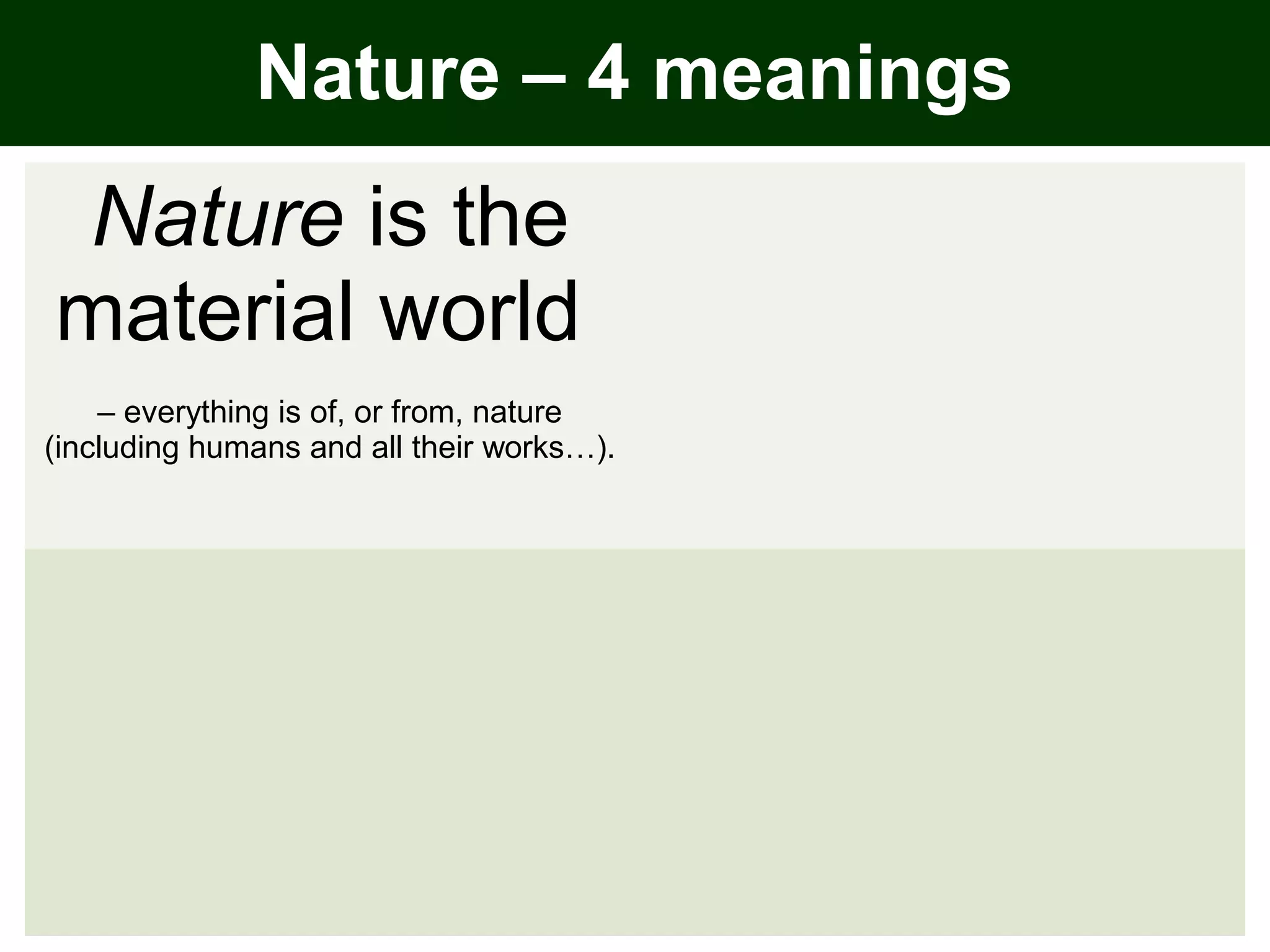
Nature is the
material world
– everything is of, or from, nature
(including humans and all their works…).
Nature – 4 meanings
Nature is the
material world
– everything is of, or from, nature
(including humans and all their works…).
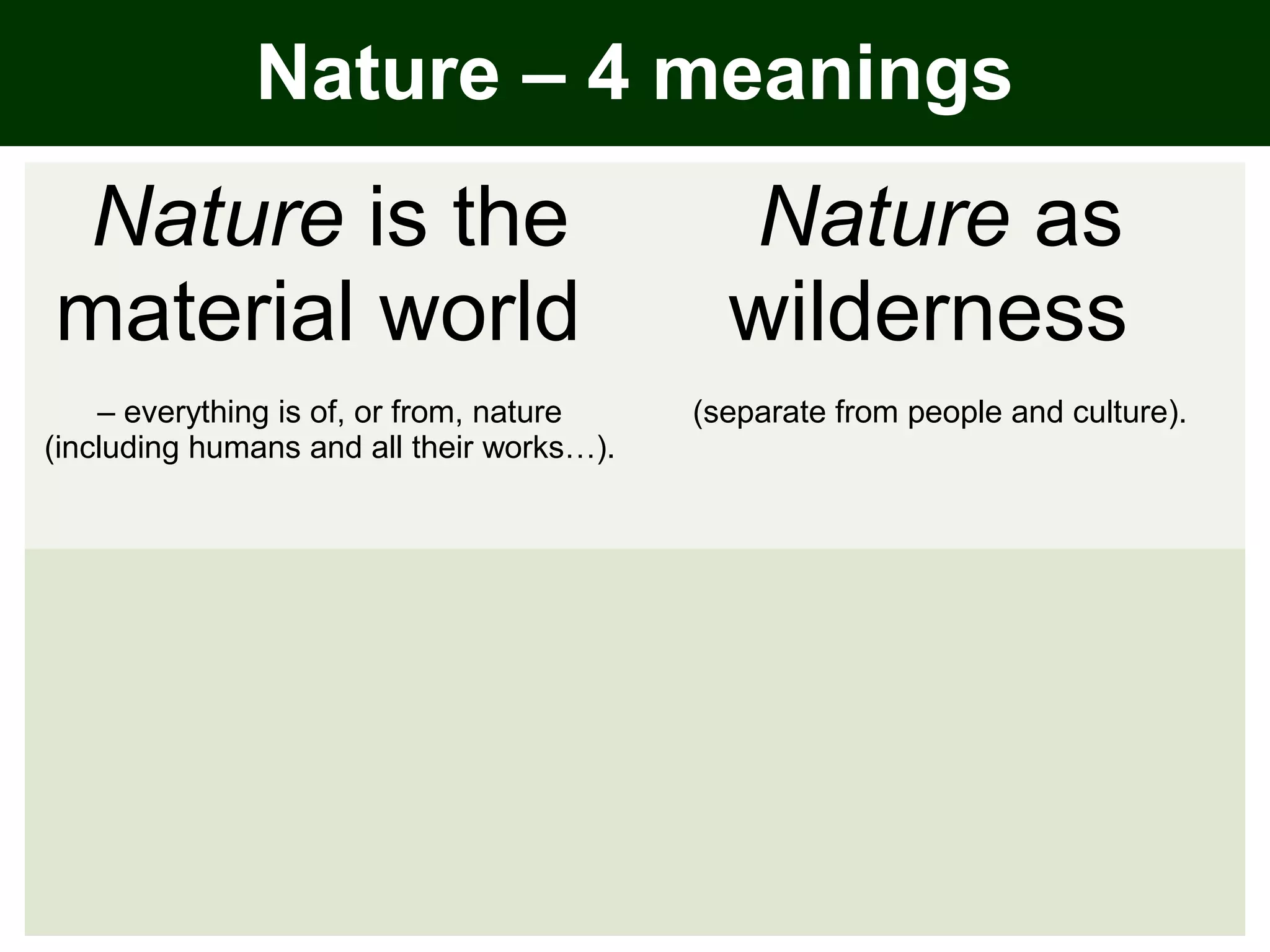
Nature as
wilderness
(separate from people and culture).
Nature – 4 meanings
Nature is the
material world
– everything is of, or from, nature
(including humans and all their works…).
Nature as
wilderness
(separate from people and culture).
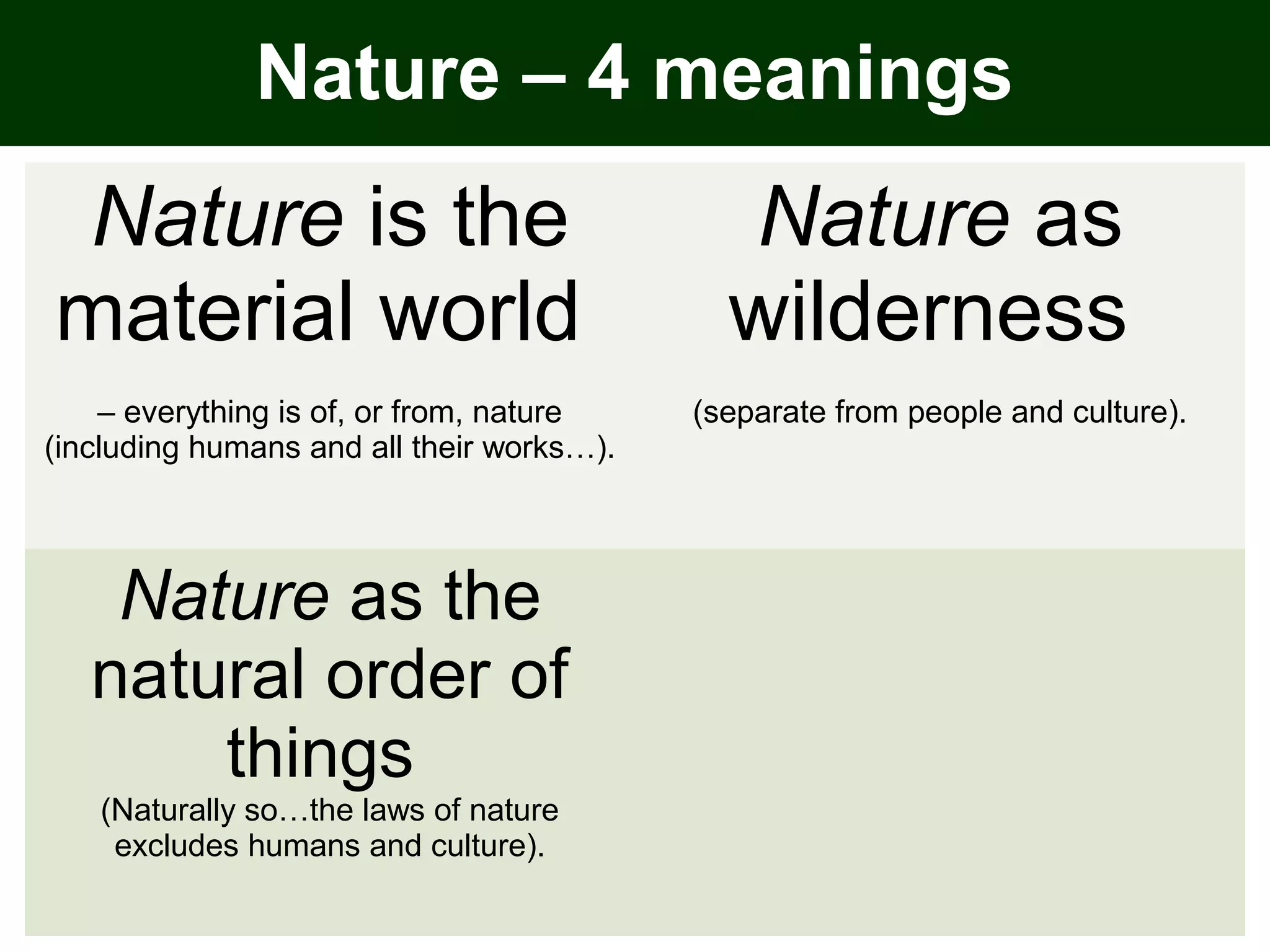
Nature as the
natural order of
things
(Naturally so…the laws of nature
excludes humans and culture).
Nature – 4 meanings
Nature is the
material world
– everything is of, or from, nature
(including humans and all their works…).
Nature as
wilderness
(separate from people and culture).
Nature as the
natural order of
things
(Naturally so…the laws of nature
excludes humans and culture).
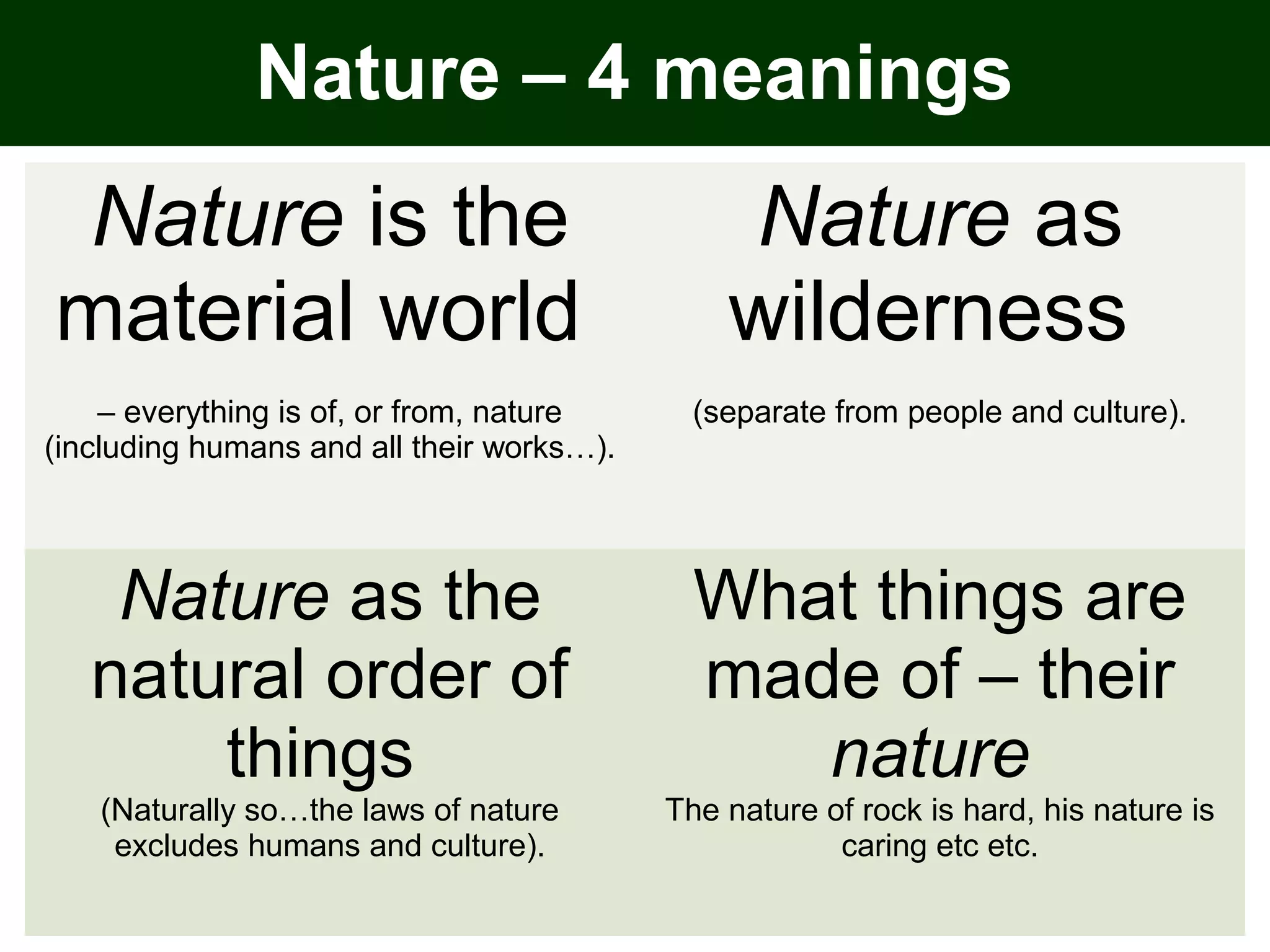
What things are
made of – their
nature
The nature of rock is hard, his nature is
caring etc etc.
Nature – 4 meanings
As an adjective nature
becomes
‘un-natural’
Write down the words you would
use to describe the opposite or
contrasting of ‘natural’ ie un-
natural.
As an adjective nature
becomes
‘un-natural’
What emotional responses do we
usually assign to these words?
Who determines what is unnatural?
Conclusions?
Nature and what is natural or un-natural are
socially defined – as is our relationship to it.
Often politically shaped. (people of colour,
homosexuality).
It varies between peoples.
It varies over time - in the same cultures in
different eras (environmental amnesia?).
Nature is held as an
ultimate way of being
natural, in balance.
BUT!
Darwinian nature is selfish, ruthless
uncaring.
Short term gain for the individual.
(sex feels good!)
Guided by nature we compete and feed
self first (natural forces are hardwired!).
Balance is achieved through boom
bust cycles.
But – humans have more power than
nature now, so boom bust cycle is
disrupted?
Sustainability, then must be brain driven
from an emotional response (foresight).
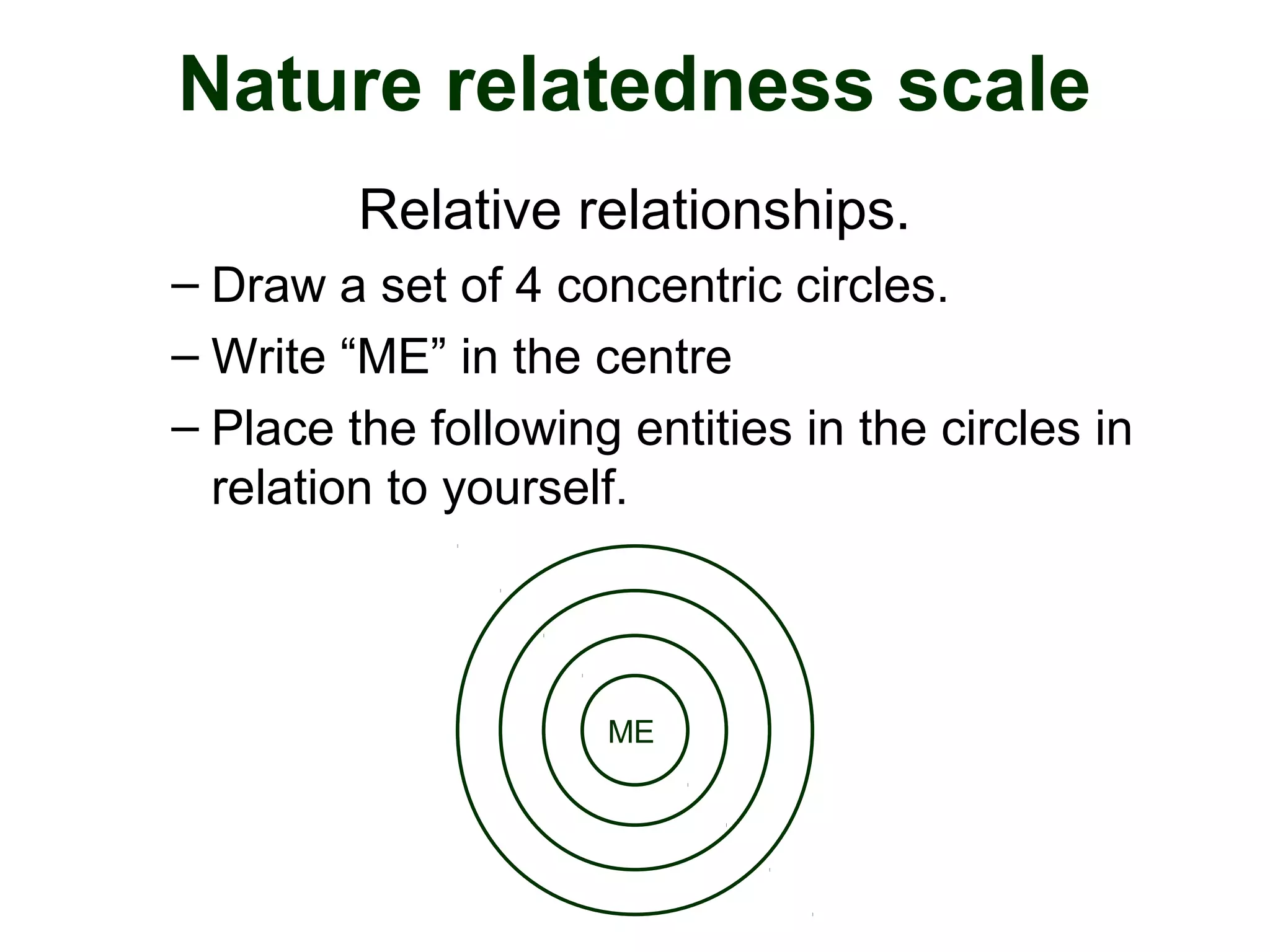
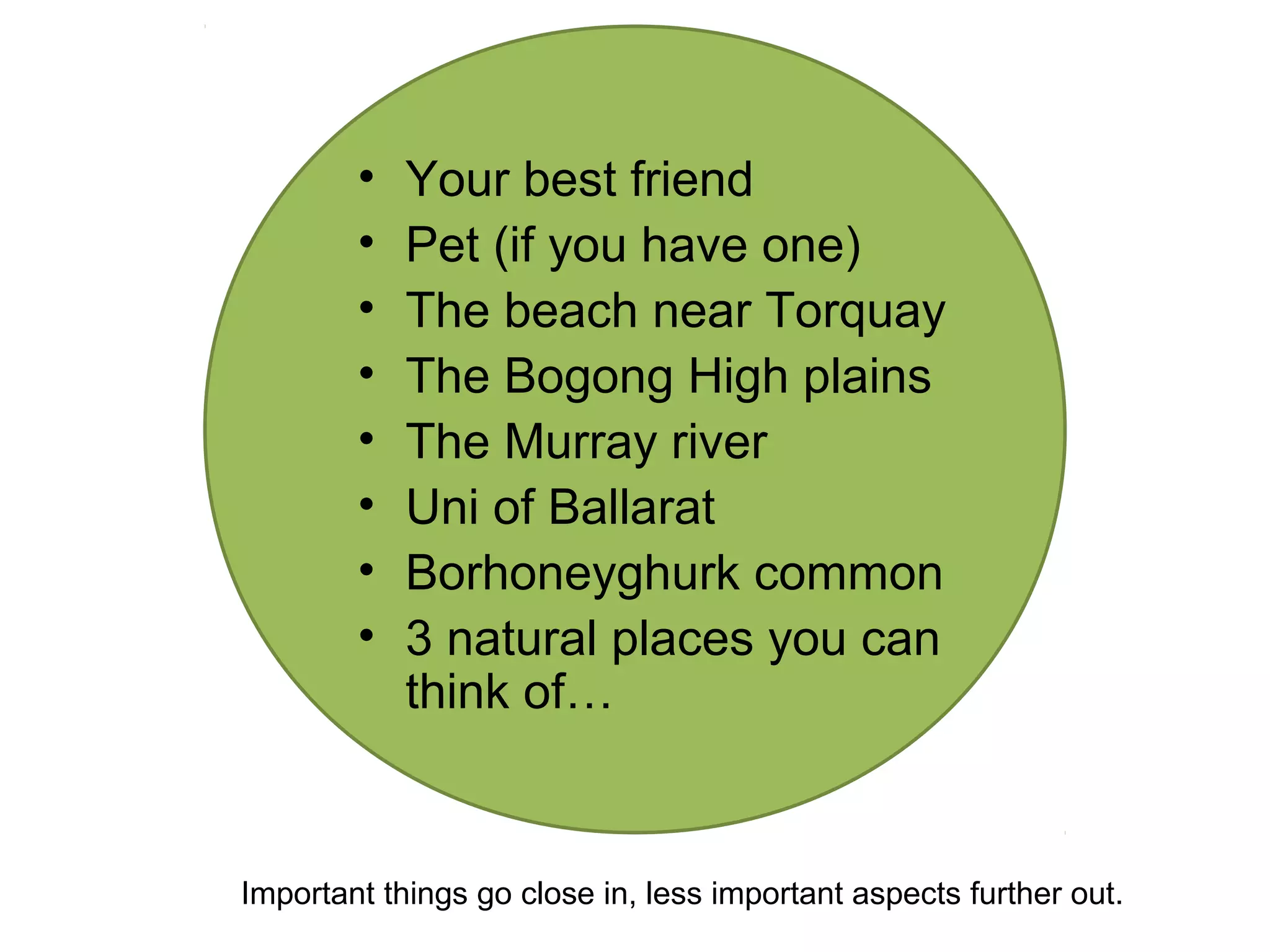
Nature relatedness scale
Relative relationships.
– Draw a set of 4 concentric circles.
– Write “ME” in the centre
– Place the following entities in the circles in
relation to yourself.
ME
• Your best friend
• Pet (if you have one)
• The beach near Torquay
• The Bogong High plains
• The Murray river
• Uni of Ballarat
• Borhoneyghurk common
• 3 natural places you can
think of…
Important things go close in, less important aspects further out.
A ‘special’ place in nature?
• Last week = a special place (your inner
circle?)
– Share that description (place) with person next to
you .
– Try to identify the VALUE (worth) of that place to
the person.
• Why do you think this place is seen as
special?
Value = to identify worth
• Values guide behaviour
• Many values are implicit in our society and
unexamined.
• For what/why are your special places
valued?
• (Culturally/politically when assessing the
value of environmental action or choice,
economic and social aspects dominate,
not triple bottom line?)
Valuing nature?
Biophilia asserts a biologically based
human need to affiliate with nature - that
human identity and fulfillment depend on
our relationship with nature (Wilson, 1984; Kellert 1993).
Valuing nature?
Humans value nature for what it can
provide for material, physical,
psychological and spiritual well being.
Valuing nature?
• A typology of nine differing values people
have towards nature (Stephen Kellert).
• Derived from extensive research
commencing with ways in which people
developed affinity for animals and the
natural world. Part of being human??
Utilitarian
• The physical or material benefits derived
from nature.
– E.g. food, clothing, tools, firewood.
• Also the ‘hidden’ values associated with
intact ecosystemic roles.
(all values are utilitarian?)
Naturalistic
• Satisfaction from direct contact with nature.
• Wonder, fascination.
– E.g. through bushwalking or nature study we gain a
sense of awe as we explore. We understand more as
we experience with curiosity.
• Mental benefits in stress release.
• Physical benefits in fitness and skill acquisition.
Aesthetic/humanistic
• Physical beauty is appreciated and
promotes human well being.
(Physiological responses evident.)
• Natural scenes preferred over built
environments. (landscape architecture,
gardens, water features etc.)
• Reflects deep attachment to nature eg.
Pets.
Ecological -Scientific
• Urge for precise study of nature.
• Nature can be understood through empirical
study.
• Recognises patterns and structure in nature.
• Satisfaction derived from understanding the
complexity of nature. (benefits derived such as
medicines)
Symbolic
• Nature as a means to facilitate thought
and communication. (Natural metaphors?)
• Eg?
Symbolic
• Nature as a means to facilitate thought
and communication. (Natural metaphors?)
• Much language and understanding is
founded on natural metaphors (brilliant,
pig, dead, fresh, fox)
• (or… “the sky was the colour of a
television tuned to a dead channel..”
“Can I scan this?”… “or hit delete.”)
Moralistic
• Affinity, ethical responsibility for and from the
natural world.
• Spiritual meaning, order and harmony in the
natural world. Nature as a guide for life.
• Romantic poetry.
• Indigenous ways of knowing/valuing nature
(living right by Country.)
• “A good act is one that enhances the
wellbeing of the planet”
Dominionistic
• Desire to master the natural world
• Explorers and adventurers appreciate
nature for the challenge.
• Able to be a hero in nature, overcome the
beast!
Negativistic
• Fear and aversion to nature
• Apathy towards the natural world.
– eg. Fear of snakes and spiders is evolutionary
based
• Desire to rid the world of the nuisance of
nature. Pests! Dirt!
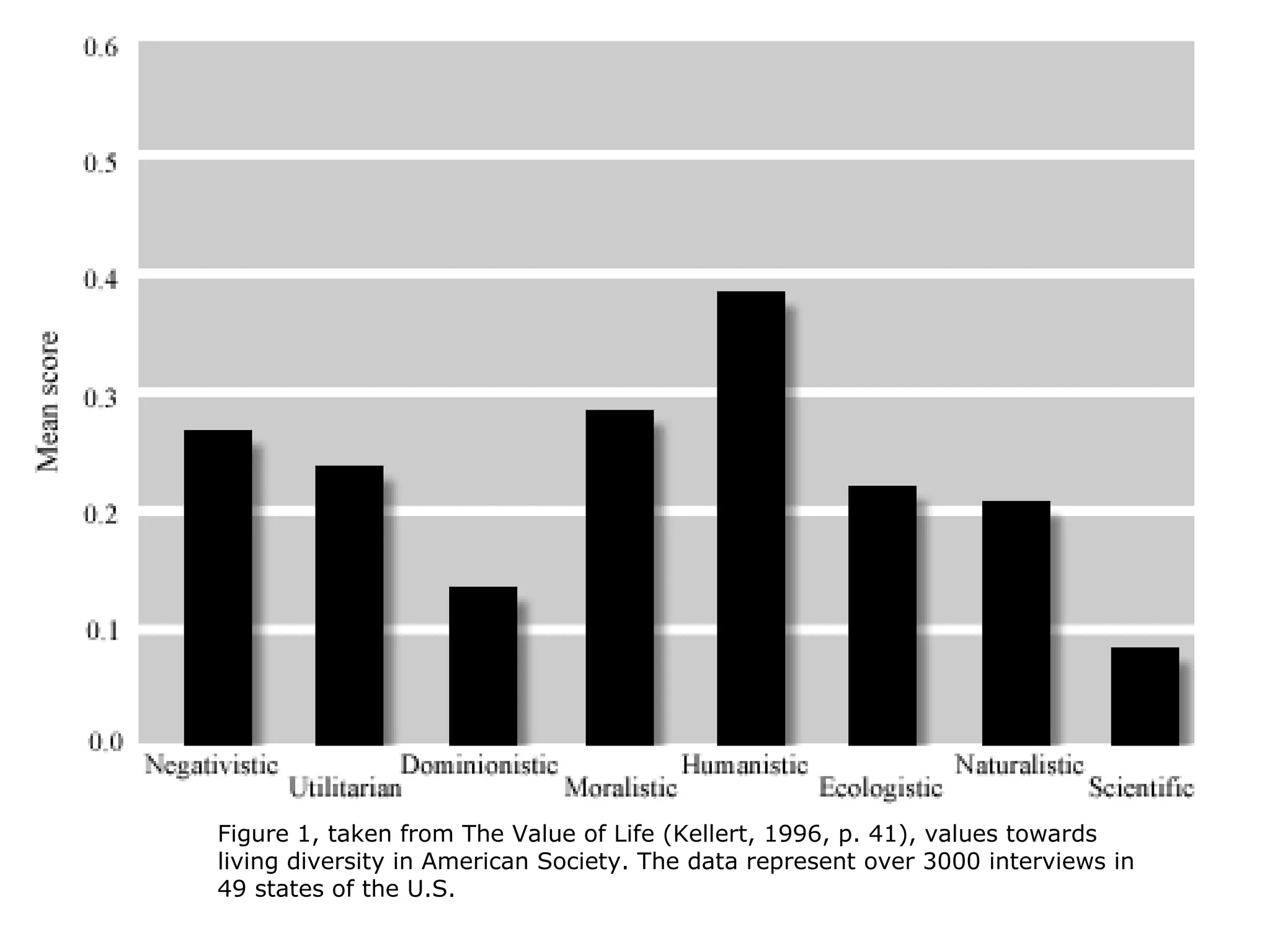
Figure 1, taken from The Value of Life (Kellert, 1996, p. 41), values towards
living diversity in American Society. The data represent over 3000 interviews in
49 states of the U.S.
"people never used to go just hunting
especially, they used to go walking
around and see what might happen.
They walked for their energy, or to
make their body feel good, or to
brighten their spirit, just walking around
on country." pg 150
Iwenhe Tyrerrtye –on what it means to be an aboriginal person.
Margret Kemarre Turner IAD Press 2010
Assessment Task 2
50%
Environmental Connections
Program
1. Develop and implement a Place
Connection journey.
2. Research paper on a connections
topic.
3. Presentation of a connections activity.
Place Connection Journey
• In groups of at least four students you are
to conceive, plan and undertake an
outdoor journey that is at least 2 days
duration.
• The aim of the journey is to explore how
practical experiences can help develop
and critically examine our connections to
the natural world.
Connections Research Paper
• The question of whether humans are
connected or separate from nature is
receiving more attention now than in any
time in our collective history.
• A minimum 3000 word research paper
exploring your topic.
Connections Activity
• Teachers don’t always have the benefit of
being able to conduct extended outdoor
journeys. Often, learning needs to take
place in school grounds or local areas.
• You will conduct an activity (or section of)
with your UB classmates during tutorial or
field work time.

Connecting with Nature - Wk 2 Values of nature 2013

  • 1.
    OEEDU5003 Connecting with Nature Weektwo What is nature, valuing nature.
  • 2.
    • Art Galleryvisit next week. We leave during class. Who is on the bus? • Collaborative learning reflections, today – TK, Dave, Hendo • PDFs on Moodle • Add paper title on PDF.
  • 3.
    Last week… Framing behavioursthrough language and metaphor
  • 4.
    Nature as Friend •Implies: – A relationship with a subjective other (emotional) – Based on lived personal experiences with other. – Closeness but separate (a relationship with) – Co-operative and caring outcomes sought – Developmental – grows or diminishes
  • 5.
    Museum & Resource store Cathedral Close Friend Part ofself Nature as an object Nature as a subject Playground & Gymnasium Perspectives of Nature (Martin 1996)
  • 6.
  • 7.
    (Relationship with placeor individual?) Initial attraction/aesthetic. Positive experience. Builds over time with the same entity. Grows with increasing trust for safety. Comfort, non-threatening. Skills to be outdoors. Emotional bond initially. Information from stories of other lived experiences? Recognition of the Other in nature. Receptive to what the Other has to communicate. Displacement of self-interest to the other.
  • 8.
    Today: Meanings of nature Environmentallife history research findings Meanings of nature How nature is valued
  • 9.
    Enviro life history- retrospective (Chawla) (emotional connections) 1. Childhood experiences of nature 2. Experiences of enviro loss or destruction 3. Pro-enviro values of family
  • 10.
    Enviro life history- retrospective (Chawla) (emotional connections) 4. Pro-enviro organisations 5. Role models (friends, teachers) 6. Education
  • 11.
    The word “nature’ means… Silentround robin 1.Write down as many meanings of ‘nature’ as you can in one minute 2.Pass you sheet on to the next person 3.Add on any new words 4.Repeat.
  • 12.
    The word “nature’ means… Natureis an abstraction, one of humanities oldest ideas Multiple meanings and more interpretations.
  • 13.
    Nature is the materialworld – everything is of, or from, nature (including humans and all their works…). Nature – 4 meanings
  • 14.
    Nature is the materialworld – everything is of, or from, nature (including humans and all their works…). Nature as wilderness (separate from people and culture). Nature – 4 meanings
  • 15.
    Nature is the materialworld – everything is of, or from, nature (including humans and all their works…). Nature as wilderness (separate from people and culture). Nature as the natural order of things (Naturally so…the laws of nature excludes humans and culture). Nature – 4 meanings
  • 16.
    Nature is the materialworld – everything is of, or from, nature (including humans and all their works…). Nature as wilderness (separate from people and culture). Nature as the natural order of things (Naturally so…the laws of nature excludes humans and culture). What things are made of – their nature The nature of rock is hard, his nature is caring etc etc. Nature – 4 meanings
  • 17.
    As an adjectivenature becomes ‘un-natural’ Write down the words you would use to describe the opposite or contrasting of ‘natural’ ie un- natural.
  • 18.
    As an adjectivenature becomes ‘un-natural’ What emotional responses do we usually assign to these words? Who determines what is unnatural? Conclusions?
  • 19.
    Nature and whatis natural or un-natural are socially defined – as is our relationship to it. Often politically shaped. (people of colour, homosexuality). It varies between peoples. It varies over time - in the same cultures in different eras (environmental amnesia?).
  • 20.
    Nature is heldas an ultimate way of being
  • 21.
  • 22.
  • 23.
    Darwinian nature isselfish, ruthless uncaring. Short term gain for the individual. (sex feels good!) Guided by nature we compete and feed self first (natural forces are hardwired!). Balance is achieved through boom bust cycles.
  • 24.
    But – humanshave more power than nature now, so boom bust cycle is disrupted? Sustainability, then must be brain driven from an emotional response (foresight).
  • 25.
    Nature relatedness scale Relativerelationships. – Draw a set of 4 concentric circles. – Write “ME” in the centre – Place the following entities in the circles in relation to yourself. ME
  • 26.
    • Your bestfriend • Pet (if you have one) • The beach near Torquay • The Bogong High plains • The Murray river • Uni of Ballarat • Borhoneyghurk common • 3 natural places you can think of… Important things go close in, less important aspects further out.
  • 27.
    A ‘special’ placein nature? • Last week = a special place (your inner circle?) – Share that description (place) with person next to you . – Try to identify the VALUE (worth) of that place to the person. • Why do you think this place is seen as special?
  • 28.
    Value = toidentify worth • Values guide behaviour • Many values are implicit in our society and unexamined. • For what/why are your special places valued? • (Culturally/politically when assessing the value of environmental action or choice, economic and social aspects dominate, not triple bottom line?)
  • 29.
    Valuing nature? Biophilia assertsa biologically based human need to affiliate with nature - that human identity and fulfillment depend on our relationship with nature (Wilson, 1984; Kellert 1993).
  • 30.
    Valuing nature? Humans valuenature for what it can provide for material, physical, psychological and spiritual well being.
  • 31.
    Valuing nature? • Atypology of nine differing values people have towards nature (Stephen Kellert). • Derived from extensive research commencing with ways in which people developed affinity for animals and the natural world. Part of being human??
  • 32.
    Utilitarian • The physicalor material benefits derived from nature. – E.g. food, clothing, tools, firewood. • Also the ‘hidden’ values associated with intact ecosystemic roles. (all values are utilitarian?)
  • 33.
    Naturalistic • Satisfaction fromdirect contact with nature. • Wonder, fascination. – E.g. through bushwalking or nature study we gain a sense of awe as we explore. We understand more as we experience with curiosity. • Mental benefits in stress release. • Physical benefits in fitness and skill acquisition.
  • 34.
    Aesthetic/humanistic • Physical beautyis appreciated and promotes human well being. (Physiological responses evident.) • Natural scenes preferred over built environments. (landscape architecture, gardens, water features etc.) • Reflects deep attachment to nature eg. Pets.
  • 35.
    Ecological -Scientific • Urgefor precise study of nature. • Nature can be understood through empirical study. • Recognises patterns and structure in nature. • Satisfaction derived from understanding the complexity of nature. (benefits derived such as medicines)
  • 36.
    Symbolic • Nature asa means to facilitate thought and communication. (Natural metaphors?) • Eg?
  • 37.
    Symbolic • Nature asa means to facilitate thought and communication. (Natural metaphors?) • Much language and understanding is founded on natural metaphors (brilliant, pig, dead, fresh, fox) • (or… “the sky was the colour of a television tuned to a dead channel..” “Can I scan this?”… “or hit delete.”)
  • 38.
    Moralistic • Affinity, ethicalresponsibility for and from the natural world. • Spiritual meaning, order and harmony in the natural world. Nature as a guide for life. • Romantic poetry. • Indigenous ways of knowing/valuing nature (living right by Country.) • “A good act is one that enhances the wellbeing of the planet”
  • 39.
    Dominionistic • Desire tomaster the natural world • Explorers and adventurers appreciate nature for the challenge. • Able to be a hero in nature, overcome the beast!
  • 40.
    Negativistic • Fear andaversion to nature • Apathy towards the natural world. – eg. Fear of snakes and spiders is evolutionary based • Desire to rid the world of the nuisance of nature. Pests! Dirt!
  • 41.
    Figure 1, takenfrom The Value of Life (Kellert, 1996, p. 41), values towards living diversity in American Society. The data represent over 3000 interviews in 49 states of the U.S.
  • 42.
    "people never usedto go just hunting especially, they used to go walking around and see what might happen. They walked for their energy, or to make their body feel good, or to brighten their spirit, just walking around on country." pg 150 Iwenhe Tyrerrtye –on what it means to be an aboriginal person. Margret Kemarre Turner IAD Press 2010
  • 43.
  • 44.
    Environmental Connections Program 1. Developand implement a Place Connection journey. 2. Research paper on a connections topic. 3. Presentation of a connections activity.
  • 45.
    Place Connection Journey •In groups of at least four students you are to conceive, plan and undertake an outdoor journey that is at least 2 days duration. • The aim of the journey is to explore how practical experiences can help develop and critically examine our connections to the natural world.
  • 46.
    Connections Research Paper •The question of whether humans are connected or separate from nature is receiving more attention now than in any time in our collective history. • A minimum 3000 word research paper exploring your topic.
  • 47.
    Connections Activity • Teachersdon’t always have the benefit of being able to conduct extended outdoor journeys. Often, learning needs to take place in school grounds or local areas. • You will conduct an activity (or section of) with your UB classmates during tutorial or field work time.

Editor's Notes

  • #6 Object = thing devoid of feeling and consequence Subject – more like us – has moral and ethical rights. Playground = Inherent values in each image. Play is not work Resources are valued for what they give to humanity mostly. Worthless cliff, choss, rubbish, weeds. Cathederal - Reverence and awe – beauty. Implied behaviours –powerfully situationist Close friends are what we all have. Implications for action and behaviours in teaching to get close to nature?? Part of self?? Differing cosmology Deep Ecology vs relational self model of eco-feminism.
  • #12 1. [n] - nature controls the world (a causal agent as in Mother nature ) 2. [n] - the natural physical world including plants and animals and landscapes etc. 3. [n] - - a particular type of thing 4. [n] - the essential qualities or characteristics by which something is recognized 5. [n] - the complex of emotional and intellectual attributes that determine a person's characteristic actions and reactions
  • #13 1. [n] - nature controls the world (a causal agent as in Mother nature ) 2. [n] - the natural physical world including plants and animals and landscapes etc. 3. [n] - - a particular type of thing 4. [n] - the essential qualities or characteristics by which something is recognized 5. [n] - the complex of emotional and intellectual attributes that determine a person's characteristic actions and reactions
  • #19 Nature and natural are culturally defined – different between cultures and over different eras.
  • #46 Sometimes outdoor education programmes include environmental awareness activities as separate components in an overall program. Eg, Students ‘do’ rock climbing and then ‘do’ some environmental activities. A better, more challenging model is to integrate environmental activity into a journey or whole activity.
  • #47 A 200 word topic proposal that outlines what topic you are considering exploring and the objectives of the paper you will produce. This then becomes the basis of your undertaking and must include a realistic due date for your final work.
  • #48 We know that experiential learning suits most students, but finding suitable shorter duration activities for exploring connections to nature can be challenging. This option allows you to examine, develop and trial such an activity.