What is CGD ?
City Gas Distribution
“City or local natural gas distribution network”
means an interconnected network of gas
pipelines and the associated equipment used
for transporting natural gas from a bulk
supply high pressure transmission main to the
medium pressure distribution grid and
subsequently to the service pipes supplying
natural gas to domestic, industrial or
commercial premises and CNG stations situated
in a specified geographical area;
Meter
CGD Network authorization
• Under the Petroleum and Natural Gas
Regulatory Board (PNGRB) Act 2006, PNGRB
grants the authorization to the entities for
developing a City Gas Distribution (CGD)
network (including PNG network) in a
specified Geographical Area (GA) of the
country.
What is T4S ?
• T4S Means Technical Standards and
Specifications including Safety Standards for
City or Local Natural Gas Distribution
Networks & Natural Gas pipelines.
City gate station (CGS)
• The point where custody transfer of natural
gas from natural gas pipeline to the CGD
network takes place and this may also be
referred to as City Gate Measuring and
Pressure Regulating Station.
Critical infrastructure / activity/ processes
• Pressure reduction skid CGS (active /monitor combination) with a minimum 50%
redundancy including slam shut valve for over pressure protection and creep relief
valves.
• On line odorisation equipment.
• Height of the vent shall be minimum 3 meters above working level.
• Gas detectors shall be installed at critical locations .
• HSSE Management System.
• Emergency Response Plan, Disaster Management Plan and written emergency
procedures. Also, provide for an Emergency Control Room, manned round the
clock and equipped with effective communication system and emergency vehicles
fitted with communication facilities, first aid equipment, fire extinguishers, gas
detectors, repair kits and tools, maps, plans, material safety data sheets etc.
Main Functions
• Isolation
• Filtration
• Pressure reduction.
• Metering.
• Pre Heaters
• PSV & CRV.
• Odorization.
Main Functions
• Isolation
Filtration
• Filtration
Pressure reduction.
Metering.
• Metering.
Pre Heaters
• Pre Heaters
Odorisation
• The odorization process of distributed gases is
required for safety reasons and it acts as a “warning
agent” in case of leakage. The process consists
of injecting a chemical agent — an odorant — that
adds a smell to the gas, turning it easily
recognisable.
• For PNG
• 10 PPM (Part per million)
• 20 milligrams of methyl mercaptan per cubic meter
(mg/m³)
• For LPG
• 25 parts per million (ppm)
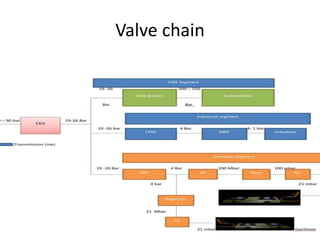
Valve chain
primary network
• pressure above 100 psig (7 bar) and below
711 psig (49 bar)
secondary network
• a pressure below 100 psig (7 bar) and above
1.5 psig (100 mbar)
• Also called called low-Pressure Distribution
•
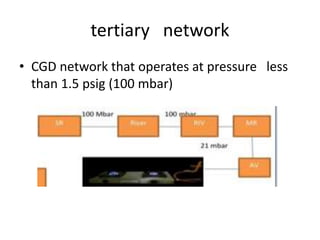
tertiary network
• CGD network that operates at pressure less
than 1.5 psig (100 mbar)
sub-transmission pipeline
• means a high pressure pipeline connecting the
main transmission pipeline to the city gate
station but is owned by the CGD entity;
velocity in the pipeline network
• The Maximum velocity in the pipeline network
should be limited to 100 ft/sec (30 m/sec )
Immediately after pressure regulating
instrument.
type of Pipe line
• Steel Pipeline. ( 4” , 8” , 12”……)
• Mdpe Pipe Line ( Medium density Polyethlen
Pipe.
• Size ( 20 mm, 32 mm, 63 mm, 90 mm, 110 mm
,125 mm , 180 mm.
MDPE
Medium-density polyethylene (MDPE) is a type of Polyethylene defined
by a density range of (0.926 - 0.940) gm/cm3
Code of MDPE Pipe- IS 14885 .
IS 14885 (2001): Polyethylene Pipes for the Supply of Gaseous Fuels
Colours – yellow – PE 80 grade
Orang – PE 100 grade
# PE100 is a higher density material than PE80 #
Material Designation Minimum Required Strength (MRS)MPa
PE100 10.0
PE80 8.0
Fittings of MDPE
FITTINGSOF MDPE-
1. Saddle
2. Coupler
3. Elbow
4. Tee
5. End cap
6. Reducer
TOOLS & TACKLES-
TOOLS & TACKLES-
1- MDPE PIPE CUTTER
2- UNIVERSAL STRAP WRENCH
3- REROUNDING TOOL
TOOLS & TACKLES-
4- SCREAPER
5- ALIGNEMENT CLAMP.
6- MANHOLE COVER LIFT KEY
7- ELECTRO FUSION MACHINE
DRS/FRS
• Inlet pressure - 19-26 bar.
• Outlet pressure – Below 7 bar.
• DRS stand for high flow Capacity for a whole
district.
DRS/FRS Flow Chart
Below 7 ba
Service Regulator (SR)
• Inlet pressure – 4 bar (4000 Mbar)
• Outlet pressure – 100 Mbar
• Capacity – 100 scmh,
• 150 scmh…ets
• To connect lage no of
• customer as per sr
• Capacity.
Regulator
• Inlet pressure – 4 bar
• Outlet pressure – 21 mbar
• Flow capacity – 6.5 scmh
• Only connect 10 – 12
• Customer.
Meter Regulator
• Inlet pressure – 100 mbar
• Outlet pressure – 21 mbar
• Flow capacity – 2.5 scmh
Meter
• Inlet pressure – 21 mbar
• Outlet pressure – 21 mbar
• P max – 0.5 bar
• Rating – G 1.6
• Min flow- 0.016 m3/h
• Max flow – 2.5 m3/h
• Type – Diaphragm.
• Flow capacity -2.5 m3/H
• Capacity in – 1.2 Liter.
Pressure
• Gauge Pressure.
• When pressure is measured relative to atmospheric
pressure (14.7 psi), it is called gauge pressure (psig).
The term gauge pressure is applied when the pressure
in the system is greater than the local atmospheric
pressure
• Absolute pressure
• When pressure is measured relative to a perfect
vacuum, it is called absolute pressure
Pressure
Domestic gas pressure
• Pressure in domestic gas pipeline
• 1.01325 + .21 = 1.22325 bar
• 1223 mbar
Type of Gas Meter
• Diaphragm.
• RPD (rotatory positive displacement) (above
0.5 bar Pressure)
• Turbine meter. ( above 20 bar Pressure)
• Orifice meter
• Ultrasonic flow meters.
• Coriolis meter
Meter selection
• G -1.6 (min 0.016 max 2.5) M3/h
• G-2.5 (min 0.025 max 4 ) m3h
• G- 4 (min 0.04 max 6 ) m3/h
• G-6 (min 0.06 max 10) m3/h
• G-10 (min 0.10 max 16) m3/h
• G-16(min 0.16 max 25) m3/h
• G-25 (min 0.25 max 40) m3/h
Meter selection
• Total Consumption – 250 scmh
• Consumption in m3/h = Consumption/
correction factor = 250/2.936
• Consumption – 85.14 m3/h
• G – 65 (min 0.65 max 100)
What is scm ?
• Standard Cubic Meter means the quantity of
Gas that occupies a volume of one (1) cubic
meter at a temperature of 15oC (fifteen
degrees Celsius) under an absolute pressure of
1.01325 Bar.
•~~~~ THANK YOU ~~~~

What is CGD.pptx

  • 1.
    What is CGD? City Gas Distribution “City or local natural gas distribution network” means an interconnected network of gas pipelines and the associated equipment used for transporting natural gas from a bulk supply high pressure transmission main to the medium pressure distribution grid and subsequently to the service pipes supplying natural gas to domestic, industrial or commercial premises and CNG stations situated in a specified geographical area;
  • 2.
  • 3.
    CGD Network authorization •Under the Petroleum and Natural Gas Regulatory Board (PNGRB) Act 2006, PNGRB grants the authorization to the entities for developing a City Gas Distribution (CGD) network (including PNG network) in a specified Geographical Area (GA) of the country.
  • 4.
    What is T4S? • T4S Means Technical Standards and Specifications including Safety Standards for City or Local Natural Gas Distribution Networks & Natural Gas pipelines.
  • 5.
    City gate station(CGS) • The point where custody transfer of natural gas from natural gas pipeline to the CGD network takes place and this may also be referred to as City Gate Measuring and Pressure Regulating Station.
  • 6.
    Critical infrastructure /activity/ processes • Pressure reduction skid CGS (active /monitor combination) with a minimum 50% redundancy including slam shut valve for over pressure protection and creep relief valves. • On line odorisation equipment. • Height of the vent shall be minimum 3 meters above working level. • Gas detectors shall be installed at critical locations . • HSSE Management System. • Emergency Response Plan, Disaster Management Plan and written emergency procedures. Also, provide for an Emergency Control Room, manned round the clock and equipped with effective communication system and emergency vehicles fitted with communication facilities, first aid equipment, fire extinguishers, gas detectors, repair kits and tools, maps, plans, material safety data sheets etc.
  • 7.
    Main Functions • Isolation •Filtration • Pressure reduction. • Metering. • Pre Heaters • PSV & CRV. • Odorization.
  • 8.
  • 9.
  • 10.
  • 11.
  • 12.
  • 13.
    Odorisation • The odorizationprocess of distributed gases is required for safety reasons and it acts as a “warning agent” in case of leakage. The process consists of injecting a chemical agent — an odorant — that adds a smell to the gas, turning it easily recognisable. • For PNG • 10 PPM (Part per million) • 20 milligrams of methyl mercaptan per cubic meter (mg/m³) • For LPG • 25 parts per million (ppm)
  • 14.
  • 15.
    primary network • pressureabove 100 psig (7 bar) and below 711 psig (49 bar)
  • 16.
    secondary network • apressure below 100 psig (7 bar) and above 1.5 psig (100 mbar) • Also called called low-Pressure Distribution •
  • 17.
    tertiary network • CGDnetwork that operates at pressure less than 1.5 psig (100 mbar)
  • 18.
    sub-transmission pipeline • meansa high pressure pipeline connecting the main transmission pipeline to the city gate station but is owned by the CGD entity;
  • 19.
    velocity in thepipeline network • The Maximum velocity in the pipeline network should be limited to 100 ft/sec (30 m/sec ) Immediately after pressure regulating instrument.
  • 20.
    type of Pipeline • Steel Pipeline. ( 4” , 8” , 12”……) • Mdpe Pipe Line ( Medium density Polyethlen Pipe. • Size ( 20 mm, 32 mm, 63 mm, 90 mm, 110 mm ,125 mm , 180 mm.
  • 21.
    MDPE Medium-density polyethylene (MDPE)is a type of Polyethylene defined by a density range of (0.926 - 0.940) gm/cm3 Code of MDPE Pipe- IS 14885 . IS 14885 (2001): Polyethylene Pipes for the Supply of Gaseous Fuels Colours – yellow – PE 80 grade Orang – PE 100 grade # PE100 is a higher density material than PE80 # Material Designation Minimum Required Strength (MRS)MPa PE100 10.0 PE80 8.0
  • 22.
    Fittings of MDPE FITTINGSOFMDPE- 1. Saddle 2. Coupler 3. Elbow 4. Tee 5. End cap 6. Reducer
  • 23.
    TOOLS & TACKLES- TOOLS& TACKLES- 1- MDPE PIPE CUTTER 2- UNIVERSAL STRAP WRENCH 3- REROUNDING TOOL
  • 24.
    TOOLS & TACKLES- 4-SCREAPER 5- ALIGNEMENT CLAMP. 6- MANHOLE COVER LIFT KEY 7- ELECTRO FUSION MACHINE
  • 25.
    DRS/FRS • Inlet pressure- 19-26 bar. • Outlet pressure – Below 7 bar. • DRS stand for high flow Capacity for a whole district.
  • 26.
  • 28.
    Service Regulator (SR) •Inlet pressure – 4 bar (4000 Mbar) • Outlet pressure – 100 Mbar • Capacity – 100 scmh, • 150 scmh…ets • To connect lage no of • customer as per sr • Capacity.
  • 29.
    Regulator • Inlet pressure– 4 bar • Outlet pressure – 21 mbar • Flow capacity – 6.5 scmh • Only connect 10 – 12 • Customer.
  • 30.
    Meter Regulator • Inletpressure – 100 mbar • Outlet pressure – 21 mbar • Flow capacity – 2.5 scmh
  • 31.
    Meter • Inlet pressure– 21 mbar • Outlet pressure – 21 mbar • P max – 0.5 bar • Rating – G 1.6 • Min flow- 0.016 m3/h • Max flow – 2.5 m3/h • Type – Diaphragm. • Flow capacity -2.5 m3/H • Capacity in – 1.2 Liter.
  • 32.
    Pressure • Gauge Pressure. •When pressure is measured relative to atmospheric pressure (14.7 psi), it is called gauge pressure (psig). The term gauge pressure is applied when the pressure in the system is greater than the local atmospheric pressure • Absolute pressure • When pressure is measured relative to a perfect vacuum, it is called absolute pressure
  • 33.
  • 34.
    Domestic gas pressure •Pressure in domestic gas pipeline • 1.01325 + .21 = 1.22325 bar • 1223 mbar
  • 35.
    Type of GasMeter • Diaphragm. • RPD (rotatory positive displacement) (above 0.5 bar Pressure) • Turbine meter. ( above 20 bar Pressure) • Orifice meter • Ultrasonic flow meters. • Coriolis meter
  • 36.
    Meter selection • G-1.6 (min 0.016 max 2.5) M3/h • G-2.5 (min 0.025 max 4 ) m3h • G- 4 (min 0.04 max 6 ) m3/h • G-6 (min 0.06 max 10) m3/h • G-10 (min 0.10 max 16) m3/h • G-16(min 0.16 max 25) m3/h • G-25 (min 0.25 max 40) m3/h
  • 37.
    Meter selection • TotalConsumption – 250 scmh • Consumption in m3/h = Consumption/ correction factor = 250/2.936 • Consumption – 85.14 m3/h • G – 65 (min 0.65 max 100)
  • 38.
    What is scm? • Standard Cubic Meter means the quantity of Gas that occupies a volume of one (1) cubic meter at a temperature of 15oC (fifteen degrees Celsius) under an absolute pressure of 1.01325 Bar.
  • 40.