Business Analysts: The Bridge Between Data and
Decision-Making
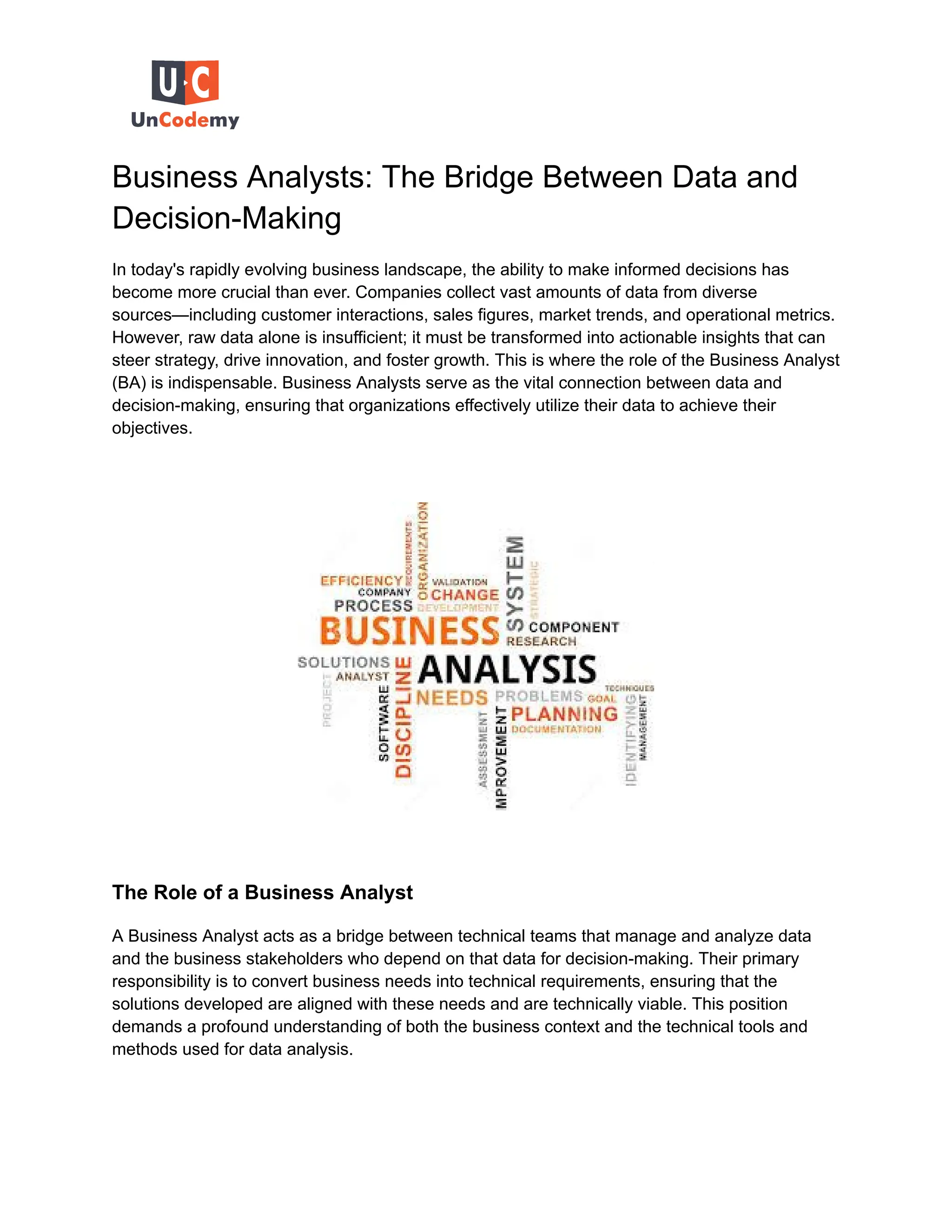
In today's rapidly evolving business landscape, the ability to make informed decisions has
become more crucial than ever. Companies collect vast amounts of data from diverse
sources—including customer interactions, sales figures, market trends, and operational metrics.
However, raw data alone is insufficient; it must be transformed into actionable insights that can
steer strategy, drive innovation, and foster growth. This is where the role of the Business Analyst
(BA) is indispensable. Business Analysts serve as the vital connection between data and
decision-making, ensuring that organizations effectively utilize their data to achieve their
objectives.
The Role of a Business Analyst
A Business Analyst acts as a bridge between technical teams that manage and analyze data
and the business stakeholders who depend on that data for decision-making. Their primary
responsibility is to convert business needs into technical requirements, ensuring that the
solutions developed are aligned with these needs and are technically viable. This position
demands a profound understanding of both the business context and the technical tools and
methods used for data analysis.
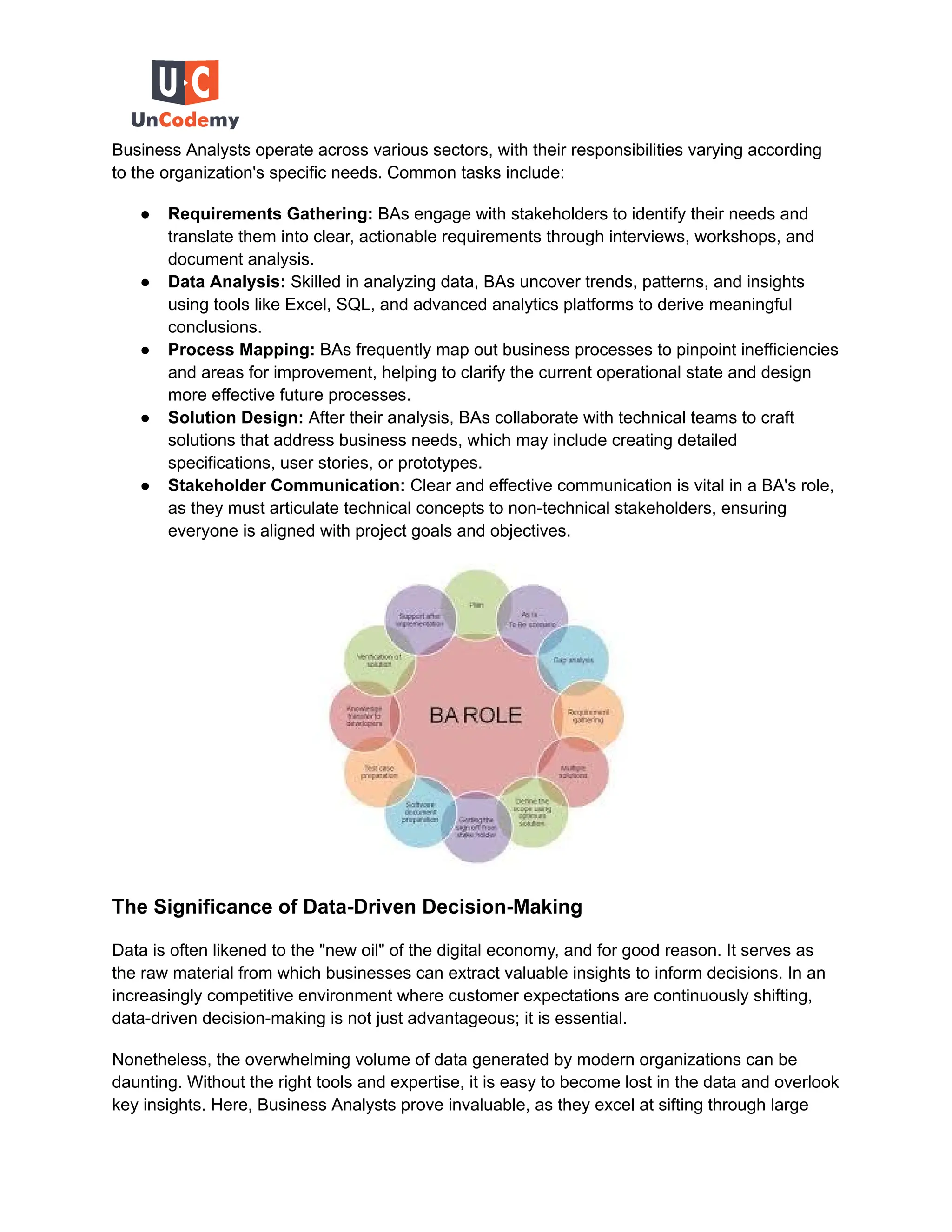
Business Analysts operate across various sectors, with their responsibilities varying according
to the organization's specific needs. Common tasks include:
● Requirements Gathering: BAs engage with stakeholders to identify their needs and
translate them into clear, actionable requirements through interviews, workshops, and
document analysis.
● Data Analysis: Skilled in analyzing data, BAs uncover trends, patterns, and insights
using tools like Excel, SQL, and advanced analytics platforms to derive meaningful
conclusions.
● Process Mapping: BAs frequently map out business processes to pinpoint inefficiencies
and areas for improvement, helping to clarify the current operational state and design
more effective future processes.
● Solution Design: After their analysis, BAs collaborate with technical teams to craft
solutions that address business needs, which may include creating detailed
specifications, user stories, or prototypes.
● Stakeholder Communication: Clear and effective communication is vital in a BA's role,
as they must articulate technical concepts to non-technical stakeholders, ensuring
everyone is aligned with project goals and objectives.
The Significance of Data-Driven Decision-Making
Data is often likened to the "new oil" of the digital economy, and for good reason. It serves as
the raw material from which businesses can extract valuable insights to inform decisions. In an
increasingly competitive environment where customer expectations are continuously shifting,
data-driven decision-making is not just advantageous; it is essential.
Nonetheless, the overwhelming volume of data generated by modern organizations can be
daunting. Without the right tools and expertise, it is easy to become lost in the data and overlook
key insights. Here, Business Analysts prove invaluable, as they excel at sifting through large
data sets, identifying the most pertinent information, and presenting it in a manner that
decision-makers can comprehend and act upon.
For example, a retail organization might collect data on customer purchases, website traffic, and
social media engagement. A Business Analyst would examine this data to identify customer
behavior trends, such as which products are most popular or which marketing initiatives yield
the best results. These insights can inform decisions regarding inventory management,
marketing strategies, and customer engagement.
The Role of Business Analysts in Digital Transformation
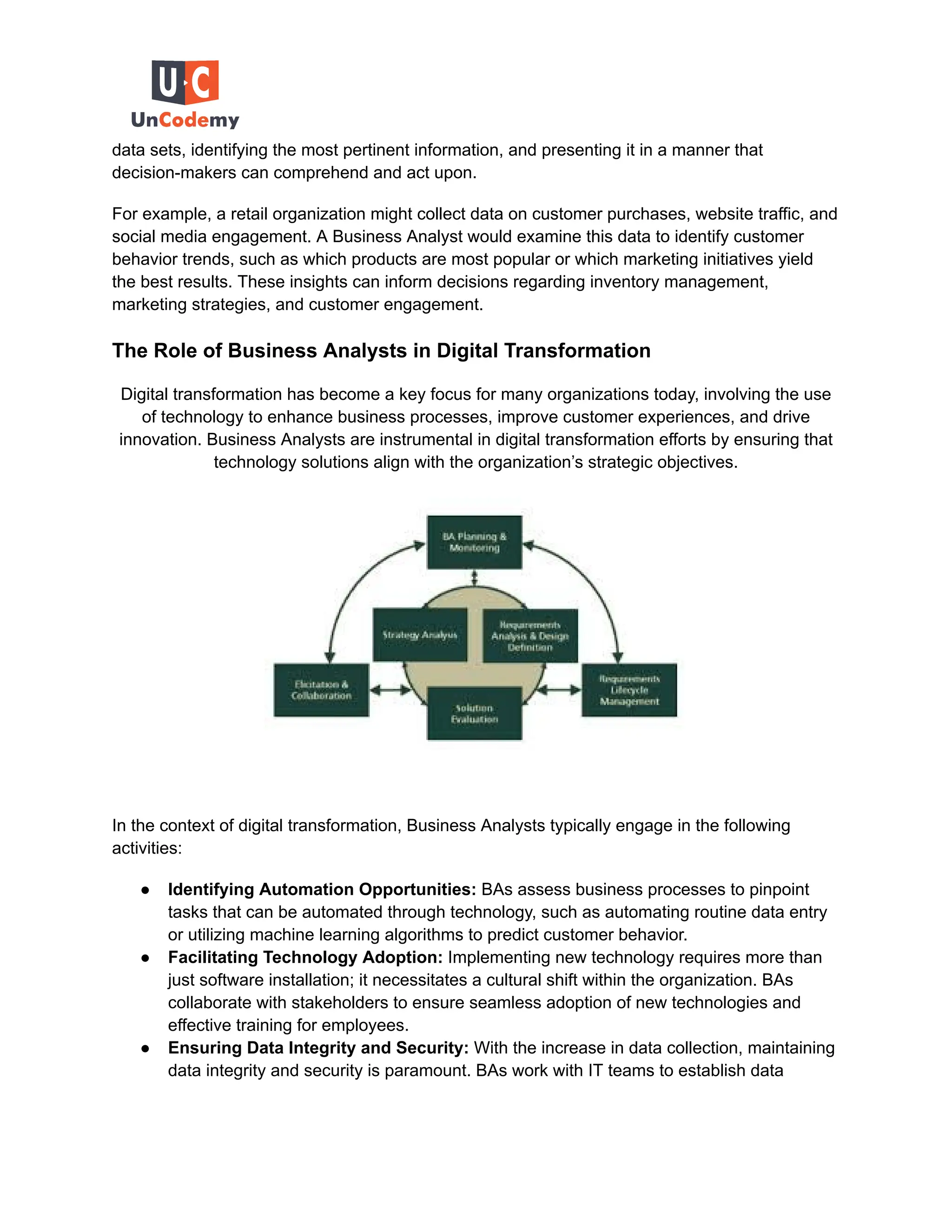
Digital transformation has become a key focus for many organizations today, involving the use
of technology to enhance business processes, improve customer experiences, and drive
innovation. Business Analysts are instrumental in digital transformation efforts by ensuring that
technology solutions align with the organization’s strategic objectives.
In the context of digital transformation, Business Analysts typically engage in the following
activities:
● Identifying Automation Opportunities: BAs assess business processes to pinpoint
tasks that can be automated through technology, such as automating routine data entry
or utilizing machine learning algorithms to predict customer behavior.
● Facilitating Technology Adoption: Implementing new technology requires more than
just software installation; it necessitates a cultural shift within the organization. BAs
collaborate with stakeholders to ensure seamless adoption of new technologies and
effective training for employees.
● Ensuring Data Integrity and Security: With the increase in data collection, maintaining
data integrity and security is paramount. BAs work with IT teams to establish data
governance frameworks that safeguard sensitive information and ensure compliance
with regulations.
● Driving Innovation: BAs often participate in brainstorming sessions and innovation
workshops, helping to identify new ways to leverage technology for organizational value.
This could entail developing new products, enhancing customer experiences, or
improving operational efficiency.
Business Analysts in Agile Methodologies
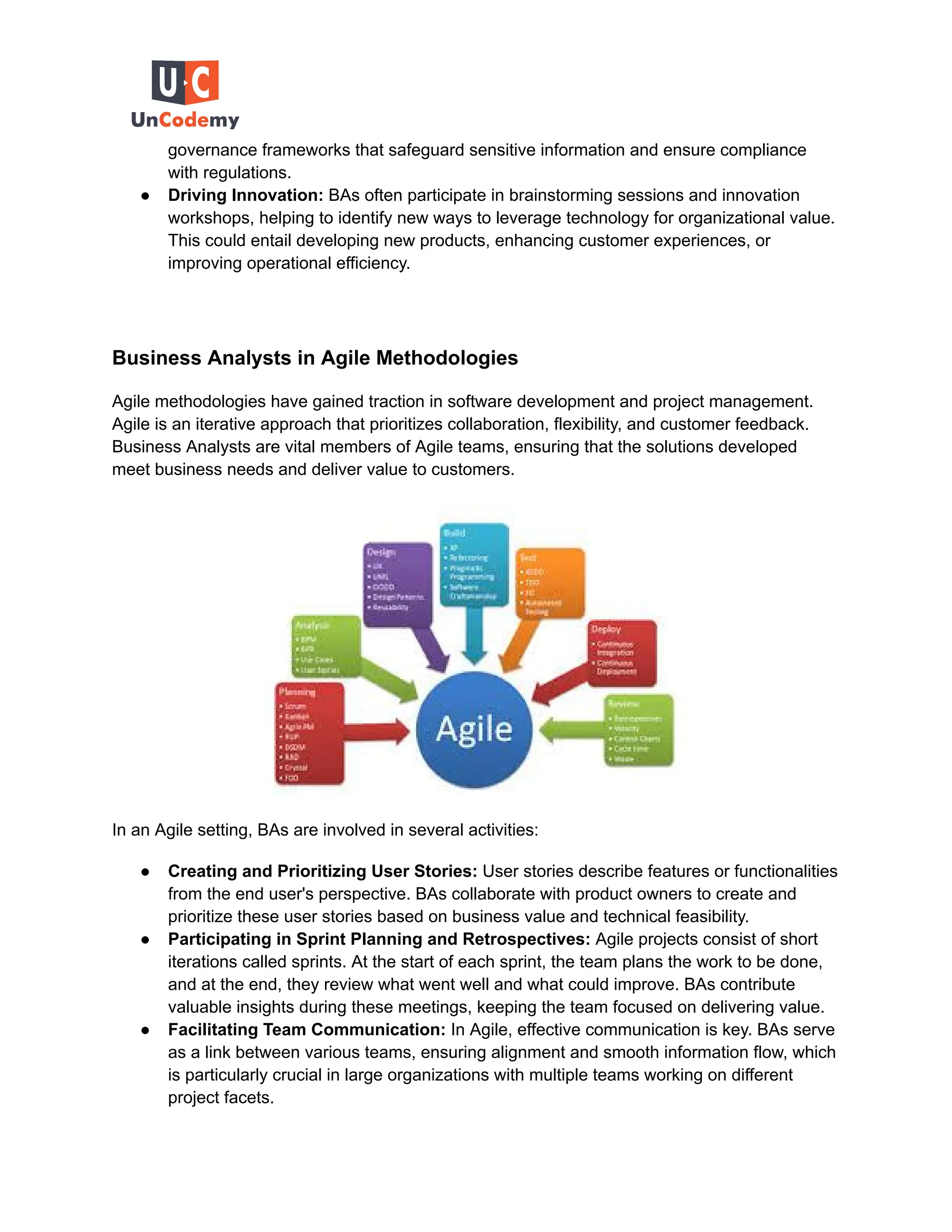
Agile methodologies have gained traction in software development and project management.
Agile is an iterative approach that prioritizes collaboration, flexibility, and customer feedback.
Business Analysts are vital members of Agile teams, ensuring that the solutions developed
meet business needs and deliver value to customers.
In an Agile setting, BAs are involved in several activities:
● Creating and Prioritizing User Stories: User stories describe features or functionalities
from the end user's perspective. BAs collaborate with product owners to create and
prioritize these user stories based on business value and technical feasibility.
● Participating in Sprint Planning and Retrospectives: Agile projects consist of short
iterations called sprints. At the start of each sprint, the team plans the work to be done,
and at the end, they review what went well and what could improve. BAs contribute
valuable insights during these meetings, keeping the team focused on delivering value.
● Facilitating Team Communication: In Agile, effective communication is key. BAs serve
as a link between various teams, ensuring alignment and smooth information flow, which
is particularly crucial in large organizations with multiple teams working on different
project facets.
● Continuous Improvement: Agile emphasizes ongoing enhancement, and BAs play a
critical role in identifying areas for improvement and implementing necessary changes,
whether refining processes, updating documentation, or introducing new tools and
techniques.
The Evolving Skill Set of Business Analysts
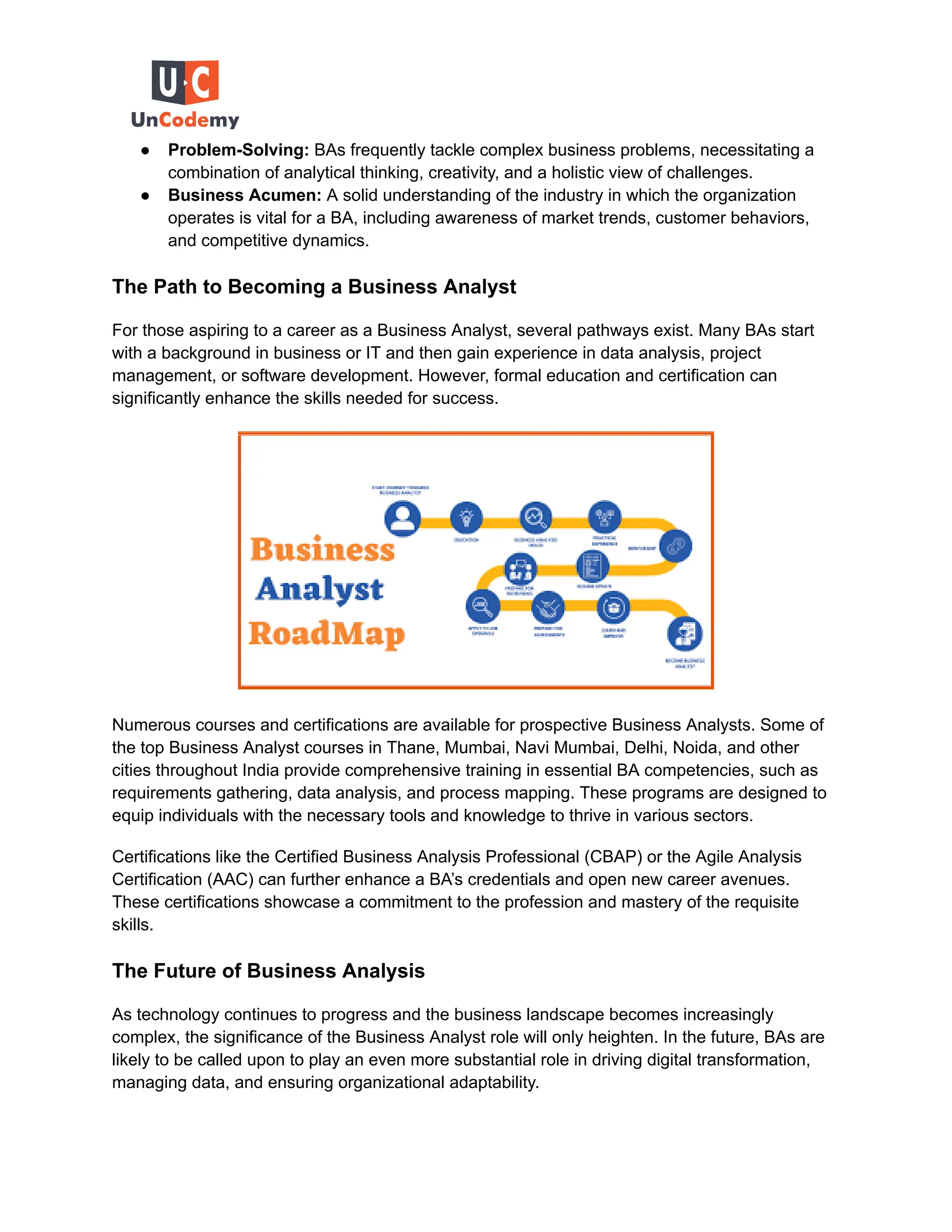
As the responsibilities of Business Analysts evolve, so too does the skill set required for
success. Beyond traditional skills like requirements gathering and process mapping, modern
BAs need proficiency in data analysis, a strong grasp of technology, and the ability to function
within Agile environments.
Essential skills for contemporary Business Analysts include:
● Data Analysis: Analyzing extensive data sets and deriving significant insights is
increasingly critical, necessitating proficiency in tools like Excel, SQL, and data
visualization platforms.
● Technical Knowledge: While BAs are not required to be developers, they must
understand the technologies employed in their organizations, including system
operations, data flows, and leveraging technology to address business challenges.
● Agile Methodologies: As Agile adoption increases, BAs must be comfortable operating
within this framework, which includes understanding Agile principles, crafting user
stories, and collaborating closely with development teams.
● Communication Skills: Effective communication remains a cornerstone of a BA’s role.
They must be able to articulate complex concepts clearly to both technical and
non-technical stakeholders, ensuring alignment on project goals.
● Change Management: Implementing new systems and processes often entails
significant organizational change. BAs should be adept at change management,
including how to communicate changes, address resistance, and ensure a seamless
transition.
● Problem-Solving: BAs frequently tackle complex business problems, necessitating a
combination of analytical thinking, creativity, and a holistic view of challenges.
● Business Acumen: A solid understanding of the industry in which the organization
operates is vital for a BA, including awareness of market trends, customer behaviors,
and competitive dynamics.
The Path to Becoming a Business Analyst
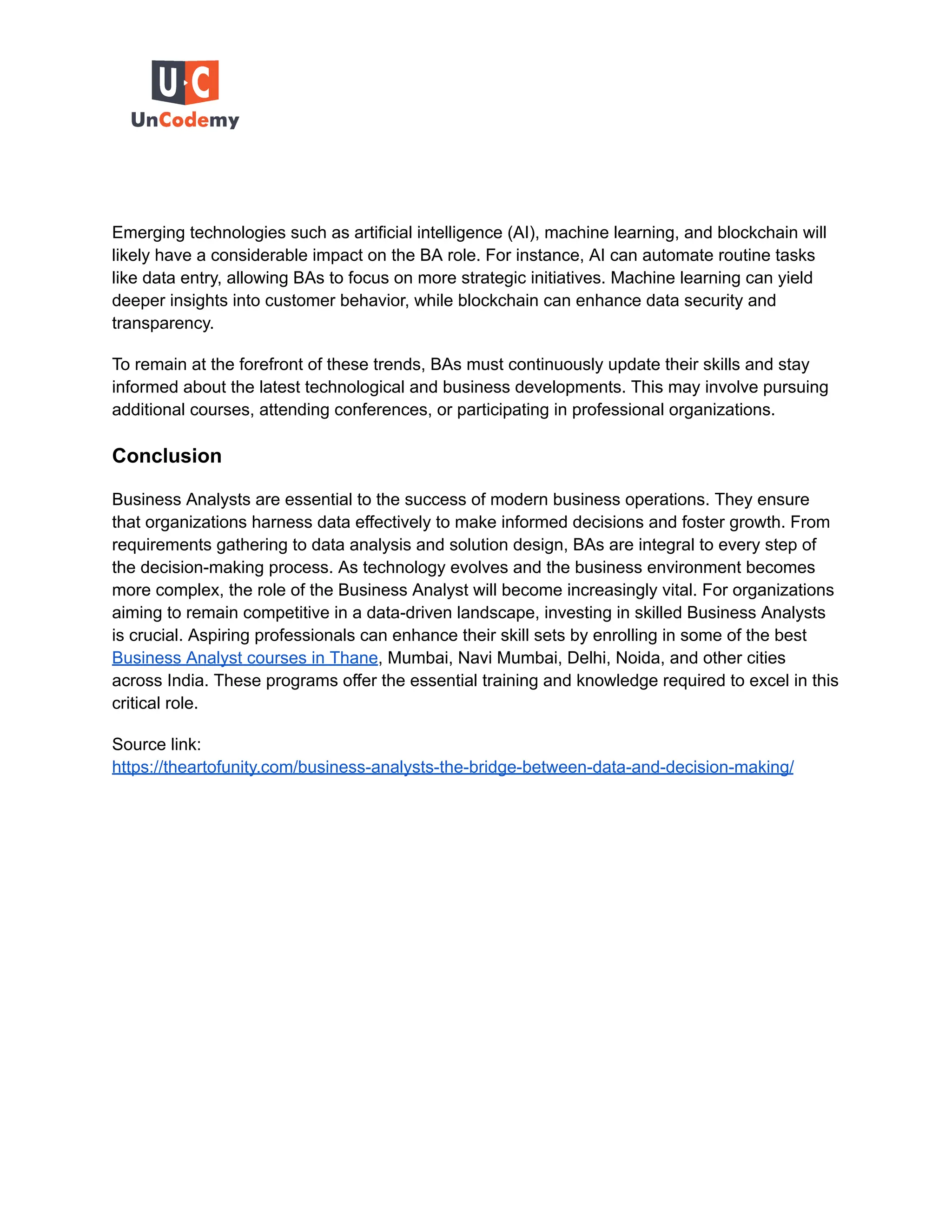
For those aspiring to a career as a Business Analyst, several pathways exist. Many BAs start
with a background in business or IT and then gain experience in data analysis, project
management, or software development. However, formal education and certification can
significantly enhance the skills needed for success.
Numerous courses and certifications are available for prospective Business Analysts. Some of
the top Business Analyst courses in Thane, Mumbai, Navi Mumbai, Delhi, Noida, and other
cities throughout India provide comprehensive training in essential BA competencies, such as
requirements gathering, data analysis, and process mapping. These programs are designed to
equip individuals with the necessary tools and knowledge to thrive in various sectors.
Certifications like the Certified Business Analysis Professional (CBAP) or the Agile Analysis
Certification (AAC) can further enhance a BA’s credentials and open new career avenues.
These certifications showcase a commitment to the profession and mastery of the requisite
skills.
The Future of Business Analysis
As technology continues to progress and the business landscape becomes increasingly
complex, the significance of the Business Analyst role will only heighten. In the future, BAs are
likely to be called upon to play an even more substantial role in driving digital transformation,
managing data, and ensuring organizational adaptability.
Emerging technologies such as artificial intelligence (AI), machine learning, and blockchain will
likely have a considerable impact on the BA role. For instance, AI can automate routine tasks
like data entry, allowing BAs to focus on more strategic initiatives. Machine learning can yield
deeper insights into customer behavior, while blockchain can enhance data security and
transparency.
To remain at the forefront of these trends, BAs must continuously update their skills and stay
informed about the latest technological and business developments. This may involve pursuing
additional courses, attending conferences, or participating in professional organizations.
Conclusion
Business Analysts are essential to the success of modern business operations. They ensure
that organizations harness data effectively to make informed decisions and foster growth. From
requirements gathering to data analysis and solution design, BAs are integral to every step of
the decision-making process. As technology evolves and the business environment becomes
more complex, the role of the Business Analyst will become increasingly vital. For organizations
aiming to remain competitive in a data-driven landscape, investing in skilled Business Analysts
is crucial. Aspiring professionals can enhance their skill sets by enrolling in some of the best
Business Analyst courses in Thane, Mumbai, Navi Mumbai, Delhi, Noida, and other cities
across India. These programs offer the essential training and knowledge required to excel in this
critical role.
Source link:
https://theartofunity.com/business-analysts-the-bridge-between-data-and-decision-making/

Business Analysts: The Bridge Between Data and Decision-Making

  • 1.
    Business Analysts: TheBridge Between Data and Decision-Making In today's rapidly evolving business landscape, the ability to make informed decisions has become more crucial than ever. Companies collect vast amounts of data from diverse sources—including customer interactions, sales figures, market trends, and operational metrics. However, raw data alone is insufficient; it must be transformed into actionable insights that can steer strategy, drive innovation, and foster growth. This is where the role of the Business Analyst (BA) is indispensable. Business Analysts serve as the vital connection between data and decision-making, ensuring that organizations effectively utilize their data to achieve their objectives. The Role of a Business Analyst A Business Analyst acts as a bridge between technical teams that manage and analyze data and the business stakeholders who depend on that data for decision-making. Their primary responsibility is to convert business needs into technical requirements, ensuring that the solutions developed are aligned with these needs and are technically viable. This position demands a profound understanding of both the business context and the technical tools and methods used for data analysis.
  • 2.
    Business Analysts operateacross various sectors, with their responsibilities varying according to the organization's specific needs. Common tasks include: ● Requirements Gathering: BAs engage with stakeholders to identify their needs and translate them into clear, actionable requirements through interviews, workshops, and document analysis. ● Data Analysis: Skilled in analyzing data, BAs uncover trends, patterns, and insights using tools like Excel, SQL, and advanced analytics platforms to derive meaningful conclusions. ● Process Mapping: BAs frequently map out business processes to pinpoint inefficiencies and areas for improvement, helping to clarify the current operational state and design more effective future processes. ● Solution Design: After their analysis, BAs collaborate with technical teams to craft solutions that address business needs, which may include creating detailed specifications, user stories, or prototypes. ● Stakeholder Communication: Clear and effective communication is vital in a BA's role, as they must articulate technical concepts to non-technical stakeholders, ensuring everyone is aligned with project goals and objectives. The Significance of Data-Driven Decision-Making Data is often likened to the "new oil" of the digital economy, and for good reason. It serves as the raw material from which businesses can extract valuable insights to inform decisions. In an increasingly competitive environment where customer expectations are continuously shifting, data-driven decision-making is not just advantageous; it is essential. Nonetheless, the overwhelming volume of data generated by modern organizations can be daunting. Without the right tools and expertise, it is easy to become lost in the data and overlook key insights. Here, Business Analysts prove invaluable, as they excel at sifting through large
  • 3.
    data sets, identifyingthe most pertinent information, and presenting it in a manner that decision-makers can comprehend and act upon. For example, a retail organization might collect data on customer purchases, website traffic, and social media engagement. A Business Analyst would examine this data to identify customer behavior trends, such as which products are most popular or which marketing initiatives yield the best results. These insights can inform decisions regarding inventory management, marketing strategies, and customer engagement. The Role of Business Analysts in Digital Transformation Digital transformation has become a key focus for many organizations today, involving the use of technology to enhance business processes, improve customer experiences, and drive innovation. Business Analysts are instrumental in digital transformation efforts by ensuring that technology solutions align with the organization’s strategic objectives. In the context of digital transformation, Business Analysts typically engage in the following activities: ● Identifying Automation Opportunities: BAs assess business processes to pinpoint tasks that can be automated through technology, such as automating routine data entry or utilizing machine learning algorithms to predict customer behavior. ● Facilitating Technology Adoption: Implementing new technology requires more than just software installation; it necessitates a cultural shift within the organization. BAs collaborate with stakeholders to ensure seamless adoption of new technologies and effective training for employees. ● Ensuring Data Integrity and Security: With the increase in data collection, maintaining data integrity and security is paramount. BAs work with IT teams to establish data
  • 4.
    governance frameworks thatsafeguard sensitive information and ensure compliance with regulations. ● Driving Innovation: BAs often participate in brainstorming sessions and innovation workshops, helping to identify new ways to leverage technology for organizational value. This could entail developing new products, enhancing customer experiences, or improving operational efficiency. Business Analysts in Agile Methodologies Agile methodologies have gained traction in software development and project management. Agile is an iterative approach that prioritizes collaboration, flexibility, and customer feedback. Business Analysts are vital members of Agile teams, ensuring that the solutions developed meet business needs and deliver value to customers. In an Agile setting, BAs are involved in several activities: ● Creating and Prioritizing User Stories: User stories describe features or functionalities from the end user's perspective. BAs collaborate with product owners to create and prioritize these user stories based on business value and technical feasibility. ● Participating in Sprint Planning and Retrospectives: Agile projects consist of short iterations called sprints. At the start of each sprint, the team plans the work to be done, and at the end, they review what went well and what could improve. BAs contribute valuable insights during these meetings, keeping the team focused on delivering value. ● Facilitating Team Communication: In Agile, effective communication is key. BAs serve as a link between various teams, ensuring alignment and smooth information flow, which is particularly crucial in large organizations with multiple teams working on different project facets.
  • 5.
    ● Continuous Improvement:Agile emphasizes ongoing enhancement, and BAs play a critical role in identifying areas for improvement and implementing necessary changes, whether refining processes, updating documentation, or introducing new tools and techniques. The Evolving Skill Set of Business Analysts As the responsibilities of Business Analysts evolve, so too does the skill set required for success. Beyond traditional skills like requirements gathering and process mapping, modern BAs need proficiency in data analysis, a strong grasp of technology, and the ability to function within Agile environments. Essential skills for contemporary Business Analysts include: ● Data Analysis: Analyzing extensive data sets and deriving significant insights is increasingly critical, necessitating proficiency in tools like Excel, SQL, and data visualization platforms. ● Technical Knowledge: While BAs are not required to be developers, they must understand the technologies employed in their organizations, including system operations, data flows, and leveraging technology to address business challenges. ● Agile Methodologies: As Agile adoption increases, BAs must be comfortable operating within this framework, which includes understanding Agile principles, crafting user stories, and collaborating closely with development teams. ● Communication Skills: Effective communication remains a cornerstone of a BA’s role. They must be able to articulate complex concepts clearly to both technical and non-technical stakeholders, ensuring alignment on project goals. ● Change Management: Implementing new systems and processes often entails significant organizational change. BAs should be adept at change management, including how to communicate changes, address resistance, and ensure a seamless transition.
  • 6.
    ● Problem-Solving: BAsfrequently tackle complex business problems, necessitating a combination of analytical thinking, creativity, and a holistic view of challenges. ● Business Acumen: A solid understanding of the industry in which the organization operates is vital for a BA, including awareness of market trends, customer behaviors, and competitive dynamics. The Path to Becoming a Business Analyst For those aspiring to a career as a Business Analyst, several pathways exist. Many BAs start with a background in business or IT and then gain experience in data analysis, project management, or software development. However, formal education and certification can significantly enhance the skills needed for success. Numerous courses and certifications are available for prospective Business Analysts. Some of the top Business Analyst courses in Thane, Mumbai, Navi Mumbai, Delhi, Noida, and other cities throughout India provide comprehensive training in essential BA competencies, such as requirements gathering, data analysis, and process mapping. These programs are designed to equip individuals with the necessary tools and knowledge to thrive in various sectors. Certifications like the Certified Business Analysis Professional (CBAP) or the Agile Analysis Certification (AAC) can further enhance a BA’s credentials and open new career avenues. These certifications showcase a commitment to the profession and mastery of the requisite skills. The Future of Business Analysis As technology continues to progress and the business landscape becomes increasingly complex, the significance of the Business Analyst role will only heighten. In the future, BAs are likely to be called upon to play an even more substantial role in driving digital transformation, managing data, and ensuring organizational adaptability.
  • 7.
    Emerging technologies suchas artificial intelligence (AI), machine learning, and blockchain will likely have a considerable impact on the BA role. For instance, AI can automate routine tasks like data entry, allowing BAs to focus on more strategic initiatives. Machine learning can yield deeper insights into customer behavior, while blockchain can enhance data security and transparency. To remain at the forefront of these trends, BAs must continuously update their skills and stay informed about the latest technological and business developments. This may involve pursuing additional courses, attending conferences, or participating in professional organizations. Conclusion Business Analysts are essential to the success of modern business operations. They ensure that organizations harness data effectively to make informed decisions and foster growth. From requirements gathering to data analysis and solution design, BAs are integral to every step of the decision-making process. As technology evolves and the business environment becomes more complex, the role of the Business Analyst will become increasingly vital. For organizations aiming to remain competitive in a data-driven landscape, investing in skilled Business Analysts is crucial. Aspiring professionals can enhance their skill sets by enrolling in some of the best Business Analyst courses in Thane, Mumbai, Navi Mumbai, Delhi, Noida, and other cities across India. These programs offer the essential training and knowledge required to excel in this critical role. Source link: https://theartofunity.com/business-analysts-the-bridge-between-data-and-decision-making/