CISOs and their teams operate against a backdrop of continuous change in the threat
landscape, information security technology, and business conditions. The mission to
protect critical assets across space and time is further complicated by a lack of direct
control over the people and processes that expose the organization to risk through day-
to-day operations.
In-depth research with hundreds of information security leaders revealed
a common thread among the top performers:
Technical skills, while essential, are not enough.
To deliver maximum impact, Information Security must
engage with the business and practice proactive
organizational engagement.
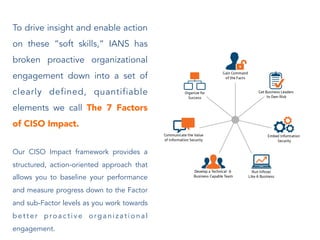
To drive insight and enable action
on these “soft skills,” IANS has
broken proactive organizational
engagement down into a set of
clearly defined, quantifiable
elements we call The 7 Factors
of CISO Impact.
Our CISO Impact framework provides a
structured, action-oriented approach that
allows you to baseline your performance
and measure progress down to the Factor
and sub-Factor levels as you work towards
b e t t e r p ro a c t i v e o rg a n i z a t i o n a l
engagement.
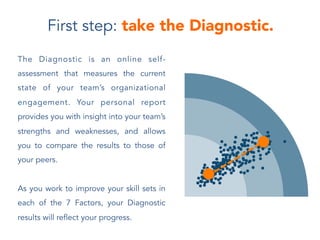
First step: take the Diagnostic.
The Diagnostic is an online self-
assessment that measures the current
state of your team’s organizational
engagement. Your personal report
provides you with insight into your team’s
strengths and weaknesses, and allows
you to compare the results to those of
your peers.
As you work to improve your skill sets in
each of the 7 Factors, your Diagnostic
results will reflect your progress.
Then, attend
a CISO Impact
Workshop.
The CISO Impact Workshop is a four-hour
deep dive into one of the 7 Factors of
CISO Impact.
IANS-proprietary worksheets will help you
break down your Factor-specific Diagnostic
results into concrete, step-by-step actions
for improvement.
You’ll experience a new way of thinking
about what you do, and walk away with
insights that will influence the way that you
execute your mission.
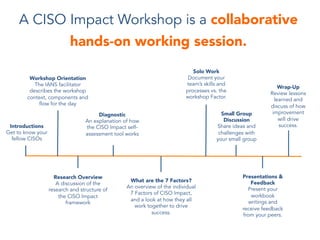
A CISO Impact Workshop is a collaborative
hands-on working session.
Wrap-Up
Review lessons
learned and
discuss of how
improvement
will drive
success.Introductions
Get to know your
fellow CISOs
Workshop Orientation
The IANS facilitator
describes the workshop
context, components and
flow for the day
Solo Work
Document your
team’s skills and
processes vs. the
workshop Factor.
Presentations &
Feedback
Present your
workbook
writings and
receive feedback
from your peers.
Research Overview
A discussion of the
research and structure of
the CISO Impact
framework
Diagnostic
An explanation of how
the CISO Impact self-
assessment tool works
What are the 7 Factors?
An overview of the individual
7 Factors of CISO Impact,
and a look at how they all
work together to drive
success.
Small Group
Discussion
Share ideas and
challenges with
your small group
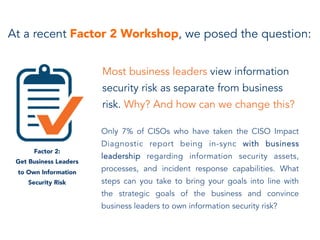
Most business leaders view information
security risk as separate from business
risk. Why? And how can we change this?
Only 7% of CISOs who have taken the CISO Impact
Diagnostic report being in-sync with business
leadership regarding information security assets,
processes, and incident response capabilities. What
steps can you take to bring your goals into line with
the strategic goals of the business and convince
business leaders to own information security risk?
At a recent Factor 2 Workshop, we posed the question:
Factor 2:
Get Business Leaders
to Own Information
Security Risk
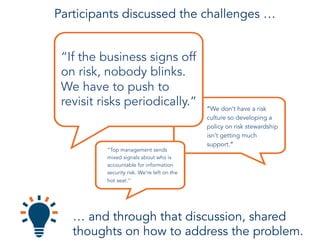
Participants discussed the challenges …
… and through that discussion, shared
thoughts on how to address the problem.
“If the business signs off
on risk, nobody blinks.
We have to push to
revisit risks periodically.” “We don’t have a risk
culture so developing a
policy on risk stewardship
isn’t getting much
support.”
“Top management sends
mixed signals about who is
accountable for information
security risk. We’re left on the
hot seat.”
You’ll walk away with strategies for success
in real-world situations. For example,
you’ll learn how to:
•  Work with C-Level executives to tie business leaders’
compensation to reducing security risks.
•  Create competition among business leaders by implementing
and publishing ‘wall of shame’ metrics for information security
compliance.
•  Work on building connections and finding security champions
in other departments in the organization, like Finance or
Legal.

What is an IANS CISO Workshop? Factor 2

  • 1.
    CISOs and theirteams operate against a backdrop of continuous change in the threat landscape, information security technology, and business conditions. The mission to protect critical assets across space and time is further complicated by a lack of direct control over the people and processes that expose the organization to risk through day- to-day operations. In-depth research with hundreds of information security leaders revealed a common thread among the top performers: Technical skills, while essential, are not enough. To deliver maximum impact, Information Security must engage with the business and practice proactive organizational engagement.
  • 2.
    To drive insightand enable action on these “soft skills,” IANS has broken proactive organizational engagement down into a set of clearly defined, quantifiable elements we call The 7 Factors of CISO Impact. Our CISO Impact framework provides a structured, action-oriented approach that allows you to baseline your performance and measure progress down to the Factor and sub-Factor levels as you work towards b e t t e r p ro a c t i v e o rg a n i z a t i o n a l engagement.
  • 3.
    First step: takethe Diagnostic. The Diagnostic is an online self- assessment that measures the current state of your team’s organizational engagement. Your personal report provides you with insight into your team’s strengths and weaknesses, and allows you to compare the results to those of your peers. As you work to improve your skill sets in each of the 7 Factors, your Diagnostic results will reflect your progress.
  • 4.
    Then, attend a CISOImpact Workshop. The CISO Impact Workshop is a four-hour deep dive into one of the 7 Factors of CISO Impact. IANS-proprietary worksheets will help you break down your Factor-specific Diagnostic results into concrete, step-by-step actions for improvement. You’ll experience a new way of thinking about what you do, and walk away with insights that will influence the way that you execute your mission.
  • 5.
    A CISO ImpactWorkshop is a collaborative hands-on working session. Wrap-Up Review lessons learned and discuss of how improvement will drive success.Introductions Get to know your fellow CISOs Workshop Orientation The IANS facilitator describes the workshop context, components and flow for the day Solo Work Document your team’s skills and processes vs. the workshop Factor. Presentations & Feedback Present your workbook writings and receive feedback from your peers. Research Overview A discussion of the research and structure of the CISO Impact framework Diagnostic An explanation of how the CISO Impact self- assessment tool works What are the 7 Factors? An overview of the individual 7 Factors of CISO Impact, and a look at how they all work together to drive success. Small Group Discussion Share ideas and challenges with your small group
  • 6.
    Most business leadersview information security risk as separate from business risk. Why? And how can we change this? Only 7% of CISOs who have taken the CISO Impact Diagnostic report being in-sync with business leadership regarding information security assets, processes, and incident response capabilities. What steps can you take to bring your goals into line with the strategic goals of the business and convince business leaders to own information security risk? At a recent Factor 2 Workshop, we posed the question: Factor 2: Get Business Leaders to Own Information Security Risk
  • 7.
    Participants discussed thechallenges … … and through that discussion, shared thoughts on how to address the problem. “If the business signs off on risk, nobody blinks. We have to push to revisit risks periodically.” “We don’t have a risk culture so developing a policy on risk stewardship isn’t getting much support.” “Top management sends mixed signals about who is accountable for information security risk. We’re left on the hot seat.”
  • 8.
    You’ll walk awaywith strategies for success in real-world situations. For example, you’ll learn how to: •  Work with C-Level executives to tie business leaders’ compensation to reducing security risks. •  Create competition among business leaders by implementing and publishing ‘wall of shame’ metrics for information security compliance. •  Work on building connections and finding security champions in other departments in the organization, like Finance or Legal.