6th grade
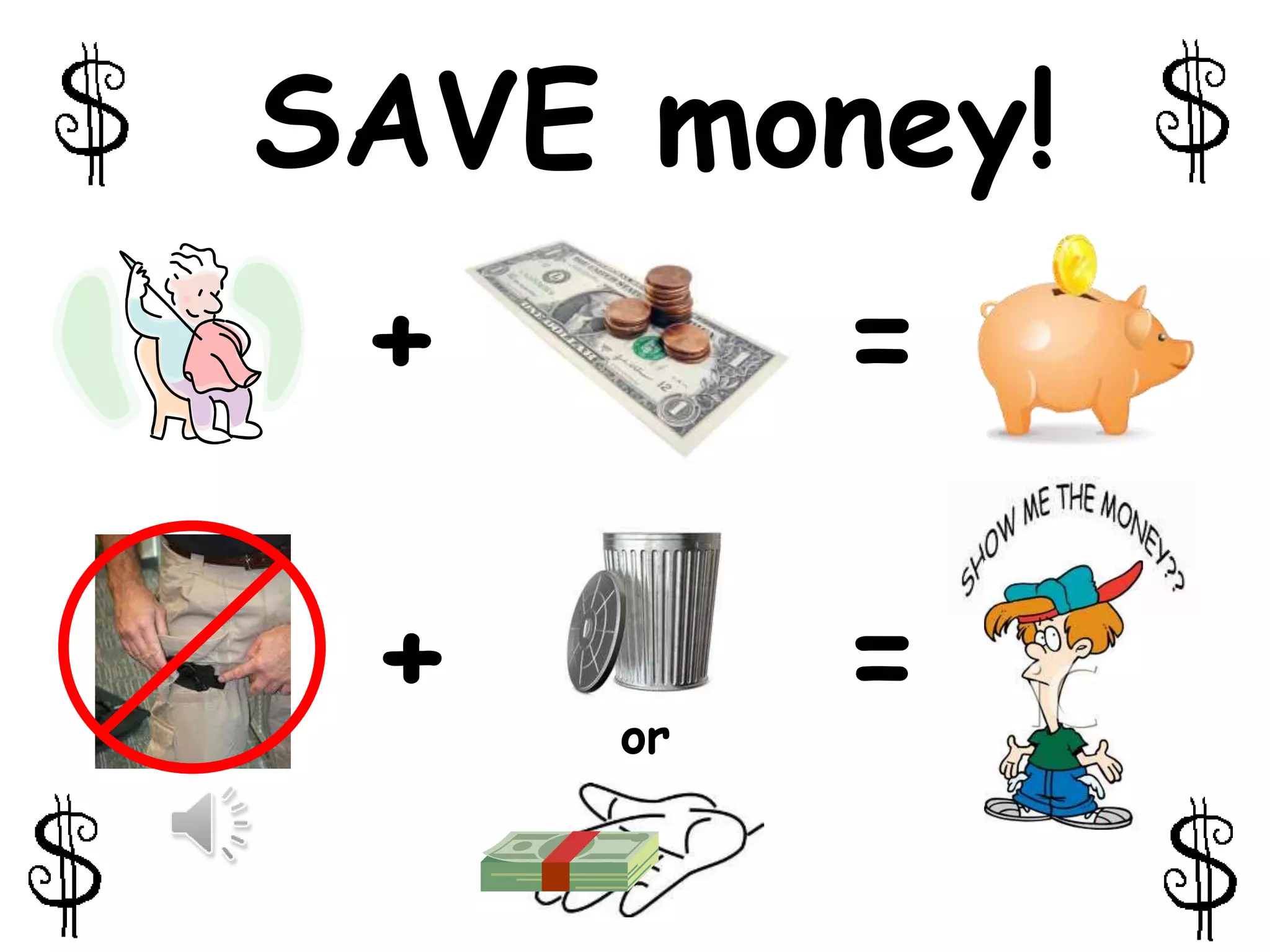
SAVE money! 
+ = 
+ = 
or
learning how to 
So 
sew will save me 
money? 
YES!!!!!!
you could 
also: 
and 
*become an entrepreneur and develop a 
product to sell on Etsy.com 
*begin your path to becoming a fashion 
designer, a costume maker or 
*just have fun making things that you 
love as gifts and/or items you can use 
yourself!
Now lets take a 
brief peek at 
the history 
of quilting.
Why?
"The past reminds us of timeless 
human truths and allows for the 
perpetuation of cultural traditions 
that can be nourishing; it contains 
examples of mistakes to avoid, 
preserves the memory of 
alternatives ways of doing things, 
and is the basis for self-understanding..." 
-Bettina Drew
Quilting History 
Where did quilts come from? 
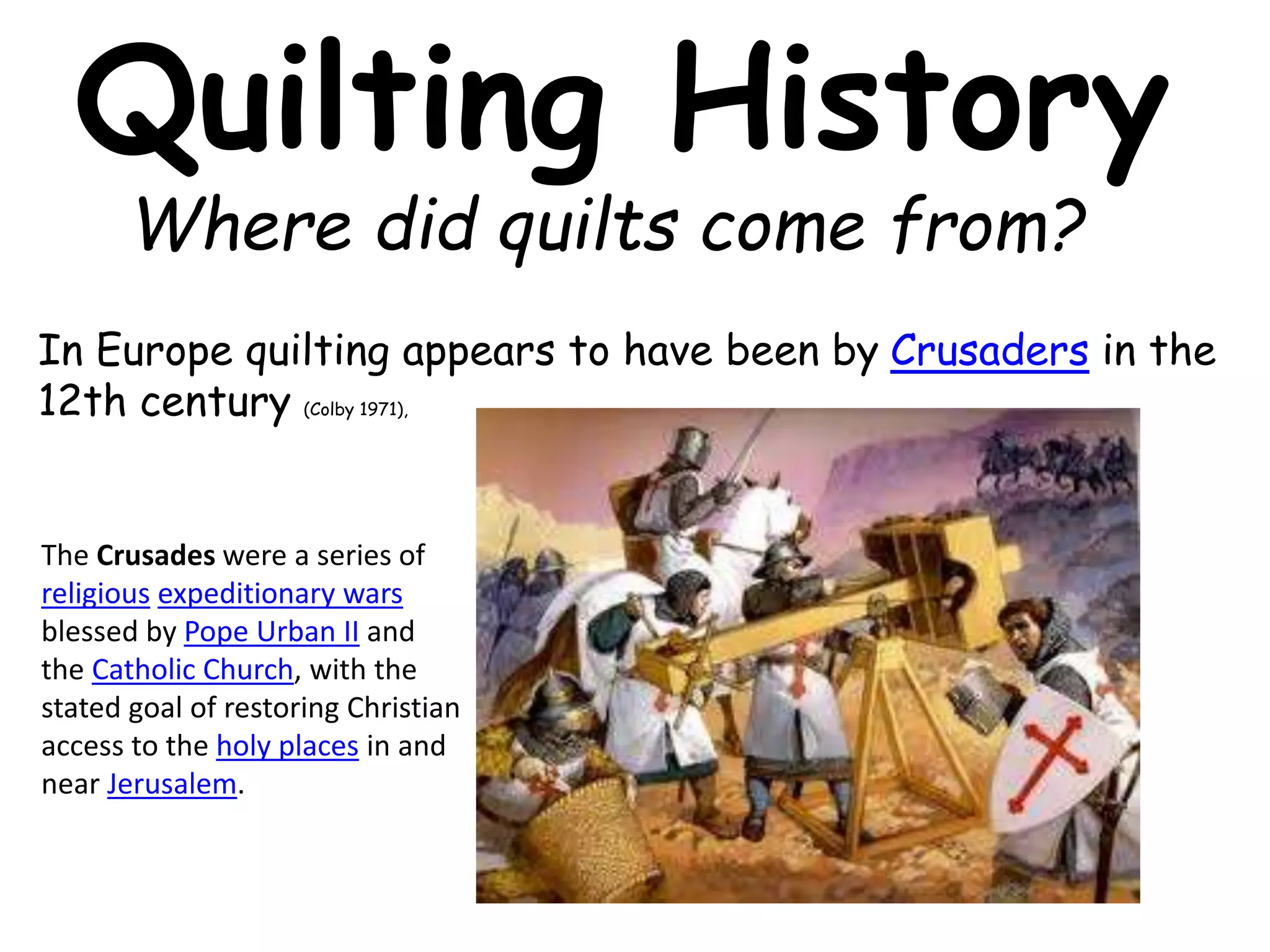
In Europe quilting appears to have been by Crusaders in the 
12th century (Colby 1971), 
The Crusades were a series of 
religious expeditionary wars 
blessed by Pope Urban II and 
the Catholic Church, with the 
stated goal of restoring Christian 
access to the holy places in and 
near Jerusalem.
Quilting History 
Where did quilts come from? 
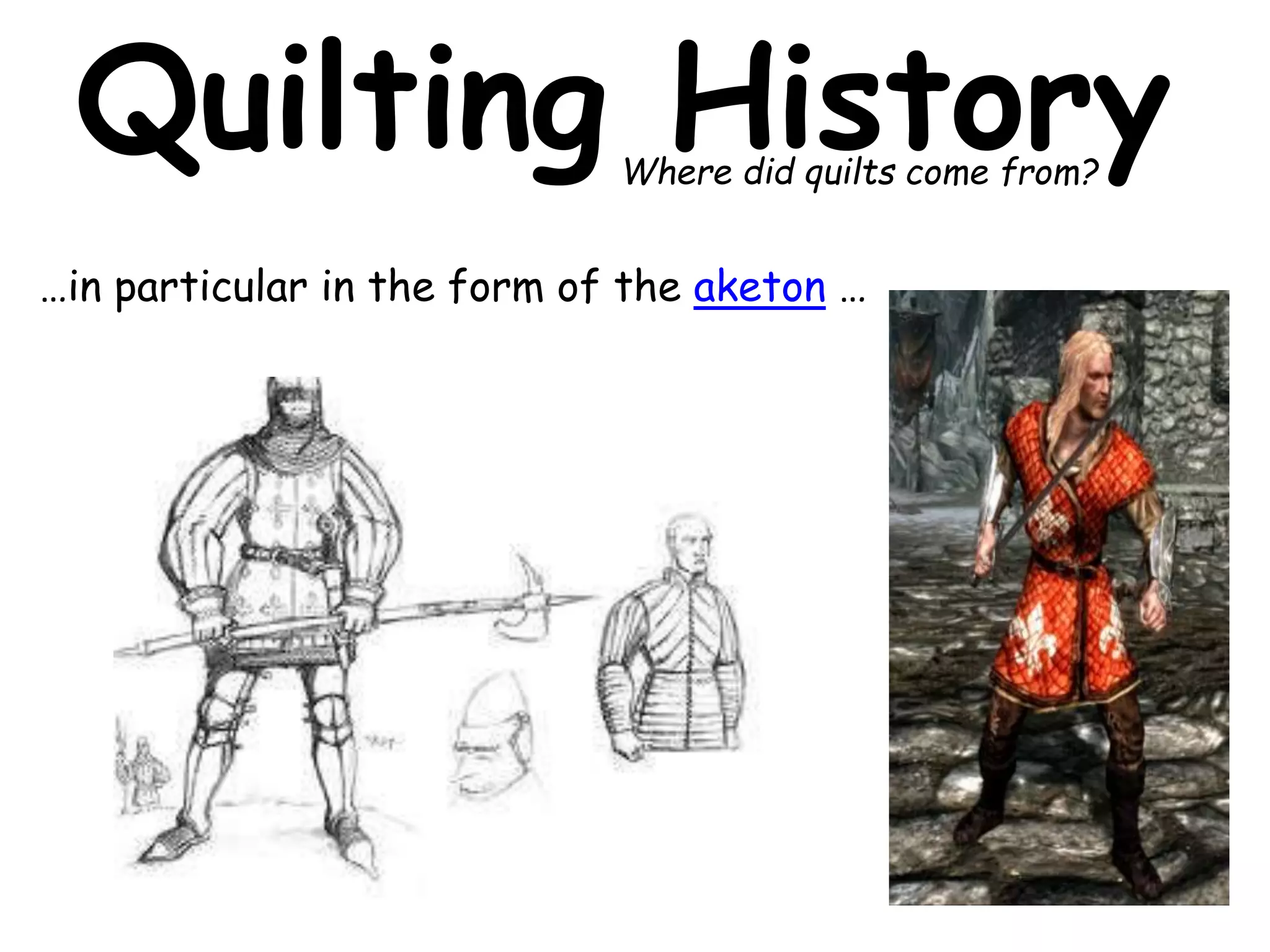
…in particular in the form of the aketon …
Quilting History 
Where did quilts come from? 
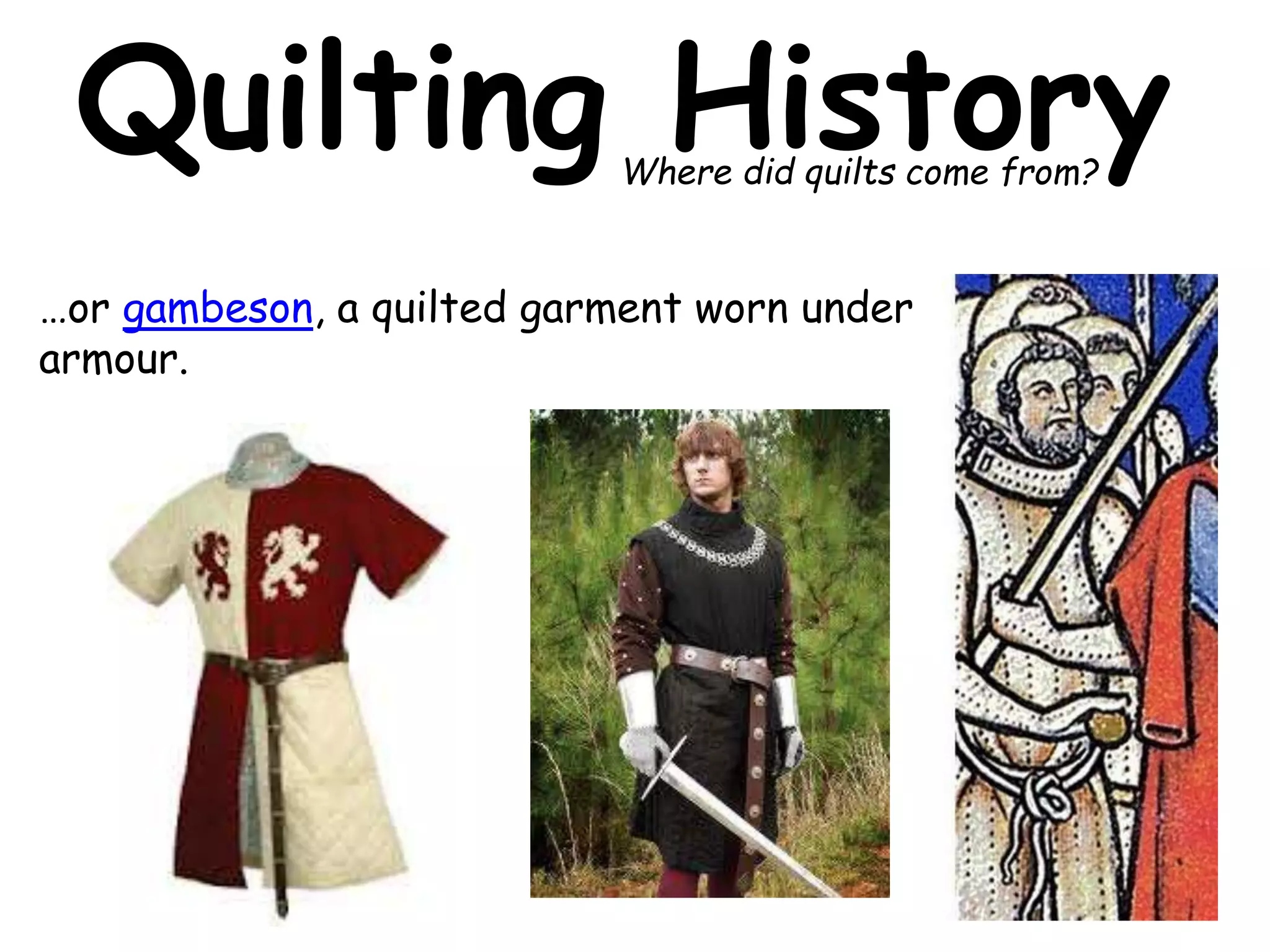
…or gambeson, a quilted garment worn under 
armour.
Quilting History 
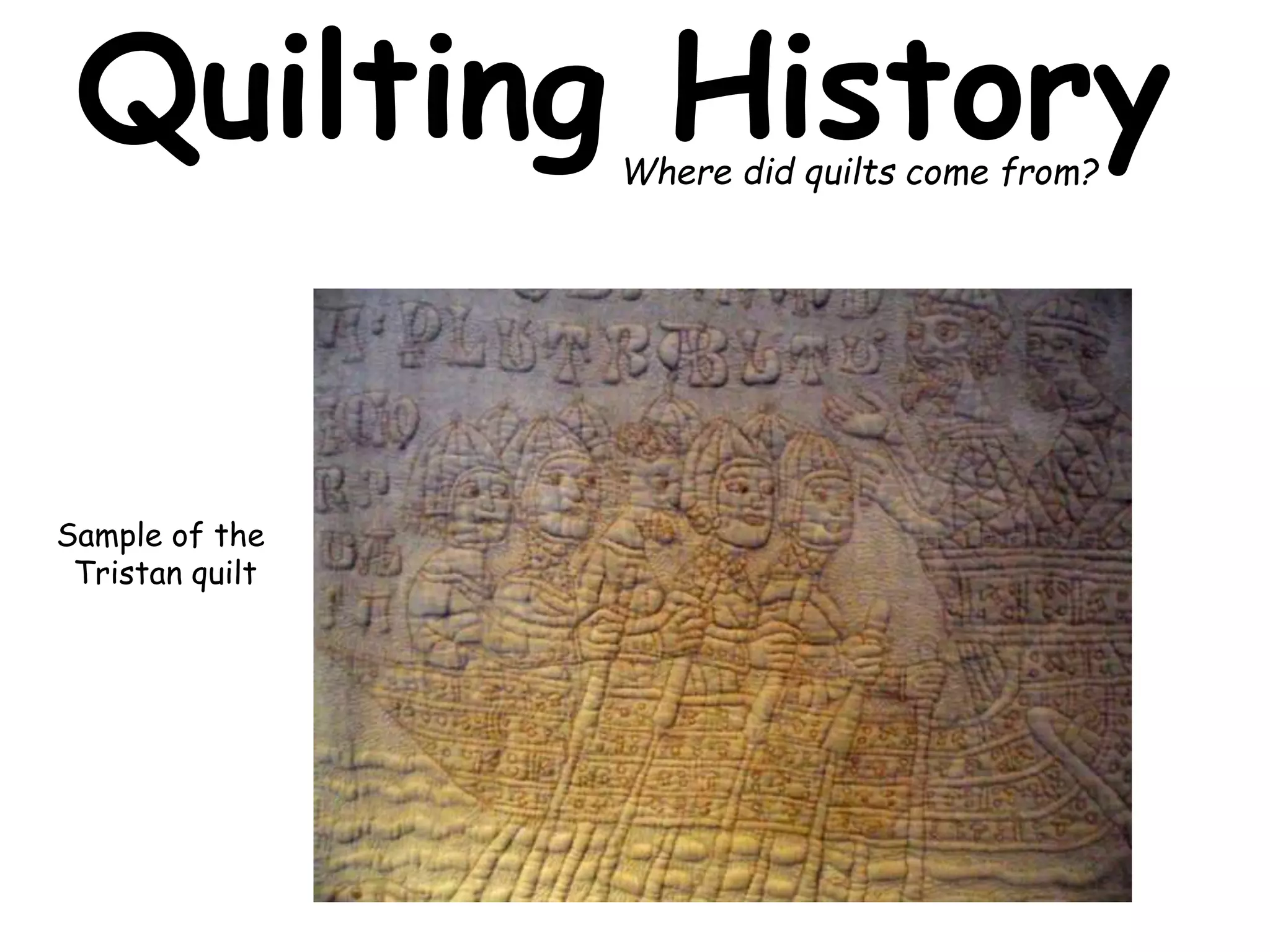
One of the earliest existing decorative works is the "Tristan quilt",[2] made 
around 1360. Made in Sicily, and as one of the earliest surviving quilts in the 
world, at least two sections survive at the Victoria & Albert Museum in London 
and the National Museum of Florance in Bargello, Florence 
Sample of the 
Tristan quilt 
Where did quilts come from?
Quilting History 
Sample of the 
Tristan quilt 
Where did quilts come from?
Quilting History 
Where did quilts come from? 
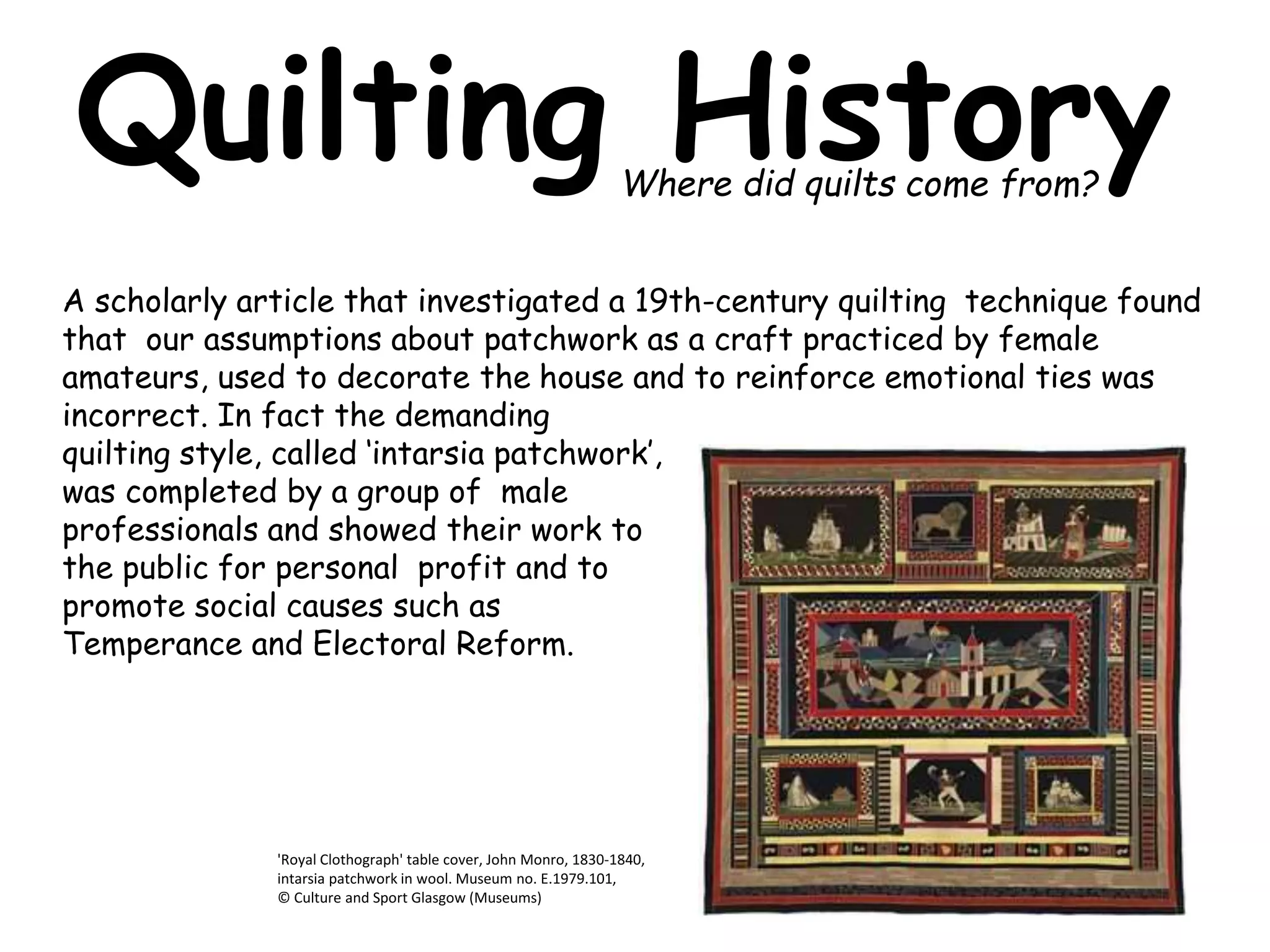
A scholarly article that investigated a 19th-century quilting technique found 
that our assumptions about patchwork as a craft practiced by female 
amateurs, used to decorate the house and to reinforce emotional ties was 
incorrect. In fact the demanding 
quilting style, called ‘intarsia patchwork’, 
was completed by a group of male 
professionals and showed their work to 
the public for personal profit and to 
promote social causes such as 
Temperance and Electoral Reform. 
'Royal Clothograph' table cover, John Monro, 1830-1840, 
intarsia patchwork in wool. Museum no. E.1979.101, 
© Culture and Sport Glasgow (Museums)
Quilting History 
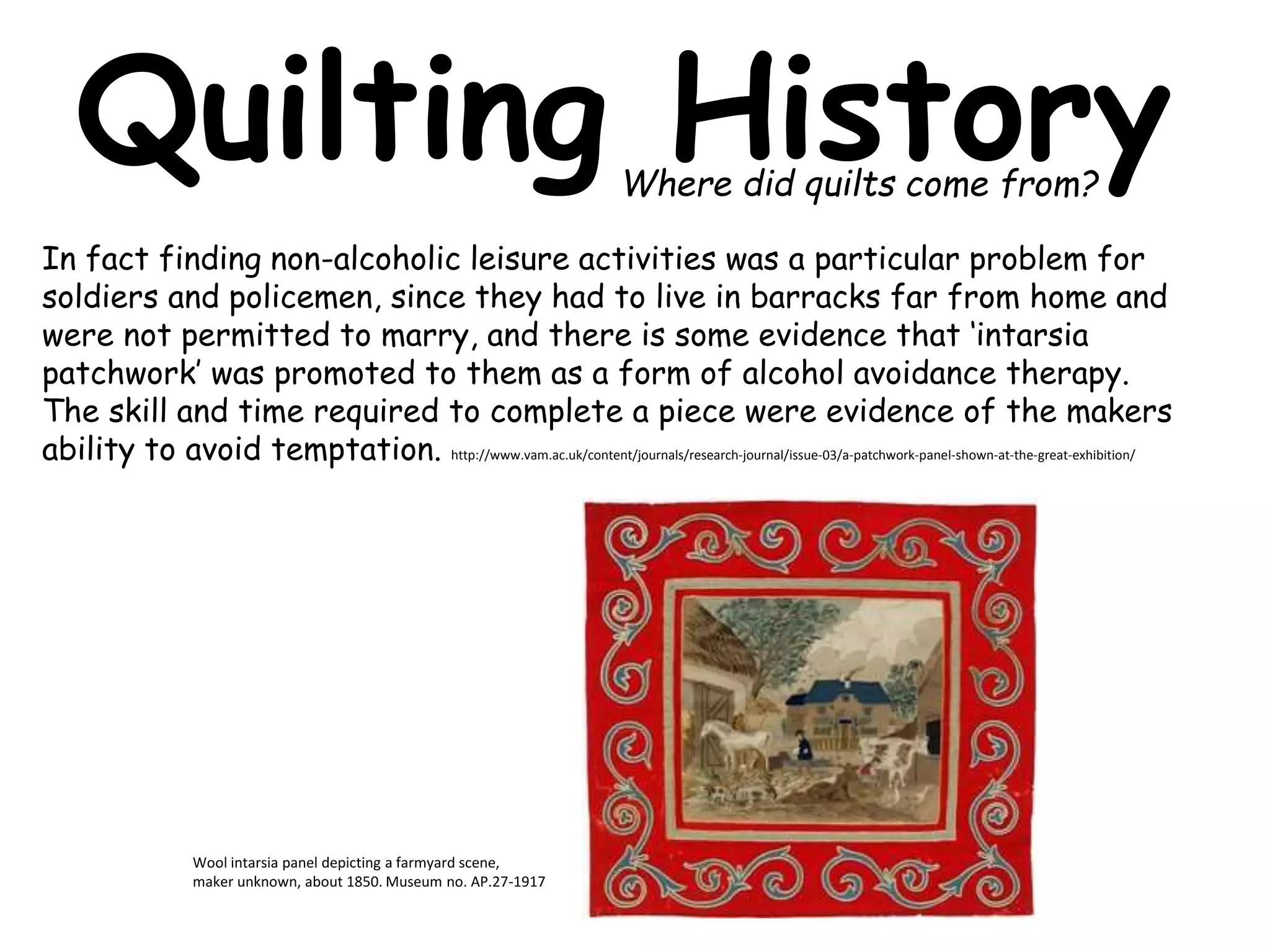
In fact finding non-alcoholic leisure activities was a particular problem for 
soldiers and policemen, since they had to live in barracks far from home and 
were not permitted to marry, and there is some evidence that ‘intarsia 
patchwork’ was promoted to them as a form of alcohol avoidance therapy. 
The skill and time required to complete a piece were evidence of the makers 
ability to avoid temptation. http://www.vam.ac.uk/content/journals/research-journal/issue-03/a-patchwork-panel-shown-at-the-great-exhibition/ 
Wool intarsia panel depicting a farmyard scene, 
maker unknown, about 1850. Museum no. AP.27-1917 
Where did quilts come from?
Quilting History 
Where did quilts come from? 
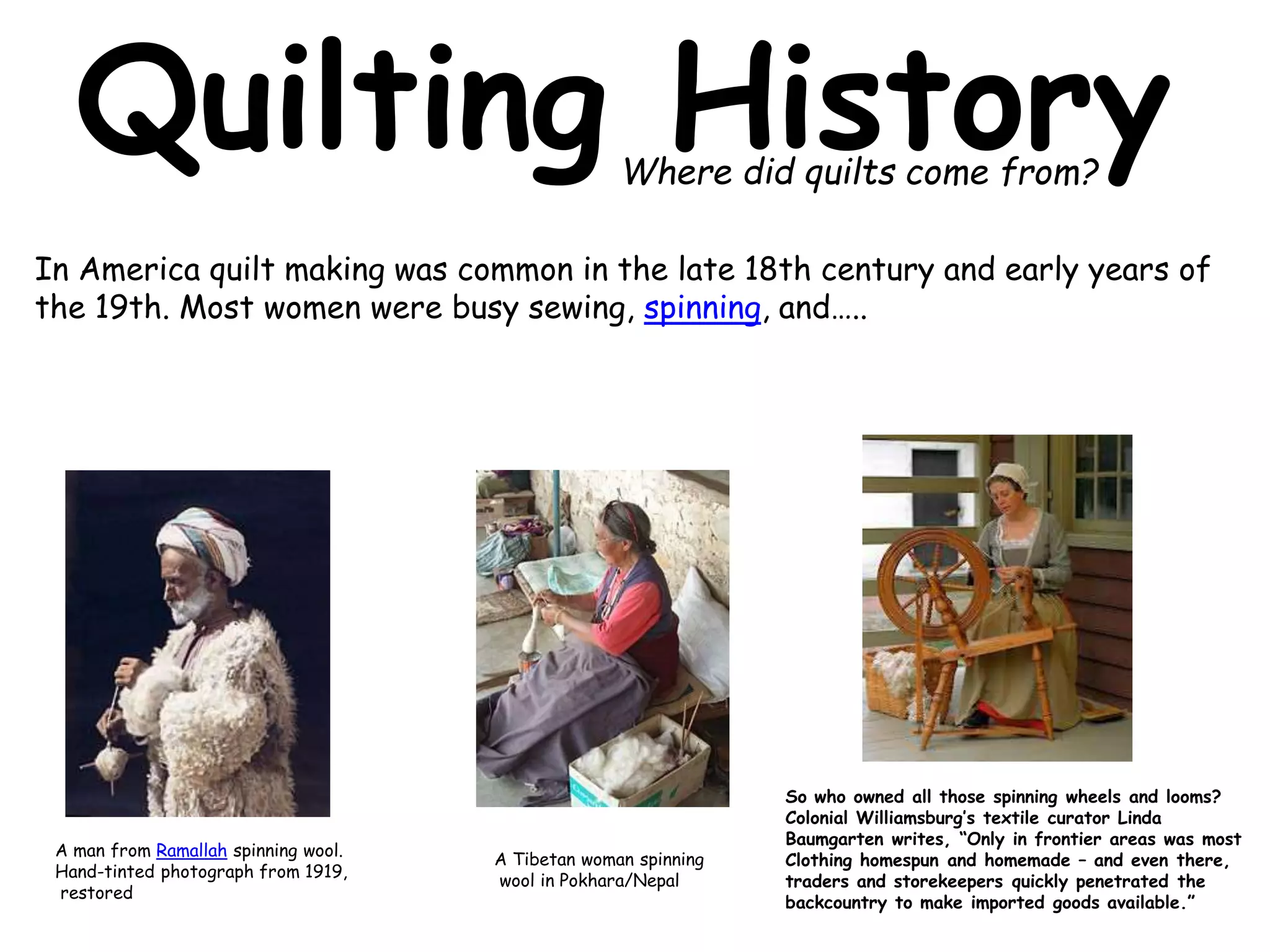
In America quilt making was common in the late 18th century and early years of 
the 19th. Most women were busy sewing, spinning, and….. 
A man from Ramallah spinning wool. 
Hand-tinted photograph from 1919, 
restored 
A Tibetan woman spinning 
wool in Pokhara/Nepal 
So who owned all those spinning wheels and looms? 
Colonial Williamsburg’s textile curator Linda 
Baumgarten writes, “Only in frontier areas was most 
Clothing homespun and homemade – and even there, 
traders and storekeepers quickly penetrated the 
backcountry to make imported goods available.”
Quilting History 
Where did quilts come from? 
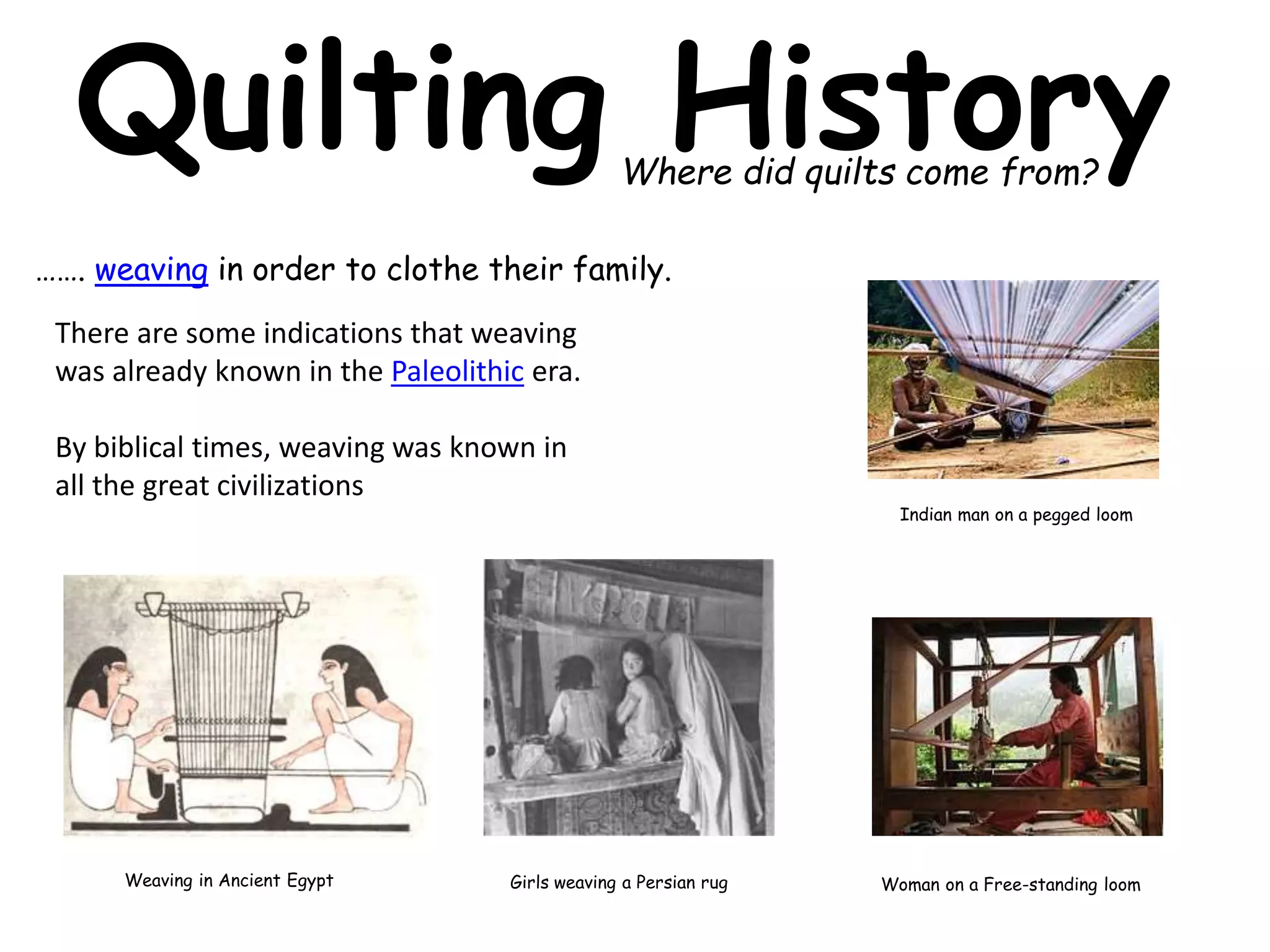
……. weaving in order to clothe their family. 
There are some indications that weaving 
was already known in the Paleolithic era. 
By biblical times, weaving was known in 
all the great civilizations 
Weaving in Ancient Egypt Girls weaving a Persian rug 
Indian man on a pegged loom 
Woman on a Free-standing loom
Quilting History 
Where did quilts come from? 
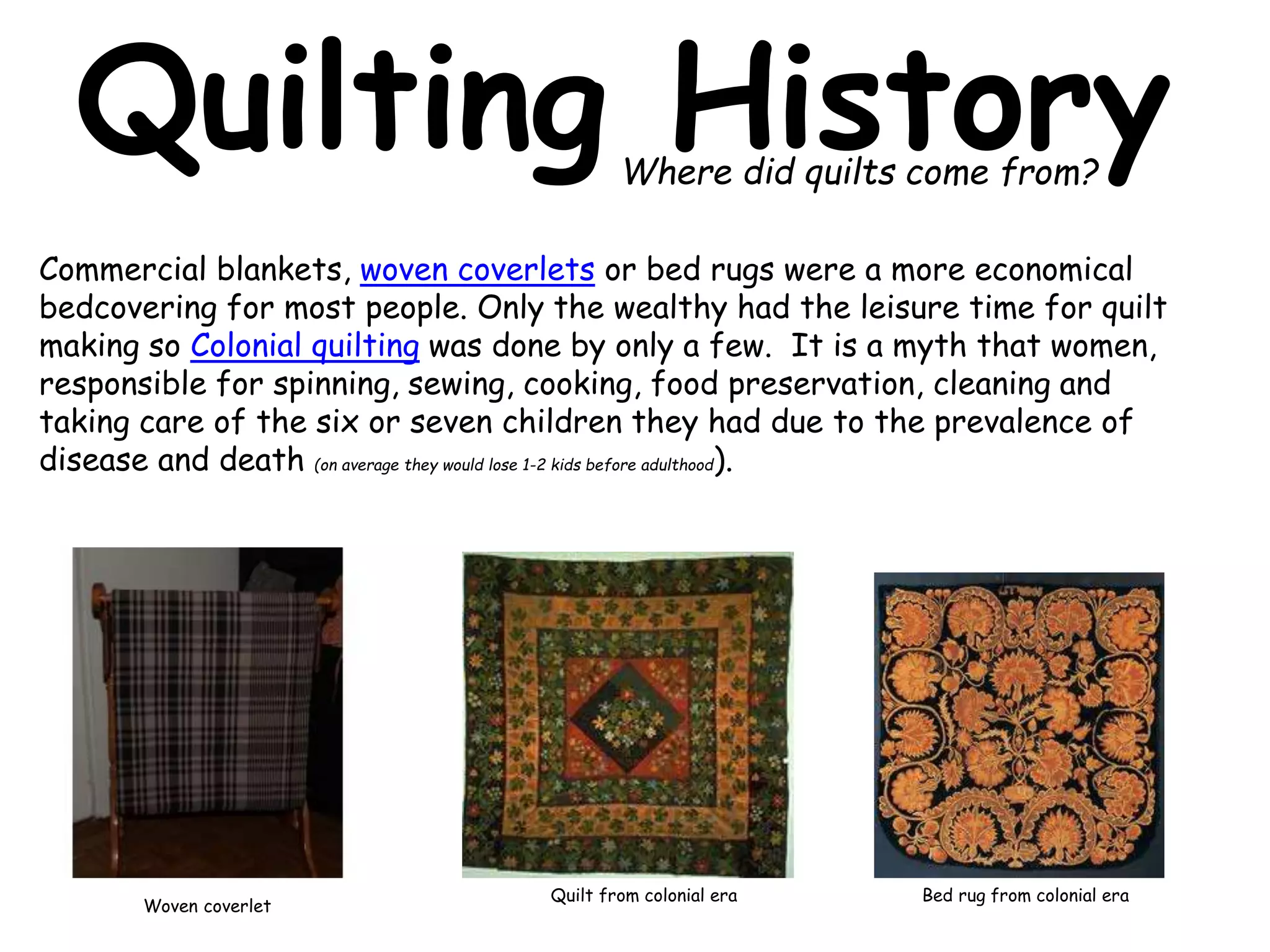
Commercial blankets, woven coverlets or bed rugs were a more economical 
bedcovering for most people. Only the wealthy had the leisure time for quilt 
making so Colonial quilting was done by only a few. It is a myth that women, 
responsible for spinning, sewing, cooking, food preservation, cleaning and 
taking care of the six or seven children they had due to the prevalence of 
disease and death (on average they would lose 1-2 kids before adulthood). 
Woven coverlet 
Quilt from colonial era Bed rug from colonial era
Quilting History 
Where did quilts come from? 
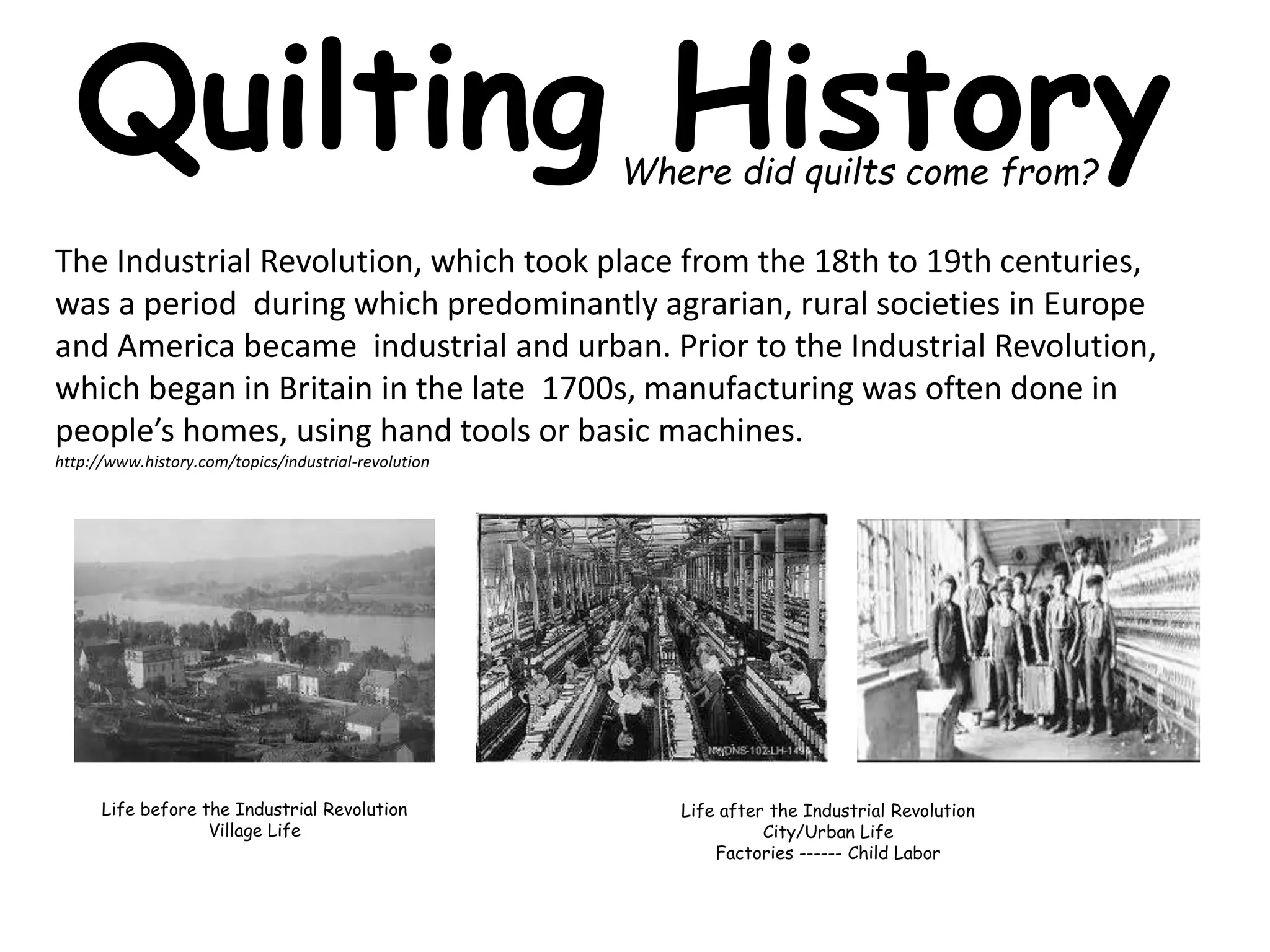
The Industrial Revolution, which took place from the 18th to 19th centuries, 
was a period during which predominantly agrarian, rural societies in Europe 
and America became industrial and urban. Prior to the Industrial Revolution, 
which began in Britain in the late 1700s, manufacturing was often done in 
people’s homes, using hand tools or basic machines. 
http://www.history.com/topics/industrial-revolution 
Life before the Industrial Revolution 
Village Life 
Life after the Industrial Revolution 
City/Urban Life 
Factories ------ Child Labor
Quilting History 
Where did quilts come from? 
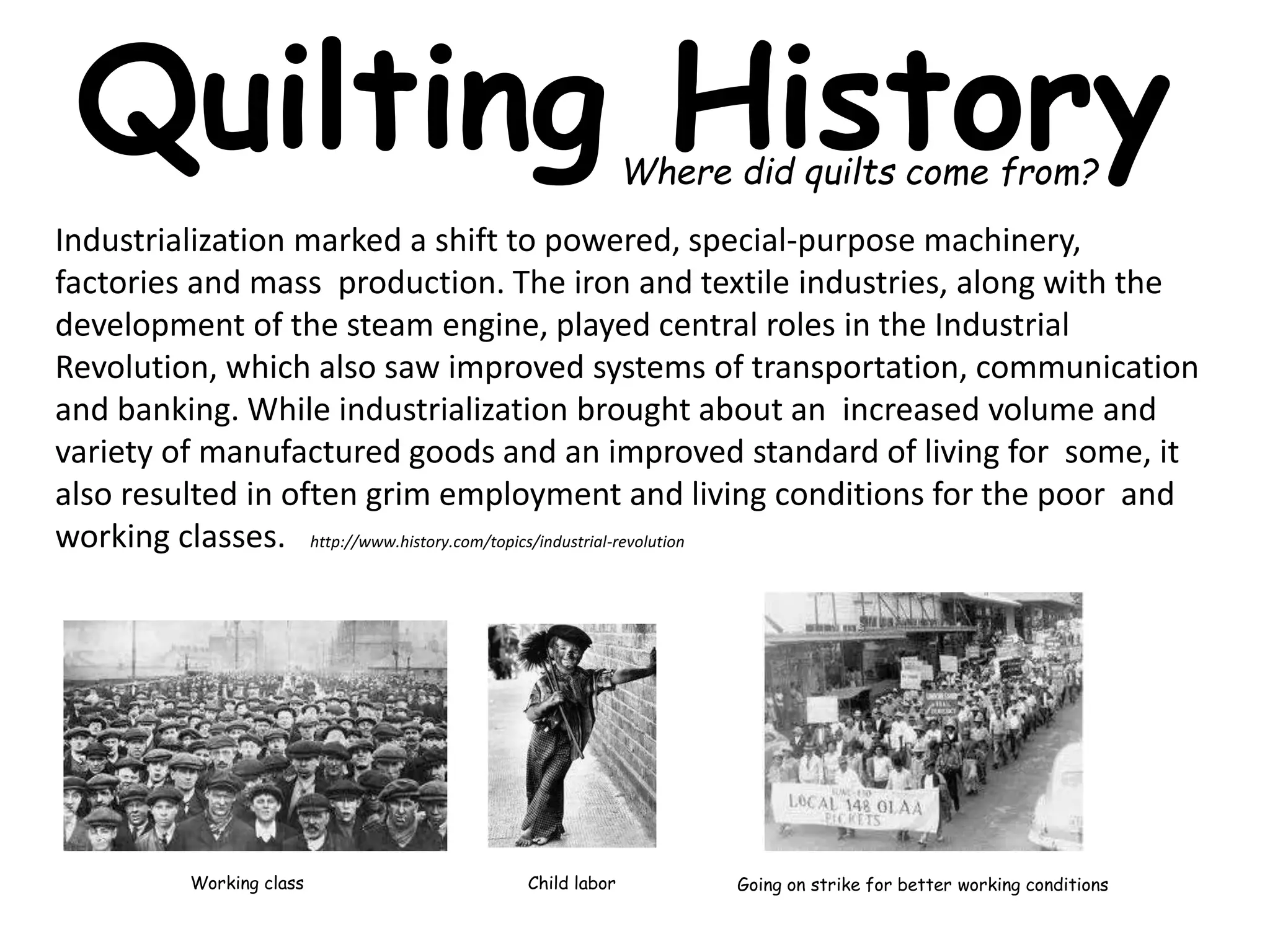
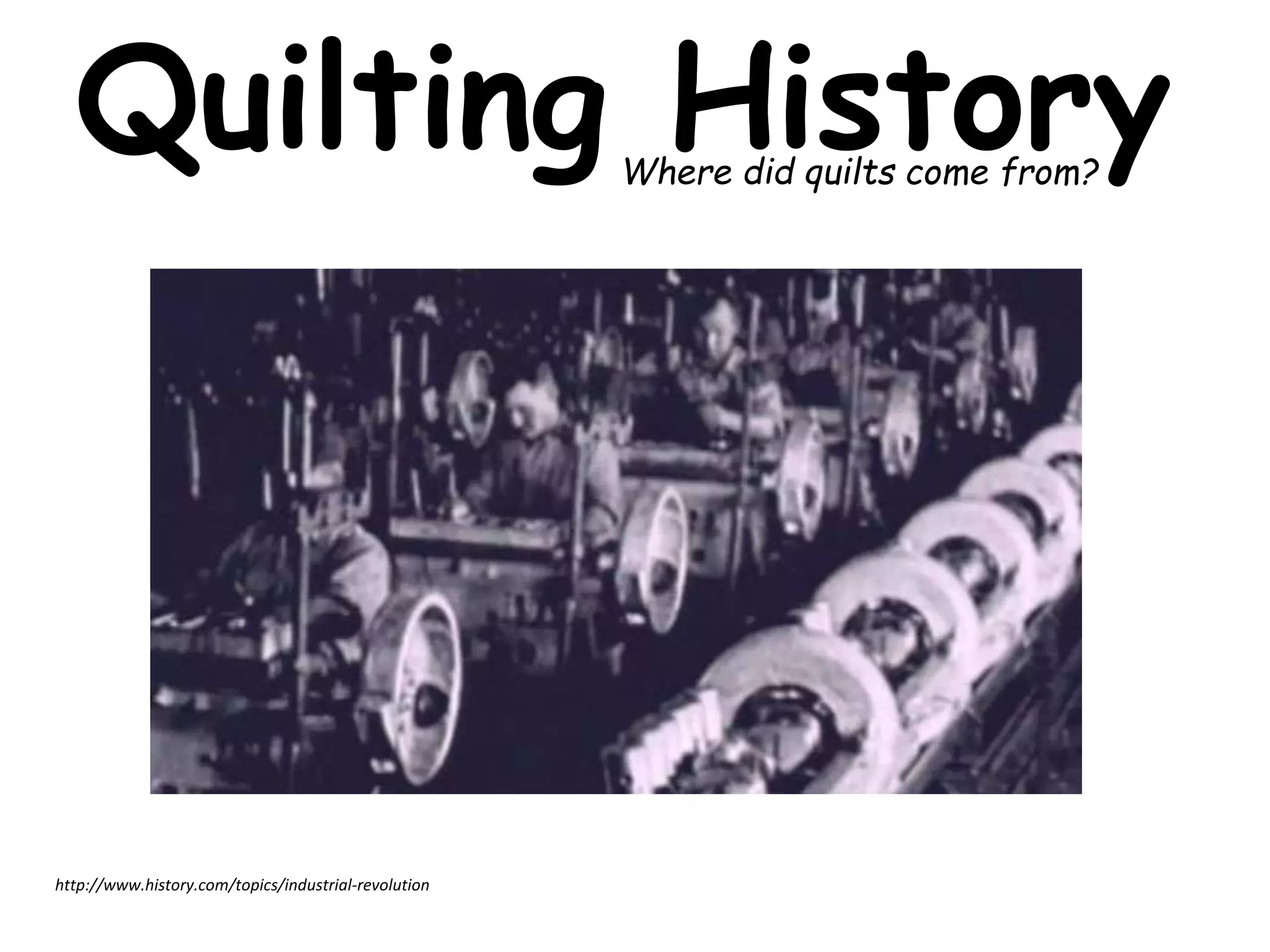
Industrialization marked a shift to powered, special-purpose machinery, 
factories and mass production. The iron and textile industries, along with the 
development of the steam engine, played central roles in the Industrial 
Revolution, which also saw improved systems of transportation, communication 
and banking. While industrialization brought about an increased volume and 
variety of manufactured goods and an improved standard of living for some, it 
also resulted in often grim employment and living conditions for the poor and 
working classes. http://www.history.com/topics/industrial-revolution 
Working class Going on strike Child labor for better working conditions
Quilting History Where did quilts come from? 
Innovation and Industrialization 
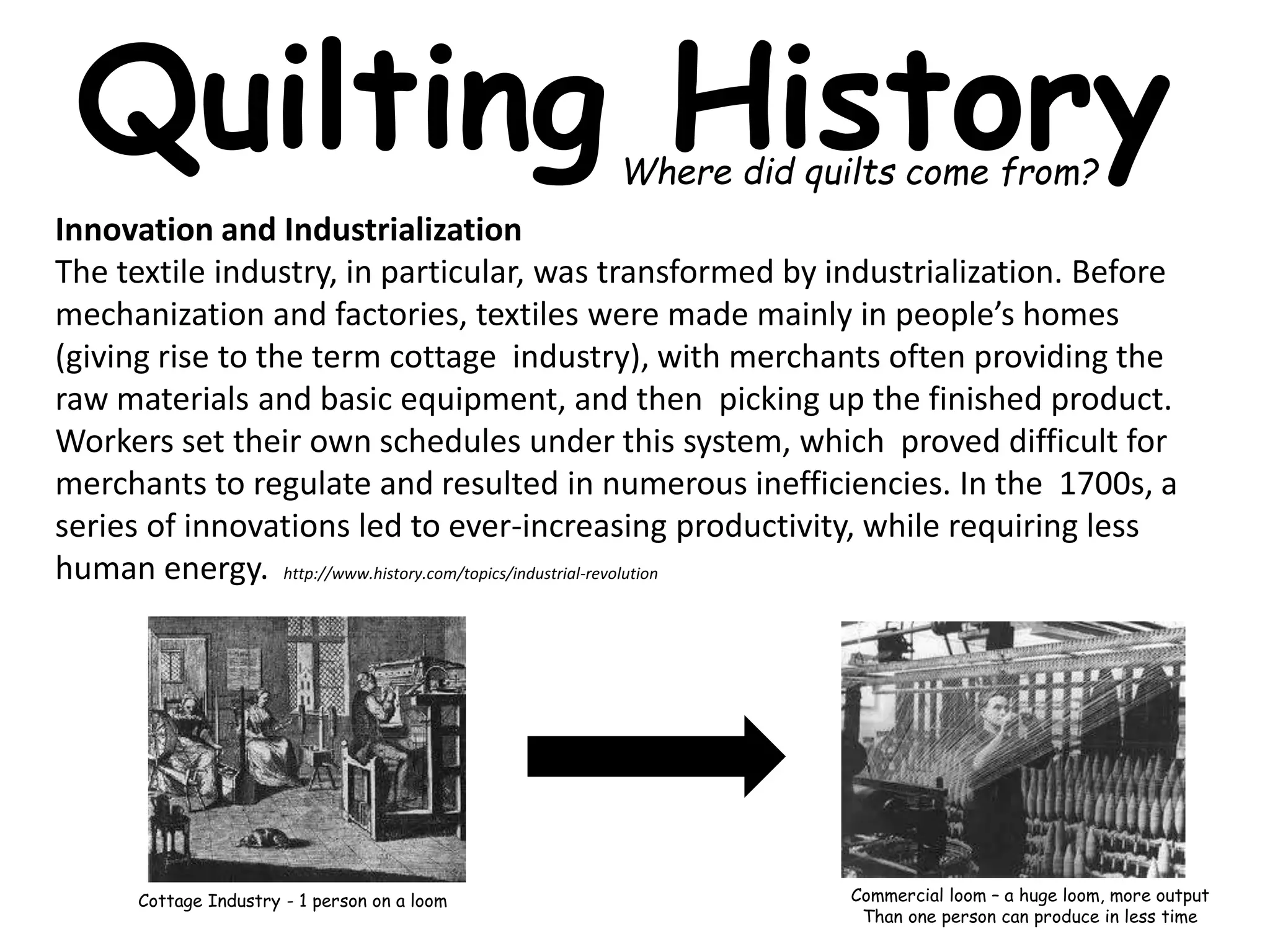
The textile industry, in particular, was transformed by industrialization. Before 
mechanization and factories, textiles were made mainly in people’s homes 
(giving rise to the term cottage industry), with merchants often providing the 
raw materials and basic equipment, and then picking up the finished product. 
Workers set their own schedules under this system, which proved difficult for 
merchants to regulate and resulted in numerous inefficiencies. In the 1700s, a 
series of innovations led to ever-increasing productivity, while requiring less 
human energy. http://www.history.com/topics/industrial-revolution 
Commercial loom – a huge loom, more output 
Than one person can produce in less time 
Cottage Industry - 1 person on a loom
Quilting History 
Where did quilts come from? 
Innovation and Industrialization 
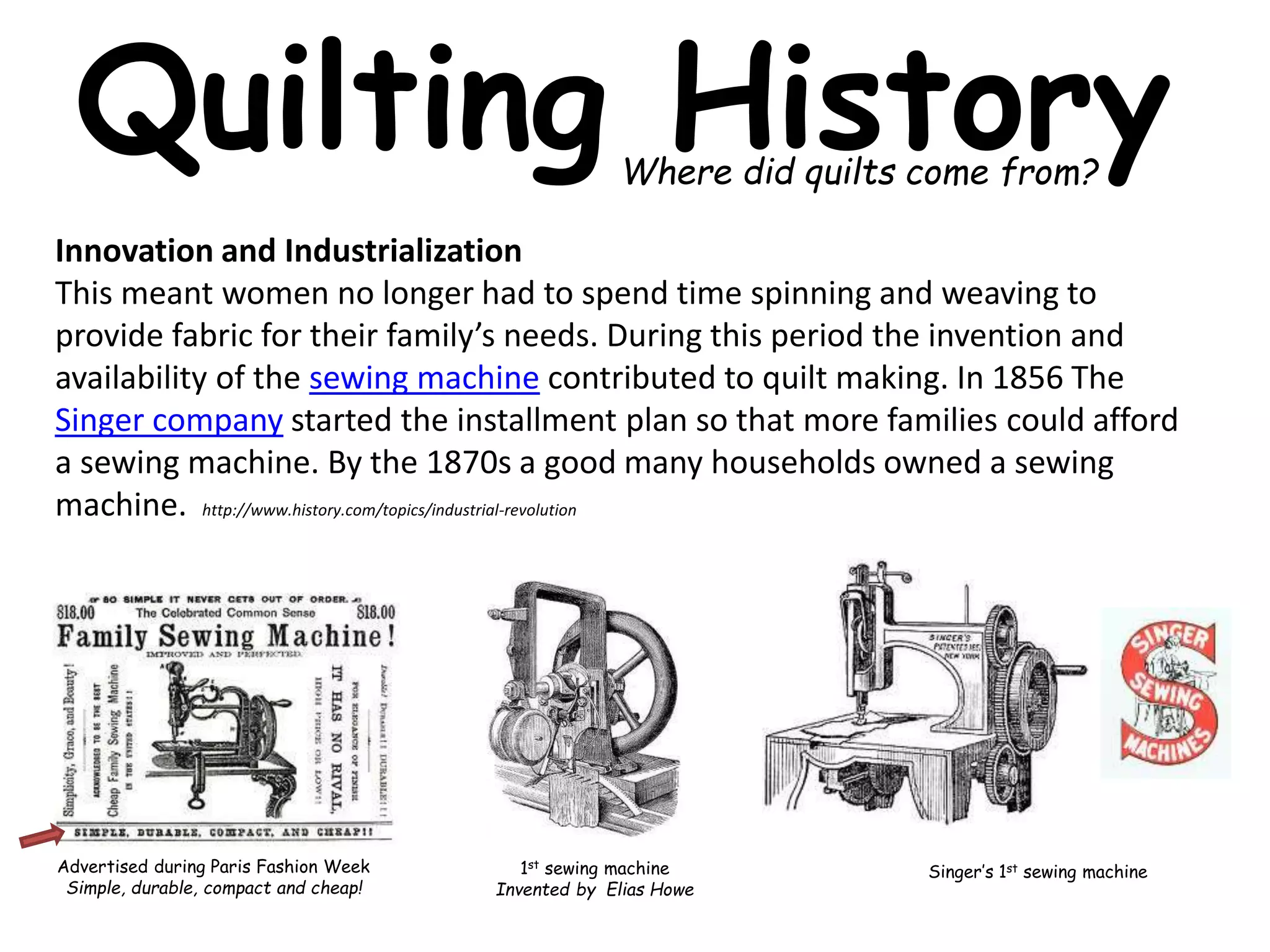
This meant women no longer had to spend time spinning and weaving to 
provide fabric for their family’s needs. During this period the invention and 
availability of the sewing machine contributed to quilt making. In 1856 The 
Singer company started the installment plan so that more families could afford 
a sewing machine. By the 1870s a good many households owned a sewing 
machine. http://www.history.com/topics/industrial-revolution 
Advertised during Paris Fashion Week 
Simple, durable, compact and cheap! 
1st sewing machine 
Invented by Elias Howe 
Singer’s 1st sewing machine
Quilting History 
http://www.history.com/videos/the-industrial-revolition 
<iframe width="480" height="320" src="http://servicesaetn-a. 
akamaihd.net/pservice/embed-player/?siteId=hist&tPid=21112182" 
frameborder="0" scrolling="no" allowfullscreen></iframe> 
http://www.history.com/topics/industrial-revolution 
Where did quilts come from?
Quilting History 
Where did quilts come from? 
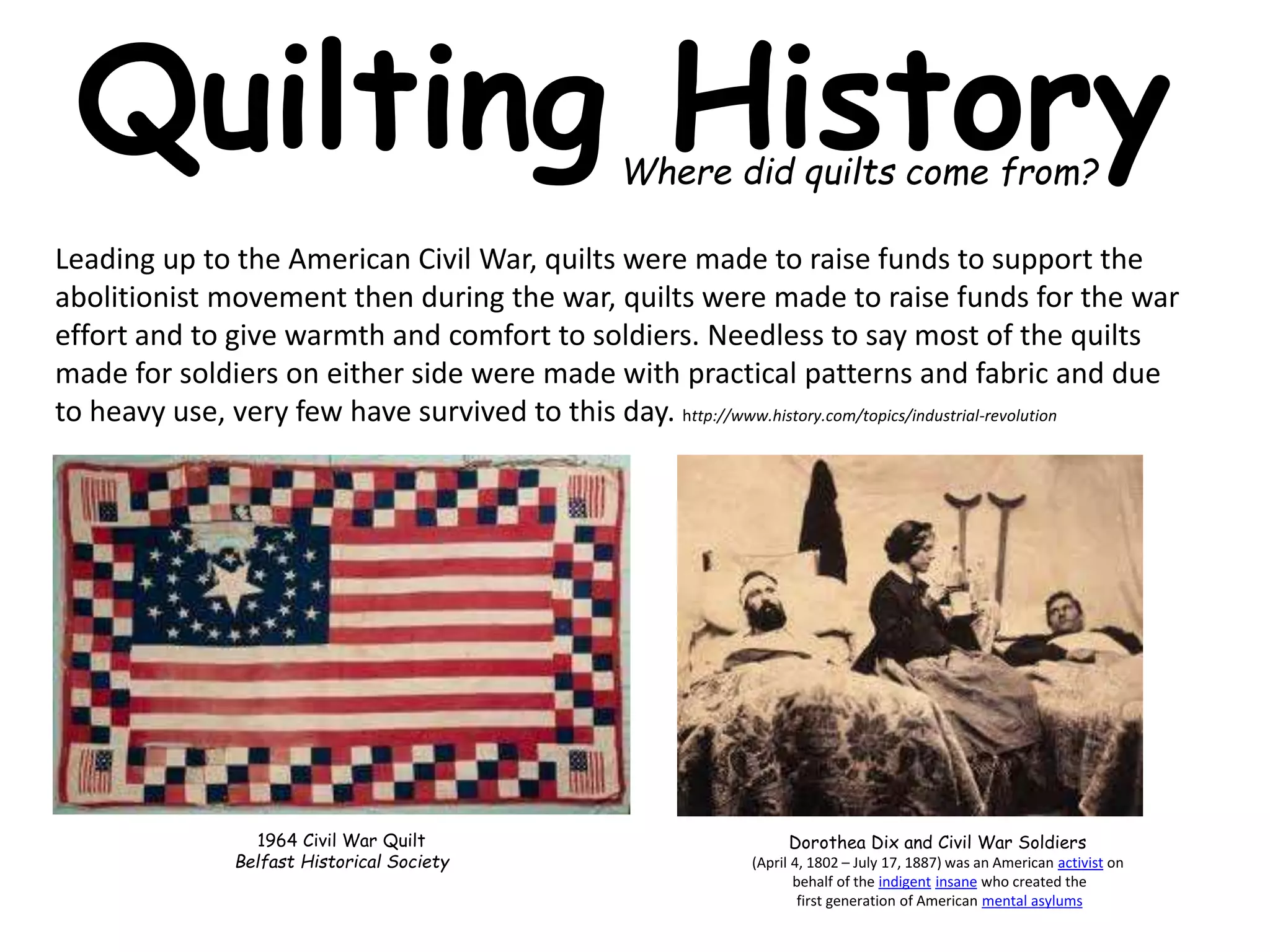
Leading up to the American Civil War, quilts were made to raise funds to support the 
abolitionist movement then during the war, quilts were made to raise funds for the war 
effort and to give warmth and comfort to soldiers. Needless to say most of the quilts 
made for soldiers on either side were made with practical patterns and fabric and due 
to heavy use, very few have survived to this day. http://www.history.com/topics/industrial-revolution 
1964 Civil War Quilt 
Belfast Historical Society 
Dorothea Dix and Civil War Soldiers 
(April 4, 1802 – July 17, 1887) was an American activist on 
behalf of the indigent insane who created the 
first generation of American mental asylums
Quilting History 
Where did quilts come from? 
Victorian era America 
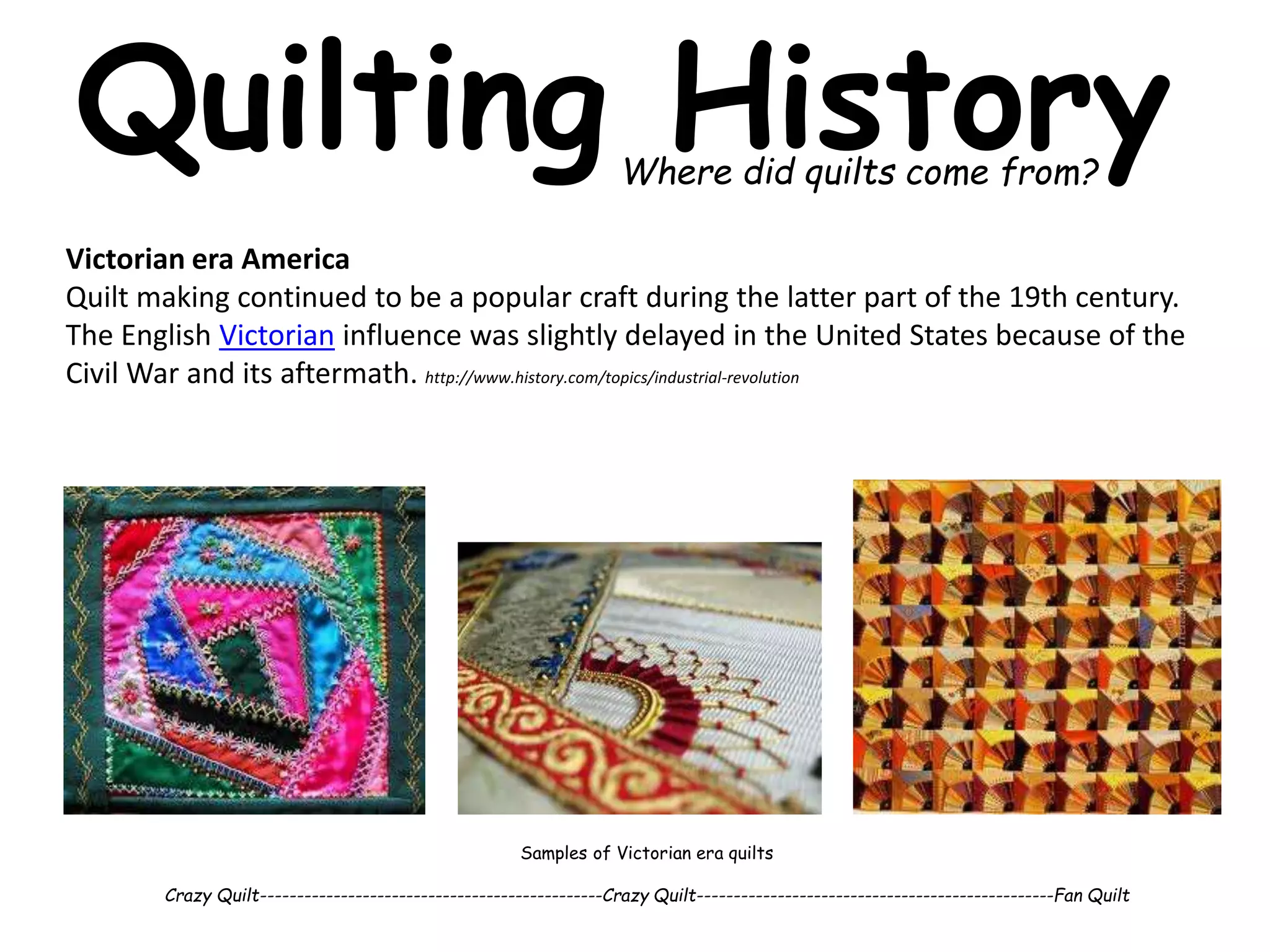
Quilt making continued to be a popular craft during the latter part of the 19th century. 
The English Victorian influence was slightly delayed in the United States because of the 
Civil War and its aftermath. http://www.history.com/topics/industrial-revolution 
Samples of Victorian era quilts 
Crazy Quilt-----------------------------------------------Crazy Quilt-------------------------------------------------Fan Quilt
Quilting History 
Where are they now? 
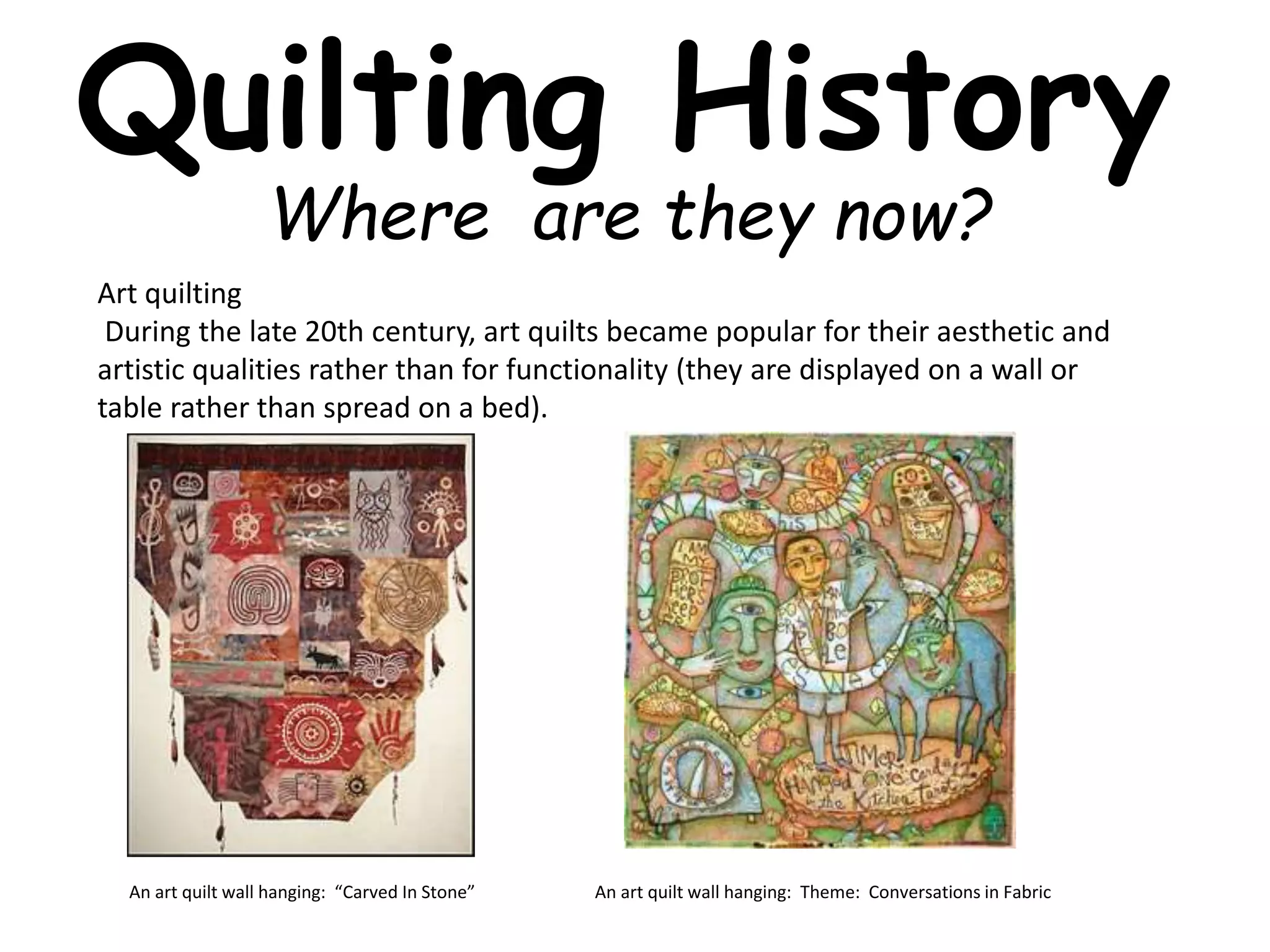
Art quilting 
During the late 20th century, art quilts became popular for their aesthetic and 
artistic qualities rather than for functionality (they are displayed on a wall or 
table rather than spread on a bed). 
An art quilt wall hanging: “Carved In Stone” An art quilt wall hanging: Theme: Conversations in Fabric
Quilting History 
Where are they now? 
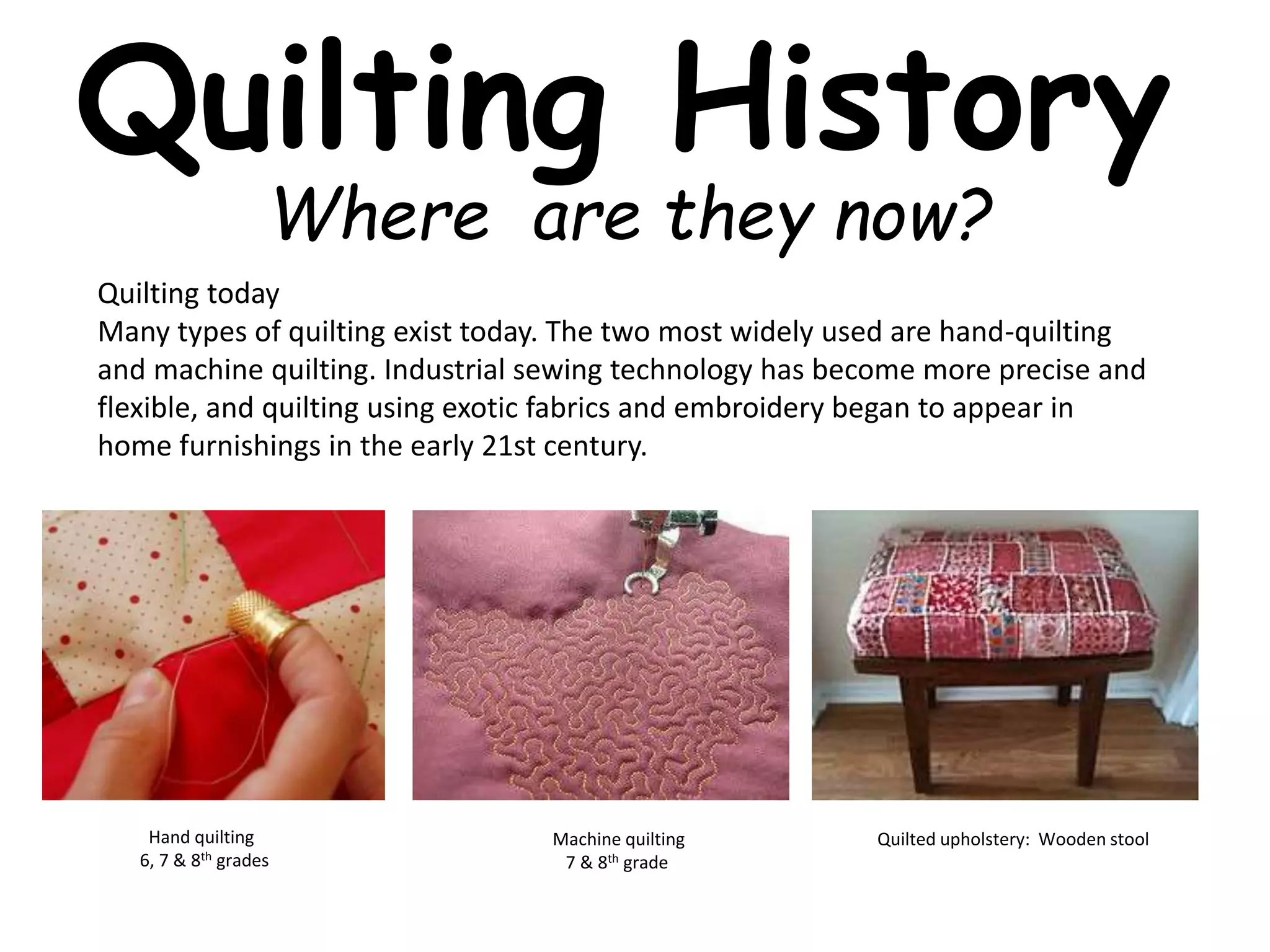
Quilting today 
Many types of quilting exist today. The two most widely used are hand-quilting 
and machine quilting. Industrial sewing technology has become more precise and 
flexible, and quilting using exotic fabrics and embroidery began to appear in 
home furnishings in the early 21st century. 
Quilted upholstery: Wooden stool 
Hand quilting 
6, 7 & 8th grades 
Machine quilting 
7 & 8th grade
Quilting History 
Where are they now? 
Quilting is now taught in some American schools. It is also taught at senior centers 
around the U.S., but quilters of all ages attend classes. These forms of workshop or 
classes are also available in other countries in guilds and community colleges. 
Quilt University.com 
Classes start every weekend between New Years and the end of October. Most classes are offered 
twice a year, although beginner classes are offered more frequently. Registration opens five weeks 
before a class starts. http://www.quiltuniversity.com/catalog.htm 
International Quilt Study Center & Museum 
The International Quilt Study Center & Museum is proud to present the juried works of six members 
of the Studio Art Quilt Associates, an international group whose mission is to promote the art quilt 
through exhibitions, publications, and professional-development opportunities. 
Michigan State University 
You can pursue a bachelor's degree in Fine Arts, Apparel and Textiles, and Art History and Visual Culture. 
Details about what is required for each degree are available by asking Ms. DeHart.
Quilting History 
Where are they now? 
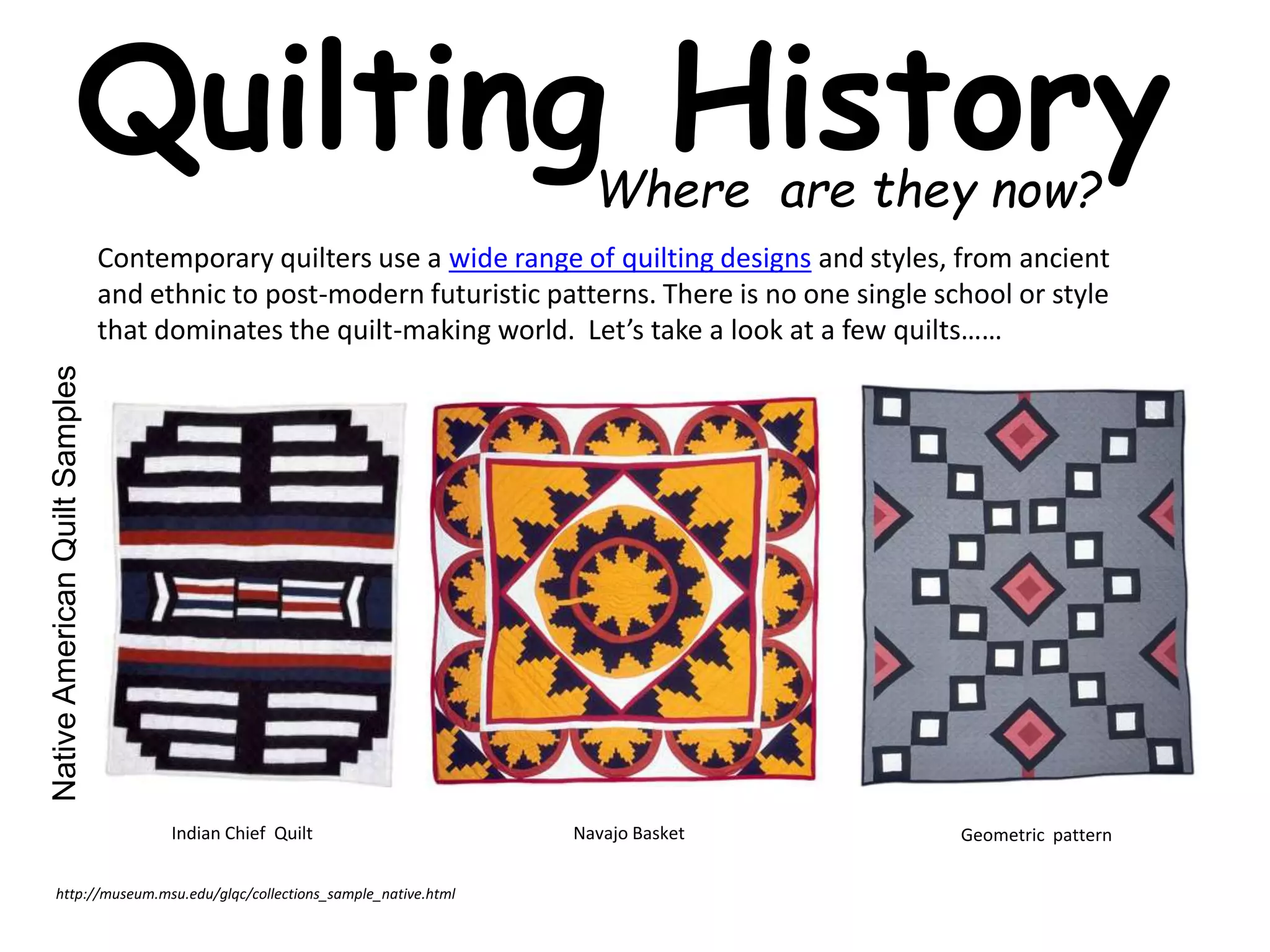
Contemporary quilters use a wide range of quilting designs and styles, from ancient 
and ethnic to post-modern futuristic patterns. There is no one single school or style 
that dominates the quilt-making world. Let’s take a look at a few quilts…… 
Native American Quilt Samples 
Indian Chief Quilt Navajo Basket Geometric pattern 
http://museum.msu.edu/glqc/collections_sample_native.html
Quilting Today 
What quilts look like? 
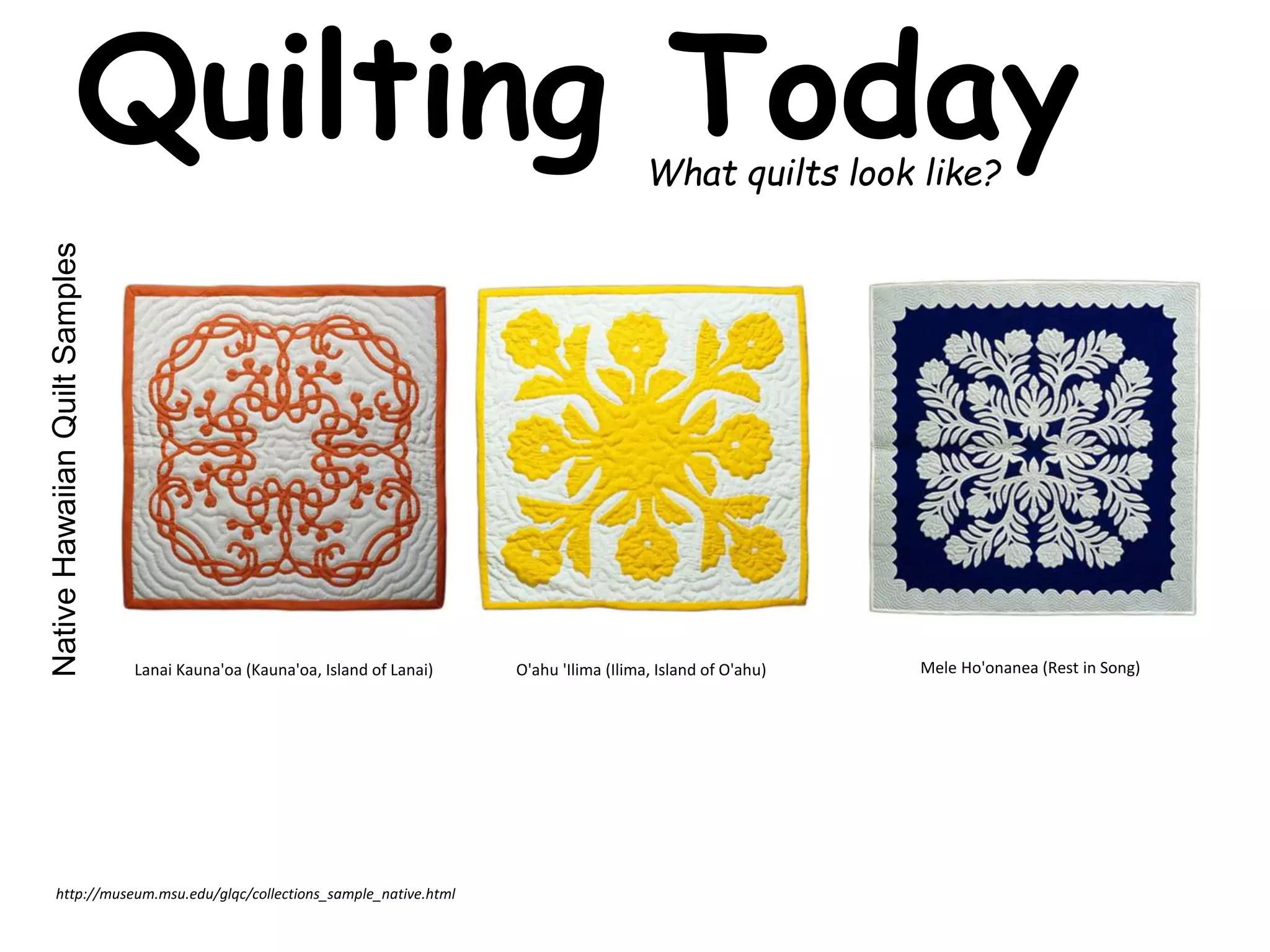
Native Hawaiian Quilt Samples 
O'ahu Lanai Kauna'oa (Kauna'oa, Island of Lanai) 'Ilima (Ilima, Island of O'ahu) Mele Ho'onanea (Rest in Song) 
http://museum.msu.edu/glqc/collections_sample_native.html
Quilting Today What quilts look like? 
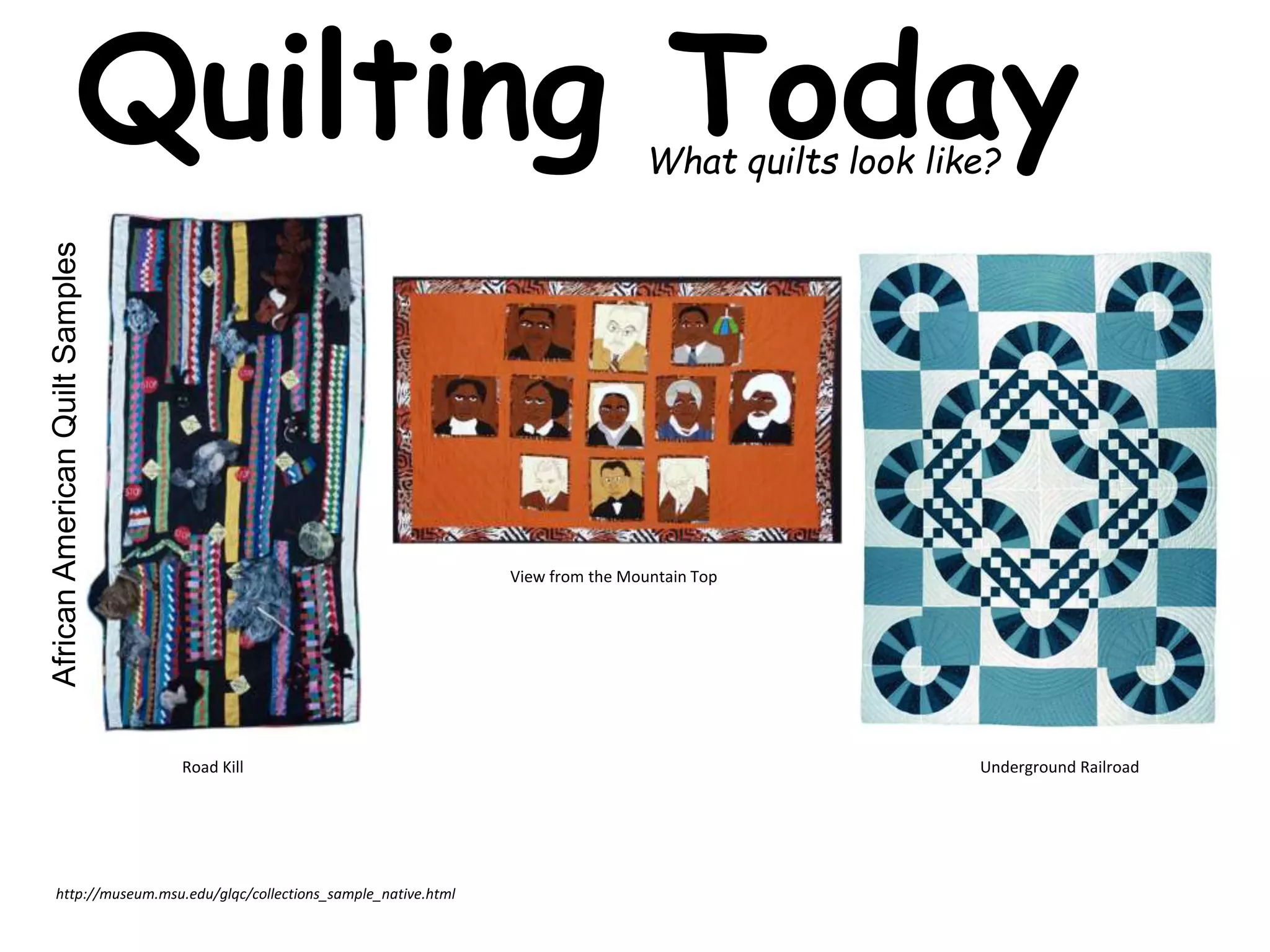
African American Quilt Samples 
Road Kill 
http://museum.msu.edu/glqc/collections_sample_native.html 
View from the Mountain Top 
Underground Railroad
Quilting Today What quilts look like? 
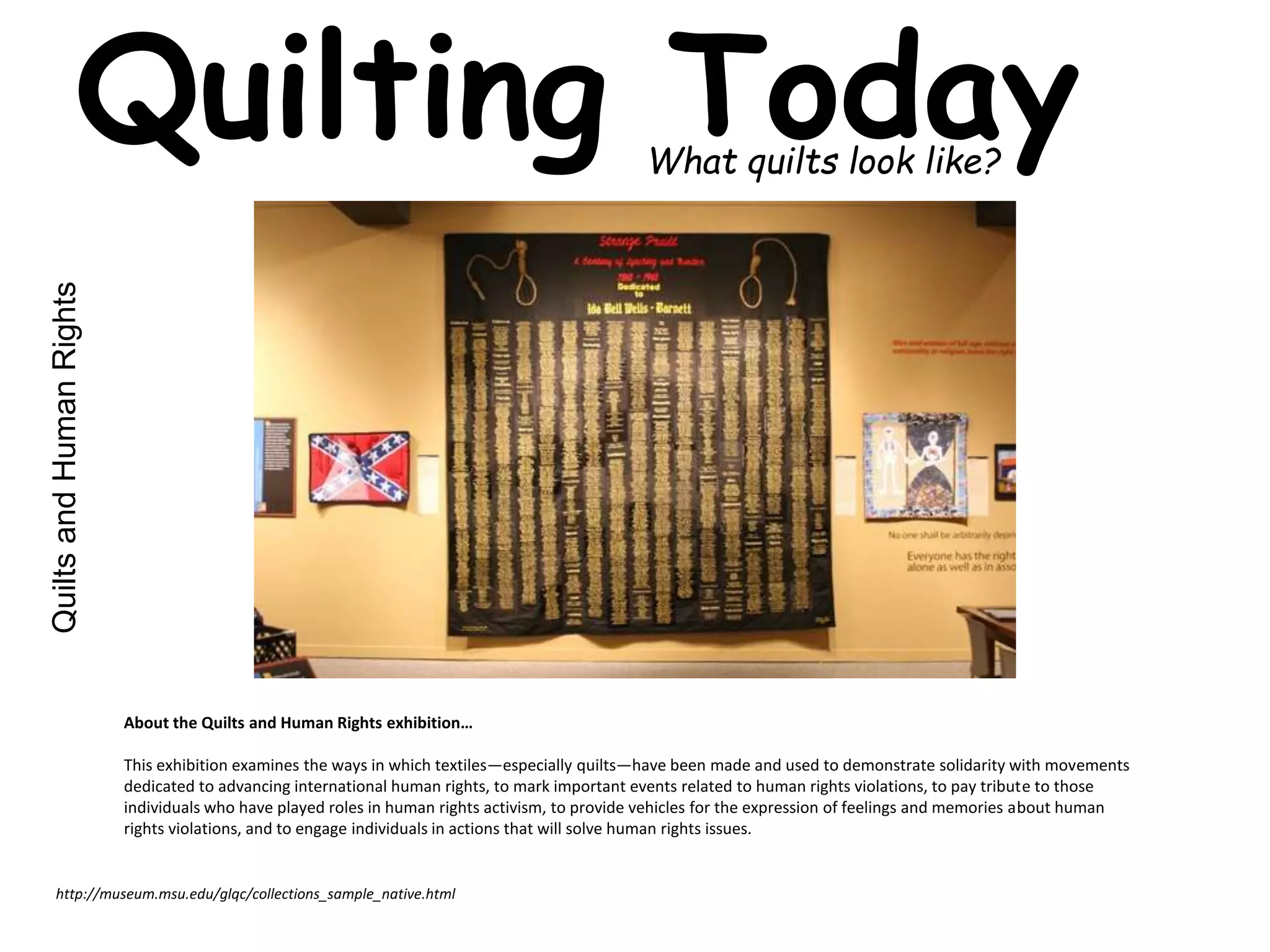
Quilts and Human Rights 
About the Quilts and Human Rights exhibition… 
This exhibition examines the ways in which textiles—especially quilts—have been made and used to demonstrate solidarity with movements 
dedicated to advancing international human rights, to mark important events related to human rights violations, to pay tribute to those 
individuals who have played roles in human rights activism, to provide vehicles for the expression of feelings and memories about human 
rights violations, and to engage individuals in actions that will solve human rights issues. 
http://museum.msu.edu/glqc/collections_sample_native.html
Quilting Today What quilts look like? 
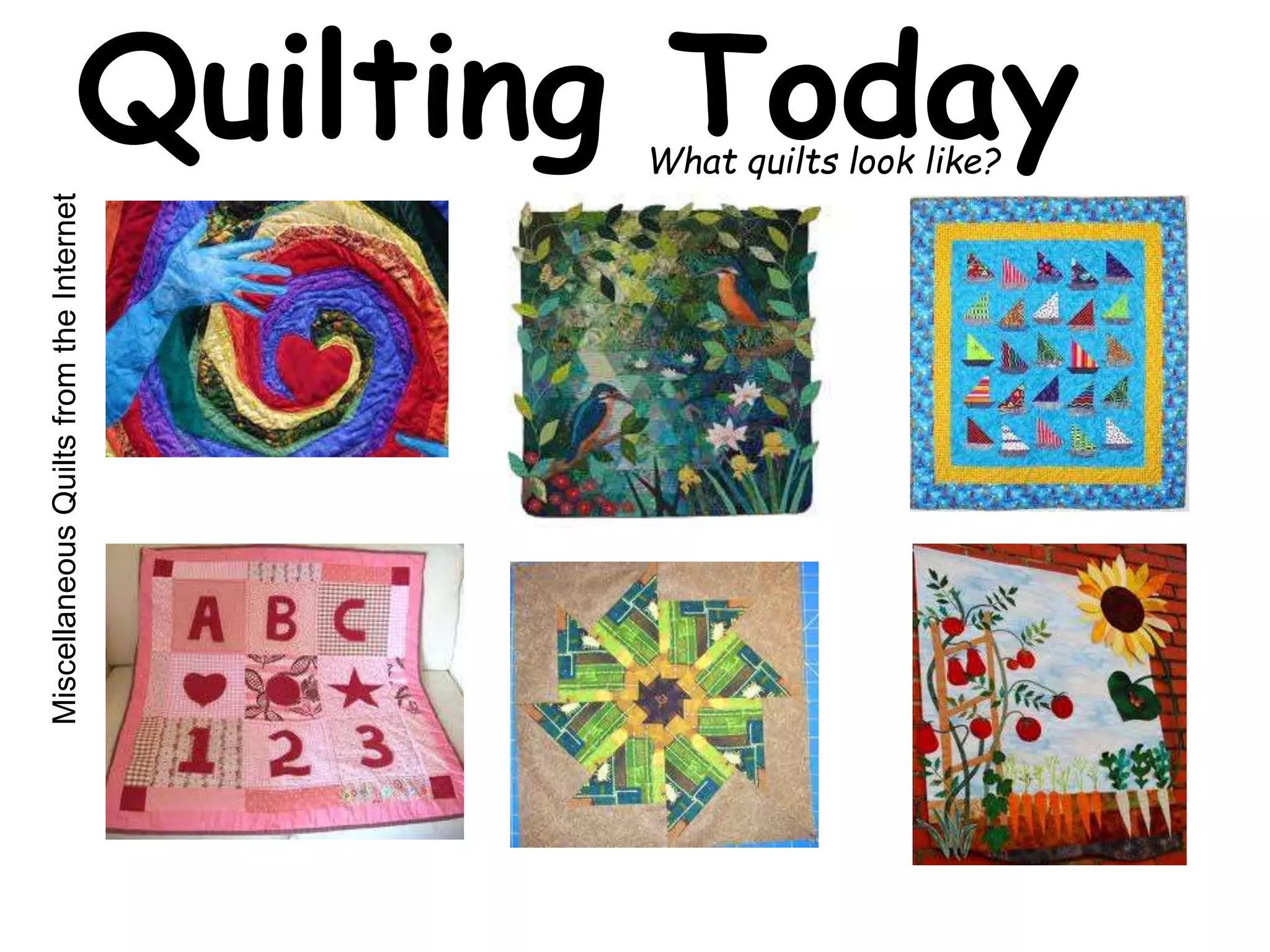
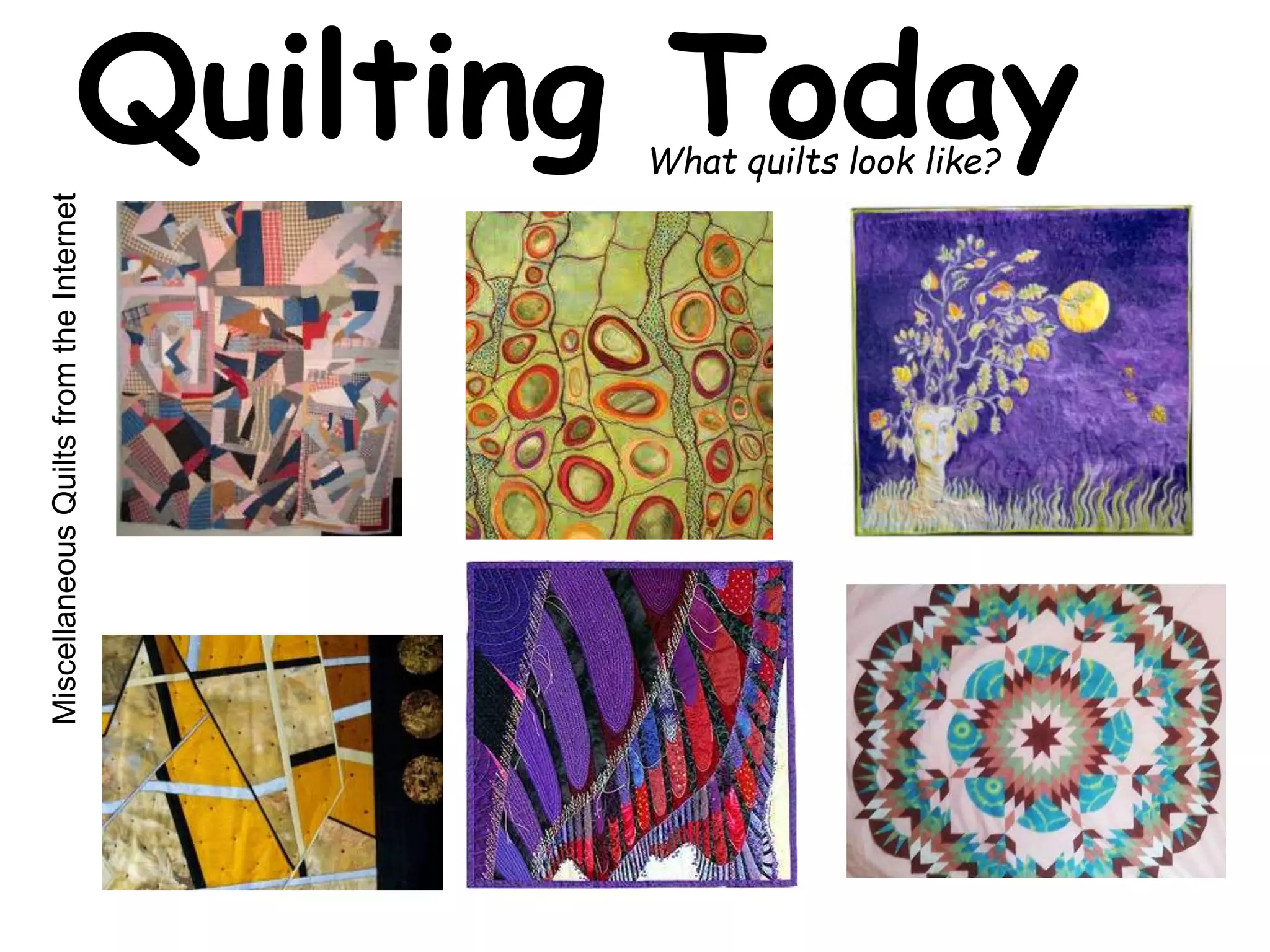
Miscellaneous Quilts from the Internet
Quilting Today What quilts look like? 
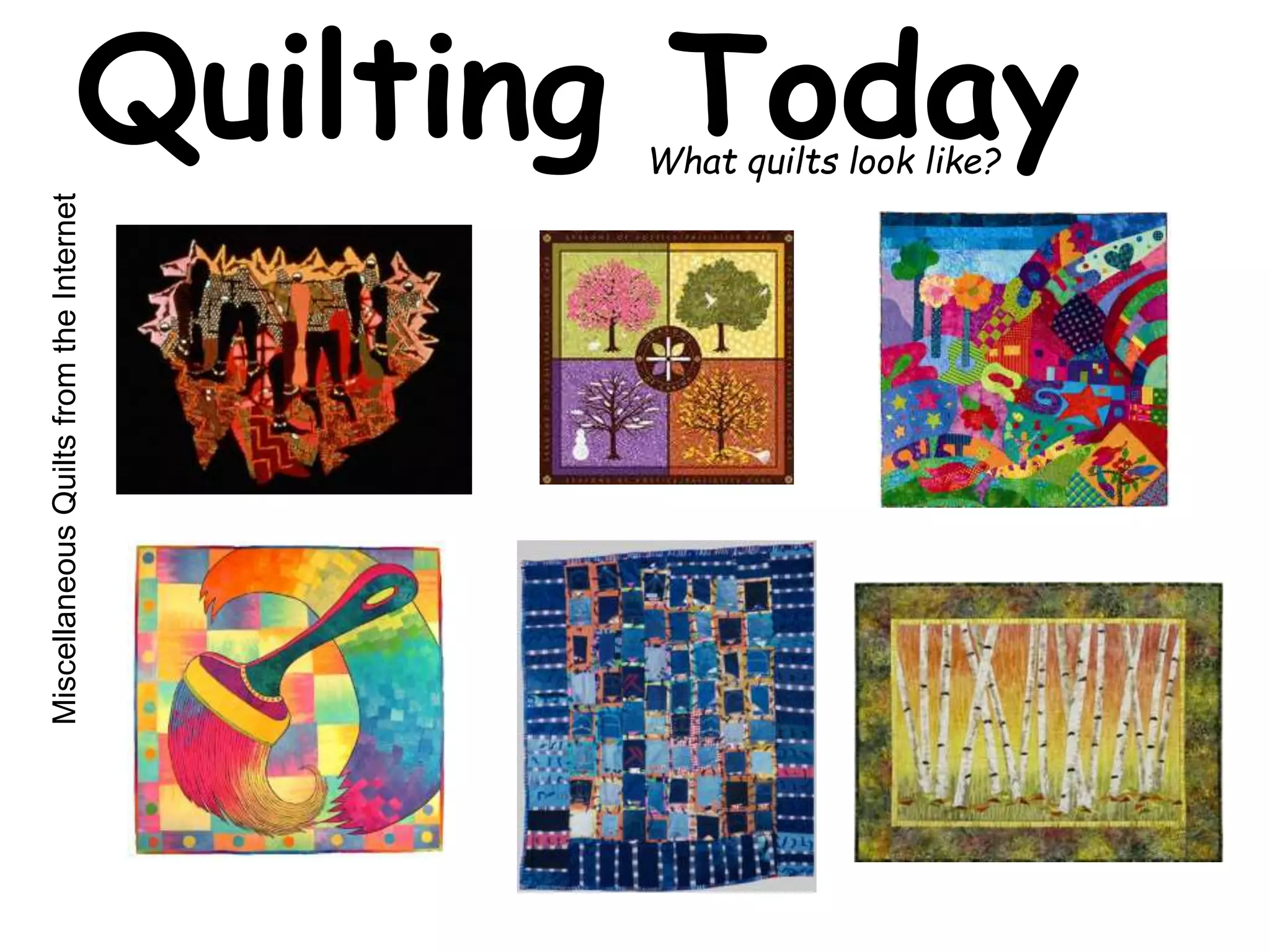
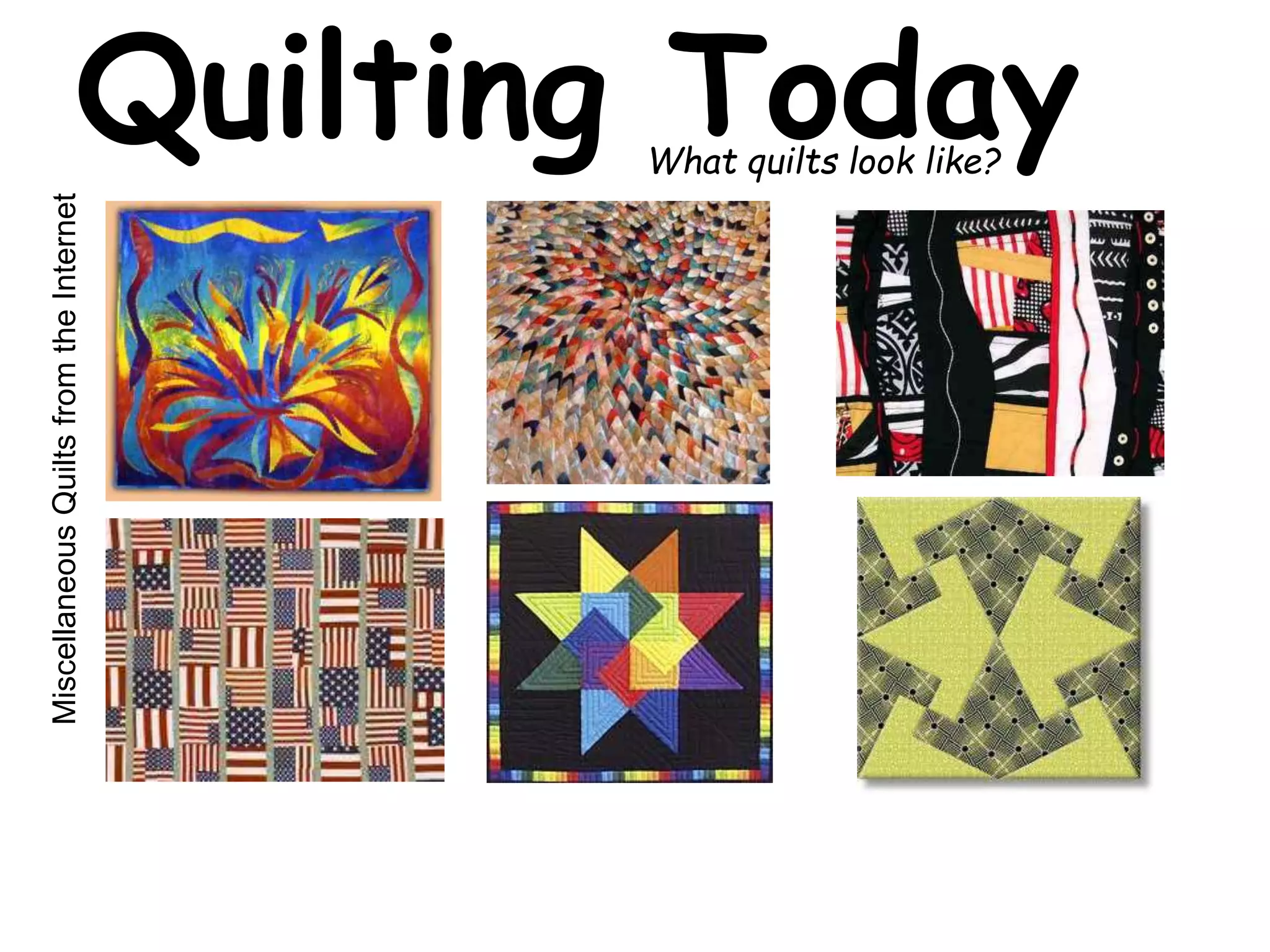
Miscellaneous Quilts from the Internet
Quilting Today What quilts look like? 
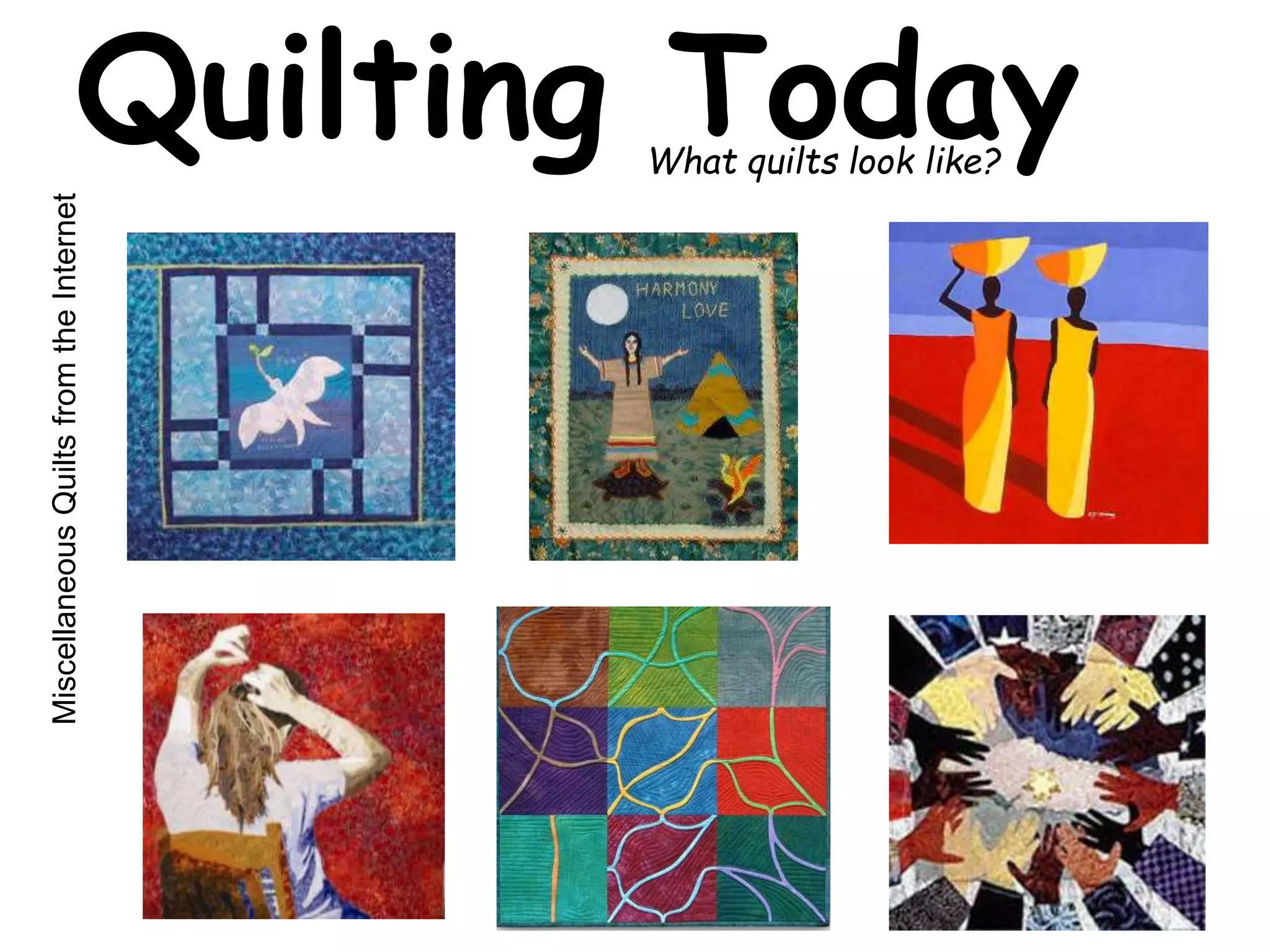
Miscellaneous Quilts from the Internet
Quilting Today What quilts look like? 
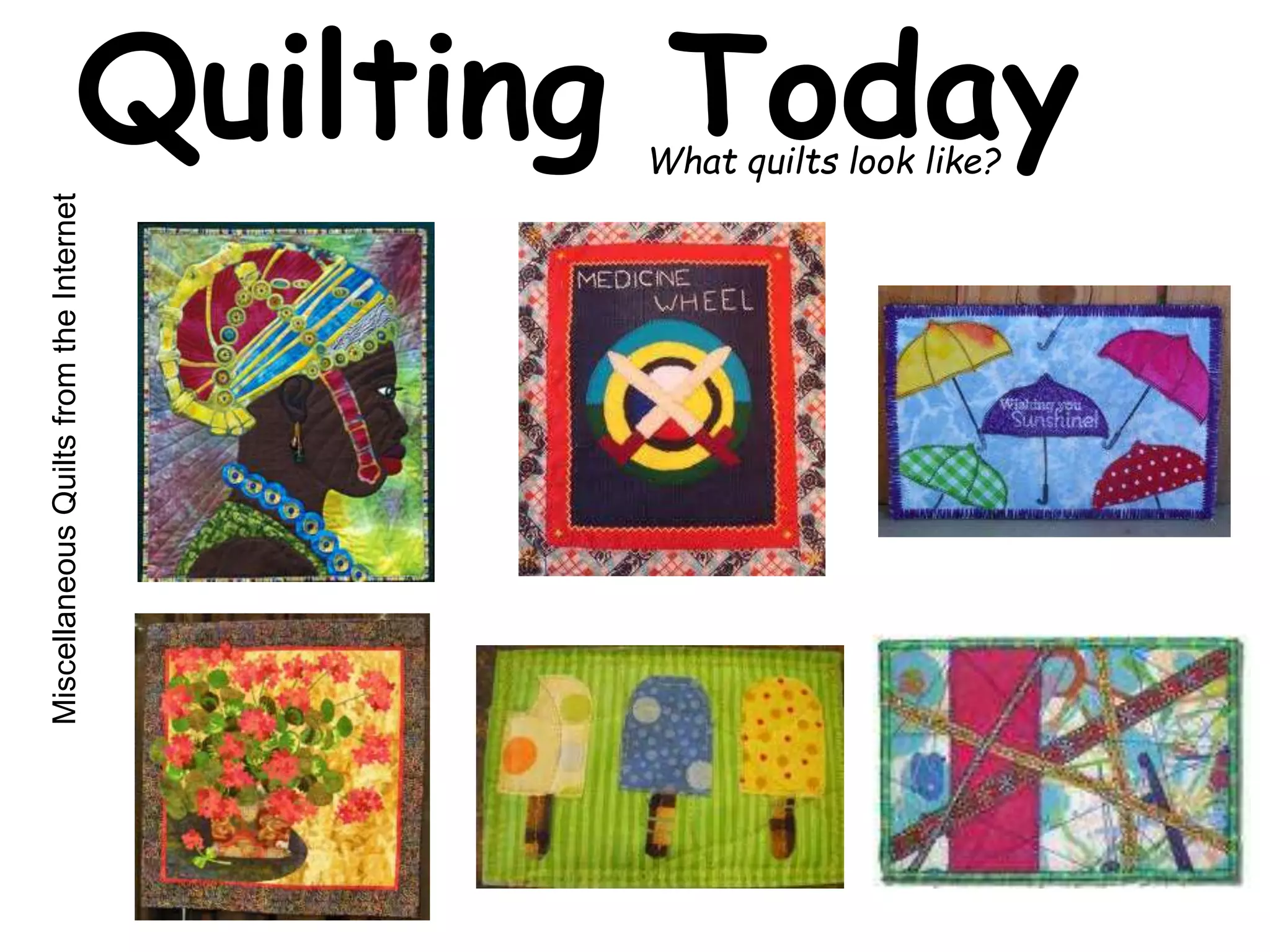
Miscellaneous Quilts from the Internet
Quilting Today What quilts look like? 
Miscellaneous Quilts from the Internet
Quilting Today What quilts look like? 
Miscellaneous Quilts from the Internet
Quilting Today What quilts look like? 
Miscellaneous Quilts from the Internet
Bibliography 
All of the pictures included in this presentation came from the PowerPoint image library or Google Images search engine 
http://www.vam.ac.uk/content/articles/t/touring-exhibition-quilts/ 
http://www.vam.ac.uk/content/journals/research-journal/issue-03/a-patchwork-panel-shown-at-the-great-exhibition 
http://historymyths.wordpress.com/tag/spinning-wheels/ 
Weaving: http://www.youtube.com/watch?v=-ByYj5G4-Hc 
Weaving on a cardboard loom: http://www.youtube.com/watch?v=LbtKnvc_9No 
Weaving lesson #2: http://www.youtube.com/watch?v=k7_I_AIlCPM 
Weaving loops: http://www.youtube.com/watch?v=IUKHRyl7sgE 
Weaving using used fabric strips: http://www.youtube.com/watch?v=rKJan2WBKFo 
Paper weaving: http://www.youtube.com/watch?v=HRV3v9eAWqs 
Fabric beads: http://www.youtube.com/watch?v=AEwXNsGQW1s
How to spin yarn – Pt 1: http://www.youtube.com/watch?v=rPUORvO-GZE&feature=pyv&ad=2835654988&kw=wool 
How to spin yarn – Pt 2: http://www.youtube.com/watch?v=WAVYmG9zeK8 
Trimming Rya: http://www.youtube.com/watch?v=mNXQkqxNmYI 
Tiger stripes: http://www.youtube.com/watch?v=QmT33UhuDMk 
Rya: http://www.youtube.com/watch?v=QmT33UhuDMk 
http://www.history.com/topics/industrial-revolution 
Basic weave: http://www.youtube.com/watch?v=nkZQtmrIKBM 
Restarting basic: http://www.youtube.com/watch?v=PZgxyWR1Aq8 
Weaving-educational video: http://www.youtube.com/watch?v=SYqyOFzNR7o 
Spinning-educational video : http://www.youtube.com/watch?v=xn6Xc-f8Gss 
Educational video : http://www.youtube.com/watch?v=SPCRenzINfk 
Quilting series: http://www.youtube.com/watch?v=bltKdP71cIk; http://www.kayewood.com/ 
History of quilting in America: http://www.womenfolk.com/quilting_history/colonial.htm 
Nancy’s Notions videos: http://www.youtube.com/user/NancysNotions/videos 
Make a pillow case: http://www.youtube.com/watch?v=-j06WzmN7KI 
T-shirt chair: http://www.youtube.com/watch?v=B6uZUzuTncY 
Rya rugs: http://www.youtube.com/watch?v=trl3V5Q2kG4

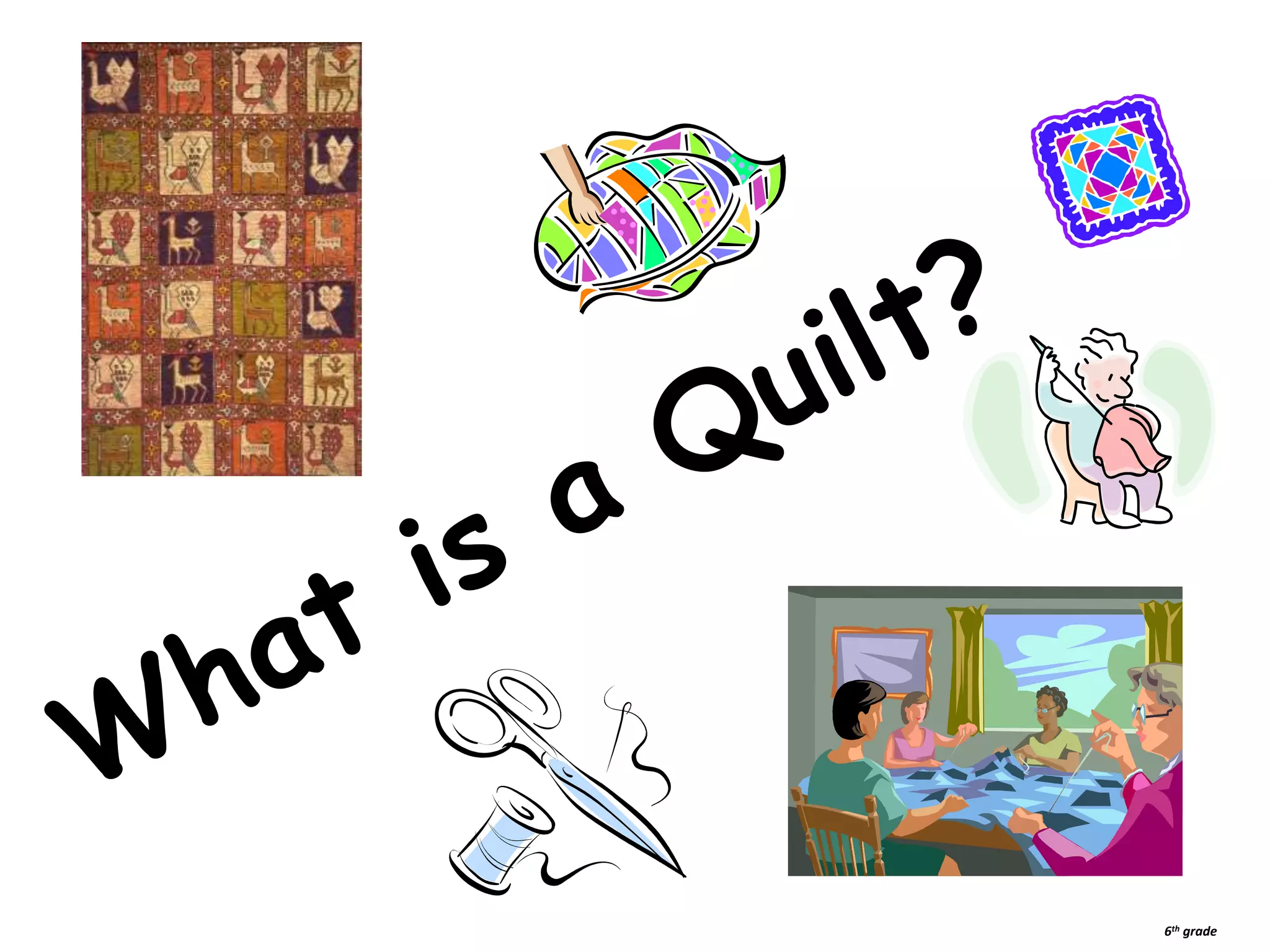
What is a Quilt Introduction

  • 1.
  • 2.
    SAVE money! += + = or
  • 3.
    learning how to So sew will save me money? YES!!!!!!
  • 4.
    you could also: and *become an entrepreneur and develop a product to sell on Etsy.com *begin your path to becoming a fashion designer, a costume maker or *just have fun making things that you love as gifts and/or items you can use yourself!
  • 5.
    Now lets takea brief peek at the history of quilting.
  • 6.
  • 7.
    "The past remindsus of timeless human truths and allows for the perpetuation of cultural traditions that can be nourishing; it contains examples of mistakes to avoid, preserves the memory of alternatives ways of doing things, and is the basis for self-understanding..." -Bettina Drew
  • 8.
    Quilting History Wheredid quilts come from? In Europe quilting appears to have been by Crusaders in the 12th century (Colby 1971), The Crusades were a series of religious expeditionary wars blessed by Pope Urban II and the Catholic Church, with the stated goal of restoring Christian access to the holy places in and near Jerusalem.
  • 9.
    Quilting History Wheredid quilts come from? …in particular in the form of the aketon …
  • 10.
    Quilting History Wheredid quilts come from? …or gambeson, a quilted garment worn under armour.
  • 11.
    Quilting History Oneof the earliest existing decorative works is the "Tristan quilt",[2] made around 1360. Made in Sicily, and as one of the earliest surviving quilts in the world, at least two sections survive at the Victoria & Albert Museum in London and the National Museum of Florance in Bargello, Florence Sample of the Tristan quilt Where did quilts come from?
  • 12.
    Quilting History Sampleof the Tristan quilt Where did quilts come from?
  • 13.
    Quilting History Wheredid quilts come from? A scholarly article that investigated a 19th-century quilting technique found that our assumptions about patchwork as a craft practiced by female amateurs, used to decorate the house and to reinforce emotional ties was incorrect. In fact the demanding quilting style, called ‘intarsia patchwork’, was completed by a group of male professionals and showed their work to the public for personal profit and to promote social causes such as Temperance and Electoral Reform. 'Royal Clothograph' table cover, John Monro, 1830-1840, intarsia patchwork in wool. Museum no. E.1979.101, © Culture and Sport Glasgow (Museums)
  • 14.
    Quilting History Infact finding non-alcoholic leisure activities was a particular problem for soldiers and policemen, since they had to live in barracks far from home and were not permitted to marry, and there is some evidence that ‘intarsia patchwork’ was promoted to them as a form of alcohol avoidance therapy. The skill and time required to complete a piece were evidence of the makers ability to avoid temptation. http://www.vam.ac.uk/content/journals/research-journal/issue-03/a-patchwork-panel-shown-at-the-great-exhibition/ Wool intarsia panel depicting a farmyard scene, maker unknown, about 1850. Museum no. AP.27-1917 Where did quilts come from?
  • 15.
    Quilting History Wheredid quilts come from? In America quilt making was common in the late 18th century and early years of the 19th. Most women were busy sewing, spinning, and….. A man from Ramallah spinning wool. Hand-tinted photograph from 1919, restored A Tibetan woman spinning wool in Pokhara/Nepal So who owned all those spinning wheels and looms? Colonial Williamsburg’s textile curator Linda Baumgarten writes, “Only in frontier areas was most Clothing homespun and homemade – and even there, traders and storekeepers quickly penetrated the backcountry to make imported goods available.”
  • 16.
    Quilting History Wheredid quilts come from? ……. weaving in order to clothe their family. There are some indications that weaving was already known in the Paleolithic era. By biblical times, weaving was known in all the great civilizations Weaving in Ancient Egypt Girls weaving a Persian rug Indian man on a pegged loom Woman on a Free-standing loom
  • 17.
    Quilting History Wheredid quilts come from? Commercial blankets, woven coverlets or bed rugs were a more economical bedcovering for most people. Only the wealthy had the leisure time for quilt making so Colonial quilting was done by only a few. It is a myth that women, responsible for spinning, sewing, cooking, food preservation, cleaning and taking care of the six or seven children they had due to the prevalence of disease and death (on average they would lose 1-2 kids before adulthood). Woven coverlet Quilt from colonial era Bed rug from colonial era
  • 18.
    Quilting History Wheredid quilts come from? The Industrial Revolution, which took place from the 18th to 19th centuries, was a period during which predominantly agrarian, rural societies in Europe and America became industrial and urban. Prior to the Industrial Revolution, which began in Britain in the late 1700s, manufacturing was often done in people’s homes, using hand tools or basic machines. http://www.history.com/topics/industrial-revolution Life before the Industrial Revolution Village Life Life after the Industrial Revolution City/Urban Life Factories ------ Child Labor
  • 19.
    Quilting History Wheredid quilts come from? Industrialization marked a shift to powered, special-purpose machinery, factories and mass production. The iron and textile industries, along with the development of the steam engine, played central roles in the Industrial Revolution, which also saw improved systems of transportation, communication and banking. While industrialization brought about an increased volume and variety of manufactured goods and an improved standard of living for some, it also resulted in often grim employment and living conditions for the poor and working classes. http://www.history.com/topics/industrial-revolution Working class Going on strike Child labor for better working conditions
  • 20.
    Quilting History Wheredid quilts come from? Innovation and Industrialization The textile industry, in particular, was transformed by industrialization. Before mechanization and factories, textiles were made mainly in people’s homes (giving rise to the term cottage industry), with merchants often providing the raw materials and basic equipment, and then picking up the finished product. Workers set their own schedules under this system, which proved difficult for merchants to regulate and resulted in numerous inefficiencies. In the 1700s, a series of innovations led to ever-increasing productivity, while requiring less human energy. http://www.history.com/topics/industrial-revolution Commercial loom – a huge loom, more output Than one person can produce in less time Cottage Industry - 1 person on a loom
  • 21.
    Quilting History Wheredid quilts come from? Innovation and Industrialization This meant women no longer had to spend time spinning and weaving to provide fabric for their family’s needs. During this period the invention and availability of the sewing machine contributed to quilt making. In 1856 The Singer company started the installment plan so that more families could afford a sewing machine. By the 1870s a good many households owned a sewing machine. http://www.history.com/topics/industrial-revolution Advertised during Paris Fashion Week Simple, durable, compact and cheap! 1st sewing machine Invented by Elias Howe Singer’s 1st sewing machine
  • 22.
    Quilting History http://www.history.com/videos/the-industrial-revolition <iframe width="480" height="320" src="http://servicesaetn-a. akamaihd.net/pservice/embed-player/?siteId=hist&tPid=21112182" frameborder="0" scrolling="no" allowfullscreen></iframe> http://www.history.com/topics/industrial-revolution Where did quilts come from?
  • 23.
    Quilting History Wheredid quilts come from? Leading up to the American Civil War, quilts were made to raise funds to support the abolitionist movement then during the war, quilts were made to raise funds for the war effort and to give warmth and comfort to soldiers. Needless to say most of the quilts made for soldiers on either side were made with practical patterns and fabric and due to heavy use, very few have survived to this day. http://www.history.com/topics/industrial-revolution 1964 Civil War Quilt Belfast Historical Society Dorothea Dix and Civil War Soldiers (April 4, 1802 – July 17, 1887) was an American activist on behalf of the indigent insane who created the first generation of American mental asylums
  • 24.
    Quilting History Wheredid quilts come from? Victorian era America Quilt making continued to be a popular craft during the latter part of the 19th century. The English Victorian influence was slightly delayed in the United States because of the Civil War and its aftermath. http://www.history.com/topics/industrial-revolution Samples of Victorian era quilts Crazy Quilt-----------------------------------------------Crazy Quilt-------------------------------------------------Fan Quilt
  • 25.
    Quilting History Whereare they now? Art quilting During the late 20th century, art quilts became popular for their aesthetic and artistic qualities rather than for functionality (they are displayed on a wall or table rather than spread on a bed). An art quilt wall hanging: “Carved In Stone” An art quilt wall hanging: Theme: Conversations in Fabric
  • 26.
    Quilting History Whereare they now? Quilting today Many types of quilting exist today. The two most widely used are hand-quilting and machine quilting. Industrial sewing technology has become more precise and flexible, and quilting using exotic fabrics and embroidery began to appear in home furnishings in the early 21st century. Quilted upholstery: Wooden stool Hand quilting 6, 7 & 8th grades Machine quilting 7 & 8th grade
  • 27.
    Quilting History Whereare they now? Quilting is now taught in some American schools. It is also taught at senior centers around the U.S., but quilters of all ages attend classes. These forms of workshop or classes are also available in other countries in guilds and community colleges. Quilt University.com Classes start every weekend between New Years and the end of October. Most classes are offered twice a year, although beginner classes are offered more frequently. Registration opens five weeks before a class starts. http://www.quiltuniversity.com/catalog.htm International Quilt Study Center & Museum The International Quilt Study Center & Museum is proud to present the juried works of six members of the Studio Art Quilt Associates, an international group whose mission is to promote the art quilt through exhibitions, publications, and professional-development opportunities. Michigan State University You can pursue a bachelor's degree in Fine Arts, Apparel and Textiles, and Art History and Visual Culture. Details about what is required for each degree are available by asking Ms. DeHart.
  • 28.
    Quilting History Whereare they now? Contemporary quilters use a wide range of quilting designs and styles, from ancient and ethnic to post-modern futuristic patterns. There is no one single school or style that dominates the quilt-making world. Let’s take a look at a few quilts…… Native American Quilt Samples Indian Chief Quilt Navajo Basket Geometric pattern http://museum.msu.edu/glqc/collections_sample_native.html
  • 29.
    Quilting Today Whatquilts look like? Native Hawaiian Quilt Samples O'ahu Lanai Kauna'oa (Kauna'oa, Island of Lanai) 'Ilima (Ilima, Island of O'ahu) Mele Ho'onanea (Rest in Song) http://museum.msu.edu/glqc/collections_sample_native.html
  • 30.
    Quilting Today Whatquilts look like? African American Quilt Samples Road Kill http://museum.msu.edu/glqc/collections_sample_native.html View from the Mountain Top Underground Railroad
  • 31.
    Quilting Today Whatquilts look like? Quilts and Human Rights About the Quilts and Human Rights exhibition… This exhibition examines the ways in which textiles—especially quilts—have been made and used to demonstrate solidarity with movements dedicated to advancing international human rights, to mark important events related to human rights violations, to pay tribute to those individuals who have played roles in human rights activism, to provide vehicles for the expression of feelings and memories about human rights violations, and to engage individuals in actions that will solve human rights issues. http://museum.msu.edu/glqc/collections_sample_native.html
  • 32.
    Quilting Today Whatquilts look like? Miscellaneous Quilts from the Internet
  • 33.
    Quilting Today Whatquilts look like? Miscellaneous Quilts from the Internet
  • 34.
    Quilting Today Whatquilts look like? Miscellaneous Quilts from the Internet
  • 35.
    Quilting Today Whatquilts look like? Miscellaneous Quilts from the Internet
  • 36.
    Quilting Today Whatquilts look like? Miscellaneous Quilts from the Internet
  • 37.
    Quilting Today Whatquilts look like? Miscellaneous Quilts from the Internet
  • 38.
    Quilting Today Whatquilts look like? Miscellaneous Quilts from the Internet
  • 39.
    Bibliography All ofthe pictures included in this presentation came from the PowerPoint image library or Google Images search engine http://www.vam.ac.uk/content/articles/t/touring-exhibition-quilts/ http://www.vam.ac.uk/content/journals/research-journal/issue-03/a-patchwork-panel-shown-at-the-great-exhibition http://historymyths.wordpress.com/tag/spinning-wheels/ Weaving: http://www.youtube.com/watch?v=-ByYj5G4-Hc Weaving on a cardboard loom: http://www.youtube.com/watch?v=LbtKnvc_9No Weaving lesson #2: http://www.youtube.com/watch?v=k7_I_AIlCPM Weaving loops: http://www.youtube.com/watch?v=IUKHRyl7sgE Weaving using used fabric strips: http://www.youtube.com/watch?v=rKJan2WBKFo Paper weaving: http://www.youtube.com/watch?v=HRV3v9eAWqs Fabric beads: http://www.youtube.com/watch?v=AEwXNsGQW1s
  • 40.
    How to spinyarn – Pt 1: http://www.youtube.com/watch?v=rPUORvO-GZE&feature=pyv&ad=2835654988&kw=wool How to spin yarn – Pt 2: http://www.youtube.com/watch?v=WAVYmG9zeK8 Trimming Rya: http://www.youtube.com/watch?v=mNXQkqxNmYI Tiger stripes: http://www.youtube.com/watch?v=QmT33UhuDMk Rya: http://www.youtube.com/watch?v=QmT33UhuDMk http://www.history.com/topics/industrial-revolution Basic weave: http://www.youtube.com/watch?v=nkZQtmrIKBM Restarting basic: http://www.youtube.com/watch?v=PZgxyWR1Aq8 Weaving-educational video: http://www.youtube.com/watch?v=SYqyOFzNR7o Spinning-educational video : http://www.youtube.com/watch?v=xn6Xc-f8Gss Educational video : http://www.youtube.com/watch?v=SPCRenzINfk Quilting series: http://www.youtube.com/watch?v=bltKdP71cIk; http://www.kayewood.com/ History of quilting in America: http://www.womenfolk.com/quilting_history/colonial.htm Nancy’s Notions videos: http://www.youtube.com/user/NancysNotions/videos Make a pillow case: http://www.youtube.com/watch?v=-j06WzmN7KI T-shirt chair: http://www.youtube.com/watch?v=B6uZUzuTncY Rya rugs: http://www.youtube.com/watch?v=trl3V5Q2kG4

Editor's Notes

  • #2 What is a quilt? It can be a blanket that you put together by yourself, it can be a group project that you put together with your friends, old and new, or it can be a piece of a quilt called a quilt square like we are going to make in this class. As you make your quilt square you can feature different skills like creating a word or picture by using a technique called embroidery! But even if you don’t want to get really fancy your project will introduce you to the basic tools of sewing: shears, thread and the use of a hand needle. The life skill you learn making your quilt square can help you make other projects you want to create and allow you to save money………..
  • #3 …..for example you could use your sewing skills to help you mend your clothes, saving you money – to go to the mall, buying new rims for your car or whatever else you want to do……instead of throwing away a perfectly good garment or paying the dry cleaners $30.00 or more to do it for you!
  • #9 The crusades were a group of people that took a vow to the church and engaged in a “holy war.” The “holy wars” were conducted between 1100 and 1600 against people the Catholic Church excommunicated (meaning the Church gave a member of its community a detention or ISS), pagans (a word used to describe people who did not believe in Christianity or God) and heretics (a word used to describe people who rebelled against the Catholic Church and its teachings).
  • #16 Spinning is an ancient textile art in which plant, animal or synthetic fibers are twisted together to form yarn. It is true that most women made most of the clothing their families wore, but few actually spun the yarn or wove the fabric. Imported fabric was cheaper and better than homespun and could be purchased in stores throughout colonial America and throughout the early decades of the United States. In fact, when you examine store inventories from the colonial and early-American period, fabric makes up the bulk of the inventory. While some was exotic and expensive (silks from the Far East, for example, or fine printed cottons from India), much was cheap. Woolens and linens from England could be purchased for less than it cost to make them in America, which is why people overwhelmingly chose to buy fabrics rather than to weave their own. Even slaves’ and servants’ clothing was usually made from imported fabric.
  • #17 the Paleolithic era is the prehistoric period of human history distinguished by the development of the most primitive stone tools.