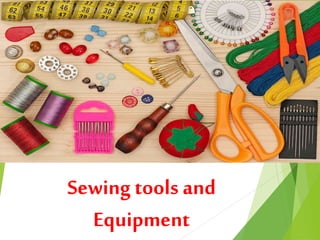
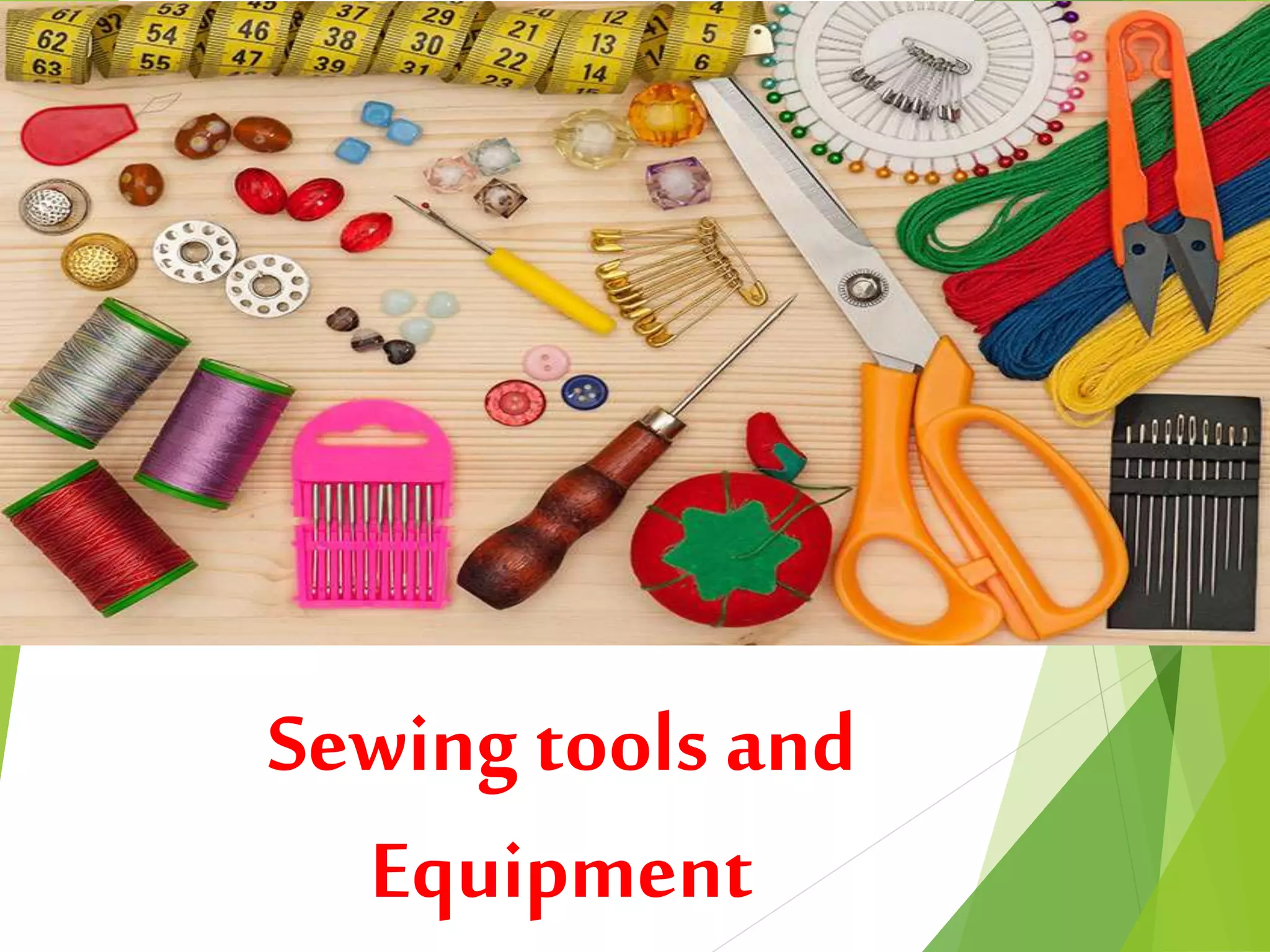
Sewing tools and
Equipment
Sewing tools and
Equipment
Sewing tools are instruments
that aid in accomplishing a
sewing task. It can be
manipulated by hand.
Sewing Equipment are the
different tools used in
clothing constructions.
Classification of Sewing Tools
 Jumbled Letters
1. MAERUIGNS OLOTS
2. CTUGNIT OTLOS
3. MRAGNIK TLOOS
4. DAFITNRG LTOOS
5. PNINIGN DAN SWINEG STOOL
1. MEASURING TOOLS
2. CUTTING TOOLS
3. MARKING TOOLS
4. DRAFTING TOOLS
5. PINNING AND SEWING TOOLS
MEASURING TOOLS
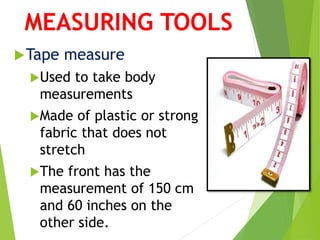
Tape measure
Used to take body
measurements
Made of plastic or strong
fabric that does not
stretch
The front has the
measurement of 150 cm
and 60 inches on the
other side.
MEASURING TOOLS
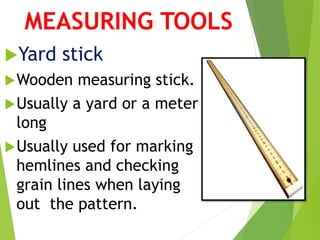
Yard stick
Wooden measuring stick.
Usually a yard or a meter
long
Usually used for marking
hemlines and checking
grain lines when laying
out the pattern.
MEASURING TOOLS
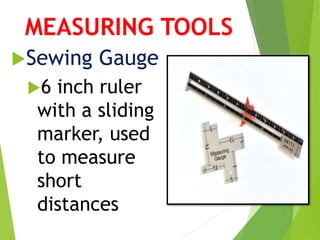
Sewing Gauge
6 inch ruler
with a sliding
marker, used
to measure
short
distances
MEASURING TOOLS
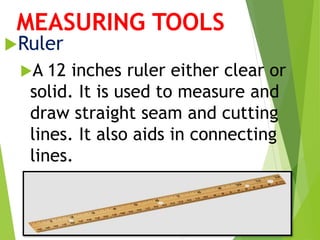
Ruler
A 12 inches ruler either clear or
solid. It is used to measure and
draw straight seam and cutting
lines. It also aids in connecting
lines.
CUTTING TOOLS
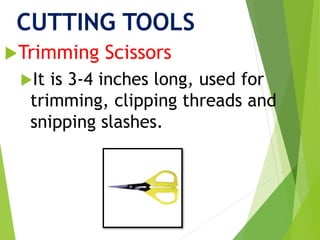
Trimming Scissors
It is 3-4 inches long, used for
trimming, clipping threads and
snipping slashes.
CUTTING TOOLS
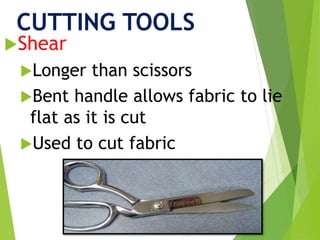
Shear
Longer than scissors
Bent handle allows fabric to lie
flat as it is cut
Used to cut fabric
CUTTING TOOLS
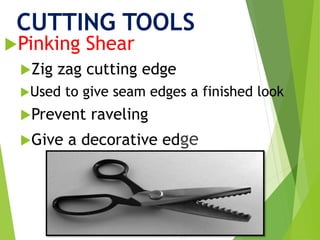
Pinking Shear
Zig zag cutting edge
Used to give seam edges a finished look
Prevent raveling
Give a decorative edge
CUTTING TOOLS
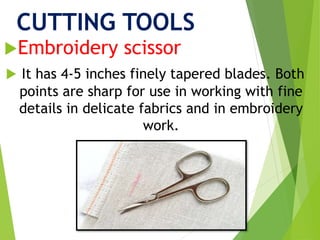
Embroidery scissor
 It has 4-5 inches finely tapered blades. Both
points are sharp for use in working with fine
details in delicate fabrics and in embroidery
work.
CUTTING TOOLS
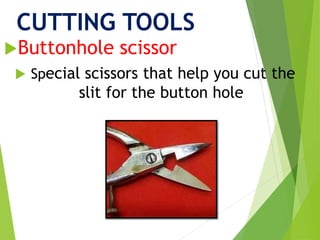
Buttonhole scissor
 Special scissors that help you cut the
slit for the button hole
CUTTING TOOLS
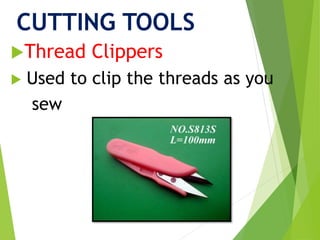
Thread Clippers
 Used to clip the threads as you
sew
CUTTING TOOLS
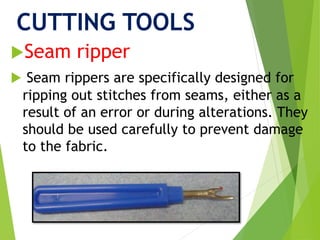
Seam ripper
 Seam rippers are specifically designed for
ripping out stitches from seams, either as a
result of an error or during alterations. They
should be used carefully to prevent damage
to the fabric.
MARKING TOOLS
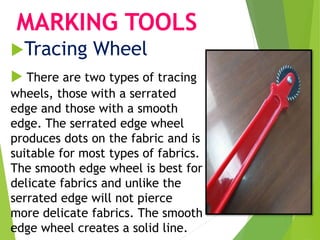
Tracing Wheel
 There are two types of tracing
wheels, those with a serrated
edge and those with a smooth
edge. The serrated edge wheel
produces dots on the fabric and is
suitable for most types of fabrics.
The smooth edge wheel is best for
delicate fabrics and unlike the
serrated edge will not pierce
more delicate fabrics. The smooth
edge wheel creates a solid line.
MARKING TOOLS
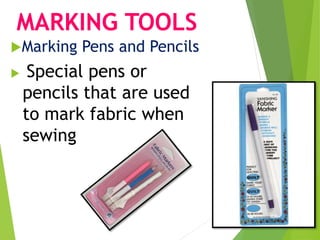
Marking Pens and Pencils
 Special pens or
pencils that are used
to mark fabric when
sewing
MARKING TOOLS
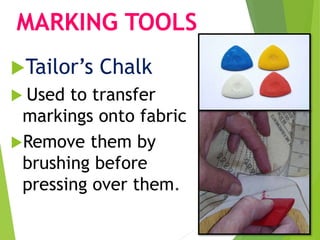
Tailor’s Chalk
 Used to transfer
markings onto fabric
Remove them by
brushing before
pressing over them.
DRAFTING TOOLS
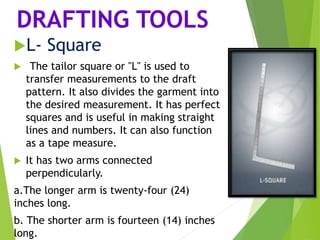
L- Square
 The tailor square or "L" is used to
transfer measurements to the draft
pattern. It also divides the garment into
the desired measurement. It has perfect
squares and is useful in making straight
lines and numbers. It can also function
as a tape measure.
 It has two arms connected
perpendicularly.
a.The longer arm is twenty-four (24)
inches long.
b. The shorter arm is fourteen (14) inches
long.
DRAFTING TOOLS
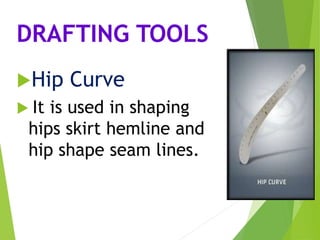
Hip Curve
 It is used in shaping
hips skirt hemline and
hip shape seam lines.
DRAFTING TOOLS
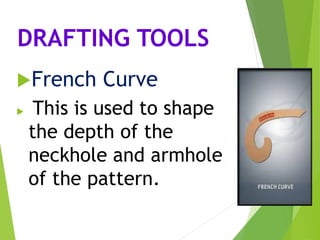
French Curve
 This is used to shape
the depth of the
neckhole and armhole
of the pattern.
PINNING AND SEWING TOOLS
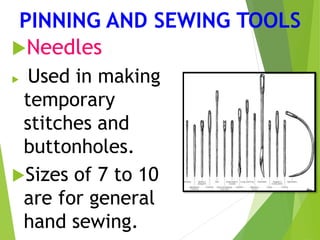
Needles
 Used in making
temporary
stitches and
buttonholes.
Sizes of 7 to 10
are for general
hand sewing.
PINNING AND SEWING TOOLS
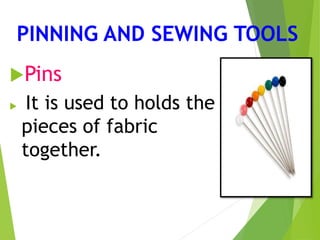
Pins
 It is used to holds the
pieces of fabric
together.
PINNING AND SEWING TOOLS
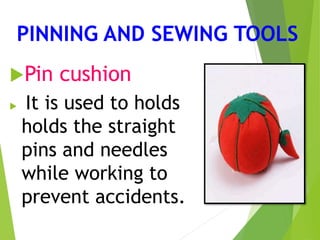
Pin cushion
 It is used to holds
holds the straight
pins and needles
while working to
prevent accidents.
PINNING AND SEWING TOOLS
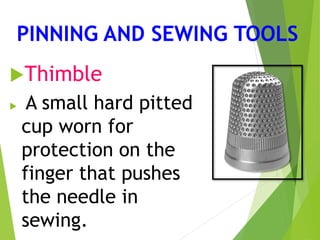
Thimble
 A small hard pitted
cup worn for
protection on the
finger that pushes
the needle in
sewing.
PINNING AND SEWING TOOLS
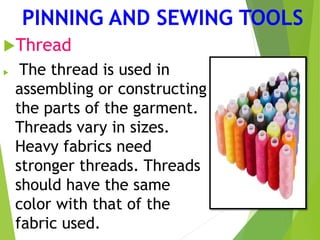
Thread
 The thread is used in
assembling or constructing
the parts of the garment.
Threads vary in sizes.
Heavy fabrics need
stronger threads. Threads
should have the same
color with that of the
fabric used.
PINNING AND SEWING TOOLS
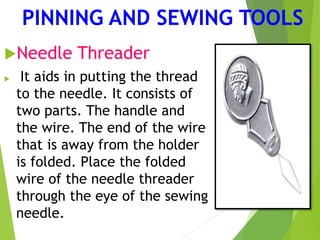
Needle Threader
 It aids in putting the thread
to the needle. It consists of
two parts. The handle and
the wire. The end of the wire
that is away from the holder
is folded. Place the folded
wire of the needle threader
through the eye of the sewing
needle.
Care of Sewing Tools
Sewing tools should be properly stored for safety
purposes as well as for durability. Keep all sewing
tools
in a suitable sewing kit.
Sharp objects such as pins and needles should be
placed in covered containers or on pin cushions.
Keep covers on seam rippers.
Where sleeves are available, use for storage of
shears
and scissors.
Do not cut paper with fabric shears.
Bernadette P. Retamar
References:
 https://designmycostume.com/sewing-tools-equipment-uses/
 https://www.amazon.com/Measure-Measuring-Sewing-Flexible-
Measurement/dp/B072VR8BR3
 https://www.thesprucecrafts.com/sewing-tools-and-equipment-
to-sew-4122025
 https://www.inchcalculator.com/ruler-information-uses-types/
 https://www.wayfair.com/outdoor/pdx/zenport-ergonomic-
bent-handle-deluxe-trimming-scissors-yrxd1050.html
 https://en.wikipedia.org/wiki/Pinking_shears
 https://stitchedmodern.com/blogs/news/why-you-need-a-good-
pair-of-embroidery-scissors#
 https://shopee.ph/EMBROIDERY-AND-SEWING-TRACING-WHEEL-
i.8788683.943312899
 https://www.universityoffashion.com/tools/l-square/
References:
 https://www.universityoffashion.com/tools/
 https://www.wawak.com/Cutting-Measuring/Pins/grabbit-
steel-sewing-pins-80box-assorted-colors/?sku=SSP1
 https://www.vectorstock.com/royalty-free-vector/types-
of-hand-sewing-needles-vector-14920670
 https://www.indiamart.com/proddetail/metal-thimble-
12658544188.html

Sewing Tools and Equipment

  • 1.
  • 2.
    Sewing tools and Equipment Sewingtools are instruments that aid in accomplishing a sewing task. It can be manipulated by hand. Sewing Equipment are the different tools used in clothing constructions.
  • 3.
    Classification of SewingTools  Jumbled Letters 1. MAERUIGNS OLOTS 2. CTUGNIT OTLOS 3. MRAGNIK TLOOS 4. DAFITNRG LTOOS 5. PNINIGN DAN SWINEG STOOL 1. MEASURING TOOLS 2. CUTTING TOOLS 3. MARKING TOOLS 4. DRAFTING TOOLS 5. PINNING AND SEWING TOOLS
  • 4.
    MEASURING TOOLS Tape measure Usedto take body measurements Made of plastic or strong fabric that does not stretch The front has the measurement of 150 cm and 60 inches on the other side.
  • 5.
    MEASURING TOOLS Yard stick Woodenmeasuring stick. Usually a yard or a meter long Usually used for marking hemlines and checking grain lines when laying out the pattern.
  • 6.
    MEASURING TOOLS Sewing Gauge 6inch ruler with a sliding marker, used to measure short distances
  • 7.
    MEASURING TOOLS Ruler A 12inches ruler either clear or solid. It is used to measure and draw straight seam and cutting lines. It also aids in connecting lines.
  • 8.
    CUTTING TOOLS Trimming Scissors Itis 3-4 inches long, used for trimming, clipping threads and snipping slashes.
  • 9.
    CUTTING TOOLS Shear Longer thanscissors Bent handle allows fabric to lie flat as it is cut Used to cut fabric
  • 10.
    CUTTING TOOLS Pinking Shear Zigzag cutting edge Used to give seam edges a finished look Prevent raveling Give a decorative edge
  • 11.
    CUTTING TOOLS Embroidery scissor It has 4-5 inches finely tapered blades. Both points are sharp for use in working with fine details in delicate fabrics and in embroidery work.
  • 12.
    CUTTING TOOLS Buttonhole scissor Special scissors that help you cut the slit for the button hole
  • 13.
    CUTTING TOOLS Thread Clippers Used to clip the threads as you sew
  • 14.
    CUTTING TOOLS Seam ripper Seam rippers are specifically designed for ripping out stitches from seams, either as a result of an error or during alterations. They should be used carefully to prevent damage to the fabric.
  • 15.
    MARKING TOOLS Tracing Wheel There are two types of tracing wheels, those with a serrated edge and those with a smooth edge. The serrated edge wheel produces dots on the fabric and is suitable for most types of fabrics. The smooth edge wheel is best for delicate fabrics and unlike the serrated edge will not pierce more delicate fabrics. The smooth edge wheel creates a solid line.
  • 16.
    MARKING TOOLS Marking Pensand Pencils  Special pens or pencils that are used to mark fabric when sewing
  • 17.
    MARKING TOOLS Tailor’s Chalk Used to transfer markings onto fabric Remove them by brushing before pressing over them.
  • 18.
    DRAFTING TOOLS L- Square The tailor square or "L" is used to transfer measurements to the draft pattern. It also divides the garment into the desired measurement. It has perfect squares and is useful in making straight lines and numbers. It can also function as a tape measure.  It has two arms connected perpendicularly. a.The longer arm is twenty-four (24) inches long. b. The shorter arm is fourteen (14) inches long.
  • 19.
    DRAFTING TOOLS Hip Curve It is used in shaping hips skirt hemline and hip shape seam lines.
  • 20.
    DRAFTING TOOLS French Curve This is used to shape the depth of the neckhole and armhole of the pattern.
  • 21.
    PINNING AND SEWINGTOOLS Needles  Used in making temporary stitches and buttonholes. Sizes of 7 to 10 are for general hand sewing.
  • 22.
    PINNING AND SEWINGTOOLS Pins  It is used to holds the pieces of fabric together.
  • 23.
    PINNING AND SEWINGTOOLS Pin cushion  It is used to holds holds the straight pins and needles while working to prevent accidents.
  • 24.
    PINNING AND SEWINGTOOLS Thimble  A small hard pitted cup worn for protection on the finger that pushes the needle in sewing.
  • 25.
    PINNING AND SEWINGTOOLS Thread  The thread is used in assembling or constructing the parts of the garment. Threads vary in sizes. Heavy fabrics need stronger threads. Threads should have the same color with that of the fabric used.
  • 26.
    PINNING AND SEWINGTOOLS Needle Threader  It aids in putting the thread to the needle. It consists of two parts. The handle and the wire. The end of the wire that is away from the holder is folded. Place the folded wire of the needle threader through the eye of the sewing needle.
  • 27.
    Care of SewingTools Sewing tools should be properly stored for safety purposes as well as for durability. Keep all sewing tools in a suitable sewing kit. Sharp objects such as pins and needles should be placed in covered containers or on pin cushions. Keep covers on seam rippers. Where sleeves are available, use for storage of shears and scissors. Do not cut paper with fabric shears.
  • 28.
  • 29.
    References:  https://designmycostume.com/sewing-tools-equipment-uses/  https://www.amazon.com/Measure-Measuring-Sewing-Flexible- Measurement/dp/B072VR8BR3 https://www.thesprucecrafts.com/sewing-tools-and-equipment- to-sew-4122025  https://www.inchcalculator.com/ruler-information-uses-types/  https://www.wayfair.com/outdoor/pdx/zenport-ergonomic- bent-handle-deluxe-trimming-scissors-yrxd1050.html  https://en.wikipedia.org/wiki/Pinking_shears  https://stitchedmodern.com/blogs/news/why-you-need-a-good- pair-of-embroidery-scissors#  https://shopee.ph/EMBROIDERY-AND-SEWING-TRACING-WHEEL- i.8788683.943312899  https://www.universityoffashion.com/tools/l-square/
  • 30.
    References:  https://www.universityoffashion.com/tools/  https://www.wawak.com/Cutting-Measuring/Pins/grabbit- steel-sewing-pins-80box-assorted-colors/?sku=SSP1 https://www.vectorstock.com/royalty-free-vector/types- of-hand-sewing-needles-vector-14920670  https://www.indiamart.com/proddetail/metal-thimble- 12658544188.html