Weaving
• Weaving: A method in which 2 sets of fibers are
interlaced using weft and warp at right angles on
a loom.

• Fibers: materials such as cotton, hemp, hair,
roots, raffia, wool or fur that can be used to
create a rope or strand to weave with.
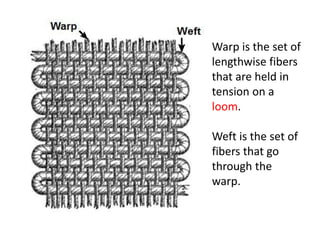
Warp is the set of
lengthwise fibers
that are held in
tension on a
loom.
Weft is the set of
fibers that go
through the
warp.
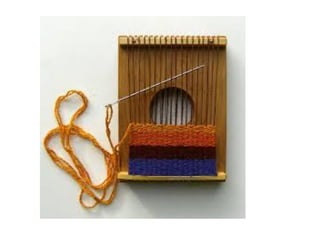
Looms
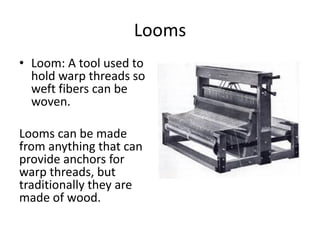
• Loom: A tool used to
hold warp threads so
weft fibers can be
woven.
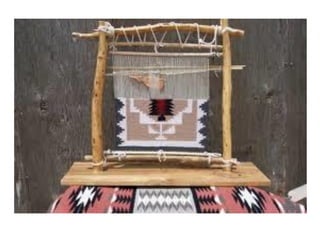
Looms can be made
from anything that can
provide anchors for
warp threads, but
traditionally they are
made of wood.
Things that are traditionally woven…
• Clothing
• Rugs
• Baskets
• Tapestries
History of Weaving
• Woven fabrics have been dated as far back as
5000BC.
• Weaving is one of the oldest forms of arts and
crafts, but it didn’t begin as a hobby.
• Early civilizations needed it to provide clothing
and shelter in order to survive
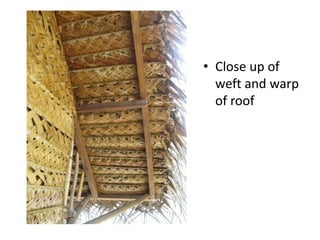
• Close up of
weft and warp
of roof
History of Weaving
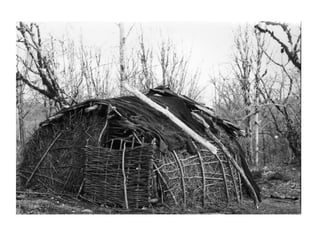
• In early civilization, people were nomads.
• They needed homes that they knew would be
temporary, but were still secure.
• They used the resources they found in nature to
weave what supplies they could.
• They also wove walls, doors, rugs and hammocks.
Early Woven Clothing
• Once people began to settle and clothing started
being made for more than simply survival
purposes, it began being created to
• Show Power
• Frighten the Enemy
• Social Approval or Social Status
• How does this compare to modern society?
History of Weaving
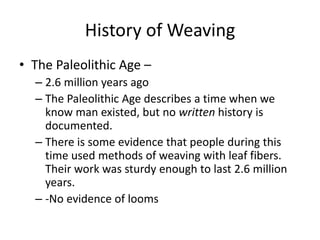
• The Paleolithic Age –
– 2.6 million years ago
– The Paleolithic Age describes a time when we
know man existed, but no written history is
documented.
– There is some evidence that people during this
time used methods of weaving with leaf fibers.
Their work was sturdy enough to last 2.6 million
years.
– -No evidence of looms
History of Weaving

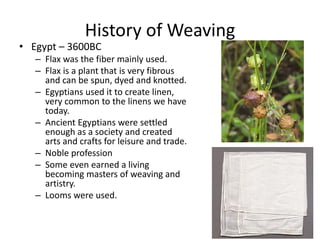
• Egypt – 3600BC

– Flax was the fiber mainly used.
– Flax is a plant that is very fibrous
and can be spun, dyed and knotted.
– Egyptians used it to create linen,
very common to the linens we have
today.

– Ancient Egyptians were settled
enough as a society and created
arts and crafts for leisure and trade.
– Noble profession
– Some even earned a living
becoming masters of weaving and
artistry.
– Looms were used.
History of Weaving
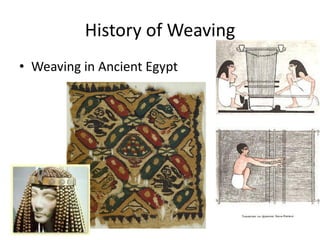
• Weaving in Ancient Egypt
History of Weaving
• Biblical Times – 2000BC
– As Ancient Egypt began to fall, the Hebrews began
to take rise.
– Their fiber of choice was wool.
– Looms were used and required 2 people to
operate.
– Weavers during this time were not artisans. They
were often children or slaves.
History of Weaving
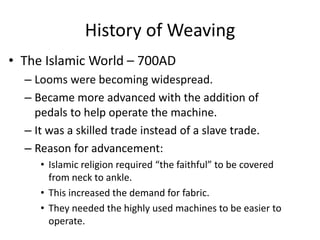
• The Islamic World – 700AD
– Looms were becoming widespread.
– Became more advanced with the addition of
pedals to help operate the machine.
– It was a skilled trade instead of a slave trade.
– Reason for advancement:
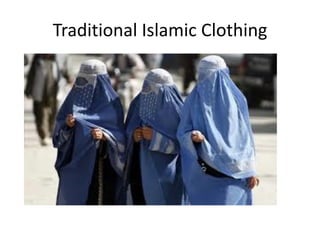
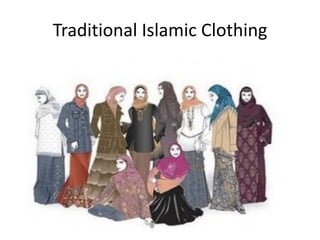
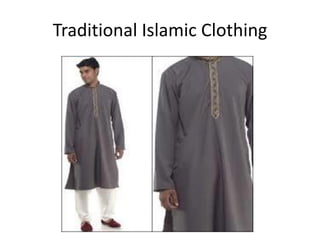
• Islamic religion required “the faithful” to be covered
from neck to ankle.
• This increased the demand for fabric.
• They needed the highly used machines to be easier to
operate.
Traditional Islamic Clothing
History of Weaving
• Medieval Europe – 800sAD
– “A weaver” was a skilled occupation
– It was a craft and provided trade that could be
bought and sold
– Tapestries were popular during this time.
– Predominant fibers were
• Wool – For royalty or people of class
• Linen – For the middleclass
• Nettlecloth – For the lower class
History of Weaving
• American Colonies 1500-1800
– Colonial America was heavily reliant on Great Britain.
– Britain wanted the colonies to begin producing their
own raw materials (live of the land)
– The Wool Act of 1699 restricted the export of Colonial
Wool
– The colonists began using cotton and flax to create
linens (Who else used flax?)
– This is the beginning of the cotton gin.
– Cotton production is still a huge cash crop for the
areas of the colonies and the south today.
History of Weaving
• Industrial Revolution 1760-1840
– The development of water power, coal and
machine tools changed society
– The importance of the craftsman declined and
began to be replaced by machines.
– Fabrics could be imported from around the world,
and machines replaced looms to create complex
and intricate fabrics.
History of Weaving
• Arts and Crafts movement – 1860-1930
– Movement against mechanization and advocate
the return to traditional craftsmanship and simple
forms.
– Weaving was a huge part of this movement with
the return of hand weaving and traditional looms.
– It became a hobby of leisure
Weaving Today
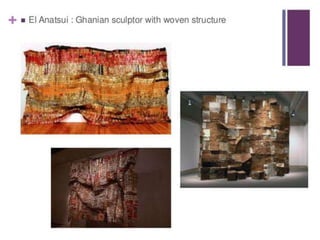
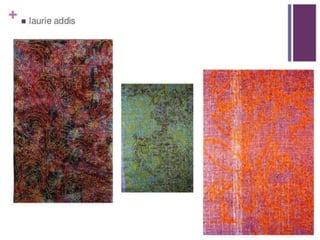
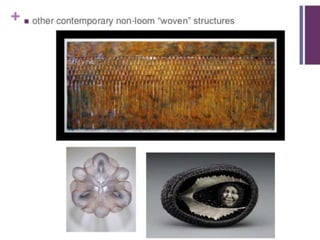
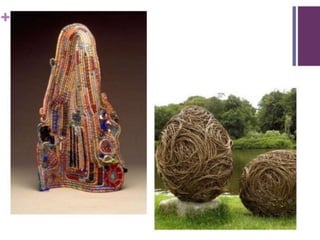
• Weaving today is considered a “Fine Art”
– Untraditional materials are experimented with
– It is commonly combined with sculpture
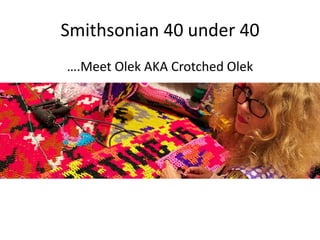
Smithsonian 40 under 40
….Meet Olek AKA Crotched Olek
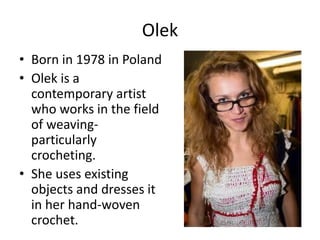
Olek
• Born in 1978 in Poland
• Olek is a
contemporary artist
who works in the field
of weavingparticularly
crocheting.
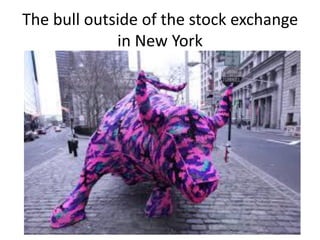
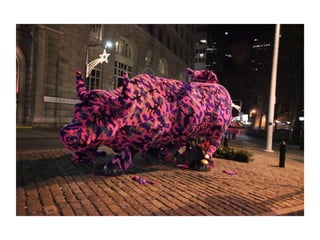
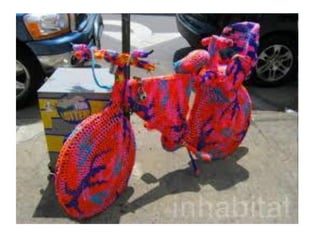
• She uses existing
objects and dresses it
in her hand-woven
crochet.
The bull outside of the stock exchange
in New York
http://www.youtube.com/watch?v=why4wCKUsc&list=TLs7Uvg4Jt_ayn64zocJL4u8304upvADnt

History of Weaving, JCarver

  • 1.
  • 2.
    • Weaving: Amethod in which 2 sets of fibers are interlaced using weft and warp at right angles on a loom. • Fibers: materials such as cotton, hemp, hair, roots, raffia, wool or fur that can be used to create a rope or strand to weave with.
  • 3.
    Warp is theset of lengthwise fibers that are held in tension on a loom. Weft is the set of fibers that go through the warp.
  • 4.
    Looms • Loom: Atool used to hold warp threads so weft fibers can be woven. Looms can be made from anything that can provide anchors for warp threads, but traditionally they are made of wood.
  • 7.
    Things that aretraditionally woven… • Clothing • Rugs • Baskets • Tapestries
  • 8.
    History of Weaving •Woven fabrics have been dated as far back as 5000BC. • Weaving is one of the oldest forms of arts and crafts, but it didn’t begin as a hobby. • Early civilizations needed it to provide clothing and shelter in order to survive
  • 11.
    • Close upof weft and warp of roof
  • 12.
    History of Weaving •In early civilization, people were nomads. • They needed homes that they knew would be temporary, but were still secure. • They used the resources they found in nature to weave what supplies they could. • They also wove walls, doors, rugs and hammocks.
  • 13.
    Early Woven Clothing •Once people began to settle and clothing started being made for more than simply survival purposes, it began being created to • Show Power • Frighten the Enemy • Social Approval or Social Status • How does this compare to modern society?
  • 14.
    History of Weaving •The Paleolithic Age – – 2.6 million years ago – The Paleolithic Age describes a time when we know man existed, but no written history is documented. – There is some evidence that people during this time used methods of weaving with leaf fibers. Their work was sturdy enough to last 2.6 million years. – -No evidence of looms
  • 15.
    History of Weaving •Egypt – 3600BC – Flax was the fiber mainly used. – Flax is a plant that is very fibrous and can be spun, dyed and knotted. – Egyptians used it to create linen, very common to the linens we have today. – Ancient Egyptians were settled enough as a society and created arts and crafts for leisure and trade. – Noble profession – Some even earned a living becoming masters of weaving and artistry. – Looms were used.
  • 16.
    History of Weaving •Weaving in Ancient Egypt
  • 17.
    History of Weaving •Biblical Times – 2000BC – As Ancient Egypt began to fall, the Hebrews began to take rise. – Their fiber of choice was wool. – Looms were used and required 2 people to operate. – Weavers during this time were not artisans. They were often children or slaves.
  • 18.
    History of Weaving •The Islamic World – 700AD – Looms were becoming widespread. – Became more advanced with the addition of pedals to help operate the machine. – It was a skilled trade instead of a slave trade. – Reason for advancement: • Islamic religion required “the faithful” to be covered from neck to ankle. • This increased the demand for fabric. • They needed the highly used machines to be easier to operate.
  • 19.
  • 20.
  • 21.
  • 22.
    History of Weaving •Medieval Europe – 800sAD – “A weaver” was a skilled occupation – It was a craft and provided trade that could be bought and sold – Tapestries were popular during this time. – Predominant fibers were • Wool – For royalty or people of class • Linen – For the middleclass • Nettlecloth – For the lower class
  • 23.
    History of Weaving •American Colonies 1500-1800 – Colonial America was heavily reliant on Great Britain. – Britain wanted the colonies to begin producing their own raw materials (live of the land) – The Wool Act of 1699 restricted the export of Colonial Wool – The colonists began using cotton and flax to create linens (Who else used flax?) – This is the beginning of the cotton gin. – Cotton production is still a huge cash crop for the areas of the colonies and the south today.
  • 24.
    History of Weaving •Industrial Revolution 1760-1840 – The development of water power, coal and machine tools changed society – The importance of the craftsman declined and began to be replaced by machines. – Fabrics could be imported from around the world, and machines replaced looms to create complex and intricate fabrics.
  • 25.
    History of Weaving •Arts and Crafts movement – 1860-1930 – Movement against mechanization and advocate the return to traditional craftsmanship and simple forms. – Weaving was a huge part of this movement with the return of hand weaving and traditional looms. – It became a hobby of leisure
  • 26.
    Weaving Today • Weavingtoday is considered a “Fine Art” – Untraditional materials are experimented with – It is commonly combined with sculpture
  • 31.
    Smithsonian 40 under40 ….Meet Olek AKA Crotched Olek
  • 32.
    Olek • Born in1978 in Poland • Olek is a contemporary artist who works in the field of weavingparticularly crocheting. • She uses existing objects and dresses it in her hand-woven crochet.
  • 34.
    The bull outsideof the stock exchange in New York
  • 37.