What Comes Next:
Perspective From
a Serial Founder
David Cancel
Converted 2016
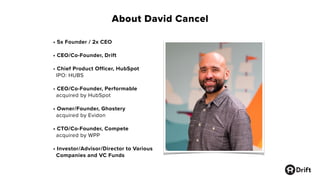
About David Cancel
• 5x Founder / 2x CEO
• CEO/Co-Founder, Drift
• Chief Product Officer, HubSpot
IPO: HUBS
• CEO/Co-Founder, Performable
acquired by HubSpot
• Owner/Founder, Ghostery
acquired by Evidon
• CTO/Co-Founder, Compete
acquired by WPP
• Investor/Advisor/Director to Various
Companies and VC Funds
my podcast
Why did I start
working on Drift?
Unfinished business.
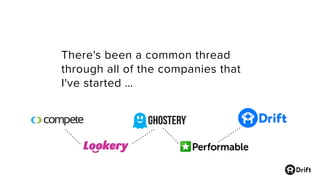
There's been a common thread
through all of the companies that
I've started …
But it’s taken a long time — and lots
of hindsight — to understand what
that thread was:
The connection between
businesses and customers.
I can trace this thread all the way
back to my college days.
As a student, I was bored.
Extremely bored.
So I'd skip all my classes and hang
out in the library, where they had …
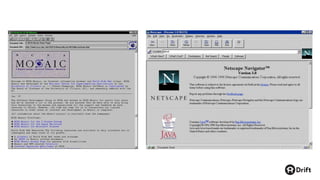
The library computers had early
versions of the Mosaic browser, and
later, the Netscape browser.
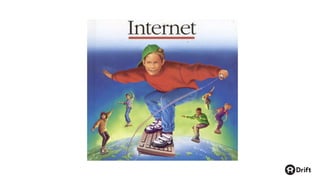
So I started to use the early internet
through those browsers and I
became obsessed.
I had been coding software up until
this point — desktop software,
boring software — but I wasn’t really
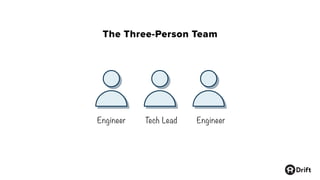
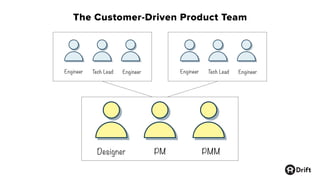
feeling it. I didn’t love it.
Then I discovered this way to have
access to all of this information
around the world, and to make
connections with people.
So I built a website. And back in the
day, you would put your email
address at the bottom of your site.
Someone emailed me. And still, to
this day, I remember this email:
Hey man, I really like your
website. It’s really cool.
“
Then I checked the ISP: the person
who had emailed me was in Russia.
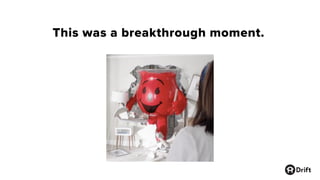
This was a breakthrough moment.
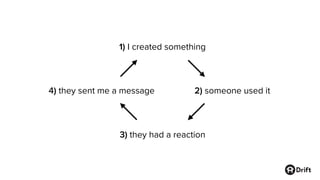
It was the first time I experienced a
customer feedback loop.
1) I created something
4) they sent me a message 2) someone used it
3) they had a reaction
And that is what I’ve been chasing
ever since …
The customer feedback loop —
1:1 communication with customers.
I didn’t realize it at the time, but I’ve
been chasing the same pattern for
five companies.
But up until my fourth company,
Performable, I was following the
same playbook as everyone else.
It’s a playbook that’s largely driven
by the ideas of the people within
the company.
Whether it was Waterfall, or Agile or
some other product methodology,
the customer was always missing.
I hate using the Agile methodology
for software now.
Because the customer isn’t included
in the process.
Meanwhile, Kickstarter & Indiegogo
have started letting companies
create products out in the open
with the customer.
And customers now regularly pay
for products long before those
products even exist.
(Source: Fortune)
Customers find value in being part
of a community, and being part of
that journey of creating the product.
At Performable, I shifted the model
to put communication with
customers at the center.
And we started to build a
methodology around having
product and engineering
communicate 1:1 with customers.
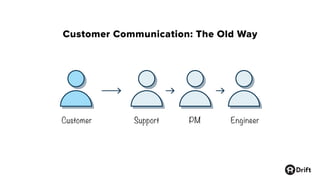
Customer Communication: The Old Way
Customer Support PM Engineer
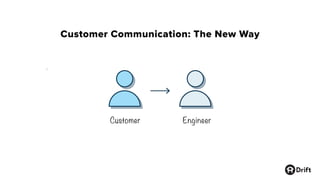
Customer Communication: The New Way
Customer Engineer
Then, in 2011, Performable was
acquired by HubSpot, and I went on
to lead product there as CPO.
This was my chance to see if a
customer-driven approach could
work at scale.
I built that team from about 50
people to around 200 by the time I
left (which was a few weeks before
we went public).
When I first got to HubSpot, I made
the decision that engineering teams
would each consist of 3 people.
The Three-Person Team
Engineer Tech Lead Engineer
And each team would own a
complete, customer-facing product.
We paired up each of these teams
with a PM, who would work across
multiple three-person teams.
Then for each PM we had a
dedicated designer and a dedicated
product marketing manager.
Designer PM PMM
Engineer Tech Lead Engineer Engineer Tech Lead Engineer
The Customer-Driven Product Team
This structure allowed the people
closest to the problem to come up
with the solutions and test them
with the actual customer.
And it produced the results that we
thought it would produce.
After implementing the new
structure, our product team had the
highest employee NPS score of any
team in the company.
The customer-driven approach
wasn’t just better for customers, it
was better for everyone.
Now, at Drift, we’re building a way
for every company in the world to
be customer-driven.
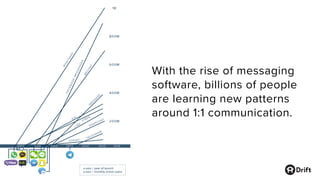
With the rise of messaging
software, billions of people
are learning new patterns
around 1:1 communication.
At Drift, we’re building a messaging
app that allows customers to
communicate with companies using
these new patterns.
But it isn’t just our product. It’s the
way we work and our philosophy
behind building companies and
building products.
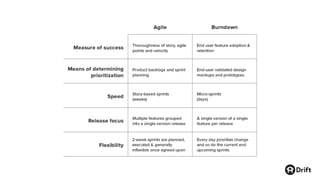
Example:
Burndown
Example:
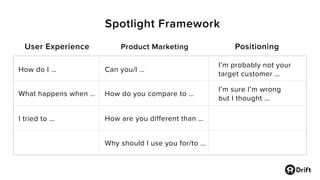
The Spotlight Framework
Spotlight Framework
Product Marketing PositioningUser Experience
What happens when …
How do I …
I tried to …
Can you/I …
How do you compare to …
How are you different than …
Why should I use you for/to …
I’m probably not your
target customer …
I’m sure I’m wrong
but I thought …
Ultimately, every company needs to
shift to be able to have the
customer at the center, and to be
able to build products and services
that serve those customers.
No longer is the customer an
afterthought. No more “Oh, OK, how
do we sell this thing now that we’ve
built it?”
Thinking Beyond
Today’s Competition
One of the things that I’ve learned
throughout my career is to really
focus on the customer, the market,
and the team.
Those are the three legs of the
stool: the customer, the market, and
the team.
Know what’s not part of that stool?
The competition.
I have this unorthodox view where I
like markets that have a fair number
of competitors in them.
Because that means there really is a
market.
There are competitors now, but I
expect that every major software
company that sort of touches our
world will get in eventually.
So the goal is to be the leader in
this market by the time that those
players come in.
We saw first-hand the market shifting
more and more toward messaging
and more and more toward this
connection with the customer.
The competition today doesn’t
matter. We’re not fighting for the
small market that some number of
competitors might have today.
What we’re trying to do is fight for
that big, billions-of-users type of
market.
We’re striving for HYPERGROWTH,
and we’re using a customer-driven
approach to do it.
Here are three things you can start
doing right now to be more
customer-driven:
1. Get rid of roadmaps.
Roadmaps serve salespeople and
other people internally. They don’t
serve the customer.
2. Just ship it.
Get products into your customers’
hands early. Let them help you
shape the product’s direction.
3. Talk to customers daily.
Your customers are closer to your
product than anyone else. Listen to
them. Talk to them. Show them that
you’re paying attention.
(P.S. If you’re having trouble
communicating with customers 1:1 at
scale, visit Drift.com)
Check out what I’m up to at Drift.com

What Comes Next: Perspective From a Serial Founder

  • 1.
    What Comes Next: PerspectiveFrom a Serial Founder David Cancel Converted 2016
  • 2.
    About David Cancel •5x Founder / 2x CEO • CEO/Co-Founder, Drift • Chief Product Officer, HubSpot IPO: HUBS • CEO/Co-Founder, Performable acquired by HubSpot • Owner/Founder, Ghostery acquired by Evidon • CTO/Co-Founder, Compete acquired by WPP • Investor/Advisor/Director to Various Companies and VC Funds
  • 3.
  • 4.
    Why did Istart working on Drift?
  • 5.
  • 6.
    There's been acommon thread through all of the companies that I've started …
  • 7.
    But it’s takena long time — and lots of hindsight — to understand what that thread was:
  • 8.
  • 9.
    I can tracethis thread all the way back to my college days.
  • 10.
    As a student,I was bored. Extremely bored.
  • 11.
    So I'd skipall my classes and hang out in the library, where they had …
  • 13.
    The library computershad early versions of the Mosaic browser, and later, the Netscape browser.
  • 15.
    So I startedto use the early internet through those browsers and I became obsessed.
  • 16.
    I had beencoding software up until this point — desktop software, boring software — but I wasn’t really feeling it. I didn’t love it.
  • 17.
    Then I discoveredthis way to have access to all of this information around the world, and to make connections with people.
  • 18.
    So I builta website. And back in the day, you would put your email address at the bottom of your site.
  • 19.
    Someone emailed me.And still, to this day, I remember this email:
  • 20.
    Hey man, Ireally like your website. It’s really cool. “
  • 21.
    Then I checkedthe ISP: the person who had emailed me was in Russia.
  • 22.
    This was abreakthrough moment.
  • 23.
    It was thefirst time I experienced a customer feedback loop.
  • 24.
    1) I createdsomething 4) they sent me a message 2) someone used it 3) they had a reaction
  • 25.
    And that iswhat I’ve been chasing ever since …
  • 26.
    The customer feedbackloop — 1:1 communication with customers.
  • 27.
    I didn’t realizeit at the time, but I’ve been chasing the same pattern for five companies.
  • 28.
    But up untilmy fourth company, Performable, I was following the same playbook as everyone else.
  • 29.
    It’s a playbookthat’s largely driven by the ideas of the people within the company.
  • 30.
    Whether it wasWaterfall, or Agile or some other product methodology, the customer was always missing.
  • 32.
    I hate usingthe Agile methodology for software now.
  • 33.
    Because the customerisn’t included in the process.
  • 34.
    Meanwhile, Kickstarter &Indiegogo have started letting companies create products out in the open with the customer.
  • 35.
    And customers nowregularly pay for products long before those products even exist.
  • 36.
  • 37.
    Customers find valuein being part of a community, and being part of that journey of creating the product.
  • 38.
    At Performable, Ishifted the model to put communication with customers at the center.
  • 39.
    And we startedto build a methodology around having product and engineering communicate 1:1 with customers.
  • 40.
    Customer Communication: TheOld Way Customer Support PM Engineer
  • 41.
    Customer Communication: TheNew Way Customer Engineer
  • 42.
    Then, in 2011,Performable was acquired by HubSpot, and I went on to lead product there as CPO.
  • 43.
    This was mychance to see if a customer-driven approach could work at scale.
  • 44.
    I built thatteam from about 50 people to around 200 by the time I left (which was a few weeks before we went public).
  • 45.
    When I firstgot to HubSpot, I made the decision that engineering teams would each consist of 3 people.
  • 46.
  • 47.
    And each teamwould own a complete, customer-facing product.
  • 48.
    We paired upeach of these teams with a PM, who would work across multiple three-person teams.
  • 49.
    Then for eachPM we had a dedicated designer and a dedicated product marketing manager.
  • 50.
    Designer PM PMM EngineerTech Lead Engineer Engineer Tech Lead Engineer The Customer-Driven Product Team
  • 51.
    This structure allowedthe people closest to the problem to come up with the solutions and test them with the actual customer.
  • 52.
    And it producedthe results that we thought it would produce.
  • 53.
    After implementing thenew structure, our product team had the highest employee NPS score of any team in the company.
  • 54.
    The customer-driven approach wasn’tjust better for customers, it was better for everyone.
  • 55.
    Now, at Drift,we’re building a way for every company in the world to be customer-driven.
  • 56.
    With the riseof messaging software, billions of people are learning new patterns around 1:1 communication.
  • 57.
    At Drift, we’rebuilding a messaging app that allows customers to communicate with companies using these new patterns.
  • 59.
    But it isn’tjust our product. It’s the way we work and our philosophy behind building companies and building products.
  • 60.
  • 62.
  • 63.
    Spotlight Framework Product MarketingPositioningUser Experience What happens when … How do I … I tried to … Can you/I … How do you compare to … How are you different than … Why should I use you for/to … I’m probably not your target customer … I’m sure I’m wrong but I thought …
  • 64.
    Ultimately, every companyneeds to shift to be able to have the customer at the center, and to be able to build products and services that serve those customers.
  • 65.
    No longer isthe customer an afterthought. No more “Oh, OK, how do we sell this thing now that we’ve built it?”
  • 66.
  • 67.
    One of thethings that I’ve learned throughout my career is to really focus on the customer, the market, and the team.
  • 68.
    Those are thethree legs of the stool: the customer, the market, and the team.
  • 70.
    Know what’s notpart of that stool?
  • 71.
  • 72.
    I have thisunorthodox view where I like markets that have a fair number of competitors in them.
  • 73.
    Because that meansthere really is a market.
  • 74.
    There are competitorsnow, but I expect that every major software company that sort of touches our world will get in eventually.
  • 75.
    So the goalis to be the leader in this market by the time that those players come in.
  • 76.
    We saw first-handthe market shifting more and more toward messaging and more and more toward this connection with the customer.
  • 77.
    The competition todaydoesn’t matter. We’re not fighting for the small market that some number of competitors might have today.
  • 78.
    What we’re tryingto do is fight for that big, billions-of-users type of market.
  • 79.
    We’re striving forHYPERGROWTH, and we’re using a customer-driven approach to do it.
  • 80.
    Here are threethings you can start doing right now to be more customer-driven:
  • 81.
    1. Get ridof roadmaps.
  • 82.
    Roadmaps serve salespeopleand other people internally. They don’t serve the customer.
  • 83.
  • 85.
    Get products intoyour customers’ hands early. Let them help you shape the product’s direction.
  • 86.
    3. Talk tocustomers daily.
  • 87.
    Your customers arecloser to your product than anyone else. Listen to them. Talk to them. Show them that you’re paying attention.
  • 88.
    (P.S. If you’rehaving trouble communicating with customers 1:1 at scale, visit Drift.com)
  • 89.
    Check out whatI’m up to at Drift.com