
Making Leaders Successful 
Every Day
Modern Applications – Modern ALM 
Jeffrey S. Hammond, Vice President & Principal Analyst 
@jhammond 
August 21, 2014
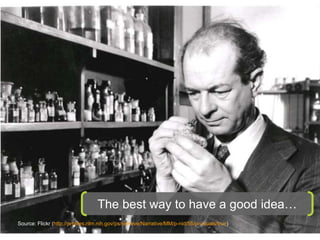
The best way to have a good idea… 
Source: Flickr (http://profiles.nlm.nih.gov/ps/retrieve/Narrative/MM/p-nid/55/p-visuals/true)
Software innovation used to be expensive… 
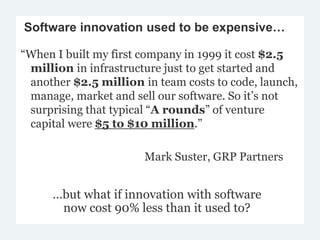
“When I built my first company in 1999 it cost $2.5 
million in infrastructure just to get started and 
another $2.5 million in team costs to code, launch, 
manage, market and sell our software. So it’s not 
surprising that typical “A rounds” of venture 
capital were $5 to $10 million.” 
Mark Suster, GRP Partners 
…but what if innovation with software 
now cost 90% less than it used to?
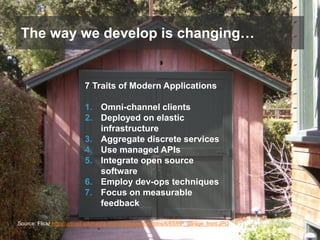
The way we develop is changing… 
7 Traits of Modern Applications 
1. Omni-channel clients 
2. Deployed on elastic 
infrastructure 
3. Aggregate discrete services 
4. Use managed APIs 
5. Integrate open source 
software 
6. Employ dev-ops techniques 
7. Focus on measurable 
feedback 
Source: Flickr http://upload.wikimedia.org/wikipedia/commons/6/65/HP_garage_front.JPG)
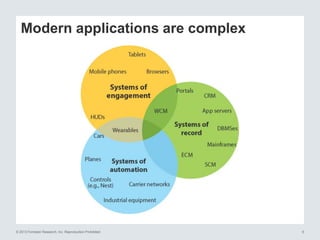
Modern applications are complex 
© 2013 Forrester Research, Inc. Reproduction Prohibited 6
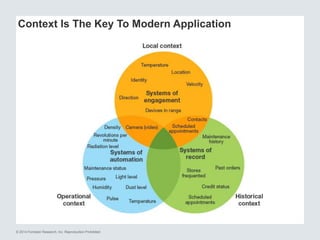
Context Is The Key To Modern Application 
© 2014 Forrester Research, Inc. Reproduction Prohibited
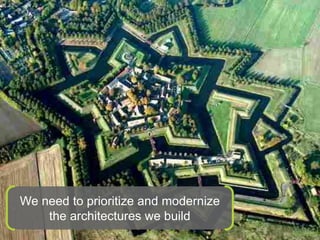
We need to prioritize and modernize 
the architectures we build
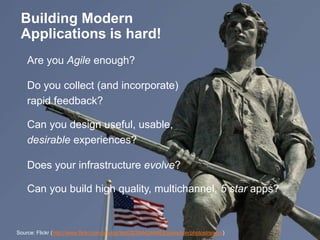
Building Modern 
Applications is hard! 
Are you Agile enough? 
Do you collect (and incorporate) 
rapid feedback? 
Can you design useful, usable, 
desirable experiences? 
Does your infrastructure evolve? 
Can you build high quality, multichannel, 5 star apps? 
Source: Flickr (http://www.flickr.com/photos/kaz25/2444344463/sizes/o/in/photostream//)
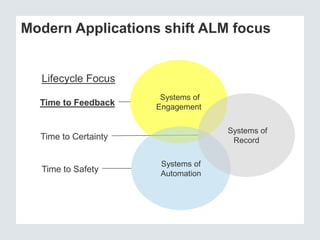
Modern Applications shift ALM focus 
Systems of 
Engagement 
Time to Feedback 
Time to Certainty 
Time to Safety 
Systems of 
Automation 
Systems of 
Record 
Lifecycle Focus
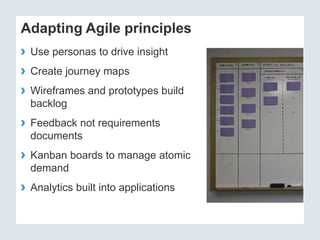
Adapting Agile principles 
› Use personas to drive insight 
› Create journey maps 
› Wireframes and prototypes build 
backlog 
› Feedback not requirements 
documents 
› Kanban boards to manage atomic 
demand 
› Analytics built into applications
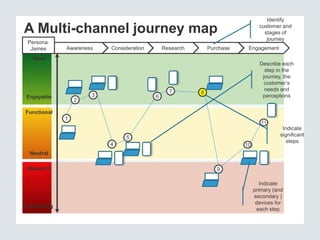
A Multi-channel journey map 
Wow 
Enjoyable 
Functional 
Neutral 
Missed It 
Frustrating 
Awareness Consideration Research Purchase Engagement 
1 
2 
3 
4 
5 
6 
7 8 
9 
10 
Describe each 
step in the 
journey, the 
customer’s 
needs and 
perceptions 
11 
Identify 
customer and 
stages of 
journey 
Indicate 
Indicate 
significant 
primary (and 
secondary ) 
devices for 
each step 
steps 
Persona: 
James
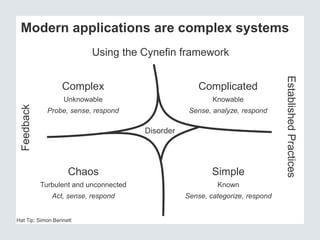
Modern applications are complex systems 
Complex 
Unknowable 
Probe, sense, respond 
Complicated 
Knowable 
Sense, analyze, respond 
Chaos 
Turbulent and unconnected 
Act, sense, respond 
Simple 
Known 
Sense, categorize, respond 
Disorder 
Feedback 
Established Practices 
Using the Cynefin framework 
Hat Tip: Simon Bennett
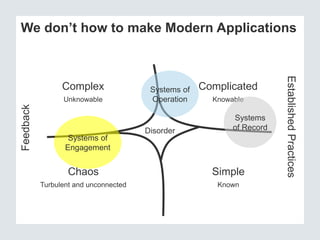
We don’t how to make Modern Applications 
Complex 
Unknowable 
Complicated 
Knowable 
Chaos 
Turbulent and unconnected 
Simple 
Known 
Disorder 
Feedback 
Established Practices 
Systems of 
Engagement 
Systems of 
Operation 
Systems 
of Record
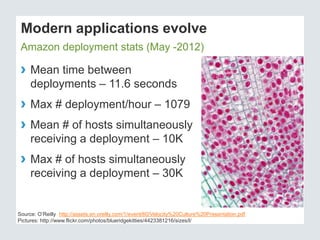
Modern applications evolve 
Amazon deployment stats (May -2012) 
› Mean time between 
deployments – 11.6 seconds 
› Max # deployment/hour – 1079 
› Mean # of hosts simultaneously 
receiving a deployment – 10K 
› Max # of hosts simultaneously 
receiving a deployment – 30K 
Source: O’Reilly (http://assets.en.oreilly.com/1/event/60/Velocity%20Culture%20Presentation.pdf) 
Pictures: http://www.flickr.com/photos/blueridgekitties/4423381216/sizes/l/
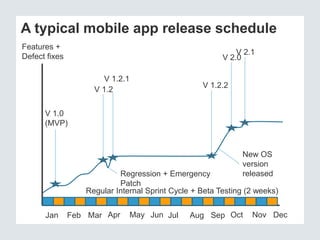
A typical mobile app release schedule 
Features + 
Defect fixes 
V 1.0 
(MVP) 
V 2.1 
V 2.0 
V 1.2.2 
V 1.2.1 
V 1.2 
Regression + Emergency 
Patch 
New OS 
version 
released 
Regular Internal Sprint Cycle + Beta Testing (2 weeks) 
Jan Feb Mar Apr May Jun Jul Aug Sep Oct Nov Dec
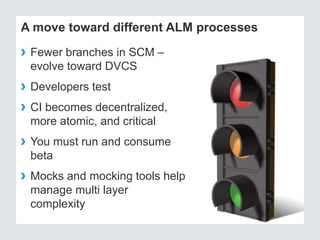
A move toward different ALM processes 
› Fewer branches in SCM – 
evolve toward DVCS 
› Developers test 
› CI becomes decentralized, 
more atomic, and critical 
› You must run and consume 
beta 
› Mocks and mocking tools help 
manage multi layer 
complexity
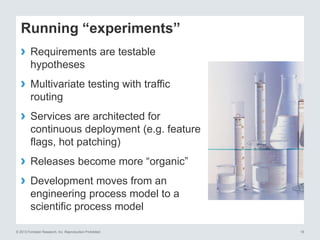
Running “experiments” 
› Requirements are testable 
hypotheses 
› Multivariate testing with traffic 
routing 
› Services are architected for 
continuous deployment (e.g. feature 
flags, hot patching) 
› Releases become more “organic” 
› Development moves from an 
engineering process model to a 
scientific process model 
© 2013 Forrester Research, Inc. Reproduction Prohibited 18
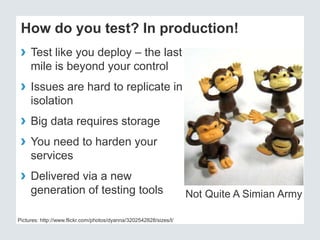
How do you test? In production! 
› Test like you deploy – the last 
mile is beyond your control 
› Issues are hard to replicate in 
isolation 
› Big data requires storage 
› You need to harden your 
services 
› Delivered via a new 
generation of testing tools 
Pictures: http://www.flickr.com/photos/dyanna/3202542828/sizes/l/ 
Not Quite A Simian Army
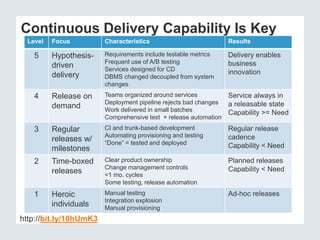
Continuous Delivery Capability Is Key 
Level Focus Characteristics Results 
5 Hypothesis-driven 
delivery 
Requirements include testable metrics 
Frequent use of A/B testing 
Services designed for CD 
DBMS changed decoupled from system 
changes 
Delivery enables 
business 
innovation 
4 Release on 
demand 
Teams organized around services 
Deployment pipeline rejects bad changes 
Work delivered in small batches 
Comprehensive test + release automation 
Service always in 
a releasable state 
Capability >= Need 
3 Regular 
releases w/ 
milestones 
CI and trunk-based development 
Automating provisioning and testing 
“Done” = tested and deployed 
Regular release 
cadence 
Capability < Need 
2 Time-boxed 
releases 
Clear product ownership 
Change management controls 
<1 mo. cycles 
Some testing, release automation 
Planned releases 
Capability < Need 
1 Heroic 
individuals 
Manual testing 
Integration explosion 
Manual provisioning 
Ad-hoc releases 
http://bit.ly/10hUmK3
21 
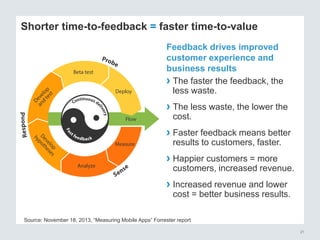
Shorter time-to-feedback = faster time-to-value 
Feedback drives improved 
customer experience and 
business results 
› The faster the feedback, the 
less waste. 
› The less waste, the lower the 
cost. 
› Faster feedback means better 
results to customers, faster. 
› Happier customers = more 
customers, increased revenue. 
› Increased revenue and lower 
cost = better business results. 
Source: November 18, 2013, “Measuring Mobile Apps” Forrester report
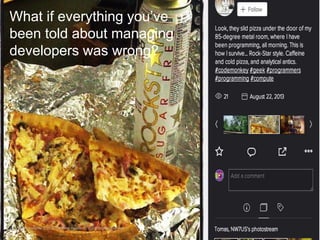
What if everything you’ve 
been told about managing 
developers was wrong? 
22 Entire contents © 2010 Forrester Research, Inc. All rights reserved.
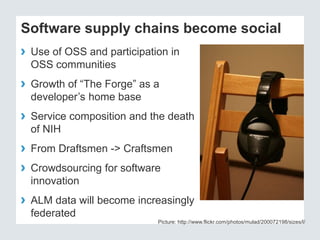
Software supply chains become social 
› Use of OSS and participation in 
OSS communities 
› Growth of “The Forge” as a 
developer’s home base 
› Service composition and the death 
of NIH 
› From Draftsmen -> Craftsmen 
› Crowdsourcing for software 
innovation 
› ALM data will become increasingly 
federated 
Picture: http://www.flickr.com/photos/mulad/200072198/sizes/l/
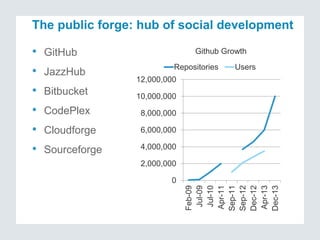
The public forge: hub of social development 
• GitHub 
• JazzHub 
• Bitbucket 
• CodePlex 
• Cloudforge 
• Sourceforge 
Github Growth 
Repositories Users 
12,000,000 
10,000,000 
8,000,000 
6,000,000 
4,000,000 
2,000,000 
0 
Feb-09 
Jul-09 
Jul-10 
Apr-11 
Sep-11 
Sep-12 
Dec-12 
Apr-13 
Dec-13
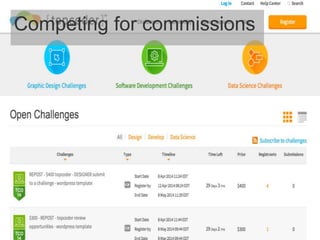
Competing for commissions
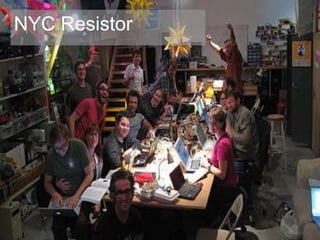
NYC Resistor
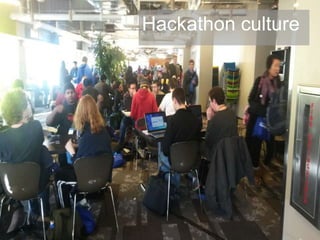
Hackathon culture
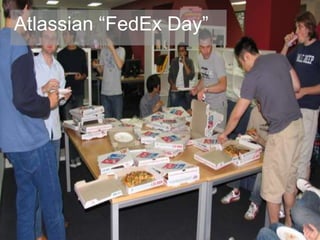
Atlassian “FedEx Day”
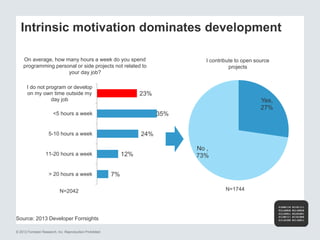
Intrinsic motivation dominates development 
Source: 2013 Developer Forrsights 
© 2012 Forrester Research, Inc. Reproduction Prohibited 
I contribute to open source 
projects 
Yes, 
27% 
No , 
73% 
N=1744 
On average, how many hours a week do you spend 
programming personal or side projects not related to 
your day job? 
N=2042 
23% 
35% 
24% 
12% 
7% 
I do not program or develop 
on my own time outside my 
day job 
<5 hours a week 
5-10 hours a week 
11-20 hours a week 
> 20 hours a week
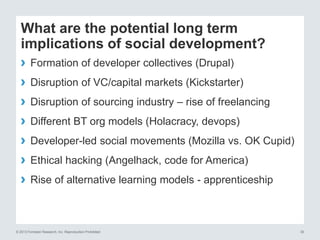
What are the potential long term 
implications of social development? 
› Formation of developer collectives (Drupal) 
› Disruption of VC/capital markets (Kickstarter) 
› Disruption of sourcing industry – rise of freelancing 
› Different BT org models (Holacracy, devops) 
› Developer-led social movements (Mozilla vs. OK Cupid) 
› Ethical hacking (Angelhack, code for America) 
› Rise of alternative learning models - apprenticeship 
© 2013 Forrester Research, Inc. Reproduction Prohibited 30
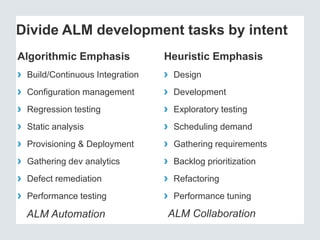
Divide ALM development tasks by intent 
Algorithmic Emphasis 
› Build/Continuous Integration 
› Configuration management 
› Regression testing 
› Static analysis 
› Provisioning & Deployment 
› Gathering dev analytics 
› Defect remediation 
› Performance testing 
Heuristic Emphasis 
› Design 
› Development 
› Exploratory testing 
› Scheduling demand 
› Gathering requirements 
› Backlog prioritization 
› Refactoring 
› Performance tuning 
ALM Automation ALM Collaboration
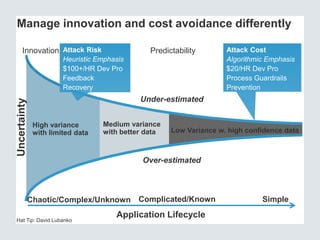
Manage innovation and cost avoidance differently 
Attack Risk 
Heuristic Emphasis 
$100+/HR Dev Pro 
Feedback 
Recovery 
Innovation Predictability Cost avoidance 
High variance 
with limited data 
Under-estimated 
Medium variance 
with better data Low Variance w. high confidence data 
Over-estimated 
Attack Cost 
Algorithmic Emphasis 
$20/HR Dev Pro 
Process Guardrails 
Prevention 
Uncertainty 
Chaotic/Complex/Unknown Complicated/Known Simple 
Application Lifecycle 
Hat Tip: David Lubanko
You need to rethink your approach 
1. ALM that’s fit to purpose 
2. Revitalize architecture 
3. Horizontal, not vertical 
4. Support hi-perf teams 
5. “Done” is DONE 
6. Federate and collaborate 
7. Make it social, fun and rewarding!
Thank you 
Jeffrey Hammond 
+1 978.226.8886 
jhammond@forrester.com

ALM Practices - Modern Applications Development and its impact on ALM

  • 1.
  • 2.
    Modern Applications –Modern ALM Jeffrey S. Hammond, Vice President & Principal Analyst @jhammond August 21, 2014
  • 3.
    The best wayto have a good idea… Source: Flickr (http://profiles.nlm.nih.gov/ps/retrieve/Narrative/MM/p-nid/55/p-visuals/true)
  • 4.
    Software innovation usedto be expensive… “When I built my first company in 1999 it cost $2.5 million in infrastructure just to get started and another $2.5 million in team costs to code, launch, manage, market and sell our software. So it’s not surprising that typical “A rounds” of venture capital were $5 to $10 million.” Mark Suster, GRP Partners …but what if innovation with software now cost 90% less than it used to?
  • 5.
    The way wedevelop is changing… 7 Traits of Modern Applications 1. Omni-channel clients 2. Deployed on elastic infrastructure 3. Aggregate discrete services 4. Use managed APIs 5. Integrate open source software 6. Employ dev-ops techniques 7. Focus on measurable feedback Source: Flickr http://upload.wikimedia.org/wikipedia/commons/6/65/HP_garage_front.JPG)
  • 6.
    Modern applications arecomplex © 2013 Forrester Research, Inc. Reproduction Prohibited 6
  • 7.
    Context Is TheKey To Modern Application © 2014 Forrester Research, Inc. Reproduction Prohibited
  • 8.
    We need toprioritize and modernize the architectures we build
  • 9.
    Building Modern Applicationsis hard! Are you Agile enough? Do you collect (and incorporate) rapid feedback? Can you design useful, usable, desirable experiences? Does your infrastructure evolve? Can you build high quality, multichannel, 5 star apps? Source: Flickr (http://www.flickr.com/photos/kaz25/2444344463/sizes/o/in/photostream//)
  • 10.
    Modern Applications shiftALM focus Systems of Engagement Time to Feedback Time to Certainty Time to Safety Systems of Automation Systems of Record Lifecycle Focus
  • 11.
    Adapting Agile principles › Use personas to drive insight › Create journey maps › Wireframes and prototypes build backlog › Feedback not requirements documents › Kanban boards to manage atomic demand › Analytics built into applications
  • 12.
    A Multi-channel journeymap Wow Enjoyable Functional Neutral Missed It Frustrating Awareness Consideration Research Purchase Engagement 1 2 3 4 5 6 7 8 9 10 Describe each step in the journey, the customer’s needs and perceptions 11 Identify customer and stages of journey Indicate Indicate significant primary (and secondary ) devices for each step steps Persona: James
  • 13.
    Modern applications arecomplex systems Complex Unknowable Probe, sense, respond Complicated Knowable Sense, analyze, respond Chaos Turbulent and unconnected Act, sense, respond Simple Known Sense, categorize, respond Disorder Feedback Established Practices Using the Cynefin framework Hat Tip: Simon Bennett
  • 14.
    We don’t howto make Modern Applications Complex Unknowable Complicated Knowable Chaos Turbulent and unconnected Simple Known Disorder Feedback Established Practices Systems of Engagement Systems of Operation Systems of Record
  • 15.
    Modern applications evolve Amazon deployment stats (May -2012) › Mean time between deployments – 11.6 seconds › Max # deployment/hour – 1079 › Mean # of hosts simultaneously receiving a deployment – 10K › Max # of hosts simultaneously receiving a deployment – 30K Source: O’Reilly (http://assets.en.oreilly.com/1/event/60/Velocity%20Culture%20Presentation.pdf) Pictures: http://www.flickr.com/photos/blueridgekitties/4423381216/sizes/l/
  • 16.
    A typical mobileapp release schedule Features + Defect fixes V 1.0 (MVP) V 2.1 V 2.0 V 1.2.2 V 1.2.1 V 1.2 Regression + Emergency Patch New OS version released Regular Internal Sprint Cycle + Beta Testing (2 weeks) Jan Feb Mar Apr May Jun Jul Aug Sep Oct Nov Dec
  • 17.
    A move towarddifferent ALM processes › Fewer branches in SCM – evolve toward DVCS › Developers test › CI becomes decentralized, more atomic, and critical › You must run and consume beta › Mocks and mocking tools help manage multi layer complexity
  • 18.
    Running “experiments” ›Requirements are testable hypotheses › Multivariate testing with traffic routing › Services are architected for continuous deployment (e.g. feature flags, hot patching) › Releases become more “organic” › Development moves from an engineering process model to a scientific process model © 2013 Forrester Research, Inc. Reproduction Prohibited 18
  • 19.
    How do youtest? In production! › Test like you deploy – the last mile is beyond your control › Issues are hard to replicate in isolation › Big data requires storage › You need to harden your services › Delivered via a new generation of testing tools Pictures: http://www.flickr.com/photos/dyanna/3202542828/sizes/l/ Not Quite A Simian Army
  • 20.
    Continuous Delivery CapabilityIs Key Level Focus Characteristics Results 5 Hypothesis-driven delivery Requirements include testable metrics Frequent use of A/B testing Services designed for CD DBMS changed decoupled from system changes Delivery enables business innovation 4 Release on demand Teams organized around services Deployment pipeline rejects bad changes Work delivered in small batches Comprehensive test + release automation Service always in a releasable state Capability >= Need 3 Regular releases w/ milestones CI and trunk-based development Automating provisioning and testing “Done” = tested and deployed Regular release cadence Capability < Need 2 Time-boxed releases Clear product ownership Change management controls <1 mo. cycles Some testing, release automation Planned releases Capability < Need 1 Heroic individuals Manual testing Integration explosion Manual provisioning Ad-hoc releases http://bit.ly/10hUmK3
  • 21.
    21 Shorter time-to-feedback= faster time-to-value Feedback drives improved customer experience and business results › The faster the feedback, the less waste. › The less waste, the lower the cost. › Faster feedback means better results to customers, faster. › Happier customers = more customers, increased revenue. › Increased revenue and lower cost = better business results. Source: November 18, 2013, “Measuring Mobile Apps” Forrester report
  • 22.
    What if everythingyou’ve been told about managing developers was wrong? 22 Entire contents © 2010 Forrester Research, Inc. All rights reserved.
  • 23.
    Software supply chainsbecome social › Use of OSS and participation in OSS communities › Growth of “The Forge” as a developer’s home base › Service composition and the death of NIH › From Draftsmen -> Craftsmen › Crowdsourcing for software innovation › ALM data will become increasingly federated Picture: http://www.flickr.com/photos/mulad/200072198/sizes/l/
  • 24.
    The public forge:hub of social development • GitHub • JazzHub • Bitbucket • CodePlex • Cloudforge • Sourceforge Github Growth Repositories Users 12,000,000 10,000,000 8,000,000 6,000,000 4,000,000 2,000,000 0 Feb-09 Jul-09 Jul-10 Apr-11 Sep-11 Sep-12 Dec-12 Apr-13 Dec-13
  • 25.
  • 26.
  • 27.
  • 28.
  • 29.
    Intrinsic motivation dominatesdevelopment Source: 2013 Developer Forrsights © 2012 Forrester Research, Inc. Reproduction Prohibited I contribute to open source projects Yes, 27% No , 73% N=1744 On average, how many hours a week do you spend programming personal or side projects not related to your day job? N=2042 23% 35% 24% 12% 7% I do not program or develop on my own time outside my day job <5 hours a week 5-10 hours a week 11-20 hours a week > 20 hours a week
  • 30.
    What are thepotential long term implications of social development? › Formation of developer collectives (Drupal) › Disruption of VC/capital markets (Kickstarter) › Disruption of sourcing industry – rise of freelancing › Different BT org models (Holacracy, devops) › Developer-led social movements (Mozilla vs. OK Cupid) › Ethical hacking (Angelhack, code for America) › Rise of alternative learning models - apprenticeship © 2013 Forrester Research, Inc. Reproduction Prohibited 30
  • 31.
    Divide ALM developmenttasks by intent Algorithmic Emphasis › Build/Continuous Integration › Configuration management › Regression testing › Static analysis › Provisioning & Deployment › Gathering dev analytics › Defect remediation › Performance testing Heuristic Emphasis › Design › Development › Exploratory testing › Scheduling demand › Gathering requirements › Backlog prioritization › Refactoring › Performance tuning ALM Automation ALM Collaboration
  • 32.
    Manage innovation andcost avoidance differently Attack Risk Heuristic Emphasis $100+/HR Dev Pro Feedback Recovery Innovation Predictability Cost avoidance High variance with limited data Under-estimated Medium variance with better data Low Variance w. high confidence data Over-estimated Attack Cost Algorithmic Emphasis $20/HR Dev Pro Process Guardrails Prevention Uncertainty Chaotic/Complex/Unknown Complicated/Known Simple Application Lifecycle Hat Tip: David Lubanko
  • 33.
    You need torethink your approach 1. ALM that’s fit to purpose 2. Revitalize architecture 3. Horizontal, not vertical 4. Support hi-perf teams 5. “Done” is DONE 6. Federate and collaborate 7. Make it social, fun and rewarding!
  • 34.
    Thank you JeffreyHammond +1 978.226.8886 jhammond@forrester.com

Editor's Notes

  • #27 http://en.wikipedia.org/wiki/NYC_Resistor
  • #29 http://svenpet.com/2011/12/19/motivation-fedex-days/
  • #32 Mike
  • #33 Jeffrey IT Governance Consists of Three Types of Behavior: Type 1 - Development based decisions- High variance with limited data- Decisions on activities designed to gather data and reduce risk. Decisions are made at known checkpoints and are examinations of the value and effort assumptions underlying the project. Venture capitalists and strategic planning occupy this space. This is typically at the start of a project, before it ships before revenue is known. Type 2 - High level process based decisions- Systems engineering type of decisions, Lower variance with better data, processes in place, examples include Supply Chain management, Customer Relationship Management- These are discrete processes with dynamic flexibility required Type 3 - Transactional behavior- typical example is an assembly line. Discrete activities that can be estimated to high degree of accuracy, Examples include IC Manufacturing