Introduction
Response to Sea Level Rise
• Long, slow process
Good news – time to respond and plan
Bad news – humans tend to respond to
threats that are immediate
Daniel Gilbert – Harvard Professor of Psychology
Resilience:
The ability to plan for, withstand, and recover
from severe events – without suffering permanent
loss of functions, devastating damage, reduced
productivity or diminished quality of life.
MITIGATION VS. ADAPTATION
‣ Mitigation:
‣ Adaptation:
Developing ways to protect
people and places by
reducing their vulnerability to
climate impacts.
Attempts to slow the process
of global climate change,
usually by lowering the level
of greenhouse gases in the
atmosphere.
GET AHEAD OF THE
CURVE
‣ How can we reduce risks to
people, property and
nature?
‣ How can we help people
and the estuary adapt to
changing conditions?
“Manage the unavoidable, and
avoid the unmanageable”
- Rip Rapson
Mitigation
Transportation
Hybrid/Electric Vehicles
Bicycling
Public Transportation
Mitigation
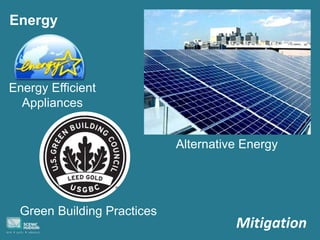
Energy
Alternative Energy
Energy Efficient
Appliances
Green Building Practices
Mitigation
Agriculture and Forests
Stopping DeforestationOrganic Farming
Buy Local
Mitigation
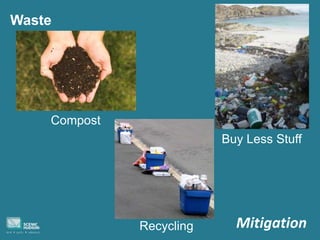
Waste
Recycling
Compost
Buy Less Stuff
Adaptation
Keep floodwaters out of
contact of structures
Reduce the impact of
contact with floodwaters and
decrease the recovery effort
after flooding.
Moving structures to avoid
contact with floodwater.
VillageofPiermont
Adaptation
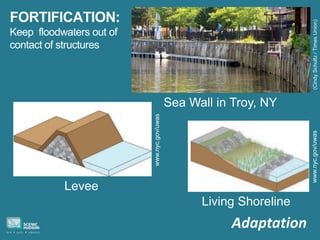
FORTIFICATION:
Keep floodwaters out of
contact of structures
(CindySchultz/TimesUnion)
Sea Wall in Troy, NY
Levee
Living Shoreline
www.nyc.gov/uwas
www.nyc.gov/uwas
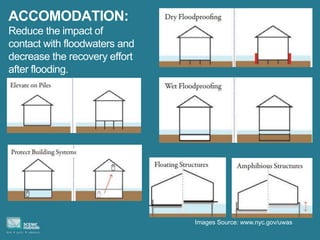
ACCOMODATION:
Reduce the impact of
contact with floodwaters and
decrease the recovery effort
after flooding.
Images Source: www.nyc.gov/uwas
Adaptation
RELOCATION:
Moving structures to avoid
contact with floodwater.
http://www.nyc.gov/uwas
5,000 years ago Today
Future
wetland migration potential where
there is vacant land
complete wetland loss where
shoreline is hardened
Adaptation
Thinking About Habitats
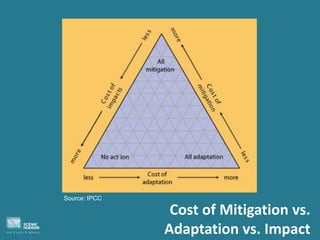
Cost of Mitigation vs.
Adaptation vs. Impact
Source: IPCC
Case Study: Kingston, NY
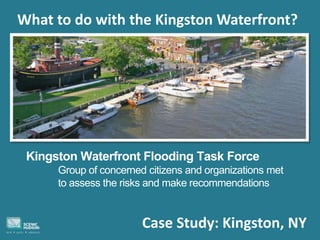
What to do with the Kingston Waterfront?
Kingston Waterfront Flooding Task Force
Group of concerned citizens and organizations met
to assess the risks and make recommendations
Case Study: Kingston, NY
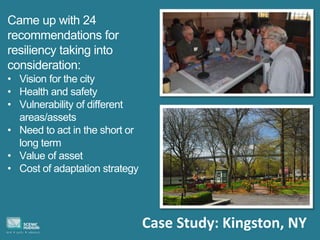
Came up with 24
recommendations for
resiliency taking into
consideration:
• Vision for the city
• Health and safety
• Vulnerability of different
areas/assets
• Need to act in the short or
long term
• Value of asset
• Cost of adaptation strategy
Case Study: Kingston, NY
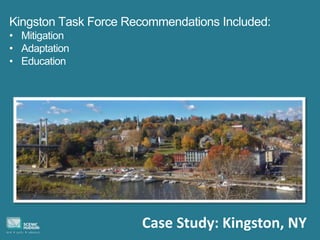
Kingston Task Force Recommendations Included:
• Mitigation
• Adaptation
• Education

What Can We Do

Editor's Notes

  • #3 As Wayne Gretzky said, you have to look towards where the puck is moving. We are going to now look forward to the future and what we can do about climate change.
  • #4 Gilbert Human brain responds to threats that are: immediate, emotional, social
  • #6 Two main approaches to dealing with climate change. Mitigation and adaptation.
  • #12 Actions or steps taken to minimize impacts from stresses, extreme events, or changing conditions. Three main ways of adapting communities: Fortification, accommodation and relocation.
  • #15 Although relocation might seem the most straightforward, is can be socially and economically complex.
  • #16 Different adaptation strategies will have different impacts on habitats along the shoreline.
  • #17 When communities are making decisions about how they are going to proceed to prepare for climate change, they need to take into account the costs of investing in adaptation vs. mitigation vs. the cost of not acting at all.
  • #18 Communities are taking these risks seriously and many towns in the Hudson Valley have developed task forces to address the threat of sea level rise and make recommendations to city planners. The city of Kingston has a bustling waterfront with many businesses and municipal buildings.
  • #20 Mitigation included implementing Kingston’s Climate Action Plan which would reduce the city’s greenhouse gas emissions through green infrastructure and architecture. Adaptation included using natural buffers and green shoreline infrastructure to reduce flooding, looking into amphibious or floating structures, wharves, berms and elevated right of ways. They also emphasized the need for education and emergency planning so community members and emergency personnel will be better able to deal with future severe events.