The Hudson River Estuary During and After
Extreme Weather Events
What do recent storms tell us about the river’s resiliency?
Dan Miller
Hudson River Estuary Program
November 19, 2014
How are Big Storms like
Home Runs?
Intense Storms Predicted to Increase in Frequency
Hurricane Irene and Tropical Storm Lee
August 28- September 10, 2011
Irene Lee
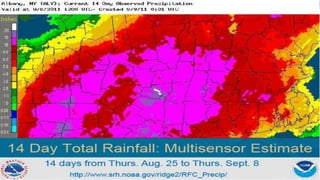
Prelude to Hurricane Irene and Tropical Storm Lee
August 28- September 10, 2011
 Wettest August on record since 1872
 12.24 inches of accumulated rain fall by August 19 (Philadelphia)
Source: NOAA, NWS
Hudson River Estuary
Watershed
•152 miles from NYC to Albany
•13,000 mi2 watershed
•Rock-framed estuary
•Supports numerous resident and
migratory species
•Essential natural and economic resource
Storm Impacts on Hudson River Estuary- Short
Term
 High Flow
 High Tides
 Sediment Input
 Turbidity
Storm Impacts on the Hudson River Estuary- Fish
 Irene and Lee had strong but not
catastrophic effects on fish
populations in the Hudson
 displaced fish populations downriver
 did not bring in strays from the
tributaries
 reduced population sizes of fish in
the shore zone
 reduced apparent growth rates of
fish
Strayer et al. 2014
alewife
Americanshad
blueback
stripedbass
whiteperch
tessellateddarter
killifish
spottail
Displacement,weeks34-38(kilometers)
-150
-100
-50
0
50
100
Fish Populations Were Displaced Downriver
2000-2010
2011
Source: Dave Strayer
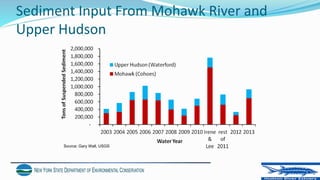
Sediment Input From Mohawk River and
Upper Hudson
Source: Gary Wall, USGS
How much is 1.75 million tons of sediment?
This truck can carry 400 tons…
Sediment Input From Tributaries
- 200,000 400,000 600,000 800,000
Roeliff Jansen
Esopus
Normanskill*
Kinderhook
Rondout
Catskill
Tons of Suspended SedimentSource: Gary Wall, USGS
* Irene only
Total = 1,160,000 tons
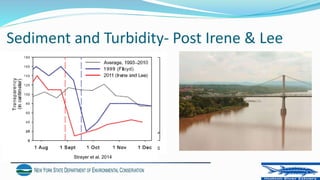
Sediment and Turbidity- Post Irene & Lee
Strayer et al. 2014
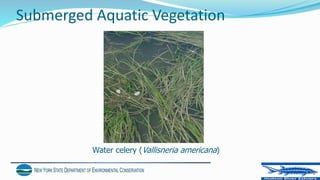
Submerged Aquatic Vegetation
Water celery (Vallisneria americana)
Ecological Functions of SAV: Habitat
More fish food = more fish
SAV Volunteer Monitoring Program Data
Ecosystem Resiliency
An ecosystem’s ability to recover after being stressed.
Has the Hudson Recovered?
• Water Quality
• Benthic Communities
• Fish and Wildlife
• SAV
Restoring Ecosystem
Resilience to HR Estuary
•SAV
•Shallow and Intertidal Habitats
•Shorelines
•Side Channels
Conclusions
 Irene and Lee had acute short-term effects on water quality and fish
communities.
 Long-term recovery still underway
 SAV Recovery
 Restoration efforts can enhance ecosystem resiliency and recovery from
future large storms
 There will be more
Thank You!
Dan Miller
Hudson River Estuary Habitat Restoration Coordinator
Hudson River Estuary Program
daniel.miller@dec.ny.gov
845-889-4745 ext. 110

The Hudson during & after extreme weather events. What do they tell us about the river’s resiliency?

Editor's Notes

  • #17 Work by Strayer and Bain comparing Val beds to no vegetation Where there is more fish food, there is more fish, and high biodiversity of both
  • #18 Impact seen in the 2012 monitoring data Volunteers visited a different number of points each year, blue is percent of points with no SAV Aimed to visit the same points plus a few extra between 2011, 2012 and 2013