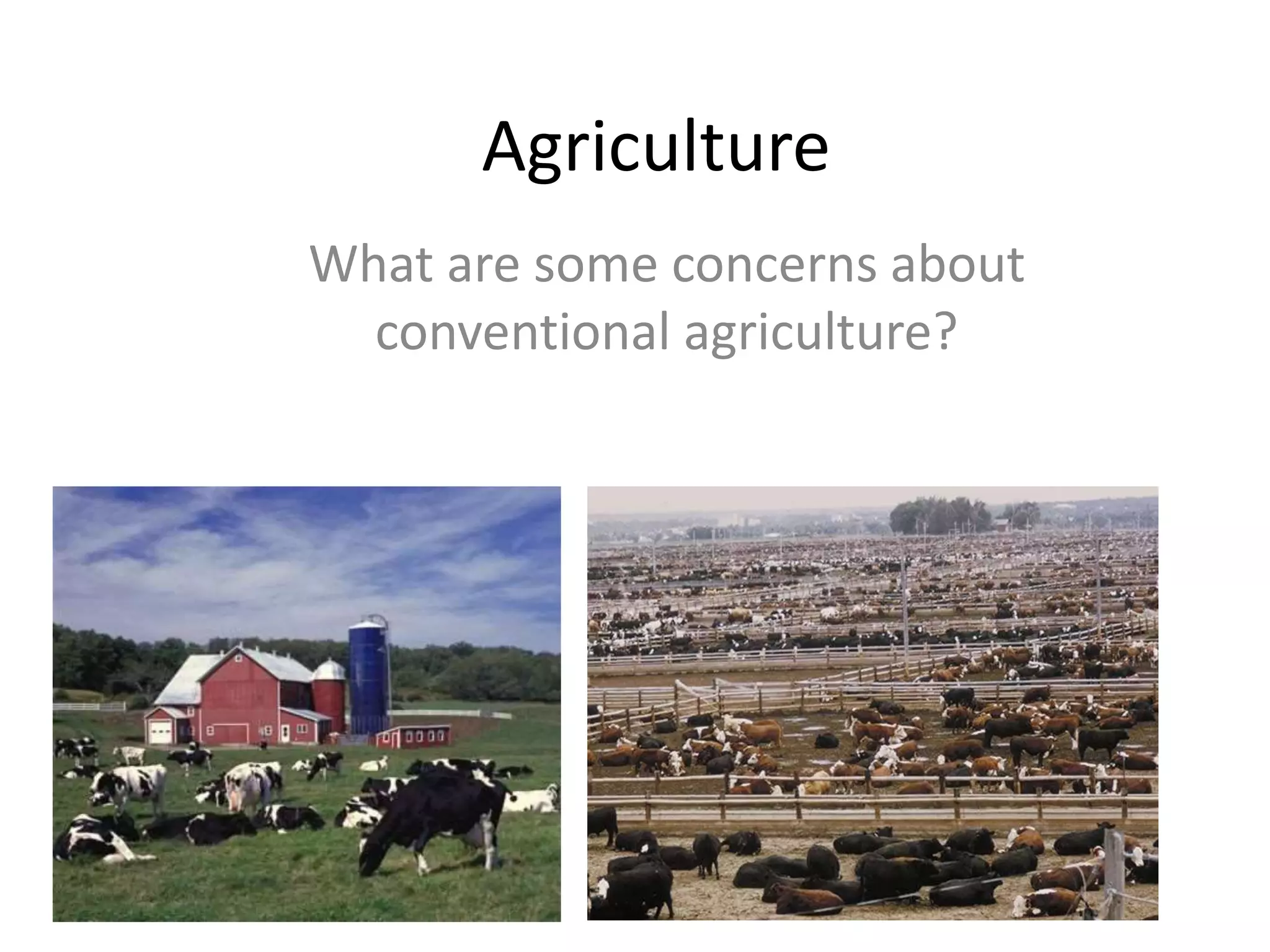
Agriculture
What are some concerns about
conventional agriculture?
Goals:
• To understand some of the major concerns with
conventional agriculture, and why conventional
agriculture began and prospered
• To explore how growing corn and raising meat
affect ecosystems, and how to combat some of
these concerns through agroecology practices
• To consider our future options for growing food for
a planet of 9+ billion
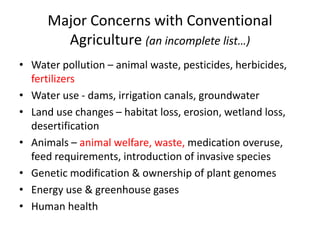
Major Concerns with Conventional
Agriculture (an incomplete list…)
• Water pollution – animal waste, pesticides, herbicides,
fertilizers
• Water use - dams, irrigation canals, groundwater
• Land use changes – habitat loss, erosion, wetland loss,
desertification
• Animals – animal welfare, waste, medication overuse,
feed requirements, introduction of invasive species
• Genetic modification & ownership of plant genomes
• Energy use & greenhouse gases
• Human health
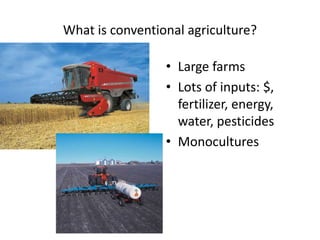
What is conventional agriculture?
• Large farms
• Lots of inputs: $,
fertilizer, energy,
water, pesticides
• Monocultures
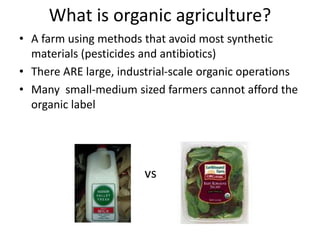
What is organic agriculture?
• A farm using methods that avoid most synthetic
materials (pesticides and antibiotics)
• There ARE large, industrial-scale organic operations
• Many small-medium sized farmers cannot afford the
organic label
vs
What is agro-ecology?
The application of ecology to the design and
management of sustainable agro-ecosystems
Agro-ecology is a whole-systems approach to
agriculture and food systems development – it
incorporates
– Traditional knowledge
– Local food systems experience
– Sustainable agriculture practices
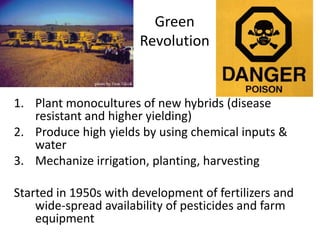
Green
Revolution
1. Plant monocultures of new hybrids (disease
resistant and higher yielding)
2. Produce high yields by using chemical inputs &
water
3. Mechanize irrigation, planting, harvesting
Started in 1950s with development of fertilizers and
wide-spread availability of pesticides and farm
equipment
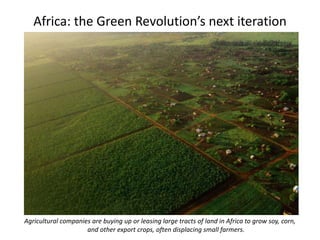
Africa: the Green Revolution’s next iteration
Agricultural companies are buying up or leasing large tracts of land in Africa to grow soy, corn,
and other export crops, often displacing small farmers.
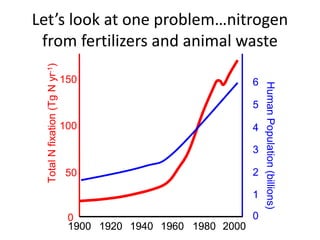
Let’s look at one problem…nitrogen
from fertilizers and animal waste
1900 1960 1980 20001920 1940
50
100
150
200
0
TotalNfixation(TgNyr-1)
4
3
2
1
5
0
6
HumanPopulation(billions)
1900 1960 1980 20001920 19401900 1960 1980 20001920 1940
50
100
150
200
0
TotalNfixation(TgNyr-1)
4
3
2
1
5
0
6
4
3
2
1
5
0
6
HumanPopulation(billions)
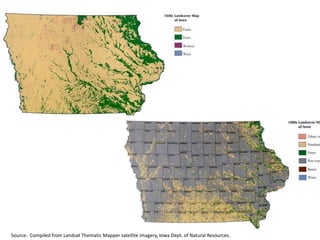
Source: Compiled from Landsat Thematic Mapper satellite imagery, Iowa Dept. of Natural Resources.
Nitrogen…so what?
• Plants and animals
need nitrogen
• But…there can be too
much of a good thing!
• Too much nitrogen
results in:
eutrophication of
aquatic systems
…which leads to…
There is both cultural (human) and
natural eutrophication
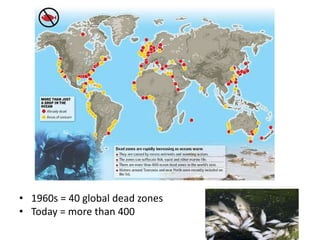
• 1960s = 40 global dead zones
• Today = more than 400
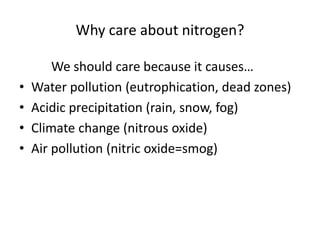
Why care about nitrogen?
We should care because it causes…
• Water pollution (eutrophication, dead zones)
• Acidic precipitation (rain, snow, fog)
• Climate change (nitrous oxide)
• Air pollution (nitric oxide=smog)
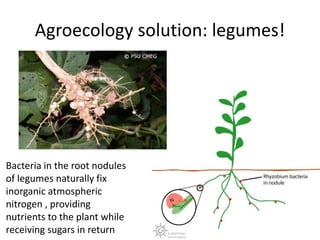
Agroecology solution: legumes!
Bacteria in the root nodules
of legumes naturally fix
inorganic atmospheric
nitrogen , providing
nutrients to the plant while
receiving sugars in return
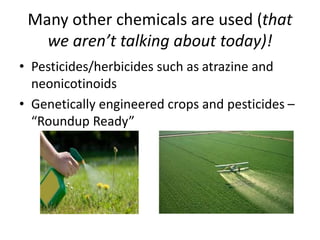
Many other chemicals are used (that
we aren’t talking about today)!
• Pesticides/herbicides such as atrazine and
neonicotinoids
• Genetically engineered crops and pesticides –
“Roundup Ready”
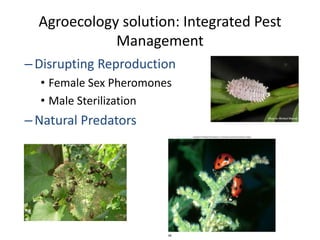
Agroecology solution: Integrated Pest
Management
–Disrupting Reproduction
• Female Sex Pheromones
• Male Sterilization
–Natural Predators
Nitrogen also comes from animal waste…
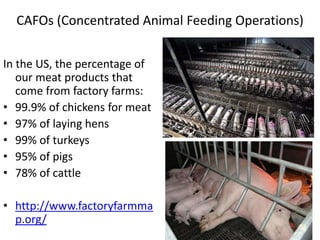
CAFOs (Concentrated Animal Feeding Operations)
In the US, the percentage of
our meat products that
come from factory farms:
• 99.9% of chickens for meat
• 97% of laying hens
• 99% of turkeys
• 95% of pigs
• 78% of cattle
• http://www.factoryfarmma
p.org/
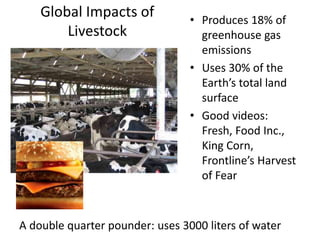
Global Impacts of
Livestock
• Produces 18% of
greenhouse gas
emissions
• Uses 30% of the
Earth’s total land
surface
• Good videos:
Fresh, Food Inc.,
King Corn,
Frontline’s Harvest
of Fear
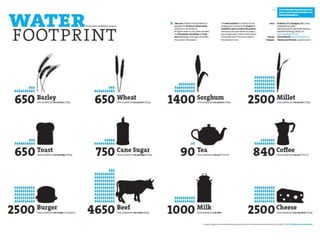
A double quarter pounder: uses 3000 liters of water
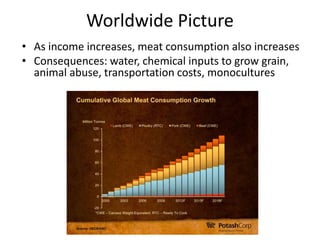
Worldwide Picture
• As income increases, meat consumption also increases
• Consequences: water, chemical inputs to grow grain,
animal abuse, transportation costs, monocultures
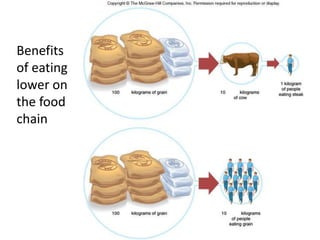
Fig. 8.5
Benefits
of eating
lower on
the food
chain
Agroecology solution
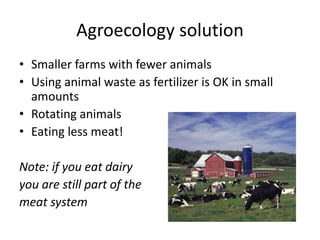
• Smaller farms with fewer animals
• Using animal waste as fertilizer is OK in small
amounts
• Rotating animals
• Eating less meat!
Note: if you eat dairy
you are still part of the
meat system
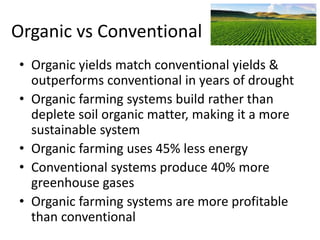
Organic vs Conventional
• Organic yields match conventional yields &
outperforms conventional in years of drought
• Organic farming systems build rather than
deplete soil organic matter, making it a more
sustainable system
• Organic farming uses 45% less energy
• Conventional systems produce 40% more
greenhouse gases
• Organic farming systems are more profitable
than conventional
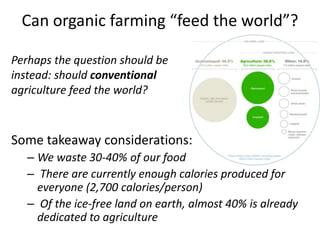
Can organic farming “feed the world”?
Some takeaway considerations:
– We waste 30-40% of our food
– There are currently enough calories produced for
everyone (2,700 calories/person)
– Of the ice-free land on earth, almost 40% is already
dedicated to agriculture
Perhaps the question should be
instead: should conventional
agriculture feed the world?
Solution: Agroecology
Recognize the farm as an ecosystem:
– Grow lots of different crops, use heritage seeds
– Rotate crops & animals
– Implement integrated pest management
– Use legumes or small amounts of animal waste for
fertilizer
– Use wetlands to reduce runoff and eutrophication
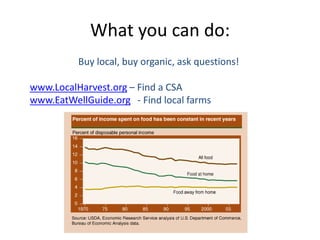
What you can do:
Buy local, buy organic, ask questions!
www.LocalHarvest.org – Find a CSA
www.EatWellGuide.org - Find local farms

Conventional vs organic agriculture: Cornelia Harris, Cary Institute of Ecosystem Studies

  • 1.
    Agriculture What are someconcerns about conventional agriculture?
  • 2.
    Goals: • To understandsome of the major concerns with conventional agriculture, and why conventional agriculture began and prospered • To explore how growing corn and raising meat affect ecosystems, and how to combat some of these concerns through agroecology practices • To consider our future options for growing food for a planet of 9+ billion
  • 3.
    Major Concerns withConventional Agriculture (an incomplete list…) • Water pollution – animal waste, pesticides, herbicides, fertilizers • Water use - dams, irrigation canals, groundwater • Land use changes – habitat loss, erosion, wetland loss, desertification • Animals – animal welfare, waste, medication overuse, feed requirements, introduction of invasive species • Genetic modification & ownership of plant genomes • Energy use & greenhouse gases • Human health
  • 4.
    What is conventionalagriculture? • Large farms • Lots of inputs: $, fertilizer, energy, water, pesticides • Monocultures
  • 5.
    What is organicagriculture? • A farm using methods that avoid most synthetic materials (pesticides and antibiotics) • There ARE large, industrial-scale organic operations • Many small-medium sized farmers cannot afford the organic label vs
  • 6.
    What is agro-ecology? Theapplication of ecology to the design and management of sustainable agro-ecosystems Agro-ecology is a whole-systems approach to agriculture and food systems development – it incorporates – Traditional knowledge – Local food systems experience – Sustainable agriculture practices
  • 7.
    Green Revolution 1. Plant monoculturesof new hybrids (disease resistant and higher yielding) 2. Produce high yields by using chemical inputs & water 3. Mechanize irrigation, planting, harvesting Started in 1950s with development of fertilizers and wide-spread availability of pesticides and farm equipment
  • 8.
    Africa: the GreenRevolution’s next iteration Agricultural companies are buying up or leasing large tracts of land in Africa to grow soy, corn, and other export crops, often displacing small farmers.
  • 9.
    Let’s look atone problem…nitrogen from fertilizers and animal waste 1900 1960 1980 20001920 1940 50 100 150 200 0 TotalNfixation(TgNyr-1) 4 3 2 1 5 0 6 HumanPopulation(billions) 1900 1960 1980 20001920 19401900 1960 1980 20001920 1940 50 100 150 200 0 TotalNfixation(TgNyr-1) 4 3 2 1 5 0 6 4 3 2 1 5 0 6 HumanPopulation(billions)
  • 10.
    Source: Compiled fromLandsat Thematic Mapper satellite imagery, Iowa Dept. of Natural Resources.
  • 11.
    Nitrogen…so what? • Plantsand animals need nitrogen • But…there can be too much of a good thing! • Too much nitrogen results in: eutrophication of aquatic systems …which leads to… There is both cultural (human) and natural eutrophication
  • 12.
    • 1960s =40 global dead zones • Today = more than 400
  • 13.
    Why care aboutnitrogen? We should care because it causes… • Water pollution (eutrophication, dead zones) • Acidic precipitation (rain, snow, fog) • Climate change (nitrous oxide) • Air pollution (nitric oxide=smog)
  • 14.
    Agroecology solution: legumes! Bacteriain the root nodules of legumes naturally fix inorganic atmospheric nitrogen , providing nutrients to the plant while receiving sugars in return
  • 15.
    Many other chemicalsare used (that we aren’t talking about today)! • Pesticides/herbicides such as atrazine and neonicotinoids • Genetically engineered crops and pesticides – “Roundup Ready”
  • 16.
    Agroecology solution: IntegratedPest Management –Disrupting Reproduction • Female Sex Pheromones • Male Sterilization –Natural Predators
  • 17.
    Nitrogen also comesfrom animal waste…
  • 18.
    CAFOs (Concentrated AnimalFeeding Operations) In the US, the percentage of our meat products that come from factory farms: • 99.9% of chickens for meat • 97% of laying hens • 99% of turkeys • 95% of pigs • 78% of cattle • http://www.factoryfarmma p.org/
  • 19.
    Global Impacts of Livestock •Produces 18% of greenhouse gas emissions • Uses 30% of the Earth’s total land surface • Good videos: Fresh, Food Inc., King Corn, Frontline’s Harvest of Fear A double quarter pounder: uses 3000 liters of water
  • 21.
    Worldwide Picture • Asincome increases, meat consumption also increases • Consequences: water, chemical inputs to grow grain, animal abuse, transportation costs, monocultures
  • 22.
  • 23.
    Agroecology solution • Smallerfarms with fewer animals • Using animal waste as fertilizer is OK in small amounts • Rotating animals • Eating less meat! Note: if you eat dairy you are still part of the meat system
  • 24.
    Organic vs Conventional •Organic yields match conventional yields & outperforms conventional in years of drought • Organic farming systems build rather than deplete soil organic matter, making it a more sustainable system • Organic farming uses 45% less energy • Conventional systems produce 40% more greenhouse gases • Organic farming systems are more profitable than conventional
  • 25.
    Can organic farming“feed the world”? Some takeaway considerations: – We waste 30-40% of our food – There are currently enough calories produced for everyone (2,700 calories/person) – Of the ice-free land on earth, almost 40% is already dedicated to agriculture Perhaps the question should be instead: should conventional agriculture feed the world?
  • 26.
    Solution: Agroecology Recognize thefarm as an ecosystem: – Grow lots of different crops, use heritage seeds – Rotate crops & animals – Implement integrated pest management – Use legumes or small amounts of animal waste for fertilizer – Use wetlands to reduce runoff and eutrophication
  • 27.
    What you cando: Buy local, buy organic, ask questions! www.LocalHarvest.org – Find a CSA www.EatWellGuide.org - Find local farms

Editor's Notes

  • #2 Ask participants about their concerns
  • #3 My point-of-view: I am, first and foremost, an ecologist with a definitive soft spot for vertebrate animals. There are many other versions of this kind of a talk!
  • #6 A story: at the screening of Food, Inc., a Stonyfield executive says to the Wal-Mart executive – “Funny, I’ve never been inside a Wal-Mart. I boycott you guys”. Meanwhile, last year Wal-Mart became the top retailer of organic foods in the country, including Stonyfield yogurt products.
  • #7 Fact: large-scale, monocropping, industrial organic exists
  • #15 By 2005 corn yields in the Midwest and China were about the same, but Chinese farmers were using about 525 pounds of nitrogen fertilizer per acre compared with 83 pounds in the Midwest, and farms in northern China generated nearly 23 times the amount of excess nitrogen than those in the Midwest. Meanwhile, farms in western Kenya uses 1/13th what the U.S. farms uses, and corn yields remain paltry. Vitousek et al, Science, 2009
  • #31 Rodale Institute motto: Healthy Soil = Healthy Food = Healthy People
  • #32 About 50% of the world’s food comes from small farms Globally, one in eight people are malnourished (UN; 2012) The United Nations has adopted a goal of halving the numbers of undernourished people by 2015; as of 2009, the number of undernourished people has actually increased instead One in six Americans experiences food insecurity (one in four in Poughkeepsie!)
  • #33 Emphasis on adapting farm design and practice to the ecological processes already occurring in the fields and landscape