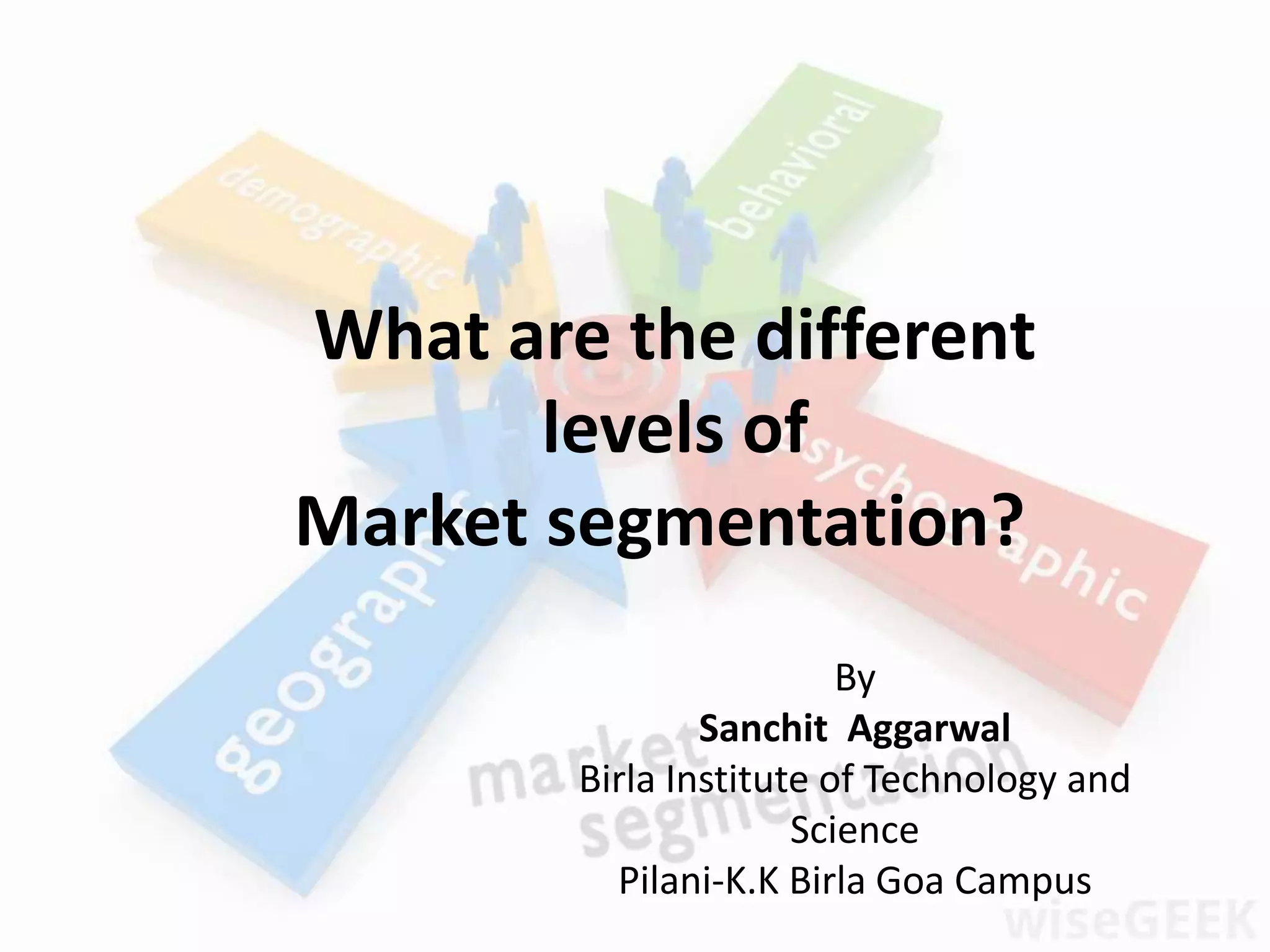
What are the different
levels of
Market segmentation?
By
Sanchit Aggarwal
Birla Institute of Technology and
Science
Pilani-K.K Birla Goa Campus
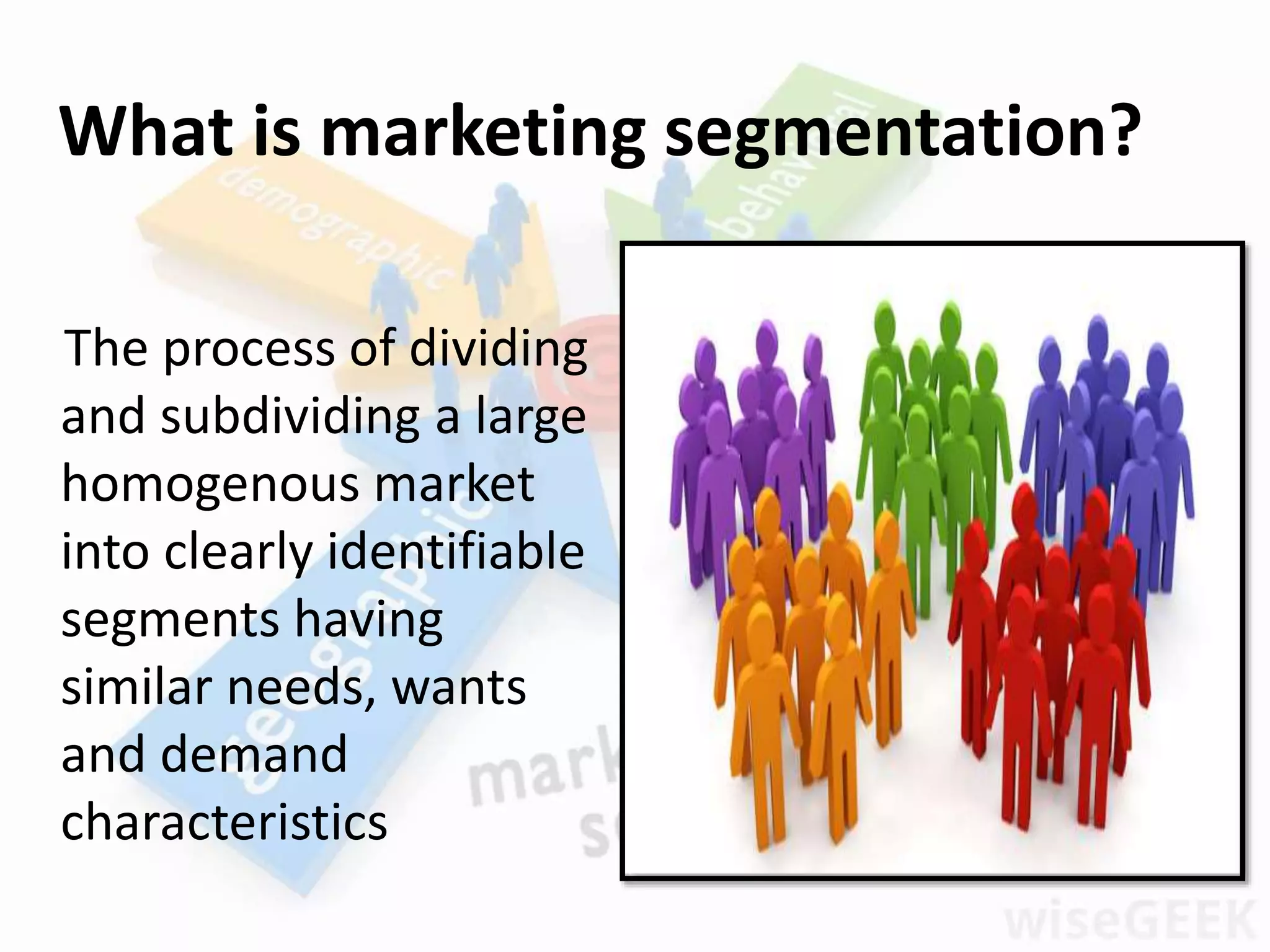
The process of dividing
and subdividing a large
homogenous market
into clearly identifiable
segments having
similar needs, wants
and demand
characteristics
What is marketing segmentation?
Why segmentation?
• To develop marketing activities
• Increase marketing effectiveness
• Generate greater customer satisfaction
• To identify strategic opportunities and niches
• Allocation of marketing budgets
• Adjustment of product to the market need
Country State/Province
City
Rural and urban
areas
Geographic
Beer is segmented across countries and
regions(through regional brewers and
brands)
And so is cheese !!
Age and life stage Gender
Income and
education
Socio-economic
classification
Demographic
AGE
Targeted at youth
Targeted at
studentsTargeted at kids
Targeted at elders
People have different concerns at
different LIFE STAGES
EDUCATION
RETIREMENT
PLANNING
HEALTH
INSURANCE
Gender
Men and women have different
needs
Income
Companies like
Rolex,
omega, and TAG
Heuer are
increasingly
advertising in
India
Low unit price
through
appropriate
packaging has
made targeting low
income audience
possible
One of the
ways is
“Sachet
marketing”
Socio-economic classification
• Developed under the initiative of the
Marketing Research Society of India(MRSI) to
classify the urban and rural household
• Urban system-the education level and the
occupation of the head of the household as
variables
• Rural system-uses education level of the head
and the type of dwelling that the household
lives in as variables
Consumption patterns across
different classes
A,B
C,R1
D,E1,R2
E2,R3
A1
Psychographic
• VALS system of
classification provides
a dynamic
framework of values
and lifestyles; which
helps to explain why
people act as they do
as social groups and
as consumers.
• Dimensions of VALS
system are consumer
motivation and
resources
Experiencers
Young, enthusiastic
impulsive people
who seek variety and
excitement
They spend a
comparatively high
proportion of their
income on fashion,
entertainment, and
socializing
Thinkers
• Mature, satisfied
and reflective
people motivated
by ideals.
• They seek
durability,
functionality and
value in a product.
Achievers
They’re
successful, goal
oriented people
who focus on
career and family.
They favour
premium products
that demonstrate
success to their
peers.
Believers
They’re
conservative,
conventional, and
traditional people
with concrete
beliefs.
They prefer
familiar, Indian
brands and are
loyal to established
brands.
Strivers
They are trendy
fun loving people
who are resource
constrained.
They prefer stylish
products that
emulate the
purchases of
those with great
material wealth.
Makers
Practical, down
to earth, self
sufficient people
Seek Indian
made products
with a practical
or functional
purpose
Survivors
Elderly,
passive
people
concerned
about change
and LOYAL to
their favourite
brands.
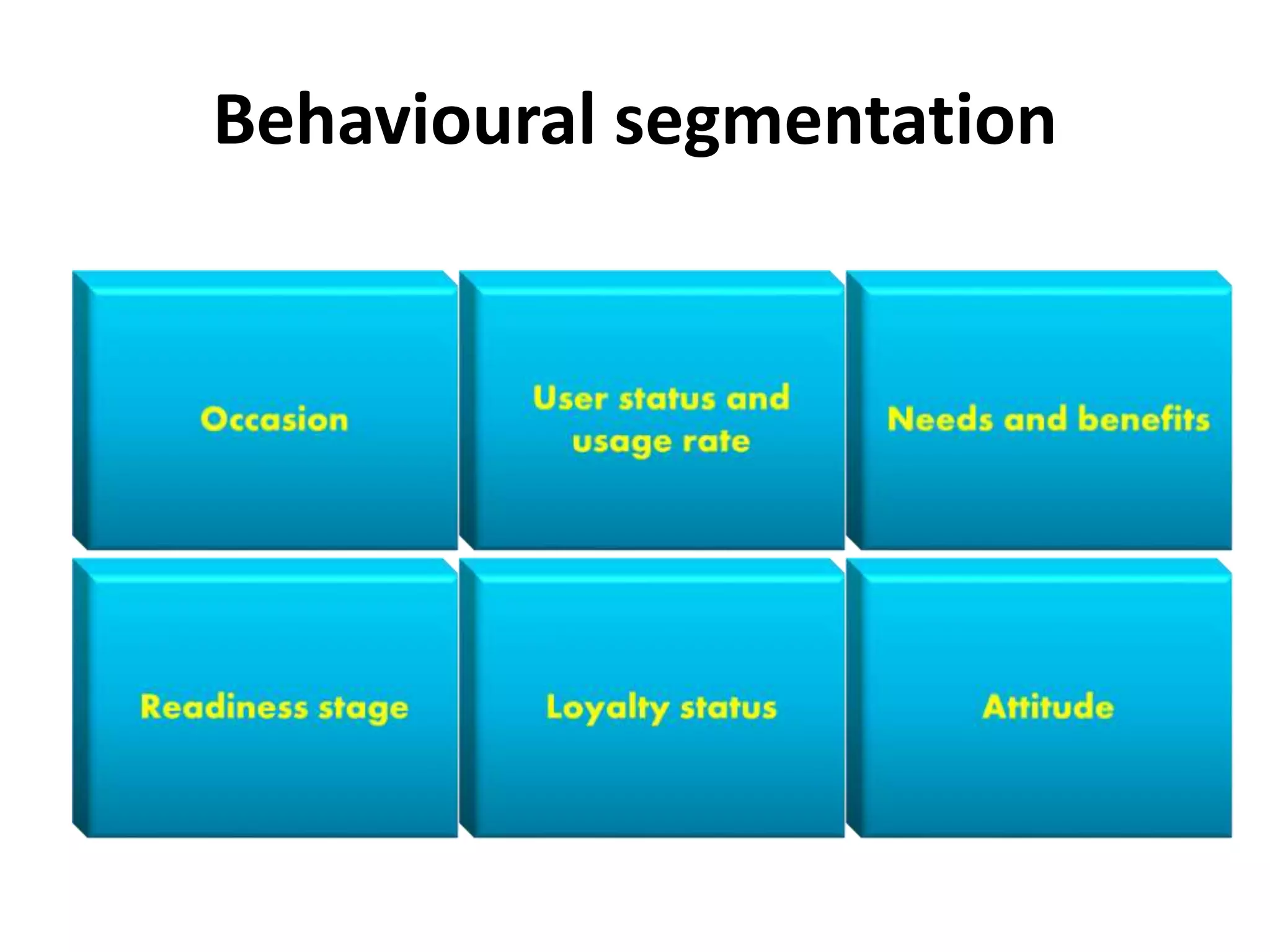
Behavioural segmentation
Occasion
Occasions marked at time
of day
User status
The key is to
attract potential
users and even
non-users.
Airlines keep
expanding their
network to
attract new
consumers
Usage rate
Customers can
be classified
and targeted
as Heavy ,
Medium and
Light users
Attitude
Political campaign are targeted
according to the attitudes of people
towards their political party.
Benefits sought
A drink can offer different benefits
Brand loyalty
Loyalty cards help generate brand loyalty
What are the different levels of segmentation?

What are the different levels of segmentation?