Marketing strategies
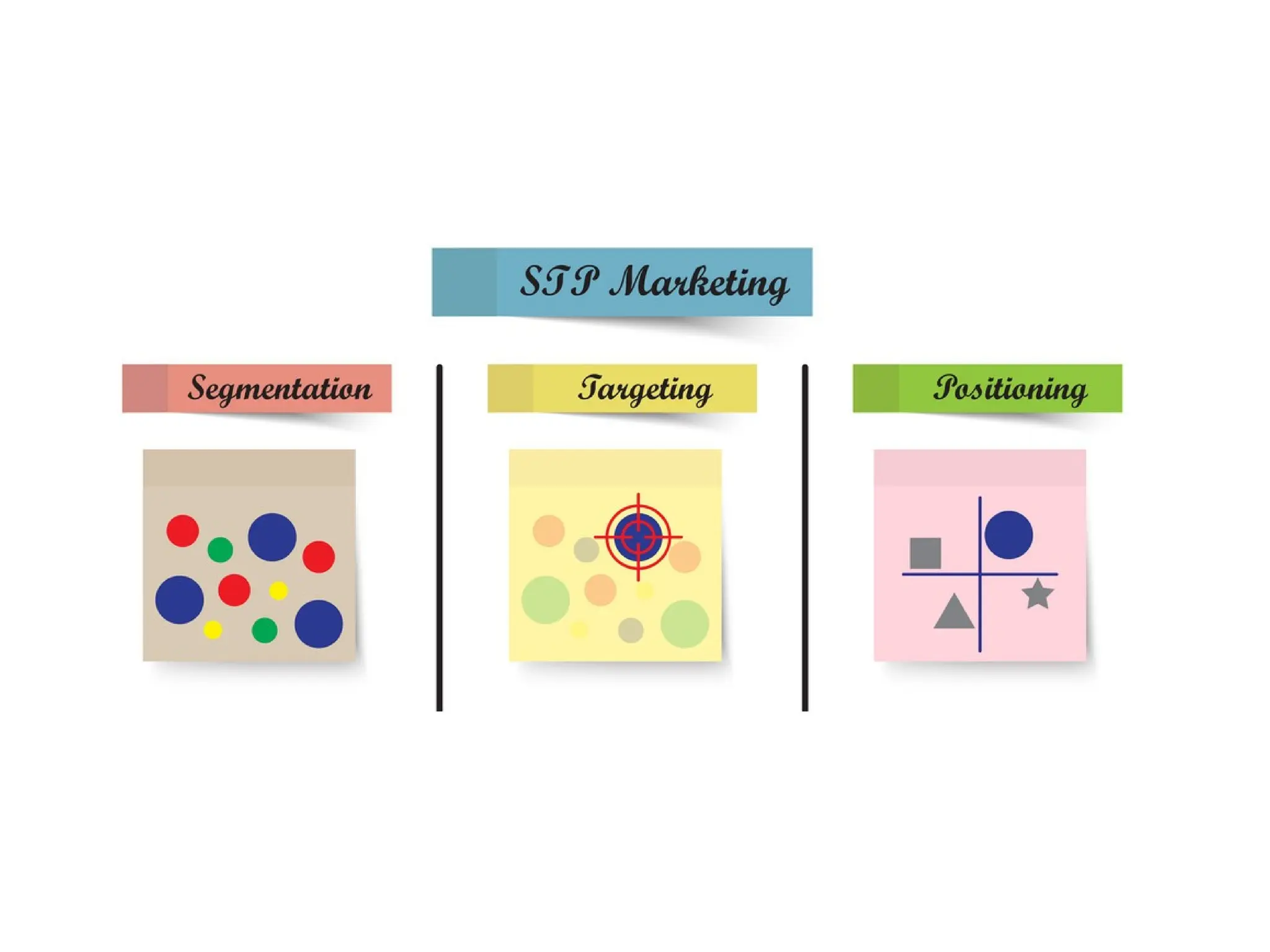
Familiar strategic approach in Marketing is
STP
• Segmentation
• Targeting and
• Positioning
STP
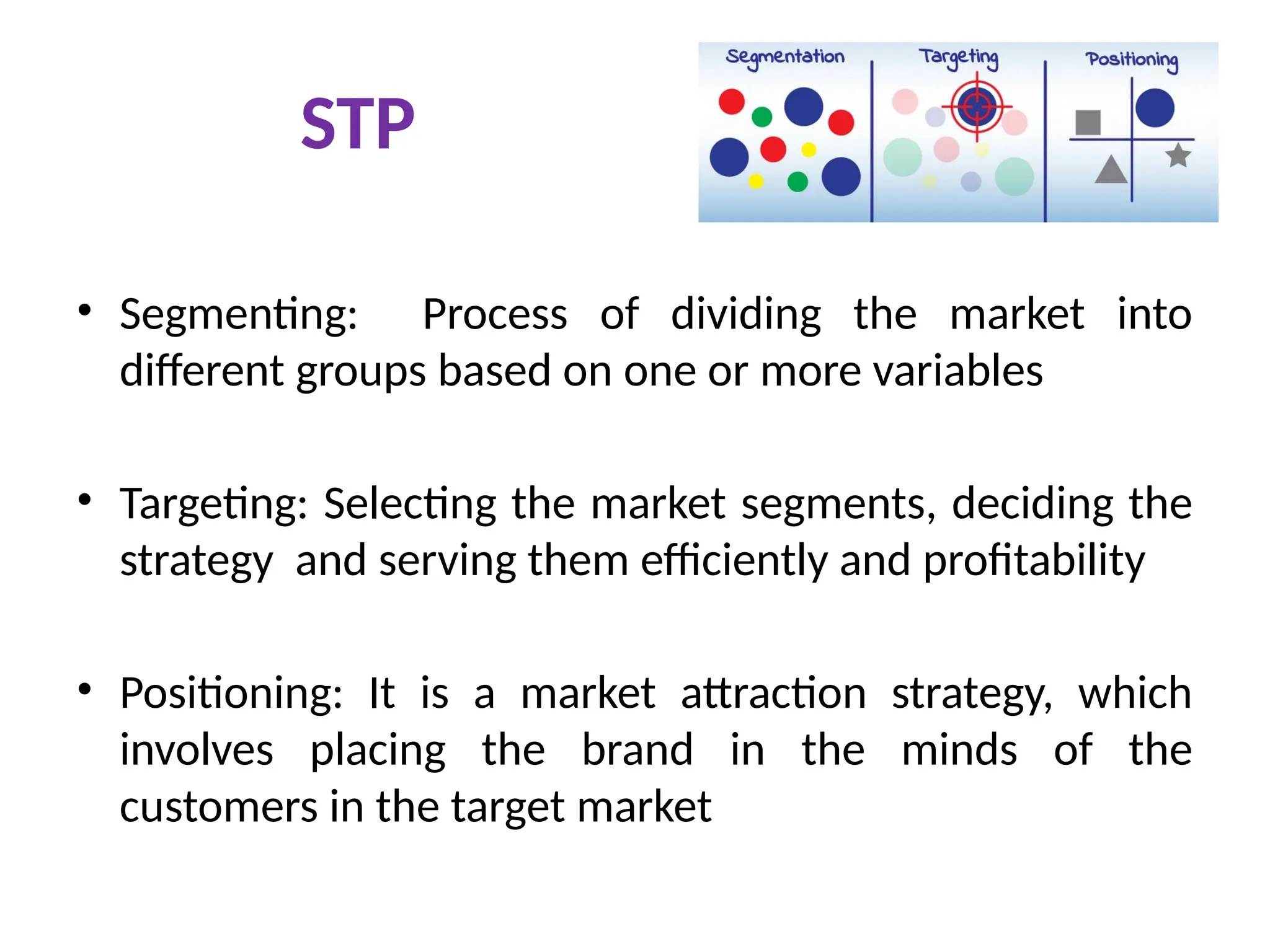
• Segmenting: Process of dividing the market into
different groups based on one or more variables
• Targeting: Selecting the market segments, deciding the
strategy and serving them efficiently and profitability
• Positioning: It is a market attraction strategy, which
involves placing the brand in the minds of the
customers in the target market
Segmentation
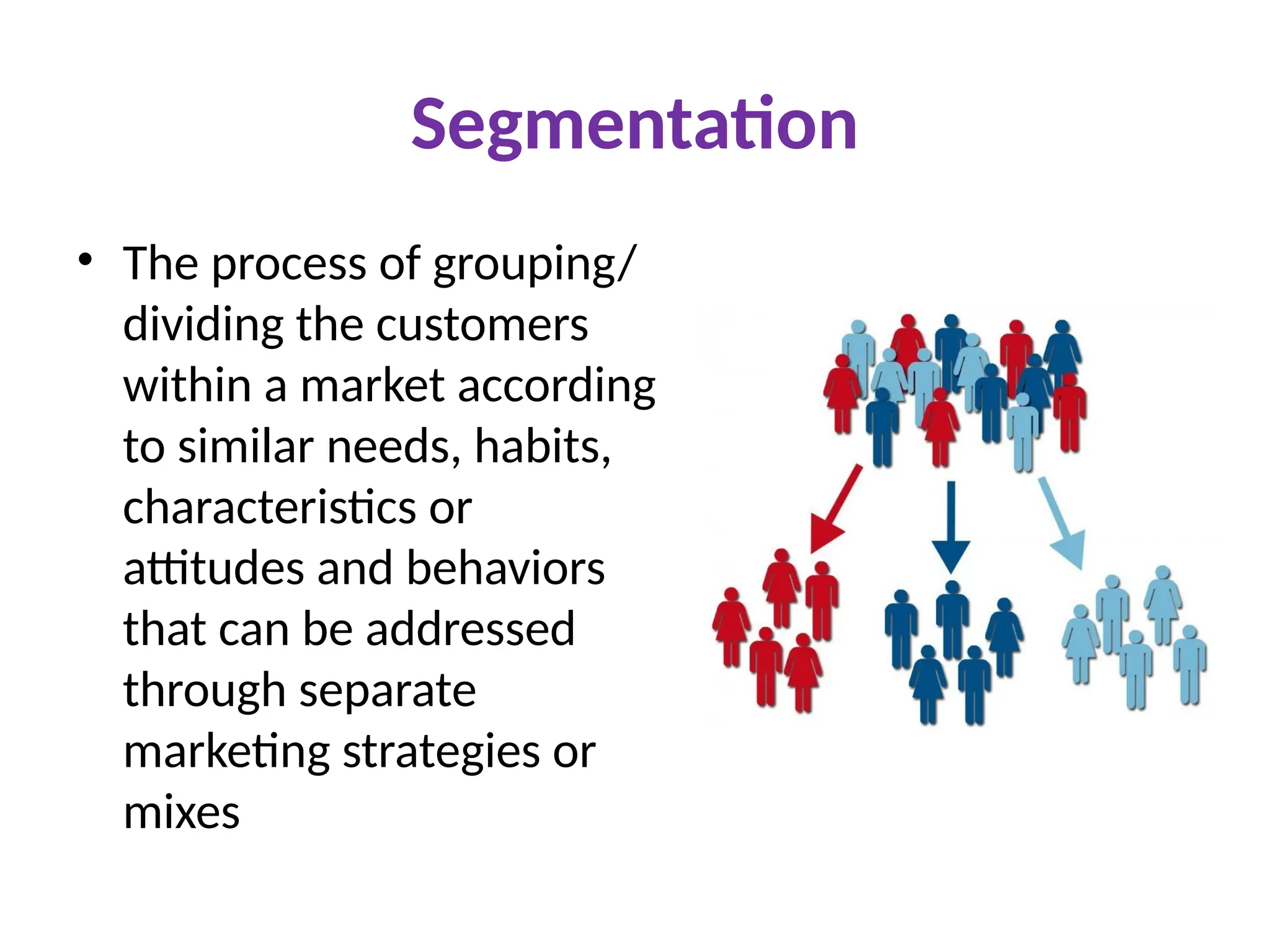
• The process of grouping/
dividing the customers
within a market according
to similar needs, habits,
characteristics or
attitudes and behaviors
that can be addressed
through separate
marketing strategies or
mixes
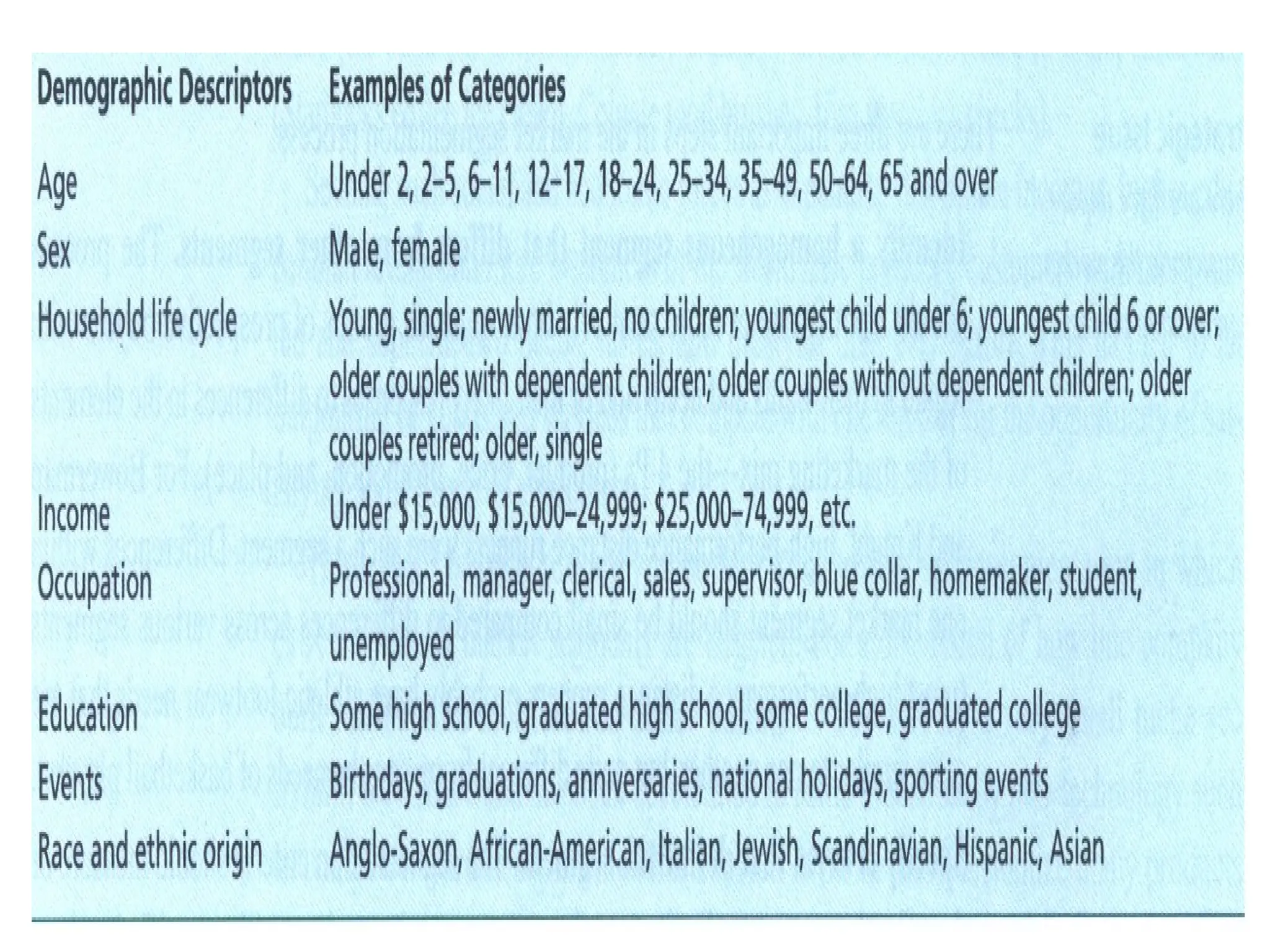
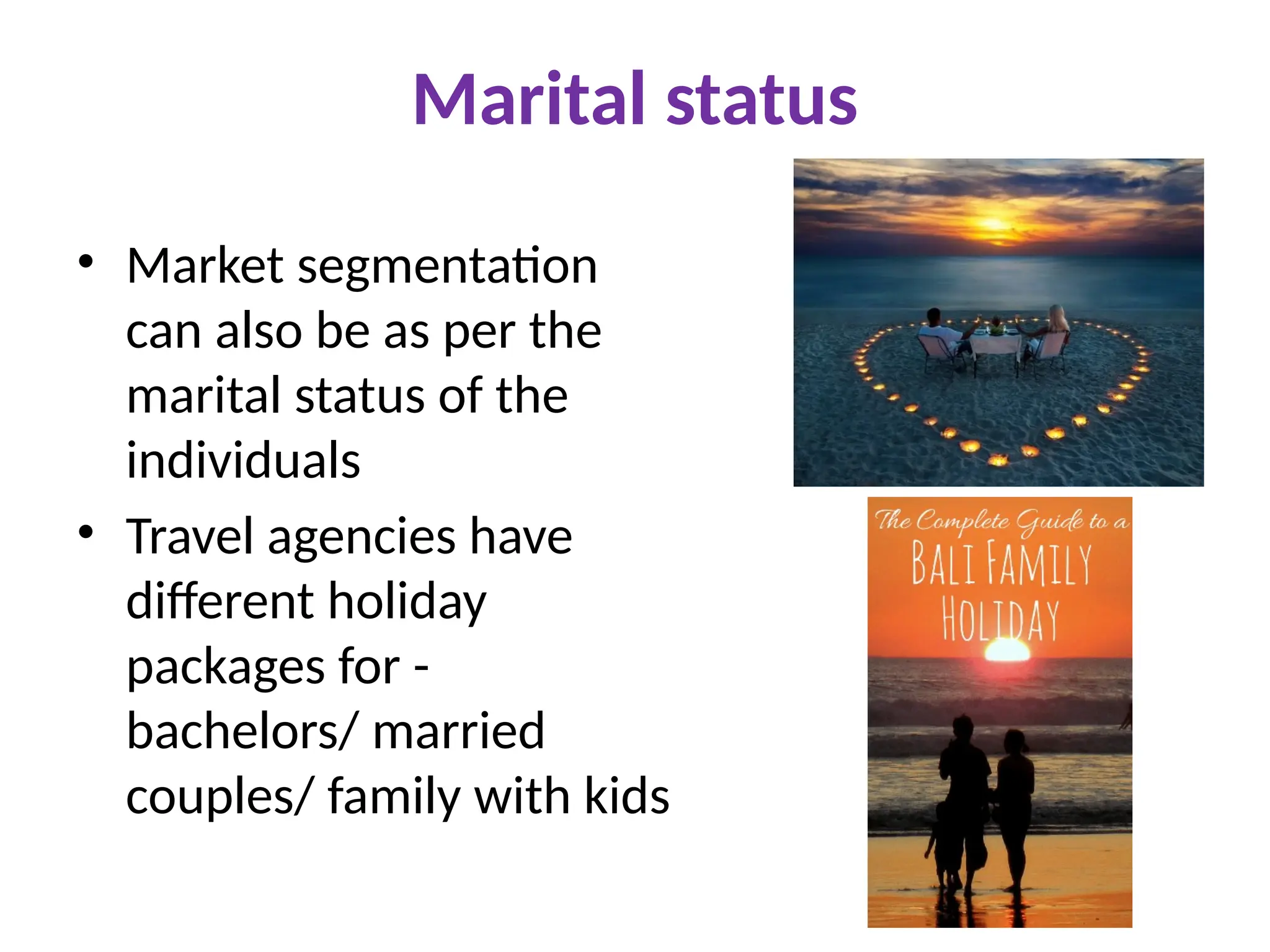
Marital status
• Market segmentation
can also be as per the
marital status of the
individuals
• Travel agencies have
different holiday
packages for -
bachelors/ married
couples/ family with kids
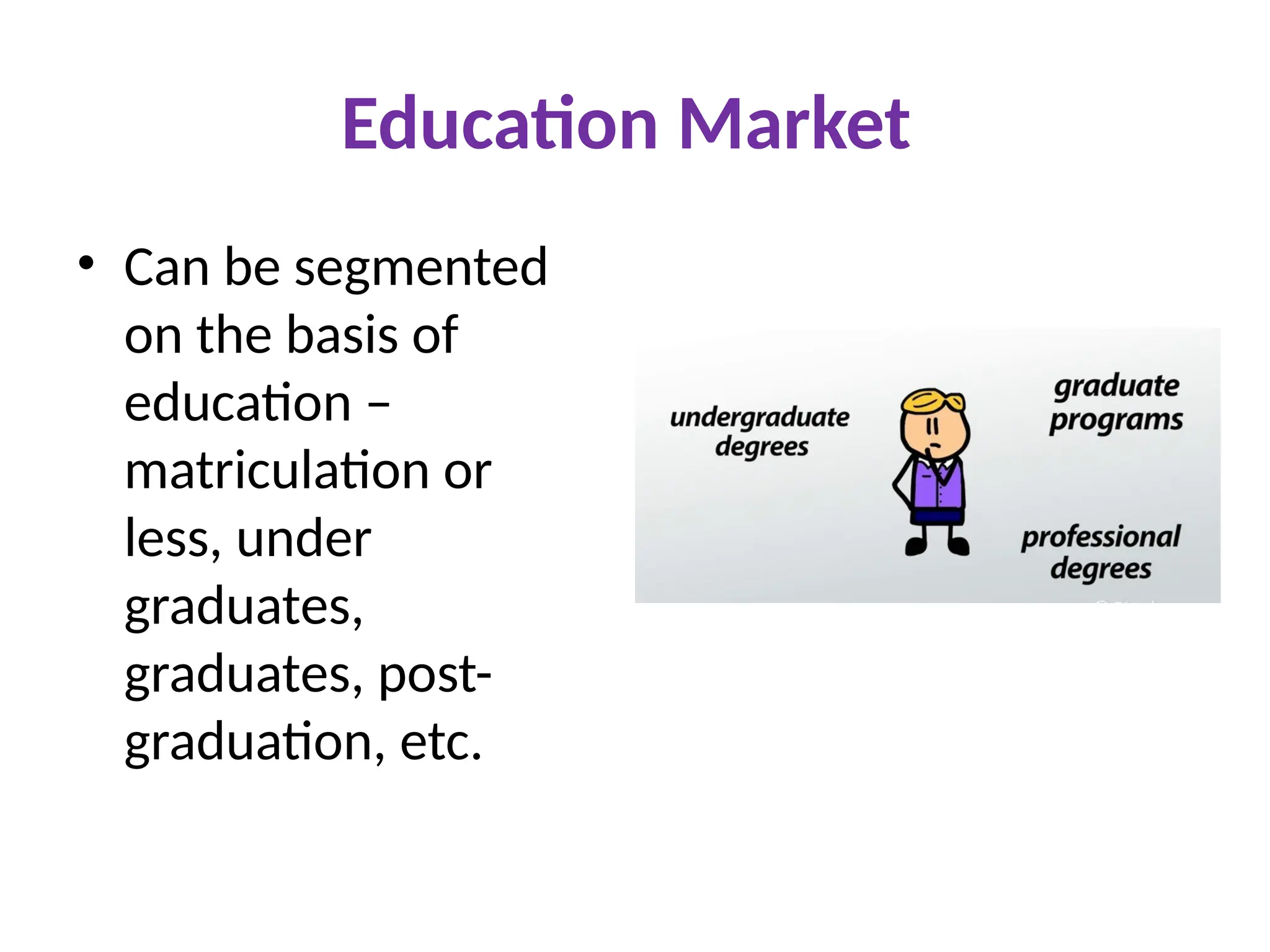
Education Market
• Can be segmented
on the basis of
education –
matriculation or
less, under
graduates,
graduates, post-
graduation, etc.
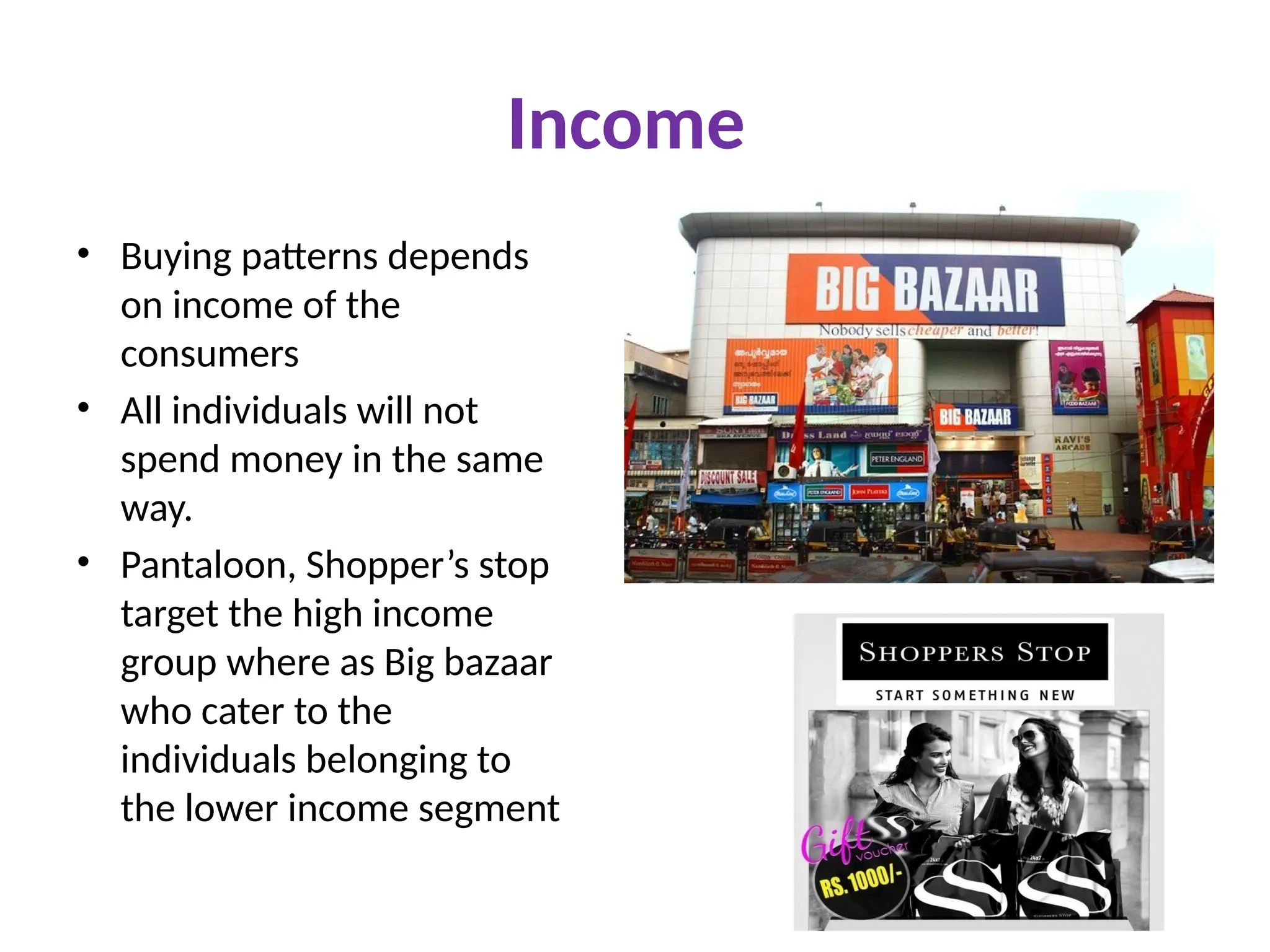
Income
• Buying patterns depends
on income of the
consumers
• All individuals will not
spend money in the same
way.
• Pantaloon, Shopper’s stop
target the high income
group where as Big bazaar
who cater to the
individuals belonging to
the lower income segment
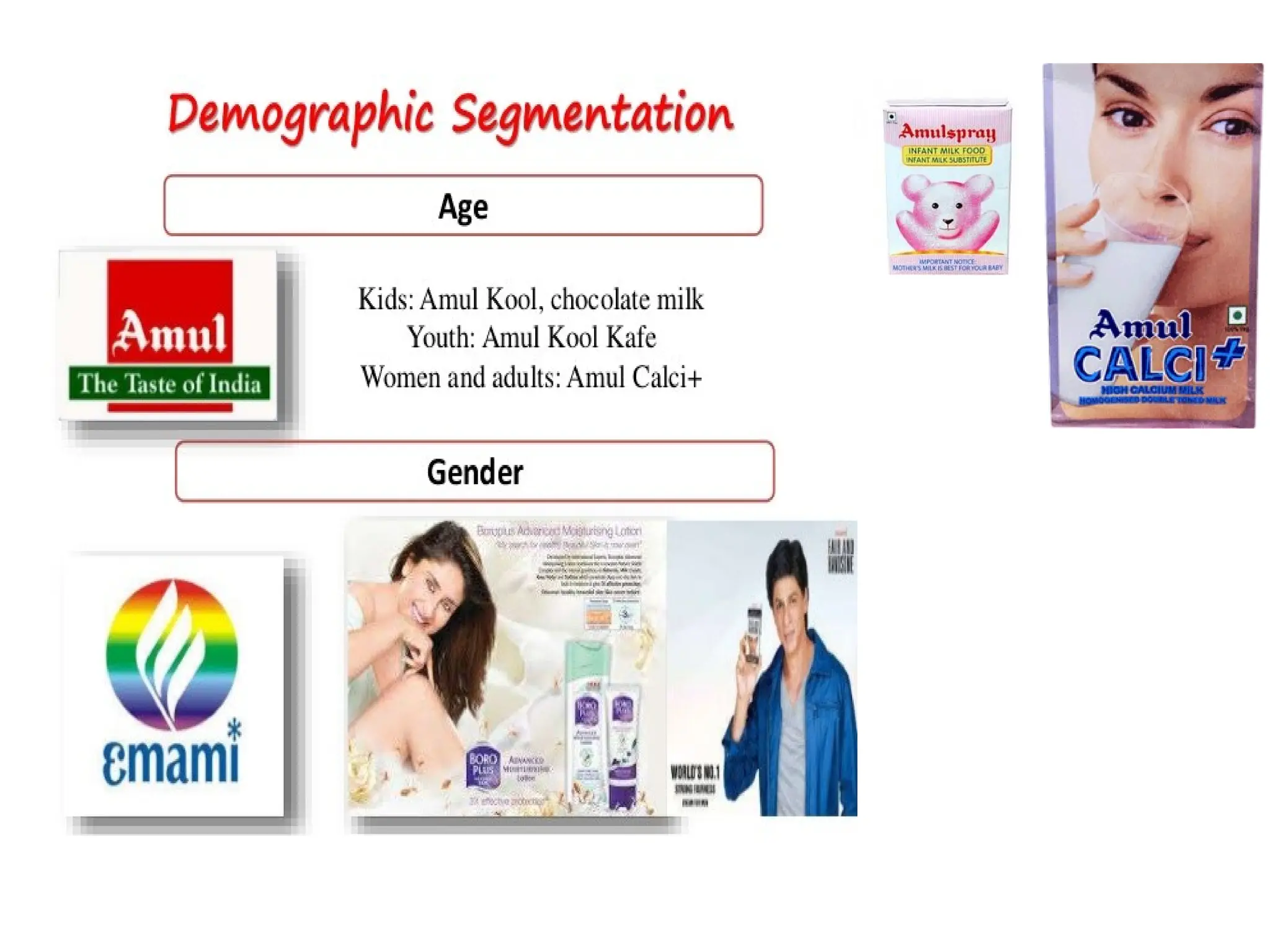
Age and stage of family life cycle
• Consumers’ wants and abilities change with age.
• On the basis of age, a market can be divided into
four parts viz., children, young, adults and old. For
the consumers belonging to the different age groups,
different types of products are produced
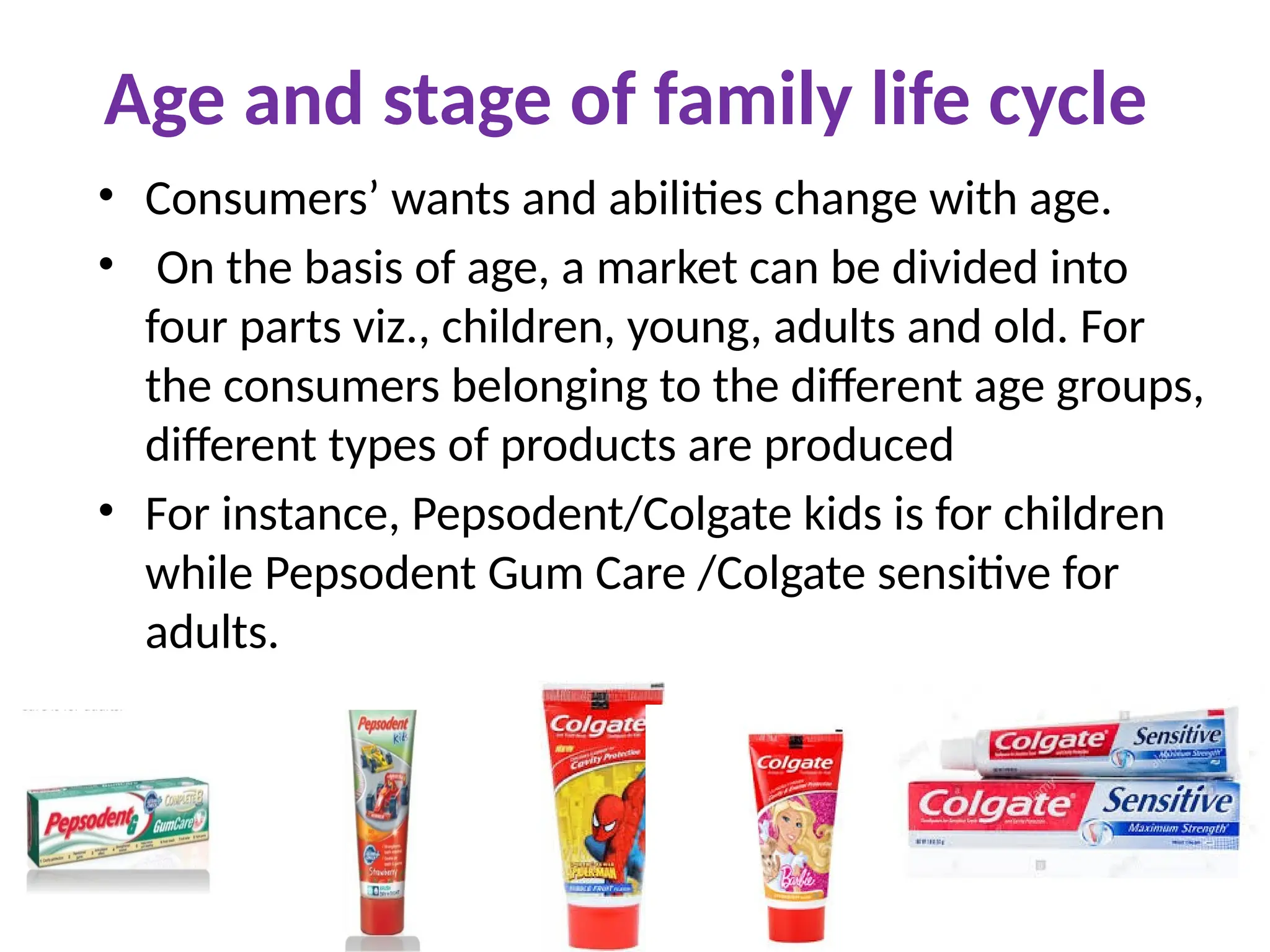
• For instance, Pepsodent/Colgate kids is for children
while Pepsodent Gum Care /Colgate sensitive for
adults.
Occupation
• It is also an important variable
• Consumption behavior differs from working
executives to self employed people or a blue
collar workers or a house wives….
• Marketers always target these people based
on their working culture
• Ex; Bank employs, Doctors, Shop keepers,
• Teachers, Lawyers….
Occupation
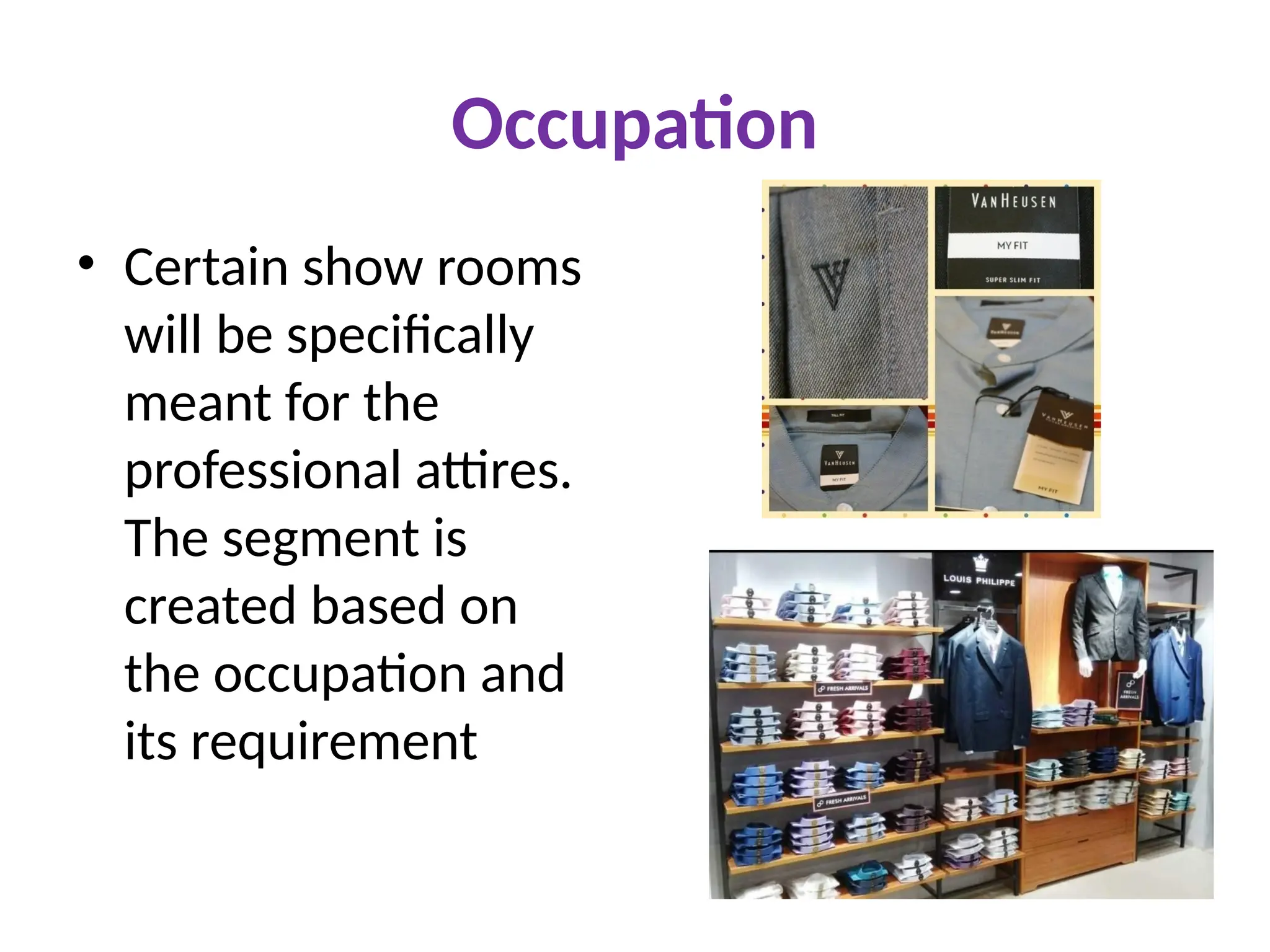
• Certain show rooms
will be specifically
meant for the
professional attires.
The segment is
created based on
the occupation and
its requirement
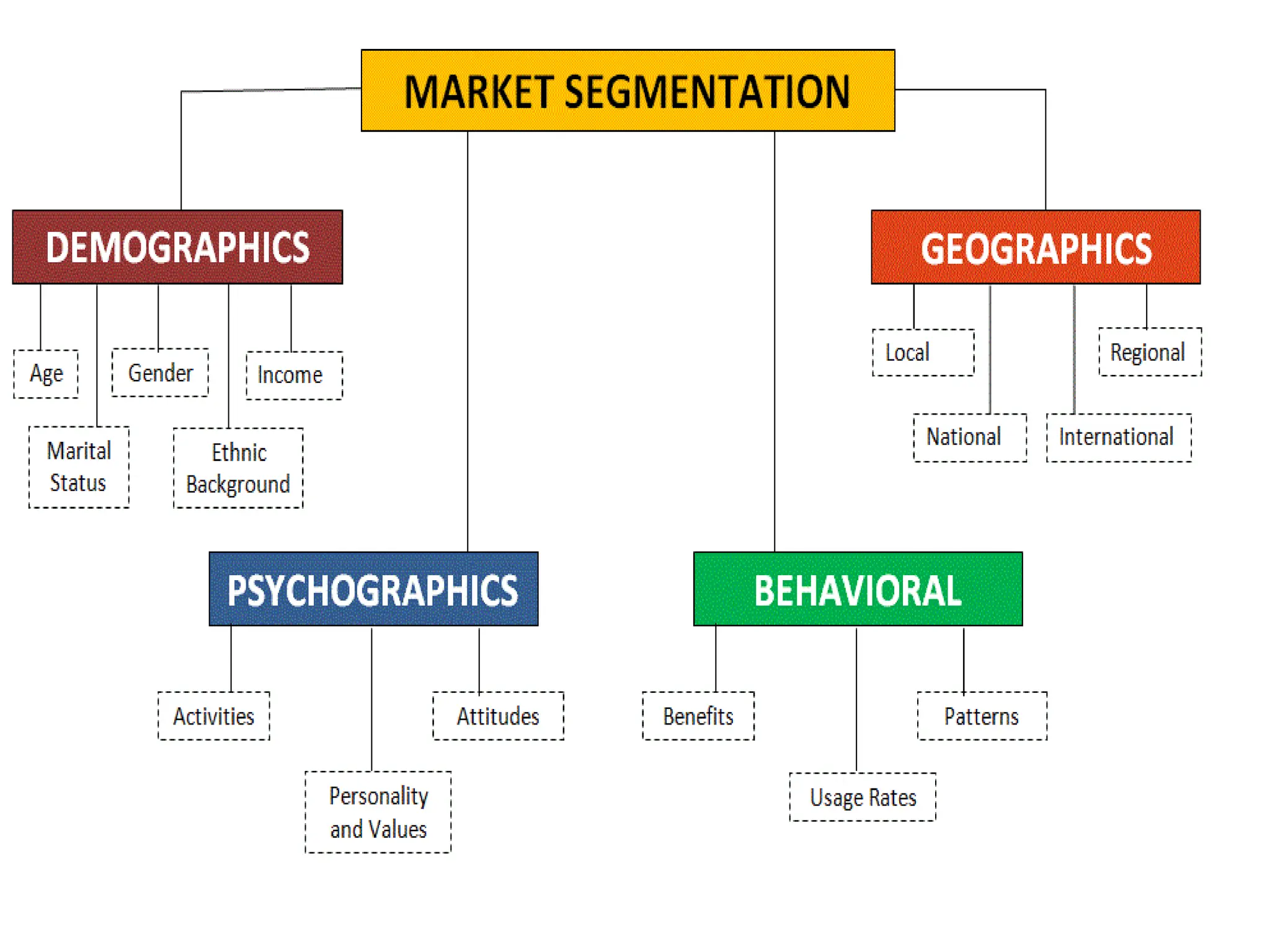
Geographic Segmentation
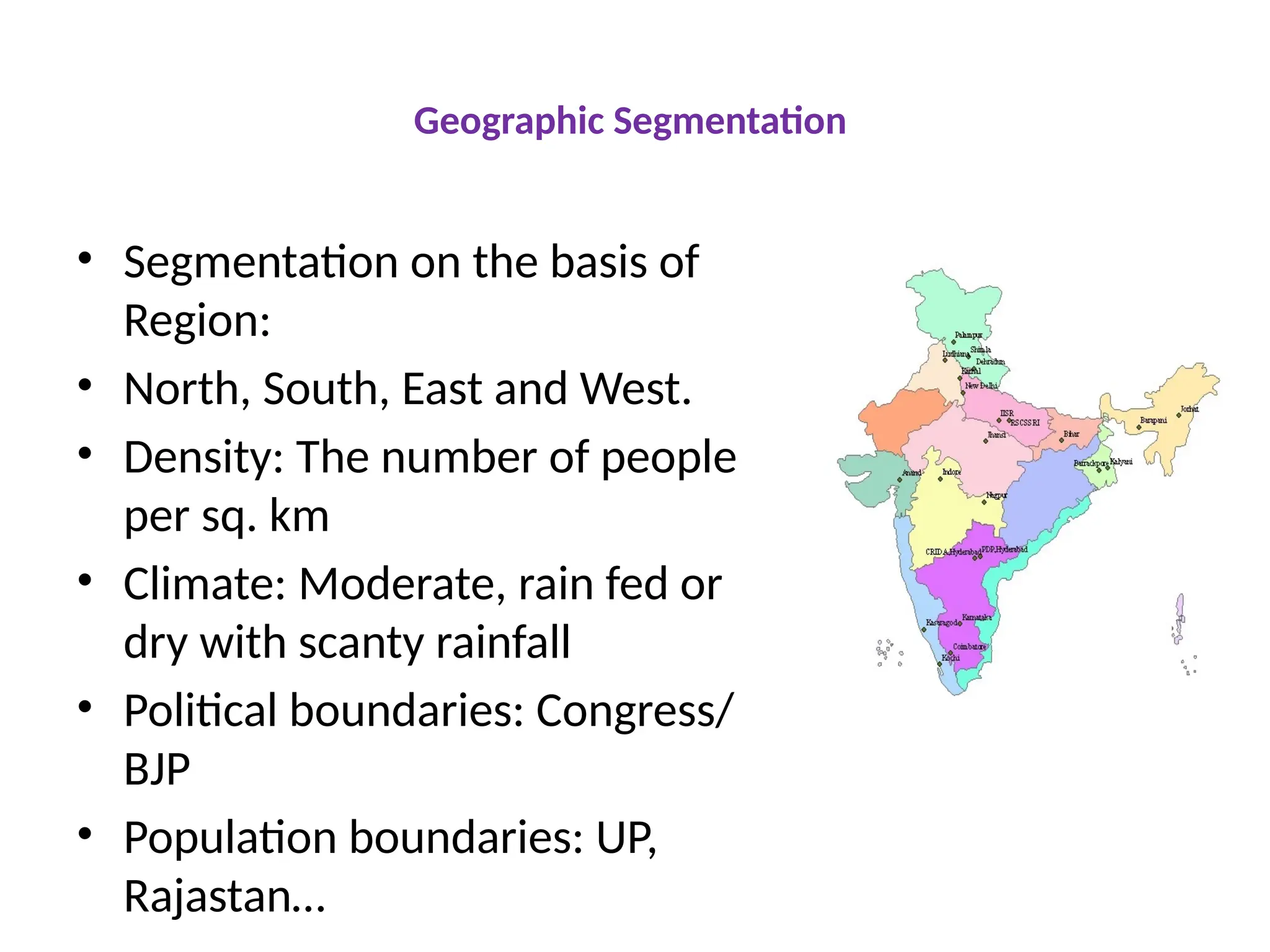
• Segmentation on the basis of
Region:
• North, South, East and West.
• Density: The number of people
per sq. km
• Climate: Moderate, rain fed or
dry with scanty rainfall
• Political boundaries: Congress/
BJP
• Population boundaries: UP,
Rajastan…
Geographic Segmentation
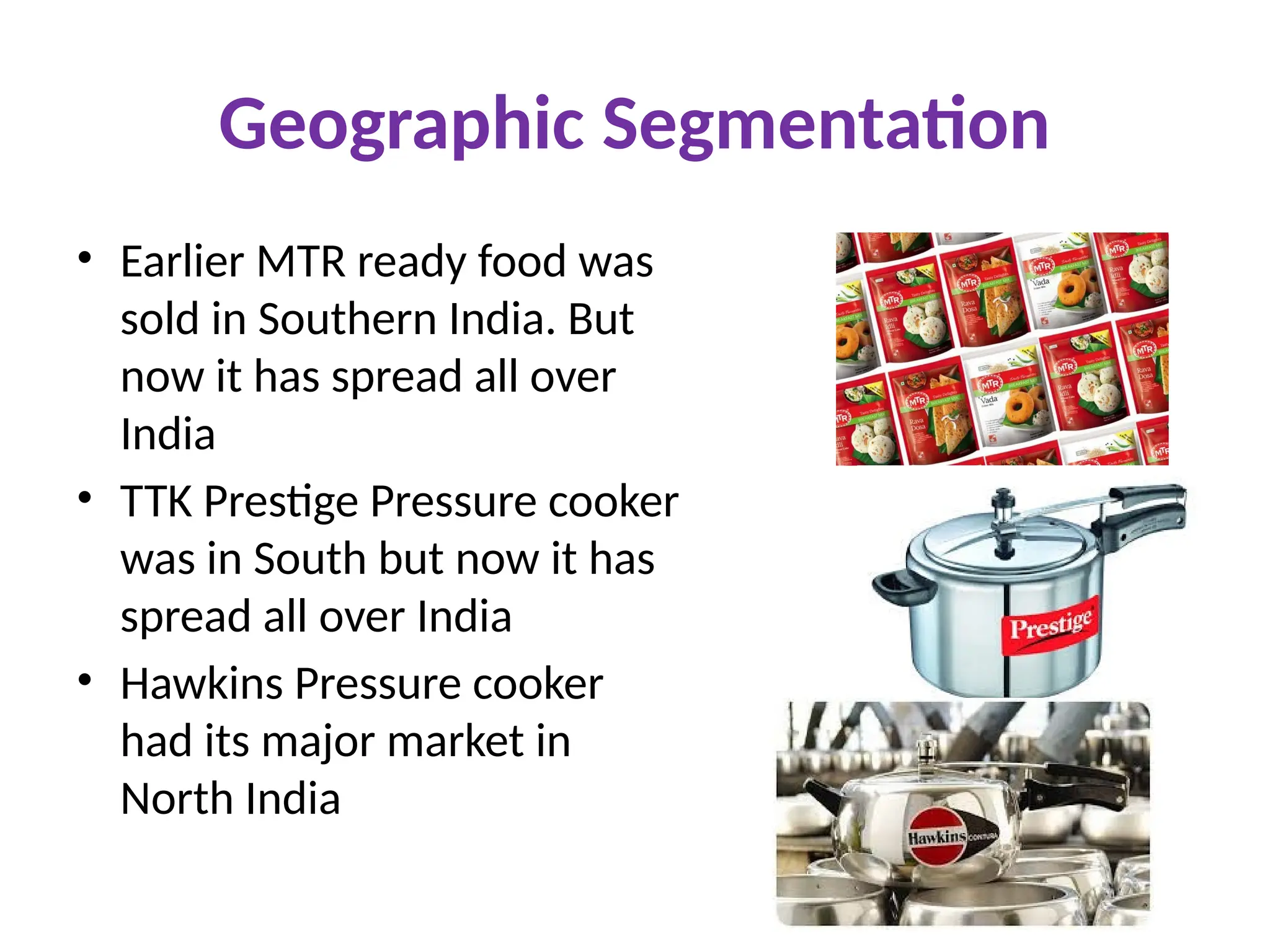
• Earlier MTR ready food was
sold in Southern India. But
now it has spread all over
India
• TTK Prestige Pressure cooker
was in South but now it has
spread all over India
• Hawkins Pressure cooker
had its major market in
North India
Geographic segmentation
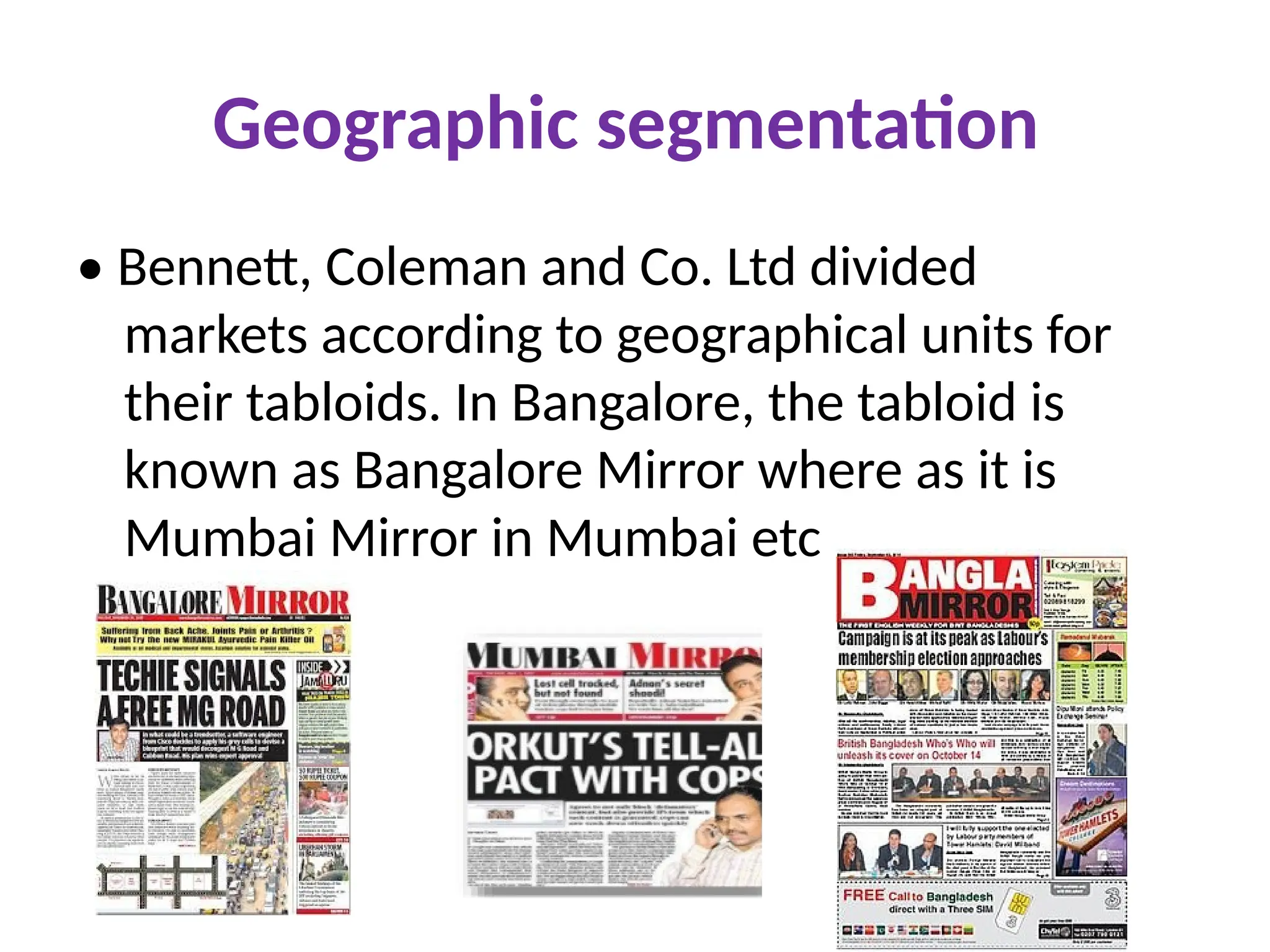
• Bennett, Coleman and Co. Ltd divided
markets according to geographical units for
their tabloids. In Bangalore, the tabloid is
known as Bangalore Mirror where as it is
Mumbai Mirror in Mumbai etc
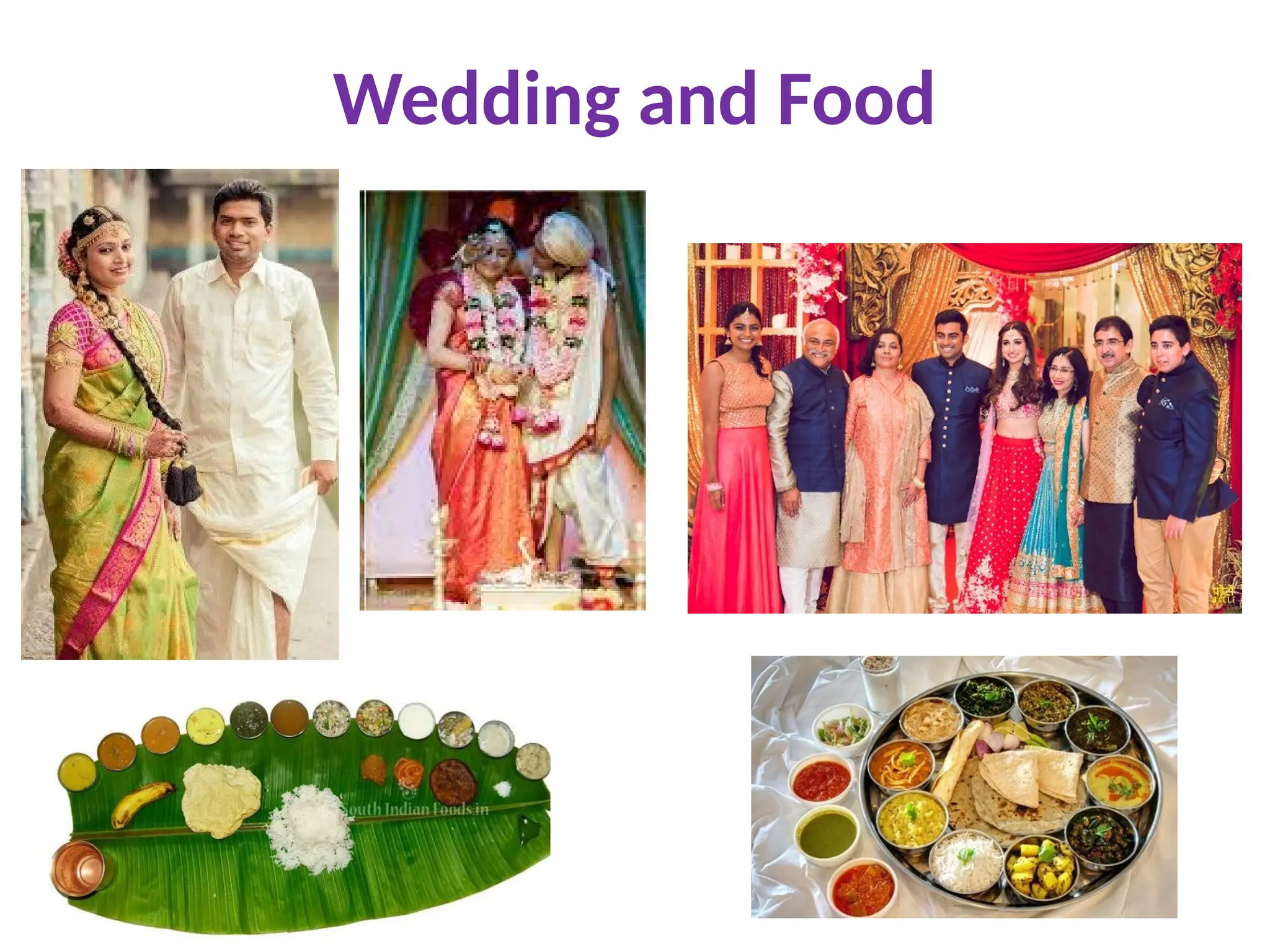
Wedding and Food
Psychographic Segmentation
• Social class: upper, lower,
middle class
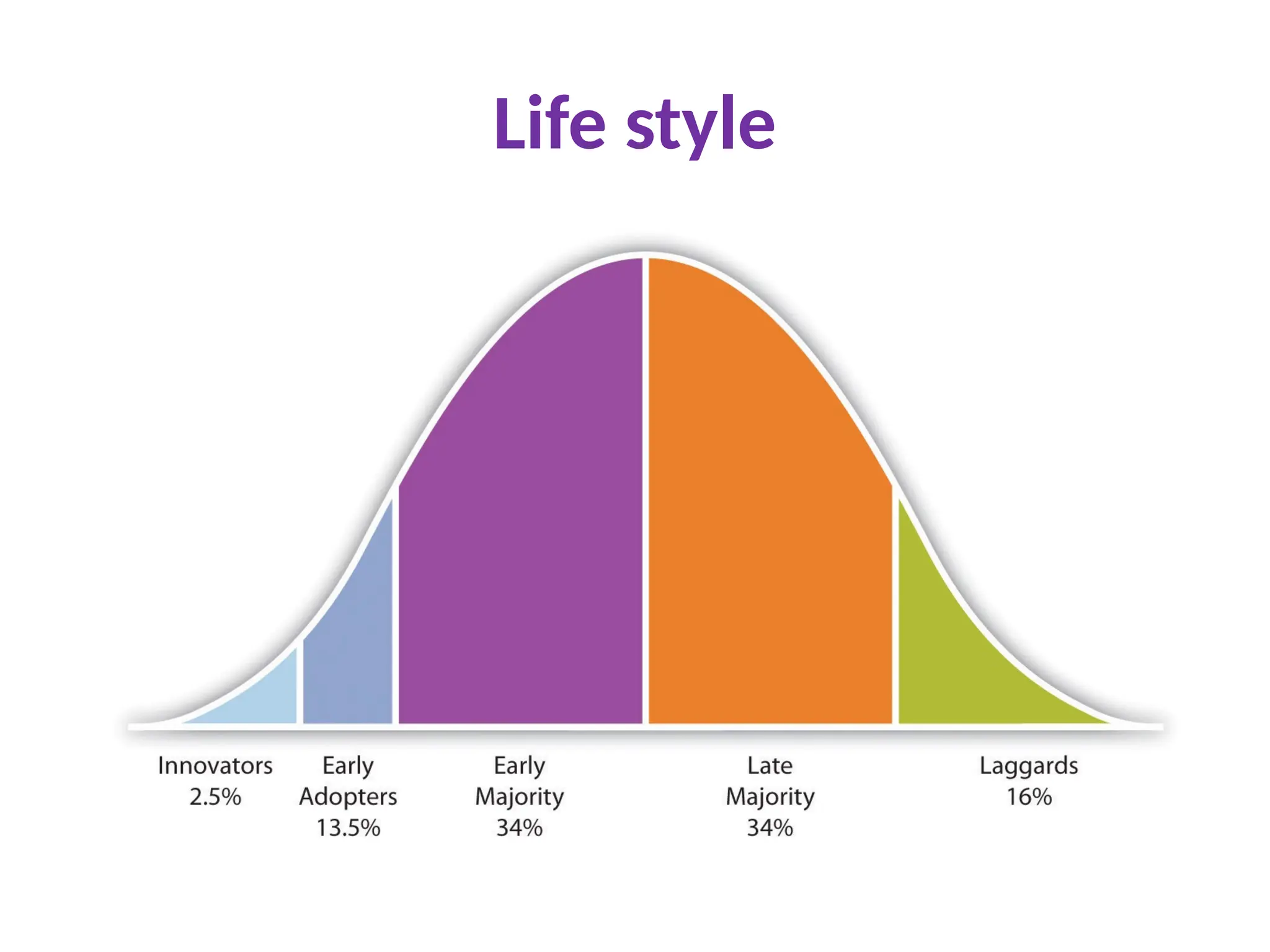
• Life style: Trendsetters,
adopters, traditionalists
• Personality: Authoritarian,
ambitious
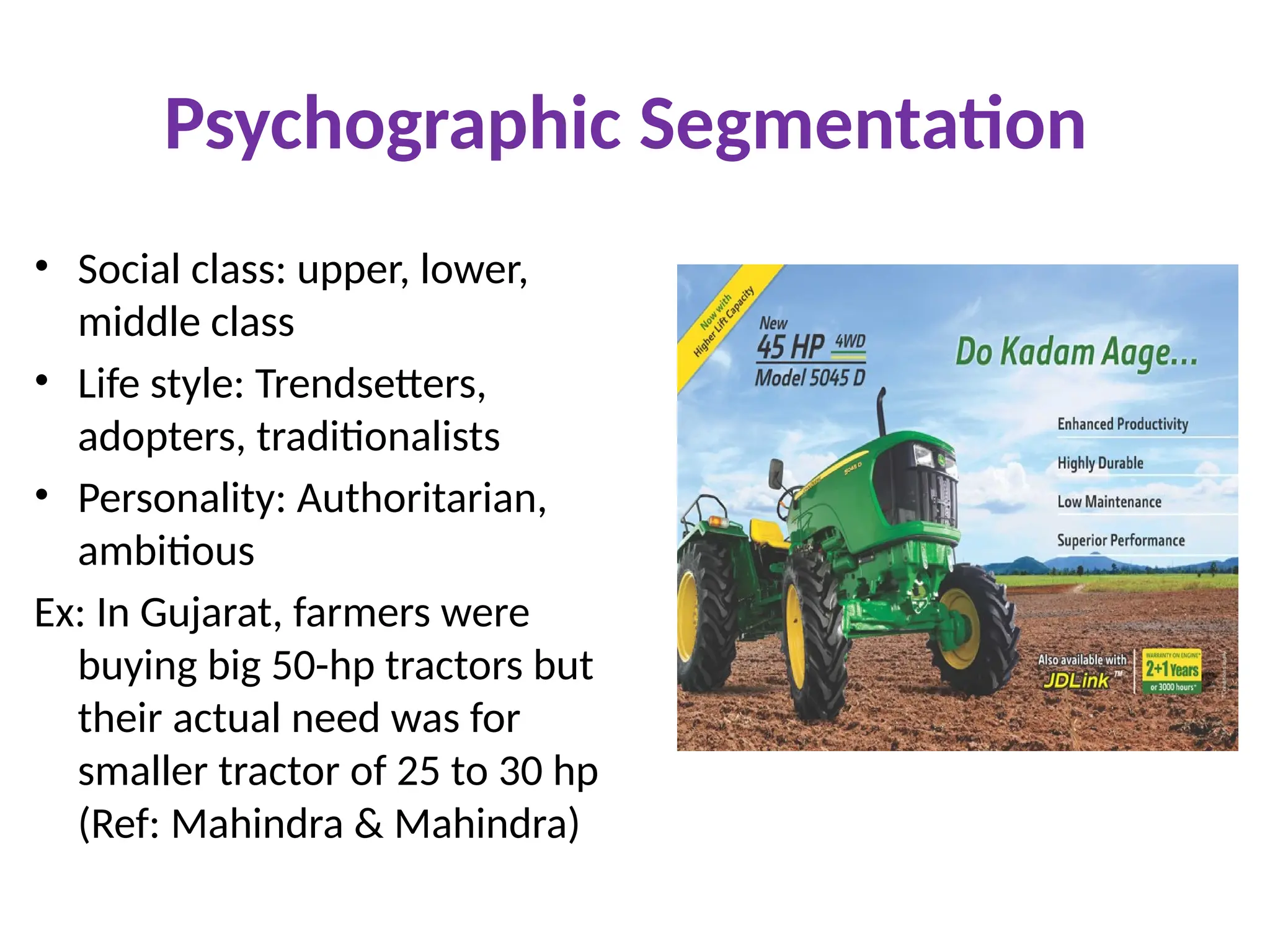
Ex: In Gujarat, farmers were
buying big 50-hp tractors but
their actual need was for
smaller tractor of 25 to 30 hp
(Ref: Mahindra & Mahindra)
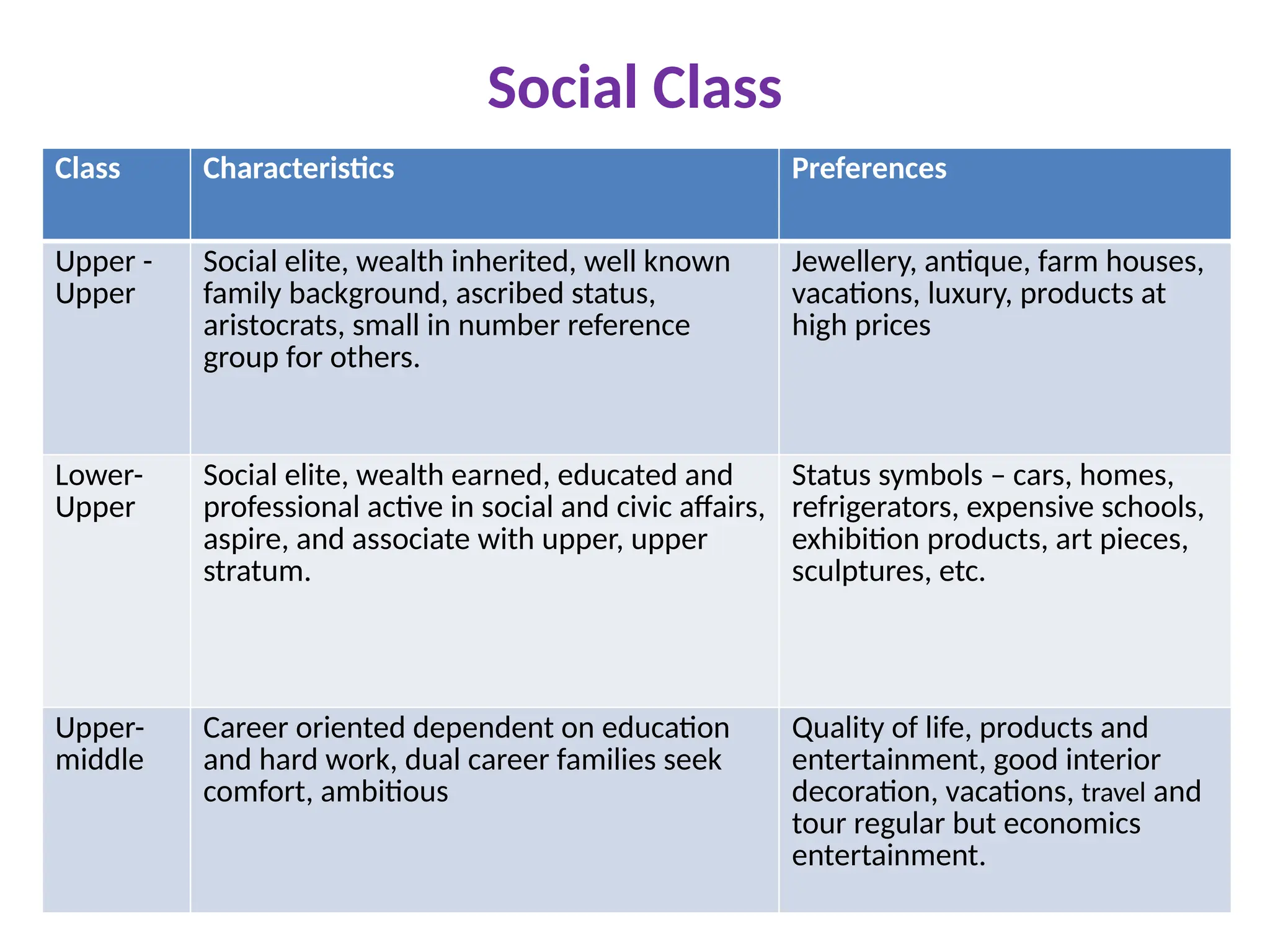
Social Class
Class Characteristics Preferences
Upper -
Upper
Social elite, wealth inherited, well known
family background, ascribed status,
aristocrats, small in number reference
group for others.
Jewellery, antique, farm houses,
vacations, luxury, products at
high prices
Lower-
Upper
Social elite, wealth earned, educated and
professional active in social and civic affairs,
aspire, and associate with upper, upper
stratum.
Status symbols – cars, homes,
refrigerators, expensive schools,
exhibition products, art pieces,
sculptures, etc.
Upper-
middle
Career oriented dependent on education
and hard work, dual career families seek
comfort, ambitious
Quality of life, products and
entertainment, good interior
decoration, vacations, travel and
tour regular but economics
entertainment.
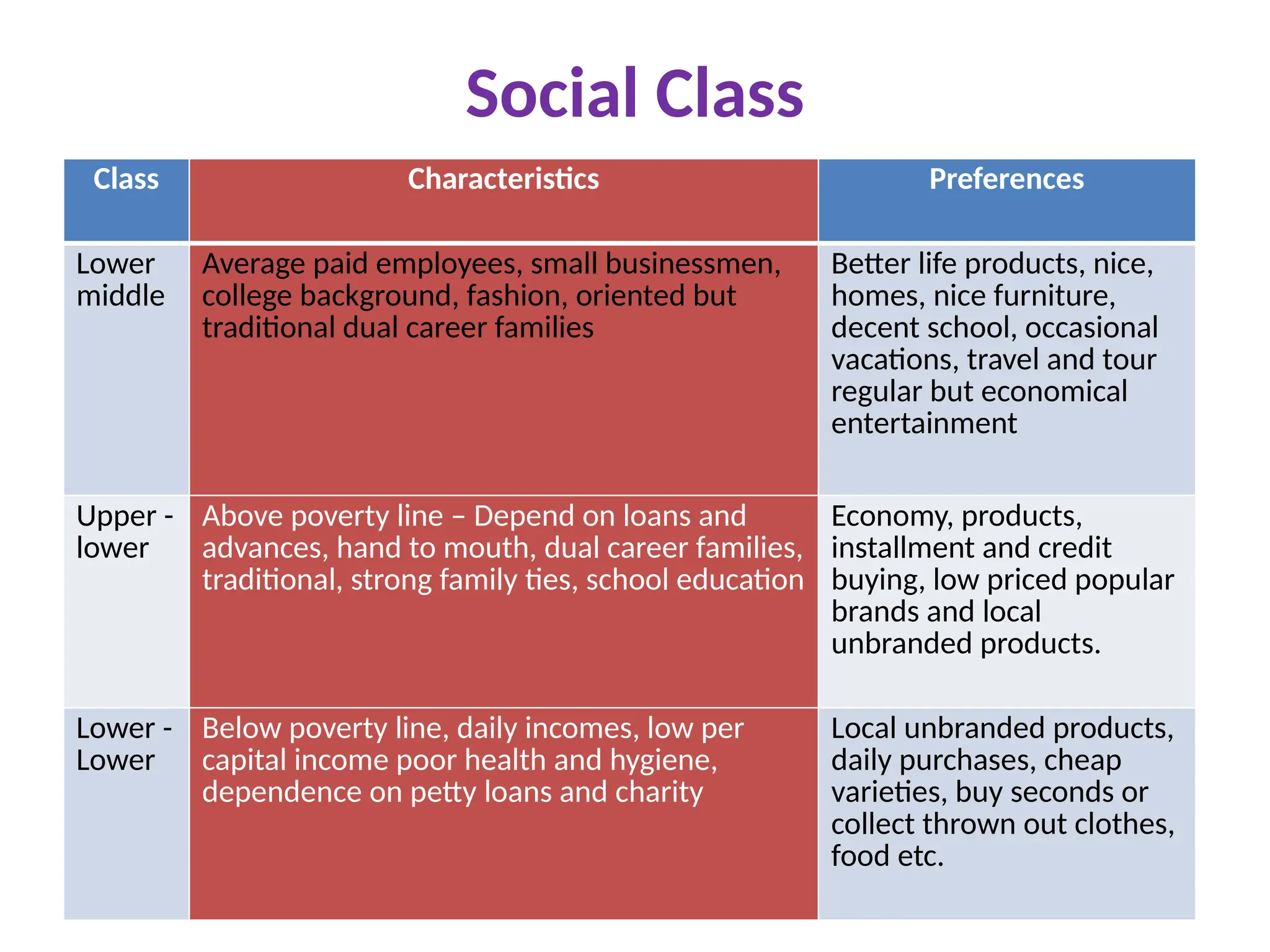
Social Class
Class Characteristics Preferences
Lower
middle
Average paid employees, small businessmen,
college background, fashion, oriented but
traditional dual career families
Better life products, nice,
homes, nice furniture,
decent school, occasional
vacations, travel and tour
regular but economical
entertainment
Upper -
lower
Above poverty line – Depend on loans and
advances, hand to mouth, dual career families,
traditional, strong family ties, school education
Economy, products,
installment and credit
buying, low priced popular
brands and local
unbranded products.
Lower -
Lower
Below poverty line, daily incomes, low per
capital income poor health and hygiene,
dependence on petty loans and charity
Local unbranded products,
daily purchases, cheap
varieties, buy seconds or
collect thrown out clothes,
food etc.
Life style
Socio-cultural values and beliefs
• Social class and cultural factors affect
consumer buying behavior.
• Social groups include: family, friends, peers,
colleagues
• Culture influences consumer behavior deeply
• A given culture brings its own unique pattern
of social conduct
Socio-cultural values and beliefs
• A person usually acquire his cultural attributes
right at his childhood
• Culture includes religion, caste, language, social
behavior
• Ex: Mc Donald don’t offer beef products in India
• Saudi Arabia Mc Donald outlets include
separate dining sections for both men& women
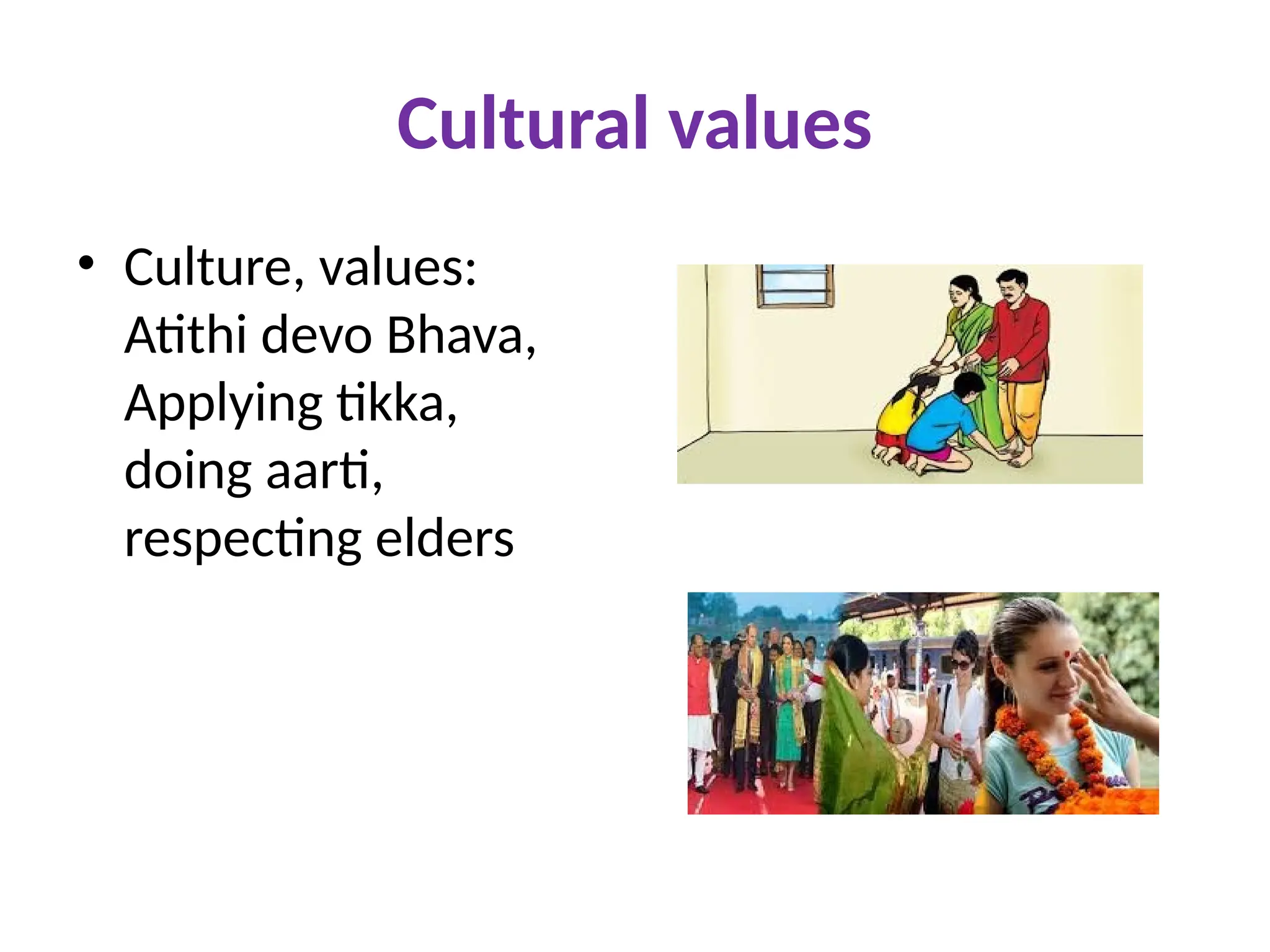
Cultural values
• Culture, values:
Atithi devo Bhava,
Applying tikka,
doing aarti,
respecting elders
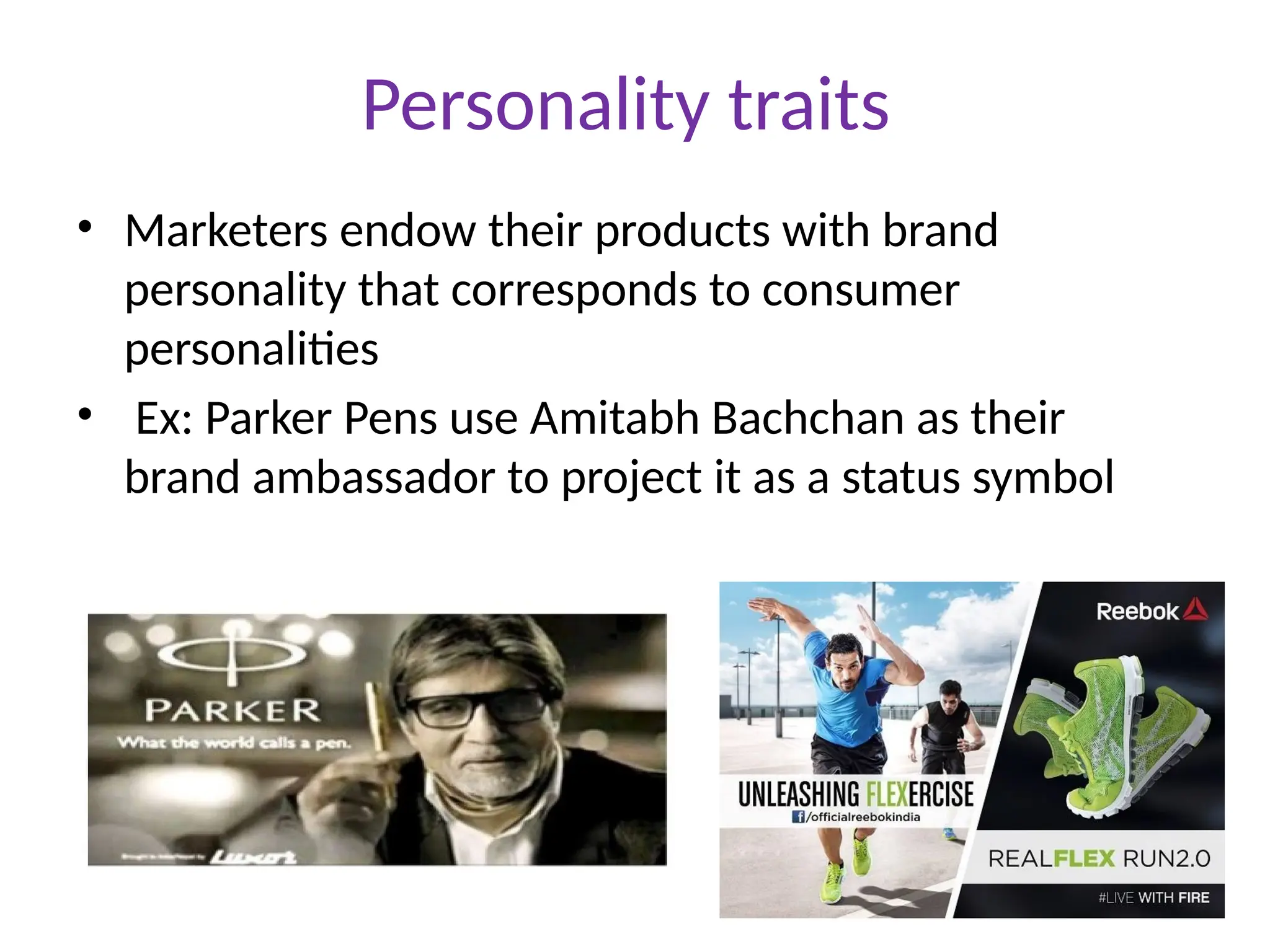
Personality traits
• Marketers endow their products with brand
personality that corresponds to consumer
personalities
• Ex: Parker Pens use Amitabh Bachchan as their
brand ambassador to project it as a status symbol
Behavioral Segmentation
• Buyers are divided into different groups
• Occasions
• Product or brand usage
• User Status
• Usage rate
• Buyer’s purchase decision based on benefits
sought
Occasions
• Archies for occasional greetings
• Cadbury is associating its chocolates with happy
occasions and trying to replace it with age old
traditional sweets
• ICICI bank sell gold coins at the occasion of Akshay
Tritiya/Diwali
• On Valentines Day company like Ferns and Petals
gets highest order to deliver flowers all across India
• Gifts at the time of Christmas and New Year
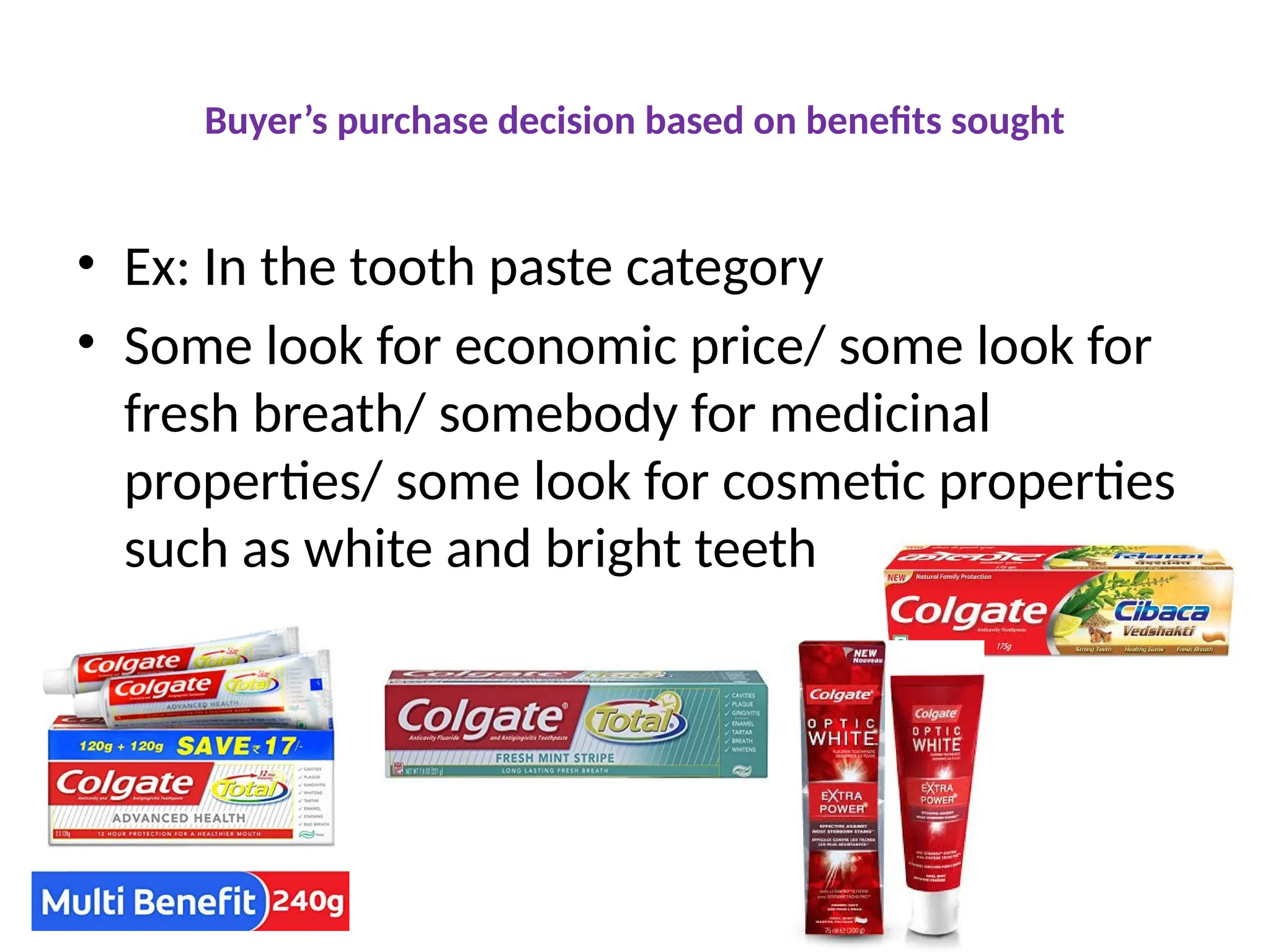
Buyer’s purchase decision based on benefits sought
• Ex: In the tooth paste category
• Some look for economic price/ some look for
fresh breath/ somebody for medicinal
properties/ some look for cosmetic properties
such as white and bright teeth
User Status
• User status is further segmented into
• First time users –
• Regular Users
• Ex users
• Potential users and
• Non Users
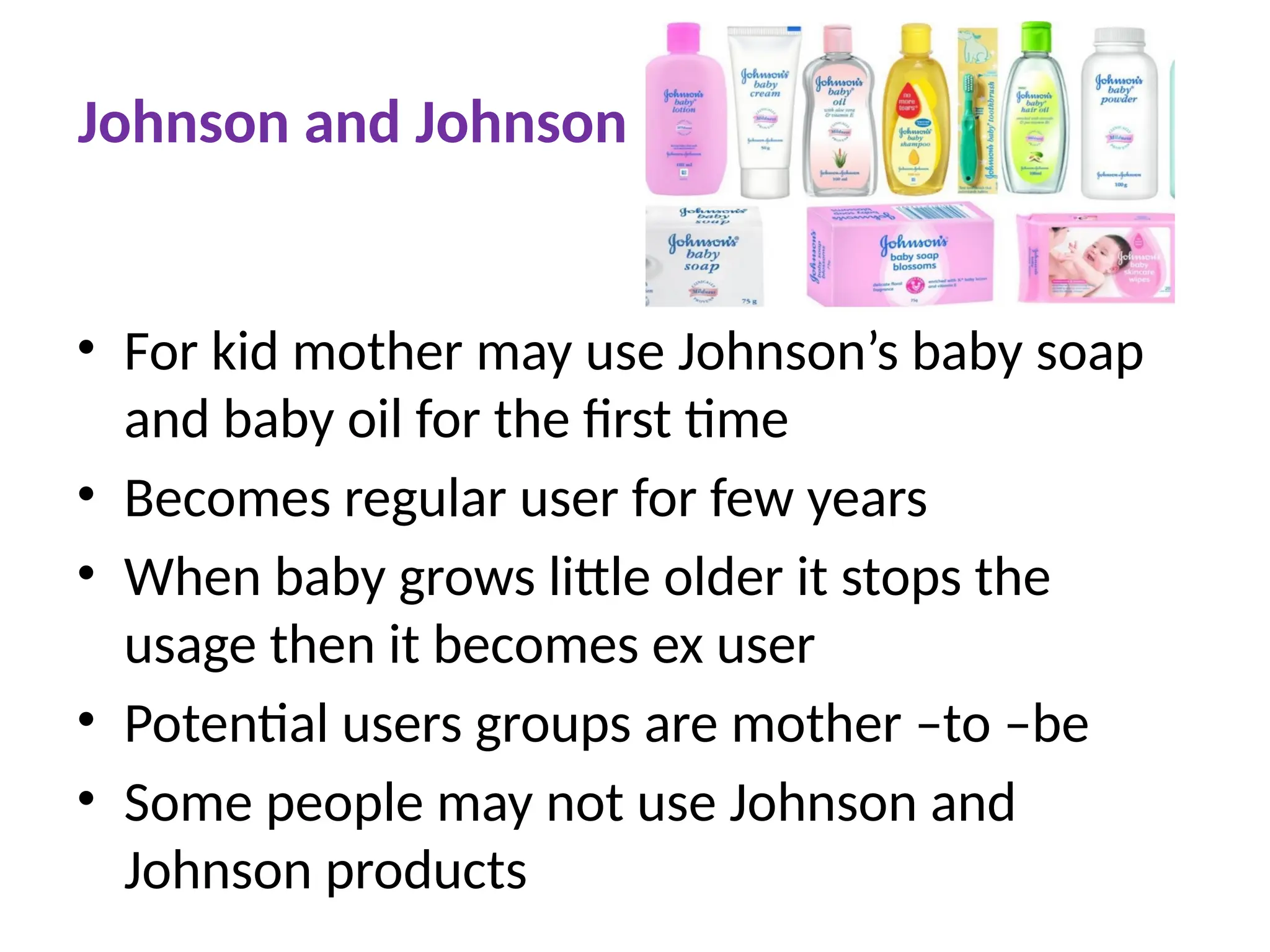
Johnson and Johnson
• For kid mother may use Johnson’s baby soap
and baby oil for the first time
• Becomes regular user for few years
• When baby grows little older it stops the
usage then it becomes ex user
• Potential users groups are mother –to –be
• Some people may not use Johnson and
Johnson products
Usage rate
• This also helps to segment the market
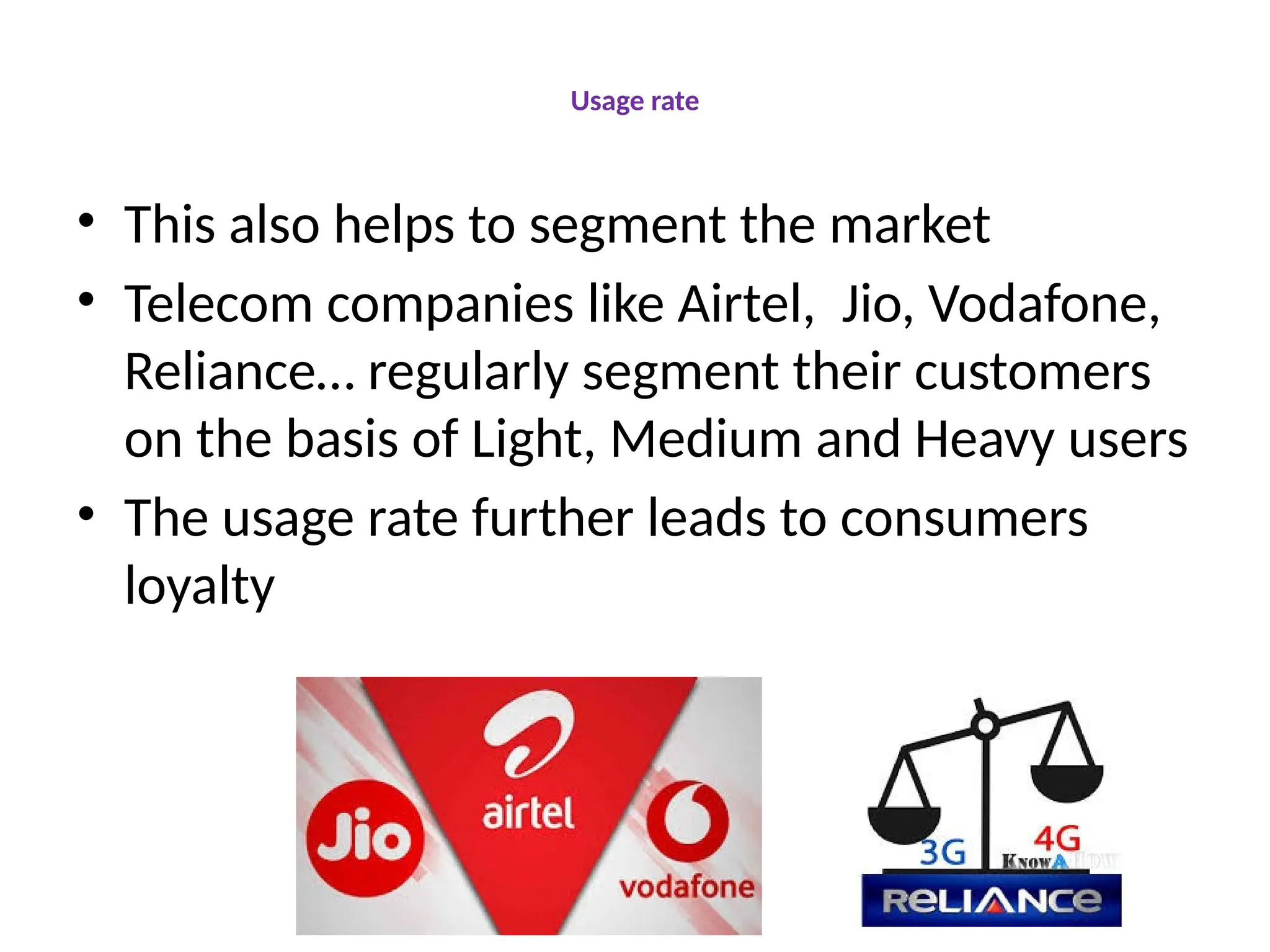
• Telecom companies like Airtel, Jio, Vodafone,
Reliance… regularly segment their customers
on the basis of Light, Medium and Heavy users
• The usage rate further leads to consumers
loyalty
Targeting
• A target market refers to a group of
individuals who are inclined towards similar
products and respond to similar marketing
techniques and promotional schemes.
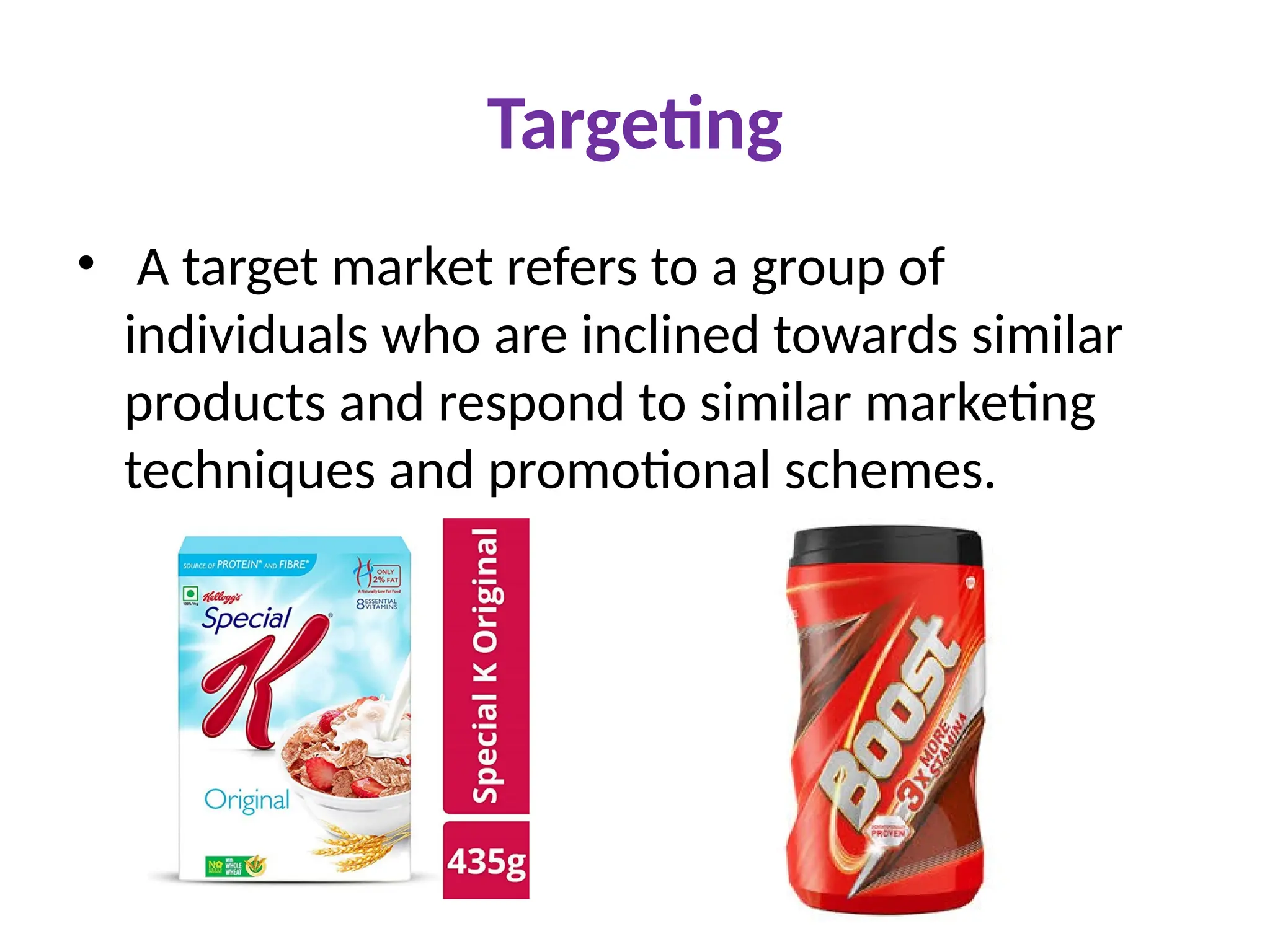
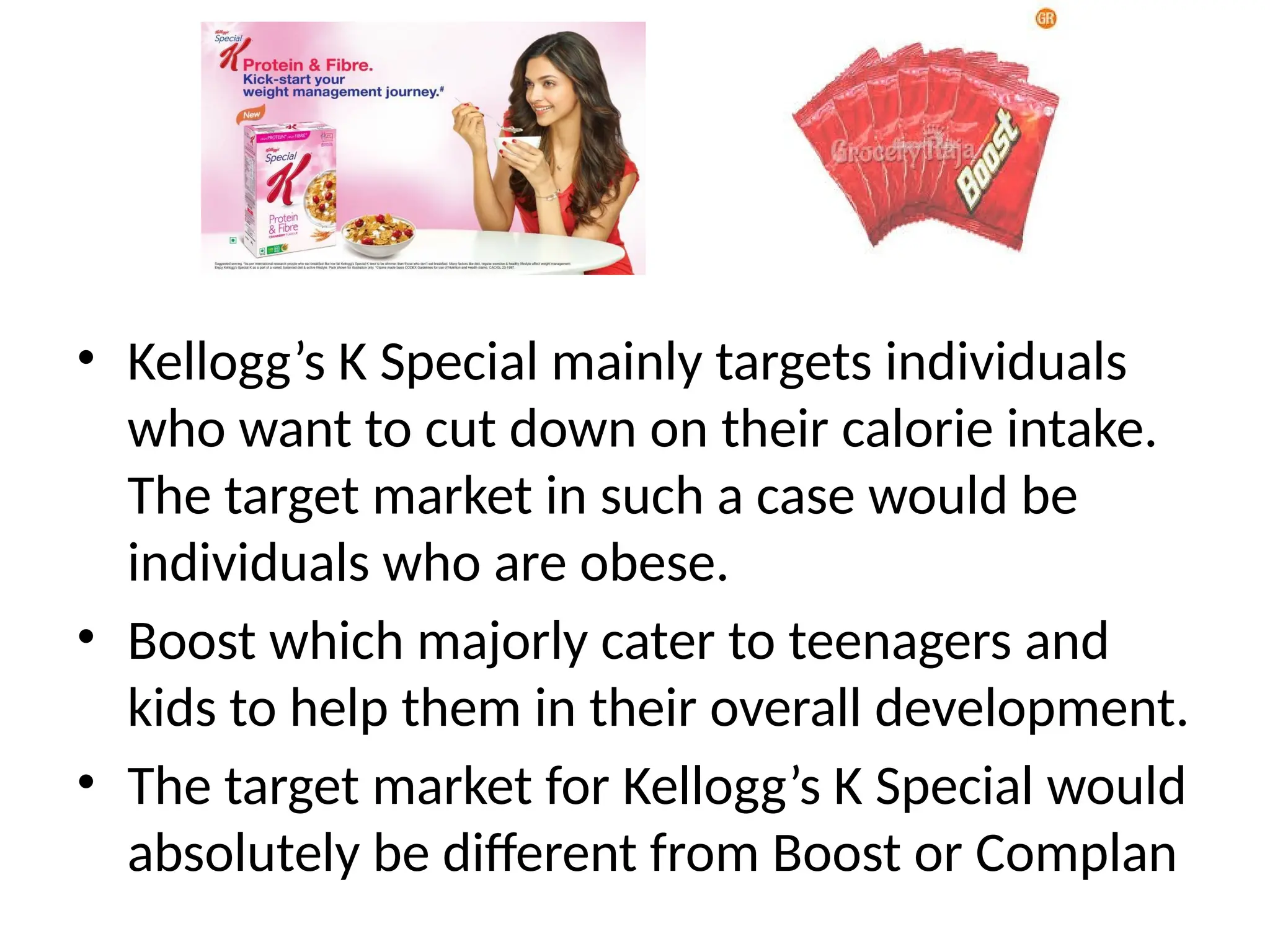
• Kellogg’s K Special mainly targets individuals
who want to cut down on their calorie intake.
The target market in such a case would be
individuals who are obese.
• Boost which majorly cater to teenagers and
kids to help them in their overall development.
• The target market for Kellogg’s K Special would
absolutely be different from Boost or Complan
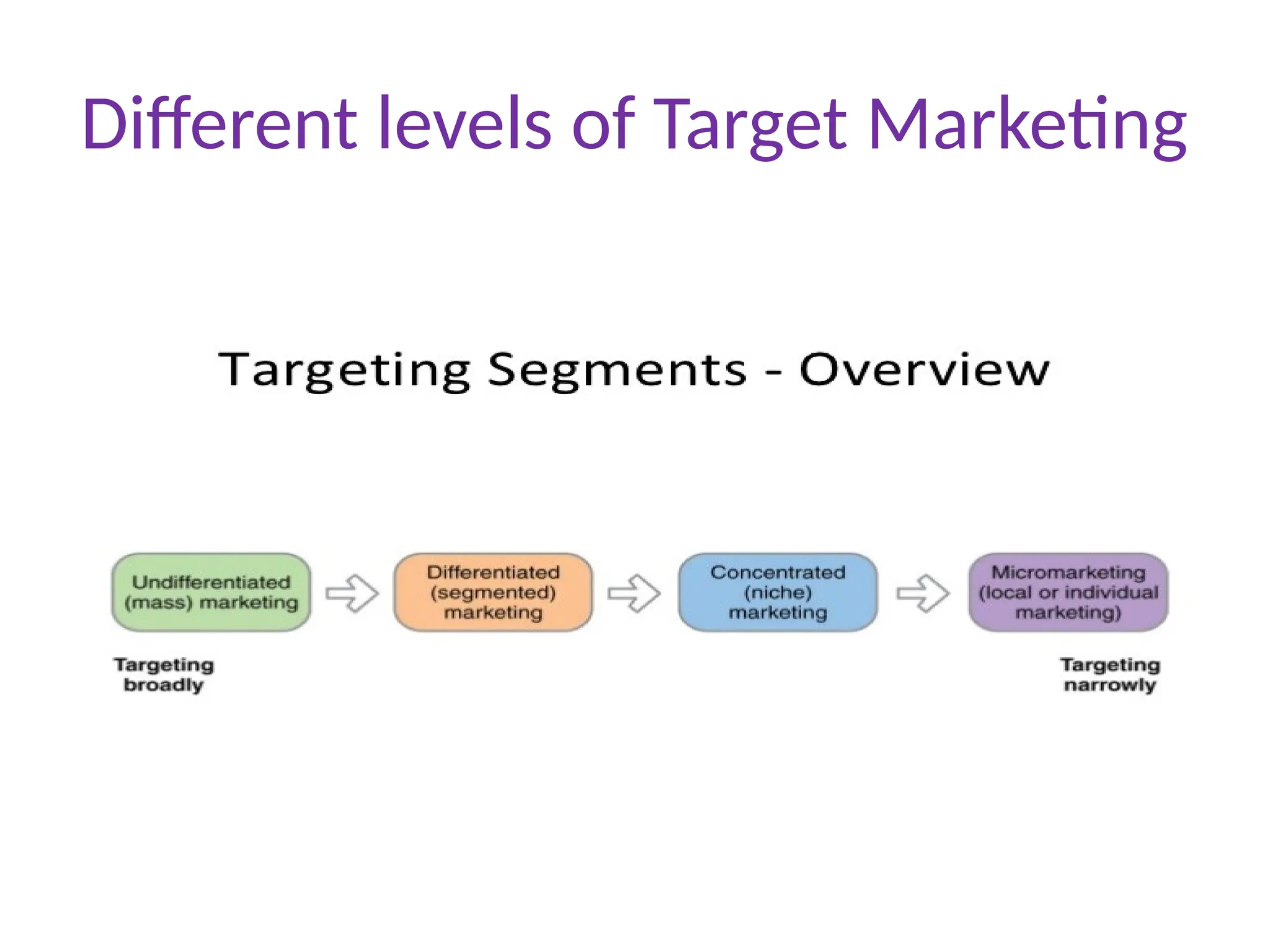
Different levels of Target Marketing
Un Differentiated ( Mass) Marketing
• Ignores segmentation
opportunity
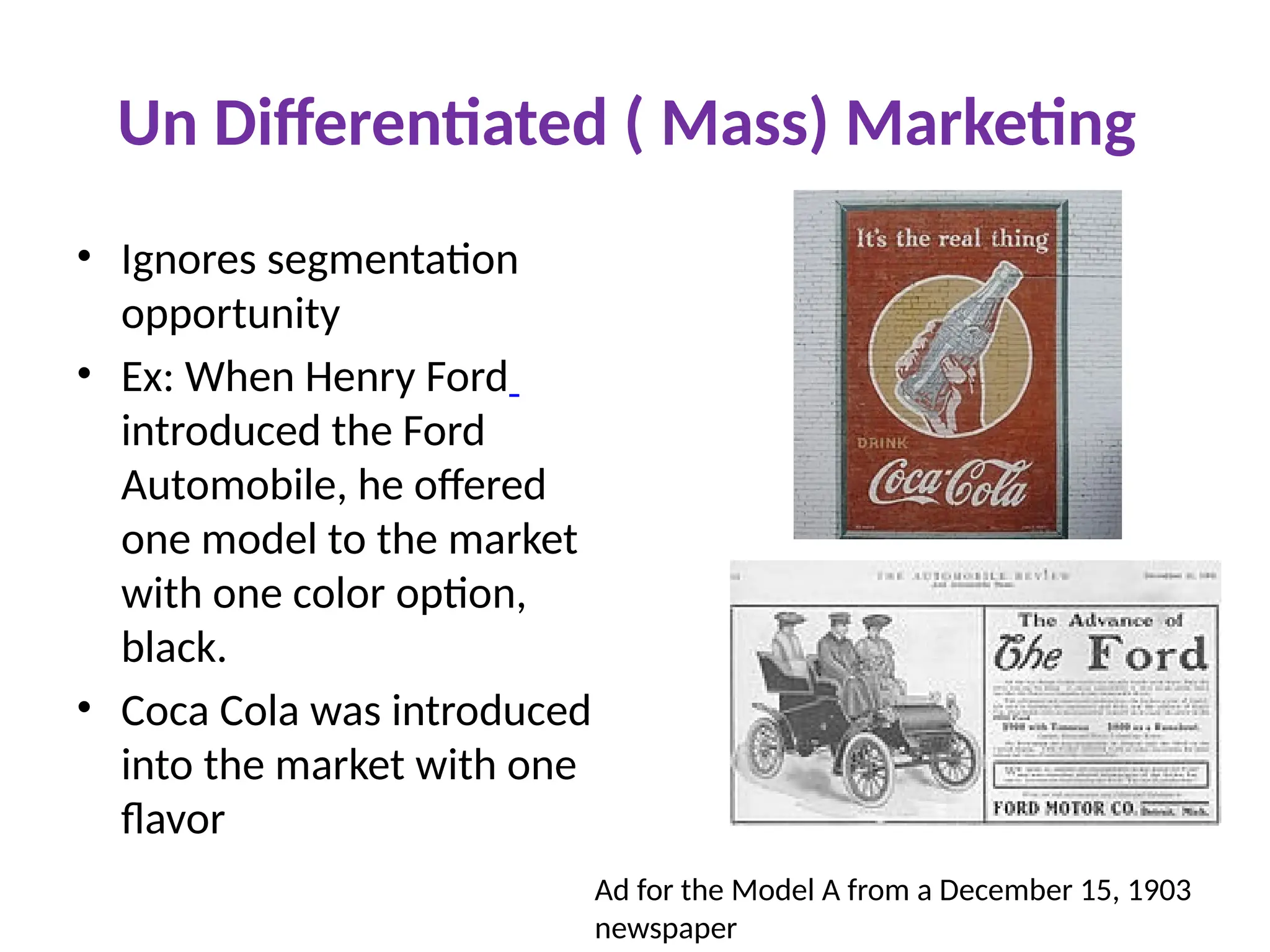
• Ex: When Henry Ford
introduced the Ford
Automobile, he offered
one model to the market
with one color option,
black.
• Coca Cola was introduced
into the market with one
flavor
Ad for the Model A from a December 15, 1903
newspaper
Differentiated Marketing
• This strategy is used when a company creates
campaigns that appeal to at least two market
segments or target groups.
• For example, a store can promote a sale that
appeals to people in at least two cities or
locations
• A company can market a product that appeals
to women in at least two age groups
Concentrated marketing
• This is targeted to one specific market segment
or audience.
• Ex: Only for teenage girls
• Retailer might market his business to residents in
a specific town
• Concentrated marketing strategies are often
geared for smaller groups of people, because
they are designed to appeal to a specific
segment
Niche market
• Is the subset of the market where a specific product is
focused
• Ex: Gold plus jewellery from the Tata Group which
targeted rural and semi urban populations in South
India.
• Ghari detergent introduced variants of its product based
on the quality of water.
• The jeevan Sadhan service of Nokia launched in 2009
specially targeted rural Indian consumers.
• It provided the services like providing agricultural tips,
market prices, weather forecasts, career information
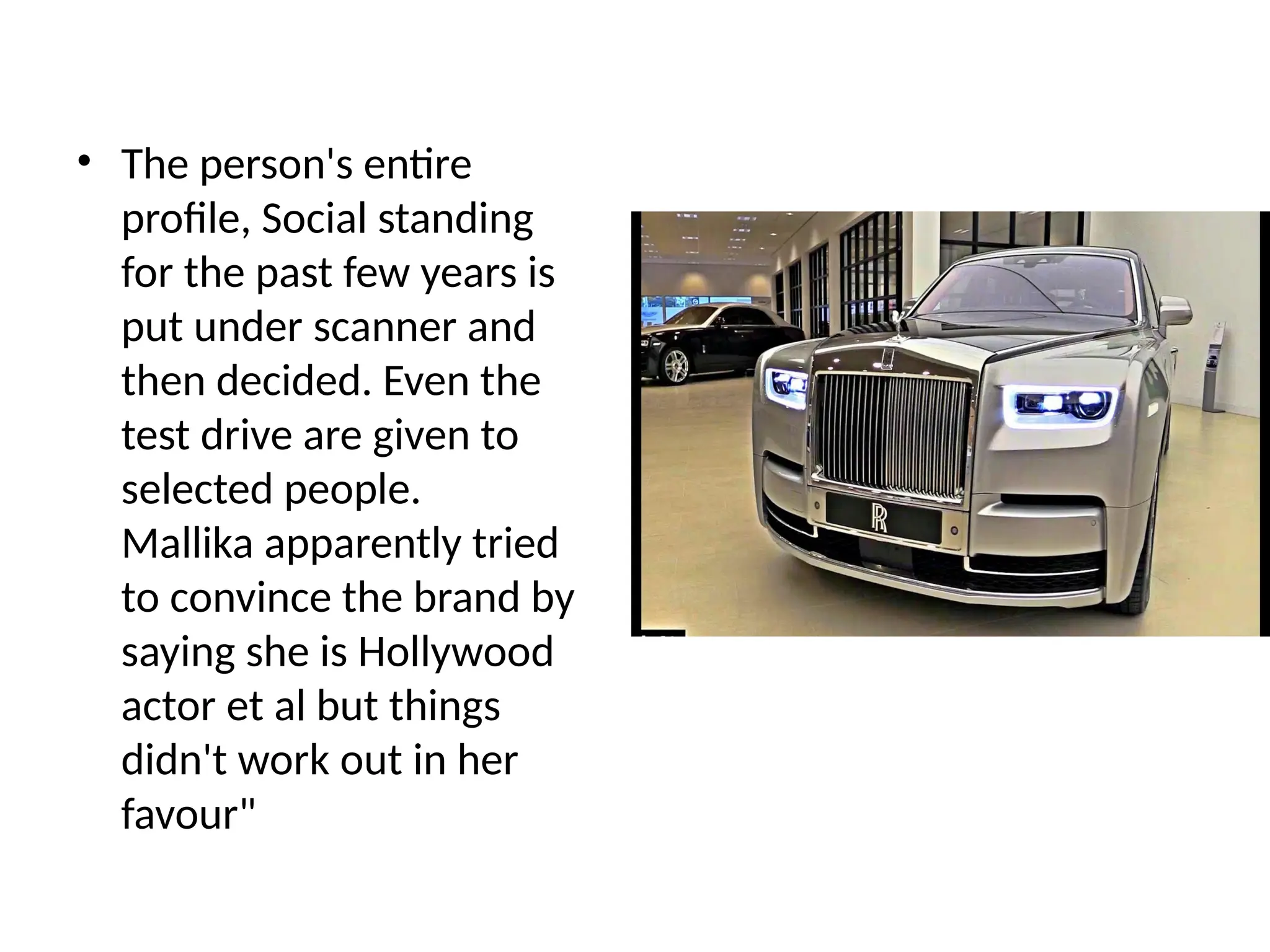
Rolls Royce
• "Mallika Sherawat wanted
to buy Rolls Royce but was
refused. The car is not sold
just to those who wish to
buy it. There is a process
where it is decided if the
person wishing to buy it is
fit enough to be its owner
or not and money is not
just a criteria.
• The person's entire
profile, Social standing
for the past few years is
put under scanner and
then decided. Even the
test drive are given to
selected people.
Mallika apparently tried
to convince the brand by
saying she is Hollywood
actor et al but things
didn't work out in her
favour"
Positioning
• Positioning is developing a product and brand
image in the minds of consumers
• It can also include improving a customer's
perception about the experience they will have if
they choose to purchase your product or service
• Effective positioning involves a good
understanding of competing products and the
benefits that are sought by your target market.
Sources of Differentiation
Key Questions
Concerning Positioning Decisions
• For whom are they written? - For consumers
• In what sort of language? - develop the catchy
consumer language, based on the chosen
positioning
• Should they focus on features or benefits?-
Benefits - which are ultimately why people will buy
• How many differentiating attributes should anchor them? -
One, or two at the most with Clear and simple language
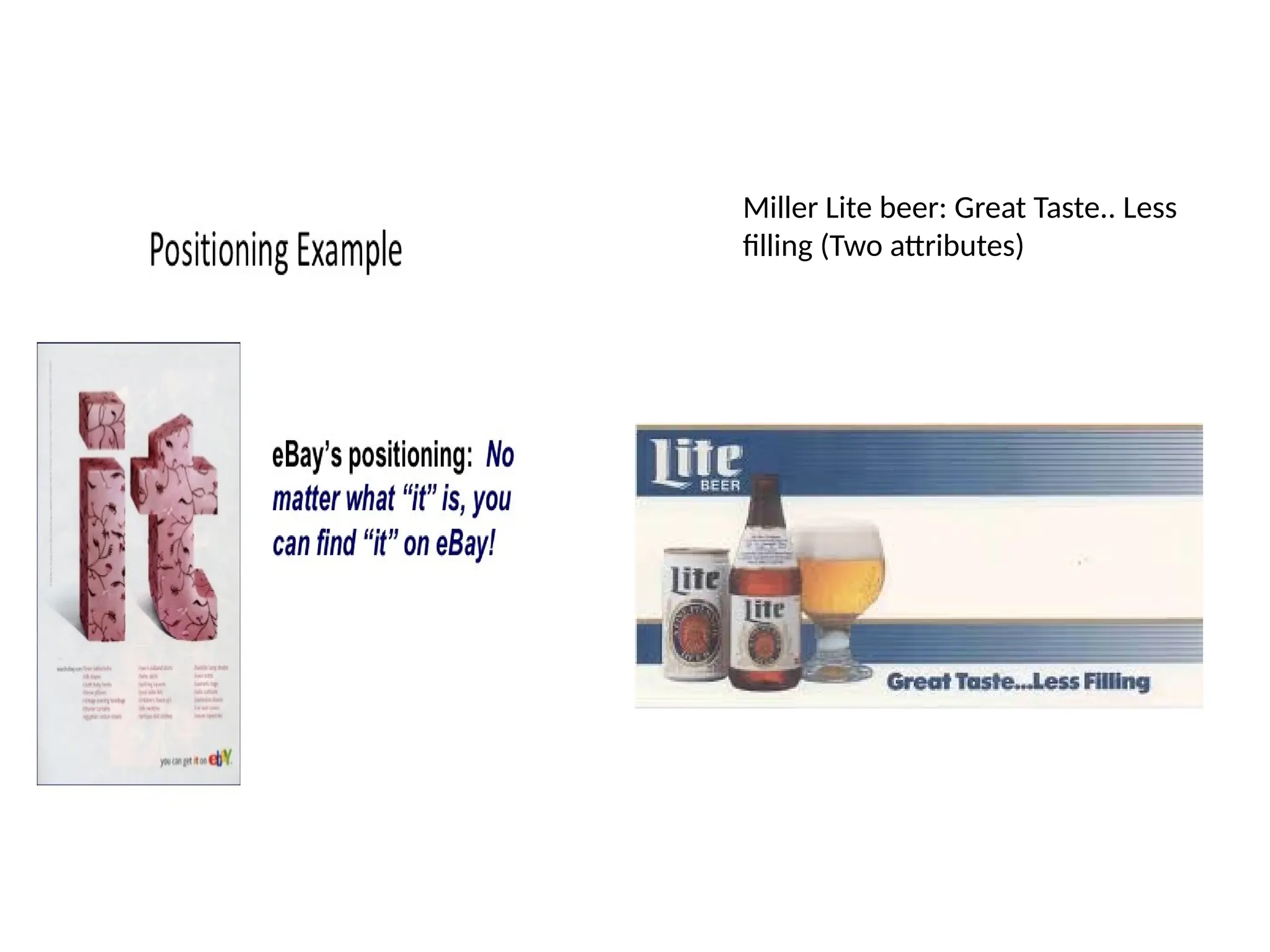
Miller Lite beer: Great Taste.. Less
filling (Two attributes)
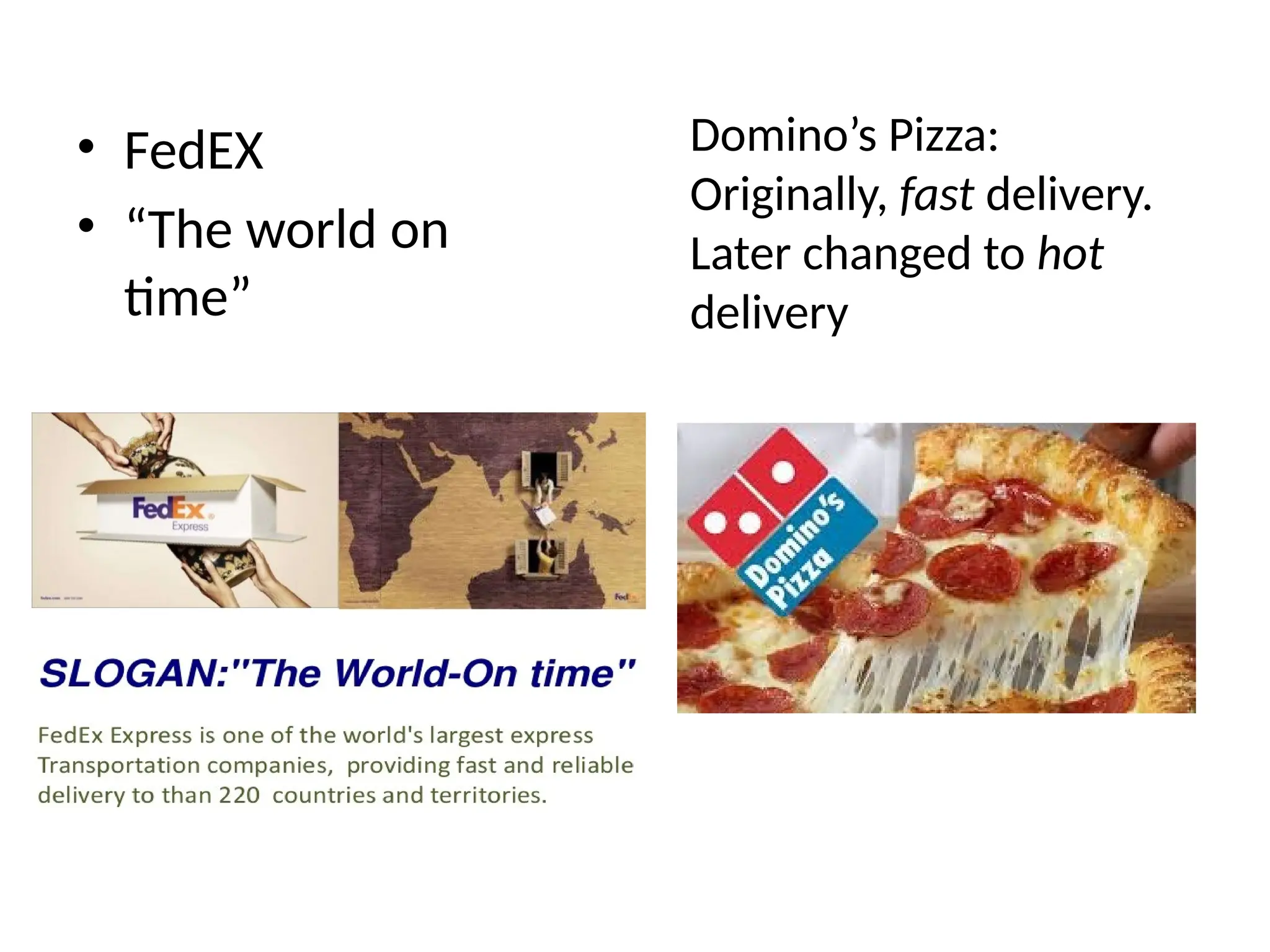
• FedEX
• “The world on
time”
Domino’s Pizza:
Originally, fast delivery.
Later changed to hot
delivery
• “Connecting People”
• “Utterly Butterly Delicious”
• “Life is Good”
• “ Just do it”
• Jo Biwi Se Kare Pyar, Woh ---------- Se Kaise
Kare Inkaar
• Yeh -------- ka mazboot jod hai…tootega nahi
• Licious is always ………………..
Thank You

segmentation, targeting, and positioning

  • 2.
    Marketing strategies Familiar strategicapproach in Marketing is STP • Segmentation • Targeting and • Positioning
  • 3.
    STP • Segmenting: Processof dividing the market into different groups based on one or more variables • Targeting: Selecting the market segments, deciding the strategy and serving them efficiently and profitability • Positioning: It is a market attraction strategy, which involves placing the brand in the minds of the customers in the target market
  • 4.
    Segmentation • The processof grouping/ dividing the customers within a market according to similar needs, habits, characteristics or attitudes and behaviors that can be addressed through separate marketing strategies or mixes
  • 8.
    Marital status • Marketsegmentation can also be as per the marital status of the individuals • Travel agencies have different holiday packages for - bachelors/ married couples/ family with kids
  • 9.
    Education Market • Canbe segmented on the basis of education – matriculation or less, under graduates, graduates, post- graduation, etc.
  • 10.
    Income • Buying patternsdepends on income of the consumers • All individuals will not spend money in the same way. • Pantaloon, Shopper’s stop target the high income group where as Big bazaar who cater to the individuals belonging to the lower income segment
  • 11.
    Age and stageof family life cycle • Consumers’ wants and abilities change with age. • On the basis of age, a market can be divided into four parts viz., children, young, adults and old. For the consumers belonging to the different age groups, different types of products are produced • For instance, Pepsodent/Colgate kids is for children while Pepsodent Gum Care /Colgate sensitive for adults.
  • 12.
    Occupation • It isalso an important variable • Consumption behavior differs from working executives to self employed people or a blue collar workers or a house wives…. • Marketers always target these people based on their working culture • Ex; Bank employs, Doctors, Shop keepers, • Teachers, Lawyers….
  • 13.
    Occupation • Certain showrooms will be specifically meant for the professional attires. The segment is created based on the occupation and its requirement
  • 14.
    Geographic Segmentation • Segmentationon the basis of Region: • North, South, East and West. • Density: The number of people per sq. km • Climate: Moderate, rain fed or dry with scanty rainfall • Political boundaries: Congress/ BJP • Population boundaries: UP, Rajastan…
  • 15.
    Geographic Segmentation • EarlierMTR ready food was sold in Southern India. But now it has spread all over India • TTK Prestige Pressure cooker was in South but now it has spread all over India • Hawkins Pressure cooker had its major market in North India
  • 16.
    Geographic segmentation • Bennett,Coleman and Co. Ltd divided markets according to geographical units for their tabloids. In Bangalore, the tabloid is known as Bangalore Mirror where as it is Mumbai Mirror in Mumbai etc
  • 17.
  • 18.
    Psychographic Segmentation • Socialclass: upper, lower, middle class • Life style: Trendsetters, adopters, traditionalists • Personality: Authoritarian, ambitious Ex: In Gujarat, farmers were buying big 50-hp tractors but their actual need was for smaller tractor of 25 to 30 hp (Ref: Mahindra & Mahindra)
  • 19.
    Social Class Class CharacteristicsPreferences Upper - Upper Social elite, wealth inherited, well known family background, ascribed status, aristocrats, small in number reference group for others. Jewellery, antique, farm houses, vacations, luxury, products at high prices Lower- Upper Social elite, wealth earned, educated and professional active in social and civic affairs, aspire, and associate with upper, upper stratum. Status symbols – cars, homes, refrigerators, expensive schools, exhibition products, art pieces, sculptures, etc. Upper- middle Career oriented dependent on education and hard work, dual career families seek comfort, ambitious Quality of life, products and entertainment, good interior decoration, vacations, travel and tour regular but economics entertainment.
  • 20.
    Social Class Class CharacteristicsPreferences Lower middle Average paid employees, small businessmen, college background, fashion, oriented but traditional dual career families Better life products, nice, homes, nice furniture, decent school, occasional vacations, travel and tour regular but economical entertainment Upper - lower Above poverty line – Depend on loans and advances, hand to mouth, dual career families, traditional, strong family ties, school education Economy, products, installment and credit buying, low priced popular brands and local unbranded products. Lower - Lower Below poverty line, daily incomes, low per capital income poor health and hygiene, dependence on petty loans and charity Local unbranded products, daily purchases, cheap varieties, buy seconds or collect thrown out clothes, food etc.
  • 21.
  • 22.
    Socio-cultural values andbeliefs • Social class and cultural factors affect consumer buying behavior. • Social groups include: family, friends, peers, colleagues • Culture influences consumer behavior deeply • A given culture brings its own unique pattern of social conduct
  • 23.
    Socio-cultural values andbeliefs • A person usually acquire his cultural attributes right at his childhood • Culture includes religion, caste, language, social behavior • Ex: Mc Donald don’t offer beef products in India • Saudi Arabia Mc Donald outlets include separate dining sections for both men& women
  • 24.
    Cultural values • Culture,values: Atithi devo Bhava, Applying tikka, doing aarti, respecting elders
  • 25.
    Personality traits • Marketersendow their products with brand personality that corresponds to consumer personalities • Ex: Parker Pens use Amitabh Bachchan as their brand ambassador to project it as a status symbol
  • 26.
    Behavioral Segmentation • Buyersare divided into different groups • Occasions • Product or brand usage • User Status • Usage rate • Buyer’s purchase decision based on benefits sought
  • 27.
    Occasions • Archies foroccasional greetings • Cadbury is associating its chocolates with happy occasions and trying to replace it with age old traditional sweets • ICICI bank sell gold coins at the occasion of Akshay Tritiya/Diwali • On Valentines Day company like Ferns and Petals gets highest order to deliver flowers all across India • Gifts at the time of Christmas and New Year
  • 28.
    Buyer’s purchase decisionbased on benefits sought • Ex: In the tooth paste category • Some look for economic price/ some look for fresh breath/ somebody for medicinal properties/ some look for cosmetic properties such as white and bright teeth
  • 29.
    User Status • Userstatus is further segmented into • First time users – • Regular Users • Ex users • Potential users and • Non Users
  • 30.
    Johnson and Johnson •For kid mother may use Johnson’s baby soap and baby oil for the first time • Becomes regular user for few years • When baby grows little older it stops the usage then it becomes ex user • Potential users groups are mother –to –be • Some people may not use Johnson and Johnson products
  • 31.
    Usage rate • Thisalso helps to segment the market • Telecom companies like Airtel, Jio, Vodafone, Reliance… regularly segment their customers on the basis of Light, Medium and Heavy users • The usage rate further leads to consumers loyalty
  • 32.
    Targeting • A targetmarket refers to a group of individuals who are inclined towards similar products and respond to similar marketing techniques and promotional schemes.
  • 33.
    • Kellogg’s KSpecial mainly targets individuals who want to cut down on their calorie intake. The target market in such a case would be individuals who are obese. • Boost which majorly cater to teenagers and kids to help them in their overall development. • The target market for Kellogg’s K Special would absolutely be different from Boost or Complan
  • 34.
    Different levels ofTarget Marketing
  • 35.
    Un Differentiated (Mass) Marketing • Ignores segmentation opportunity • Ex: When Henry Ford introduced the Ford Automobile, he offered one model to the market with one color option, black. • Coca Cola was introduced into the market with one flavor Ad for the Model A from a December 15, 1903 newspaper
  • 36.
    Differentiated Marketing • Thisstrategy is used when a company creates campaigns that appeal to at least two market segments or target groups. • For example, a store can promote a sale that appeals to people in at least two cities or locations • A company can market a product that appeals to women in at least two age groups
  • 37.
    Concentrated marketing • Thisis targeted to one specific market segment or audience. • Ex: Only for teenage girls • Retailer might market his business to residents in a specific town • Concentrated marketing strategies are often geared for smaller groups of people, because they are designed to appeal to a specific segment
  • 38.
    Niche market • Isthe subset of the market where a specific product is focused • Ex: Gold plus jewellery from the Tata Group which targeted rural and semi urban populations in South India. • Ghari detergent introduced variants of its product based on the quality of water. • The jeevan Sadhan service of Nokia launched in 2009 specially targeted rural Indian consumers. • It provided the services like providing agricultural tips, market prices, weather forecasts, career information
  • 39.
    Rolls Royce • "MallikaSherawat wanted to buy Rolls Royce but was refused. The car is not sold just to those who wish to buy it. There is a process where it is decided if the person wishing to buy it is fit enough to be its owner or not and money is not just a criteria.
  • 40.
    • The person'sentire profile, Social standing for the past few years is put under scanner and then decided. Even the test drive are given to selected people. Mallika apparently tried to convince the brand by saying she is Hollywood actor et al but things didn't work out in her favour"
  • 41.
    Positioning • Positioning isdeveloping a product and brand image in the minds of consumers • It can also include improving a customer's perception about the experience they will have if they choose to purchase your product or service • Effective positioning involves a good understanding of competing products and the benefits that are sought by your target market.
  • 42.
  • 43.
    Key Questions Concerning PositioningDecisions • For whom are they written? - For consumers • In what sort of language? - develop the catchy consumer language, based on the chosen positioning • Should they focus on features or benefits?- Benefits - which are ultimately why people will buy • How many differentiating attributes should anchor them? - One, or two at the most with Clear and simple language
  • 47.
    Miller Lite beer:Great Taste.. Less filling (Two attributes)
  • 48.
    • FedEX • “Theworld on time” Domino’s Pizza: Originally, fast delivery. Later changed to hot delivery
  • 49.
    • “Connecting People” •“Utterly Butterly Delicious” • “Life is Good” • “ Just do it” • Jo Biwi Se Kare Pyar, Woh ---------- Se Kaise Kare Inkaar • Yeh -------- ka mazboot jod hai…tootega nahi • Licious is always ………………..
  • 51.