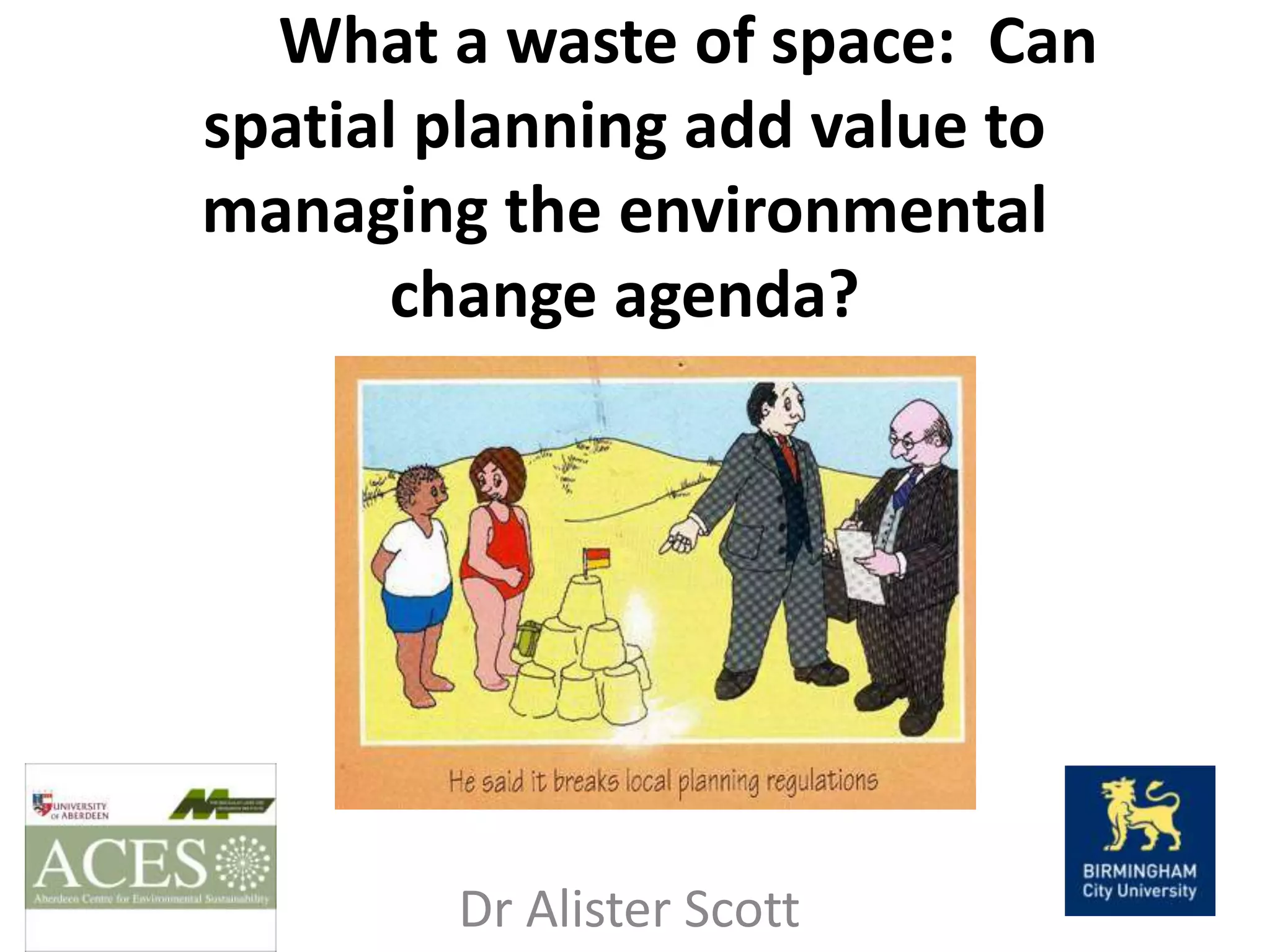
What a waste of space:  Can spatial planning add value to managing the environmental change agenda? Dr Alister Scott
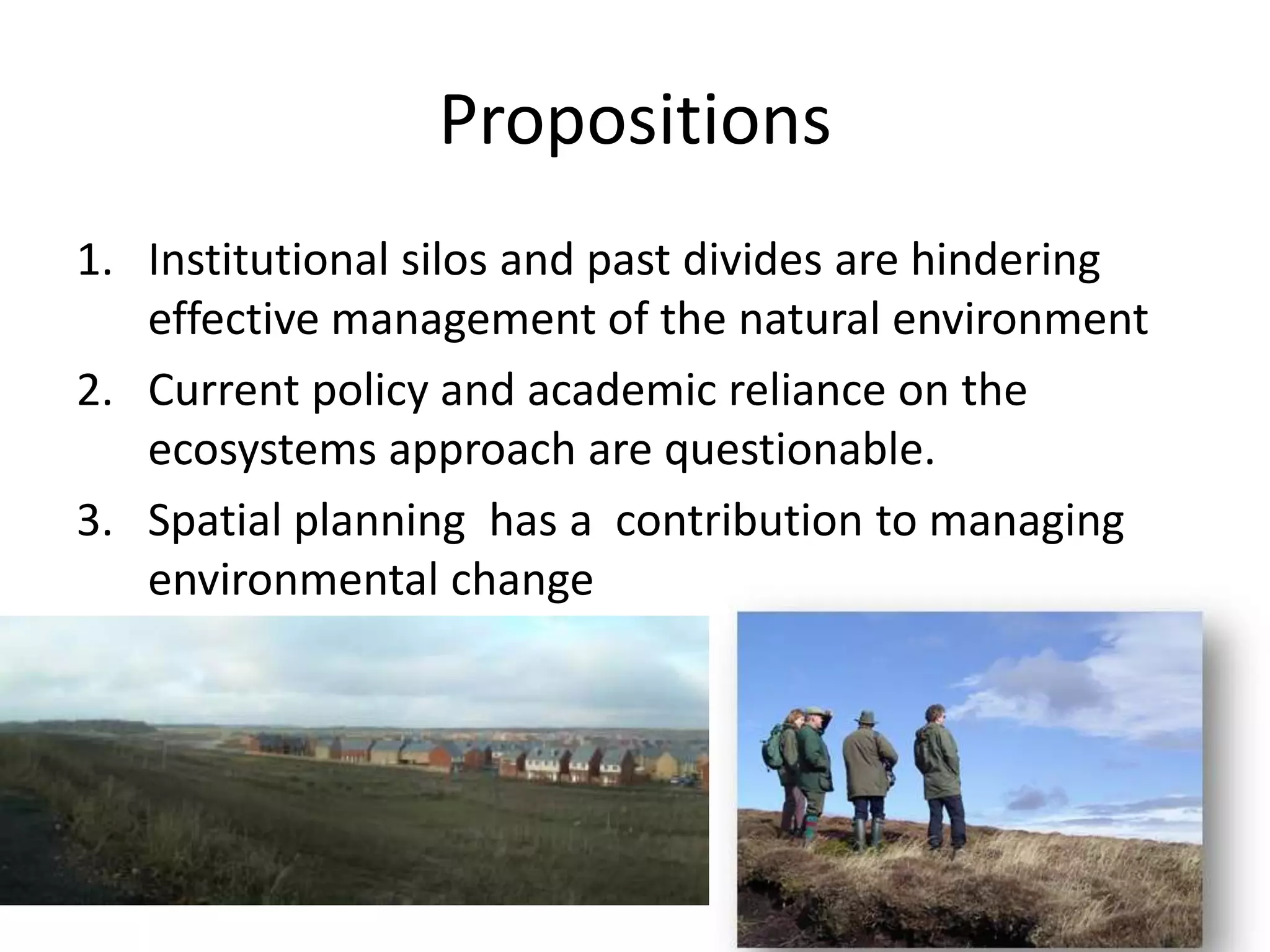
Propositions Institutional silos and past divides are hindering effective management of the natural environment  Current policy and academic reliance on the ecosystems approach are questionable.   Spatial planning  has a  contribution to managing environmental change
Talk outline: The planning: environment divides   Critical review of spatial planning theory and practice Planning peatlands (IUCN) Rural urban fringe (RELU)A way forward: Adapting spatial planning practice Reflections : reconnecting the divides;  interdisciplinary work and social learning.
Planning and Environment: LURNing from past divides Fragmented environmental governanceUrban vs Rural (Curry, 1994; 2008)Landscape vs Nature Conservation (MacEwen +MacEwen  1982 Institutional/professional separation: Nature Conservancy vs National Parks CommissionDEFRA vs CLG Academic Separate paradigms to guide theory and practice Limited communication and understanding across the divides
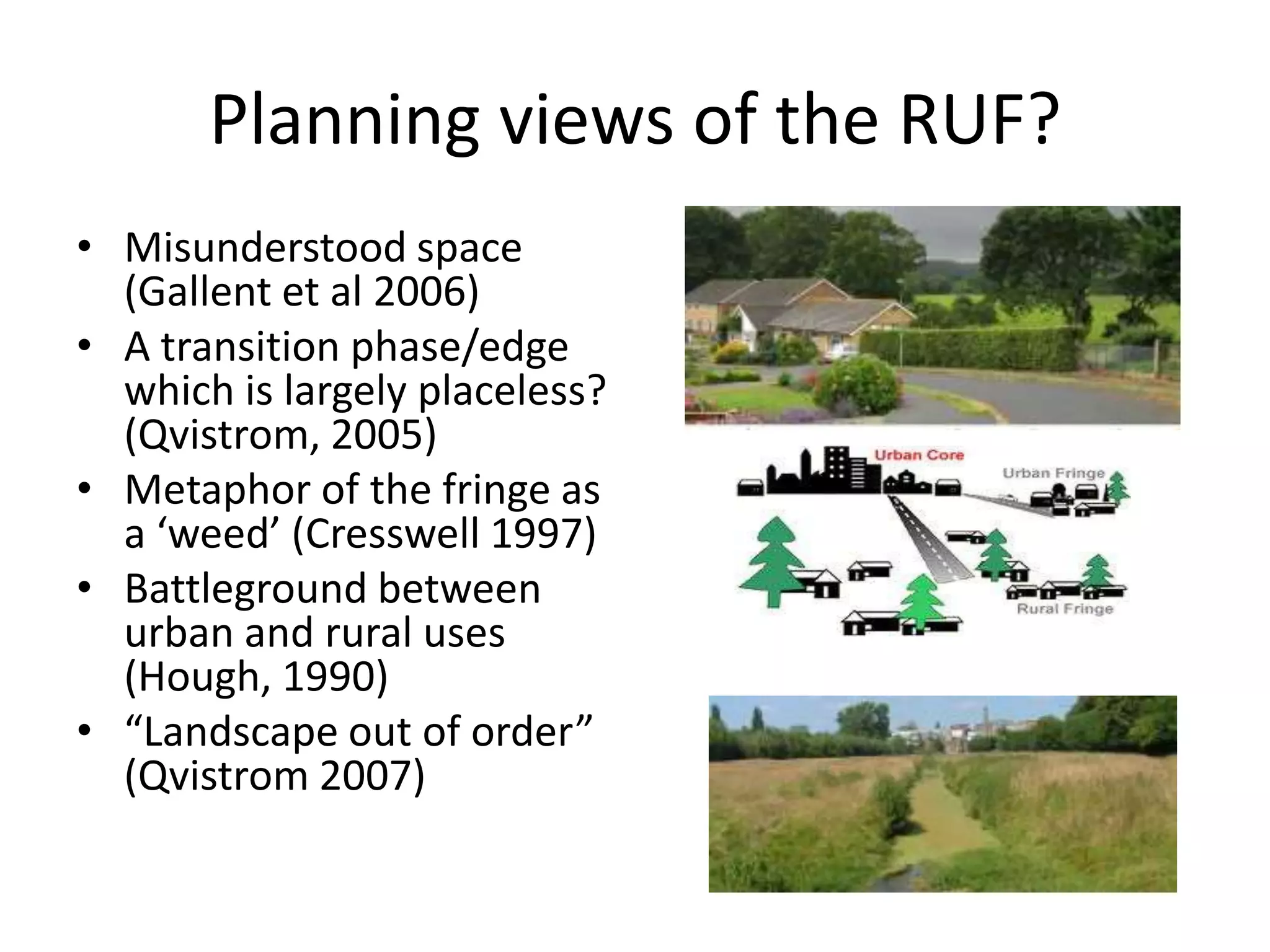
Planning views of the RUF?  Misunderstood space   (Gallent et al 2006)  A transition phase/edge which is largely placeless? (Qvistrom, 2005)Metaphor of the fringe as a ‘weed’ (Cresswell 1997)Battleground between urban and rural uses (Hough, 1990) “Landscape out of order” (Qvistrom 2007)
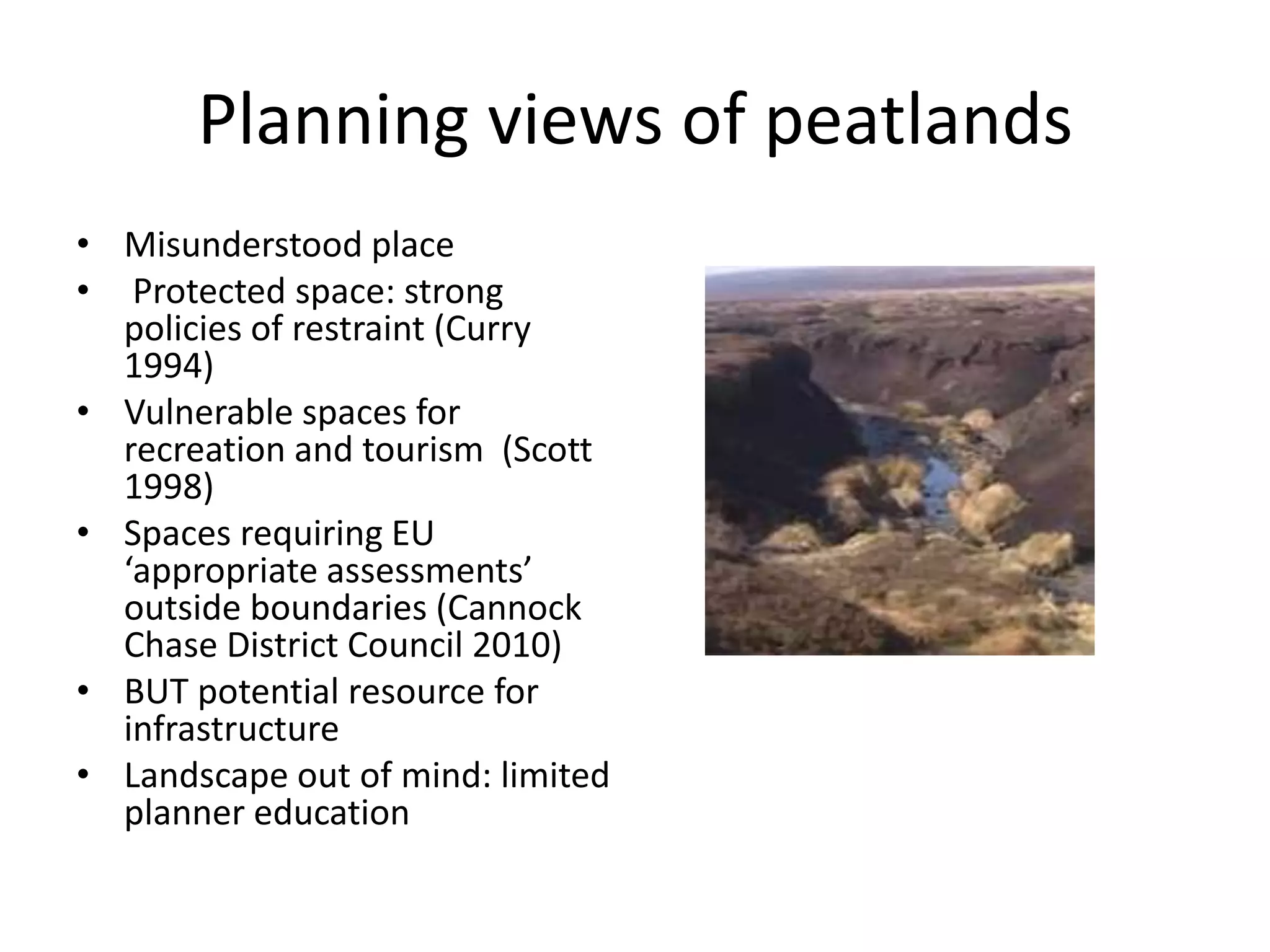
Planning views of peatlands Misunderstood place Protected space: strong policies of restraint (Curry 1994)  Vulnerable spaces for recreation and tourism  (Scott 1998) Spaces requiring EU ‘appropriate assessments’ outside boundaries (Cannock Chase District Council 2010)BUT potential resource for infrastructure   Landscape out of mind: limited planner education
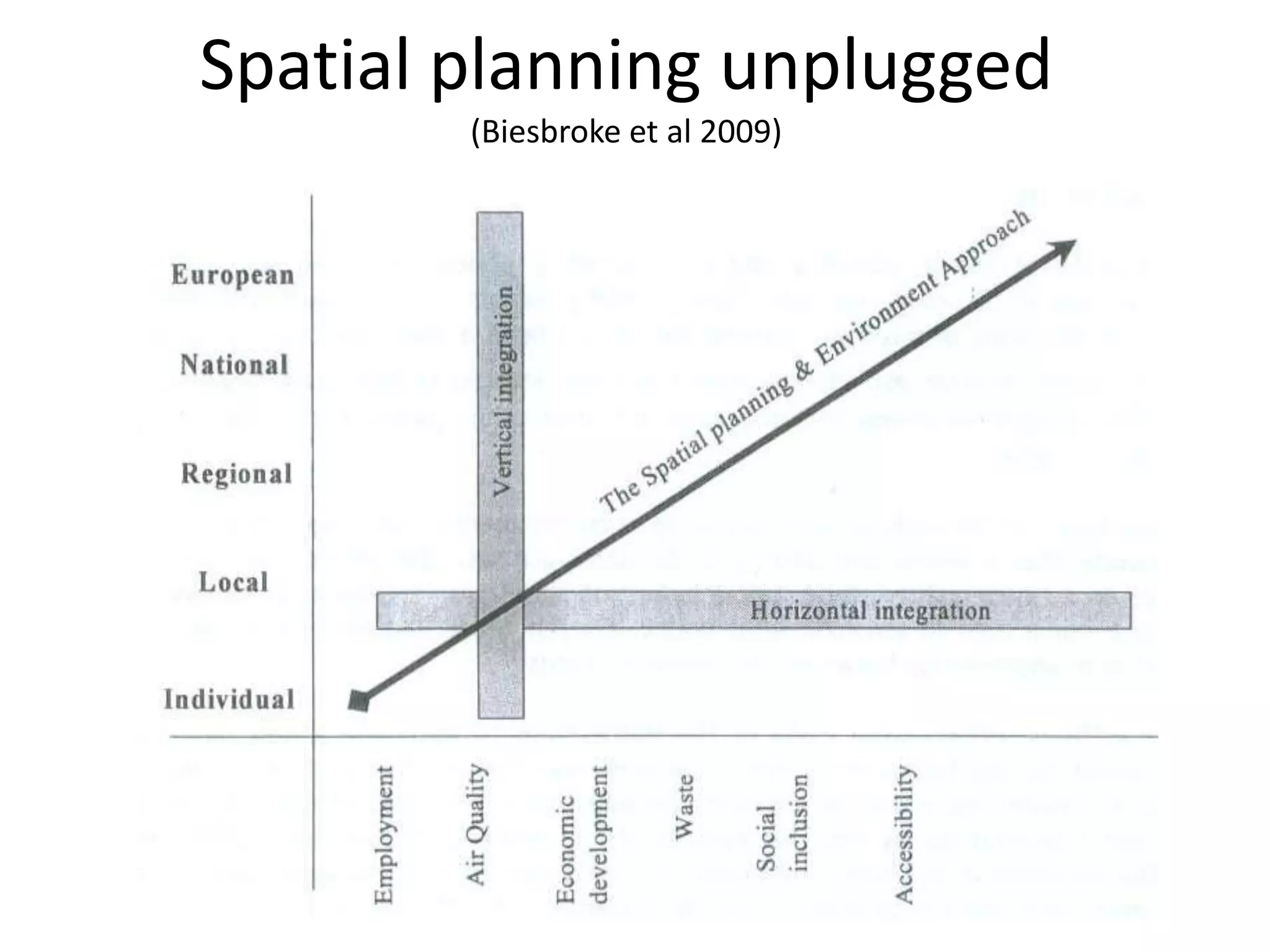
Spatial planning unplugged (Biesbroke et al 2009)
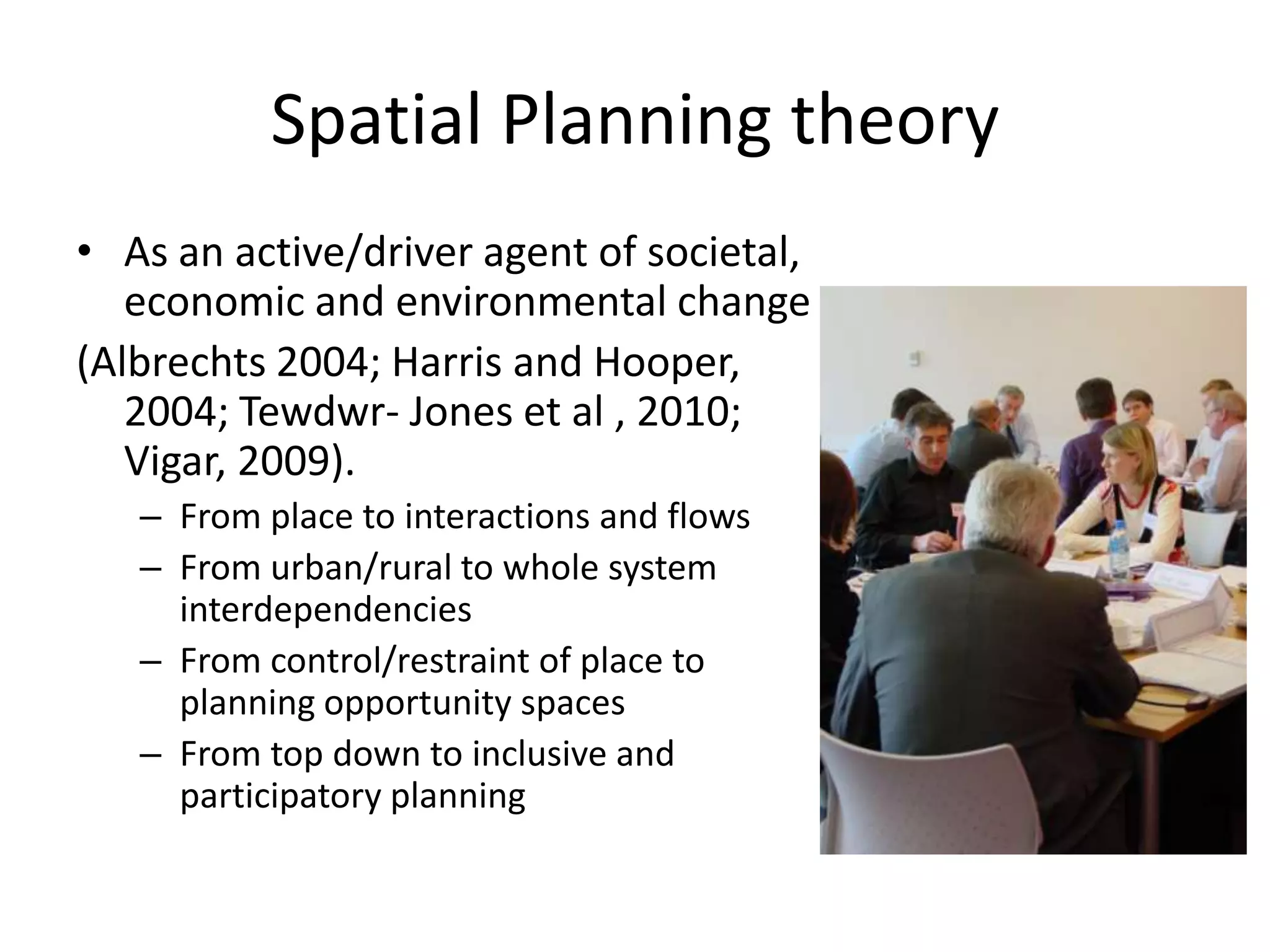
Spatial Planning theory  As an active/driver agent of societal, economic and environmental change (Albrechts 2004; Harris and Hooper, 2004; Tewdwr- Jones et al , 2010; Vigar, 2009).From place to interactions and flows   From urban/rural to whole system  interdependencies From control/restraint of place to planning opportunity spaces From top down to inclusive and participatory planning
Key ‘problem’ areas in SP practice  “The spatial planning project has failed” (Scott, 2010)“Theory practice disjuncture” (Scott et al, 2009) Uncertainty ProactivityLong TermismIntegration Governance Evidence Transparency
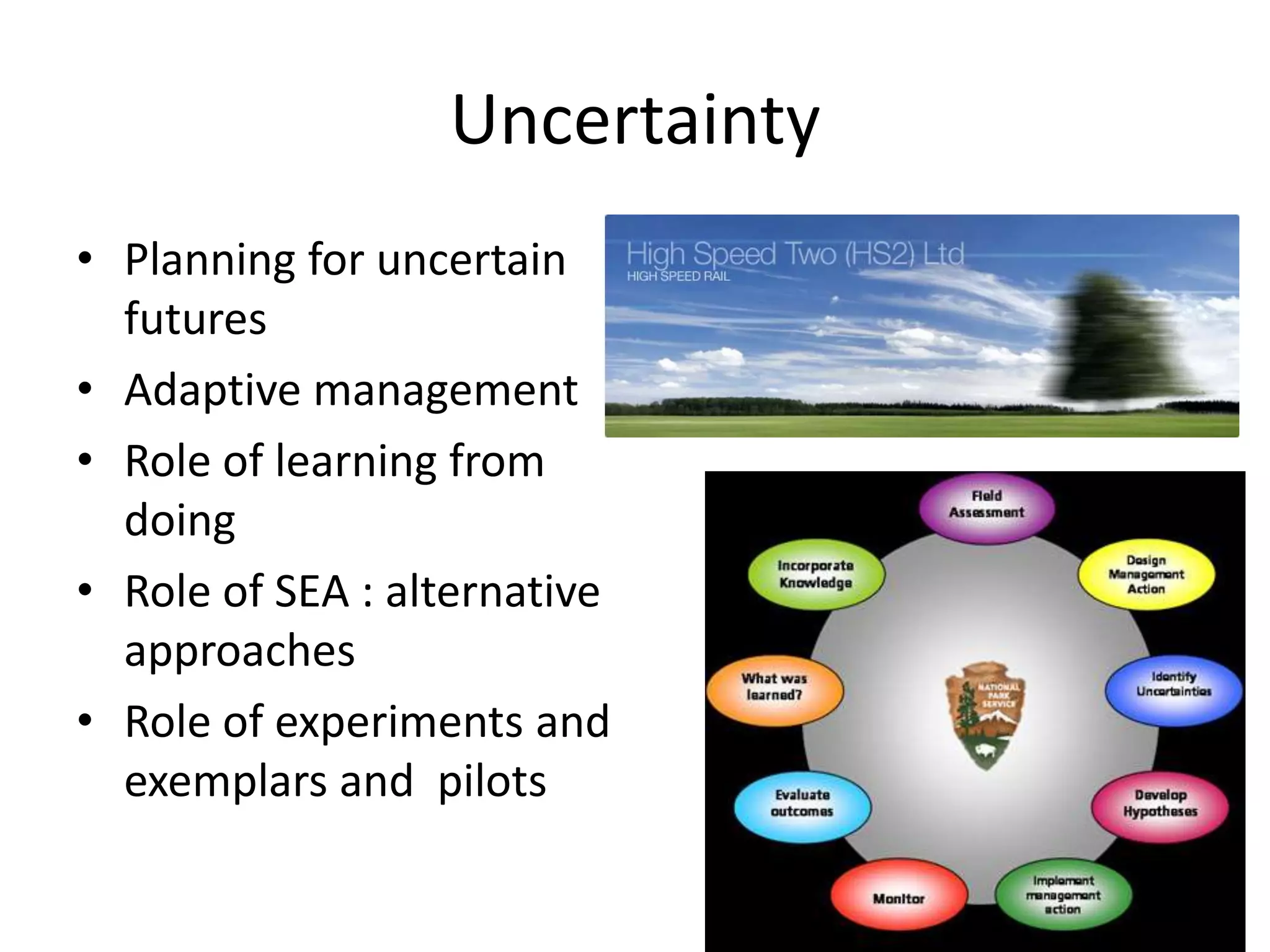
Uncertainty Planning for uncertain futures Adaptive management Role of learning from doingRole of SEA : alternative approaches Role of experiments and exemplars and  pilots
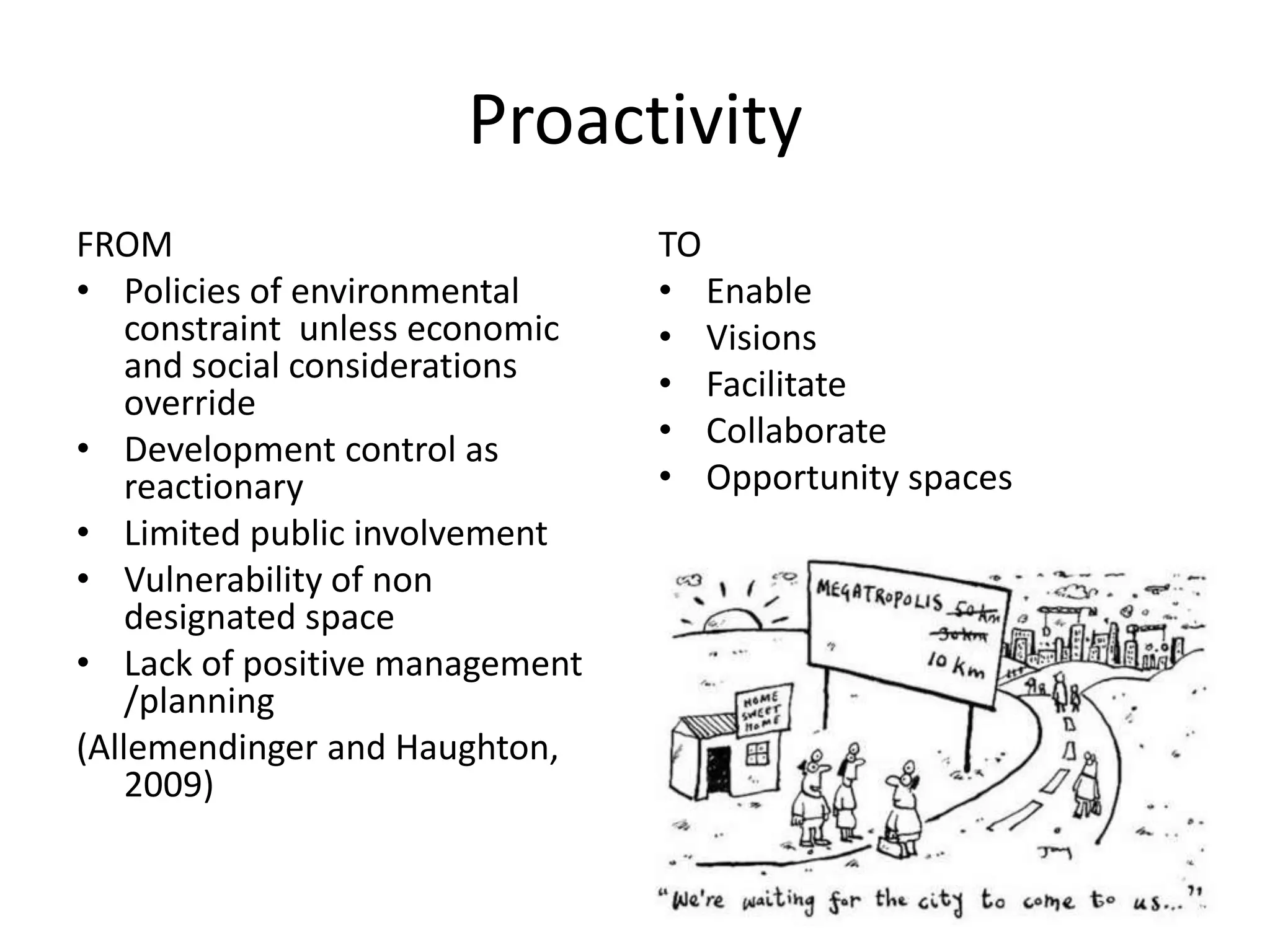
ProactivityFROMPolicies of environmental constraint  unless economic and social considerations overrideDevelopment control as reactionaryLimited public involvementVulnerability of non designated space Lack of positive management /planning(Allemendinger and Haughton, 2009)TO Enable Visions Facilitate Collaborate Opportunity spaces
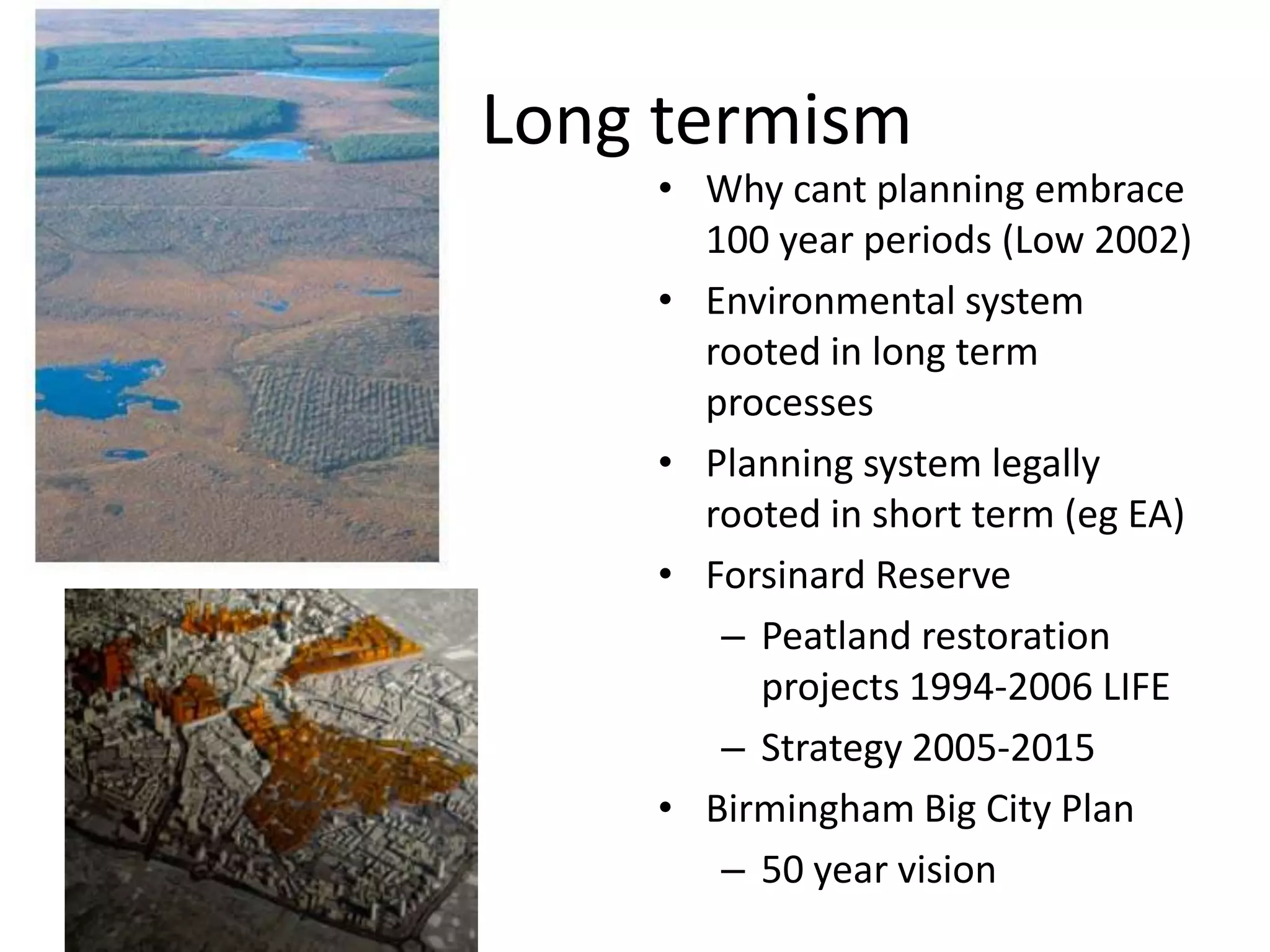
       Long termismWhy cant planning embrace 100 year periods (Low 2002)Environmental system rooted in long term processes Planning system legally rooted in short term (eg EA)Forsinard Reserve Peatland restoration  projects 1994-2006 LIFE Strategy 2005-2015 Birmingham Big City Plan50 year vision
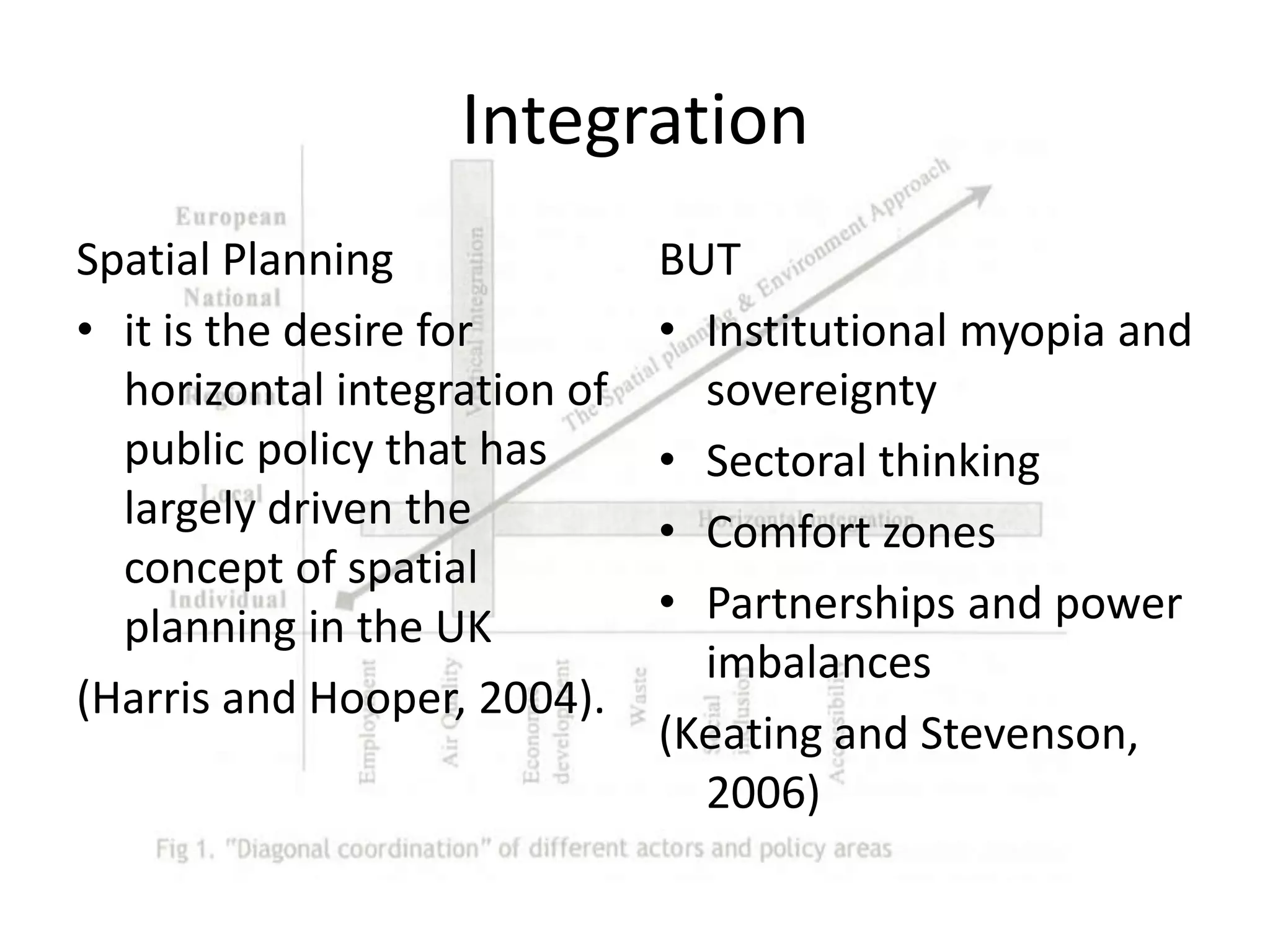
Integration  Spatial Planning it is the desire for horizontal integration of public policy that has largely driven the concept of spatial planning in the UK(Harris and Hooper, 2004). BUT Institutional myopia and sovereigntySectoral thinking Comfort zones Partnerships and power imbalances (Keating and Stevenson, 2006)
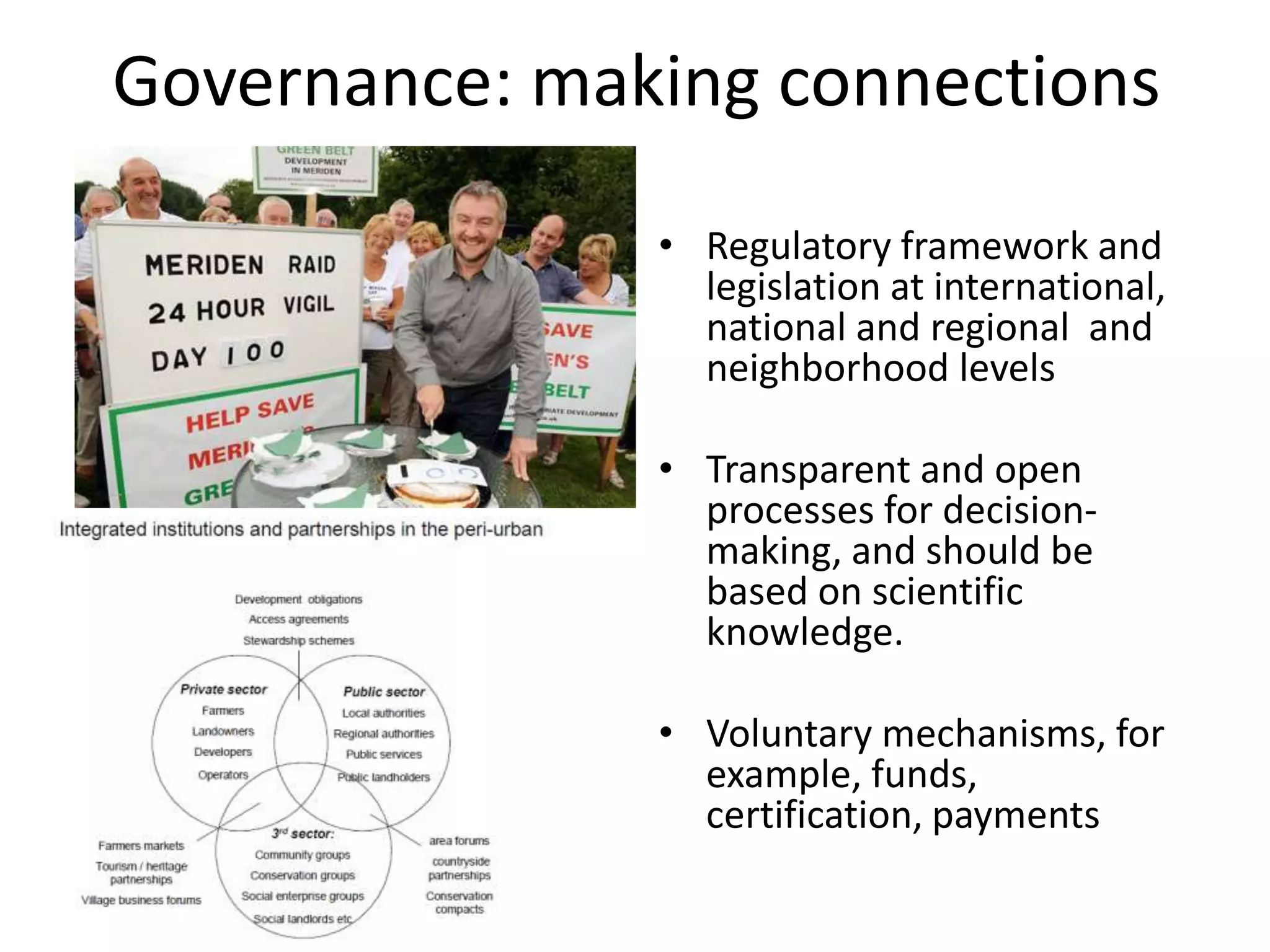
Governance: making connections Regulatory framework and legislation at international, national and regional  and neighborhood levelsTransparent and open processes for decision-making, and should be based on scientific knowledge.Voluntary mechanisms, for example, funds, certification, payments
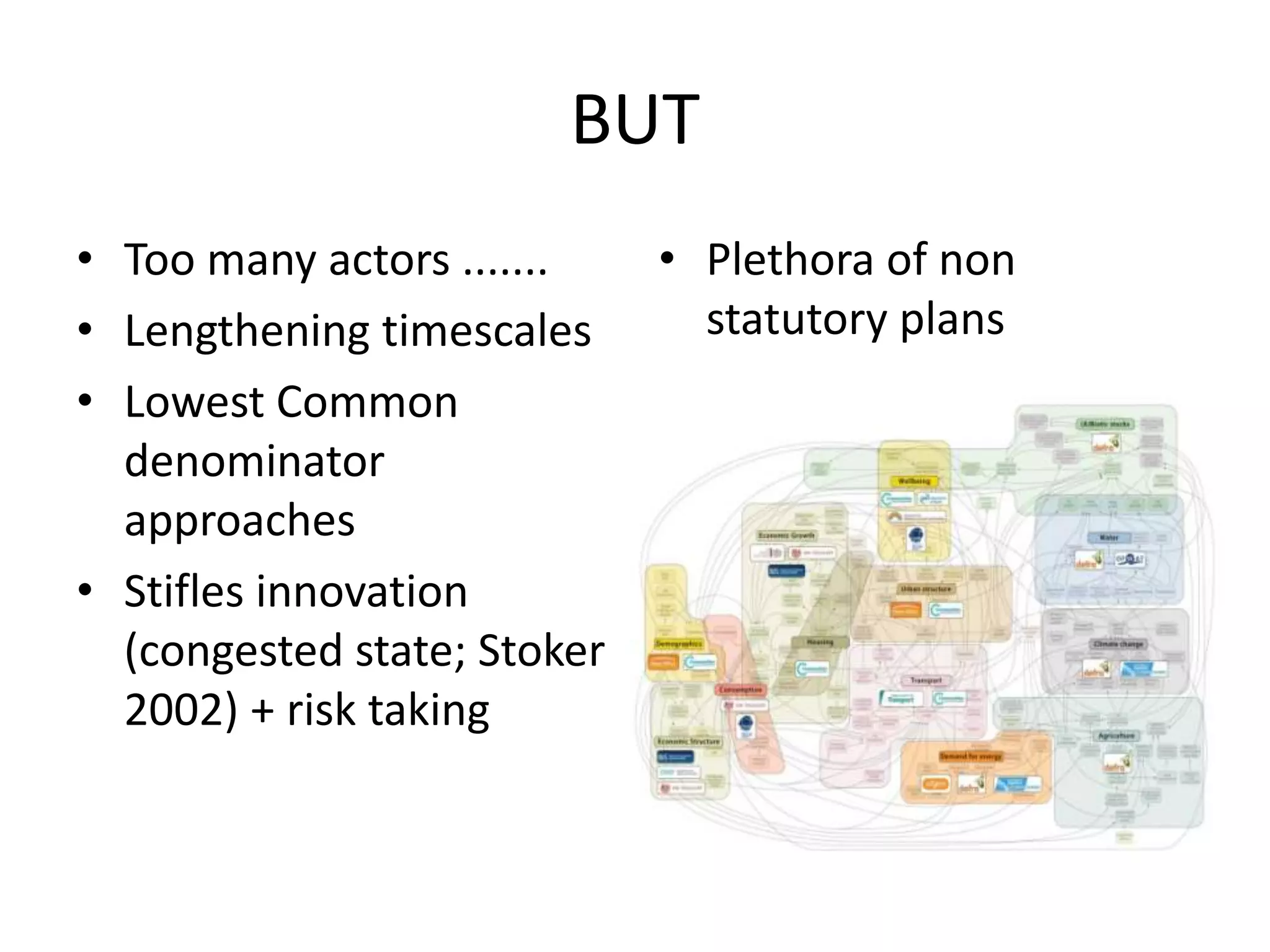
BUT Too many actors .......Lengthening timescalesLowest Common denominator approaches Stifles innovation (congested state; Stoker 2002) + risk taking  Plethora of non statutory plans
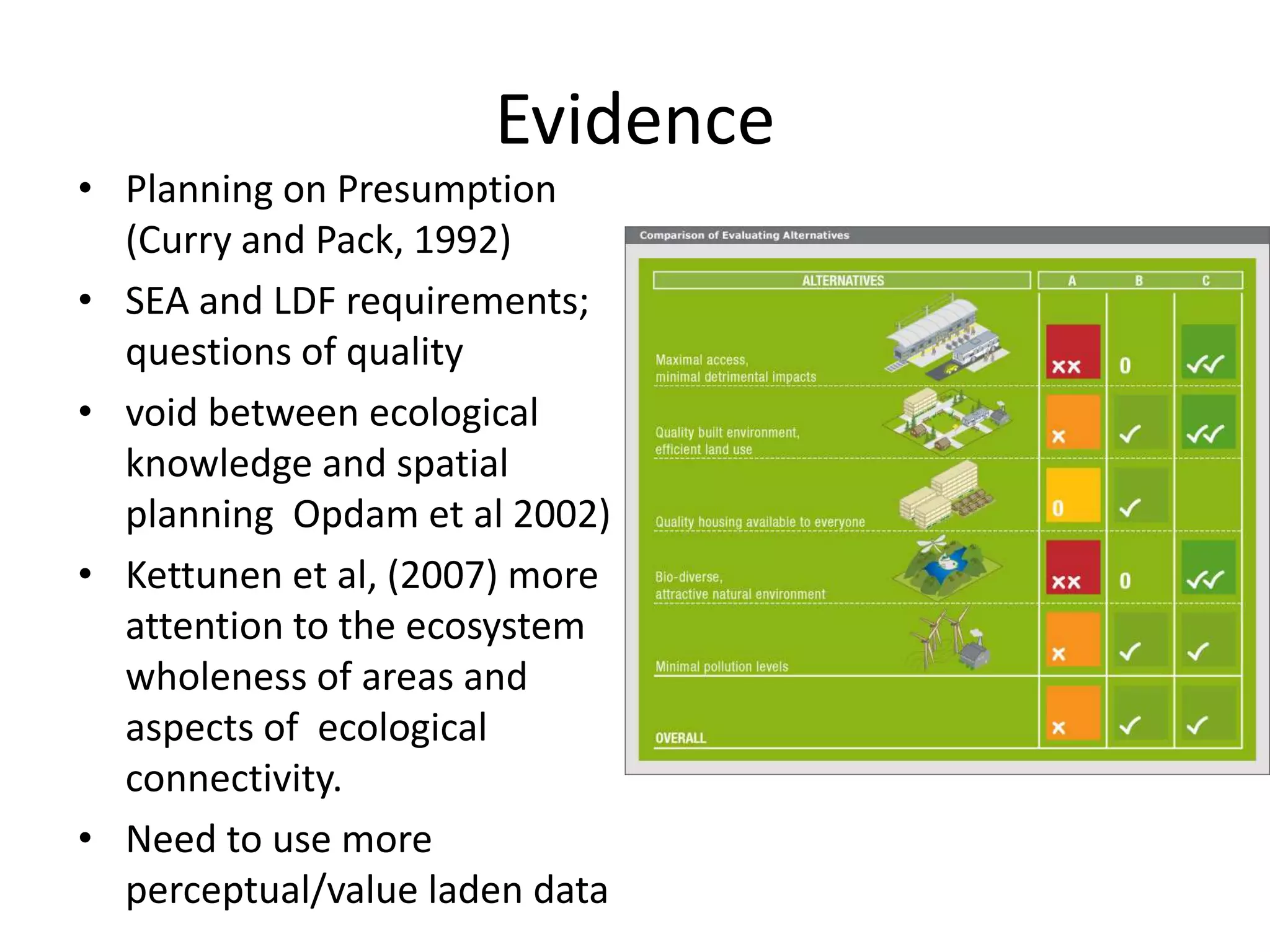
Evidence Planning on Presumption (Curry and Pack, 1992)SEA and LDF requirements; questions of quality   void between ecological knowledge and spatial planning  Opdam et al 2002)Kettunenet al, (2007) more attention to the ecosystem wholeness of areas and aspects of  ecological connectivity.Need to use more perceptual/value laden data
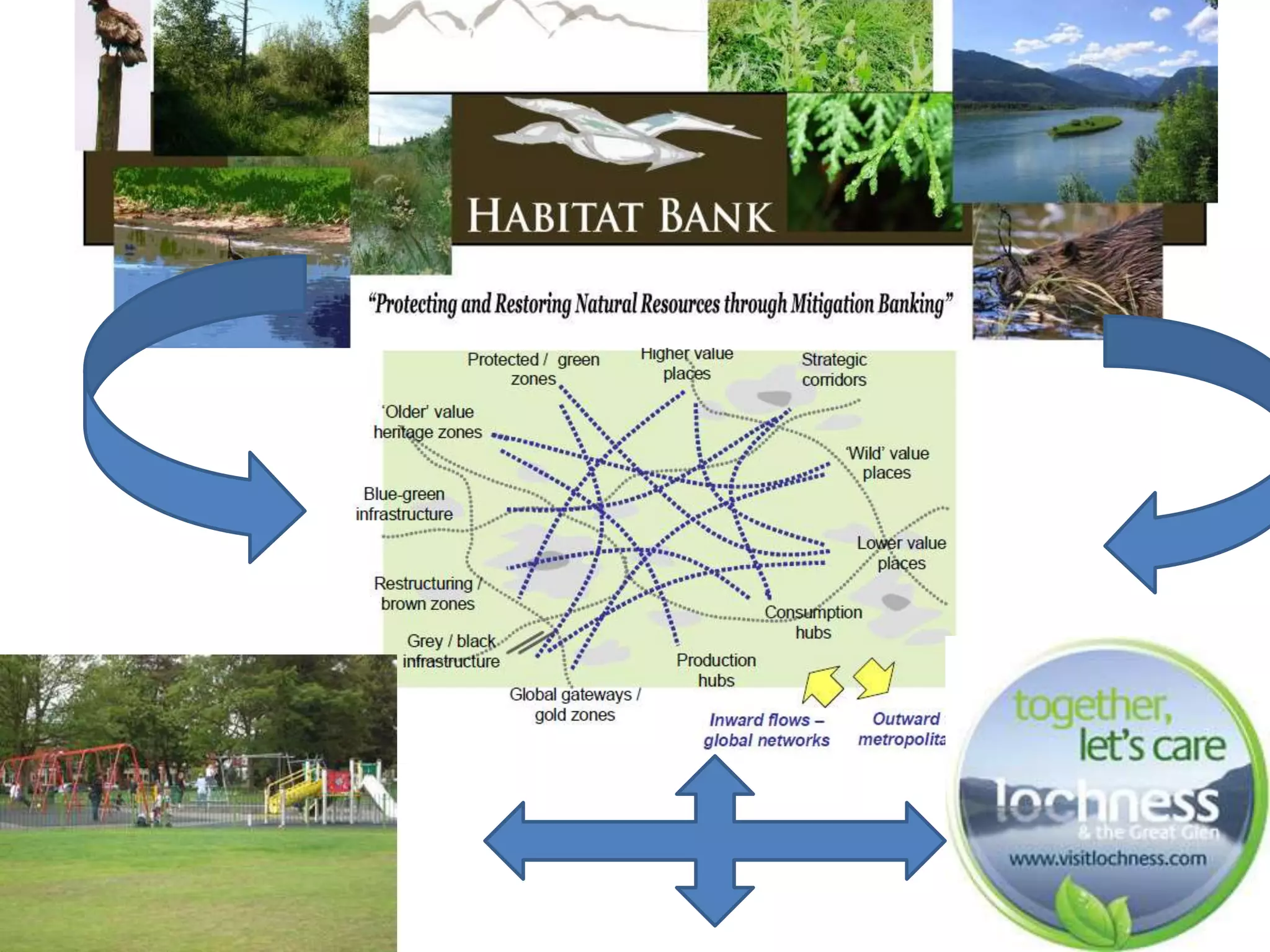
Adapted ideas for RUF and Peat  Concept of betterment and compensation Linking ideas of visitor payback, community infrastructure levy and habitat banking into ONE planning process.Role of voluntary partnerships to support environmental projectsLink with business, visitors, environment  and local communities  Provide a strategic reserve for funding needed activities. Joint community understanding and prioritisation of needs (community strategies and parish plans) Separation of planning  development from payback type investments (eg limits of S106) .
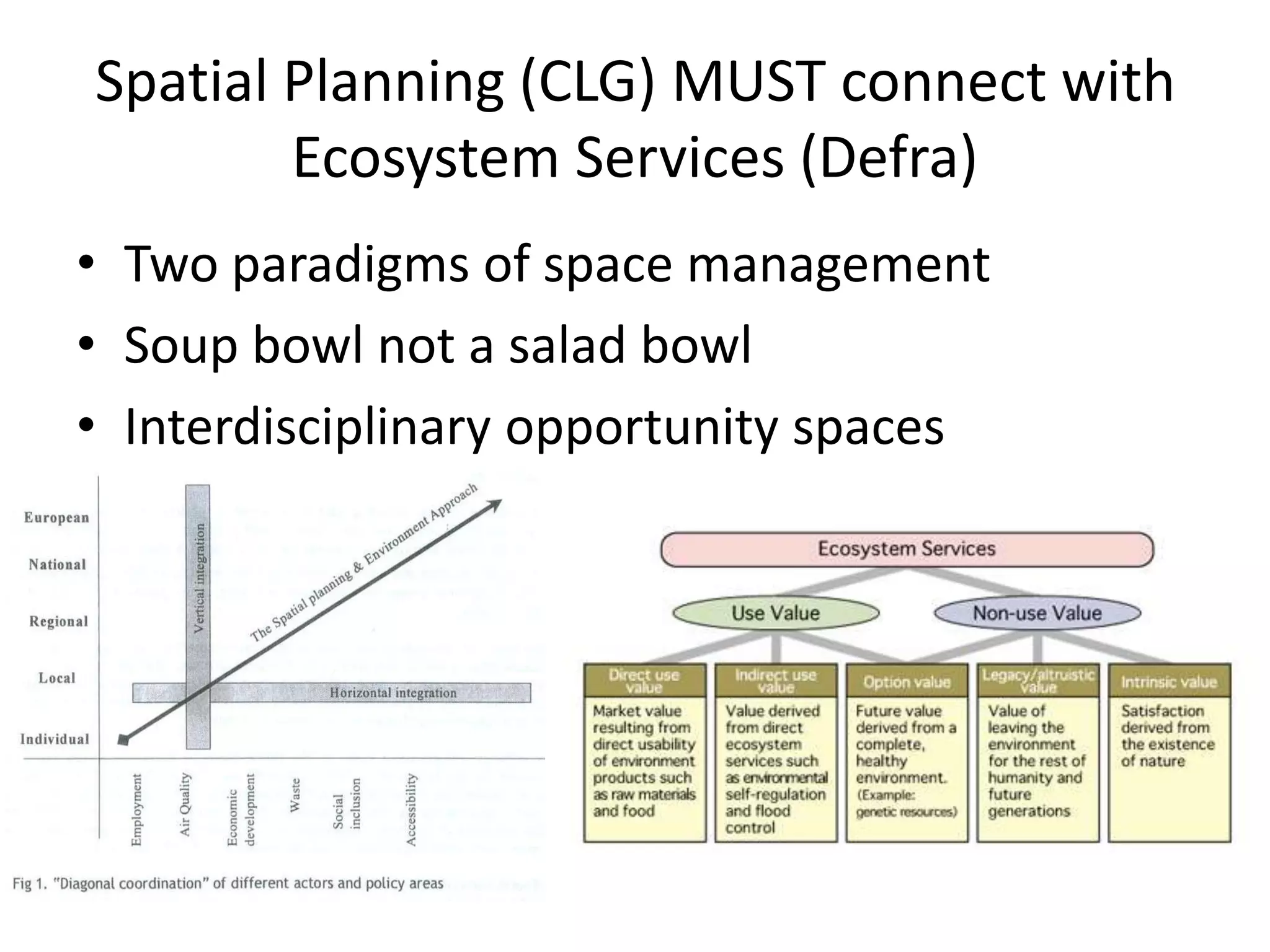
Spatial Planning (CLG) MUST connect with   Ecosystem Services (Defra)Two paradigms of space managementSoup bowl not a salad bowl Interdisciplinary opportunity spaces
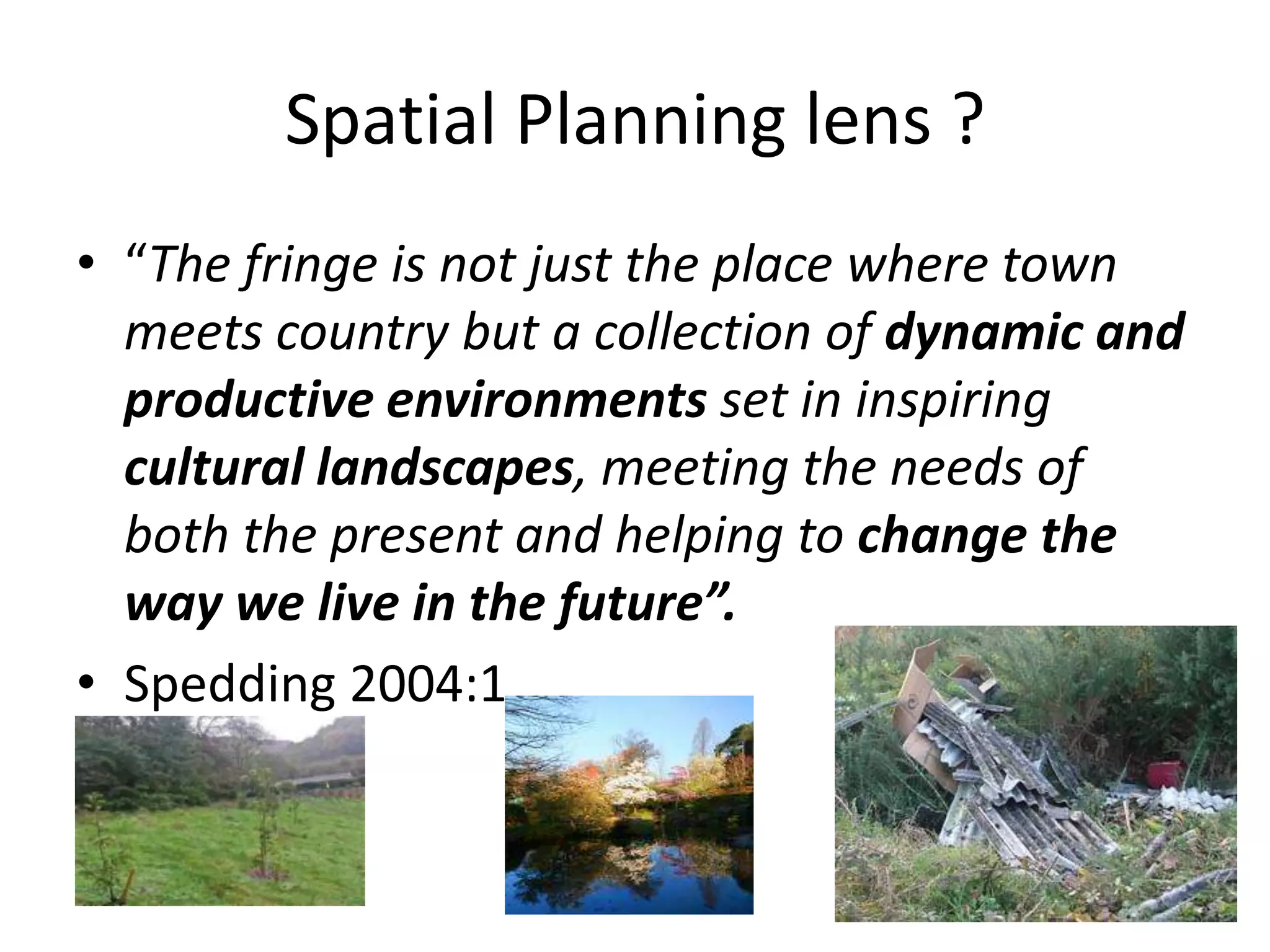
Spatial Planning lens ?“The fringe is not just the place where town meets country but a collection of dynamic and productive environments set in inspiring cultural landscapes, meeting the needs of both the present and helping to change the way we live in the future”. Spedding 2004:1
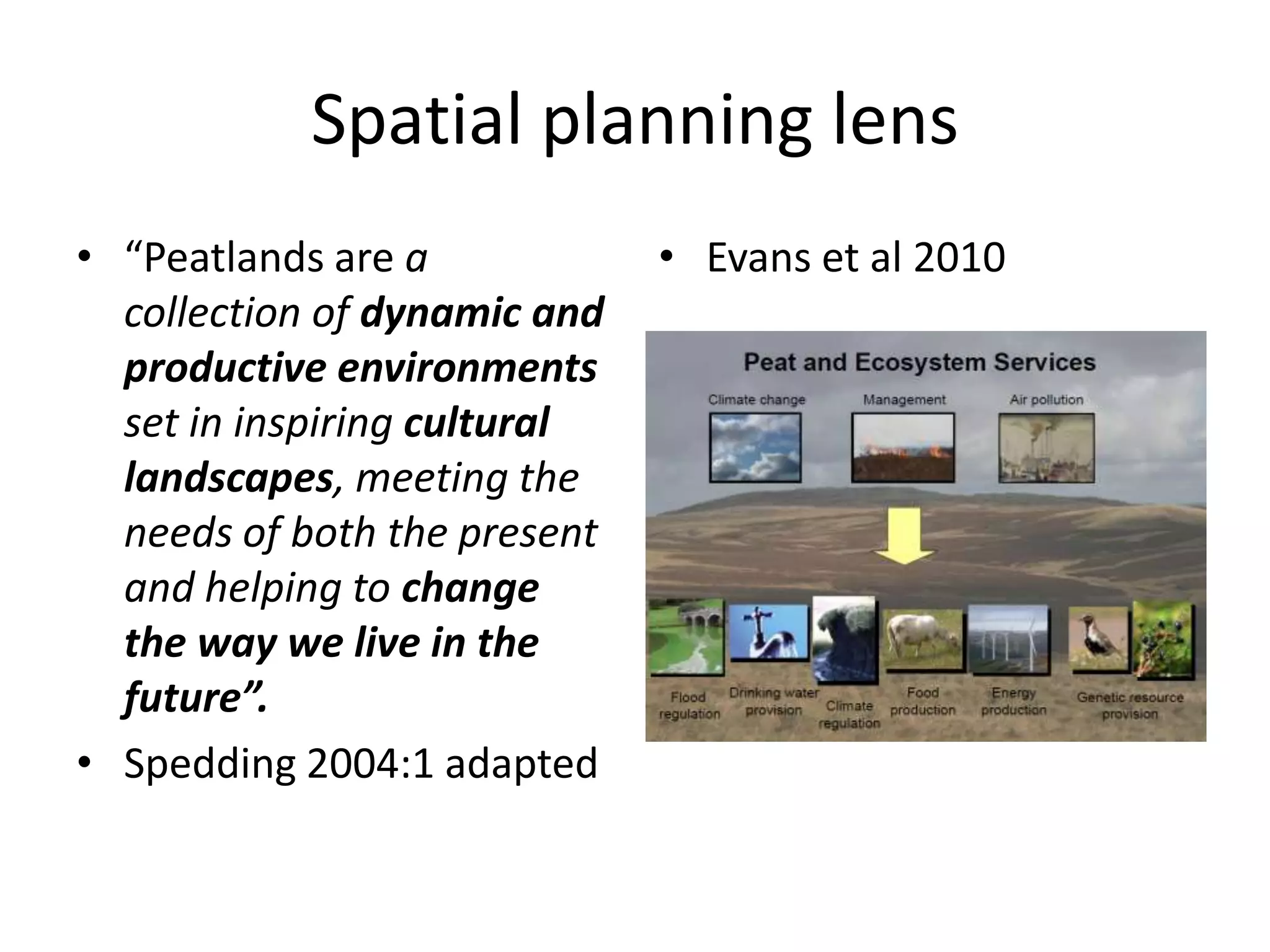
Spatial planning lens “Peatlands are a collection of dynamic and productive environments set in inspiring cultural landscapes, meeting the needs of both the present and helping to change the way we live in the future”. Spedding2004:1 adapted Evans et al 2010
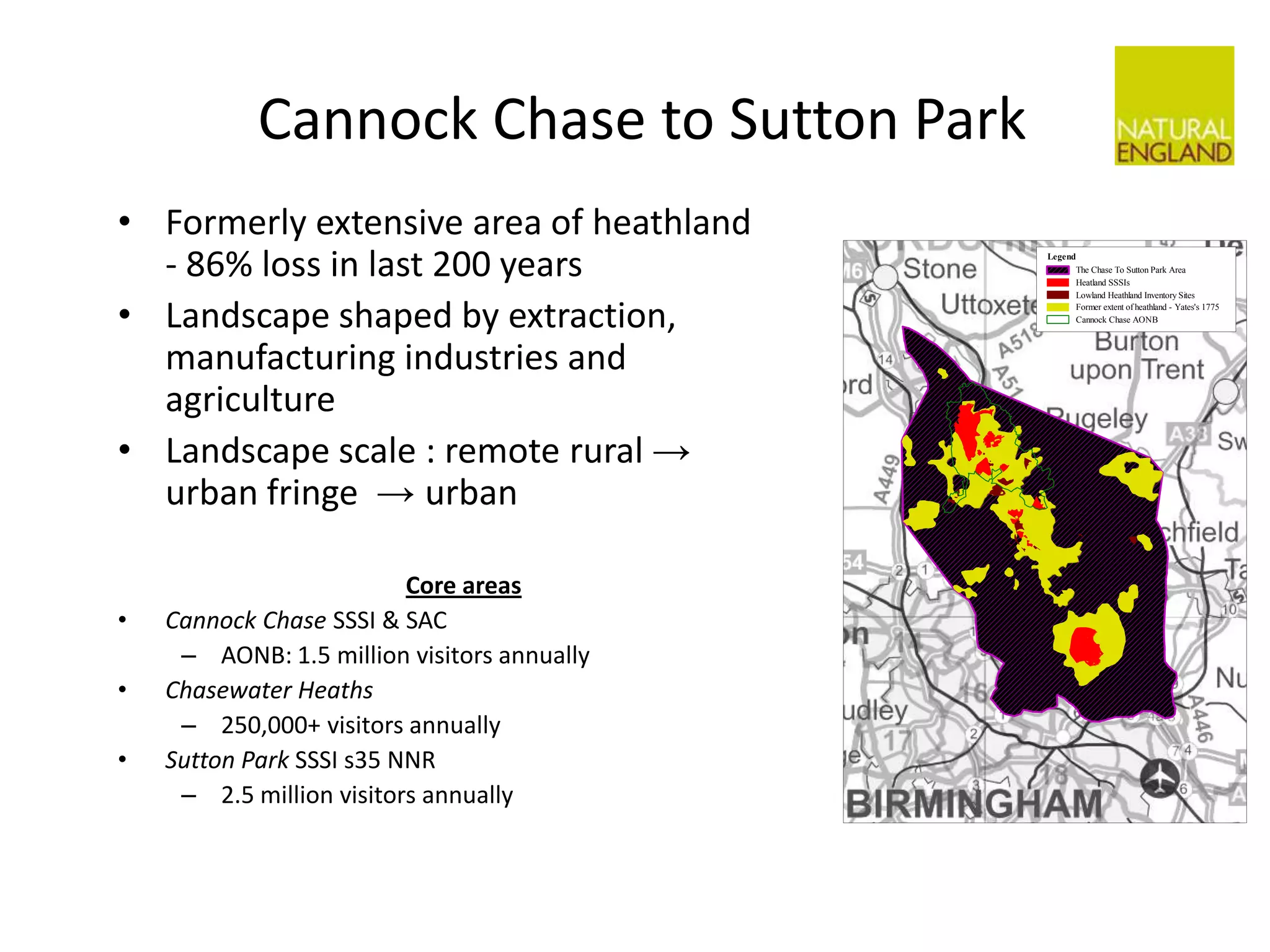
 Cannock Chase to Sutton ParkFormerly extensive area of heathland - 86% loss in last 200 yearsLandscape shaped by extraction, manufacturing industries and agriculture Landscape scale : remote rural -> urban fringe -> urbanCore areasCannock Chase SSSI & SACAONB: 1.5 million visitors annuallyChasewater Heaths250,000+ visitors annuallySutton Park SSSI s35 NNR2.5 million visitors annually
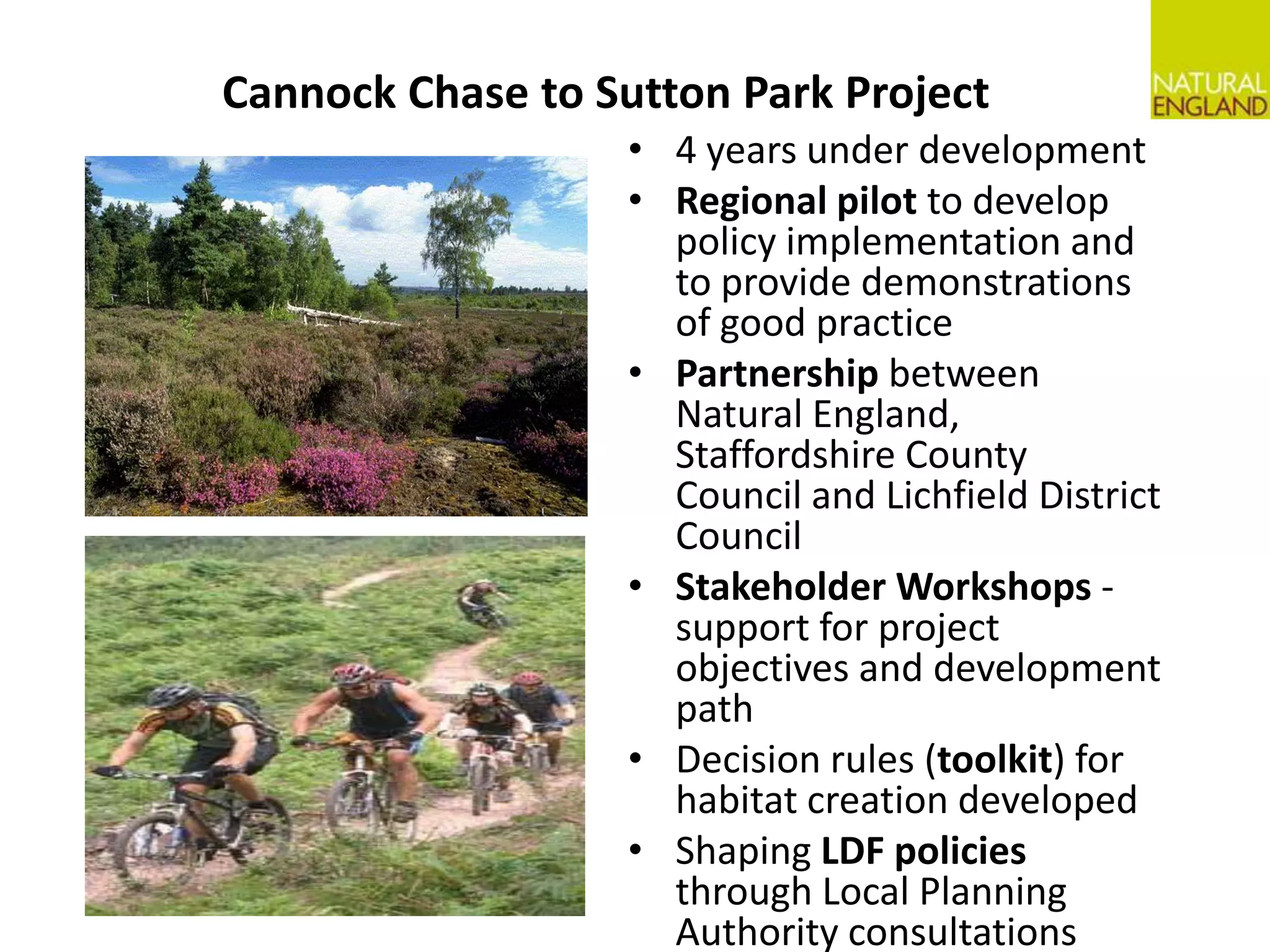
Cannock Chase to Sutton Park Project4 years under development Regional pilot to develop policy implementation and to provide demonstrations of good practice Partnership between Natural England, Staffordshire County Council and Lichfield District CouncilStakeholder Workshops - support for project objectives and development pathDecision rules (toolkit) for habitat creation developed Shaping LDF policies through Local Planning Authority consultations
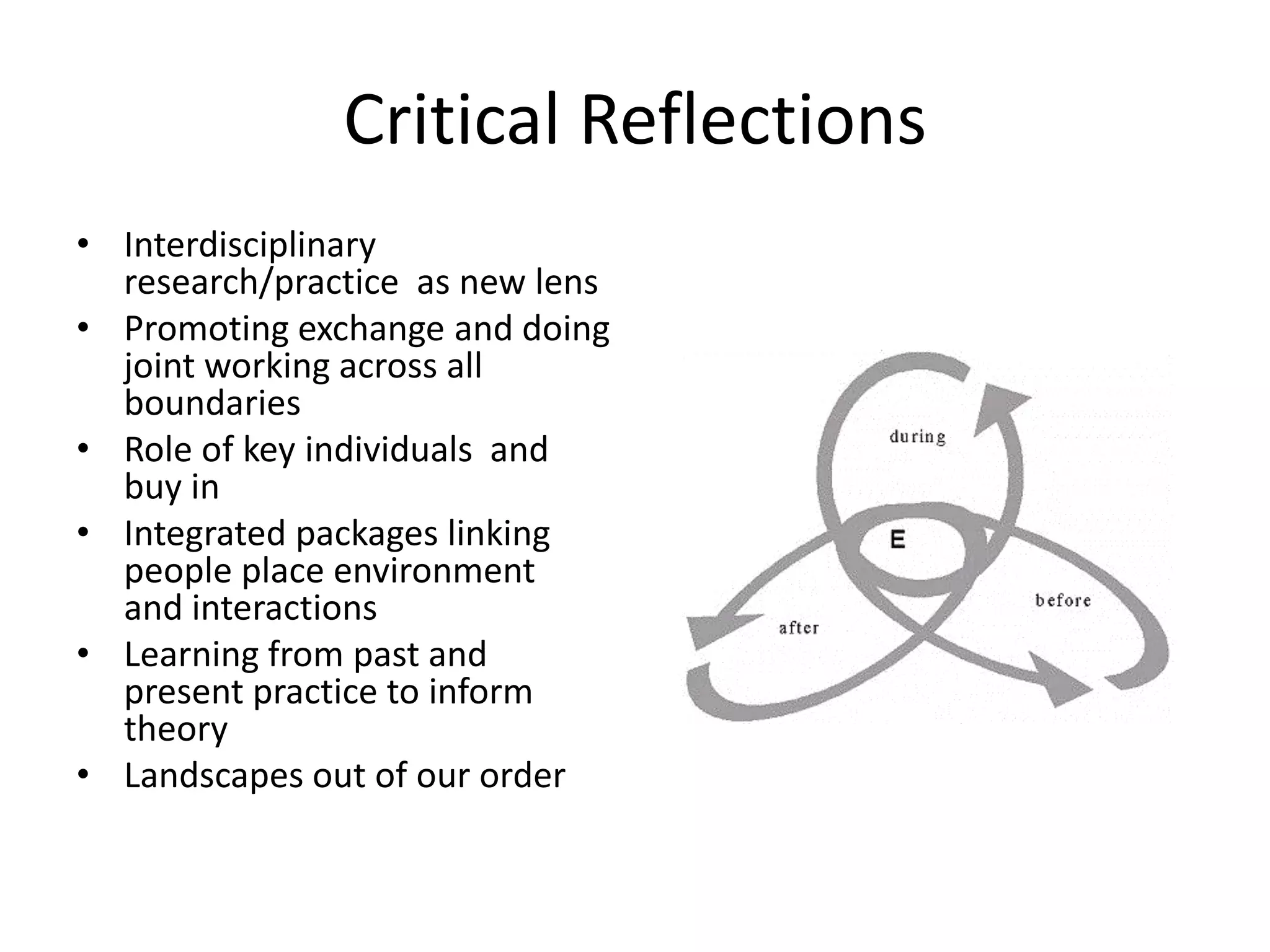
Critical Reflections Interdisciplinary research/practice  as new lensPromoting exchange and doing joint working across all boundariesRole of key individuals  and buy in Integrated packages linking people place environment  and interactions Learning from past and present practice to inform  theory Landscapes out of our order

What a waste of space: Can spatial planning add value to managing the environmental change agenda?

  • 1.
    What a waste of space: Can spatial planning add value to managing the environmental change agenda? Dr Alister Scott
  • 2.
    Propositions Institutional silosand past divides are hindering effective management of the natural environment Current policy and academic reliance on the ecosystems approach are questionable. Spatial planning has a contribution to managing environmental change
  • 3.
    Talk outline: Theplanning: environment divides Critical review of spatial planning theory and practice Planning peatlands (IUCN) Rural urban fringe (RELU)A way forward: Adapting spatial planning practice Reflections : reconnecting the divides; interdisciplinary work and social learning.
  • 4.
    Planning and Environment:LURNing from past divides Fragmented environmental governanceUrban vs Rural (Curry, 1994; 2008)Landscape vs Nature Conservation (MacEwen +MacEwen 1982 Institutional/professional separation: Nature Conservancy vs National Parks CommissionDEFRA vs CLG Academic Separate paradigms to guide theory and practice Limited communication and understanding across the divides
  • 5.
    Planning views ofthe RUF? Misunderstood space (Gallent et al 2006) A transition phase/edge which is largely placeless? (Qvistrom, 2005)Metaphor of the fringe as a ‘weed’ (Cresswell 1997)Battleground between urban and rural uses (Hough, 1990) “Landscape out of order” (Qvistrom 2007)
  • 6.
    Planning views ofpeatlands Misunderstood place Protected space: strong policies of restraint (Curry 1994) Vulnerable spaces for recreation and tourism (Scott 1998) Spaces requiring EU ‘appropriate assessments’ outside boundaries (Cannock Chase District Council 2010)BUT potential resource for infrastructure Landscape out of mind: limited planner education
  • 7.
    Spatial planning unplugged(Biesbroke et al 2009)
  • 8.
    Spatial Planning theory As an active/driver agent of societal, economic and environmental change (Albrechts 2004; Harris and Hooper, 2004; Tewdwr- Jones et al , 2010; Vigar, 2009).From place to interactions and flows From urban/rural to whole system interdependencies From control/restraint of place to planning opportunity spaces From top down to inclusive and participatory planning
  • 9.
    Key ‘problem’ areasin SP practice “The spatial planning project has failed” (Scott, 2010)“Theory practice disjuncture” (Scott et al, 2009) Uncertainty ProactivityLong TermismIntegration Governance Evidence Transparency
  • 10.
    Uncertainty Planning foruncertain futures Adaptive management Role of learning from doingRole of SEA : alternative approaches Role of experiments and exemplars and pilots
  • 11.
    ProactivityFROMPolicies of environmentalconstraint unless economic and social considerations overrideDevelopment control as reactionaryLimited public involvementVulnerability of non designated space Lack of positive management /planning(Allemendinger and Haughton, 2009)TO Enable Visions Facilitate Collaborate Opportunity spaces
  • 12.
    Long termismWhy cant planning embrace 100 year periods (Low 2002)Environmental system rooted in long term processes Planning system legally rooted in short term (eg EA)Forsinard Reserve Peatland restoration projects 1994-2006 LIFE Strategy 2005-2015 Birmingham Big City Plan50 year vision
  • 13.
    Integration SpatialPlanning it is the desire for horizontal integration of public policy that has largely driven the concept of spatial planning in the UK(Harris and Hooper, 2004). BUT Institutional myopia and sovereigntySectoral thinking Comfort zones Partnerships and power imbalances (Keating and Stevenson, 2006)
  • 14.
    Governance: making connectionsRegulatory framework and legislation at international, national and regional and neighborhood levelsTransparent and open processes for decision-making, and should be based on scientific knowledge.Voluntary mechanisms, for example, funds, certification, payments
  • 15.
    BUT Too manyactors .......Lengthening timescalesLowest Common denominator approaches Stifles innovation (congested state; Stoker 2002) + risk taking Plethora of non statutory plans
  • 16.
    Evidence Planning onPresumption (Curry and Pack, 1992)SEA and LDF requirements; questions of quality void between ecological knowledge and spatial planning Opdam et al 2002)Kettunenet al, (2007) more attention to the ecosystem wholeness of areas and aspects of ecological connectivity.Need to use more perceptual/value laden data
  • 17.
    Adapted ideas forRUF and Peat Concept of betterment and compensation Linking ideas of visitor payback, community infrastructure levy and habitat banking into ONE planning process.Role of voluntary partnerships to support environmental projectsLink with business, visitors, environment and local communities Provide a strategic reserve for funding needed activities. Joint community understanding and prioritisation of needs (community strategies and parish plans) Separation of planning development from payback type investments (eg limits of S106) .
  • 18.
    Spatial Planning (CLG)MUST connect with Ecosystem Services (Defra)Two paradigms of space managementSoup bowl not a salad bowl Interdisciplinary opportunity spaces
  • 19.
    Spatial Planning lens?“The fringe is not just the place where town meets country but a collection of dynamic and productive environments set in inspiring cultural landscapes, meeting the needs of both the present and helping to change the way we live in the future”. Spedding 2004:1
  • 20.
    Spatial planning lens“Peatlands are a collection of dynamic and productive environments set in inspiring cultural landscapes, meeting the needs of both the present and helping to change the way we live in the future”. Spedding2004:1 adapted Evans et al 2010
  • 22.
    Cannock Chaseto Sutton ParkFormerly extensive area of heathland - 86% loss in last 200 yearsLandscape shaped by extraction, manufacturing industries and agriculture Landscape scale : remote rural -> urban fringe -> urbanCore areasCannock Chase SSSI & SACAONB: 1.5 million visitors annuallyChasewater Heaths250,000+ visitors annuallySutton Park SSSI s35 NNR2.5 million visitors annually
  • 23.
    Cannock Chase toSutton Park Project4 years under development Regional pilot to develop policy implementation and to provide demonstrations of good practice Partnership between Natural England, Staffordshire County Council and Lichfield District CouncilStakeholder Workshops - support for project objectives and development pathDecision rules (toolkit) for habitat creation developed Shaping LDF policies through Local Planning Authority consultations
  • 24.
    Critical Reflections Interdisciplinaryresearch/practice as new lensPromoting exchange and doing joint working across all boundariesRole of key individuals and buy in Integrated packages linking people place environment and interactions Learning from past and present practice to inform theory Landscapes out of our order