South East & Sussex Context:
Thinking Strategically About Nature at the County and
Regional Level
Photo: Sussex Wildlife Trust
• Quick introduction to the Sussex LNP & South East Nature
Partnership
• Strategic Thinking
• Natural Capital Investment Strategy
• Strategic maps
• SE principles
• Local Initiatives
Photo: Sussex Wildlife Trust
Working
Groups
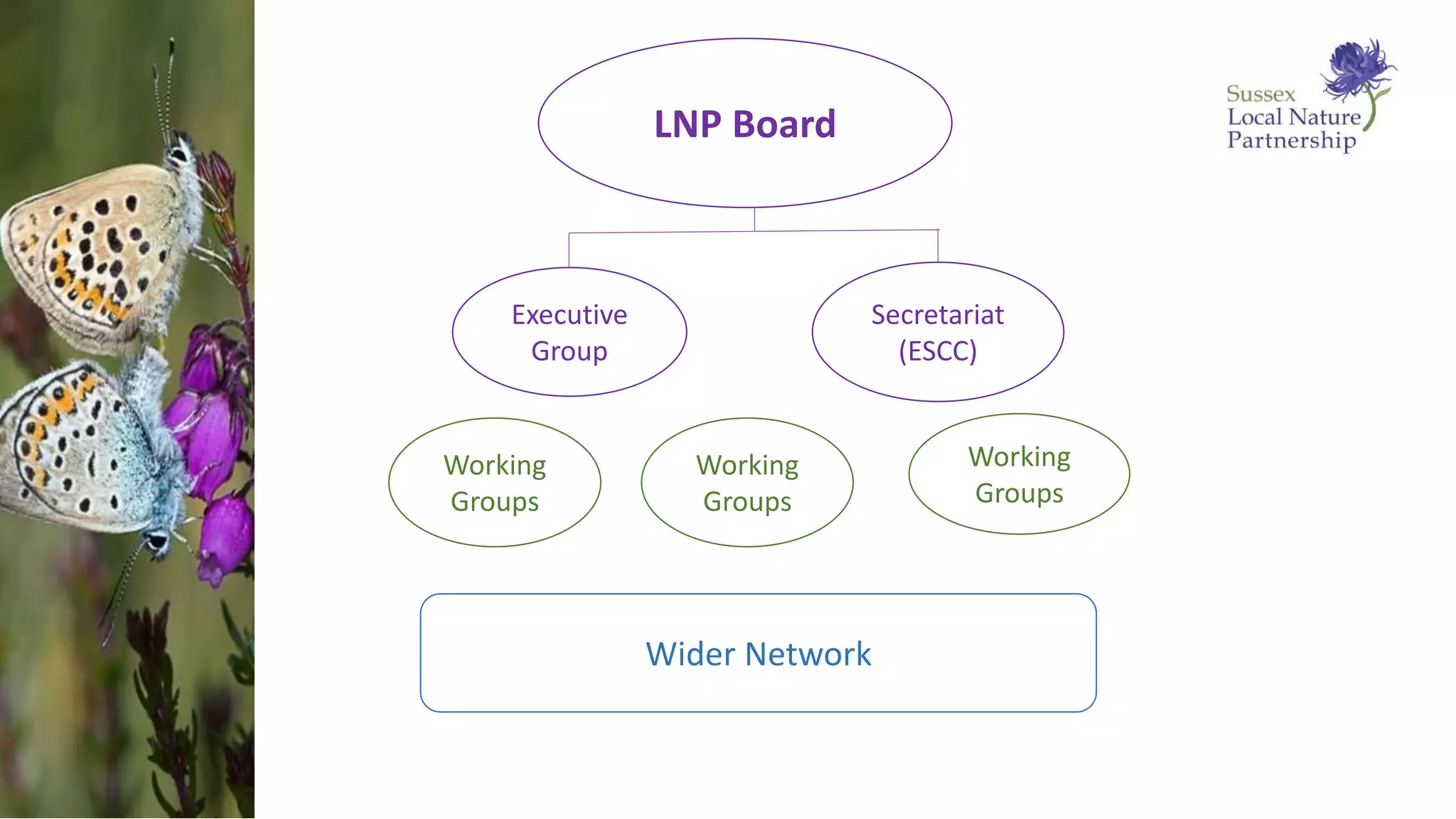
LNP Board
Executive
Group
Working
Groups
Working
Groups
Secretariat
(ESCC)
Wider Network
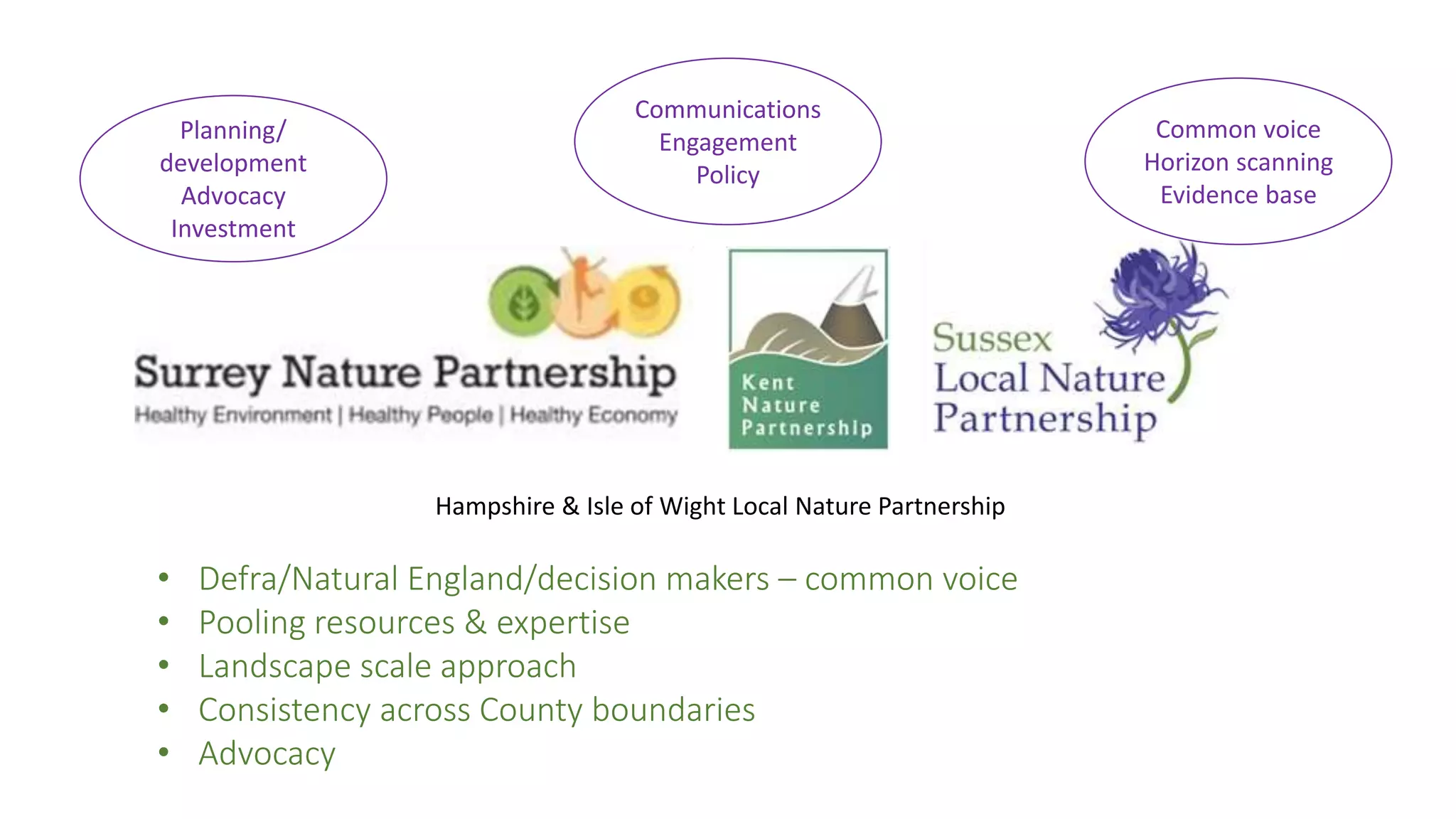
Hampshire & Isle of Wight Local Nature Partnership
• Defra/Natural England/decision makers – common voice
• Pooling resources & expertise
• Landscape scale approach
• Consistency across County boundaries
• Advocacy
Planning/
development
Advocacy
Investment
Communications
Engagement
Policy
Common voice
Horizon scanning
Evidence base
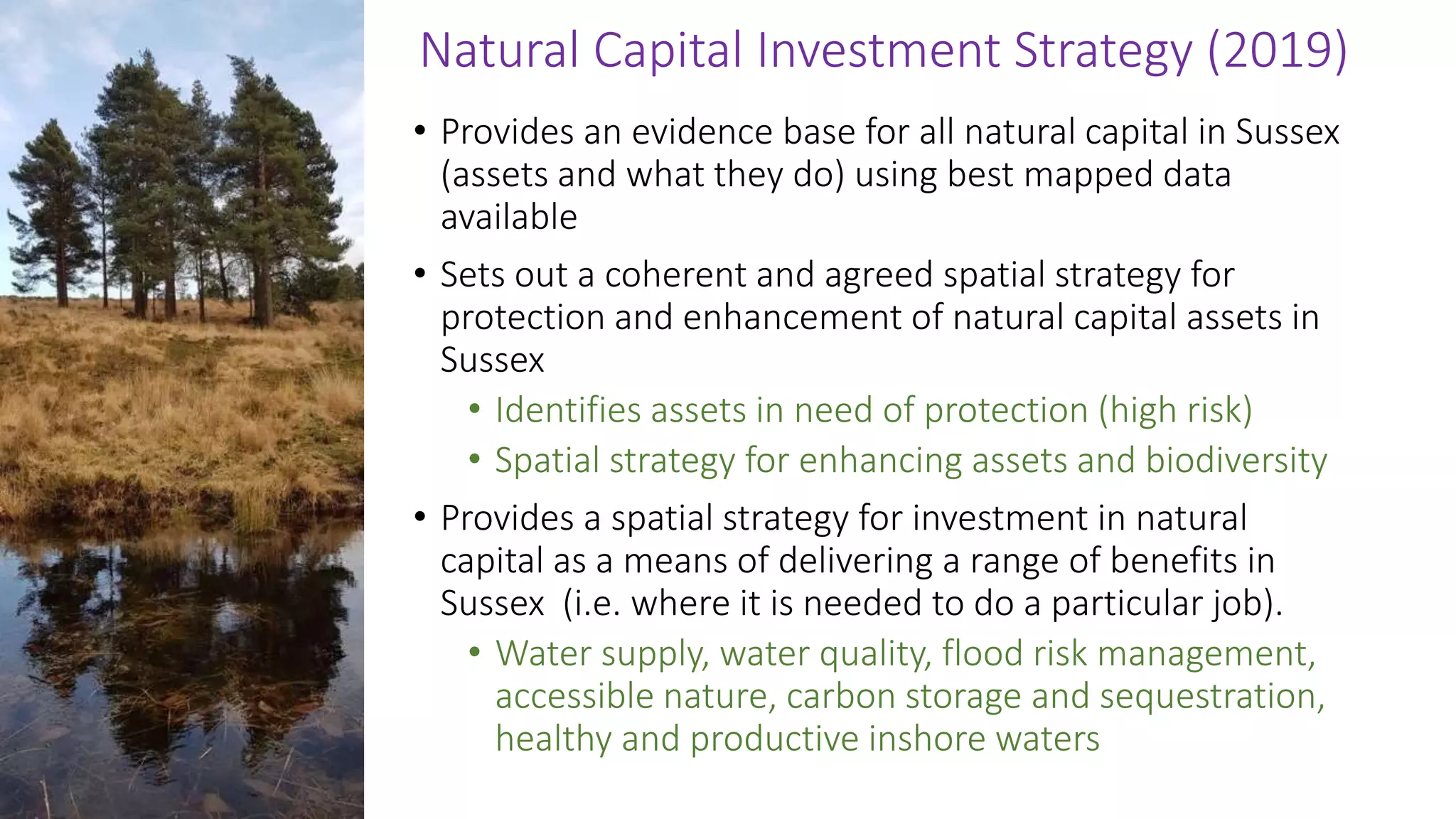
• Provides an evidence base for all natural capital in Sussex
(assets and what they do) using best mapped data
available
• Sets out a coherent and agreed spatial strategy for
protection and enhancement of natural capital assets in
Sussex
• Identifies assets in need of protection (high risk)
• Spatial strategy for enhancing assets and biodiversity
• Provides a spatial strategy for investment in natural
capital as a means of delivering a range of benefits in
Sussex (i.e. where it is needed to do a particular job).
• Water supply, water quality, flood risk management,
accessible nature, carbon storage and sequestration,
healthy and productive inshore waters
Natural Capital Investment Strategy (2019)
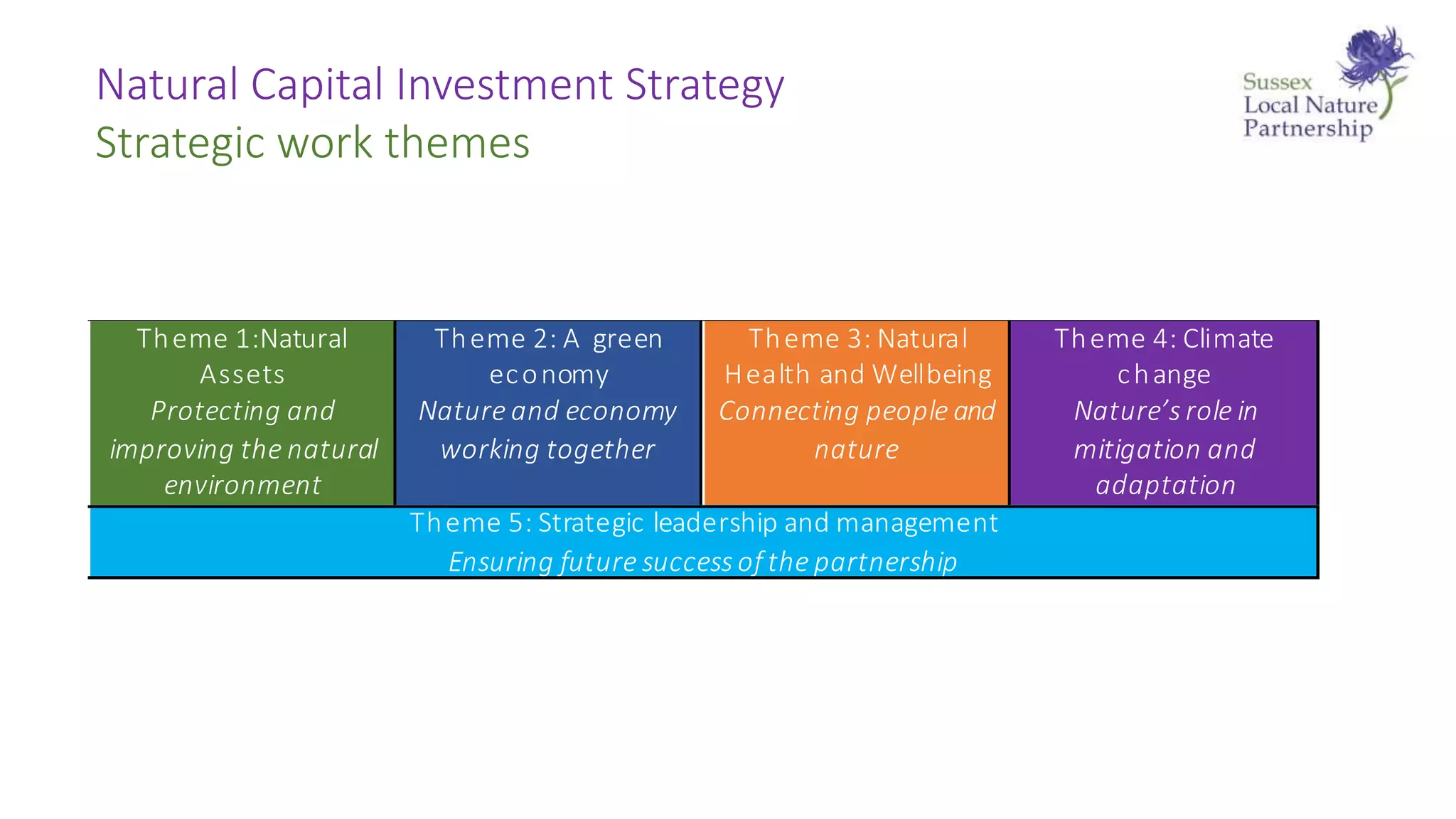
Natural Capital Investment Strategy
Strategic work themes
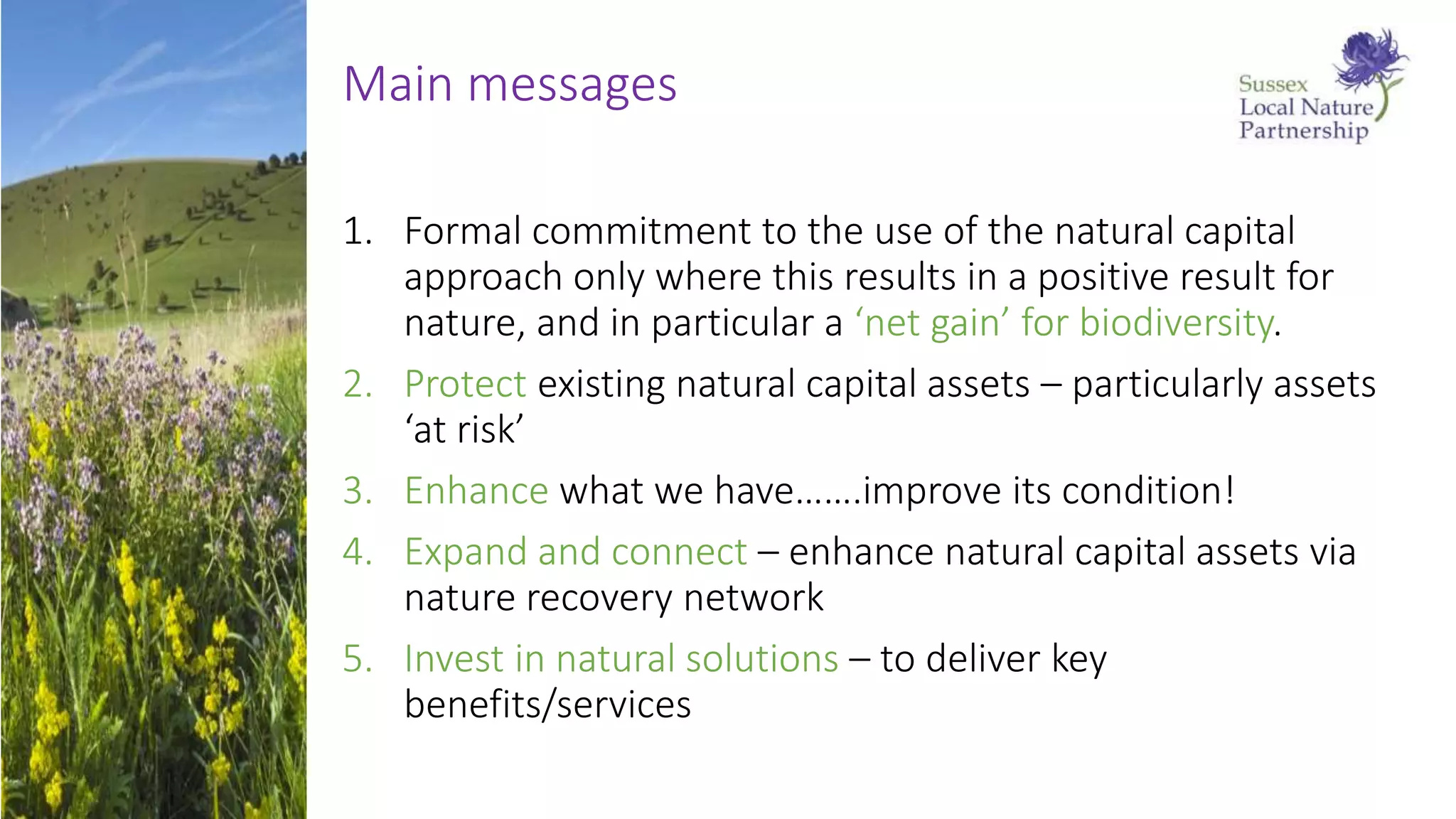
Main messages
1. Formal commitment to the use of the natural capital
approach only where this results in a positive result for
nature, and in particular a ‘net gain’ for biodiversity.
2. Protect existing natural capital assets – particularly assets
‘at risk’
3. Enhance what we have…….improve its condition!
4. Expand and connect – enhance natural capital assets via
nature recovery network
5. Invest in natural solutions – to deliver key
benefits/services
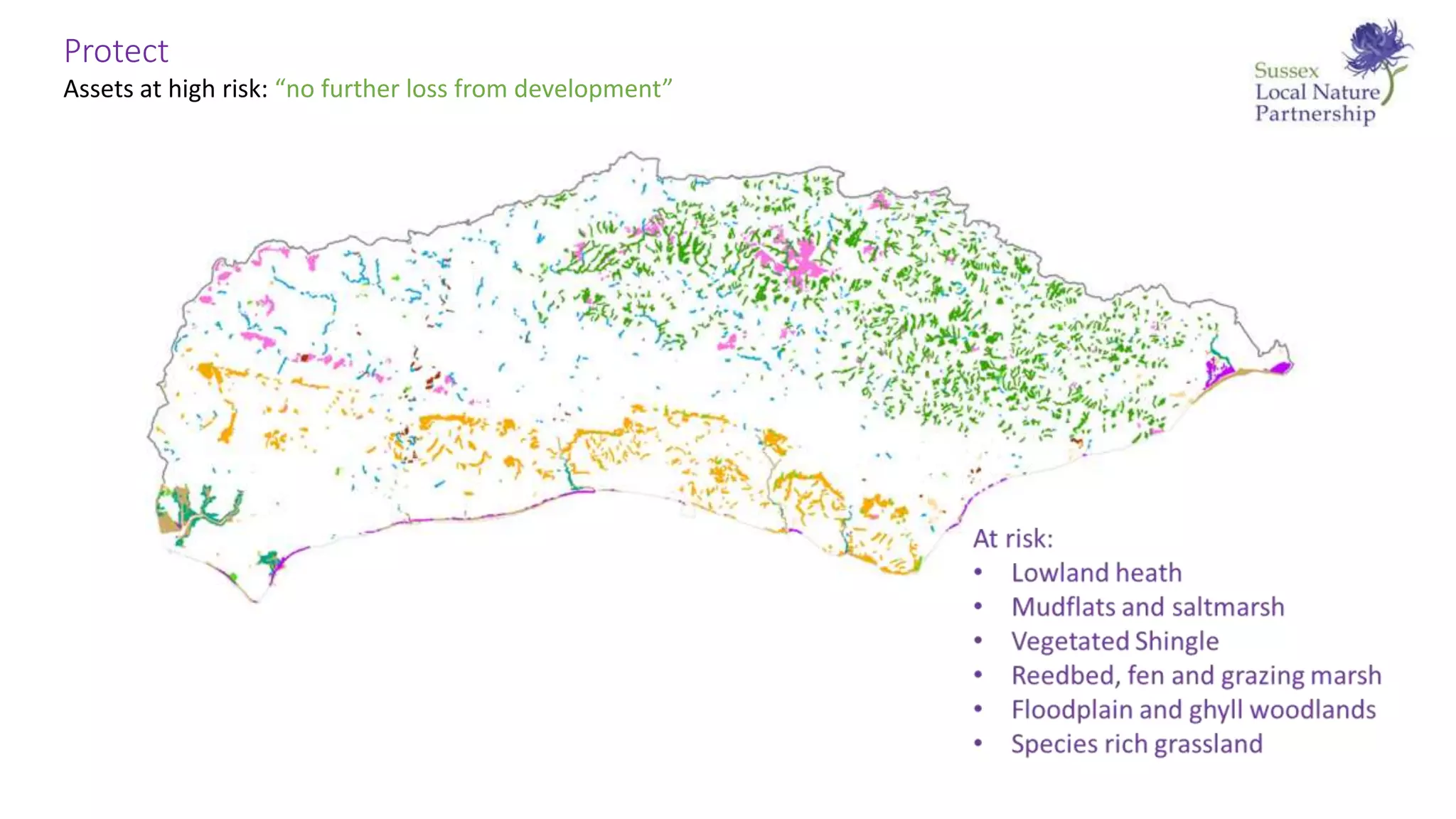
Protect
Assets at high risk: “no further loss from development”
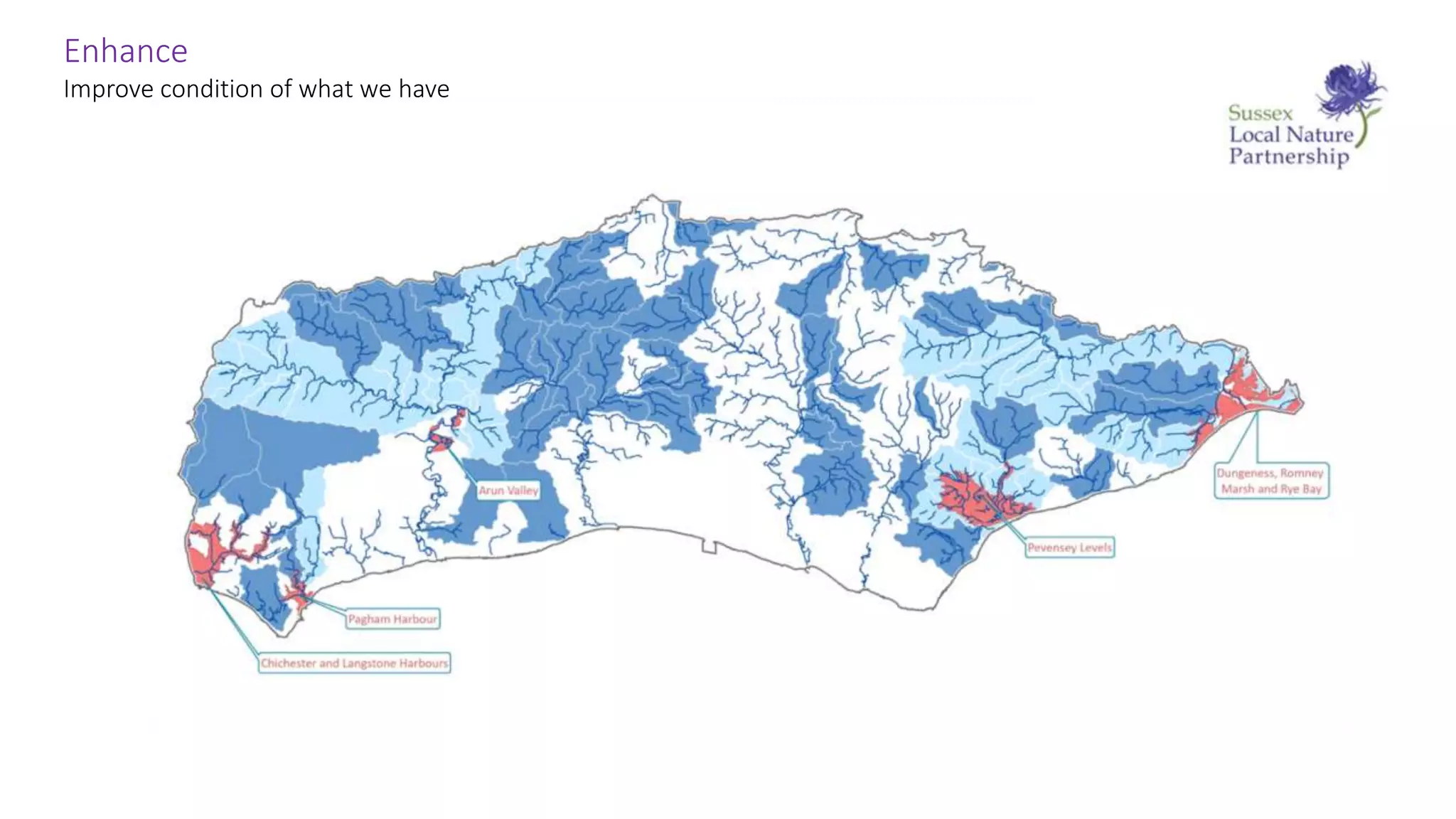
Natural Capital Investment Areas: a clean water environment
Enhance
Improve condition of what we have
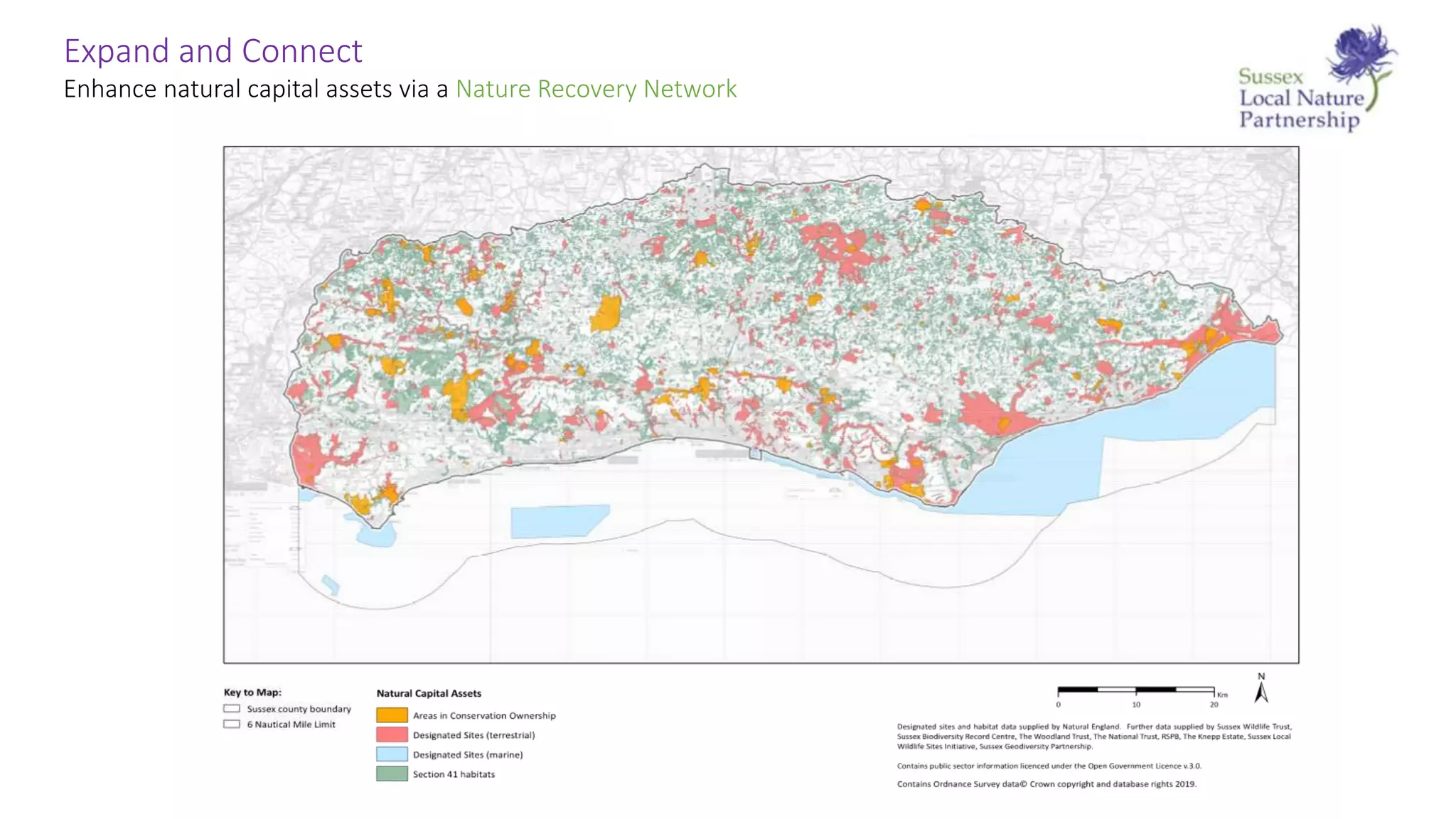
Expand and Connect
Enhance natural capital assets via a Nature Recovery Network
Local
Wildlife Site
SSSI
Urban area
Farmland
Chalk grassland
(Priority Habitat)
Farmland
Improved pasture
Core areas – for investment in habitat
protection and condition
Housing
allocation
site
River floodplain
Small wetland site
‘Potential areas’ –
new habitat created
to join up wildlife
sites
Natural capital investment area
for wetland creation – delivering
flood protection and water
quality benefits and expanding
wetland habitat.
New development with high %
of green space. Net gain used to
provide new adjacent woodland
and linkages to it.
Natural capital
investment area – for
new accessible
woodland providing
access, flood
protection and water
quality benefits
Natural capital
investment area:
woodland provided by
net gain. Provides
benefits for people,
carbon storage, noise
and air pollution
reduction
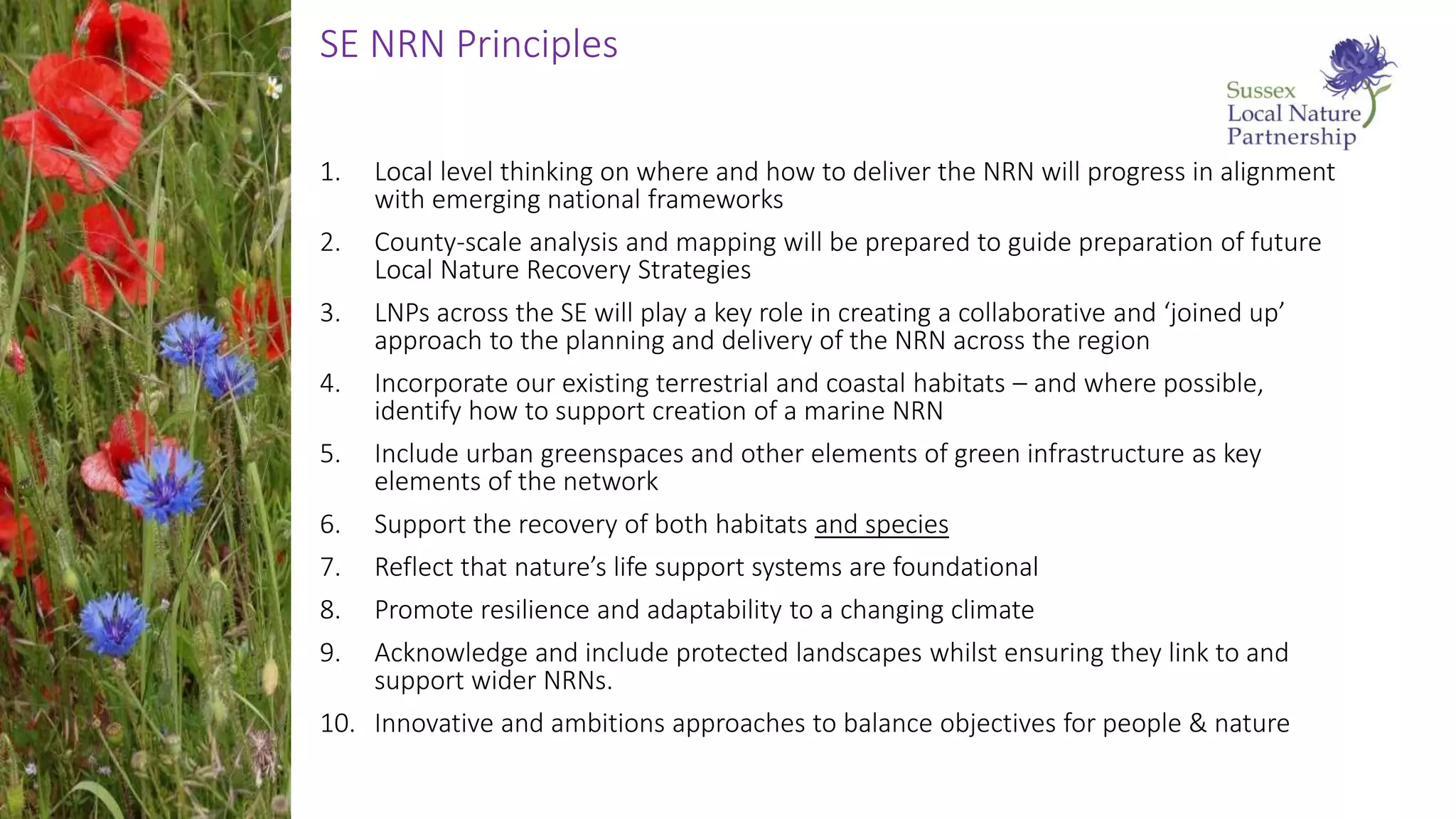
SE NRN Principles
1. Local level thinking on where and how to deliver the NRN will progress in alignment
with emerging national frameworks
2. County-scale analysis and mapping will be prepared to guide preparation of future
Local Nature Recovery Strategies
3. LNPs across the SE will play a key role in creating a collaborative and ‘joined up’
approach to the planning and delivery of the NRN across the region
4. Incorporate our existing terrestrial and coastal habitats – and where possible,
identify how to support creation of a marine NRN
5. Include urban greenspaces and other elements of green infrastructure as key
elements of the network
6. Support the recovery of both habitats and species
7. Reflect that nature’s life support systems are foundational
8. Promote resilience and adaptability to a changing climate
9. Acknowledge and include protected landscapes whilst ensuring they link to and
support wider NRNs.
10. Innovative and ambitions approaches to balance objectives for people & nature
Photo: Sussex Wildlife Trust
Further information: www.sussexlnp.org.uk
Email: kate.cole@eastsussex.gov.uk

Thinking Strategically about nature at the county and regional level by Kate Cole

  • 1.
    South East &Sussex Context: Thinking Strategically About Nature at the County and Regional Level Photo: Sussex Wildlife Trust
  • 2.
    • Quick introductionto the Sussex LNP & South East Nature Partnership • Strategic Thinking • Natural Capital Investment Strategy • Strategic maps • SE principles • Local Initiatives Photo: Sussex Wildlife Trust
  • 4.
  • 5.
    Hampshire & Isleof Wight Local Nature Partnership • Defra/Natural England/decision makers – common voice • Pooling resources & expertise • Landscape scale approach • Consistency across County boundaries • Advocacy Planning/ development Advocacy Investment Communications Engagement Policy Common voice Horizon scanning Evidence base
  • 6.
    • Provides anevidence base for all natural capital in Sussex (assets and what they do) using best mapped data available • Sets out a coherent and agreed spatial strategy for protection and enhancement of natural capital assets in Sussex • Identifies assets in need of protection (high risk) • Spatial strategy for enhancing assets and biodiversity • Provides a spatial strategy for investment in natural capital as a means of delivering a range of benefits in Sussex (i.e. where it is needed to do a particular job). • Water supply, water quality, flood risk management, accessible nature, carbon storage and sequestration, healthy and productive inshore waters Natural Capital Investment Strategy (2019)
  • 7.
    Natural Capital InvestmentStrategy Strategic work themes
  • 8.
    Main messages 1. Formalcommitment to the use of the natural capital approach only where this results in a positive result for nature, and in particular a ‘net gain’ for biodiversity. 2. Protect existing natural capital assets – particularly assets ‘at risk’ 3. Enhance what we have…….improve its condition! 4. Expand and connect – enhance natural capital assets via nature recovery network 5. Invest in natural solutions – to deliver key benefits/services
  • 9.
    Protect Assets at highrisk: “no further loss from development”
  • 10.
    Natural Capital InvestmentAreas: a clean water environment Enhance Improve condition of what we have
  • 11.
    Expand and Connect Enhancenatural capital assets via a Nature Recovery Network
  • 12.
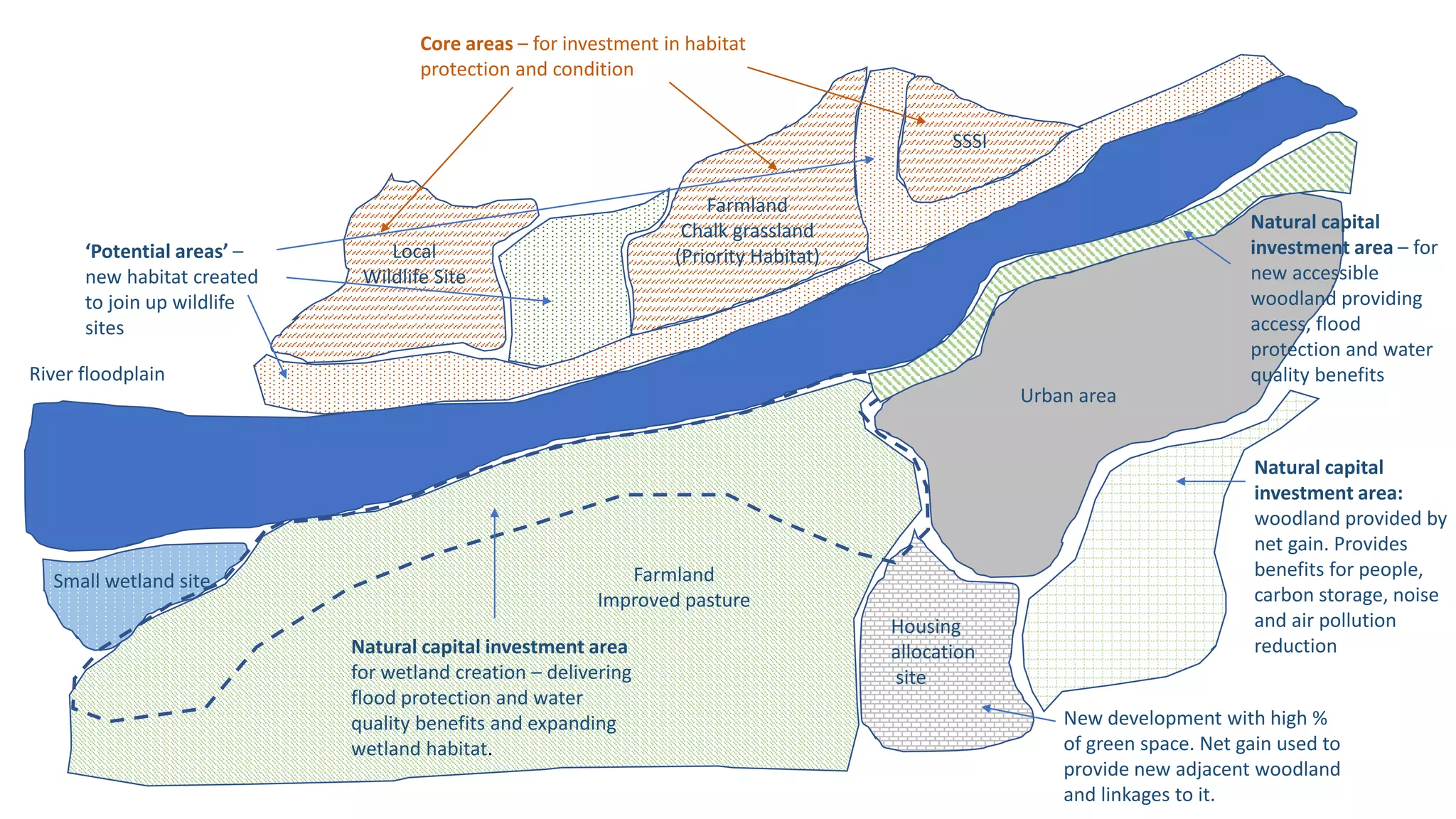
    Local Wildlife Site SSSI Urban area Farmland Chalkgrassland (Priority Habitat) Farmland Improved pasture Core areas – for investment in habitat protection and condition Housing allocation site River floodplain Small wetland site ‘Potential areas’ – new habitat created to join up wildlife sites Natural capital investment area for wetland creation – delivering flood protection and water quality benefits and expanding wetland habitat. New development with high % of green space. Net gain used to provide new adjacent woodland and linkages to it. Natural capital investment area – for new accessible woodland providing access, flood protection and water quality benefits Natural capital investment area: woodland provided by net gain. Provides benefits for people, carbon storage, noise and air pollution reduction
  • 14.
    SE NRN Principles 1.Local level thinking on where and how to deliver the NRN will progress in alignment with emerging national frameworks 2. County-scale analysis and mapping will be prepared to guide preparation of future Local Nature Recovery Strategies 3. LNPs across the SE will play a key role in creating a collaborative and ‘joined up’ approach to the planning and delivery of the NRN across the region 4. Incorporate our existing terrestrial and coastal habitats – and where possible, identify how to support creation of a marine NRN 5. Include urban greenspaces and other elements of green infrastructure as key elements of the network 6. Support the recovery of both habitats and species 7. Reflect that nature’s life support systems are foundational 8. Promote resilience and adaptability to a changing climate 9. Acknowledge and include protected landscapes whilst ensuring they link to and support wider NRNs. 10. Innovative and ambitions approaches to balance objectives for people & nature
  • 16.
    Photo: Sussex WildlifeTrust Further information: www.sussexlnp.org.uk Email: kate.cole@eastsussex.gov.uk

Editor's Notes

  • #2 Also district level
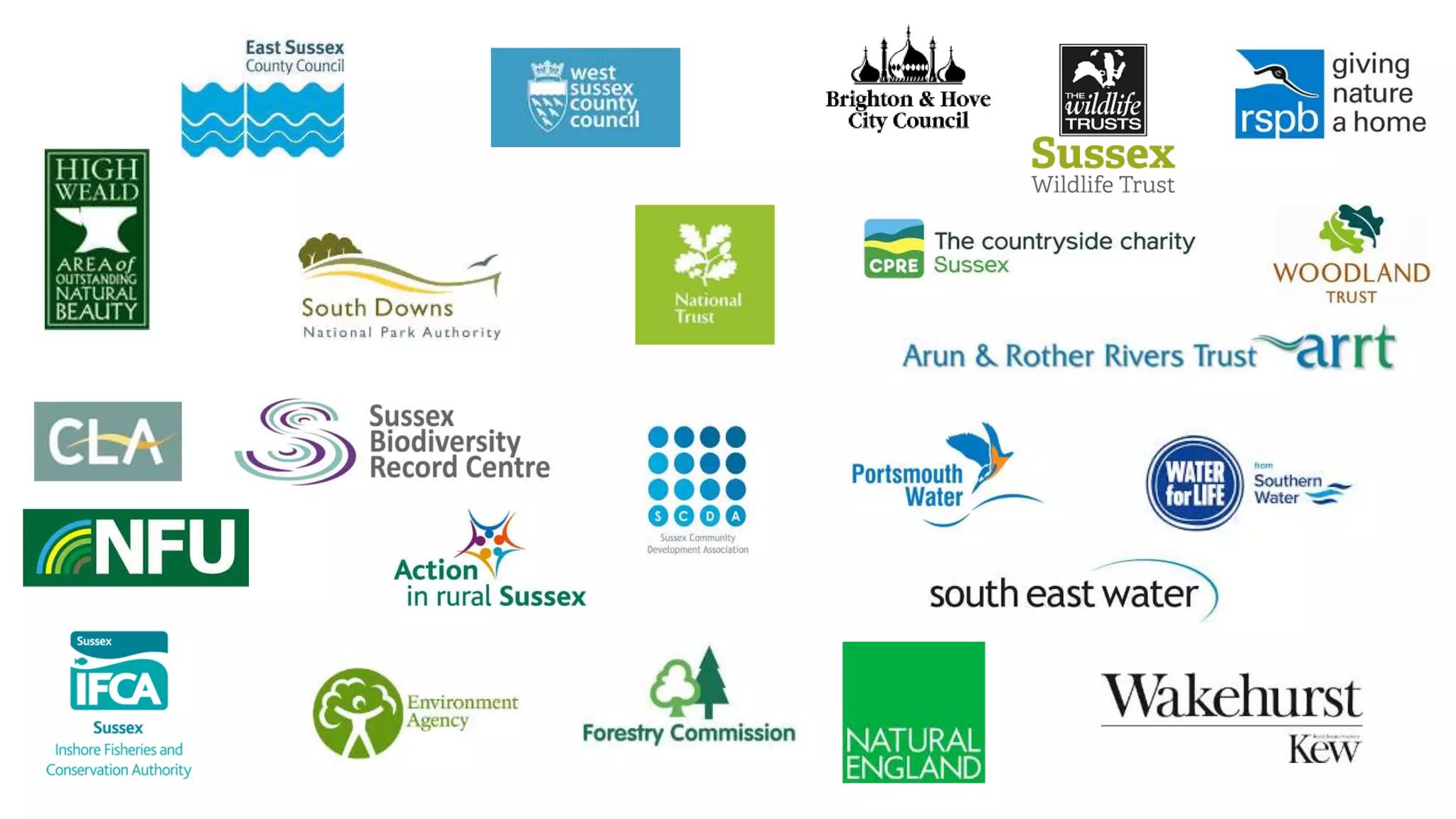
  • #4 >27 members Voluntary partnership – set up, like others, under approval from Defra Top Tier LPAs (ESCC, WSCC, BHCC) Conservation NGOs (e.g. WT, NT, RSPB, Sussex WT) Protected Landscapes (SDNPA, High Weald AONB) Landowner organisations (NFU, CLA) Businesses (e.g. SEW, SW, PW) Statutory bodies including Marine (NE, EA, FC, SxIFCA) Community organisations (SCDA) Research/evidence - Biodiversity Record Centre, Kew No funding model – survives from contributions from core members Vulnerable and operating on a shoestring! But strong, cross sectoral partnership with commitment from members.
  • #5 Board supported by Executive Team and Secretariat. To date, much of the work has been driven by a few individuals/organisations. Plans to continue to expand the network of organisations and increase reach/influence through a wider network and working groups who will be the engine of the LNP. New members are welcome. One of the priority working groups we are setting up now is LPA engagement – to get more involvement with Ds and Bs as we recognize this as a gap, and we’re now in a position where we can provide a real benefit.
  • #6 Linked to wider regional network of LNPs (SENP): Sussex, Surrey, Hampshire and Kent We’ve had good communications with our neighbouring LNPs for a while but recently formalised into the SENP. Each of the individual LNPs brings different strengths to the table: Surrey – strong on planning and development and furthest ahead in terms of local investment, as we heard earlier. Kent – strong on policy, communications and engagement Sussex – probably has the largest board, so one of our strengths is providing a common voice. Thanks to expertise within the LNP, we’re also good at horizon scanning and making sure work we’re doing locally is in line with emerging policy and legislation, and we have a strong evidence base. Hamps & IoW – relatively new, but are engaging well and are a logical member of the group. Advantages of working together at regional level: Enables us to pool resources and expertise Can take a truly landscape approach and consider the bigger picture Ensures consistency of approach across county boundaries Together we can advocate for the issues that really matter in the SE, e.g. sound metrics for carbon that include habitats other than woodland and peatland Defra/NE/other national decision makers appreciate hearing from a common voice
  • #7 Key piece of work for Sussex which is now providing a focus for our work is our NCIS, adopted 2019. In terms of benefits, it was agreed that in the first instance we would concentrate on water, accessible nature, carbon and healthy and productive inshore waters. There are obviously a whole range of other benefits, e.g. air quality, pollination, agriculture etc, but this suite was felt to be the most pressing and if we can deliver investment in these areas, we are likely to benefit other areas as well.
  • #8 Work under key themes: NRN, planning reform, LPA engagement Collating evidence base on nature and green recovery – across SENP Health & Wellbeing working group, Greenspaces project Carbon metric advocacy, strategic tree planting, events to raise awareness of what we know and to establish where help is needed. Presentations on website Forthcoming event 25/01/21 Governance, providing strategic focus, establishing working groups.
  • #9 2. Protect existing natural capital assets – particularly assets ‘at risk’ D Helm…. ‘Hold the line’ Existing protections Natural capital Assets ‘at risk’ No further loss due to development Improve condition through better management Reduce pressures/threats Watching brief . ‘Invest’ in natural solutions – to deliver key benefits/services Sufficient water supply A clean water environment Reduced Flood Risk Accessible Nature Healthy and productive inshore waters Improved climate regulation (through carbon storage and sequestration)
  • #10 Mapped these….fragmented, trend is downwards in area and condition, threats not diminishing. Many threats are more difficult to tackle (e.g. climate change) – but we feel that ‘loss to development’ is avoidable – if this information can be embedded in decision-making processes. So this is an important place to start.
  • #11 Enhance what we have…….improve its condition! Example of where you should invest in natural capital for a clean water. Investment in the protection, enhancement and creation of natural capital in catchments – focussing on habitats and soil management – will help improve the freshwater environment by increasing the filtering of sediment and pollutants they carry out. Buffering along water courses, disruption of flow pathways in the landscape, woody debris and other actions for slowing the flow will further support this function. All areas shaded blue are suitable for investment, but the priority areas are shaded dark blue – failing under WFD. Urgency is greatest in those priority areas affecting internationally recognised wetland sites (red). By improving the management of existing habitats including woodland, ponds, heathland, chalk grassland, urban greenspaces and soil, within these dark blue areas, will improve water quality and will help store water in the landscape, helping at times of water stress like flooding and drought.
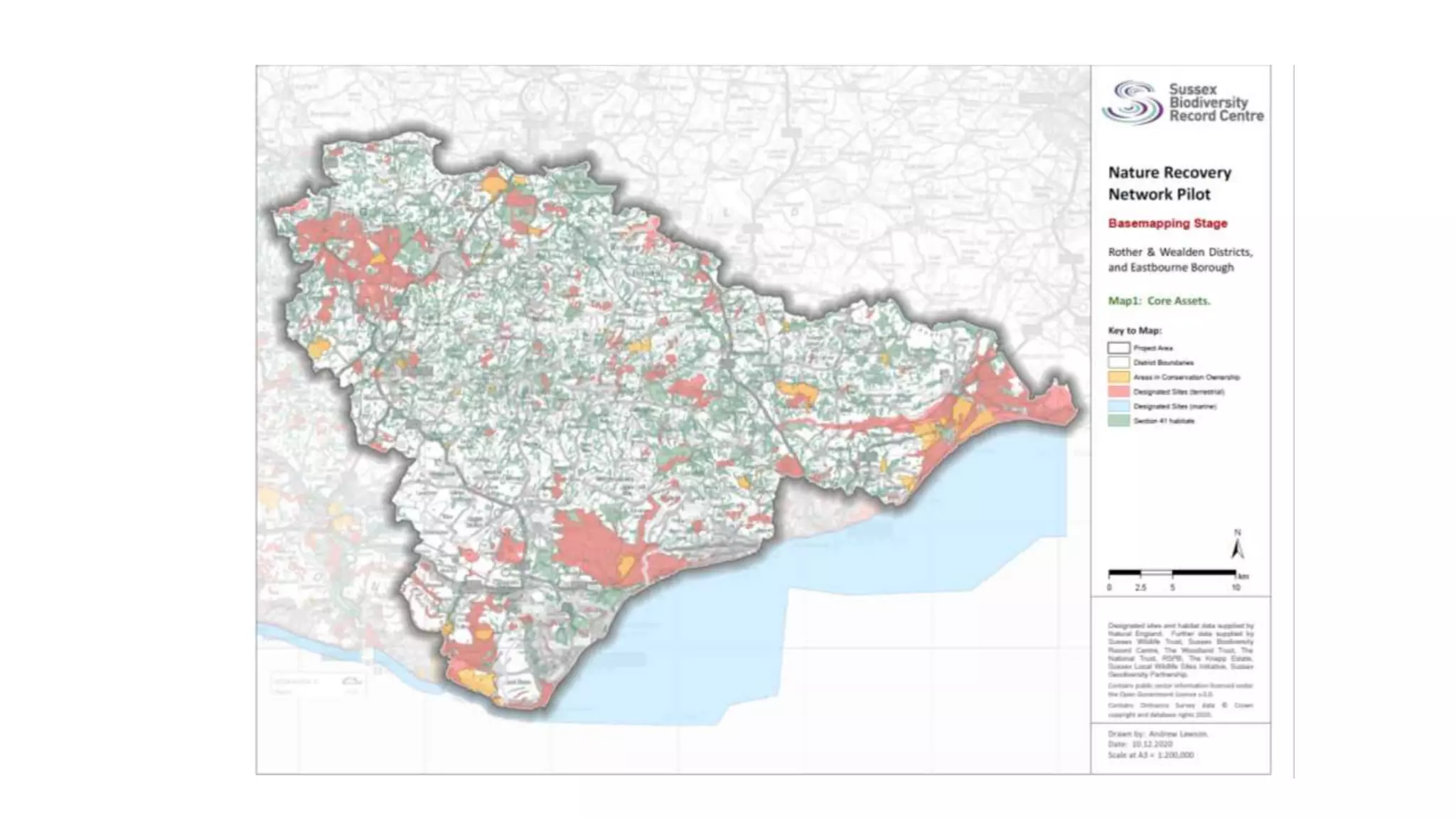
  • #12 Slide shows core areas of a NRN. Designated sites (red and blue), areas in conservation ownership (orange) and priority habitats (green). Many of the habitat types found areas are currently in poor condition so there is a need to focus on uplifting their condition as part of delivery of a NRN. We also need to identify potential areas for the creation of new areas of habitat, e.g. areas that will connect, support and protected these core areas.
  • #13 Diagram tried to illustrate how you might do that. Core areas for investment for protection and to improve condition. If you created new habitat around them, you would buffer and protect those core areas, and start joining them up. On the other side you’ve got an urban area adjacent to a river, and farmland. Investing in creating wetland would deliver flood protection and water quality benefits, and would help expand existing wetland habitat. Investing in creating new accessible woodland between the river and the urban area would provide access (health and wellbeing benefits), flood protection and water quality benefits. Housing allocation site – use net gain from that to provide new woodland – provides benefits of new and existing residential areas, plus provides opps for carbon storage, noise and air pollution reduction.
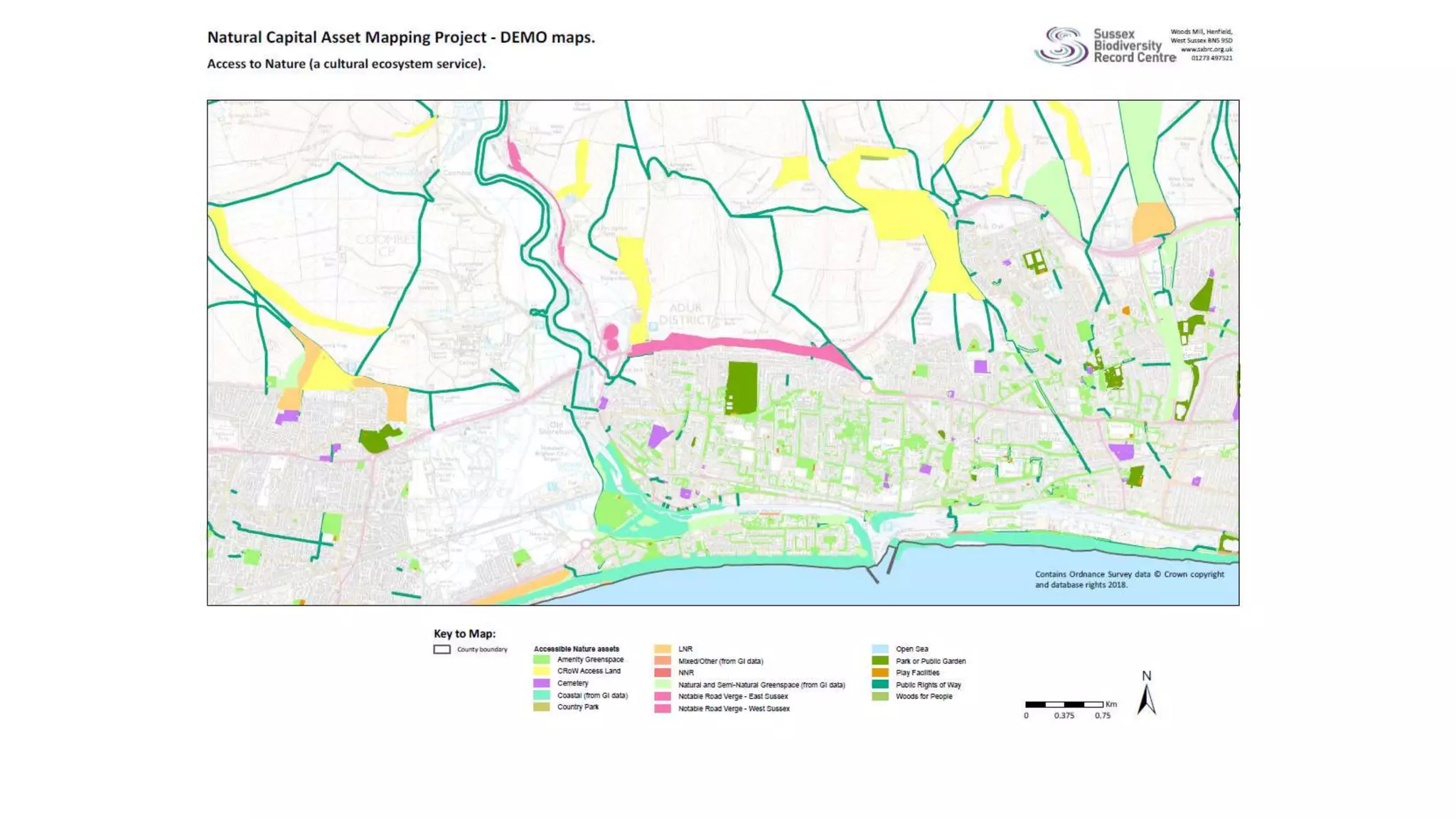
  • #14 The maps I’ve shown you as examples of some of the strategic thinking that has been happening have all been at pan-Sussex scale, but important to note that because they are being developed using the best available local datasets, you can drill down into them to look at particular assets and the benefits they provide, and therefore where the gaps are and where investment can be made. Example shows natural capital assets that provide access to nature at the local scale. This data has been mapped for all assets for the identified priority benefits.
  • #15 Those were a few examples of some of the county-level mapping that has already been done to help us understand where the best opportunities for investment in natural capital are. Across the SE, we have also been working on agreeing general principles for a suite of measures, so we can ensure coordination across boundaries. Example is principles for NRNs. Has already started. Well positioned to use local data and expertise and assess local drivers and needs. Will therefore proceed to develop local thinking, but these local approaches are flexible and can be evolved. Will share lessons nationally. Will start to ID and engage with locally specific stakeholders to draw in wide range of voices and actors at an early stage. As existing multi-disciplinary partnerships, LNPs well placed to encourage collaborative approach and will do what we can to facilitate broad stakeholder engagement in the process. Will join up with existing strategies and emerging NRN thinking in the area to ensure integration and added value. Will facilitate communication across administrative boundaries. Coast and sea are vital components of the Sussex landscape. We will therefore ensure that these are well reflected in the overall vision, mapping and design of NRNs. Urban greenspaces and GI are an essential component of a NRN, providing wildlife refuges and other ecosystem services within urban areas and acting as green spaces for people to connect with nature. More than just simple expanding and linking core habitats, need to support thriving and resilient populations of our native wildlife species. Protecting and enhancing natural capital assets means protecting and enhancing the flow of benefits and services from them for people and the economy, e.g. climate regulation, pollination, water and soil health, air quality and HAW. Means creating the right space for native species to adapt while acknowledging that climate change will bring new species. Also about identifying and implementing natural climate solutions.
  • #16 Finally, going to briefly tell you about a new mapping project that we are just starting, focussing on Wealden, Rother and Eastbourne in East Sussex, supported by funding from NE, and acting as a pilot. The project will develop a methodology for developing a spatial map of NRNs at the district level, and for working with key stakeholders to identify a process for moving from strategic to delivery maps to guide action and investment. We are starting by mapping what we have now, including core areas, and if we have the data, areas of existing connectitity, and collating existing mapping data from habitat potential and/or connectivity modelling, habitat condition assessments etc, and using local expert knowledge to identify opportunities where new habitats can be created or existing habitats restored/improved, delivering benefits for nature and peoples. This will generate a single strategic map of opportunity/potential areas. We are then going to work with planners/planning departments from those authorities to focus on how these delivery areas can be made to happen, e.g. through CIL, BNG etc. The output will be the identification of recommendations for application of the project across Sussex, and engaging with other key stakeholders such as farmers/land managers. Needs to be completed by March 2021, so should be able to share our experiences soon.