water-technology-ppt.pptx.chemistry for engineering
1.
Module -1
WATER TECHNOLOGY
Theworld cannot exist without
water
Dr K VIJAYAKUMAR,
Professor
Department of chemistry
MKCE, Karur
2.
Introduction
For existence ofall living beings (animals, humans,
plants) water is very important.
Almost all human activities, domestic, agricultural and
industrial purpose water is used.
Without food, human can survive for a number of days,
but water is such an essential that without it one
cannot survive
Although water is nature’s most abundant compound
but only less than 1% of the world’s water resources
are available for ready use.
3.
Importance of water
Itis an important engineering material
In steam generation
Coolant in power and chemical plants
water widely used in Steel, plastic, atomic
energy and textile industries.
Other fields such as drinking, bathing, sanitary,
washing irrigation etc.
4.
Source of water
I.Surface waters:
River water: This fed by rain water. Water flows over
surface, dissolves salts of soil and suspended
organic matter.
Lake water: Contain much lower amount of
dissolved salts and organic matter.
Sea water: Most impure form of water. River water
throws salts and matter. Continuous evaporation
makes sea water more concentration.
II.Underground water: water percolates into earth.
During its journey it comes contact with minerals
get concentrated.
5.
How is theAvailable Water
Used in the World?
Agriculture
Sector
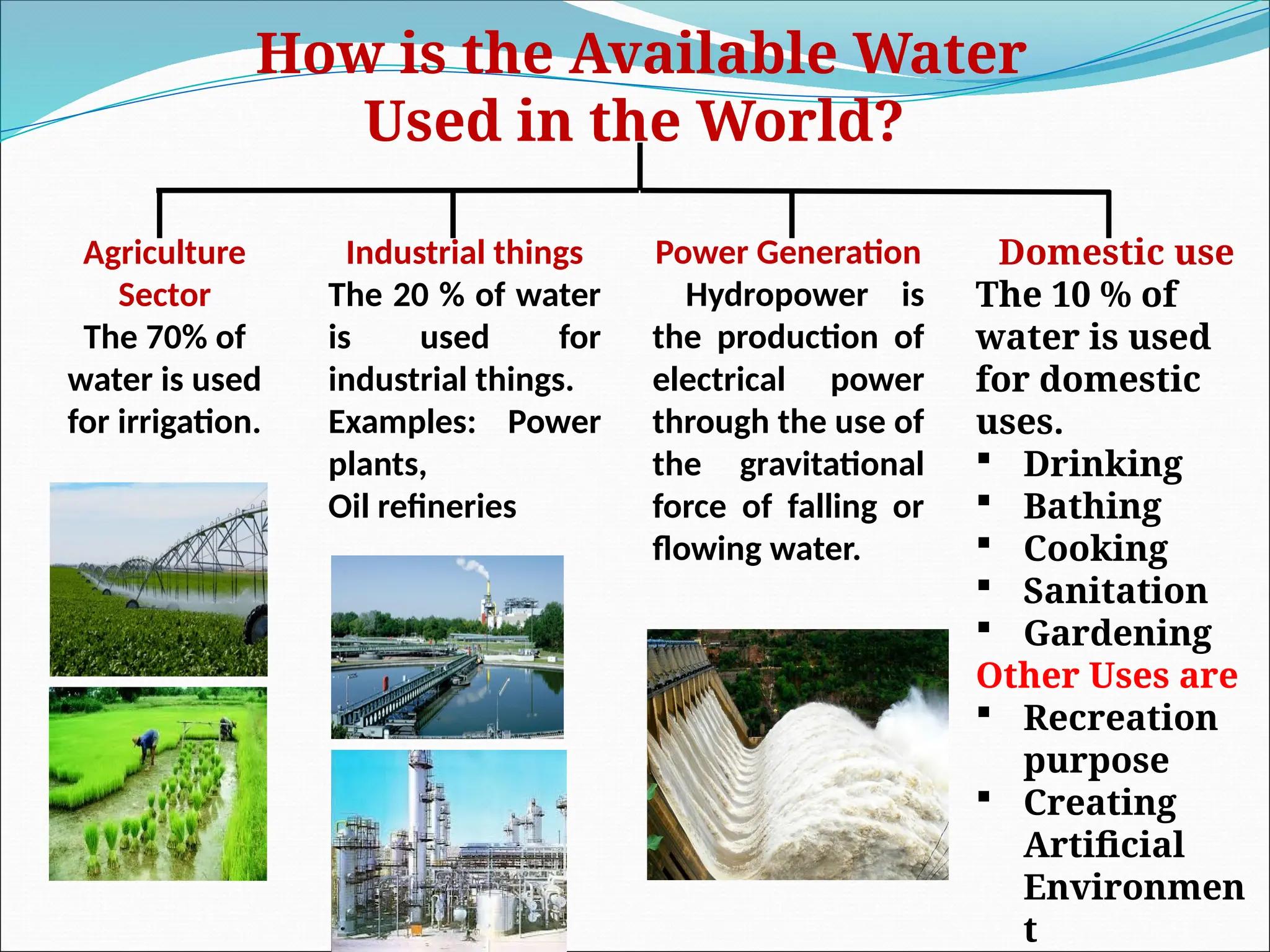
The 70% of
water is used
for irrigation.
Industrial things
The 20 % of water
is used for
industrial things.
Examples: Power
plants,
Oil refineries
Power Generation
Hydropower is
the production of
electrical power
through the use of
the gravitational
force of falling or
flowing water.
Domestic use
The 10 % of
water is used
for domestic
uses.
Drinking
Bathing
Cooking
Sanitation
Gardening
Other Uses are
Recreation
purpose
Creating
Artificial
Environmen
t
6.
Impurities in water
Impuritiesin water classified into following types.
1. Dissolved impurities: Dissolved salts like
carbonates, bicarbonates, chlorides and
sulphates of Ca, Mg, Fe and Na. Dissolved gasses
like O2 and CO2.
2. Suspended impurities: inorganic impurities like
clay and sand, organic impurities like oil globules,
animal and plant matter.
3. Microorganisms: Bacteria, fungi and algae.
7.
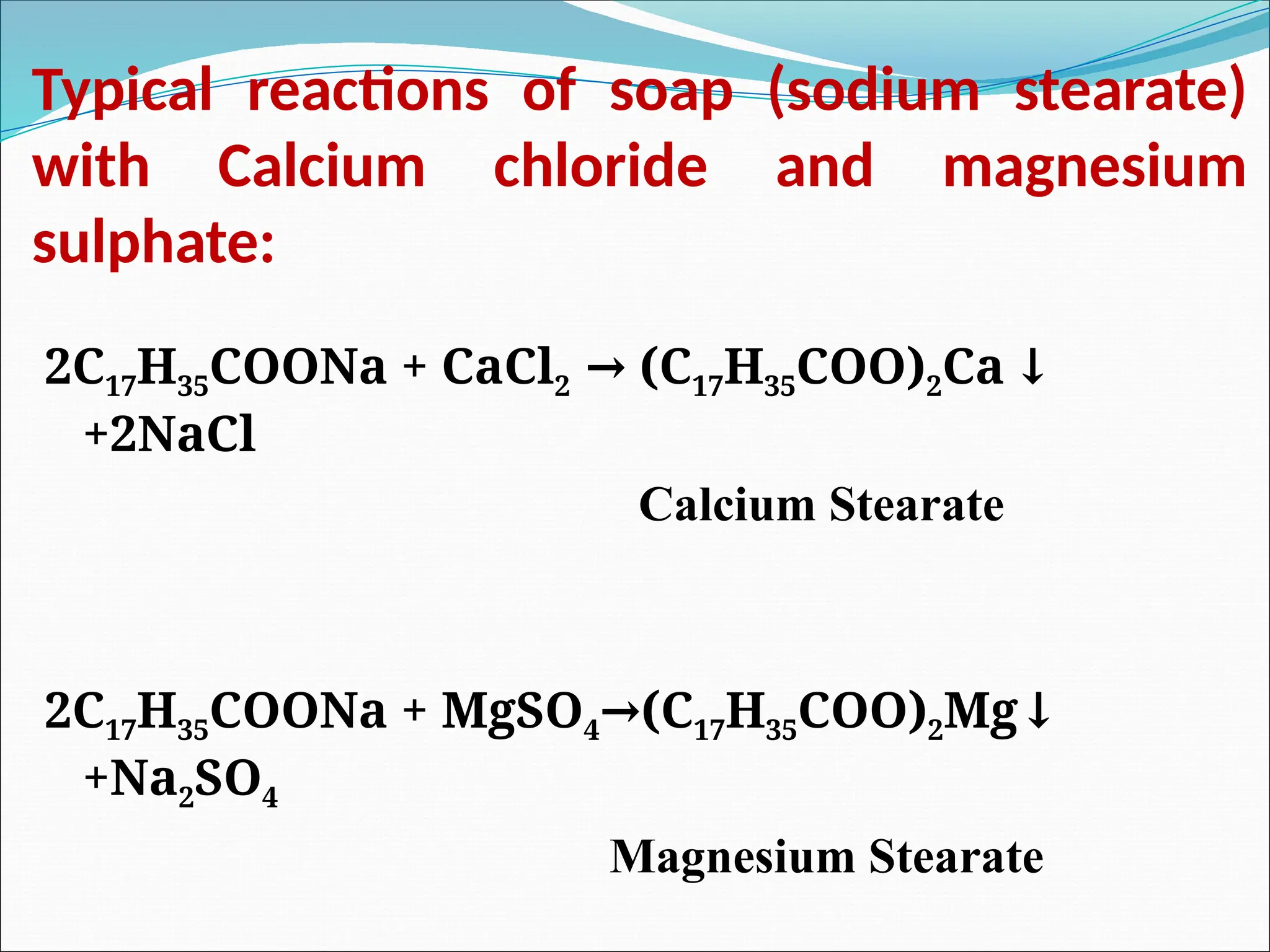
Hard water
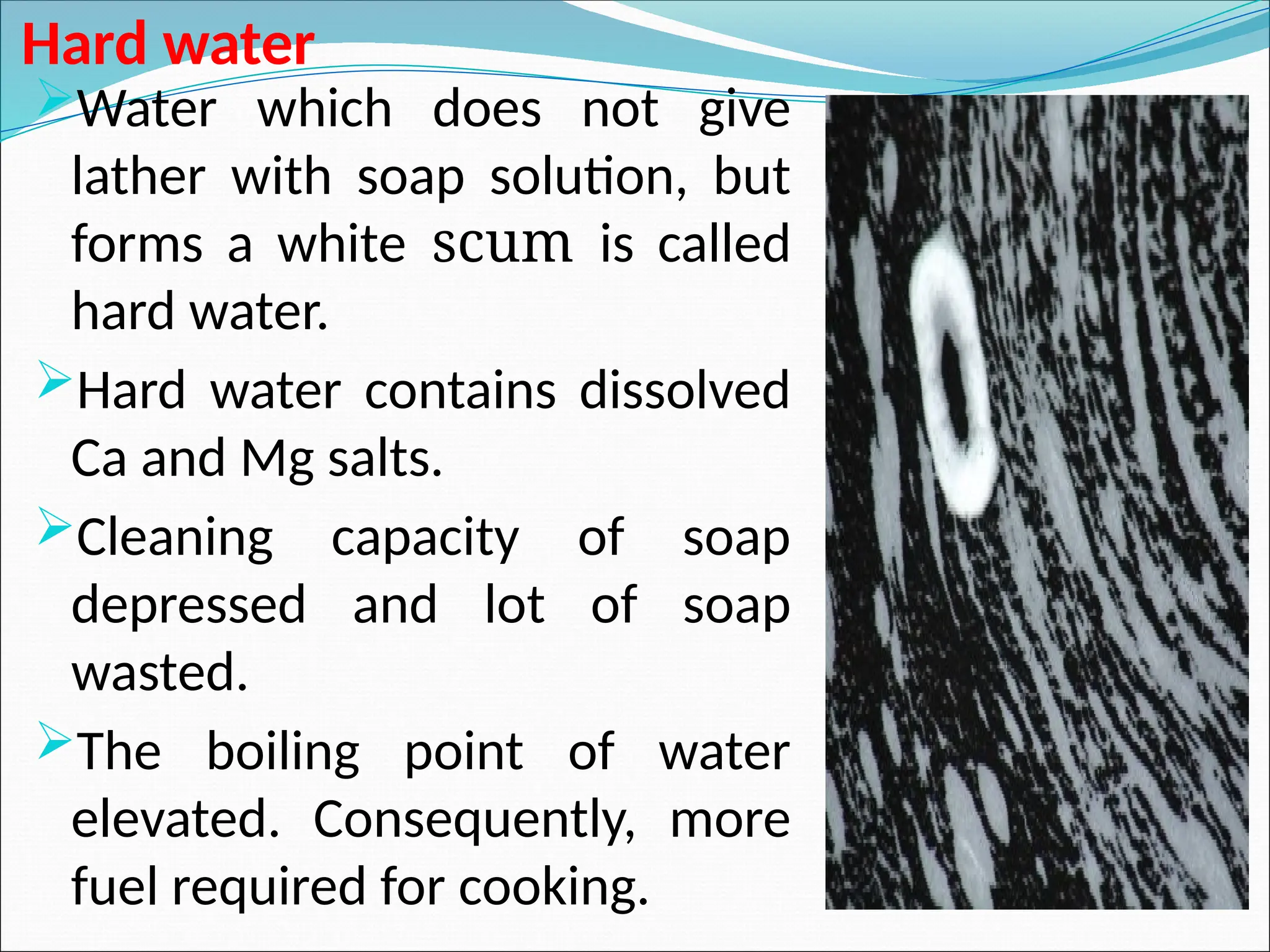
Water whichdoes not give
lather with soap solution, but
forms a white scum is called
hard water.
Hard water contains dissolved
Ca and Mg salts.
Cleaning capacity of soap
depressed and lot of soap
wasted.
The boiling point of water
elevated. Consequently, more
fuel required for cooking.
TYPES OF HARDNESS
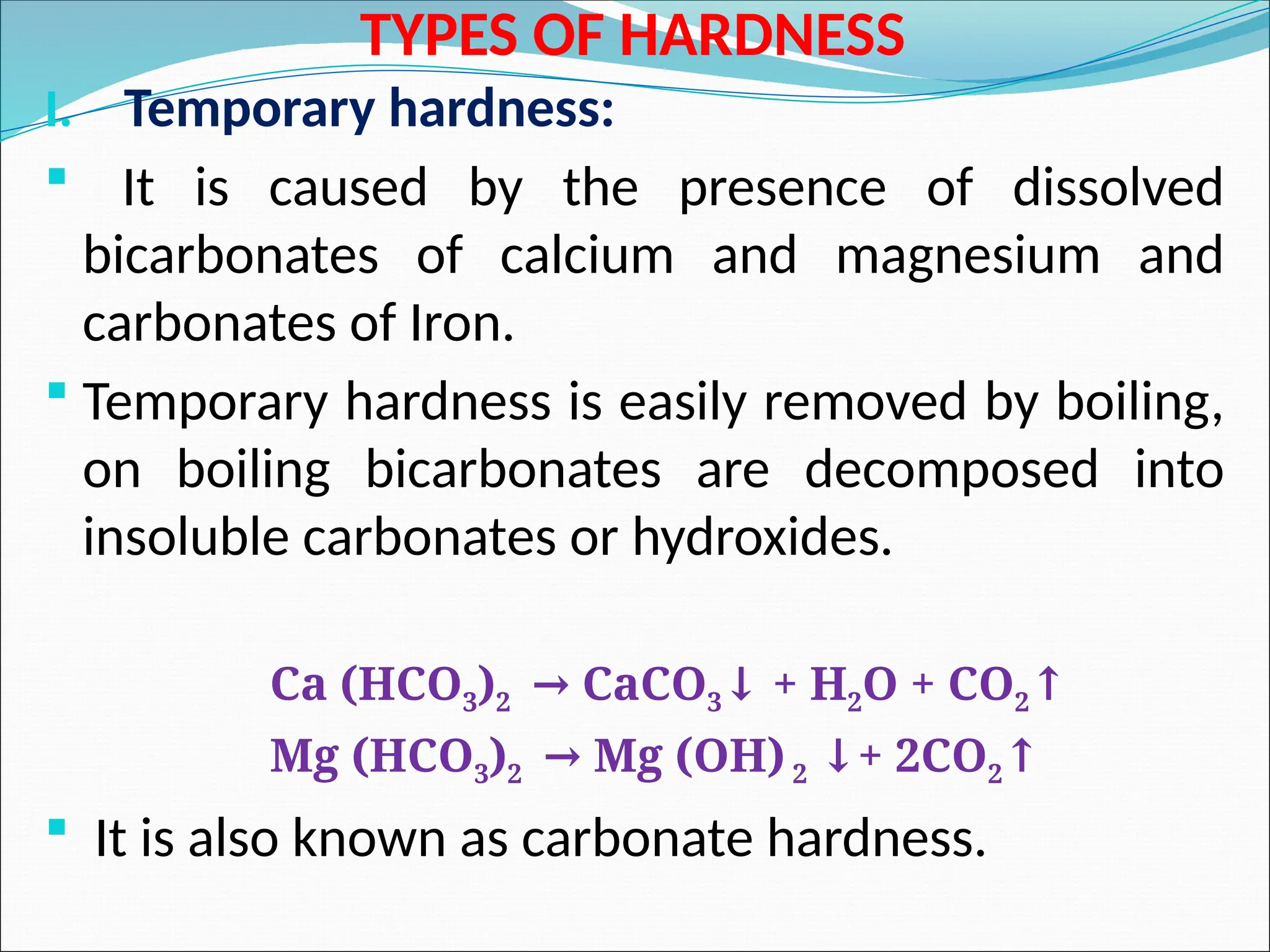
I.Temporary hardness:
It is caused by the presence of dissolved
bicarbonates of calcium and magnesium and
carbonates of Iron.
Temporary hardness is easily removed by boiling,
on boiling bicarbonates are decomposed into
insoluble carbonates or hydroxides.
Ca (HCO3)2 CaCO
→ 3 + H
↓ 2O + CO2↑
Mg (HCO3)2 Mg (OH)
→ 2 + 2CO
↓ 2↑
It is also known as carbonate hardness.
10.
II. Permanent hardness
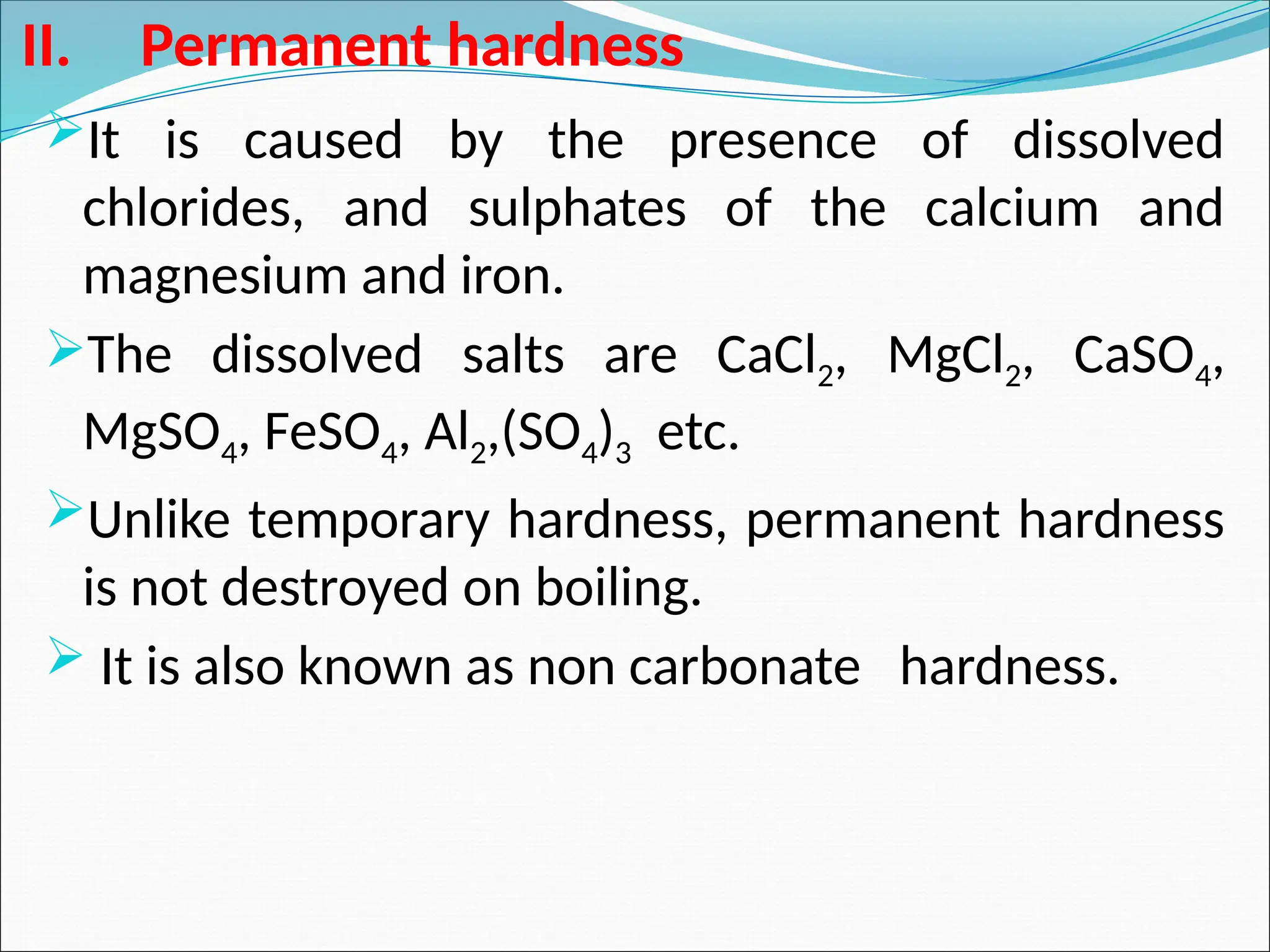
Itis caused by the presence of dissolved
chlorides, and sulphates of the calcium and
magnesium and iron.
The dissolved salts are CaCl2, MgCl2, CaSO4,
MgSO4, FeSO4, Al2,(SO4)3 etc.
Unlike temporary hardness, permanent hardness
is not destroyed on boiling.
It is also known as non carbonate hardness.
11.
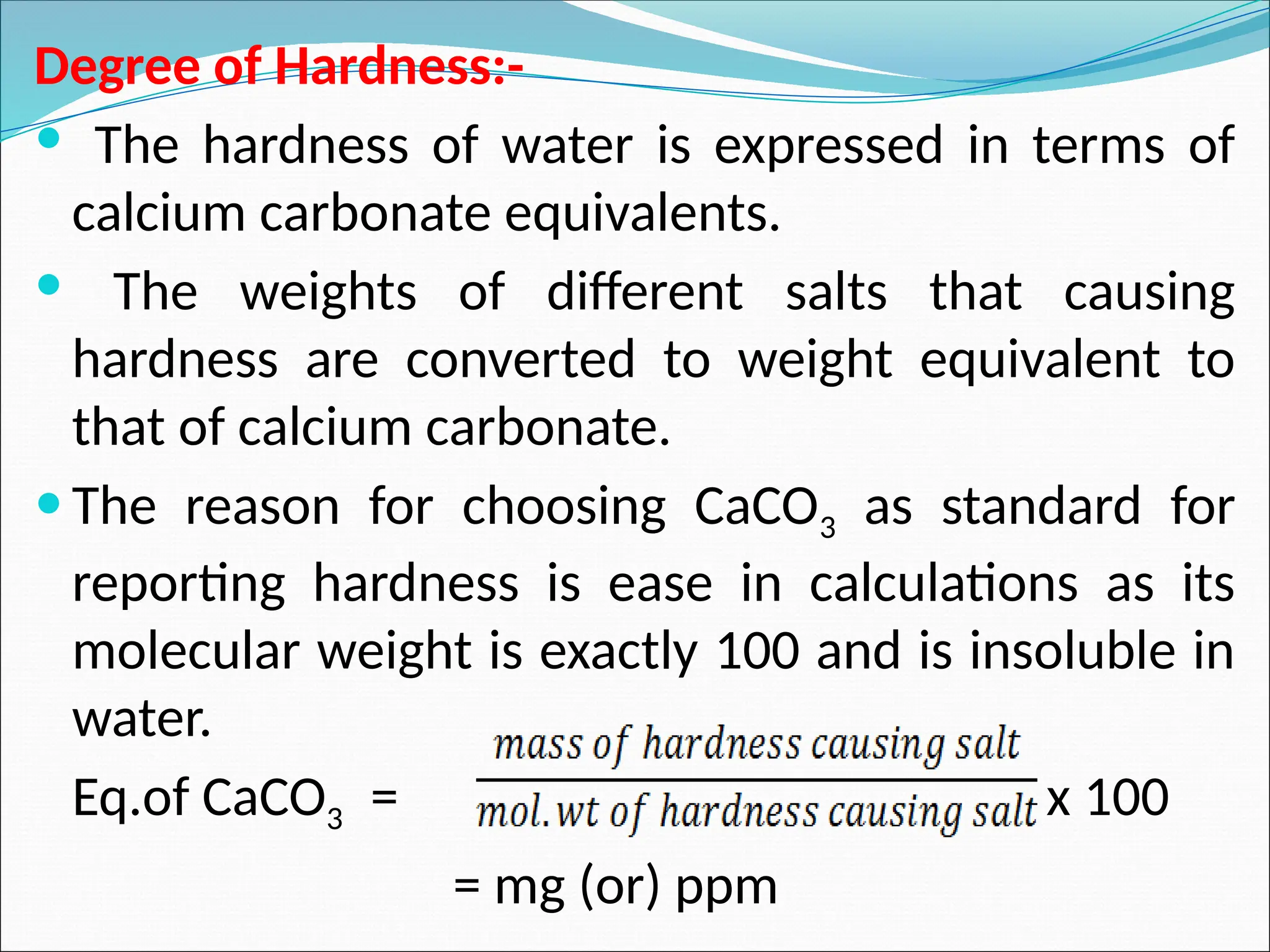
Degree of Hardness:-
The hardness of water is expressed in terms of
calcium carbonate equivalents.
The weights of different salts that causing
hardness are converted to weight equivalent to
that of calcium carbonate.
The reason for choosing CaCO3 as standard for
reporting hardness is ease in calculations as its
molecular weight is exactly 100 and is insoluble in
water.
Eq.of CaCO3 = x 100
= mg (or) ppm
12.
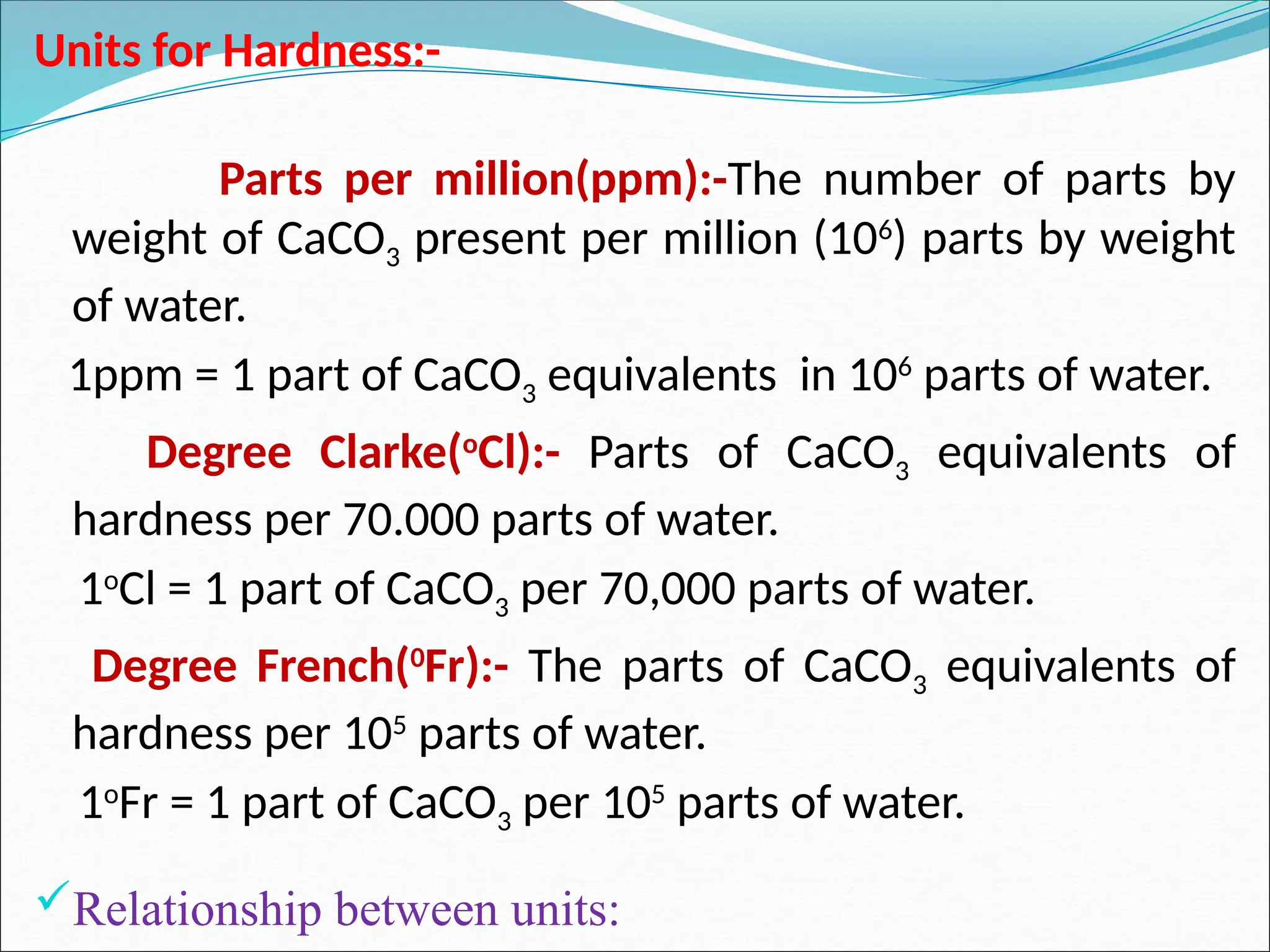
Units for Hardness:-
Partsper million(ppm):-The number of parts by
weight of CaCO3 present per million (106
) parts by weight
of water.
1ppm = 1 part of CaCO3 equivalents in 106
parts of water.
Degree Clarke(o
Cl):- Parts of CaCO3 equivalents of
hardness per 70.000 parts of water.
1o
Cl = 1 part of CaCO3 per 70,000 parts of water.
Degree French(0
Fr):- The parts of CaCO3 equivalents of
hardness per 105
parts of water.
1o
Fr = 1 part of CaCO3 per 105
parts of water.
Relationship between units:
13.
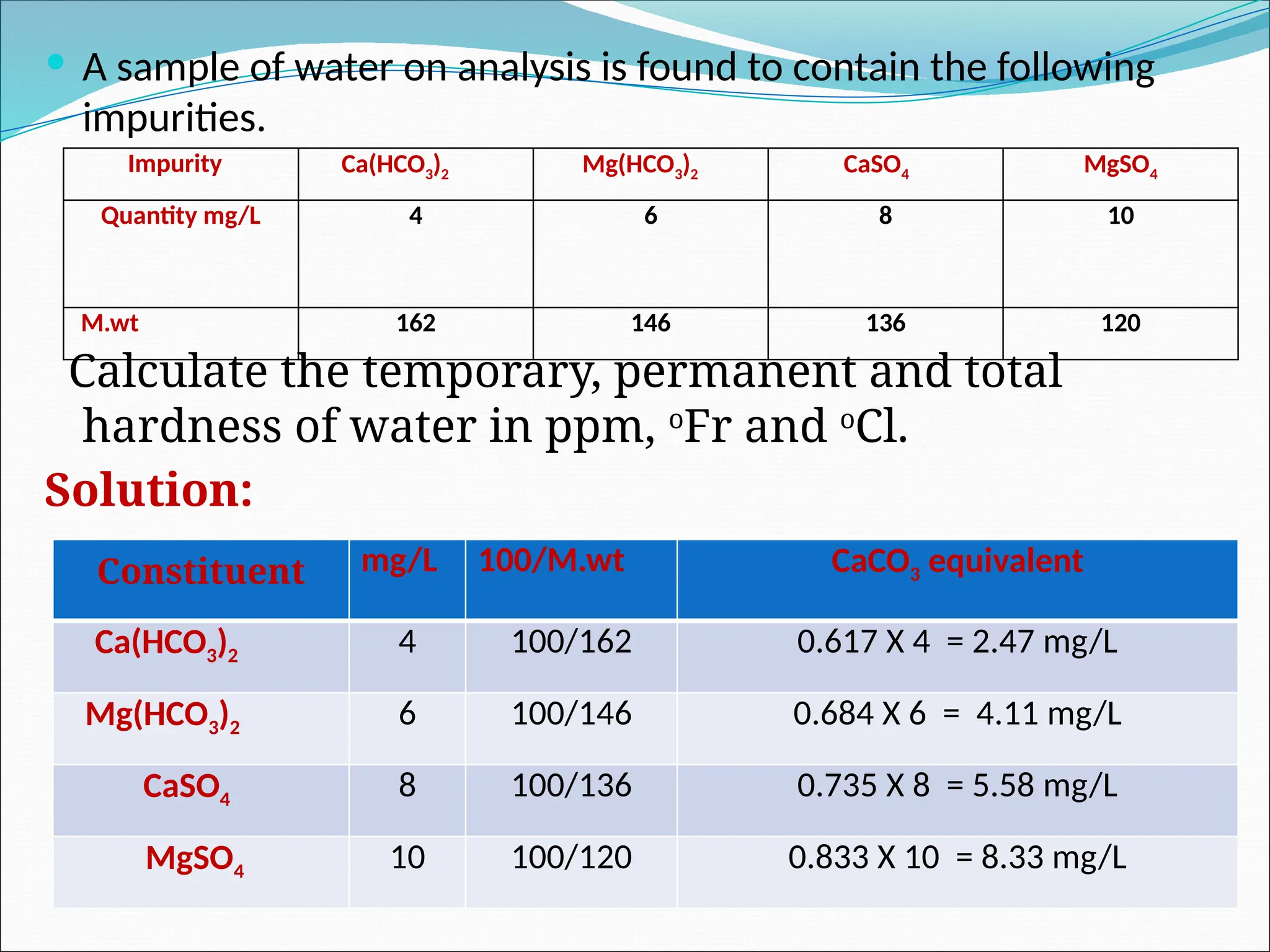
Impurity Ca(HCO3)2 Mg(HCO3)2CaSO4 MgSO4
Quantity mg/L 4 6 8 10
M.wt 162 146 136 120
A sample of water on analysis is found to contain the following
impurities.
Calculate the temporary, permanent and total
hardness of water in ppm, o
Fr and o
Cl.
Solution:
Constituent mg/L 100/M.wt CaCO3 equivalent
Ca(HCO3)2 4 100/162 0.617 X 4 = 2.47 mg/L
Mg(HCO3)2 6 100/146 0.684 X 6 = 4.11 mg/L
CaSO4 8 100/136 0.735 X 8 = 5.58 mg/L
MgSO4 10 100/120 0.833 X 10 = 8.33 mg/L
14.
Determination of temporaryHardness:-
THS is due to presence of bicarbonates of Ca and Mg
THS = 2.47+ 4.11 =6.58 mg/L (or) ppm
As 1mg/L = 1ppm = 0.1 o
Fr = 0.07 o
Cl
Temporary hardness = 6.58 mg/L (or) ppm
= 6.58 x 0.1 =0.658 o
Fr
= 6.58 x0.07= 0.46 o
Cl
Determination of permanent hardness:-
PHS is due to presence of CaSO4 and MgSO4
Permanent hardness = 5.88 + 8.33 = 14.21 mg/L
= 14.21ppm
= 14.21 x 0.1 = 1.421o
Fr
= 14.21x 0.07 = 0.995o
Cl
15.
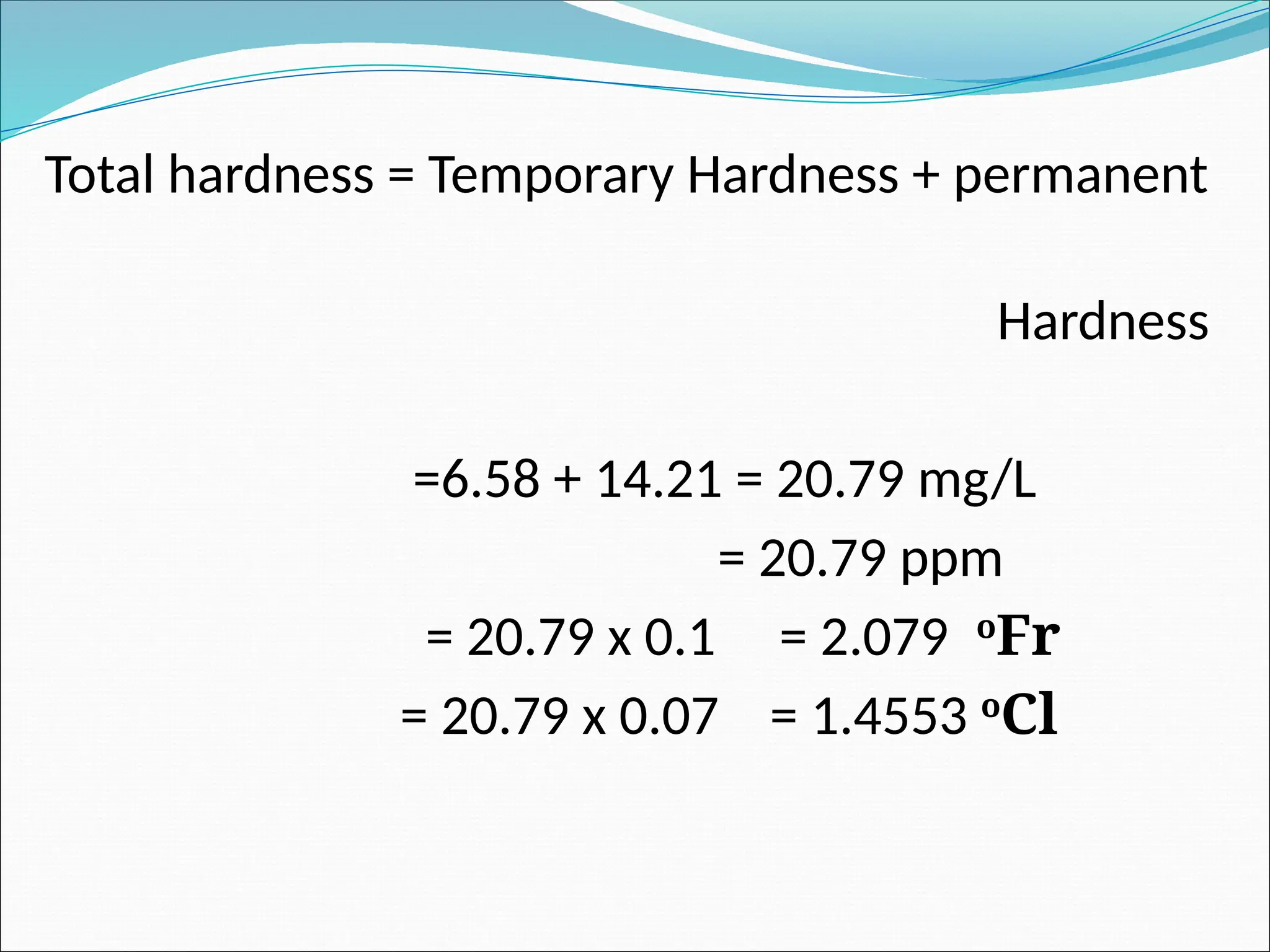
Total hardness =Temporary Hardness + permanent
Hardness
=6.58 + 14.21 = 20.79 mg/L
= 20.79 ppm
= 20.79 x 0.1 = 2.079 o
Fr
= 20.79 x 0.07 = 1.4553 o
Cl
16.
DETERMINATION OF HARDNESS- EDTA METHOD
Why hardness to be determined?
Drinkable or not drinkable - (ISO- 200 mg/l)
Applicable in industry or not
Boiler feed water hardness - (ASME - 0.3ppm
depend on pressure)
Applicable in irrigation or not
Role of Eriochromeblack-T (EBT) ?
Metal ion indicator – to determine end point
The most common way to detect the end point in
EDTA titration is with a metal ion indicator.
Metal ion indicators are compounds that change colour
when they bind to a metal ion to form complex.
Eriochrome black-T is a metal ion indicator used in
EDTA titrations. Free state and combined state both
have different colours (pH dependent)
19.
Role of Buffersolution (pH=10) ?
Buffer solution is resistant to pH change
Stabilize the system
Buffer solution of pH 10 is using in EDTA
titration (at pH = 10, EBT colour is blue)
16.9 g NH4Cl in 143 ml NH4OH
20.
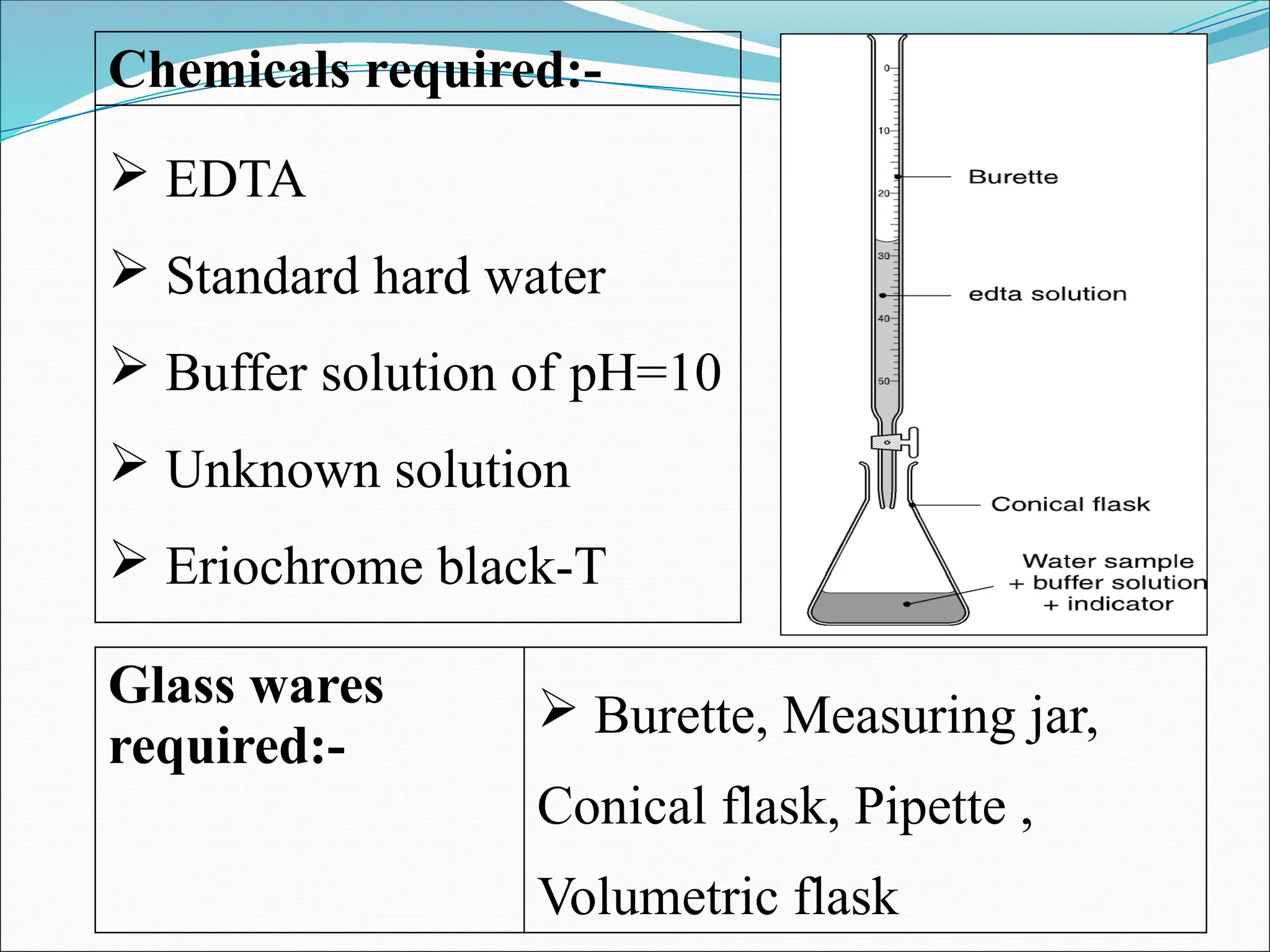
Principle:-
10 ml SHW+ 5 ml
Buffer solution + 2-
3 drops of
Eriochrome black-T
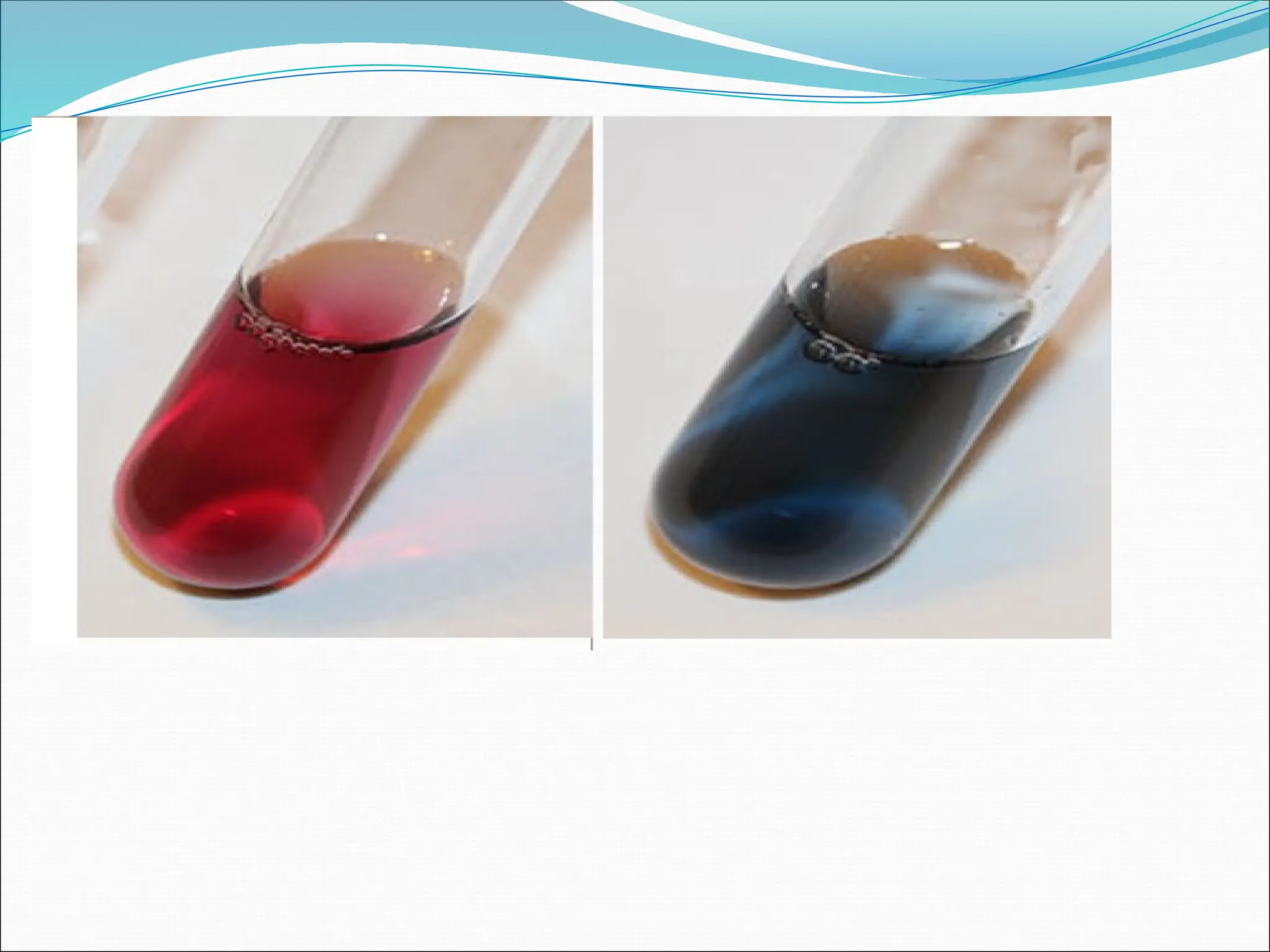
= wine red colour
EB-T forms unstable wine red
complex with Ca+2
and Mg+2
ions
M+2
+ EBT → [ M-EBT ]
wine red complex
(unstable)
M = Ca+2
and Mg+2
ions of hard
water
21.
Principle of EDTAmethod for the determination of
hardness of water
In order to determine the equivalence point , indicator
eriochrome black – T (EBT) is employed.
EBT forms unstable wine red complex with Ca+2
and Mg+2
ions
M+2
+ EBT → [ M-EBT ] complex
(Ca+2
and Mg+2
ions
of hard water ) wine red
23.
eriochrome black –T (EBT)
Iupac- Sodium 4-[2-(1-hydroxynaphthalen-2-yl)hydrazin-1-
ylidene]-7-nitro-3-oxo-3,4-dihydronaphthalene-1-sulfonate
or
Sodium 1-[1-Hydroxynaphthylazo]-6-nitro-2-naphthol-4-
sulfonate
C20H12N3O7SNa
24.
During titrationEDTA combines with Ca+2
or Mg+2
ions and forms stable [M-EDTA] blue coloured
complex.
[M-EBT] complex + EDTA → [M-EDTA]complex + EBT
wine red blue
The change of wine red colour to distinct blue colour
marks the end point of titration.
PROCEDURE:
I. Preparation ofStandard Hard water:
Transfer 1gm of CaCO3 into a 100ml
volumetric flask + 50 ml water + dil.HCl + Make
up to the mark by adding water.
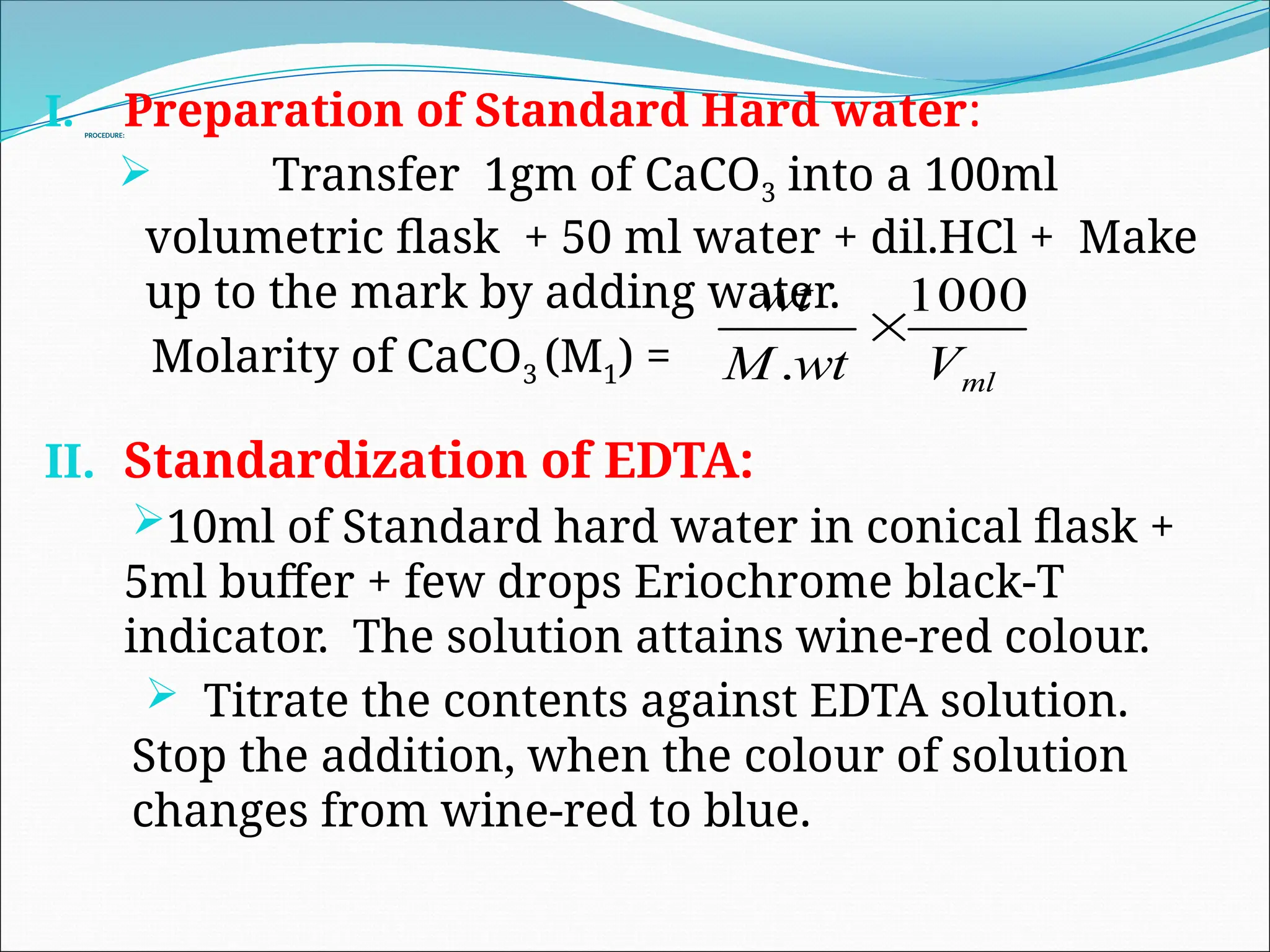
Molarity of CaCO3 (M1) =
II. Standardization of EDTA:
10ml of Standard hard water in conical flask +
5ml buffer + few drops Eriochrome black-T
indicator. The solution attains wine-red colour.
Titrate the contents against EDTA solution.
Stop the addition, when the colour of solution
changes from wine-red to blue.
ml
V
wt
M
wt 1000
.
27.
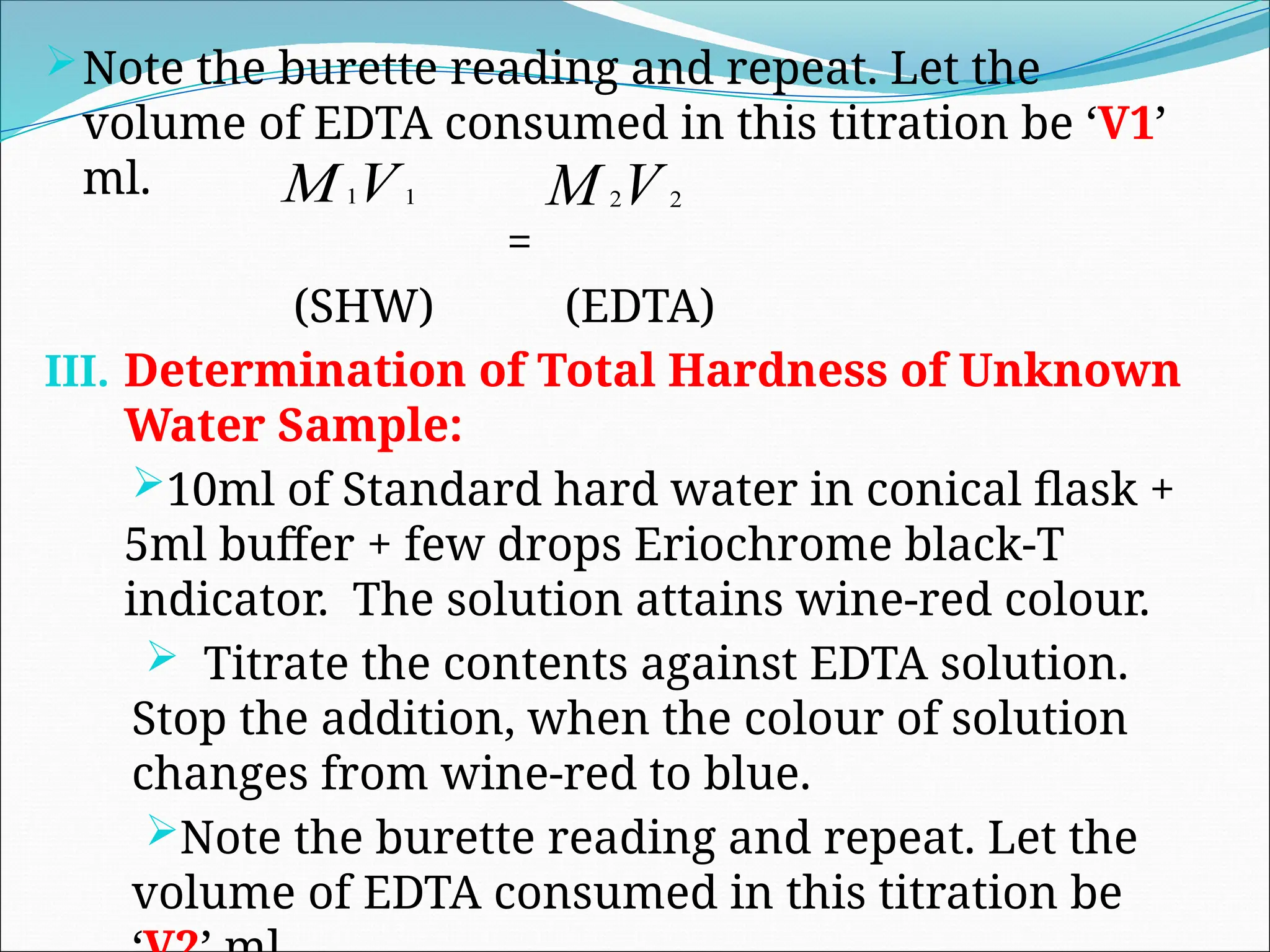
Note the burettereading and repeat. Let the
volume of EDTA consumed in this titration be ‘V1’
ml.
=
(SHW) (EDTA)
III. Determination of Total Hardness of Unknown
Water Sample:
10ml of Standard hard water in conical flask +
5ml buffer + few drops Eriochrome black-T
indicator. The solution attains wine-red colour.
Titrate the contents against EDTA solution.
Stop the addition, when the colour of solution
changes from wine-red to blue.
Note the burette reading and repeat. Let the
volume of EDTA consumed in this titration be
V
M 1
1 V
M 2
2
28.
=
(EDTA) (UWS)
The totalhardness of the test sample of water is
calculated as follows:
= M3 × 100 × 1000 = ppm
IV. Determination of Permanent Hardness of
Unknown Water Sample:
10ml of boiled water in conical flask + 5ml buffer +
few drops Eriochrome black-T indicator. The
solution attains wine-red colour.
Titrate the contents against EDTA solution. Stop
the addition, when the colour of solution changes
from wine-red to blue.
V
M 2
2 V
M 3
3
29.
Note the burettereading and repeat. Let the volume
of EDTA consumed in this titration be ‘V2’ ml.
=
(EDTA) (BWS)
Permanent hardness = ×100 × 1000 = ppm
Total hardness = Temporary hardness + permanent
hardness.
Temporary hardness = Total Hardness – permanent
Hardness.
V
M 2
2 V
M 4
4
M4
30.
Water for Industrialpurpose:
Different uses of water demand different specifications
Food Industry:
1.Poor quality water is responsible for diseases.
2.Free from microorganisms such as viruses,
protozoa and bacteria.
3.Free from toxic chemicals like heavy metals
and radio active compounds.
31.
Textile industry:
a)If hardwater used, uniform dyeing not possible,
b)Hard water decreases solubility of acidic dyes,
c) Basic dyes precipitated by hard water,
d)Organic matter imparts foul smell,
e)Fe and Mn salts leaves stains on fabrics,
It should be from above impurities.
32.
Pharmaceutical industries:
Require purewater , should be colourless, tasteless,
odourless and free from pathogenic organisms.
Sugar industry:
If hard water is used, results in deliquescent sugar.
Impurities cause difficulty in crystallization.
Paper industry:
Should free from SiO2, Fe and Mn salts.
SiO2 produces cracks and Fe, Mn imparts
colour to paper.
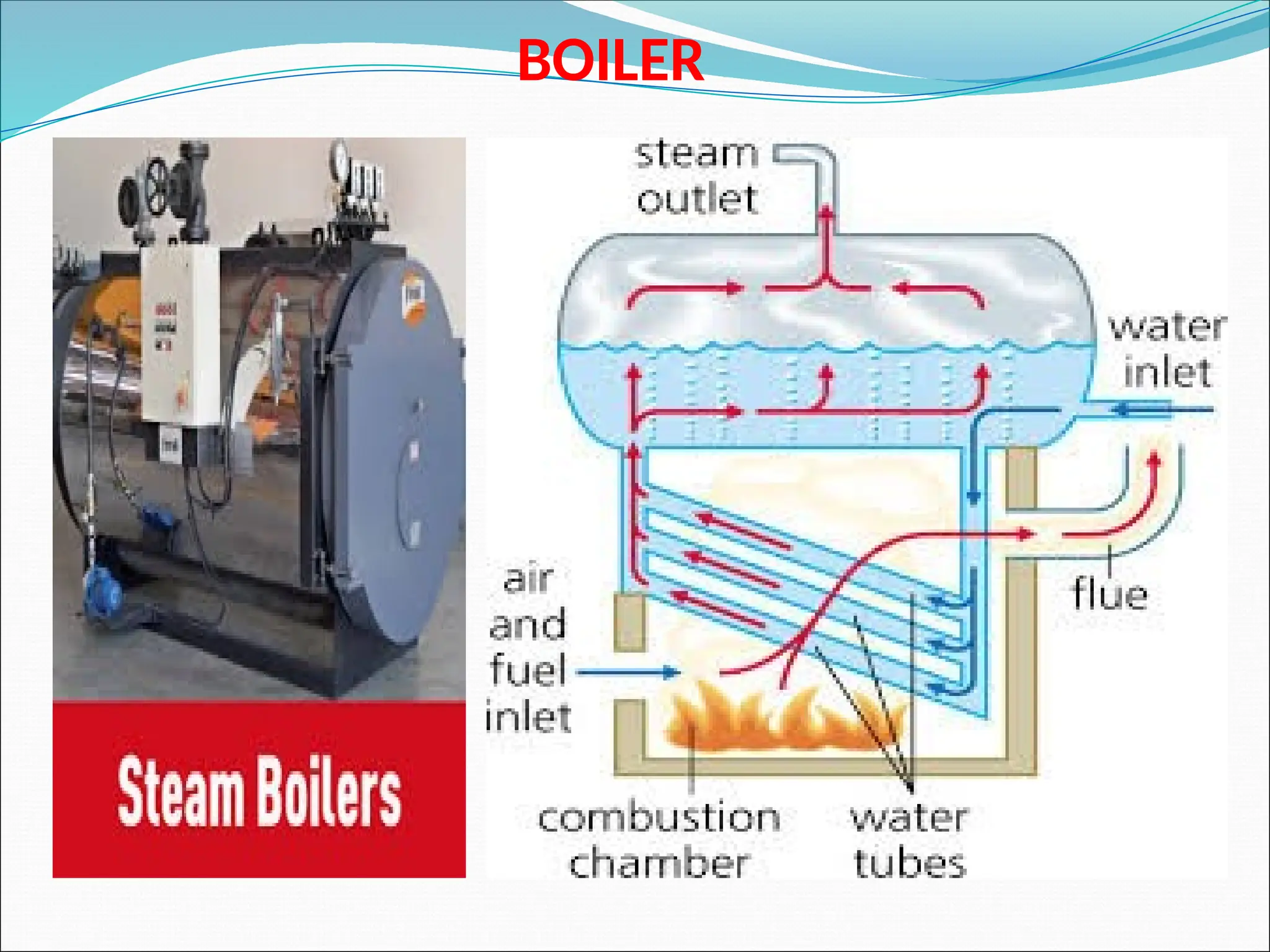
Boiler troubles:
Boilers areemployed in industries for generation of
steam.
When raw water is directly feed into the boilers
various physical changes and chemical reactions
are induced in the boiler with the action of the
heat.
The ultimate result being the problem such as
1. Carry over,
2. Boiler corrosion,
3. Caustic embrittlement and
4. Sludge and Scale formation.
35.
1.Carry over:
The processof carrying of water with
impurities by steam is called carry over.
a) PRIMING: When boiler is steaming
rapidly, some droplets of liquid water
carried along with the steam. This
process of wet steam formation is
called priming.
It is caused by the presence of large
amount of dissolved salts,
Improper boiler design,
High steam velocities and sudden
boiling.
36.
Priming can beavoided
By fitting
mechanical steam
purifiers,
Avoiding rapid
change in steaming
rate,
Maintaining low
water levels in
boilers,
Efficient softening
and filtration of the
37.
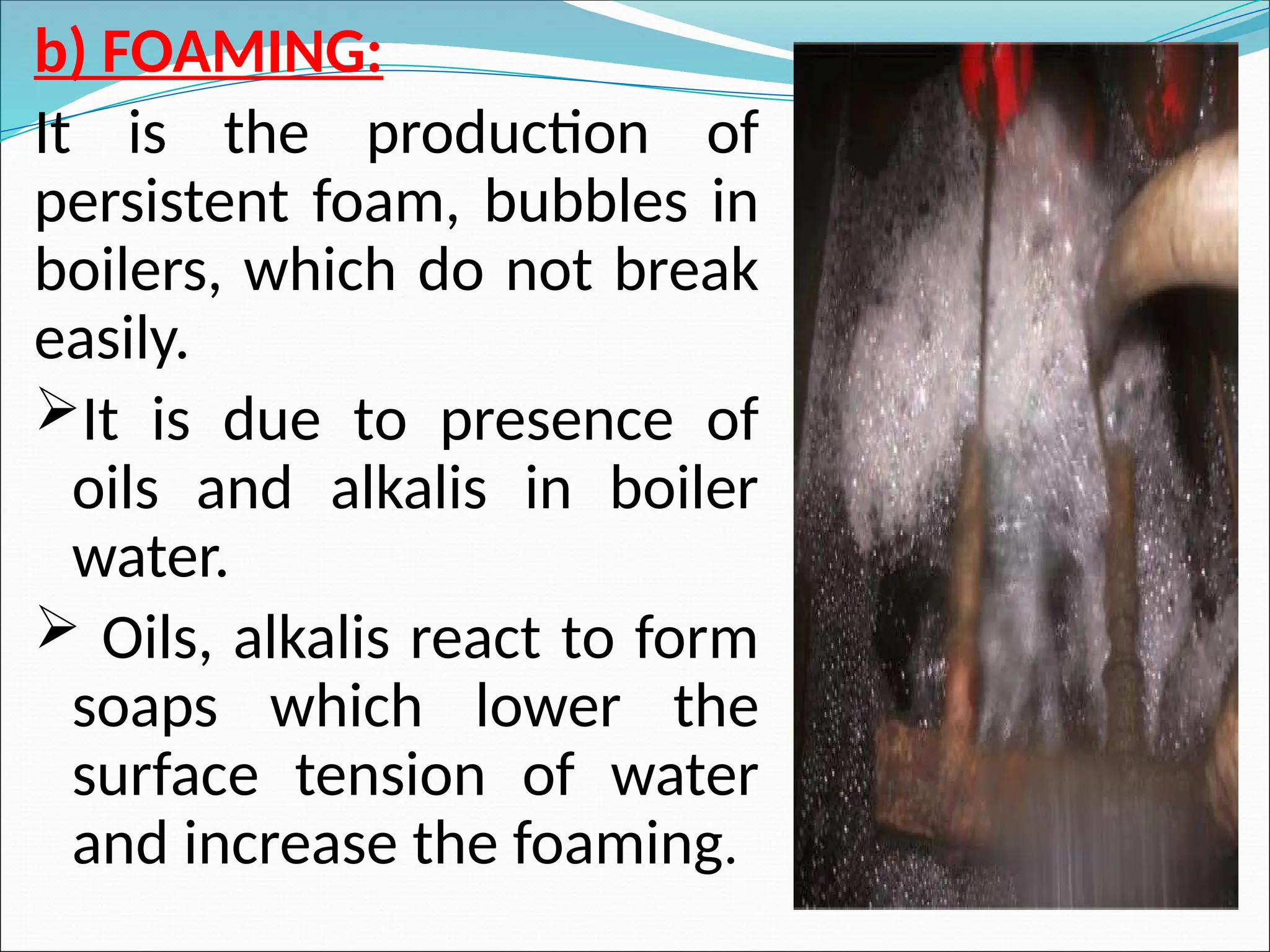
b) FOAMING:
It isthe production of
persistent foam, bubbles in
boilers, which do not break
easily.
It is due to presence of
oils and alkalis in boiler
water.
Oils, alkalis react to form
soaps which lower the
surface tension of water
and increase the foaming.
38.
Foaming can beavoided by
Addition of antifoaming agents like castor oil.
By removing foaming agent like oil and alkalis in
boiler water.
The oils can be removed by adding compounds
like sodium aluminates and aluminum sulphate.
Disadvantages of priming and foaming:-
The actual height of the water in boiler is not
judged,
Wastage of heat,
Efficiency f the boiler is lowered
corrosion of the machineries.
39.
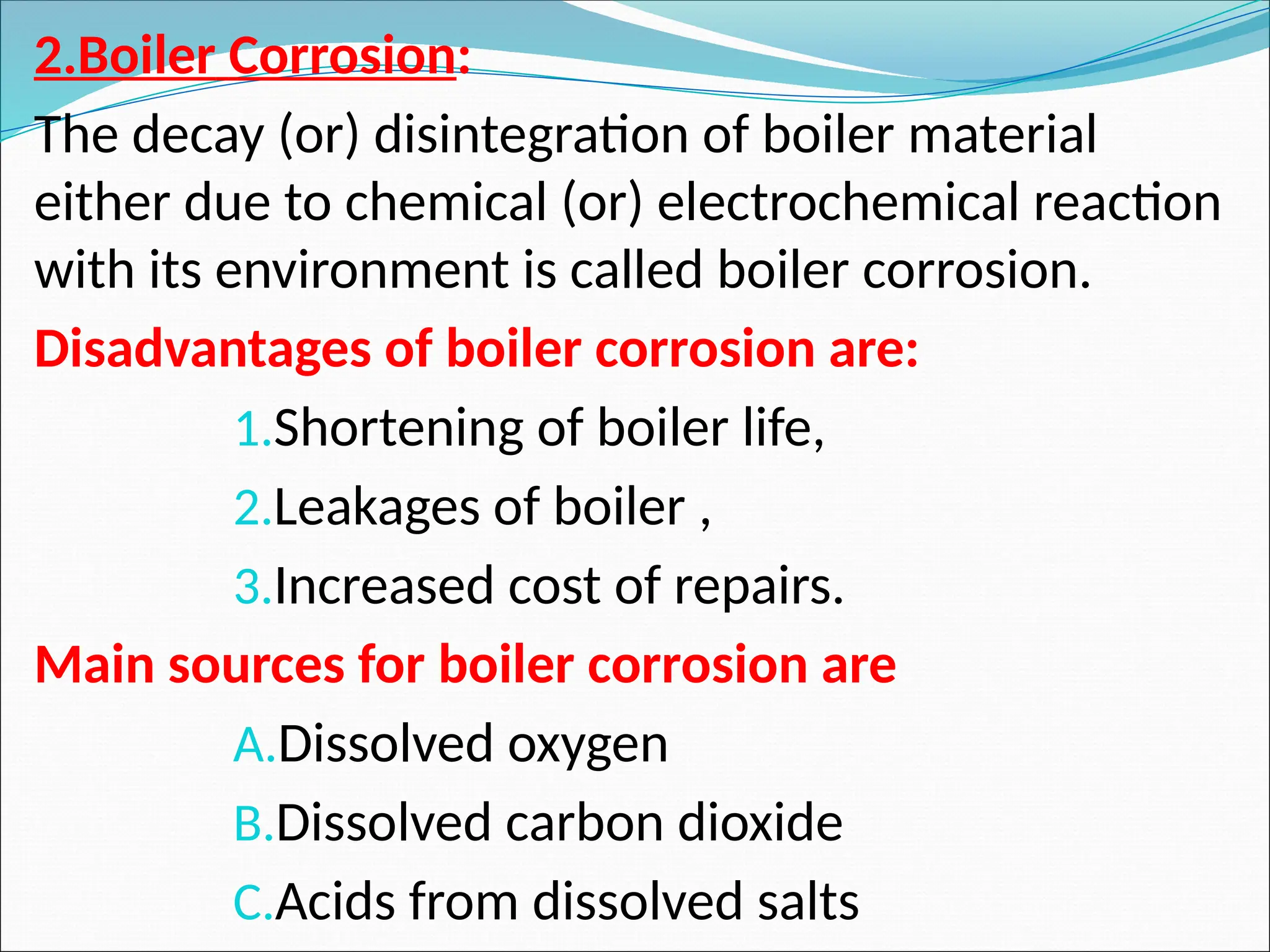
2.Boiler Corrosion:
The decay(or) disintegration of boiler material
either due to chemical (or) electrochemical reaction
with its environment is called boiler corrosion.
Disadvantages of boiler corrosion are:
1.Shortening of boiler life,
2.Leakages of boiler ,
3.Increased cost of repairs.
Main sources for boiler corrosion are
A.Dissolved oxygen
B.Dissolved carbon dioxide
C.Acids from dissolved salts
40.
A. Dissolved oxygen:Water usually contains about
8ppm of dissolved oxygen at RT.
It attacks boilers at high temperature.
4Fe +2H2O + O → 4Fe [OH]2↓
4Fe [OH]2↓ + O2 → 2[Fe2O32H2O] ↓
(Ferrous hydroxide) (Rust)
Removal of dissolved oxygen:
By adding sodium sulphite , hydrazine and sodium sulphide
2Na2
SO3
+ O2
2 Na2
SO4
N2
H4
+ O2
N2
+ 2H2
O
Na2
S + 2O2
Na2
SO4
41.
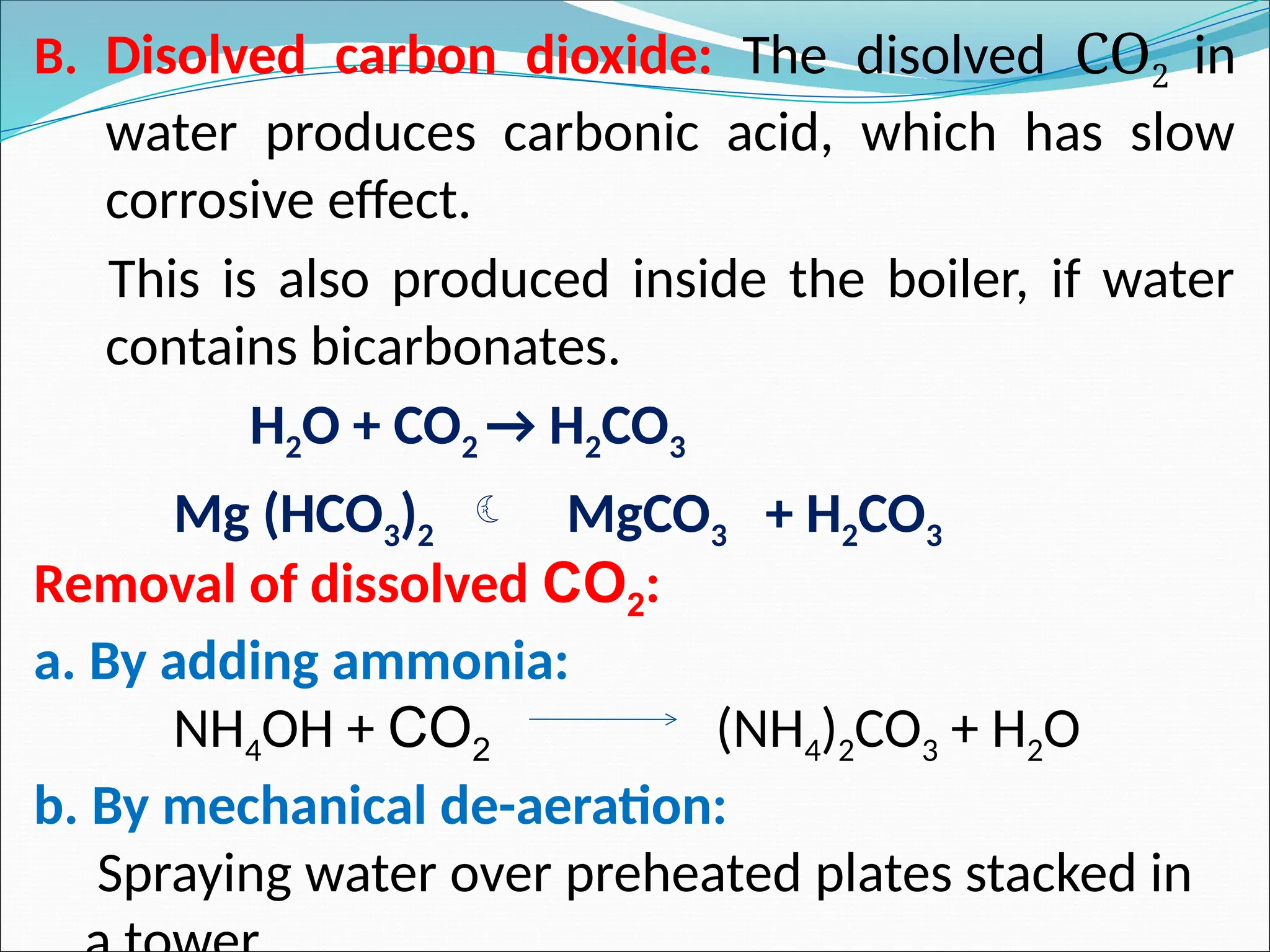
B. Disolved carbondioxide: The disolved CO2 in
water produces carbonic acid, which has slow
corrosive effect.
This is also produced inside the boiler, if water
contains bicarbonates.
H2O + CO2 → H2CO3
Mg (HCO3)2 MgCO3 + H2CO3
Removal of dissolved CO2:
a. By adding ammonia:
NH4OH + CO2 (NH4)2CO3 + H2O
b. By mechanical de-aeration:
Spraying water over preheated plates stacked in
43.
C. Acids fromdissolved salts:
Mineral acids are generated by the hydrolysis of
disolved acidic salts.
The liberated acid reacts with Fe of boiler to form
Fe(OH)2
subsequently get converted into rust .
Small amount of MgCl2
will cause corrosion of Fe
to a large extent.
MgCl2
+ 2H2
O Mg(OH)2
+ 2HCl
2HCl + Fe FeCl2
+ H2
FeCl2
+ 2H2
O Fe(OH)2
+ 2HCl
Fe(OH)2
+ O2
Fe2
O3
.2H2
O
44.
Prevention of Acidcorrosion :
HCl can be removed by adding alkalis
By addition of inhibitors
By frequent blow down operation
By softening of boiler water .
45.
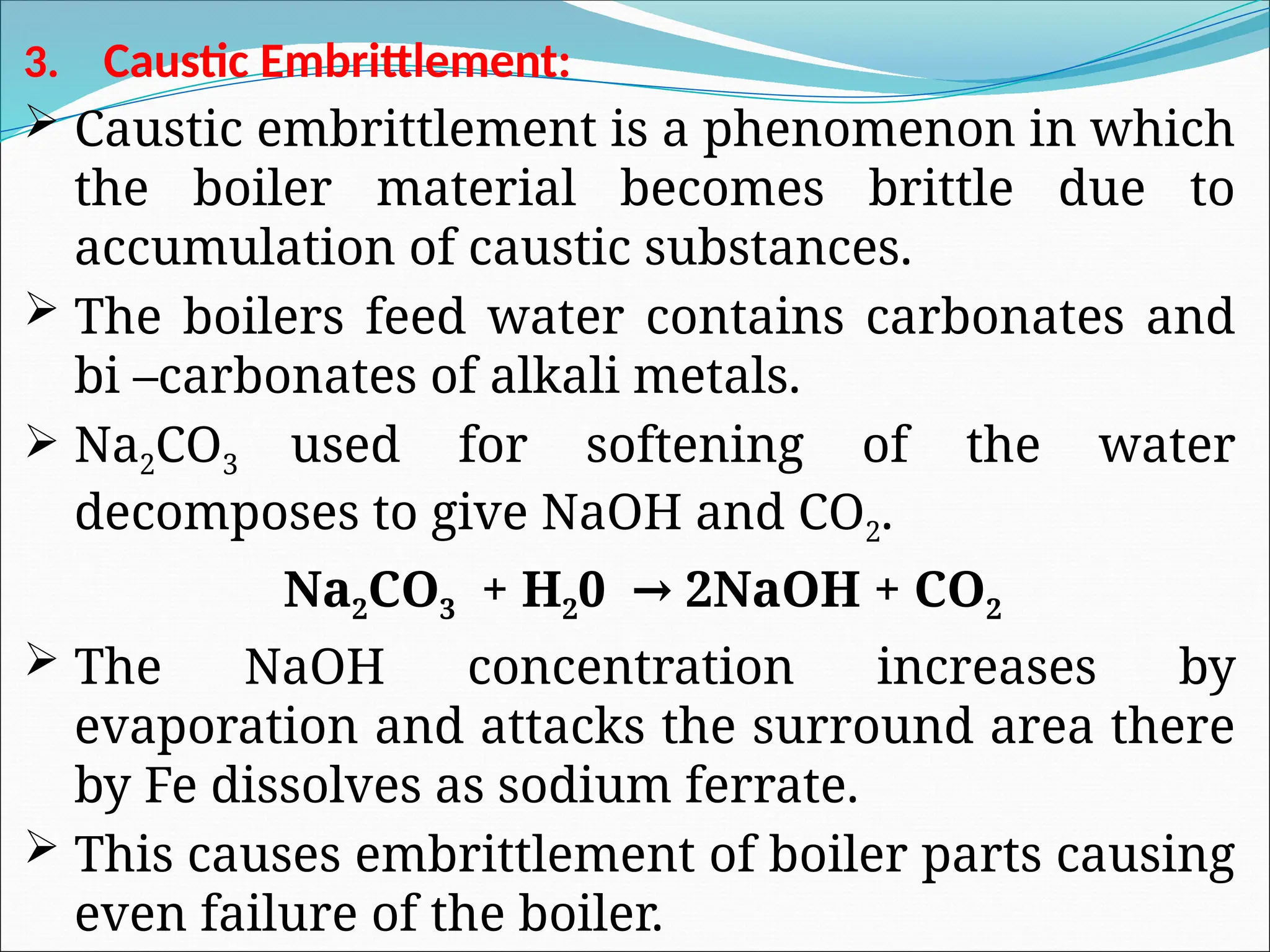
3. Caustic Embrittlement:
Caustic embrittlement is a phenomenon in which
the boiler material becomes brittle due to
accumulation of caustic substances.
The boilers feed water contains carbonates and
bi –carbonates of alkali metals.
Na2CO3 used for softening of the water
decomposes to give NaOH and CO2.
Na2CO3 + H20 2NaOH + CO
→ 2
The NaOH concentration increases by
evaporation and attacks the surround area there
by Fe dissolves as sodium ferrate.
This causes embrittlement of boiler parts causing
even failure of the boiler.
46.
Prevention methods:-
Byusing sodium phosphate as
softening reagent instead of Na2CO3
for boiler water.
By adding Na2SO4 to boiler water
which blocks the hair cracks in the
boiler.
By adding tannin or lignin to boiler
water which blocks the hair cracks in
the boiler there by preventing
formation of concentration cells.
47.
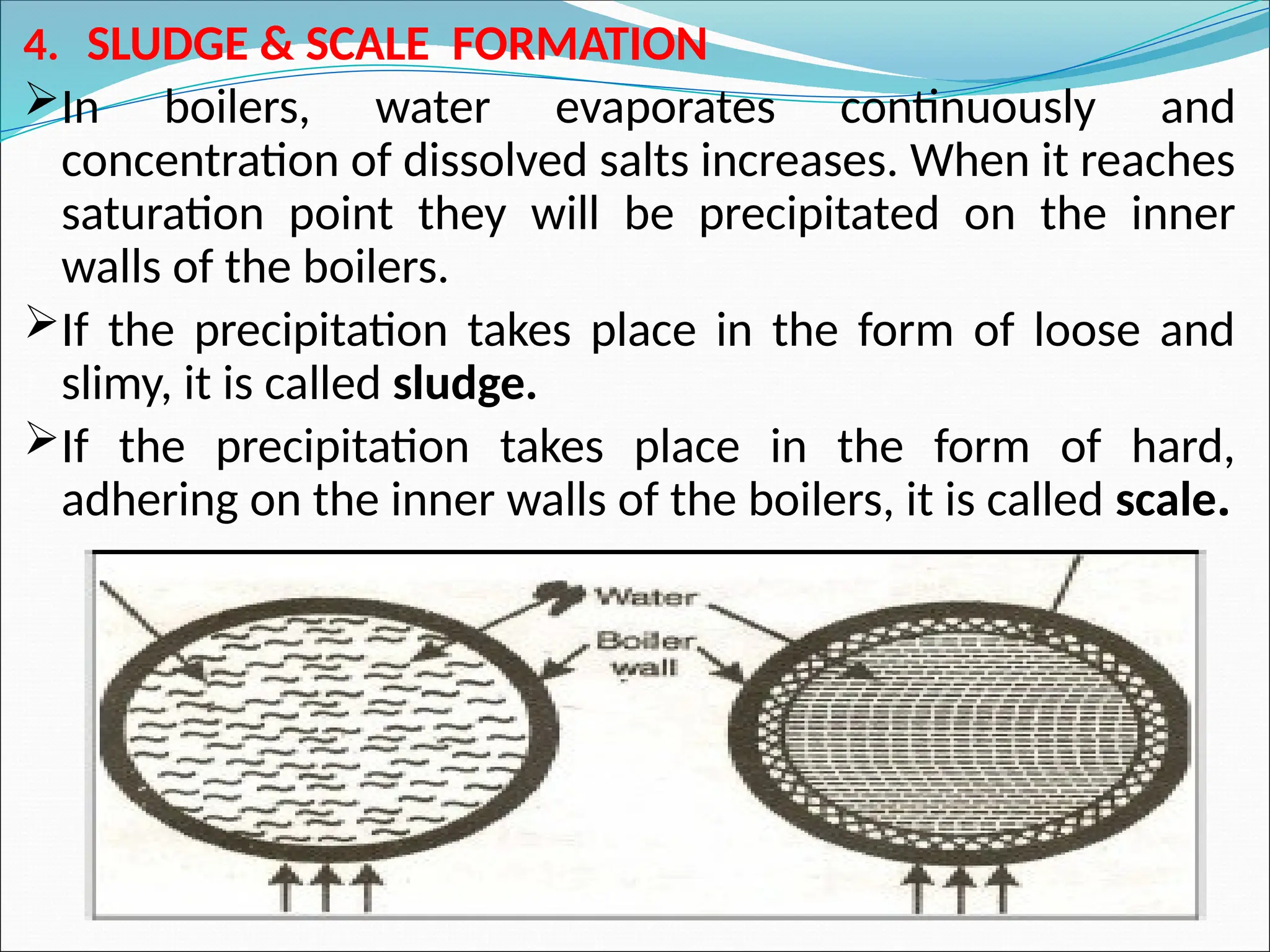
4. SLUDGE &SCALE FORMATION
In boilers, water evaporates continuously and
concentration of dissolved salts increases. When it reaches
saturation point they will be precipitated on the inner
walls of the boilers.
If the precipitation takes place in the form of loose and
slimy, it is called sludge.
If the precipitation takes place in the form of hard,
adhering on the inner walls of the boilers, it is called scale.
48.
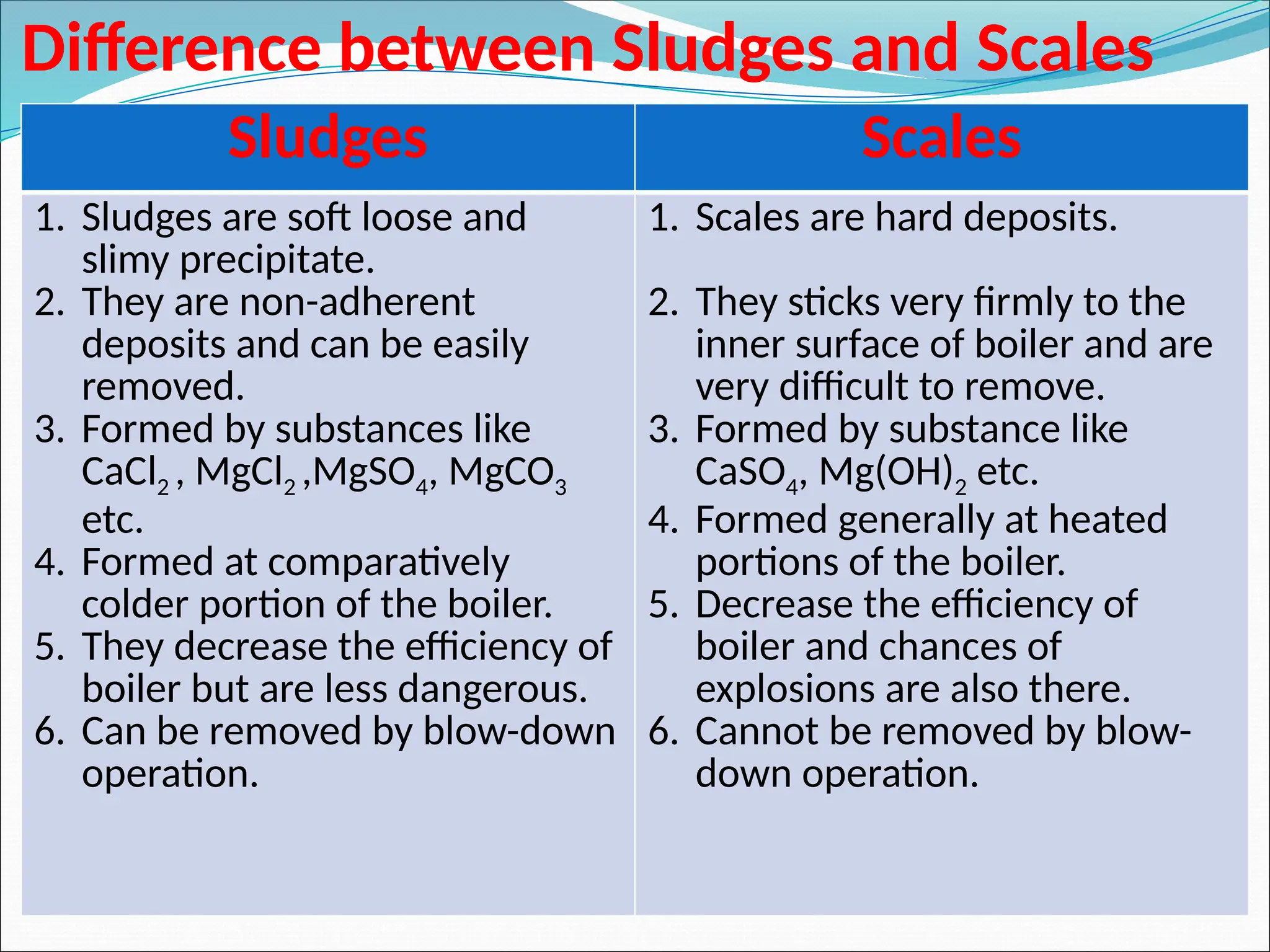
Difference between Sludgesand Scales
Sludges Scales
1. Sludges are soft loose and
slimy precipitate.
2. They are non-adherent
deposits and can be easily
removed.
3. Formed by substances like
CaCl2 , MgCl2 ,MgSO4, MgCO3
etc.
4. Formed at comparatively
colder portion of the boiler.
5. They decrease the efficiency of
boiler but are less dangerous.
6. Can be removed by blow-down
operation.
1. Scales are hard deposits.
2. They sticks very firmly to the
inner surface of boiler and are
very difficult to remove.
3. Formed by substance like
CaSO4, Mg(OH)2 etc.
4. Formed generally at heated
portions of the boiler.
5. Decrease the efficiency of
boiler and chances of
explosions are also there.
6. Cannot be removed by blow-
down operation.
49.
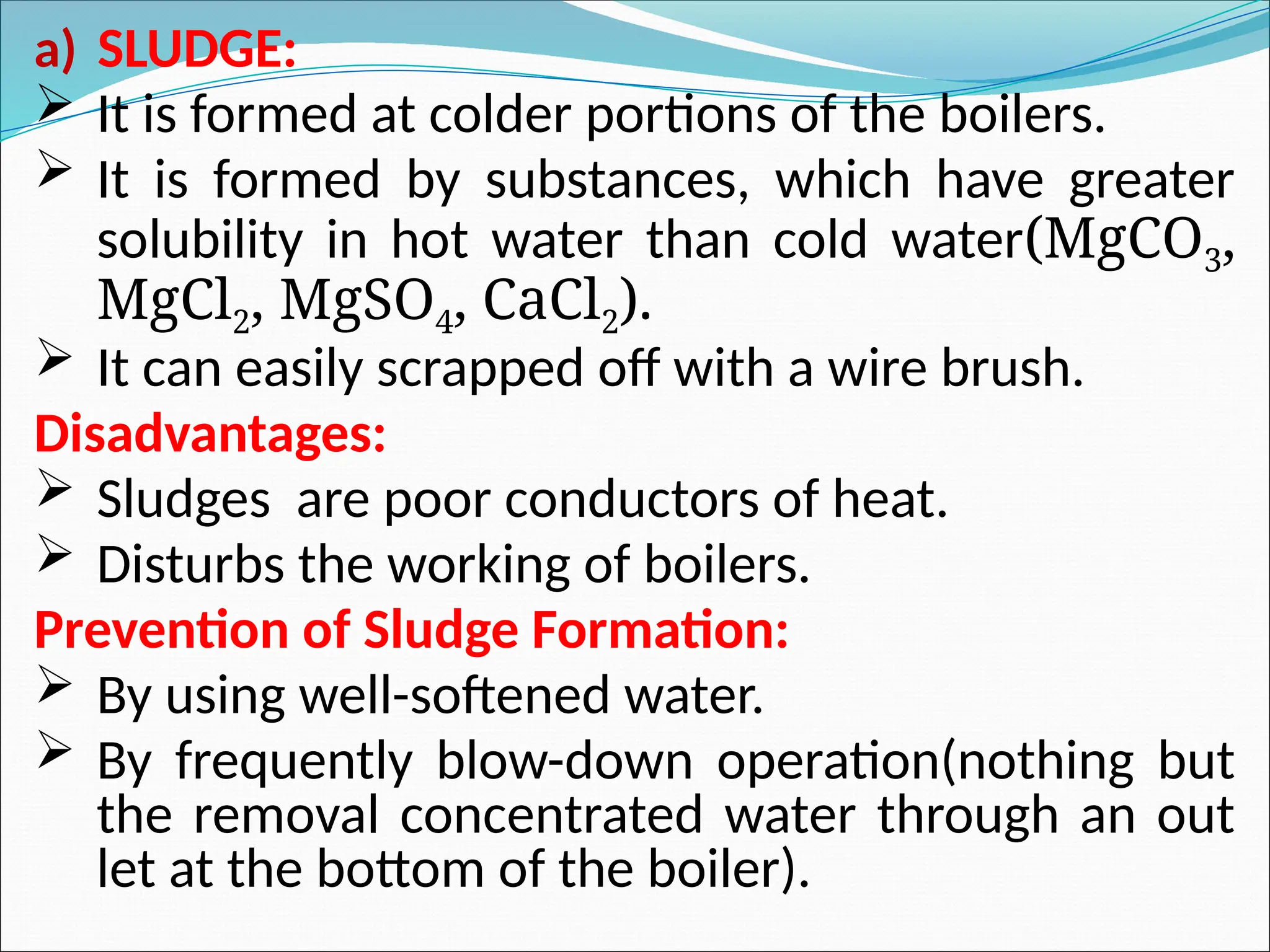
a) SLUDGE:
Itis formed at colder portions of the boilers.
It is formed by substances, which have greater
solubility in hot water than cold water(MgCO3,
MgCl2, MgSO4, CaCl2).
It can easily scrapped off with a wire brush.
Disadvantages:
Sludges are poor conductors of heat.
Disturbs the working of boilers.
Prevention of Sludge Formation:
By using well-softened water.
By frequently blow-down operation(nothing but
the removal concentrated water through an out
let at the bottom of the boiler).
50.
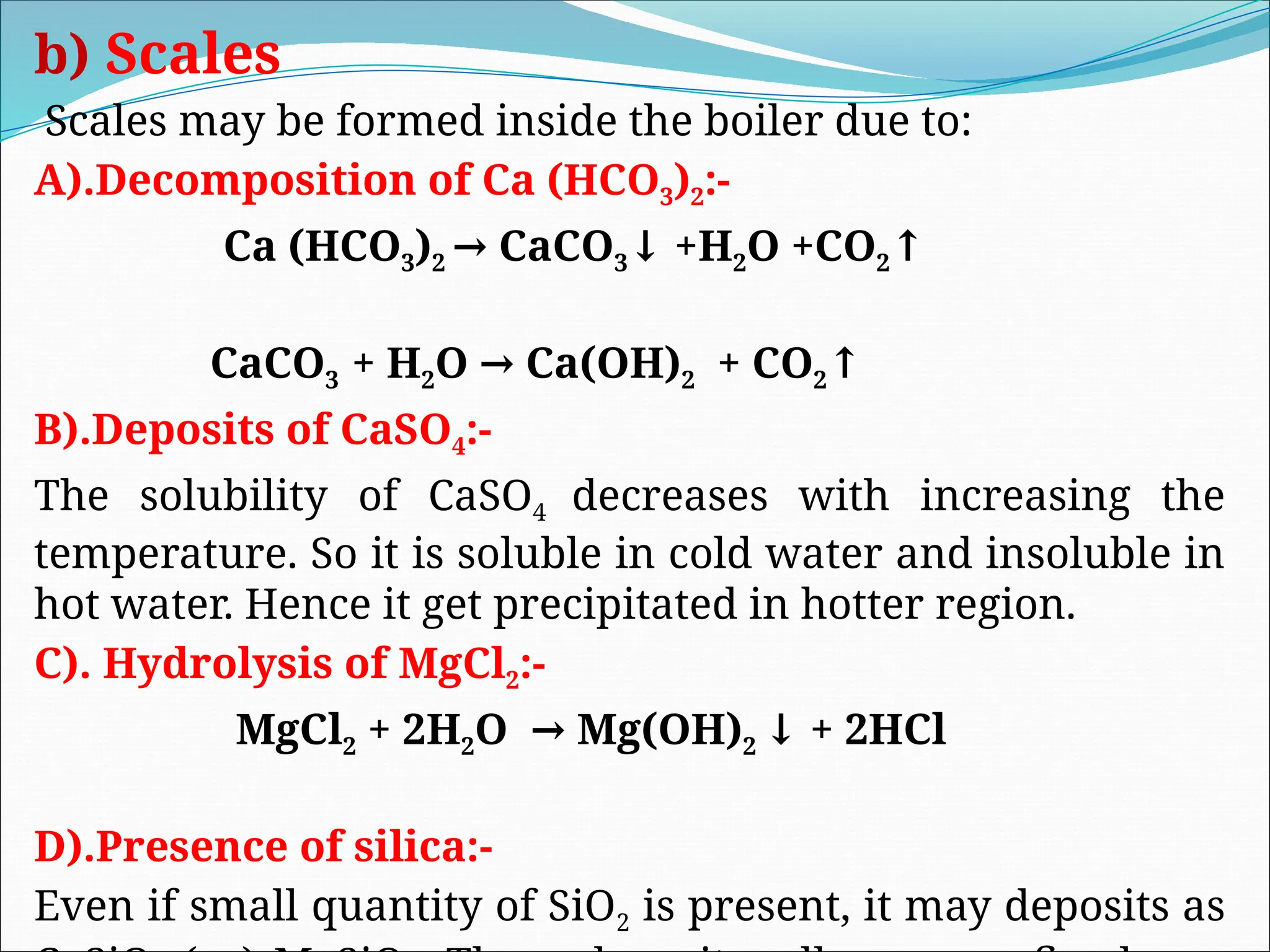
b) Scales
Scales maybe formed inside the boiler due to:
A).Decomposition of Ca (HCO3)2:-
Ca (HCO3)2 CaCO
→ 3 +H
↓ 2O +CO2↑
CaCO3 + H2O Ca(OH)
→ 2 + CO2↑
B).Deposits of CaSO4:-
The solubility of CaSO4 decreases with increasing the
temperature. So it is soluble in cold water and insoluble in
hot water. Hence it get precipitated in hotter region.
C). Hydrolysis of MgCl2:-
MgCl2 + 2H2O Mg(OH)
→ 2 + 2HCl
↓
D).Presence of silica:-
Even if small quantity of SiO2 is present, it may deposits as
51.
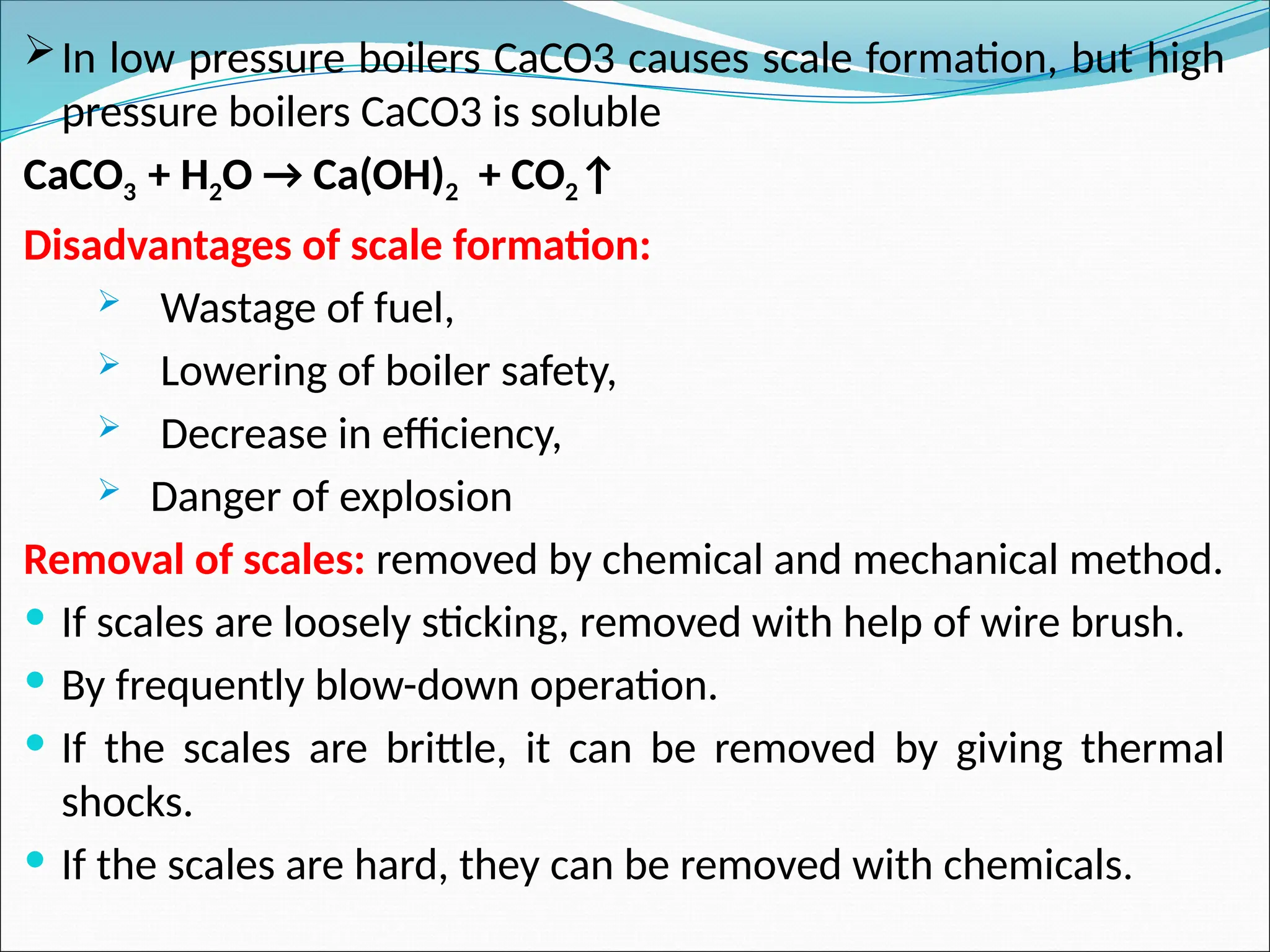
In low pressureboilers CaCO3 causes scale formation, but high
pressure boilers CaCO3 is soluble
CaCO3 + H2O → Ca(OH)2 + CO2↑
Disadvantages of scale formation:
Wastage of fuel,
Lowering of boiler safety,
Decrease in efficiency,
Danger of explosion
Removal of scales: removed by chemical and mechanical method.
If scales are loosely sticking, removed with help of wire brush.
By frequently blow-down operation.
If the scales are brittle, it can be removed by giving thermal
shocks.
If the scales are hard, they can be removed with chemicals.
52.
Treatment (or) Softeningof water for industry
Treatment of boiler Feed water:-
Water used in boiler should be free from
impurities. Otherwise cause operational troubles.
The removal of hardness is done by following
methods.
I.Internal Treatment of water.
II.External Treatment of water
53.
I. Internal Treatment
In this method, raw water is treated inside the boiler.
Addition of suitable chemicals to reduce scale and
sludge formation and to convert the scale forming
chemicals into sludge which can be removed by blow
down process.
Some of the internal treatment methods used for the
removal of scale formation in boilers are.
A) Phosphate conditioning
B) Carbonate conditioning
C) Calgon conditioning
54.
A) Phosphate conditioning
Itis generally applicable to high pressure boilers.
Scale formation is avoided by adding sodium phosphate,
which reacts with magnesium and calcium salts forming
non-sticky and easily removable sludge of calcium and
magnesium phosphate and easily removed by blow down
operation.
3MCl2
+ 2Na3
PO4
→ M3
( PO4
)2
↓ + 6NaCl
[Where M = Ca2+
, Mg2+
]
3MSO4
+ 2Na3
PO4
→ M3
( PO4
)2
↓ + 6NaSO4
55.
B) Carbonate conditioning
Inlow pressure boilers, scale formation can be avoided
by adding sodium carbonate to boiler water.
When salts like CaSO4 can be converted into CaCO3.
CaCO3 can be removed by blow down process.
CaSO4 + Na2CO3 CaCO
→ 3 + Na
↓ 2SO4↓
56.
C) Calgon conditioning:
Itinvolves in adding Sodium hexa meta phosphate
(calgon) to boiler water to prevent the scale and
sludge formation.
Calgon converts the scale forming impurity like
CaSO4 into soluble complex compound.
Na2 [Na4 (PO3)6] ↔ 2Na+
+ [Na4 (PO3)6]2-
Calgon
2CaSO4 + [Na4 (PO3)6]2-
→ [Ca2 (PO3)6]2-
+ 2Na2SO4
Insoluble soluble insoluble
57.
The removal ofhardness causing salts from
water before it feed into the boiler is external
treatment
This treatment is given outside the boiler, to
reduce the concentration of hardness producing
ions.
II. EXTERNAL TREATMENT:
58.
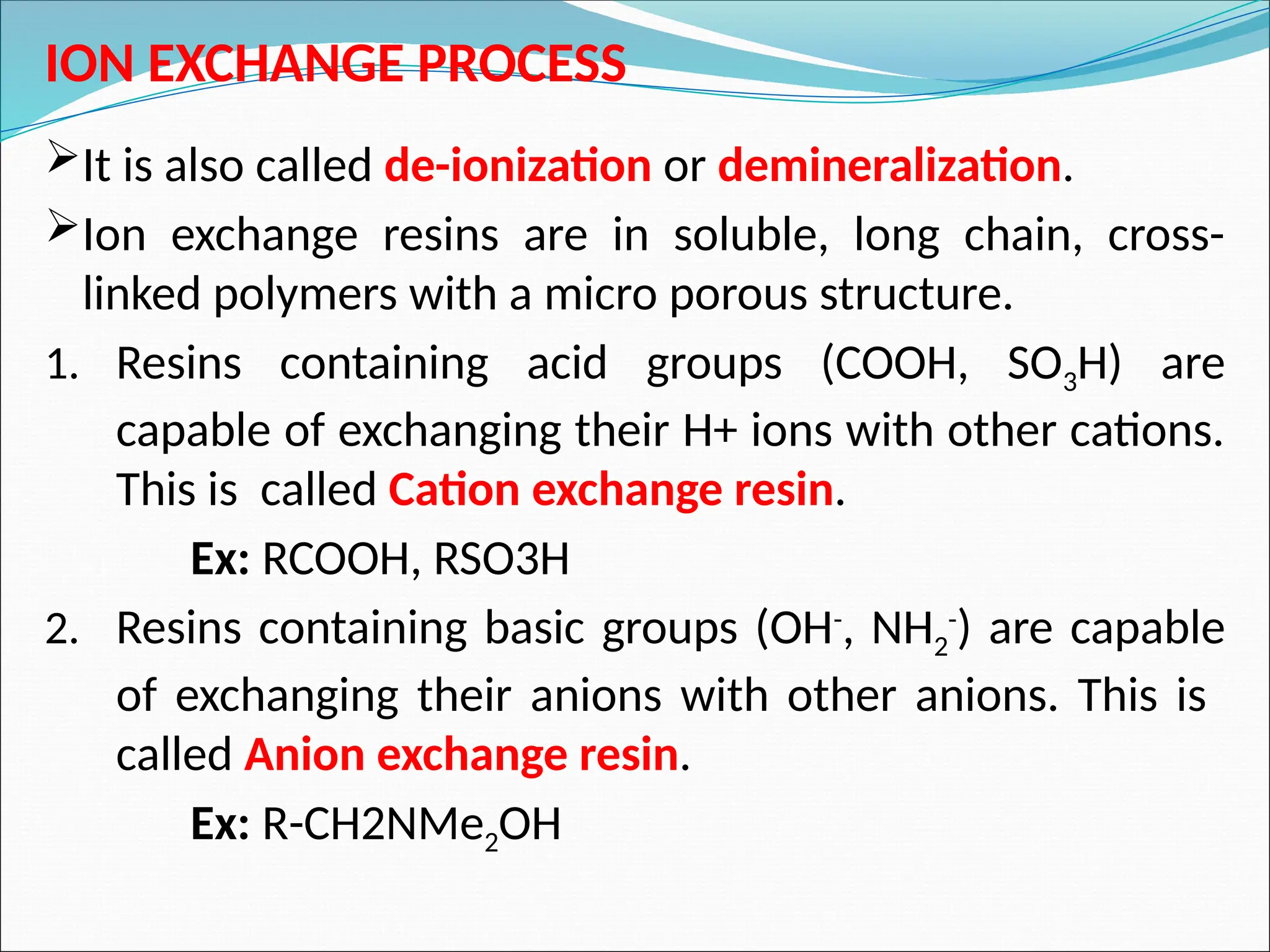
ION EXCHANGE PROCESS
Itis also called de-ionization or demineralization.
Ion exchange resins are in soluble, long chain, cross-
linked polymers with a micro porous structure.
1. Resins containing acid groups (COOH, SO3H) are
capable of exchanging their H+ ions with other cations.
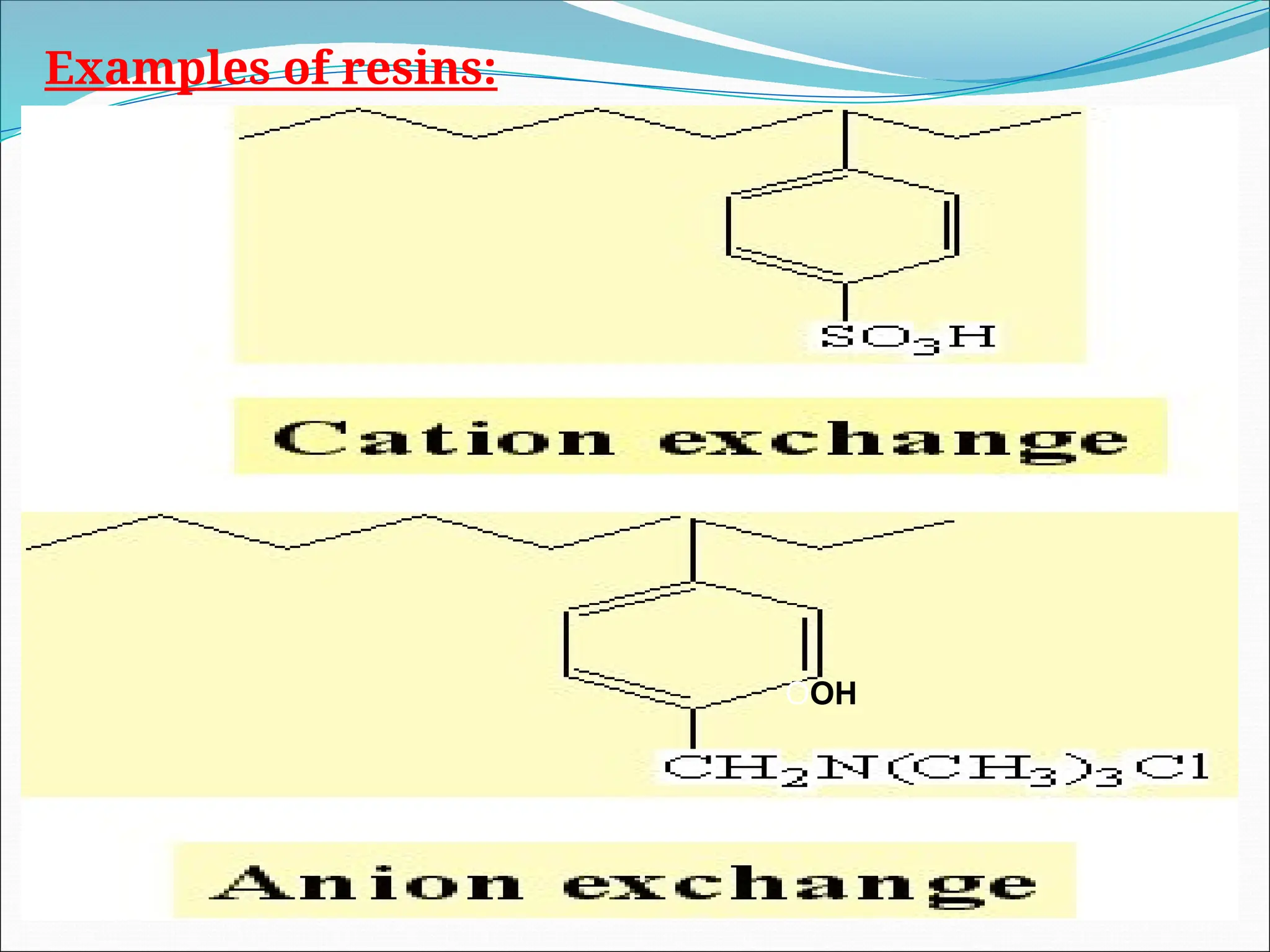
This is called Cation exchange resin.
Ex: RCOOH, RSO3H
2. Resins containing basic groups (OH-
, NH2
-
) are capable
of exchanging their anions with other anions. This is
called Anion exchange resin.
Ex: R-CH2NMe2OH
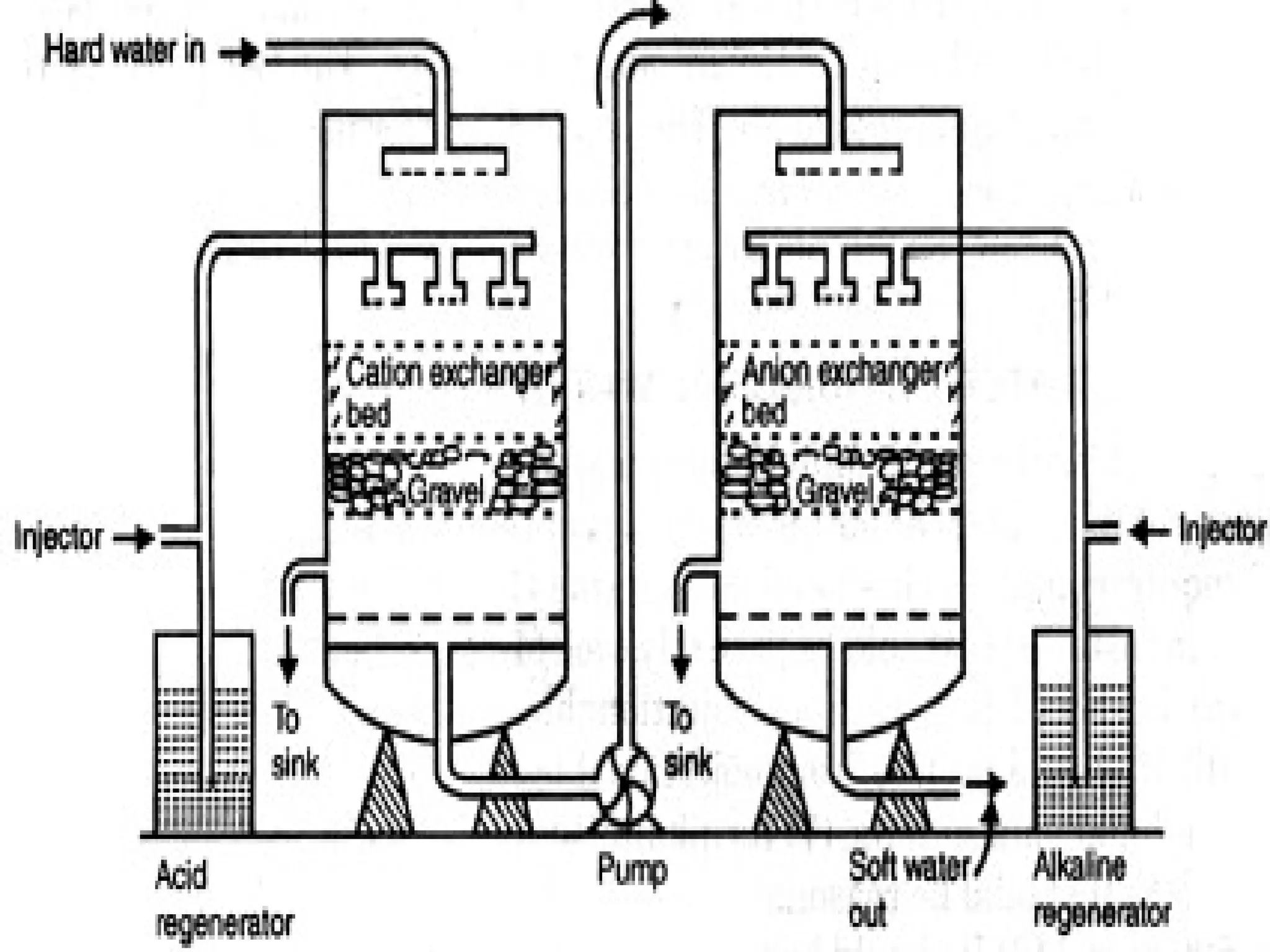
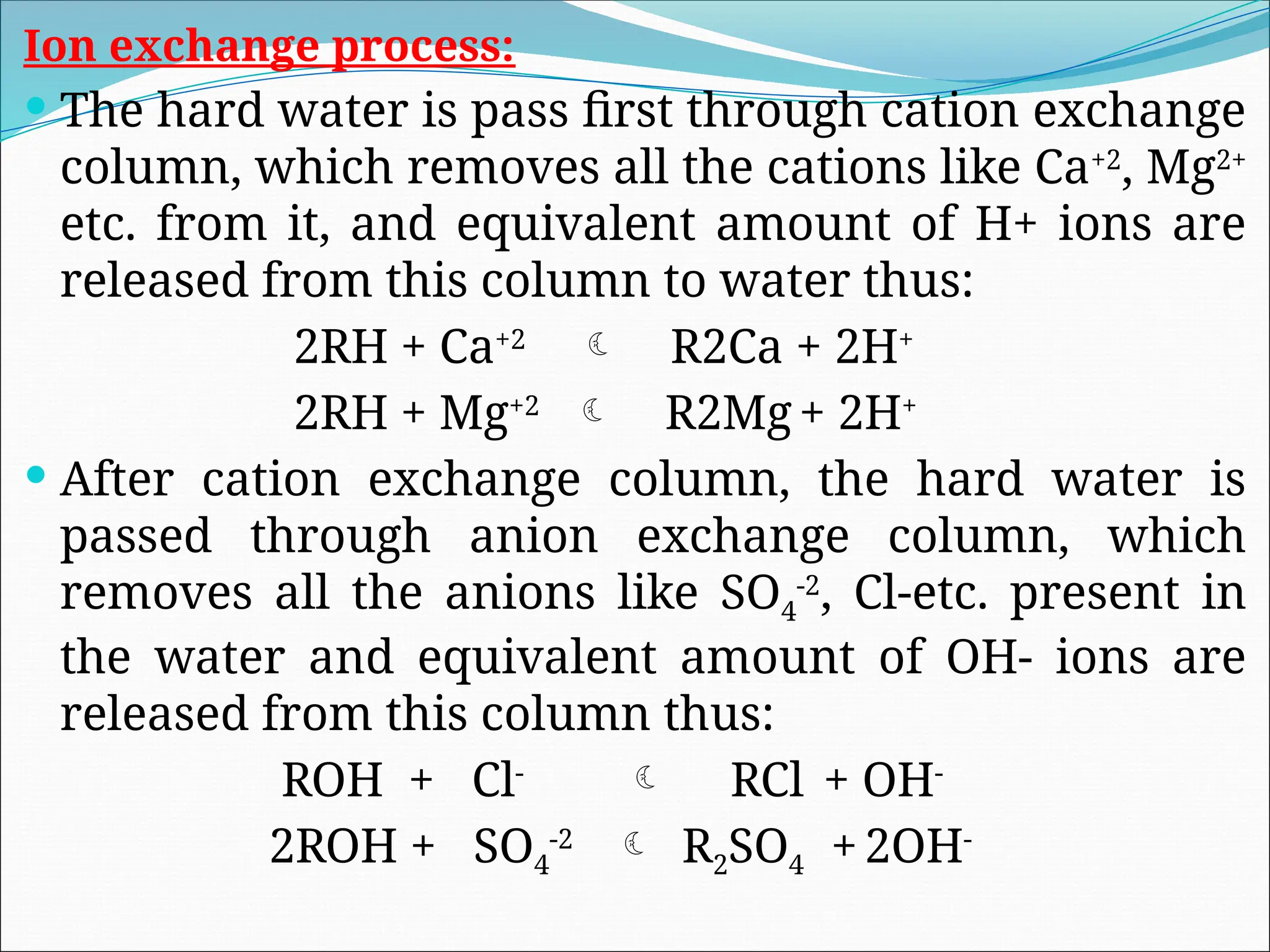
Ion exchange process:
The hard water is pass first through cation exchange
column, which removes all the cations like Ca+2
, Mg2+
etc. from it, and equivalent amount of H+ ions are
released from this column to water thus:
2RH + Ca+2
R2Ca + 2H+
2RH + Mg+2
R2Mg+ 2H+
After cation exchange column, the hard water is
passed through anion exchange column, which
removes all the anions like SO4
-2
, Cl-etc. present in
the water and equivalent amount of OH- ions are
released from this column thus:
ROH + Cl-
RCl + OH-
2ROH + SO4
-2
R2SO4 +2OH-
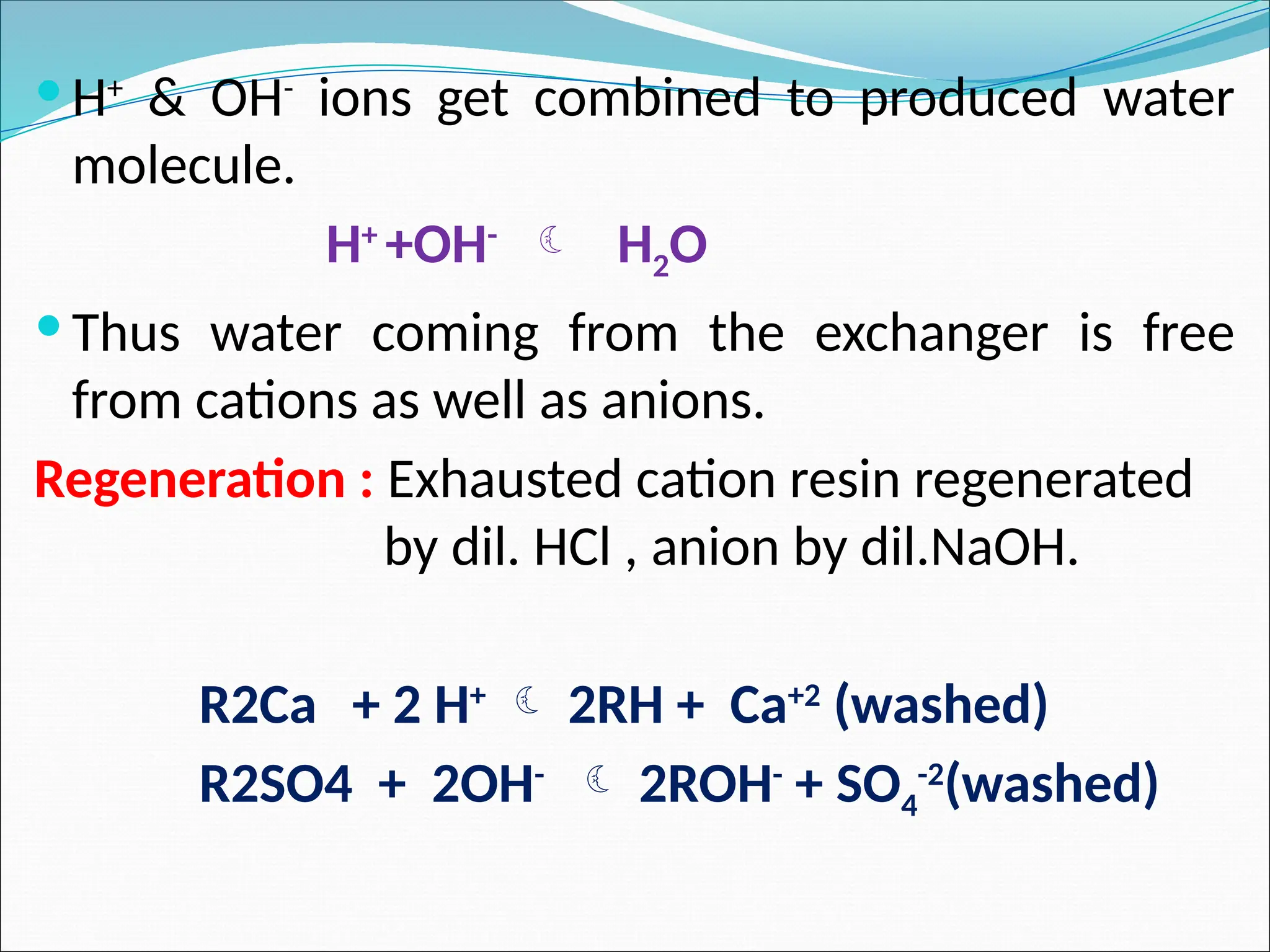
62.
H+
& OH-
ionsget combined to produced water
molecule.
H+
+OH-
H2O
Thus water coming from the exchanger is free
from cations as well as anions.
Regeneration : Exhausted cation resin regenerated
by dil. HCl , anion by dil.NaOH.
R2Ca + 2 H+
2RH + Ca+2
(washed)
R2SO4 + 2OH-
2ROH-
+ SO4
-2
(washed)
63.
Desalination
The process ofremoval of dissolved salts (NaCl, KCl)
present in water is known as desalination.
Water is divided into three categories on the basis of
salinity:
(a) Sea water: The salinity is greater than 35000 mg/L.
(b) Brakish water: The salinity is in the range of
1000−35000 mg/L. It has peculiar salty
taste.
Important desalination methods are:
Reverse osmosis,
Electrodialyis.
64.
Reverse Osmosis Process
When two solutions of unequal concentration
are separated by a semi permeable membrane,
flow of solvent takes from dilute solution to
concentrated solution. This is called osmosis.
During osmosis solvent develops a pressure on
membrane which is called osmotic pressure.
If pressure higher than osmotic pressure is
applied from the higher concentrated side, so
that the path of the solvent reversal which is
called reverse osmosis.
65.
This methodis applicable mainly for the desalination of
sea water. Ionic, non-ionic, Colloidal and organic matter
can be removed from the water sample
Reverse osmosis cell
66.
Advantages of theprocess
The process removes ionic as well as non-ionic dissolved
salts easily.
It is effective in removing colloidal impurities in water.
The process is economical and convenient. The process
can be carried out at a room temperature.
It is suitable for converting sea water into drinking water
Disadvantages:
The life time of membrane is quite high ,which is an
average more than a year.
The maintenance cost is only replacement of membrane.
67.
Potable/Domestic/Municipal Water
The watersupplied by municipality should be fit for
human consumption. It should satisfy the following
requirements:
It should be colorless, odourless, and pleasant to
taste.
Turbidity should not exceed 10 ppm. TDS should
not exceed 500 ppm.
It should not be very alkaline (pH 8.0).
It should be free from dissolved gases.(H2S,CO2)
It should be free from objectionable minerals such
as Pb, As, Cs, Mn
68.
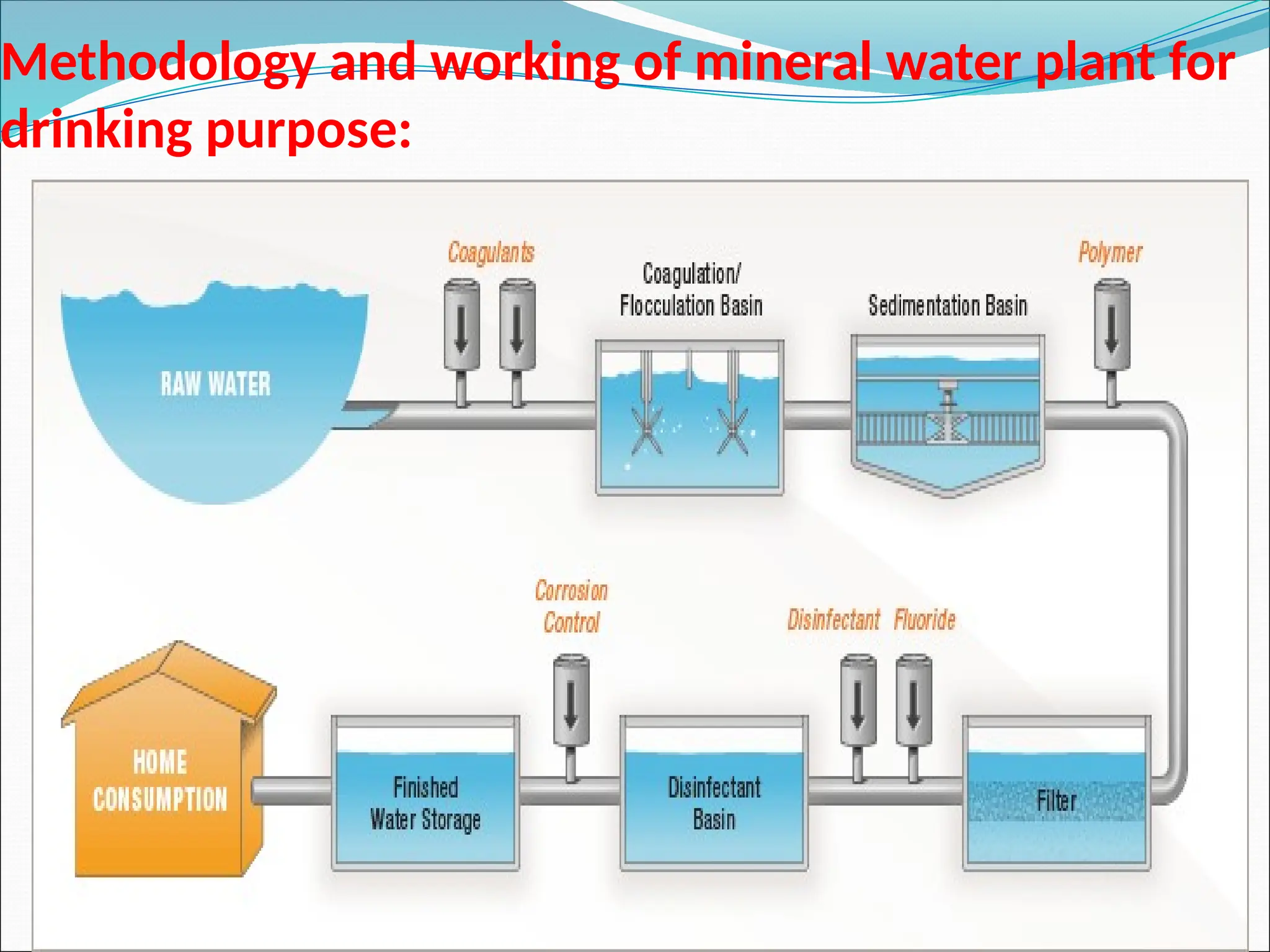
Water Treatment PlantStages
1. Screening
2. Sedimentation
3. Coagulation
4. Filtration
5. Disinfection(chlorination & ozonization)
Depending on the type of treatment plant and the quality of
raw water, treatment generally proceeds in the following
sequence of stages:
As required, other steps will be added, depending on
the chemistry of the treated water.
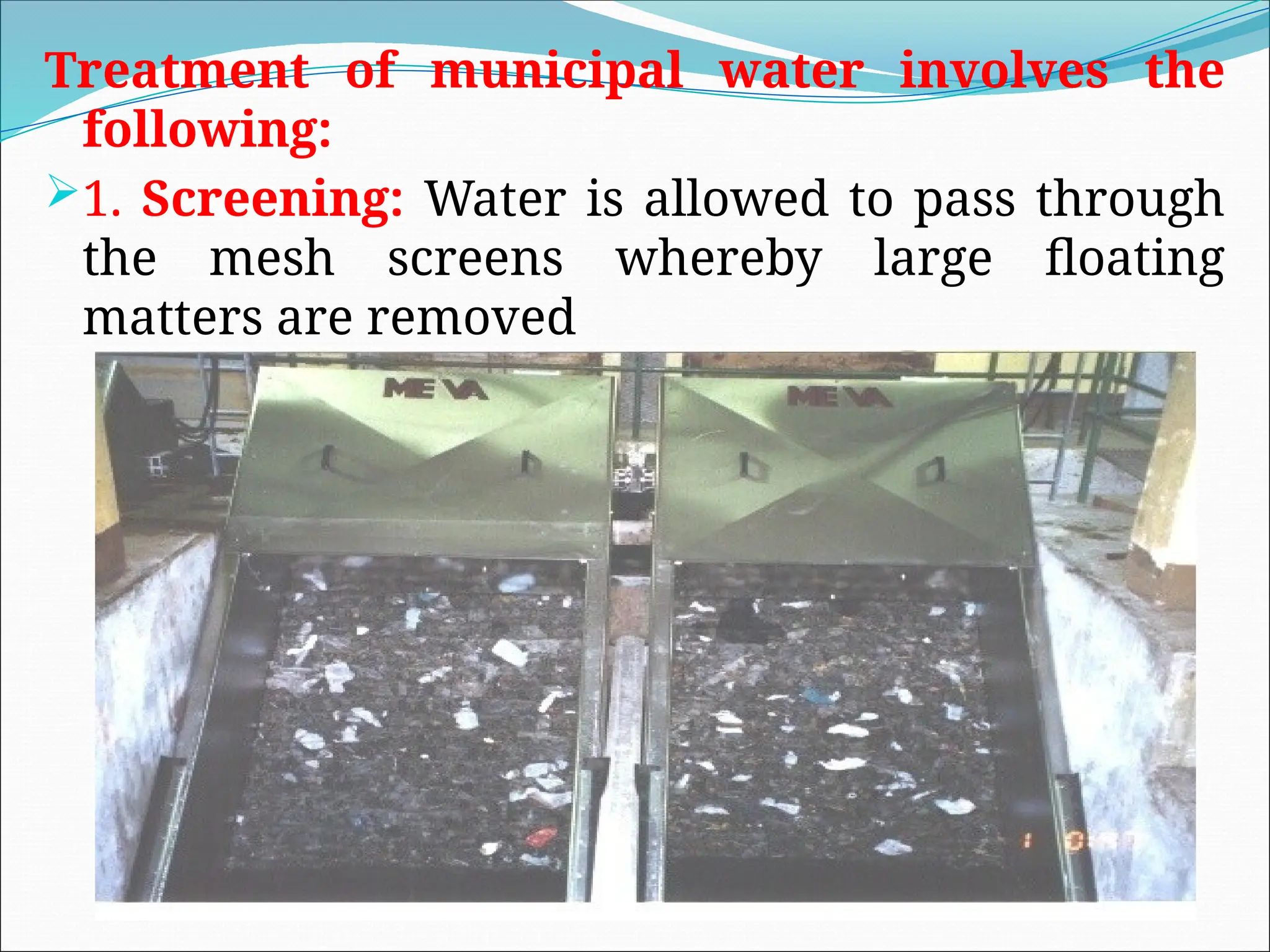
Treatment of municipalwater involves the
following:
1. Screening: Water is allowed to pass through
the mesh screens whereby large floating
matters are removed
71.
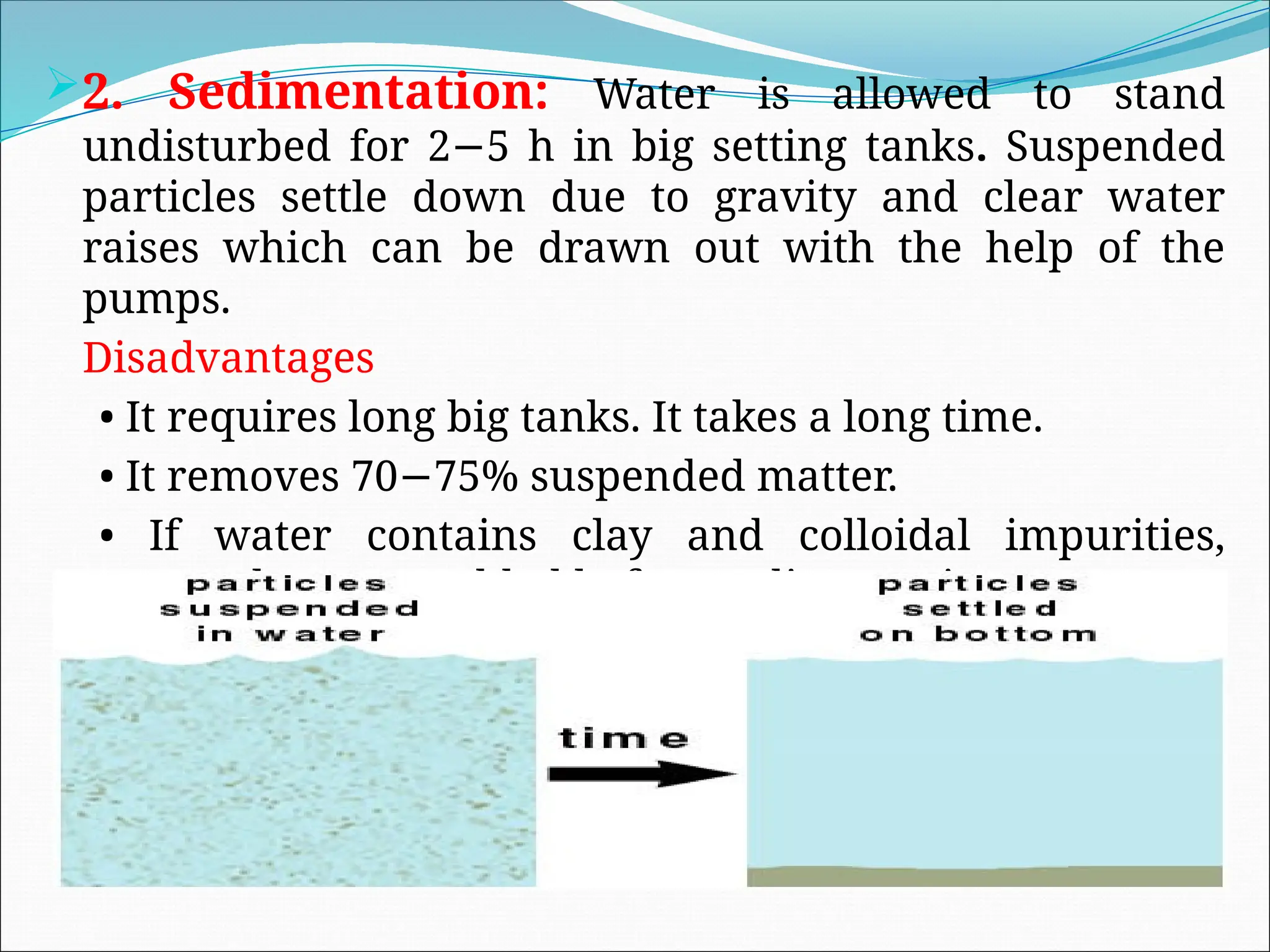
2. Sedimentation: Wateris allowed to stand
undisturbed for 2 5 h in big setting tanks
− . Suspended
particles settle down due to gravity and clear water
raises which can be drawn out with the help of the
pumps.
Disadvantages
• It requires long big tanks. It takes a long time.
• It removes 70 75% suspended matter.
−
• If water contains clay and colloidal impurities,
coagulants are added before sedimentation.
72.
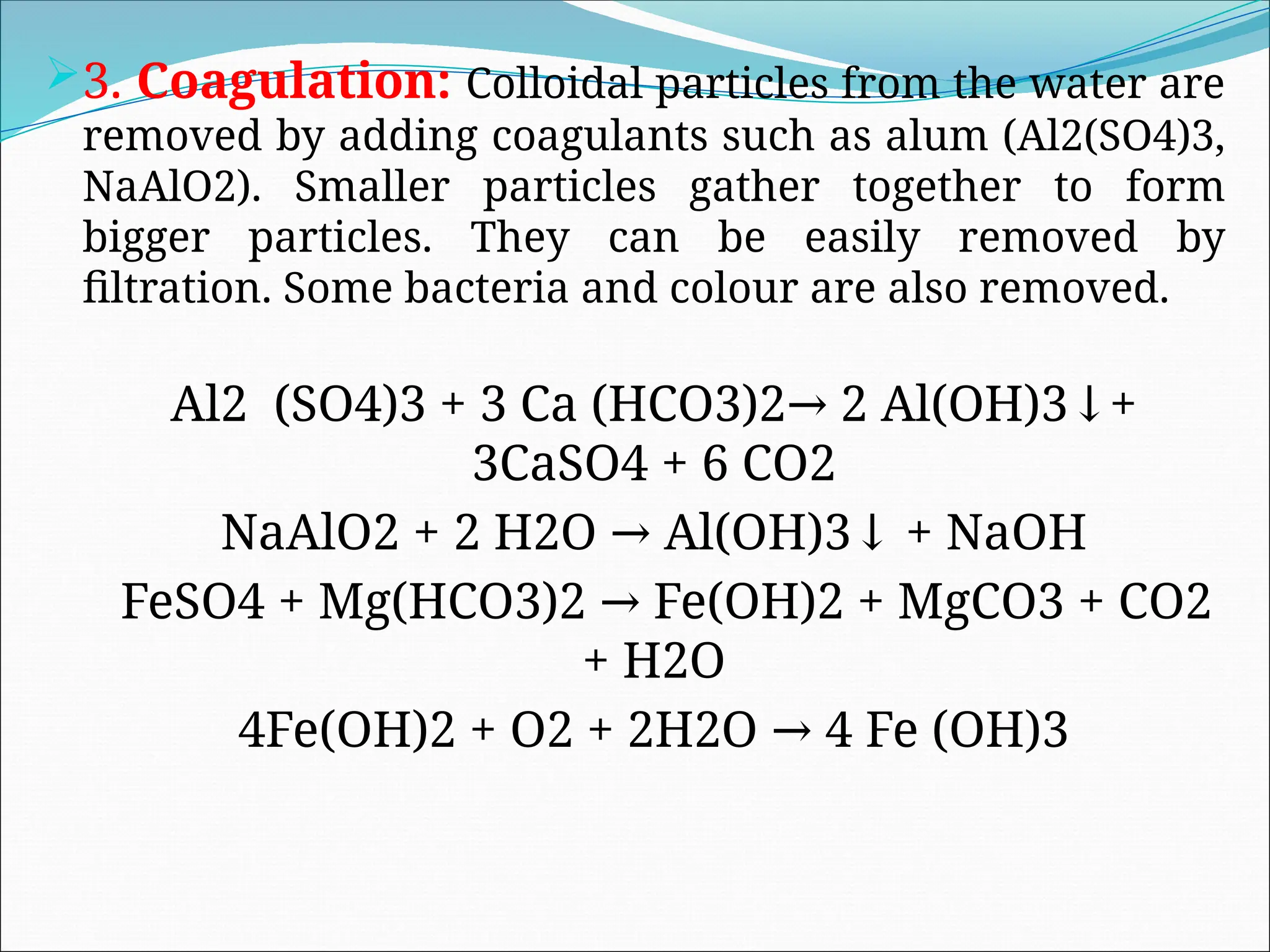
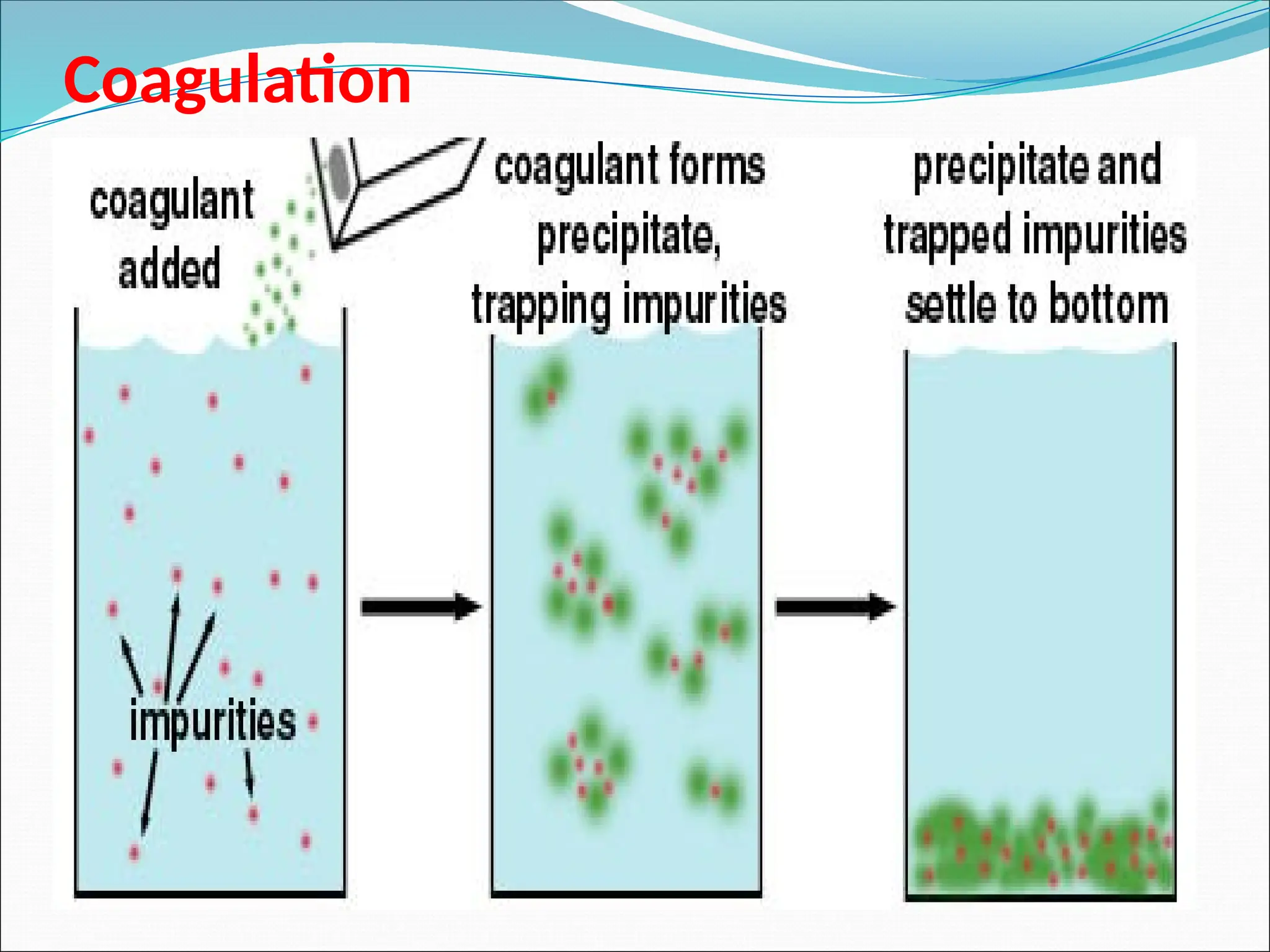
3. Coagulation: Colloidalparticles from the water are
removed by adding coagulants such as alum (Al2(SO4)3,
NaAlO2). Smaller particles gather together to form
bigger particles. They can be easily removed by
filtration. Some bacteria and colour are also removed.
Al2 (SO4)3 + 3 Ca (HCO3)2 2 Al(OH)3 +
→ ↓
3CaSO4 + 6 CO2
NaAlO2 + 2 H2O Al(OH)3 + NaOH
→ ↓
FeSO4 + Mg(HCO3)2 Fe(OH)2 + MgCO3 + CO2
→
+ H2O
4Fe(OH)2 + O2 + 2H2O 4 Fe (OH)3
→
4. Filtration:
Colloidal matter,bacteria, micro-organism are
removed. Water is passed through a large area sand
bed. The filter may be pressure filter or gravity filter.
5. Sterilization/disinfection:
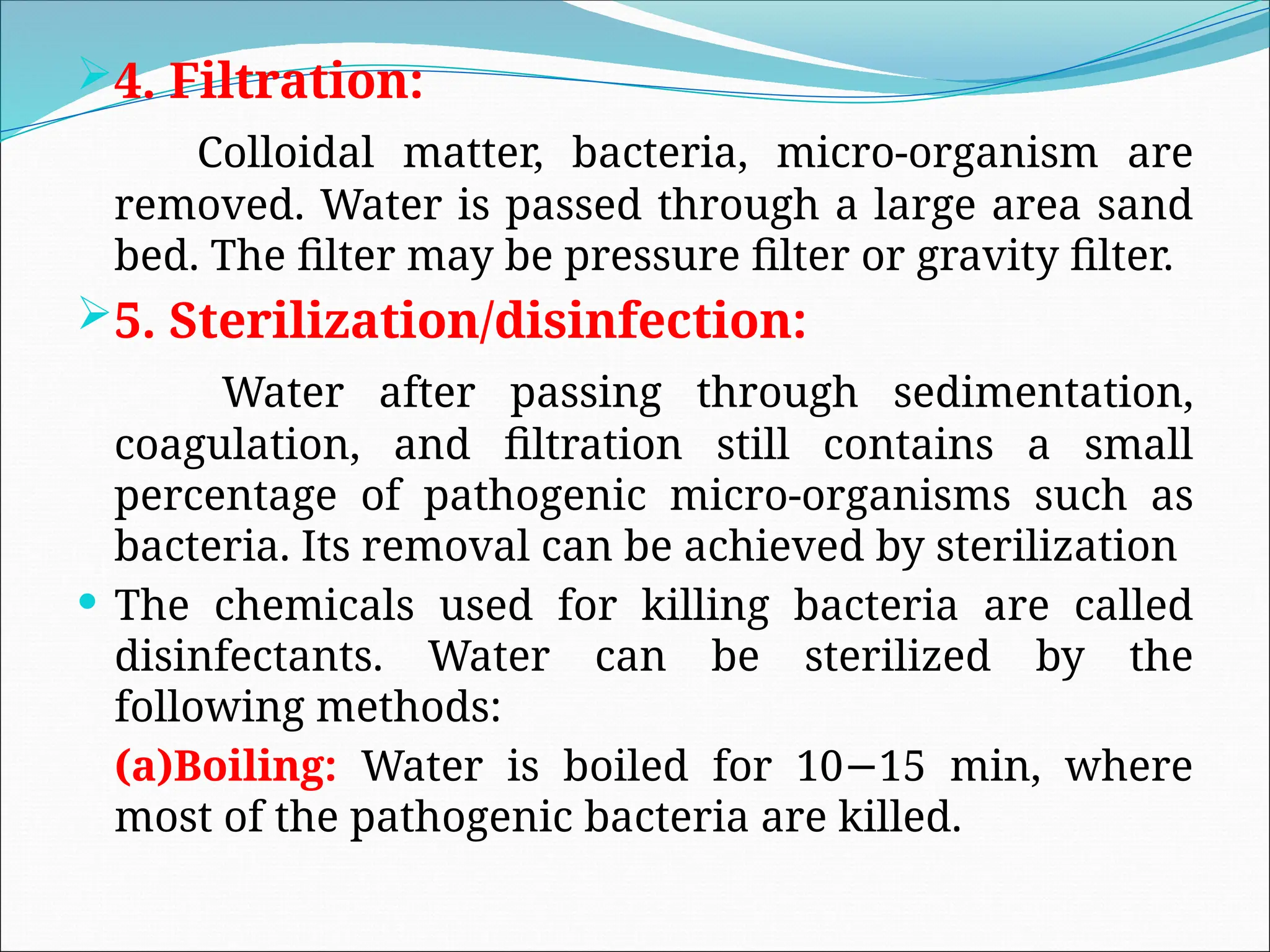
Water after passing through sedimentation,
coagulation, and filtration still contains a small
percentage of pathogenic micro-organisms such as
bacteria. Its removal can be achieved by sterilization
The chemicals used for killing bacteria are called
disinfectants. Water can be sterilized by the
following methods:
(a)Boiling: Water is boiled for 10 15 min, where
−
most of the pathogenic bacteria are killed.
75.
(b)By adding bleachingpowder. Bleaching powder in
calculated amount is added to water and allowedto stand for
several hours.
CaOCl2 + H2O Ca(OH)2 + Cl2
→
Cl2 + H2O HCl + HOCl
→
HOCl + Germs germs are killed
→
Disadvantages:
Bleaching powder introduces Ca2+ hardness in water and adds
lime residue.
Excess of it gives bad smell and bad taste. Excess chlorine is
irritating to mucous membrane.
(c)By chlorination
Cl2 + H2O HCl + HOCl
→
Bacteria + HOCl killed bacteria
→
The quantity of chlorine to be added is important. The
disinfection will not complete if chlorine is insufficient. If excess
chlorine is added, it causes irritation, bad taste, and odour.
76.
De-chlorination
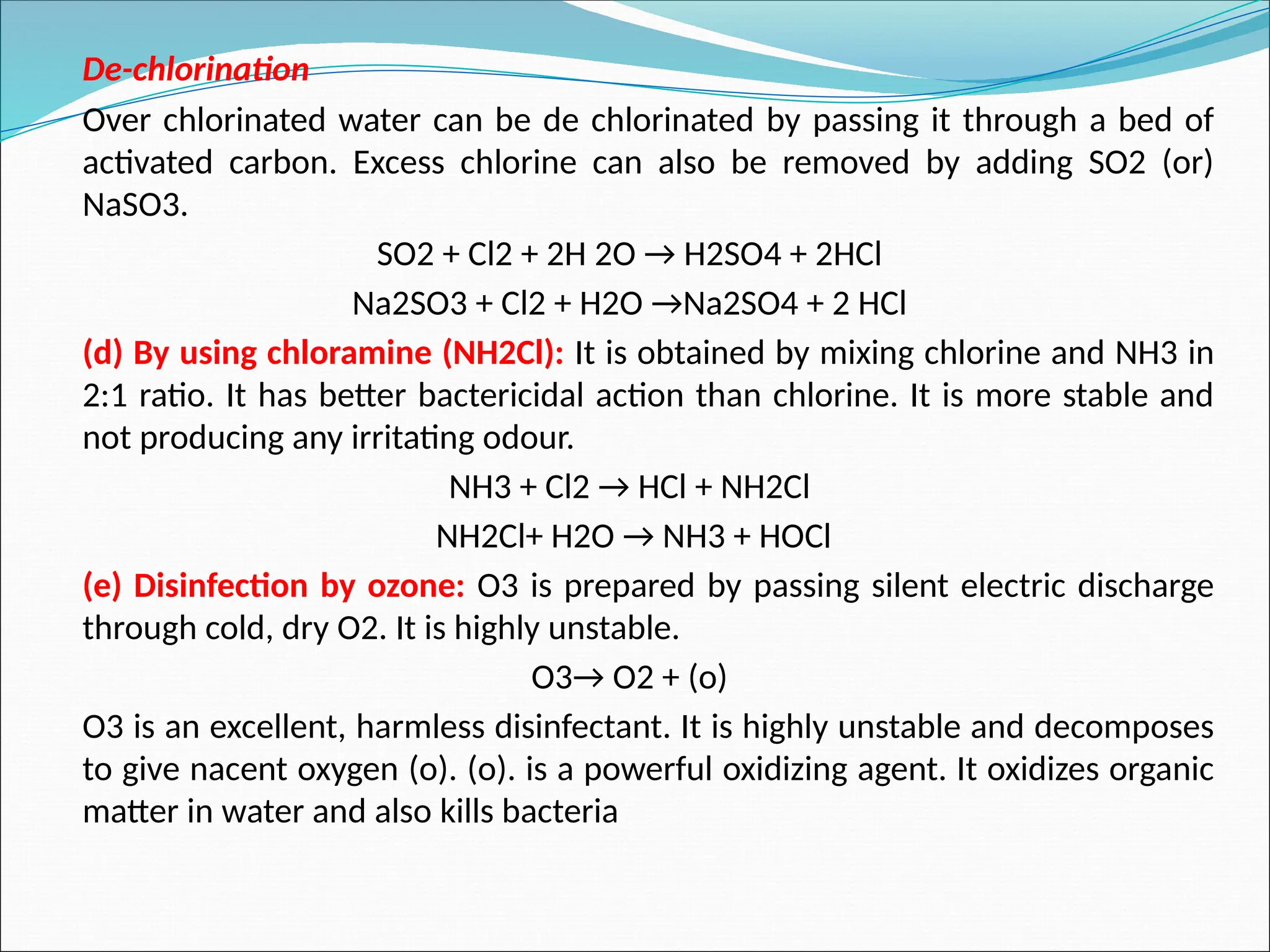
Over chlorinated watercan be de chlorinated by passing it through a bed of
activated carbon. Excess chlorine can also be removed by adding SO2 (or)
NaSO3.
SO2 + Cl2 + 2H 2O → H2SO4 + 2HCl
Na2SO3 + Cl2 + H2O →Na2SO4 + 2 HCl
(d) By using chloramine (NH2Cl): It is obtained by mixing chlorine and NH3 in
2:1 ratio. It has better bactericidal action than chlorine. It is more stable and
not producing any irritating odour.
NH3 + Cl2 → HCl + NH2Cl
NH2Cl+ H2O → NH3 + HOCl
(e) Disinfection by ozone: O3 is prepared by passing silent electric discharge
through cold, dry O2. It is highly unstable.
O3→ O2 + (o)
O3 is an excellent, harmless disinfectant. It is highly unstable and decomposes
to give nacent oxygen (o). (o). is a powerful oxidizing agent. It oxidizes organic
matter in water and also kills bacteria
77.
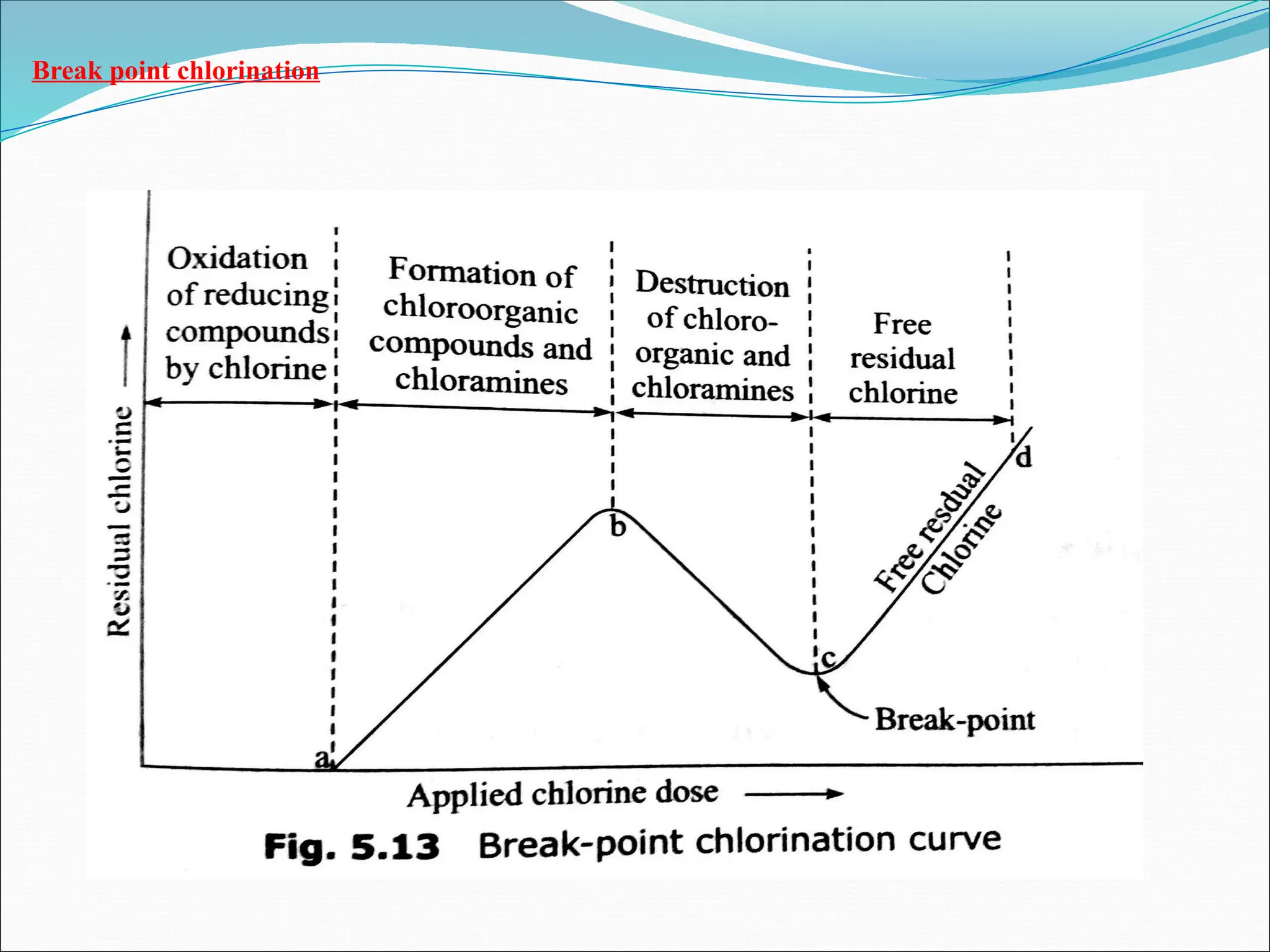
Break-point Chlorination (Freeresidual chlorination):
Breakpoint chlorination is a controlled chlorination
process in which water is treated with an amount of
chlorine which is sufficient to
• 1. destroy bacteria
• 2. to oxidize organic matter
• 3. to oxidise the ammonia, if present in water
• 4. leave behind slight excess of free chlorine which
could act as disinfectant during storage of water.
78.
Curve – ABCD- Impure water
OA-When the dose of applied chlorine is low, all the added chlorine get consumed in
complete oxidation of reducing substances present in water, hence no free residual
chlorine.
AB- On increasing the amount of added chlorine, the amount of residual chlorine is
also increased slowly- correspond to the formation of chloro-organic compound
without oxidizing them.
At high dose or conc. of applied chlorine, oxidation of chloro-organic compound or
microorganism takes place. Hence the amount of residual chlorine is decreased.
BC- The destruction of chloro-organic compound and chloramines takes place
continuously and reaches the minima.
79.
NH2Cl + 3Cl2+ H2O → N2 + N2O + 10 HCl
2NHCl2 + 3Cl2 + 4H2O → 2NO2 + 10 HCl
Point C - after reaching the minima, the added chlorine does not take part in
chemical reaction.
Curve CD - the amount of residual chlorine is increased by adding the amount
of chlorine
Point C- Break point chlorination- at which free residual chlorine begins to
appear Hence for effectively killing the microorganism, sufficient amount of
chlorine must be added. After break point chlorination all the bacteria killed,
oxidizing organic matter but it produced eliminating bad taste and disagreeable
odour in water.
80.
Advantages and significance:
•1.It indicates the complete destruction of organic compound.
•2. It completely destroys all the pathogenic bacteria
• 3. It helps to calculate the sufficient amount of chlorine for adding
in water.
• 4. It prevents the growth of any weeds in water.
•5. It also signifies the complete decomposition of NH3, removal of
coloring materials and improvements of taste and odour of the water
sample.
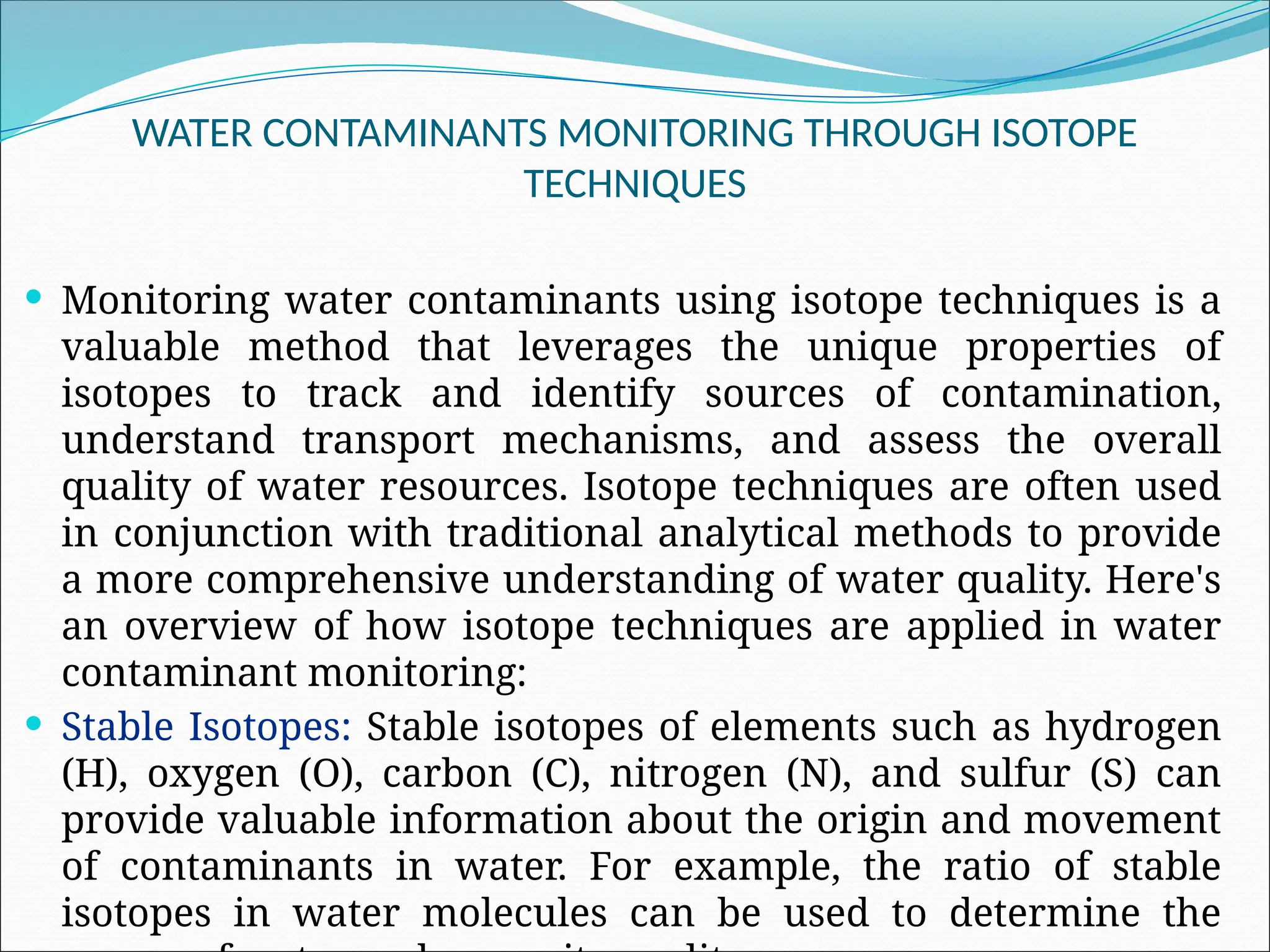
WATER CONTAMINANTS MONITORINGTHROUGH ISOTOPE
TECHNIQUES
Monitoring water contaminants using isotope techniques is a
valuable method that leverages the unique properties of
isotopes to track and identify sources of contamination,
understand transport mechanisms, and assess the overall
quality of water resources. Isotope techniques are often used
in conjunction with traditional analytical methods to provide
a more comprehensive understanding of water quality. Here's
an overview of how isotope techniques are applied in water
contaminant monitoring:
Stable Isotopes: Stable isotopes of elements such as hydrogen
(H), oxygen (O), carbon (C), nitrogen (N), and sulfur (S) can
provide valuable information about the origin and movement
of contaminants in water. For example, the ratio of stable
isotopes in water molecules can be used to determine the
83.
Isotope Hydrology:Isotope hydrology involves using isotopes of
hydrogen and oxygen (e.g., deuterium and oxygen-18) to study the
movement and sources of groundwater and surface water. By
analyzing the isotopic composition of water samples from various
locations, researchers can track the flow of water and identify
potential contamination sources.
Tracer Isotopes: Isotopes can be used as tracers to follow the
movement of contaminants. For example, in the case of a
suspected leak from an underground storage tank, a specific
isotope can be introduced into the tank, and its presence
downstream can indicate the path of the contaminant.
Radioactive Isotopes: Radioactive isotopes are used to trace
contaminants in water. For example, the presence of radionuclides
like tritium or isotopes of iodine and cesium can indicate nuclear
or radiological contamination.
Carbon Isotopes: Carbon isotopes (carbon-12, carbon-13, and
carbon-14) can be used to study the origin of organic
contaminants, such as pollutants from agricultural runoff or
84.
Nitrogen Isotopes:Nitrogen isotopes are used to study the
sources of nitrogen contamination, such as nitrates from
agricultural fertilizers or sewage.
Sulfur Isotopes: Sulfur isotopes can help identify sources of
sulfur contamination, including sources related to mining,
industry, or natural geological processes.
Isotope Fractionation: The fractionation of isotopes during
chemical reactions can reveal information about the
biogeochemical processes affecting contaminants. This can be
useful for understanding the natural attenuation of
contaminants in water systems.
Groundwater Dating: Isotopes can be used to date
groundwater, which is essential for understanding the age
and flow characteristics of groundwater and the potential
time lag between contamination and detection.
Combining Isotope Data: Often, multiple isotopes are analyzed
together to obtain a more comprehensive understanding of
85.
Advantages:
The advantage ofisotope techniques in water
contaminant monitoring is their ability to provide
insights into the origin and movement of
contaminants, allowing for more targeted and
effective remediation strategies. However, this
approach requires specialized equipment and
expertise, and results may need to be interpreted
in conjunction with other hydrogeological and
environmental data to form a complete
representation of water quality and contamination
sources.
86.
SMART WATER TECHNOLOGYFOR EFFICIENT WATER
MANAGEMENT
Smart water technology refers to the use of advanced digital
systems and sensors to monitor, manage, and optimize water
resources in a more efficient and sustainable manner. It
leverages the power of data and real-time analysis to
enhance water management processes. Here are some key
components and applications of smart water technology for
efficient water management:
Remote Sensing and IoT Devices:
Sensors: Deploying sensors to measure water flow, quality,
pressure, and usage in real time.
IoT Devices: Internet of Things devices that collect and
transmit data from various sources, enabling remote
monitoring and control.
87.
Data Analyticsand Machine Learning:
Data Analytics: Analyzing large datasets to identify
patterns, trends, and anomalies in water usage.
Machine Learning: Predictive analytics for demand
forecasting, leak detection, and proactive maintenance.
Leak Detection and Prevention:
Continuous Monitoring: Constantly monitoring water
distribution systems to detect leaks in pipelines.
Pressure Management: Optimizing water pressure to
reduce stress on pipes and minimize the risk of leaks.
Demand Response and Water Conservation:
Smart Metering: Installing smart water meters that provide
real- time data to consumers and utility companies,
encouraging water conservation.
Demand Response: Implementing variable pricing based on
demand to encourage consumers to use water
88.
Infrastructure Monitoring:
AssetManagement: Using sensors to monitor the health
and performance of water infrastructure such as
pumps, valves, and reservoirs.
Predictive Maintenance: Anticipating equipment failures
and scheduling maintenance before critical issues arise.
Flood and Pollution Management:
Flood Prediction: Utilizing real-time data to predict and
prepare for potential flooding events.
Pollution Monitoring: Monitoring water bodies for
pollutants and ensuring timely response to
contamination incidents.
89.
Customer Engagement:
MobileApps and Portals: Providing consumers with
access to their water usage data, tips for conservation,
and alerts about supply interruptions.
Education Campaigns: Raising awareness about water
conservation and the importance of efficient water
use.
Integration with Smart Grids and Smart Cities:
Collaboration: Integrating water management systems
with other smart city initiatives, such as energy
management, to optimize overall resource usage.
Cross-Functional Planning: Coordinating urban planning
efforts to ensure water infrastructure aligns with the
city's growth and development.
90.
Benefits of SmartWater Technology:
Efficiency: Reducing water wastage and optimizing
distribution networks.
Sustainability: Conserving water resources for future
generations.
Cost Savings: Minimizing operational costs through
predictive maintenance and optimized usage.
Environmental Impact: Mitigating the environmental
impact of water-related activities.
Resilience: Enhancing the ability to respond to
emergencies such as leaks, floods, and pollution incidents.
Implementing smart water technology requires
collaboration between government bodies, private sector
entities, and the community. It's not just about deploying
technology but also about fostering a water-conscious
culture and sustainable practices within society.



![Principle:-
10 ml SHW + 5 ml
Buffer solution + 2-
3 drops of
Eriochrome black-T
= wine red colour
EB-T forms unstable wine red
complex with Ca+2
and Mg+2
ions
M+2
+ EBT → [ M-EBT ]
wine red complex
(unstable)
M = Ca+2
and Mg+2
ions of hard
water](https://image.slidesharecdn.com/water-technology-ppt-250406140350-88e09430/75/water-technology-ppt-pptx-chemistry-for-engineering-20-2048.jpg)
![Principle of EDTA method for the determination of
hardness of water
In order to determine the equivalence point , indicator
eriochrome black – T (EBT) is employed.
EBT forms unstable wine red complex with Ca+2
and Mg+2
ions
M+2
+ EBT → [ M-EBT ] complex
(Ca+2
and Mg+2
ions
of hard water ) wine red](https://image.slidesharecdn.com/water-technology-ppt-250406140350-88e09430/75/water-technology-ppt-pptx-chemistry-for-engineering-21-2048.jpg)
![eriochrome black – T (EBT)
Iupac- Sodium 4-[2-(1-hydroxynaphthalen-2-yl)hydrazin-1-
ylidene]-7-nitro-3-oxo-3,4-dihydronaphthalene-1-sulfonate
or
Sodium 1-[1-Hydroxynaphthylazo]-6-nitro-2-naphthol-4-
sulfonate
C20H12N3O7SNa](https://image.slidesharecdn.com/water-technology-ppt-250406140350-88e09430/75/water-technology-ppt-pptx-chemistry-for-engineering-23-2048.jpg)
![ During titration EDTA combines with Ca+2
or Mg+2
ions and forms stable [M-EDTA] blue coloured
complex.
[M-EBT] complex + EDTA → [M-EDTA]complex + EBT
wine red blue
The change of wine red colour to distinct blue colour
marks the end point of titration.](https://image.slidesharecdn.com/water-technology-ppt-250406140350-88e09430/75/water-technology-ppt-pptx-chemistry-for-engineering-24-2048.jpg)





![A. Dissolved oxygen: Water usually contains about
8ppm of dissolved oxygen at RT.
It attacks boilers at high temperature.
4Fe +2H2O + O → 4Fe [OH]2↓
4Fe [OH]2↓ + O2 → 2[Fe2O32H2O] ↓
(Ferrous hydroxide) (Rust)
Removal of dissolved oxygen:
By adding sodium sulphite , hydrazine and sodium sulphide
2Na2
SO3
+ O2
2 Na2
SO4
N2
H4
+ O2
N2
+ 2H2
O
Na2
S + 2O2
Na2
SO4](https://image.slidesharecdn.com/water-technology-ppt-250406140350-88e09430/75/water-technology-ppt-pptx-chemistry-for-engineering-40-2048.jpg)




![A) Phosphate conditioning
It is generally applicable to high pressure boilers.
Scale formation is avoided by adding sodium phosphate,
which reacts with magnesium and calcium salts forming
non-sticky and easily removable sludge of calcium and
magnesium phosphate and easily removed by blow down
operation.
3MCl2
+ 2Na3
PO4
→ M3
( PO4
)2
↓ + 6NaCl
[Where M = Ca2+
, Mg2+
]
3MSO4
+ 2Na3
PO4
→ M3
( PO4
)2
↓ + 6NaSO4](https://image.slidesharecdn.com/water-technology-ppt-250406140350-88e09430/75/water-technology-ppt-pptx-chemistry-for-engineering-54-2048.jpg)

![C) Calgon conditioning:
It involves in adding Sodium hexa meta phosphate
(calgon) to boiler water to prevent the scale and
sludge formation.
Calgon converts the scale forming impurity like
CaSO4 into soluble complex compound.
Na2 [Na4 (PO3)6] ↔ 2Na+
+ [Na4 (PO3)6]2-
Calgon
2CaSO4 + [Na4 (PO3)6]2-
→ [Ca2 (PO3)6]2-
+ 2Na2SO4
Insoluble soluble insoluble](https://image.slidesharecdn.com/water-technology-ppt-250406140350-88e09430/75/water-technology-ppt-pptx-chemistry-for-engineering-56-2048.jpg)