CANTERBURY
CATHEDRAL
MADEBY
VARNIKA JAIN A1904012077
MITUL JAIN A1904012080
DIKSHA JAIN A1904012
HISTORY
• Canterbury Cathedral - Christ Church - reflects the changing
architectural styles of five centuries.
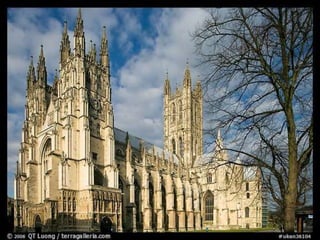
• Canterbury Cathedral in Canterbury, Kent, is one of the oldest and
most famous Christian structures in England and forms part of
a World Heritage Site. It is the cathedral of the Archbishop of
Canterbury, leader of the Church of England and symbolic leader
of the worldwide Anglican Communion. Its formal title is
the Cathedral and Metropolitical Church of Christ at Canterbury.
• Founded in 597, the cathedral was completely rebuilt from 1070 to
1077. The east end was greatly enlarged at the beginning of the
twelfth century, and largely rebuilt in the Gothic style following a
fire in 1174, with significant eastward extensions to accommodate
the flow of pilgrims visiting the shrine of Thomas Becket, the
archbishop who was murdered in the cathedral in 1170. The
Norman nave and transepts survived until the late fourteenth
century, when they were demolished to make way for the present
structures.
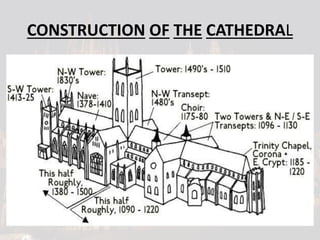
CONSTRUCTION OF THE CATHEDRAL
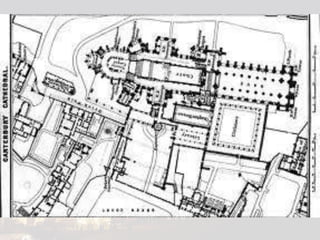
SITE PLAN
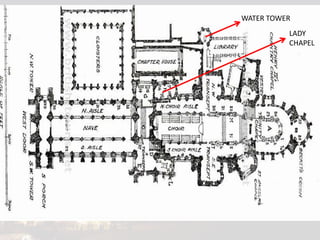
PLAN
WATER TOWER
LADY
CHAPEL
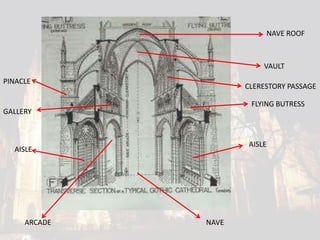
SECTION
NAVE ROOF
VAULT
AISLE
NAVE
PINACLE
AISLE
FLYING BUTRESS
GALLERY
ARCADE
CLERESTORY PASSAGE
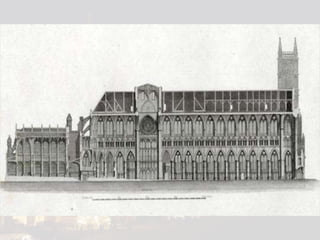
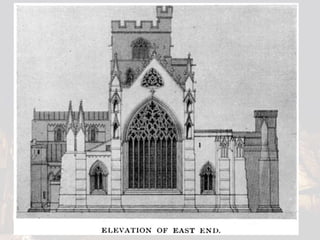
ELEVATIONS
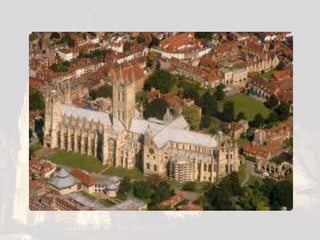
VIEW
ARCHITECTURAL FEATURES
• It is located in Canterbury,Kent.
• Gothic style of architecture.
• Built between 1070-1834 AD.
• Length of the cathedral is 160m (525 feet).
• Width is 47m (154 feet)
• Nave length is 54m,width is 22m and height is
24m.
• Choir length is 55m and height is 22m.
• There are 3 towers in total.
• The tower total height is 72m (236 feet).
• There was only 1 spire which is now lost.
• The spire height is 58m (north west tower
demolished in 1705).
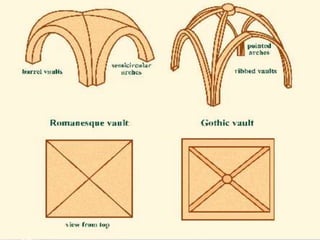
VAULTS
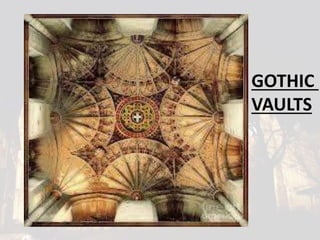
GOTHIC
VAULTS
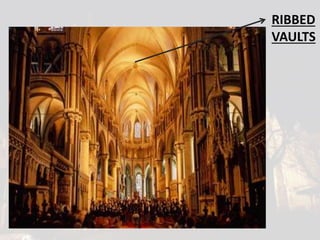
RIBBED
VAULTS
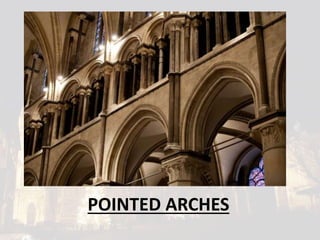
POINTED ARCHES
IMPORTANT
FEATURES
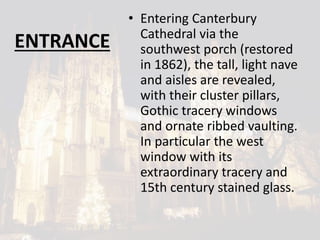
ENTRANCE
• Entering Canterbury
Cathedral via the
southwest porch (restored
in 1862), the tall, light nave
and aisles are revealed,
with their cluster pillars,
Gothic tracery windows
and ornate ribbed vaulting.
In particular the west
window with its
extraordinary tracery and
15th century stained glass.
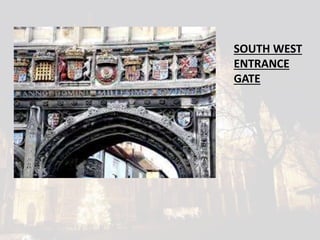
SOUTH WEST
ENTRANCE
GATE
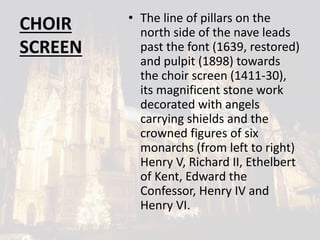
CHOIR
SCREEN
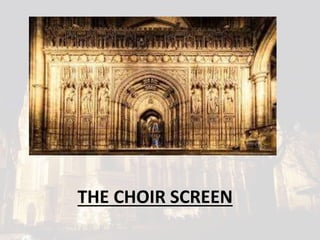
• The line of pillars on the
north side of the nave leads
past the font (1639, restored)
and pulpit (1898) towards
the choir screen (1411-30),
its magnificent stone work
decorated with angels
carrying shields and the
crowned figures of six
monarchs (from left to right)
Henry V, Richard II, Ethelbert
of Kent, Edward the
Confessor, Henry IV and
Henry VI.
THE CHOIR SCREEN
AMBULATORY
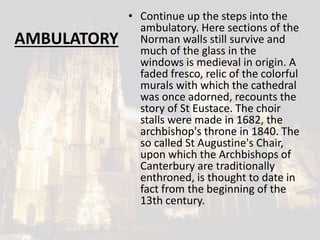
• Continue up the steps into the
ambulatory. Here sections of the
Norman walls still survive and
much of the glass in the
windows is medieval in origin. A
faded fresco, relic of the colorful
murals with which the cathedral
was once adorned, recounts the
story of St Eustace. The choir
stalls were made in 1682, the
archbishop's throne in 1840. The
so called St Augustine's Chair,
upon which the Archbishops of
Canterbury are traditionally
enthroned, is thought to date in
fact from the beginning of the
13th century.
TOMBS
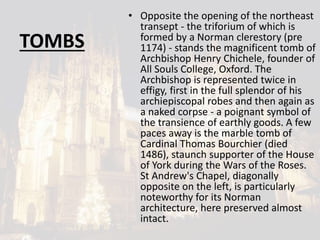
• Opposite the opening of the northeast
transept - the triforium of which is
formed by a Norman clerestory (pre
1174) - stands the magnificent tomb of
Archbishop Henry Chichele, founder of
All Souls College, Oxford. The
Archbishop is represented twice in
effigy, first in the full splendor of his
archiepiscopal robes and then again as
a naked corpse - a poignant symbol of
the transience of earthly goods. A few
paces away is the marble tomb of
Cardinal Thomas Bourchier (died
1486), staunch supporter of the House
of York during the Wars of the Roses.
St Andrew's Chapel, diagonally
opposite on the left, is particularly
noteworthy for its Norman
architecture, here preserved almost
intact.
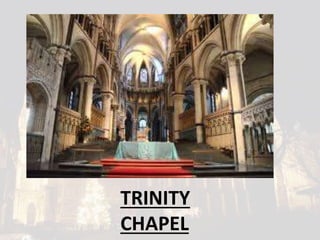
TRINITY
CHAPEL
• Near St Andrew's Chapel are steps leading,
on the right, to Trinity Chapel where, from
1220 until its destruction in 1538, stood St
Thomas Becket's golden shrine. Once or
twice a day the heavy lid of the shrine would
be raised with the aid of a block and tackle,
to allow suitably awestruck and reverential
pilgrims a glimpse of the gem-encrusted
casket containing Becket's remains.
• Note the elegant sobriety of the Early Gothic
choir (1184), the first example of the style to
be seen in England. The columns of dark
Purbeck marble contrast handsomely with
the much lighter arcades below the
colonnaded triforium, above which fine
articulated ribs support the vaulting.
• In the north (left hand) ambulatory of the
Chapel are the alabaster tomb of Henry IV
(died 1413) and his wife Joan of Navarre
(died 1437) and, near by, the Renaissance
tomb (1567) of the first post Reformation
Dean of Canterbury, Nicholas Wotton, who is
shown at prayer.
TRINITY
CHAPEL
STAINED
GLASS
WINDOW
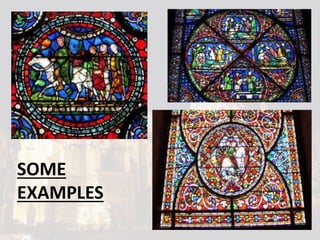
• The walls of the choir on both
sides of the Corona (the circular
chapel at the far east end) are
embellished with superb late
12th and 13th century stained
glass windows. Known as the
Miracle Windows they depict
scenes from Becket's life and
works.
• The Miracle Windows are a part
of the larger series which
includes Old and New Testament
subjects. This is the most
important medieval stained glass
series in England.
SOME
EXAMPLES
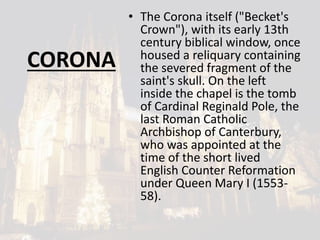
CORONA
• The Corona itself ("Becket's
Crown"), with its early 13th
century biblical window, once
housed a reliquary containing
the severed fragment of the
saint's skull. On the left
inside the chapel is the tomb
of Cardinal Reginald Pole, the
last Roman Catholic
Archbishop of Canterbury,
who was appointed at the
time of the short lived
English Counter Reformation
under Queen Mary I (1553-
58).
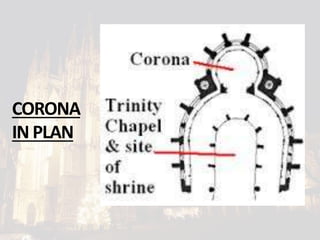
CORONA
IN PLAN
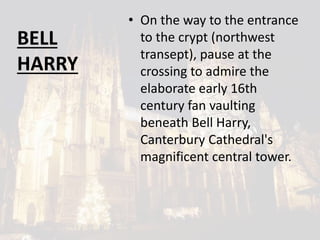
BELL
HARRY
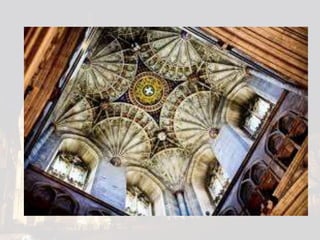
• On the way to the entrance
to the crypt (northwest
transept), pause at the
crossing to admire the
elaborate early 16th
century fan vaulting
beneath Bell Harry,
Canterbury Cathedral's
magnificent central tower.
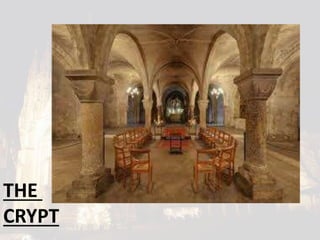
CRYPT
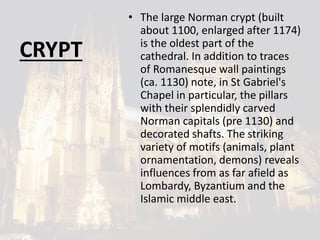
• The large Norman crypt (built
about 1100, enlarged after 1174)
is the oldest part of the
cathedral. In addition to traces
of Romanesque wall paintings
(ca. 1130) note, in St Gabriel's
Chapel in particular, the pillars
with their splendidly carved
Norman capitals (pre 1130) and
decorated shafts. The striking
variety of motifs (animals, plant
ornamentation, demons) reveals
influences from as far afield as
Lombardy, Byzantium and the
Islamic middle east.
THE
CRYPT
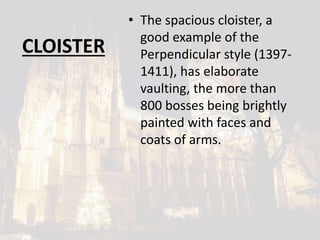
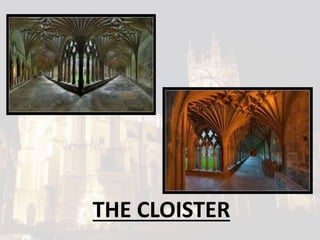
CLOISTER
• The spacious cloister, a
good example of the
Perpendicular style (1397-
1411), has elaborate
vaulting, the more than
800 bosses being brightly
painted with faces and
coats of arms.
THE CLOISTER
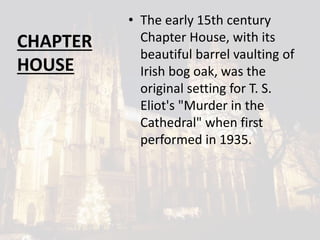
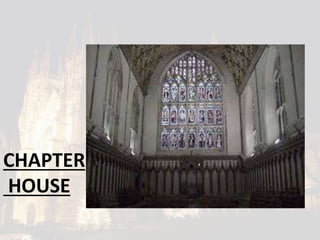
CHAPTER
HOUSE
• The early 15th century
Chapter House, with its
beautiful barrel vaulting of
Irish bog oak, was the
original setting for T. S.
Eliot's "Murder in the
Cathedral" when first
performed in 1935.
CHAPTER
HOUSE
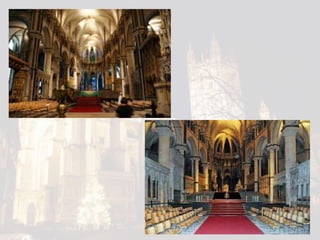
INTERIORS
THANK YOU

Canterbury

  • 1.
  • 3.
    HISTORY • Canterbury Cathedral- Christ Church - reflects the changing architectural styles of five centuries. • Canterbury Cathedral in Canterbury, Kent, is one of the oldest and most famous Christian structures in England and forms part of a World Heritage Site. It is the cathedral of the Archbishop of Canterbury, leader of the Church of England and symbolic leader of the worldwide Anglican Communion. Its formal title is the Cathedral and Metropolitical Church of Christ at Canterbury. • Founded in 597, the cathedral was completely rebuilt from 1070 to 1077. The east end was greatly enlarged at the beginning of the twelfth century, and largely rebuilt in the Gothic style following a fire in 1174, with significant eastward extensions to accommodate the flow of pilgrims visiting the shrine of Thomas Becket, the archbishop who was murdered in the cathedral in 1170. The Norman nave and transepts survived until the late fourteenth century, when they were demolished to make way for the present structures.
  • 4.
  • 5.
  • 7.
  • 8.
  • 9.
  • 10.
  • 11.
  • 14.
  • 16.
    ARCHITECTURAL FEATURES • Itis located in Canterbury,Kent. • Gothic style of architecture. • Built between 1070-1834 AD. • Length of the cathedral is 160m (525 feet). • Width is 47m (154 feet) • Nave length is 54m,width is 22m and height is 24m. • Choir length is 55m and height is 22m. • There are 3 towers in total.
  • 17.
    • The towertotal height is 72m (236 feet). • There was only 1 spire which is now lost. • The spire height is 58m (north west tower demolished in 1705).
  • 18.
  • 20.
  • 21.
  • 22.
  • 23.
  • 24.
    ENTRANCE • Entering Canterbury Cathedralvia the southwest porch (restored in 1862), the tall, light nave and aisles are revealed, with their cluster pillars, Gothic tracery windows and ornate ribbed vaulting. In particular the west window with its extraordinary tracery and 15th century stained glass.
  • 25.
  • 26.
    CHOIR SCREEN • The lineof pillars on the north side of the nave leads past the font (1639, restored) and pulpit (1898) towards the choir screen (1411-30), its magnificent stone work decorated with angels carrying shields and the crowned figures of six monarchs (from left to right) Henry V, Richard II, Ethelbert of Kent, Edward the Confessor, Henry IV and Henry VI.
  • 27.
  • 28.
    AMBULATORY • Continue upthe steps into the ambulatory. Here sections of the Norman walls still survive and much of the glass in the windows is medieval in origin. A faded fresco, relic of the colorful murals with which the cathedral was once adorned, recounts the story of St Eustace. The choir stalls were made in 1682, the archbishop's throne in 1840. The so called St Augustine's Chair, upon which the Archbishops of Canterbury are traditionally enthroned, is thought to date in fact from the beginning of the 13th century.
  • 29.
    TOMBS • Opposite theopening of the northeast transept - the triforium of which is formed by a Norman clerestory (pre 1174) - stands the magnificent tomb of Archbishop Henry Chichele, founder of All Souls College, Oxford. The Archbishop is represented twice in effigy, first in the full splendor of his archiepiscopal robes and then again as a naked corpse - a poignant symbol of the transience of earthly goods. A few paces away is the marble tomb of Cardinal Thomas Bourchier (died 1486), staunch supporter of the House of York during the Wars of the Roses. St Andrew's Chapel, diagonally opposite on the left, is particularly noteworthy for its Norman architecture, here preserved almost intact.
  • 30.
    TRINITY CHAPEL • Near StAndrew's Chapel are steps leading, on the right, to Trinity Chapel where, from 1220 until its destruction in 1538, stood St Thomas Becket's golden shrine. Once or twice a day the heavy lid of the shrine would be raised with the aid of a block and tackle, to allow suitably awestruck and reverential pilgrims a glimpse of the gem-encrusted casket containing Becket's remains. • Note the elegant sobriety of the Early Gothic choir (1184), the first example of the style to be seen in England. The columns of dark Purbeck marble contrast handsomely with the much lighter arcades below the colonnaded triforium, above which fine articulated ribs support the vaulting. • In the north (left hand) ambulatory of the Chapel are the alabaster tomb of Henry IV (died 1413) and his wife Joan of Navarre (died 1437) and, near by, the Renaissance tomb (1567) of the first post Reformation Dean of Canterbury, Nicholas Wotton, who is shown at prayer.
  • 31.
  • 32.
    STAINED GLASS WINDOW • The wallsof the choir on both sides of the Corona (the circular chapel at the far east end) are embellished with superb late 12th and 13th century stained glass windows. Known as the Miracle Windows they depict scenes from Becket's life and works. • The Miracle Windows are a part of the larger series which includes Old and New Testament subjects. This is the most important medieval stained glass series in England.
  • 33.
  • 34.
    CORONA • The Coronaitself ("Becket's Crown"), with its early 13th century biblical window, once housed a reliquary containing the severed fragment of the saint's skull. On the left inside the chapel is the tomb of Cardinal Reginald Pole, the last Roman Catholic Archbishop of Canterbury, who was appointed at the time of the short lived English Counter Reformation under Queen Mary I (1553- 58).
  • 35.
  • 36.
    BELL HARRY • On theway to the entrance to the crypt (northwest transept), pause at the crossing to admire the elaborate early 16th century fan vaulting beneath Bell Harry, Canterbury Cathedral's magnificent central tower.
  • 38.
    CRYPT • The largeNorman crypt (built about 1100, enlarged after 1174) is the oldest part of the cathedral. In addition to traces of Romanesque wall paintings (ca. 1130) note, in St Gabriel's Chapel in particular, the pillars with their splendidly carved Norman capitals (pre 1130) and decorated shafts. The striking variety of motifs (animals, plant ornamentation, demons) reveals influences from as far afield as Lombardy, Byzantium and the Islamic middle east.
  • 39.
  • 40.
    CLOISTER • The spaciouscloister, a good example of the Perpendicular style (1397- 1411), has elaborate vaulting, the more than 800 bosses being brightly painted with faces and coats of arms.
  • 41.
  • 42.
    CHAPTER HOUSE • The early15th century Chapter House, with its beautiful barrel vaulting of Irish bog oak, was the original setting for T. S. Eliot's "Murder in the Cathedral" when first performed in 1935.
  • 43.
  • 44.
  • 46.