Have developed an
understanding of how
Mathematics is taught today.
MAJOR CHANGES FROM WHEN YOU WERE
AT SCHOOL
–Multi level to meet children’s
needs
–Small group teaching
–Children encouraged to use
equipment including fingers
WHAT IS
NUMERACY?
Number
Knowledge
Mental
Strategies
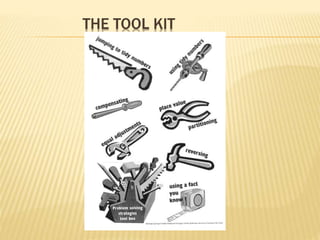
THE TOOL KIT
WHAT ARE THE NUMERACY STAGES? WHAT
DO THEY LOOK LIKE?
How would you solve a problem? Let’s solve
a problem to find out what stage we are
working at.
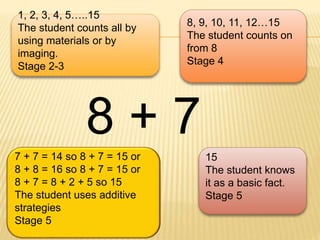
8 + 7
1, 2, 3, 4, 5…..15
The student counts all by
using materials or by
imaging.
Stage 2-3
8, 9, 10, 11, 12…15
The student counts on
from 8
Stage 4
7 + 7 = 14 so 8 + 7 = 15 or
8 + 8 = 16 so 8 + 7 = 15 or
8 + 7 = 8 + 2 + 5 so 15
The student uses additive
strategies
Stage 5
15
The student knows
it as a basic fact.
Stage 5
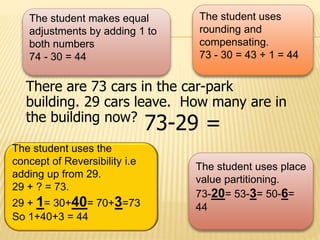
73-29 =
There are 73 cars in the car-park
building. 29 cars leave. How many are in
the building now?
The student makes equal
adjustments by adding 1 to
both numbers
74 - 30 = 44
The student uses
rounding and
compensating.
73 - 30 = 43 + 1 = 44
The student uses the
concept of Reversibility i.e
adding up from 29.
29 + ? = 73.
29 + 1= 30+40= 70+3=73
So 1+40+3 = 44
The student uses place
value partitioning.
73-20= 53-3= 50-6=
44
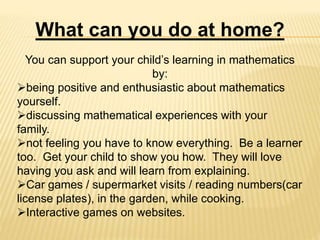
What can you do at home?
You can support your child’s learning in mathematics
by:
being positive and enthusiastic about mathematics
yourself.
discussing mathematical experiences with your
family.
not feeling you have to know everything. Be a learner
too. Get your child to show you how. They will love
having you ask and will learn from explaining.
Car games / supermarket visits / reading numbers(car
license plates), in the garden, while cooking.
Interactive games on websites.
•Websites
A PEEP INTO A TYPICAL CLASSROOM
AND THE EQUIPMENT AND GAMES
CHILDREN ARE ENGAGED IN TO
PROMOTE PROBLEM SOLVING.

Numeracy 2014

  • 2.
    Have developed an understandingof how Mathematics is taught today.
  • 3.
    MAJOR CHANGES FROMWHEN YOU WERE AT SCHOOL –Multi level to meet children’s needs –Small group teaching –Children encouraged to use equipment including fingers
  • 4.
  • 6.
  • 7.
    WHAT ARE THENUMERACY STAGES? WHAT DO THEY LOOK LIKE?
  • 8.
    How would yousolve a problem? Let’s solve a problem to find out what stage we are working at.
  • 9.
    8 + 7 1,2, 3, 4, 5…..15 The student counts all by using materials or by imaging. Stage 2-3 8, 9, 10, 11, 12…15 The student counts on from 8 Stage 4 7 + 7 = 14 so 8 + 7 = 15 or 8 + 8 = 16 so 8 + 7 = 15 or 8 + 7 = 8 + 2 + 5 so 15 The student uses additive strategies Stage 5 15 The student knows it as a basic fact. Stage 5
  • 10.
    73-29 = There are73 cars in the car-park building. 29 cars leave. How many are in the building now? The student makes equal adjustments by adding 1 to both numbers 74 - 30 = 44 The student uses rounding and compensating. 73 - 30 = 43 + 1 = 44 The student uses the concept of Reversibility i.e adding up from 29. 29 + ? = 73. 29 + 1= 30+40= 70+3=73 So 1+40+3 = 44 The student uses place value partitioning. 73-20= 53-3= 50-6= 44
  • 11.
    What can youdo at home? You can support your child’s learning in mathematics by: being positive and enthusiastic about mathematics yourself. discussing mathematical experiences with your family. not feeling you have to know everything. Be a learner too. Get your child to show you how. They will love having you ask and will learn from explaining. Car games / supermarket visits / reading numbers(car license plates), in the garden, while cooking. Interactive games on websites.
  • 12.
  • 13.
    A PEEP INTOA TYPICAL CLASSROOM AND THE EQUIPMENT AND GAMES CHILDREN ARE ENGAGED IN TO PROMOTE PROBLEM SOLVING.