Barilla SpA Team: Anantharaman Akshay Bhardwaj Jaimin Parikh Rohit Shahane
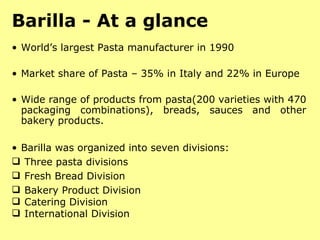
Barilla - At a glance World’s largest Pasta manufacturer in 1990 Market share of Pasta – 35% in Italy and 22% in Europe Wide range of products from pasta(200 varieties with 470 packaging combinations), breads, sauces and other bakery products.  Barilla was organized into seven divisions:  Three pasta divisions  Fresh Bread Division  Bakery Product Division Catering Division International Division
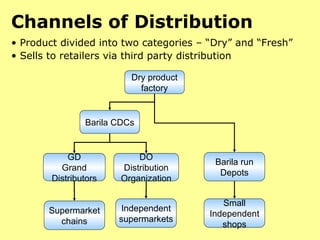
Channels of Distribution Product divided into two categories – “Dry” and “Fresh” Sells to retailers via third party distribution Barila run Depots GD Grand Distributors Dry product factory DO Distribution Organization Barila CDCs Supermarket chains Independent supermarkets Small Independent shops
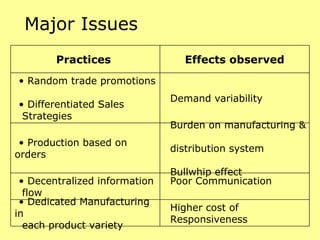
Major Issues Poor Communication  Decentralized information  flow Practices  Effects observed Random trade promotions Differentiated Sales Strategies Demand variability Production based on orders Burden on manufacturing &  distribution system Bullwhip effect Dedicated Manufacturing in  each product variety  Higher cost of  Responsiveness
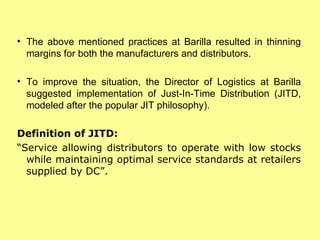
The above mentioned practices at Barilla resulted in thinning margins for both the manufacturers and distributors. To improve the situation, the Director of Logistics at Barilla suggested implementation of Just-In-Time Distribution (JITD, modeled after the popular JIT philosophy).  Definition of JITD: “ Service allowing distributors to operate with low stocks while maintaining optimal service standards at retailers supplied by DC”.
Implementing JITD would entail the following: Barilla would now have to buy point-of-sales data from all distributors for effective demand forecasting (in effect, production would now be based on the predicted demand and not the distributor orders ). Would have to convince the distributors about the credibility of JITD. Promotions now need to be planned well in advance for effective co-ordination with the manufacturing facility. In essence, rather than following the traditional practice, Barilla’s own Logistics Organization would specify the “appropriate” delivery quantities.
Just-in-Time Distribution Benefits for  Manufacturer  : Enjoys control over entire supply chain Reduces inventory levels Better Relationship with distributor Improvement in manufacturing planning Better prediction & planning for promotions Benefits for  Distributor : Relief from Forecasting Reduces inventory Fewer backlogs/stock-outs at retailers Fair competition amongst distributors
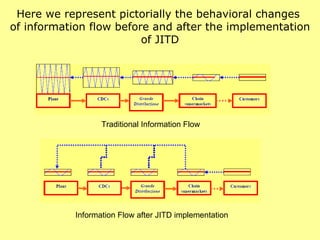
Traditional Information Flow Information Flow after JITD implementation Here we represent pictorially the behavioral changes  of information flow before and after the implementation of JITD
Resistance to JITD implementation From Distributors (External) : “ Managing stock is my job; I don’t need you to see my warehouse or my figures.” “ We would be giving Barilla the power to push products into our warehouse just so that Barilla can reduce its costs.” From Sales & Marketing Department (Internal) : “ How can we get the trade to push Barilla product to retailers if we don’t offer some sort of incentive?” “ If space is freed up in our distributors’ warehouses, the distributors would then push our competitors’ product more than ours.”
Recommendations Run Pilot Tests at Barilla owned depots as evidence to convince third party distributors.
Recommendations To provide scope for competition among distributors, Barilla should allow them to place orders within a specified range.
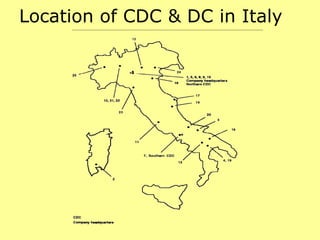
Recommendations To offset the high investment in implementing JITD system to whatever extent possible, we recommend that CDC integrated with their Northern Manufacturing Plant can be eliminated.
Location of CDC & DC in Italy
Recommendations Since, “Per capita pasta consumption in Italy averaged nearly 18 kilos per year, greatly exceeding that of other western European countries”, Barilla cannot afford stock out. Therefore, at least one CDC is required. To successfully implement JITD system, responsiveness of the manufacturing facility has to be enhanced. We propose that this can be achieved by investing in R&D to facilitate postponement of the final step (include seasoning in packaging) in preparation of particular variety of pasta.

Final Scm Presentation

  • 1.
    Barilla SpA Team:Anantharaman Akshay Bhardwaj Jaimin Parikh Rohit Shahane
  • 2.
    Barilla - Ata glance World’s largest Pasta manufacturer in 1990 Market share of Pasta – 35% in Italy and 22% in Europe Wide range of products from pasta(200 varieties with 470 packaging combinations), breads, sauces and other bakery products. Barilla was organized into seven divisions: Three pasta divisions Fresh Bread Division Bakery Product Division Catering Division International Division
  • 3.
    Channels of DistributionProduct divided into two categories – “Dry” and “Fresh” Sells to retailers via third party distribution Barila run Depots GD Grand Distributors Dry product factory DO Distribution Organization Barila CDCs Supermarket chains Independent supermarkets Small Independent shops
  • 4.
    Major Issues PoorCommunication Decentralized information flow Practices Effects observed Random trade promotions Differentiated Sales Strategies Demand variability Production based on orders Burden on manufacturing & distribution system Bullwhip effect Dedicated Manufacturing in each product variety Higher cost of Responsiveness
  • 5.
    The above mentionedpractices at Barilla resulted in thinning margins for both the manufacturers and distributors. To improve the situation, the Director of Logistics at Barilla suggested implementation of Just-In-Time Distribution (JITD, modeled after the popular JIT philosophy). Definition of JITD: “ Service allowing distributors to operate with low stocks while maintaining optimal service standards at retailers supplied by DC”.
  • 6.
    Implementing JITD wouldentail the following: Barilla would now have to buy point-of-sales data from all distributors for effective demand forecasting (in effect, production would now be based on the predicted demand and not the distributor orders ). Would have to convince the distributors about the credibility of JITD. Promotions now need to be planned well in advance for effective co-ordination with the manufacturing facility. In essence, rather than following the traditional practice, Barilla’s own Logistics Organization would specify the “appropriate” delivery quantities.
  • 7.
    Just-in-Time Distribution Benefitsfor Manufacturer : Enjoys control over entire supply chain Reduces inventory levels Better Relationship with distributor Improvement in manufacturing planning Better prediction & planning for promotions Benefits for Distributor : Relief from Forecasting Reduces inventory Fewer backlogs/stock-outs at retailers Fair competition amongst distributors
  • 8.
    Traditional Information FlowInformation Flow after JITD implementation Here we represent pictorially the behavioral changes of information flow before and after the implementation of JITD
  • 9.
    Resistance to JITDimplementation From Distributors (External) : “ Managing stock is my job; I don’t need you to see my warehouse or my figures.” “ We would be giving Barilla the power to push products into our warehouse just so that Barilla can reduce its costs.” From Sales & Marketing Department (Internal) : “ How can we get the trade to push Barilla product to retailers if we don’t offer some sort of incentive?” “ If space is freed up in our distributors’ warehouses, the distributors would then push our competitors’ product more than ours.”
  • 10.
    Recommendations Run PilotTests at Barilla owned depots as evidence to convince third party distributors.
  • 11.
    Recommendations To providescope for competition among distributors, Barilla should allow them to place orders within a specified range.
  • 12.
    Recommendations To offsetthe high investment in implementing JITD system to whatever extent possible, we recommend that CDC integrated with their Northern Manufacturing Plant can be eliminated.
  • 13.
    Location of CDC& DC in Italy
  • 14.
    Recommendations Since, “Percapita pasta consumption in Italy averaged nearly 18 kilos per year, greatly exceeding that of other western European countries”, Barilla cannot afford stock out. Therefore, at least one CDC is required. To successfully implement JITD system, responsiveness of the manufacturing facility has to be enhanced. We propose that this can be achieved by investing in R&D to facilitate postponement of the final step (include seasoning in packaging) in preparation of particular variety of pasta.