Welcome to Year 9 and
GCSEs Evening
DON’T LEAVE IT
TOO LATE!!!!
New 9-1 GCSEs
Key Facts
Why the Changes?
• To ensure that young people have the
knowledge and skills they need to succeed in
the 21st Century.
• To ensure that students leave school better
prepared for work or further study.
• They cover more challenging content and are
designed to match standards in the strongest
performing education systems elsewhere in
the world.
How do these GCSEs Differ?
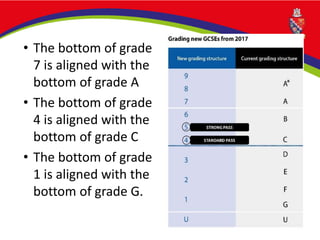
• A new 9 to 1 grading scale is being used.
• Grade 9 is the highest grade and will be
awarded to fewer students than the
previous A*.
• The old and new GCSE grading scales do
not directly compare but there are three
points where they align:
• The bottom of grade
7 is aligned with the
bottom of grade A
• The bottom of grade
4 is aligned with the
bottom of grade C
• The bottom of grade
1 is aligned with the
bottom of grade G.
How do these GCSEs Differ?
• There will be more demanding content.
• Two tiers – foundation and higher but only for
Maths, Science and MFL
• Assessment will be at the end of the course (no
more modules).
• Assessment will be mainly by exam, other types
of assessment used only when needed to test
essential skills.
Expectations
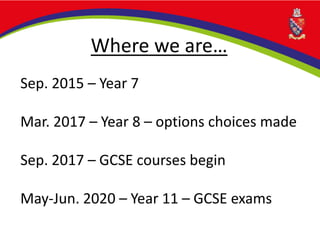
Where we are…
Sep. 2015 – Year 7
Mar. 2017 – Year 8 – options choices made
Sep. 2017 – GCSE courses begin
May-Jun. 2020 – Year 11 – GCSE exams
Sep. 2017 – GCSE courses begin
• Similarities to Year 7 and 8
• Differences from Year 7 and 8
Similarities
• Core subjects – maths, English, science, RE and
core PE
• School routines and expectations
• Continuation of subjects
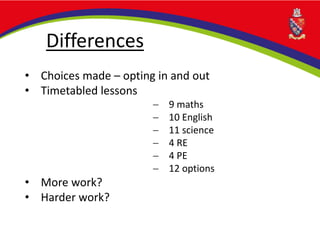
Differences
• Choices made – opting in and out
• Timetabled lessons
 9 maths
 10 English
 11 science
 4 RE
 4 PE
 12 options
• More work?
• Harder work?
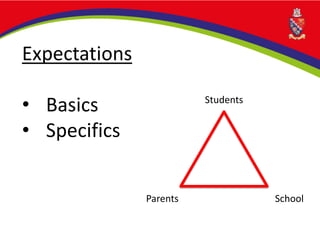
Expectations
• Basics
• Specifics
Students
Parents School
Basics - Students
• Uniform
• Equipment
• Behaviour for learning
 Effort
 Behaviour
 Use of planner
 Homework
 Time management
Specifics - Students
• Subject requirements
– overview available tonight
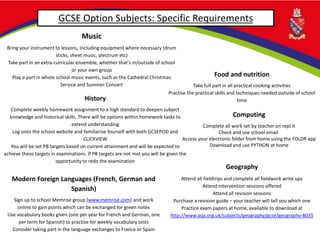
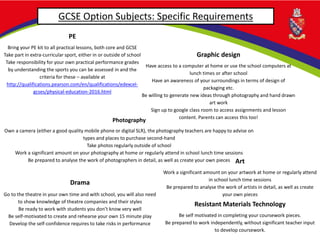
GCSE Option Subjects: Specific Requirements
Computing
Complete all work set by teacher on repl.it
Check and use school email
Access your electronic folder from home using the FOLDR app
Download and use PYTHON at home
Geography
Attend all fieldtrips and complete all fieldwork write ups
Attend intervention sessions offered
Attend all revision sessions
Purchase a revision guide – your teacher will tell you which one
Practice exam papers at home, available to download at
http://www.aqa.org.uk/subjects/geography/gcse/geography-8035
History
Complete weekly homework assignment to a high standard to deepen subject
knowledge and historical skills. There will be options within homework tasks to
extend understanding
Log onto the school website and familiarise Yourself with both GCSEPOD and
CLICKVIEW
You will be set PB targets based on current attainment and will be expected to
achieve these targets in examinations. If PB targets are not met you will be given the
opportunity to redo the examination
Music
Bring your instrument to lessons, including equipment where necessary (drum
sticks, sheet music, plectrum etc)
Take part in an extra-curricular ensemble, whether that's in/outside of school
or your own group
Play a part in whole school music events, such as the Cathedral Christmas
Service and Summer Concert
Food and nutrition
Take full part in all practical cooking activities
Practise the practical skills and techniques needed outside of school
time
Modern Foreign Languages (French, German and
Spanish)
Sign up to school Memrise group (www.memrise.com) and work
online to gain points which can be exchanged for green notes
Use vocabulary books given (one per year for French and German, one
per term for Spanish) to practise for weekly vocabulary tests
Consider taking part in the language exchanges to France or Spain
PE
Bring your PE kit to all practical lessons, both core and GCSE
Take part in extra-curricular sport, either in or outside of school
Take responsibility for your own practical performance grades
by understanding the sports you can be assessed in and the
criteria for these – available at
http://qualifications.pearson.com/en/qualifications/edexcel-
gcses/physical-education-2016.html
Art
Work a significant amount on your artwork at home or regularly attend
in school lunch time sessions
Be prepared to analyse the work of artists in detail, as well as create
your own pieces
Photography
Own a camera (either a good quality mobile phone or digital SLR), the photography teachers are happy to advise on
types and places to purchase second-hand
Take photos regularly outside of school
Work a significant amount on your photography at home or regularly attend in school lunch time sessions
Be prepared to analyse the work of photographers in detail, as well as create your own pieces
Graphic design
Have access to a computer at home or use the school computers at
lunch times or after school
Have an awareness of your surroundings in terms of design of
packaging etc.
Be willing to generate new ideas through photography and hand drawn
art work
Sign up to google class room to access assignments and lesson
content. Parents can access this too!
Resistant Materials Technology
Be self motivated in completing your coursework pieces.
Be prepared to work independently, without significant teacher input
to develop coursework.
Drama
Go to the theatre in your own time and with school, you will also need
to show knowledge of theatre companies and their styles
Be ready to work with students you don’t know very well
Be self-motivated to create and rehearse your own 15 minute play
Develop the self-confidence requires to take risks in performance
GCSE Option Subjects: Specific Requirements
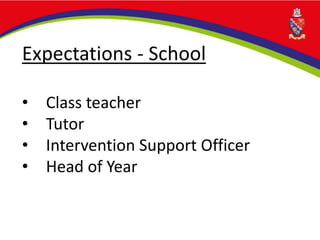
Expectations - School
• Class teacher
• Tutor
• Intervention Support Officer
• Head of Year
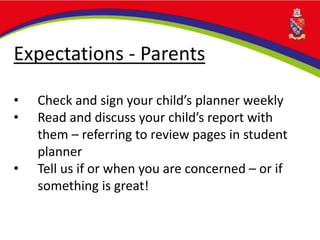
Expectations - Parents
• Check and sign your child’s planner weekly
• Read and discuss your child’s report with
them – referring to review pages in student
planner
• Tell us if or when you are concerned – or if
something is great!
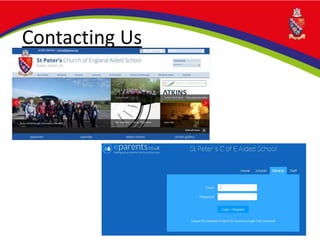
Contacting Us
GCSE Mathematics
Recognise this
feeling……………..
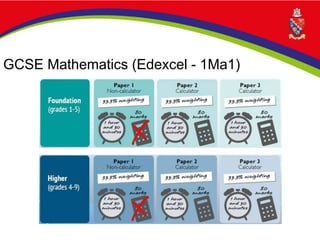
GCSE Mathematics (Edexcel - 1Ma1)
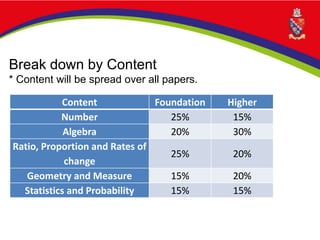
Content Foundation Higher
Number 25% 15%
Algebra 20% 30%
Ratio, Proportion and Rates of
change
25% 20%
Geometry and Measure 15% 20%
Statistics and Probability 15% 15%
Break down by Content
* Content will be spread over all papers.
Supporting your child.
- 9 lessons a fortnight.
- Weekly homework (provided it relevant)
- https://www.vle.mathswatch.com/vle/
- Unit Topic Sheets which include.
- Break down of learning objectives.
- Linked to Mathswatch clips to aid revision as
well as supporting pupils who miss lessons
through illness or extra curricular.
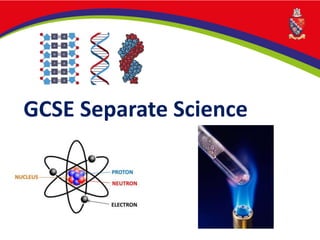
GCSE Separate Science
Separate Science
• All pupils have separate lessons of
Biology, Chemistry and Physics.
• 11 hours a fortnight in Yr.9 split
across the disciplines.
• Exams can be taken at either higher
(9-4) or foundation tiers (5-1).
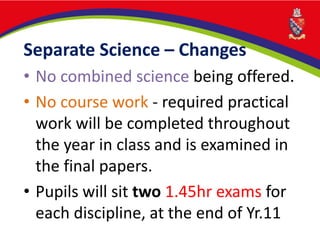
Separate Science – Changes
• No combined science being offered.
• No course work - required practical
work will be completed throughout
the year in class and is examined in
the final papers.
• Pupils will sit two 1.45hr exams for
each discipline, at the end of Yr.11
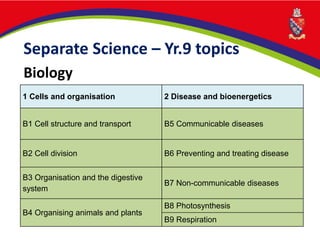
Separate Science – Yr.9 topics
Biology
1 Cells and organisation 2 Disease and bioenergetics
B1 Cell structure and transport B5 Communicable diseases
B2 Cell division B6 Preventing and treating disease
B3 Organisation and the digestive
system
B7 Non-communicable diseases
B4 Organising animals and plants
B8 Photosynthesis
B9 Respiration
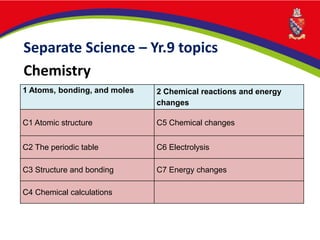
Separate Science – Yr.9 topics
Chemistry
1 Atoms, bonding, and moles 2 Chemical reactions and energy
changes
C1 Atomic structure C5 Chemical changes
C2 The periodic table C6 Electrolysis
C3 Structure and bonding C7 Energy changes
C4 Chemical calculations
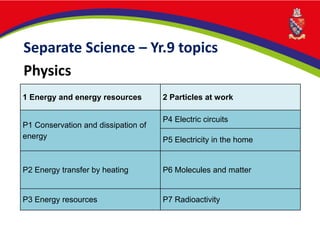
Separate Science – Yr.9 topics
Physics
1 Energy and energy resources 2 Particles at work
P1 Conservation and dissipation of
energy
P4 Electric circuits
P5 Electricity in the home
P2 Energy transfer by heating P6 Molecules and matter
P3 Energy resources P7 Radioactivity
Separate Science – Home Learning
• Homework – Pupils should be carrying
out short but regular revision sessions in
addition to their normal set homework.
• A revision guides letter has already been
passed to all pupils. Replies are due to
finance office by 6th October.
Separate Science - Online
• Science website:
www.spexe.org/hosted/sci
• All pupils have access to ‘Kerboodle’.
This is an online resource to support the
lessons. There are worksheets,
interactive activities, practice tests and
digital copies of our exercise books, all
accessible at home.
Humanities at St Peter’s
» Geography
» History
» RE
Geography
 PAPER 1 (35%) Physical Environment
Natural hazards; Living World; Physical
landscape of the UK, Geographical skills.
1.5 hours 88 marks
 PAPER 2 (35%) Human Environment
Urban issues; Changing economic world;
Resource management; Geographical skills.
1.5 hours 88 marks
 PAPER 3 (30%) Geographical
Applications (fieldwork and geographical
skills) 1.25 hours 76 marks
Students are:
• Expected to attend all fieldtrips and
complete all fieldwork write ups
• Expected to attend any interventions
sessions that are offered
• Attend all revision sessions
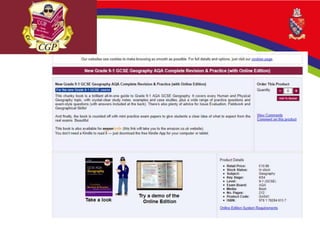
• Purchase a revision guide
• Practise exam papers at home which
are available to download at
http://www.aqa.org.uk/subjects/geography/g
cse/geography-8035
History
• Homework integral to deepening subject knowledge and
historical skills.
• Students will have one homework assignment per week.
• Students will be given options with homework to extend
understanding.
• Logging onto the school website and familiarising
themselves with both GCSEPOD and CLICKVIEW would
be beneficial as often homework will require them to
watch historical documentaries.
• Later in the school year students will be set
“personal best”targets based on current
attainment and will be expected to achieve these
targets in examinations. If PB targets not met they
will be given the opportunity to redo the
examination.
• Students are expected to complete all starter tasks
as they are often GCSE questions.
Welcome to Year 9
What to expect
from GCSE RE…
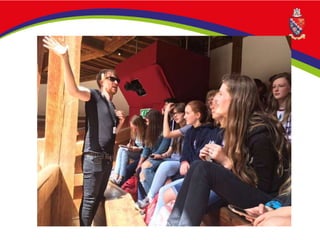
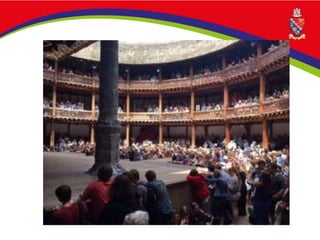
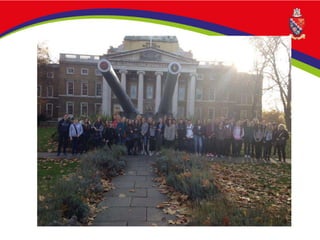
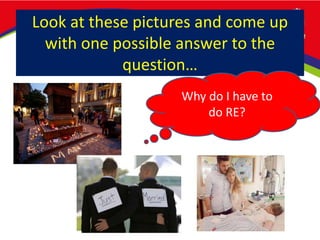
Look at these pictures and come up
with one possible answer to the
question…
Why do I have to
do RE?
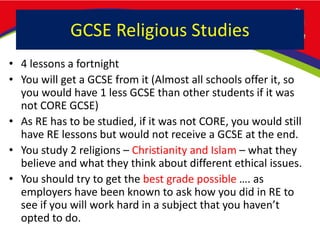
GCSE Religious Studies
• 4 lessons a fortnight
• You will get a GCSE from it (Almost all schools offer it, so
you would have 1 less GCSE than other students if it was
not CORE GCSE)
• As RE has to be studied, if it was not CORE, you would still
have RE lessons but would not receive a GCSE at the end.
• You study 2 religions – Christianity and Islam – what they
believe and what they think about different ethical issues.
• You should try to get the best grade possible …. as
employers have been known to ask how you did in RE to
see if you will work hard in a subject that you haven’t
opted to do.
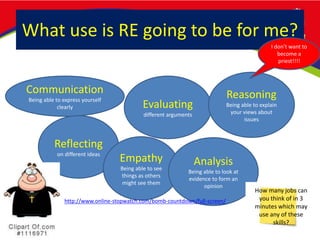
What use is RE going to be for me?
Communication
Being able to express yourself
clearly Evaluating
different arguments
Reasoning
Being able to explain
your views about
issues
Reflecting
on different ideas
I don’t want to
become a
priest!!!!
Empathy
Being able to see
things as others
might see them
Analysis
Being able to look at
evidence to form an
opinion
How many jobs can
you think of in 3
minutes which may
use any of these
skills?
http://www.online-stopwatch.com/bomb-countdown/full-screen/
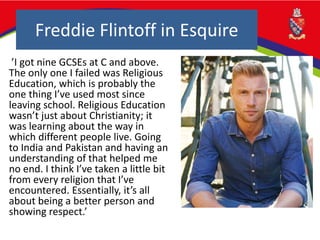
Freddie Flintoff in Esquire
’I got nine GCSEs at C and above.
The only one I failed was Religious
Education, which is probably the
one thing I’ve used most since
leaving school. Religious Education
wasn’t just about Christianity; it
was learning about the way in
which different people live. Going
to India and Pakistan and having an
understanding of that helped me
no end. I think I’ve taken a little bit
from every religion that I’ve
encountered. Essentially, it’s all
about being a better person and
showing respect.’
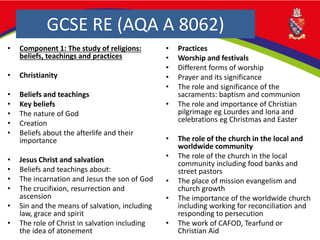
GCSE RE (AQA A 8062)
• Component 1: The study of religions:
beliefs, teachings and practices
• Christianity
• Beliefs and teachings
• Key beliefs
• The nature of God
• Creation
• Beliefs about the afterlife and their
importance
• Jesus Christ and salvation
• Beliefs and teachings about:
• The incarnation and Jesus the son of God
• The crucifixion, resurrection and
ascension
• Sin and the means of salvation, including
law, grace and spirit
• The role of Christ in salvation including
the idea of atonement
• Practices
• Worship and festivals
• Different forms of worship
• Prayer and its significance
• The role and significance of the
sacraments: baptism and communion
• The role and importance of Christian
pilgrimage eg Lourdes and Iona and
celebrations eg Christmas and Easter
• The role of the church in the local and
worldwide community
• The role of the church in the local
community including food banks and
street pastors
• The place of mission evangelism and
church growth
• The importance of the worldwide church
including working for reconciliation and
responding to persecution
• The work of CAFOD, Tearfund or
Christian Aid
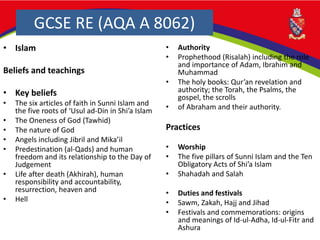
• Islam
Beliefs and teachings
• Key beliefs
• The six articles of faith in Sunni Islam and
the five roots of ‘Usul ad-Din in Shi’a Islam
• The Oneness of God (Tawhid)
• The nature of God
• Angels including Jibril and Mika’il
• Predestination (al-Qads) and human
freedom and its relationship to the Day of
Judgement
• Life after death (Akhirah), human
responsibility and accountability,
resurrection, heaven and
• Hell
• Authority
• Prophethood (Risalah) including the role
and importance of Adam, Ibrahim and
Muhammad
• The holy books: Qur’an revelation and
authority; the Torah, the Psalms, the
gospel, the scrolls
• of Abraham and their authority.
Practices
• Worship
• The five pillars of Sunni Islam and the Ten
Obligatory Acts of Shi’a Islam
• Shahadah and Salah
• Duties and festivals
• Sawm, Zakah, Hajj and Jihad
• Festivals and commemorations: origins
and meanings of Id-ul-Adha, Id-ul-Fitr and
Ashura
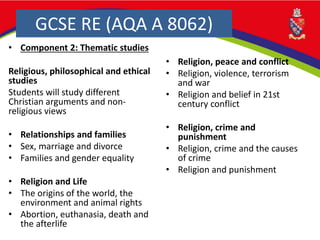
GCSE RE (AQA A 8062)
• Component 2: Thematic studies
Religious, philosophical and ethical
studies
Students will study different
Christian arguments and non-
religious views
• Relationships and families
• Sex, marriage and divorce
• Families and gender equality
• Religion and Life
• The origins of the world, the
environment and animal rights
• Abortion, euthanasia, death and
the afterlife
• Religion, peace and conflict
• Religion, violence, terrorism
and war
• Religion and belief in 21st
century conflict
• Religion, crime and
punishment
• Religion, crime and the causes
of crime
• Religion and punishment
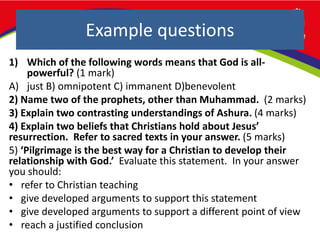
GCSE RE (AQA A 8062)
Example questions
1) Which of the following words means that God is all-
powerful? (1 mark)
A) just B) omnipotent C) immanent D)benevolent
2) Name two of the prophets, other than Muhammad. (2 marks)
3) Explain two contrasting understandings of Ashura. (4 marks)
4) Explain two beliefs that Christians hold about Jesus’
resurrection. Refer to sacred texts in your answer. (5 marks)
5) ‘Pilgrimage is the best way for a Christian to develop their
relationship with God.’ Evaluate this statement. In your answer
you should:
• refer to Christian teaching
• give developed arguments to support this statement
• give developed arguments to support a different point of view
• reach a justified conclusion
What is new?
• The DfE published prescribed content for the
new RE GCSE when the GCSEs were reformed
• ALL exam boards now follow the same
structure – more content, two in depth
studies of religions, thematic studies
• ALL exam boards must exemplify that the UK
is, in the main, a Christian country
• A new grading system 1-9
How can you support your child?
• Watch the news and talk about current affairs and
global concerns
• Embrace some of the more controversial issues and try
to consider both sides
• Encourage the appreciation of diversity
• Be aware that RE is more rigorous, academic and
challenging than it has ever been before
• Encourage the use of Kerboodle at home to complete
homework tasks and to consolidate learning
• Buy the CGP revision guide
• Sign the parental feedback section of assessment
sheets and encourage response to feedback
Thank you
• Year 9 have started very positively and we are
really pleased with the attitude and effort
shown so far
• Excellent engagement and behaviour was
commented on by staff, volunteers and those
who hosted our visit in the churches and
mosque
Careers @ St Peter’s
Offering impartial and
independent careers
education, advice and
guidance to every pupil.
• There has never been a time when careers guidance
has been as important for young people as it is today.
The landscape of education, training and employment
opportunities that students need to navigate is more
complex and more challenging than that faced by
previous generations. While the economy is
beginning to recover from the recent recession, levels
of youth unemployment and under-employment are
still high. The raising of the age for participating in
learning means that young people face a wider range
of choices of courses and places to study.
• Careers education does not just mean informing
students about their options after school but also how
their school career will affect their futures. It is our
statutory duty to ensure that all pupils receive
independent, impartial advice and guidance regarding
all options within school and how they will affect
their options after school and which careers pathways
will become available to them. By helping students
with decisions at crucial stages, informing them of all
their options and introducing them to the world of
work, we aim to prepare them for life after school
whichever path they choose.
How important are GCSE
choices for university?
Your GCSE choices matter!
Dig about a bit into the entry requirements of
most university courses and there, sitting quietly alongside
the A-level or other advanced course grades you need, will
probably be a section on specific GCSE conditions. In fact,
with the recent A-level reforms, universities may well
use GCSEs more and more when making a decision about
your application.
‘WHICH’ MAGAZINE
Update for 2017 GCSE results: we've also taken a closer
look at whether this year's English and Maths grade and
curriculum changes could make a difference to your future
plans.
In a nutshell, your GCSE results could affect the following:
•1. The sixth form you go to
•2. The qualifications you take next
•3. Your eligibility for a university course
•4. The universities you can apply to
•5. Your career prospects
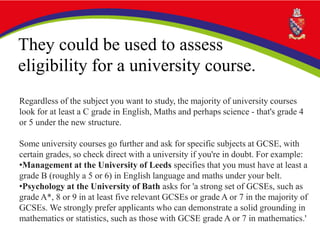
They could be used to assess
eligibility for a university course.
Regardless of the subject you want to study, the majority of university courses
look for at least a C grade in English, Maths and perhaps science - that's grade 4
or 5 under the new structure.
Some university courses go further and ask for specific subjects at GCSE, with
certain grades, so check direct with a university if you're in doubt. For example:
•Management at the University of Leeds specifies that you must have at least a
grade B (roughly a 5 or 6) in English language and maths under your belt.
•Psychology at the University of Bath asks for 'a strong set of GCSEs, such as
grade A*, 8 or 9 in at least five relevant GCSEs or grade A or 7 in the majority of
GCSEs. We strongly prefer applicants who can demonstrate a solid grounding in
mathematics or statistics, such as those with GCSE grade A or 7 in mathematics.'
St Peter's is about preparing children for life, not just
exams. The world that our students are inheriting is
changing rapidly and there will be many careers for
them that have not even been imagined yet.
Employers will require well rounded characters who
are:
•emotionally intelligent
•able to learn how to learn
•able to use habits in a range of contexts
•curious about learning
•flexible, imaginative thinkers
•creative and entrepreneurial
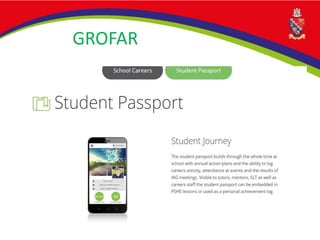
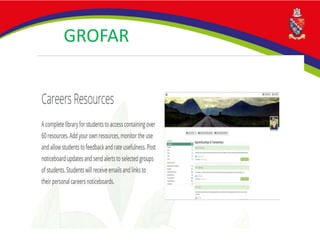
GROFAR
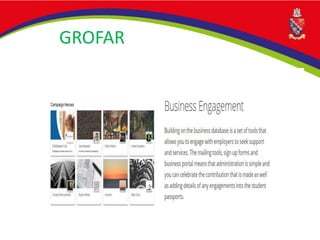
GROFAR
GROFAR
OPPORTUNITIES @ St. Peter’s
in KS4
• Volunteers in the Community Programme: giving
something back to the community.
• Work Experience: finding out first hand what skills and
qualities employers want.
• University of Exeter’s Outreach Programme for
Medicine and Law
• Talks from local Employers
• Talks from all Post 16 Providers
• Post 16 Open Events
• Invitations to Taster events
• National Apprenticeship Show at Westpoint
Every Tuesday St Peter’s Year 10 students volunteer to
help at local Parent & Toddler Groups and the Over 60s
Lunch Club . Pupils commit to just two sessions.
We support St James’ Lunch Club where students set up
tables, help to serve lunch, clear up afterwards and then
get a free lunch. Very popular with boys!
We also support Pinhoe Road Baptist Church ‘Parent &
Toddler Group’,
We encourage every Year 10 student to talk part in this
programme and remind them how effective it looks on their
CVs.
What can National Careers Services offer?
National Careers Services offers careers and
skills advice to fit your individual needs.
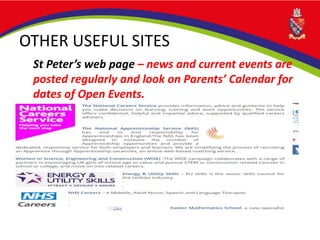
OTHER USEFUL SITES
St Peter’s web page – news and current events are
posted regularly and look on Parents’ Calendar for
dates of Open Events.
Work Experience 2019
Flybe Met Office NHS South West Water
Devon & Cornwall Police Exeter City FC
Cats Protection League Crealy City Vets
Primary Schools – only for those interested in working with
children Liverpool Victoria
Jacobs Atkins Ashfords Michelmores
Jury’s Inn Buckeral Lodge Southgate Hotel
Exeter Golf & Country Club Topsham Pool
Hairdressing Sainsburys John Lewis
Acorn Ecology Aviation South West Barnardos
Finally……………
Are you able to offer one of our
students a work experience
placement?
You will need to have Public Liability Insurance
and Employers Liability Insurance.
We would appreciate any support you
can give for our Work Experience
Programme.
Welcome to year 9

Welcome to year 9

  • 1.
    Welcome to Year9 and GCSEs Evening
  • 2.
  • 3.
  • 4.
    Why the Changes? •To ensure that young people have the knowledge and skills they need to succeed in the 21st Century. • To ensure that students leave school better prepared for work or further study. • They cover more challenging content and are designed to match standards in the strongest performing education systems elsewhere in the world.
  • 5.
    How do theseGCSEs Differ? • A new 9 to 1 grading scale is being used. • Grade 9 is the highest grade and will be awarded to fewer students than the previous A*. • The old and new GCSE grading scales do not directly compare but there are three points where they align:
  • 6.
    • The bottomof grade 7 is aligned with the bottom of grade A • The bottom of grade 4 is aligned with the bottom of grade C • The bottom of grade 1 is aligned with the bottom of grade G.
  • 7.
    How do theseGCSEs Differ? • There will be more demanding content. • Two tiers – foundation and higher but only for Maths, Science and MFL • Assessment will be at the end of the course (no more modules). • Assessment will be mainly by exam, other types of assessment used only when needed to test essential skills.
  • 8.
  • 10.
    Where we are… Sep.2015 – Year 7 Mar. 2017 – Year 8 – options choices made Sep. 2017 – GCSE courses begin May-Jun. 2020 – Year 11 – GCSE exams
  • 11.
    Sep. 2017 –GCSE courses begin • Similarities to Year 7 and 8 • Differences from Year 7 and 8
  • 12.
    Similarities • Core subjects– maths, English, science, RE and core PE • School routines and expectations • Continuation of subjects
  • 13.
    Differences • Choices made– opting in and out • Timetabled lessons  9 maths  10 English  11 science  4 RE  4 PE  12 options • More work? • Harder work?
  • 14.
  • 15.
    Basics - Students •Uniform • Equipment • Behaviour for learning  Effort  Behaviour  Use of planner  Homework  Time management
  • 16.
    Specifics - Students •Subject requirements – overview available tonight
  • 17.
    GCSE Option Subjects:Specific Requirements Computing Complete all work set by teacher on repl.it Check and use school email Access your electronic folder from home using the FOLDR app Download and use PYTHON at home Geography Attend all fieldtrips and complete all fieldwork write ups Attend intervention sessions offered Attend all revision sessions Purchase a revision guide – your teacher will tell you which one Practice exam papers at home, available to download at http://www.aqa.org.uk/subjects/geography/gcse/geography-8035 History Complete weekly homework assignment to a high standard to deepen subject knowledge and historical skills. There will be options within homework tasks to extend understanding Log onto the school website and familiarise Yourself with both GCSEPOD and CLICKVIEW You will be set PB targets based on current attainment and will be expected to achieve these targets in examinations. If PB targets are not met you will be given the opportunity to redo the examination Music Bring your instrument to lessons, including equipment where necessary (drum sticks, sheet music, plectrum etc) Take part in an extra-curricular ensemble, whether that's in/outside of school or your own group Play a part in whole school music events, such as the Cathedral Christmas Service and Summer Concert Food and nutrition Take full part in all practical cooking activities Practise the practical skills and techniques needed outside of school time Modern Foreign Languages (French, German and Spanish) Sign up to school Memrise group (www.memrise.com) and work online to gain points which can be exchanged for green notes Use vocabulary books given (one per year for French and German, one per term for Spanish) to practise for weekly vocabulary tests Consider taking part in the language exchanges to France or Spain
  • 18.
    PE Bring your PEkit to all practical lessons, both core and GCSE Take part in extra-curricular sport, either in or outside of school Take responsibility for your own practical performance grades by understanding the sports you can be assessed in and the criteria for these – available at http://qualifications.pearson.com/en/qualifications/edexcel- gcses/physical-education-2016.html Art Work a significant amount on your artwork at home or regularly attend in school lunch time sessions Be prepared to analyse the work of artists in detail, as well as create your own pieces Photography Own a camera (either a good quality mobile phone or digital SLR), the photography teachers are happy to advise on types and places to purchase second-hand Take photos regularly outside of school Work a significant amount on your photography at home or regularly attend in school lunch time sessions Be prepared to analyse the work of photographers in detail, as well as create your own pieces Graphic design Have access to a computer at home or use the school computers at lunch times or after school Have an awareness of your surroundings in terms of design of packaging etc. Be willing to generate new ideas through photography and hand drawn art work Sign up to google class room to access assignments and lesson content. Parents can access this too! Resistant Materials Technology Be self motivated in completing your coursework pieces. Be prepared to work independently, without significant teacher input to develop coursework. Drama Go to the theatre in your own time and with school, you will also need to show knowledge of theatre companies and their styles Be ready to work with students you don’t know very well Be self-motivated to create and rehearse your own 15 minute play Develop the self-confidence requires to take risks in performance GCSE Option Subjects: Specific Requirements
  • 19.
    Expectations - School •Class teacher • Tutor • Intervention Support Officer • Head of Year
  • 20.
    Expectations - Parents •Check and sign your child’s planner weekly • Read and discuss your child’s report with them – referring to review pages in student planner • Tell us if or when you are concerned – or if something is great!
  • 21.
  • 22.
  • 23.
  • 24.
  • 25.
    Content Foundation Higher Number25% 15% Algebra 20% 30% Ratio, Proportion and Rates of change 25% 20% Geometry and Measure 15% 20% Statistics and Probability 15% 15% Break down by Content * Content will be spread over all papers.
  • 26.
    Supporting your child. -9 lessons a fortnight. - Weekly homework (provided it relevant) - https://www.vle.mathswatch.com/vle/ - Unit Topic Sheets which include. - Break down of learning objectives. - Linked to Mathswatch clips to aid revision as well as supporting pupils who miss lessons through illness or extra curricular.
  • 28.
  • 29.
    Separate Science • Allpupils have separate lessons of Biology, Chemistry and Physics. • 11 hours a fortnight in Yr.9 split across the disciplines. • Exams can be taken at either higher (9-4) or foundation tiers (5-1).
  • 30.
    Separate Science –Changes • No combined science being offered. • No course work - required practical work will be completed throughout the year in class and is examined in the final papers. • Pupils will sit two 1.45hr exams for each discipline, at the end of Yr.11
  • 31.
    Separate Science –Yr.9 topics Biology 1 Cells and organisation 2 Disease and bioenergetics B1 Cell structure and transport B5 Communicable diseases B2 Cell division B6 Preventing and treating disease B3 Organisation and the digestive system B7 Non-communicable diseases B4 Organising animals and plants B8 Photosynthesis B9 Respiration
  • 32.
    Separate Science –Yr.9 topics Chemistry 1 Atoms, bonding, and moles 2 Chemical reactions and energy changes C1 Atomic structure C5 Chemical changes C2 The periodic table C6 Electrolysis C3 Structure and bonding C7 Energy changes C4 Chemical calculations
  • 33.
    Separate Science –Yr.9 topics Physics 1 Energy and energy resources 2 Particles at work P1 Conservation and dissipation of energy P4 Electric circuits P5 Electricity in the home P2 Energy transfer by heating P6 Molecules and matter P3 Energy resources P7 Radioactivity
  • 34.
    Separate Science –Home Learning • Homework – Pupils should be carrying out short but regular revision sessions in addition to their normal set homework. • A revision guides letter has already been passed to all pupils. Replies are due to finance office by 6th October.
  • 35.
    Separate Science -Online • Science website: www.spexe.org/hosted/sci • All pupils have access to ‘Kerboodle’. This is an online resource to support the lessons. There are worksheets, interactive activities, practice tests and digital copies of our exercise books, all accessible at home.
  • 36.
    Humanities at StPeter’s » Geography » History » RE
  • 37.
    Geography  PAPER 1(35%) Physical Environment Natural hazards; Living World; Physical landscape of the UK, Geographical skills. 1.5 hours 88 marks  PAPER 2 (35%) Human Environment Urban issues; Changing economic world; Resource management; Geographical skills. 1.5 hours 88 marks  PAPER 3 (30%) Geographical Applications (fieldwork and geographical skills) 1.25 hours 76 marks
  • 38.
    Students are: • Expectedto attend all fieldtrips and complete all fieldwork write ups • Expected to attend any interventions sessions that are offered • Attend all revision sessions
  • 39.
    • Purchase arevision guide • Practise exam papers at home which are available to download at http://www.aqa.org.uk/subjects/geography/g cse/geography-8035
  • 43.
    History • Homework integralto deepening subject knowledge and historical skills. • Students will have one homework assignment per week. • Students will be given options with homework to extend understanding. • Logging onto the school website and familiarising themselves with both GCSEPOD and CLICKVIEW would be beneficial as often homework will require them to watch historical documentaries.
  • 44.
    • Later inthe school year students will be set “personal best”targets based on current attainment and will be expected to achieve these targets in examinations. If PB targets not met they will be given the opportunity to redo the examination. • Students are expected to complete all starter tasks as they are often GCSE questions.
  • 48.
    Welcome to Year9 What to expect from GCSE RE…
  • 49.
    Look at thesepictures and come up with one possible answer to the question… Why do I have to do RE?
  • 50.
    GCSE Religious Studies •4 lessons a fortnight • You will get a GCSE from it (Almost all schools offer it, so you would have 1 less GCSE than other students if it was not CORE GCSE) • As RE has to be studied, if it was not CORE, you would still have RE lessons but would not receive a GCSE at the end. • You study 2 religions – Christianity and Islam – what they believe and what they think about different ethical issues. • You should try to get the best grade possible …. as employers have been known to ask how you did in RE to see if you will work hard in a subject that you haven’t opted to do.
  • 51.
    What use isRE going to be for me? Communication Being able to express yourself clearly Evaluating different arguments Reasoning Being able to explain your views about issues Reflecting on different ideas I don’t want to become a priest!!!! Empathy Being able to see things as others might see them Analysis Being able to look at evidence to form an opinion How many jobs can you think of in 3 minutes which may use any of these skills? http://www.online-stopwatch.com/bomb-countdown/full-screen/
  • 52.
    Freddie Flintoff inEsquire ’I got nine GCSEs at C and above. The only one I failed was Religious Education, which is probably the one thing I’ve used most since leaving school. Religious Education wasn’t just about Christianity; it was learning about the way in which different people live. Going to India and Pakistan and having an understanding of that helped me no end. I think I’ve taken a little bit from every religion that I’ve encountered. Essentially, it’s all about being a better person and showing respect.’
  • 53.
    GCSE RE (AQAA 8062) • Component 1: The study of religions: beliefs, teachings and practices • Christianity • Beliefs and teachings • Key beliefs • The nature of God • Creation • Beliefs about the afterlife and their importance • Jesus Christ and salvation • Beliefs and teachings about: • The incarnation and Jesus the son of God • The crucifixion, resurrection and ascension • Sin and the means of salvation, including law, grace and spirit • The role of Christ in salvation including the idea of atonement • Practices • Worship and festivals • Different forms of worship • Prayer and its significance • The role and significance of the sacraments: baptism and communion • The role and importance of Christian pilgrimage eg Lourdes and Iona and celebrations eg Christmas and Easter • The role of the church in the local and worldwide community • The role of the church in the local community including food banks and street pastors • The place of mission evangelism and church growth • The importance of the worldwide church including working for reconciliation and responding to persecution • The work of CAFOD, Tearfund or Christian Aid
  • 54.
    • Islam Beliefs andteachings • Key beliefs • The six articles of faith in Sunni Islam and the five roots of ‘Usul ad-Din in Shi’a Islam • The Oneness of God (Tawhid) • The nature of God • Angels including Jibril and Mika’il • Predestination (al-Qads) and human freedom and its relationship to the Day of Judgement • Life after death (Akhirah), human responsibility and accountability, resurrection, heaven and • Hell • Authority • Prophethood (Risalah) including the role and importance of Adam, Ibrahim and Muhammad • The holy books: Qur’an revelation and authority; the Torah, the Psalms, the gospel, the scrolls • of Abraham and their authority. Practices • Worship • The five pillars of Sunni Islam and the Ten Obligatory Acts of Shi’a Islam • Shahadah and Salah • Duties and festivals • Sawm, Zakah, Hajj and Jihad • Festivals and commemorations: origins and meanings of Id-ul-Adha, Id-ul-Fitr and Ashura GCSE RE (AQA A 8062)
  • 55.
    • Component 2:Thematic studies Religious, philosophical and ethical studies Students will study different Christian arguments and non- religious views • Relationships and families • Sex, marriage and divorce • Families and gender equality • Religion and Life • The origins of the world, the environment and animal rights • Abortion, euthanasia, death and the afterlife • Religion, peace and conflict • Religion, violence, terrorism and war • Religion and belief in 21st century conflict • Religion, crime and punishment • Religion, crime and the causes of crime • Religion and punishment GCSE RE (AQA A 8062)
  • 56.
    Example questions 1) Whichof the following words means that God is all- powerful? (1 mark) A) just B) omnipotent C) immanent D)benevolent 2) Name two of the prophets, other than Muhammad. (2 marks) 3) Explain two contrasting understandings of Ashura. (4 marks) 4) Explain two beliefs that Christians hold about Jesus’ resurrection. Refer to sacred texts in your answer. (5 marks) 5) ‘Pilgrimage is the best way for a Christian to develop their relationship with God.’ Evaluate this statement. In your answer you should: • refer to Christian teaching • give developed arguments to support this statement • give developed arguments to support a different point of view • reach a justified conclusion
  • 57.
    What is new? •The DfE published prescribed content for the new RE GCSE when the GCSEs were reformed • ALL exam boards now follow the same structure – more content, two in depth studies of religions, thematic studies • ALL exam boards must exemplify that the UK is, in the main, a Christian country • A new grading system 1-9
  • 58.
    How can yousupport your child? • Watch the news and talk about current affairs and global concerns • Embrace some of the more controversial issues and try to consider both sides • Encourage the appreciation of diversity • Be aware that RE is more rigorous, academic and challenging than it has ever been before • Encourage the use of Kerboodle at home to complete homework tasks and to consolidate learning • Buy the CGP revision guide • Sign the parental feedback section of assessment sheets and encourage response to feedback
  • 59.
    Thank you • Year9 have started very positively and we are really pleased with the attitude and effort shown so far • Excellent engagement and behaviour was commented on by staff, volunteers and those who hosted our visit in the churches and mosque
  • 60.
    Careers @ StPeter’s Offering impartial and independent careers education, advice and guidance to every pupil.
  • 61.
    • There hasnever been a time when careers guidance has been as important for young people as it is today. The landscape of education, training and employment opportunities that students need to navigate is more complex and more challenging than that faced by previous generations. While the economy is beginning to recover from the recent recession, levels of youth unemployment and under-employment are still high. The raising of the age for participating in learning means that young people face a wider range of choices of courses and places to study.
  • 62.
    • Careers educationdoes not just mean informing students about their options after school but also how their school career will affect their futures. It is our statutory duty to ensure that all pupils receive independent, impartial advice and guidance regarding all options within school and how they will affect their options after school and which careers pathways will become available to them. By helping students with decisions at crucial stages, informing them of all their options and introducing them to the world of work, we aim to prepare them for life after school whichever path they choose.
  • 63.
    How important areGCSE choices for university? Your GCSE choices matter! Dig about a bit into the entry requirements of most university courses and there, sitting quietly alongside the A-level or other advanced course grades you need, will probably be a section on specific GCSE conditions. In fact, with the recent A-level reforms, universities may well use GCSEs more and more when making a decision about your application.
  • 64.
    ‘WHICH’ MAGAZINE Update for2017 GCSE results: we've also taken a closer look at whether this year's English and Maths grade and curriculum changes could make a difference to your future plans. In a nutshell, your GCSE results could affect the following: •1. The sixth form you go to •2. The qualifications you take next •3. Your eligibility for a university course •4. The universities you can apply to •5. Your career prospects
  • 65.
    They could beused to assess eligibility for a university course. Regardless of the subject you want to study, the majority of university courses look for at least a C grade in English, Maths and perhaps science - that's grade 4 or 5 under the new structure. Some university courses go further and ask for specific subjects at GCSE, with certain grades, so check direct with a university if you're in doubt. For example: •Management at the University of Leeds specifies that you must have at least a grade B (roughly a 5 or 6) in English language and maths under your belt. •Psychology at the University of Bath asks for 'a strong set of GCSEs, such as grade A*, 8 or 9 in at least five relevant GCSEs or grade A or 7 in the majority of GCSEs. We strongly prefer applicants who can demonstrate a solid grounding in mathematics or statistics, such as those with GCSE grade A or 7 in mathematics.'
  • 67.
    St Peter's isabout preparing children for life, not just exams. The world that our students are inheriting is changing rapidly and there will be many careers for them that have not even been imagined yet. Employers will require well rounded characters who are: •emotionally intelligent •able to learn how to learn •able to use habits in a range of contexts •curious about learning •flexible, imaginative thinkers •creative and entrepreneurial
  • 68.
  • 69.
  • 70.
  • 71.
    OPPORTUNITIES @ St.Peter’s in KS4 • Volunteers in the Community Programme: giving something back to the community. • Work Experience: finding out first hand what skills and qualities employers want. • University of Exeter’s Outreach Programme for Medicine and Law • Talks from local Employers • Talks from all Post 16 Providers • Post 16 Open Events • Invitations to Taster events • National Apprenticeship Show at Westpoint
  • 72.
    Every Tuesday StPeter’s Year 10 students volunteer to help at local Parent & Toddler Groups and the Over 60s Lunch Club . Pupils commit to just two sessions. We support St James’ Lunch Club where students set up tables, help to serve lunch, clear up afterwards and then get a free lunch. Very popular with boys! We also support Pinhoe Road Baptist Church ‘Parent & Toddler Group’, We encourage every Year 10 student to talk part in this programme and remind them how effective it looks on their CVs.
  • 73.
    What can NationalCareers Services offer? National Careers Services offers careers and skills advice to fit your individual needs.
  • 74.
    OTHER USEFUL SITES StPeter’s web page – news and current events are posted regularly and look on Parents’ Calendar for dates of Open Events.
  • 75.
    Work Experience 2019 FlybeMet Office NHS South West Water Devon & Cornwall Police Exeter City FC Cats Protection League Crealy City Vets Primary Schools – only for those interested in working with children Liverpool Victoria Jacobs Atkins Ashfords Michelmores Jury’s Inn Buckeral Lodge Southgate Hotel Exeter Golf & Country Club Topsham Pool Hairdressing Sainsburys John Lewis Acorn Ecology Aviation South West Barnardos
  • 76.
    Finally…………… Are you ableto offer one of our students a work experience placement? You will need to have Public Liability Insurance and Employers Liability Insurance. We would appreciate any support you can give for our Work Experience Programme.