Supporting Success Evening
Year 10
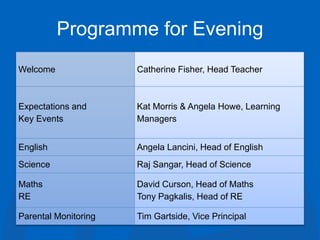
Programme for Evening
Welcome Catherine Fisher, Head Teacher
Expectations and
Key Events
Kat Morris & Angela Howe, Learning
Managers
English Angela Lancini, Head of English
Science Raj Sangar, Head of Science
Maths
RE
David Curson, Head of Maths
Tony Pagkalis, Head of RE
Parental Monitoring Tim Gartside, Vice Principal
Supporting Success Evening
Year 10
Learning Managers
Kat Morris and Angela Howe
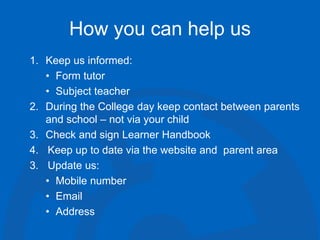
How you can help us
1. Keep us informed:
• Form tutor
• Subject teacher
2. During the College day keep contact between parents
and school – not via your child
3. Check and sign Learner Handbook
4. Keep up to date via the website and parent area
3. Update us:
• Mobile number
• Email
• Address
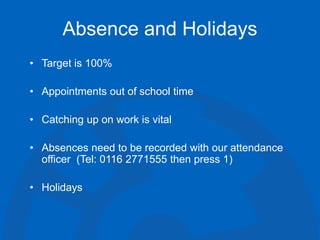
Absence and Holidays
• Target is 100%
• Appointments out of school time
• Catching up on work is vital
• Absences need to be recorded with our attendance
officer (Tel: 0116 2771555 then press 1)
• Holidays
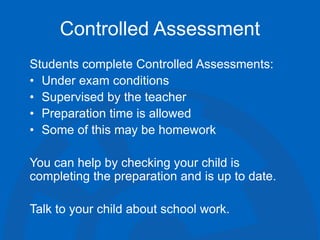
Controlled Assessment
Students complete Controlled Assessments:
• Under exam conditions
• Supervised by the teacher
• Preparation time is allowed
• Some of this may be homework
You can help by checking your child is
completing the preparation and is up to date.
Talk to your child about school work.
Monitoring Your Child’s Progress
You will get information for each subject:
• Target grade
• Current working at grade
• Projected grade
• Motivational score
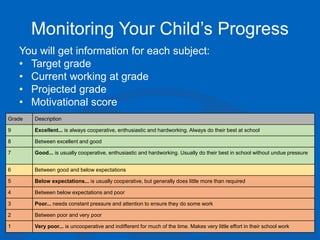
Grade Description
9 Excellent... is always cooperative, enthusiastic and hardworking. Always do their best at school
8 Between excellent and good
7 Good... is usually cooperative, enthusiastic and hardworking. Usually do their best in school without undue pressure
6 Between good and below expectations
5 Below expectations... is usually cooperative, but generally does little more than required
4 Between below expectations and poor
3 Poor... needs constant pressure and attention to ensure they do some work
2 Between poor and very poor
1 Very poor... is uncooperative and indifferent for much of the time. Makes very little effort in their school work
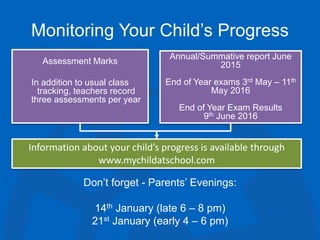
Monitoring Your Child’s Progress
Assessment Marks
In addition to usual class
tracking, teachers record
three assessments per year
Don’t forget - Parents’ Evenings:
14th January (late 6 – 8 pm)
21st January (early 4 – 6 pm)
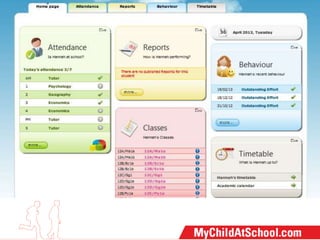
Information about your child’s progress is available through
www.mychildatschool.com
Annual/Summative report June
2015
End of Year exams 3rd May – 11th
May 2016
End of Year Exam Results
9th June 2016
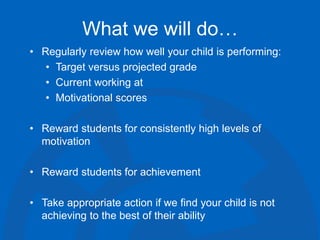
What we will do…
• Regularly review how well your child is performing:
• Target versus projected grade
• Current working at
• Motivational scores
• Reward students for consistently high levels of
motivation
• Reward students for achievement
• Take appropriate action if we find your child is not
achieving to the best of their ability
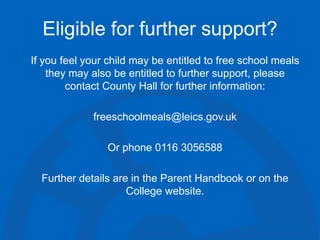
Eligible for further support?
If you feel your child may be entitled to free school meals
they may also be entitled to further support, please
contact County Hall for further information:
freeschoolmeals@leics.gov.uk
Or phone 0116 3056588
Further details are in the Parent Handbook or on the
College website.
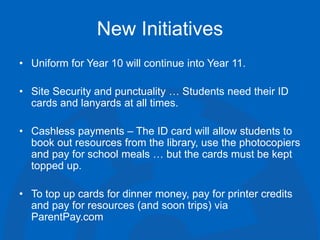
New Initiatives
• Uniform for Year 10 will continue into Year 11.
• Site Security and punctuality … Students need their ID
cards and lanyards at all times.
• Cashless payments – The ID card will allow students to
book out resources from the library, use the photocopiers
and pay for school meals … but the cards must be kept
topped up.
• To top up cards for dinner money, pay for printer credits
and pay for resources (and soon trips) via
ParentPay.com
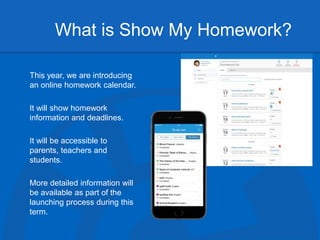
What is Show My Homework?
This year, we are introducing
an online homework calendar.
It will show homework
information and deadlines.
It will be accessible to
parents, teachers and
students.
More detailed information will
be available as part of the
launching process during this
term.
Benefits for
Students
• See all homework at
the click of a button
• Access to description
and resources
wherever they are
• A personalised
experience to help
stay organised
• Automatic notifications
to remind them in
advance
• Visibility on exactly what
homework has been set,
across subjects
• Easily take part in home
learning
• Direct engagement with
teachers
• Translation into 50+
languages
• Better communication
through school
announcements
Benefits for
Parents
VIVO Miles
This is the College Online Reward System
VIVOS are allocated for a variety of reasons
Students can access their VIVO account via the
web or the VIVO app
Students can choose from a range of rewards or to
donate to charity
Further Information
• Booklets – students will receive these during
their next tutorial and will be available online
for parents via the website
• The Learning Link - Fronter
• Tutor
• Key Stage 4 office
• Attendance officer (Victoria Wright)
• Exams officer (Janette Hare)
English in Year 10
WJEC Eduqas
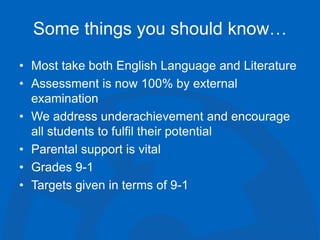
Some things you should know…
• Most take both English Language and Literature
• Assessment is now 100% by external
examination
• We address underachievement and encourage
all students to fulfil their potential
• Parental support is vital
• Grades 9-1
• Targets given in terms of 9-1
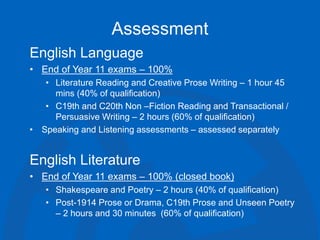
Assessment
English Language
• End of Year 11 exams – 100%
• Literature Reading and Creative Prose Writing – 1 hour 45
mins (40% of qualification)
• C19th and C20th Non –Fiction Reading and Transactional /
Persuasive Writing – 2 hours (60% of qualification)
• Speaking and Listening assessments – assessed separately
English Literature
• End of Year 11 exams – 100% (closed book)
• Shakespeare and Poetry – 2 hours (40% of qualification)
• Post-1914 Prose or Drama, C19th Prose and Unseen Poetry
– 2 hours and 30 minutes (60% of qualification)
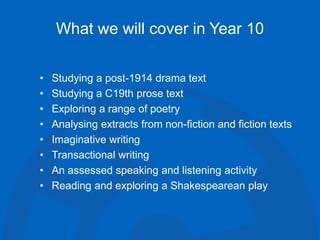
What we will cover in Year 10
• Studying a post-1914 drama text
• Studying a C19th prose text
• Exploring a range of poetry
• Analysing extracts from non-fiction and fiction texts
• Imaginative writing
• Transactional writing
• An assessed speaking and listening activity
• Reading and exploring a Shakespearean play
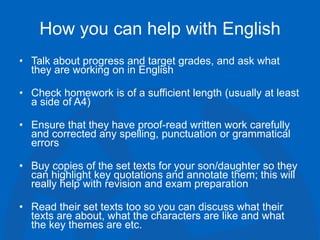
How you can help with English
• Talk about progress and target grades, and ask what
they are working on in English
• Check homework is of a sufficient length (usually at least
a side of A4)
• Ensure that they have proof-read written work carefully
and corrected any spelling, punctuation or grammatical
errors
• Buy copies of the set texts for your son/daughter so they
can highlight key quotations and annotate them; this will
really help with revision and exam preparation
• Read their set texts too so you can discuss what their
texts are about, what the characters are like and what
the key themes are etc.
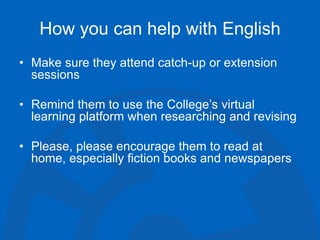
How you can help with English
• Make sure they attend catch-up or extension
sessions
• Remind them to use the College’s virtual
learning platform when researching and revising
• Please, please encourage them to read at
home, especially fiction books and newspapers
GCSE Maths
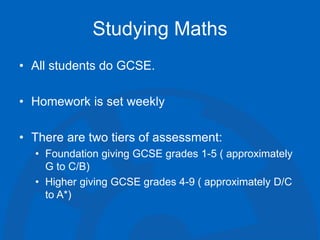
Studying Maths
• All students do GCSE.
• Homework is set weekly
• There are two tiers of assessment:
• Foundation giving GCSE grades 1-5 ( approximately
G to C/B)
• Higher giving GCSE grades 4-9 ( approximately D/C
to A*)
Maths Sets
• All students are put in sets using Key Stage
3 assessments and year 9 tests
• There are 5 or 6 sets
• Setting is reviewed regularly and set
changes happen after Key Assessment
points
GCSE Tiers and Targets
• We would expect :
• Sets 1 and 2: Higher Tier
• Sets 3 and 4: Higher or Foundation Tier
• Set 5: Foundation Tier
( Numbered “grades” apply from this year onwards in
English and Maths)
GCSE Maths Assessments
• GCSE Maths is assessed by 2 exams both at the end of Year 11
June 2017
• Top set students who excel, will do a GCSE in Further
Mathematics at the end of Year 11
• We use different exam boards depending on students ability and
needs
We offer:
• EDUQAS Higher to students likely to gain at least a B grade
• EDEXCEL Higher to students who are C/B borderline
• EDUQAS Foundation to students who are working towards a C
grade
Homework
• Pre-planned for the year, set weekly
• Advanced notice
• On Fronter and as a booklet
• Teachers will check that homework is
completed and provide answers
• Specific pieces of work will be marked in
greater detail
Resources to support learning and
revision
• Test Analysis
• Revision Guides and Work Books
• Specimen and past paper booklets
• Web Sites:
• www.mymaths.co.uk (User: countesthorpe, Password: triangle)
• BBC GCSE Bitesize
Resources to support learning and
revision
• Drop-in sessions run twice a week
throughout the year
• Every Tuesday and Thursday there are
Maths specialists to help with homework
/ topics covered that week
Success depends on
• Having the right equipment i.e. Scientific
calculator
• Students practising until they get it right
• At home, going over what they have done in
lessons
• Revising systematically
• Acting on feedback given by the teacher
Science GCSE
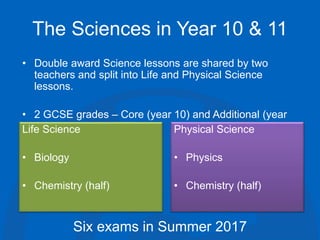
The Sciences in Year 10 & 11
• Double award Science lessons are shared by two
teachers and split into Life and Physical Science
lessons.
• 2 GCSE grades – Core (year 10) and Additional (year
11)Life Science
• Biology
• Chemistry (half)
Physical Science
• Physics
• Chemistry (half)
Six exams in Summer 2017
The Sciences in Year 10
• In Triple Science students are taught by three
teachers – separate Biology, Chemistry and
Physics.
• All exams are at the end of course in Year 11
• Triple Science 9 exams in summer 2017
• Double Science 6 exam in summer 2017
• Long term memory tested. There can be close to
80% of marks from memory in a paper!
• Papers at Foundation and Higher levels.
Assessment
• Assessed Investigative Skills Assessments
(ISAs) will take place during the two years
• Worth 25% and assessed by two written
exam papers
• Regular Testing and Mocks
• Support Sessions during or after-school
Support
• Key issue – retention of knowledge from
Years 10 and 11
• Drip feed revision in lessons
• Exam practice questions in lessons
• Revision Guide – bring into class and use
with the teacher
• Encourage independent study
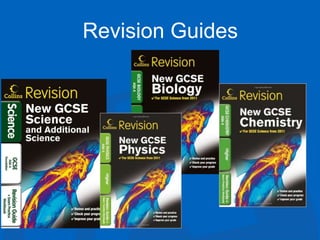
Revision Guides
Support
• Revision Guide
• Learning Link (Fronter) has links to other
sites
• Websites e.g. BBC Bitesize
• Past Paper practise
• Apps
• Mentor
• Interventions during or after-school
Religious Studies
GCSE
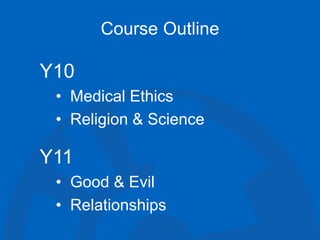
Course Outline
Y10
• Medical Ethics
• Religion & Science
Y11
• Good & Evil
• Relationships
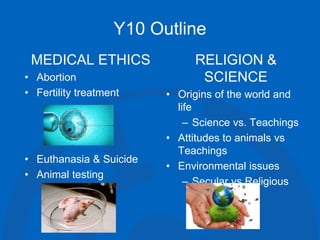
Y10 Outline
MEDICAL ETHICS
• Abortion
• Fertility treatment
• Euthanasia & Suicide
• Animal testing
RELIGION &
SCIENCE
• Origins of the world and
life
– Science vs. Teachings
• Attitudes to animals vs
Teachings
• Environmental issues
– Secular vs Religious
responses
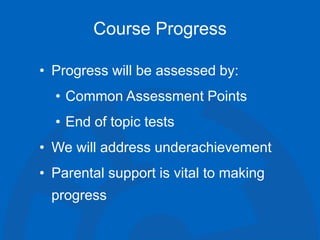
Course Progress
• Progress will be assessed by:
• Common Assessment Points
• End of topic tests
• We will address underachievement
• Parental support is vital to making
progress
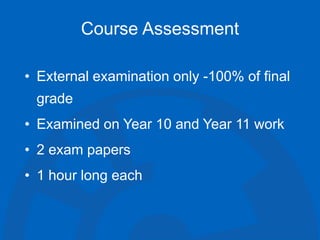
Course Assessment
• External examination only -100% of final
grade
• Examined on Year 10 and Year 11 work
• 2 exam papers
• 1 hour long each
How You Can Help - Homework
• Homework will involve research
• Ask your child what facts they have
discovered
• What have they found interesting
• Set them a challenge – say you would
like to know more about a particular
topic or issue
How You Can Help – Tests, Revision
• End of Topic tests/exams require revision
• Try to ensure your child is not simply reading their
existing notes
• Advise them to make revision cards and volunteer to
help them memorise the information
• Be a sounding board for them to explain an issue to
you
• Ask for more than one point of view and/or
evidence/examples
MyChildAtSchool.com
MyChildAtSchool.com
• Online way to share attendance,
behaviour and progress information to
parents.
• The website is live and shows lesson by
lesson attendance and punctuality.
• Through this password protected website
we provide parents with reports.
Year 10 Supporting Success Evening

Year 10 Supporting Success Evening

  • 1.
  • 2.
    Programme for Evening WelcomeCatherine Fisher, Head Teacher Expectations and Key Events Kat Morris & Angela Howe, Learning Managers English Angela Lancini, Head of English Science Raj Sangar, Head of Science Maths RE David Curson, Head of Maths Tony Pagkalis, Head of RE Parental Monitoring Tim Gartside, Vice Principal
  • 3.
    Supporting Success Evening Year10 Learning Managers Kat Morris and Angela Howe
  • 4.
    How you canhelp us 1. Keep us informed: • Form tutor • Subject teacher 2. During the College day keep contact between parents and school – not via your child 3. Check and sign Learner Handbook 4. Keep up to date via the website and parent area 3. Update us: • Mobile number • Email • Address
  • 5.
    Absence and Holidays •Target is 100% • Appointments out of school time • Catching up on work is vital • Absences need to be recorded with our attendance officer (Tel: 0116 2771555 then press 1) • Holidays
  • 6.
    Controlled Assessment Students completeControlled Assessments: • Under exam conditions • Supervised by the teacher • Preparation time is allowed • Some of this may be homework You can help by checking your child is completing the preparation and is up to date. Talk to your child about school work.
  • 7.
    Monitoring Your Child’sProgress You will get information for each subject: • Target grade • Current working at grade • Projected grade • Motivational score Grade Description 9 Excellent... is always cooperative, enthusiastic and hardworking. Always do their best at school 8 Between excellent and good 7 Good... is usually cooperative, enthusiastic and hardworking. Usually do their best in school without undue pressure 6 Between good and below expectations 5 Below expectations... is usually cooperative, but generally does little more than required 4 Between below expectations and poor 3 Poor... needs constant pressure and attention to ensure they do some work 2 Between poor and very poor 1 Very poor... is uncooperative and indifferent for much of the time. Makes very little effort in their school work
  • 8.
    Monitoring Your Child’sProgress Assessment Marks In addition to usual class tracking, teachers record three assessments per year Don’t forget - Parents’ Evenings: 14th January (late 6 – 8 pm) 21st January (early 4 – 6 pm) Information about your child’s progress is available through www.mychildatschool.com Annual/Summative report June 2015 End of Year exams 3rd May – 11th May 2016 End of Year Exam Results 9th June 2016
  • 9.
    What we willdo… • Regularly review how well your child is performing: • Target versus projected grade • Current working at • Motivational scores • Reward students for consistently high levels of motivation • Reward students for achievement • Take appropriate action if we find your child is not achieving to the best of their ability
  • 10.
    Eligible for furthersupport? If you feel your child may be entitled to free school meals they may also be entitled to further support, please contact County Hall for further information: freeschoolmeals@leics.gov.uk Or phone 0116 3056588 Further details are in the Parent Handbook or on the College website.
  • 11.
    New Initiatives • Uniformfor Year 10 will continue into Year 11. • Site Security and punctuality … Students need their ID cards and lanyards at all times. • Cashless payments – The ID card will allow students to book out resources from the library, use the photocopiers and pay for school meals … but the cards must be kept topped up. • To top up cards for dinner money, pay for printer credits and pay for resources (and soon trips) via ParentPay.com
  • 12.
    What is ShowMy Homework? This year, we are introducing an online homework calendar. It will show homework information and deadlines. It will be accessible to parents, teachers and students. More detailed information will be available as part of the launching process during this term.
  • 13.
    Benefits for Students • Seeall homework at the click of a button • Access to description and resources wherever they are • A personalised experience to help stay organised • Automatic notifications to remind them in advance • Visibility on exactly what homework has been set, across subjects • Easily take part in home learning • Direct engagement with teachers • Translation into 50+ languages • Better communication through school announcements Benefits for Parents
  • 14.
    VIVO Miles This isthe College Online Reward System VIVOS are allocated for a variety of reasons Students can access their VIVO account via the web or the VIVO app Students can choose from a range of rewards or to donate to charity
  • 15.
    Further Information • Booklets– students will receive these during their next tutorial and will be available online for parents via the website • The Learning Link - Fronter • Tutor • Key Stage 4 office • Attendance officer (Victoria Wright) • Exams officer (Janette Hare)
  • 16.
    English in Year10 WJEC Eduqas
  • 17.
    Some things youshould know… • Most take both English Language and Literature • Assessment is now 100% by external examination • We address underachievement and encourage all students to fulfil their potential • Parental support is vital • Grades 9-1 • Targets given in terms of 9-1
  • 18.
    Assessment English Language • Endof Year 11 exams – 100% • Literature Reading and Creative Prose Writing – 1 hour 45 mins (40% of qualification) • C19th and C20th Non –Fiction Reading and Transactional / Persuasive Writing – 2 hours (60% of qualification) • Speaking and Listening assessments – assessed separately English Literature • End of Year 11 exams – 100% (closed book) • Shakespeare and Poetry – 2 hours (40% of qualification) • Post-1914 Prose or Drama, C19th Prose and Unseen Poetry – 2 hours and 30 minutes (60% of qualification)
  • 19.
    What we willcover in Year 10 • Studying a post-1914 drama text • Studying a C19th prose text • Exploring a range of poetry • Analysing extracts from non-fiction and fiction texts • Imaginative writing • Transactional writing • An assessed speaking and listening activity • Reading and exploring a Shakespearean play
  • 20.
    How you canhelp with English • Talk about progress and target grades, and ask what they are working on in English • Check homework is of a sufficient length (usually at least a side of A4) • Ensure that they have proof-read written work carefully and corrected any spelling, punctuation or grammatical errors • Buy copies of the set texts for your son/daughter so they can highlight key quotations and annotate them; this will really help with revision and exam preparation • Read their set texts too so you can discuss what their texts are about, what the characters are like and what the key themes are etc.
  • 21.
    How you canhelp with English • Make sure they attend catch-up or extension sessions • Remind them to use the College’s virtual learning platform when researching and revising • Please, please encourage them to read at home, especially fiction books and newspapers
  • 22.
  • 23.
    Studying Maths • Allstudents do GCSE. • Homework is set weekly • There are two tiers of assessment: • Foundation giving GCSE grades 1-5 ( approximately G to C/B) • Higher giving GCSE grades 4-9 ( approximately D/C to A*)
  • 24.
    Maths Sets • Allstudents are put in sets using Key Stage 3 assessments and year 9 tests • There are 5 or 6 sets • Setting is reviewed regularly and set changes happen after Key Assessment points
  • 25.
    GCSE Tiers andTargets • We would expect : • Sets 1 and 2: Higher Tier • Sets 3 and 4: Higher or Foundation Tier • Set 5: Foundation Tier ( Numbered “grades” apply from this year onwards in English and Maths)
  • 26.
    GCSE Maths Assessments •GCSE Maths is assessed by 2 exams both at the end of Year 11 June 2017 • Top set students who excel, will do a GCSE in Further Mathematics at the end of Year 11 • We use different exam boards depending on students ability and needs We offer: • EDUQAS Higher to students likely to gain at least a B grade • EDEXCEL Higher to students who are C/B borderline • EDUQAS Foundation to students who are working towards a C grade
  • 27.
    Homework • Pre-planned forthe year, set weekly • Advanced notice • On Fronter and as a booklet • Teachers will check that homework is completed and provide answers • Specific pieces of work will be marked in greater detail
  • 28.
    Resources to supportlearning and revision • Test Analysis • Revision Guides and Work Books • Specimen and past paper booklets • Web Sites: • www.mymaths.co.uk (User: countesthorpe, Password: triangle) • BBC GCSE Bitesize
  • 29.
    Resources to supportlearning and revision • Drop-in sessions run twice a week throughout the year • Every Tuesday and Thursday there are Maths specialists to help with homework / topics covered that week
  • 30.
    Success depends on •Having the right equipment i.e. Scientific calculator • Students practising until they get it right • At home, going over what they have done in lessons • Revising systematically • Acting on feedback given by the teacher
  • 31.
  • 32.
    The Sciences inYear 10 & 11 • Double award Science lessons are shared by two teachers and split into Life and Physical Science lessons. • 2 GCSE grades – Core (year 10) and Additional (year 11)Life Science • Biology • Chemistry (half) Physical Science • Physics • Chemistry (half) Six exams in Summer 2017
  • 33.
    The Sciences inYear 10 • In Triple Science students are taught by three teachers – separate Biology, Chemistry and Physics. • All exams are at the end of course in Year 11 • Triple Science 9 exams in summer 2017 • Double Science 6 exam in summer 2017 • Long term memory tested. There can be close to 80% of marks from memory in a paper! • Papers at Foundation and Higher levels.
  • 34.
    Assessment • Assessed InvestigativeSkills Assessments (ISAs) will take place during the two years • Worth 25% and assessed by two written exam papers • Regular Testing and Mocks • Support Sessions during or after-school
  • 35.
    Support • Key issue– retention of knowledge from Years 10 and 11 • Drip feed revision in lessons • Exam practice questions in lessons • Revision Guide – bring into class and use with the teacher • Encourage independent study
  • 36.
  • 37.
    Support • Revision Guide •Learning Link (Fronter) has links to other sites • Websites e.g. BBC Bitesize • Past Paper practise • Apps • Mentor • Interventions during or after-school
  • 38.
  • 39.
    Course Outline Y10 • MedicalEthics • Religion & Science Y11 • Good & Evil • Relationships
  • 40.
    Y10 Outline MEDICAL ETHICS •Abortion • Fertility treatment • Euthanasia & Suicide • Animal testing RELIGION & SCIENCE • Origins of the world and life – Science vs. Teachings • Attitudes to animals vs Teachings • Environmental issues – Secular vs Religious responses
  • 41.
    Course Progress • Progresswill be assessed by: • Common Assessment Points • End of topic tests • We will address underachievement • Parental support is vital to making progress
  • 42.
    Course Assessment • Externalexamination only -100% of final grade • Examined on Year 10 and Year 11 work • 2 exam papers • 1 hour long each
  • 43.
    How You CanHelp - Homework • Homework will involve research • Ask your child what facts they have discovered • What have they found interesting • Set them a challenge – say you would like to know more about a particular topic or issue
  • 44.
    How You CanHelp – Tests, Revision • End of Topic tests/exams require revision • Try to ensure your child is not simply reading their existing notes • Advise them to make revision cards and volunteer to help them memorise the information • Be a sounding board for them to explain an issue to you • Ask for more than one point of view and/or evidence/examples
  • 45.
  • 46.
    MyChildAtSchool.com • Online wayto share attendance, behaviour and progress information to parents. • The website is live and shows lesson by lesson attendance and punctuality. • Through this password protected website we provide parents with reports.