Supporting Success
Year 11 Learning Managers
11A Amanda Rashleigh
11M Matt Page
Pastoral Support
• Tutor
• Learning Manager
• Key Stage 4 Co-ordinator
• Assistant Headteacher – Guy Whitehead
• Inclusion Mentor
• Learning Mentor
• All can be contacted via the Key Stage 4 office
Assessment Data
• 5 data inputs will take place over the next 9
months
• Subject teachers will record this information
which will then be used by the mentors in their
meetings with their mentees
• It will be available via the
MyChildAtSchool.com after each input in:
October, November, January, February and
April
• An online report will be produced in June 2014
Monitoring Students
• Assessment data collected monthly and available
to parents via learning link or email
• Our post 16 Open Evening 7th November 2013
• Other Open days/evenings will be publicised for
students
• Parents’ Evening (6-8pm) 28th November 2013
• Parents’ Evening (4-6pm) 5th December 2013
• Applications for 16+/FE will be out in December
• Mocks begin 9th December 2013
• Interviews for 16+ January 2014
• Mock results day - Tuesday 21st January 2014
Controlled Assessment
• Has replaced coursework
• Independent study skills are central to success
• Booklets are on the website for Parents and
students will be given their own copy in tutorial
• The Heads of Department for each of the Core
subjects will speak to you to give you more detail
• Deadlines are different for every subject - the key
thing is that deadlines must be met
Assertive Mentoring
• Every Year 11 student has an assertive
mentor who will discuss each round of data
with your child
• Monthly meetings will be held to discuss
their progress
• Targets will be set and intervention used if
necessary to ensure students achieve their
target grades, which will be recorded on
p.176 of their planners
Examinations
• The examinations officer – Eleanor Gregory telephone 0116 277
1555 or e-mail on egregory@countesthorpe.cc
• GCSE entries will be finalised by departments in March, when
tiers are decided (if appropriate)
• Examination entry statements will be given to students before
the Easter holidays and individual seating plans after Easter
holidays
• Please read the exams policy which is on our website
• Parents and students can contact Eleanor directly if there are
any inaccuracies or queries
• Queries about re-sits should be directed to the Head of
Department in the first instance
Exams
• The official start of the summer examination
period is Monday 12th May 2014 but practical
exams will be taking place before this date in
Music, Drama, Art, Languages and PE
• Those involved will be given exam slips
• Results will be available to students on:
Thursday 21st August 2014
Good Habits
• Planners – please ensure your child is using it and
you are checking it and signing it
• Equipment – this will be checked by tutors and
students are aware of the requirements
• Attendance – please ensure any absence is
reported to our attendance officer at the earliest
opportunity, texts will be sent for absences
• Details – please ensure details are updated
especially emergency contact numbers
English in Year 11
In English …
• Most students take both English Language
and English Literature. Some excellent
results already
• Assessment is by Controlled Assessment and
external examination
• Intervention is used to address
underachievement
• Parental support is vital
Year 11 Controlled Assessments
All written controlled assessments are done.
There’s just one Speaking and Listening left:
• December 2013 Topical Discussion
In Year 11 we will also look to re-do any assessments
that are under target grades
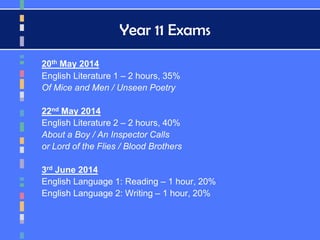
Year 11 Exams
20th May 2014
English Literature 1 – 2 hours, 35%
Of Mice and Men / Unseen Poetry
22nd May 2014
English Literature 2 – 2 hours, 40%
About a Boy / An Inspector Calls
or Lord of the Flies / Blood Brothers
3rd June 2014
English Language 1: Reading – 1 hour, 20%
English Language 2: Writing – 1 hour, 20%
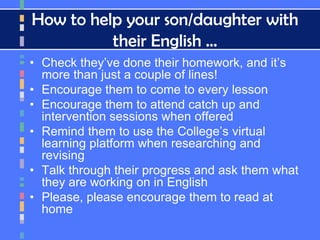
How to help your son/daughter with
their English …
• Check they’ve done their homework, and it’s
more than just a couple of lines!
• Encourage them to come to every lesson
• Encourage them to attend catch up and
intervention sessions when offered
• Remind them to use the College’s virtual
learning platform when researching and
revising
• Talk through their progress and ask them what
they are working on in English
• Please, please encourage them to read at
home
Countesthorpe College
GCSE Maths in Year 11
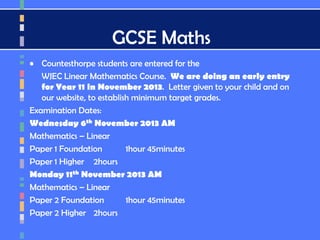
GCSE Maths
• Countesthorpe students are entered for the
WJEC Linear Mathematics Course. We are doing an early entry
for Year 11 in November 2013. Letter given to your child and on
our website, to establish minimum target grades.
Examination Dates:
Wednesday 6th November 2013 AM
Mathematics – Linear
Paper 1 Foundation 1hour 45minutes
Paper 1 Higher 2hours
Monday 11th November 2013 AM
Mathematics – Linear
Paper 2 Foundation 1hour 45minutes
Paper 2 Higher 2hours
GCSE Maths
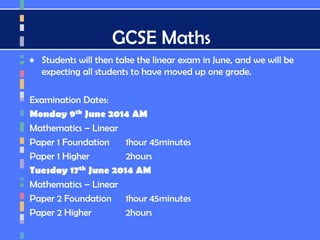
• Students will then take the linear exam in June, and we will be
expecting all students to have moved up one grade.
Examination Dates:
Monday 9th June 2014 AM
Mathematics – Linear
Paper 1 Foundation 1hour 45minutes
Paper 1 Higher 2hours
Tuesday 17th June 2014 AM
Mathematics – Linear
Paper 2 Foundation 1hour 45minutes
Paper 2 Higher 2hours
GCSE Further Maths
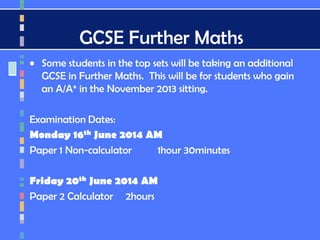
• Some students in the top sets will be taking an additional
GCSE in Further Maths. This will be for students who gain
an A/A* in the November 2013 sitting.
Examination Dates:
Monday 16th June 2014 AM
Paper 1 Non-calculator 1hour 30minutes
Friday 20th June 2014 AM
Paper 2 Calculator 2hours
Studying Maths
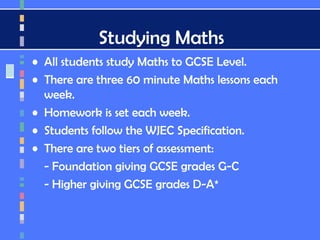
• All students study Maths to GCSE Level.
• There are three 60 minute Maths lessons each
week.
• Homework is set each week.
• Students follow the WJEC Specification.
• There are two tiers of assessment:
- Foundation giving GCSE grades G-C
- Higher giving GCSE grades D-A*
How Students Excel
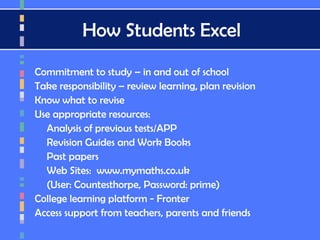
Commitment to study – in and out of school
Take responsibility – review learning, plan revision
Know what to revise
Use appropriate resources:
Analysis of previous tests/APP
Revision Guides and Work Books
Past papers
Web Sites: www.mymaths.co.uk
(User: Countesthorpe, Password: prime)
College learning platform - Fronter
Access support from teachers, parents and friends
Homework
• Homework is a compulsory element of our
courses and is set weekly.
• We have pre-prepared weekly homeworks
following our scheme of work. Homeworks are
accessed from Fronter and are also available
as a printed booklet.
Teachers will check that homework is
completed, provide answers and mark some
work in detail.
We will encourage and support all
students to achieve their best
• Most students do well through full participation in
their weekly lessons.
• We identify students who are underachieving and
intervene to boost their performance. This is
particularly the case for those on the D/C borderline.
• We also look out for rapid improvements where
target grades were less than D and want to be
better.
• As the final exam approaches we will provide
additional revision opportunities.
Intervention Strategies
• Provide every student with a set of revision booklets and topics
to revise.
• Use mock exam results and analysis to identify students likely to
underachieve and provide additional support in the run up to
exams.
• A target group will be identified and provided with additional
support in preparation for the final exam in June.
• Mathematics Clinics after school twice a week.
SCIENCE
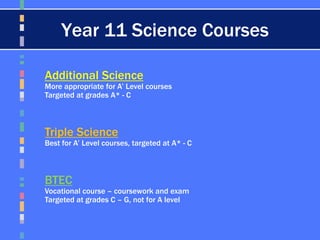
Year 11 Science Courses
Additional Science
More appropriate for A’ Level courses
Targeted at grades A* - C
Triple Science
Best for A’ Level courses, targeted at A* - C
BTEC
Vocational course – coursework and exam
Targeted at grades C – G, not for A level
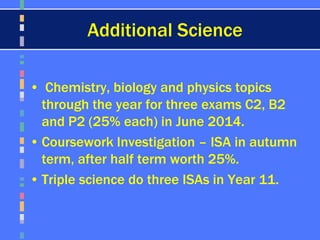
Additional Science
• Chemistry, biology and physics topics
through the year for three exams C2, B2
and P2 (25% each) in June 2014.
• Coursework Investigation – ISA in autumn
term, after half term worth 25%.
• Triple science do three ISAs in Year 11.
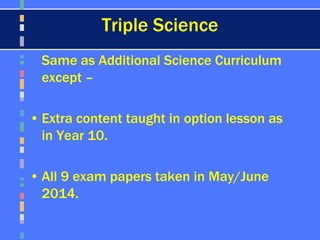
Triple Science
Same as Additional Science Curriculum
except –
• Extra content taught in option lesson as
in Year 10.
• All 9 exam papers taken in May/June
2014.
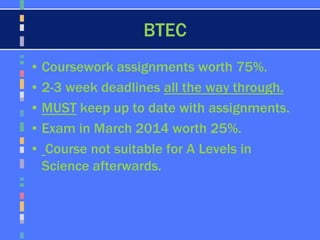
BTEC
• Coursework assignments worth 75%.
• 2-3 week deadlines all the way through.
• MUST keep up to date with assignments.
• Exam in March 2014 worth 25%.
• Course not suitable for A Levels in
Science afterwards.
Support
• Tuesday and Thursday P.A.S.S. Sessions
(Pupil After School Support).
• Revision Guides
• Learning Link
• Websites e.g. BBC Bitesize (links in
Fronter VLE)
• Past Papers for practise.
ACHIEVING SUCCESS DESIGN TECHNOLOGY YEAR 11
For either AQA GCSE Resistant Materials, Graphic Products,
Textiles or Food.
HOW IS IT STRUCTURED?
The course is assessed as 2 units:
Unit 1: Subject knowledge acquired from introductory projects
and independent research. Worth 40%
 2 hour exam paper in May or June
Research and revision around a theme / topic which they will be
given in March 2014
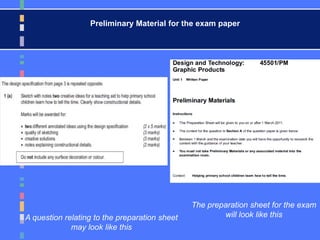
A question relating to the preparation sheet
may look like this
The preparation sheet for the exam
will look like this
Preliminary Material for the exam paper
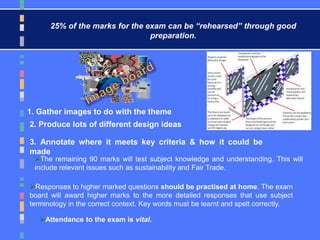
25% of the marks for the exam can be “rehearsed” through good
preparation.
The remaining 90 marks will test subject knowledge and understanding. This will
include relevant issues such as sustainability and Fair Trade.
Responses to higher marked questions should be practised at home. The exam
board will award higher marks to the more detailed responses that use subject
terminology in the correct context. Key words must be learnt and spelt correctly.
Attendance to the exam is vital.
1. Gather images to do with the theme
2. Produce lots of different design ideas
3. Annotate where it meets key criteria & how it could be
made
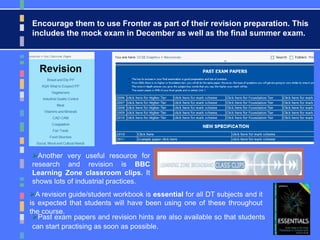
Another very useful resource for
research and revision is BBC
Learning Zone classroom clips. It
shows lots of industrial practices.
Past exam papers and revision hints are also available so that students
can start practising as soon as possible.
Encourage them to use Fronter as part of their revision preparation. This
includes the mock exam in December as well as the final summer exam.
A revision guide/student workbook is essential for all DT subjects and it
is expected that students will have been using one of these throughout
the course.
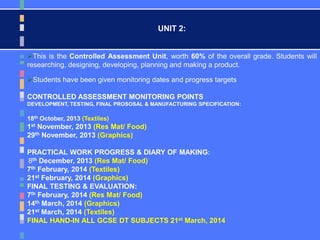
UNIT 2:
This is the Controlled Assessment Unit, worth 60% of the overall grade. Students will
researching, designing, developing, planning and making a product.
Students have been given monitoring dates and progress targets
CONTROLLED ASSESSMENT MONITORING POINTS
DEVELOPMENT, TESTING, FINAL PROSOSAL & MANUFACTURING SPECIFICATION:
18th October, 2013 (Textiles)
1st November, 2013 (Res Mat/ Food)
29th November, 2013 (Graphics)
PRACTICAL WORK PROGRESS & DIARY OF MAKING:
8th December, 2013 (Res Mat/ Food)
7th February, 2014 (Textiles)
21st February, 2014 (Graphics)
FINAL TESTING & EVALUATION:
7th February, 2014 (Res Mat/ Food)
14th March, 2014 (Graphics)
21st March, 2014 (Textiles)
FINAL HAND-IN ALL GCSE DT SUBJECTS 21st March, 2014
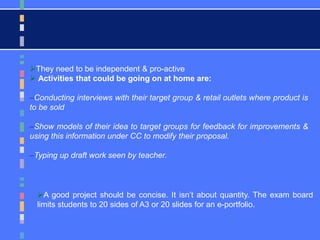
A good project should be concise. It isn’t about quantity. The exam board
limits students to 20 sides of A3 or 20 slides for an e-portfolio.
They need to be independent & pro-active
 Activities that could be going on at home are:
Conducting interviews with their target group & retail outlets where product is
to be sold
Show models of their idea to target groups for feedback for improvements &
using this information under CC to modify their proposal.
Typing up draft work seen by teacher.
HOW CAN YOU HELP SUPPORT YOUR SON/ DAUGHTER?
Check planners for equipment or materials needed….especially Textiles and Food.
Textiles: Purchase the fabric to make their product & bring into College next week
 Attend support sessions on Tuesdays and Thursdays when late buses run.
Meet Controlled Assessment deadline, needs to be signed off by 21st March 2014)
Research work using the library or the Internet can be
undertaken outside of College. However, this must be used for
reference only and should not be submitted in its entirety as part
of the project.
Folders must remain in College and any major practical work
has to be carried out under supervision in class time or during an
after school session. The only practical work that may be
done at home are adding embellishments.
ADDITIONAL STUDY SESSIONS
Additional sessions are arranged with students as required.
These take place mainly on Tuesdays and Thursdays. Students
should speak directly to their subject teacher.
DT23 (Graphics) is available every lunchtime for students to
complete folder tasks or type up their work.
REVISION GUIDES AND
STUDENT WORK BOOKS:
Letts and Lonsdale series:
Students have had letters to
order these already.
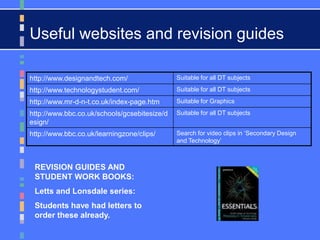
http://www.designandtech.com/ Suitable for all DT subjects
http://www.technologystudent.com/ Suitable for all DT subjects
http://www.mr-d-n-t.co.uk/index-page.htm Suitable for Graphics
http://www.bbc.co.uk/schools/gcsebitesize/d
esign/
Suitable for all DT subjects
http://www.bbc.co.uk/learningzone/clips/ Search for video clips in ‘Secondary Design
and Technology’
Useful websites and revision guides
BTEC LEVEL 2 ENGINEERING
BTEC Engineering consists of 4 units.
Students have already completed 2 units for this course and are well
on track.
No formal examination. All internally assessed and verified.
Qualification is equivalent to 2 GCSE’s A*-C and it is graded as Pass,
Merit, Distinction or Distinction plus (P,M or D).
THE UNITS & STRUCTURE OF THE COURSE
Students do 4 units, two as separate units and two inter-linked.
Evidence will be reports, slide shows, verbal and electronic presentations,
photographs and teacher observations
UNIT 19: Electronic Circuit Construction (24 weeks)
Making an amplifier, design circuits and soldering. The cover for the amplifier will
have been designed for unit 2 using TechSoft 2D Design.
UNIT 10: Using Computer Aided Drawing Techniques in Engineering
(24 weeks)
A prototype will be produced using the CNC milling machine from a CAD drawing.
Units to complete….
HOW CAN YOU HELP SUPPORT YOUR SON/ DAUGHTER?
The use of FRONTER is essential. All
assignments, including homework tasks, are
submitted electronically
Check assignment feedback on Fronter. Feedback
on assignments is given electronically. To improve
to the next grade, all assignments must be at
that level.
Download Google Sketch-up. This will enable
them to practice for unit 10 to do CAD drawings.
GCSE Humanities
AQA 4070
Expectations and Course Content
Maggie Devine
Head of Humanities
GCSE Humanities Course
The topics are:
• 1. Culture and Beliefs (Paper 1-Year 11)
• 2. Environmental Issues (Paper 1 – Year 11)
• 3. Prejudice and Persecution (Paper 2 –Year 11)
• 4. Global Inequality (Paper 2 – Year 11)
Unit 2 – Year 11
Prejudice and
Persecution
 Causes
• Types
• Case Studies
• Evaluation of strategies used to
prevent prejudice and
discrimination
Global Inequality
• How to identify it
• Causes
• Impact on MEDCs and LEDCs
• Addressing the issues
• Aid agencies and their
contributions
Scheme of Assessment
There are 2 exam papers:
• Paper 1: 1 hr 15 mins. Culture & Beliefs/
Environmental Issues.
• Source Booklets will be released to
candidates.
• Paper 2: 1 hr 15 mins. Global Inequality/
Prejudice & Persecution.
• Controlled Assessment – Year 11
Autumn/Spring Term
Preparation GCSE Humanities Exam
• A source book to accompany the exam will be
issued
• Revision Booklets will be available for a small cost
• Practice exam questions 2 to 12 marks
• Timed exam questions.
Year 11 Controlled Assessment
• Worth 25%
• 2000 words
• Investigation and planning 8-12 hours
• Final presentation, students work independently, under
formal supervision for 3-4 hours (exam conditions).
• May take research materials but not a plan into the
formal supervised sessions. This must be submitted to the
exam board.
• Focus question will change every year – “Globalisation and
interdependence between countries can cause more
challenges than benefits.” Do you agree?
Preparation for Controlled
Assessment
• Regular research tasks to develop skills
required for Controlled Assessment.
• Encouragement of students to accept
responsibility for own learning.
• Access to research facilities as part of
Humanities lessons; to be followed up at
home.
• Practise ‘Controlled Assessment’ skills.
• Maintain a bibliography.
Why study Humanities?
• Develops understanding of social, political, religious and moral issues.
• Develops communication and lifelong skills.
• Allows you to consider issues from different perspectives
• Develops academic skills across a range of school disciplines eg History,
Geography, Sociology
• Develops knowledge of current affairs.

• Interesting and thought-provoking subject.
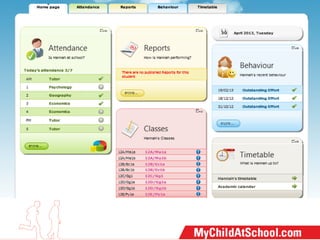
MyChildAtSchool.com
• Online way to share attendance, behaviour
and progress information to parents.
• The website is live and shows lesson by lesson
attendance and punctuality.
• Through this password protected website we
provide parents with reports.
• Parents were sent usernames and passwords in
June.
Year 11 Supporting Success 2013-14 Presentation

Year 11 Supporting Success 2013-14 Presentation

  • 1.
    Supporting Success Year 11Learning Managers 11A Amanda Rashleigh 11M Matt Page
  • 2.
    Pastoral Support • Tutor •Learning Manager • Key Stage 4 Co-ordinator • Assistant Headteacher – Guy Whitehead • Inclusion Mentor • Learning Mentor • All can be contacted via the Key Stage 4 office
  • 3.
    Assessment Data • 5data inputs will take place over the next 9 months • Subject teachers will record this information which will then be used by the mentors in their meetings with their mentees • It will be available via the MyChildAtSchool.com after each input in: October, November, January, February and April • An online report will be produced in June 2014
  • 4.
    Monitoring Students • Assessmentdata collected monthly and available to parents via learning link or email • Our post 16 Open Evening 7th November 2013 • Other Open days/evenings will be publicised for students • Parents’ Evening (6-8pm) 28th November 2013 • Parents’ Evening (4-6pm) 5th December 2013 • Applications for 16+/FE will be out in December • Mocks begin 9th December 2013 • Interviews for 16+ January 2014 • Mock results day - Tuesday 21st January 2014
  • 5.
    Controlled Assessment • Hasreplaced coursework • Independent study skills are central to success • Booklets are on the website for Parents and students will be given their own copy in tutorial • The Heads of Department for each of the Core subjects will speak to you to give you more detail • Deadlines are different for every subject - the key thing is that deadlines must be met
  • 6.
    Assertive Mentoring • EveryYear 11 student has an assertive mentor who will discuss each round of data with your child • Monthly meetings will be held to discuss their progress • Targets will be set and intervention used if necessary to ensure students achieve their target grades, which will be recorded on p.176 of their planners
  • 7.
    Examinations • The examinationsofficer – Eleanor Gregory telephone 0116 277 1555 or e-mail on egregory@countesthorpe.cc • GCSE entries will be finalised by departments in March, when tiers are decided (if appropriate) • Examination entry statements will be given to students before the Easter holidays and individual seating plans after Easter holidays • Please read the exams policy which is on our website • Parents and students can contact Eleanor directly if there are any inaccuracies or queries • Queries about re-sits should be directed to the Head of Department in the first instance
  • 8.
    Exams • The officialstart of the summer examination period is Monday 12th May 2014 but practical exams will be taking place before this date in Music, Drama, Art, Languages and PE • Those involved will be given exam slips • Results will be available to students on: Thursday 21st August 2014
  • 9.
    Good Habits • Planners– please ensure your child is using it and you are checking it and signing it • Equipment – this will be checked by tutors and students are aware of the requirements • Attendance – please ensure any absence is reported to our attendance officer at the earliest opportunity, texts will be sent for absences • Details – please ensure details are updated especially emergency contact numbers
  • 10.
  • 11.
    In English … •Most students take both English Language and English Literature. Some excellent results already • Assessment is by Controlled Assessment and external examination • Intervention is used to address underachievement • Parental support is vital
  • 12.
    Year 11 ControlledAssessments All written controlled assessments are done. There’s just one Speaking and Listening left: • December 2013 Topical Discussion In Year 11 we will also look to re-do any assessments that are under target grades
  • 13.
    Year 11 Exams 20thMay 2014 English Literature 1 – 2 hours, 35% Of Mice and Men / Unseen Poetry 22nd May 2014 English Literature 2 – 2 hours, 40% About a Boy / An Inspector Calls or Lord of the Flies / Blood Brothers 3rd June 2014 English Language 1: Reading – 1 hour, 20% English Language 2: Writing – 1 hour, 20%
  • 14.
    How to helpyour son/daughter with their English … • Check they’ve done their homework, and it’s more than just a couple of lines! • Encourage them to come to every lesson • Encourage them to attend catch up and intervention sessions when offered • Remind them to use the College’s virtual learning platform when researching and revising • Talk through their progress and ask them what they are working on in English • Please, please encourage them to read at home
  • 15.
  • 16.
    GCSE Maths • Countesthorpestudents are entered for the WJEC Linear Mathematics Course. We are doing an early entry for Year 11 in November 2013. Letter given to your child and on our website, to establish minimum target grades. Examination Dates: Wednesday 6th November 2013 AM Mathematics – Linear Paper 1 Foundation 1hour 45minutes Paper 1 Higher 2hours Monday 11th November 2013 AM Mathematics – Linear Paper 2 Foundation 1hour 45minutes Paper 2 Higher 2hours
  • 17.
    GCSE Maths • Studentswill then take the linear exam in June, and we will be expecting all students to have moved up one grade. Examination Dates: Monday 9th June 2014 AM Mathematics – Linear Paper 1 Foundation 1hour 45minutes Paper 1 Higher 2hours Tuesday 17th June 2014 AM Mathematics – Linear Paper 2 Foundation 1hour 45minutes Paper 2 Higher 2hours
  • 18.
    GCSE Further Maths •Some students in the top sets will be taking an additional GCSE in Further Maths. This will be for students who gain an A/A* in the November 2013 sitting. Examination Dates: Monday 16th June 2014 AM Paper 1 Non-calculator 1hour 30minutes Friday 20th June 2014 AM Paper 2 Calculator 2hours
  • 19.
    Studying Maths • Allstudents study Maths to GCSE Level. • There are three 60 minute Maths lessons each week. • Homework is set each week. • Students follow the WJEC Specification. • There are two tiers of assessment: - Foundation giving GCSE grades G-C - Higher giving GCSE grades D-A*
  • 20.
    How Students Excel Commitmentto study – in and out of school Take responsibility – review learning, plan revision Know what to revise Use appropriate resources: Analysis of previous tests/APP Revision Guides and Work Books Past papers Web Sites: www.mymaths.co.uk (User: Countesthorpe, Password: prime) College learning platform - Fronter Access support from teachers, parents and friends
  • 21.
    Homework • Homework isa compulsory element of our courses and is set weekly. • We have pre-prepared weekly homeworks following our scheme of work. Homeworks are accessed from Fronter and are also available as a printed booklet. Teachers will check that homework is completed, provide answers and mark some work in detail.
  • 22.
    We will encourageand support all students to achieve their best • Most students do well through full participation in their weekly lessons. • We identify students who are underachieving and intervene to boost their performance. This is particularly the case for those on the D/C borderline. • We also look out for rapid improvements where target grades were less than D and want to be better. • As the final exam approaches we will provide additional revision opportunities.
  • 23.
    Intervention Strategies • Provideevery student with a set of revision booklets and topics to revise. • Use mock exam results and analysis to identify students likely to underachieve and provide additional support in the run up to exams. • A target group will be identified and provided with additional support in preparation for the final exam in June. • Mathematics Clinics after school twice a week.
  • 24.
  • 25.
    Year 11 ScienceCourses Additional Science More appropriate for A’ Level courses Targeted at grades A* - C Triple Science Best for A’ Level courses, targeted at A* - C BTEC Vocational course – coursework and exam Targeted at grades C – G, not for A level
  • 26.
    Additional Science • Chemistry,biology and physics topics through the year for three exams C2, B2 and P2 (25% each) in June 2014. • Coursework Investigation – ISA in autumn term, after half term worth 25%. • Triple science do three ISAs in Year 11.
  • 27.
    Triple Science Same asAdditional Science Curriculum except – • Extra content taught in option lesson as in Year 10. • All 9 exam papers taken in May/June 2014.
  • 28.
    BTEC • Coursework assignmentsworth 75%. • 2-3 week deadlines all the way through. • MUST keep up to date with assignments. • Exam in March 2014 worth 25%. • Course not suitable for A Levels in Science afterwards.
  • 29.
    Support • Tuesday andThursday P.A.S.S. Sessions (Pupil After School Support). • Revision Guides • Learning Link • Websites e.g. BBC Bitesize (links in Fronter VLE) • Past Papers for practise.
  • 30.
    ACHIEVING SUCCESS DESIGNTECHNOLOGY YEAR 11 For either AQA GCSE Resistant Materials, Graphic Products, Textiles or Food. HOW IS IT STRUCTURED? The course is assessed as 2 units: Unit 1: Subject knowledge acquired from introductory projects and independent research. Worth 40%  2 hour exam paper in May or June Research and revision around a theme / topic which they will be given in March 2014
  • 31.
    A question relatingto the preparation sheet may look like this The preparation sheet for the exam will look like this Preliminary Material for the exam paper
  • 32.
    25% of themarks for the exam can be “rehearsed” through good preparation. The remaining 90 marks will test subject knowledge and understanding. This will include relevant issues such as sustainability and Fair Trade. Responses to higher marked questions should be practised at home. The exam board will award higher marks to the more detailed responses that use subject terminology in the correct context. Key words must be learnt and spelt correctly. Attendance to the exam is vital. 1. Gather images to do with the theme 2. Produce lots of different design ideas 3. Annotate where it meets key criteria & how it could be made
  • 33.
    Another very usefulresource for research and revision is BBC Learning Zone classroom clips. It shows lots of industrial practices. Past exam papers and revision hints are also available so that students can start practising as soon as possible. Encourage them to use Fronter as part of their revision preparation. This includes the mock exam in December as well as the final summer exam. A revision guide/student workbook is essential for all DT subjects and it is expected that students will have been using one of these throughout the course.
  • 34.
    UNIT 2: This isthe Controlled Assessment Unit, worth 60% of the overall grade. Students will researching, designing, developing, planning and making a product. Students have been given monitoring dates and progress targets CONTROLLED ASSESSMENT MONITORING POINTS DEVELOPMENT, TESTING, FINAL PROSOSAL & MANUFACTURING SPECIFICATION: 18th October, 2013 (Textiles) 1st November, 2013 (Res Mat/ Food) 29th November, 2013 (Graphics) PRACTICAL WORK PROGRESS & DIARY OF MAKING: 8th December, 2013 (Res Mat/ Food) 7th February, 2014 (Textiles) 21st February, 2014 (Graphics) FINAL TESTING & EVALUATION: 7th February, 2014 (Res Mat/ Food) 14th March, 2014 (Graphics) 21st March, 2014 (Textiles) FINAL HAND-IN ALL GCSE DT SUBJECTS 21st March, 2014
  • 35.
    A good projectshould be concise. It isn’t about quantity. The exam board limits students to 20 sides of A3 or 20 slides for an e-portfolio. They need to be independent & pro-active  Activities that could be going on at home are: Conducting interviews with their target group & retail outlets where product is to be sold Show models of their idea to target groups for feedback for improvements & using this information under CC to modify their proposal. Typing up draft work seen by teacher.
  • 36.
    HOW CAN YOUHELP SUPPORT YOUR SON/ DAUGHTER? Check planners for equipment or materials needed….especially Textiles and Food. Textiles: Purchase the fabric to make their product & bring into College next week  Attend support sessions on Tuesdays and Thursdays when late buses run. Meet Controlled Assessment deadline, needs to be signed off by 21st March 2014)
  • 37.
    Research work usingthe library or the Internet can be undertaken outside of College. However, this must be used for reference only and should not be submitted in its entirety as part of the project. Folders must remain in College and any major practical work has to be carried out under supervision in class time or during an after school session. The only practical work that may be done at home are adding embellishments. ADDITIONAL STUDY SESSIONS Additional sessions are arranged with students as required. These take place mainly on Tuesdays and Thursdays. Students should speak directly to their subject teacher. DT23 (Graphics) is available every lunchtime for students to complete folder tasks or type up their work.
  • 38.
    REVISION GUIDES AND STUDENTWORK BOOKS: Letts and Lonsdale series: Students have had letters to order these already. http://www.designandtech.com/ Suitable for all DT subjects http://www.technologystudent.com/ Suitable for all DT subjects http://www.mr-d-n-t.co.uk/index-page.htm Suitable for Graphics http://www.bbc.co.uk/schools/gcsebitesize/d esign/ Suitable for all DT subjects http://www.bbc.co.uk/learningzone/clips/ Search for video clips in ‘Secondary Design and Technology’ Useful websites and revision guides
  • 39.
    BTEC LEVEL 2ENGINEERING BTEC Engineering consists of 4 units. Students have already completed 2 units for this course and are well on track. No formal examination. All internally assessed and verified. Qualification is equivalent to 2 GCSE’s A*-C and it is graded as Pass, Merit, Distinction or Distinction plus (P,M or D). THE UNITS & STRUCTURE OF THE COURSE Students do 4 units, two as separate units and two inter-linked. Evidence will be reports, slide shows, verbal and electronic presentations, photographs and teacher observations
  • 40.
    UNIT 19: ElectronicCircuit Construction (24 weeks) Making an amplifier, design circuits and soldering. The cover for the amplifier will have been designed for unit 2 using TechSoft 2D Design. UNIT 10: Using Computer Aided Drawing Techniques in Engineering (24 weeks) A prototype will be produced using the CNC milling machine from a CAD drawing. Units to complete….
  • 41.
    HOW CAN YOUHELP SUPPORT YOUR SON/ DAUGHTER? The use of FRONTER is essential. All assignments, including homework tasks, are submitted electronically Check assignment feedback on Fronter. Feedback on assignments is given electronically. To improve to the next grade, all assignments must be at that level. Download Google Sketch-up. This will enable them to practice for unit 10 to do CAD drawings.
  • 42.
    GCSE Humanities AQA 4070 Expectationsand Course Content Maggie Devine Head of Humanities
  • 43.
    GCSE Humanities Course Thetopics are: • 1. Culture and Beliefs (Paper 1-Year 11) • 2. Environmental Issues (Paper 1 – Year 11) • 3. Prejudice and Persecution (Paper 2 –Year 11) • 4. Global Inequality (Paper 2 – Year 11)
  • 44.
    Unit 2 –Year 11 Prejudice and Persecution  Causes • Types • Case Studies • Evaluation of strategies used to prevent prejudice and discrimination Global Inequality • How to identify it • Causes • Impact on MEDCs and LEDCs • Addressing the issues • Aid agencies and their contributions
  • 45.
    Scheme of Assessment Thereare 2 exam papers: • Paper 1: 1 hr 15 mins. Culture & Beliefs/ Environmental Issues. • Source Booklets will be released to candidates. • Paper 2: 1 hr 15 mins. Global Inequality/ Prejudice & Persecution. • Controlled Assessment – Year 11 Autumn/Spring Term
  • 46.
    Preparation GCSE HumanitiesExam • A source book to accompany the exam will be issued • Revision Booklets will be available for a small cost • Practice exam questions 2 to 12 marks • Timed exam questions.
  • 47.
    Year 11 ControlledAssessment • Worth 25% • 2000 words • Investigation and planning 8-12 hours • Final presentation, students work independently, under formal supervision for 3-4 hours (exam conditions). • May take research materials but not a plan into the formal supervised sessions. This must be submitted to the exam board. • Focus question will change every year – “Globalisation and interdependence between countries can cause more challenges than benefits.” Do you agree?
  • 48.
    Preparation for Controlled Assessment •Regular research tasks to develop skills required for Controlled Assessment. • Encouragement of students to accept responsibility for own learning. • Access to research facilities as part of Humanities lessons; to be followed up at home. • Practise ‘Controlled Assessment’ skills. • Maintain a bibliography.
  • 49.
    Why study Humanities? •Develops understanding of social, political, religious and moral issues. • Develops communication and lifelong skills. • Allows you to consider issues from different perspectives • Develops academic skills across a range of school disciplines eg History, Geography, Sociology • Develops knowledge of current affairs. • Interesting and thought-provoking subject.
  • 50.
    MyChildAtSchool.com • Online wayto share attendance, behaviour and progress information to parents. • The website is live and shows lesson by lesson attendance and punctuality. • Through this password protected website we provide parents with reports. • Parents were sent usernames and passwords in June.