St Peter’s
Mathematics and English
Support Evening
January 2020
Alison McDowall
Subject Learning Leader - English
Duane Wilson
Subject Learning Leader - Mathematics
Hopes for this evening:
- How we will support your child.
- How your child can support themselves
- How you can support your child.
- Any questions you have are answered.
Mathematics
Foundation
Higher
1 2 3 4 5 6 7 8 9
One Tier
English – One Tier.
Everybody is entered for the
same paper (1 – 9).
Mathematics
Foundation
Higher
1 2 3 4 5 6 7 8 9
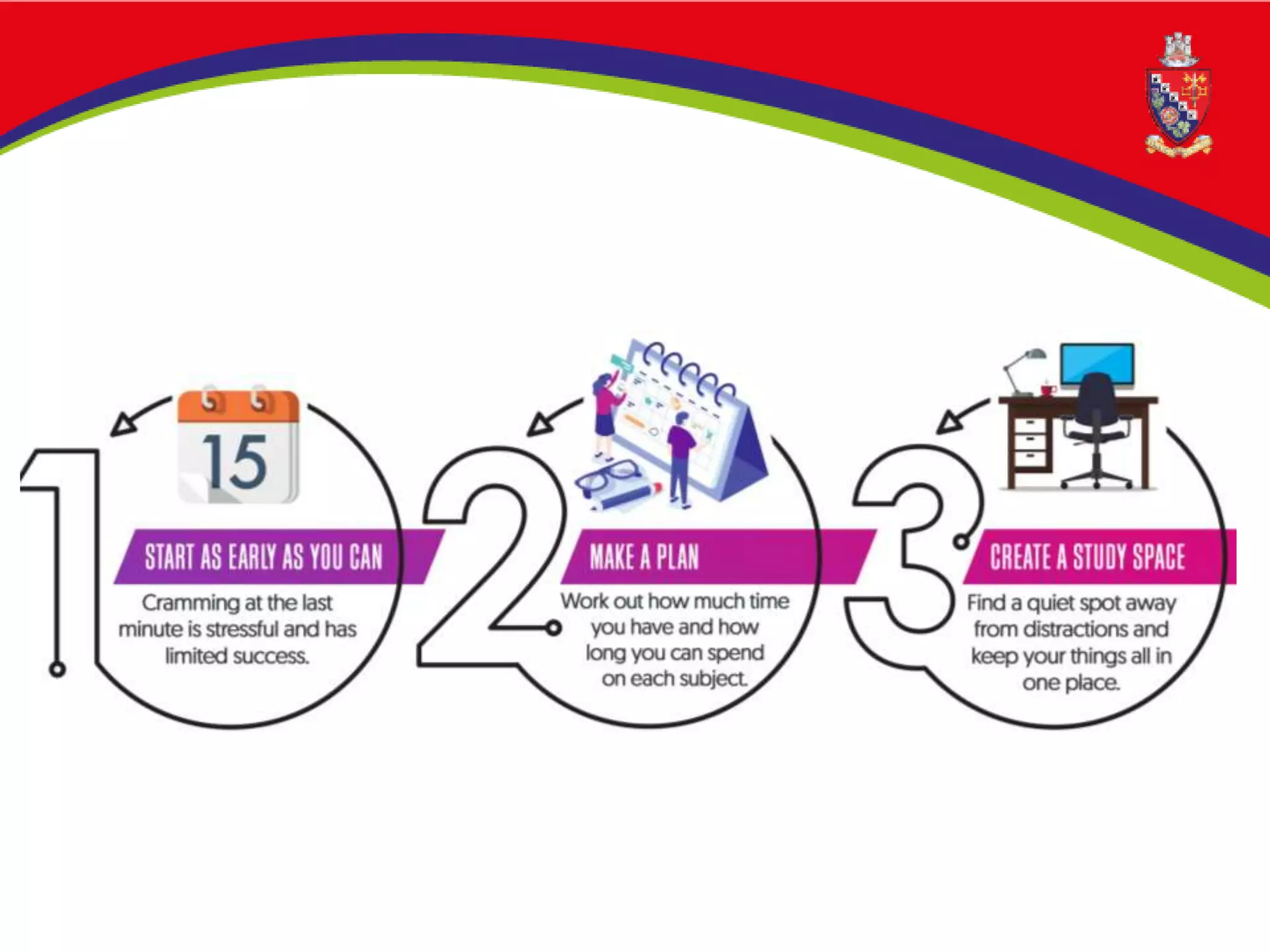
Identify what
you don’t
know
Revise it, learn
it, discuss it
Test is – Past
papers or
practice
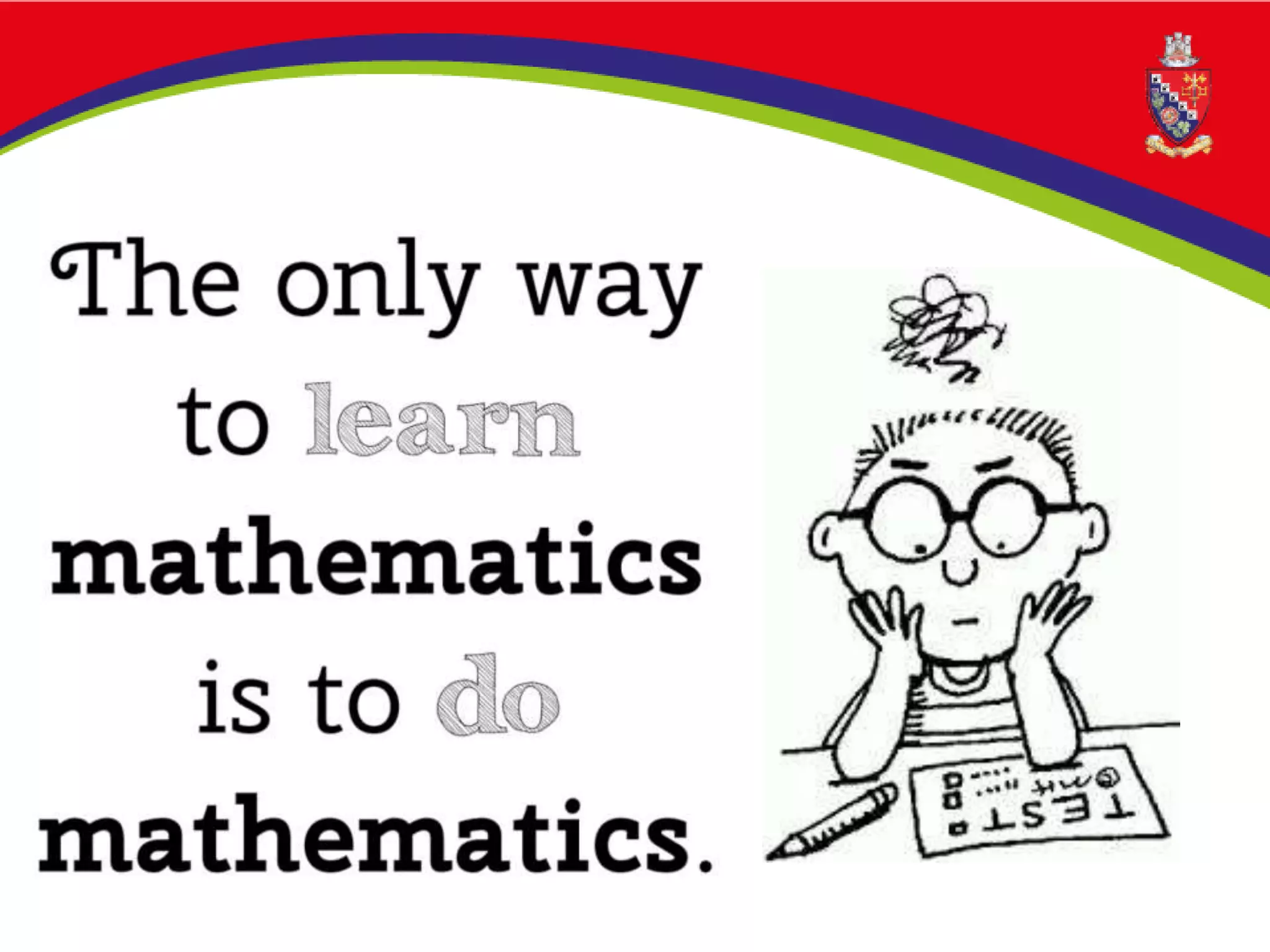
Or in maths terms………………
Aim for a 7 because if you fail you
will likely get a 6!
If you college says you only need a 5
and you aim for this you will likely
end up with a 4.
English Language
and
English Literature
English Language AQA – course outline
Paper 1: Explorations in Creative Reading and Writing
Assessment: Written exam – 1 hour 45 minutes 80 marks in total 50% GCSE
Section A: Reading
(one literature fiction extract - unseen)
Reading = 40 marks (25% of GCSE)
Section B: Writing
(descriptive or narrative writing)
Writing = 40 marks (25% of GCSE)
Paper 2: Writers’ Viewpoints and Perspectives
Assessment: Written exam – 1 hour 45 minutes 80 marks in total 50% GCSE
Section A: Reading
(two linked unseen extracts – one non-fiction extract
and one literary non-fiction extract)
Reading = 40 marks (25% of GCSE)
Section B: Writing
(writing to present a viewpoint – writing for purpose,
audience, form)
Writing = 40 marks (25% of GCSE)
Non-examination Assessment: Spoken Language
Assessment: set and marked by teacher during the course with a separate endorsement 0% of GCSE grade
Students will have to prepare and deliver a presentation in front of a specified audience and then respond to
questions and feedback. Students will be assessed on their use of language and Standard English and their skills
of delivering a presentation. (AO7 – 9)
English Language
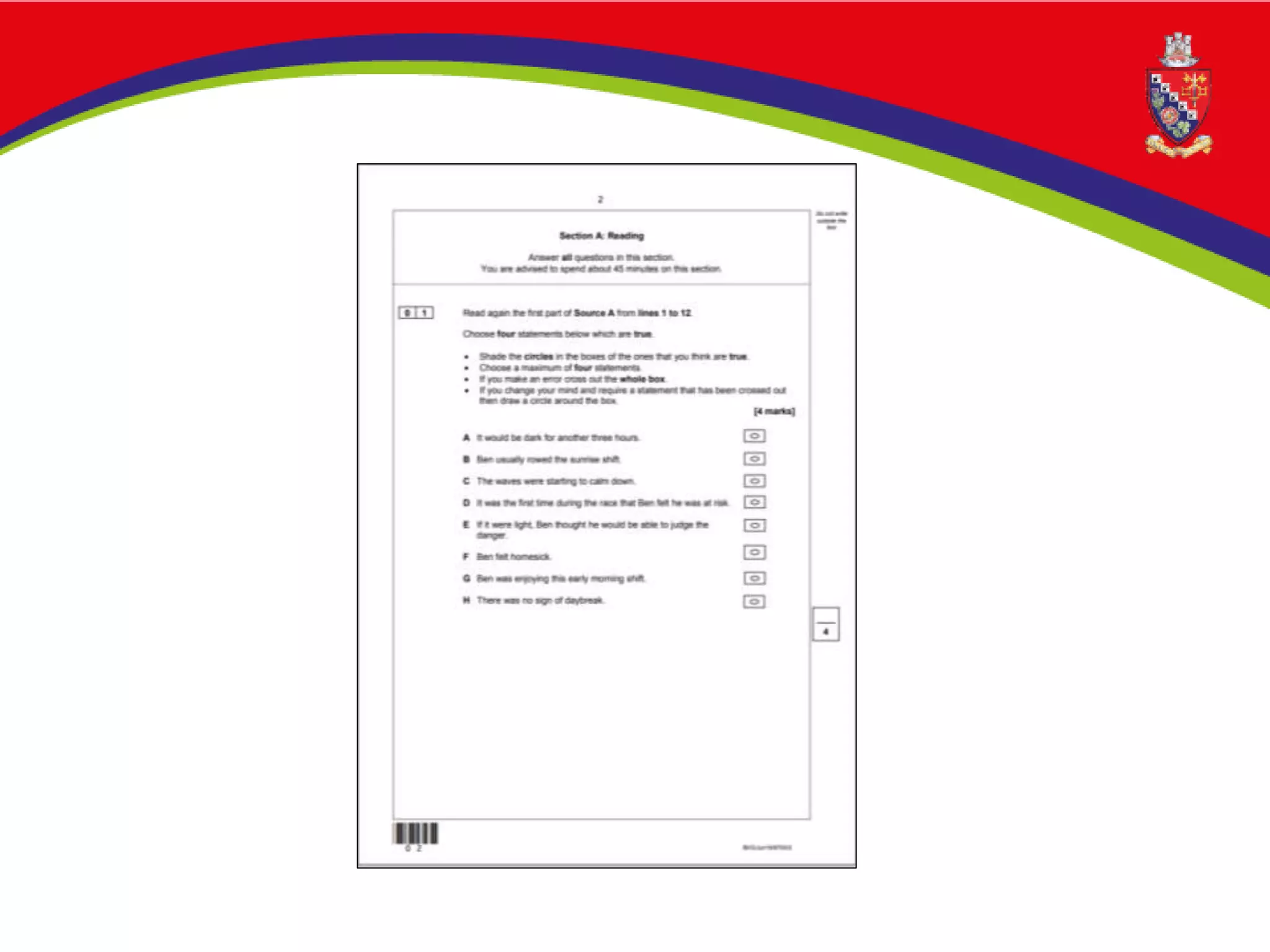
Reasons to celebrate!
We more or less know what the questions
will be.
English Language
The Challenge!
The texts for English Language
are all unseen.
English Language Paper 1
Areas for Development.
• Students often decided to comment on ‘thin’ but struggled
to explore it in depth - try and encourage students to
explore the connotations of the word within its context.
• Some students didn’t offer more than one inference of a
chosen word/phrases/- students must explore the word at
length.
• Students should select 3 pieces of evidence that are vivid
and they should discuss them in depth in relation to the
question.
• Some students explored their chosen quotation in isolation,
without taking into consideration the context of the text.
This kept them into the “some comment” band as they
were not making any developed comments on language
• Some students did not have a clear focus on the question –
their responses would have been enhanced by a statement
that addressed the question before they attempted to
comment on language e.g Without doubt it becomes
apparent that the Hartop family are…
Areas for Development
 Too many students used the phrase ‘makes us read on to find out more’.
 Some students didn’t use evidence to back up their points about
structure. Because students tended not to use textual evidence to
support their response to this question their responses appeared vague
and remain in the ‘simple’ or ‘some’ understanding band.
 Students may have benefited from looking at specific sections of the text
and perhaps using simple terms like “in the middle” and “at the end” to
support the structure of their response
 Students should try and think carefully about the full journey of the
extract.
 Students should be advised (unless they can comment on the effect of
punctuation on pace) to stay away from looking at punctuation for this
question.
Areas for Development
 I would advise students to agree with the statement and find evidence
that helps them agree (particularly with middle ability students)
 Candidates need to realise that this is a combination of question 2 & 3
with a clear focus.
 Candidates need to answer the question – many students went off
track and didn’t keep referring back to the task.
 Candidates must identify methods used by a writer.
 Perhaps (especially for the middle/lower ability students) evaluative
sentence stems such as “this was successful because…” and “this made
me, as a reader, feel…” would enhance their approach to the question
 Students were not always evaluating the method that the writer used,
students must identify method and say how that method helps them to
either agree or disagree with the statement. E.g. The successful use of
pathetic fallacy encourages us to feel a sense of sympathy for Alice…
 Perhaps breaking this question down to “what?” and “how?” might
enable students to answer this question with more clarity
 Some students were not using quotations to support their points – they
must ensure this is a focus. Their response must be rooted in the
evidence provided and the method used by the writer.
 Students must make sure that they select precise quotation from the
lines in the question.
Areas for development.
 Students need to think carefully about timing and
development for question 5 remembering the amount of
marks available.
 A lot of students used the image very literally instead of
possibly using it as a spring board for their creativity.
 At times, students’ sentences were overly long and there
was little evidence of crafting sentences for impact. This
impacted their SPaG marks.
 Organisation seemed to be a problem for some.
 There is still some work to do around vocabulary choices
and drafting writing to ensure that students have the best
chance of securing good marks for this question.
English Language Paper 2
Areas for development
 No evidence of planning
 At 3 marks, focused on age with quotes but this was narrative in
style and did not infer
 In order to move into level 3, you need to explain clearly e.g.
the difference in age of the boats meant that although the
older boat was damaged, it nevertheless survived the storm,
whereas the brand new racing boat capsized quickly,
demonstrating that age was not a guide to safety.
 Summary of differences noting the irony that the new boat had
been untested compared to the older boat that was weather
beaten but still survived the storm.
 Use SQI (similarity/quote/infer)
Areas for development
 Accuracy when naming language feature
 To move to level 3, students need to explain the effects of
writer’s choices rather than naming terminology
 Students working at level 2 referred to the features of a
washing machine but didn’t relate these comments to the
experience of Fogle underwater. Comments need to be
contextualised in order to achieve level 3.
Areas for development
 This question is about understanding the view/perspective.
 Track the viewpoint e.g. how does the writer feel at the
beginning, middle and end? Track the viewpoint by writing a
summative word next to each paragraph. This is ‘the what’.
 Explain how the writer conveys this viewpoint through the
methods they use this is ‘the how’.
 Compare like with like to move into level 3. E.g. Students at level
2 typically compare how Fogle was scared by the boat capsizing
whereas Hudson was uncertain about the safety of the ship.
Fear of the ocean and concerns about safety are very different
feelings, and they would be rewarded as an attempt to compare.
However, comparing how both writers responded with terror to
the power of the sea, or how they viewed the relative safety of
their boats would be a comparison of ‘like with like’ and, when
explained clearly, would warrant a mark in level 3.
 You must plan.
 Timing
Areas for development
 Plan response – what are you going to include in 5
paragraphs? How do you want your reader to feel?
 Create a character and have a clear viewpoint. Who would
write a letter to the editor of a newspaper? You are
writing in response to something you have read.
 More sophisticated vocabulary e.g. ‘it is conceivable that…’
or ‘celebrities are often vilified in the press’.
 Increased formality rather than conversational tone.
What your child can do at home…
• English Homework Booklets
• Go over all past assessments and reuse extracts covered in class to practice individual
questions.
• Use texts from novels, newspapers and magazines to practice individual questions.
• Read a wide range of non-fiction texts to support reading and writing sections of Paper 2.
• Watch tutorials by Mr Bruff on YouTube.
• Use GCSE Pod / SENECA / BBC Bitesize and online resources.
• Remind your children to proof-read their written work
• Encourage them to read widely and talk to them about their reading
• Read newspaper articles, magazine articles, leaflets etc and discuss the viewpoints being
presented and the methods being used.
“The more that you read, the more things you will know. The more that you
learn, the more places you'll go.”
Dr. Seuss, I Can Read With My Eyes Shut!
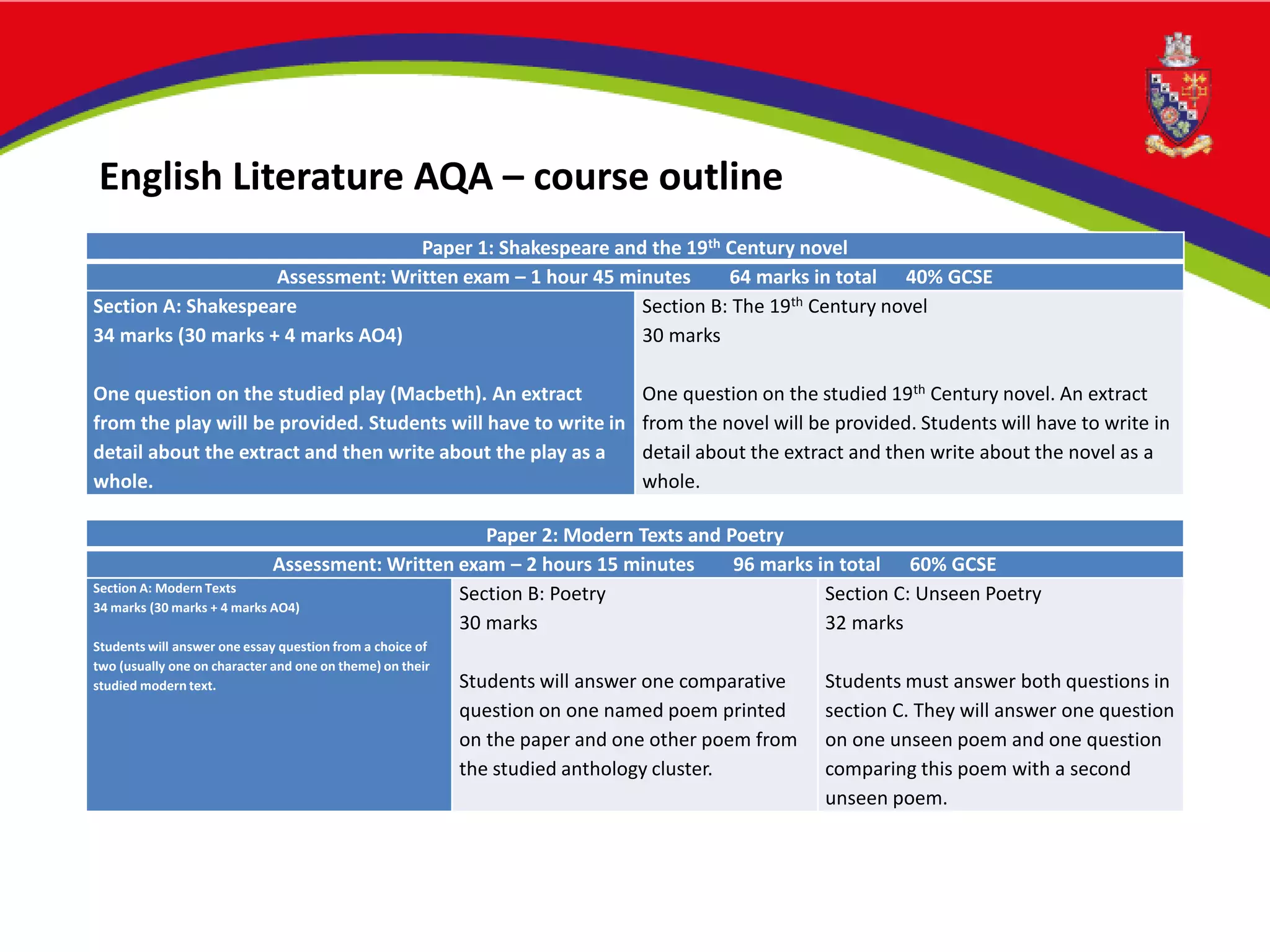
English Literature AQA – course outline
Paper 1: Shakespeare and the 19th Century novel
Assessment: Written exam – 1 hour 45 minutes 64 marks in total 40% GCSE
Section A: Shakespeare
34 marks (30 marks + 4 marks AO4)
One question on the studied play (Macbeth). An extract
from the play will be provided. Students will have to write in
detail about the extract and then write about the play as a
whole.
Section B: The 19th Century novel
30 marks
One question on the studied 19th Century novel. An extract
from the novel will be provided. Students will have to write in
detail about the extract and then write about the novel as a
whole.
Paper 2: Modern Texts and Poetry
Assessment: Written exam – 2 hours 15 minutes 96 marks in total 60% GCSE
Section A: Modern Texts
34 marks (30 marks + 4 marks AO4)
Students will answer one essay question from a choice of
two (usually one on character and one on theme) on their
studied modern text.
Section B: Poetry
30 marks
Students will answer one comparative
question on one named poem printed
on the paper and one other poem from
the studied anthology cluster.
Section C: Unseen Poetry
32 marks
Students must answer both questions in
section C. They will answer one question
on one unseen poem and one question
comparing this poem with a second
unseen poem.
English Literature
Reasons to Celebrate
Students have copies of each text
that will be in the exam. They can
get to know these really well.
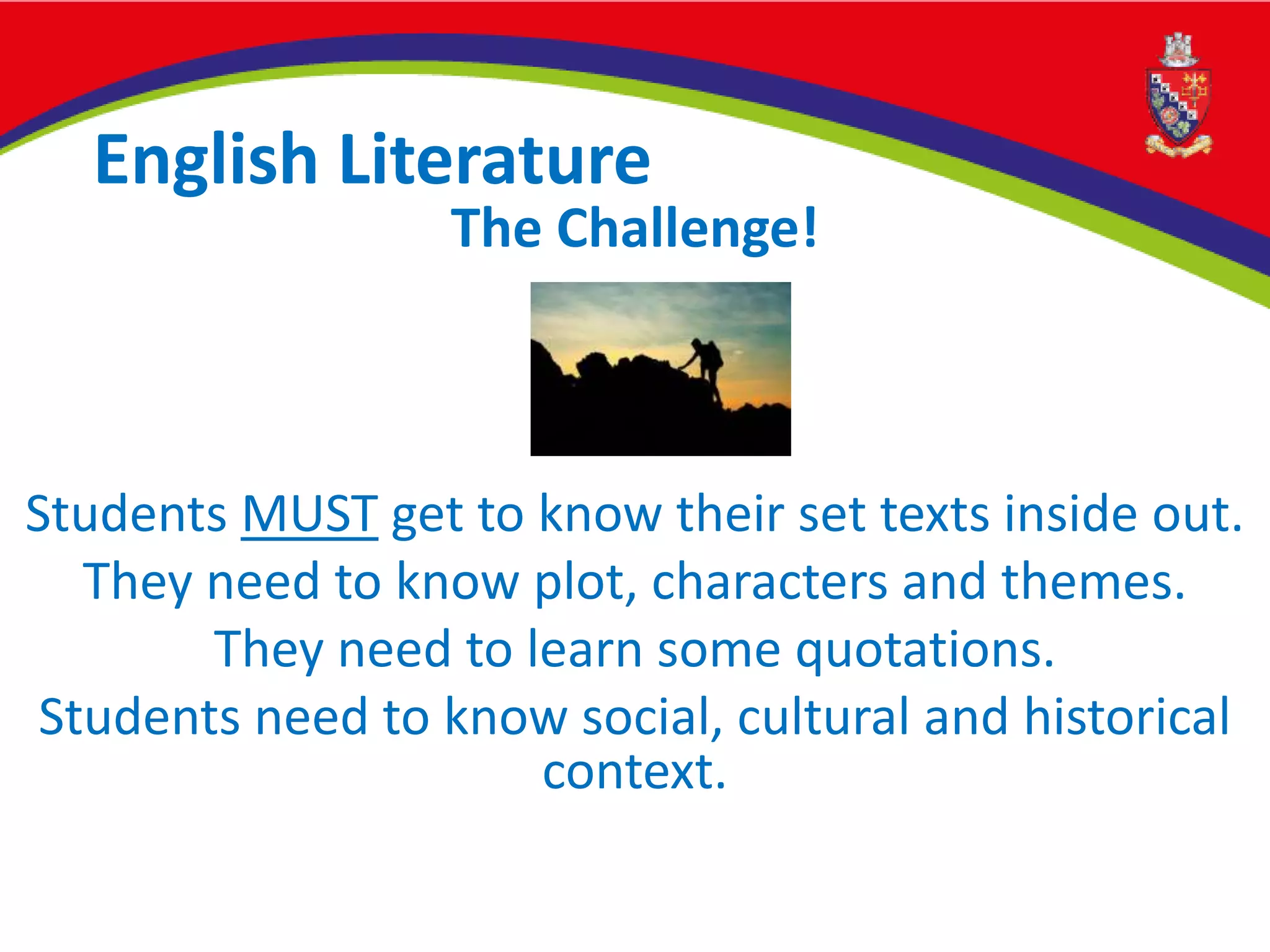
English Literature
The Challenge!
Students MUST get to know their set texts inside out.
They need to know plot, characters and themes.
They need to learn some quotations.
Students need to know social, cultural and historical
context.
Paper 1: Shakespeare and the
19th Century novel
Paper 2: Modern Texts and Poetry
What can you do to support?
• Students need to know the texts. They must reread ‘Macbeth’, ‘A Christmas
Carol’ and ‘An Inspector Calls’.
• Encourage your child to make revision cards or mindmaps.
• Test your child on plot.
• Encourage your child to use GCSEpod.
• Watch tutorials by Mr Bruff on YouTube.
Any Questions?
Maths and English support evening

Maths and English support evening

  • 1.
    St Peter’s Mathematics andEnglish Support Evening January 2020
  • 2.
    Alison McDowall Subject LearningLeader - English Duane Wilson Subject Learning Leader - Mathematics
  • 3.
    Hopes for thisevening: - How we will support your child. - How your child can support themselves - How you can support your child. - Any questions you have are answered.
  • 8.
    Mathematics Foundation Higher 1 2 34 5 6 7 8 9 One Tier English – One Tier. Everybody is entered for the same paper (1 – 9).
  • 9.
  • 10.
    Identify what you don’t know Reviseit, learn it, discuss it Test is – Past papers or practice
  • 16.
    Or in mathsterms……………… Aim for a 7 because if you fail you will likely get a 6! If you college says you only need a 5 and you aim for this you will likely end up with a 4.
  • 18.
  • 19.
    English Language AQA– course outline Paper 1: Explorations in Creative Reading and Writing Assessment: Written exam – 1 hour 45 minutes 80 marks in total 50% GCSE Section A: Reading (one literature fiction extract - unseen) Reading = 40 marks (25% of GCSE) Section B: Writing (descriptive or narrative writing) Writing = 40 marks (25% of GCSE) Paper 2: Writers’ Viewpoints and Perspectives Assessment: Written exam – 1 hour 45 minutes 80 marks in total 50% GCSE Section A: Reading (two linked unseen extracts – one non-fiction extract and one literary non-fiction extract) Reading = 40 marks (25% of GCSE) Section B: Writing (writing to present a viewpoint – writing for purpose, audience, form) Writing = 40 marks (25% of GCSE) Non-examination Assessment: Spoken Language Assessment: set and marked by teacher during the course with a separate endorsement 0% of GCSE grade Students will have to prepare and deliver a presentation in front of a specified audience and then respond to questions and feedback. Students will be assessed on their use of language and Standard English and their skills of delivering a presentation. (AO7 – 9)
  • 20.
    English Language Reasons tocelebrate! We more or less know what the questions will be.
  • 21.
    English Language The Challenge! Thetexts for English Language are all unseen.
  • 22.
  • 24.
    Areas for Development. •Students often decided to comment on ‘thin’ but struggled to explore it in depth - try and encourage students to explore the connotations of the word within its context. • Some students didn’t offer more than one inference of a chosen word/phrases/- students must explore the word at length. • Students should select 3 pieces of evidence that are vivid and they should discuss them in depth in relation to the question. • Some students explored their chosen quotation in isolation, without taking into consideration the context of the text. This kept them into the “some comment” band as they were not making any developed comments on language • Some students did not have a clear focus on the question – their responses would have been enhanced by a statement that addressed the question before they attempted to comment on language e.g Without doubt it becomes apparent that the Hartop family are…
  • 25.
    Areas for Development Too many students used the phrase ‘makes us read on to find out more’.  Some students didn’t use evidence to back up their points about structure. Because students tended not to use textual evidence to support their response to this question their responses appeared vague and remain in the ‘simple’ or ‘some’ understanding band.  Students may have benefited from looking at specific sections of the text and perhaps using simple terms like “in the middle” and “at the end” to support the structure of their response  Students should try and think carefully about the full journey of the extract.  Students should be advised (unless they can comment on the effect of punctuation on pace) to stay away from looking at punctuation for this question.
  • 26.
    Areas for Development I would advise students to agree with the statement and find evidence that helps them agree (particularly with middle ability students)  Candidates need to realise that this is a combination of question 2 & 3 with a clear focus.  Candidates need to answer the question – many students went off track and didn’t keep referring back to the task.  Candidates must identify methods used by a writer.  Perhaps (especially for the middle/lower ability students) evaluative sentence stems such as “this was successful because…” and “this made me, as a reader, feel…” would enhance their approach to the question  Students were not always evaluating the method that the writer used, students must identify method and say how that method helps them to either agree or disagree with the statement. E.g. The successful use of pathetic fallacy encourages us to feel a sense of sympathy for Alice…  Perhaps breaking this question down to “what?” and “how?” might enable students to answer this question with more clarity  Some students were not using quotations to support their points – they must ensure this is a focus. Their response must be rooted in the evidence provided and the method used by the writer.  Students must make sure that they select precise quotation from the lines in the question.
  • 27.
    Areas for development. Students need to think carefully about timing and development for question 5 remembering the amount of marks available.  A lot of students used the image very literally instead of possibly using it as a spring board for their creativity.  At times, students’ sentences were overly long and there was little evidence of crafting sentences for impact. This impacted their SPaG marks.  Organisation seemed to be a problem for some.  There is still some work to do around vocabulary choices and drafting writing to ensure that students have the best chance of securing good marks for this question.
  • 28.
  • 30.
    Areas for development No evidence of planning  At 3 marks, focused on age with quotes but this was narrative in style and did not infer  In order to move into level 3, you need to explain clearly e.g. the difference in age of the boats meant that although the older boat was damaged, it nevertheless survived the storm, whereas the brand new racing boat capsized quickly, demonstrating that age was not a guide to safety.  Summary of differences noting the irony that the new boat had been untested compared to the older boat that was weather beaten but still survived the storm.  Use SQI (similarity/quote/infer)
  • 31.
    Areas for development Accuracy when naming language feature  To move to level 3, students need to explain the effects of writer’s choices rather than naming terminology  Students working at level 2 referred to the features of a washing machine but didn’t relate these comments to the experience of Fogle underwater. Comments need to be contextualised in order to achieve level 3.
  • 32.
    Areas for development This question is about understanding the view/perspective.  Track the viewpoint e.g. how does the writer feel at the beginning, middle and end? Track the viewpoint by writing a summative word next to each paragraph. This is ‘the what’.  Explain how the writer conveys this viewpoint through the methods they use this is ‘the how’.  Compare like with like to move into level 3. E.g. Students at level 2 typically compare how Fogle was scared by the boat capsizing whereas Hudson was uncertain about the safety of the ship. Fear of the ocean and concerns about safety are very different feelings, and they would be rewarded as an attempt to compare. However, comparing how both writers responded with terror to the power of the sea, or how they viewed the relative safety of their boats would be a comparison of ‘like with like’ and, when explained clearly, would warrant a mark in level 3.  You must plan.  Timing
  • 33.
    Areas for development Plan response – what are you going to include in 5 paragraphs? How do you want your reader to feel?  Create a character and have a clear viewpoint. Who would write a letter to the editor of a newspaper? You are writing in response to something you have read.  More sophisticated vocabulary e.g. ‘it is conceivable that…’ or ‘celebrities are often vilified in the press’.  Increased formality rather than conversational tone.
  • 34.
    What your childcan do at home… • English Homework Booklets • Go over all past assessments and reuse extracts covered in class to practice individual questions. • Use texts from novels, newspapers and magazines to practice individual questions. • Read a wide range of non-fiction texts to support reading and writing sections of Paper 2. • Watch tutorials by Mr Bruff on YouTube. • Use GCSE Pod / SENECA / BBC Bitesize and online resources. • Remind your children to proof-read their written work • Encourage them to read widely and talk to them about their reading • Read newspaper articles, magazine articles, leaflets etc and discuss the viewpoints being presented and the methods being used. “The more that you read, the more things you will know. The more that you learn, the more places you'll go.” Dr. Seuss, I Can Read With My Eyes Shut!
  • 35.
    English Literature AQA– course outline Paper 1: Shakespeare and the 19th Century novel Assessment: Written exam – 1 hour 45 minutes 64 marks in total 40% GCSE Section A: Shakespeare 34 marks (30 marks + 4 marks AO4) One question on the studied play (Macbeth). An extract from the play will be provided. Students will have to write in detail about the extract and then write about the play as a whole. Section B: The 19th Century novel 30 marks One question on the studied 19th Century novel. An extract from the novel will be provided. Students will have to write in detail about the extract and then write about the novel as a whole. Paper 2: Modern Texts and Poetry Assessment: Written exam – 2 hours 15 minutes 96 marks in total 60% GCSE Section A: Modern Texts 34 marks (30 marks + 4 marks AO4) Students will answer one essay question from a choice of two (usually one on character and one on theme) on their studied modern text. Section B: Poetry 30 marks Students will answer one comparative question on one named poem printed on the paper and one other poem from the studied anthology cluster. Section C: Unseen Poetry 32 marks Students must answer both questions in section C. They will answer one question on one unseen poem and one question comparing this poem with a second unseen poem.
  • 36.
    English Literature Reasons toCelebrate Students have copies of each text that will be in the exam. They can get to know these really well.
  • 37.
    English Literature The Challenge! StudentsMUST get to know their set texts inside out. They need to know plot, characters and themes. They need to learn some quotations. Students need to know social, cultural and historical context.
  • 38.
    Paper 1: Shakespeareand the 19th Century novel
  • 39.
    Paper 2: ModernTexts and Poetry
  • 41.
    What can youdo to support? • Students need to know the texts. They must reread ‘Macbeth’, ‘A Christmas Carol’ and ‘An Inspector Calls’. • Encourage your child to make revision cards or mindmaps. • Test your child on plot. • Encourage your child to use GCSEpod. • Watch tutorials by Mr Bruff on YouTube.
  • 42.