Grade 7/8 Teachers: Ms. A Campanaro
Ms. E. Harris
September 26th, 2013
Grade 7/8 Team
 Ms. Harris- Homeroom language, math, rotary
science, physical education, drama, health
 Ms. Campanaro- Homeroom language, math, rotary
history and Geography, physical education, drama,
health
 Mrs. Eriksen- Music and Visual Art
 Mme. Jaskolka- French
 Ms. Jackson- Special Education, ELL
 Ms. Gibson- CYW/EA
 Ms. Tumangday- Teacher Librarian
School Behavioural Policy
 Please review the front pages of your child’s agenda as it
outlines academic and behavioural expectations.
 The online Moodle is an ESSENTIAL organizational tool to
be used by your child this year. Students will use it
throughout the year to track homework, blog, review and
submit assignments and be reminded of important events.
As parents, you are highly encouraged to review the
Moodle as well. Username and password will be given after
this presentation
 In addition to homework posted on the Moodle, we
encourage your child to read for 30 minutes or more a day
at home.
Homework Policy
 You can expect your child to have anywhere between 30-90
minutes of homework a night (no homework on weekends
policy)
 Homework may include pleasurable reading, drills or
practice in math/reading/writing skills, collection of
materials or resources, preparing for presentations,
studying for tests, practicing musical instruments
 One “Freebie” a term
 Second notice a letter is sent home
 Third is a phone call
 Every homework note preceding is a parent/teacher
conference.
Homework Roles and
Responsibilities…
Parent Teacher Student
-Initiate
communication with
the teacher when
necessary to ensure
child’s progress
-Provide a quiet and
consistent workspace
for your child
- monitor the Moodle
and classroom blog
and review your child’s
school work and show
an interest in your
child’s learning
-Assign relevant and
purposeful work
-Provide guidelines
and success criteria to
complete homework
independently
-Ensure that students
have the
understanding in order
to complete their work
-Set timelines that are
reasonable and take
into account other
responsibilities, (i.e.
language classes,
tutoring)
-Complete assigned
work to the best of
your ability
- meet deadlines for
homework completion
-Develop a homework
routine
-Advocate for yourself!
ASK your teacher for
clarification when you
do not understand the
task
- Communicate with
parents about what is
happening at school
School Supplies… What is a must?
 Geometry set
 Scientific calculator
 USB key
 BYOD- Bring your own electronic device
 Appropriate clothing and footwear for physical
education
 Strongly encouraged: Gmail account and dropbox
account (invites will be sent through gmail)
Why should students BYOD?
 ONE to ONE use of technological devices- increases
students engagement
 Convenience
 More effective use of resources and time
 Efficiency and comfort in knowing where your applications
and shortcuts are located on your personal devices
 Information portability (USB vs. Cloud Computing- drop
box, Google drive)
 Digital textbooks, E-reading, apps with curriculum
connections
 Students without devices will not be left behind!
Safety using Technology
 Bring it only when necessary
 Keep valuables locked in locker
 Report if stolen
 Keep record of colour, make, serial number, or any
other identification
 Don’t leave device unattended
 Tracking software
Useful resources…
 There are many resources available on the classroom
Moodle to support your child’s learning. For all
curriculum expectations please visit the ministry’s
website at
 http://www.edu.gov.on.ca/eng/teachers/curriculum.ht
ml
For additional resources visit
www.linktolearning.com
Curriculum
 Language: A Balanced Literacy Approach
 Using a balanced literacy approach, the Grade 7/8
curriculum extends to all content areas (reading,
writing, oral, media and digital); across all subject
areas
 Reading: Intermediate students will be exposed
to a variety of genres, using a variety of platforms.
Guided reading groups will focus on specific
reading comprehension skills and strategies,
critical thinking skills, and creative/ alternative
responses.
Curriculum Cont.
 Writing
 Although intermediate students write on a daily basis
across the curriculum, a writers notebook, ongoing
instruction of purpose and audience, and instruction in the
craft of writing provides students to write about a variety of
topics in narrative, expository and persuasive formats.
Students will use a variety of organizational tools for the
planning process, as they are expected to use the writing
process to produce written pieces. Writing instruction will
focus on improving the 7 traits of effective writing; ideas,
organization, voice, word choice, sentence fluency,
conventions and presentation
Curriculum Cont.
 Math: The primary textbook that we use to teach
math is MATH MAKES SENSE. Throughout the year
we will be using a variety of alternative resources that
consist of problem solving approaches based on
everyday situations, frequent practice of basic skills, an
opportunity to revisit concepts and skills regularly, and
an exploration of mathematical content beyond basic
arithmetic.
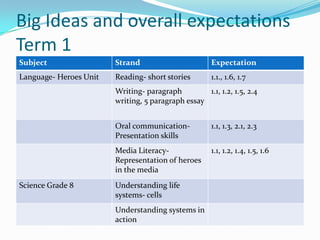
Big Ideas and overall expectations
Term 1
Subject Strand Expectation
Language- Heroes Unit Reading- short stories 1.1., 1.6, 1.7
Writing- paragraph
writing, 5 paragraph essay
1.1, 1.2, 1.5, 2.4
Oral communication-
Presentation skills
1.1, 1.3, 2.1, 2.3
Media Literacy-
Representation of heroes
in the media
1.1, 1.2, 1.4, 1.5, 1.6
Science Grade 8 Understanding life
systems- cells
Understanding systems in
action
Big Ideas and expectations cont.
Subject Strand Expectation
Science Grade 7 Life Systems- Interactions
with the environment
History Grade 8 Confederation
The Development of
Western Canada
History Grade 7 Life in New France
British North America
Math Number Sense integers, exponents, ratio
and rates
Measurement Circumference of a circle
(8) Surface area (7)
Geometry transformations
Patterning and Algebra Expressions, patterns
Sample Culminating Tasks and
Rubrics
 Students are assessed and evaluated through a variety of tools;
conversation, observation and products produced by the student
 Each Method is divided into 4 Categories; Thinking,
Application, Communication, and Knowledge. These 4
categories are indicated in the core subjects (math, language,
science, history/geography
 Sample rubrics can be found on the classroom Moodle
Looking Forward… Grade 9
 8 courses a year- 4 each semester
 4 periods, 75 minutes each
 Course selection begins in January
 Orientation, welcome night spring 2014
 Academic vs. Applied- what to expect
 Applied courses- university stream
 Academic expectations (grade 8 marks)
 4 credits in English, 3 math, 2 science, 1 French, 1 phys-ed, 1
history, 1 geography, 1 art, career studies, civics
 40 hours of community service, successful completion of
literacy test, 12 optional credits
Thank you for coming!
 Please remember to continue to be a part of your
child’s learning by frequently using-
 Ms. Harris’s moodle
 Ms. Campanaro’s moodle
 moodle2.yrdsb.ca
 Follow the blog… acampanaro.blogspot.ca
Thank you for coming to
Curriculum Night 2013!

Curriculumnight2013

  • 1.
    Grade 7/8 Teachers:Ms. A Campanaro Ms. E. Harris September 26th, 2013
  • 2.
    Grade 7/8 Team Ms. Harris- Homeroom language, math, rotary science, physical education, drama, health  Ms. Campanaro- Homeroom language, math, rotary history and Geography, physical education, drama, health  Mrs. Eriksen- Music and Visual Art  Mme. Jaskolka- French  Ms. Jackson- Special Education, ELL  Ms. Gibson- CYW/EA  Ms. Tumangday- Teacher Librarian
  • 3.
    School Behavioural Policy Please review the front pages of your child’s agenda as it outlines academic and behavioural expectations.  The online Moodle is an ESSENTIAL organizational tool to be used by your child this year. Students will use it throughout the year to track homework, blog, review and submit assignments and be reminded of important events. As parents, you are highly encouraged to review the Moodle as well. Username and password will be given after this presentation  In addition to homework posted on the Moodle, we encourage your child to read for 30 minutes or more a day at home.
  • 4.
    Homework Policy  Youcan expect your child to have anywhere between 30-90 minutes of homework a night (no homework on weekends policy)  Homework may include pleasurable reading, drills or practice in math/reading/writing skills, collection of materials or resources, preparing for presentations, studying for tests, practicing musical instruments  One “Freebie” a term  Second notice a letter is sent home  Third is a phone call  Every homework note preceding is a parent/teacher conference.
  • 5.
    Homework Roles and Responsibilities… ParentTeacher Student -Initiate communication with the teacher when necessary to ensure child’s progress -Provide a quiet and consistent workspace for your child - monitor the Moodle and classroom blog and review your child’s school work and show an interest in your child’s learning -Assign relevant and purposeful work -Provide guidelines and success criteria to complete homework independently -Ensure that students have the understanding in order to complete their work -Set timelines that are reasonable and take into account other responsibilities, (i.e. language classes, tutoring) -Complete assigned work to the best of your ability - meet deadlines for homework completion -Develop a homework routine -Advocate for yourself! ASK your teacher for clarification when you do not understand the task - Communicate with parents about what is happening at school
  • 6.
    School Supplies… Whatis a must?  Geometry set  Scientific calculator  USB key  BYOD- Bring your own electronic device  Appropriate clothing and footwear for physical education  Strongly encouraged: Gmail account and dropbox account (invites will be sent through gmail)
  • 7.
    Why should studentsBYOD?  ONE to ONE use of technological devices- increases students engagement  Convenience  More effective use of resources and time  Efficiency and comfort in knowing where your applications and shortcuts are located on your personal devices  Information portability (USB vs. Cloud Computing- drop box, Google drive)  Digital textbooks, E-reading, apps with curriculum connections  Students without devices will not be left behind!
  • 8.
    Safety using Technology Bring it only when necessary  Keep valuables locked in locker  Report if stolen  Keep record of colour, make, serial number, or any other identification  Don’t leave device unattended  Tracking software
  • 9.
    Useful resources…  Thereare many resources available on the classroom Moodle to support your child’s learning. For all curriculum expectations please visit the ministry’s website at  http://www.edu.gov.on.ca/eng/teachers/curriculum.ht ml For additional resources visit www.linktolearning.com
  • 10.
    Curriculum  Language: ABalanced Literacy Approach  Using a balanced literacy approach, the Grade 7/8 curriculum extends to all content areas (reading, writing, oral, media and digital); across all subject areas  Reading: Intermediate students will be exposed to a variety of genres, using a variety of platforms. Guided reading groups will focus on specific reading comprehension skills and strategies, critical thinking skills, and creative/ alternative responses.
  • 11.
    Curriculum Cont.  Writing Although intermediate students write on a daily basis across the curriculum, a writers notebook, ongoing instruction of purpose and audience, and instruction in the craft of writing provides students to write about a variety of topics in narrative, expository and persuasive formats. Students will use a variety of organizational tools for the planning process, as they are expected to use the writing process to produce written pieces. Writing instruction will focus on improving the 7 traits of effective writing; ideas, organization, voice, word choice, sentence fluency, conventions and presentation
  • 12.
    Curriculum Cont.  Math:The primary textbook that we use to teach math is MATH MAKES SENSE. Throughout the year we will be using a variety of alternative resources that consist of problem solving approaches based on everyday situations, frequent practice of basic skills, an opportunity to revisit concepts and skills regularly, and an exploration of mathematical content beyond basic arithmetic.
  • 13.
    Big Ideas andoverall expectations Term 1 Subject Strand Expectation Language- Heroes Unit Reading- short stories 1.1., 1.6, 1.7 Writing- paragraph writing, 5 paragraph essay 1.1, 1.2, 1.5, 2.4 Oral communication- Presentation skills 1.1, 1.3, 2.1, 2.3 Media Literacy- Representation of heroes in the media 1.1, 1.2, 1.4, 1.5, 1.6 Science Grade 8 Understanding life systems- cells Understanding systems in action
  • 14.
    Big Ideas andexpectations cont. Subject Strand Expectation Science Grade 7 Life Systems- Interactions with the environment History Grade 8 Confederation The Development of Western Canada History Grade 7 Life in New France British North America Math Number Sense integers, exponents, ratio and rates Measurement Circumference of a circle (8) Surface area (7) Geometry transformations Patterning and Algebra Expressions, patterns
  • 15.
    Sample Culminating Tasksand Rubrics  Students are assessed and evaluated through a variety of tools; conversation, observation and products produced by the student  Each Method is divided into 4 Categories; Thinking, Application, Communication, and Knowledge. These 4 categories are indicated in the core subjects (math, language, science, history/geography  Sample rubrics can be found on the classroom Moodle
  • 16.
    Looking Forward… Grade9  8 courses a year- 4 each semester  4 periods, 75 minutes each  Course selection begins in January  Orientation, welcome night spring 2014  Academic vs. Applied- what to expect  Applied courses- university stream  Academic expectations (grade 8 marks)  4 credits in English, 3 math, 2 science, 1 French, 1 phys-ed, 1 history, 1 geography, 1 art, career studies, civics  40 hours of community service, successful completion of literacy test, 12 optional credits
  • 17.
    Thank you forcoming!  Please remember to continue to be a part of your child’s learning by frequently using-  Ms. Harris’s moodle  Ms. Campanaro’s moodle  moodle2.yrdsb.ca  Follow the blog… acampanaro.blogspot.ca
  • 18.
    Thank you forcoming to Curriculum Night 2013!